Euthanasia Methods in Invertebrates: A Critical Narrative Review of Methodological and Welfare Standards

 , , , , , , and
Simple Summary
Abstract
1. Introduction
2. Materials and Methods
3. Considerations in Invertebrate Euthanasia
3.1. Humane Euthanasia
3.2. Considerations for Single-Step Euthanasia Methods
3.2.1. Thermal Methods
3.2.2. Chemical Methods
3.2.3. Gaseous Methods
3.2.4. Physical and Mechanical Methods
3.3. Two-Step Euthanasia
3.4. General Considerations When Choosing a Method
4. Euthanasia Method per Taxa
4.1. Coelenterates
4.2. Mollusks
4.3. Crustaceans
4.4. Echinoderms
4.5. Chelicerates
4.5.1. Aquatic Chelicerates
4.5.2. Terrestrial Chelicerates
4.6. Myriapods
4.7. Insects
4.8. Annelids
5. Discussion

| Section | Described Species | Advised Euthanasia Method Include Medicine, Dosage, and Route | Two-Step Euthanasia Protocol Recommended? | Reference |
|---|---|---|---|---|
| 3.1 Coelenterates | Jellyfish | Step 1: MgCl2 immersion (142 g/L) Step 2: Physical destruction or immersion in fixative | Yes | [47] |
| Anemones | Step 1: MgCl2 immersion Step 2: Physical destruction or immersion in ethanol or fixative | Yes | [91] | |
| Corals | Step 1: MgCl2 immersion Step 2: Physical destruction or immersion in ethanol or fixative | Yes | [91] | |
| 3.2 Mollusks | Gastropods | Step 1: 5% ethanol immersion (10–15 min) Step 2: 70–95% ethanol or 10% formalin immersion | Yes | [53] |
| Squids | Step 1: MgCl2 immersion Step 2: Mechanical destruction of the brain | Yes | [51] [50] | |
| Cuttlefish | Step 1: MgCl2 immersion Step 2: Surgical decerebration | Yes | [8] | |
| Octopi | Step 1: MgCl2 immersion Step 2: Surgical decerebration | Yes | [8] | |
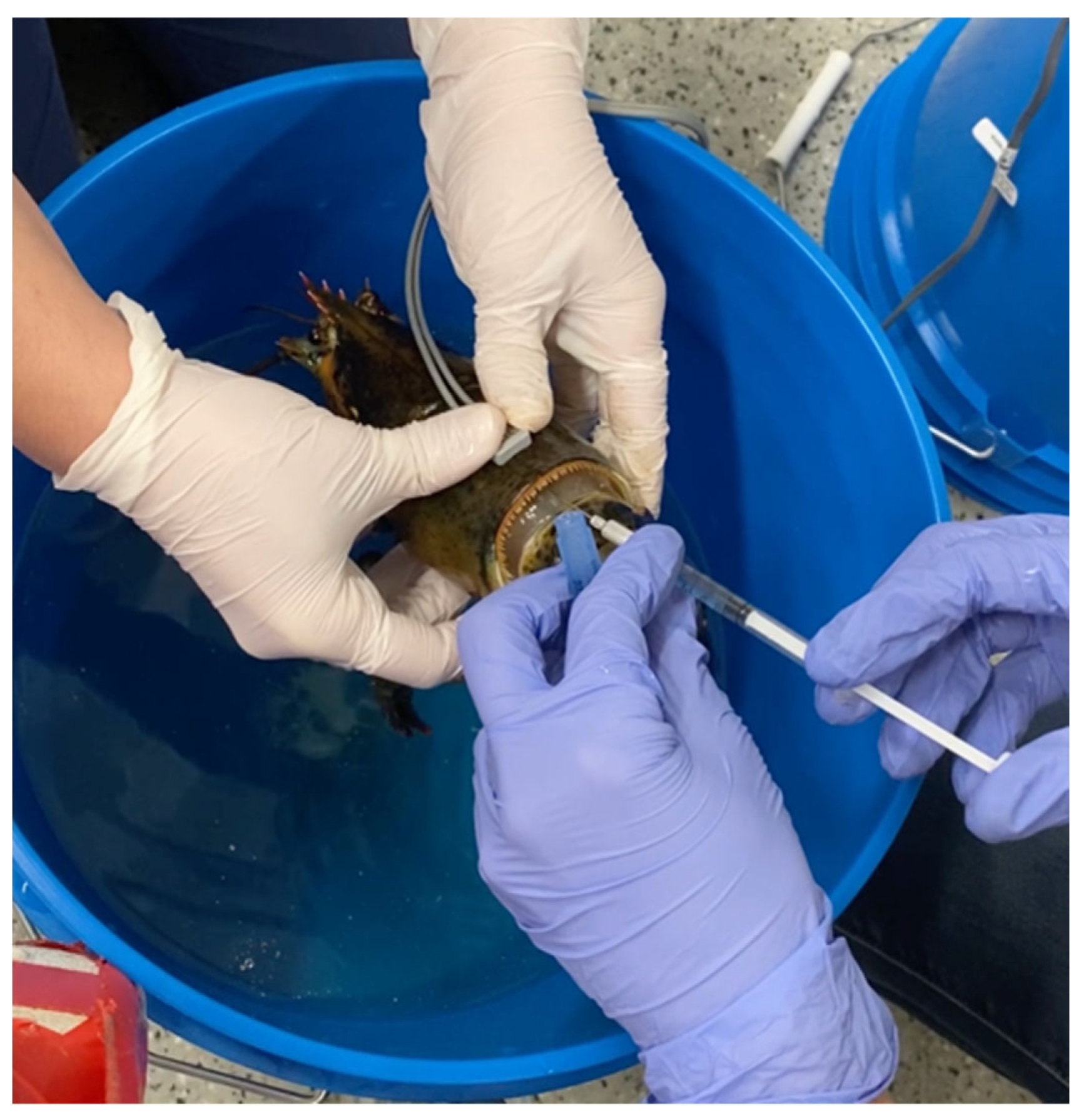
| 3.3 Crustaceans | Lobsters | Eugenol prolonged immersion or injection | No | [60] |
| Crabs | Step 1: Eugenol prolonged immersion or injection Step 2: Physical destruction or freezing | Yes | [60] | |
| Crayfish | Electrical stunning | No | [59]. | |
| Shrimp | No validated humane methods available | [62] | ||
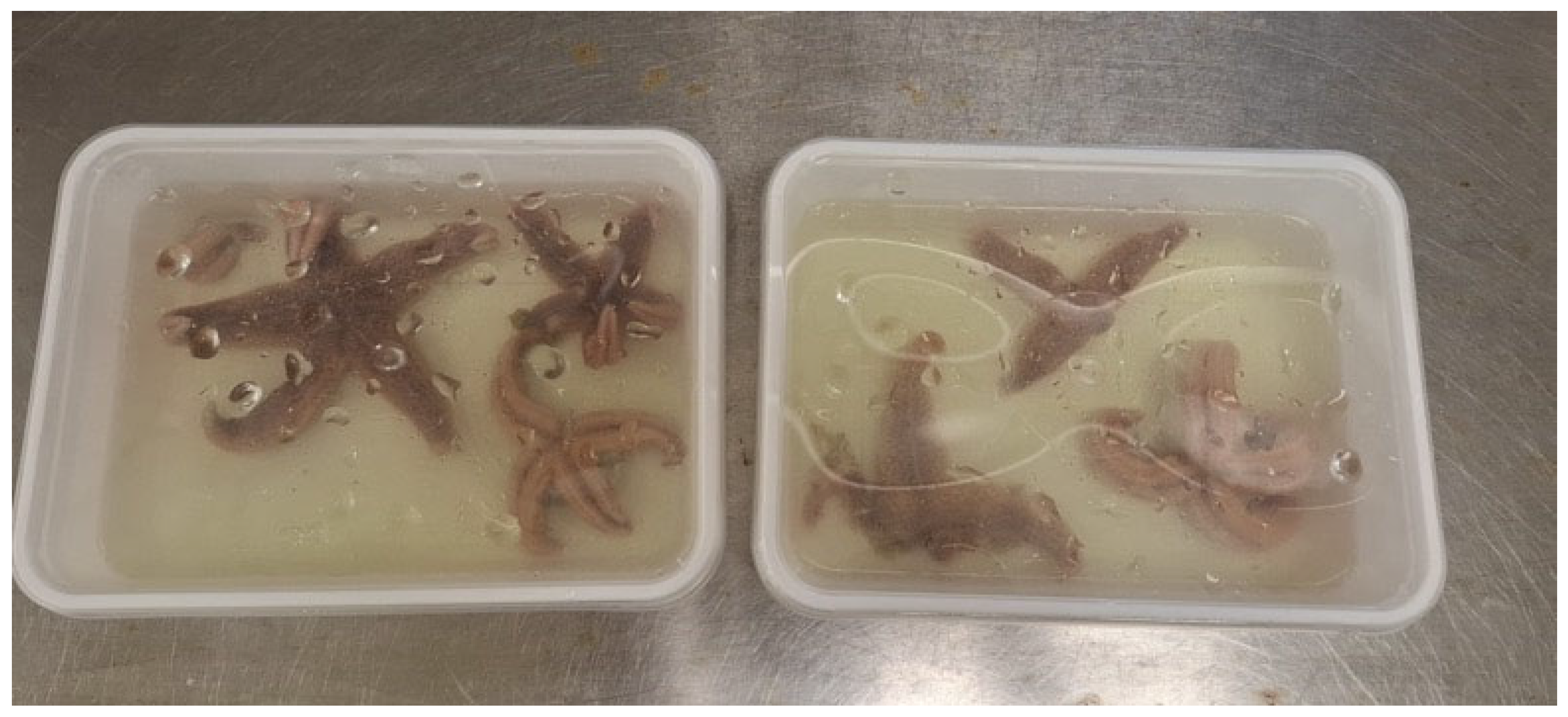
| 3.4 Echinoderms | Sea stars | Step 1: MgCl2 immersion Step 2: Physical destruction | Yes | [63] |
| Urchins | Step 1: MgCl2 immersion Step 2: Immersion in ethanol or physical destruction | [9] | ||
| Sea cucumbers | Step 1: MgCl2 immersion Step 2: Evisceration | Yes | [64] | |
| 3.5 Chelicerates | Spiders | Step 1: isoflurane anesthesia Step 2: Immersion in >70% ethanol | Yes | [23] |
| Scorpions | Step 1: isoflurane anesthesia Step 2: Immersion in >70% ethanol | Yes | [9] | |
| Horseshoe crabs | Step 1: Pentobarbital injection (390 mg, 1–2 mL/animal) into the cardiac sinus Step 2: Physical destruction | Yes | [66,67] | |
| 3.6 Myriapods | Centipedes and millipedes | Step 1: isoflurane anesthesia Step 2: Immersion in >70% ethanol | Yes | [9] |
| 3.7 Insects | Honey bees (colony) | SO2 exposure | No | [24] |
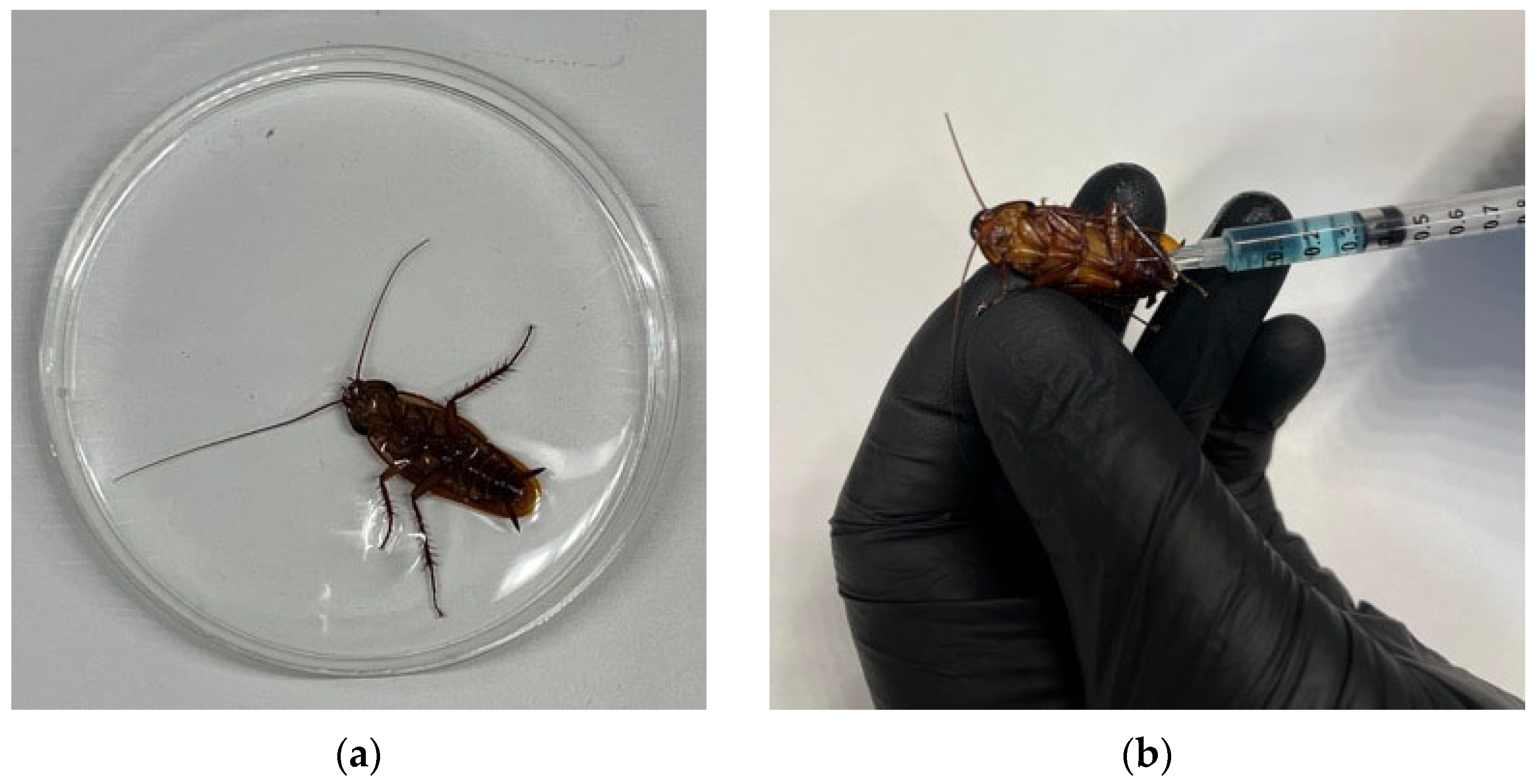
| Cockroaches | Step 1: 70% isopropyl alcohol immersion Step 2: Physical destruction | Yes | [75] | |
| Stick insects | Step 1: isoflurane anesthesia Step 2: ivermectin injection (100 mg/kg) | Yes | [77] | |
| Beetle larvae | Step 1: isoflurane anesthesia Step 2: immersion in 100% ethanol | [78] | ||
| 3.8 Annelids | Polychaetes | Step 1: 7–8% MgCl2 immersion Step 2: prolonged 4–5% formaldehyde immersion | Yes | [79] |
| Oligochaetes | Step 1: 5% ethanol immersion Step 2: immersion in 4% procaine or lidocaine | Yes | [83,84] | |
| Hirudineans | Step 1: immersion in 400 mg/L benzocaine Step 2: 70% isopropyl alcohol immersion | Yes | [86,88] |
6. Conclusions
Author Contributions
Funding
Institutional Review Board Statement
Informed Consent Statement
Data Availability Statement
Conflicts of Interest
References
- Eisenhauer, N.; Hines, J. Invertebrate biodiversity and conservation. Curr. Biol. 2021, 31, R1214–R1218. [Google Scholar] [CrossRef] [PubMed]
- Lewbart, G.A.; Zachariah, T.T. Aquatic and terrestrial invertebrate welfare. Animals 2023, 13, 3375. [Google Scholar] [CrossRef] [PubMed]
- Crook, R.J. The welfare of invertebrate animals in research: Can science’s next generation improve their lot? Postdoc. J. 2013, 1, 9–18. [Google Scholar] [CrossRef]
- Perkins, K. Invisible Invertebrates: The welfare of invertebrates in public aquaria. Animals 2023, 13, 3620. [Google Scholar] [CrossRef]
- Winlow, W.; Mather, J.; Cosmo, A.D. Postscript to invertebrate welfare: “We have met the enemy and he is us”. Animals 2024, 14, 2082. [Google Scholar] [CrossRef]
- American Veterinary Medical Association. AVMA Guidelines for the Euthanasia of Animals, 2020 ed.; AMVA: Schaumburg, IL, USA, 2020; Available online: https://www.avma.org/sites/default/files/2020-02/Guidelines-on-Euthanasia-2020.pdf (accessed on 27 November 2025).
- Cooper, J.E. Anesthesia, analgesia, and euthanasia of invertebrates. ILAR J. 2011, 52, 196–204. [Google Scholar] [CrossRef]
- Fiorito, G.; Affuso, A.; Basil, J.; Cole, A.; de Girolamo, P.; D’Angelo, L.; Dickel, L.; Gestal, C.; Grasso, F.; Kuba, M.; et al. Guidelines for the care and welfare of cephalopods in research -a consensus based on an initiative by CephRes, FELASA and the Boyd Group. Lab. Anim. 2015, 49, 1–90. [Google Scholar] [CrossRef]
- Murray, M.J. Euthanasia. In Invertebrate Medicine, 3rd ed.; Lewbart, G.A., Ed.; John Wiley & Sons, Inc., Wiley Blackwell: Hoboken, NJ, USA, 2022; Chapter 27; pp. 645–650. [Google Scholar]
- Zachariah, T.T. Invertebrate Animal Welfare. In Invertebrate Medicine, 3rd ed.; Lewbart, G.A., Ed.; John Wiley & Sons, Inc., Wiley Blackwell: Hoboken, NJ, USA, 2022; Chapter 29; pp. 669–676. [Google Scholar]
- Gibbons, M.; Crump, A.; Barrett, M.; Sarlak, S.; Birch, J.; Chittka, L. Can insects feel pain? A review of the neural and behavioural evidence. Adv. Insect Physiol. 2022, 63, 155–229. [Google Scholar]
- Rodkey, E.N.; Pillai Riddell, R. The infancy of infant pain research: The experimental origins of infant pain denial. J. Pain. 2013, 14, 338–350. [Google Scholar] [CrossRef]
- Sneddon, L.U. Evolution of nociception and pain: Evidence from fish models. Philos. Trans. R. Soc. Lond. B Biol. Sci. 2019, 374, 20190290. [Google Scholar] [CrossRef]
- Perry, S.M.; Nevarez, J.G. Pain and its control in reptiles. Vet. Clin. North. Am. Exot. Anim. Pract. 2018, 21, 1–16. [Google Scholar] [CrossRef] [PubMed]
- Smith, E.S.; Lewin, G.R. Nociceptors: A phylogenetic view. J. Comp. Physiol. A Neuroethol. Sens. Neural Behav. Physiol. 2009, 195, 1089–1106. [Google Scholar] [CrossRef] [PubMed]
- Wahltinez, S.J.; Stacy, N.I.; Hadfield, C.A.; Harms, C.A.; Lewbart, G.A.; Newton, A.L.; Nunamaker, E.A. Perspective: Opportunities for advancing aquatic invertebrate welfare. Front. Vet. Sci. 2022, 9, 973376. [Google Scholar] [CrossRef] [PubMed]
- AVMA. AVMA Guidelines for the Humane Slaughter of Animals: 2024 Edition. Available online: https://www.avma.org/sites/default/files/2024-09/Humane-Slaughter-Guidelines-2024.pdf (accessed on 8 January 2026).
- Drinkwater, E.; Robinson, E.J.H.; Hart, A.G. Keeping invertebrate research ethical in a landscape of shifting public opinion. Methods Ecol. Evol. 2019, 10, 1265–1273. [Google Scholar] [CrossRef]
- Murray, M.J. Euthanasia. In Invertebrate Medicine, 1st ed.; Lewbart, G.A., Ed.; John Wiley & Sons, Inc., Wiley Blackwell: Hoboken, NJ, USA, 2006; pp. 303–304. [Google Scholar]
- Kirby, A.J.; Balko, J.A.; Goertz, C.E.C.; Lewbart, G.A. Characterization of current husbandry and veterinary care practices of the giant Pacific octopus (Enteroctopus dofleini) using an online survey. Vet. Sci. 2023, 10, 448. [Google Scholar] [CrossRef]
- Ferdowsian, H.; Merskin, D. Parallels in sources of trauma, pain, distress, and suffering in humans and nonhuman animals. J. Trauma. Dissociation. 2012, 13, 448–468. [Google Scholar] [CrossRef]
- Taqi, S.A.; Sami, S.A.; Sami, L.B.; Zaki, S.A. A review of artifacts in histopathology. J. Oral. Maxillofac. Pathol. 2018, 22, 279. [Google Scholar] [CrossRef]
- Pizzi, R.; Kennedy, B. Spiders. In Invertebrate Medicine, 3rd ed.; Lewbart, G.A., Ed.; John Wiley & Sons, Inc., Wiley Blackwell: Hoboken, NJ, USA, 2022; Chapter 14; pp. 301–347. [Google Scholar]
- Roy, C.; Vidal-Naquet, N. Euthanasia of honey-bee colonies: Proposal of a standard method. Can. Vet. J. 2022, 63, 541–544. [Google Scholar]
- Rivero-Wendt, C.L.; Borges, A.C.; Oliveira-Filho, E.C.; Miranda-Vilela, A.L.; Ferreira, M.F.; Grisolia, C.K. Effects of 17α-methyltestosterone on the reproduction of the freshwater snail Biomphalaria glabrata. Genet. Mol. Res. 2014, 13, 605–615. [Google Scholar] [CrossRef]
- Zhang, N.; Yamada, K.; Suzuki, N.; Yoshida, N. Factors controlling shell carbon isotopic composition of land snail Acusta despecta sieboldiana estimated from laboratory culturing experiment. Biogeosciences 2014, 11, 5335–5348. [Google Scholar] [CrossRef]
- Gardner, C. Options for humanely immobilizing and killing crabs. J. Shellfish. Res. 1997, 16, 219–224. [Google Scholar]
- Conte, F.; Voslarova, E.; Vecerek, V.; Elwood, R.W.; Coluccio, P.; Pugliese, M.; Passantino, A. Humane slaughter of edible decapod crustaceans. Animals 2021, 11, 1089. [Google Scholar] [CrossRef] [PubMed]
- Ekin, I. Distribution of fatty acids and total lipids in 5 tissues of edible snail Helix lucorum (L., 1758) from the Southeast of Turkey. Ital. J. Food Sci. 2014, 26, 56–61. [Google Scholar]
- Paczesniak, D.; Jokela, J.; Larkin, K.; Neiman, M. Discordance between nuclear and mitochondrial genomes in sexual and asexual lineages of the freshwater snail Potamopyrgus antipodarum. Mol. Ecol. 2013, 22, 4695–4710. [Google Scholar] [CrossRef] [PubMed]
- Liu, J.; Chen, X.; Zhang, J.; Yao, F.; Shi, Z.; Chen, Y.; Chen, Q.; Qin, Z. Effect of metaldehyde on survival, enzyme activities, and histopathology of the apple snail Pomacea c analiculata (Lamarck 1822). Biology 2024, 13, 428. [Google Scholar] [CrossRef]
- Hollingsworth, R.G.; Howe, K.; Jarvi, S.I. Control measures for slug and snail hosts of Angiostrongylus cantonensis, with special reference to the semi-slug Parmarion martensi. Hawaii. J. Med. Public. Health. 2013, 72, 75–80. [Google Scholar]
- Carter, J.; Jobson, S.; Hamel, J.F.; Mercier, A. Efficacy of anesthetics in an echinoderm based on multifaceted stress biomarkers. Sci. Rep. 2024, 14, 26619. [Google Scholar] [CrossRef]
- Mutinelli, F. Euthanasia and welfare of managed honey bee colonies. J. Apic. Res. 2023, 62, 2–10. [Google Scholar] [CrossRef]
- Kyle, B.; Applegate, J.R., Jr. Honey bees and humane euthanasia. Vet. Clin. N. Am. Food Anim. Pract. 2021, 37, 569–575. [Google Scholar] [CrossRef]
- Brunt, M.W.; Améndola, L.; Weary, D.M. Attitudes of laboratory animal professionals and researchers towards carbon dioxide euthanasia for rodents and perceived barriers to change. Lab. Anim. 2021, 55, 531–539. [Google Scholar] [CrossRef]
- Conlee, K.M.; Stephens, M.L.; Rowan, A.N.; King, L.A. Carbon dioxide for euthanasia: Concerns regarding pain and distress, with special reference to mice and rats. Lab. Anim. 2005, 39, 137–161. [Google Scholar] [CrossRef] [PubMed]
- Steiner, A.R.; Axiak Flammer, S.; Beausoleil, N.J.; Berg, C.; Bettschart-Wolfensberger, R.; García Pinillos, R.; Golledge, H.D.R.; Marahrens, M.; Meyer, R.; Schnitzer, T.; et al. Humanely ending the life of animals: Research priorities to identify alternatives to carbon dioxide. Animals 2019, 9, 911. [Google Scholar] [CrossRef] [PubMed]
- Kulkarni, S.; Hickman, D. Isoflurane and carbon dioxide elicit similar behavioral responses in rats. Animals 2020, 10, 1431. [Google Scholar] [CrossRef]
- Turner, P.V.; Hickman, D.L.; van Luijk, J.; Ritskes-Hoitinga, M.; Sargeant, J.M.; Kurosawa, T.M.; Agui, T.; Baumans, V.; Choi, W.S.; Choi, Y.K.; et al. Welfare impact of carbon dioxide euthanasia on laboratory mice and rats: A systematic review. Front. Vet. Sci. 2020, 7, 411. [Google Scholar] [CrossRef] [PubMed]
- Colinet, H.; Renault, D. Metabolic effects of CO2 anaesthesia in Drosophila melanogaster. Biol. Lett. 2012, 8, 1050–1054. [Google Scholar] [CrossRef] [PubMed]
- Aquatic Invertebrate Taxon Advisory Group—Reference Guide for the Euthanasia of Aquatic Invertebrates Approved by the AZA Animal Health Committee and Veterinary Scientific Advisory Group July 2024. Available online: https://assets.speakcdn.com/assets/2332/aquatic_invertebrate_tag_-_euthanasia_of_aquatic_invertebrates_(2024).pdf (accessed on 10 November 2025).
- Canadian Council on Animal Care. CCAC Guidelines. Can. Vet. J. 2003, 44, 631. [Google Scholar]
- Sivula, C.P.; Suckow, M.A. Euthanasia. In Management of Animal Care and Use Programs in Research, Education, and Testing, 2nd ed.; Weichbrod, R.H., Thompson, G.A.H., Norton, J.N., Eds.; CRC Press: Boca Raton, FL, USA, 2018; Chapter 35. Available online: https://www.ncbi.nlm.nih.gov/books/NBK500441/ (accessed on 29 November 2025). [CrossRef]
- Atwood, M.A. Effects of euthanasia method on stable-carbon and stable-nitrogen isotope analysis for an ectothermic vertebrate. Rapid Commun. Mass. Spectrom. 2013, 27, 909–913, Erratum in Rapid Commun. Mass. Spectrom. 2013, 27, 1814. [Google Scholar] [CrossRef]
- Grieves, J.L.; Dick, E.J., Jr.; Schlabritz-Loutsevich, N.E.; Butler, S.D.; Leland, M.M.; Price, S.E.; Schmidt, C.R.; Nathanielsz, P.W.; Hubbard, G.B. Barbiturate euthanasia solution-induced tissue artifact in nonhuman primates. J. Med. Primatol. 2008, 37, 154–161. [Google Scholar] [CrossRef]
- Doerr, M.; Stoskopf, M.K. Evaluation of euthanasia of moon jellyfish (Aurelia aurita) using simple salt solutions. J. Zoo. Wildl. Med. 2019, 50, 123–126. [Google Scholar] [CrossRef]
- Millar, Z.; Kecheliev, D.; Wolvin, S.; LePage, V.; Lumsden, J.S. Residual tissue magnesium concentration in jellyfish (Aurelia aurita and Cassiopea andromeda) following magnesium chloride euthanasia. Zoo Biol. 2023, 42, 661–667. [Google Scholar] [CrossRef]
- Freeman, K.S.; Lewbart, G.A.; Robarge, W.P.; Harms, C.A.; Law, J.M.; Stoskopf, M.K. Characterization of eversion syndrome in captive Scyphomedusa jellyfish. Am. J. Vet. Res. 2009, 70, 1087–1093. [Google Scholar] [CrossRef] [PubMed]
- Butler-Struben, H.M.; Brophy, S.M.; Johnson, N.A.; Crook, R.J. In vivo recording of neural and behavioral correlates of anesthesia induction, reversal, and euthanasia in cephalopod molluscs. Front. Physiol. 2018, 9, 109. [Google Scholar] [CrossRef] [PubMed]
- Andrews, P.L.R.; Darmaillacq, A.S.; Dennison, N.; Gleadall, I.G.; Hawkins, P.; Messenger, J.B.; Osorio, D.; Smith, V.J.; Smith, J.A. The identification and management of pain, suffering and distress in cephalopods, including anesthesia, analgesia and humane killing. J. Exp. Mar. Biol. Ecol. 2013, 447, 46–64. [Google Scholar] [CrossRef]
- Barord, G.J.; Christie, B.L. Benzocaine in the euthanasia of the giant Pacific octopus Enteroctopus dolfleini (WÜLKER, 1910). Drum Croaker 2007, 38, 7–12. [Google Scholar]
- Gilbertson, C.R.; Wyatt, J.D. Evaluation of euthanasia techniques for an invertebrate species, land snails (Succinea putris). J. Am. Assoc. Lab. Anim. Sci. 2016, 55, 577–581. [Google Scholar]
- Elwood, R.W.; Barr, S.; Patterson, L. Pain and stress in crustaceans? Appl. Anim. Behav. Sci. 2009, 118, 128–136. [Google Scholar] [CrossRef]
- Rotllant, G.; Llonch, P.; García Del Arco, J.A.; Chic, Ò.; Flecknell, P.; Sneddon, L.U. Methods to induce analgesia and anesthesia in crustaceans: A supportive decision tool. Biology 2023, 12, 387. [Google Scholar] [CrossRef]
- Lauridsen, H.; Alstrup, A.K.O. Boiling time to estimated stunning and death of decapod crustaceans of different sizes and shapes. Animals 2024, 14, 3277. [Google Scholar] [CrossRef]
- Neil, D.M.; Albalat, A.; Thompson, J. The effects of electrical stunning on the nervous activity and physiological stress response of a commercially important decapod crustacean, the brown crab Cancer pagurus L. PLoS ONE 2022, 17, e0270960. [Google Scholar] [CrossRef]
- Albalat, A.; Gornik, S.G.; Muangnapoh, C.; Neil, D.M. Effectiveness and quality evaluation of electrical stunning versus chilling in Norway lobsters (Nephrops norvegicus). Food Control 2022, 138, 108930. [Google Scholar] [CrossRef]
- Kells, N.J.; Perrott, M.; Johnson, C.B. The efficacy of electrical stunning of New Zealand rock lobster (Jasus edwardsii) and freshwater crayfish (Paranephrops zealandicus) using the Crustastun™. Anim. Welf. 2023, 32, e57. [Google Scholar] [CrossRef] [PubMed]
- Huntsberger, C. Use of Injectable Eugenol for Euthanasia and Anesthesia of American Lobsters (Homarus americanus) and Similar Species. Master’s Thesis, Roger Williams University, Bristol, RI, USA, 2012. Available online: http://docs.rwu.edu/biology_theses/2 (accessed on 6 November 2025).
- Battison, A.; MacMillan, R.; MacKenzie, A.; Rose, P.; Cawthorn, R.; Horney, B. Use of injectable potassium chloride for euthanasia of American lobsters (Homarus americanus). Comp. Med. 2000, 50, 545–550. [Google Scholar] [PubMed]
- Darbyshire, A.K.; Oliver, K.H.; Dupont, W.D.; Plummer, W.D.; Jones, C.P.; Boyd, K.L. Anesthesia and euthanasia of brine shrimp (Artemia franciscana). J. Am. Assoc. Lab. Anim. Sci. 2019, 58, 58–64. [Google Scholar] [CrossRef] [PubMed]
- Wahltinez, S.J.; Kroll, K.J.; Nunamaker, E.A.; Denslow, N.D.; Stacy, N.I. Practical euthanasia method for common sea stars (Asterias rubens) that allows for high-quality RNA sampling. Animals 2021, 11, 1847. [Google Scholar] [CrossRef]
- Martín-Hernández, R.; Rodríguez-Canul, R.; Kantún-Moreno, N.; Olvera-Novoa, M.A.; Medina-Contreras, O.; Garikoitz-Legarda, C.; Triviño, J.C.; Zamora-Briseño, J.A.; May-Solis, V.; Poot-Salazar, A.; et al. Comparative transcriptomes of the body wall of wild and farmed sea cucumber Isostichopus badionotus. Int. J. Mol. Sci. 2021, 22, 3882. [Google Scholar] [CrossRef]
- Dakrory, A.I.; Fahmy, S.R.; Soliman, A.M.; Mohamed, A.S.; Amer, S.A. Protective and curative effects of the sea cucumber Holothuria atra extract against DMBA-induced hepatorenal diseases in rats. Biomed. Res. Int. 2015, 2015, 563652. [Google Scholar] [CrossRef]
- Smith, S.A. Horseshoe Crabs. In Invertebrate Medicine, 3rd ed.; Lewbart, G.A., Ed.; John Wiley & Sons, Inc., Wiley Blackwell: Hoboken, NJ, USA2022, Chapter 13; pp. 283–300.
- Dannemiller, N.G.; Watson, K.M.; Christiansen, E.F.; Westmoreland, L.S. Traumatic telson avulsion and attempted external stabilization in Atlantic horseshoe crabs (Limulus polyphemus). Zoo Biol. 2024, 43, 205–209. [Google Scholar] [CrossRef]
- Krasner, A.E.; Hancock-Ronemus, A.; Christian, L.S.; Griffith, E.H.; Lewbart, G.A.; Law, J.M. Histological evaluation of five suture materials in the telson ligament of the American horseshoe crab (Limulus polyphemus). Peer J. 2019, 7, e7061. [Google Scholar] [CrossRef]
- Dombrowski, D.; De Voe, R. Emergency care of invertebrates. Vet. Clin. N. Am. Exot. Anim. Pract. 2007, 10, 621–645. [Google Scholar] [CrossRef]
- Bennie, N.A.; Loaring, C.D.; Bennie, M.M.; Trim, S.A. An effective method for terrestrial arthropod euthanasia. J. Exp. Biol. 2012, 215, 4237–4241. [Google Scholar] [CrossRef]
- Cooper, J.E.; Knowler, C. Snails and snail farming: An introduction for the veterinary profession. Vet. Rec. 1991, 129, 541–549. [Google Scholar] [PubMed]
- Pellett, S.; Bushell, M.; Trim, S.A. Tarantula husbandry and critical care. Companion Anim. 2015, 20, 119–125. [Google Scholar] [CrossRef]
- Günther, A.; Drack, M.; Monod, L.; Wirkner, C.S. A unique yet technically simple type of joint allows for the high mobility of scorpion tails. J. R. Soc. Interface. 2021, 18, 20210388. [Google Scholar] [CrossRef] [PubMed]
- Cruz, E.; Wittstock, W.; Snyder, B.A.; Sengupta, A. Tissue-specific DNA isolation from dissected millipedes for nanopore sequencing. Biol. Methods Protoc. 2025, 10, bpaf042. [Google Scholar] [CrossRef]
- Tucker, S.M.; Balko, J.A.; Smith, D.C.; Minter, L.J.; Houck, E.L. Investigation of euthanasia techniques in four species of cockroaches. Peer J. 2023, 11, e16199. [Google Scholar] [CrossRef]
- Barnes, S.; Sadar, M.J.; Hausmann, J.; Mama, K. The use of soapy water and freezing as secondary steps for euthanasia in cave (Blaberus giganteus) and Madagascar hissing (Gromphadorhina portentosa) cockroaches. Am. J. Vet. Res. 2024, 85, ajvr.24.04.0114. [Google Scholar] [CrossRef]
- Heniff, A.C.; Gorges, M.A.; Lewbart, G.A.; Balko, J.A. Evaluation of targeted injections of ivermectin or potassium chloride for euthanasia of anesthetized thorny devil stick insects (Eurycantha calcarata). J. Zool. Bot. Gard. 2023, 4, 231–239. [Google Scholar] [CrossRef]
- Lum, A.M.; Keller, K.A. Anesthesia and humane euthanasia methods for king worm larvae (Zophobas morio). Zoo. Biol. 2024, 43, 164–168. [Google Scholar] [CrossRef]
- Bonyadi Naeini, A.; Rahimian, H.; Glasby, C. A New Substance to Relax Polychaete Worms (Annelida) Prior to Morphological Study. Zookeys 2016, 594, 1–9. [Google Scholar] [CrossRef]
- Darbyshire, T. Intertidal and Nearshore Nereididae (Annelida) of the Falkland Islands, Southwestern Atlantic, Including a New Species of Gymnonereis. Zookeys 2014, 427, 75–108. [Google Scholar] [CrossRef]
- Fauchald, K.; Rouse, G. Polychaete Systematics: Past and Present. Zool. Scr. 1997, 26, 71–138. [Google Scholar] [CrossRef]
- McKay, C.R.; Hartzband, D.J. Propylene Phenoxetol: Narcotic Agent for Unsorted Benthic Invertebrates. Trans. Am. Microsc. Soc. 1970, 89, 53. [Google Scholar] [CrossRef]
- Cooper, E.L.; Roch, P. Second-Set Allograft Responses in the Earthworm Lumbricus terrestris. Kinetics and Characteristics. Transplantation 1986, 41, 514–520. [Google Scholar]
- Podolak, A.; Kostecka, J.; Rożen, A.; Garczyńska, M.; Pączka, G.; Mazur-Pączka, A.; Szura, R. New Perspectives for the Use of Earthworms—Testing of Anesthetics. J. Ecol. Eng. 2019, 20, 253–261. [Google Scholar] [CrossRef] [PubMed]
- Cooper, J.; Mahaffey, P.; Applebee, K. Anaesthesia of the Medicinal Leech (Hirudo medicinalis). Vet. Rec. 1986, 118, 589–590. [Google Scholar] [CrossRef]
- Tettamanti, G.; Grimaldi, A.; Ferrarese, R.; Palazzi, M.; Perletti, G.; Valvassori, R.; Cooper, E.L.; Lanzavecchia, G.; De Eguileor, M. Leech Responses to Tissue Transplantation. Tissue Cell 2003, 35, 199–212. [Google Scholar] [CrossRef]
- Ellerby, D.J. The Physiology and Mechanics of Undulatory Swimming: A Student Laboratory Exercise Using Medicinal Leeches. Adv. Physiol. Educ. 2009, 33, 213–220. [Google Scholar] [CrossRef]
- Litwinowicz, A.; Blaszkowska, J. Preventing Infective Complications Following Leech Therapy: Elimination of Symbiotic Aeromonas Spp. from the Intestine of Hirudo verbana Using Antibiotic Feeding. Surg. Infect. 2014, 15, 757–762. [Google Scholar] [CrossRef]
- Percie du Sert, N.; Hurst, V.; Ahluwalia, A.; Alam, S.; Avey, M.T.; Baker, M.; Browne, W.J.; Clark, A.; Cuthill, I.C.; Dirnagl, U.; et al. The ARRIVE guidelines 2.0: Updated guidelines for reporting animal research. PLoS Biol. 2020, 18, e3000410. [Google Scholar] [CrossRef]
- National Research Council (US) Committee on Recognition and Alleviation of Distress in Laboratory Animals. Recognition and Assessment of Stress and Distress. In Recognition and Alleviation of Distress in Laboratory Animals; National Academies Press (US): Washington, DC, USA, 2008; Chapter 3. Available online: https://www.ncbi.nlm.nih.gov/books/NBK4033/ (accessed on 4 December 2025).
- Hawkridge, J.M.; Pipe, R.K.; Brown, B.E. Localization of antioxidant enzymes in the cnidarians Anemonia viridis and Goniopora stokesi. Mar Biol. 2000, 137, 1–9. [Google Scholar] [CrossRef]


Disclaimer/Publisher’s Note: The statements, opinions and data contained in all publications are solely those of the individual author(s) and contributor(s) and not of MDPI and/or the editor(s). MDPI and/or the editor(s) disclaim responsibility for any injury to people or property resulting from any ideas, methods, instructions or products referred to in the content. |
© 2026 by the authors. Licensee MDPI, Basel, Switzerland. This article is an open access article distributed under the terms and conditions of the Creative Commons Attribution (CC BY) license.
Share and Cite
Bakker, J.; de la Garza, M.A.; Morel, M.; Outwater, A.H.; Chipangura, J.; Stumpel, J.B.G.; Vercammen, F.; Lewbart, G.A.; Nederlof, R.A. Euthanasia Methods in Invertebrates: A Critical Narrative Review of Methodological and Welfare Standards. Animals 2026, 16, 222. https://doi.org/10.3390/ani16020222
Bakker J, de la Garza MA, Morel M, Outwater AH, Chipangura J, Stumpel JBG, Vercammen F, Lewbart GA, Nederlof RA. Euthanasia Methods in Invertebrates: A Critical Narrative Review of Methodological and Welfare Standards. Animals. 2026; 16(2):222. https://doi.org/10.3390/ani16020222
Chicago/Turabian StyleBakker, Jaco, Melissa A. de la Garza, Margot Morel, Anne H. Outwater, John Chipangura, Job B. G. Stumpel, Francis Vercammen, Gregory A. Lewbart, and Remco A. Nederlof. 2026. "Euthanasia Methods in Invertebrates: A Critical Narrative Review of Methodological and Welfare Standards" Animals 16, no. 2: 222. https://doi.org/10.3390/ani16020222
APA StyleBakker, J., de la Garza, M. A., Morel, M., Outwater, A. H., Chipangura, J., Stumpel, J. B. G., Vercammen, F., Lewbart, G. A., & Nederlof, R. A. (2026). Euthanasia Methods in Invertebrates: A Critical Narrative Review of Methodological and Welfare Standards. Animals, 16(2), 222. https://doi.org/10.3390/ani16020222