Article

Digestive Enzyme Activity and Temperature: Evolutionary Constraint or Physiological Flexibility?

by
Konstantinos Sagonas
1,*,
Foteini Paraskevopoulou
1,
Panayiota Kotsakiozi
2,
Ilias Sozopoulos
2,
Panayiotis Pafilis
3,4 and
Efstratios D. Valakos
2,3
1
Department of Zoology, School of Biology, Aristotle University of Thessaloniki, 54124 Thessaloniki, Greece
2
Section of Animal and Human Physiology, Department of Biology, National and Kapodistrian University of Athens, 15784 Athens, Greece
3
Zoological Museum, National and Kapodistrian University of Athens, 15784 Athens, Greece
4
Section of Zoology and Marine Biology, Department of Biology, National and Kapodistrian University of Athens, 15784 Athens, Greece
*
Author to whom correspondence should be addressed.
Animals 2026, 16(1), 100; https://doi.org/10.3390/ani16010100 (registering DOI)
Submission received: 1 December 2025 / Revised: 22 December 2025 / Accepted: 25 December 2025 / Published: 29 December 2025

Simple Summary

Lizards rely on external temperatures to regulate their body functions, including digestion. This study explored how rising temperatures affect the activity of digestive enzymes, (protease, lipase, and maltase) in eight Mediterranean wall lizard species living on the Greek mainland and islands. Our findings showed that enzyme activity generally increased with temperature up to about 50 °C and then declined. Island species showed higher lipase activity than mainland species in addition to longer intestines, suggesting better fat digestion, an advantage in environments of food scarcity or unpredictability. However, island species also showed sharper drops in enzyme activities at very high temperatures, indicating lower heat tolerance. These results suggest that island and mainland lizard species have developed different digestive strategies to cope with their environments. Understanding these physiological differences helps predict how reptiles might respond to future variations in climate in terms of food intake and energy assimilation.

Abstract

Temperature strongly influences physiological processes in ectotherms, including digestion, yet its effects on digestive enzyme activity remain poorly understood. We examined the temperature dependence of digestive performance in eight Mediterranean wall lizard species (Podarcis spp.) from mainland and island populations. Under controlled laboratory conditions, we measured the activity of three key enzymes, protease, lipase, and maltase, across a temperature gradient (20–55 °C), alongside gastrointestinal (GI) morphology. Enzyme activity generally increased with temperature up to 50 °C and declined thereafter, reflecting typical thermal kinetics. Lipase activity was consistently higher in island species, while protease and maltase showed no significant geographic or phylogenetic trends. Island lizards also exhibited longer and heavier GI tracts relative to body size (SVL), suggesting enhanced nutrient absorption capacity. Phylogenetic signal analyses (Pagel’s λ and Abouheif’s Cmean) revealed no significant evolutionary constraints on digestive traits, indicating that observed differences reflect ecological adaptation rather than ancestry. Overall, island species appear to have evolved digestive traits that improve energy extraction under resource-limited conditions, but may be more sensitive to extreme heat. These findings highlight contrasting adaptive strategies between island and mainland reptiles and underscore the importance of digestive physiology in predicting the response of species to warming climates.

1. Introduction

Global environmental changes, including shifts in climate, habitat availability, and resource distribution, pose growing challenges to animal survival and adaptation [1]. Predicting species’ resilience under these conditions requires a deep understanding of the physiological mechanisms that determine their capacity to cope with environmental stressors. While much research has focused on thermotolerance and behavioral thermoregulation [2,3], less attention has been given to how rising temperatures affect digestive physiology, a key determinant of energy acquisition, metabolism, and overall fitness [4].
For ectothermic animals such as lizards, body temperature, and therefore digestive function, is largely dictated by external thermal conditions [4,5]. Digestive efficiency, defined as the ability to extract and assimilate nutrients from food, is central to energy balance and influences maintenance, growth, and reproduction [6]. As global temperatures are projected to rise between 1.4 °C and 5.8 °C by 2100 [7], lizards must either shift their distribution to thermally more favorable habitats or physiologically adjust to maintain digestive performance and energy balance [8,9]. Failure to do so may reduce digestive efficiency, forcing increased foraging effort, which could negatively affect survival and reproductive success [10].
Temperature influences digestive efficiency via multiple physiological mechanisms, including gastrointestinal (GI) motility [11], gut transit time [12], and enzymatic activity [13]. Digestive enzymes break down complex food molecules into absorbable units [13] and their activity generally follows temperature-dependent kinetics [4,14,15]. While enzymatic activity tends to increase with temperature up to an optimum, the extent to which different lizard species can maintain optimal digestive enzyme function under warming conditions remains unclear.
Proteases, lipases and carbohydrases are key digestive enzymes responsible for processing fats, sugars, and proteins, respectively [13]. Lipases catalyze the hydrolysis of fatty acid esters, essential for energy regulation in lizards [16]. Carbohydrases, such as alpha glucosidase (maltase), break down sugars into absorbable monosaccharides [17], while proteases hydrolyze dietary proteins into peptides and free amino acids and are particularly important in carnivorous species where they directly influence growth and tissue regeneration [4,18,19]. Despite their importance, most studies on the thermal sensitivity of digestive enzymes have focused on fish [20,21,22] and birds [23,24,25], leaving reptiles largely understudied.
In this study, under controlled laboratory conditions, we tested the response of digestive enzymes to in vitro incubation temperature increases in eight species of Mediterranean lacertid lizards that inhabit different environments, on the mainland and the islands. We focused on two key components of digestive performance: gastrointestinal (GI) tract morphology and the activity of proteases, lipase, and maltase. Our primary goals were to identify interspecific differences in enzyme thermal sensitivity, compare mainland and island populations, and assess whether observed variations in digestive performance [4] is driven by environmental adaptation or constrained by phylogeny. Building on the work of Pafilis et al. [4], who found that gut passage time and apparent digestive efficiency for proteins, sugars and lipids increased with temperature, especially in insular species, we hypothesized that island-dwelling lizards would exhibit enhanced enzyme activity and greater intestinal surface area (or length), reflecting adaptations for more efficient nutrient extraction in warmer and potentially more resource-limited environments.

2. Materials and Methods

2.1. Study Species and Area

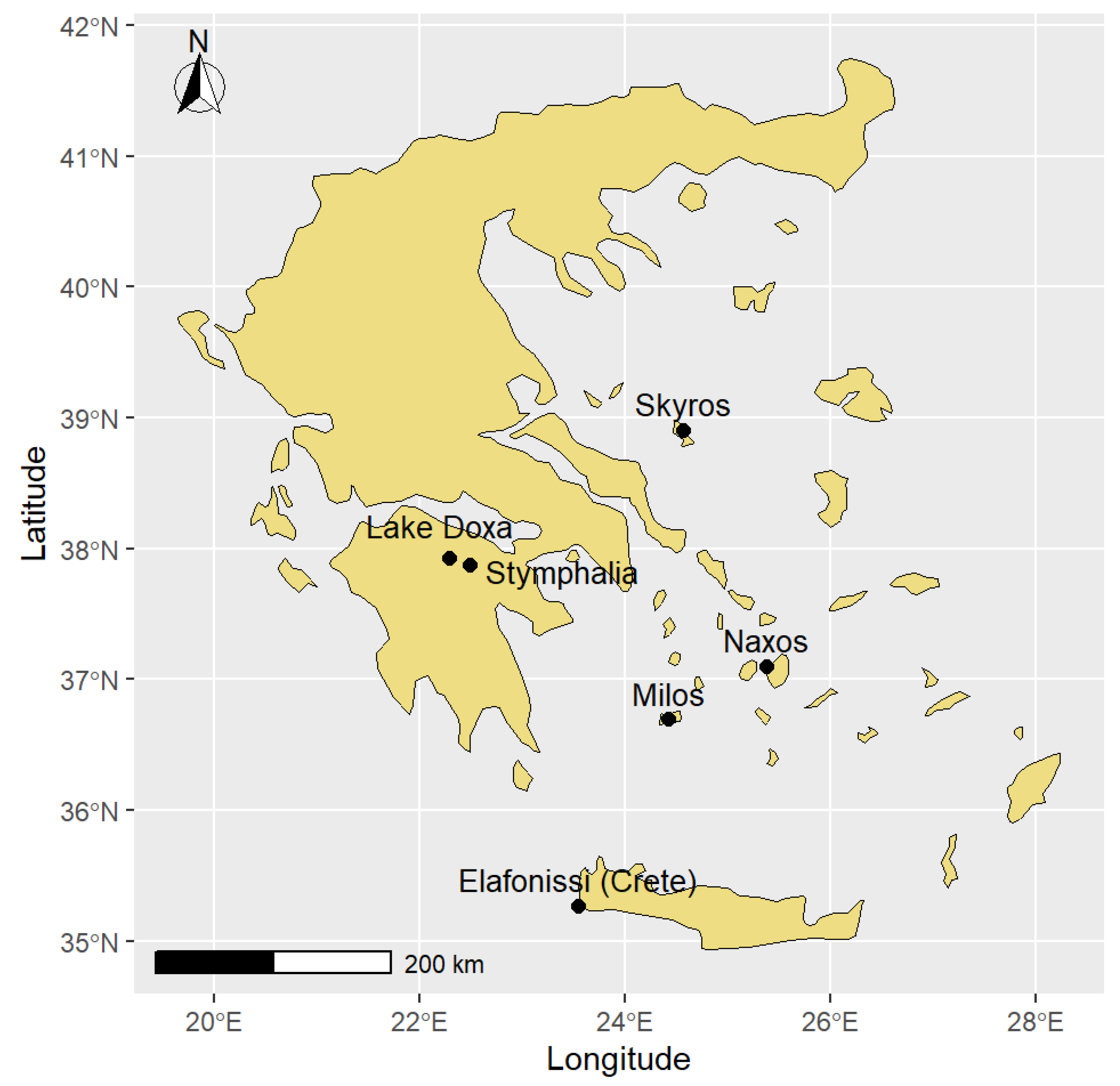
The study was conducted using eight species of wall lizards (genus Podarcis) (N = 152) inhabiting diverse Mediterranean habitats across mainland and insular Greece (Figure 1). All species are small-bodied, generalist arthropod predators with similar thermal preferences [26,27,28,29], and have known phylogenetic relationships [30,31,32]. While their diet primarily comprises terrestrial invertebrates, particularly insects, insular populations display additional dietary behaviors such as frugivory (fruit consumption), ovophagy (egg consumption), and herbivory [33].
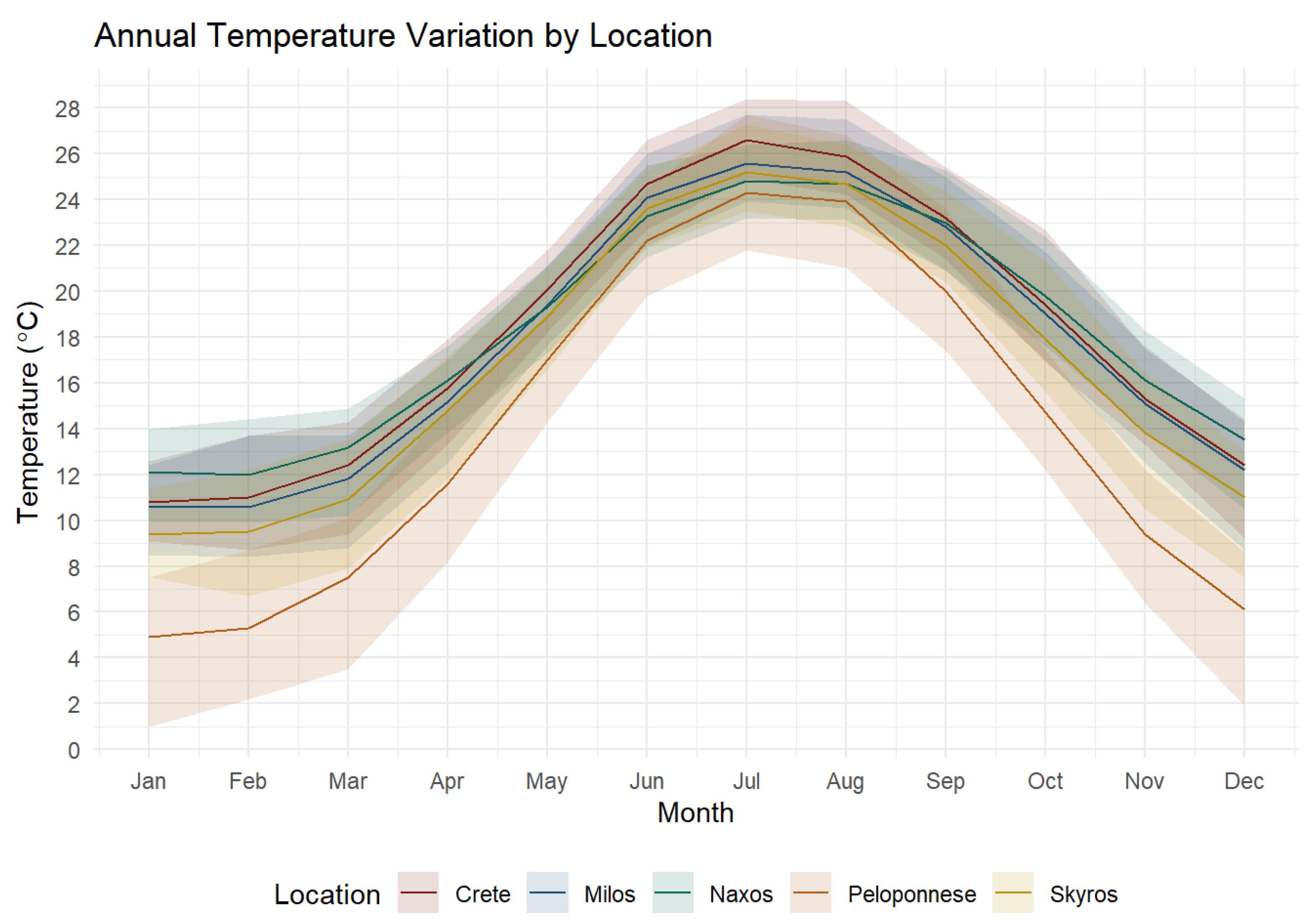
The three mainland species included the widely distributed common wall lizard (P. muralis; N = 18), the endemic Peloponnese wall lizard (P. peloponnesiacus; N = 22), and the Balkan wall lizard (P. tauricus; N = 18). These were collected from a narrow strip of land (100 m in length, 20 m in width) near Lake Doxa on the Feneos plateau (FE; 37.93112° N, 22.28341° E) (Figure 1). The area is surrounded by high mountains covered with forests of fir, black pine (Pinus nigra), oak (Quercus coccifera), and plane trees (Platanus occidentalis), and has a temperate climate with snowy and rainy winters and warm summers (Figure 2). The eastern Peloponnese wall lizard (P. thais; N = 18), endemic to the eastern Peloponnese, was sampled from the western banks of Lake Stymphalia (LS; 37.86836° N, 22.46054° E; Figure 1). The habitat at Stymphalia consists of a rocky slope 20 m from the lake, featuring many crevices and small overhangs with low plants (Thymus vulgaris, Erica sp., Phlomis fruticosa), while the base and top of the slope are covered by Quercus coccifera, Arbutus unedo, and Spartium junceum.
Among the island species (see Figure 1 for all island sampling locations), Erhard’s wall lizards (P. erhardii; N = 19), widely distributed across the southern Balkans and the Aegean islands, were sampled from Naxos Island (NX; 37.08294° N, 25.57855° E). The Skyros wall lizard (P. gaigeae; N = 21), endemic to the Skyros Archipelago and Piperi Island, was sampled from Skyros Island (SK; 38.82349° N, 24.56740° E). The Milos wall lizard (P. milensis; N = 18), endemic to the Milos Archipelago, was sampled from Milos Island (ML; 36.68658° N, 24.45722° E), while the Cretan wall lizard (P. cretensis; N = 18) was captured from Elafonissi at Crete (CR; 35.27098° N, 23.54615° E). The predominant vegetation of all island sites is the typical Mediterranean maquis and phrygana, primarily Sarcopoterium spinosum and Thymus capitatus, with a rocky substrate. The climate is milder and warmer than in continental areas [34], thanks to the buffering effect of the surrounding sea [35]. Monthly means of temperature for the last 30 years were obtained from the National Meteorological Service of Greece (http://climatlas.hnms.gr/sdi/, accessed on 29 October 2025) (Figure 2).
Lizards were collected by noosing during the nonreproductive period in September 2014 and in accordance with Greek National Law (Presidential Decree 67/81). To avoid possible sex and age effect, we used exclusively adult males. For each lizard collected, we recorded SVL (in mm) with a digital caliper (Silverline 380244, Silverline Tools, Walsall, UK, accurate to 0.01 mm) and body mass using a digital scale (i500 Backlit Display, My Weight, Digital Scales Company, Gloucestershire, UK, accurate to 0.1 g). One hundred and fifty-two lizards were captured in the field and transported to the animal facilities of the National and Kapodistrian University of Athens and housed individually in plastic terraria (20 cm × 25 cm × 15 cm) containing a sandy substrate and artificial shelters. The room temperature was kept at 25 °C and a controlled photoperiod (12 light: 12 dark) was provided by fluorescent bulbs, while additional incandescent lamps (60 W) and UVB lamps upon each terrarium allowed animals to thermoregulate behaviorally for 12 h/d. All lizards were fed mealworms (Tenebrio molitor) coated with mineral powder (TerraVit Powder, JBL GmbH & Co. KG, Neuhofen, Germany) every other day, and had access to water ad libitum.

2.2. Intestinal Tissue Preparation

One hundred and fifty-two lizards were captured and maintained under laboratory conditions, of which 144 individuals were processed for biochemical analyses. Prior to the experiment, lizards were fasted for 48 h to complete gut clearance [4] and to prevent residual food from interfering with enzyme assays. Following the fasting period, lizards were killed by rapid decapitation following deep anesthesia with isoflurane. After death, the gastrointestinal tract was immediately dissected, and any remaining food residues and fecal material were carefully removed from the intestinal lumen before tissue collection. In rare cases (n = 8) where undigested food remained within the lumen, samples were excluded from further analyses. This ensured that the subsequent estimate of enzymatic activities was based solely on the intestinal tissue itself, rather than any residual waste or food particles. Protease, lipase and maltase activities were measured in all processed individuals. Dissections were undertaken over ice to avoid enzyme and tissue degradation. The GI tract, spanning from the stomach to the cloaca, was cut lengthwise and rinsed with Ringer’s solution (0.1 M NaCl, 1.8 mM KCl, 2.0 mM CaCl2, 1.0 mM MgCl2, 5.0 mM HEPES-NaOH, pH 7.6). The length of the GI tract was then measured using digital calipers (to 0.01 mm) and weighed using a precision scale (wet mass, to 0.001 g). The tract was divided into three sections, based on standard anatomical landmarks: Section 1 (foregut; stomach), Section 2 (midgut; duodenum), and Section 3 (hindgut; the rest of the intestine extending to the cloaca). The pancreas was carefully excluded from all samples. Each section was weighed and measured again before being frozen in liquid nitrogen and stored at −80 °C for subsequent enzyme activity analysis. Intestine tissue samples were thawed at 21 to 23 °C and homogenized with 0.1 M phosphoric buffer pH 7.0. Tissue blanks were used as controls to distinguish enzymatic activity from baseline substrate concentrations. Standardized intestinal enzymatic activity was calculated on the basis of absorbance and expressed as μmoles × gr−1 × min−1 for each section.

2.3. Assays of Digestive Enzyme Activities

Protease, lipase, and maltase activities were assessed at 20, 25, 30, 33, 35, and 40 °C, temperatures within the thermal tolerance range of Podarcis lizards (e.g., [36,37]) and commonly recorded in the field during summer, as well as at 45, 50, and 55 °C [38,39], representing the upper extremes they might encounter. Protease activity was estimated using the Lowry method [40] with denatured casein (4% w/v) as the substrate, a well-established approach. This method quantifies total protein, including small peptides generated during digestion. Following careful tissue preparation and the removal of digesta to minimize confounding factors, this method can also serve as an indirect measure of protease activity through protein hydrolysis. Homogenized tissue was incubated for 30 min at the desired temperature (20–55 °C), and the reaction was terminated by adding 10% (v/v) trichloroacetic acid (TCA). The sample was centrifuged at 6000 rpm for 10 min; the pellet was discarded, and the supernatant was used to determine hydrolyzed protein. Folin phenol reagent was added to the sample, which was then incubated for another 30 min. Finally, the concentration of the reduced Folin reagent was measured at 750 nm, using a spectrophotometer (Barnstead/Turner SP-830 Plus, Turner, Madison, WI, USA).
To estimate total lipase activity, we used the oxidation of glycerol to dihydroxyacetone phosphate by glycerol kinase, a method modified from Kessler and Lederer [41]. While the original method was optimized to measure lipoprotein lipase activity in adipose tissue, skeletal muscle, and plasma, its principle of quantifying glycerol release from triglyceride hydrolysis is broadly applicable for assessing lipase activity. Here, using olive oil as a substrate to reflect the hydrolytic activity of lipases, the method was modified to suit intestinal tissue homogenates. Because the gastrointestinal tract was rinsed and the pancreas excluded, our measurements primarily reflect tissue-associated lipase activity in the intestinal mucosa (e.g., brush-border and intracellular lipases), rather than pancreatic secretions in the lumen. Although the assay does not distinguish among specific lipase types, the careful preparation of intestinal homogenates minimized contributions from luminal contents, and provides a consistent comparative index of triglyceride hydrolysis across populations. This approach thus offers valuable insights into overall enzymatic potential in the intestinal tissues of the studied lizards. The reaction was initiated by incubating the homogenized tissue at the desired temperature for 60 min with 0.5 mL of olive oil as the substrate. To terminate the reaction, samples were incubated at 100 °C for 10 min. The samples were then centrifuged at 3000 rpm for 5 min, and 0.5 mL of the supernatant was mixed with 2 mL of glycine phosphate buffer and 0.4 mL of NAD. Lipase activity was quantified based on the amount of released glycerol, determined by measuring the absorbance of NADH at 340 nm every 10 min until stabilization.
Maltase activity was measured using the glucose oxidase method (Glucinet kit; Glucofix, Menarini Diagnostics, Winnersh, UK). Homogenized tissue was incubated with 4% (w/v) maltose at a desired temperature (20–55 °C) for 30 min. The reaction was stopped by adding 10% (v/v) trichloroacetic acid (TCA), and the samples were centrifuged at 3000 rpm for 5 min. The resulting pellet was discarded. A universal pH indicator [Merck Universal Indicator (pH 4–10), Merck KGaA, Darmstadt, Germany] was then added, followed by a second centrifugation at 30,000 rpm for 5 min. Absorbance was measured at 510 nm using a spectrophotometer after 10 min of incubation at 37 °C. Additionally, we measured sucrose activity in each section of the gastrointestinal tract, but it was too low to be quantified.

2.4. Statistical Analysis

Data were analyzed in R version 4.3 [42]. Non-parametric tests were performed when parametric assumptions were not satisfied, and a significance level of α 0.05 was adopted, unless stated otherwise. A one-way analysis of variance (ANOVA) was used to compare body length, body mass, GI length and GI mass among populations. When necessary, an ANCOVA was performed, considering the SVL of each lizard as a covariate. Likewise, an ANOVA was performed to test differences in proteases, lipases and maltase activities between species across temperature treatments. Post hoc multiple comparisons were performed using the Tukey HSD method.

2.5. Phylogenetic Signal

The tendency for closely related species to share similarities in ecology, morphology, and physiology more than distantly related ones is known as phylogenetic signal [43]. This phylogenetic relatedness violates the assumptions of normal statistical methods, leading to the non-independence of trait values among species. To account for phylogenetic signal in our dataset, we used the Pagel’s λ [44] and Abouheif’s Cmean [45] methods, both of which are powerful and reliable for measuring and testing a phylogenetic signal [46] and have been widely applied to ecological traits [47,48,49]. Since phylogenetic signal estimates depend on the underlying phylogenetic tree, we constructed a phylogeny of the eight Podarcis species using mitochondrial and nuclear gene sequences available in the literature [30,31,32,50]. The robustness of the results was assessed using 1000 bootstrap replicates.

3. Results

3.1. Body Size and Gut Length

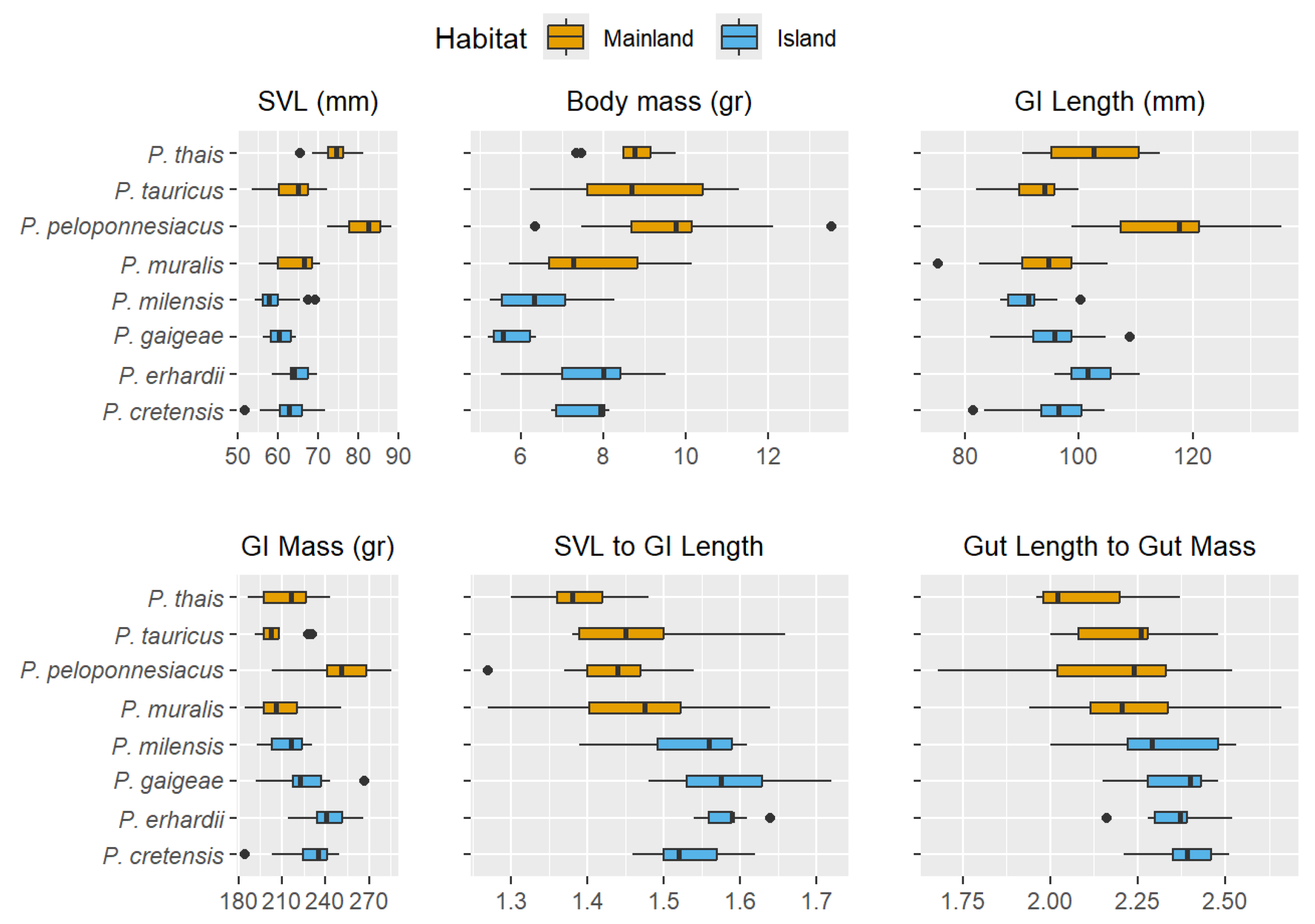
The comparison of body size (SVL; F7,136 = 41.18, p < 0.001), body mass (F7,136 = 17.68, p < 0.001), gut length (GILength; F7,136 = 22.46, p < 0.001) and gut mass (GIMass; F7,136 = 13.44, p < 0.001) revealed significant differences among the eight Podarcis species (Figure 3). Mainland species (P. tauricus, P. peloponnesiacus, P. muralis, and P. thais) exhibited significantly longer and heavier body and gut compared to island species. Since body length correlates positively with GI tract length (r2 = 0.76, t = 20.68, p < 0.001), and GI length with GI mass (r2 = 0.42, t = 10.22, p < 0.001), we calculated the ratios of these traits and repeated the analysis. Interestingly, although mainland lizards had overall larger GI tract dimensions, island species exhibited significantly longer GI length-to-SVL (F7,136 = 18.48, p < 0.001) and GI length-to-GI mass (F7,136 = 7.76, p < 0.001; Figure 3) ratios. Similar results were obtained when SVL was used as a covariate (ANCOVA for GI length: F7,135 = 62.91, p < 0.001).

3.2. Digestive Enzyme Activities

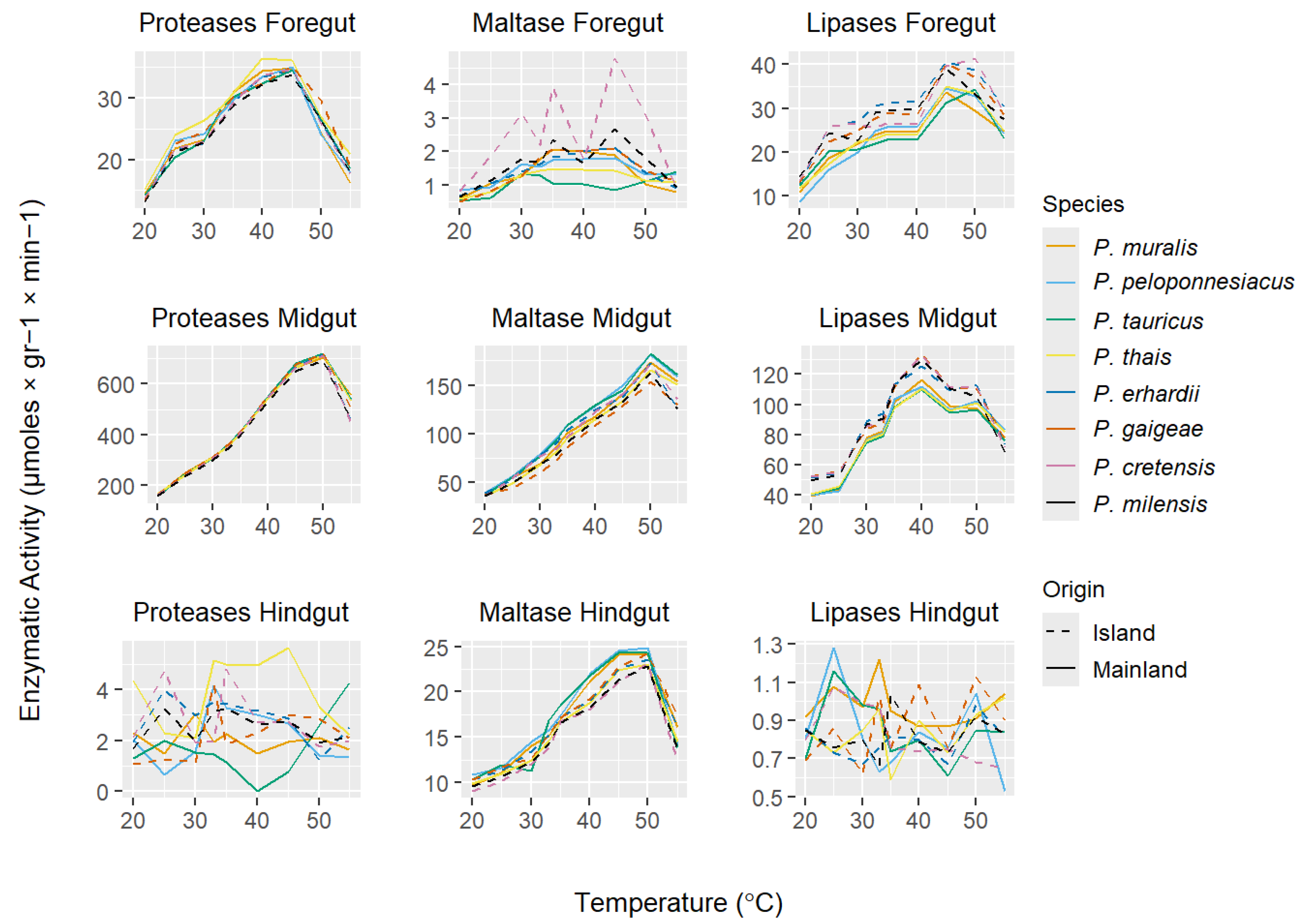
Digestive enzyme activities were highest in the midgut and lowest in the hindgut across all studied species and temperatures (all p < 0.001; Figure 4). In addition, enzyme activity increased significantly with temperature for all species up to 50 °C, followed by a significant decline at 55 °C (Figure 4). However, this decline was more evident on island species than mainland ones (midgut; proteases: 34% versus 24%, F1,137 = 383.80, p < 0.001; lipases: 31% versus 20%, F1,137 = 4.69, p < 0.001; and maltase: 21% versus 11%, F1,137 = 280.70, p < 0.001).
The comparison of peptidase and glucosidase activities in the foregut (proteases: F1,7 = 0.51, p = 0.834; maltase: F1,7 = 0.53, p = 0.811), midgut (proteases: F1,7 = 1.27, p = 0.260; maltase: F1,7 = 10.95, p < 0.001), and hindgut (proteases: F1,7 = 2.61, p = 0.011; maltase: F1,7 = 0.92, p = 0.493) revealed no or minimal interspecies differences across temperature treatments. The few significant differences detected, such as increased maltase activity in the midgut, appeared to occur randomly, without any environmental or phylogenetic signal (Figure 4). Similar results were observed when considering morphological variables such as body length and gastrointestinal tract size, with no significant relationships found (all p > 0.05).
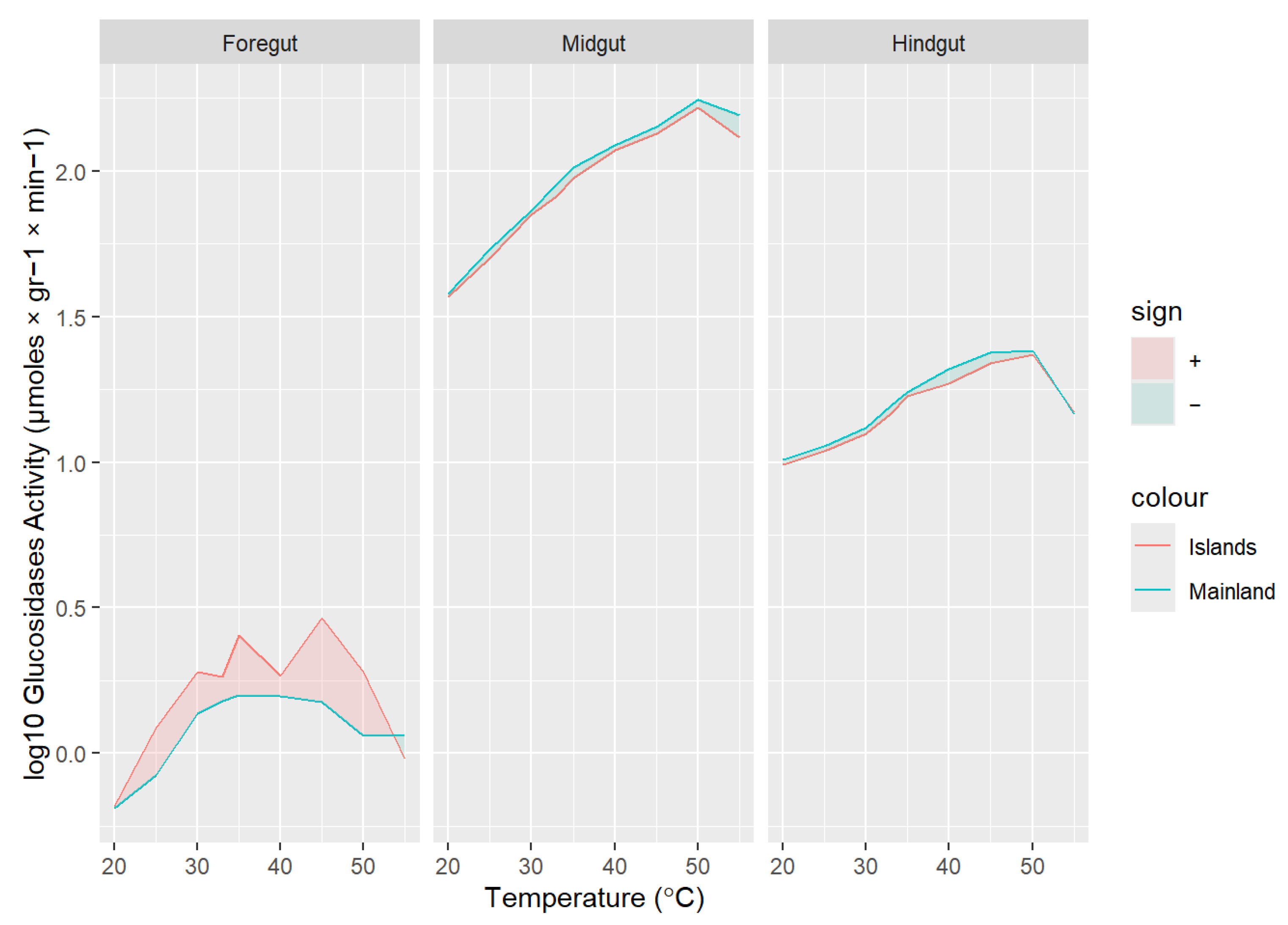
Regarding lipase activity, a distinct pattern emerged: island species tended to cluster together in both the foregut (F7,136 = 41.93, p < 0.001) and midgut (F7,136 = 12.24, p < 0.001), exhibiting increased activity across all tested temperatures (Figure 4 and Figure 5), whereas mainland Podarcis species formed a separate group. This grouping pattern remained even after controlling for snout-vent length (SVL), body mass, and gastrointestinal tract length (all comparisons p < 0.001). No significant differences in lipase activity were observed in the hindgut (F7,136 = 1.43, p = 0.191).

3.3. Phylogenetic Signal Effects

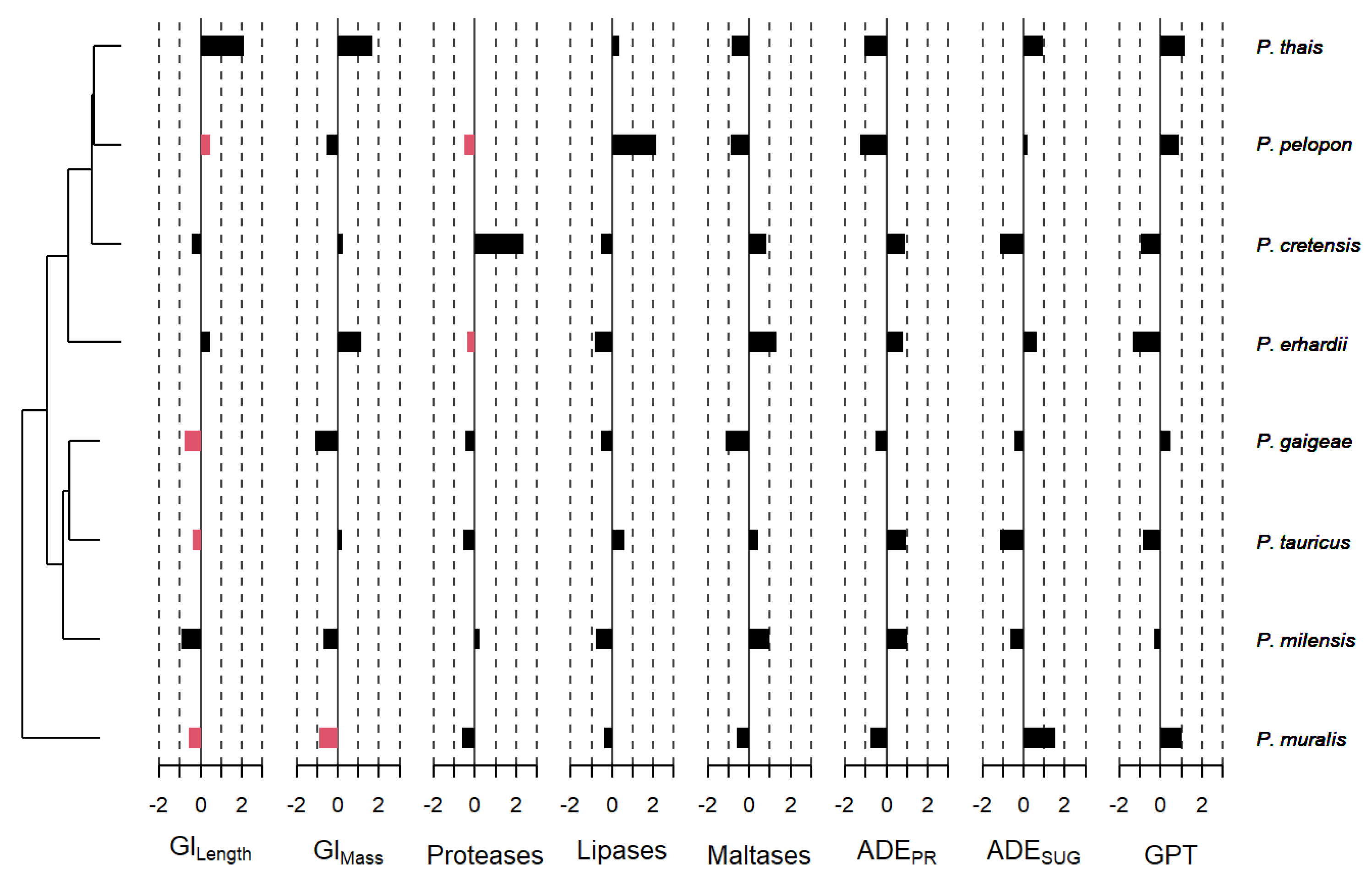
To account for phylogenetic effects on enzyme activities, we repeated all analyses, integrating physiological data with the phylogenetic tree. Our findings showed no statistical evidence of a phylogenetic signal for any tested trait (Table 1 and Figure 6). Accordingly, all phylogenetic correlograms were either flat and nonsignificant or exhibited weak positive autocorrelation.

4. Discussion

Ambient environmental temperature is a key factor affecting directly or indirectly species’ overall biology [51]. This is especially true for ectotherms, such as lizards, which rely on external heat sources to regulate their body temperature and optimize their physiology, metabolism and development [52]. Our in vitro laboratory experiments showed that increasing temperatures affect the activities of digestive enzymes (protease, lipase, and maltase) across all segments of the gastrointestinal tract. However, the magnitude of this response varied among species and was independent of phylogenetic relationships (i.e., closely related species within the same clade often displayed substantial differences, whereas adjacent clades were more likely to share similar trait values). As anticipated, following the study of Pafilis et al. [4], the island species, P. cretensis, P. erhardii, P. milensis and P. gaigeae, exhibited a more pronounced increase in lipase activity in relation to temperature, while no consistent grouping was observed for protease and maltase activities. Additionally, island lizards were found to have relatively longer and heavier gastrointestinal tracts in proportion to their body size, supporting our hypothesis and previous findings on the digestive systems of lacertid lizards inhabiting island environments [12,53].
Arthropods, particularly insects, constitute the major component of the Podarcis lizards’ diet [33,54,55,56,57], although both inter- and intraspecific dietary variations have been reported, likely due to geographical and/or seasonal differences in prey composition and availability e.g., [33,55]. These shifts in prey consumption allow lizards to meet their energy requirements under resource-limited conditions. In line with the typical enzymatic profile of carnivorous species, we found that Podarcis lizards exhibit high protease and lipase activity, but low maltase activity across all segments of the gastrointestinal tract. Members of the genus Podarcis are predominantly insectivorous, with insects providing a rich source of protein and fatty acids, but being relatively low in digestible fiber [58,59,60]; the primary structural carbohydrate in insects is insoluble chitin, which is concentrated in their exoskeleton [60,61]. The observed enzymatic profile therefore suggests an adaptation facilitating the efficient digestion of protein and lipid-rich diets. Notably, digestive enzyme activity was higher in the midgut, where most enzymatic breakdown occurs, and in the foregut, where initial hydrolysis begins [62,63]. In contrast, enzyme activity was lower in the hindgut, which in carnivorous/insectivorous reptiles is primarily involved in nutrient and water absorption, rather than enzymatic digestion [64,65].
As a temperature-dependent process, the efficiency of protein, lipid and sugar digestion is highly sensitive to changes in body temperature, primarily due to its influence on food transit time, enzymatic breakdown, emulsification, and nutrient absorption [4,39,66,67,68]. While a shortened transit time can reduce digestive efficiency by limiting the duration of food processing, increased enzyme activity and other compensatory digestive mechanisms at higher temperatures may help maintain overall digestive performance. Classical enzymatic theory predicts that enzyme activity generally increases with temperature up to an optimal threshold, beyond which activity plateaus or declines [69,70] as enzymes begin to denature and lose functionality [38,71]. Our in vitro study utilized a temperature gradient ranging from 20 °C to 55 °C, reflecting the range of temperatures that lizards are likely to experience in their natural environments. Consistent with previous studies showing that digestive enzymes become heat-sensitive at temperatures above 45 °C [38,39], we observed no loss of activity for proteases, lipase, and maltase up to 40 or even 45 °C. This suggests a high degree of thermal plasticity in digestive enzyme function.
The comparative analysis of protease and maltase activity within the three regions of the digestive tract revealed no consistent clustering of enzymatic activity among species, with only random differences detected (Figure 4), indicating a general similarity between mainland and island populations and no evidence of species- or population-specific adaptations to local environmental conditions. These findings align with previous studies on enzymatic activity in ectotherms that support the hard-wired hypothesis [72,73]. Examining the apparent digestive efficiency in a subset of these species across a range of temperatures, Pafilis et al. [4] identified two distinct groups, with island taxa exhibiting approximately 30% higher efficiency for proteins (ADEPROTEINS) and 10–20% shorter gut passage time (GPT), although no differences were observed in ADESUGARS. Given the typically negative correlation between GPT and digestive efficiency, these findings may appear contradictory. Potential explanations for the increased ADEPROTEINS are either enhanced digestive enzyme activity or improved nutrient absorption in the gut. On one hand, our data allow us to reject the first hypothesis, as no such pattern of differences in protease activity was detected among mainland and island species across all temperature regimes. On the other hand, gut morphology differed significantly between island and mainland taxa. Island taxa exhibited gastrointestinal tracts that were, on average, 10% longer and 18% heavier—a proxy of increased gut surface area or thicker intestinal mucosa and muscle layers [74,75]—relative to body size, compared to their mainland counterparts (Figure 3). These morphological differences provide strong evidence that increased nutrient absorption, rather than differences in enzymatic activity, might underlie the higher digestive efficiency [62,76] of proteins and sugars observed in insular Podarcis lizards [4]. Notably, protease and maltase activities in mainland lizards showed a weaker temperature dependence at the upper end of the tested range, maintaining relatively higher activity at high incubation temperatures compared to island species (Figure 4). This pattern suggests convergent adaptation among mainland species to more variable thermal environments, which may select for broader thermal tolerance in digestive enzymes. Interestingly, this enhanced thermal resilience in enzyme activity was observed even though mainland Podarcis species are phylogenetically nested within clades [30] containing island congeners, indicating that these adaptations are likely a response to environmental conditions rather than phylogenetic constraints.
Contrary to the patterns observed for proteases and maltase, lipase activity showed an increase of approximately 13% across all temperatures in island taxa compared to mainland Podarcis. Lipid digestion begins in the stomach through the action of gastric lipase which breaks dietary lipids into smaller droplets, and continues in the duodenum [77], where emulsification and micelle formation facilitate passive absorption at the intestinal brush border [78,79]. Given the longer gastrointestinal tracts in island lizards and the high metabolic cost of lipase production [80], this upregulation is intriguing, as strong selection for elevated lipase activity might not be expected under such conditions. However, island populations are known to often experience lower and more unpredictable food availability than their mainland kins [4,81]. In this context, efficient lipid digestion may play a disproportionately important role in energy acquisition to support energy-consuming processes such as growth and reproduction. Fats are the most energy-dense macronutrients, yielding over twice the energy per gram compared to proteins or carbohydrates. Under such resource-scarce and fluctuating conditions, maximizing the extraction of fatty acids from available prey could confer a significant selective advantage; a digestive strategy reported in several taxa [4,12,82,83,84].
Alternatively, enzyme activity, including that of lipases, is often tightly correlated with dietary substrate availability [80,85,86]. Thus, the elevated lipase activity observed could reflect dietary differences among the eight studied sites and species, potentially due to variations in lipid content across arthropod prey [87]. The upregulation of lipases, in conjunction with longer and heavier gastrointestinal tracts in island populations (Figure 3), may, therefore, represent a compensatory strategy to enhance fat utilization. However, because we lack direct empirical data on dietary composition for the studied populations, such interpretations remain speculative, and should be tested explicitly in future studies combining enzymatic assays with direct dietary analyses. Notably, previous work has shown that island species exhibit higher digestive efficiency for proteins, likely as a result of slower gut passage times [4]. In contrast, lipid digestion may rely more strongly on enzymatic activity, particularly when micelle formation is limited due to suboptimal bile salt availability or low dietary emulsifiers in insular diets [88,89]. Thus, the increased lipase activity may not simply reflect higher lipid intake, but rather a physiological need to overcome digestive constraints specific to lipid processing in resource-poor environments.

5. Conclusions

While several studies have shown that reptiles, including lizards, are generally very efficient in extracting energy from their food, our understanding of how reptiles meet their nutritional needs (proteins, lipids and sugars) and how temperature may influence this balance is still rather limited, in most contexts [90]. Here, we examined the thermal sensitivity of digestive enzyme activity across several closely related Podarcis species, integrating physiological and morphological data within a phylogenetic framework. We found that enzyme activity generally increased with temperature, but island species displayed steeper declines in activity beyond 50 °C (30% vs. 19% decrease), suggesting reduced thermal tolerance compared to their mainland counterparts. These differences, together with distinct gut morphologies, gut passage time and digestive efficiencies [4], point toward divergent adaptive strategies [76] shaped by the contrasting environmental pressures of mainland and island habitats, especially in terms of food availability and thermal variability. Given variations in global temperatures, our findings highlight the fact that even closely related ectothermic species can exhibit markedly different physiological responses to rising temperatures and different adaptive capacity. Should ambient temperatures rise and heatwaves become more frequent and intense, the digestive efficiency and nutrient acquisition strategies of reptiles may be increasingly challenged, particularly in insular populations with narrower thermal tolerances and less genetic diversity upon which selection may act. Understanding these physiological constraints and adaptive responses is crucial for predicting species resilience and distribution under future climate scenarios [91] and underscores the importance of integrating digestive physiology into broader discussions of reptile vulnerability and climate adaptation.

Author Contributions

Conceptualization, E.D.V., P.P. and K.S.; methodology, E.D.V., P.P., I.S., P.K. and K.S.; formal analysis, K.S. and F.P.; investigation, E.D.V., P.P., I.S. and K.S.; resources, E.D.V.; data curation, K.S. and F.P.; writing—original draft preparation, E.D.V., P.P., K.S. and F.P.; writing—review and editing, E.D.V., P.P., K.S., F.P., P.K. and I.S.; supervision, E.D.V.; project administration, E.D.V.; funding acquisition, E.D.V. All authors have read and agreed to the published version of the manuscript.

Funding

This research received no external funding.

Institutional Review Board Statement

Ethical review and approval were not required for this study because no procedures falling under the scope of Directive 2010/63/EU on the protection of animals used for scientific purposes were performed. The study was conducted in accordance with Greek national legislation in force at the time of the research (Presidential Decree 67/1981) and under a valid permit (ΥΠΕΝ/ΔΔΔ/16809/663) issued by the Greek Ministry of Environment.

Informed Consent Statement

Not applicable.

Data Availability Statement

The data presented in this study are available on request from the corresponding author.

Acknowledgments

The experimental and field work was carried out under the special permit issued by the Greek Ministry of Environment ΥΠΕΝ/ΔΔΔ/16809/663 and according to Greek Legislation on the use of animals (Presidential Decree 67/1981).

Conflicts of Interest

The authors declare no conflicts of interest.

References

  1. Pfenning-Butterworth, A.; Buckley, L.B.; Drake, J.M.; Farner, J.E.; Farrell, M.J.; Gehman, A.-L.M.; Mordecai, E.A.; Stephens, P.R.; Gittleman, J.L.; Davies, T.J. Interconnecting global threats: Climate change, biodiversity loss, and infectious diseases. Lancet Planet. Health 2024, 8, e270–e283. [Google Scholar] [CrossRef] [PubMed]
  2. Silveira, R.M.F.; Façanha, D.A.E.; de Vasconcelos, A.M.; Leite, S.C.B.; Leite, J.H.G.M.; Saraiva, E.P.; Fávero, L.P.; Tedeschi, L.O.; da Silva, I.J.O. Physiological adaptability of livestock to climate change: A global model-based assessment for the 21st century. Environ. Impact Assess. Rev. 2026, 116, 108061. [Google Scholar] [CrossRef]
  3. Sunday, J.M.; Bates, A.E.; Dulvy, N.K. Thermal tolerance and the global redistribution of animals. Nat. Clim. Change 2012, 2, 686–690. [Google Scholar] [CrossRef]
  4. Pafilis, P.; Foufopoulos, J.; Poulakakis, N.; Lymberakis, P.; Valakos, E. Digestive performance in five Mediterranean lizard species: Effects of temperature and insularity. J. Comp. Physiol. B 2007, 177, 49–60. [Google Scholar] [CrossRef]
  5. McKinon, W.; Alexander, G.J. Is temperature independence of digestive efficiency an experimental artefact in lizards? A test using the common flat lizard (Platysuarus intermedius). Copeia 1999, 1999, 299–303. [Google Scholar] [CrossRef]
  6. Angilletta, M.J.J. Thermal Adaptation: A Theoritical and Empirical Synthesis; Oxford University Press: New York, NY, USA, 2009. [Google Scholar]
  7. Collins, M.; Knutti, R.; Arblaster, J.; Dufresne, J.-L.; Fichefet, T.; Friedlingstein, P.; Gao, X.; Gutowski, W.J.; Johns, T.; Krinner, G.; et al. Long-term Climate Change: Projections, Commitments and Irreversibility. In Climate Change 2013—The Physical Science Basis: Working Group I Contribution to the Fifth Assessment Report of the Intergovernmental Panel on Climate Change; Intergovernmental Panel on Climate Change, Ed.; Cambridge University Press: Cambridge, UK, 2013. [Google Scholar]
  8. Garcia-Porta, J.; Šmíd, J.; Sol, D.; Fasola, M.; Carranza, S. Testing the island effect on phenotypic diversification: Insights from the Hemidactylus geckos of the Socotra Archipelago. Sci. Rep. 2016, 6, 23729. [Google Scholar] [CrossRef]
  9. Huang, S.-P.; Chiou, C.-R.; Lin, T.-E.; Tu, M.-C.; Lin, C.-C.; Porter, W.P. Future advantages in energetics, activity time, and habitats predicted in a high-altitude pit viper with climate warming. Funct. Ecol. 2013, 27, 446–458. [Google Scholar] [CrossRef]
  10. Jessen, H.H.; Opdal, A.F.; Enberg, K. Life-history evolution in response to foraging risk, modelled for Northeast Arctic cod (Gadus morhua). Ecol. Model. 2023, 482, 110378. [Google Scholar] [CrossRef]
  11. Malone, J.C.; Thavamani, A. Physiology, Gastrocolic Reflex. In StatPearls; StatPearls Publishing LLC.: Treasure Island, FL, USA, 2025. [Google Scholar]
  12. Sagonas, K.; Pafilis, P.; Valakos, E.D. Effects of insularity on digestive performance: Living in islands induces shifts in physiological and morphological traits in a Mediterranean lizard? Sci. Nat. 2015, 102, 55–62. [Google Scholar] [CrossRef] [PubMed]
  13. Karasov, W.H.; Martinez Del Rio, C. Physiological Ecology: How Animals Process Energy, Nutrients, and Toxins; Princeton University Press: Princeton, NJ, USA, 2007. [Google Scholar]
  14. Toledo, L.F.; Abe, A.S.; Andrade, D.V. Temperature and meal size effects on the postprandial metabolism and energetics in a boid snake. Physiol. Biochem. Zool. 2003, 76, 240–246. [Google Scholar] [CrossRef] [PubMed]
  15. Wang, T.; Zaar, M.; Arvedsen, S.; Vedel-Smith, C.; Overgaard, J. Effects of temperature on the metabolic response to feeding in Python molurus. Comp. Biochem. Physiol. A Mol. Integr. Physiol. 2002, 133, 519–527. [Google Scholar] [CrossRef]
  16. Price, E.R. The physiology of lipid storage and use in reptiles. Biol. Rev. Camb. Philos. Soc. 2017, 92, 1406–1426. [Google Scholar] [CrossRef] [PubMed]
  17. Ha, C.-E.; Bhagavan, N.V. Essentials of Medical Biochemistry with Clinical Cases, 3rd ed.; Academic Press: Cambridge, MA, USA, 2022. [Google Scholar]
  18. Smith, K.T.; Comay, O.; Maul, L.; Wegmüller, F.; Le Tensorer, J.-M.; Dayan, T. A model of digestive tooth corrosion in lizards: Experimental tests and taphonomic implications. Sci. Rep. 2021, 11, 12877. [Google Scholar] [CrossRef]
  19. Sagonas, K.; Deimezis-Tsikoutas, A.; Reppa, A.; Domenikou, I.; Papafoti, M.; Synevrioti, K.; Polydouri, I.; Voutsela, A.; Bletsa, A.; Karambotsi, N.; et al. Tail regeneration alters the digestive performance of lizards. J. Evol. Biol. 2021, 34, 671–679. [Google Scholar] [CrossRef] [PubMed]
  20. Hofer, R. The adaptation of digestive enzymes to temperature, season and diet in roach, Rutilus rutilus and rudd Scardinius erythrophthalmus; Proteases. J. Fish Biol. 1979, 15, 373–379. [Google Scholar] [CrossRef]
  21. German, D.P.; Bittong, R.A. Digestive enzyme activities and gastrointestinal fermentation in wood-eating catfishes. J. Comp. Physiol. B 2009, 179, 1025–1042. [Google Scholar] [CrossRef]
  22. Hofer, R.; Schiemer, F. Proteolytic activity in the digestive tract of several species of fish with different feeding habits. Oecologia 1981, 48, 342–345. [Google Scholar] [CrossRef]
  23. Martínez del Rio, C. Sugar preferences in hummingbirds: The influence of subtle chemical differences on food choice. Codor 1990, 92, 1022–1030. [Google Scholar]
  24. Kohl, K.D.; Ciminari, M.E.; Chediack, J.G.; Leafloor, J.O.; Karasov, W.H.; McWilliams, S.R.; Caviedes-Vidal, E. Modulation of digestive enzyme activities in the avian digestive tract in relation to diet composition and quality. J. Comp. Physiol. B 2017, 187, 339–351. [Google Scholar] [CrossRef]
  25. Cacace, J.; Marinone, G.F.; Cid, F.D.; Chediack, J.G. Impacts of heat stress and its mitigation by capsaicin in health status and digestive enzymes in house sparrows (Passer domesticus). Comp. Biochem. Physiol. Part A Mol. Integr. Physiol. 2025, 308, 111909. [Google Scholar] [CrossRef] [PubMed]
  26. Spaneli, V.; Valakos, E.D.; Pafilis, P.; Lymberakis, P. Thermoregulation by the lizard Podarcis cretensis (Squamata; Lacertidae) in Western Crete: Variation between three populations along an altitudinal gradient. In Proceedings of the 6th Symposium on the Lacertids of the Mediterranean Basin, Lesvos, Greece, 23–27 June 2008; p. 57. [Google Scholar]
  27. Pafilis, P.; Herrel, A.; Kapsalas, G.; Vasilopoulou-Kampitsi, M.; Fabre, A.-C.; Foufopoulos, J.; Donihue, C.M. Habitat shapes the thermoregulation of Mediterranean lizards introduced to replicate experimental islets. J. Therm. Biol. 2019, 84, 368–374. [Google Scholar] [CrossRef]
  28. Reppa, A.; Agori, A.F.; Santikou, P.; Parmakelis, A.; Pafilis, P.; Valakos, E.D.; Sagonas, K. Small Island Effects on the Thermal Biology of the Endemic Mediterranean Lizard Podarcis gaigeae. Animals 2023, 13, 2965. [Google Scholar] [CrossRef]
  29. Sagonas, K.; Kapsalas, G.; Valakos, E.; Pafilis, P. Living in sympatry: The effect of habitat partitioning on the thermoregulation of three Mediterranean lizards. J. Therm. Biol. 2017, 65, 130–137. [Google Scholar] [CrossRef] [PubMed]
  30. Poulakakis, N.; Lymberakis, P.; Valakos, E.; Zouros, E.; Mylonas, M. Phylogenetic relationships and biogeography of Podarcis species from the Balkan Peninsula, by Bayesian and maximum likelihood analyses of mitochondrial DNA sequences. Mol. Phylogenet. Evol. 2005, 37, 845–857. [Google Scholar] [CrossRef]
  31. Spilani, L.; Bougiouri, K.; Antoniou, A.; Psonis, N.; Poursanidis, D.; Lymberakis, P.; Poulakakis, N. Multigene phylogeny, phylogeography and population structure of Podarcis cretensis species group in south Balkans. Mol. Phylogenet. Evol. 2019, 138, 193–204. [Google Scholar] [CrossRef] [PubMed]
  32. Kiourtsoglou, A.; Kaliontzopoulou, A.; Poursanidis, D.; Jablonski, D.; Lymberakis, P.; Poulakakis, N. Evidence of cryptic diversity in Podarcis peloponnesiacus and re-evaluation of its current taxonomy; insights from genetic, morphological, and ecological data. J. Zool. Syst. Evol. Res. 2021, 59, 2350–2370. [Google Scholar] [CrossRef]
  33. Adamopoulou, C.; Valakos, E.; Pafilis, P. Summer diet of Podarcis milensis, Podarcis gaigeae and Podarcis erhardii (Sauria: Lacertidae). Bonn. Zool. Bull. 1999, 48, 275–282. [Google Scholar]
  34. Kotini-Zabaka, S. Contribution to the Study of the Climate of Greece. Ph.D. Thesis, University of Thessaloniki, Thessaloniki, Greece, 1983. [Google Scholar]
  35. Schwaner, T.D. A field study of thermoregulation in black tiger snakes (Notechis ater niger: Elapidae) on the Franklin Islands, South Australia. Herpetologica 1989, 45, 393–401. [Google Scholar]
  36. Liwanag, H.E.M.; Haro, D.; Callejas, B.; Labib, G.; Pauly, G.B. Thermal tolerance varies with age and sex for the nonnative Italian Wall Lizard (Podarcis siculus) in Southern California. J. Therm. Biol. 2018, 78, 263–269. [Google Scholar] [CrossRef]
  37. Litmer, A.R.; Murray, C.M. Critical thermal tolerance of invasion: Comparative niche breadth of two invasive lizards. J. Therm. Biol. 2019, 86, 102432. [Google Scholar] [CrossRef]
  38. Kabir, M.F.; Ju, L.-K. On optimization of enzymatic processes: Temperature effects on activity and long-term deactivation kinetics. Process Biochem. 2023, 130, 734–746. [Google Scholar] [CrossRef]
  39. Li, X.; Wu, X.; Li, X.; Zhu, T.; Zhu, Y.; Chen, Y.; Wu, X.; Yang, D. Effects of water temperature on growth performance, digestive enzymes activities, and serum indices of juvenile Coreius guichenoti. J. Therm. Biol. 2023, 115, 103595. [Google Scholar] [CrossRef]
  40. Lowry, O.H.; Rosebrough, N.J.; Farr, A.L.; Randall, R.J. Protein measurement with the folin phenol reagent. J. Biol. Chem. 1951, 193, 265–275. [Google Scholar] [CrossRef]
  41. Kessler, G.; Lederer, H. Fluorometric measurement of triglycerides. In Automation in Analytical Chemistry, Technicon Symposia; Skeggs, L.T.J., Ed.; Mediad Inc.: New York, NY, USA, 1965; pp. 341–344. [Google Scholar]
  42. R Development Core Team. R: A Language and Environment for Statistical Computing; R Foundation for Statistical Computing: Vienna, Austria, 2022. [Google Scholar]
  43. Blomberg, S.P.; Garland, T.; Ives, A.R.; Crespi, B. Testing for phylogenetic signal in comparative data: Behavioral traits are more labile. Evolution 2003, 57, 717–745. [Google Scholar] [CrossRef]
  44. Pagel, M. Inferring the historical patterns of biological evolution. Nature 1999, 401, 877–884. [Google Scholar] [CrossRef]
  45. Abouheif, E. A method for testing the assumption of phylogenetic independence in comparative data. Evol. Ecol. Res. 1999, 1, 895–909. [Google Scholar]
  46. Münkemüller, T.; Lavergne, S.; Bzeznik, B.; Dray, S.; Jombart, T.; Schiffers, K.; Thuiller, W. How to measure and test phylogenetic signal. Methods Ecol. Evol. 2012, 3, 743–756. [Google Scholar] [CrossRef]
  47. Freckleton, R.P.; Harvey, P.H.; Pagel, M. Phylogenetic analysis and comparative data: A test and review of evidence. Am. Nat. 2002, 160, 712–726. [Google Scholar] [CrossRef]
  48. Comte, L.; Murienne, J.; Grenouillet, G. Species traits and phylogenetic conservatism of climate-induced range shifts in stream fishes. Nat. Commun. 2014, 5, 5023. [Google Scholar] [CrossRef] [PubMed]
  49. Keck, F.; Rimet, F.; Franc, A.; Bouchez, A. Phylogenetic signal in diatom ecology: Perspectives for aquatic ecosystems biomonitoring. Ecol. Appl. 2016, 26, 861–872. [Google Scholar] [CrossRef]
  50. Lymberakis, P.; Poulakakis, N.; Kaliontzopoulou, A.; Valakos, E.; Mylonas, M. Two new species of Podarcis (Squamata; Lacertidae) from Greece. Syst. Biodivers. 2008, 6, 307–318. [Google Scholar] [CrossRef]
  51. McCue, M. General Effects of Temperature on Animal Biology; Smithsonian Books: Washington, DC, USA, 2004; pp. 71–78. [Google Scholar]
  52. Angilletta, M.J.J.; Steury, T.D.; Sears, M.W. Temperature, growth rate, and body size in ectotherms: Fitting pieces of a life-history puzzle. Integr. Comp. Biol. 2004, 44, 498–509. [Google Scholar] [CrossRef] [PubMed]
  53. Vervust, B.; Pafilis, P.; Valakos, E.D.; Van Damme, R. Anatomical and physiological changes associated with a recent dietary shift in the lizard Podarcis sicula. Physiol. Biochem. Zool. 2010, 83, 632–642. [Google Scholar] [CrossRef] [PubMed]
  54. Alemany, I.; Pérez-Cembranos, A.; Pérez-Mellado, V.; Castro, J.A.; Picornell, A.; Ramon, C.; Jurado-Rivera, J.A. DNA metabarcoding the diet of Podarcis lizards endemic to the Balearic Islands. Curr. Zool. 2022, 69, 514–526. [Google Scholar] [CrossRef]
  55. Runemark, A.; Sagonas, K.; Svensson, E.I. Ecological explanations to island gigantism: Dietary niche divergence, predation, and size in an endemic lizard. Ecology 2015, 96, 2077–2092. [Google Scholar] [CrossRef]
  56. Vacheva, E.; Naumov, B. Some insights into the diet of the Balkan wall lizard Podarcis tauricus (Pallas, 1814) in northwestern Bulgaria. Biharean Biol. 2024, 18, 51–56. [Google Scholar]
  57. Taverne, M.; Fabre, A.-C.; King-Gillies, N.; Krajnović, M.; Lisičić, D.; Martin, L.; Michal, L.; Petricioli, D.; Štambuk, A.; Tadić, Z.; et al. Diet variability among insular populations of Podarcis lizards reveals diverse strategies to face resource-limited environments. Ecol. Evol. 2019, 9, 12408–12420. [Google Scholar] [CrossRef] [PubMed]
  58. Reeves, J.T.; Fuhlendorf, S.D.; Davis, C.A.; Wilder, S.M. Arthropod prey vary among orders in their nutrient and exoskeleton content. Ecol. Evol. 2021, 11, 17774–17785. [Google Scholar] [CrossRef]
  59. Zielińska, E.; Baraniak, B.; Karaś, M.; Rybczyńska, K.; Jakubczyk, A. Selected species of edible insects as a source of nutrient composition. Food Res. Int. 2015, 77, 460–466. [Google Scholar] [CrossRef]
  60. Kouřimská, L.; Adámková, A. Nutritional and sensory quality of edible insects. NFS J. 2016, 4, 22–26. [Google Scholar] [CrossRef]
  61. Huis, A.; Van Itterbeeck, J.; Klunder, H.; Mertens, E.; Halloran, A.; Muir, G.; Vantomme, P. Edible Insects Future Prospects for Food and Feed Security; Food And Agriculture Organization: Rome, Italy, 2013; Volume 171. [Google Scholar]
  62. Wang, Z.; Chen, S.; Zheng, Y.; Wu, R.; Yang, Y. Digestive tract morphology and argyrophil cell distribution of three sympatric lizard species. Eur. Zool. J. 2024, 91, 649–661. [Google Scholar] [CrossRef]
  63. Troyer, K. Structure and Function of the Digestive Tract of a Herbivorous Lizard Iguana iguana. Physiol. Zool. 1984, 57, 1. [Google Scholar] [CrossRef]
  64. Mitchell, B.; Sharma, R. The digestive system. In Embryology, 2nd ed.; Mitchell, B., Sharma, R., Eds.; Churchill Livingstone: London, UK, 2009; pp. 41–48. [Google Scholar]
  65. Karasov, W.H.; Petrossian, E.; Rosenberg, L.; Diamond, J.M. How do food passage rate and assimilation differ between herbivorous lizards and nonruminant mammals? J. Comp. Physiol. B 1986, 156, 599–609. [Google Scholar] [CrossRef]
  66. Beaupre, S.; Dunham, A.; Overall, K. The Effects of Consumption Rate and Temperature on Apparent Digestibility Coefficient, Urate Production, Metabolizable Energy Coefficient and Passage Time in Canyon Lizards (Sceloporus merriami) from Two Populations. Funct. Ecol. 1993, 7, 273–280. [Google Scholar] [CrossRef]
  67. McConnachie, S.; Alexander, G.J. The effect of temperature on digestive and assimilation efficiency, gut passage time and appetite in an ambush foraging lizard, Cordylus melanotus melanotus. J. Comp. Physiol. B 2004, 174, 99–105. [Google Scholar] [CrossRef] [PubMed]
  68. Navarro-Guillén, C.; Yúfera, M.; Perera, E. Biochemical features and modulation of digestive enzymes by environmental temperature in the greater amberjack, Seriola dumerili. Front. Mar. Sci. 2022, 9, 960746. [Google Scholar] [CrossRef]
  69. Hungate, R.E. The Rumen and Its Microbes; Academic Press: New York, NY, USA, 1966. [Google Scholar]
  70. Harwood, R.H. The effect of temperature on the digestive efficiency of three species of lizards, Cnemidophorus tigris, Gerrhonotus multicarinatus and Sceloporus occidentalis. Comp. Biochem. Physiol. Part A 1979, 63, 417–433. [Google Scholar] [CrossRef]
  71. Daniel, R.M.; Danson, M.J.; Eisenthal, R. The temperature optima of enzymes: A new perspective on an old phenomenon. Trends Biochem. Sci. 2001, 26, 223–225. [Google Scholar] [CrossRef]
  72. Sabat, P.; Božinović, F. Dietary chemistry and allometry of intestinal disaccharidases in the toad Bufo spinulosus. Rev. Chil. Hist. Nat. 1996, 69, 387–391. [Google Scholar]
  73. Naya, D.E.; Farfán, G.; Sabat, P.; Méndez, M.A.; Bozinovic, F. Digestive morphology and enzyme activity in the Andean toad Bufo spinulosus: Hard-wired or flexible physiology? Comp. Biochem. Physiol. Part A 2005, 140, 165–170. [Google Scholar] [CrossRef]
  74. Stojanović, O.; Altirriba, J.; Rigo, D.; Spiljar, M.; Evrard, E.; Roska, B.; Fabbiano, S.; Zamboni, N.; Maechler, P.; Rohner-Jeanrenaud, F.; et al. Dietary excess regulates absorption and surface of gut epithelium through intestinal PPARα. Nat. Commun. 2021, 12, 7031. [Google Scholar] [CrossRef] [PubMed]
  75. Holmberg, A.; Kaim, J.; Persson, A.; Jensen, J.; Wang, T.; Holmgren, S. Effects of digestive status on the reptilian gut. Comp. Biochem. Physiol. Part A Mol. Integr. Physiol. 2002, 133, 499–518. [Google Scholar] [CrossRef]
  76. King, G.M. Reptiles and Herbivory; Chapman and Hall: London, UK, 1996. [Google Scholar]
  77. Berne, R.M.; Levy, M.N. Principles of Physiology, 2nd ed.; Mosby: St. Louis, MO, USA, 1996. [Google Scholar]
  78. Bakala N’Goma, J.C.; Amara, S.; Dridi, K.; Jannin, V.; Carrière, F. Understanding the lipid-digestion processes in the GI tract before designing lipid-based drug-delivery systems. Ther. Deliv. 2012, 3, 105–124. [Google Scholar] [CrossRef] [PubMed]
  79. Costanso, L.S. Gastrointestinal physiology. In Physiology, 6th ed.; Costanso, L.S., Ed.; Elsevier: Amsterdam, The Netherlands, 2018; pp. 339–393. [Google Scholar]
  80. Karasov, W.H.; Douglas, A.E. Comparative digestive physiology. Compr. Physiol. 2013, 3, 741–783. [Google Scholar] [CrossRef] [PubMed]
  81. Donihue, C.M.; Brock, K.M.; Foufopoulos, J.; Herrel, A. Feed or fight: Testing the impact of food availability and intraspecific aggression on the functional ecology of an island lizard. Funct. Ecol. 2015, 30, 566–575. [Google Scholar] [CrossRef]
  82. Pinoni, S.A.; Iribarne, O.; Mañanes, A.A.L. Between-habitat comparison of digestive enzymes activities and energy reserves in the SW Atlantic euryhaline burrowing crab Neohelice granulata. Comp. Biochem. Physiol. Part A Mol. Integr. Physiol. 2011, 158, 552–559. [Google Scholar] [CrossRef]
  83. Kimura, N.; Kikumori, A.; Kawase, D.; Okano, M.; Fukamachi, K.; Ishida, T.; Nakajima, K.; Shiomi, M. Species differences in lipoprotein lipase and hepatic lipase activities: Comparative studies of animal models of lifestyle-related diseases. Exp. Anim. 2019, 68, 267–275. [Google Scholar] [CrossRef]
  84. Clissold, F.J.; Brown, Z.P.; Simpson, S.J. Protein-induced mass increase of the gastrointestinal tract of locusts improves net nutrient uptake via larger meals rather than more efficient nutrient absorption. J. Exp. Biol. 2013, 216, 329–337. [Google Scholar] [CrossRef]
  85. Melo, J.; Lundstedt, L.; Inoue, L. Effect of different concentrations of protein on the digestive system of juvenile silver catfish. Arq. Bras. Med. Vet. Zootec. 2012, 64, 450–457. [Google Scholar] [CrossRef]
  86. Méndez, E.; Michiels, M.S.; López-Mañanes, A.A. The influence of habitat on metabolic and digestive parameters in an intertidal crab from a SW Atlantic coastal lagoon. Belg. J. Zool. 2021, 151, 81–98. [Google Scholar] [CrossRef]
  87. Senti, T.; Gifford, M. Seasonal and taxonomic variation in arthropod macronutrient content. Food Webs 2024, 38, e00328. [Google Scholar] [CrossRef]
  88. Macierzanka, A.; Torcello-Gómez, A.; Jungnickel, C.; Maldonado-Valderrama, J. Bile salts in digestion and transport of lipids. Adv. Colloid Interface Sci. 2019, 274, 102045. [Google Scholar] [CrossRef]
  89. Bauer, E.; Jakob, S.; Mosenthin, R. Principles of Physiology of Lipid Digestion. Asian-Australas. J. Anim. Sci. 2005, 18, 282–295. [Google Scholar] [CrossRef]
  90. Wehrle, B.A.; German, D.P. Reptilian digestive efficiency: Past, present, and future. Comp. Biochem. Physiol. Part A Mol. Integr. Physiol. 2023, 277, 111369. [Google Scholar] [CrossRef] [PubMed]
  91. Wikelski, M.; Cooke, S.J. Conservation physiology. Trends Ecol. Evol. 2006, 21, 38–46. [Google Scholar] [CrossRef] [PubMed]
Figure 1. Map of Greece in the East Mediterranean Sea. Dots denote the six sampling locations. Naxos: Podarcis erhardii; Milos: Podarcis milensis; Crete: Podarcis cretensis; Skyros: Podarcis gaigeae; Lake Doxa: Podarcis tauricus, Podarcis peloponessiacus; Podarcis muralis; Stymphalia: Podarcis thais.
Animals 16 00100 g001
Figure 2. Monthly means of air temperature for the last 30 years, in six sampling locations. Crete (P. cretensis), Milos (P. milensis) Naxos (P. erhardii), Peloponnese (Lake Doxa for P. peloponnesiacus and Stymphalia for P. thais) and Skyros (P. gaigeae).
Animals 16 00100 g002
Figure 3. Box plot for all morphological traits examined. Blue bars correspond to mainland distributed species, while yellow bars represent insular Podarcis species and populations. SVL refers to snout-vent-length. Dots indicate outliers.
Animals 16 00100 g003
Figure 4. Curve plots showing the activity of proteases, lipases, and maltase (μmoles × gr−1 × min−1) within the three gut regions in eight Podarcis species. Solid lines denote mainland species (i.e., P. muralis, peloponnesiacus, P. tauricus, P. thais), while dashed lines denote islanders (i.e., P. erhardii, P. gaigeae, P. cretensis and P. milensis).
Animals 16 00100 g004
Figure 5. Density curve plots of lipase activity log10 transformed within the three regions of the gastrointestinal tract, illustrating the effects of increasing temperature on enzyme activity. The plot highlights differences between insular (P. erhardii, P. gaigeae, P. milensis, P. cretensis; red) and mainland (P. peloponnesiacus, P. tauricus, P. thais, P. muralis; blue) Podarcis species.
Animals 16 00100 g005
Figure 6. Phylogenetic tree reconstructed by maximum likelihood from the mitochondrial protein encoding cyt b and a partial sequence of the nonprotein coding mitochondrial 16S [30] for the eight Podarcis species. The bars give the score/signal of each taxon on the first principal component of the phylogenetic PCA. Red bars indicate a phylogenetic signal in the trait.
Animals 16 00100 g006
Table 1. Measurements and tests of the phylogenetic signal for 10 physiological and morphological traits with two methods (Pagel’s λ and Abouheif’s Cmean). The values of ADE and GPT were retrieved from the study of Pafilis et al. (2007) [4]. Bold values indicate a statistically significant phylogenetic signal.
TraitCmeanp-Valueλp-Value
Body Length (SVL)0.3090.0190.0010.999
Body Mass−0.0560.2790.0010.999
GI Tract Length0.1930.0270.0010.999
GI Tract Mass−0.1150.3470.0010.999
Protease Activity−0.0420.2340.0010.999
Lipase Activity−0.1670.4890.0010.999
Maltase Activity−0.1570.5570.0010.999
ADEPR−0.0690.3110.0010.999
ADESUG−0.0510.2630.4520.999
Gut Passage Time−0.1330.4140.0010.999
Disclaimer/Publisher’s Note: The statements, opinions and data contained in all publications are solely those of the individual author(s) and contributor(s) and not of MDPI and/or the editor(s). MDPI and/or the editor(s) disclaim responsibility for any injury to people or property resulting from any ideas, methods, instructions or products referred to in the content.