Farming Practices, Biosecurity Gaps, and Genetic Insights into African Swine Fever Virus in the Iringa and Ruvuma Regions of Tanzania
by
 , , , , , add
Show full author list
, , , , , add
Show full author list
Agathe Auer
1,2,*,† ,
,
Anderson Samwel Yohana
3,†,
Tirumala B. K. Settypalli
1,
Raphael Sallu
4,
Jelly Chang’a
3,
Stella Bitanyi
3,
Stella Gaichugi Kiambi
4,
Irene K. Meki
1,
William G. Dundon
1,
Artem Metlin
2,
Andriy Rozstalnyy
2,
Geofrey Hallan Mbata
3,
James Anset Okachu
3,
Henry Magwisha
4,
Sauda Ally Hamis
3,
Jeremia Theodos Choga
5,
Stela Lucas Chalo
5,
Joshua Kimutai
6,
Gerald Misinzo
7 ,
,
Solomon Wilson Nong’ona
5,‡,
Joseph Edmund Lyimo
5 and
Charles E. Lamien
1add
Show full author list
1
Animal Production and Health Laboratory (APHL) at the Joint FAO/IAEA Centre of Nuclear Techniques in Food and Agriculture, Department of Nuclear Sciences and Applications, International Atomic Energy Agency (IAEA), Wagramer Strasse 5, P.O. Box 100, A-1400 Vienna, Austria
2
Food and Agriculture Organization of the United Nations (FAO), 00153 Rome, Italy
3
Tanzania Veterinary Laboratory Agency Iringa (TVLA), Iringa P.O. Box 290, Tanzania
4
Food and Agriculture Organization of the United Nations (FAO), Emergency Centre for Transboundary Animal Diseases, Dar Es Salaam 14111, Tanzania
5
Zonal Veterinary Investigation Centre (ZVC), Southern Highland Zone, Iringa P.O. Box 290, Tanzania
6
Food and Agriculture Organization of the United Nations (FAO), Emergency Centre for Transboundary Animal Diseases, Nairobi 00100, Kenya
7
Department of Microbiology, Parasitology and Biotechnology, College of Veterinary Medicine and Biomedical Sciences, Sokoine University of Agriculture, P.O. Box 3019, Morogoro 67152, Tanzania
*
Author to whom correspondence should be addressed.
†
These authors contributed equally to this work.
‡
Solomon Wilson Nong’ona is deceased (18 March 2025).
Animals 2025, 15(7), 1007; https://doi.org/10.3390/ani15071007
Submission received: 15 January 2025
/
Revised: 14 March 2025
/
Accepted: 28 March 2025
/
Published: 31 March 2025
(This article belongs to the Special Issue African Swine Fever Virus Transmission and Control: The Role of Wild and Domestic Suids—2nd Edition)
Simple Summary
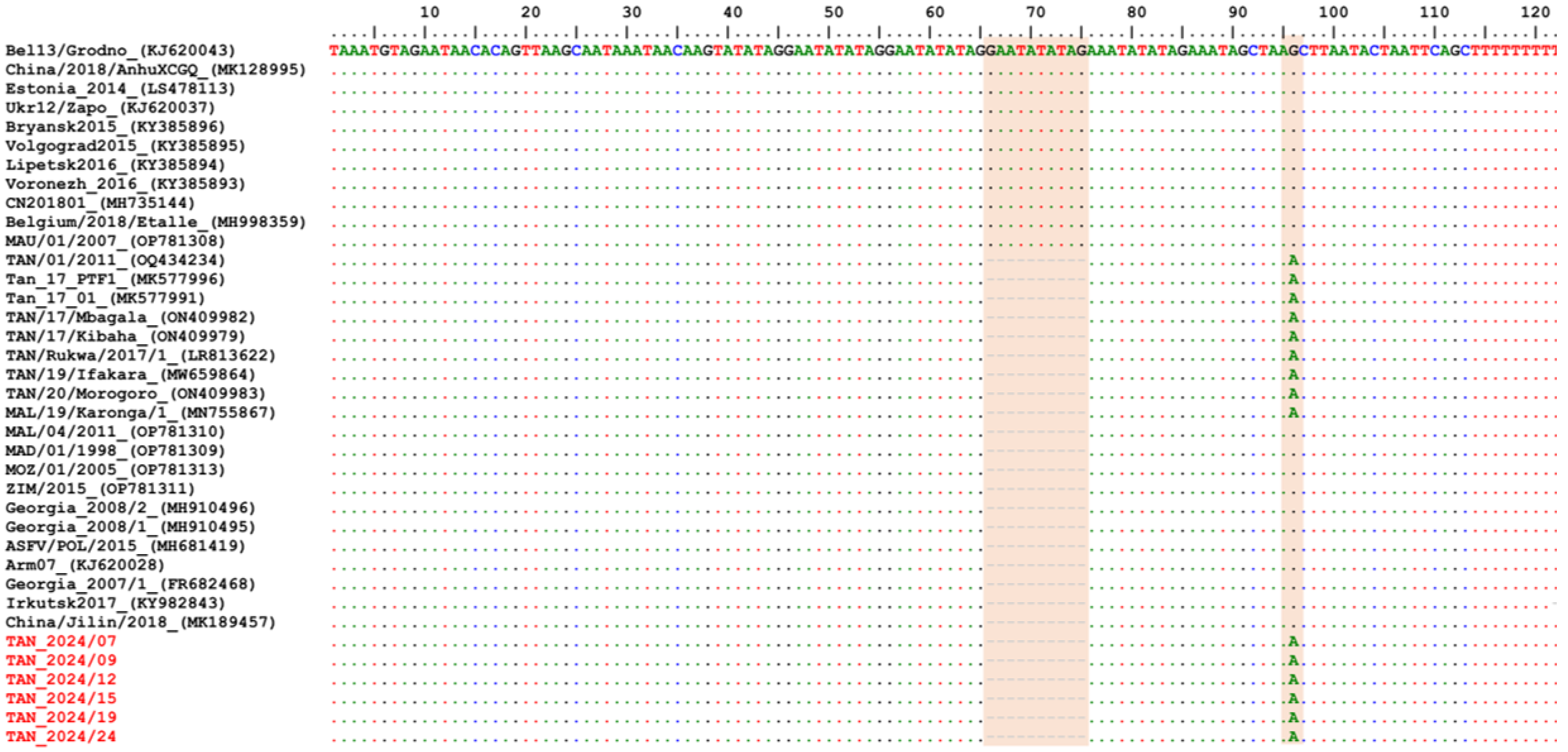
African Swine Fever Virus (ASFV) poses a severe threat to pig farming globally. This study investigates farming practices and ASFV genotype II distribution in the Iringa and Ruvuma Regions of Tanzania, focusing on biosecurity gaps and molecular characterization. The study attempted to establish the ASFV infection status and the standards of biosecurity status in a select group of holdings. Therefore, a total of 205 clinical specimens were collected from 120 farm holdings, resulting in the confirmation of 21 ASFV cases from 14 holdings, and the detection of porcine circovirus-2 (PCV-2) co-infection in some cases. These findings emphasize the need for targeted biosecurity interventions and surveillance to mitigate ASF outbreaks in endemic regions. Phylogenetic analysis showed genetic uniformity among isolates, underlining the persistent dominance and stability of genotype II in the region.
Abstract
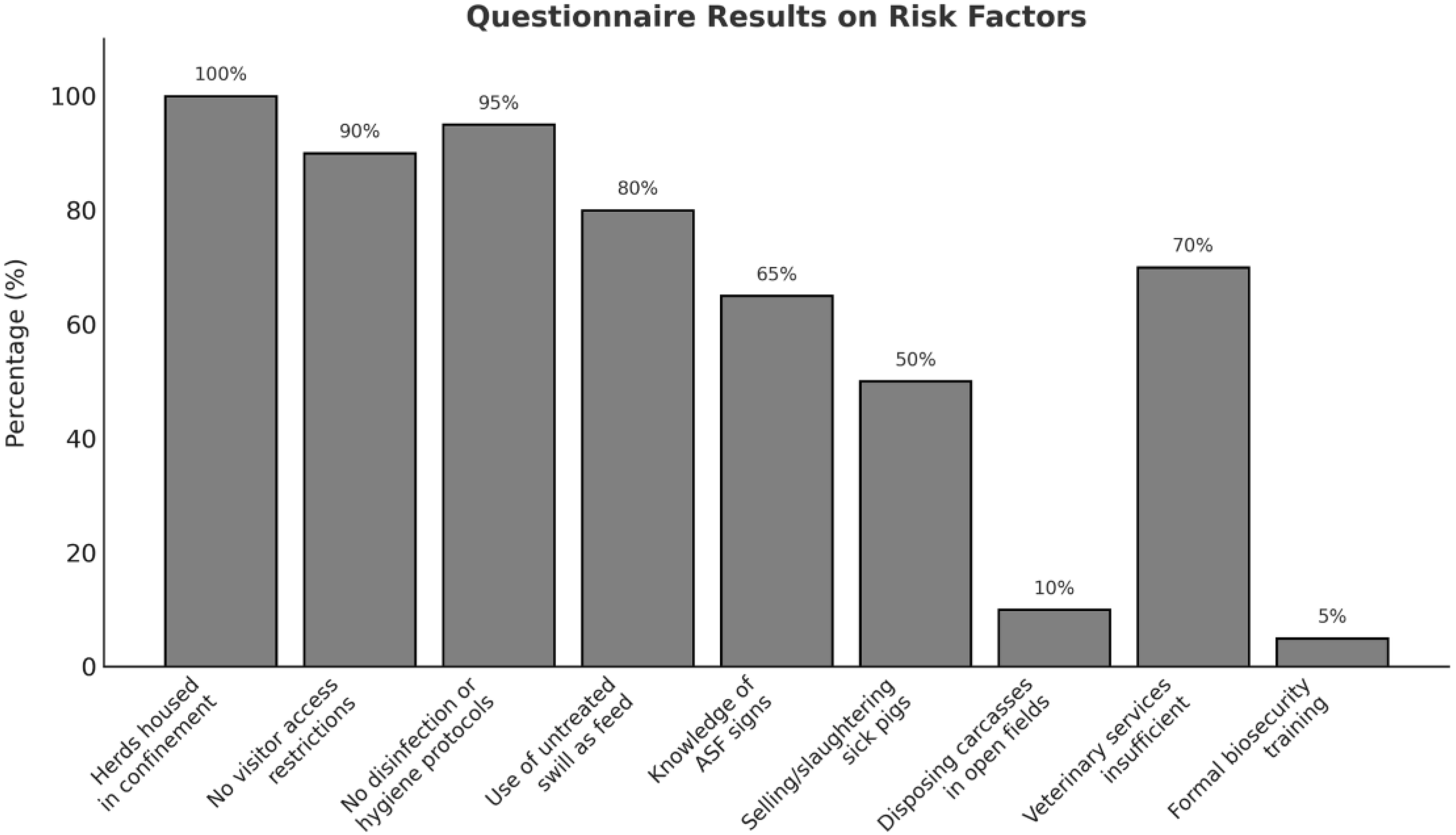
African Swine Fever Virus (ASFV) genotype II dominates outbreaks in Tanzania’s Southern Highlands, continuing to persist as the dominant strain over a decade after its first incursion in 2010. A total of 205 samples from 120 holdings were collected, with 21 confirmed ASFV-positive animals from 14 holdings. Molecular analysis revealed genetic uniformity among isolates, all clustering within ASFV genotype II. Poor biosecurity measures, such as feeding of untreated swill (80% of holdings) and lack of restrictions on visitors (90% of holdings), were identified as risk factors. Additionally, co-infection with porcine circovirus-2 (PCV-2) further complicates disease management. This study underscores the urgent need for enhanced biosecurity and farmer education to mitigate ASFV outbreaks in endemic regions.
Keywords:
ASFV; biosecurity; molecular characterization; Tanzania; pig farming