Typification and Characterization of Different Livestock Production Systems of Mediterranean Dairy Sheep Farms with Different Degrees of Intensification: A Comparative Study
by
 , , , , , and
Manuel Gonzalez-Ronquillo
1,* ,
,
Lizbeth E. Robles-Jimenez
1 ,
,
Jorge Osorio Avalos
1, 
Isabel Revilla
2,
Cristina Hidalgo-González
3 ,
,
Pilar Rodriguez
3,
Jaime Nieto
4,
Javier Plaza
4 and
and
Carlos Palacios Riocerezo
4,*
1
Facultad de Medicina Veterinaria y Zootecnia, Instituto Literario 100, Universidad Autonoma del Estado de Mexico, Toluca 50000, Mexico
2
Escuela Politécnica Superior de Zamora, Universidad de Salamanca, Av. de Requejo, 33, 49029 Zamora, Spain
3
Facultad de Ciencias Económicas y Empresariales, Universidad de León, Joaquín Gonzalez Vecín, 24007 Leon, Spain
4
Facutad de Ciencias Agrarias y Ambientales, Universidad de Salamanca, Av. de Filiberto Villalobos, 119, 37007 Salamanca, Spain
*
Authors to whom correspondence should be addressed.
Animals 2025, 15(3), 448; https://doi.org/10.3390/ani15030448
Submission received: 18 December 2024
/
Revised: 27 January 2025
/
Accepted: 2 February 2025
/
Published: 6 February 2025
(This article belongs to the Section Small Ruminants)
Simple Summary
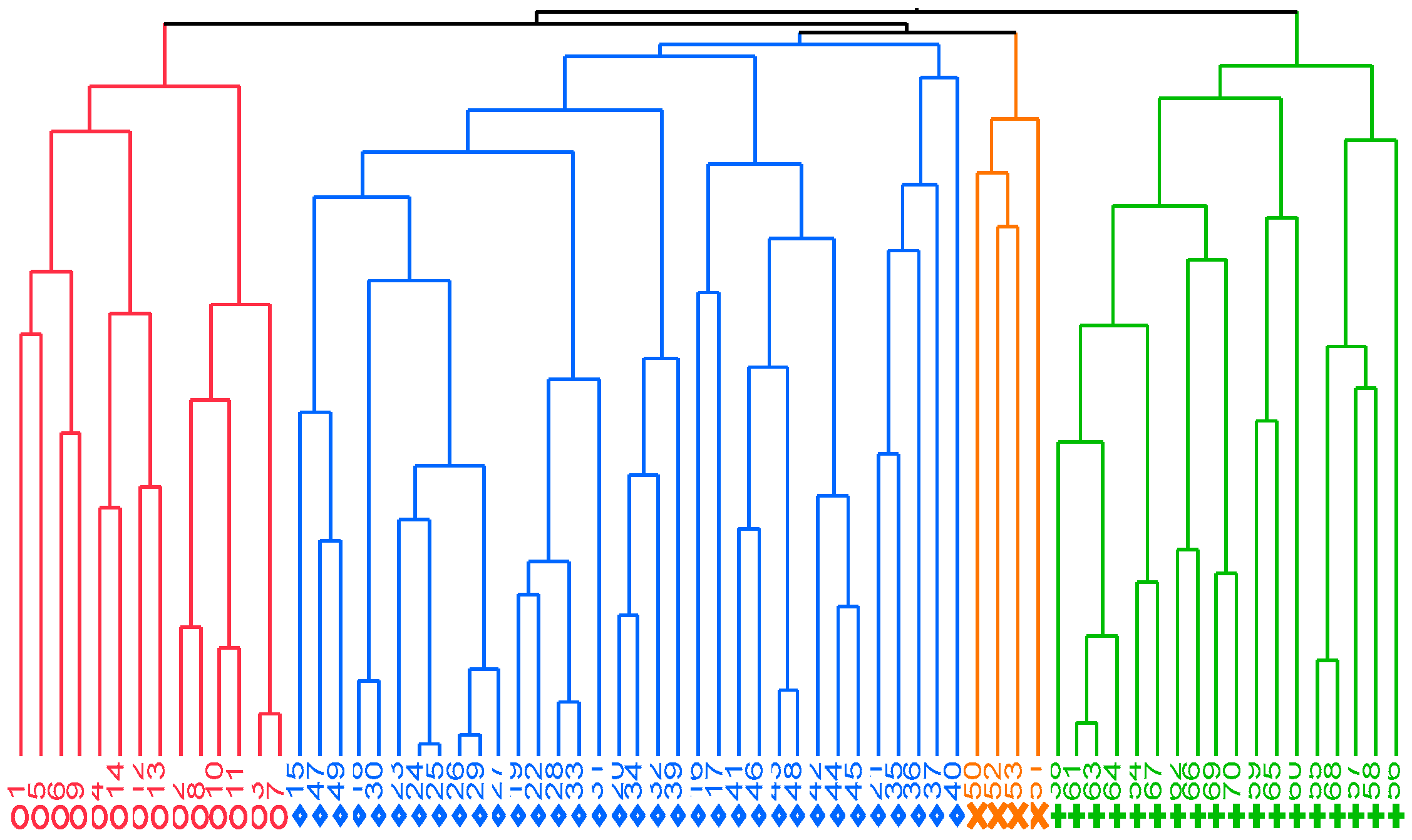
The relationships between technology use and farm and farmer characteristics in dairy sheep production were studied across 70 dairy sheep farms. Five factors were identified: F1, milk production (23.8%); F2, animal species in the flock (18.1%); F3, product transformation (cheese) (14.2%); F4, energy use (8.8%); and F5, hectares per animal (7.2%). Four different clusters were then identified: Semi-Extensive Dairy (SED), Semi-Intensive (SI), Semi-Extensive Cheese (SEC), and Intensive (I) Systems. The traditional classification of dairy sheep farms according to their dependence on natural resources can be complemented by the inclusion of other indicators that allow for a more complete differentiation of farms.
Abstract
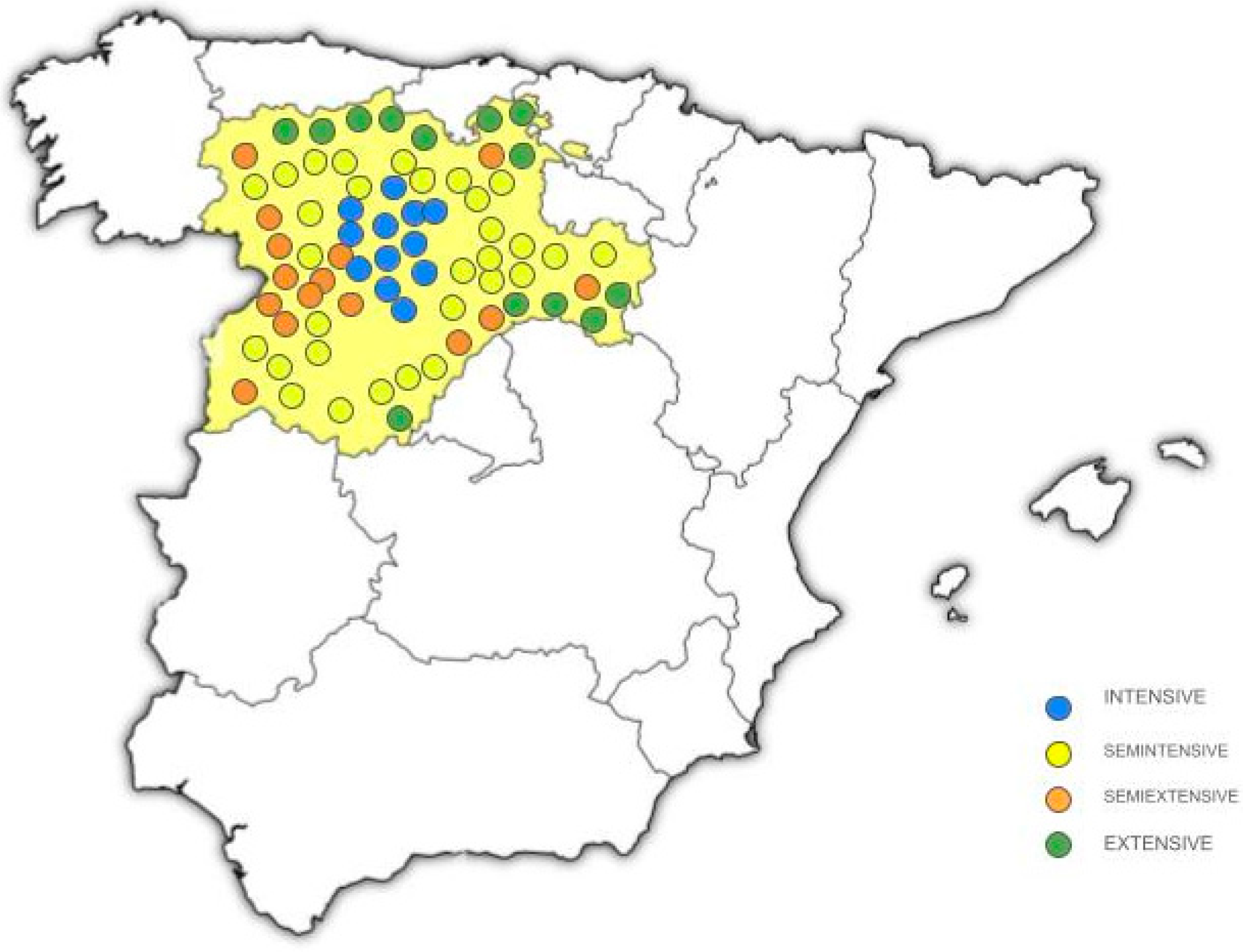
It is necessary to study small-ruminant production systems in a spatial context, as different areas, depending on their natural, socioeconomic, and cultural context, will respond differently to the effects of such causal factors. The aim of this study was to analyze the relationships between technology use and farm and farmer characteristics in dairy sheep production by developing a farm typology using multivariate statistical analysis and comparing it with the multi-scale sustainability evaluation of the Natural Resource Management Systems (NRMS) method. Quantitative and qualitative data were evaluated and compared using the NRMS method and cluster analysis to identify groups of farms. Fourteen variables were considered for the analysis, resulting in four farm systems with the NRMS method, named Intensive, Semi-Intensive, Semi-Extensive, and Extensive; however, when analyzing the data by cluster analysis, the following clusters were used: Cluster 1, Semi-Extensive Dairy Systems (SEDSs); Cluster 2, Semi-Intensive Systems (SIDSs); Cluster 3, Semi-Extensive Cheese Systems (SECSs); and Cluster 4, Intensive Dairy Systems (IDSs). This study concludes that the traditional classification of dairy sheep farms based on their dependence on natural resources can be enriched by incorporating additional indicators that allow for a more comprehensive and accurate characterization of farms.
Keywords:
production systems; sheep; typification; milk; NRMS; MESMIS