Article

Relationship Between Age at First Calving and 305-Day Milk Yield in Hungarian Holstein-Friesian Cows: Trends and Genetic Parameters

by
Szabolcs Albin Bene
1,*,
Zsolt Jenő Kőrösi
2,
László Bognár
2,
József Péter Polgár
1 and
Ferenc Szabó
3
1
Institute of Animal Sciences, Georgikon Campus, Hungarian University of Agriculture and Life Sciences, Deák Ferenc u. 16, H-8360 Keszthely, Hungary
2
National Association of Hungarian Holstein Friesian Breeders, Lőportár u. 16, H-1134 Budapest, Hungary
3
Department of Animal Sciences, Albert Kázmér Faculty of Agriculture and Food Sciences, Széchenyi István University, Vár t. 2, H-9200 Mosonmagyaróvár, Hungary
*
Author to whom correspondence should be addressed.
Animals 2025, 15(24), 3648; https://doi.org/10.3390/ani15243648
Submission received: 28 October 2025 / Revised: 12 December 2025 / Accepted: 16 December 2025 / Published: 18 December 2025
(This article belongs to the Special Issue Advances in Cattle Genetics and Breeding)

Simple Summary

The subject of this manuscript is the age at first calving in Holstein-Friesian cows, which is an important trait from an economic point of view. It is true that if a cow calves at a younger age, she will produce earlier and the costs of rearing her will be refunded earlier. This paper shows and discusses the environmental and genetic factors influencing age at first calving, their rates, the trend, and the relationship with 305-day milk yield of this trait. Our findings confirm a slight, but consistent, phenotypic decrease in age at first calving and increase in milk yield among Hungarian Holstein-Friesian cows. Despite moderate heritability, significant environmental effects, particularly herd management, largely influenced these traits. These results suggest that while age at first calving may not yet be a direct selection criterion, it holds promise as a complementary trait for improving herd productivity and efficiency.

Abstract

Age at first calving (AFC) and 305-day milk yield in the first lactation (MY) data of 18,545 Holstein-Friesian cows born between 2008 and 2018 in six herds were evaluated. The effects of some genetic and environmental factors, population genetic parameters, breeding value (BV), and phenotypic and genetic trends of AFC and MY traits were estimated. The GLM method (ANOVA Type III) and BLUP animal model were used for the estimations. One-way linear regression analysis was used for trend calculations. The adjusted overall mean value (±SE) of the AFC and MY traits was 25.19 ± 0.02 months and 10,287.14 ± 24.79 kg, respectively. The percentage proportion contribution of the different factors in the phenotype in the case of AFC was as follows: herd 94.41%, birth year of cow 3.26%, birth season of cow 1.39%, and sire 0.71%. For MY, the contribution was as follows: herd 89.17%, birth season of cow 5.38%, birth year of cow 4.09%, and sire 1.05%. The heritability of AFC and MY traits by two different models proved to be moderate (0.26 ± 0.02, 0.19 ± 0.01 and 0.30 ± 0.02, 0.34 ± 0.01, respectively). There were relatively small differences between the sires in the estimated BV for the traits AFC and MY. The phenotypic and genetic correlations between AFC and MY traits were weak (between −0.05 and −0.16). Based on the phenotypic trend calculation, AFC showed a decreasing direction (−0.12 months per year) and MY an increasing direction (+42.30 kg per year). However, the genetic trend was very slightly decreasing for AFC (−0.00 and −0.05 months per year) and slightly increasing for MY (+5.52 and +16.49 kg per year) over the period studied.

1. Introduction

The Holstein-Friesian (HF) is large-bodied, medium mature cattle breed [1]. It was bred in the USA in the 1800s and is undoubtedly the most recognized and widespread dairy breed in the world. In breeding practice we see that heifers of this breed are increasingly being bred at younger ages, with the age at first calving (AFC) decreasing each year [2]. AFC is a defining moment that describes an important event in the cow’s life, as it marks the beginning of the dairy cow’s productive career [3].
There are many previous studies in the literature that have evaluated the effect of different factors on AFC: live weight [4], herd [5], parity of dam [6], etc. The sire can also influence the AFC of his daughters [7]. In the study by Santos et al. [8], the genotype × environment interaction had a significant effect on AFC.
AFC is associated with many traits. Kirkpatrick and Berry [9] found a weak phenotypic correlation (rp = 0.14) between the twinning and AFC. According to van der Heide et al. [10], the genetic correlation (rg) between longevity and AFC was 0.26. AFC showed a close rg with some conformation and udder traits [11,12], longevity [13], growth traits [14], calving difficulty [15], calving interval and conception [16,17], and milk protein polymorphism [18].
According to many literature sources, AFC is related to milk production (MP). In the study by Easthem et al. [19] and Pirlo et al. [20], an increase in AFC was associated with an increase in MP, i.e., there was a direct proportionality between the two traits. Similarly, Van Eetvelde et al. [21] described a positive association between AFC and MP traits, with a plateau between 34 and 42 months. In contrast, in the study by Krpalková et al. [16], the earliest-calving cows (AFC = 735 days) had the highest milk production (8126 kg). Cows that calved later (AFC = 825 days) had a lower milk yield (7327 kg). According to Hutchinson et al. [22], the rg between the traits AFC and MP in HF cows was −0.43. In the study by Ruiz-Sanchez et al. [23] the rp and rg between the AFC and MP traits were −0.11 and −0.44, respectively. Several other studies reported an optimum for MP at an AFC of 22 to 26 months, with similar or even lower MPs in older cows [24,25].
There are many different values of heritability (h2) reported in the literature for AFC in different breeds [26]. According to most literature sources [27,28], the h2 of AFC is quite low or moderate. Similar to the previous trait, the h2 of the MP trait is also moderate in the literature sources [29,30,31,32]. In addition, the h2 data of the AFC and MP traits are variable in the literature.
As AFC is largely a breeder decision, there is very little information in the international literature on the breeding value (BV) of bulls with the AFC trait [33,34]. Bormann and Wilson [35] published BV’s of sires for AFC, ranging from −46.6 to +45.9 days. BVs for the trait MP are usually found in INTERBULL [36] publications, and their numerical data are found in very few of the literature sources.
When analyzing the relevant literature, it seems that AFC has shown a decreasing and MP an increasing trend in all dairy cattle breeds in the recent period [37,38]. In contrast, the relationship between rp and rg is not clear. In our opinion, these require clarification using a large database and complex mathematical procedures.
The MP of HF cows is well known and has been reported by many previous sources [1,9,12,20,23,26]. Therefore, the results of the relevant literature sources will not be detailed here.
Therefore, the aim of this study was to examine the AFC and 305-day milk yield in the first lactation (MY) data of Hungarian HF cows on a large national database. During the work, six questions were formulated, which we wanted to answer based on the results:
  • What influence do sire, herd, year of birth, and season have on the AFC and MY traits of HF cows?
  • What is the h2 of the AFC and MY traits?
  • What are the differences in BV for the AFC and MY traits between HF sires?
  • Are there any differences in the ranking of the sires due to the different BV models?
  • What is the phenotypic and genetic relationship between the AFC and MY traits?
  • What are the trends (phenotypic and genetic) for the AFC and MY traits in the tested Hungarian HF population?

2. Materials and Methods

2.1. The Processed Data and the Examined Traits

The data sources for this study were six large-scale HF herds provided by the National Association of Hungarian Holstein Friesian Breeders (NAHHFB) in Hungary. Data from 18,545 HF cows born between 2008 and 2018 were included in the study. The cows were the offspring of 732 sires and 13,819 dams (Table 1).
The AFC of cows was calculated as the distance between the date of birth and the date of first calving [33,34]. Similar to the method used by Hutchinson et al. [22], Hossein-Zadeh [38], and Ferrari et al. [26], only data from cows aged 18 to 40 months at first calving were used.
The 305-day milk yield in the first lactation (MY) data were obtained from the national database of the NAHHFB [36]. Only data from cows whose milk yield in the first lactation was between 5000 and 18,000 kg were used.

2.2. Farm Management and Housing Technology

The Holstein cows examined were kept in a free-range housing facility, group-based according to their lactation status and production, and milked in a milking parlor. The feedings were based on a TMR (Total Mixed Ration), which consisted of corn silage, alfalfa or ryegrass hay, and concentrates.

2.3. Descriptive Statistic

Descriptive statistics involved simple mathematical methods using the SPSS 27.0 [39] software (Descriptive statistic module).
The Kolmogorov–Smirnov test was used to check the normality and the Levene test to check the homogeny of variance of the data for the AFC and MY traits.

2.4. The Used Models

During the study, two models were used to estimate variance components, population genetic parameters, and BVs. One was a GLM model and the other was a BLUP animal model [40]. The used models are presented in Table 2.

2.5. Estimation with GLM Method

2.5.1. Examining the Effects of Different Factors

The effects of the different genetic and environmental factors on the AFC and MY traits were evaluated by univariate analysis of variance (GLM, general linear model; hereafter the GLM method). The random effect was the sire, while the other studied factors—herd, birth year of cow, and birth season of cow—were considered as fixed effects [41]. The GLM model used was as follows (Equation (1)):
y ^ h i j k = μ + F h + Y i + M j + S k + e h i j k
where ŷhijk = the estimated AFC or MY of the cow born in herd “h”, year “i”, and season “j” of sire “k”; μ = mean of AFC or MY trait; Fh = herd effect (fixed); Yi = birth year of cow effect (fixed); Mj = birth season of cow effect (4 seasons, namely, winter = December + January + February; spring = March + April + May; summer = June + July + August; Autumn = September + October + November) (fixed); Sk = sire effect (random); ehijk = random error.
The study examined the effect of the genetic and environmental factors on the named traits. In cases where the GLM showed a significant difference, the Tukey test was used to detect differences between groups in the case of homogeneous variance, and the Tamhene test was used in the case of non-homogeneous variance.
The Microsoft Excel 2007 and Word 2007 software packages were used to prepare the database. The SPSS 27.0 [39] statistical software package was used to evaluate the effect of different factors.

2.5.2. Population Genetic Parameter Estimation with GLM Method

The previous GLM model was used to estimate the three variance components, where the genetic variance (σ2d), the environmental variance (σ2e), and the phenotypic variance (σ2p) were estimated. For the estimations, the ANOVA Type III procedure was used. This procedure is mathematically equivalent to Harvey’s sire model [42].
The genetic variance (σ2d) was calculated as follows (Equation (2)):
σ 2 d = M S s i r e M S e k 1 × 4
where σ2d = genetic variance; MSsire = the mean square value of sire from the ANOVA table; MSe = the mean square value of the residual (error) from the ANOVA table, i.e., MSe = σ2e; the k1 coefficient was calculated from the number of animals and the sire’s degree of freedom [42].
From the variance data obtained, h2 was calculated using the following method (Equation (3)):
h 2 = σ 2 d σ 2 d + σ 2 e = σ 2 d σ 2 p
The GLM method and calculation procedure used were the same as described in detailed in our previous paper [43]. In the case of the GLM method, the SPSS 27.0 [39] software was used for the estimates.

2.5.3. Breeding Value Estimation with GLM Method

Based on the guidelines of Tőzsér and Komlósi [44], the estimated value of BV with the GLM method (BVGLM) was calculated using the following formula (Equation (4)):
B V G L M = 2 × n × h 2 4 + ( n 1 ) × h 2 × ( X ¯ i X ¯ )
where BVGLM = breeding value of sire in AFC or MY trait, estimated with the GLM method; n = number of progeny of the sire; h2 = heritability; Xi = the average AFC or MY of the sire’s offspring group; X = mean value of the AFC or MY of the contemporary offspring population.
Based on the instructions of Tőzsér and Komlósi [44], the reliability (b) of the estimated BV’s was calculated as the follows (Equation (5)):
b = n × h 2 4 + ( n 1 ) × h 2
where b = reliability of the estimated BV; n = number of progeny of the sire; h2 = heritability.
For reasons of size, the BV’s are only shown for the 10 sires with the most progeny.

2.6. Estimation with the BLUP Animal Model

2.6.1. Population Genetic Parameters Estimation with the REML Method

The population genetic parameters were analyzed using the maximum likelihood (REML) approach with the DFREML 3.0 [45] software.
Similar to Djedovic et al. [46], the effect of fixed factors (as in the GLM method) on the examined traits was tested using the step-by-step method, so that the models used in this research only included factors that showed a statistically significant effect within the mentioned procedure. The effect of the individual (animal effect, cow) was included as a random factor.
Based on the above, the following model was used to estimate the variance components (Equation (6)):
y ^ h i j o = μ + F h + Y i + M j + a o + e h i j o
where ŷhijo = the phenotypic expression of the AFC or MY trait; μ = mean of the AFC or MY trait; Fh = herd effect (fixed); Yi = birth year of cow effect (fixed); Mj = birth season of cow effect (fixed) (as in Equation 1); ao = animal (cow) effect (random); ehijo = random error.
The σ2d, σ2e, and σ2p values were determined during the estimation using the REML method. Similar to the GLM method, the h2 value was calculated with Equation (3).

2.6.2. Breeding Value Estimation with BLUP Animal Model

The BLUP animal model (BVBLUP) was used for estimation of BVe of the studied traits. Two matrices were created; the former included pedigree data for sires, dams, grandparents, full sibs, and half sibs. The database matrix included the same fixed effects as in the GLM method (as above) and the AFC and MY data. The random effect was the individual (cow) [47]. The general formula of the used BLUP animal model was as follows (Equation (7)):
y = X b + Z u + e
where y = vector of observation; b = vector of fixed effects; u = vector of random effects; e = error vector; X = matrix of fixed effects; Z = matrix of random effects.
Based on the guidelines of Szőke and Komlósi [48], the MTDFREML software [49] was used to run the BLUP animal model for BV estimation. The MTDFREML software used automatically determined the BVs, which were copied from the result files for further calculations.
Similar to the GLM method, the reliability (b) of the estimated BVBLUP was estimated using the formula shown in Equation (5).
Also, similar to the GLM method, for reasons of size, the BVBLUP values are only shown for the 10 sires with the most progeny.

2.7. Comparison the Ranking of Sires

Using the GLM method and the BLUP animal model two–two different rankings were obtained based on the estimated BV of the sires in the traits AFC and MY. In line with the studies of Núnez-Dominguez et al. [50], the effect of the model on sire rank was calculated with rank correlation method [51].

2.8. Phenotypic and Genetic Correlations

The phenotypic correlation coefficient (rp) was based on measured data. The genetic correlation coefficient (rg) was based on the BV’s of the AFC and MY traits. The correlation coefficients were calculated according to the instructions of Tőzsér and Komlósi [44].
The SPSS 27.0 [39] software was used for correlation calculations.

2.9. Phenotypic Trend Estimation

To calculate the phenotypic trend, the AFC and MY data of cows born in the same year were averaged. The annual means of AFC and MY (dependent variable, Y) were plotted in the coordinate system. The X value (independent variable) was the birth year of cows. One-way linear regression analysis was used to find the best-fitting line to the points. The constant (a), slope (b), and goodness of fit (R2) values and their standard error (SE) and statistical reliability were also estimated.

2.10. Genetic Trend Estimation

Two different methods were used to calculate the genetic trends. On the one hand, the BV of the sires in AFC and MY traits born in the same year and, on the other hand, the BV of the entire population in AFC and MY traits born in the same year were averaged and plotted on a coordinate system (dependent variable, Y). The independent variable (X) was the birth year of sires or birth year of the entire population.
For sires, BV (and genetic trend) was calculated separately using the GLM method and using the BLUP animal model.
Similar to the phenotypic trend estimation, a one-way linear regression analysis was used to fit a line to the resulting points. According to Ostler et al. [52], the constant value (a), the slope value (b), and the goodness of fit value (R2) were determined as well as their statistical reliability.
Estimates of genetic trends were made for the period 2001–2016 for sires and 2008–2018 for the entire population.
Both phenotypic and genetic trends of the AFC and MY traits were calculated using the SPSS 27.0 [39] software.

3. Results and Discussion

3.1. Effect of Different Factors

As can be seen from the data in Table 3, the arithmetic mean (±SE) of AFC of the HF cows was 25.0 ± 0.0 months. Subtracting the average gestation length of the cows (285 days or 9.5 months) from the AFC, it can be concluded that the HF heifers in Hungary were exposed to breeding at an average age of 15.5 months. This result is similar to that found by Berry and Cromie [15] but lower than that published by Ferrari et al. [26]. Compared to the data from previous works, the AFC (month) of the HF cows in the different sources was as follows: 22.6 [53], 23.5 [54], 25.6 [28], 26.0 [27], 26.1 [20], 26.5–30.0 [37], and 26.9 [55].
The mean of MY was 10,179.4 ± 15.1 kg. Most of the relevant literature sources [29,47,56] reported similarly high MY values.
In all cases, a significant effect (p < 0.01) was found between the examined random and fixed factors on the AFC and MY traits (Table 4). The percentages of observed effects in phenotype were as follows: herd (AFC 94.41%, MY 89.17%), birth year of cow (AFC 3.26%, MY 4.09%), birth season of cow (AFC 1.39%, MY 5.38%), and sire (AFC 0.71%, MY 1.05%). However, compared to the data reported by Mohd Nor et al. [7], the magnitude of the sire effect is smaller in our work.
Table 5 summarizes the effect of environmental factors on the AFC and MY traits. The adjusted mean value (±SE) of the AFC and MY traits obtained by the GLM method was found to be 25.2 ± 0.0 months and 10,287.1 ± 24.8 kg, respectively.
Of the studied herds, herd number 5 had the highest AFC (27.5 ± 0.1 months), which was 2.5–3.3 months higher than that observed in the other herds. In the case of MY, the difference between the best herd (herd number 1, 11,539.3 ± 70.9 kg) and the worst herd (herd number 5, 8417.9 ± 58.7 kg) was 3122 kg. The results for the influence of herd on AFC were similar to those published by Dobos et al. [4] and Ettema and Santos [5].
The AFC of cows born in the early years (year 2008–2009) were 1.1 months higher than that of cows born in the later years (year 2017–2018).
Regarding the birth year of cows, the MY trait of the cows was quite balanced (except for year 2008, where the smallest MY was calculated). The largest MY (10,963.6 ± 103.3 kg) was found in year 2018. The annual MY results were similar to the data reported by Ansari-Lari et al. [37] and Hossein-Zadeh [38].

3.2. Breeding Values and Heritabilities of the Examined Traits

Table 6 shows the means of the AFC and MY traits of the sire’s progeny groups. The two different models gave different results between the estimated BV of the sires.
Estimation by the GLM method showed the lowest AFC (24.7 ± 0.2 months) in the progeny group of the sire with registration number 25863. The highest AFC (25.8 ± 0.2 months) was found in the progeny group of the sire with registration number 21556. The difference between the two extremes was 1.1 months, which is much less than previously observed [30].
According to the previous results, in case of the AFC trait, a difference of 2.0 and 1.2 months was found between the two BV extremes (by sires with registration numbers 25863 and 21556) using the GLM method and the BLUP animal model, respectively. The BV values of AFC estimated with the BLUP animal model were lower than the data published by Bormann and Wilson [35] in Angus and by Bognár et al. [47] in HF cows.
In the case of MY, the lowest production (9226.1 ± 165.7 kg) was shown by daughters of the sire with registration number 21556. It was shown in the previous sections that daughters of this sire were the earliest to be taken into breeding. The highest MY (11,189 ± 150.1 kg) was obtained in the progeny group of sire 27494. The difference between the highest and lowest MY of the progeny groups was almost 2000 kg.
Regarding the BVs estimated with both the GLM method and the BLUP animal model, the highest values (+1636.8 kg and +961.5 kg, respectively) were estimated for the sire with registration number 27494 in the case of the MY trait. Quite large differences (about 3500 kg and 2400 kg) were found between the BVs of the sires estimated with the two different models.
Subsequently, a strong and positive rank correlation (in AFC and MY, rrank = 0.91 and 0.87, respectively) was found between the sire rankings obtained in the two different models.
In the studied HF population, the estimated h2 values (±SE) of the AFC and MY traits were moderate (Table 7).
In the case of AFC, the h2 value estimated with the GLM method was 0.26 ± 0.02, while that estimated with the BLUP animal model was 0.19 ± 0.01. In contrast to our results, the h2 of the AFC trait is usually low in the relevant literature sources: HF 0.10, 0.03 [27,28], Brown Swiss 0.08 [57], and Ayrshire 0.09 [58]. In summary, the h2 estimates for AFC in our study were slightly higher than some published in the literature [27,28,55].
Although a relatively small difference was found between the h2 values estimated with the two models, the h2 estimates differed significantly between the GLM and BLUP models. The reason for this may be that the GLM method estimated the genetic variance based on the sire data, whereas the BLUP model estimated the genetic variance based on total population data.
In the case of MY, slightly higher h2 values (0.30 ± 0.02 and 0.34 ± 0.01) were estimated than previously. Most of the relevant literature sources reported similar h2 values for the MY trait. These estimates are higher than those published by Dematawewa and Berger [32], who reported an h2 value of 0.20 for MY. They also exceed the results of Roman et al. [31] and Abdallah et al. [59], who reported h2 estimates ranging from 0.17 to 0.37 for MP traits. Erfani-Asl et al. [60] reported even smaller h2 values (0.13–0.16) for MP traits than previous results.
As the h2 of AFC is slightly lower than that of MY but greater than zero (0.19–0.26), it also offers a selection opportunity for this trait. However, based on the data, we would expect genetic progress to be slower than what is achievable in terms of increasing milk yield.

3.3. Phenotypic and Genetic Correlations

The rp and rg values between the AFC and MY traits in the studied HF population are shown in Table 8. According to the results, there was a weak but significant between rp and rg (from −0.05 to −0.16) and the AFC and MY traits. In our study, the negative low rg between the AFC and MY traits indicates a weak association.
Our results are similar to data of Hutchinson et al. [22] and Ruiz-Sanchez et al. [23], who found −0.43 and −0.44 values of rg between the AFC and MY traits. Furthermore, our results showed similarities with the studies of Krpalková et al. [16] and Curran et al. [24], who found the highest milk production in cows that were introduced into breeding earliest. In contrast, our results differ from those of Pirlo et al. [20], Eastham et al. [19], and Van Eatvelde et al. [21], who found a positive relationship between AFC and MY.
The correlation coefficients were statistically proven to be small and negative. However, the negative signs indicate that earlier exposure to breeding may increase milk production in the first lactation.

3.4. Phenotypic and Genetic Trends

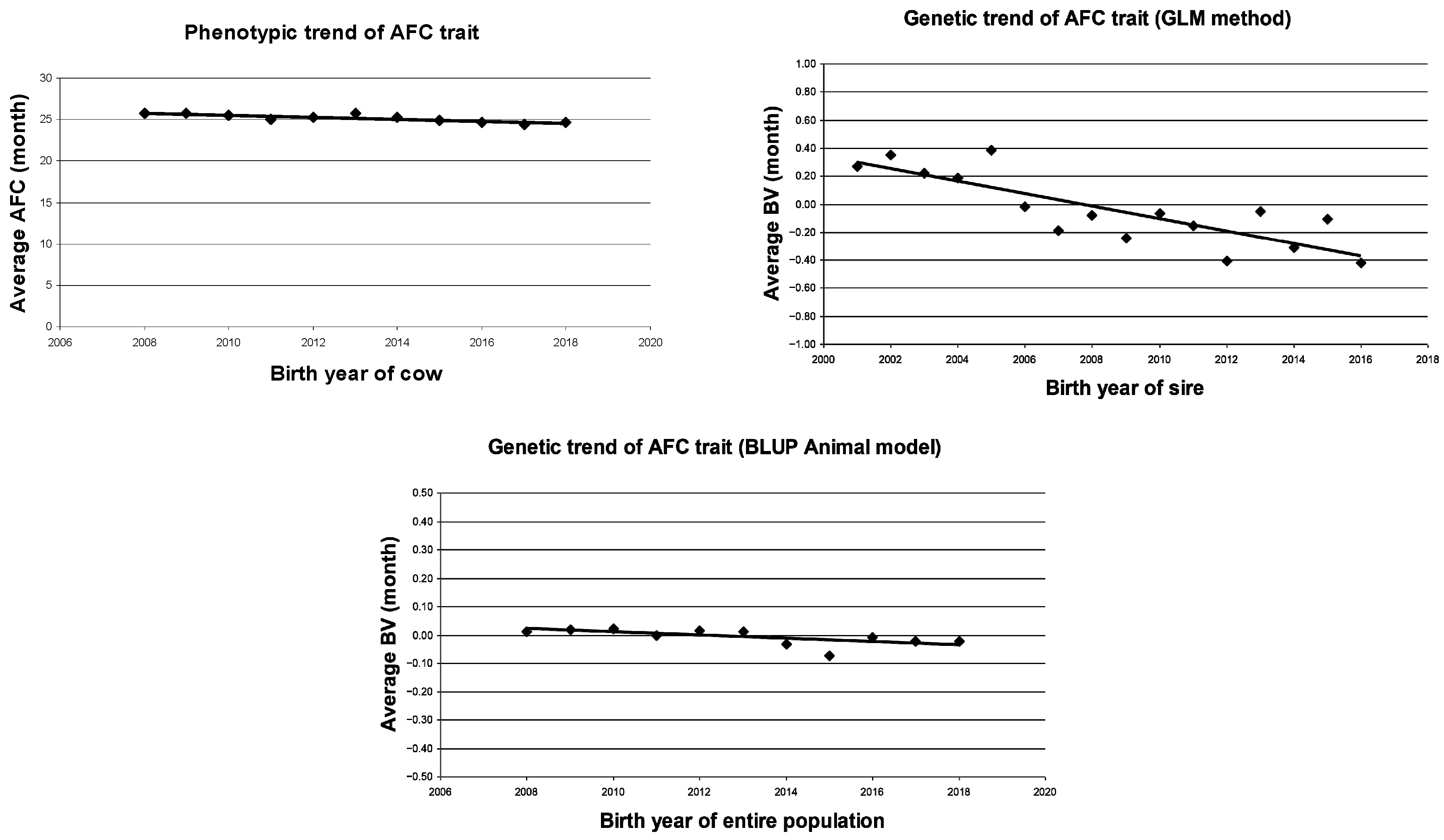
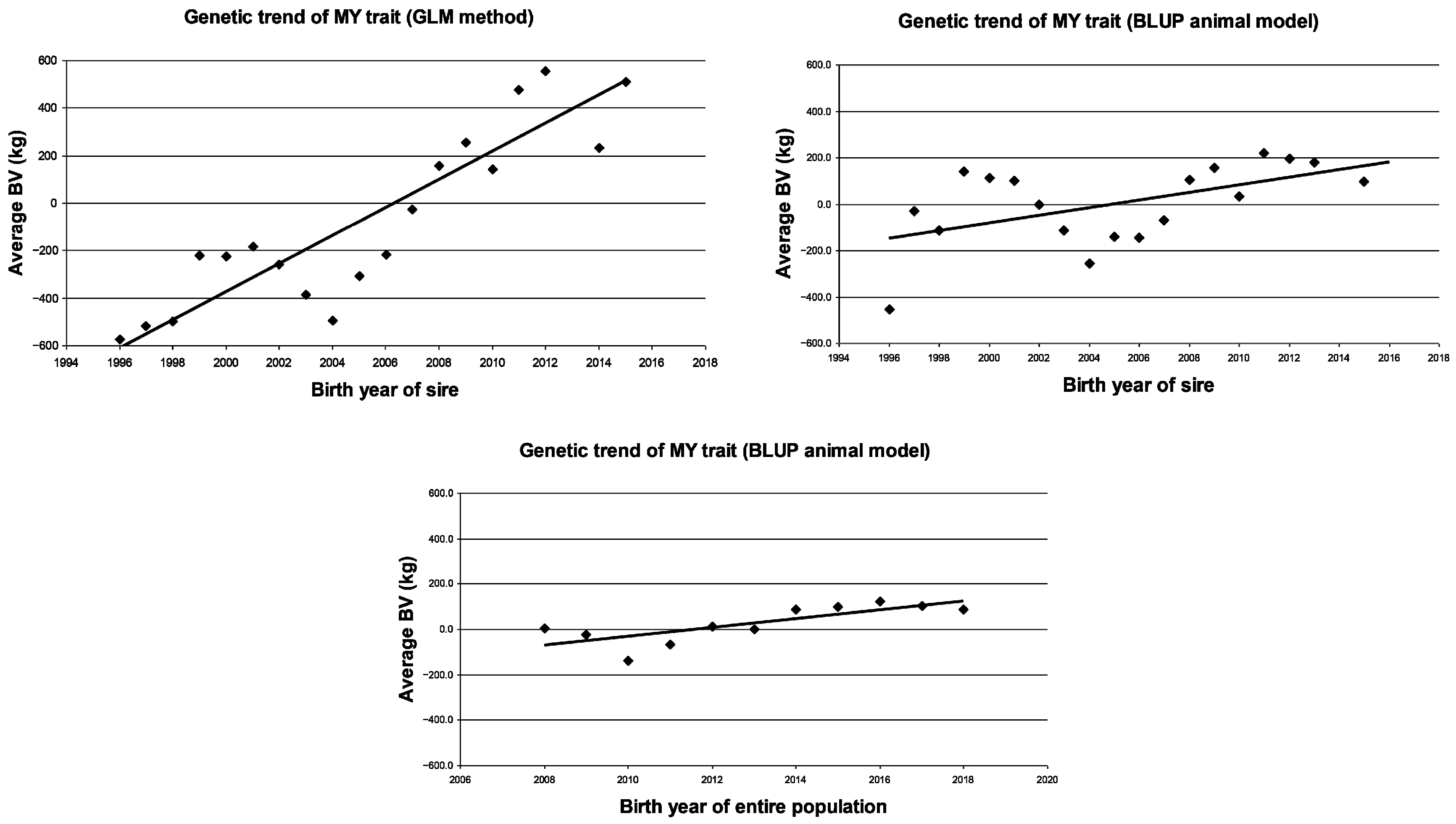
The results of the phenotypic trend calculation in the studied HF population clearly showed a decreasing trend in the AFC trait and an increasing trend in the MY trait (Table 9 and Figure 1 and Figure 2).
Taking into account the phenotypic trends, AFC decreased by −0.12 months per year (b = −0.12 ± 0.02; p < 0.01). It seems that MY was increasing by +42.3 kg per year (b = +42.3 ± 24.8; NS), but this trend was not statistically proven. The fitting of the phenotypic trend was strong and significant (R2 = 0.75; p < 0.01) in the case of the AFC, but it was not significant in the case of MY (R2 = 0.25; NS).
Similarly to the previous result, the genetic trend (based on BV of sires) showed a yearly decrease in the AFC trait and a yearly increase in the MY trait. There was an average decrease of −0.05 months per year (b = −0.05 ± 0.01; p < 0.05) and +59.1 kg (b = +59.1 ± 6.7; p < 0.01), respectively, as estimated by the GLM method. The fitting of these trends of the AFC and MY traits showed a medium or strong (R2 = 0.69 and 0.81) and significant value (p < 0.01).
However, when the BLUP animal model was used, the trend estimate based on the sire’s BV of the AFC trait did not result in a significant change, i.e., the slope was almost zero and the fit of the equation was very poor (R2 = 0.12; NS). In contrast, the genetic trend based on the sire’s BV of the MY trait was increasing (b = +16.5 ± 6.2; p < 0.05) and had a significant fit (R2 = 0.29; p < 0.05).
A partially similar result was obtained for the BV of all animals, where a very low value and a negative genetic trend was found in AFC (b = −0.01 ± 0.00; p < 0.01) and MY (b = +19.10 ± 5.21; p < 0.01).
Based on these results, it appears that there were very small genetic changes in the AFC of the HF cows during the evaluated period.
Compared to the literature data, the study by Ansari-Lari et al. [37] showed a significant decrease in the AFC of HF cows in Iran from 30 months (in year 2000) to 26 months (in the year 2005). Hare et al. [3] found a decrease in the AFC of the HF, Brown Swiss, and Jersey breeds in the USA in the period 1980–2004. Hossein-Zadeh [38] reported a decreasing phenotypic (−0.08 month/year) and genetic (−0.01 month/year) trend for AFC in the HF breed between 1990 and 2007. Amimo et al. [58] reported a decreasing genetic trend (−0.01 month/year) in Ayrshire cows in Kenya.
Our results are confirmed, as a similar trend has been published for dairy herds by Hare et al. [3], Ansari-Lari et al. [37], Hossein-Zadeh [38], and Ostler et al. [52].

4. Conclusions

In our study we wanted to see how simultaneous efforts by breeders to increase milk production and reduce AFC would lead to changes in the latter trait in the HF breed.
Based on the results of this study, AFC did not decrease genetically to a significant extent. This may be due to the low h2 estimates, the low R2 genetic trends, and the weak correlation with milk production. Other possible factors include the bias introduced by the genotype × environment effects, which imply limited selection pressure on AFC.
Taken together, this may have resulted in only a small phenotypic improvement in AFC compared to the increase in milk production.
As AFC is an important trait from many perspectives (e.g., economic, reproductive biological, etc.), it would be useful to investigate the feasibility of further reducing AFC and its economic and biological limitations.
Our findings confirm a very slight, but consistent, phenotypic decrease in AFC and an increase in MY among Hungarian HF cows. As a consequence of moderate heritability, significant environmental effects, particularly herd management, influenced these traits to a large extent. These results suggest that although AFC may not yet be a direct selection criterion, it has the potential to complement other traits in improving herd productivity and efficiency.
When we compare our results with those in the literature, we find that some are consistent with certain studies while others are not. The possible reasons for the differences may be due to differences in the population and management.
Overall, the results of our study show that, despite a slight phenotypic decrease, the AFC of Holstein cows did not change significantly genetically over time during periods of increased milk production. In other words, the animals did not calve at a notably younger age due to their genotype. Given the significant economic interest in improving precocity, revising current selection practices from this perspective poses a great challenge for dairy industry.


Author Contributions

Conceptualization S.A.B., Z.J.K., L.B., J.P.P. and F.S.; methodology J.P.P. and S.A.B.; software S.A.B.; validation S.A.B. and F.S.; formal analysis S.A.B.; investigation S.A.B. and F.S.; resources J.P.P., Z.J.K. and L.B.; data curation Z.J.K. and L.B.; writing—original draft preparation S.A.B.; writing—review and editing S.A.B. and F.S.; visualization S.A.B.; supervision J.P.P. and F.S.; project administration S.A.B.; funding acquisition J.P.P. All authors have read and agreed to the published version of the manuscript.

Funding

This research received no external funding.

Institutional Review Board Statement

Not applicable.

Informed Consent Statement

Not applicable.

Data Availability Statement

The data presented in this study are available on request from the National Association of Hungarian Holstein Friesian Breeders.

Conflicts of Interest

The National Association of Hungarian Holstein Friesian Breeders (employer of Zsolt Jenő Kőrösi and László Bognár) were involved in the provision of data for this study. They did not interfere with the co-authors’ access to the study’s data, analysis and interpretation of the data, or preparation and publishing of the manuscripts independently. The authors declare no conflicts of interest.

References

  1. Albarrán-Portillo, B.; Pollott, G.E. The relationship between fertility and lactation characteristics in Holstein cows on United Kingdom commercial dairy farms. J. Dairy Sci. 2013, 96, 635–646. [Google Scholar] [CrossRef]
  2. Le Cozler, Y.; Lollivier, V.; Lacasse, P.; Disenhaus, C. Rearing strategy and optimizing first-calving targets in dairy heifers: A review. Animal 2008, 2, 1393–1404. [Google Scholar] [CrossRef] [PubMed]
  3. Hare, E.; Norman, H.D.; Wright, J.R. Trends in calving ages and calving intervals for dairy cattle breeds in the United States. J. Dairy Sci. 2006, 89, 365–370. [Google Scholar] [CrossRef]
  4. Dobos, R.C.; Nandra, K.S.; Riley, K.; Fulkerson, W.J.; Lean, I.J.; Kellaway, R.C. Effects of age and live weight at first calving on first lactation milk, protein and fat yield of Friesian heifers. Aust. J. Exp. Agric. 2001, 41, 13–19. [Google Scholar] [CrossRef]
  5. Ettema, J.F.; Santos, J.E.P. Impact of age at calving on lactation, reproduction, health, and income in first-parity Holsteins on commercial farms. J. Dairy Sci. 2004, 87, 2730–2742. [Google Scholar] [CrossRef] [PubMed]
  6. Heinrichs, A.J.; Heinrichs, B.S. A prospective study of calf factors affecting first-lactation and lifetime milk production and age of cows when removed from the herd. J. Dairy Sci. 2011, 94, 336–341. [Google Scholar] [CrossRef]
  7. Mohd Nor, N.; Steeneveld, W.; van Werven, T.; Mourits, M.C.M.; Hogeveen, H. First-calving age and first-lactation milk production on Dutch dairy farms. J. Dairy Sci. 2013, 96, 981–992. [Google Scholar] [CrossRef] [PubMed]
  8. Santos, J.C.; Malhado, C.H.M.; Carneiro, P.L.S.; de Rezende, M.P.G.; Cobuci, J.A. Genotype-environment interaction for age at first calving in Holstein cows in Brazil. Vet. Anim. Sci. 2020, 9, 100098. [Google Scholar] [CrossRef]
  9. Kirkpatrick, B.W.; Berry, D.P. A genomic analysis of twinning rate and its relationship with other reproductive traits in Holstein-Friesian cattle. J. Dairy Sci. 2024, 108, 1686–1698. [Google Scholar] [CrossRef] [PubMed]
  10. van der Heide, E.M.M.; Veerkamp, R.F.; van Pelt, M.L.; Kamphuis, C.; Ducro, B.J. Predicting survival in dairy cattle by combining genomic breeding values and phenotypic information. J. Dairy Sci. 2019, 103, 556–571. [Google Scholar] [CrossRef]
  11. Gutiérrez, J.P.; Alvarez, I.; Fernández, I.; Royo, L.J.; Díaz, J.; Goyache, F. Genetic relationships between calving date, calving interval, age at first calving and type traits in beef cattle. Livest. Prod. Sci. 2002, 78, 215–222. [Google Scholar] [CrossRef]
  12. Kopec, T.; Filipčík, R.; Dřízhalová, B.; Horký, P.; Večeřa, M.; Falta, D. The effect of exterior traits on milk production and calving ease in Czech Fleckvieh cows in first parity. Arch. Anim. Breed. 2024, 67, 133–143. [Google Scholar] [CrossRef]
  13. Costa, E.V.; Ventura, H.T.; Veroneze, R.; Silva, F.F.; Pereira, M.A.; Lopes, P.S. Bayesian linear-threshold censored models for genetic evaluation of age at first calving and stayability in Nellore cattle. Livest. Sci. 2019, 230, 103833. [Google Scholar] [CrossRef]
  14. Baldi, F.; de Alencar, M.M.; de Freitas, A.R.; Barbosa, R.T. Genetic parameters for body size, condition score, reproductive and longevity traits in females of the Canchim breed. R. Bras. Zootec. 2008, 37, 247–253. [Google Scholar] [CrossRef]
  15. Berry, D.P.; Cromie, A.R. Associations between age at first calving and subsequent performance in Irish spring calving Holstein-Friesian dairy cows. Livest. Sci. 2009, 123, 44–54. [Google Scholar] [CrossRef]
  16. Krpálková, L.; Cabrera, V.E.; Kvapilík, J.; Burdych, J.; Crump, P. Associations between age at first calving, rearing average daily weight gain, herd milk yield and dairy herd production, reproduction, and profitability. J. Dairy Sci. 2014, 97, 6573–6582. [Google Scholar] [CrossRef]
  17. Meesters, M.; Van Eetvelde, M.; Verdru, K.; Govaere, J.; Opsomer, G. Small for gestational age calves: Part II—Reduced fertility, productive performance, and survival in Holstein Friesian heifers born small for their gestational age. Animals 2024, 14, 2157. [Google Scholar] [CrossRef]
  18. Czerniawska-Piątkowska, E.; Cioch-Szklarz, B.; Kowalczyk, A.; Wrzecińska, M.; Wójcik, J.; Kordan, W.; Araujo, J.P.; Cerqueira, J.L.; Kossakowski, K.; Cwynar, P. Relationship between milk protein polymorphism and selected cows’ reproductive indices. Animals 2023, 13, 1729. [Google Scholar] [CrossRef]
  19. Eastham, N.T.; Coate, A.; Cripps, P.; Richardson, H.; Smith, R.; Oikonomou, G. Associations between age at first calving and subsequent lactation performance in UK Holstein and Holstein Friesian dairy cows. PLoS ONE 2018, 13, e0197764. [Google Scholar] [CrossRef]
  20. Pirlo, G.; Miglior, F.; Speroni, M. Effect of age at first calving on production traits and on difference between milk yield returns and rearing costs in Italian Holsteins. J. Dairy Sci. 2000, 83, 603–608. [Google Scholar] [CrossRef] [PubMed]
  21. Van Eetvelde, M.; de Jong, G.; Verdru, K.; van Pelt, M.L.; Meesters, M.; Opsomer, G. A large-scale study on the effect of age at first calving, dam parity, and birth and calving month on first-lactation milk yield in Holstein Friesian dairy cattle. J. Dairy Sci. 2020, 103, 11515–11523. [Google Scholar] [CrossRef]
  22. Hutchison, J.L.; VanRaden, P.M.; Null, D.J.; Cole, J.B.; Bickhart, D.M. Genomic evaluation of age at first calving. J. Dairy Sci. 2017, 100, 6853–6861. [Google Scholar] [CrossRef]
  23. Ruiz-Sánchez, R.; Blake, R.W.; Castro-Gámez, H.M.A.; Sánchez, F.; Montaldo, H.H.; Castillo-Juárez, H. Short communication: Changes in the association between milk yield and age at first calving in Holstein cows with herd environment level for milk yield. J. Dairy Sci. 2007, 90, 4830–4834. [Google Scholar] [CrossRef]
  24. Curran, R.D.; Weigel, K.A.; Hoffman, P.C.; Marshall, J.A.; Kuzdas, C.K.; Coblentz, W.K. Relationships between age at first calving; herd management criteria; and lifetime milk, fat, and protein production in Holstein cattle. Appl. Anim. Sci. 2013, 29, 1–9. [Google Scholar] [CrossRef]
  25. Froidmont, E.; Mayeres, P.; Picron, P.; Turlot, A.; Planchon, V.; Stilmant, D. Association between age at first calving, year, and season of first calving and milk production in Holstein cows. Animal 2013, 7, 665–672. [Google Scholar] [CrossRef] [PubMed]
  26. Ferrari, V.; Galluzzo, F.; van Kaam, J.B.C.H.M.; Penasa, M.; Marusi, M.; Finocchiaro, R.; Visentin, G.; Cassandro, M. Genetic and genomic evaluation of age at first calving in Italian Holsteins. J. Dairy Sci. 2023, 107, 3104–3113. [Google Scholar] [CrossRef] [PubMed]
  27. Heise, J.; Stock, K.F.; Reinhardt, F.; Ha, N.T.; Simianer, H. Phenotypic and genetic relationships between age at first calving, its component traits, and survival of heifers up to second calving. J. Dairy Sci. 2018, 101, 425–432. [Google Scholar] [CrossRef]
  28. Brzáková, M.; Zavadilová, L.; Pribyl, J.; Pešek, P.; Kašná, E.; Kranjčevičová, A. Estimation of genetic parameters for female fertility traits in the Czech Holstein population. Czech J. Anim. Sci. 2019, 64, 199–206. [Google Scholar] [CrossRef]
  29. Haas, Y.; Janss, L.L.G.; Kadarmideen, H.N. Genetic and phenotypic parameters for conformation and yield traits in three Swiss dairy cattle breeds. Anim. Bred. Genet. 2007, 124, 12–19. [Google Scholar] [CrossRef]
  30. Medeiros, G.C.; Ferraz, J.B.S.; Pedrosa, V.B.; Chen, S.Y.; Doucette, J.S.; Boerman, J.P.; Brito, L.F. Genetic parameters for udder conformation traits derived from Cartesian coordinates generated by robotic milking systems in North American Holstein cattle. J. Dairy Sci. 2024, 107, 7038–7051. [Google Scholar] [CrossRef]
  31. Roman, R.M.; Wilcox, C.J.; Martin, F.G. Estimates of repeatability and heritability of productive and reproductive traits in a herd of Jersey cattle. Genet. Mol. Biol. 2000, 23, 113–119. [Google Scholar] [CrossRef]
  32. Dematawewa, C.M.B.; Berger, P.J. Genetic and phenotypic parameters for 305-day yield, fertility and survival in Holsteins. J. Dairy Sci. 1998, 81, 2700–2709. [Google Scholar] [CrossRef]
  33. Bene, S.; Polgár, J.P.; Szűcs, M.; Márton, J.; Szabó, E.; Szabó, F. Environmental effects, population genetic parameters, breeding value, phenotypic and genetic trend for age at first calving of Limousin cows. J. Cent. Eur. Agric. 2021, 22, 240–249. [Google Scholar] [CrossRef]
  34. Márton, J.; Bene, S.A.; Szabó, F. Heritability estimates of age at first calving and correlation analysis in Angus cows bred in Hungary. Animals 2024, 14, 3715. [Google Scholar] [CrossRef]
  35. Bormann, J.M.; Wilson, D.E. Calving day and age at first calving in Angus heifers. J. Anim. Sci. 2010, 88, 1947–1956. [Google Scholar] [CrossRef]
  36. Interbull Guidelines for National & International Genetic Evaluation Systems, in Dairy Cattle, with Focus on Production Traits. 2001. Available online: https://old.icar.org/wp-content/uploads/2015/08/interbull-guidelines-20011.pdf (accessed on 15 December 2025).
  37. Ansari-Lari, M.; Rezagholi, M.; Reiszadeh, M. Trends in calving ages and calving intervals for Iranian Holsteins in Fars province, southern Iran. Trop. Anim. Health Prod. 2009, 41, 1283–1288. [Google Scholar] [CrossRef]
  38. Hossein-Zadeh, N.G. Genetic and phenotypic trends for age at first calving and milk yield and compositions in Holstein dairy cows. Arch. Anim. Breed. 2011, 54, 338–347. [Google Scholar] [CrossRef][Green Version]
  39. IBM Corporation. IBM SPSS Statistics for Windows, Version 27.0; IBM Corporation: Armonk, NY, USA, 2020.
  40. Henderson, C.R. Best linear unbiased estimation and prediction under a selection model. Biometrics 1975, 31, 423–447. [Google Scholar] [CrossRef]
  41. Bene, S.; Szűcs, M.; Polgár, J.P.; Szabó, F. Ranking of beef cattle sires by their breeding value on progeny performance. J. Cent. Eur. Agric. 2020, 21, 697–706. [Google Scholar] [CrossRef]
  42. Harvey, W.R. User’s Guide for LSLMW and MIXMDL PC-2 Version Mixed Model Least-Squares and Maximum Likelihood Computer Program; The Ohio State University: Colombus, OH, USA, 1990. [Google Scholar]
  43. Bene, S. Performance test results of stallions of different breeds between 1998–2010 in Hungary. 6th paper: Population genetic parameters, breeding values. Hung. J. Anim. Prod. 2013, 62, 21–36. Available online: https://real.mtak.hu/90260/1/Allatteny_021-036.pdf (accessed on 15 December 2025). (In Hungarian).
  44. Tőzsér, J.; Komlósi, I. Breeding value estimation. In General Animal Husbandry; Szabó, F., Ed.; Mezőgazda Publisher: Budapest, Hungary, 2015; pp. 301–304. ISBN 978-963-286-711-3. [Google Scholar]
  45. Meyer, K. DFREML. Version 3.0. User Notes, 1998. Available online: https://didgeridoo.une.edu.au/km/StuffToDownload/DFREML/DFREMLmanual.pdf (accessed on 15 December 2025).
  46. Djedović, R.; Vukasinovic, N.; Stanojević, D.; Bogdanović, V.; Ismael, H.; Janković, D.; Gligović, N.; Brka, M.; Štrbac, L. Genetic parameters for functional longevity, type traits, and production in the Serbian Holstein. Animals 2023, 13, 534. [Google Scholar] [CrossRef]
  47. Bognár, L.; Kőrösi, Z.J.; Anton, I.; Bene, S.; Szabó, F. Different breeding values under uniform environmental condition for milk production yield traits in Holstein-Friesian cows. Animals 2025, 15, 51. [Google Scholar] [CrossRef]
  48. Szőke, S.; Komlósi, I. Comparison of BLUP models. Hung. J. Anim. Prod. 2000, 49, 231–246. Available online: https://real-j.mtak.hu/14114/3/allattenyesztes_2000_49_3.pdf (accessed on 15 December 2025). (In Hungarian).
  49. Boldman, K.G.; Kriese, L.A.; Van Vleck, L.D.; Kachman, S.D. A Manual for Use of MTDFREML. A Set of Programs to Obtain Estimates of Variances and Covariances; USDA-ARS: Clay Center, NE, USA, 1993; Available online: https://zzlab.net/MTDFREML/index.html# (accessed on 15 December 2025).
  50. Núnez-Dominguez, R.; Van Vleck, L.D.; Cundiff, L.V. Prediction of genetic values of sires for growth traits of crossbred cattle using a multivariate animal model with heterogeneous variances. J. Anim. Sci. 1995, 73, 2940–2950. [Google Scholar] [CrossRef] [PubMed]
  51. Spearman, C. The proof of measurement of association between two things. Am. J. Psycho. 1904, 15, 72–101. [Google Scholar] [CrossRef]
  52. Ostler, S.; Fries, R.; Emmerling, R.; Götz, K.U.; Aumann, J.; Thaller, G. Investigation of determinants for the genetic progress in the Bavarian Fleckvieh. Züchtungskunde 2005, 77, 341–357. (In German) [Google Scholar]
  53. Stanton, A.L.; Kelton, D.F.; LeBlanc, S.J.; Wormuth, J.; Leslie, K.E. The effect of respiratory disease and a preventative antibiotic treatment on growth, survival, age at first calving, and milk production of dairy heifers. J. Dairy Sci. 2012, 95, 4950–4960. [Google Scholar] [CrossRef]
  54. Krpálková, L.; Cabrera, V.E.; Vacek, M.; Štípková, M.; Stádník, L.; Crump, P. Effect of prepubertal and postpubertal growth and age at first calving on production and reproduction traits during the first 3 lactations in Holstein dairy cattle. J. Dairy Sci. 2014, 97, 3017–3027. [Google Scholar] [CrossRef]
  55. Martins, E.; Oliveira, P.; Correia-Gomes, C.; Mendonça, D.; Ribeiro, J.N. Association of Mycobacterium avium paratuberculosis serostatus with age at first calving, calving interval, and milk production in dairy cows. J. Dairy Sci. 2024, 107, 3916–3926. [Google Scholar] [CrossRef] [PubMed]
  56. Miglior, F.; Fleming, A.; Malchiodi, F.; Brito, L.F.; Martin, P.; Baes, C.F. A 100-year review: Identification and genetic selection of economically important traits in dairy cattle. J. Dairy Sci. 2017, 100, 10251–10271. [Google Scholar] [CrossRef]
  57. Segura-Correa, J.C.; Chin-Colli, R.C.; Magana-Monforte, J.G.; Núnez-Domingúez, R. Genetic parameters for birth weight, weaning weight and age at first calving in Brown Swiss cattle in Mexico. Trop. Anim. Health Prod. 2012, 44, 337–341. [Google Scholar] [CrossRef] [PubMed]
  58. Amimo, J.O.; Mosi, R.O.; Wakhungu, J.W.; Muasya, T.K.; Inyangala, B.O. Phenotypic and genetic parameters of reproductive traits for Ayrshire cattle on large-scale farms in Kenya. Livest. Res. Rural Dev. 2006, 18, 147. Available online: https://www.lrrd.org/lrrd18/10/amim18147.htm (accessed on 15 December 2025).
  59. Abdallah, J.M.; McDaniel, B.T. Genetic parameters and trends of milk, fat, days open, and body weight after calving in North Carolina experimental herds. J. Dairy Sci. 2000, 83, 1364–1370. [Google Scholar] [CrossRef] [PubMed]
  60. Erfani-Asl, Z.; Hashemiand, A.; Farhadia, M. Estimates of repeatability and heritability of productive trait in Holstein dairy cattle. Iranian J. Appl. Anim. Sci. 2015, 5, 827–832. [Google Scholar]
Figure 1. Phenotypic and genetic trends in age at first calving trait in Holstein-Friesian cows. AFC = average age at first calving (month); BV = breeding value.
Animals 15 03648 g001
Figure 2. Phenotypic and genetic trends in 305-day milk yield in the first lactation trait in Holstein-Friesian cows. MY = 305-day milk yield in the first lactation (kg); BV = breeding value.
Animals 15 03648 g002
Table 1. Structure of the initial Holstein-Friesian population database.
Factors ExaminedUsed Database
Test period by date of birth of cows2008–2018
Number of herds6
Number of cows18,545
Number of sires (sire of cow)732
Date of birth of sires2001–2016
Average number of cow progeny per sire25.3
Number of dams (dam of cow)13,819
Table 2. The models used for the estimations.
Components in the ModelGLM MethodBLUP Animal Model
Random effects
- sire (sire of cow)+-
- cow (animal)-+
Fixed effects
- herd++
- birth year of cow++
- birth season of cow++
Pedigree matrix
- sire (sire of cow)-+
- dam (dam of cow)-+
- full sibs, half sibs-+
- grandparents-+
Examined traits
- AFC++
- MY++
+ = the model includes this effect; - = the model does not include this effect; AFC = age at first calving; MY = 305-day milk yield in the first lactation.
Table 3. Statistical characteristics of the examined traits of Holstein-Friesian cows.
ParametersAFC (Month)MY (kg)
N18,54518,545
Mean25.0010,179.36
Standard error (SE)0.0215.14
Standard deviation (SD)2.321856.57
Coefficient of variation (cv%)9.2818.23
Median24.5710,216.02
Minimum185000.0
Maximum4018,000.0
Levene test (p) #0.000.06
Kolmogorov–Smirnov test * (p)0.200.11
# If p > 0.05, homogeneity is confirmed; If * p > 0.05, a normal distribution is confirmed; AFC = age at first calving; MY = 305-day milk yield in the first lactation.
Table 4. Influence of different factors on the examined traits of Holstein-Friesian cows.
TraitClassesAFCMY
FactorThe Effect and Rate of Different Factors in the Phenotype
p%p%
Sire of cow732<0.010.71<0.011.05
Herd6<0.0194.41<0.0189.17
Birth year of cow11<0.013.26<0.014.09
Birth season of cow4<0.011.39<0.015.38
Residual--0.23-0.31
Total--100.00-100.00
AFC = age at first calving; MY = 305-day milk yield in the first lactation.
Table 5. Environmental effects on the examined traits of Holstein-Friesian cows.
TraitNAFC (Month)MY (kg)
Adjusted overall mean (±SE)18,54525.19 ± 0.0210,287.14 ± 24.79
Environmental Factors Mean (±SE)DOMMean (±SE)DOM
Herd (code)
- 11630a 24.81 ± 0.08−0.36a 11,539.29 ± 70.91+1252.15
- 26056b 24.17 ± 0.04−1.00b 10,102.33 ± 38.30−184.81
- 31992c 25.01 ± 0.07−0.16b 10,385.90 ± 62.19+98.76
- 44214d 24.93 ± 0.05−0.24c 10,073.22 ± 46.49−213.92
- 53303e 27.48 ± 0.06+2.31d 8417.94 ± 58.72−1869.20
- 61350c 24.62 ± 0.08−0.55e 11,203.78 ± 68.29+916.64
Birth year of cow
- 20081110a 25.72 ± 0.13+0.55a 9954.10 ± 122.31−333.04
- 20091369b 25.70 ± 0.11+0.53b 10,333.41 ± 110.32+46.27
- 20101469b 25.53 ± 0.10+0.36c 10,129.88 ± 97.00−157.26
- 20111463c 25.07 ± 0.09−0.10a 10,142.34 ± 84.59−144.80
- 20121695d 25.27 ± 0.08+0.10de 10,550.30 ± 76.08+263.16
- 20131661b 25.74 ± 0.08+0.57d 10,314.06 ± 73.41+26.92
- 20141810c 25.21 ± 0.07+0.04de 10,241.00 ± 66.40−46.14
- 20151829d 24.93 ± 0.08−0.24d 10,069.09 ± 69.18−218.05
- 20161896e 24.66 ± 0.09−0.51e 10,054.73 ± 77.14−232.41
- 20172104f 24.45 ± 0.10−0.72f 10,405.11 ± 87.13+117.97
- 20182139e 24.60 ± 0.12−0.57g 10,963.64 ± 103.28+676.50
Birth season of cow
- winter4773a 25.26 ± 0.04+0.08a 10,322.21 ± 35.59+35.07
- spring3272a 25.16 ± 0.04−0.01b 10,154.08 ± 39.18−133.06
- summer4926a 25.19 ± 0.04+0.01b 10,233.81 ± 33.63−53.33
- autumn5574b 25.08 ± 0.03−0.09c 10,438.12 ± 32.00+150.98
Values that do not contain the same letter are significantly (p < 0.05) different from each other; AFC = age at first calving; MY = 305-day milk yield in the first lactation; DOM = deviation from overall mean.
Table 6. Sire effect on the examined traits of Holstein-Friesian cows.
TraitSire of Cow (Reg. Number)N *GLM MethodBLUP Animal Model
Mean of Progeny Group (±SE)BVGLMbBVBLUPb
AFC (month)- 1653011725.7 ± 0.2+0.80.94+0.30.94
- 1932412125.1 ± 0.2−0.20.95−0.50.95
- 1953028125.2 ± 0.1+0.10.98+0.20.98
- 2155611925.8 ± 0.2+1.10.94+0.70.94
- 2172712725.2 ± 0.2+0.00.95−0.30.95
- 2208417425.4 ± 0.1+0.40.96+0.50.96
- 2328813525.1 ± 0.2−0.20.95−0.20.95
- 2586312124.7 ± 0.2−0.90.95−0.50.95
- 2749416325.2 ± 0.2−0.10.96+0.40.96
- 2838814325.3 ± 0.2+0.20.95+0.60.95
- AOM ± SE18,54525.2 ± 0.0----
Rank-correlation value (rrank)0.91 (p < 0.01)
MY (kg)- 165301179267.3 ± 190.4−1703.70.94−1114.30.94
- 1932412110,403.5 ± 172.9+204.80.95+778.40.95
- 1953028110,667.9 ± 108.7+714.90.98+894.50.98
- 215561199226.1 ± 165.7−1872.60.94−1443.00.94
- 217271279784.8 ± 158.6−887.30.95−448.00.95
- 2208417410,388 ± 130.9+183.90.96+379.80.96
- 232881359774.8 ± 149.3−914.80.95−738.80.95
- 2586312110,076.3 ± 160.6−370.20.95−661.60.95
- 2749416311,189 ± 150.1+1636.80.96+961.50.96
- 2838814310,492.6 ± 170.2+369.50.95−724.90.95
- AOM ± SE18,54510,287.1 ± 24.8----
Rank-correlation value (rrank)0.87 (p < 0.01)
N * = number of progeny; BV = breeding value; b = reliability of the estimate; AFC = age at first calving; MY = 305-day milk yield the in first lactation; AOM = adjusted overall mean.
Table 7. Variance components and heritability estimates of the examined traits of Holstein-Friesian cows.
ParametersAFCMY
GLM MethodBLUP Animal ModelGLM MethodBLUP Animal Model
σ2d1.170.71963,784.4819,426.0
σ2e3.353.052,250,677.21,590,650.4
σ2p = σ2d + σ2e4.523.763,214,461.72,410,076.4
h2 = σ2d2p0.26 ± 0.020.19 ± 0.010.30 ± 0.020.34 ± 0.01
AFC = age of first calving; MY = 305-day milk yield in the first lactation; σ2d = genetic variance; σ2e = residual variance; σ2p = phenotypic variance; h2 = heritability.
Table 8. Phenotypic and genetic correlations between the examined traits of Holstein-Friesian cows.
rTraitMY
Phenotypic (rp)AFC−0.16 (p < 0.01)
Genetic (based on BVGLM of sires) (rg)AFC−0.16 (p < 0.01)
Genetic (based on BVBLUP of sires) (rg)AFC−0.09 (p < 0.05)
Genetic (based on BVBLUP of entire population) (rg)AFC−0.05 (p < 0.01)
AFC = age of first calving; MY = 305-day milk yield in the first lactation; BVGLM = breeding value estimated with the GLM method; BVBLUP = breeding value estimated with the BLUP animal model.
Table 9. Trends in the examined traits of Holstein-Friesian cows.
TrendYSlope (bX)Intercept (a)Fitting
bSEpaSEpR2p
PAFC−0.120.02<0.01273.4047.29<0.010.75<0.01
GSGAFCBV−0.050.01<0.0189.5416.13<0.010.69<0.01
GSBAFCBV−0.010.01NS18.0613.31NS0.12NS
GABAFCBV−0.010.00<0.0111.361.95<0.010.42<0.01
PMY+42.3024.79NS−74,870.749,850.5NS0.25NS
GSGMYBV+59.116.71<0.01−118,483.013,527.9<0.010.81<0.01
GSBMYBV+16.496.22<0.05−32,974.812,517.8<0.050.29<0.05
GABMYBV+19.105.21<0.01−38,423.310,494.4<0.010.60<0.01
P = phenotypic trend; GSG = genetic trend, based on sire’s BV using the GLM method; GSB = genetic trend, based on sire’s BV using the BLUP animal model; GAB = genetic trend, based on all animals’ BV using the BLUP animal model; X = year of birth; AFC = average age at first calving (month); AFCBV = average BV at AFC (month); MY = 305-day milk yield in the first lactation (kg); MYBV = average BV at MY (kg).
Disclaimer/Publisher’s Note: The statements, opinions and data contained in all publications are solely those of the individual author(s) and contributor(s) and not of MDPI and/or the editor(s). MDPI and/or the editor(s) disclaim responsibility for any injury to people or property resulting from any ideas, methods, instructions or products referred to in the content.