Dietary Green Tea Enhances the Growth, Antioxidant Capacity, and Abundance of Beneficial Intestinal Flora of Grass Carp (Ctenopharyngodon idellus)

Simple Summary
Abstract
1. Introduction
2. Materials and Methods
2.1. Fish and Experimental Diets
2.2. Experimental Procedure and Feeding Management
2.3. Sample Collection
2.4. Determination of Biochemical and Physiological Indices
2.5. Sequencing of Intestinal Flora
2.6. Calculations and Statistical Analysis
3. Results
3.1. Growth Performance, Feed Utilization, and Body Indices
3.2. Whole Body Composition
3.3. Digestive Enzyme Activities
3.4. Metabolic Enzyme Activity and Liver Glycogen and Muscle Glycogen Content
3.5. Antioxidant Index
3.6. Effects of Green Tea on Intestinal Flora
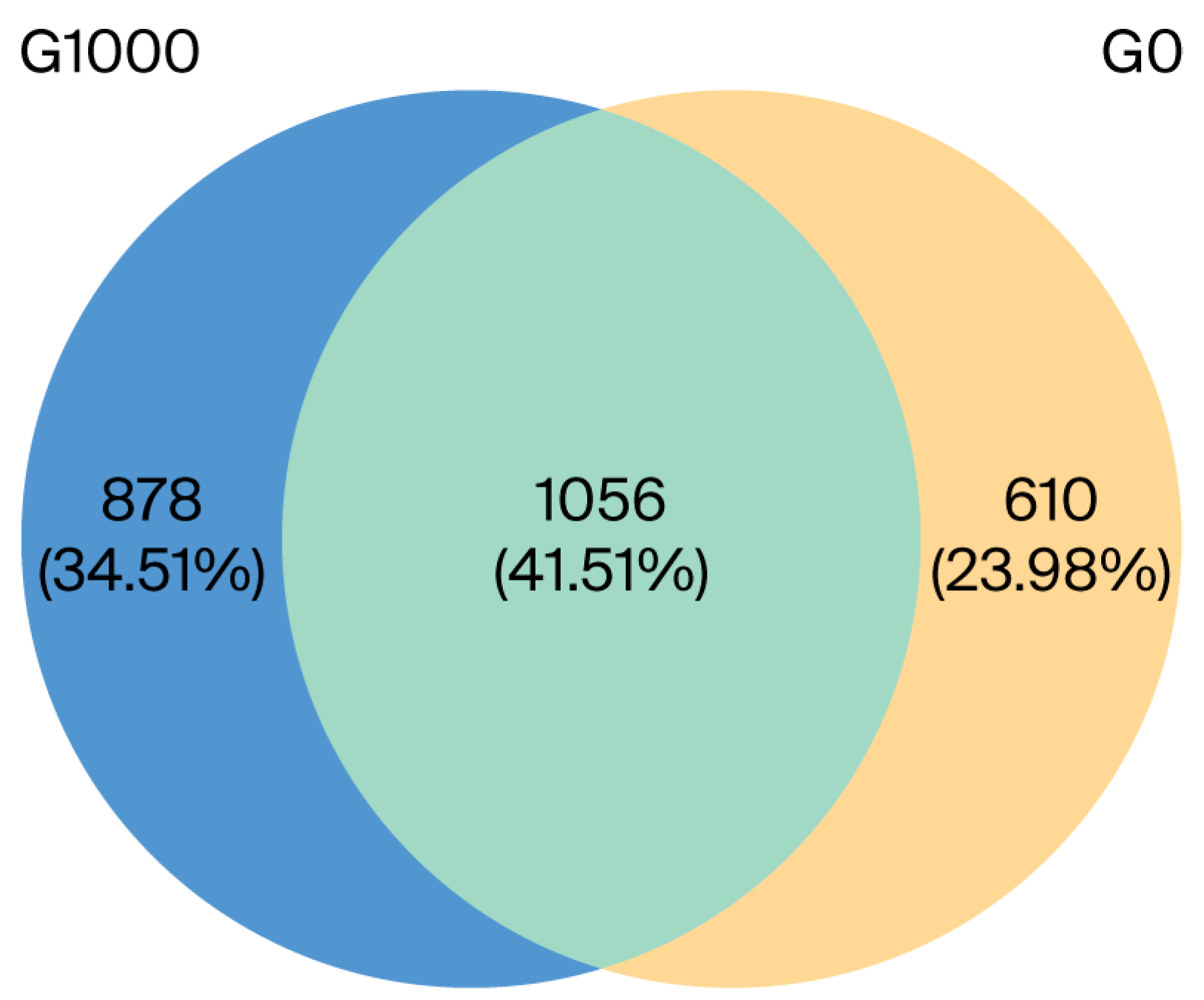
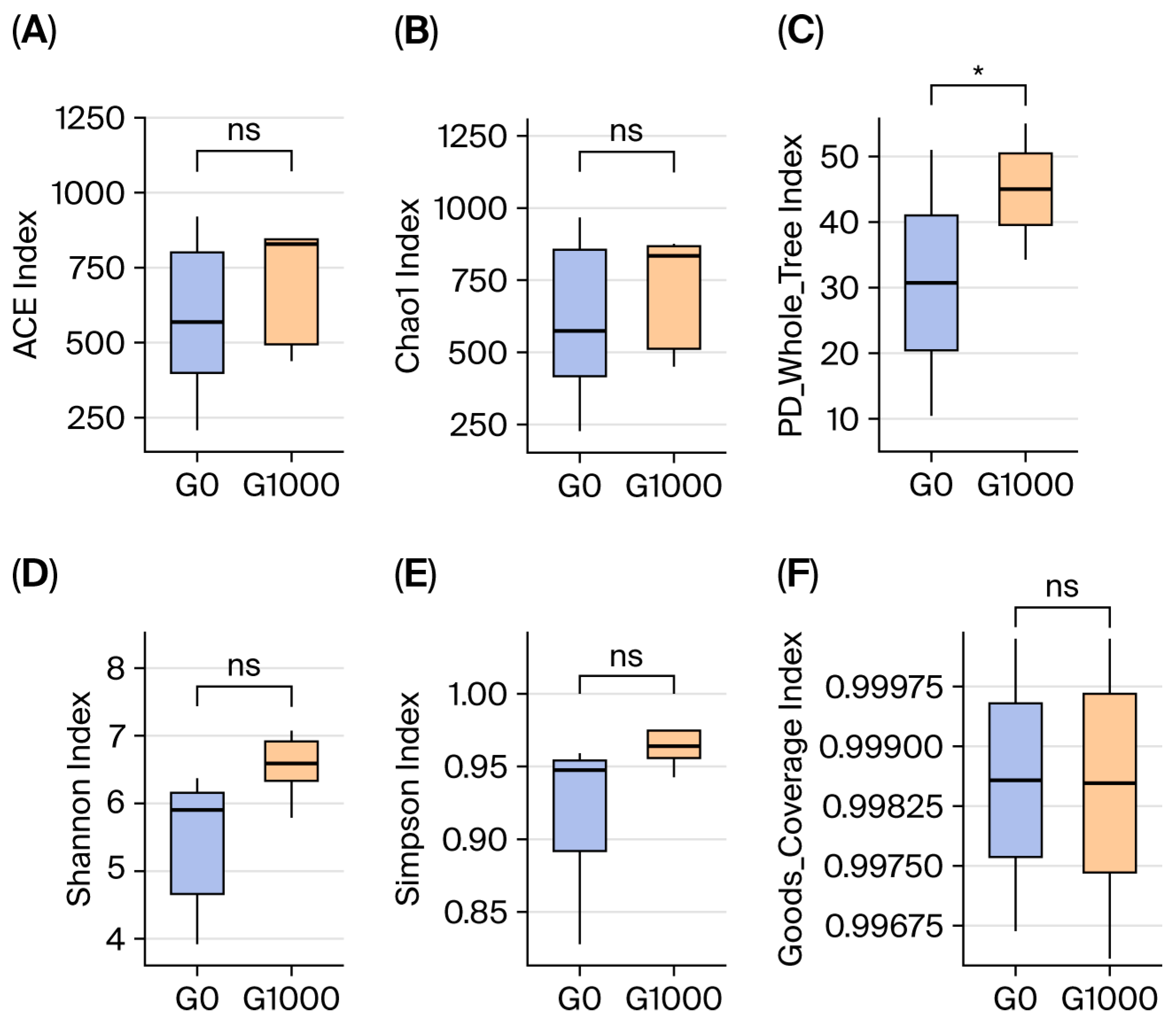
3.6.1. Richness and Diversity
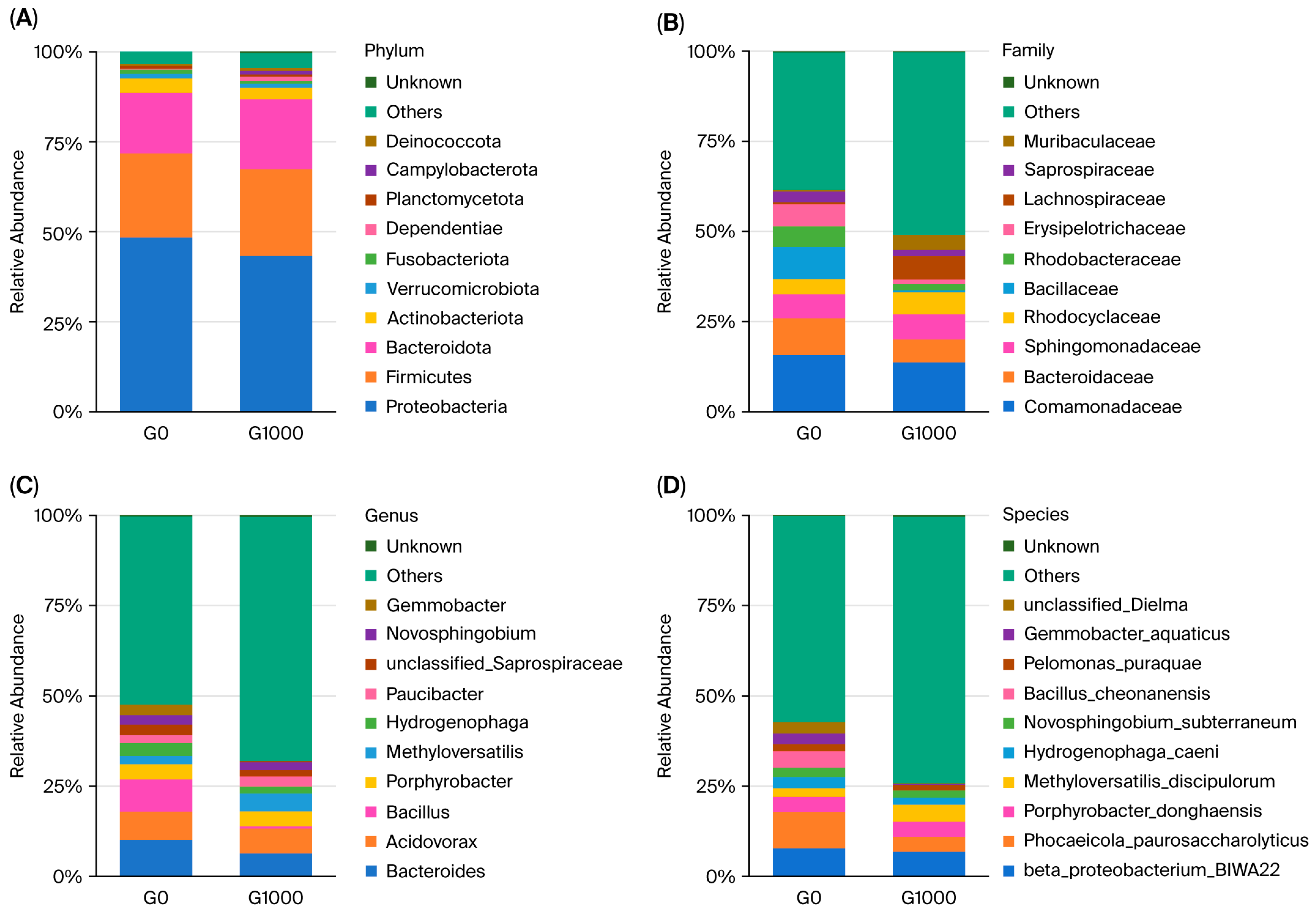
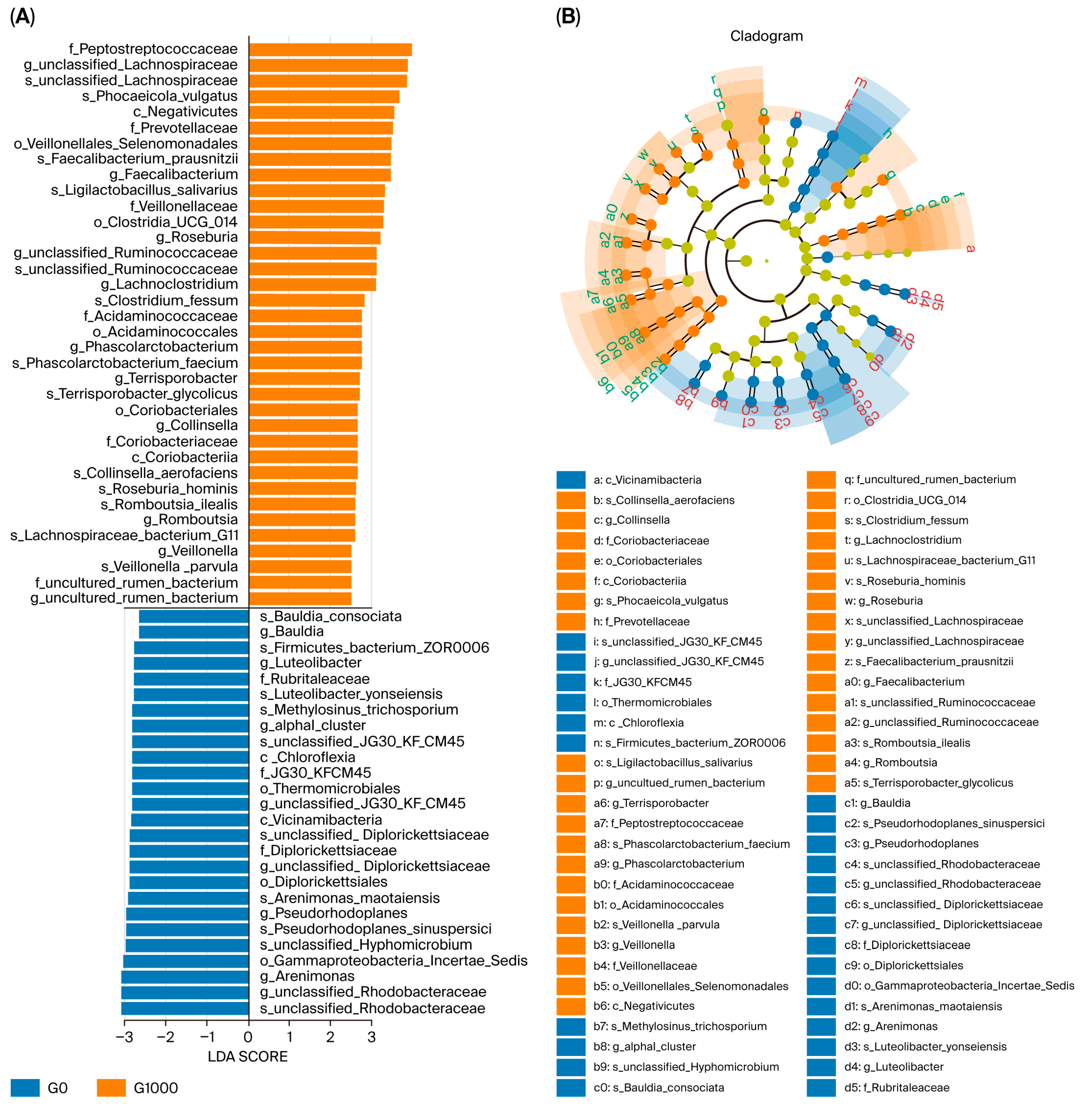
3.6.2. Community Composition and Biomarker Analysis
4. Discussion
4.1. Effects on Growth Performance, Feed Utilization, and Digestive and Metabolic Enzymes
4.2. Effect on Antioxidant Status
4.3. Effects on Intestinal Flora
5. Conclusions
Author Contributions
Funding
Institutional Review Board Statement
Informed Consent Statement
Data Availability Statement
Acknowledgments
Conflicts of Interest
Abbreviations
| ALT | alanine aminotransferase |
| AST | aspartate aminotransferase |
| CAT | catalase |
| CF | condition factor |
| FER | feed efficiency ratio |
| FR | feeding rate |
| G-6-Pase | glucose-6-phosphatase |
| GPx | glutathione peroxidase |
| HG | hepatic glycogen |
| HIS | hepatosomatic index |
| HK | hexokinase |
| HL | hepatic lipase |
| LDA | linear discriminant analysis |
| LDH | lactic dehydrogenase |
| LEfSe | linear discriminant analysis effect size |
| LPL | lipoprotein lipase |
| MDA | malondialdehyde |
| MFI | mesenteric fat index |
| MG | muscle glycogen |
| OUT | operational taxonomic unit |
| PEPCK | phosphoenolpyruvate carboxykinase |
| PK | pyruvate kinase |
| ROS | reactive oxygen species |
| SDH | succinate dehydrogenase |
| SGR | specific growth rate |
| SOD | superoxide dismutase |
| T-AOC | total antioxidant capacity |
| TCA | tricarboxylic acid |
| TL | total lipase |
| TPs | tea polyphenols |
| VSI | viscerosomatic index |
References
- Lin, D.; Mao, Y.Q.; Cai, F.S. Nutritional lipid liver disease of grass carp Ctenopharyngodon idellus (C. et V.). Chin. J. Ocean. Limnol. 1990, 8, 363–373. [Google Scholar] [CrossRef]
- Fisheries and Fisheries Administration of the Ministry of Agriculture and Rural Affairs; National Fisheries Technology Extension Center; China Society of Fisheries. China Fishery Statistics Yearbook; China Agriculture Press: Beijing, China, 2024. [Google Scholar]
- Ashley, P.J. Fish welfare: Current issues in aquaculture. Appl. Anim. Behav. Sci. 2007, 104, 199–235. [Google Scholar] [CrossRef]
- Tian, J.; Xie, N.N.; Xiao, W.F.; Yu, L.J.; Tang, L.; Deng, G.F.; Wen, H.; Li, X.P. Effects of inactivated Lactobacillus plantarum and its metabolites on growth performance and intestinal health of grass carp (Ctenopharyngodon idellus). J. Fish. China 2022, 46, 1980–1991. [Google Scholar] [CrossRef]
- Pandey, V.; Bhat, R.A.H.; Chandra, S.; Tandel, R.S.; Dubey, M.K.; Sharma, P.; Gehlot, B.; Dash, P.; Joshi, R. Clinical signs, lethal dose and histopathological lesions in grass carp, Ctenopharyngodon idellus experimentally infected with Edwardsiella tarda. Microb. Pathog. 2021, 16, 105292. [Google Scholar] [CrossRef] [PubMed]
- Fariya, N.; Kaur, H.; Singh, M.; Abidi, R.; El-Matbouli, M.; Kumar, G. Morphological and Molecular Characterization of a New Myxozoan, Myxobolus grassi sp. nov. (Myxosporea), Infecting the Grass Carp, Ctenopharyngodon idellus in the Gomti River, India. Pathogens 2022, 11, 303. [Google Scholar] [CrossRef]
- Mallick, C.; Sreedevi, A.; Mukherjee, T.K.; Pal, D.; Das, R.; Mondal, S.; Gautam, M. Accessibility, detection, bioaccumulation, concentration and toxicity studies of antibiotics in fish. Aquat. Toxicol. 2025, 287, 107525. [Google Scholar] [CrossRef]
- Liu, F.L. Preparation and Research of Ichthyophthirius multifiliis Nucleic Acid Vaccine. Master’s Thesis, Zhejiang Normal University, Jinhua, China, 2022. [Google Scholar] [CrossRef]
- Johnston, I.A.; Kent, M.P.; Boudinot, P.; Looseley, M.; Bargelloni, L.; Faggion, S.; Merino, G.A.; Ilsley, G.R.; Bobe, J.; Costas, S.; et al. Advancing fish breeding in aquaculture through genome functional annotation. Aquaculture 2024, 583, 740589. [Google Scholar] [CrossRef]
- Weisburger, J.H. Tea and health: The underlying mechanisms. Proc. Soc. Exp. Biol. Med. 1999, 220, 271–275. [Google Scholar] [CrossRef]
- Ma, Y.B.; Zhou, X.Q.; Jiang, W.D.; Wu, P.; Liu, Y.; Ren, H.M.; Jin, X.W.; Lin, F. Tea polyphenols: A promising alternative to antibiotics for preventing bacterial enteritis in grass carp (Ctenopharyngodon idellus). Food Res. Int. 2025, 213, 116575. [Google Scholar] [CrossRef]
- Yang, Z.; Sun, G.; Tao, J.; Tang, W.; Li, W.; Wei, Z.; Yu, Q. Dietary Tea Polyphenols Improve Growth Performance and Intestinal Microbiota Under Chronic Crowding Stress in Hybrid Crucian Carp. Animals 2025, 15, 1983. [Google Scholar] [CrossRef]
- Zhang, N.; Tao, J.; Yu, Q.; Sun, G.; Liu, X.; Tang, W.; Zhang, L.; Yang, Z. Dietary Tea Polyphenols Alleviate Acute-Heat-Stress-Induced Death of Hybrid Crucian Carp HCC2: Involvement of Modified Lipid Metabolisms in Liver. Metabolites 2025, 15, 229. [Google Scholar] [CrossRef] [PubMed]
- Zhao, Z.X.; Zhao, F.; Cairang, Z.M.; Zhou, Z.; Du, Q.; Wang, J.L.; Zhao, F.; Wang, Q.F.; Li, Z.Y.; Zhang, X.P. Role of dietary tea polyphenols on growth performance and gut health benefits in juvenile hybrid sturgeon (Acipenser baerii ♀ × A. schrenckii ♂). Fish Shellfish Immunol. 2023, 139, 108911. [Google Scholar] [CrossRef] [PubMed]
- Zhong, L.; Hu, Y.J.; Hu, Y.; Li, J.L.; Tian, Y.N.; Chen, J.S.; Ai, Q.H.; Xiao, T.Y. Effects of dietary tea polyphenols on growth, immunity and lipid metabolism of juvenile black carp Mylopharyngodon piceus. Aquac. Res. 2020, 51, 569–576. [Google Scholar] [CrossRef]
- Pan, S.M.; Yan, X.B.; Li, T.; Suo, X.X.; Liu, H.; Tan, B.P.; Huang, W.B.; Yang, Y.Z.; Zhang, H.T.; Dong, X.H. Impacts of tea polyphenols on growth, antioxidant capacity and immunity in juvenile hybrid grouper (Epinephelus fuscoguttatus ♀ × E. lanceolatus ♂) fed high-lipid diets. Fish Shellfish Immunol. 2022, 128, 348–359. [Google Scholar] [CrossRef]
- Yu, H.; Sattanathan, G.; Yu, L.; Li, L.; Xiao, Y. Impact of Nutritional Tea Polyphenols on Growth, Feed Efficiency, Biochemical Traits, Antioxidant Capacity, Haematological Parameters and Immunity in Coho Salmon (Oncorhynchus kisutch). Animals 2024, 14, 2104. [Google Scholar] [CrossRef]
- Nootash, S.; Sheikhzadeh, N.; Baradaran, B.; Oushani, A.K.; Moghadam, M.R.M.; Nofouzi, K.; Monfaredan, A.; Aghebati, L.; Zare, F.; Shabanzadeh, S. Green tea (Camellia sinensis) administration induces expression of immune relevant genes and biochemical parameters in Rainbow trout (Oncorhynchus mykiss). Fish Shellfish Immunol. 2013, 35, 1916–1923. [Google Scholar] [CrossRef]
- Mukhtar, H.; Ahmad, N. Tea polyphenols: Prevention of cancer and optimizing health. Am. J. Clin. Nutr. 2000, 71, 1698–1702. [Google Scholar] [CrossRef]
- Negi, T.; Kumar, Y.; Sirohi, R.; Singh, S.; Tarafdar, A.; Pareek, S.; Awasthi, M.K.; Sagar, N.A. Advances in bioconversion of spent tea leaves to value-added products. Bioresour. Technol. 2022, 346, 126409. [Google Scholar] [CrossRef]
- Çakmak, T.G.; Saricaoglu, B.; Ozkan, G.; Tomas, M.; Capanoglu, E. Valorization of tea waste: Composition, bioactivity, extraction methods, and utilization. Food Sci. Nutr. 2024, 12, 3112–3124. [Google Scholar] [CrossRef] [PubMed]
- Chen, L.; Yang, Y.O.; Wan, X.C.; Zhou, Y.B.; Sang, B.Y.; Zhang, J.L. Effects of six kinds of Chinese tea on antioxidant indexes of channel catfish (Letalurus punetaus). Feed Ind. 2015, 36, 18–22. [Google Scholar] [CrossRef]
- Zhang, Y.R.; Gao, K.D.; Ren, Y.H.; Zhang, J.M.; Lu, R.H.; Cao, X.L.; Yang, L.P.; Xu, X.X.; Nie, G.X. Broken Xinyang Maojian tea supplementation in a high-fat diet improves the growth performance, flesh quality and lipid metabolism of Yellow River carp (Cyprinus carpio). Aquac. Rep. 2022, 25, 101236. [Google Scholar] [CrossRef]
- Abdel-Tawwab, M.; Ahmad, M.H.; Seden, M.E.A.; Sakr, S.F.M. Use of Green Tea, Camellia sinensis L., in Practical Diet for Growth and Protection of Nile Tilapia, Oreochromis niloticus (L.), against Aeromonas hydrophila Infection. J. World Aquac. Soc. 2010, 41, 203–213. [Google Scholar] [CrossRef]
- Zheng, Q.M.; Han, C.Y.; Zhong, Y.M.; Wen, R.S.; Zhong, M. Effects of dietary supplementation with green tea waste on growth, digestive enzyme and lipid metabolism of juvenile hybrid tilapia, Oreochromis niloticus × O. aureus. Fish Physiol. Biochem. 2017, 43, 361–371. [Google Scholar] [CrossRef]
- Yue, D.D.; Huang, S.J.; Yang, R.Y.; Sun, Y.N.; Rizwan, M.; Xie, S.Q.; Wan, X.C.; Wang, R.; Yang, Y.O. Effects of tea polyphenols on the growth performance, carbohydrate metabolism of grass carp (Ctenopharyngodon idellus). Aquac. Nutr. 2021, 27, 2344–2354. [Google Scholar] [CrossRef]
- Hwang, J.H.; Lee, S.W.; Rha, S.J.; Yoon, H.S.; Park, E.S.; Han, K.H.; Kim, S.J. Dietary green tea extract improves growth performance, body composition, and stress recovery in the juvenile black rockfish, Sebastes schlegeli. Aquac. Int. 2013, 21, 525–538. [Google Scholar] [CrossRef]
- Standardization Administration of the People’s Republic of China. Tea—Determination of Water Extracts Content; Standards Press of China: Beijing, China, 2013. [Google Scholar]
- Standardization Administration of the People’s Republic of China. Determination of Total Polyphenols and Catechins Content in Tea; Standards Press of China: Beijing, China, 2018. [Google Scholar]
- Standardization Administration of the People’s Republic of China. Tea—Determination of Free Amino Acids Content; Standards Press of China: Beijing, China, 2013. [Google Scholar]
- Standardization Administration of the People’s Republic of China. Tea—Determination of Caffeine Content; Standards Press of China: Beijing, China, 2013. [Google Scholar]
- Standardization Administration of the People’s Republic of China. Determination of Theanine in Tea—Using High Performance Liquid Chromatography; Standards Press of China: Beijing, China, 2017. [Google Scholar]
- AOAC. Official Methods of Analysis of Official Analytical Chemists International, 17th ed.; AOAC International: Gaithersburg, MD, USA, 2003. [Google Scholar]
- Segata, N.; Izard, J.; Waldron, L.; Gevers, D.; Miropolsky, L.; Garrett, W.S.; Huttenhower, C. Metagenomic biomarker discovery and explanation. Genome Biol. 2011, 12, R60. [Google Scholar] [CrossRef] [PubMed]
- Caporaso, J.G.; Kuczynski, J.; Stombaugh, J.; Bittinger, K.; Bushman, F.D.; Costello, E.K.; Fierer, N.; Peña, A.G.; Goodrich, J.K.; Gordon, J.I.; et al. QIIME allows analysis of high-throughput community sequencing data. Nat. Methods 2010, 7, 335–336. [Google Scholar] [CrossRef]
- Kause, A.; Nousiainen, A.; Koskinen, H. Improvement in feed efficiency and reduction in nutrient loading from rainbow trout farms: The role of selective breeding. J. Anim. Sci. 2022, 100, skac214. [Google Scholar] [CrossRef] [PubMed]
- Liang, G.Y.; Li, X.Q.; Yang, H.; Poolsawat, L.; Gao, B.W.; Leng, X.J. Effects of Tea Polyphenol on Growth, Digestion Function, Immune Performance and Disease Resistance Capability of Hybrid Tilapia (Oreochromis niloticus × O. aureus). Chin. J. Anim. Nutr. 2018, 30, 3199–3207. [Google Scholar] [CrossRef]
- He, Q.; Lv, Y.P.; Yao, K. Effects of tea polyphenols on the activities of α-amylase, pepsin, trypsin and lipase. Food Chem. 2007, 101, 1178–1182. [Google Scholar] [CrossRef]
- Rodhi, A.M.; Yap, P.G.; Olalere, O.A.; Gan, C.Y. Unveiling α-Amylase Inhibition: A Bioinformatics Perspective on Peptide Properties and Amino Acid Contributions. J. Mol. Struct. 2024, 1305, 137768. [Google Scholar] [CrossRef]
- Wu, X.L.; He, W.Y.; Wang, W.P.; Luo, X.P.; Cao, H.Y.; Lin, L.X.; Feng, K.Q.; Liu, Z.G. Investigation of the interaction between (−)-epigallocatechin-3-gallate with trypsin and alpha-chymotrypsin. Int. J. Food Sci. Technol. 2013, 48, 2340–2347. [Google Scholar] [CrossRef]
- Sirasunthorn, N.; Jantho, T.; Ubolsaard, T. Catechin detection in tea samples based on catechin-induced conformational changes in papain. J. Food Compos. Anal. 2024, 132, 106313. [Google Scholar] [CrossRef]
- Man, Z.Y.; Feng, Y.; Xiao, J.B.; Yang, H.L.; Wu, X.T. Structural changes and molecular mechanism study on the inhibitory activity of epigallocatechin against α-glucosidase and α-amylase. Front. Nutr. 2022, 9, 948027. [Google Scholar] [CrossRef] [PubMed]
- Liu, J.; Wang, M.Z.; Peng, S.L.; Zhang, G.Y. Effect of Green Tea Catechins on the Postprandial Glycemic Response to Starches Differing in Amylose Content. J. Agric. Food Chem. 2021, 59, 4582–4588. [Google Scholar] [CrossRef]
- Zhang, R.; Liu, L.L.; Wang, X.W.; Guo, C.Y.; Zhu, H. Dietary tea polyphenols induce changes in immune response and intestinal microbiota in Koi carp, cryprinus carpio. Aquaculture 2020, 516, 734636. [Google Scholar] [CrossRef]
- Mao, H.; Zhou, X.H.; Wang, Y.C.; Li, J.; Wu, Q.H.; Bao, S.S.; Jiang, L.; Liu, B. Use of fermented tea residues as a feed additive and effects on growth performance, body composition, intestinal enzyme activities, and inflammatory biomarkers in juvenile largemouth bass (Micropterus salmoides). Aquac. Rep. 2023, 31, 101671. [Google Scholar] [CrossRef]
- De Carvalho, C.V.A.; Bianchini, A.; Tesser, M.B.; Sampaio, L.A. The effect of protein levels on growth, postprandial excretion and tryptic activity of juvenile mullet Mugil platanus (Günther). Aquac. Res. 2010, 41, 511–518. [Google Scholar] [CrossRef]
- Divakaruni, A.S.; Wiley, S.E.; Rogers, G.W.; Andreyev, A.Y.; Petrosyan, S.; Loviscach, M.; Wall, E.A.; Yadava, N.; Heuck, A.P.; Ferrick, D.A.; et al. Thiazolidinediones are acute, specific inhibitors of the mitochondrial pyruvate carrier. Proc. Natl. Acad. Sci. USA 2013, 110, 5422–5427. [Google Scholar] [CrossRef]
- Wang, R.; Chen, L.; Xu, X.Y.; Zhu, Q.; Wang, C.; Huang, S.J.; Rizwan, M.; Yao, F.; Zhong, C.L.; Yan, Y.O. Different responses of grass carp (Ctenopharyngodon idellus) and black carp (Mylopharngodon piceus) to low-protein diets and subsequent recovery. Aquac. Rep. 2022, 28, 101424. [Google Scholar] [CrossRef]
- Enes, P.; Panserat, S.; Kaushik, S.; Oliva-Teles, A. Nutritional regulation of hepatic glucose metabolism in fish. Fish Physiol. Biochem. 2009, 35, 519–539. [Google Scholar] [CrossRef]
- Lee, J.; Choi, J.; Alpergin, E.S.S.; Zhao, L.; Hartung, T.; Scafidi, S.; Riddle, R.C.; Wolfgang, M.J. Loss of Hepatic Mitochondrial Long-Chain Fatty Acid Oxidation Confers Resistance to Diet-Induced Obesity and Glucose Intolerance. Cell Rep. 2017, 20, 655–667. [Google Scholar] [CrossRef]
- Wu, W.Y.; Ji, H. Overwinter Starvation on Biochemical Composition and Transcriptional Level of Glucose-Lipid-Protein Metabolism Related Genes Transcription Level in Grass Carp (Ctenopharyngodon idellus). Int. J. Hydrobiol. 2022, 46, 1618–1630. [Google Scholar] [CrossRef]
- Lim, A.L.L.; Ip, A.L.L. Effect of fasting on glycogen metabolism and activities of glycolytic and gluconeogenic enzymes in the mudskipper Boleophthalmus boddaerti. J. Fish Biol. 1989, 34, 349–367. [Google Scholar] [CrossRef]
- Fynn-Aikins, K.; Hughes, S.G.; Vandenberg, G.W. Protein retention and liver aminotransferase activities in Atlantic salmon fed diets containing different energy sources. Comp. Biochem. Physiol. A Physiol. 1995, 111, 163–170. [Google Scholar] [CrossRef]
- Pozza, E.D.; Dando, I.; Pacchiana, R.; Liboi, E.; Scupoli, M.T.; Donadelli, M.; Palmieri, M. Regulation of succinate dehydrogenase and role of succinate in cancer. Semin. Cell Dev. Biol. 2019, 98, 4–14. [Google Scholar] [CrossRef]
- Szeto, S.S.W.; Reinke, S.N.; Sykes, B.D.; Lemire, B. Mutations in the Saccharomyces cerevisiae Succinate Dehydrogenase Result in Distinct Metabolic Phenotypes Revealed Through H-1 NMR-Based Metabolic Footprinting. J. Phys. Chem. Lett. 2010, 9, 6729–6739. [Google Scholar] [CrossRef]
- Bernatoniene, J.; Kopustinskiene, D.M. The Role of Catechins in Cellular Responses to Oxidative Stress. Molecules 2018, 23, 965. [Google Scholar] [CrossRef]
- Grzesik, M.; Naparło, K.; Bartosz, G.; Sadowska-Bartosz, I. Antioxidant properties of catechins: Comparison with other antioxidants. Food Chem. 2018, 241, 480–492. [Google Scholar] [CrossRef] [PubMed]
- Heim, K.E.; Tagliaferro, A.R.; Bobilya, D.J. Flavonoid antioxidants: Chemistry, metabolism and structure-activity relationships. J. Nutr. Biochem. 2002, 13, 572–584. [Google Scholar] [CrossRef]
- Ma, Y.B.; Zhou, X.Q.; Jiang, W.D.; Wu, P.; Liu, Y.; Li, S.W.; Tang, L.; Zhang, L.; Mi, H.F.; Lin, F. Tea polyphenols protect against Flavobacterium columnare-induced gill injury via suppression of oxidative stress. Int. J. Biol. Macromol. 2024, 254, 127050. [Google Scholar] [CrossRef]
- Ji, R.L.; Li, Y.C.; Li, X.S.; Xiang, X.J.; Li, Y.N.; Zhu, S.; Yang, B.; Zhang, Y.J.; Mai, K.S.; Ai, Q.H. Effects of dietary tea polyphenols on growth, biochemical and antioxidant responses, fatty acid composition and expression of lipid metabolism related genes of large yellow croaker (Larimichthys crocea). Aquac. Res. 2018, 49, 1210–1218. [Google Scholar] [CrossRef]
- Liu, C.; Boeren, S.; Miro Estruch, I.; Rietjens, I.M.C.M. The Gut Microbial Metabolite Pyrogallol Is a More Potent Inducer of Nrf2-Associated Gene Expression Than Its Parent Compound Green Tea (−)-Epigallocatechin Gallate. Nutrients 2022, 14, 3392. [Google Scholar] [CrossRef] [PubMed]
- Gansemer, E.R.; McCommis, K.S.; Martino, M.; King-McAlpin, A.Q.; Potthoff, M.J.; Finck, B.N.; Taylor, E.B.; Rutkowski, D.T. NADPH and Glutathione Redox Link TCA Cycle Activity to Endoplasmic Reticulum Homeostasis. iScience 2020, 23, 101116. [Google Scholar] [CrossRef] [PubMed]
- Labarrere, C.A.; Kassab, G.S. Glutathione: A Samsonian life-sustaining small molecule that protects against oxidative stress, ageing and damaging inflammation. Front. Nutr. 2022, 9, 1007816. [Google Scholar] [CrossRef] [PubMed]
- David, M.; Munaswamy, V.; Halappa, R.; Marigoudar, S.R. Impact of sodium cyanide on catalase activity in the freshwater exotic carp, Cyprinus carpio (Linnaeus). Pestic. Biochem. Phys. 2008, 92, 15–18. [Google Scholar] [CrossRef]
- Shi, Y.; Zhong, L.; Chen, K.J.; Fan, Y.D.; Xie, K.; Zhang, J.Z.; Dai, J.H.; Hu, Y. Sanguinarine attenuates hydrogen peroxide-induced toxicity in liver of Monopterus albus: Role of oxidative stress, inflammation and apoptosis. Fish Shellfish Immunol. 2022, 125, 190–199. [Google Scholar] [CrossRef] [PubMed]
- Tao, Y.; Hua, J.; Lu, S.; Wang, Q.; Li, Y.; Jiang, B.; Dong, Y.; Qiang, J.; Xu, P. Ultrastructural, Antioxidant, and Metabolic Responses of Male Genetically Improved Farmed Tilapia (GIFT, Oreochromis niloticus) to Acute Hypoxia Stress. Antioxidants 2024, 13, 89. [Google Scholar] [CrossRef]
- Zhang, X.; Wang, A.R.; Chang, E.H.; Han, B.; Xu, J.; Fu, Y.; Dong, X.J.; Miao, S.Y. Effects of dietary tryptophan on the antioxidant capacity and immune response associated with TOR and TLRs/MyD88/NF-κB signaling pathways in northern snakehead, Channa argus (Cantor, 1842). Front. Immunol. 2023, 14, 1149151. [Google Scholar] [CrossRef]
- Scibior, D.; Czeczot, H. Catalase: Structure, properties, functions. Postepy Hig. Med. Dosw. (Online) 2006, 60, 170–180. Available online: https://pubmed.ncbi.nlm.nih.gov/16618987/ (accessed on 16 April 2006).
- Lei, Y.J.; Liu, K.F.; Meng, J.; Li, Z.; Huang, R.J. Effect of tea polyphenols on immunity and disease resistance of grass carp. Feed Res. 2020, 43, 54–57. [Google Scholar] [CrossRef]
- Liu, Z.X.; Ke, H.; Hao, L.; Ma, Y.P.; Lin, M. Effect of tea polyphenols on growth performance, antioxidant function and non—Specific immune indexes of tilapia. Guangdong Agric. Sci. 2012, 39, 113–115. [Google Scholar] [CrossRef]
- Li, Y.M.; Chan, H.Y.E.; Huang, Y.; Chen, Z.Y. Green tea catechins upregulate superoxide dismutase and catalase in fruit flies. Mol. Nutr. Food Res. 2007, 51, 546–554. [Google Scholar] [CrossRef] [PubMed]
- Wang, D.X.; Wang, Y.J.; Wan, X.C.; Yang, C.S.; Zhang, J.S. Green tea polyphenol (−)-epigallocatechin-3-gallate triggered hepatotoxicity in mice: Responses of major antioxidant enzymes and the Nrf2 rescue pathway. Toxicol. Appl. Pharmacol. 2015, 283, 65–74. [Google Scholar] [CrossRef] [PubMed]
- Li, M.; Liang, H.; Yang, H.W.; Ding, Q.W.; Xia, R.; Chen, J.; Zhou, W.H.; Yang, Y.L.; Zhang, Z.; Yao, Y.Y.; et al. Deciphering the gut microbiome of grass carp through multi-omics approach. Microbiome 2024, 12, 2. [Google Scholar] [CrossRef] [PubMed]
- Gradisar, H.; Pristovsek, P.; Plaper, A.; Jerala, R. Green tea catechins inhibit bacterial DNA gyrase by interaction with its ATP binding site. J. Med. Chem. 2007, 50, 264–271. [Google Scholar] [CrossRef]
- Cui, Y.; Oh, Y.J.; Lim, J.; Youn, M.; Lee, I.; Pak, H.K.; Park, W.; Jo, W.; Park, S. AFM study of the differential inhibitory effects of the green tea polyphenol (−)-epigallocatechin-3-gallate (EGCG) against Gram-positive and Gram-negative bacteria. Food Microbiol. 2012, 29, 80–87. [Google Scholar] [CrossRef]
- Han, X.B.; Ding, S.J.; Ma, Y.; Fang, J.; Jiang, H.M.; Li, Y.; Liu, G. Lactobacillus plantarum and Lactobacillus brevis Alleviate Intestinal Inflammation and Microbial Disorder Induced by ETEC in a Murine Model. Oxid. Med. Cell. Longev. 2021, 2021, 6867962. [Google Scholar] [CrossRef]
- He, G.L.; Sun, H.; Liao, R.S.; Wei, Y.X.; Zhang, T.T.; Chen, Y.J.; Lin, S.M. Effects of herbal extracts (Foeniculum vulgare and Artemisia annua) on growth, liver antioxidant capacity, intestinal morphology and microorganism of juvenile largemouth bass, Micropterus salmoides. Aquac. Rep. 2022, 23, 101081. [Google Scholar] [CrossRef]
- Heaver, S.L.; Le, H.H.; Tang, P.J.; Baslé, A.; Barone, C.M.; Vu, D.L.; Waters, J.L.; Marles-Wright, J.; Johnson, E.L.; Campopiano, D.J.; et al. Characterization of inositol lipid metabolism in gut-associated Bacteroidetes. Nat. Microbiol. 2022, 7, 986–1000. [Google Scholar] [CrossRef]
- Wang, T.; Zhou, N.N.; Ding, F.F.; Hao, Z.Z.; Galindo-Villegas, J.; Du, Z.Y.; Su, X.Y.; Zhang, M.L. Xylanase enhances gut microbiota-derived butyrate to exert immune-protective effects in a histone deacetylase-dependent manner. Microbiome 2024, 12, 212. [Google Scholar] [CrossRef]
- Tang, Y.P.; Pu, Q.Y.; Zhao, Q.L.; Zhou, Y.F.; Jiang, X.X.; Han, T. Effects of Fucoidan Isolated from Laminaria japonica on Immune Response and Gut Microbiota in Cyclophosphamide-Treated Mice. Front. Immunol. 2022, 13, 916618. [Google Scholar] [CrossRef]
- Rooks, M.G.; Garrett, W.S. Gut microbiota, metabolites and host immunity. Nat. Rev. Immunol. 2016, 16, 341–352. [Google Scholar] [CrossRef]
- Zhao, C.J.; Bao, L.J.; Qiu, M.; Wu, K.Y.; Zhao, Y.H.; Feng, L.J.; Xiang, K.H.; Zhang, N.S.; Hu, X.Y.; Fu, Y.H. Commensal cow Roseburia reduces gut-dysbiosis-induced mastitis through inhibiting bacterial translocation by producing butyrate in mice. Cell Rep. 2022, 41, 111681. [Google Scholar] [CrossRef] [PubMed]
- Franzosa, E.A.; Sirota-Madi, A.; Avila-Pacheco, J.; Fornelos, N.; Haiser, H.J.; Reinker, S.; Vatanen, T.; Hall, A.B.; Mallick, H.; McIver, L.J.; et al. Gut microbiome structure and metabolic activity in inflammatory bowel disease. Nat. Microbiol. 2019, 4, 293–305. [Google Scholar] [CrossRef] [PubMed]
- Ng, S.K.C.; Hamilton, I.R. Lactate Metabolism by Veillonella parvula. J. Bacteriol. 1971, 105, 999–1005. [Google Scholar] [CrossRef]
- Xin, J.J.; Yan, S.H.; Hong, X.S.; Zhang, H.; Zha, J.M. Environmentally relevant concentrations of clozapine induced lipotoxicity and gut microbiota dysbiosis in Chinese rare minnow (Gobiocypris rarus). Environ. Pollut. 2021, 286, 117298. [Google Scholar] [CrossRef] [PubMed]
- Liu, W.K.; Zhang, J.M.; Liu, J.J.; Wang, X.; Dong, L.X.; Gao, X.; Wen, H.; Jiang, M.; Meng, X.L.; Tian, J. Inactivated lactobacillus plantarum promoted growth performance, intestine health and antioxidant capacity of juvenile largemouth bass, Micropterus salmoides. Aquac. Rep. 2024, 36, 102158. [Google Scholar] [CrossRef]
- Li, H.Q.; Zhou, Y.; Ling, H.Y.; Luo, L.; Qi, D.; Feng, L. The effect of dietary supplementation with Clostridium butyricum on the growth performance, immunity, intestinal microbiota and disease resistance of tilapia (Oreochromis niloticus). PLoS ONE 2019, 14, e0223428. [Google Scholar] [CrossRef]
- Martinez-Garcia, M.; Brazel, D.M.; Swan, B.K.; Arnosti, C.; Chain, P.S.G.; Reitenga, K.G.; Xie, G.; Poulton, N.J.; Gomez, M.L.; Masland, D.E.D.; et al. Capturing Single Cell Genomes of Active Polysaccharide Degraders: An Unexpected Contribution of Verrucomicrobia. PLoS ONE 2012, 7, e35314. [Google Scholar] [CrossRef]
- Xing, P.; Hahnke, R.L.; Unfried, F.; Markert, S.; Huang, S.X.; Barbeyron, T.; Harder, J.; Becher, D.; Schweder, T.; Glöckner, F.O. Niches of two polysaccharide-degrading Polaribacter isolates from the North Sea during a spring diatom bloom. ISME J. 2015, 9, 1410–1422. [Google Scholar] [CrossRef] [PubMed]
- Gioda, C.R.; Pretto, A.; Freitas, C.S.; Leitemperger, J.; Loro, V.L.; Lazzari, R.; Lissner, L.A.; Baldisserotto, B.; Salbego, J. Different feeding habits influence the activity of digestive enzymes in freshwater fish. Cienc. Rural 2017, 47, e20160113. [Google Scholar] [CrossRef]



| Ingredients (%) | G0 | G500 | G1000 | G2000 | G4000 | G8000 |
|---|---|---|---|---|---|---|
| White fishmeal 1 | 15 | 15 | 15 | 15 | 15 | 15 |
| Soybean meal 2 | 42 | 42 | 42 | 42 | 42 | 42 |
| Rapeseed meal 3 | 10 | 10 | 10 | 10 | 10 | 10 |
| Cottonseed meal 4 | 8 | 8 | 8 | 8 | 8 | 8 |
| α-starch 5 | 4 | 4 | 4 | 4 | 4 | 4 |
| Wheat meal 6 | 7.5 | 7.5 | 7.5 | 7.5 | 7.5 | 7.5 |
| Soybean oil 7 | 3 | 3 | 3 | 3 | 3 | 3 |
| Cellulose 8 | 7 | 6.95 | 6.90 | 6.80 | 6.60 | 6.20 |
| Ca(H2PO4)2 9 | 1.6 | 1.6 | 1.6 | 1.6 | 1.6 | 1.6 |
| Choline Chloride 9 | 0.3 | 0.3 | 0.3 | 0.3 | 0.3 | 0.3 |
| Vitamin C 9 | 0.1 | 0.1 | 0.1 | 0.1 | 0.1 | 0.1 |
| Mineral premix 10 | 0.3 | 0.3 | 0.3 | 0.3 | 0.3 | 0.3 |
| Vitamin premix 11 | 1.2 | 1.2 | 1.2 | 1.2 | 1.2 | 1.2 |
| Green tea | 0 | 0.05 | 0.10 | 0.20 | 0.40 | 0.80 |
| Proximate composition | ||||||
| Crude protein (%) | 35.70 | 35.74 | 35.65 | 35.58 | 35.64 | 35.54 |
| Crude lipid (%) | 5.02 | 5.14 | 5.08 | 4.97 | 4.94 | 4.88 |
| Ash (%) | 6.45 | 6.38 | 6.49 | 6.36 | 6.41 | 6.50 |
| Gross energy (MJ kg−1) | 15.13 | 15.09 | 15.11 | 14.94 | 15.15 | 14.98 |
| Group | G0 | G500 | G1000 | G2000 | G4000 | G8000 |
|---|---|---|---|---|---|---|
| IBW (g) | 7.46 ± 0.13 | 7.46 ± 0.02 | 7.44 ± 0.10 | 7.44 ± 0.10 | 7.39 ± 0.07 | 7.44 ± 0.08 |
| FBW (g) | 36.32 ± 2.27 a | 37.02 ± 2.79 a | 37.54 ± 2.52 a | 37.14 ± 2.87 a | 31.83 ± 2.61 b | 29.78 ± 1.57 b |
| SGR (% d−1) | 2.93 ± 0.15 a | 2.96 ± 0.15 a | 3.01 ± 0.13 a | 2.97 ± 0.17 a | 2.70 ± 0.16 ab | 2.57 ± 0.12 b |
| FR (% bw d−1) | 3.16 ± 0.05 a | 3.15 ± 0.10 a | 3.09 ± 0.08 a | 3.19 ± 0.07 a | 3.36 ± 0.03 b | 3.47 ± 0.04 c |
| FER (%) | 75.03 ± 1.13 a | 77.83 ± 3.24 ab | 78.64 ± 1.01 b | 75.55 ± 2.35 ab | 68.08 ± 2.32 c | 63.51 ± 1.39 c |
| CF (g cm−3) | 1.87 ± 0.04 | 1.81 ± 0.09 | 1.84 ± 0.01 | 1.83 ± 0.06 | 1.89 ± 0.05 | 1.90 ± 0.02 |
| VSI (%) | 11.27 ± 0.15 | 10.78 ± 0.31 | 11.18 ± 1.08 | 11.04 ± 0.33 | 10.93 ± 0.50 | 11.13 ± 0.34 |
| HIS (%) | 1.78 ± 0.05 a | 1.66 ± 0.04 ab | 1.54 ± 0.06 b | 1.62 ± 0.05 ab | 1.69 ± 0.03 ab | 1.79 ± 0.10 a |
| MFI (%) | 2.51 ± 0.30 | 2.44 ± 0.16 | 2.32 ± 0.38 | 2.32 ± 0.49 | 2.31 ± 0.32 | 2.64 ± 0.28 |
| Group | Moisture (%) | Crude Protein (%) | Crude Lipid (%) | Ash (%) |
|---|---|---|---|---|
| G0 | 77.44 ± 0.48 | 16.73 ± 0.55 | 4.48 ± 0.59 | 2.51 ± 0.19 |
| G500 | 78.36 ± 0.64 | 16.14 ± 0.41 | 4.51 ± 0.65 | 2.61 ± 0.04 |
| G1000 | 77.97 ± 0.88 | 17.10 ± 1.08 | 4.60 ± 0.40 | 2.62 ± 0.35 |
| G2000 | 78.06 ± 0.61 | 16.44 ± 0.40 | 4.85 ± 0.28 | 2.34 ± 0.15 |
| G4000 | 77.82 ± 0.40 | 16.72 ± 0.84 | 4.49 ± 0.42 | 2.59 ± 0.05 |
| G8000 | 77.32 ± 0.09 | 17.25 ± 0.95 | 4.82 ± 0.37 | 2.57 ± 0.08 |
| Group | Trypsin (U mg−1 Prot) | Lipase (U g−1 Prot) | Amylase (U mg−1 Prot) |
|---|---|---|---|
| G0 | 28.67 ± 1.11 a | 16.66 ± 3.04 | 88.81 ± 4.18 a |
| G500 | 29.15 ± 1.67 ab | 16.76 ± 0.82 | 80.58 ± 5.95 ab |
| G1000 | 31.01 ± 1.09 b | 16.86 ± 1.60 | 75.52 ± 4.03 b |
| G2000 | 28.58 ± 0.94 ab | 16.64 ± 1.65 | 81.44 ± 3.05 ab |
| G4000 | 27.64 ± 2.66 ab | 16.23 ± 2.21 | 80.16 ± 5.32 ab |
| G8000 | 25.20 ± 2.37 a | 15.79 ± 1.37 | 60.12 ± 5.56 c |
| Group | G0 | G500 | G1000 | G2000 | G4000 | G8000 |
|---|---|---|---|---|---|---|
| HK (U g−1 prot) | 4.45 ± 0.51 a | 5.82 ± 0.32 b | 6.22 ± 0.40 b | 5.74 ± 0.46 b | 5.43 ± 0.67 ab | 5.41 ± 0.48 ab |
| PK (U g−1 prot) | 10.52 ± 0.37 a | 11.87 ± 0.53 b | 12.70 ± 0.82 b | 11.88 ± 3.44 ab | 11.24 ± 2.36 ab | 11.85 ± 1.63 ab |
| LDH (U mg−1 prot) | 9.49 ± 1.07 | 9.04 ± 1.10 | 9.48 ± 0.60 | 8.25 ± 1.31 | 10.30 ± 0.93 | 10.08 ± 1.50 |
| SDH (U mg−1 prot) | 6.74 ± 0.37 a | 7.50 ± 0.93 a | 6.63 ± 0.45 a | 6.13 ± 0.53 ab | 6.23 ± 0.34 ab | 5.35 ± 0.29 b |
| PEPCK (U g−1 prot) | 43.69 ± 3.16 a | 42.50 ± 2.42 a | 43.56 ± 2.04 a | 41.80 ± 5.56 ab | 36.86 ± 2.21 bc | 32.89 ± 1.54 c |
| G-6-Pase (U g−1 prot) | 109.45 ± 5.12 a | 118.01 ± 10.87 a | 115.72 ± 7.04 a | 110.93 ± 6.08 a | 90.17 ± 6.56 b | 82.06 ± 5.78 b |
| ALT (U g−1 prot) | 24.36 ± 2.52 a | 24.88 ± 3.04 a | 24.22 ± 4.08 a | 24.06 ± 3.41 a | 22.22 ± 3.53 a | 15.09 ± 2.96 b |
| AST (U g−1 prot) | 24.00 ± 4.26 a | 27.07 ± 3.51 a | 26.25 ± 3.08 a | 24.05 ± 2.58 a | 26.06 ± 3.11 a | 37.92 ± 3.54 b |
| LPL (U g−1 prot) | 1.60 ± 0.07 a | 1.73 ± 0.04 ab | 1.86 ± 0.11 b | 1.86 ± 0.10 b | 1.63 ± 0.18 ab | 1.21 ± 0.07 c |
| HL (U g−1 prot) | 3.39 ± 0.11 | 3.48 ± 0.32 | 3.52 ± 0.41 | 3.11 ± 0.23 | 3.52 ± 0.36 | 3.26 ± 0.44 |
| TL (U g−1 prot) | 4.99 ± 0.12 | 5.21 ± 0.28 | 5.38 ± 0.31 | 4.97 ± 0.28 | 5.15 ± 0.53 | 4.47 ± 0.51 |
| HG (mg g−1) | 10.49 ± 1.29 a | 7.23 ± 0.71 b | 5.67 ± 0.39 c | 6.85 ± 0.92 bc | 6.92 ± 1.00 bc | 6.87 ± 0.57 bc |
| MG (mg g−1) | 0.30 ± 0.06 | 0.26 ± 0.02 | 0.27 ± 0.02 | 0.26 ± 0.05 | 0.25 ± 0.05 | 0.30 ± 0.02 |
| SOD (U mg−1 Prot) | MDA (nmol mg−1 Prot) | CAT (U mg−1 Prot) | T-AOC (U mg−1 Prot) | GSH (μmol g−1 Prot) | GPx (U mg−1 Prot) | |
|---|---|---|---|---|---|---|
| G0 | 200.36 ± 7.54 a | 5.49 ± 0.56 | 30.02 ± 2.30 a | 3.19 ± 0.21 a | 25.24 ± 2.17 a | 1144.39 ± 127.21 a |
| G500 | 246.05 ± 11 b | 5.37 ± 0.74 | 46.66 ± 6.13 b | 4.11 ± 0.13 b | 26.35 ± 3.09 a | 1480.74 ± 132.08 b |
| G1000 | 247.51 ± 13.1 b | 6.40 ± 0.55 | 39.16 ± 4.01 b | 4.42 ± 0.24 b | 25.80 ± 1.34 a | 1527.40 ± 160.25 b |
| G2000 | 247.56 ± 8.25 b | 6.54 ± 0.68 | 31.39 ± 4.21 a | 4.16 ± 0.3 b | 22.14 ± 3.47 ab | 1357.03 ± 102.56 ab |
| G4000 | 255.07 ± 14.33 b | 5.00 ± 0.60 | 29.66 ± 1.49 a | 4.11 ± 0.34 b | 20.88 ± 2.49 ab | 1410.75 ± 156.25 ab |
| G8000 | 249.83 ± 13.78 b | 4.96 ± 0.66 | 22.61 ± 3.67 c | 4.01 ± 0.26 b | 18.98 ± 2.53 b | 1517.55 ± 91.74 b |
Disclaimer/Publisher’s Note: The statements, opinions and data contained in all publications are solely those of the individual author(s) and contributor(s) and not of MDPI and/or the editor(s). MDPI and/or the editor(s) disclaim responsibility for any injury to people or property resulting from any ideas, methods, instructions or products referred to in the content. |
© 2025 by the authors. Licensee MDPI, Basel, Switzerland. This article is an open access article distributed under the terms and conditions of the Creative Commons Attribution (CC BY) license (https://creativecommons.org/licenses/by/4.0/).
Share and Cite
Li, Y.; Yang, R.; Zhu, S.; Wang, C.; Wang, R.; Yue, D.; Wang, Y.; Yang, Y. Dietary Green Tea Enhances the Growth, Antioxidant Capacity, and Abundance of Beneficial Intestinal Flora of Grass Carp (Ctenopharyngodon idellus). Animals 2025, 15, 3595. https://doi.org/10.3390/ani15243595
Li Y, Yang R, Zhu S, Wang C, Wang R, Yue D, Wang Y, Yang Y. Dietary Green Tea Enhances the Growth, Antioxidant Capacity, and Abundance of Beneficial Intestinal Flora of Grass Carp (Ctenopharyngodon idellus). Animals. 2025; 15(24):3595. https://doi.org/10.3390/ani15243595
Chicago/Turabian StyleLi, Yuyan, Ruiyi Yang, Shaoyu Zhu, Cong Wang, Rui Wang, Dingding Yue, Yuning Wang, and Yanou Yang. 2025. "Dietary Green Tea Enhances the Growth, Antioxidant Capacity, and Abundance of Beneficial Intestinal Flora of Grass Carp (Ctenopharyngodon idellus)" Animals 15, no. 24: 3595. https://doi.org/10.3390/ani15243595
APA StyleLi, Y., Yang, R., Zhu, S., Wang, C., Wang, R., Yue, D., Wang, Y., & Yang, Y. (2025). Dietary Green Tea Enhances the Growth, Antioxidant Capacity, and Abundance of Beneficial Intestinal Flora of Grass Carp (Ctenopharyngodon idellus). Animals, 15(24), 3595. https://doi.org/10.3390/ani15243595