1. Introduction
Corn, an annual grass herb, is the most widely cultivated grain in the world. Its high yield, diverse sources, and low price make it the most processed crop with the longest industrial chain, earning it the title of the “king of grains”. Its applications span food production, animal feed, and various industrial uses [
1]. In China, corn production has reached 260 million tons, with feed accounting for 71% of total corn demand. Corn by-products include corn steep liquor, corn husks, corn protein meal, and corn germ meal. The deep-processed products of corn are utilized in various industries, including food, textiles, automotive, electronics, and medicine [
2]. As by-products of corn, corncobs and corn steep liquor represent significant resource potential. China generates 65 million tons of corncobs annually; however, most are discarded as agricultural waste, resulting in limited utilization [
3], Corncobs are rich in crude protein, crude fiber, crude fat, minerals, and other nutrients, and they can serve as a potential source of roughage for animal feed [
4].
Corncobs are the residual husks after corn is harvested, accounting for approximately 20% of the whole corn [
5]. They consist of a hard outer shell and a complex, internal structure primarily composed of cellulose and hemicellulose. Corncobs exhibit strong water absorption, a uniform structure, good toughness, and high wear resistance, making them challenging to crush [
6]. Due to their high fiber content and poor palatability as feed, livestock often encounter issues, such as selective feeding and leftover feed, which greatly limits the utilization of corncobs as roughage [
7]. Studies have indicated that fermentation of corncobs leads to a looser structure, with more porous surfaces and rough textures, suggesting that the breakdown of cellulose, hemicellulose, and lignin facilitates better microbial utilization and potentially improves their palatability [
8]. Microbial fermentation can balance the nutritional structure of feed, enhance palatability, increase feed efficiency, and reduce the prevalence of intestinal pathogens. The fermentation process softens the texture of corncob and enhances feed palatability [
9]. Research findings have demonstrated that, compared with the conventional silage group, dairy cows supplemented with corncob and corn husk silage exhibited a 2.42% increase in milk production, indicating that the nutritional value of corncob and corn husk silage surpasses that of traditional corn stover silage [
10]. As an unconventional and low-cost feed resource, corncob can effectively replace corn silage, alleviating shortages of traditional feed materials such as corn and soybean meal [
11]. However, corncobs have low crude protein, and their fibers are not easily utilized. Adding corn steep liquor can enhance the nutritional components of the feed and make better use of resources.
Corn steep liquor (CSL) is a by-product of wet processing of corn starch, produced by soaking corn in a sulfite solution [
12]. This by-product CSL is rich in soluble protein, sugar, vitamins, minerals, and other nutrients [
13], making it a valuable and cost-effective nutrient source for antibiotic fermentation and MSG production [
14]. CSL can be produced at a low cost, it has been proposed as a nitrogen source for the biochemical industry to replace more expensive nitrogen sources. It is a mixture of corn extracts that are steeped in water, with the soluble solids varying from 3% to 12% (dry basis), and it is a good source of sugar 2.5% (dry basis), organic acids 26% (dry basis), crude protein 47% (dry basis), minerals, and vitamins, which makes it highly beneficial as a source of nutrients for microorganisms [
15]. Studies show that supplementing urea-treated wheat straw with CSL improves the digestibility of dry matter, organic matter, crude fiber, and crude protein in buffalo [
16]. Experiments were conducted with mixed CSL with corn straw for silage at varying CSL concentrations of 0%, 15%, 20%, 25%, and 30%. The results showed that a CSL concentration of 15–20% yielded the best fermentation quality with higher protein levels in the straw, while higher CSL proportions inhibited lactic acid bacteria growth and impaired feed fermentation [
17]. Research has shown that CSL could effectively replace 75% of fishmeal without negatively impacting fish growth. Dietary CSL supplementation improved the protein and fat content at slaughter and elevated nutritional quality [
18]. The addition of CSL to fermented apple residue can improve the nutritional conditions for microbial growth in the fermentation substrate. This promotes the proliferation of microorganisms, stimulates the development of enzyme-producing fungi, and increases the synthesis and secretion of extracellular enzymes. As a result, it facilitates the hydrolysis of macromolecular carbohydrates in apple residue and boosts the production of single-cell proteins [
19]. CSL is rich in vitamins, serving as an effective growth promoter for microorganisms. Through fermentation, it increases the crude protein content in feed, supports microbial growth, and provides a nitrogen source for feed supplementation [
20]. However, little information is available relating to the microbial community and ruminal degradation characteristics during the ensiling of corncob. With the rapid extension of cattle and sheep farming and the rising cost of forage, feed expenses have surged. The rational development and utilization of unconventional feed sources, such as agricultural and forestry by-products, can diversify forage options, alleviate the shortage of conventional feed materials, reduce feed costs, and generate significant economic value [
21].
In this study, corncobs were used as the feed substrate for ensiling, supplemented with varying proportions of CSL and microbial inoculants. The objective was to investigate the effects of varying CSL addition levels on the silage quality and microbial community of corncob. By assessing these variations’ impact on silage quality and microbial flora, this research strives to convert agricultural waste, such as corn steep liquor and corncobs, into usable feed, thereby enhancing the efficiency of corn resource utilization. Ultimately, it aims to provide a theoretical foundation for the feed utilization of corn steep liquor and corncobs.
2. Materials and Methods
2.1. Ethics Statement
All animals involved in this experiment were cared for in accordance with the guidelines of the Biology Ethics Committee of Shihezi University, Shihezi, Xinjiang, China. The experimental procedures were reviewed and approved by the committee (A2025-713).
2.2. Materials Preparation
Corncobs were collected from Bole Zonghai Jiahui Feed Company in May 2024 and crushed to a size of 1–3 cm. Corn steep liquor was purchased from Xinjiang Wujiaqu Meihua Biological Company; its production batch number was YL01-241005. All these raw materials were then transported to the experimental station for fermentation experiments. The nutritional composition of raw materials is shown in
Table 1.
2.3. Fermentation Process
A single-factor experimental design was employed in this study. The control group (CON) was corncob silage without additive supplementation, while L1, L2, L3, and L4 represented experimental groups, with corn steep liquor in varying concentration gradients (L1: 5%, L2: 10%, L3: 15%, L4: 20%, based on total weight) added into the corn silage. For each treatment group, 0.5% microbial preparations (including Saccharomyces cerevisiae at an application rate of 2.5 × 10⁸ CFU/mL, Bacillus subtilis at an application rate of 5.5 × 10⁸ CFU/mL, Lactobacillus plantarum at an application rate of 2.5 × 10⁸ CFU/mL, Geotrichum candidum at an application rate of 7.5 × 10⁸ CFU/mL, and Candida utilis at an application rate of 1.0 × 10⁸ CFU/mL) were added as inoculum. All strains were purchased from the Institute of Microbiology, Chinese Academy of Sciences (CAS) and along with 0.2% salt (based on total weight) were added as energy source for microbes. The samples were evenly mixed until the moisture content reached 65%, with a total weight of 1000 g per group, and five repetitions were conducted. After thorough mixing, samples were placed into polyethylene vacuum bags, sealed with a vacuum packaging machine, and fermented under dark conditions at room temperature for 45 days.
2.4. Chemical Composition Analysis
After 45 days of fermentation, 200 g samples from each group were dried in the oven at 65 °C for 48 h to determine the dry matter (DM) content. Crude protein was determined using an N310 automatic Kjeldahl nitrogen analyzer, and was calculated by multiplying TN by 6.25 [
22]. Soluble sugars were determined using the anthrone–sulfuric acid method, while neutral detergent fiber (NDF) and acid detergent fiber (ADF) contents were assessed according to the Van Soest method [
23]. Extract content was detected via the Soxhlet method, and crude ash was determined based on the GB/T 23742-2009 standard [
24].
2.5. Fermentation Quality Analysis
After 45 days of silage, 20 g samples were taken from each treatment and mixed with 180 mL of distilled water. The mixture was stored in a refrigerator at 4 °C for 24 h and then filtered through four layers of gauze and qualitative filter paper. The resulting filtrate was defined as the feed extract. The pH value of this extract was measured using a pH meter (PHBJ- 260F; Shanghai INESA Scientific Instrument Co., Ltd., Shanghai, China), while the ammonia nitrogen (NH
3-N) content was analyzed using colorimetry, specifically, the phenol–hypochlorite method [
25]. Volatile acids were determined using a high-efficiency gas chromatograph (Agilent Technologies 7890A, Santa Clara, CA, USA), and lactic acid content was assessed using a lactic acid kit from Nanjing Jiancheng Bioengineering Institute.
2.6. Microbial Community Analysis
For this procedure, 20 g of silage corncob was placed in a conical flask with 180 mL of ultra-pure water, soaked in a shaker at 4 °C for 4 h, then filtered through four layers of gauze and qualitative filter paper. The mixture was centrifuged at 10,000 rpm (≈12,800× g) for 15 min at 4 °C for DNA extraction and collect the supernatant solution. Microbial DNA was isolated according to the Fast DNA ®Spin Kit for Soil (Shanghai BIOZERON Co, Ltd., Shanghai, China), with quality assessed through agarose gel electrophoresis. DNA concentration and purity were determined using a Nano Drop 2000. PCR amplification of the V3–V4 regions of bacterial 16S rRNA genes was accomplished using primers 341F (5’- CCTAYGGGRBGCASCAG-3’) and 806R (5’- GGACTACNNGGGTATCTAAT-3’). The PCR products were quantified using a Quanti Fluor™ ST Blue fluorescence quantification system (Promega, Madison, WI, USA) and mixed according to the sequencing volume requirements. Finally, a PE250 library was constructed, and sequencing was conducted by Shanghai Ling En Biotechnology Co. Ltd (Shanghai, China). The original sequencing reads have been archived in the NCBI Sequence Read File (SRA) database. Sequencing was performed on the Illumina PE250 platform (Shanghai BIOZERON Co, Ltd., Shanghai, China). The obtained data were analyzed using QIIME2 software. The generated sequence data are available in the Sequence Read File (SRA) under the accession number PRJNA1269722.
2.7. Ruminal Degradation Analysis
Three rumen-cannulated Kazakh sheep (12-month-old, 25 ± 5 kg) were used in the in situ trial to determine the digestibility of the nutrients. The animals were raised in the experimental animal station of Shihezi University and underwent quarantine and deworming before the trial. Animals were fed twice daily at scheduled times (9:00 and 18:00), with free access to water. The basal diet was formulated according to the nutritional requirements specified in NY/T816-2021, maintaining a concentrate-to-roughage ratio of 4:6 [
26]. Dietary composition is shown in
Table 2.
The ruminal degradation rate was determined using the in vivo method, also referred to as the in situ nylon bag technique. For this purpose, 3 g of air-dried samples were placed into labeled nylon bags (12 × 8 cm, 40–50 µm pore size), which were subsequently sewn shut. Each sample was repeated three times. Each set of three parallel samples was attached to one end of a plastic hose, with the other end secured to a thick nylon rope, which was then fixed on the iron ring at the outer end of the rumen fistula to prevent slipping. After being placed in the rumen for 4, 8, 12, 24, 36, and 48 h, feeds were removed and washed under cold water for 10-15 min until clear. At the zero-hour mark, the sample were placed in a 37 °C water bath, stirred slowly every 5 min, and removed after 30 min. The samples were rinsed slowly under running water until clear, and the rinsed nylon bags were placed in an oven to dry for 24 h before weighing. Parameters such as a, b, c, and the effective degradation rate (ED) of DM, NDF, ADF, and CP were determined. The ruminal disappearance rate was calculated as follows:
where A represents the nutrient disappearance rate (%), B represents the initial nutrient content (g), and C represents the post-degradation nutrient content (g). The rumen degradation rate was calculated via the following equation:
where y represents the degradation rate after t hours, a represents the rapidly degraded portion, b represents the slow degradation portion, c represents the degradation velocity constant of the slow degradation portion. The effective degradation rate of the sample was calculated as follows:
where ED is the effective degradation rate in the rumen and k is the feed outflow rate of 0.0253/h in this experiment [
27].
2.8. Statistical Analysis
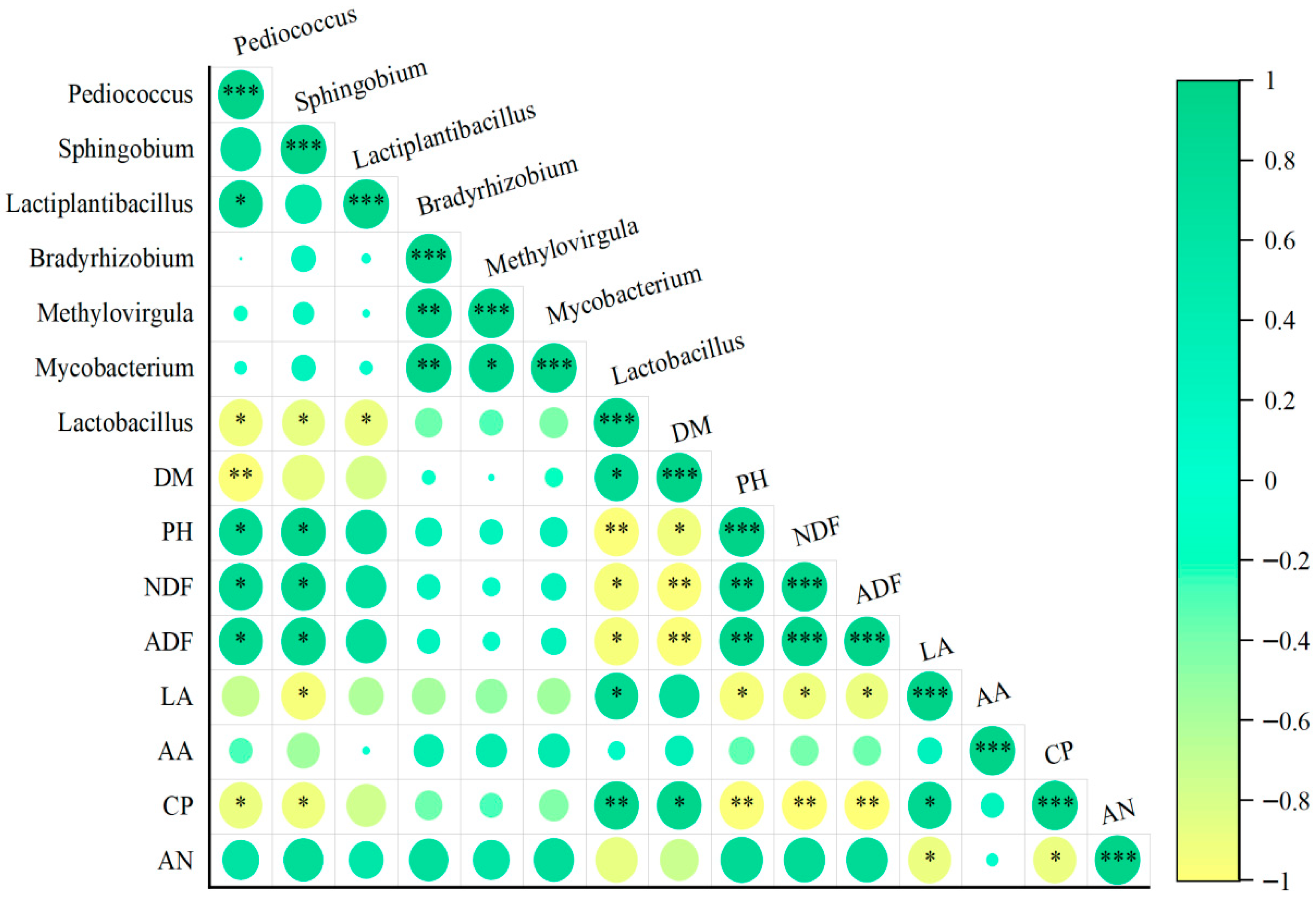
In this experiment, SPSS (version SPSS 27.0, Chicago, IL, USA) was used for univariate analysis of variance to examine the effects of varying proportions of corn steep liquor on fermentation quality and microflora in corncobs. The data of the rumen degradation rate were analyzed by one-way ANOVA and a nonlinear model. The correlation diagram of microbial communities was created using Origin 2021 (OriginLab Corporation, Northampton, MA, USA), while multiple comparisons were conducted through Duncan’s method. A significance level of p < 0.05 was established to denote significant differences, and p < 0.01 indicates an extremely significant difference. Results are presented as means and standard error of the mean (SEM).