Comparing Morphometric and Mitochondrial DNA Data from Honeybees and Honey Samples for Identifying Apis mellifera ligustica Subspecies at the Colony Level
by
 , , , , , , , and
Valeria Taurisano
1 ,
,
Anisa Ribani
1 ,
,
Valerio Joe Utzeri
1,
Dalal Sami
1,
Kate Elise Nelson Johnson
1,
Giovanni Formato
2 ,
,
Marcella Milito
2,
Giuseppina Schiavo
1,
Samuele Bovo
1 ,
,
Francesca Bertolini
1 and
Luca Fontanesi
1,* 1
Animal and Food Genomics Group, Division of Animal Sciences, Department of Agricultural and Food Sciences, University of Bologna, Viale Giuseppe Fanin 46, 40127 Bologna, Italy
2
Istituto Zooprofilattico Sperimentale del Lazio e della Toscana “M. Aleandri”, Via Appia Nuova 1411, 00178 Roma, Italy
*
Author to whom correspondence should be addressed.
Animals 2025, 15(12), 1743; https://doi.org/10.3390/ani15121743
Submission received: 24 April 2025
/
Revised: 9 June 2025
/
Accepted: 11 June 2025
/
Published: 12 June 2025
(This article belongs to the Section Animal Genetics and Genomics)
Simple Summary
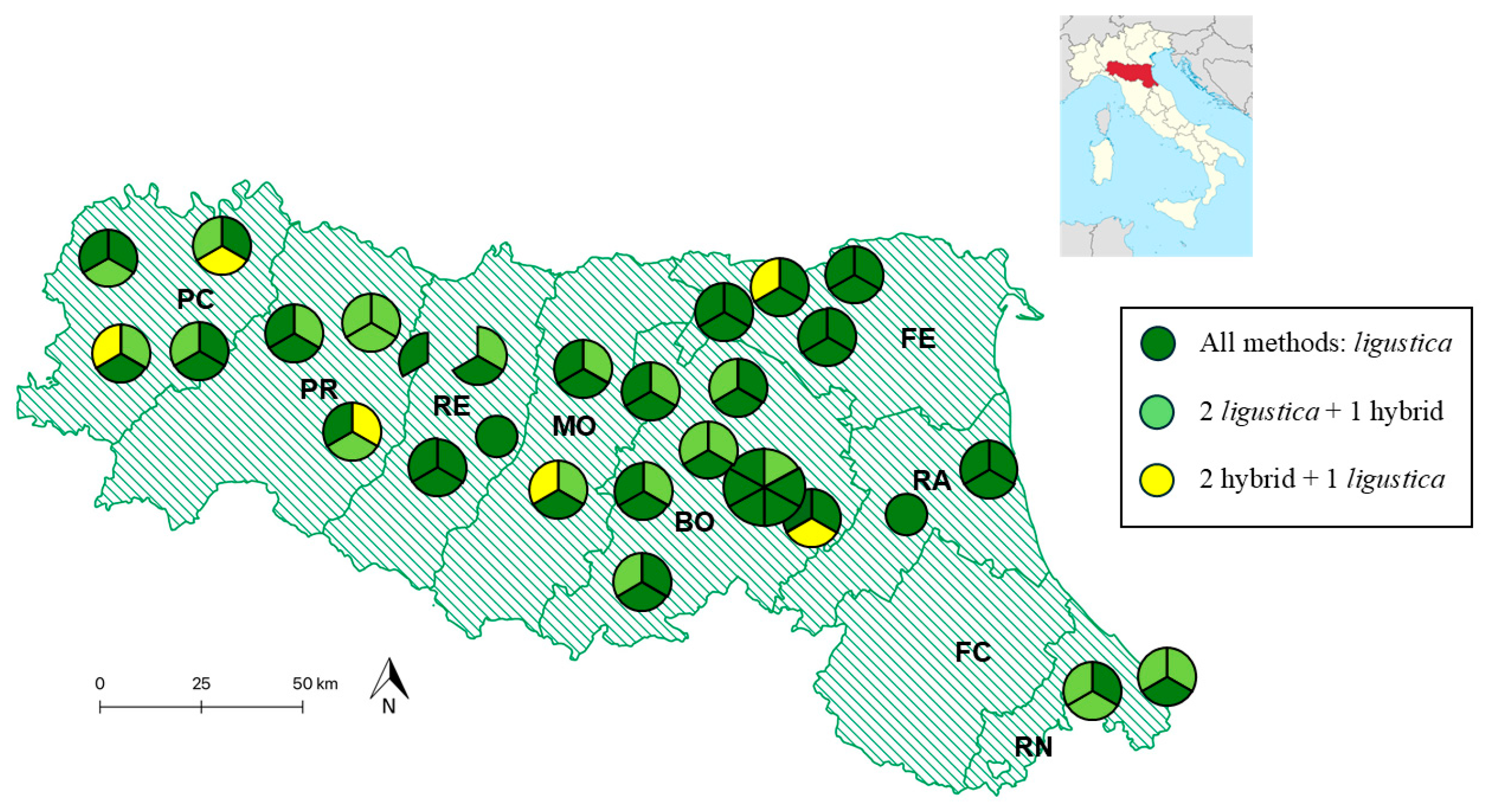
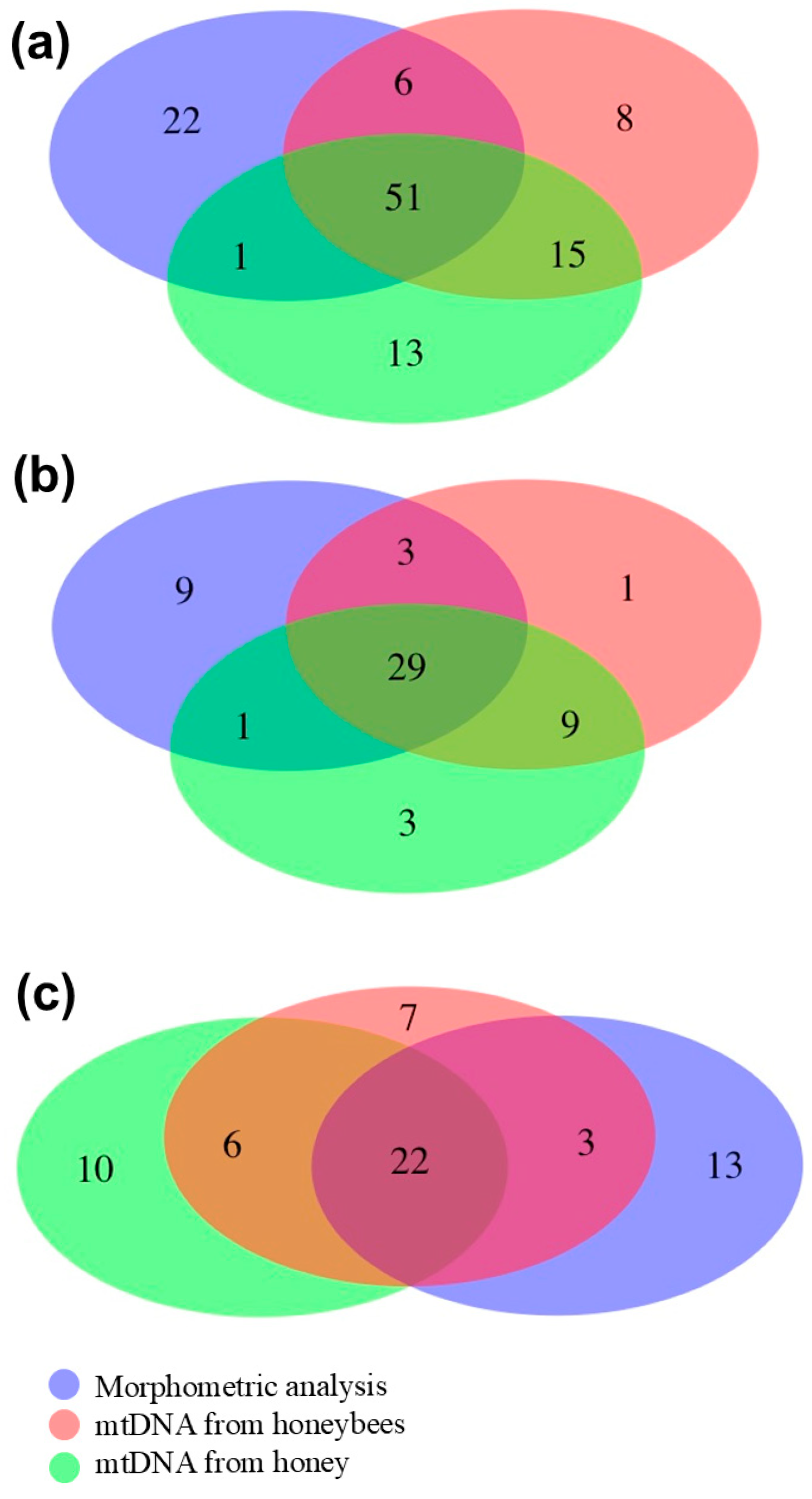
Assigning a honeybee colony to the corresponding Apis mellifera subspecies is crucial for implementing conservation programs that preserve the genetic integrity of local populations, even though it can be technically and economically challenging when large-scale monitoring approaches are needed. Morphometric analysis of honeybees, considered the gold standard for this purpose, is a demanding method in terms of sample preparation. Therefore, we compared the results obtained from this method with findings from analyzing mitochondrial DNA (mtDNA) from honeybees and honey sampled from the same colonies used for morphometric analysis. To comparatively assess these three methods, we took advantage of a field study derived from the need to apply a regional law issued by the Emilia-Romagna region (Northern Italy) protecting the A. m. ligustica subspecies. For approximately two-thirds of the eighty colonies that we analyzed, all three methods agreed on classifying the colonies as either belonging to the A. m. ligustica subspecies or not. Although not completely effective in terms of informativeness, the analysis of mtDNA from honey samples could serve as an initial cost-effective assay useful to begin initiatives aimed at assessing the genetic integrity of A. mellifera subspecies.
Abstract
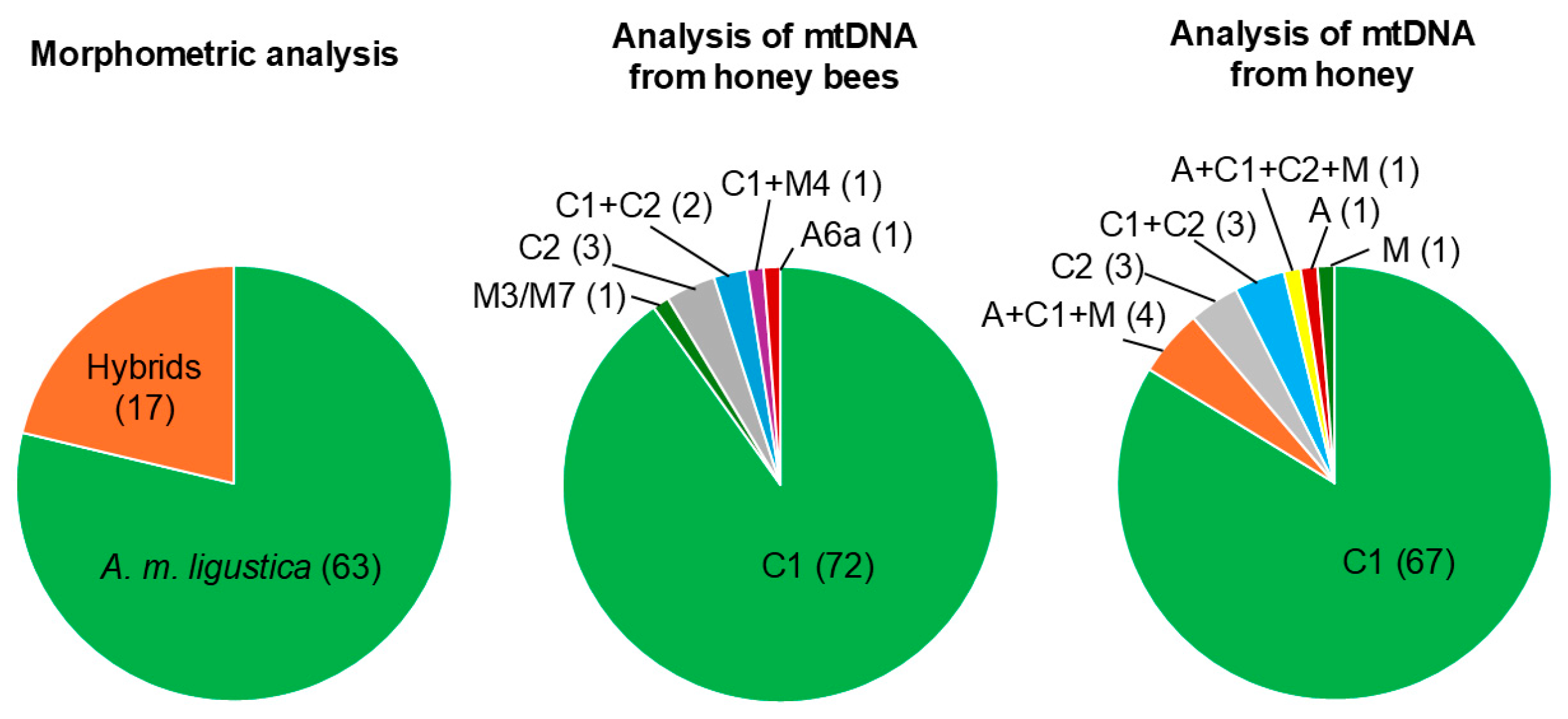
The ability to differentiate between different Apis mellifera subspecies can have significant implications for their conservation. In this study, we explored the possibility of obtaining multi-level information that could be useful in assigning a colony to the A. m. ligustica subspecies. This was accomplished by combining (1) standard morphometric characteristics of the honeybees with mitochondrial DNA (mtDNA) sequence data obtained from both the (2) honeybees and (3) honey present in a honeycomb sampled from the same colony. Eighty colonies were sampled in the Emilia-Romagna region (Northern Italy). From these colonies, a total of 413 honeybees were analyzed to obtain sequence information of the tRNALeu-COII mtDNA region. When we combined the results obtained from all three methods, 63.75% of the colonies were found to be compatible with being assigned to A. m. ligustica. For 36.25% of the colonies, morphometric analysis indicated a hybrid origin and mtDNA from honeybees or honey samples indicated the presence of mtDNA haplotypes other than those characteristic for this subspecies. Cohen’s Kappa statistic indicated poor agreement in the classification of the colonies between morphometric analysis and the two DNA-based methods, which, in turn, were in substantial agreement with each other. Although not completely effective, mtDNA analysis of honey samples could serve as an initial and practical compromise to begin initiatives aimed at preserving the genetic integrity of A. m. ligustica in the Emilia-Romagna region, as well as in other regions where it is necessary to preserve the genetic integrity of autochthonous honeybee populations.