Effects of Curcumin on Growth Performance, Ruminal Fermentation, Rumen Microbial Protein Synthesis, and Serum Antioxidant Capacity in Housed Growing Lambs



College of Animal Science, Shanxi Agriculture University, Jinzhong 030801, China
*
Author to whom correspondence should be addressed.
Animals 2023, 13(9), 1439; https://doi.org/10.3390/ani13091439
Submission received: 18 March 2023
/
Revised: 19 April 2023
/
Accepted: 19 April 2023
/
Published: 23 April 2023
(This article belongs to the Section Small Ruminants)
Simple Summary
The strong antioxidant properties of curcumin (CUR) could alleviate oxidative stress suffered by housed growing lambs, thus promoting growth. This study shows that dietary CUR can promote rumen fermentation, enhance rumen microbial activity, and promote microbial protein synthesis. However, high doses of CUR could inhibit the number of Fibrobacter succinogenes, thus affecting the weight gain of lambs. Our research results provide evidence for the addition of CUR to certain ruminant diets.
Abstract
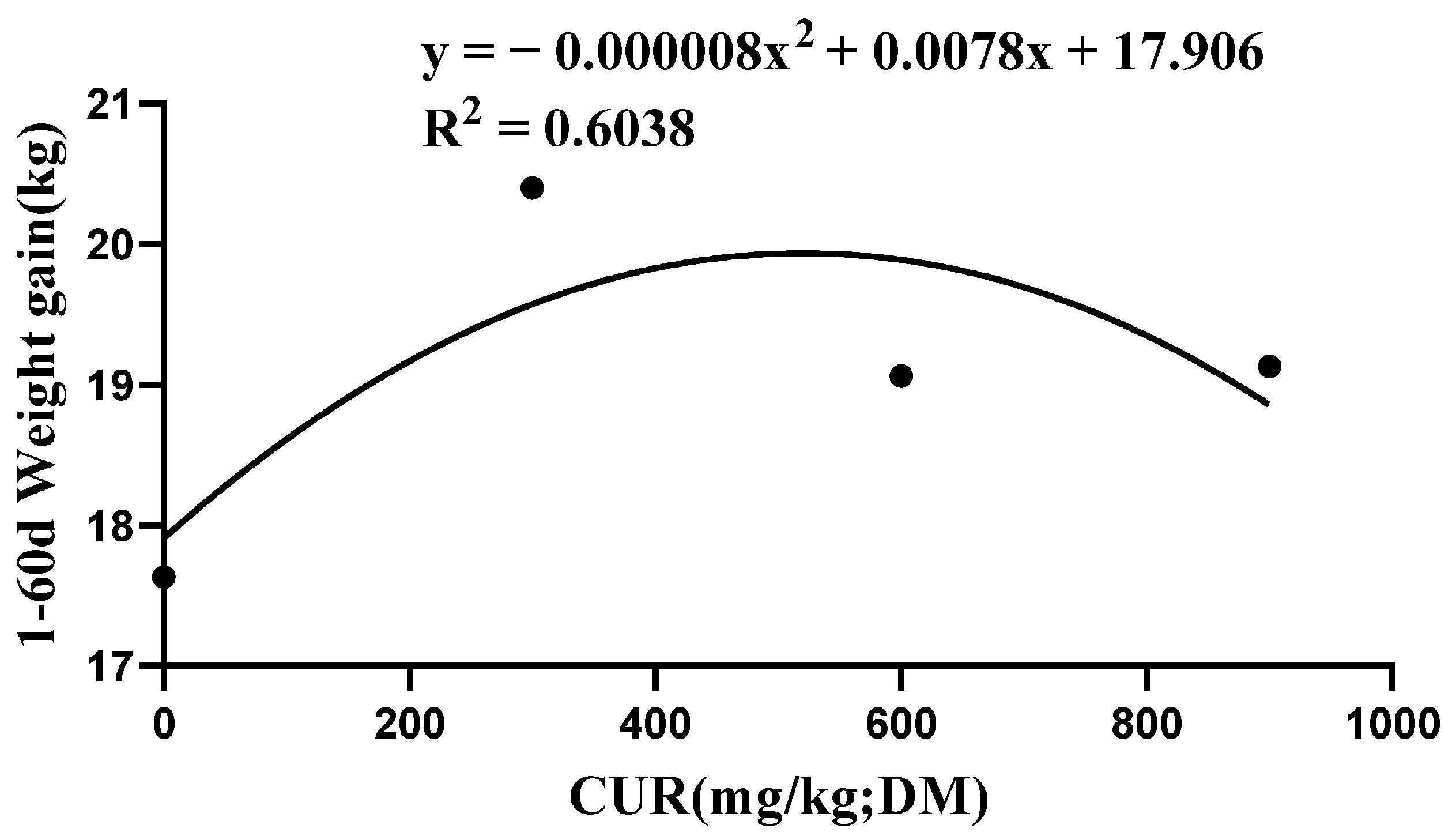
This experiment was conducted to investigate growth performance, ruminal fermentation, rumen microbial protein synthesis, and serum antioxidant capacity with different doses of curcumin (CUR) included in the diet of housed growing lambs. Forty-eight four-month-old Dorper × Thin-tailed Han F1 crossbred male lambs (body weight = 20.89 ± 1.15 kg, age = 120 ± 10 days; mean ± SD) were randomly divided into four groups for a single-factor, completely randomized experiment. Treatments comprised the following: the basal diet supplemented with 0 (Control), 300 mg/kg (300 CUR), 600 mg/kg (600 CUR), or 900 mg/kg (900 CUR) CUR, respectively. The results showed that dietary CUR increased average daily gain (ADG), and the 300 CUR group evidenced the highest value. There were no significant effects on dry matter intake (DMI) and DMI/ADG. Lambs in the 300 CUR group showed higher totals of volatile fatty acids (VFA) and acetate than other groups, while decreased valerate was observed with supplementary CUR. The ruminal pH and ammonia N (NH3-N) concentration decreased with increasing CUR, with the greatest effect in the 300 CUR group. The quadratic effects were found in pectinase, carboxymethyl cellulose, and protease, with the greatest value in the 300 CUR group. The microbial populations of total bacteria and Ruminococcus albus also responded quadratically, and the methanogens, protozoan, and Fibrobacter succinogenes populations decreased linearly with increasing CUR. Lambs receiving additional CUR showed increased Prevotella ruminicola population. Microbial protein (MCP) synthesis was promoted by supplementary CUR. As supplementation with CUR increased, the serum activity of total antioxidant capacity (T-AOC), superoxide dismutase (SOD), and glutathione peroxidase (GSH-Px) was enhanced, with the greatest value in the 300 CUR group. In conclusion, dietary CUR improved ruminal fermentation, promoted rumen microbial protein (MCP) synthesis, and enhanced serum antioxidant activity, as well as promoting growth performance in housed growing lambs.
Keywords:
curcumin; growth performance; ruminal fermentation; microbial protein; antioxidant; lambs