Lameness in Pregnant Sows Alters Placental Stress Response
by
 , , , , , and
Marisol Parada Sarmiento
1,2,*,† ,
,
Lydia Lanzoni
2 ,
,
Leandro Sabei
1,†,
Matteo Chincarini
2,
Rupert Palme
3,
Adroaldo José Zanella
1,* and
Giorgio Vignola
2 1
Center for Comparative Studies in Sustainability, Health and Welfare, Department of Preventive Veterinary Medicine and Animal Health, School of Veterinary Medicine and Animal Science, University of São Paulo, Pirassununga CEP 13635-900, SP, Brazil
2
Department of Veterinary Medicine, University of Teramo, Loc. Piano d’Accio, 64100 Teramo, Italy
3
Unit of Physiology, Pathophysiology and Experimental Endocrinology, Department of Biomedical Sciences, University of Veterinary Medicine, Veterinärpl. 1, 1210 Wien, Austria
*
Authors to whom correspondence should be addressed.
†
These authors contributed equally to this work.
Animals 2023, 13(11), 1722; https://doi.org/10.3390/ani13111722
Submission received: 9 April 2023
/
Revised: 8 May 2023
/
Accepted: 18 May 2023
/
Published: 23 May 2023
(This article belongs to the Special Issue Pigs' Health Driven by Welfare and Behaviour)
Simple Summary
Lameness is a painful and common condition in the pig production systems that makes locomotion difficult, negatively impacting sow welfare and profitability. This study demonstrates that the placenta of gestating lame sows was less efficient in inactivating stress hormones, an important mechanism to protect fetuses from the potentially damaging effect of maternal glucocorticoids. Our findings suggest that greater attention should be paid to the sows’ lameness because their welfare state may also affect their offspring’s welfare.
Abstract
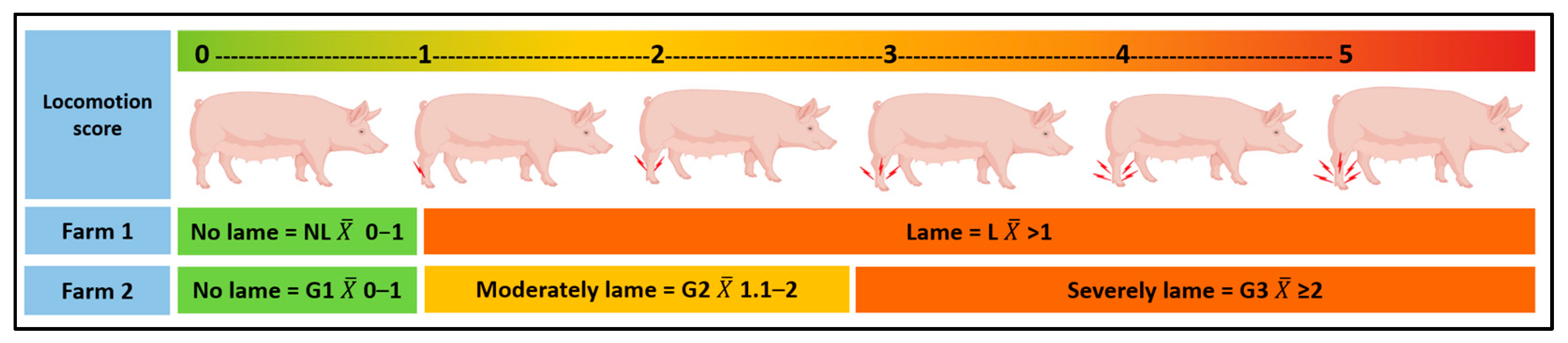
Pregnant sows from commercial pig farms may experience painful states, such as lameness, an essential indicator in assessing sow welfare. We investigated the effect of lameness during the last third of pregnancy on reproductive performance and placental glucocorticoid concentrations in sows. Periodic locomotion assessments were carried out on two commercial pig farms using a validated 0–5 scoring system (from 0: normal locomotion; to 5: a downer animal). Sows from both farms (N = 511) were grouped based on their average locomotion scores. On Farm 1, 30 sows were selected and grouped as either Not Lame (NL = 16;
Keywords:
fetal programming; glucocorticoids; pain; pig; welfare