Distribution of CRISPR in Escherichia coli Isolated from Bulk Tank Milk and Its Potential Relationship with Virulence

College of Veterinary Medicine and Zoonoses Research Institute, Kyungpook National University, Daegu 41566, Korea
*
Author to whom correspondence should be addressed.
Animals 2022, 12(4), 503; https://doi.org/10.3390/ani12040503
Submission received: 30 December 2021
/
Revised: 14 February 2022
/
Accepted: 15 February 2022
/
Published: 17 February 2022
(This article belongs to the Section Cattle)
Simple Summary
In the dairy farms of many different countries, E. coli is one of the most common causes of mastitis. It is defined as mammary pathogenic E. coli, and is known to cause opportunistic infections by possessing diverse virulence factors. Therefore, the purpose of this study was to investigate the virulence potential of E. coli isolates from bulk tank milk in Korea, and observe its association with clustered regularly interspaced short palindromic repeat (CRISPR) arrays. The results showed that out of 183 isolates, 164 (89.6%) possessed one or more of 18 virulence genes, and belonged to phylogenetic groups B1 (64.0%), A (20.1%), D (8.5%), and C (7.3%). CRISPR arrays of E. coli are classified as either CRISPR I-E (CRISPR 1 and 2) or CRISPR I-F (CRISPR 3 and 4). In this study, only CRISPR 1 (95.7%) and 2 (74.4%) were detected. Among the eight protospacers matching plasmids and phages, three were associated with gene regulation, and one was associated with virulence. Moreover, the different virulence genes showed significantly different patterns of CRISPR distribution and CRISPR sequence-types. This result implies that CRISPR loci may be associated with gene regulation and pathogenicity in E. coli, and that the CRISPR sequence-typing approach can help to clarify and trace virulence potential, even though the E. coli isolates were from normal bulk tank milk.
Abstract
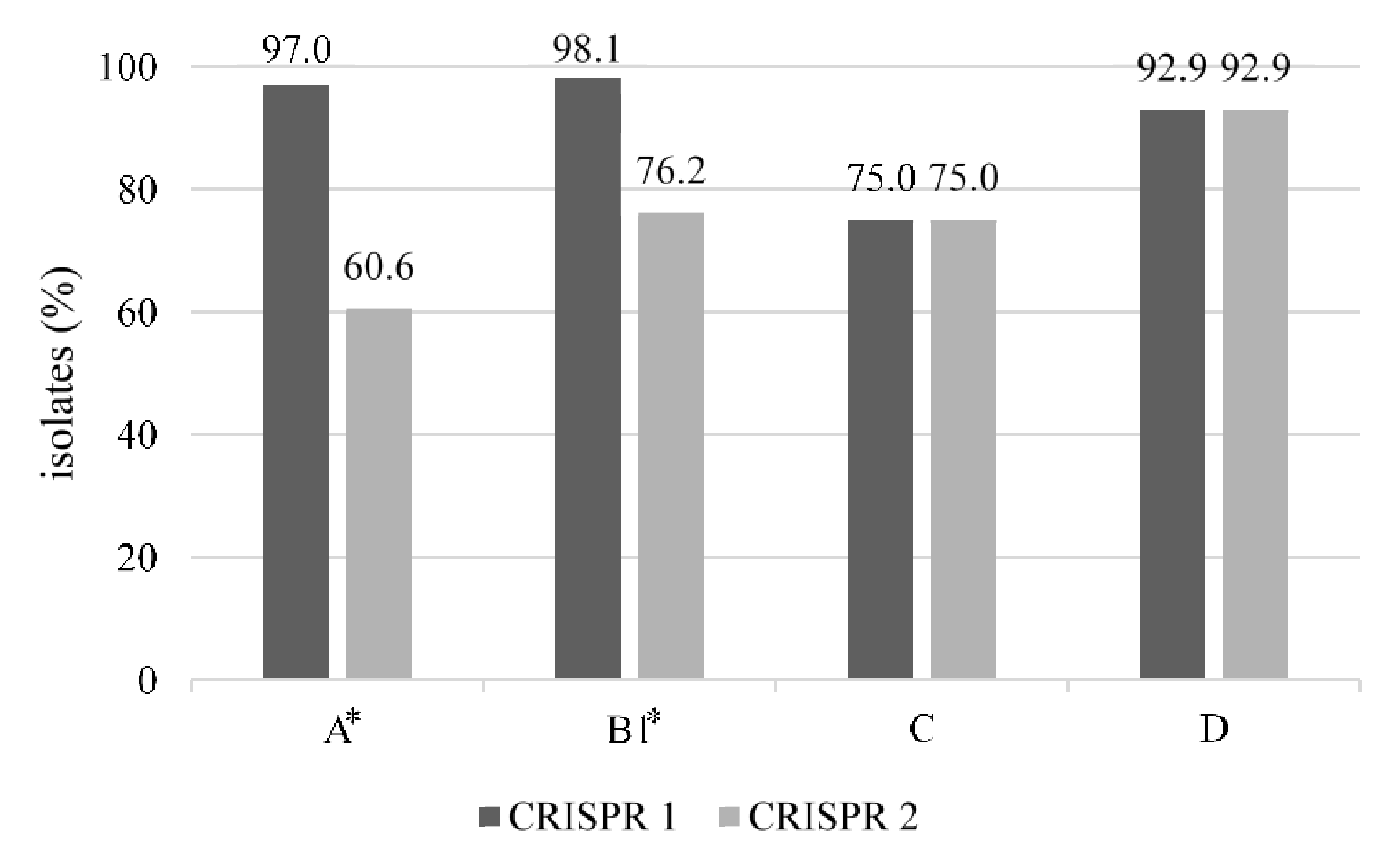
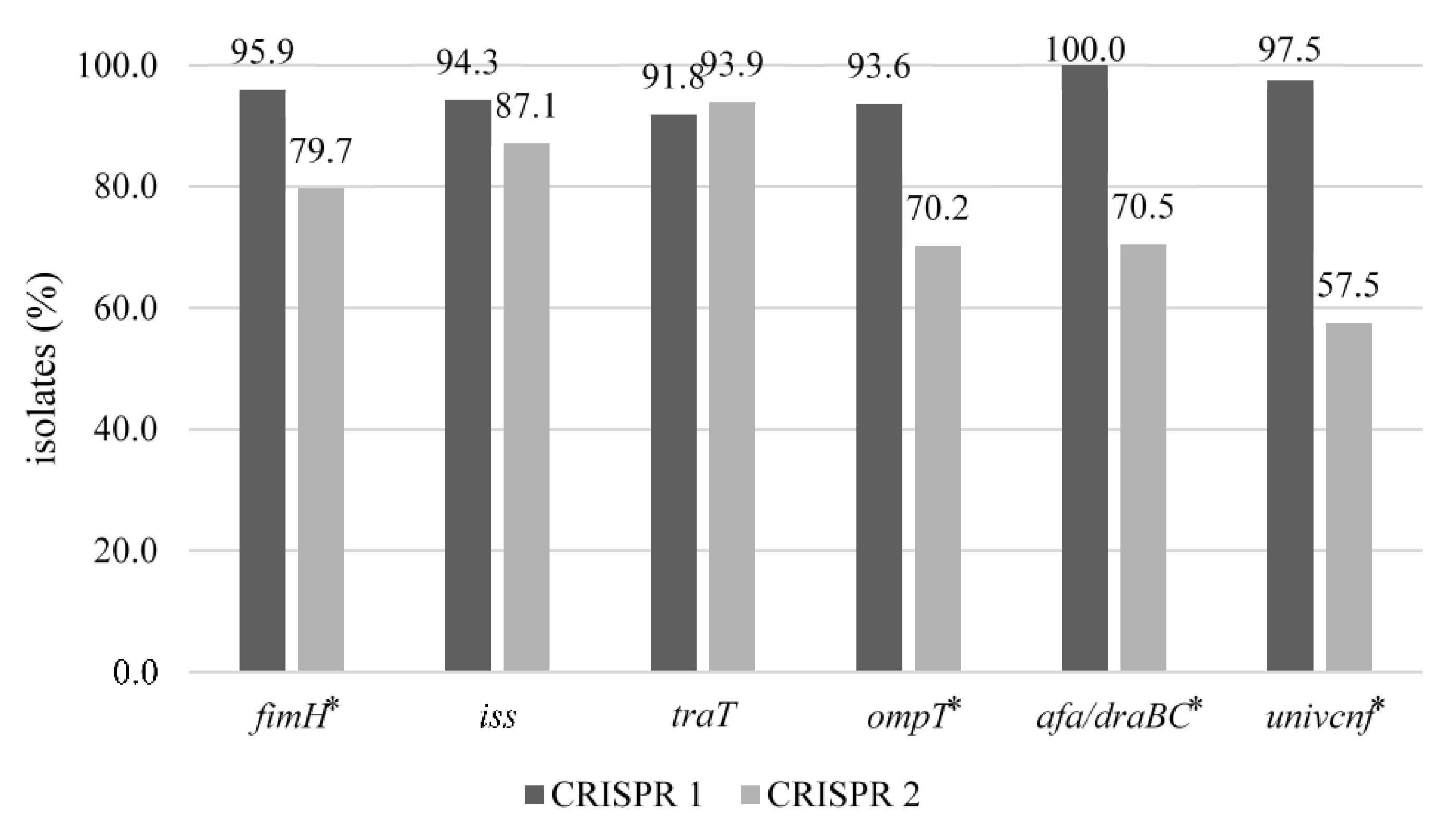
Escherichia coli is one of the most common causes of mastitis on dairy farms around the world, but its clinical severity is determined by a combination of virulence factors. Recently, clustered regularly interspaced short palindromic repeat (CRISPR) arrays have been reported as a novel typing method because of their usefulness in discriminating pathogenic bacterial isolates. Therefore, this study aimed to investigate the virulence potential of E. coli isolated from bulk tank milk, not from mastitis, and to analyze its pathogenic characterization using the CRISPR typing method. In total, 164 (89.6%) out of 183 E. coli isolated from the bulk tank milk of 290 farms carried one or more of eighteen virulence genes. The most prevalent virulence gene was fimH (80.9%), followed by iss (38.3%), traT (26.8%), ompT (25.7%), afa/draBC (24.0%), and univcnf (21.9%). Moreover, the phylogenetic group with the highest prevalence was B1 (64.0%), followed by A (20.1%), D (8.5%), and C (7.3%) (p < 0.05). Among the four CRISPR loci, only two, CRISPR 1 and CRISPR 2, were found. Interestingly, the distribution of CRISPR 1 was significantly higher in groups A and B1 compared to that of CRISPR 2 (p < 0.05), but there were no significant differences in groups C and D. The prevalence of CRISPR 1 by virulence gene ranged from 91.8% to 100%, whereas that of CRISPR 2 ranged from 57.5% to 93.9%. The distribution of CRISPR 1 was significantly higher in fimH, ompT, afa/draBC, and univcnf genes than that of CRISPR 2 (p < 0.05). The most prevalent E. coli sequence types (EST) among 26 ESTs was EST 22 (45.1%), followed by EST 4 (23.2%), EST 16 (20.1%), EST 25 (19.5%), and EST 24 (18.3%). Interestingly, four genes, fimH, ompT, afa/draBC, and univcnf, had a significantly higher prevalence in both EST 4 and EST 22 (p < 0.05). Among the seven protospacers derived from CRISPR 1, protospacer 163 had the highest prevalence (20.4%), and it only existed in EST 4 and EST 22. This study suggests that the CRISPR sequence-typing approach can help to clarify and trace virulence potential, although the E. coli isolates were from normal bulk tank milk and not from mastitis.
Keywords:
E. coli; virulence gene; phylogeny; CRISPR array; bulk tank milk