Using the Relationship between Concentrations of Selected Whey Proteins and BHBA to Characterize the Metabolism of Dairy Cows in Early Lactation
by
 , , and
Kamila Puppel
* ,
,
Patrycja Staniszewska
,
Marcin Gołębiewski
*,
Jan Slósarz
,
Grzegorz Grodkowski
,
Paweł Solarczyk
 ,
,
Małgorzata Kunowska-Slósarz
,
Piotr Kostusiak
,
Beata Kuczyńska
 and
and
Tomasz Przysucha
Institute of Animal Science, Warsaw University of Life Sciences, 02-786 Warsaw, Poland
*
Authors to whom correspondence should be addressed.
Animals 2021, 11(8), 2298; https://doi.org/10.3390/ani11082298
Submission received: 9 July 2021
/
Accepted: 2 August 2021
/
Published: 4 August 2021
(This article belongs to the Section Cattle)
Simple Summary
A negative energy balance alters the concentration of various fractions of cows’ milk. Moreover, key changes are observed in the fat and protein content. Therefore, by analyzing the concentration of individual proteins in milk, it is possible to indirectly monitor the health of the animal. Subclinical ruminal acidosis and ketosis are the primary economic issues in dairy farming due to non-specific symptoms, difficulty in obtaining a diagnosis and reduced milk production. The aim of the present study was to identify the relationship between the concentrations of blood β-hydroxybutyric (BHBA) and whey proteins in milk as a marker for the diagnosis of metabolic diseases. Whey proteins were significantly influenced by both the lactation phase and BHBA. Therefore, it can be concluded that whey proteins can be used as non-invasive markers for diagnosing metabolic diseases. A high concentration of β-lactoglobulin can be a marker for diagnosing ketosis. Conversely, elevated levels of α-lactalbumin may indicate the occurrence of a metabolic disorder, such as acidosis.
Abstract
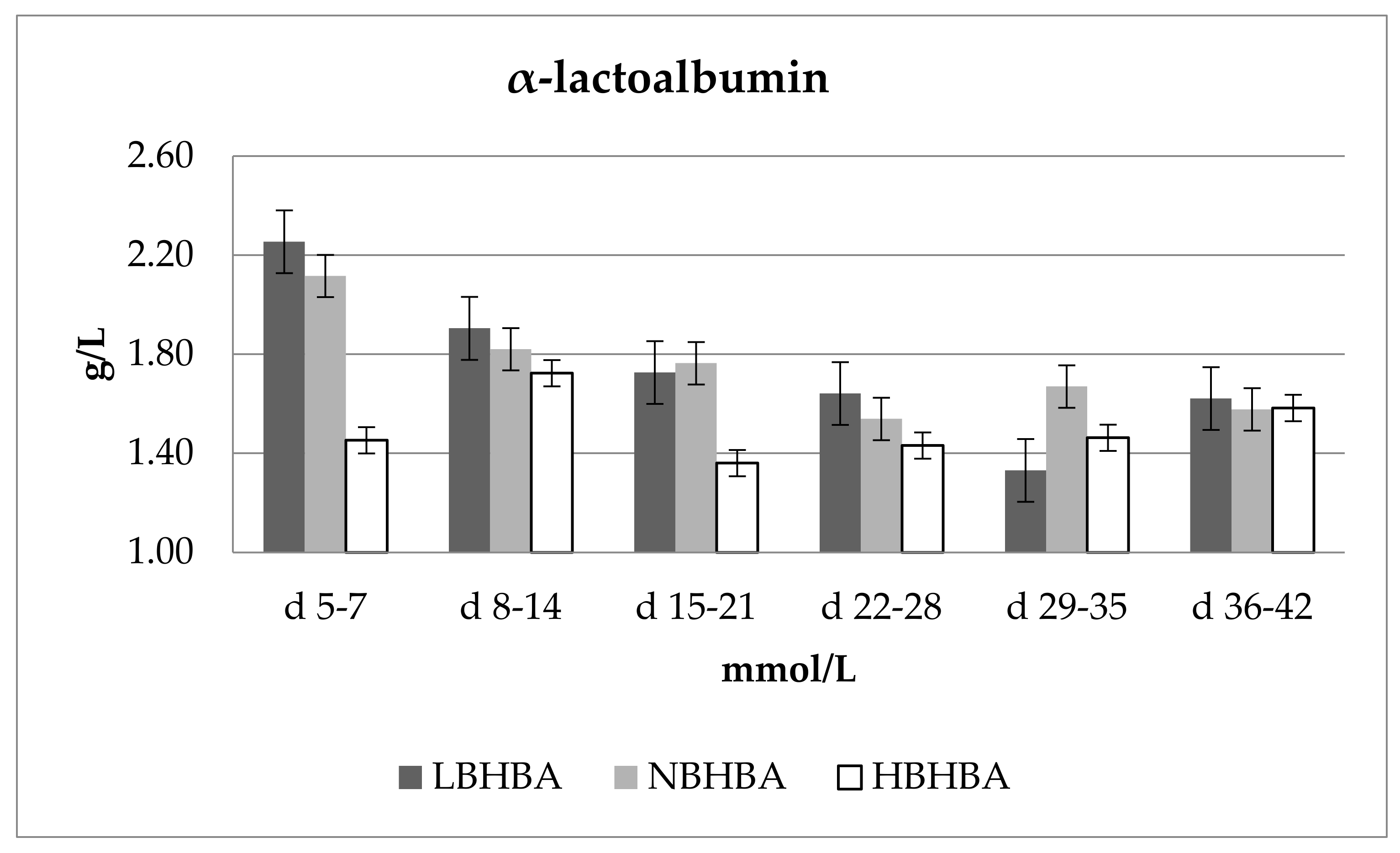
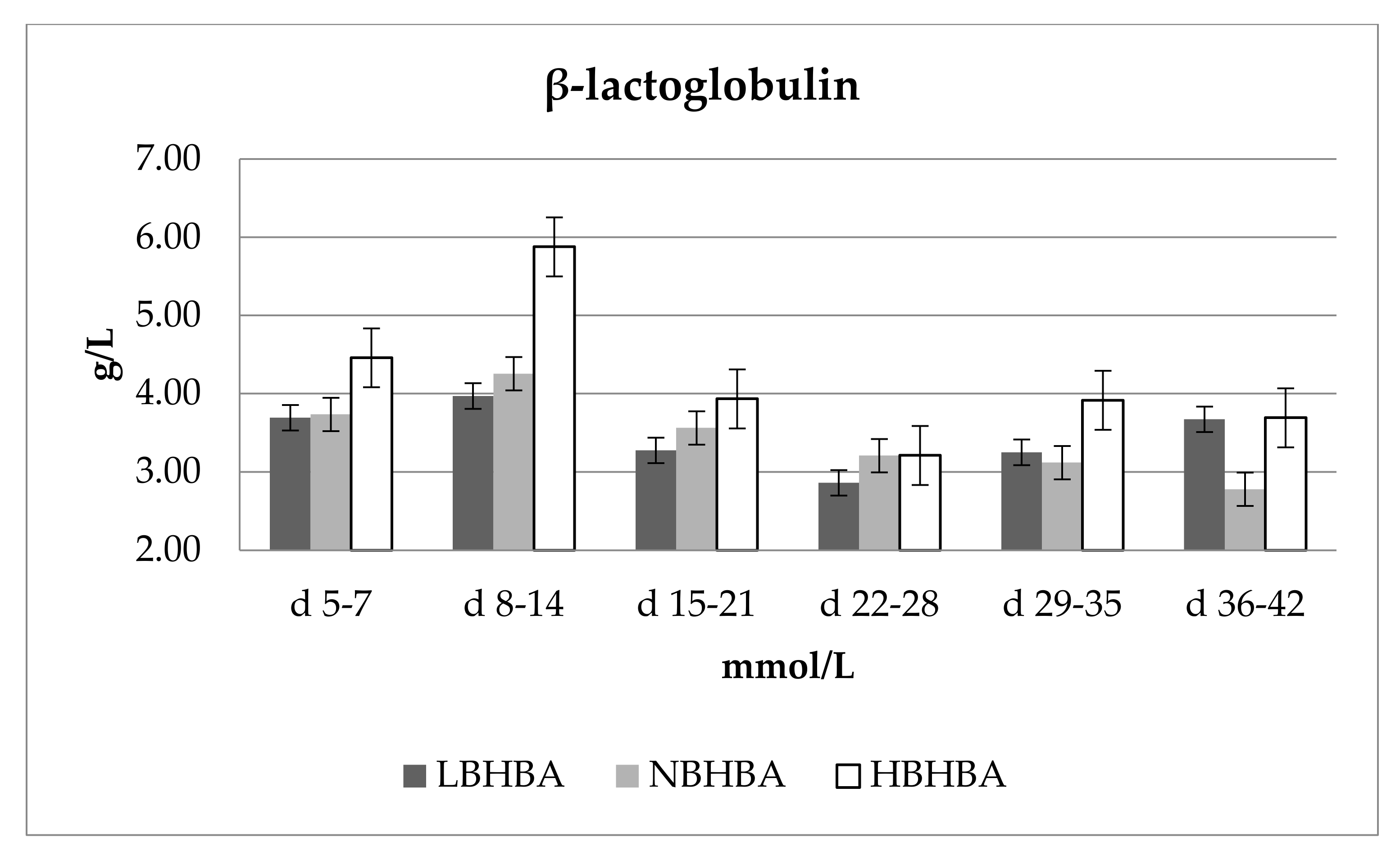
A negative energy balance alters the concentration of various fractions of cows’ milk. Therefore, by analyzing the concentration of individual proteins in milk, it is possible to indirectly monitor the health of the animal. The aim of the present study was to identify the relationship between the concentrations of blood β-hydroxybutyric acid (BHBA) and whey proteins in milk as a marker for the diagnosis of metabolic diseases. The analysis included milk and blood samples from 95 Holstein-Friesian cows, which were divided into three groups that were differentiated in terms of serum BHBA levels 5–7 days post-calving: LBHBA, low level of BHBA: 0.200–0.500 mmol/L; NBHBA, optimal level of BHBA- control group: 0.500–1.200 mmol/L; HBHBA, high level of BHBA: >1.200 mmol/L. Concentrations of α-lactoalbumin in the milk after 7 days of lactation proceeded in accordance with the concentration of β-hydroxybutyric acid, as follows: LBHBA > NBHBA > HBHBA. Concentrations of β-lactoglobulin in milk after 14 days of lactation proceeded in accordance with the concentration of β-hydroxybutyric acid, as follows: LBHBA < NBHBA < HBHBA. Therefore, it can be concluded that whey proteins can be used as non-invasive markers for diagnosing metabolic diseases. A high concentration of β-lactoglobulin can be a marker for diagnosing ketosis. Conversely, elevated levels of α-lactalbumin may indicate the occurrence of a metabolic disorder, such as acidosis.
Keywords:
metabolic disease; BHBA; α-lactalbumin; β-lactoglobulin; dairy cow