Next Article in Journal
Candida glabrata: A Lot More Than Meets the Eye
Next Article in Special Issue
Erratum: Mpanga, I.K.; et al. The Form of N Supply Determines Plant Growth Promotion by P-Solubilizing Microorganisms in Maize. Microorganisms 2019, 7, 38
Previous Article in Journal
Fungal Endophyte Communities of Three Agricultural Important Grass Species Differ in Their Response Towards Management Regimes
 
 
Erratum published on 25 April 2019, see Microorganisms 2019, 7(4), 111.
Article

The Form of N Supply Determines Plant Growth Promotion by P-Solubilizing Microorganisms in Maize


1
Institute of Crop Science (340h), Universität Hohenheim, Fruwirthstraße 20, 70593 Stuttgart, Germany
2
Department of Agriculture, University of Naples Federico II, 80138 Napoli, Italy
3
Institute of Bioanalytical Sciences, Anhalt University of Applied Sciences, 06406 Bernburg, Germany
4
Eurochem Agro GmbH, 68165 Mannheim, Germany
*
Author to whom correspondence should be addressed.
Microorganisms 2019, 7(2), 38; https://doi.org/10.3390/microorganisms7020038

Submission received: 28 December 2018 / Revised: 16 January 2019 / Accepted: 26 January 2019 / Published: 29 January 2019

Abstract

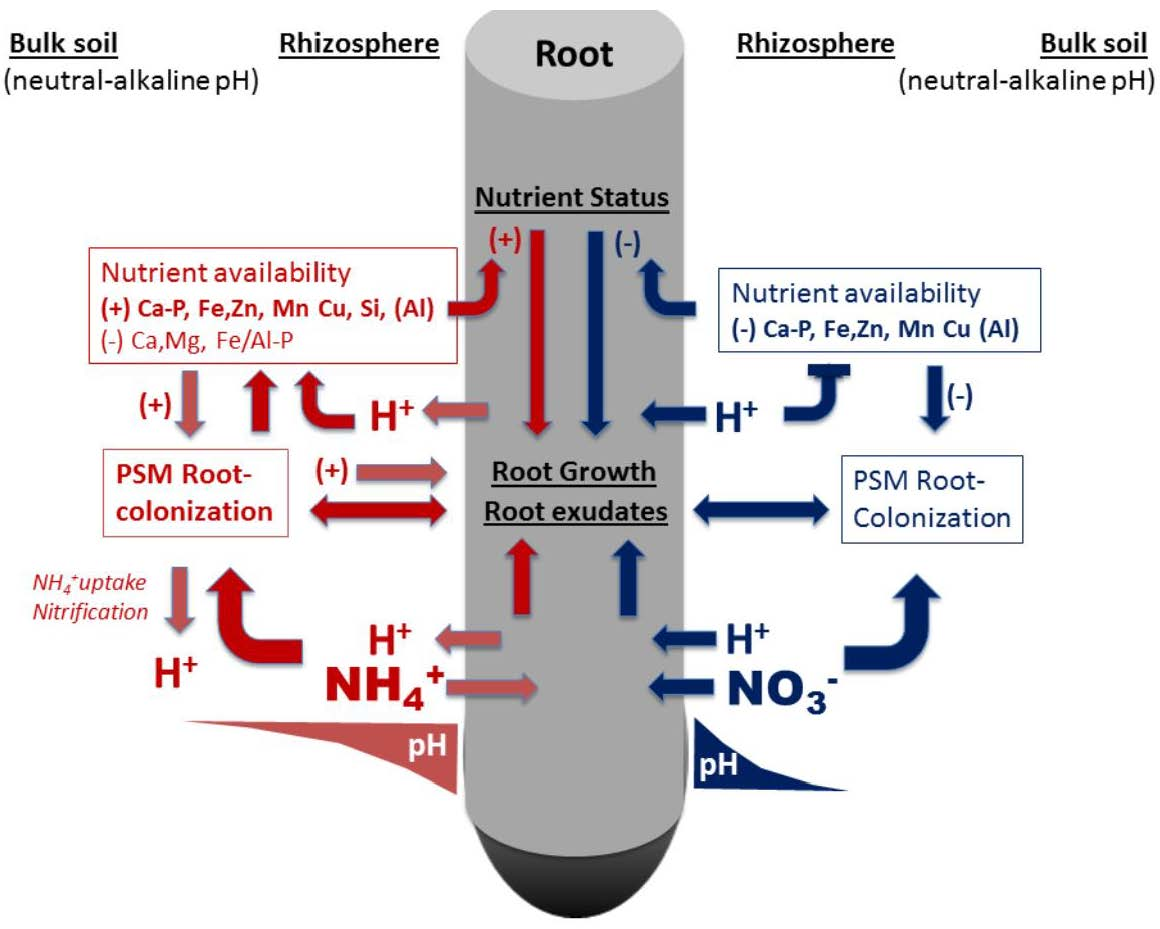
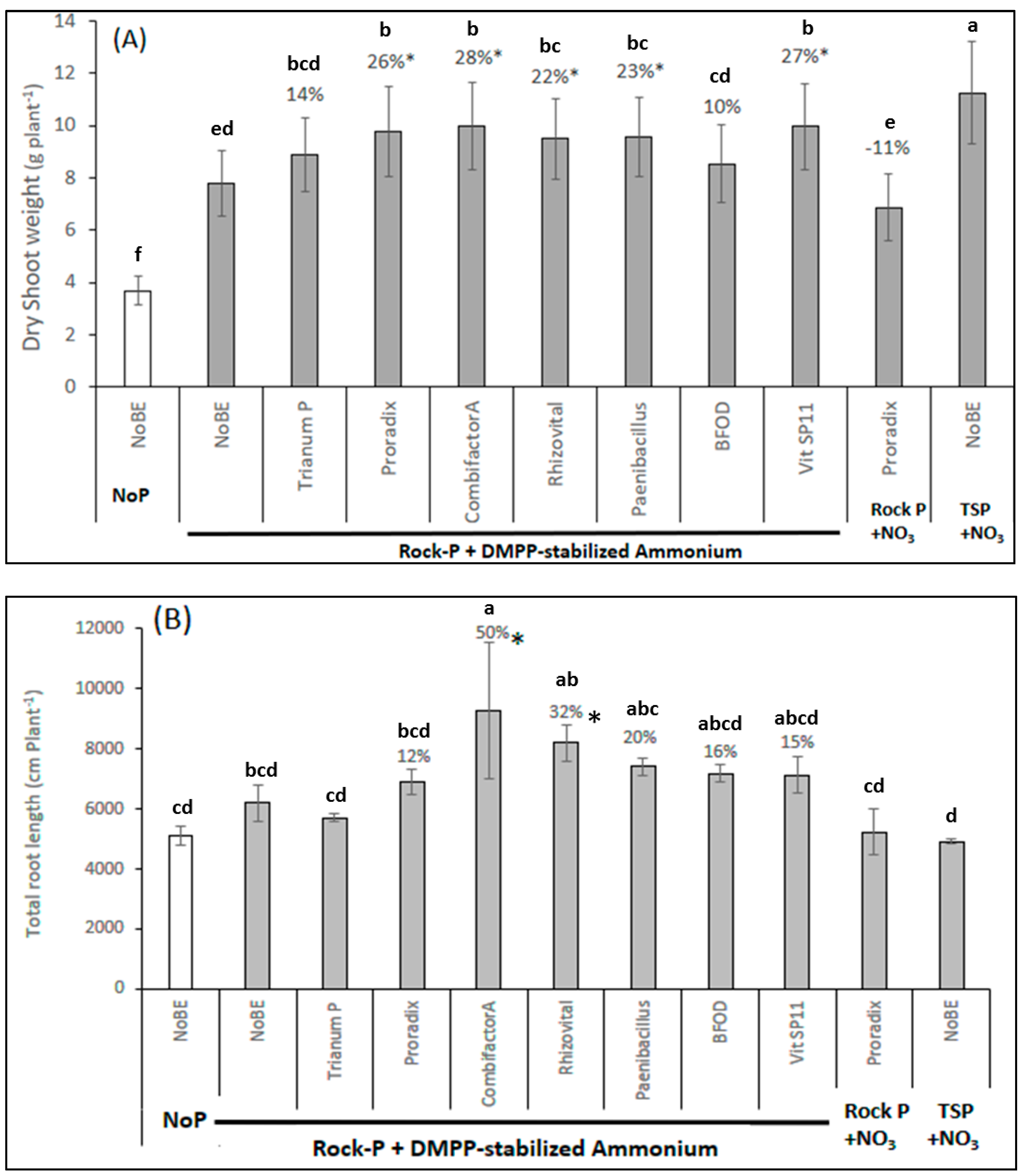
Phosphate-(P)-solubilizing microorganisms (PSM) are important drivers of P cycling in natural and agro-ecosystems. Their use as plant inoculants to improve P acquisition of crops has been investigated for decades. However, limited reproducibility of the expected effects, particularly under field conditions, remains a major challenge. This study demonstrates that the form of nitrogen fertilization has a significant impact on the performance of various fungal and bacterial PSM inoculants in maize grown on neutral to alkaline soils with limited P availability. Under these conditions, a high soil pH-buffering capacity frequently limits the efficiency of nutrient mobilization, mediated by plant roots and microorganisms via rhizosphere acidification. In a soil pH range between 7.0 and 8.0, nitrate fertilization promoting rhizosphere alkalinisation further aggravates this problem. Accordingly, in greenhouse experiments, six strains of Pseudomonas, Bacillus, Paenibacillus, Streptomyces, and Penicillium with proven P-solubilizing potential, completely failed to promote P acquisition in maize grown on a calcareous Loess sub-soil pH 7.6 with nitrate fertilization and rock phosphate (Rock-P) as a sparingly soluble P source. However, after replacement of nitrate fertilization by ammonium, stabilized with the nitrification inhibitor 3,4-dimethylpyrazole-phosphate (DMPP), five out of seven investigated PSM inoculants (comprising 12 fungal and bacterial PSM strains) exerted beneficial effects on plant growth and reached up to 88% of the shoot biomass production of a control supplied with soluble triple-superphosphate (TSP). Stabilized ammonium combined with PSM-inoculants improved P acquisition (Trichoderma harzianum T22, Pseudomonas sp. DMSZ 13134), while other strains particularly stimulated root growth (T. harzianum OMG16, Bacillus amyloliquefaciens FZB42), which promoted the acquisition also of other mineral nutrients, such as N, K, and Mn. A similar effect was recorded under field conditions on an alkaline clay-loam soil pH 8.6. The combination of stabilized ammonium with a range of consortium products based on T. harzianum OMG16, B. amyloliquefaciens, micronutrients, and humic acids completely compensated the effect of a TSP fertilization on field establishment, nutrient acquisition, and yield formation in maize, while non-stabilized urea-di-ammonium phosphate fertilization was largely ineffective. These findings suggest that the efficiency of PSM-plant interactions can be influenced by the form of N fertilization, offering promising perspectives for synergistic effects with stabilized ammonium fertilizers.
Keywords: Plant Growth-Promoting Microorganisms (PGPM); P-Solubilizing Microorganisms (PSM); maize; nitrogen; stabilized ammonium; N-form, 3,4-dimethylpyrazole-phosphate (DMPP); phosphate mobilization Plant Growth-Promoting Microorganisms (PGPM); P-Solubilizing Microorganisms (PSM); maize; nitrogen; stabilized ammonium; N-form, 3,4-dimethylpyrazole-phosphate (DMPP); phosphate mobilization
Graphical Abstract