Article

Optimization of Solid-State Fermentation Process for Prodigiosin Production from Soybean Residue Using Serratia marcescens BD2025 and Evaluation of Pigment Properties


Peking University Institute of Advanced Agricultural Sciences, Shandong Laboratory of Advanced Agricultural Sciences in Weifang, Weifang 261325, China
*
Author to whom correspondence should be addressed.
Microorganisms 2026, 14(7), 1475; https://doi.org/10.3390/microorganisms14071475
Submission received: 3 June 2026 / Revised: 1 July 2026 / Accepted: 1 July 2026 / Published: 6 July 2026
(This article belongs to the Section Microbial Biotechnology)

Abstract

Soybean residue, a major by-product of soy milk and tofu processing, is a large-yield and nutrient-rich substrate, but it is currently experiencing low utilization rates. In this study, a prodigiosin-producing strain, Serratia marcescens BD2025, was isolated from naturally fermented soybean residue. Subsequently, prodigiosin was produced by solid-state fermentation of soybean residue, and the fermentation conditions were further optimized by a Box–Behnken (BBD) model involving the soybean residue-to-water ratio, inoculum size, and temperature. Under the optimized conditions of a soybean residue-to-water ratio of 1:4.28, an inoculum size of 5.2%, and cultivation at 27.5 °C for 48 h, the prodigiosin yield reached 19.05 mg/g. High-performance liquid chromatography analysis showed that the major pigment peak had a retention time comparable to that of a prodigiosin standard, with an estimated purity of 96% based on peak area normalization. The results show that prodigiosin remains relatively stable at below 40 °C, in acidic conditions, and in darkness. The extracted prodigiosin inhibited both Escherichia coli and Staphylococcus aureus, with stronger activity against S. aureus. The scavenging ability of DPPH radical was dose-dependent, with the scavenging activity of 93.13% at 5 mg/mL. These findings indicate that soybean residue can serve as a solid-state fermentation substrate for prodigiosin production and provide a basis for the value-added utilization of soybean-processing residues.

1. Introduction

Prodigiosin is a red secondary metabolite composed of a tricyclic pyrrole ring [1]. It has been reported to exhibit antibacterial [2], anti-cancer [3,4], immunosuppressive [5], insecticidal [6], antimalarial [7], and antiparasitic activities [8]. These biological properties have supported its potential application in food, pharmaceutical, cosmetic, textile, and biomaterial-related fields [9]. Prodigiosin can be produced by chemical synthesis or microbial fermentation [10]. However, the chemical synthesis method has several drawbacks, including poor system stability, easy formation of isomers, difficult control of the synthesis process, and high production costs [1]. In contrast, microbial fermentation provides a more sustainable production route because it can be conducted under mild conditions, reduces dependence on chemical synthesis steps, and generates biologically derived pigments with high purity [11]. Accordingly, microbial fermentation has become one of the most promising strategies for prodigiosin production. Microorganisms are the principal natural sources of prodigiosin, although pigment yield varies substantially among species, strains, and cultivation condition [12]. Among prodigiosin-producing bacteria, Serratia marcescens (S. marcescens) is one of the most extensively investigated species [13]. S. marcescens is a Gram-negative bacterium that is widely distributed in humid environments, including ecosystems and hospital environments [14]. Pigment production by S. marcescens is strongly affected by environmental and nutritional factors, particularly temperature, pH, carbon source, nitrogen source, and medium composition [15]. Previous studies have reported that prodigiosin production by S. marcescens is generally favored at approximately 20–28 °C [15]. Deviations from this temperature range can markedly reduce pigment formation [16]. Therefore, optimization of both medium formulation and fermentation conditions is essential for improving prodigiosin yield.
Prodigiosin not only demonstrates strong biological activity but also shows unique potential in the development of new materials, such as intelligent color-changing packaging, anti-MRSA wound dressings and fabric dyeing [17]. Therefore, the demand for prodigiosin production is increasing. Despite its biological and industrial potential, the large-scale production of prodigiosin remains limited by the cost of conventional nutrient media [18]. This limitation has stimulated interest in low-cost agro-industrial residues and food-processing by-products as alternative substrates for microbial pigment production. Several waste-derived materials have been evaluated for prodigiosin fermentation. For example, sugarcane bagasse has been used as a solid-state fermentation substrate for S. marcescens Xd-1, achieving a prodigiosin yield of 79 mg/kg dry solid [19]. Fermentation of S. marcescens SBL03 using agricultural and industrial wastes increased prodigiosin production by 7.62-fold [20]. Soybean meal has also been used as the sole nutritional source for S. marcescens, resulting in a 5.8-fold higher yield than that obtained with commercial media [21]. In addition, S. marcescens NCHU05 produced significantly higher levels of prodigiosin when food waste was used as the fermentation medium than when conventional liquid medium was used [22]. These studies demonstrate that waste-derived substrates can support prodigiosin biosynthesis and may improve the economic and environmental sustainability of microbial pigment production.
Solid-state fermentation (SSF) is particularly suitable for the bioconversion of solid organic residues because it operates with limited free water, can reduce contamination risk, lowers liquid effluent generation, and facilitates the handling or reuse of spent fermentation materials [23]. Compared with submerged fermentation, solid-state fermentation may better match the physical characteristics of many agro-industrial by-products and food-processing residues. Therefore, integrating solid-state fermentation with nutrient-rich waste substrates provides a practical strategy for producing high-value microbial metabolites while promoting waste valorization.
Soybean residue is a major by-product of soymilk and tofu processing, with annual global production estimated at millions of tons [24]. Owing to its high contents of dietary fiber, protein, isoflavones and minerals, soybean residue represents a nutrient-rich organic feedstock rather than merely a processing waste [25]. However, its high moisture content, rapid spoilage, and limited economic value in conventional applications have restricted its large-scale utilization, and a considerable proportion is still directed to low-value uses or remains underutilized [26]. The valorization of soybean-processing by-products has therefore attracted increasing attention as a strategy for developing functional ingredients and microbial bioprocesses [27]. In particular, the protein and carbohydrate-rich composition of soybean residue makes it a suitable substrate for microbial growth and metabolite production [25]. Previous studies have demonstrated its use in protease production [28] and probiotic cultivation, including lactic acid bacteria fermentation [29]. Nevertheless, the direct use of soybean residue as a solid-state fermentation substrate for prodigiosin production by S. marcescens has not been systematically investigated. Developing such a process could provide a value-added route for soybean residue utilization while reducing the medium cost associated with microbial pigment production.
In this study, soybean residue was investigated as a low-cost substrate for solid-state prodigiosin production by Serratia marcescens BD2025, a strain isolated from naturally fermented soybean residue. Red pigment was produced using bean residue as the solid-state fermentation substrate. The study focused on strain isolation and identification, pigment extraction and characterization, optimization of fermentation conditions using a Box–Behnken design, and evaluation of pigment stability, antibacterial activity, and DPPH radical scavenging activity. The objective was to establish a sustainable fermentation strategy for converting soybean-processing residue into a high-value microbial pigment. The findings may provide a basis for the development of waste-based bioprocesses for prodigiosin production and support the value-added utilization of soybean residue.

2. Materials and Methods

2.1. Isolation and Identification of S. marcescens BD2025

The soybean residue used in this article was provided by Yuwang Group in Dezhou, Shandong, China. A red pigment-producing strain was isolated from naturally fermented soybean residue in nature. Briefly, 1.0 g of fermented soybean residue was transferred into 10 mL of sterile physiological saline. The resulting suspension was serially diluted with sterile physiological saline, and appropriate dilutions were spread onto nutrient agar (NA) plates. The plates were incubated at 28 °C for 48 h. Red-pigmented colonies were selected and repeatedly streaked on NA plates until morphologically uniform colonies were obtained. The purified isolate was designated BD2025. The bacterial strain DNA was extracted and purified using the DNA extraction kit (Bao Biotechnology Engineering Co., Ltd., Dalian, China). The integrity of the DNA was checked using a nucleic acid electrophoresis instrument (SC12, Beijing Kaiyuan Xinxie Instrument Co., Ltd., Beijing, China). The 16S rDNA fragment was amplified using the universal primers 27F (5′–AGA GTT TGA TCC TGG CTC AG–3′) and 1492R (5′–ACG GTT ACC TTG TTA CGA CTT–3′). The reaction system is as follows: 2 μL template DNA, 1 μL 27F primer, 1 μL 1492R primer, 12.5 μL Taq DNA polymerase, and 8.5 μL ddH2O. The reaction conditions were 98 °C for 5 min, 95 °C for 35 s, 55 °C for 35 s, 72 °C for 90 s, and 35 cycles for 8 min. After the reaction, the PCR products were detected by 1% agarose gel electrophoresis. Then, the PCR products were subjected to DNA sequencing. The results were submitted to the National Center for Biotechnology Information (NCBI) and subjected to an online comparison using the basic local alignment search tool (BLAST, https://blast.ncbi.nlm.nih.gov/Blast.cgi, access date is: 16 June 2026). Subsequently, a phylogenetic tree was drawn using the MEGA-X software (v. 10.2.6). Based on sequence analysis, the isolate was identified as Serratia marcescens BD2025.

2.2. Preparation and Analysis of Prodigiosin

Prodigiosin extraction and quantification were carried out according to the method described by Gohil et al. [21], with modifications. S. marcescens BD2025 was cultured in nutrient broth medium to the logarithmic phase. Then, 5% of the bacterial solution was taken and inoculated into the cooled and sterilized soybean residue. Solid-state fermentation was carried out at 28 °C for 48 h. The pigment was extracted from the soybean residue using ethanol (analytical-grade, Sinopharm Chemical Reagent Co., Ltd., Shanghai, China) as the solvent at a solid-to-liquid ratio of 1:10 (w/v). The mixture was treated with an ultrasonic cleaning machine (40 kHz, 720 W, Ningbo Xinzhi Biotechnology Co., Ltd., Ningbo, China) at 28 °C for 30 min. The extract was centrifuged at 12,000 rpm for 10 min at 4 °C, and the supernatant was collected. The extraction was repeated until the solid residue became nearly colorless. The combined supernatants were filtered through a 0.22 µm PES syringe filter (FilterBio PES Syringe Filter, Lab-Ex Ltd., Budapest, Hungary) and concentrated under reduced pressure using a rotary evaporator (Rotavapor RV.10, IKA Staufen, Staufen, Germany). The concentrate was subsequently lyophilized for 72 h using a freeze dryer (LaboGene, Lillerød, Denmark) to obtain crude pigment powder.
The extracted pigment was analyzed using an Agilent 1260 Infinity II high-performance liquid chromatograph (HPLC, Agilent Technologies, San Jose, CA, USA), and its relative purity was estimated using the peak area normalization method [30]. A prodigiosin standard and the extracted pigment sample were analyzed under the same chromatographic conditions. The pigment extraction was detected using a diode array detector (DAD). Separation was performed using an Agilent Zorbax SB-C18 column (4.6 × 250 mm, 5 µm). The mobile phase consisted of acetonitrile (HPLC gradient grade, ≥99.9%, Merck, Darmstadt, Germany) and 5% aqueous ammonium acetate solution (10 mM, pH 5.0) at a ratio of 85:15 (v/v), with isocratic elution at a flow rate of 1.0 mL/min. The column temperature was maintained at 40 °C, the injection volume was 10 µL, and the total run time was 10 min. Detection was performed at 535 nm.

2.3. Optimization of Prodigiosin Fermentation Process Based on Box-Behnken Design

The optimization procedure was adapted from Gohil et al. [20] to improve prodigiosin production from soybean residue. Response surface methodology (RSM) was used to optimize prodigiosin production conditions, a Box–Behnken design (BBD) was used to fit the model by least squares, and the proposed model was evaluated by variance analysis (ANOVA). In this study, the soybean residue-to-water ratio (X1), the inoculation size (X2), and cultivation temperature (X3) were selected as independent variables, and prodigiosin yield was used as the response variable. The coded levels of the independent variables are shown in Table 1.
A total of 17 experimental runs, including five center-point replicates, were performed according to the BBD matrix shown in Table 2. All fermentations were conducted for 48 h. A second-order polynomial model was fitted to the experimental data by least-squares regression. Model significance, lack of fit, and the effects of individual and interactive variables were evaluated by analysis of variance (ANOVA) using Design-Expert 13 software. Three-dimensional response surface plots and contour plots were generated to visualize the interactions among the selected variables and to determine the optimal fermentation conditions.

2.4. Stability Analysis of Prodigiosin

The stability of prodigiosin was determined using the method described by Shuhua Liu et al. [31], with some minor modifications. A methanol (analytical grade, Sinopharm Chemical Reagent Co., Ltd.) solution of 1 mg/mL of prodigiosin was prepared, and its initial absorbance value was measured at 535 nm. Equal-volume aliquots of the prodigiosin solution were then subjected to different temperature, pH, and light treatments. For thermal stability analysis, aliquots were incubated in the dark at 20, 40, 60, 80, and 100 °C, and the absorbance at 535 nm was measured at 1 h intervals. For pH stability analysis, aliquots were adjusted to pH 1, 3, 5, 7, 9, 11, and 13, and absorbance was measured at 4 h intervals in the dark. For light stability analysis, aliquots were exposed either to darkness or natural light, and absorbance was measured at 2 h intervals. The pigment retention content was calculated using the following equation:
Residual pigment content (%) = At/A0 × 100
where A0 is the initial absorbance, and At is the absorbance after treatment.

2.5. Evaluation of Antibacterial Activity of Prodigiosin In Vitro

The antibacterial activity of prodigiosin was evaluated by using an agar diffusion assay according to the method described by Xin Wang et al. [32], with modifications. The specific operation is as follows: Staphylococcus aureus (S. aureus, ATCC 6538, Beijing Soleibao Biotechnology Co., Ltd., Beijing, China) and Escherichia coli (E. coli, ATCC 8099, Beijing Soleibao Biotechnology Co., Ltd., Beijing, China) were prepared into bacterial suspension, and 0.2 mL of each suspension was evenly spread on the plates. Sterile filter paper discs (6 mm in diameter) were immersed for 30 min in ethanolic prodigiosin solutions at concentrations of 0, 10, 40, 160, and 640 µg/mL. The 0 µg/mL treatment served as the solvent control. After the bacterial solution had been absorbed into the agar surface, the plates were incubated at 30 °C for 18 h. The diameters of the inhibition zones were measured after incubation. Each concentration was tested in triplicate, and the results were expressed as the mean inhibition-zone diameter.

2.6. DPPH Radical Scavenging Ability

The antioxidant activity of prodigiosin was assessed using the 1,1-Diphenyl-2-picrylhydrazyl (DPPH) radical scavenging assay according to Ibrahim et al. [33], with modifications. The assay was performed using an DPPH free-radical scavenging kit (Beijing Solarbio Science & Technology Co., Ltd., Beijing, China). Briefly, prodigiosin sample solution was mixed with 950 µL of DPPH working solution. The mixture was incubated at room temperature in the dark for 30 min, and the absorbance was immediately measured at 517 nm. Sample controls without DPPH working solution and a blank control without prodigiosin were prepared in parallel.
The DPPH radical scavenging activity was calculated as follows:
D P P H   r a d i c a l   s c a v e n g i n g   r a t e   D % = A b A s + A c A b × 100 %
where Ab is the absorbance of the blank control, As is the absorbance of the sample reaction mixture, and Ac is the absorbance of the sample control.

2.7. Statistical Analysis

Unless otherwise stated, experiments were performed in triplicate, and data were expressed as mean ± standard deviation. The BBD regression model and ANOVA were performed using Design-Expert 13 software. Differences among treatment groups in stability, antibacterial activity, and DPPH radical scavenging activity should be analyzed using an appropriate statistical test, with p < 0.05 considered statistically significant.

3. Results and Discussion

3.1. Isolation and Identification of Serratia marcescens BD2025

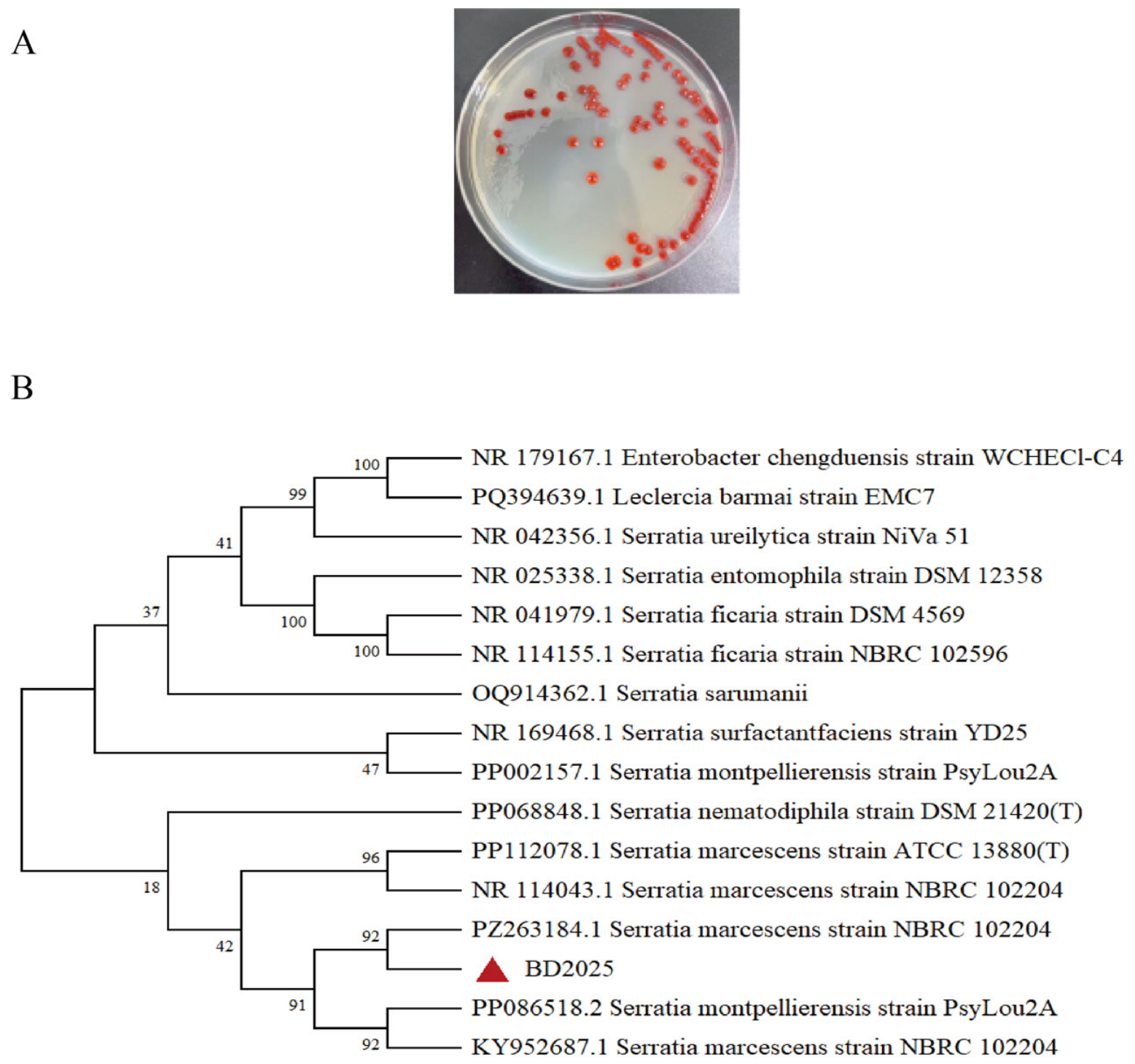
After serial dilution of the naturally fermented soybean residue suspension and incubation on NA plates at 28 °C for 48 h, colonies with different morphologies were obtained. A red-pigmented colony was selected and purified by repeated streaking. As shown in Figure 1A, the purified isolate formed bright red, circular, convex colonies with smooth surfaces and entire margins on NA medium. The isolate was named BD2025.
The taxonomic identity of strain BD2025 was further determined by 16S rDNA gene sequencing. Phylogenetic analysis showed that BD2025 clustered with Serratia marcescens strain NBRC 102204 (Figure 1B). Therefore, this isolate was identified as Serratia marcescens BD2025 and used for subsequent prodigiosin production.

3.2. Extraction and Characterization of Prodigiosin

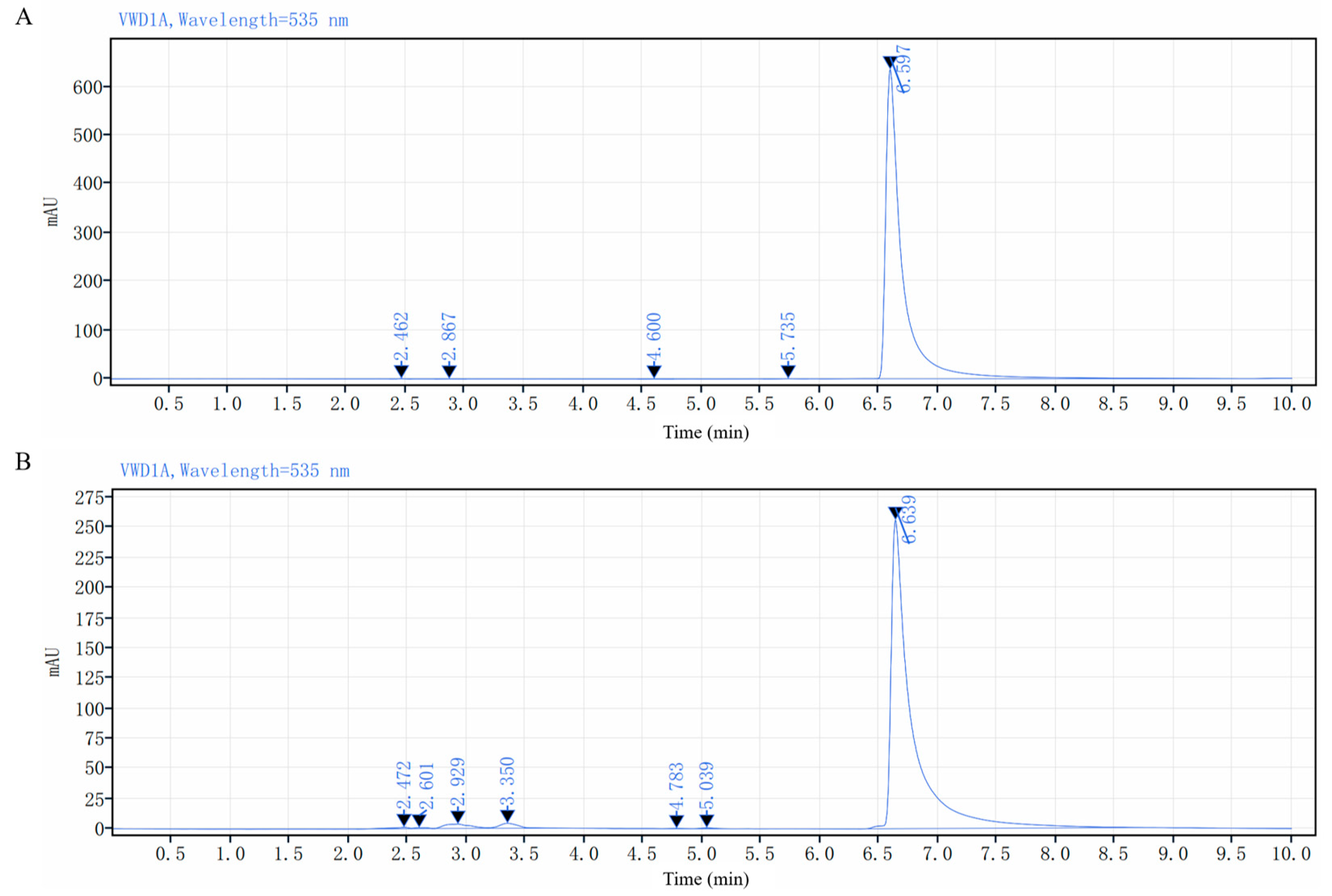
The pigment produced by S. marcescens BD2025 during solid-state fermentation of soybean residue was extracted with ethanol and analyzed by HPLC. As shown in Figure 2A, the prodigiosin standard showed a major peak at a retention time of 6.597 min at 535 nm. The ethanol-extracted pigment showed a major peak at 6.639 min under the same chromatographic conditions (Figure 2B). The close agreement in retention time between the sample and the standard indicates that the extracted pigment was consistent with prodigiosin. The relative purity of the extracted prodigiosin was estimated to be 96% using the peak area normalization method. This result indicates that the pigment extracted in this study was prodigiosin, and the purity was 96%.

3.3. Optimization of Prodigiosin Production Using a Box–Behnken Design

The production of prodigiosin is affected by multiple external factors. Previous studies have shown that the fermentation substrate and environmental factors, including moisture content, temperature and pH, significantly affect the production of prodigiosin [34]. Prodigiosin is generally synthesized by S. marcescens as a secondary metabolite during the late growth phase; therefore, an adequate fermentation period is essential for pigment accumulation [22]. Previous studies have reported that prodigiosin production by S. marcescens generally occurs within 15–84 h, depending on the strain and cultivation conditions [35,36]. Based on preliminary experiments, a fermentation time of 48 h was selected for S. marcescens BD2025.
To reduce the production cost of prodigiosin and increase the yield, in this study, soybean residue was used as the fermentation medium for S. marcescens BD2025. To improve prodigiosin production from soybean residue, three fermentation parameters were optimized using response surface methodology with a Box–Behnken design: soybean residue-to-water ratio, inoculum size, and temperature. The experimental design and observed prodigiosin yields are shown in Table 2. Among the experimental runs, the highest observed yield was 19.49 mg/g under the center-point conditions, corresponding to a soybean residue-to-water ratio of 1:4, an inoculation size of 5%, and a temperature of 28 °C. These results indicate that moderate water addition, inoculum size, and temperature were favorable for prodigiosin accumulation during solid-state fermentation.
The analysis of variance for the fitted regression models is shown in Table 3. The overall model was highly significant, with a model p-value < 0.0001, whereas the lack of fit was not significant (p > 0.05). The coefficient of determination values were high, with R2 = 0.9965, adjusted R2 = 0.9919, and predicted R2 = 0.9918, indicating good agreement between the experimental and model-predicted values. The linear effects of soybean residue-to-water ratio, inoculum size, and temperature were significant. The interaction terms between soybean residue-to-water ratio and inoculum size, and between soybean residue-to-water ratio and temperature, were also significant, whereas the interaction between inoculum size and temperature was not significant. The significant quadratic terms further indicate that prodigiosin production responded nonlinearly to the selected variables.
Based on the established model, the regression equation is as follows:
Y = 12.0663 + 5.91328 X1+ 1.54426 X2 − 2.99513 X3 − 0.37915 X1 X2 + 0.673263 X1 X3 + 0.272275 X2 X3 − 1.27055 X12 − 3.00931 X22 − 7.38794 X32
where Y represents the predicted prodigiosin yield (mg/g), and X1, X2, and X3 respectively represent the ratio of soybean residue to water, inoculum size, and temperature.
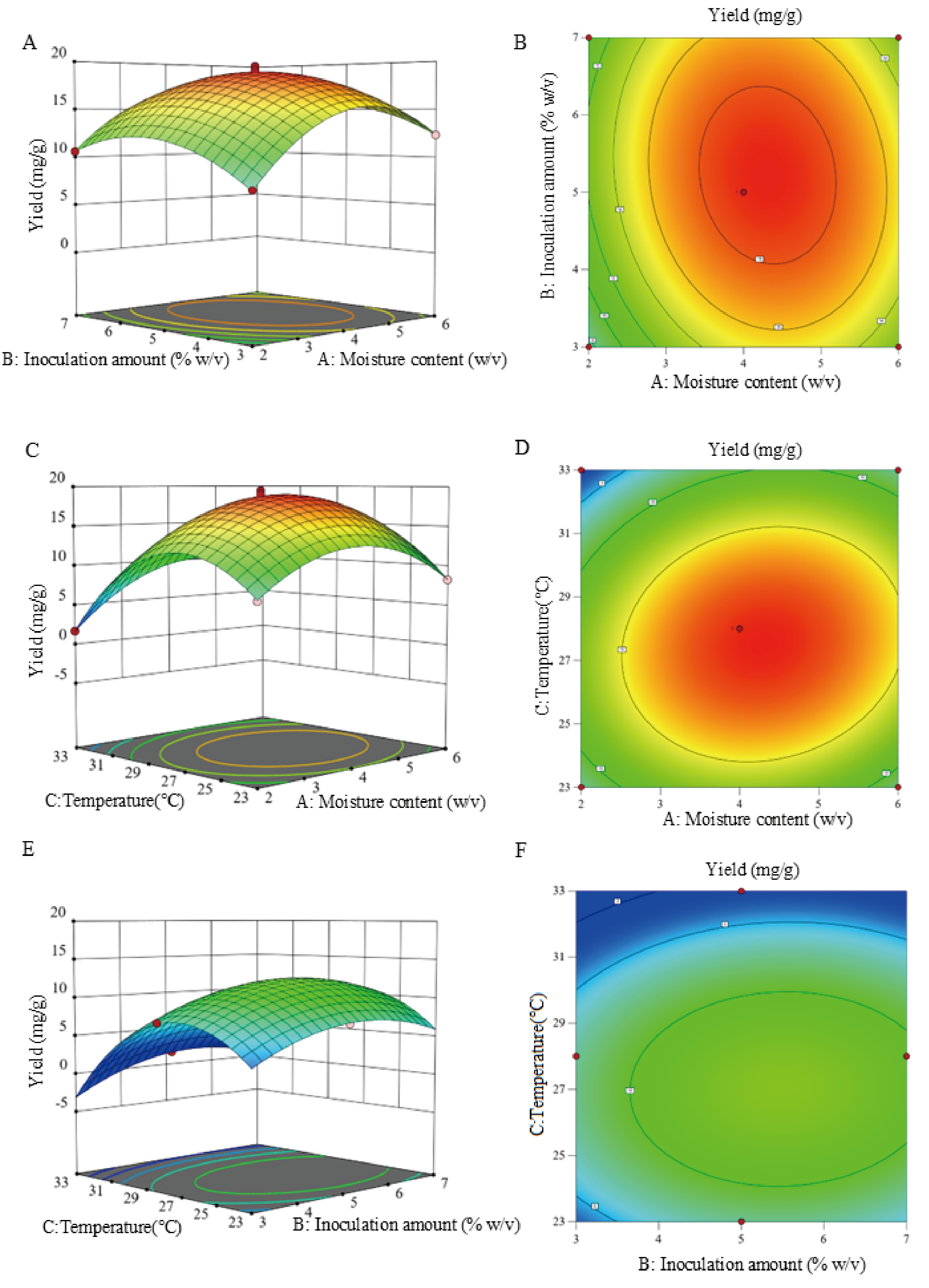
The 3D response surface and contour plots further illustrate the effects of the selected variables on prodigiosin production (Figure 3). The model predicted an optimal soybean residue-to-water ratio of 1:4.28, an inoculum size of 5.2%, and a cultivation temperature of 27.5 °C, with a predicted prodigiosin yield of 19.05 mg/g. The result is significantly higher than what has been reported in similar studies. For example, solid-state fermentation with Serratia marcescens on soybean dreg, rice bran and fish meal substrates yielded only 79, 50 and 54 mg/kg, respectively [19,20,21,22]. The yield of solid-state fermentation on LB1 agar plates was also only 22 mg/kg [22]. In contrast, the yield in this study is about several hundred times that of the solid-state fermentation described above. This fully demonstrates the high-yield potential of S. marcescens BD2025 in the production of prodigiosin, and it also verifies the effectiveness of the Box–Behnken design in optimizing fermentation conditions. In conclusion, this study not only has significant advantages in substrate selection and process optimization, but also provides a solid technical foundation for the high-value utilization of soybean residue and the green industrial production of prodigiosin.
Moisture content is a critical factor in solid-state fermentation. Insufficient water limits nutrient diffusion and microbial metabolic activity, whereas excessive water can reduce substrate porosity and oxygen transfer, making the system closer to submerged fermentation. Kuo and Li et al. reported that prodigiosin production from rice bran and fish meal was strongly influenced by water addition and that excessive moisture was strongly influenced by water addition and unfavorable for pigment accumulation [22]. The present results are consistent with this observation, as prodigiosin yield increased at moderate soybean residue-to-water ratios but declined under less favorable hydration conditions.
The inoculation size is regarded as an important factor in the solid-state fermentation process. An insufficient inoculation dose results in a low initial bacterial concentration, which in turn affects the pigment production. In previous studies, the optimal inoculation dose for prodigiosin production using bioreactors was 8 to 10% [37]. Our previous single-factor experiments results showed that the production of prodigiosin first increased and then decreased with the increase in inoculum, indicating that the production of prodigiosin was not utilized when the inoculum was too high. Some studies have suggested that due to the complex relationship between population sensing and the production of secondary metabolites, a high initial bacterial density has an adverse effect on the production of secondary metabolites in solid fermentation substrates [38]. However, the Petri dish used in this study was too small, and the optimal inoculation volume differed somewhat from that of the bioreactor.
Temperature is another key determinant of prodigiosin production [34]. It is reported that the production of prodigiosin by Serratia will be affected when the temperature exceeds 30 °C. The reason is that above 30 °C, the condensing enzyme Pig C, which is the final step in the synthesis of prodigiosin, will denature, making it difficult to synthesize prodigiosin [34]. Therefore, the optimum temperature for prodigiosin production is usually 22 to 30 °C, which is related to the species characteristics, and the optimum temperature for BD2025 in this study was 27.5 °C, which is within the optimum temperature range of Serratia. The present results therefore support the need for temperature control during soybean residue-based solid-state fermentation by S. marcescens BD2025.

3.4. Stability of Prodigiosin

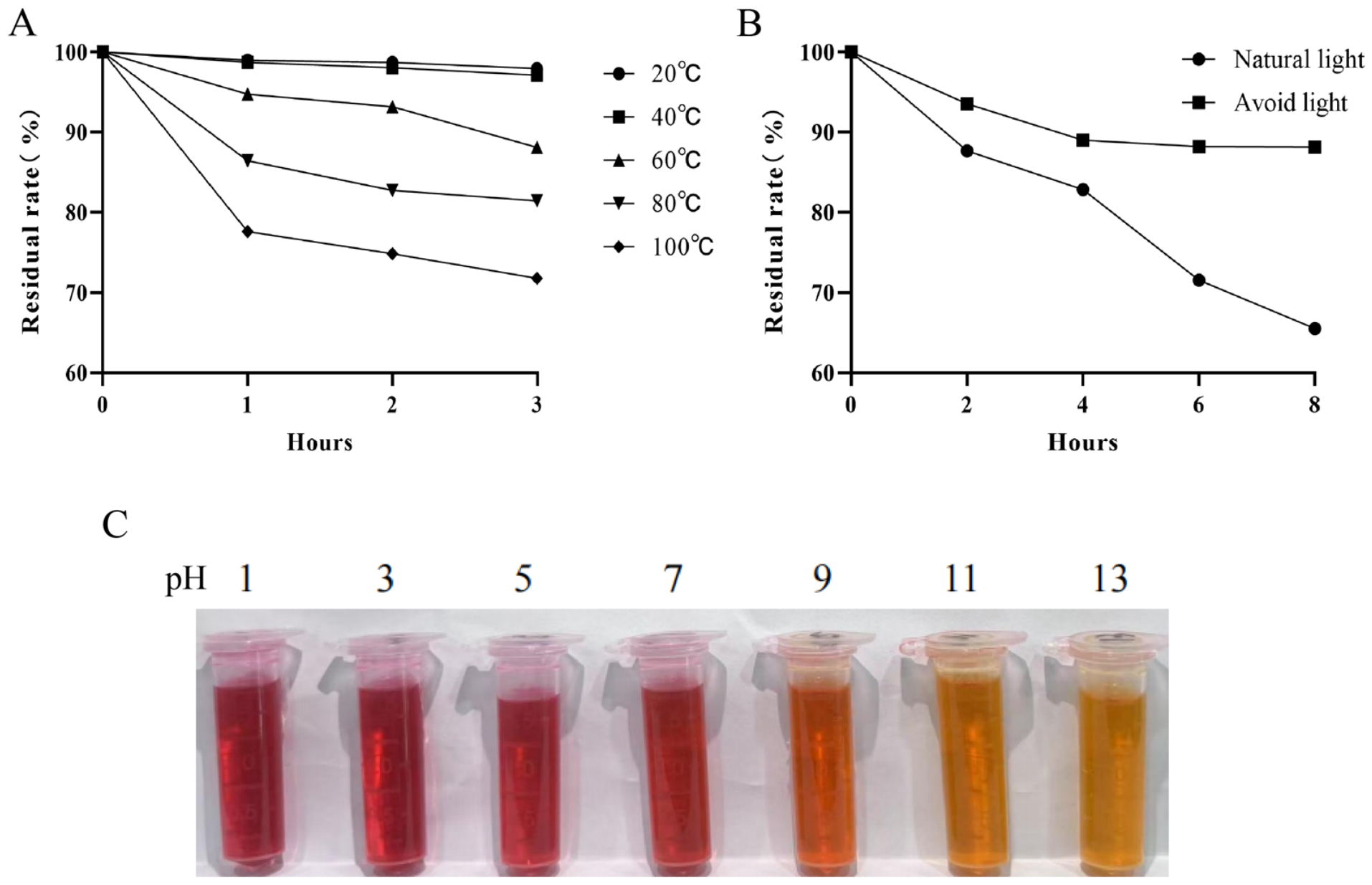
The stability of prodigiosin under different environmental conditions was evaluated by monitoring the residual absorbance at 535 nm. As shown in Figure 4A, prodigiosin remained relatively stable at 20 °C and 40 °C. However, pigment stability decreased markedly when the temperature exceeded 60 °C, indicating that elevated temperature accelerated pigment degradation. This thermal instability may be associated with disruption of the conjugated pyrrole system or structural changes in the monopyrrole and dipyrrole moieties of prodigiosin [39].
Light exposure also influenced prodigiosin stability. As shown in Figure 4B, with the passage of time, the OD535 nm value of prodigiosin under dark conditions remained basically unchanged, and the retention rate was still above 90%. However, under natural light conditions, the OD535 nm value of prodigiosin showed a downward trend, and the retention rate of the pigment was 65.51% after 8 h. The results show that the stability of prodigiosin under natural light was significantly different from that in dark environment. Therefore, light exposure has a considerable impact on prodigiosin. In the presence of light, these pigment molecules are in an excited state, which helps to enhance their reaction capabilities [40]. This reaction led to the disappearance of the color, because the pyrrole group in the lichen red pigment underwent delocalization [41].
The pH stability results show that prodigiosin was more stable under acidic and neutral conditions than under alkaline conditions. In the acidic range, the pigment solution is red; when the pH is greater than or equal to 9, the pigment solution gradually changes from red to orange-yellow (Figure 4C). As shown in Table 4, this red pigment is relatively stable in acidic solutions. When the pH is between 1 and 7, its residual rate remains above 87%, and there is a slight change in color, with the redness becoming weaker. Between pH 9 and 13, the color turns into an orange-yellow shade, significantly fading, and the residual rate is less than 50% at pH 13. These color changes are consistent with previous studies [18]. This may be due to the fact that under extremely acidic conditions, the pyrrole group is protonated on the second carbon atom of the ring, rather than on the nitrogen atom, and thus is no longer aromatic [42]. In an extremely alkaline environment, the -OH group will lose the hydrogen atom in the amine structure, thereby forming an anion [42]. In both cases, the conjugated system formed by the double bond is destroyed, leading to degradation of the pigment [43]. Overall, the extracted prodigiosin showed better stability at 20–40 °C.

3.5. Antibacterial Activity of Prodigiosin

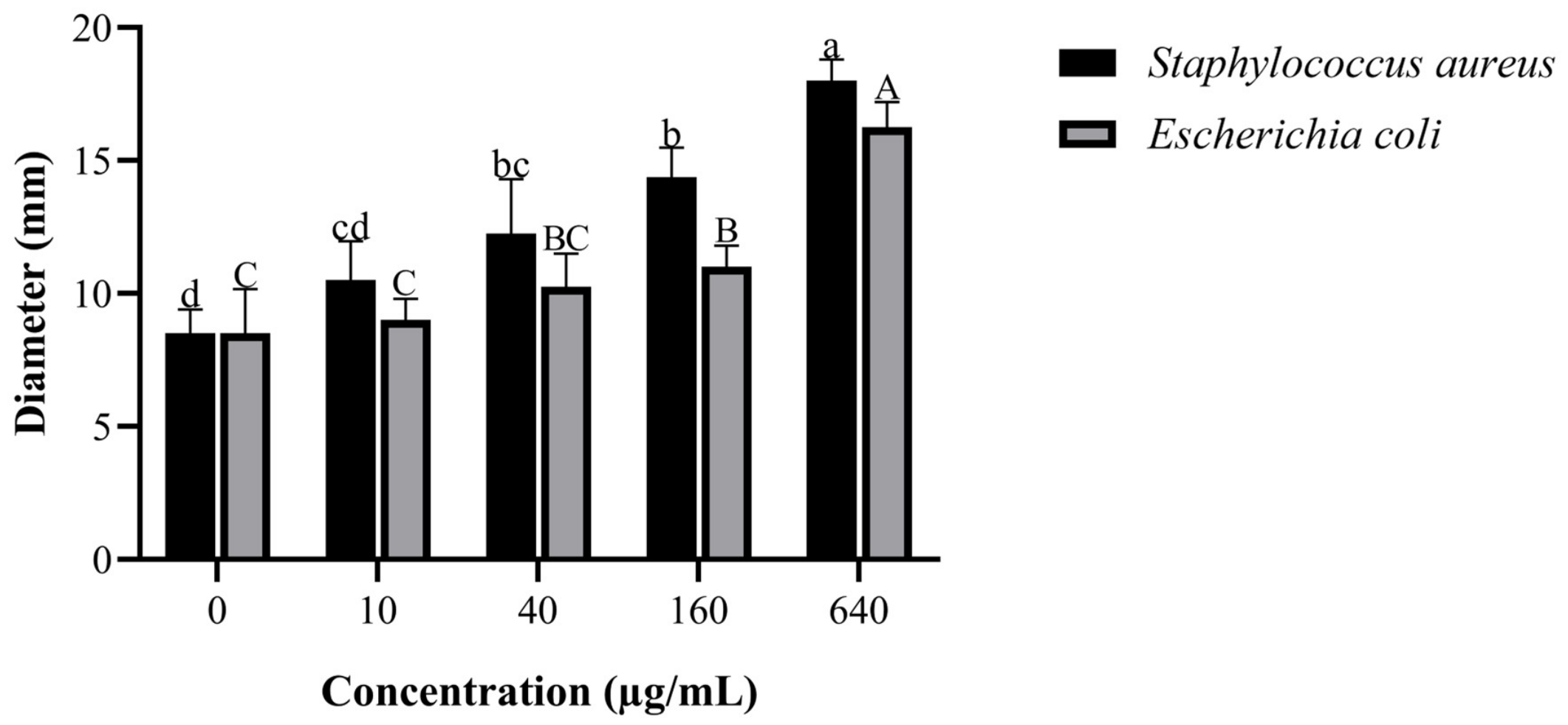
The antibacterial activity of prodigiosin was evaluated against E. coli and S. aureus using the agar disk diffusion assay. As shown in Figure 5, prodigiosin inhibited both bacterial strains, and the inhibition-zone diameter increased with increasing prodigiosin concentration. These results indicate that the antibacterial activity of prodigiosin was concentration-dependent within the tested range.
The inhibition zone against S. aureus were larger than those against E. coli at the same prodigiosin concentrations, suggesting that S. aureus was more susceptible to the extracted prodigiosin. This observation is consistent with previous reports showing that prodigiosin exhibits broad-spectrum antibacterial activity against both Gram-positive and Gram-negative bacteria, with stronger inhibitory effects often observed against Gram-positive bacteria [44,45].
The difference in susceptibility between S. aureus and E. coli may be associated with differences in extracellular membrane structure. This might be due to the fact that S. aureus (Gram-positive bacteria) lacks an outer membrane structure, and its cell wall is composed only of peptidoglycan, through which prodigiosin can freely penetrate [46]. The lipopolysaccharide structure on the outer polysaccharide layer of Gram-negative bacteria is impermeable to lipophilic solutes. Gram-negative bacteria are more difficult to be penetrated by the lipophilic prodigiosin than Gram-positive bacteria [46]. These results suggest that prodigiosin produced from soybean residue-based fermentation has potential antimicrobial activity.

3.6. Antioxidant Activity of Prodigiosin

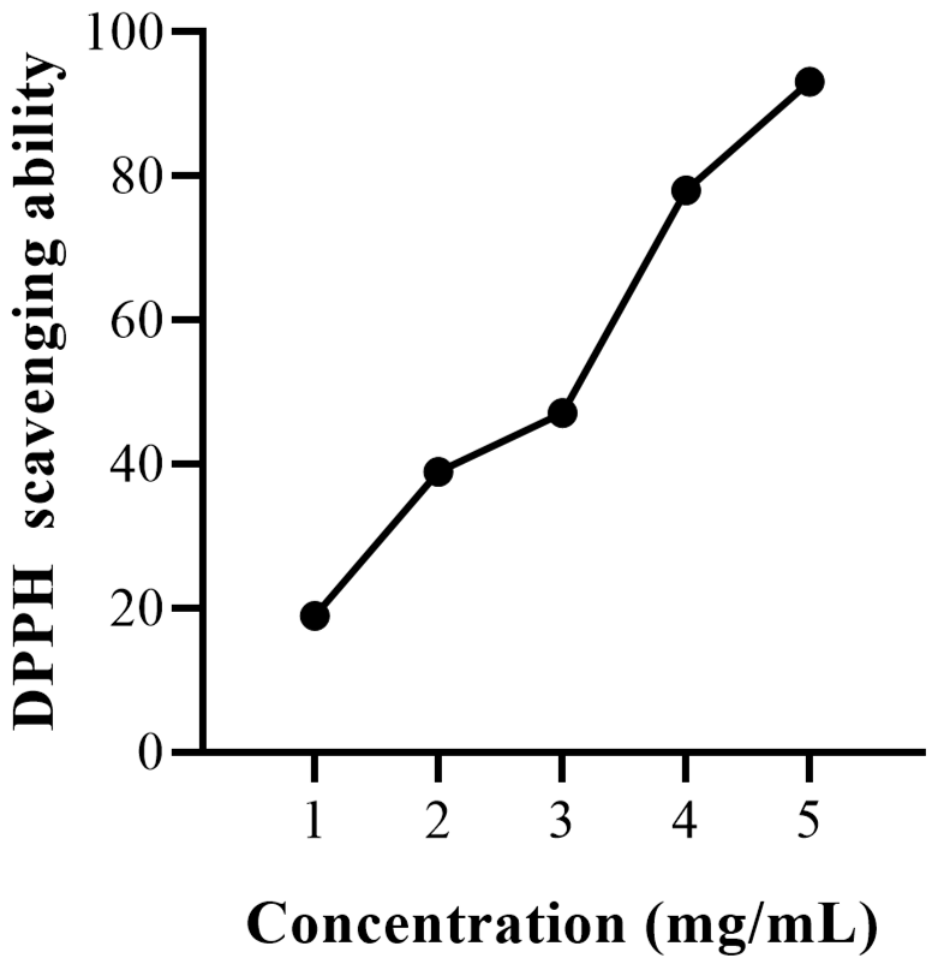
The antioxidant activity of prodigiosin was evaluated using the DPPH radical scavenging assay. As shown in Figure 6, prodigiosin exhibited concentration-dependent radical scavenging activity. At concentrations of 1, 2, 3, 4 and 5 mg/mL, the DPPH radical scavenging activities were 18.94%, 38.96%, 47.15%, 78.00% and 93.13%, respectively.
The DPPH radical scavenging activity of prodigiosin may be attributed to its tripyrrole ring structure and conjugated system, which can participate in electron or hydrogen atom transfer and thereby stabilize free radicals [33]. Previous studies have also reported that the radical scavenging ability of prodigiosin is dependent on both concentration and reaction time, with higher concentrations and longer reaction times generally leading to stronger scavenging effects [33]. The present results indicate that prodigiosin produced by S. marcescens BD2025 using soybean residue as the fermentation substrate has in vitro antioxidant potential. However, because the DPPH assay represents a chemical radical scavenging system, additional antioxidant assays would be required to evaluate its activity in more complex biological or food-related systems.

4. Conclusions

In this study, a strain of Serratia marcescens BD2025 with a high yield of prodigiosin was isolated from naturally fermented soybean residue. Through Box–Behnken design optimization, under the conditions of a bean residue-to-water ratio of 1:4.28, an inoculum size of 5.2%, and a cultivation temperature of 27.5 °C for 48 h, the maximum yield of prodigiosin reached 19.05 mg/g. The property study showed that this pigment has good stability under dark, low-temperature and acidic conditions. It exhibited significant antibacterial activity against both Escherichia coli and Staphylococcus aureus, and its DPPH radical scavenging ability showed a dose-dependent relationship. Overall, these findings indicate that soybean residue can be used as a low-cost substrate for solid-state prodigiosin production, providing a potential value-added route for soybean-processing waste utilization. Further work should focus on process scale-up, yield validation under optimized conditions, and comprehensive evaluation of product safety and application performance.

Author Contributions

Conceptualization, D.S. and D.H.; methodology, T.Y.; software, T.Y.; validation, Q.J., R.Z. and Y.W.; formal analysis, D.S.; investigation, Q.J. and H.S.; resources, D.S.; data curation, T.Y.; writing—original draft preparation, T.Y.; writing—review and editing, W.B.; visualization, J.H.; supervision, Y.W., H.S. and Z.M. All authors have read and agreed to the published version of the manuscript.

Funding

This research was funded by the Taishan Industrial Experts Program and the Yuandu Industry Leading Talents Project.

Institutional Review Board Statement

Not applicable.

Informed Consent Statement

Not applicable.

Data Availability Statement

The original contributions presented in this study are included in the article. Further inquiries can be directed to the corresponding author.

Acknowledgments

The authors have reviewed and edited the output and take full responsibility for the content of this publication.

Conflicts of Interest

The authors declare no conflicts of interest.

References

  1. Wang, J.; Zhang, T.; Liu, Y.; Wang, S.; Liu, S.; Han, Y.; Xu, H. Adaptive laboratory evolution of Serratia marcescens with enhanced osmotic stress tolerance for prodigiosin synthesis. Process Biochem. 2025, 148, 32–42. [Google Scholar]
  2. Joshy, N.; Dhanashree, B. Antibacterial Effect of Prodigiosin on Uropathogenic Escherichia coli. Scientifica 2025, 2025, 6668394. [Google Scholar] [CrossRef] [PubMed]
  3. Wang, B.; Shi, R.; Du, W.; Guo, J.; He, N.; Zhu, Y.; Yu, H.; Lu, H.; Zhong, L.; Li, X.; et al. Prodigiosin inhibits proliferation and induces apoptosis through influencing amino acid metabolism in multiple myeloma. Bioorganic Chem. 2025, 159, 108349. [Google Scholar] [CrossRef]
  4. Yang, H.-A.; Han, T.-H.; Haam, K.; Lee, K.-S.; Kim, J.; Han, T.-S.; Lee, M.-S.; Ban, H.S. Prodigiosin regulates cancer metabolism through interaction with GLUT1. Nat. Prod. Res. 2025, 39, 5264–5271. [Google Scholar] [PubMed]
  5. Han, S.B.; Kim, H.M.; Kim, Y.H.; Lee, C.W.; Jang, E.S.; Son, K.H.; Kim, S.U.; Kim, Y.K. T-cell specific immunosuppression by prodigiosin isolated from Serratia marcescens. Int. J. Immunopharmacol. 1998, 20, 1–13. [Google Scholar] [CrossRef] [PubMed]
  6. Hamada, M.A.; Mohamed, E.T. Characterization of Serratia marcescens (OK482790)’ prodigiosin along with in vitro and in silico validation for its medicinal bioactivities. BMC Microbiol. 2024, 24, 495. [Google Scholar] [CrossRef] [PubMed]
  7. Lazaro, J.E.; Nitcheu, J.; Predicala, R.Z.; Mangalindan, G.C.; Nesslany, F.; Marzin, D.; Concepcion, G.P.; Diquet, B. Heptyl prodigiosin, a bacterial metabolite, is antimalarial in vivo and non-mutagenic in vitro. J. Nat. Toxins 2002, 11, 367–377. [Google Scholar] [PubMed]
  8. Ehrenkaufer, G.; Li, P.; Stebbins, E.E.; Kangussu-Marcolino, M.M.; Debnath, A.; White, C.V.; Moser, M.S.; DeRisi, J.; Gisselberg, J.; Yeh, E.; et al. Identification of anisomycin, prodigiosin and obatoclax as compounds with broad-spectrum anti-parasitic activity. PLoS Negl. Trop. Dis. 2020, 14, e0008150. [Google Scholar] [PubMed]
  9. Ma, S.; Yang, L.; Chen, H.; Yan, Y.; Wei, X.; Wang, Z. Natural prodigiosin from Serratia marcescens: A promising functional food colorant with iron chelation and antioxidative properties. Food Biosci. 2025, 68, 106490. [Google Scholar] [CrossRef]
  10. Darshan, N.; Manonmani, H.K. Prodigiosin and its potential applications. J. Food Sci. Technol. 2015, 52, 5393–5407. [Google Scholar] [CrossRef] [PubMed]
  11. Prabowo, C.P.S.; Eun, H.; Yang, D.; Huccetogullari, D.; Jegadeesh, R.; Kim, S.-J.; Lee, S.Y. Production of natural colorants by metabolically engineered microorganisms. Trends Chem. 2022, 4, 608–626. [Google Scholar] [CrossRef]
  12. Papireddy, K.; Smilkstein, M.; Kelly, J.X.; Shweta; Salem, S.M.; Alhamadsheh, M.; Haynes, S.W.; Challis, G.L.; Reynolds, K.A. Antimalarial Activity of Natural and Synthetic Prodiginines. J. Med. Chem. 2011, 54, 5296–5306. [Google Scholar] [CrossRef] [PubMed]
  13. Feng, G.; Guo, X.; Hao, S.; Dong, S.; Yu, Q.; Fu, Y.; Hao, X.; Zhang, X.; Chen, Z. Metabolite-mediated microbial community modulation by Serratia marcescens enhances cucumber seedling growth in artificial cultivation systems. Sci. Hortic. 2025, 352, 114459. [Google Scholar] [CrossRef]
  14. Liu, D.; Wang, L.; Gou, L.; Lu, Y.; Ma, Y.; Yao, S.; Fan, T.-P.; Deng, H.; Cai, Y. Hybrid Methylotrophic Pathway in Serratia marcescens for Sustainable Terpenoid Biosynthesis. ACS Synth. Biol. 2025, 14, 1766–1776. [Google Scholar] [CrossRef] [PubMed]
  15. Srilekha, V.; Krishna, G.; Sreelatha, B.; Jagadeesh Kumar, E.; Rajeshwari, K.V.N. Prodigiosin: A fascinating and the most versatile bioactive pigment with diverse applications. Syst. Microbiol. Biomanuf. 2024, 4, 66–76. [Google Scholar]
  16. Sundararajan, P.; Ramasamy, S.P. Development of sustainable, eco-friendly antimicrobial finishing of cotton fabric using prodigiosin of Serratia marcescens SP1. Prog. Org. Coat. 2024, 188, 108216. [Google Scholar] [CrossRef]
  17. Alves, C.; Soares-Castro, P.; Fernandes, R.D.V.; Pereira, A.; Rodrigues, R.; Fonseca, A.R.; Santos, N.C.; Zille, A. Application of Prodigiosin Extracts in Textile Dyeing and Novel Printing Processes for Halochromic and Antimicrobial Wound Dressings. Biomolecules 2025, 15, 1113. [Google Scholar] [CrossRef] [PubMed]
  18. Wang, C.; Gao, Z.; Han, R.; Tian, Y.; Fan, H.; Zhang, Y. High Yield of Prodigiosin by Serratia marcescens Ka3 Using Additive Huangshui, a Byproduct of Chinese Liquor (Baijiu). Curr. Microbiol. 2025, 82, 272. [Google Scholar] [CrossRef] [PubMed]
  19. Xia, Y.; Wang, G.; Lin, X.; Song, X.; Ai, L. Solid-state fermentation with Serratia marcescens Xd-1 enhanced production of prodigiosin by using bagasse as an inertia matrix. Ann. Microbiol. 2016, 66, 1239–1247. [Google Scholar] [CrossRef]
  20. Gohil, N.; Siruka, D.; Musini, D.; Makwana, K.; Khambhati, K.; Bhattacharjee, G.; Kalariya, R.; Abusharha, A.; Ramakrishna, S.; Singh, V. Enhanced Production of Prodigiosin Utilizing Agro-industrial Yellow Mustard Cake Waste by a Novel Strain Serratia marcescens SBL03. Appl. Biochem. Biotechnol. 2025, 197, 5131–5147. [Google Scholar] [PubMed]
  21. Gohil, N.; Bhattacharjee, G.; Kalariya, R.; Pandya, V.; Khambhati, K.; Gohil, J.; Alzahrani, K.J.; Show, P.-L.; Maurya, R.; Singh, V. Biovalorization of agro-industrial waste soybean meal for the production of prodigiosin by Serratia marcescens. Biomass Convers. Biorefin. 2025, 15, 29823–29834. [Google Scholar]
  22. Kuo, Y.-Y.; Li, S.-Y. Solid-state fermentation of food waste by Serratia marcescens NCHU05 for prodigiosin production. J. Taiwan Inst. Chem. Eng. 2024, 160, 105260. [Google Scholar]
  23. Soccol, C.R.; Costa, E.S.F.d.; Letti, L.A.J.; Karp, S.G.; Woiciechowski, A.L.; Vandenberghe, L.P.d.S. Recent developments and innovations in solid state fermentation. Biotechnol. Res. Innov. 2017, 1, 52–71. [Google Scholar] [CrossRef]
  24. Tuly, J.A.; Ma, H. Bioconversion of food industrial waste okara by microbial fermentation: Scope of omics study and possibility. Trends Food Sci. Technol. 2024, 146, 104391. [Google Scholar] [CrossRef]
  25. Nile, S.H.; Venkidasamy, B.; Samynathan, R.; Nile, A.; Shao, K.; Chen, T.; Sun, M.; Khan, M.U.; Dutta, N.; Thiruvengadam, M.; et al. Soybean Processing Wastes: Novel Insights on Their Production, Extraction of Isoflavones, and Their Therapeutic Properties. J. Agric. Food Chem. 2022, 70, 6849–6863. [Google Scholar] [PubMed]
  26. Colletti, A.; Attrovio, A.; Boffa, L.; Mantegna, S.; Cravotto, G. Valorisation of By-Products from Soybean (Glycine max (L.) Merr.) Processing. Molecules 2020, 25, 2129. [Google Scholar] [CrossRef] [PubMed]
  27. Nile, S.H.; Nile, A.; Oh, J.-W.; Kai, G. Soybean processing waste: Potential antioxidant, cytotoxic and enzyme inhibitory activities. Food Biosci. 2020, 38, 100778. [Google Scholar] [CrossRef]
  28. Duan, Y.; Du, W.; Xu, Y.; Guo, G.; Liu, Z.; Hao, N. Enhanced nattokinase production by Bacillus subtilis from glycerol and okara: Optimization of culture medium via response surface methodology. Front. Microbiol. 2025, 16, 2025. [Google Scholar] [CrossRef] [PubMed]
  29. Feng, J.-Y.; Zhang, W.-W.; Thakur, K.; Hu, F.; Zhang, J.-G.; Wei, Z.-J. Combination of dry planetary ball milling and Lactobacillus plantarum fermentation improves nutritional and functional value of okara. Appl. Food Res. 2025, 5, 100827. [Google Scholar] [CrossRef]
  30. Nguyen, T.H.; Wang, C.-H.; Wang, S.-L.; Nguyen, A.D.; Phan, T.Q.; Nguyen, V.B. High-Level Scale Bioproduction of Prodigiosin Using a Novel Designed Culture Medium Completely Based on Organic By-Products and its Potential Anti-Alzheimer Effect: An Experimental and Virtual Study. Curr. Microbiol. 2025, 83, 73. [Google Scholar] [PubMed]
  31. Liu, S.; Yu, L.; Han, Y.; Wang, S.; Liu, Z.; Xu, H. Preparation, characterization, formation mechanism, and stability studies of zein/pectin nanoparticles for the delivery of prodigiosin. Int. J. Biol. Macromol. 2025, 290, 138915. [Google Scholar] [PubMed]
  32. Wang, X.; Zhang, Z.; Zhao, J.; Liu, X.; Wang, J.; Lv, Z.; Song, Q.; Hua, D.; Meng, G.; Zhang, J.; et al. Study on the antibacterial activity and mechanism of prodigiosin against Methicillin-resistant Staphylococcus aureus: Insights from metabolomic and transcriptomic analyses. Process Biochem. 2025, 154, 143–156. [Google Scholar] [CrossRef]
  33. Ibrahim, G.S.; Abdelhamid, S.A.; Elmansy, E.A.; Asker, M.M.S.; El Shall, F.N. Red pigment from isolated Serratia marcescens SEM: Structure, antimicrobial and antioxidant activity. Biocatal. Agric. Biotechnol. 2023, 54, 102932. [Google Scholar] [CrossRef]
  34. Li, O.; Zhu, J.; Qiao, Y.; Xiong, Y.; Chio, C.; Liu, C.; Chen, Y.; Boteju, R.; Qin, W. A novel and efficient strategy for screening high prodigiosin-yielding bacterial mutants by using multiple negative regulatory factors and fermentation optimization under waste cooking oil and precursors. J. Clean. Prod. 2025, 491, 144701. [Google Scholar] [CrossRef]
  35. Liu, W.; Yang, J.; Tian, Y.; Zhou, X.; Wang, S.; Zhu, J.; Sun, D.; Liu, C. An in situ extractive fermentation strategy for enhancing prodigiosin production from Serratia marcescens BWL1001 and its application to inhibiting the growth of Microcystis aeruginosa. Biochem. Eng. J. 2021, 166, 107836. [Google Scholar] [CrossRef]
  36. Su, W.-T.; Tsou, T.-Y.; Liu, H.-L. Response surface optimization of microbial prodigiosin production from Serratia marcescens. J. Taiwan Inst. Chem. Eng. 2011, 42, 217–222. [Google Scholar] [CrossRef]
  37. Abdul Manas, N.H.; Chong, L.Y.; Tesfamariam, Y.M.; Zulkharnain, A.; Mahmud, H.; Abang Mahmod, D.S.; Mohamad Fuzi, S.F.Z.; Wan Azelee, N.I. Effects of oil substrate supplementation on production of prodigiosin by Serratia nematodiphila for dye-sensitized solar cell. J. Biotechnol. 2020, 317, 16–26. [Google Scholar] [CrossRef] [PubMed]
  38. Aruldass, C.A.; Venil, C.K.; Zakaria, Z.A.; Ahmad, W.A. Brown sugar as a low-cost medium for the production of prodigiosin by locally isolated Serratia marcescens UTM1. Int. Biodeterior. Biodegrad. 2014, 95, 19–24. [Google Scholar] [CrossRef]
  39. Siva, R.; Subha, K.; Bhakta, D.; Ghosh, A.R.; Babu, S. Characterization and Enhanced Production of Prodigiosin from the Spoiled Coconut. Appl. Biochem. Biotechnol. 2012, 166, 187–196. [Google Scholar] [PubMed]
  40. Song, M.-J.; Bae, J.; Lee, D.-S.; Kim, C.-H.; Kim, J.-S.; Kim, S.-W.; Hong, S.-I. Purification and characterization of prodigiosin produced by integrated bioreactor from Serratia sp. KH-95. J. Biosci. Bioeng. 2006, 101, 157–161. [Google Scholar] [CrossRef] [PubMed]
  41. Namazkar, S. Spray-dried Prodigiosin from Serratia marcescens as A colorant. Biosci. Biotechnol. Res. Asia 2013, 10, 69–76. [Google Scholar] [CrossRef]
  42. Faraag, A.; El-Batal, A.; El-Hendawy, H. Characterization of prodigiosin produced by Serratia marcescens strain isolated from irrigation water in Egypt. Nat. Sci. 2017, 15. [Google Scholar] [CrossRef]
  43. Gajadhar, S.; Mellem, J.J. Isolation and Characterization of A Microbial Pigment Obtained from Serratia marcescens as A Natural Food Colourant. Ann. Univ. Dunarea Jos Galati. Fasc. VI. Food Technol. 2019, 43, 137–154. [Google Scholar] [CrossRef]
  44. Ji, K.; Kim, Y. Antimicrobial Activity of Prodigiosin from Serratia sp. PDGS120915 Against Intestinal Pathogenic Bacteria. Microbiol. Biotechnol. Lett. 2019, 47, 459–464. [Google Scholar] [CrossRef]
  45. Samrot, A.; Pachiyappan, S.; Chandana, K.; Gopakumaran, N. Optimization of prodigiosin production by Serratia marcescens SU-10 and evaluation of its bioactivity. Int. Res. J. Biotechnol. 2011, 2, 2141–5153. [Google Scholar]
  46. Yip, C.-H.; Mahalingam, S.; Wan, K.-L.; Nathan, S. Prodigiosin inhibits bacterial growth and virulence factors as a potential physiological response to interspecies competition. PLoS ONE 2021, 16, e0253445. [Google Scholar] [CrossRef] [PubMed]
Figure 1. Identification of Serratia marcescens BD2025. (A) Colony morphology of strain BD2025 on NA medium. (B) Phylogenetic tree based on 16S rRNA gene sequence analysis.
Microorganisms 14 01475 g001
Figure 2. HPLC analysis of prodigiosin. (A) Prodigiosin standard. (B) Ethanol-extracted pigment produced by S. marcescens BD2025 during solid-state fermentation of soybean residue.
Microorganisms 14 01475 g002
Figure 3. Effect of different variables on prodigiosin production, presented as a 3D plot (left) and contour plot (right). (A) 3D plot—the ratio of soybean residue to water with the inoculation size. (B) Contour plot—the ratio of bean residue to water with the inoculation size. (C) 3D plot—the ratio of bean residue to water with temperature. (D) Contour plot—the ratio of bean residue to water with temperature. (E) 3D plot—inoculation size with temperature. (F) Contour plot—inoculation size with temperature. The color gradient from blue to red represents the predicted yield, with warmer colors indicating higher production.
Microorganisms 14 01475 g003
Figure 4. Stability of prodigiosin under different environmental conditions. (A) Temperature stability. (B) Light stability. (C) Color change under different pH conditions.
Microorganisms 14 01475 g004
Figure 5. Antibacterial activity of prodigiosin against E. coli and S. aureus. Different capital letters indicate significant differences (p < 0.05) in the effect of prodigiosin at different concentrations on Escherichia coli, while the same letters indicate no significant difference (p > 0.05). Different lowercase letters indicate significant differences (p < 0.05) in the effect of prodigiosinat different concentrations on Staphylococcus aureus, while the same letters represent no significant differences (p > 0.05).
Microorganisms 14 01475 g005
Figure 6. DPPH radical scavenging activity of prodigiosin at different concentrations.
Microorganisms 14 01475 g006
Table 1. The levels and ranges of the variables in the BBD.
Variable FactorsCoded SymbolCoded Levels
−101
Soybean residue-to-water ratio (w/v)X11:21:41:6
Inoculation size (% w/v)X2357
Temperature (°C)X3232833
Table 2. Experimental design matrix and prodigiosin yield.
RunExperimental VariablesProdigiosin Yield (mg/g)
X1X2X3
111012.3075
2−11010.6115
3−10−17.5428
40117.7938
5−1−107.6142
60−1−19.5776
7−1011.7023
800017.8903
900019.2101
100−115.5861
1100018.9686
1200018.4922
1301−110.6962
1400019.4922
1510−18.2857
161017.8313
171−1012.3434
Table 3. ANOVA of regression models for optimizing prodigiosin production.
SourceSum of SquaresdfMean SquareF-Valuep-Value
Model472.88952.54218.42<0.0001
A—Soybean residue-to-water ratio130.111130.11540.86<0.0001
B—Inoculation size6.3616.3626.440.0013
C—Temperature23.92123.9299.44<0.0001
AB2.3012.309.560.0175
AC7.5217.2530.150.0009
BC0.296510.29651.230.3036
A2108.751108.75452.09<0.0001
B238.13138.13158.51<0.0001
C2229.821229.82955.35<0.0001
Residual1.6870.2406  
Lack of fit0.086430.02880.07210.9718
Pure error1.6040.3994  
Cor Total474.5716   
R2 = 99.65%; R2(adj) = 99.19%; R2(pred) = 99.18%.
Table 4. pH stability of prodigiosin after 4 h of treatment.
pH0 h4 hResidual Rate (%)
11.3331.23392.5 a
31.2701.15390.79 b
51.2531.10488.11 c
71.2411.08587.43 d
91.2180.88872.91 e
110.8680.47855.07 f
130.6650.28442.71 g
Values with different lowercase letters indicate significant differences among pH treatments (p < 0.05).
Disclaimer/Publisher’s Note: The statements, opinions and data contained in all publications are solely those of the individual author(s) and contributor(s) and not of MDPI and/or the editor(s). MDPI and/or the editor(s) disclaim responsibility for any injury to people or property resulting from any ideas, methods, instructions or products referred to in the content.