Article

Antimicrobial Resistance and Comparative Genome Analysis of High-Risk Escherichia coli Strains Isolated from Ventilator-Associated Pneumonia Cases in Egyptian ICUs


1
Microbiology and Immunology Department, Faculty of Veterinary Medicine, Assiut University, Assiut 71515, Egypt
2
Medical Microbiology and Immunology Department, Faculty of Medicine, Assiut University, Assiut 71515, Egypt
3
Department of Basic Medical Sciences, Badr University in Assiut (BUA), Assiut 19592, Egypt
4
Assiut International Center of Nanomedicine, Al-Rajhy Liver Hospital, Assiut University, Assiut 71515, Egypt
5
Microbiology and Immunology Department, School of Biotechnology, Badr University in Assiut, Assiut 19592, Egypt
6
Department of Zoonoses, Faculty of Veterinary Medicine, Zagazig University, Zagazig 44519, Egypt
7
School of Science, Faculty of Engineering and Science, University of Greenwich, Medway campus, Kent ME4 4TB, UK
8
College of Veterinary Medicine, Northwest A&F University, Xianyang 712100, China
9
Biosciences, Aston University, Aston Triangle, Birmingham B4 7ET, UK
10
Aston Institute for Membrane Excellence, Aston University, Birmingham B4 7ET, UK
*
Authors to whom correspondence should be addressed.
Microorganisms 2026, 14(7), 1438; https://doi.org/10.3390/microorganisms14071438
Submission received: 20 May 2026 / Revised: 25 June 2026 / Accepted: 26 June 2026 / Published: 30 June 2026
(This article belongs to the Special Issue Bacterial Infection and Antimicrobial Resistance)

Abstract

Escherichia coli is increasingly recognised as an important cause of ventilator-associated pneumonia (VAP), particularly in intensive care units (ICUs) with high antimicrobial selective pressure. Unlike classical respiratory pathogens, ICU-associated E. coli often originates from the patient’s intestinal microbiota and harbours a complex mobilome enriched with antimicrobial resistance determinants. In this study, a total of 200 nosocomial endotracheal aspirate samples were aseptically collected from patients admitted to the Respiratory ICU at Assiut University hospital. Antimicrobial susceptibility testing, serotyping and screening for various virulence and antimicrobial resistance genes (e.g., extended-spectrum β-lactamase (ESBL) and carbapenems genes) were carried out. In total, E. coli isolates were recovered from 54/200 (27%) endotracheal aspirates, with a high prevalence of multidrug resistance (MDR) observed (74.1%). Resistance to β-lactams was common with phenotypic evidence suggestive of ESBL production detected in 64.8% of isolates. Genome sequencing of three MDR E. coli isolates confirmed that they carried multiple antimicrobial resistance genes, which included ESBL genes (e.g., blaCTX-M-15 and blaTEM-1B). Each strain was also found to be high-risk extraintestinal pathogenic E. coli (ExPEC) clones, belonging to either sequence type ST131 or ST405. These findings support an endogenous infection model for VAP, whereby ICU selective pressure favours highly mobile, multidrug-resistant E. coli lineages adapted for extraintestinal survival. The high production of ESBLs and the prevalence of carbapenemase genes highlight the urgent need for molecular surveillance and antimicrobial stewardship strategies for the control of such high-priority pathogens in this part of the world.

1. Introduction

Healthcare-associated infections remain a major threat to patient safety, particularly in intensive care units (ICUs), where critically ill patients are highly susceptible to opportunistic pathogens [1]. The ICU environment supports the persistence of clinically important pathogens, particularly the ESKAPE group (Enterococcus faecium, Staphylococcus aureus, Klebsiella pneumoniae, Acinetobacter baumannii, Pseudomonas aeruginosa, and Enterobacter spp.), which are well known for their ability to accumulate and disseminate antimicrobial resistance. Within this complex microbial landscape, Escherichia coli occupies a unique position as it is not only a commensal organism but also a cause of serious nosocomial infections [2]. E. coli’s capacity to induce ventilator-associated pneumonia (VAP) and other ICU-acquired infections reflects remarkable adaptability, driven by a diverse repertoire of virulence determinants and antimicrobial resistance mechanisms [2,3]. The co-occurrence of these traits poses additional challenges for clinical management and infection control, emphasising the need for a detailed molecular understanding of ICU-adapted E. coli strains [3].
Due to its eclectic ability to acquire virulence determinants, E. coli frequently causes diseases at various sites within the human body. In many instances, infection results in diarrhoea, which accounts for considerable global morbidity and mortality, particularly amongst children. In addition to diarrhoeagenic E. coli, some strains have acquired virulence genes that allow them to cause extraintestinal infections, such as urinary tract infections (UTIs), respiratory tract infections and sepsis, and have been termed extraintestinal pathogenic E. coli (ExPEC) [4,5]. In this context, E. coli is increasingly recognised as an emerging opportunistic pathogen in VAP, particularly among critically ill, mechanically ventilated patients, although it remains less frequently reported than classical ICU pathogens [6]. When present in the respiratory tract, especially as multidrug-resistant lineages, it is associated with poor clinical outcomes and limited therapeutic options [7]. The presence of endotracheal tubes further facilitates bacterial adhesion and biofilm formation, promoting persistent colonisation, immune evasion, and reduced antimicrobial efficacy [6,8]. Altogether, these factors highlight the clinical relevance of MDR E. coli in VAP, which is associated with prolonged mechanical ventilation, a longer ICU stay, and increased mortality in critically ill patients [7].
E. coli has been traditionally classified into four major phylogenetic groups, e.g., A, B1, B2, and D, based on their genetic makeup. Commensal isolates are generally associated with phylogroups A and B1, whereas pathogenic strains are more often linked to groups B2 and D [9,10]. Further classification is achieved by dividing strains into specific sequence types (STs) using multilocus sequence typing (MLST) based on the carriage of specific alleles of marker genes [11]. In parallel, serotyping based on O (lipopolysaccharide) and H (flagellar) antigens remains an important tool for epidemiological surveillance and the identification of clinically relevant lineages [12]. Phylogenetic background and serotype are frequently interrelated, as certain serotypes are consistently associated with specific phylogroups and pathogenic potential [13,14]. Together, these classification systems provide complementary insights into the epidemiology and virulence characteristics of E. coli.
The pathogenicity of E. coli is largely mediated by a wide array of virulence determinants that enable colonisation, invasion, immune evasion, and host persistence. Adhesion-associated genes such as fimH, papA, papG, papGI, papGII, and papGIII enable bacterial attachment to host tissues [15], while afa/draBC and sfa/focDE further promote colonisation and invasion. Importantly, several of these adhesins, particularly type 1 fimbriae (FimH) and S-fimbrial adhesins, are key virulence factors that facilitate binding to host cell receptors and abiotic materials. This interaction enables the establishment of biofilms, facilitating bacterial colonisation and increasing the risk of VAP in intubated patients [16]. Toxins encoded by hlyA and cnf1 disrupt host cell membranes and enhance invasiveness [17]. Immune evasion is supported by genes including kpsMII, traT, and ibseA [18], whereas iron acquisition and metabolic fitness rely on genes such as iutA, fyuA, and malX [19]. Altogether, these determinants contribute to the adaptation of E. coli to the hostile ICU environment and facilitate colonisation in the respiratory tract.
Concurrently, E. coli serves as a major reservoir of multidrug resistance (MDR) genes. In particular, this encompasses strains resistant to third-generation cephalosporin antibiotics (such as ceftriaxone), due to the carriage of extended-spectrum β-lactamases (ESBLs) genes like blaCTX-M, blaTEM, and blaSHV [20,21]. Furthermore, the carriage of carbapenemase genes, like the Klebsiella pneumoniae carbapenemase (blaKPC), New Delhi metallo-β-lactamase (blaNDM) and oxacillin hydrolysing enzymes (blaOXA-48-like), confer resistance to carbapenem antibiotics (e.g., imipenem), further compromising the efficacy of β-lactam antibiotics, which are at the frontline of fighting severe infections. [20,21,22,23]. The convergence of virulence and resistance within the same strain not only intensifies disease severity but also promotes persistence of MDR E. coli in ICU patients [24].
Against this background, the present study aimed to characterise E. coli isolates recovered from endotracheal aspirates of mechanically ventilated ICU patients, focusing on: (i) the prevalence of various antimicrobial resistance genes (ARGs); (ii) the distribution of phylogenetic groups and serotypes; and (iii) the repertoire of virulence genes that support adaptation to the respiratory tract. Increasing rates of MDR and carbapenem-resistant E. coli in intensive care units have become a major healthcare concern in Egypt and other low- and middle-income countries, but genomic surveillance data remain limited. Therefore, in addition, we use whole-genome sequencing to understand more about three of these MDR strains, identifying the ARG, plasmids and virulence determinants they carry, and use comparative genomics to place them in the context of the strains previously isolated and sequenced in Egypt. Furthermore, few studies have thoroughly investigated the relationship between antimicrobial resistance, virulence determinants, phylogenetic background, and genomic characteristics among respiratory isolates from mechanically ventilated patients, particularly in Egypt, despite the growing prevalence of MDR E. coli in ICUs. Thus, the integration of phenotypic and genotypic analyses in this study provides insights into the mechanisms underlying the persistence and pathogenic potential of E. coli in the ICU, offering a framework regarding antimicrobial stewardship measures, infection prevention strategies, and empirical therapy in critically ill patients.

2. Materials and Methods

2.1. Isolation and Characterisation of E. coli Strains from Endotracheal Aspirates

A total of 200 nosocomial endotracheal aspirates were aseptically collected from VAP patients admitted to the Respiratory ICU at Assiut University Hospital in 2020. Patients were diagnosed according to the Infectious Diseases Society of America (IDSA), defined as patients under mechanical ventilation for more than 48 h with new or progressive radiographic infiltrate, plus at least two of three clinical features (fever greater than 38 °C, leucocytosis or leucopenia, purulent secretions, new or worsening cough, dyspnoea, tachypnoea or impaired gas exchange) [25]. Exclusion criteria included patients who were mechanically ventilated for less than 48 h and those who did not fulfil the criteria of VAP. Samples were transported on ice and processed immediately or held at 4 °C for no longer than 24 h. E. coli isolates were recovered and identified using standard bacteriological methods [26]. Antimicrobial susceptibility was determined using the Kirby–Bauer disc diffusion method on Mueller–Hinton agar using a panel of β-lactams, aminoglycosides, fluoroquinolones, tetracycline, chloramphenicol, trimethoprim–sulfamethoxazole, and imipenem. Zone diameters were interpreted according to CLSI guidelines (2025) [27]. Isolates were classified as nondrug-resistant (NDR), single-drug-resistant (SDR), dual-antibiotic-resistant, or MDR, being defined as possessing resistance to one agent in three or more antimicrobial categories.

2.2. Detection of ESBLs and Carbapenemases

Phenotypic screening for ESBL production was performed by disc diffusion using oxyimino-cephalosporins according to CLSI criteria [27]. Confirmation was carried out using the combined disc method with cefoperazone and cefoperazone/sulbactam; an increase of ≥5 mm in inhibition zone diameter was considered positive [28]. Molecular detection of blaCTX-M-3-like, blaCTX-M-14-like, blaTEM, and blaSHV genes was performed using PCR with the primer sequences detailed in Supplementary Table S1. The blaCTX-M-3-like primers target members of the CTX-M group 1 (CTX-M-1/CTX-M-3 lineage), while blaCTX-M-14-like primers target members of the CTX-M group 9 (CTX-M-14 lineage). Selected amplicons were sequenced, and variants were identified using the NCBI database (https://blast.ncbi.nlm.nih.gov/Blast.cgi (accessed on 25 March 2026)). For PCR reactions, positive and negative controls were incorporated to support the validity of data (Supplementary Figure S1). Carbapenemase activity was screened phenotypically using the modified Hodge test and the imipenem–EDTA combined disc test [29,30]. Carbapenemase genes (blaIMP, blaVIM, blaNDM and blaKPC) were screened by PCR using the primers in Supplementary Table S1. Positive and negative PCR controls were incorporated to confirm the validity of data (Supplementary Figure S2).

2.3. Serotyping of E. coli Isolates

Serotyping was performed using monoclonal antisera (Statens Serum Institute, Copenhagen, Denmark) following the manufacturer’s instructions [31]. Isolates positive with polyvalent antisera were further tested using individual antisera. Heat-treated bacterial supernatants were mixed with antisera in microtiter plates, and reactions were read after overnight incubation. Carpet formation was considered positive, while button formation indicated a negative reaction.

2.4. Phylogenetic Analysis and Virulence Gene Profiling

Phylogenetic grouping was determined using the Clermont method [32]. PCR was used to detect virulence-associated genes, including fimH, papA, papG (I–III), afa/draBC, sfa/focDE, hlyA, cnf1, iutA, fyuA, kpsMII, traT, ibeA, and malX using primers in Supplementary Table S1. Positive and negative controls were incorporated to support the validity of the PCR data (Supplementary Figure S3).

2.5. Genome Sequencing

Three E. coli isolates were selected for further characterisation based on their phylogenetic background, AMR phenotype, and virulence profiles. Two isolates belonged to phylogroup B2 and serogroup O25, features commonly associated with extra-intestinal pathogenic E. coli (ExPEC). To provide representation of another clinically relevant phylogenetic background, a third isolate belonging to phylogroup D was included. This isolate also exhibited MDR and carried multiple virulence-associated genes. The sequencing of E. coli strains was carried out by Microbes NG (https://microbesng.com/ (accessed on 25 March 2026)) using Illumina sequencing as before [33]. Trimmomatic 0.30 was used to trim reads using a Q15 sliding window quality cutoff [34]. SPAdes version 3.7 was used for genome assembly [35] and Prokka 1.11 for genome annotation [36]. The sequencing data for this project have been placed in DDBJ/ENA/GenBank (BioProject: PRJNA1460381) under the accession numbers E43: JBXYYI000000000, E106: JBXYYH000000000 and E110: JBXYYG000000000.

2.6. Bioinformatic Analysis of Genome Sequences

MLST 2.0 was used to determine bacterial sequence types [37], SerotypeFinder 2.0 was used for bacterial serotyping [38], plasmids were identified using PlasmidFinder 2.1 [39], ResFinder version 4.7.2 was used to identify antibiotic resistance determinants [40] and VirulenceFinder 2.0 and PathogenFinder 2 were used for virulence gene analysis [41,42,43] using software at the Center for Genomic Epidemiology (CGE) (http://www.genomicepidemiology.org/ (accessed on 25 March 2026)). The EzClermont in silico Clermont phylotyper was also used to determine the phylotype of each strain (https://ezclermont.hutton.ac.uk/ (accessed on 25 March 2026)) [44].
Artemis was used to visualise draft genomes [45], and genome comparisons were performed using the Proksee Server (https://proksee.ca/about (accessed on 25 March 2026)) [46], the Artemis Comparison Tool (ACT) [47] and the Basic Local Alignment Search Tool (BLAST 2.17) at NCBI (https://blast.ncbi.nlm.nih.gov/Blast.cgi (accessed on 25 March 2026)). Proksee [46] and ACT [47] were used to draw depictions of plasmid and genome organisation.
For phylogenetic analysis, Egyptian E. coli draft genomes were obtained from the NCBI Pathogen Detection Browser (https://www.ncbi.nlm.nih.gov/pathogens/ (accessed 25 March 2025)) [48] and the Enterobase Database (https://enterobase.warwick.ac.uk/ (accessed 25 March 2025)) [49]. Single-nucleotide polymorphism (SNP) analysis and phylogenetic tree construction were achieved using the bioinformatics pipeline at Solu Genomics (https://www.solugenomics.com/ (accessed on 25 March 2026)) [50]. Genomes were aligned to the reference genome of E. coli K-12 strain MG1655 (NC_000913) with Snippy v4.6.0 (https://github.com/tseemann/snippy (accessed on 25 March 2026)). Phylogenetic trees were constructed using IQ-TREE v2.3.6 [51] and visualised using NCBI Tree Viewer (https://www.ncbi.nlm.nih.gov/tools/treeviewer/ (accessed on 25 March 2025)) and FigTree v1.4.4 (https://github.com/rambaut/figtree/releases (accessed 25 March 2026)). Tree construction was validated by the inclusion of suitable E. coli reference genomes.

3. Results

3.1. Identification of E. coli Isolates and Antimicrobial Susceptibility Patterns

Out of the 200 endotracheal aspirates collected from patients admitted to the Respiratory ICU at Assiut University Hospital in 2020, 54 E. coli isolates (27%) were identified. Antimicrobial susceptibility testing against 16 antibiotics representing eight antimicrobial classes revealed high resistance rates across multiple agents. Within the penicillin group, resistance was highest to amoxicillin (81.5%), followed by piperacillin (70.4%) and amoxicillin–clavulanic acid (59.2%). Resistance to cephalosporins ranged from 68.5% to 81.5%, with the highest resistance observed for cefazolin (81.5%) and the lowest for ceftriaxone (68.5%). Among aminoglycosides, resistance to gentamicin and amikacin was 35.2% and 24%, respectively. Resistance rates to other antimicrobials included trimethoprim–sulfamethoxazole (72.2%), tetracycline (63%), levofloxacin (61.1%), chloramphenicol (22.2%), and imipenem (1.9%). Based on resistance profiles, 40 isolates (74.1%) were classified as MDR, four isolates (7.4%) as dual-antibiotic-resistant, while 10 isolates (18.5%) as NDR.

3.2. Phenotypic and Genotypic Detection of ESBL-Producing E. coli Isolates

Initial phenotypic screening identified 44 of 54 isolates (81.5%) as potential ESBL producers, while 10 isolates (18.5%) were classified as non-ESBL producers. Confirmatory testing using the combined disc method verified ESBL production in 35 of the 44 screened isolates, whereas 9 isolates were confirmed as non-ESBL producers (Supplementary Table S2). For downstream molecular characterisation, only the 44 isolates identified as potential ESBL producers during initial screening were included. This approach was adopted to focus on isolates with a higher likelihood of harbouring ESBL-associated resistance determinants and to enable detailed investigation into their genetic and phenotypic characteristics.
PCR screening of all 44 E. coli isolates detected 42 ESBL gene targets in 29 isolates (Supplementary Table S2). The most prevalent ESBL genes were blaCTX-M-3-like and blaTEM, each identified in 17 isolates (38.6%), followed by blaCTX-M-14-like in six isolates (13.6%) and blaSHV in two isolates (4.5%). Sequencing identified multiple ESBL variants, reflecting notable genetic diversity among the isolates (Supplementary Table S2). Sequence analysis of blaCTX-M-3-like amplicons revealed three distinct CTX-M group 1 variants: blaCTX-M-15 (carrying the D240G substitution) detected in nine isolates, blaCTX-M-109 (with Q56R, D240G, and D288K substitutions along with a deletion of Gly289 and Leu290) detected in one isolate, and blaCTX-M-216 (possessing D240G and G289S substitutions) detected in seven isolates. Sequence analysis of the blaCTX-M-14-like amplicons identified two CTX-M group 9 variants: blaCTX-M-17 (with the E288K substitution) and blaCTX-M-27 (carrying the D240G substitution) in three isolates each. BLAST analysis of the blaTEM sequences identified the reference blaTEM-1 (detected in six isolates) along with four variant types. These included an unclassified blaTEM variant detected in six isolates (possessing a W286V substitution and insertion of three amino acids (NLS)), blaTEM-214 (with the I13F substitution) in three isolates, and blaTEM-169 (with M69L and W165G substitutions) and blaTEM-190 (carrying M69L, W165G, and N276D substitutions) each detected in one isolate. Sequence analysis of the two detected blaSHV genes revealed identical amino acid substitutions (i.e., L35Q, G237S, and E238K), classifying them as blaSHV-12. Importantly, phenotypic ESBL expression showed strong concordance with the presence of ESBL genes (Supplementary Table S2).

3.3. Detection of Carbapenemases in E. coli Isolates

Metallo-β-lactamase production, as detected by the imipenem–EDTA combined disc test, was identified in 8 of 44 isolates (18.1%). PCR screening revealed the presence of the blaNDM-1 gene in 16 isolates (36.4%) (Supplementary Table S2). None of the isolates were positive for blaKPC, blaVIM, or blaIMP genes.

3.4. Phylogenetic Grouping, Virulence Gene Profile and Serotyping of E. coli Isolates

Phylogenetic analysis of the 44 E. coli isolates showed that phylogroup A was the most prevalent (38.6%), followed by phylogroup B2 (31.8%), phylogroup D (25%), and phylogroup B1 (4.5%) (Supplementary Table S3). Serotyping of the 44 E. coli isolates revealed substantial diversity, with serotype O86a being the most prevalent, identified in 11 isolates (25%). Twelve isolates (27.2%) were non-typeable, and serotypes O1 and O125 were each detected in four isolates (9.09%), whilst O25, O114, and O146 were detected in two isolates each (4.54%). The remaining serotypes (O18, O111, O152, O78, O55, O102 and O167) were each identified in one isolate (2.27%) (Supplementary Table S3).
Virulence gene profiling revealed traT (77.3%) and fimH (77.3%) as the most frequently detected genes. Moderate prevalence was observed for malX (40.9%) and iutA (36.4%). Adhesion-associated genes, including papA (15.9%), papGIII (13.6%), sfa/focDE (13.6%), and afa/draBC (11.4%), were less common. Toxin-associated genes (cnf1, hlyA, ibeA) were detected in 9.1–11.4% of isolates. Notably, papGI, papGII, and kpsMTII were not detected in any isolate (Supplementary Table S3).

3.5. Genome Characterisation of E. coli Isolates E43, E106 and E110

To understand more about the strains that we have isolated, the genomes of three MDR strains, E43, E106 and E110, were sequenced using short-read Illumina whole-genome sequencing (Table 1). As predicted, E43 and E110 were phylotype B2, whilst E106 was phylotype D, with further phylogenetic analysis indicating that E43 and E110 were sequence type ST131 and E106 was ST405 (Table 1; Supplementary Table S3). It is of note that both ST131 and ST405 are considered globally dispersed high-risk ExPEC clones owing to their strong association with MDR, their ability to accumulate and disseminate resistance plasmids, and frequent involvement in healthcare-associated infections. Both lineages have previously been detected in Egypt [52,53,54]. Predictably, each strain possessed multiple ARGs, with genes that would enable resistance to β-lactams (e.g., blaCTX-M-15, blaOXA-1, and blaTEM-1B), carbapenems (blaNDM-1), aminoglycosides (aac(3)-IId, aac(6′)-Ib-cr, aadA5, aph(3″)-Ib, aph(3′)-VI, aph(6)-Id), fluoroquinolones (aac(6′)-Ib-cr), macrolides (mphA), sulphonamide (sul1 and sul2), trimethoprim (dfrA17 and dfrB4,), tetracyclines (tetA and tetB) and chloramphenicol (catB3) antibiotics being detected (Table 1) [40,55,56]. Each strain also carried point mutation in gyrA, parC and parE, which are associated with resistance to various quinolone antibiotics [40,55,56] (Table 1). Thus, the identification of these resistance determinants compares well with the AMR phenotypes observed for these strains (Table 1).
Unsurprisingly, analysis of each draft genome using PathogenFinder 2 indicated that all three strains were likely human pathogens (Table 1) [41,42,43]. Each strain carried a number of well-characterised virulence determinants, which included capsule biosynthetic genes (kpsE and kpsMII), glutamate decarboxylases acid resistance genes (gadA/gadB) [58], serum resistance genes (e.g., the iss lipoprotein [59] and traT outer membrane protein [60]) and iron scavenging systems (e.g., yersiniabactin, fyuA, ipr1 and ipr2; aerobactin, iucABCDiutA; and sitAB [61]) (Table 1). In addition, both ST131 isolates E43 and E110 carried the papA pilin gene, the sat serine protease autotransporter toxin and the usp uropathogenic-specific protein, with E43 also carrying papC and papG and E110 carrying afaABC [18]. The ST405 isolate E106 also carried hylE and hlyF haemolysin genes as well as the salmochelin siderophore receptor gene, iroN (Table 1). It is of note that many of the virulence genes carried by these isolates are associated with ExPEC strains [18,52,54].

3.6. Characterisation of Plasmids Carried by Egyptian E. coli Isolates E43, E106 and E110

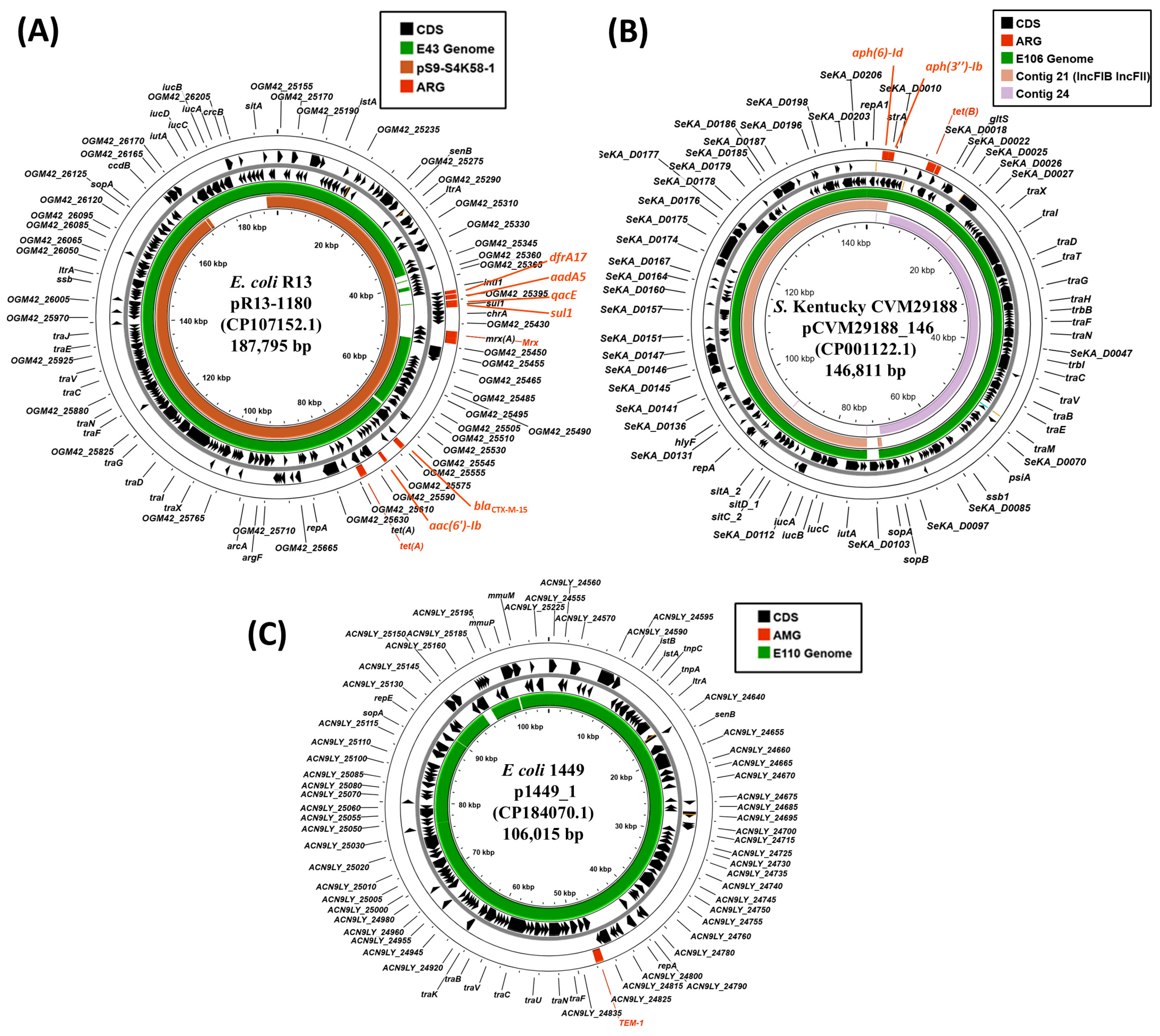
Like most MDR E. coli strains, all three isolates carried multiple plasmid replicons, possibly suggesting that they carry a number of plasmids (Table 1). Due to the limitations of short-read sequencing, the complete sequence of plasmids could not be determined, as they were often encoded on multiple contigs. However, in spite of this, we were able to make predictions about the plasmids that each strain might harbour. For example, strain E43 carries five plasmid replicons (Table 1), and Blastn analysis indicated that E43 contigs 21 (Col156: 38,235 bp), 26 (IncFIA: 25,370 bp), 27 (IncFII: 24,910 bp) and 36 (IncFII: 10,220 bp) were identical (100% coverage/100% identity) to sections of plasmid pR13-1180 (CP107152.1: human isolate) [62] (Figure 1A; Supplementary Figure S4). Consistent with this, plasmid pR13-1180 carries Col156, IncFIA, IncFIB and two IncFII replicons and aac(6′)-Ib-cr, blaCTX-M-15, blaOXA-1, catB3 and tetA, which are also both localised on E43 contig 27 (Figure 1A; Supplementary Figure S4). It is of note that strain R13, which carried pR13-1180, was isolated in Sweden in 2018 from a patient with a UTI and like E43 was sequence type ST131. Furthermore, a similar plasmid, pS9-S4K58-1 (CP107123.1: human isolate), was also isolated from E. coli strain S9 (also ST131) during that study (Figure 1A; Supplementary Figure S4) [62]. Thus, we propose that E43 might carry a similar multi-replicon plasmid to pR13-1180.
For strain E106, the IncFIB and IncFII replicons are both localised on contig 21 (79,866 bp), which also carries siderophore and iron transfer genes (iucABCD-iutA and sitA) and aph(3″)-Ib and aph(6)-Id aminoglycoside resistance genes (Table 1; Supplementary Figure S5). Blastn analysis indicated that contig 21 was very similar to Salmonella enterica serovar Kentucky CVM29188 plasmid pCVM29188_146 (poultry: CP001122.1) (97% coverage/99.98% identity) (Figure 1B; Supplementary Figure S5) [63]. Furthermore, E106 contig 24 (65,526 bp), which carries tet resistance and conjugational-transfer (tra) genes, was also similar to a large section of pCVM29188_146 (100% coverage/99.94% identity) (Figure 1B; Supplementary Figure S5). Interestingly, conjugational transfer of pCVM29188_146 was demonstrated to both Salmonella and E. coli strains, suggesting that this plasmid can be readily swapped between different members of the Enterobacteriaceae [63]. Thus, we propose that E106 might potentially carry a similar hybrid AMR-virulence plasmid.
Like E43, Egyptian isolate E110 carries five plasmid replicons (Table 1). Blastn analysis indicating that contigs 36 (IncFIA: 15,974 bp), 38 (IncFIB: 15,234 bp), and 41 (Col156: 10,625 bp) were identical to sections of plasmid p1449_1 (CP184070.1: human isolate) (100% coverage: 100% identity) (Figure 1C; Supplementary Figure S6). Plasmid p1449_1 was isolated from E. coli strain 1449 in the USA in 2016, and like E110 it was sequence type ST131. Thus, we propose that E110 could possibly carry a similar plasmid to p1449_1.

3.7. Phylogenetic Analysis of Egyptian E. coli Isolates

To understand more about the phylogeny of Egyptian E. coli strains, we searched the Enterobase Database [49] and the NCBI Pathogen Detection Browser [48] and identified 178 Egyptian E. coli with accessible draft genomes (Supplementary Table S4), increasing the number of strains we previously found [64]. Analysis of this data set indicated that the most abundant Egyptian sequence types were ST167, ST410, ST131, ST405, ST10 and ST361 (Table 2). Worryingly, the blaNDM was the most prevalent carbapenemase derivative, and 53.5% (95/178) of sequenced Egyptian isolates were found to carry a carbapenemase gene, with 12 isolates carrying both blaNDM and blaOXA carbapenemases. Furthermore, for the two major sequence types identified (ST167 and ST410), carbapenemase gene carriage was remarkably high at 92.3% (36/39) and 82.6% (24/29), respectively (Table 2).
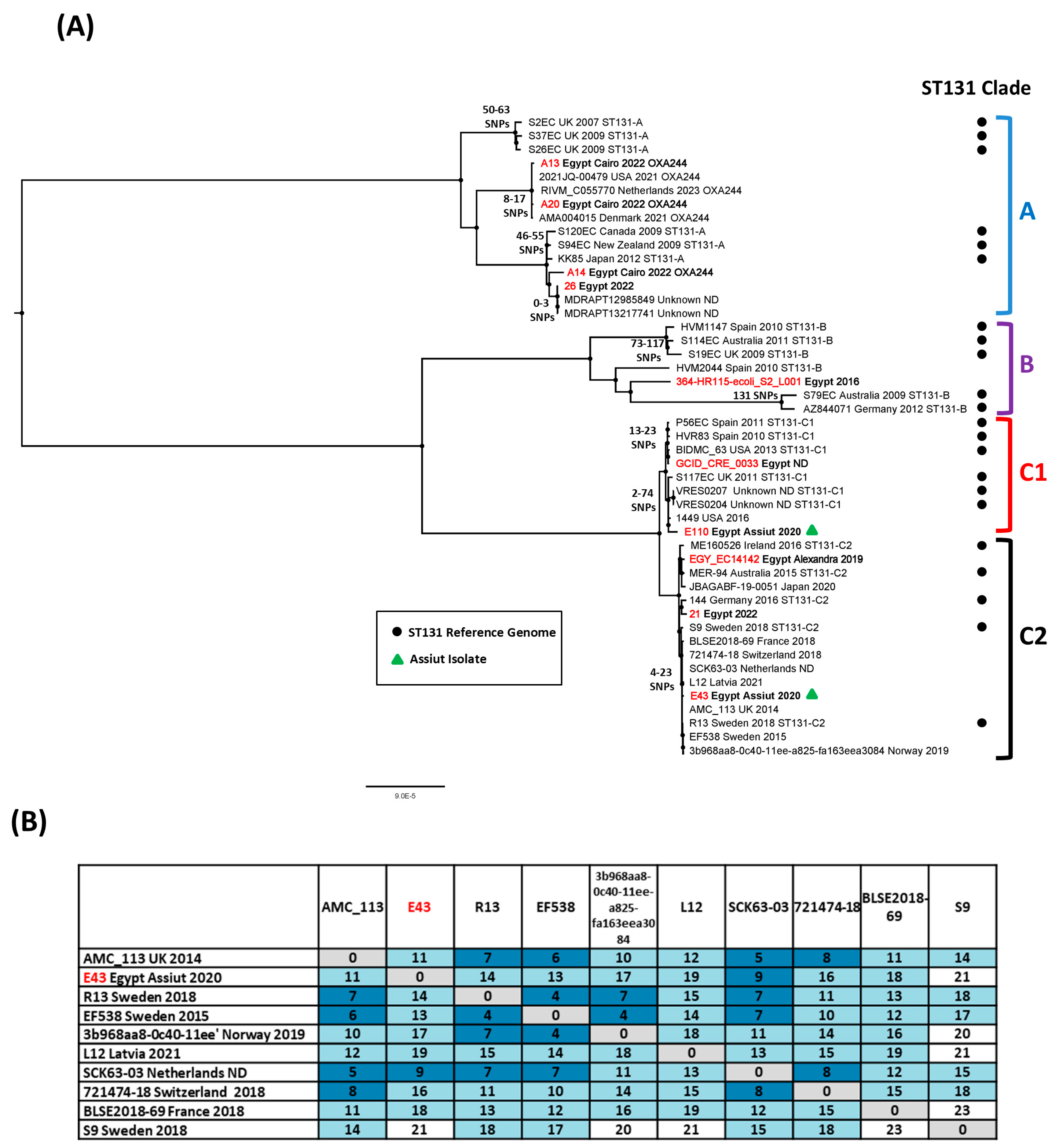
Comparative genomics has classified E. coli sequence type ST131 into three major clades (A, B and C), which has been determined by the presence of various fimH alleles, serotypes, AMR point mutations and ARGs [62,65,66,67]. For example, clade A consists of strains with serotype O16:H5 carrying the fimH41 allele, clade B contains serotype O25b:H4 with fimH22, and clade C contains serotype O25b:H4 with fimH30. Clade C has been further subdivided into major sub-clades C1 and C2, with C1 carrying point mutations associated with fluoroquinolone and C2 fluoroquinolone resistance coupled with carriage of blaCTX-M-15 [62,65,66,67]. In total, we identified ten Egyptian ST131 strains, including isolates E43 and E101 (Supplementary Tables S4 and S5). SNP analysis, coupled with phylogenetic analysis, indicated that Egyptian ST131 isolates were found in all three clades, clustering with previously identified ST131 reference genomes (Figure 2) [62,65,66]. Importantly, strain E43 was located in sub-clade C2, and SNP analysis indicated that it was very similar to the Swedish strains R13 (14 SNPs) and S9 (21 SNPs), which we previously identified [62] (Figure 1 and Figure 2). Furthermore, E43 was found to be close to other human isolates from the Netherlands (strain SCK63-03 (9 SNPs)), the UK (strain AMC_113 (11 SNPs), Sweden (EF538 (13 SNPs)), Switzerland (strain 721474-18 (16 SNPs)), Norway (strain 3b968aa8-0c40-11ee-a825-fa163eea3084 (17 SNPs)), France (BLSE2018-69 (18 SNPs) and Latvia (L12 (19 SNPs)) (Figure 2). As SNP threshold of ≤25 SNPs has previously been used to confirm outbreak strains within hospital settings [68,69], our data suggested that very similar ST131 strains were present within Egypt and throughout Europe.
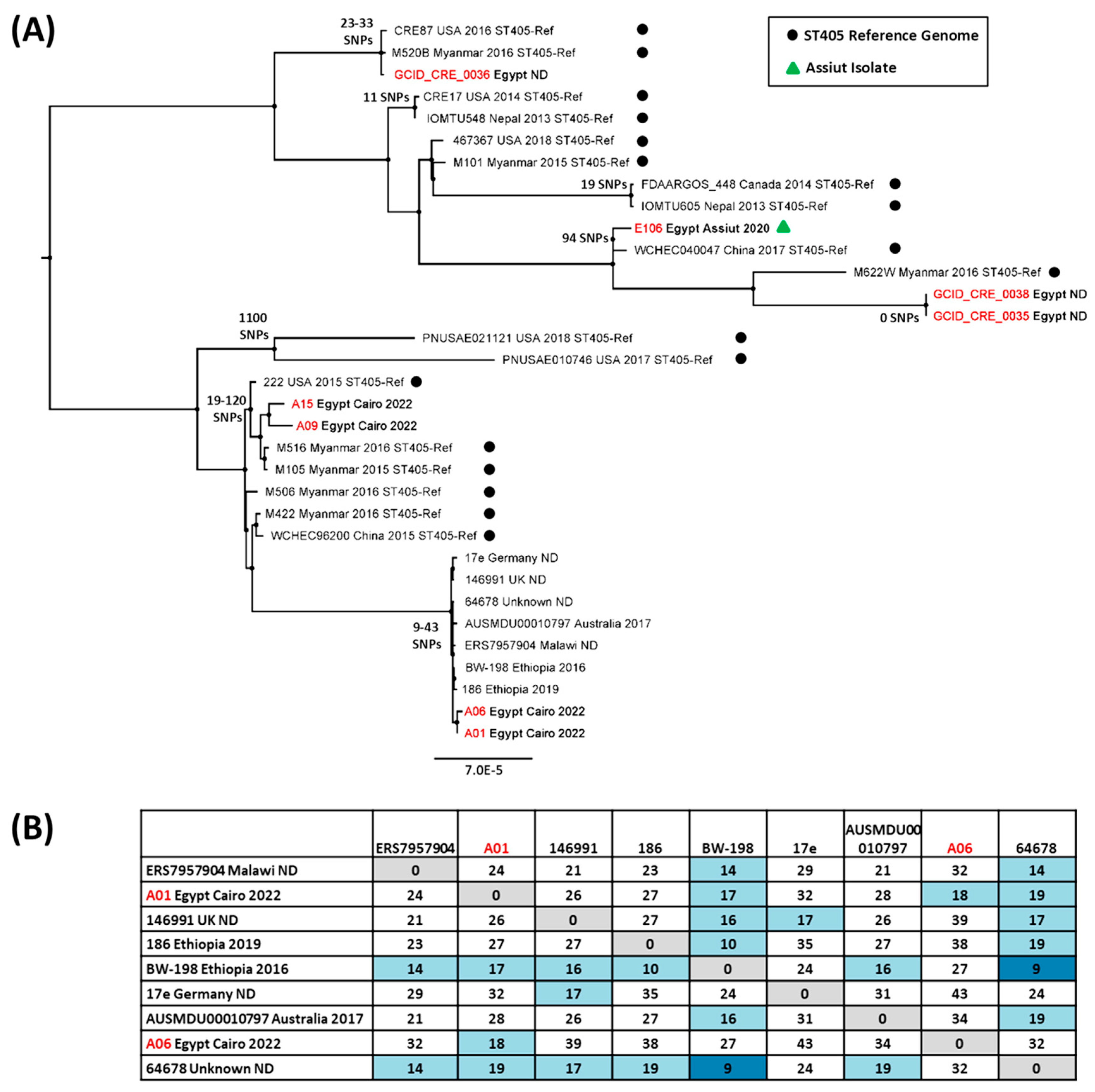
With respect to sequence type ST405, we identified eight Egyptian isolates (Table 2; Supplementary Tables S4 and S6). Although E. coli ST405 has not been categorised into specific clades, we carried out SNP analysis coupled with phylogenetic analysis comparing Egyptian ST405 isolates with previously identified ST405 reference genomes (Figure 3) [70]. Interestingly, our results suggest that the ST405 may split into two separate clades with Egyptian ST405 isolates populating each clade. In particular, it is of note that Egyptian human isolates A01 and A06, which were isolated in Cairo in 2022 [53], were closely related, being separated by 18 SNPs, and formed a group of similar strains isolated from Ethiopia, Australia and Malawi, possibly suggesting strain circulation and that transmission events have occurred (Figure 3).

4. Discussion

In this study, Escherichia coli accounted for 27% (54/200) of isolates recovered from endotracheal aspirates of mechanically ventilated ICU patients, underscoring its substantial contribution to respiratory infections in this setting. Although E. coli has not historically been regarded as a primary pathogen in VAP, contemporary surveillance studies increasingly recognise the expanding role of Enterobacterales in ICU-acquired pneumonia, particularly in environments characterised by high antimicrobial pressure [71]. Large multicentre cohort analyses report E. coli as the causative pathogen in approximately 9–10% of VAP episodes, ranking behind Pseudomonas aeruginosa and Klebsiella pneumoniae yet remaining clinically significant [72]. In contrast, a prospective single-centre ICU study from Egypt documented a lower incidence of 5%, emphasising how institutional ecology, antibiotic consumption patterns, and infection-prevention practices may substantially influence pathogen distribution [73]. The markedly higher prevalence observed in our cohort likely reflects local factors such as prolonged mechanical ventilation, extensive empirical antibiotic use, and selective intestinal decontamination practices, all of which can promote intestinal overgrowth and selection of resistant Enterobacterales [74,75].
Phenotypic antimicrobial susceptibility testing revealed high resistance rates to β-lactams, ranging from 68.5% to 81.5%, with an overall multidrug resistance (MDR) rate of 74.1%. These findings align with contemporary ICU data, indicating MDR prevalence rates of 65–80% among Enterobacterales isolated from late-onset VAP [75,76]. Resistance to fluoroquinolones was also substantial, with 61.1% of isolates resistant by disk diffusion and 74.1% resistant by MIC testing. The discrepancy between disk diffusion and MIC results may reflect borderline susceptibility patterns and emphasises the importance of quantitative susceptibility assessment in ICU pathogens. High fluoroquinolone resistance among Enterobacteriaceae in critical care settings has been widely documented and is attributed to sustained selective pressure in patients exposed to repeated or prolonged antimicrobial regimens [77,78].
Despite low phenotypic resistance to carbapenems (1.9% for imipenem), molecular screening revealed blaNDM-1 in 36.4% of isolates. This apparent genotype–phenotype discordance is increasingly recognised in Enterobacterales, as carbapenemase genes may circulate in strains that do not yet exhibit high-level phenotypic resistance, particularly in the absence of porin loss or high expression levels [79]. Such silent carriage poses a significant epidemiological risk, as antibiotic pressure may rapidly select for phenotypic expression and clinical resistance. Extended-spectrum β-lactamase (ESBL) production was phenotypically confirmed in 64.8% of isolates, consistent with meta-analytic data reporting approximately 60% ESBL prevalence among clinical E. coli isolates in high-burden healthcare settings [80].
Molecular characterisation demonstrated predominance of blaCTX-M–type β-lactamases, with blaCTX-M-15 identified in 20.4% of isolates, making it the most prevalent ESBL variant in our cohort. This observation mirrors global surveillance findings that identify blaCTX-M-15 as one of the main ESBL genotypes in ICU-associated E. coli, largely due to its linkage with high-risk epidemic plasmids and successful clonal lineages [81,82]. The concurrent detection of multiple blaCTX-M, blaTEM and blaSHV variants within individual isolates reflects accumulation of resistance determinants under sustained antimicrobial pressure and ongoing microevolution [81,83,84]. The detection of blaNDM-1 in 36.4% of isolates places our ICU at the higher end of reported prevalence rates, consistent with global data and our analysis (Table 2) identifying blaNDM carbapenemases as the most frequent carbapenemase gene in carbapenem-resistant E. coli, albeit with significant regional variability [85]. Phylogenetic clustering of blaNDM-positive isolates suggests local clonal dissemination, a pattern increasingly described in ICU molecular epidemiology studies [86].
Phylogenetic analysis revealed a heterogeneous population dominated by phylogroup A (38.6%), followed by B2 (31.8%), D (25%), and B1 (4.5%). Although community-associated ExPEC infections are frequently linked to phylogroup B2 [87], ICU-based studies increasingly report substantial phylogenetic heterogeneity, including significant representation of non-B2 lineages [88]. The predominance of phylogroup A in our cohort may reflect adaptation to the hospital environment and selection under antibiotic pressure. These findings support the widely accepted model that ExPEC strains often arise from endogenous intestinal reservoirs rather than exclusively from classical community-associated clones [87].
Genome sequencing of three of our VAP MDR strains identified that isolates E43 and E110 were phylotype B2 and ST131, whilst E106 was phylotype D and ST405 (Table 1; Supplementary Table S3). Consistent with their MDR phenotype, each strain possessed multiple ARGs (Table 1) including ESBLs (e.g., blaCTX-M-15 and blaTEM-1B) and E106 carried the blaNDM-1 carbapenemase gene. Furthermore, each strain carried well-characterised ExPEC virulence determinants, such as pap pilin genes, siderophore iron scavenging systems and toxins (Table 1), consistent with both ST131 and ST405 being global high-risk ExPEC clones [18,52,53,54]. The draft genomes of all three isolates also possessed multiple plasmid replicons (Table 1), though, due to the limitations of short-read sequencing, it was not possible to determine complete plasmid sequences. However, our analysis did suggest that each strain might carry a large multi-replicon AMR plasmid (Figure 1). For example, strain E43 potentially carries a plasmid similar to plasmid pR13-1180 (CP107152.1: human isolate) isolated from ST131 strain R13 in Sweden. Phylogenetic analysis was consistent with a close relationship between these strains (Figure 2), with E43 and R13 located in ST131 sub-clade C2, separated by only 14 SNP differences. Remarkably, E43 also clustered closely with strains from the Netherlands, UK, Sweden, Switzerland, Norway, France and Latvia (with a SNP difference range of 4 to 24) (Figure 2), and each strain appears to carry a plasmid analogous to pR13-1180 (Supplementary Figure S4C). This suggests that closely related ST131 strains have been present within Egypt and throughout Europe and that transmission events may have taken place. It is also of note that many of these strains were isolated from human urine or blood (Supplementary Table S5), highlighting the diverse niches that ExPEC ST131 can colonise and cause disease from. Indeed, the ST131 O25b:H4 lineage is a well-established gastrointestinal coloniser and a leading cause of extra-intestinal infections worldwide. Within this context, VAP-associated E. coli infections are typically endogenous, developing after airway or gastrointestinal colonisation with subsequent micro-aspiration of contaminated secretions, while biofilm formation on endotracheal tubes contributes to bacterial persistence. The E. coli ST131 lineage is further characterised by enhanced biofilm-forming capacity that may facilitate its persistence and success in healthcare-associated infections [8,89].
Whole-genome sequencing studies have demonstrated near-identical intestinal and pulmonary isolates, providing direct evidence of gut-to-lung translocation in VAP [90]. Accordingly, the detection of ExPEC-associated serogroups in our cohort likely reflects endogenous gut colonisation and subsequent aspiration under mechanical ventilation rather than true enteric pathogenesis. Overall, the integration of phylogenetic diversity, serotype heterogeneity, virulence profiles, and resistance determinants is consistent with an endogenous infection model for VAP. Furthermore, in critically ill, mechanically ventilated patients, intestinal barrier dysfunction, immune dysregulation, dysbiosis, and micro-aspiration facilitate migration of gut-derived bacteria into the lower respiratory tract [6,74,91]. These findings further support the gut as a major reservoir for ICU respiratory infections [90,92].
In conclusion, the E. coli isolates recovered from mechanically ventilated ICU patients represent a heterogeneous population of extraintestinal pathogenic strains adapted to respiratory infection [87,88]. These isolates are characterised by high MDR and ESBL prevalence, frequent plasmid-mediated resistance, and a virulence profile emphasising adhesion, serum resistance, and metabolic fitness rather than classical enteropathogenic or uropathogenic traits [81,83,93]. The presence of ExPEC-associated serogroups and virulence determinants is consistent with endogenous gut colonisation with subsequent aspiration under mechanical ventilation rather than enteric pathogenesis [90,94]. The combination of genotypic, phenotypic, and phylogenetic evidence supports the likelihood of an endogenous infection model for VAP [6,76,91]. These findings highlight the importance of E. coli as a clinically relevant, yet under-estimated etiologic agent of VAP, which may be overlooked in routine diagnostic and therapeutic algorithms. Importantly they also reinforce the critical need for antimicrobial stewardship and aspiration-focused infection-prevention strategies and suggest that surveillance of intestinal colonisation may help guide empirical therapy and limit the emergence of MDR ICU pathogens [74,95].
Several limitations should be acknowledged. Although the findings support an endogenous reservoir for VAP, the single-centre design may limit their generalizability to other ICU settings. Furthermore, the absence of paired gastrointestinal and respiratory isolates precluded direct assessment of gut-to-lung transmission, while the use of endotracheal aspirates cannot definitively differentiate true lower respiratory tract infection from contamination or device colonisation. As a result, alternative routes of acquisition, including device colonisation and healthcare-associated transmission, cannot be excluded. Despite these limitations, this study provides a comprehensive phenotypic and genotypic characterisation of ExPEC-associated VAP and offers valuable insight into the complex interplay between host factors, antimicrobial pressure, and bacterial adaptation that shapes the emergence of MDR respiratory pathogens in ICU settings.

Supplementary Materials

The following supporting information can be downloaded at: https://www.mdpi.com/article/10.3390/microorganisms14071438/s1, Figure S1: PCR analysis of ESBL genes carried by E. coli isolates; Figure S2: PCR analysis of carbapenemase genes carried by E. coli isolates; Figure S3: PCR analysis of E. coli virulence genes carried by E. coli isolates; Figure S4: Comparison of E. coli strain R13 plasmid pR13-1180 with the draft genome of E. coli E43; Figure S5: Analysis of contigs 21 and 24 from E. coli strain E106; Figure S6. Comparison of E. coli strain 1449 plasmid p1449_1 with the draft genome of E. coli E110; Table S1: PCR primers used in this study; Table S2: Phenotypic resistance profiles and genotypic characteristics of the 44 E. coli isolates identified as potential ESBL producers during initial screening (n = 44); Table S3: Phylogenetic, virulence and serotyping of 44 E. coli isolates; Table S4: The Egyptian E. coli draft genomes analysed in this study; Table S5: The E. coli ST131 genomes used for phylogenetic SNP analysis in this study; Table S6. The E. coli ST405 genomes used for phylogenetic SNP analysis in this study [33,37,40,46,47,48,49,50,52,53,54,62,63,64,65,66,70,96,97,98,99,100,101,102,103,104,105,106,107,108,109,110,111,112,113,114,115,116,117,118,119,120,121,122,123,124,125,126].

Author Contributions

Conceptualisation, D.F.B. and S.A.A.; formal analysis, S.H., M.S., H.A.H., R.A., M.H.A.-R., D.F.B. and S.A.A.; investigation, S.Y., X.L. and D.F.B.; data curation, S.Y., S.H., H.A.H., R.A., X.L. and D.F.B.; methodology, S.Y.; writing—original draft preparation, S.H., D.F.B. and S.A.A.; writing—review and editing, M.H.A.-R., O.E.-B., A.G.T., D.F.B. and S.A.A.; supervision, M.H.A.-R., O.E.-B., A.G.T., S.H.A. and S.A.A. All authors have read and agreed to the published version of the manuscript.

Funding

This research was funded by the Science, Technology & Innovative Funding Authority (STDF) One Health Grant under grant number 5884 to S.A.A. S.Y. was supported by the Grant Office of the Faculty of Medicine, Assiut University, Assiut, Egypt number (2016-12-28-009). D.F.B. was generously supported by BBSRC research grants BB/R017689/1 and BB/Y007603/1. The Aston Institute for Membrane Excellence (AIME) is funded by UKRI’s Research England as part of their Expanding Excellence in England (E3) fund.

Institutional Review Board Statement

This study was conducted in accordance with the Declaration of Helsinki and approved by the Assiut Faculty of Medicine Institutional Review Board of 17300228 (27 August 2018).

Informed Consent Statement

Informed consent was obtained from all subjects involved in the study. As stipulated by the Assiut Faculty of Medicine Institutional Review Board, consent was taken for each sample with elaboration that the sample be used to detect and isolate the causative organism, determine its antibiotic sensitivity and investigate its properties for research purposes only. No identifiable data were collected to link patients to any of the samples.

Data Availability Statement

This Whole Genome Shotgun project has been deposited at DDBJ/ENA/GenBank with the sequence data for E. coli strains (BioProject: PRJNA1460381) under the accession numbers E43: JBXYYI000000000, E106: JBXYYH000000000 and E110: JBXYYG000000000.

Acknowledgments

We thank MicrobesNG for sequencing and genome annotation and Solu Genomics for advice on genomic and phylogenetic analysis.

Conflicts of Interest

The authors declare no conflicts of interest.

References

  1. Aiesh, B.M.; Qashou, R.; Shemmessian, G.; Swaileh, M.W.; Abutaha, S.A.; Sabateen, A.; Barqawi, A.-K.; AbuTaha, A.; Zyoud, S.H. Nosocomial infections in the surgical intensive care unit: An observational retrospective study from a large tertiary hospital in Palestine. BMC Infect. Dis. 2023, 23, 686. [Google Scholar] [CrossRef] [PubMed]
  2. Ramos, S.; Silva, V.; Dapkevicius, M.L.E.; Caniça, M.; Tejedor-Junco, M.T.; Igrejas, G.; Poeta, P. Escherichia coli as Commensal and Pathogenic Bacteria Among Food-Producing Animals: Health Implications of Extended Spectrum β-lactamase (ESBL) Production. Animals 2020, 10, 2239. [Google Scholar] [CrossRef] [PubMed]
  3. Braz, V.S.; Melchior, K.; Moreira, C.G. Escherichia coli as a Multifaceted Pathogenic and Versatile Bacterium. Front. Cell. Infect. Microbiol. 2020, 10, 548492. [Google Scholar] [CrossRef] [PubMed]
  4. Kaper, J.B.; Nataro, J.P.; Mobley, H.L.T. Pathogenic Escherichia coli. Nat. Rev. Microbiol. 2004, 2, 123–140. [Google Scholar] [CrossRef] [PubMed]
  5. Riley, L.W. Distinguishing Pathovars from Nonpathovars: Escherichia coli. Microbiol. Spectr. 2020, 8, AME-0014-2020. [Google Scholar] [CrossRef] [PubMed]
  6. Papazian, L.; Klompas, M.; Luyt, C.-E. Ventilator-associated pneumonia in adults: A narrative review. Intensiv. Care Med. 2020, 46, 888–906. [Google Scholar] [CrossRef] [PubMed]
  7. Teng, J.; Imani, S.; Zhou, A.; Zhao, Y.; Du, L.; Deng, S.; Li, J.; Wang, Q. Combatting resistance: Understanding multi-drug resistant pathogens in intensive care units. Biomed. Pharmacother. 2023, 167, 115564. [Google Scholar] [CrossRef] [PubMed]
  8. Mishra, S.; Baidya, S.; Bhattarai, A.; Shrestha, S.; Homagain, S.; Rayamajhee, B.; Hui, A.; Willcox, M. Bacteriology of endotracheal tube biofilms and antibiotic resistance: A systematic review. J. Hosp. Infect. 2024, 147, 146–157. [Google Scholar] [CrossRef] [PubMed]
  9. Clermont, O.; Christenson, J.K.; Denamur, E.; Gordon, D.M. The Clermont Escherichia coli phylo-typing method revisited: Improvement of specificity and detection of new phylo-groups. Environ. Microbiol. Rep. 2013, 5, 58–65. [Google Scholar] [CrossRef] [PubMed]
  10. Mosquito, S.; Pons, M.J.; Riveros, M.; Ruiz, J.; Ochoa, T.J. Diarrheagenic Escherichia coli phylogroups are associated with antibiotic resistance and duration of diarrheal episode. Sci. World J. 2015, 2015, 610403. [Google Scholar] [CrossRef] [PubMed]
  11. Maiden, M.C.J.; van Rensburg, M.J.J.; Bray, J.E.; Earle, S.G.; Ford, S.A.; Jolley, K.A.; McCarthy, N.D. MLST revisited: The gene-by-gene approach to bacterial genomics. Nat. Rev. Microbiol. 2013, 11, 728–736. [Google Scholar] [CrossRef] [PubMed]
  12. Fratamico, P.M.; DebRoy, C.; Liu, Y.; Needleman, D.S.; Baranzoni, G.M.; Feng, P. Advances in Molecular Serotyping and Subtyping of Escherichia coli. Front. Microbiol. 2016, 7, 644. [Google Scholar] [CrossRef] [PubMed]
  13. Martins, J.C.L.; Gonçalves, A.; Fernandes, C.; Cabecinha, E.; Monteiro, S.; Guedes, H.; Almeida, G.; Garcia, J.; da Silva, G.J.; Varandas, S.; et al. Multidrug-Resistant Escherichia coli Accumulated by Freshwater Bivalves: An Underestimated Risk for Public Health? Pathogens 2024, 13, 617. [Google Scholar] [CrossRef] [PubMed]
  14. Lakheshar, M.M.; Bhati, T.; Dedar, S.; Chaudhary, J.; Khandelwal, S.; Shringi, B.N. Phylotyping and Serotyping of Escherichia coli Isolates from Poultry Faecal Samples. Vet. Pract. 2022, 23, 4–8. [Google Scholar]
  15. Pakbin, B.; Brück, W.M.; Rossen, J.W.A. Virulence Factors of Enteric Pathogenic Escherichia coli: A Review. Int. J. Mol. Sci. 2021, 22, 9922. [Google Scholar] [CrossRef] [PubMed]
  16. Diaconu, O.; Siriopol, I.; Poloșanu, L.I.; Grigoraș, I. Endotracheal Tube Biofilm and its Impact on the Pathogenesis of Ventilator-Associated Pneumonia. J. Crit. Care Med. 2018, 4, 50–55. [Google Scholar] [CrossRef] [PubMed]
  17. Haghighatpanah, M.; Mojtahedi, A. Characterization of antibiotic resistance and virulence factors of Escherichia coli strains isolated from Iranian inpatients with urinary tract infections. Infect. Drug Resist. 2019, 12, 2747. [Google Scholar] [CrossRef] [PubMed]
  18. Sora, V.M.; Meroni, G.; Martino, P.A.; Soggiu, A.; Bonizzi, L.; Zecconi, A. Extraintestinal Pathogenic Escherichia coli: Virulence Factors and Antibiotic Resistance. Pathogens 2021, 10, 1355. [Google Scholar] [CrossRef] [PubMed]
  19. Kathayat, D.; Lokesh, D.; Ranjit, S.; Rajashekara, G. Avian Pathogenic Escherichia coli (APEC): An Overview of Virulence and Pathogenesis Factors, Zoonotic Potential, and Control Strategies. Pathogens 2021, 10, 467. [Google Scholar] [CrossRef] [PubMed]
  20. Dirar, M.H.; Bilal, N.E.; Ibrahim, M.E.; Hamid, M.E. Prevalence of extended-spectrum β-lactamase (ESBL) and molecular detection of blaTEM, blaSHV and blaCTX-M genotypes among Enterobacteriaceae isolates from patients in Khartoum, Sudan. Pan Afr. Med. J. 2020, 37, 213. [Google Scholar] [CrossRef] [PubMed]
  21. Sati, H.; Carrara, E.; Savoldi, A.; Hansen, P.; Garlasco, J.; Campagnaro, E.; Boccia, S.; Castillo-Polo, J.A.; Magrini, E.; Garcia-Vello, P.; et al. The WHO Bacterial Priority Pathogens List 2024: A prioritisation study to guide research, development, and public health strategies against antimicrobial resistance. Lancet Infect. Dis. 2025, 25, 1033–1043. [Google Scholar] [CrossRef] [PubMed]
  22. Wu, W.; Feng, Y.; Tang, G.; Qiao, F.; McNally, A.; Zong, Z. NDM Metallo-β-Lactamases and Their Bacterial Producers in Health Care Settings. Clin. Microbiol. Rev. 2019, 32, e00115-18. [Google Scholar] [CrossRef] [PubMed]
  23. Kopotsa, K.; Sekyere, J.O.; Mbelle, N.M. Plasmid evolution in carbapenemase-producing Enterobacteriaceae: A review. Ann. N. Y. Acad. Sci. 2019, 1457, 61–91. [Google Scholar] [CrossRef] [PubMed]
  24. Geisinger, E.; Isberg, R.R. Interplay Between Antibiotic Resistance and Virulence During Disease Promoted by Multidrug-Resistant Bacteria. J. Infect. Dis. 2017, 215, S9–S17. [Google Scholar] [CrossRef] [PubMed]
  25. Kalil, A.C.; Metersky, M.L.; Klompas, M.; Muscedere, J.; Sweeney, D.A.; Palmer, L.B.; Napolitano, L.M.; O’Grady, N.P.; Bartlett, J.G.; Carratala, J.; et al. Management of Adults with Hospital-acquired and Ventilator-associated Pneumonia: 2016 Clinical Practice Guidelines by the Infectious Diseases Society of America and the American Thoracic Society. Clin. Infect. Dis. 2016, 63, e61–e111, Erratum in Clin. Infect. Dis. 2017, 65, 2161. [Google Scholar] [CrossRef] [PubMed]
  26. Strockbine, N.A.; Bopp, C.A.; Fields, P.I.; Kaper, J.B.; Nataro, J.P. Escherichia, Shigella, and Salmonella. In Manual of Clinical Microbiology; Jorgensen, J.H., Carroll, K.C., Funke, G., Pfaller, M.A., Landry, M.L., Richter, S.S., Eds.; Wiley: Hoboken, NJ, USA, 2015; pp. 685–713. [Google Scholar]
  27. Clinical & Laboratory Standards Institute (CLSI). Performance Standards for Antimicrobial Susceptibility Testing, 35th ed.; CLSI: Wayne, PA, USA, 2025. [Google Scholar]
  28. Padayatti, P.S.; Helfand, M.S.; Totir, M.A.; Carey, M.P.; Carey, P.R.; Bonomo, R.A.; Akker, F.v.D. High Resolution crystal structures of the trans-enamine intermediates formed by sulbactam and clavulanic acid and E166A SHV-1 β-lactamase. J. Biol. Chem. 2005, 280, 34900–34907. [Google Scholar] [CrossRef] [PubMed]
  29. Amjad, A.; Mirza, I.; Abbasi, S.; Farwa, U.; Malik, N.; Zia, F. Modified Hodge test: A simple and effective test for detection of carbapenemase production. Iran. J. Microbiol. 2011, 3, 189–193. [Google Scholar] [PubMed]
  30. Yong, D.; Lee, K.; Yum, J.H.; Shin, H.B.; Rossolini, G.M.; Chong, Y. Imipenem-EDTA disk method for differentiation of metallo-β-lactamase-producing clinical isolates of Pseudomonas spp. and Acinetobacter spp. J. Clin. Microbiol. 2002, 40, 3798–3801. [Google Scholar] [CrossRef] [PubMed]
  31. Ørskov, F.; Ørskov, I. 2 Serotyping of Escherichia coli. Methods Microbiol. 1984, 14, 43–112. [Google Scholar] [CrossRef]
  32. Clermont, O.; Dixit, O.V.; Vangchhia, B.; Condamine, B.; Dion, S. Characterization and rapid identification of phylogroup G in Escherichia coli, a lineage with high virulence and antibiotic resistance potential. Environ. Microbiol. 2019, 21, 3107–3117. [Google Scholar] [CrossRef] [PubMed]
  33. Abdelwahab, R.; Yasir, M.; Godfrey, R.E.; Christie, G.S.; Element, S.J.; Saville, F.; Hassan, E.A.; Ahmed, E.H.; Abu-Faddan, N.H.; Daef, E.A.; et al. Antimicrobial resistance and gene regulation in Enteroaggregative Escherichia coli from Egyptian children with diarrhoea: Similarities and differences. Virulence 2021, 12, 57–74. [Google Scholar] [CrossRef] [PubMed]
  34. Bolger, A.M.; Lohse, M.; Usadel, B. Trimmomatic: A flexible trimmer for Illumina sequence data. Bioinformatics 2014, 30, 2114–2120. [Google Scholar] [CrossRef] [PubMed]
  35. Bankevich, A.; Nurk, S.; Antipov, D.; Gurevich, A.A.; Dvorkin, M.; Kulikov, A.S.; Lesin, V.M.; Nikolenko, S.I.; Pham, S.; Prjibelski, A.D.; et al. SPAdes: A new genome assembly algorithm and its applications to single-cell sequencing. J. Comput. Biol. 2012, 19, 455–477. [Google Scholar] [CrossRef] [PubMed]
  36. Seemann, T. Prokka: Rapid prokaryotic genome annotation. Bioinformatics 2014, 30, 2068–2069. [Google Scholar] [CrossRef] [PubMed]
  37. Larsen, M.V.; Cosentino, S.; Rasmussen, S.; Friis, C.; Hasman, H.; Marvig, R.L.; Jelsbak, L.; Sicheritz-Pontéen, T.; Ussery, D.W.; Aarestrup, F.M.; et al. Multilocus sequence typing of total-genome-sequenced bacteria. J. Clin. Microbiol. 2012, 50, 1355–1361. [Google Scholar] [CrossRef] [PubMed]
  38. Joensen, K.G.; Tetzschner, A.M.; Iguchi, A.; Aarestrup, F.M.; Scheutz, F. Rapid and Easy In Silico Serotyping of Escherichia coli Isolates by Use of Whole-Genome Sequencing Data. J. Clin. Microbiol. 2015, 53, 2410–2426. [Google Scholar] [CrossRef] [PubMed]
  39. Carattoli, A.; Zankari, E.; Garcìa-Fernandez, A.; Larsen, M.; Lund, O.; Voldby Villa, L.; Møller Aarestrup, F.; Hasman, H. In silico detection and typing of plasmids. Antimicrob using PlasmidFinder and plasmid multilocus sequence typing. Antimicrob. Agents Chemother. 2014, 58, 3895–3903. [Google Scholar] [CrossRef] [PubMed]
  40. Bortolaia, V.; Kaas, R.S.; Ruppe, E.; Roberts, M.C.; Schwarz, S.; Cattoir, V.; Philippon, A.; Allesoe, R.L.; Rebelo, A.R.; Florensa, A.F.; et al. ResFinder 4.0 for predictions of phenotypes from genotypes. J. Antimicrob. Chemother. 2020, 75, 3491–3500. [Google Scholar] [CrossRef] [PubMed]
  41. Joensen, K.G.; Scheutz, F.; Lund, O.; Hasman, H.; Kaas, R.S.; Nielsen, E.M.; Aarestrup, F.M. Real-time whole-genome sequencing for routine typing, surveillance, and outbreak detection of verotoxigenic Escherichia coli. J. Clin. Microbiol. 2014, 52, 1501–1510. [Google Scholar] [CrossRef] [PubMed]
  42. Tetzschner, A.M.M.; Johnson, J.R.; Johnston, B.D.; Lund, O.; Scheutz, F. In Silico Genotyping of Escherichia coli Isolates for Extraintestinal Virulence Genes by Use of Whole-Genome Sequencing Data. J. Clin. Microbiol. 2020, 58, e01269-20. [Google Scholar] [CrossRef] [PubMed]
  43. Florensa, A.F.; Armenteros, J.J.A.; Kaas, R.S.; Clausen, P.T.L.C.; Nielsen, H.; Rost, B.; Aarestrup, F.M. Whole-genome prediction of bacterial pathogenic capacity on novel bacteria using protein language models with PathogenFinder2. Bioinformatics 2026, 42, btag129. [Google Scholar] [CrossRef] [PubMed]
  44. Waters, N.R.; Abram, F.; Brennan, F.; Holmes, A.; Pritchard, L. Easy phylotyping of Escherichia coli via the EzClermont web app and command-line tool. Access Microbiol. 2020, 2, e000143. [Google Scholar] [CrossRef] [PubMed]
  45. Rutherford, K.; Parkhill, J.; Crook, J.; Horsnell, T.; Rice, P.; Rajandream, M.-A.; Barrell, B. Artemis: Sequence visualization and annotation. Bioinformatics 2000, 16, 944–945. [Google Scholar] [CrossRef] [PubMed]
  46. Grant, J.R.; Enns, E.; Marinier, E.; Mandal, A.; Herman, E.K.; Chen, C.-Y.; Graham, M.; Van Domselaar, G.; Stothard, P. Proksee: In-depth characterization and visualization of bacterial genomes. Nucleic Acids Res. 2023, 51, W484–W492. [Google Scholar] [CrossRef] [PubMed]
  47. Carver, T.J.; Rutherford, K.M.; Berriman, M.; Rajandream, M.-A.; Barrell, B.G.; Parkhill, J. ACT: The Artemis Comparison Tool. Bioinformatics 2005, 21, 3422–3423. [Google Scholar] [CrossRef] [PubMed]
  48. The NCBI Pathogen Detection Project; National Center for Biotechnology Information, National Library of Medicine, National Institutes of Health: Bethesda, MD, USA, 2016. Available online: https://www.ncbi.nlm.nih.gov/pathogens/ (accessed on 9 November 2025).
  49. Dyer, N.P.; Päuker, B.; Baxter, L.; Gupta, A.; Bunk, B.; Overmann, J.; Diricks, M.; Dreyer, V.; Niemann, S.; Holt, K.E.; et al. EnteroBase in 2025: Exploring the genomic epidemiology of bacterial pathogens. Nucleic Acids Res. 2025, 53, D757–D762. [Google Scholar] [CrossRef] [PubMed]
  50. Saratto, T.; Visuri, K.; Lehtinen, J.; Ortega-Sanz, I.; Steenwyk, J.L.; Sihvonen, S. Solu: A cloud platform for real-time genomic pathogen surveillance. BMC Bioinform. 2025, 26, 12. [Google Scholar] [CrossRef] [PubMed]
  51. Minh, B.Q.; Schmidt, H.A.; Chernomor, O.; Schrempf, D.; Woodhams, M.D.; von Haeseler, A.; Lanfear, R. IQ-TREE 2: New Models and Efficient Methods for Phylogenetic Inference in the Genomic Era. Mol. Biol. Evol. 2020, 37, 1530–1534, Erratum in Mol. Biol. Evol. 2020, 37, 2461. [Google Scholar] [CrossRef] [PubMed]
  52. Kocsis, B.; Gulyás, D.; Szabó, D. Emergence and Dissemination of Extraintestinal Pathogenic High-Risk International Clones of Escherichia coli. Life 2022, 12, 2077. [Google Scholar] [CrossRef] [PubMed]
  53. Jalal, D.; Lotfi, M.; Ziad, G.A.; Mahfouz, S.; Madney, Y.; Bayoumi, A.; Hassanain, O.; Tolba, M.; Hashem, M.; Elanany, M.; et al. Dual Transmission Dynamics of Carbapenem Resistance in Pediatric Oncology: Plasmid-Mediated and Clonal Spread of blaNDM-5 Enterobacterales. Infect. Dis. Ther. 2026, 15, 245–263. [Google Scholar] [CrossRef] [PubMed]
  54. Zakaria, A.S.; Edward, E.A.; Mohamed, N.M. Pathogenicity Islands in Uropathogenic Escherichia coli Clinical Isolate of the Globally Disseminated O25:H4-ST131 Pandemic Clonal Lineage: First Report from Egypt. Antibiotics 2022, 11, 1620. [Google Scholar] [CrossRef] [PubMed]
  55. Zankari, E.; Hasman, H.; Cosentino, S.; Vestergaard, M.; Rasmussen, S.; Lund, O.; Aarestrup, F.M.; Larsen, M.V. Identification of acquired antimicrobial resistance genes. J. Antimicrob. Chemother. 2012, 67, 2640–2644. [Google Scholar] [CrossRef] [PubMed]
  56. Machuca, J.; Ortiz, M.; Recacha, E.; Díaz-De-Alba, P.; Docobo-Perez, F.; Rodríguez-Martínez, J.-M.; Pascual, Á. Impact of AAC(6′)-Ib-cr in combination with chromosomal-mediated mechanisms on clinical quinolone resistance in Escherichia coli. J. Antimicrob. Chemother. 2016, 71, 3066–3071. [Google Scholar] [CrossRef] [PubMed]
  57. Roer, L.; Tchesnokova, V.; Allesøe, R.; Muradova, M.; Chattopadhyay, S.; Ahrenfeldt, J.; Thomsen, M.C.F.; Lund, O.; Hansen, F.; Hammerum, A.M.; et al. Development of a Web Tool for Escherichia coli Subtyping Based on fimH Alleles. J. Clin. Microbiol. 2017, 55, 2538–2543. [Google Scholar] [CrossRef] [PubMed]
  58. Lund, P.; Tramonti, A.; De Biase, D. Coping with low pH: Molecular strategies in neutralophilic bacteria. FEMS Microbiol. Rev. 2014, 38, 1091–1125. [Google Scholar] [CrossRef] [PubMed]
  59. Johnson, T.J.; Wannemuehler, Y.M.; Nolan, L.K. Evolution of the iss Gene in Escherichia coli. Appl. Environ. Microbiol. 2008, 74, 2360–2369. [Google Scholar] [CrossRef] [PubMed]
  60. Pramoonjago, P.; Kaneko, M.; Kinoshita, T.; Ohtsubo, E.; Takeda, J.; Hong, K.S.; Inagi, R.; Inoue, K. Role of TraT protein, an anticomplementary protein produced in Escherichia coli by R100 factor, in serum resistance. J. Immunol. 1992, 148, 827–836. [Google Scholar] [CrossRef]
  61. Garénaux, A.; Caza, M.; Dozois, C.M. The Ins and Outs of siderophore mediated iron uptake by extra-intestinal pathogenic Escherichia coli. Veter. Microbiol. 2011, 153, 89–98. [Google Scholar] [CrossRef] [PubMed]
  62. Jaén-Luchoro, D.; Kahnamouei, A.; Yazdanshenas, S.; Lindblom, A.; Samuelsson, E.; Åhrén, C.; Karami, N. Comparative Genomic Analysis of ST131 Subclade C2 of ESBL-Producing E. coli Isolates from Patients with Recurrent and Sporadic Urinary Tract Infections. Microorganisms 2023, 11, 1622. [Google Scholar] [CrossRef] [PubMed]
  63. Fricke, W.F.; McDermott, P.F.; Mammel, M.K.; Zhao, S.; Johnson, T.J.; Rasko, D.A.; Fedorka-Cray, P.J.; Pedroso, A.; Whichard, J.M.; LeClerc, J.E.; et al. Antimicrobial resistance-conferring plasmids with similarity to virulence plasmids from avian pathogenic Escherichia coli strains in Salmonella enterica serovar kentucky isolates from poultry. Appl. Environ. Microbiol. 2009, 75, 5963–5971. [Google Scholar] [CrossRef] [PubMed]
  64. Abdelwahab, R.; Alhammadi, M.M.; Yasir, M.; Hassan, E.A.; Ahmed, E.H.; Abu-Faddan, N.H.; Daef, E.A.; Busby, S.J.W.; Browning, D.F. Antimicrobial Resistance and Comparative Genome Analysis of High-Risk Escherichia coli Strains Isolated from Egyptian Children with Diarrhoea. Microorganisms 2026, 14, 247. [Google Scholar] [CrossRef] [PubMed]
  65. Petty, N.K.; Ben Zakour, N.L.; Stanton-Cook, M.; Skippington, E.; Totsika, M.; Forde, B.M.; Phan, M.-D.; Moriel, D.G.; Peters, K.M.; Davies, M.; et al. Global dissemination of a multidrug resistant Escherichia coli clone. Proc. Natl. Acad. Sci. USA 2014, 111, 5694–5699. [Google Scholar] [CrossRef] [PubMed]
  66. Decano, A.G.; Downing, T. An Escherichia coli ST131 pangenome atlas reveals population structure and evolution across 4,071 isolates. Sci. Rep. 2019, 9, 17394. [Google Scholar] [CrossRef] [PubMed]
  67. Peirano, G.; Lynch, T.; Matsumara, Y.; Nobrega, D.; Finn, T.J.; DeVinney, R.; Pitout, J.D. Trends in Population Dynamics of Escherichia coli Sequence Type 131, Calgary, Alberta, Canada, 2006–2016. Emerg. Infect. Dis. 2020, 26, 2907–2915. [Google Scholar] [CrossRef] [PubMed]
  68. Ba, X.; Guo, Y.; Moran, R.A.; Doughty, E.L.; Liu, B.; Yao, L.; Li, J.; He, N.; Shen, S.; Li, Y.; et al. Global emergence of a hypervirulent carbapenem-resistant Escherichia coli ST410 clone. Nat. Commun. 2024, 15, 494. [Google Scholar] [CrossRef] [PubMed]
  69. Gorrie, C.L.; Da Silva, A.G.; Ingle, D.J.; Higgs, C.; Seemann, T.; Stinear, T.P.; Williamson, D.A.; Kwong, J.C.; Grayson, M.L.; Sherry, N.L.; et al. Key parameters for genomics-based real-time detection and tracking of multidrug-resistant bacteria: A systematic analysis. Lancet Microbe 2021, 2, e575–e583. [Google Scholar] [CrossRef] [PubMed]
  70. Takayama, Y.; Sekizuka, T.; Matsui, H.; Adachi, Y.; Eda, R.; Nihonyanagi, S.; Wada, T.; Matsui, M.; Suzuki, S.; Takaso, M.; et al. Characterization of the IncFII-IncFIB(pB171) Plasmid Carrying blaNDM-5 in Escherichia coli ST405 Clinical Isolate in Japan. Infect. Drug Resist. 2020, 13, 561–566. [Google Scholar] [CrossRef] [PubMed]
  71. Montrucchio, G.; Balzani, E.; Sales, G.; Vaninetti, A.; Grillo, F.; Trompeo, A.C.; Zanierato, M.; Fanelli, V.; Corcione, S.; De Rosa, F.G.; et al. Multidrug-resistant pathogens and ventilator-associated pneumonia in critically ill COVID-19 and non-COVID-19 patients: A prospective observational monocentric comparative study. Respir. Res. 2024, 25, 168. [Google Scholar] [CrossRef] [PubMed]
  72. Colaneri, M.; Montrucchio, G.; Scaglione, G.; Monti, G.; Tricella, G.; Genovese, C.; Agostini, F.; Dore, F.; Viaggi, B.; Brazzi, L.; et al. Incidence, microbiology, and mortality of ventilation-associated pneumonia in a large Italian cohort of critically ill patients: Results from the PROSAFE project. Clin. Microbiol. Infect. 2025, 31, 1491–1499. [Google Scholar] [CrossRef] [PubMed]
  73. Elsheikh, M.; Kuriyama, A.; Goto, Y.; Takahashi, Y.; Toyama, M.; Nishikawa, Y.; El Heniedy, M.A.; Abdelraouf, Y.M.; Okada, H.; Nakayama, T. Incidence and predictors of ventilator-associated pneumonia using a competing risk analysis: A single-center prospective cohort study in Egypt. BMC Infect. Dis. 2024, 24, 1007. [Google Scholar] [CrossRef] [PubMed]
  74. Ulsamer, A.; Bonilla, S.; Pérez-Fernández, X.; Rello, J.; Sabater-Riera, J. The pathogenesis of ventilator-associated pneumonia: Old and new mechanisms. Expert Rev. Respir. Med. 2025, 19, 655–671. [Google Scholar] [CrossRef] [PubMed]
  75. Halat, D.H.; Moubareck, C.A. Hospital-acquired and ventilator-associated pneumonia caused by multidrug-resistant Gram-negative pathogens: Understanding epidemiology, resistance patterns, and implications with COVID-19. F1000Research 2023, 12, 92. [Google Scholar] [CrossRef] [PubMed]
  76. Alnimr, A. Antimicrobial Resistance in Ventilator-Associated Pneumonia: Predictive Microbiology and Evidence-Based Therapy. Infect. Dis. Ther. 2023, 12, 1527–1552. [Google Scholar] [CrossRef] [PubMed]
  77. Abdel-Rahim, M.H.; El-Badawy, O.; Hadiya, S.; Daef, E.A.; Suh, S.-J.; Boothe, D.M.; Aly, S.A. Patterns of Fluoroquinolone Resistance in Enterobacteriaceae Isolated from the Assiut University Hospitals, Egypt: A Comparative Study. Microb. Drug Resist. 2019, 25, 509–519. [Google Scholar] [CrossRef] [PubMed]
  78. Kilinc, M. Antibiotic Resistance and Mortality in ICU Patients: A Retrospective Analysis of First Culture Growth Results. Antibiotics 2025, 14, 290. [Google Scholar] [CrossRef] [PubMed]
  79. Nordmann, P.; Poirel, L. Epidemiology and Diagnostics of Carbapenem Resistance in Gram-negative Bacteria. Clin. Infect. Dis. 2019, 69, S521–S528. [Google Scholar] [CrossRef] [PubMed]
  80. Azzam, A.; Khaled, H.; Samer, D.; Nageeb, W.M. Prevalence and molecular characterization of ESBL-producing Enterobacteriaceae in Egypt: A systematic review and meta-analysis of hospital and community-acquired infections. Antimicrob. Resist. Infect. Control 2024, 13, 145. [Google Scholar] [CrossRef] [PubMed]
  81. Aljohni, M.S.; Harun-Ur-Rashid, M.; Selim, S. Emerging threats: Antimicrobial resistance in extended-spectrum beta-lactamase and carbapenem-resistant Escherichia coli. Microb. Pathog. 2025, 200, 107275. [Google Scholar] [CrossRef] [PubMed]
  82. Ding, Y.; Song, M.; Yang, Y.; Zhuang, H.; Pan, Q.; Xu, L.; He, J.; Zhou, J.; Liu, H.; Lin, Y.; et al. Genetic characteristics and risk factors of extended-spectrum β-lactamase-producing Escherichia coli in Chinese intensive care unit: A prospective molecular epidemiology study. Microbiol. Spectr. 2025, 13, e0289524. [Google Scholar] [CrossRef] [PubMed]
  83. Carattoli, A.; Arcari, G.; Bibbolino, G.; Sacco, F.; Tomolillo, D.; Di Lella, F.M.; Trancassini, M.; Faino, L.; Venditti, M.; Antonelli, G.; et al. Evolutionary Trajectories toward Ceftazidime-Avibactam Resistance in Klebsiella pneumoniae Clinical Isolates. Antimicrob. Agents Chemother. 2021, 65, e0057421. [Google Scholar] [CrossRef] [PubMed]
  84. Carattoli, A.; Villa, L.; Fortini, D.; García-Fernández, A. Contemporary IncI1 plasmids involved in the transmission and spread of antimicrobial resistance in Enterobacteriaceae. Plasmid 2021, 118, 102392. [Google Scholar] [CrossRef] [PubMed]
  85. Walker, M.M.; Roberts, J.A.; Li, Y.; Sime, F.B. A systematic review and meta-analysis of the global epidemiology of carbapenem-resistant Escherichia coli. Int. J. Antimicrob. Agents 2026, 67, 107668. [Google Scholar] [CrossRef] [PubMed]
  86. Vedani, T.; Pot, M.; Garrigos, T.; Sababadichetty, L.; Daniel, M.; Wilkinson, D.; Benoit-Cattin, T.; Belmonte, O.; Mavingui, P.; Dortet, L.; et al. Emergence and polyclonal dissemination of NDM-5/OXA-181 carbapenemase-producing Escherichia coli in the French Indian Ocean territories. Ann. Clin. Microbiol. Antimicrob. 2025, 24, 8. [Google Scholar] [CrossRef] [PubMed]
  87. Manges, A.R.; Geum, H.M.; Guo, A.; Edens, T.J.; Fibke, C.D.; Pitout, J.D.D. Global Extraintestinal Pathogenic Escherichia coli (ExPEC) Lineages. Clin. Microbiol. Rev. 2019, 32, e00135-18. [Google Scholar] [CrossRef] [PubMed]
  88. Castañeda-Meléndrez, A.M.; García-Cervantes, P.C.; Báez-Flores, M.E.; Clemente-Soto, A.F.; Barrios-Villa, E.; Bernal-Reynaga, R. Virulence, Phylogenetic Grouping, and Antimicrobial Resistance Traits of Extraintestinal Escherichia coli in Clinical Isolates From Northwest Mexico. Int. J. Microbiol. 2025, 2025, 8881117. [Google Scholar] [CrossRef] [PubMed]
  89. Celebi, D.; Aydın, E.; Rakici, E.; Baser, S.; Celebi, O.; Taghizadehghalehjoughi, A. Evaluation of presence of clone ST131 and biofilm formation in ESBL producing and non-producing Escherichia coli strains. Mol. Biol. Rep. 2023, 50, 5949–5956. [Google Scholar] [CrossRef] [PubMed]
  90. Gao, H.; Xu, L.; Liu, Y.; Wang, X.; Zhu, S.; Lin, H.; Gao, Y.; Mao, D.; Lu, X.; Luo, Y. Whole genome comparisons reveal gut-to-lung translocation of Escherichia coli and Burkholderia cenocepacia in two cases of ventilator-associated pneumonia in ICU patients. Respir. Res. 2025, 26, 178. [Google Scholar] [CrossRef] [PubMed]
  91. Dickson, R.P. The microbiome and critical illness. Lancet Respir. Med. 2016, 4, 59–72. [Google Scholar] [CrossRef] [PubMed]
  92. El Chaar, M.; Khoury, Y.; Douglas, G.M.; El Kazzi, S.; Jisr, T.; Soussi, S.; Merhi, G.; Moghnieh, R.A.; Shapiro, B.J. Longitudinal genomic surveillance of multidrug-resistant Escherichia coli carriage in critical care patients. Microbiol. Spectr. 2024, 12, e0312823. [Google Scholar] [CrossRef] [PubMed]
  93. Bok, E.; Mazurek-Popczyk, J.; Wojciech, M.; Baldy-Chudzik, K. Extraintestinal traits of pathogenicity and sequence type lineages in commensal Escherichia coli from adults and young children: Genotypic and phenotypic profiles. Front. Microbiol. 2025, 16, 1579685. [Google Scholar] [CrossRef] [PubMed]
  94. Santos, A.C.M.; Silva, R.S.; Vieira, M.A.M.; Niero, C.V.; Ribeiro, M.S.F.; Guth, B.E.C.; Gomes, T.A.T.; Silva, R.M. The diverse virulence potential of atypical enteropathogenic Escherichia coli isolated from diarrhea: The emergence of a hybrid pathotype? Front. Microbiol. 2025, 16, 1599350. [Google Scholar] [CrossRef] [PubMed]
  95. Zaborin, A.; Smith, D.; Garfield, K.; Quensen, J.; Shakhsheer, B.; Kade, M.; Tirrell, M.; Tiedje, J.; Gilbert, J.A.; Zaborina, O.; et al. Membership and Behavior of ultra-low-diversity pathogen communities present in the gut of humans during prolonged critical illness. mBio 2014, 5, e01361-14. [Google Scholar] [CrossRef] [PubMed]
  96. Farzi, S.; Ranjbar, R.; Niakan, M.; Ahmadi, M.H. Molecular Characterization of Antibiotic Resistance Associated with TEM and CTX-M ESBL in Uropathogenic E. coli Strains Isolated from Outpatients. Iran. J. Pathol. 2021, 16, 386–391. [Google Scholar] [CrossRef]
  97. Ruiz, J.; Simon, K.; Horcajada, J.P.; Velasco, M.; Barranco, M.; Roig, G.; Moreno-Martínez, A.; Martínez, J.A.; de Anta, T.J.; Mensa, J.; et al. Differences in virulence factors among clinical isolates of Escherichia coli causing cystitis and pyelonephritis in women and prostatitis in men. J. Clin. Microbiol. 2002, 40, 4445–4449. [Google Scholar] [CrossRef] [PubMed]
  98. Machado, E.; Coque, T.M.; Cantón, R.; Sousa, J.C.; Peixe, L. Commensal Enterobacteriaceae as reservoirs of extended-spectrum beta-lactamases, integrons, and sul genes in Portugal. Front. Microbiol. 2013, 4, 80. [Google Scholar] [CrossRef] [PubMed]
  99. Johnson, J.R.; Brown, J.J. A Novel multiply primed polymerase chain reaction assay for identification of variant papG genes encoding the Gal(1-4)Gal-binding PapG adhesins of Escherichia coli. J. Infect. Dis. 1996, 173, 920–926. [Google Scholar] [CrossRef] [PubMed]
  100. Hernández, J.; Stedt, J.; Bonnedahl, J.; Molin, Y.; Drobni, M.; Calisto-Ulloa, N.; Gomez-Fuentes, C.; Astorga-España, M.S.; González-Acuña, D.; Waldenström, J.; et al. Human-associated extended-spectrum β-lactamase in the Antarctic. Appl. Environ. Microbiol. 2012, 78, 2056–2058. [Google Scholar] [CrossRef] [PubMed]
  101. Adams-Sapper, S.; Diep, B.A.; Perdreau-Remington, F.; Riley, L.W. Clonal composition and community clustering of drug-susceptible and -resistant Escherichia coli isolates from bloodstream infections. Antimicrob. Agents Chemother. 2013, 57, 490–497. [Google Scholar] [CrossRef] [PubMed]
  102. Yum, J.H.; Kim, S.; Lee, H.; Yong, D.; Lee, K.; Cho, S.-N.; Chong, Y. Emergence and wide dissemination of CTX-M-type ESBLs, and CMY-2- and DHA-1-type AmpC β-lactamases in Korean respiratory isolates of Klebsiella pneumoniae. J. Korean Med. Sci. 2005, 20, 961–965. [Google Scholar] [CrossRef] [PubMed]
  103. Tanaka, M.; Hanawa, T.; Suda, T.; Tanji, Y.; Minh, L.N.; Kondo, K.; Azam, A.H.; Kiga, K.; Yonetani, S.; Yashiro, R.; et al. Comparative analysis of virulence-associated genes in ESBL-producing Escherichia coli isolates from bloodstream and urinary tract infections. Front. Microbiol. 2025, 16, 1571121. [Google Scholar] [CrossRef] [PubMed]
  104. Huang, S.; Dai, W.; Sun, S.; Zhang, X.; Zhang, L. Prevalence of plasmid-mediated quinolone resistance and aminoglycoside resistance determinants among carbapeneme non-susceptible Enterobacter cloacae. PLoS ONE 2012, 7, e47636. [Google Scholar] [CrossRef] [PubMed]
  105. Le Bouguenec, C.; Archambaud, M.; Labigne, A. Rapid and specific detection of the pap, afa, and sfa adhesin-encoding operons in uropathogenic Escherichia coli strains by polymerase chain reaction. J. Clin. Microbiol. 1992, 30, 1189–1193. [Google Scholar] [CrossRef] [PubMed]
  106. Johnson, J.R.; Stell, A.L. Extended virulence genotypes of Escherichia coli strains from patients with urosepsis in relation to phylogeny and host compromise. J. Infect. Dis. 2000, 181, 261–272. [Google Scholar] [CrossRef] [PubMed]
  107. Chen, P.-A.; Hung, C.-H.; Huang, P.-C.; Chen, J.-R.; Huang, I.-F.; Chen, W.-L.; Chiou, Y.-H.; Hung, W.-Y.; Wang, J.-L.; Cheng, M.-F. Characteristics of CTX-M Extended-Spectrum β-Lactamase-Producing Escherichia coli Strains Isolated from Multiple Rivers in Southern Taiwan. Appl. Environ. Microbiol. 2016, 82, 1889–1897. [Google Scholar] [CrossRef] [PubMed]
  108. Koh, T.H.; Sng, L.-H.; Babini, G.S.; Woodford, N.; Livermore, D.M.; Hall, L.M.C. Carbapenem-resistant Klebsiella pneumoniae in Singapore producing IMP-1 β-lactamase and lacking an outer membrane protein. Antimicrob. Agents Chemother. 2001, 45, 1939–1940. [Google Scholar] [CrossRef] [PubMed][Green Version]
  109. Wu, J.-J.; Ko, W.-C.; Wu, H.-M.; Yan, J.-J. Prevalence of Qnr determinants among bloodstream isolates of Escherichia coli and Klebsiella pneumoniae in a Taiwanese Hospital, 1999–2005. J. Antimicrob. Chemother. 2008, 61, 1234–1239. [Google Scholar] [CrossRef] [PubMed]
  110. Yamamoto, S.; Terai, A.; Yuri, K.; Kurazono, H.; Takeda, Y.; Yoshida, O. Detection of urovirulence factors in Escherichia coli by multiplex polymerase chain reaction. FEMS Immunol. Med. Microbiol. 1995, 12, 85–90. [Google Scholar] [CrossRef] [PubMed]
  111. Wroblewska, M.; Towner, K.; Marcher, H.; Luczak, M. Emergence and spread of carbapenem-resistant strains of Acinetobacter baumannii in a tertiary-care hospital in Poland. Clin. Microbiol. Infect. 2007, 13, 490–496. [Google Scholar] [CrossRef] [PubMed][Green Version]
  112. Poirel, L.; Walsh, T.R.; Cuvillier, V.; Nordmann, P. Multiplex PCR for detection of acquired carbapenemase genes. Diagn. Microbiol. Infect. Dis. 2011, 70, 119–123. [Google Scholar] [CrossRef] [PubMed]
  113. Germon, P.; Chen, Y.-H.; He, L.; Blanco, J.E.; Brée, A.; Schouler, C.; Huang, S.-H.; Moulin-Schouleur, M. ibeA, a virulence factor of avian pathogenic Escherichia coli. Microbiology 2005, 151, 1179–1186. [Google Scholar] [CrossRef] [PubMed]
  114. Cullik, A.; Pfeifer, Y.; Prager, R.; von Baum, H.; Witte, W. A novel IS26 structure surrounds bla CTX-M genes in different plasmids from German clinical Escherichia coli isolates. J. Med. Microbiol. 2010, 59, 580–587. [Google Scholar] [CrossRef] [PubMed]
  115. Neamati, F.; Firoozeh, F.; Saffari, M.; Zibaei, M. Virulence Genes and Antimicrobial Resistance Pattern in Uropathogenic Escherichia coli Isolated from Hospitalized Patients in Kashan, Iran. Jundishapur J. Microbiol. 2015, 8, e17514. [Google Scholar] [CrossRef] [PubMed]
  116. Li, L.; Zhang, Y.; Guo, H.; Yang, J.; He, F. Genomic insights into a blaNDM-5-carrying Escherichia coli ST167 isolate recovered from faecal sample of a healthy individual in China. J. Glob. Antimicrob. Resist. 2024, 36, 240–243. [Google Scholar] [CrossRef] [PubMed]
  117. Mbelle, N.M.; Feldman, C.; Sekyere, J.O.; Maningi, N.E.; Modipane, L.; Essack, S.Y. The Resistome, Mobilome, Virulome and Phylogenomics of Multidrug-Resistant Escherichia coli Clinical Isolates from Pretoria, South Africa. Sci. Rep. 2019, 9, 16457, Erratum in Sci. Rep. 2020, 10, 1270. [Google Scholar] [CrossRef] [PubMed]
  118. Peirano, G.; Chen, L.; Nobrega, D.; Finn, T.J.; Kreiswirth, B.N.; DeVinney, R.; Pitout, J.D. Genomic Epidemiology of Global Carbapenemase-Producing Escherichia coli, 2015–2017. Emerg. Infect. Dis. 2022, 28, 924–931. [Google Scholar] [CrossRef] [PubMed]
  119. Ramadan, H.; Soliman, A.M.; Hiott, L.M.; Elbediwi, M.; Woodley, T.A.; Chattaway, M.A.; Jenkins, C.; Frye, J.G.; Jackson, C.R. Emergence of Multidrug-Resistant Escherichia coli Producing CTX-M, MCR-1, and FosA in Retail Food from Egypt. Front. Cell. Infect. Microbiol. 2021, 11, 681588. [Google Scholar] [CrossRef] [PubMed]
  120. Gamal, D.; Fernández-Martínez, M.; El-Defrawy, I.; Ocampo-Sosa, A.A.; Martínez-Martínez, L. First identification of NDM-5 associated with OXA-181 in Escherichia coli from Egypt. Emerg. Microbes Infect. 2016, 5, e30. [Google Scholar] [CrossRef] [PubMed]
  121. Ramadan, H.; Gupta, S.K.; Sharma, P.; Ahmed, M.; Hiott, L.M.; Barrett, J.B.; Woodley, T.A.; Frye, J.G.; Jackson, C.R. Circulation of emerging NDM-5-producing Escherichia coli among humans and dogs in Egypt. Zoonoses Public Health 2020, 67, 324–329. [Google Scholar] [CrossRef] [PubMed]
  122. Soliman, A.M.; Ramadan, H.; Zarad, H.; Sugawara, Y.; Yu, L.; Sugai, M.; Shimamoto, T.; Hiott, L.M.; Frye, J.G.; Jackson, C.R.; et al. Coproduction of Tet(X7) Conferring High-Level Tigecycline Resistance, Fosfomycin FosA4, and Colistin Mcr-1.1 in Escherichia coli Strains from Chickens in Egypt. Antimicrob. Agents Chemother. 2021, 65, e02084-20. [Google Scholar] [CrossRef] [PubMed]
  123. Soliman, A.M.; Ramadan, H.; Shimamoto, T.; Komatsu, T.; Maruyama, F.; Shimamoto, T. Detection and Genomic Characteristics of NDM-19- and QnrS11-Producing O101:H5 Escherichia coli Strain Phylogroup A: ST167 from a Poultry Farm in Egypt. Microorganisms 2025, 13, 1769. [Google Scholar] [CrossRef] [PubMed]
  124. Souvorov, A.; Agarwala, R.; Lipman, D.J. SKESA: Strategic k-mer extension for scrupulous assemblies. Genome Biol. 2018, 19, 153. [Google Scholar] [CrossRef] [PubMed]
  125. Zhang, X.; Feng, Y.; Zhou, W.; McNally, A.; Zong, Z. Cryptic transmission of ST405 Escherichia coli carrying bla NDM-4 in hospital. Sci. Rep. 2018, 8, 390. [Google Scholar] [CrossRef] [PubMed]
  126. Sugawara, Y.; Akeda, Y.; Hagiya, H.; Sakamoto, N.; Takeuchi, D.; Shanmugakani, R.K.; Motooka, D.; Nishi, I.; Zin, K.N.; Aye, M.M.; et al. Spreading Patterns of NDM-Producing Enterobacteriaceae in Clinical and Environmental Settings in Yangon, Myanmar. Antimicrob. Agents Chemother. 2019, 63, e01924-18. [Google Scholar] [CrossRef] [PubMed]
Figure 1. Analysis of the plasmids carried by E. coli isolates E43, E106 and E110. (A) The panel shows the comparison of E. coli strain R13 plasmid pR13-1180 (CP107152.1: human isolate) [62] with the draft genome of E43 and with plasmid pS9-S4K58-1 (human isolate: CP107123.1) [62] using ProkSee [46]. The genes (CDS) of pR13-1180 are displayed in the outer rings. The green and brown rings illustrate the BLAST results when the E43 draft genome and pS9-S4K58-1 are compared to pR13-1180. (B) The panel shows the comparison of plasmid pCVM29188_146 from Salmonella enterica serovar Kentucky CVM29188 (poultry: CP001122.1) [63] with the draft genome of E106 and E106 contigs 21 (79,866 bp) and 24 (65,526 bp) using ProkSee [46]. The genes (CDS) of pCVM29188_146 are displayed in the outer rings. The green, light brown and light purple rings depict the BLAST results when the sequences of the E106 draft genome and contigs 21 and 24 are compared with pCVM29188_146. (C) The panel shows the comparison of plasmid p1449_1 (CP184070.1: human isolate) from E. coli strain 1449 with the draft genome of E110 using ProkSee [46]. The outer two rings display the genes of p1149_1 (CDS), and the green ring illustrates the BLAST results when the E110 draft genome is compared to p1449_1. In all panels, the location of various ARGs is indicated.
Microorganisms 14 01438 g001
Figure 2. SNP analysis of Egyptian E. coli ST131. (A) The panel shows a phylogenetic analysis of ST131 E. coli strains. The ST131 strains isolated in this study are indicated by green triangles. SNP analysis of ST131 strains in Supplementary Table S5 was used to construct the tree. ST131 clades A, B, C1 and C2 are indicated, and ST131 reference genomes (indicated by black dots) have been used to confirm clade positioning [62,65,66]. Egyptian ST131 strains are highlighted in red and in bold, and at selected branch points the range of SNP differences is given. ND: no date. (B) SNP distance table showing the pairwise SNP differences for various strains from (A). Light blue shading denotes SNP differences between 20 and 10, whilst dark blue shading indicates SNP differences below 10.
Microorganisms 14 01438 g002
Figure 3. SNP analysis of Egyptian E. coli ST405 strains. (A) The panel shows a phylogenetic analysis of ST405 E. coli strains. The ST405 strain isolated in this study is highlighted by a green triangle. SNP analysis of ST405 strains in Supplementary Table S6 was used to construct the tree. ST405 reference genomes have been included to calibrate the tree, which are shown by black dots. Egyptian ST405 strains are highlighted in red and in bold. At selected branch points, the range of SNP differences is given. ND: no date. (B) SNP distance table showing the pairwise SNP differences for various strains from (A). Light blue shading denotes SNP differences between 20 and 10, whilst dark blue shading indicates SNP differences below 10.
Microorganisms 14 01438 g003
Table 1. Analysis of E. coli strains subjected to whole-genome sequencing in this study.
StrainE43E106E110
Genome size5,299,921 bp5,554,700 bp5,255,755 bp
Contigs123680217
CDS a501850904951
GC%50.73%50.83%50.76%
Phylotype bB2DB2
MLST cST131ST405ST131
Serotype d O25:H4O102:H6O25:H4
fimH type efimH30fimH27fimH30
Plasmid
replicons f
Col156, IncFIA, IncFIB, 2xIncFIICol440I, IncFIB, IncFIICol(MG828), Col156, IncFIA, IncFIB, IncFII
Resistance
profile g
MDR 1,2,4,5,6MDR 1,2,4,5,6,7,8MDR 1,2,4,5,6,7
Antibiotic
resistance g
AML, PI, CZ, CTR, CPD, CPZ, CIPAML, PI, AM/C, CZ, CTR, CPD, CPZ, CIP, LEV, GEN, AK, TE, SXT, CAML, PI, AM/C, CZ, CTR, CPD, CPZ, LEV, GEN, TE, SXT
Antimicrobial resistance genes haac(6′)-Ib-cr,
blaCTX-M-15, blaOXA-1,
catB3, tet(A)
aph(3′)-VI, aph(3″)-Ib, aph(6)-Id,
blaNDM-1, blaCTX-M-15, blaTEM-1B,
dfrB4, mph(A), sul1, tet(A), tet(B)
aac(3)-IId, aadA5, aph(3″)-Ib, aph(6)-Id, blaCTX-M-15, blaTEM-1B, dfrA17, mph(A), sul1, sul2, tet(A)
AMR point mutations hGyrA S83L, D87N
ParC S80I, E84V,
ParE I529L
GyrA S83L, D87N
ParC S80I,
ParE S458A
GyrA S83L, D87N,
ParC S80I, E84V,
ParE I529L
Virulence genes ichuA, fdeC, fimH, fyuA, gad, hra, iha, irp1, irp2, iss iucC, iutA, kpsE, kpsMII_K5, malX, ompT, papA, papC, papG, sat, senB, shiB, sitAB, terC, traT, uspair, chuA, eilA, fdeC, fimH, fyuA, gad, hlyE, hlyF, iroN, irp1, irp2, iss, iucC, iutA, kpsE, kpsMIII_K96, malX, ompT, shiA, sitAB, terC, traTafaA, afaC, afaD, chuA, fdeC, fimH, fyuA, gad, iha, irp1, irp2, iss, iucC, iutA, kpsE, kpsMII, malX, ompT, papA, sat, senB, shiAB, sitA, terC, traT, usp
Pathogen score j0.97570.97970.9789
a CDSs: coding sequences. b Strain phylotype was determined using the EzClermont in silico Clermont phylotyper [44]. Software at CGE was used to identify: c the sequence type [37], d the serotype [38], e the fimH type [57], f the plasmid replicons [39], h various ARG and point mutations associated with AMR [40] and i the virulence determinants [41] each strain possessed. g Resistance profile. Antibiotics tested were: 1 penicillins (amoxicillin [AML], piperacillin [PI], amoxicillin/clavulanic acid [AM/C]); 2 cephalosporins (cefazolin [CZ], ceftriaxone [CTR], cefpodoxime [CPD], cefoperazone [CPZ]); 3 carbapenems (imipenem [IMP]); 4 fluoroquinolones (ciprofloxacin [CIP], levofloxacin [LEV]); 5 aminoglycosides (gentamicin [GEN], amikacin [AK]); 6 tetracyclines (tetracycline [TE]); 7 folate pathway inhibitors (trimethoprim/sulfamethoxazole [SXT]); 8 phenicol (chloramphenicol [C]). j PathogenFinder 2 was used to determine if strains were likely human pathogens [43], with scoring ranging from 0 to 1. Values that are closer to 1 indicate that the input organism was predicted as a human pathogen.
Table 2. Analysis of Egyptian E. coli strains by sequence type.
Sequence Type a (Phylotype b) Number of Strains per STPercentage of Strains per ST (n = 178)Number of Strains Carrying
blaNDM
Number of Strains Carrying
blaOXA
Percentage of ST Carrying a Carbapenemase
ST167 (A)3921.9%343 (1) c92.3% (36/39) d
ST410 (C)2916.3%2113 (10) c82.6% (24/29) d
ST131 (B2)105.6%0330% (3/10) d
ST405 (D)84.5%1462.5% (5/8) d
ST10 (A)73.9%0229.6% (2/7) d
ST361 (A) 63.3%1366.7% (4/6) d
ST38, ST155, ST2165, ST8645, ST--52.8%13 (1) cnd
ST4842.2%000% (0/4) d
ST1715, ST216, ST224, ST226, ST648, ST101131.7%41nd
ST69, ST156, ST617, ST3541, ST635521.1%23nd
ST43, ST46, ST58, ST450, ST457, ST501, ST515, ST744, ST997, ST11075, ST1139, ST1380, ST1421, ST1485, ST1702, ST1722, ST3268, ST4553, ST4981, ST7624, ST10825, ST1557810.6%26nd
Total: 66Total: 41 (12) c
a Sequence types presented in bold indicate that carbapenemase carriage was associated with that sequence type. b The phylotype of the major sequence types was determined using the EzClermont in silico Clermont phylotyper [44]. c Values in brackets indicate the number of strains carrying both blaNDM and blaOXA carbapenemase genes. d Values in brackets indicated the numbers of each sequence type carrying a carbapenemase gene. nd: not determined.
Disclaimer/Publisher’s Note: The statements, opinions and data contained in all publications are solely those of the individual author(s) and contributor(s) and not of MDPI and/or the editor(s). MDPI and/or the editor(s) disclaim responsibility for any injury to people or property resulting from any ideas, methods, instructions or products referred to in the content.