




Coastal Phytoplankton Response to Acidification and Warming Under Differing Levels of Nutrient Availability
 , , ,
, , ,
Abstract
1. Introduction
2. Materials and Methods
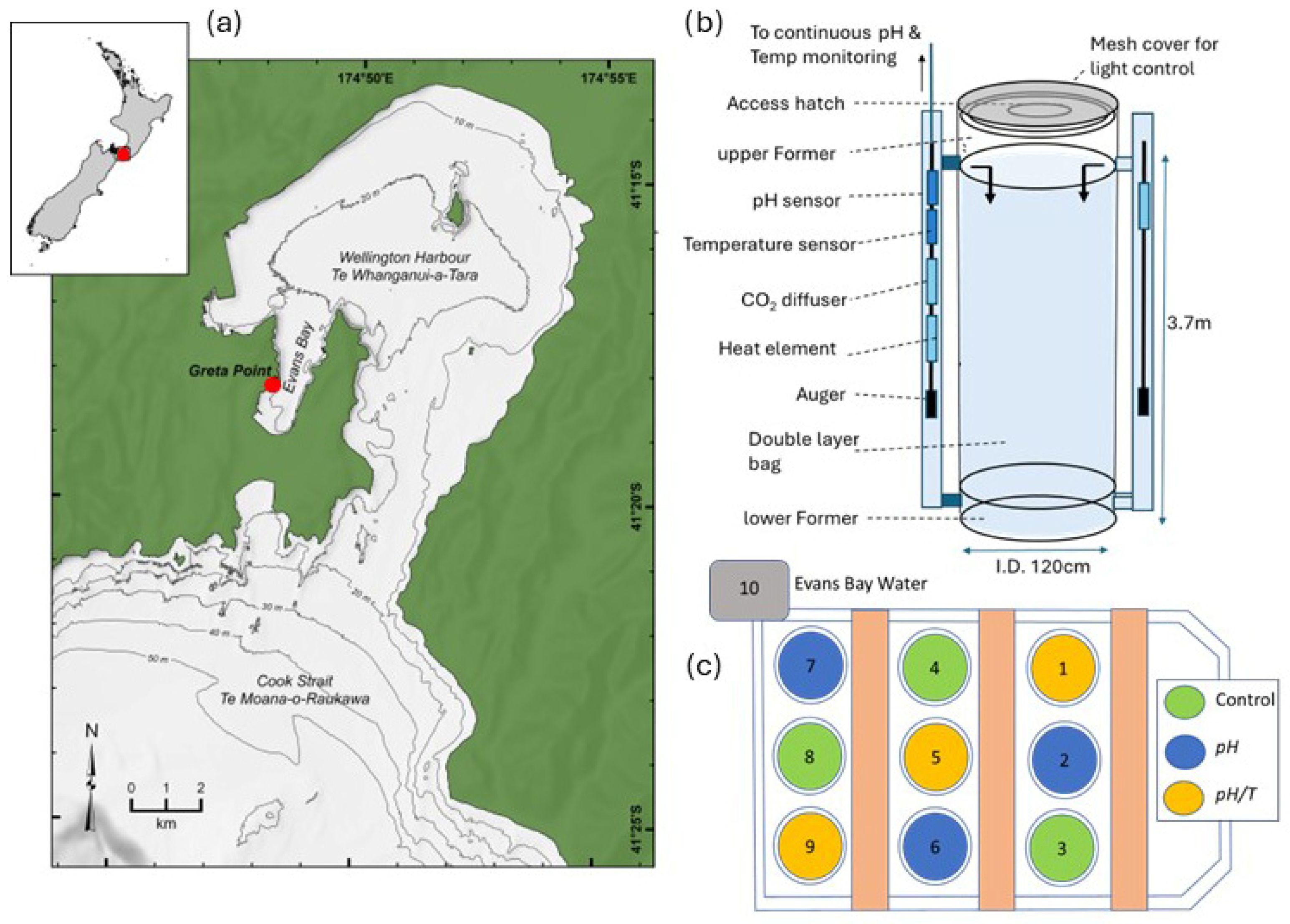
2.1. Mesocosm Framework
2.2. Experimental Design
2.3. Ancillary Parameters
2.3.1. Nutrients
2.3.2. Carbonate System
2.3.3. Phytoplankton
2.3.4. Data Analysis
- Model 1 (Null model) provided a global smooth across the experiment with no consideration of different treatments using predictors of Day Number and the auto-correlation term;
- Model 2 provided independent smooths across each experiment for each treatment, with predictors of Day Number subset by Treatment and the auto-correlation term, so representing individual processes over time in each treatment;
- Model 3 provided both global and independent smooths across days for each treatment using predictors of Day Number, Day Number subset by Treatment ID, and the auto-correlation term, representing one underlying process affected by individual treatment effects.
3. Results
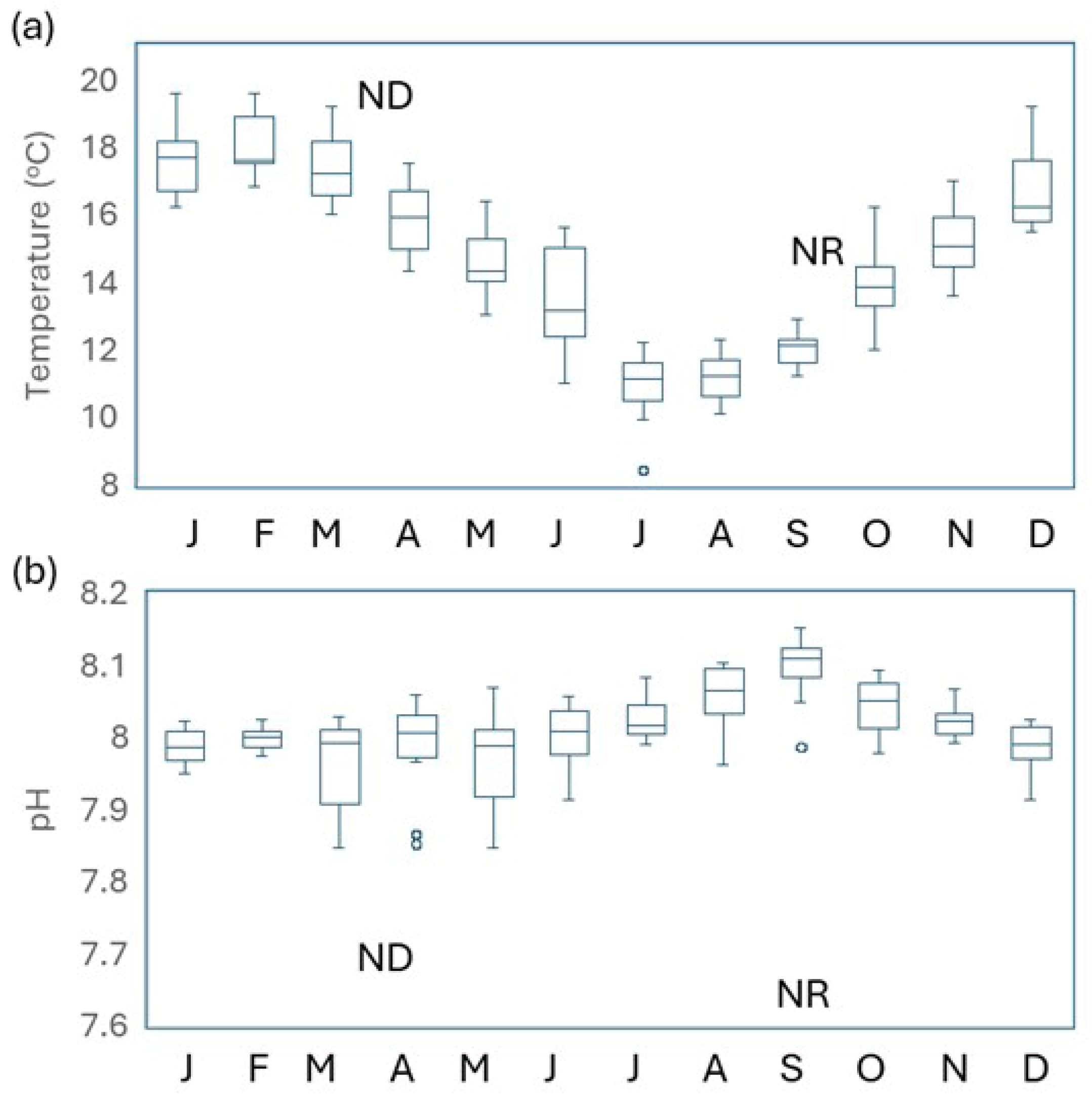
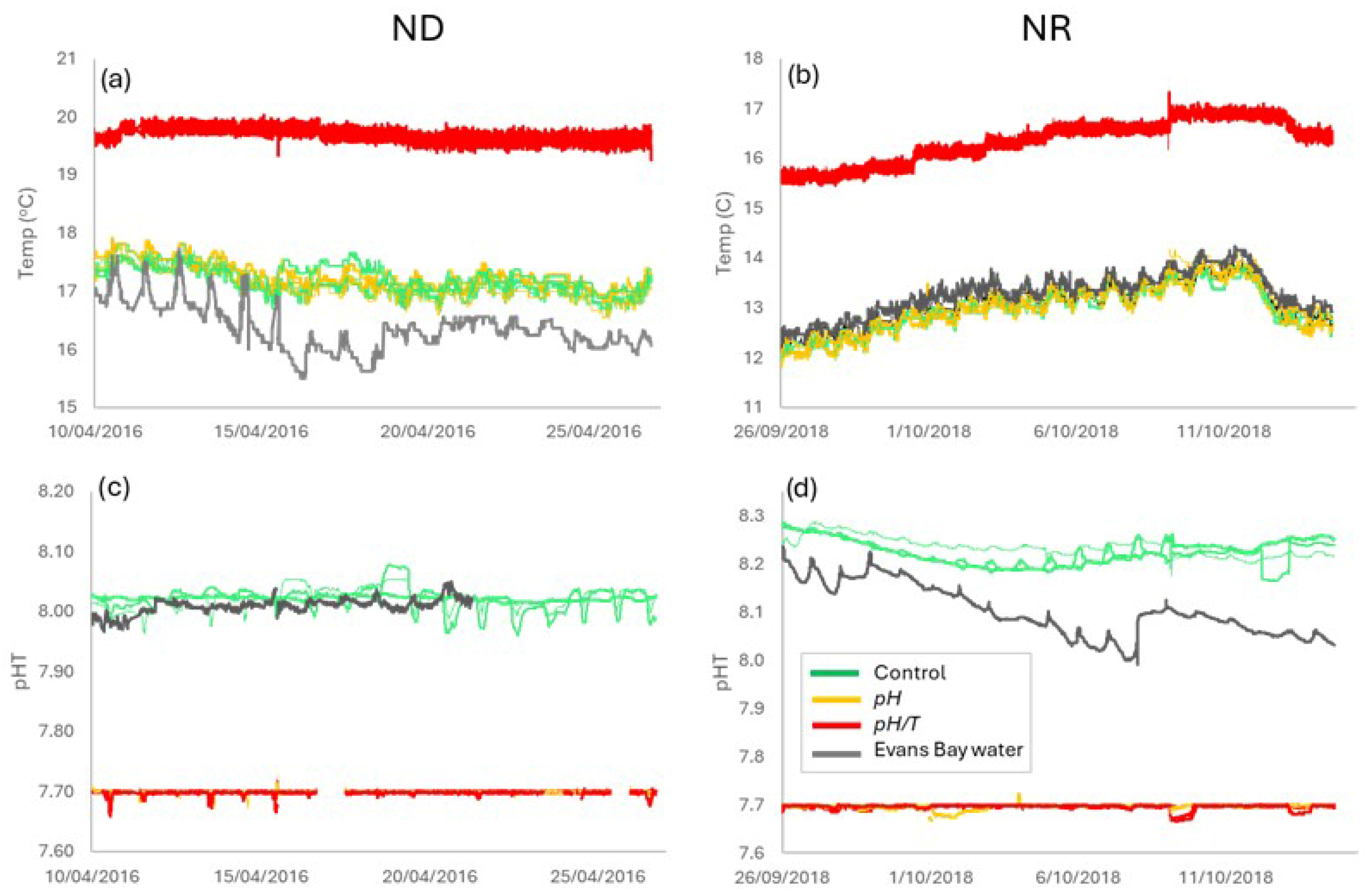
3.1. pH Time Series
3.2. Experiment Response
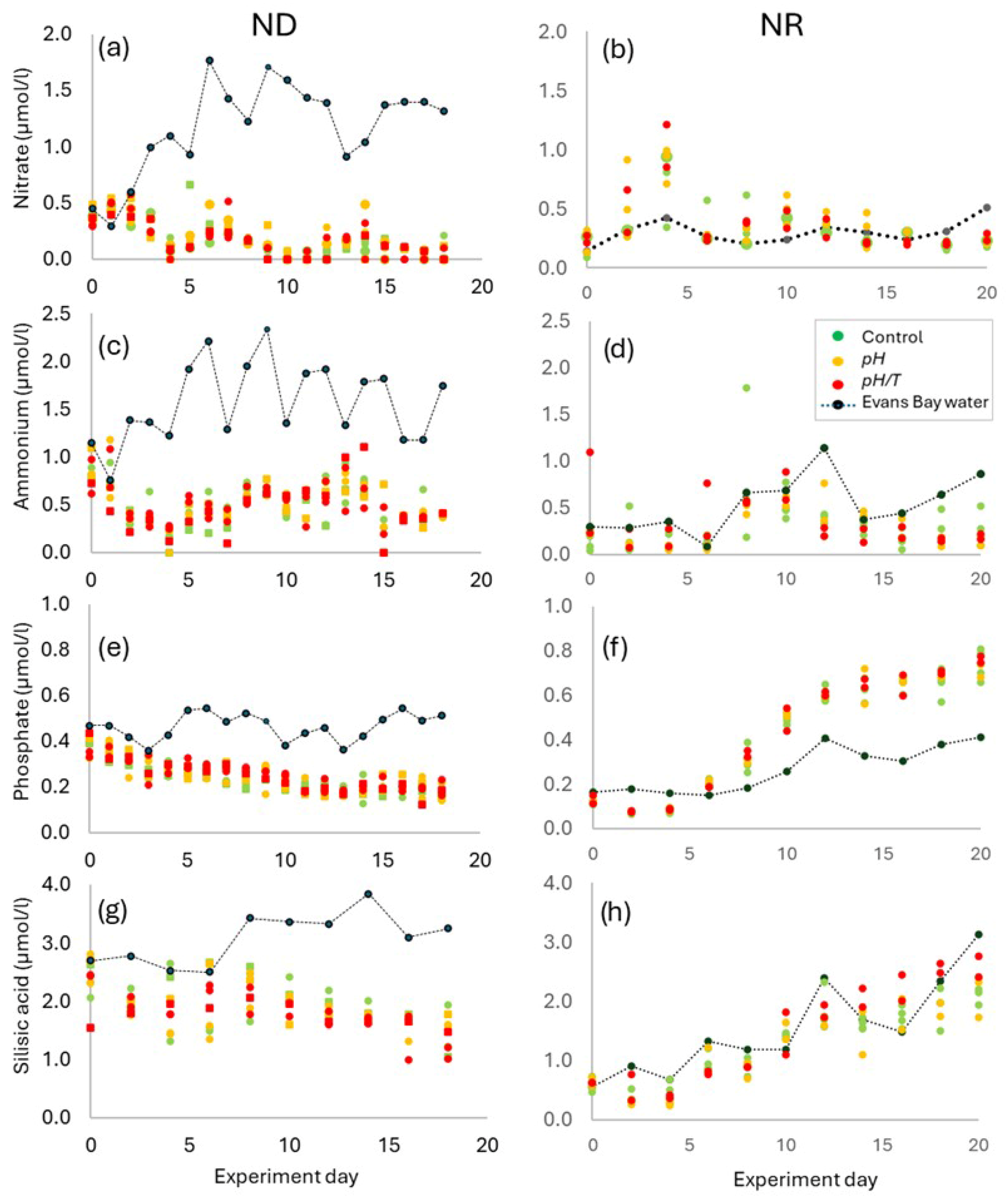
3.2.1. Nutrients
3.2.2. Total Chlorophyll
3.2.3. Size-Fractionated Chlorophyll
3.2.4. Phytoplankton Community Composition
3.2.5. Particulate Elemental Composition
4. Discussion
4.1. Chl-a Response to Lower pH
4.2. Chl-a Response to Lower pH and Warming
4.3. Cell Size Response
4.4. Diatom Response
4.5. Dinoflagellate and Flagellate Response
4.6. Implications for Coastal Ecosystems
5. Conclusions
Supplementary Materials
Author Contributions
Funding
Data Availability Statement
Acknowledgments
Conflicts of Interest
References
- Raven, J.A.; Beardall, J. Influence of global environmental Change on plankton. J. Plankton Res. 2021, 43, 779–800. [Google Scholar] [CrossRef]
- Paul, A.J.; Bach, L.T.; Schulz, K.G.; Boxhammer, T.; Czerny, J.; Achterberg, E.P.; Hellemann, D.; Trense, Y.; Nausch, M.; Sswat, M.; et al. Effect of elevated CO2 on organic matter pools and fluxes in a summer Baltic Sea plankton community. Biogeosciences 2015, 12, 6181–6203. [Google Scholar] [CrossRef]
- Taucher, J.; Arístegui, J.; Bach, L.T.; Guan, W.; Montero, M.F.; Nauendorf, A.; Achterberg, E.P.; Riebesell, U. Response of subtropical phytoplankton communities to ocean acidification under oligotrophic conditions and during nutrient fertilization. Front. Mar. Sci. 2018, 5, 330. [Google Scholar] [CrossRef]
- Dai, R.; Wen, Z.; Hong, H.; Browning, T.J.; Hu, X.; Chen, Z.; Liu, X.; Dai, M.; Morel, F.M.; Shi, D. Eukaryotic phytoplankton drive a decrease in primary production in response to elevated CO2 in the tropical and subtropical oceans. Proc. Natl. Acad. Sci. USA 2025, 122, e2423680122. [Google Scholar]
- Raven, J.A.; Beardall, J. CO2 concentrating mechanisms and environmental change. Aquat. Bot. 2014, 118, 24–37. [Google Scholar]
- Hopkinson, B.M.; Dupont, C.L.; Allen, A.E.; Morel, F.M.M. Efficiency of the CO2-concentrating mechanism of diatoms. Proc. Natl. Acad. Sci. USA 2011, 108, 3830−3837. [Google Scholar]
- Li, Y.; Zhuang, S.; Wu, Y.; Ren, H.; Chen, F.; Lin, X.; Wang, K.; Beardall, J.; Gao, K. Ocean acidification modulates expression of genes and physiological performance of a marine diatom. PLoS ONE 2017, 12, e0170970. [Google Scholar] [CrossRef] [PubMed]
- Taylor, A.R.; Brownlee, C.; Wheeler, G.L. Proton channels in algae: Reasons to be excited. Trends Plant Sci. 2012, 17, 675–684. [Google Scholar] [CrossRef]
- Paul, A.J.; Bach, L.T. Universal response pattern of phytoplankton growth rates to increasing CO2. New Phytol. 2020, 228, 1710–1716. [Google Scholar] [CrossRef]
- Boyd, P.W.; Rynearson, T.A.; Armstrong, E.A.; Fu, F.; Hayashi, K.; Hu, Z.; Hutchins, D.A.; Kudela, R.M.; Litchman, E.; Mulholland, M.R.; et al. Marine phytoplankton temperature versus growth responses from polar to tropical waters–outcome of a scientific community-wide study. PLoS ONE 2013, 8, e63091. [Google Scholar] [CrossRef]
- Eggers, S.L.; Lewandowska, A.M.; Barcelos e Ramos, J.; Blanco-Ameijeiras, S.; Gallo, F.; Matthiessen, B. Community composition has greater impact on the functioning of marine phytoplankton communities than ocean acidification. Glob. Change Biol. 2014, 20, 713–723. [Google Scholar] [CrossRef]
- Eppley, R.W. Temperature and phytoplankton growth in the sea. Fish. Bull. 1971, 70, 1063. [Google Scholar]
- Finkel, Z.V.; Beardall, J.; Flynn, K.J.; Quigg, A.; Rees, T.A.V.; Raven, J.A. Phytoplankton in a changing world: Cell size and elemental stoichiometry. J. Plankton Res. 2010, 32, 119–137. [Google Scholar] [CrossRef]
- Sett, S.; Schulz, K.G.; Bach, L.T.; Riebesell, U. Shift towards larger diatoms in a natural phytoplankton assemblage under combined high-CO2 and warming conditions. J. Plankton Res. 2018, 40, 391–406. [Google Scholar] [CrossRef]
- Harvey, B.P.; Gwynn-Jones, D.; Moore, P.J. Meta-analysis reveals complex marine biological responses to the interactive effects of ocean acidification and warming. Ecol. Evol. 2013, 3, 1016–1030. [Google Scholar]
- Feng, Y.; Chai, F.; Wells, M.L.; Liao, Y.; Li, P.; Cai, T.; Zhao, T.; Fu, F.; Hutchins, D.A. The Combined Effects of Increased pCO2 and Warming on a Coastal Phytoplankton Assemblage: From Species Composition to Sinking Rate. Front. Mar. Sci. 2021, 8, 622319. [Google Scholar] [CrossRef]
- Li, F.; Beardall, J.; Gao, K. Diatom performance in a future ocean: Interactions between nitrogen limitation, temperature, and CO2-induced seawater acidification. ICES J. Mar. Sci. 2018, 75, 1451–1464. [Google Scholar] [CrossRef]
- Boyd, P.W.; Dillingham, P.W.; McGraw, C.M.; Armstrong, E.A.; Cornwall, C.E.; Feng, Y.Y.; Hurd, C.L.; Gault-Ringold, M.; Roleda, M.Y.; Timmins-Schiffman, E.; et al. Physiological responses of a Southern Ocean diatom to complex future ocean conditions. Nat. Clim. Change 2016, 6, 207–213. [Google Scholar] [CrossRef]
- Hofmann, G.E.; Smith, J.E.; Johnson, K.S.; Send, U.; Levin, L.A.; Micheli, F.; Paytan, A.; Price, N.N.; Peterson, B.; Takeshita, Y.; et al. High-frequency dynamics of ocean pH: A multi-ecosystem comparison. PLoS ONE 2011, 6, e28983. [Google Scholar] [CrossRef]
- Breitburg, D.L.; Salisbury, J.; Bernhard, J.M.; Cai, W.J.; Dupont, S.; Doney, S.C.; Kroeker, K.J.; Levin, L.A.; Long, W.C.; Milke, L.M.; et al. And on top of all that… Coping with ocean acidification in the midst of many stressors. Oceanography 2015, 28, 48–61. [Google Scholar] [CrossRef]
- Zeldis, J.R.; Currie, K.I.; Graham, S.L.; Gall, M.P. Attributing controlling factors of acidification and hypoxia in a deep, nutrient-enriched estuarine embayment. Front. Mar. Sci. 2022, 8, 803439. [Google Scholar] [CrossRef]
- Varela, R.M.; De Castro, J.M.D.; Gómez-Gesteira, M. Coastal warming under climate change: Global, faster and heterogeneous. Sci. Total Environ. 2023, 886, 164029. [Google Scholar] [CrossRef]
- Waldbusser, G.G.; Salisbury, J.E. Ocean acidification in the coastal zone from an organism’s perspective: Multiple system parameters, frequency domains, and habitats. Annu. Rev. Mar. Sci. 2014, 6, 221–247. [Google Scholar] [CrossRef] [PubMed]
- Bach, L.T.; Taucher, J.; Boxhammer, T.; Ludwig, A.; Kristineberg KOSMOS Consortium; Achterberg, E.P.; Algueró-Muñiz, M.; Anderson, L.G.; Bellworthy, J.; Büdenbender, J.; et al. Influence of ocean acidification on a natural winter-to-summer plankton succession: First insights from a long-term mesocosm study draw attention to periods of low nutrient concentrations. PLoS ONE 2016, 11, e0159068. [Google Scholar] [CrossRef]
- Alvarez-Fernandez, S.; Bach, L.T.; Taucher, J.; Riebesell, U.; Sommer, U.; Aberle, N.; Brussaard, C.P.D.; Boersma, M. Plankton responses to ocean acidification: The role of nutrient limitation. Prog. Oceanogr. 2018, 165, 11–18. [Google Scholar] [CrossRef]
- Hernández-Hernández, N.; Bach, L.T.; Montero, M.F.; Taucher, J.; Baños, I.; Guan, W.; Espósito, M.; Ludwig, A.; Achterberg, E.P.; Riebesell, U.; et al. High CO2 Under Nutrient Fertilization Increases Primary Production and Biomass in Subtropical Phytoplankton Communities: A Mesocosm Approach. Front. Mar. Sci. 2018, 5, 213. [Google Scholar] [CrossRef]
- Saint-Macary, A.D.; Barr, N.; Armstrong, E.; Safi, K.; Marriner, A.; Gall, M.; McComb, K.; Dillingham, P.W.; Law, C.S. The Influence of Ocean Acidification and Warming on DMSP & DMS in New Zealand Coastal Water. Atmosphere 2021, 12, 181. [Google Scholar] [CrossRef]
- Meyers, M.; Décima, M.; Law, C.S.; Gall, M.; Barr, N.; Miller, M.; Safi, K.; Sabadel, A.; Wing, S.; Hoffmann, L. No evidence of altered relationship between diet and consumer fatty acid composition in a natural plankton community under combined climate drivers. J. Exp. Mar. Biol. Ecol. 2022, 551, 151734. [Google Scholar] [CrossRef]
- Sabadel, A.J.M.; Décima, M.; McComb, K.; Meyers, M.; Barr, N.; Gall, M.; Safi, K.; Law, C.S. Amino acid nitrogen stable isotopes as biomarkers of coastal phytoplankton assemblages and food web interactions. Mar. Ecol. Prog. Ser. 2022, 690, 1–13. [Google Scholar] [CrossRef]
- Law, C.S.; Rickard, G.J.; Mikaloff-Fletcher, S.E.; Pinkerton, M.H.; Behrens, E.; Chiswell, S.M.; Currie, K. Climate Change projections for the surface ocean around New Zealand. N. Z. J. Mar. Freshw. Res. 2018, 52, 309–335. [Google Scholar] [CrossRef]
- Vance, J.M.; Currie, K.I.; Law, C.S.; Murdoch, J.; Zeldis, J. NZOA-ON: The New Zealand Ocean Acidification Observing Network. Mar. Freshw. Res. 2019, 71, 281–299. [Google Scholar] [CrossRef]
- Dickson, A.G.; Sabine, C.L.; Christian, J.R. (Eds.) Guide to Best Practices for Ocean CO2 Measurements; PICES Special Publication 3, IOCCP Report No. 8; North Pacific Marine Science Organization: Sidney, BC, Canada, 2007; p. 191. [Google Scholar]
- Strickland, J.D.H.; Parsons, T.R. A Practical Handbook of Seawater Analysis. In Fisheries Research Bulletin of Canada, 2nd ed.; Bulletin 167; Fisheries and Oceans Canada: Ottawa, ON, Canada, 1972; p. 310. [Google Scholar]
- Safi, K.A.; Griffiths, F.B.; Hall, J.A. Microzooplankton composition, biomass and grazing rates along the WOCE SR3 line between Tasmania and Antarctica. Deep. Sea Res. Part I Oceanogr. Res. Pap. 2007, 54, 1025–1041. [Google Scholar] [CrossRef]
- Edler, L.; Elbrächter, M. The Utermöhl Method for Quantitative Phytoplankton Analysis; UNESCO: Paris, France, 2010. [Google Scholar]
- Hillebrand, H.; Dürselen, C.D.; Kirschtel, D.; Pollingher, U.; Zohary, T. Biovolume calculation for pelagic and benthic microalgae. J. Phycol. 1999, 35, 403–424. [Google Scholar] [CrossRef]
- Sun, J.; Liu, D. Geometric models for calculating cell biovolume and surface area for phytoplankton. J. Plankton Res. 2003, 25, 1331–1346. [Google Scholar] [CrossRef]
- Olenina, I.; Hajdu S: Edler L: Andersson, A.; Wasmund, N.; Busch, S.; Göbel, J.; Gromisz, S.; Huseby, S.; Huttunen, M.; Jaanus, A.; Kokkonen, P.; et al. Biovolumes and size-classes of phytoplankton in the Baltic Sea. HELCOM Balt. Sea Environ. Proc. 2006, 106. Available online: https://epic.awi.de/id/eprint/30141/1/bsep106.pdf (accessed on 19 April 2026).
- Montagnes, D.J.; Franklin, M. Effect of temperature on diatom volume, growth rate, and carbon and nitrogen content: Reconsidering some paradigms. Limnol. Oceanogr. 2001, 46, 2008–2018. [Google Scholar] [CrossRef]
- Menden-Deuer, S.; Lessard, E.J. Carbon to volume relationships for dinoflagellates, diatoms, and other protist plankton. Limnol. Oceanogr. 2000, 45, 569–579. [Google Scholar] [CrossRef]
- Pedersen, E.J.; Miller, D.L.; Simpson, G.L.; Ross, N. Hierarchical generalized additive models in ecology: An introduction with mgcv. PeerJ 2019, 7, e6876. [Google Scholar] [CrossRef]
- Rose, N.L.; Yang, H.; Turner, S.D.; Simpson, G.L. An Assessment of the Mechanisms for the Transfer of Lead and Mercury from Atmospherically Contaminated Organic Soils to Lake Sediments with Particular Reference to Scotland, UK. Geochim. Cosmochim. Acta 2012, 82, 113–135. [Google Scholar]
- Schaum, C.E.; Rost, B.; Collins, S. Environmental stability affects phenotypic evolution in a globally distributed marine picoplankton. ISME J. 2015, 10, 75. [Google Scholar] [CrossRef]
- Meyer, J.; Riebesell, U. Reviews and Syntheses: Responses of coccolithophores to ocean acidification: A meta-analysis. Biogeosciences 2015, 12, 1671–1682. [Google Scholar] [CrossRef]
- Bach, L.T.; Taucher, J. CO2 effects on diatoms: A synthesis of more than a decade of ocean acidification experiments with natural communities. Ocean Sci. 2019, 15, 1159–1175. [Google Scholar] [CrossRef]
- Rossoll, D.; Sommer, U.; Winder, M. Community interactions dampen acidification effects in a coastal plankton system. Mar. Ecol. Prog. Ser. 2013, 486, 37–46. [Google Scholar] [CrossRef]
- Maugendre, L.; Guieu, C.; Gattuso, J.P.; Gazeau, F. Ocean acidification in the Mediterranean Sea: Pelagic mesocosm experiments. A synthesis. Estuar. Coast. Shelf Sci. 2017, 186, 1–10. [Google Scholar] [CrossRef]
- Hoppe, C.J.; Wolf, K.K.; Schuback, N.; Tortell, P.D.; Rost, B. Compensation of ocean acidification effects in Arctic phytoplankton assemblages. Nat. Clim. Change 2018, 8, 529–533. [Google Scholar] [CrossRef]
- Sharma, D.; Biswas, H.; Silori, S.; Bandyopadhyay, D.; Shaik, A.U.R. Phytoplankton growth and community shift over a short-term high-CO2 simulation experiment from the southwestern shelf of India, Eastern Arabian Sea (summer monsoon). Environ. Monit. Assess. 2022, 194, 581. [Google Scholar] [CrossRef]
- Spisla, C.; Taucher, J.; Bach, L.T.; Haunost, M.; Boxhammer, T.; King, A.L.; Jenkins, B.D.; Wallace, J.R.; Ludwig, A.; Meyer, J.; et al. Extreme Levels of Ocean Acidification Restructure the Plankton Community and Biogeochemistry of a Temperate Coastal Ecosystem: A Mesocosm Study. Front. Mar. Sci. 2021, 7, 611157. [Google Scholar] [CrossRef]
- Vargas, C.A.; Lagos, N.A.; Lardies, M.A.; Duarte, C.; Manríquez, P.H.; Aguilera, V.M.; Broitman, B.; Widdicombe, S.; Dupont, S. Species-specific responses to ocean acidification should account for local adaptation and adaptive plasticity. Nat. Ecol. Evol. 2017, 1, 0084. [Google Scholar] [CrossRef]
- Sommer, U.; Paul, C.; Moustaka-Gouni, M. Warming and ocean acidification effects on phytoplankton—From species shifts to size shifts within species in a mesocosm experiment. PLoS ONE 2015, 10, e0125239. [Google Scholar] [CrossRef]
- Hyun, B.; Kim, J.M.; Jang, P.G.; Jang, M.C.; Choi, K.H.; Lee, K.; Yang, E.J.; Noh, J.H.; Shin, K. The effects of ocean acidification and warming on growth of a natural community of coastal phytoplankton. J. Mar. Sci. Eng. 2020, 8, 821. [Google Scholar] [CrossRef]
- Bénard, R.; Levasseur, M.; Scarratt, M.; Blais, M.A.; Mucci, A.; Ferreyra, G.; Starr, M.; Gosselin, M.; Tremblay, J.É.; Lizotte, M. Experimental assessment of the sensitivity of an estuarine phytoplankton fall bloom to acidification and warming. Biogeosciences 2018, 15, 4883–4904. [Google Scholar] [CrossRef]
- Hare, C.E.; Leblanc, K.; DiTullio, G.R.; Kudela, R.M.; Zhang, Y.; Lee, P.A.; Riseman, S.; Hutchins, D.A. Consequences of increased temperature and CO2 for phytoplankton community structure in the Bering Sea. Mar. Ecol. Prog. Ser. 2007, 352, 9–16. [Google Scholar] [CrossRef]
- Piontek, J.; Sperling, M.; Nöthig, E.M.; Engel, A. Multiple environmental changes induce interactive effects on bacterial degradation activity in the Arctic Ocean. Limnol. Oceanogr. 2015, 60, 1392–1410. [Google Scholar] [CrossRef]
- Sommer, U.; Lengfellner, K. Climate change and the timing, magnitude, and composition of the phytoplankton spring bloom. Glob. Change Biol. 2008, 14, 1199−1208. [Google Scholar] [CrossRef]
- Sommer, U.; Lewandowska, A. Climate change and the phytoplankton spring bloom: Warming and overwintering zooplankton have similar effects on phytoplankton. Glob. Change Biol. 2011, 17, 154−162. [Google Scholar] [CrossRef]
- O’Connor, M.I.; Piehler, M.F.; Leech, D.M.; Anton, A.; Bruno, J.F. Warming and resource availability shift food web structure and metabolism. PLoS Biol. 2009, 7, e1000178. [Google Scholar]
- Paul, C.; Matthiessen, B.; Sommer, U. Warming, but not enhanced CO2 concentration, quantitatively and qualitatively affects phytoplankton biomass. Mar. Ecol. Prog. Ser. 2015, 528, 39–51. [Google Scholar] [CrossRef]
- Atkinson, D.; Ciotti, B.J.; Montagnes, D.J. Protists decrease in size linearly with temperature: Ca. 2.5% degrees C(-1). Proc. Biol. Sci. 2003, 270, 2605–2611. [Google Scholar] [CrossRef]
- Bach, L.T.; Alvarez-Fernandez, S.; Hornick, T.; Stuhr, A.; Riebesell, U. Simulated ocean acidification reveals winners and losers in coastal phytoplankton. PLoS ONE 2017, 12, e0188198. [Google Scholar] [CrossRef] [PubMed]
- Sala, M.M.; Aparicio, F.L.; Balagué, V.; Boras, J.A.; Borrull, E.; Cardelús, C.; Cros, L.; Gomes, A.; López Sanz, A.; Malits, A.; et al. Contrasting effects of ocean acidification on the microbial food web under different trophic conditions. Ices J. Mar. Sci. 2016, 73, 670–679. [Google Scholar] [CrossRef]
- Huang, R.; Sun, J.; Yang, Y.; Jiang, X.; Wang, Z.; Song, X.; Wang, T.; Zhang, D.; Li, H.; Yi, X.; et al. Elevated pCO2 Impedes Succession of Phytoplankton Community from Diatoms to Dinoflagellates Along with Increased Abundance of Viruses and Bacteria. Front. Mar. Sci. 2021, 8, 642208. [Google Scholar] [CrossRef]
- Paul, C.; Sommer, U.; Garzke, J.; Moustaka-Gouni, M.; Paul, A.; Matthiessen, B. Effects of increased CO2 concentration on nutrient limited coastal summer plankton depend on temperature. Limnol. Oceanogr. 2016, 61, 853–868. [Google Scholar] [CrossRef]
- Wu, X.; Liu, H.; Ru, Z.; Tu, G.; Xing, L.; Ding, Y. Meta-analysis of the response of marine phytoplankton to nutrient addition and seawater warming. Mar. Environ. Res. 2021, 168, 105294. [Google Scholar] [CrossRef]
- Armbrust, E.V. The life of diatoms in the world’s oceans. Nature 2009, 459, 185–192. [Google Scholar] [CrossRef]
- Wu, Y.; Gao, K.; Riebesell, U. CO2-induced seawater acidification affects physiological performance of the marine diatom Phaeodactylum tricornutum. Biogeosciences 2010, 7, 2915–2923. [Google Scholar] [CrossRef]
- Hong, H.; Li, D.; Lin, W.; Li, W.; Shi, D. Nitrogen nutritional condition affects the response of energy metabolism in diatoms to elevated carbon dioxide. Mar. Ecol. Prog. Ser. 2017, 567, 41–56. [Google Scholar] [CrossRef]
- Domingues, R.B.; Barreto, M.; Brotas, V.; Galvão, H.M.; Barbosa, A.B. Short-term effects of winter warming and acidification on phytoplankton growth and mortality: More losers than winners in a temperate coastal lagoon. Hydrobiologia 2021, 848, 4763–4785. [Google Scholar] [CrossRef]
- Tortell, P.D.; Payne, C.D.; Li, Y.; Trimborn, S.; Rost, B.; Smith, W.O.; Riesselman, C.; Dunbar, R.B.; Sedwick, P.; DiTullio, G.R. CO2 sensitivity of Southern Ocean phytoplankton. Geophys. Res. Lett. 2008, 35, L04605. [Google Scholar] [CrossRef]
- Rabalais, N.N.; Turner, R.E.; Díaz, R.J.; Justić, D. Global change and eutrophication of coastal waters. ICES J. Mar. Sci. 2009, 66, 1528–1537. [Google Scholar] [CrossRef]
- Schulz, K.G.; Bach, L.T.; Bellerby, R.G.J.; Bermúdez, R.; Büdenbender, J.; Boxhammer, T.; Czerny, J.; Engel, A.; Ludwig, A.; Meyerhöfer, M.; et al. Phytoplankton Blooms at Increasing Levels of Atmospheric Carbon Dioxide: Experimental Evidence for Negative Effects on Prymnesiophytes and Positive on Small Picoeukaryotes. Front. Mar. Sci. 2017, 4, 64. [Google Scholar] [CrossRef]
- Feng, Y.; Hare, C.E.; Rose, J.M.; Handy, S.M.; DiTullio, G.R.; Lee, P.A.; Smith, W.O., Jr.; Peloquin, J.; Tozzi, S.; Sun, J.; et al. Interactive effects of iron, irradiance and CO2 on Ross Sea phytoplankton. Deep. Sea Res. Part I Oceanogr. Res. Pap. 2010, 57, 368–383. [Google Scholar] [CrossRef]
- Tanaka, N. The cell division rates of 10 species of attaching diatoms in natural seawater. Nippon. Suisan Gakkaishi 1984, 50, 969–972. [Google Scholar] [CrossRef][Green Version]
- Kumar, M.; Tibocha-Bonilla, J.D.; Füssy, Z.; Lieng, C.; Schwenck, S.M.; Levesque, A.V.; Al-Bassam, M.M.; Passi, A.; Neal, M.; Zuniga, C.; et al. Mixotrophic growth of a ubiquitous marine diatom. Sci. Adv. 2024, 10, eado2623. [Google Scholar] [CrossRef]
- Makareviciute-Fichtner, K.; Matthiessen, B.; Lotze, H.K.; Sommer, U. Decrease in diatom dominance at lower Si: N ratios alters plankton food webs. J. Plankton Res. 2020, 42, 411–424. [Google Scholar] [CrossRef]
- Paul, C.; Sommer, U.; Matthiessen, B. Composition and dominance of edible and inedible phytoplankton predict responses of Baltic Sea summer communities to elevated temperature and CO2. Microorganisms 2021, 9, 2294. [Google Scholar] [CrossRef] [PubMed]
- Pinkerton, M.H.; Sutton, P.; Wood, S. Satellite Indicators of Phytoplankton and Ocean Surface Temperature for New Zealand; Unpublished Report Prepared for the New Zealand Ministry for the Environment, December 2018, NIWA Client Report 2018180WN; 2018; p. 87. Available online: https://environment.govt.nz/assets/Publications/Files/satellite-indicators-of-phytoplankton-and-ocean-surface-temperature.pdf (accessed on 19 April 2026).
- Sommer, U.; Stibor, H.; Katechakis, A.; Sommer, F.; Hansen, T. Pelagic food web configurations at different levels of nutrient richness and their implications for the ratio fish production:primary production. Hydrobiologia 2002, 484, 11–20. [Google Scholar] [CrossRef]
- Riebesell, U.; Schulz, K.G.; Bellerby, R.G.J.; Botros, M.; Fritsche, P.; Meyerhöfer, M.; Neill, C.; Nondal, G.; Oschlies, A.; Wohlers, J.; et al. Enhanced biological carbon consumption in a high CO2 ocean. Nature 2007, 450, 545–548. [Google Scholar] [CrossRef] [PubMed]
- Taucher, J.; Boxhammer, T.; Bach, L.T.; Paul, A.J.; Schartau, M.; Stange, P.; Riebesell, U. Changing carbon-to-nitrogen ratios of organic-matter export under ocean acidification. Nat. Clim. Change 2021, 11, 52–57. [Google Scholar] [CrossRef]
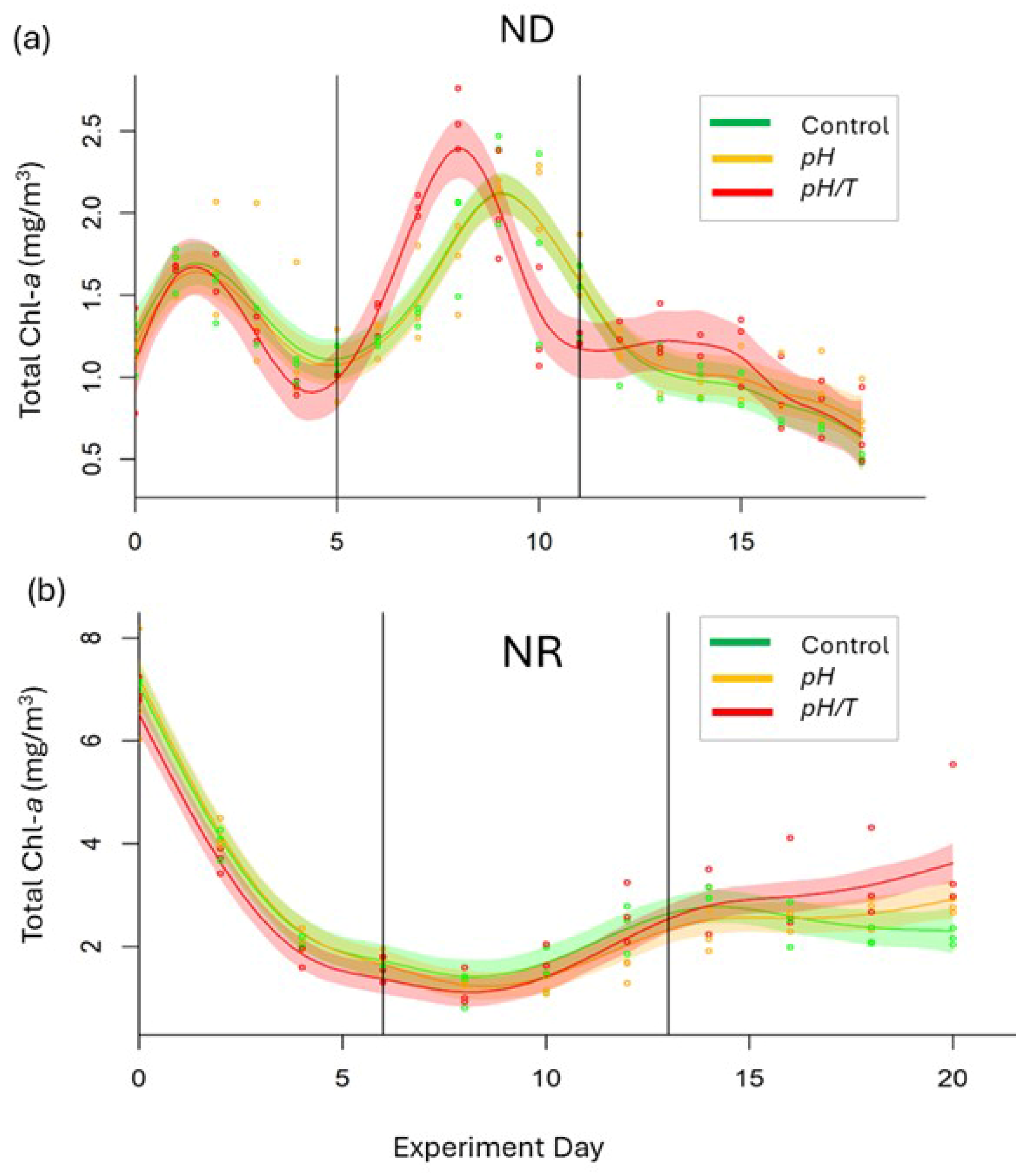
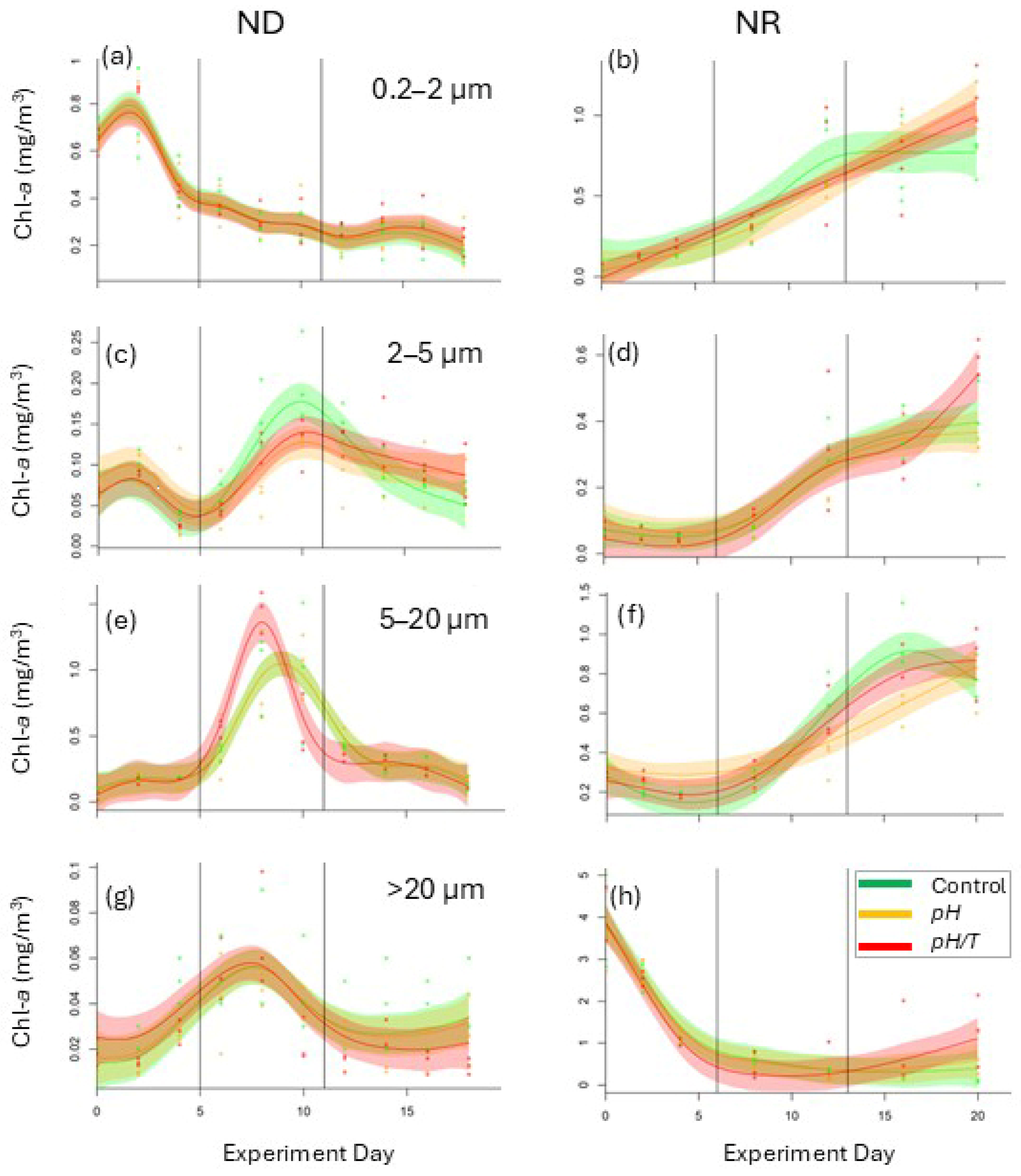
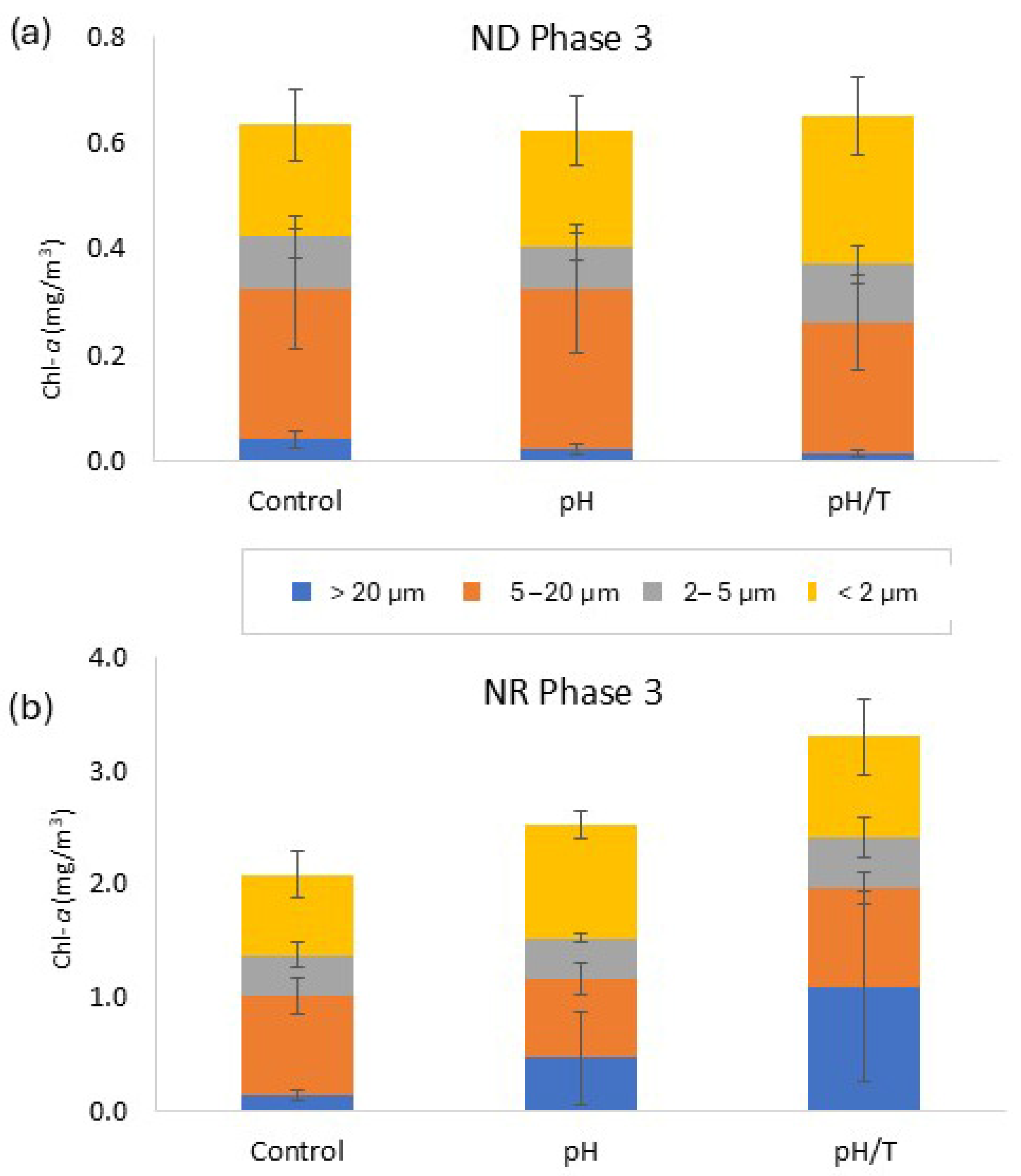
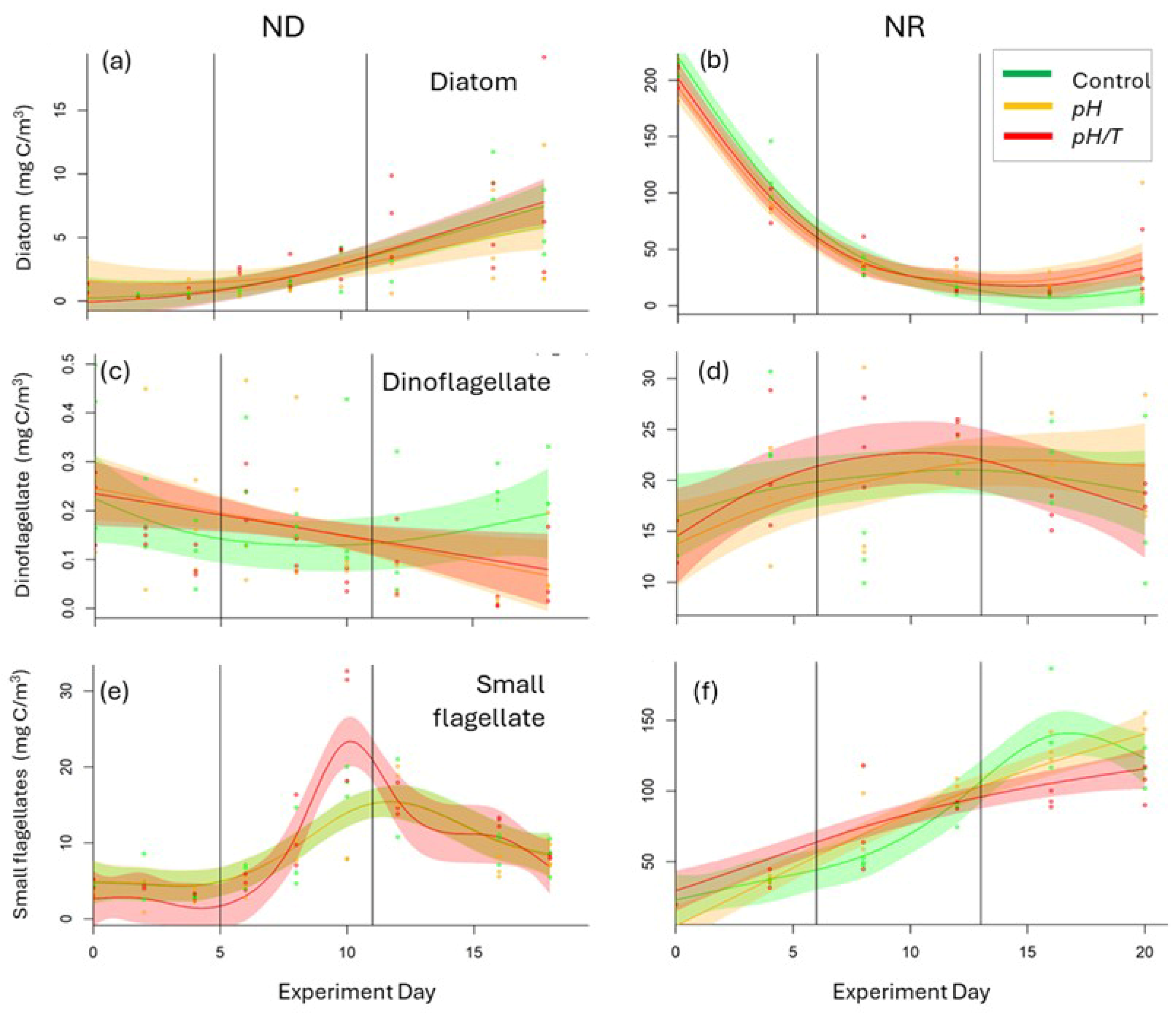

| Exp. | Time | Initial Temp (°C) | Initial pH | Initial Chl-a mg/m3 | Treatment (pH, pH/T) | Days | Mean Initial Nutrients (µmol/L) NO3/NH4/P/Si | Nutrient Addition (µmol/L) During exp. NO3/NH4/P/Si |
|---|---|---|---|---|---|---|---|---|
| ND | Autumn 2016 | 17.1 | 8.03 | 0.8 | −0.33 −0.33/+2.5 °C | 18 | 0.4/0.8/0.4/2.5 | Nutrient-deplete No addition |
| NR | Spring 2018 | 12.1 | 8.15 | 7.0 | −0.5 −0.5/+3.5 °C | 20 | 0.3/0.3/0.2/0.6 | Nutrient-replete Daily addition Total: 1.8/1.8/0.9/2.0 |
| Particulate | ND | NR | |
|---|---|---|---|
| Carbon (mmol/m3) | Control | 11.91 ± 2.2 | 23.1 ± 2.3 |
| pH | 12.28 ± 2.6 | 21.83 ± 2.3 | |
| pH/T | 13.28 ± 2.9 | 27.25 ± 3.9 | |
| Nitrogen (mmol/m3) | Control | 1.16 ± 0.35 | 4.21 ± 0.2 |
| pH | 1.14 ± 0.35 | 4.17 ± 0.2 | |
| pH/T | 1.31 ± 0.41 | 3.83 ± 0.4 | |
| C:N (mol) | Control | 10.2 ± 2.2 | 5.5 ± 0.3 |
| pH | 10.7 ± 3.1 | 5.2 ± 0.4 | |
| pH/T | 10.1 ± 1.8 | 7.1 ± 0.7 |
| Experiment | ND Nutrient-Deplete | NR Nutrient-Replete | |||
|---|---|---|---|---|---|
| Treatment | pH | pH/T | pH | pH/T | |
| Chl-a Size fraction | Total |  | | ||
| 0.2–2 µm |  |  | | ||
| 2–5 µm |  | ||||
| 5–20 µm | | ||||
| >20 µm |  |  |  | | |
| Group | Diatoms |  | | ||
| Dinoflagellates | | | |||
| Small flagellates | | | |||
Disclaimer/Publisher’s Note: The statements, opinions and data contained in all publications are solely those of the individual author(s) and contributor(s) and not of MDPI and/or the editor(s). MDPI and/or the editor(s) disclaim responsibility for any injury to people or property resulting from any ideas, methods, instructions or products referred to in the content. |
© 2026 by the authors. Licensee MDPI, Basel, Switzerland. This article is an open access article distributed under the terms and conditions of the Creative Commons Attribution (CC BY) license.
Share and Cite
Law, C.S.; Barr, N.; Currie, K.; Deppeler, S.; Dillingham, P.W.; Gall, M.P.; Marriner, A.; McComb, K.; Murdoch, J.; Northcote, L.; et al. Coastal Phytoplankton Response to Acidification and Warming Under Differing Levels of Nutrient Availability. Microorganisms 2026, 14, 989. https://doi.org/10.3390/microorganisms14050989
Law CS, Barr N, Currie K, Deppeler S, Dillingham PW, Gall MP, Marriner A, McComb K, Murdoch J, Northcote L, et al. Coastal Phytoplankton Response to Acidification and Warming Under Differing Levels of Nutrient Availability. Microorganisms. 2026; 14(5):989. https://doi.org/10.3390/microorganisms14050989
Chicago/Turabian StyleLaw, Cliff S., Neill Barr, Kim Currie, Stacy Deppeler, Peter W. Dillingham, Mark P. Gall, Andrew Marriner, Kiri McComb, Judith Murdoch, Lisa Northcote, and et al. 2026. "Coastal Phytoplankton Response to Acidification and Warming Under Differing Levels of Nutrient Availability" Microorganisms 14, no. 5: 989. https://doi.org/10.3390/microorganisms14050989
APA StyleLaw, C. S., Barr, N., Currie, K., Deppeler, S., Dillingham, P. W., Gall, M. P., Marriner, A., McComb, K., Murdoch, J., Northcote, L., & Safi, K. (2026). Coastal Phytoplankton Response to Acidification and Warming Under Differing Levels of Nutrient Availability. Microorganisms, 14(5), 989. https://doi.org/10.3390/microorganisms14050989

