Grazing Responses of Distinct-Sized Tropical Cladocerans to Different Filamentous Sizes of the Cyanobacterium Dolichospermum planctonicum

 ,
,  and
and
Abstract
1. Introduction
2. Materials and Methods
2.1. Phytoplankton Cultivation
2.2. Zooplankton Cultivation
2.3. Grazing Experiments
2.3.1. Single Diets at Varying Concentrations
2.3.2. Mixed Diets
2.3.3. Selectivity Index (α)
2.4. Statistical Analysis
3. Results
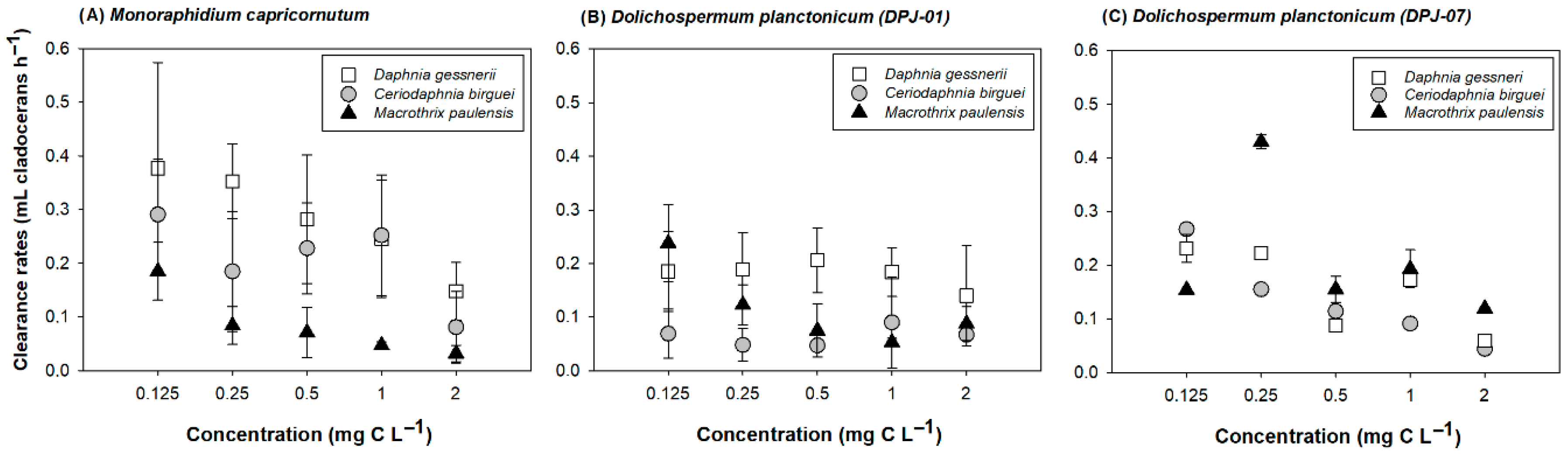
3.1. Single-Diet Experiments at Varying Concentrations
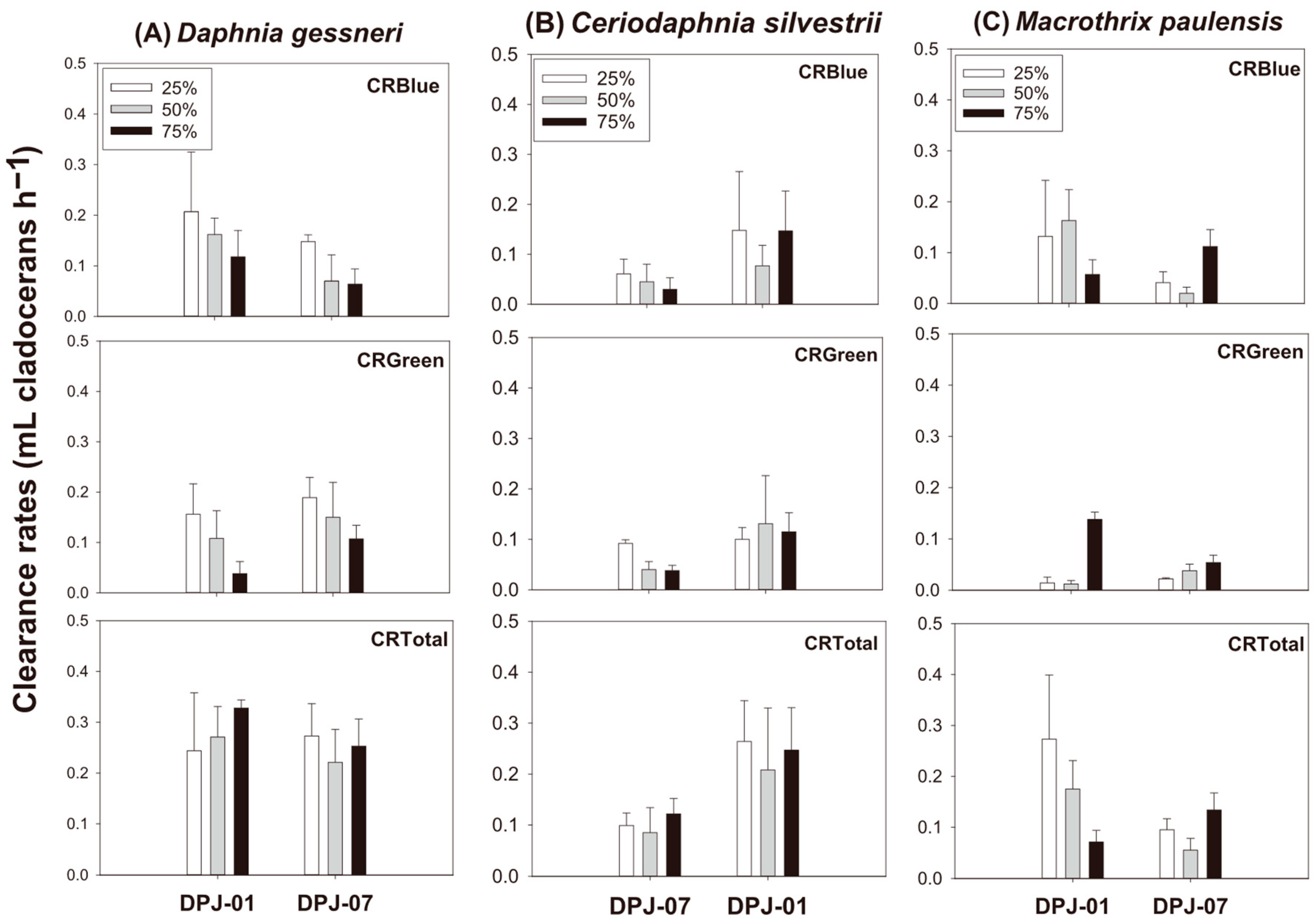
3.2. Mixed-Diet Experiments with Varying Proportions of Cyanobacteria
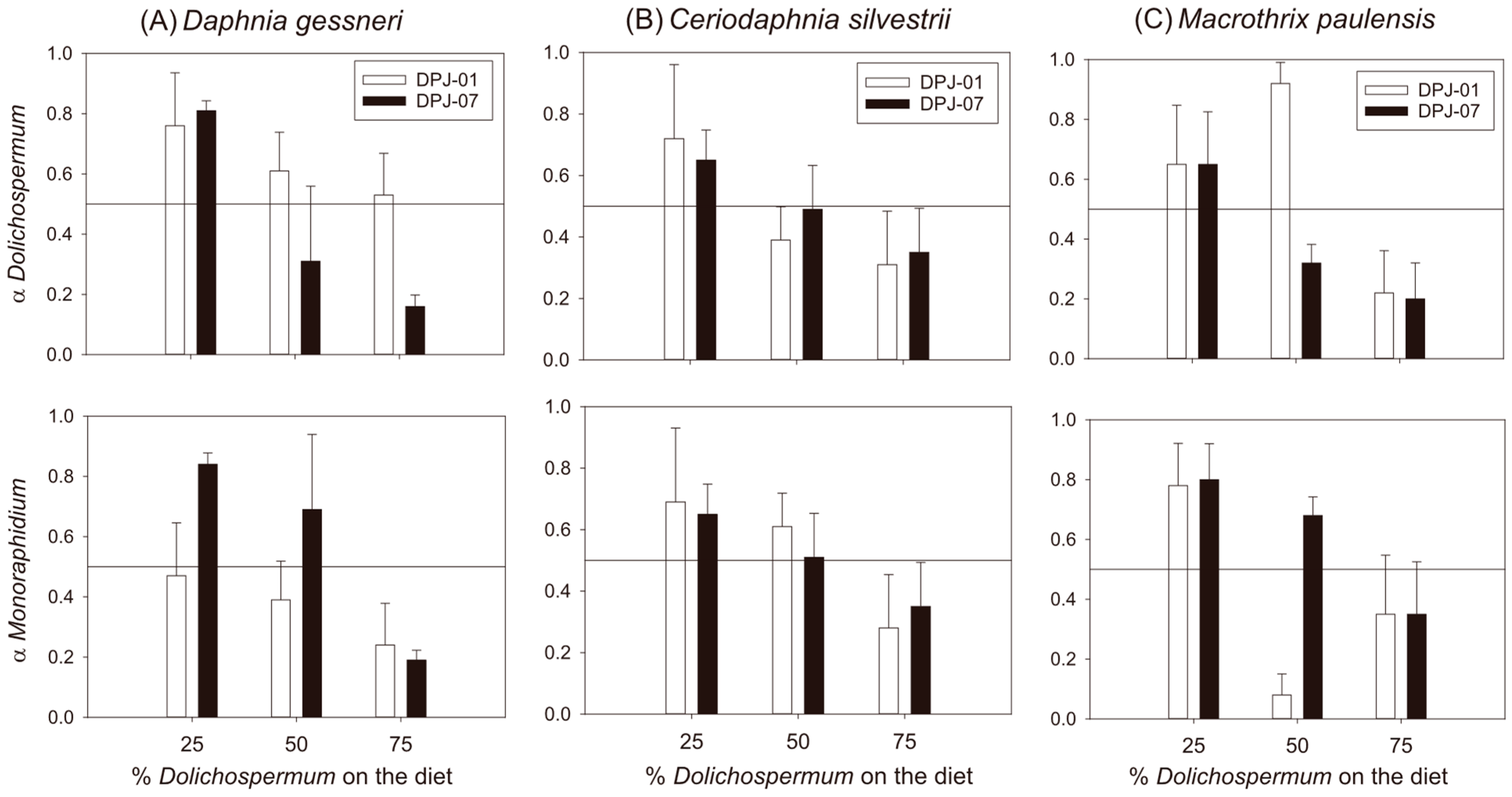
3.3. Selectivity Indices
4. Discussion
Author Contributions
Funding
Institutional Review Board Statement
Informed Consent Statement
Data Availability Statement
Conflicts of Interest
References
- Akinnawo, S.O. Eutrophication: Causes, Consequences, Physical, Chemical and Biological Techniques for Mitigation Strategies. Environ. Chall. 2023, 12, 100733. [Google Scholar] [CrossRef]
- Petry, A.C.; Manzi Marinho, M.; Maria Pellegrini Caramaschi, É.; Fernanda Santos Gomes, F.; Valerio Santana, J.P.; Augusto Sander de Carvalho, L.; Machado Rangel, L.; Fernando de Albuquerque Bruno, L.; Coelho Berjante Mesquita, M.; Novello Rocha, M.; et al. Floração Intensa e Persistente de Cianobactérias Potencialmente Tóxicas No Reservatório de Juturnaíba (RJ) Requer Abordagem Interdisciplinar. Limnotemas 2025, 1, 1–7. [Google Scholar]
- Chorus, I.; Spijkerman, E. What Colin Reynolds Could Tell Us about Nutrient Limitation, N:P Ratios and Eutrophication Control. Hydrobiologia 2021, 848, 95–111. [Google Scholar] [CrossRef]
- Chorus, I.; Welker, M. Toxic Cyanobacteria in Water; Taylor & Francis: London, UK, 2021. [Google Scholar] [CrossRef]
- Gobler, C.J. Climate Change and Harmful Algal Blooms: Insights and Perspective. Harmful Algae 2020, 91, 101731. [Google Scholar] [CrossRef]
- Zepernick, B.N.; Wilhelm, S.W.; Bullerjahn, G.S.; Paerl, H.W. Climate Change and the Aquatic Continuum: A Cyanobacterial Comeback Story. Environ. Microbiol. Rep. 2023, 15, 3–12. [Google Scholar] [CrossRef]
- Rangel, L.M.; Soares, M.C.S.; Paiva, R.; Silva, L.H.S. Morphology-Based Functional Groups as Effective Indicators of Phytoplankton Dynamics in a Tropical Cyanobacteria-Dominated Transitional River–Reservoir System. Ecol. Indic. 2016, 64, 217–227. [Google Scholar] [CrossRef]
- Erratt, K.J.; Creed, I.F.; Lobb, D.A.; Smol, J.P.; Trick, C.G. Climate Change Amplifies the Risk of Potentially Toxigenic Cyanobacteria. Glob. Change Biol. 2023, 29, 5240–5249. [Google Scholar] [CrossRef] [PubMed]
- Burford, M.A.; Beardall, J.; Willis, A.; Orr, P.T.; Magalhaes, V.F.; Rangel, L.M.; Azevedo, S.M.F.O.E.; Neilan, B.A. Understanding the Winning Strategies Used by the Bloom-Forming Cyanobacterium Cylindrospermopsis Raciborskii. Harmful Algae 2016, 54, 44–53. [Google Scholar] [CrossRef] [PubMed]
- Marinho, M.M.; Souza, M.B.G.; Lürling, M. Light and Phosphate Competition between Cylindrospermopsis Raciborskii and Microcystis Aeruginosa Is Strain Dependent. Microb. Ecol. 2013, 66, 479–488. [Google Scholar] [CrossRef]
- Guedes, I.A.; Pacheco, A.B.F.; Vilar, M.C.P.; Mello, M.M.; Marinho, M.M.; Lurling, M.; Azevedo, S.M.F.O. Intraspecific Variability in Response to Phosphorus Depleted Conditions in the Cyanobacteria Microcystis Aeruginosa and Raphidiopsis Raciborskii. Harmful Algae 2019, 86, 96–105. [Google Scholar] [CrossRef]
- Celano, M.R.; De Pinho, J.V.; Azevedo, S.M.F.d.O.e.; Vilar, M.C.P. Environmentally Relevant Concentrations of the Antibiotic Azithromycin Enhance the Toxicity of the Cyanobacterium Microcystis Aeruginosa on the Water Flea Daphnia Similis. Harmful Algae 2026, 152, 103040. [Google Scholar] [CrossRef] [PubMed]
- De Meester, L.; Declerck, S.A.J.; Ger, K.A. Beyond Daphnia: A Plea for a More Inclusive and Unifying Approach to Freshwater Zooplankton Ecology. Hydrobiologia 2023, 850, 4693–4703. [Google Scholar] [CrossRef]
- Rangel, L.M.; Mesquita, M.C.B.; de Barros, S.R.; Neres-Lima, V.; Celano, M.R.; Vilar, M.C.P.; Azevedo, S.M.F.d.O.e.; Marinho, M.M. Chemical and Morphological Constitutive Defensive Traits of Cyanobacteria Have Different Effects on the Grazing of a Small Tropical Cladoceran. Toxins 2025, 17, 343. [Google Scholar] [CrossRef]
- Rangel, L.M.; Silva, L.H.S.; Faassen, E.J.; Lürling, M.; Ger, K.A. Copepod Prey Selection and Grazing Efficiency Mediated by Chemical and Morphological Defensive Traits of Cyanobacteria. Toxins 2020, 12, 465. [Google Scholar] [CrossRef]
- Ger, K.A.; Urrutia-Cordero, P.; Frost, P.C.; Hansson, L.-A.; Sarnelle, O.; Wilson, A.E.; Lürling, M. The Interaction between Cyanobacteria and Zooplankton in a More Eutrophic World. Harmful Algae 2016, 54, 128–144. [Google Scholar] [CrossRef]
- de Pinho, J.V.; Celano, M.R.; Vilar, M.C.P.; Correia, F.V.; Ferrão-Filho, A.d.S. Zooplankton Are Adversely Affected by Chronic Exposure to Raphidiopsis Raciborskii and Acetamiprid: A Study of Single and Combined Toxicity. Aquat. Toxicol. 2026, 292, 107741. [Google Scholar] [CrossRef]
- Harris, T.D.; Reinl, K.L.; Azarderakhsh, M.; Berger, S.A.; Berman, M.C.; Bizic, M.; Bhattacharya, R.; Burnet, S.H.; Cianci-Gaskill, J.A.; Domis, L.N.d.S.; et al. What Makes a Cyanobacterial Bloom Disappear? A Review of the Abiotic and Biotic Cyanobacterial Bloom Loss Factors. Harmful Algae 2024, 133, 102599. [Google Scholar] [CrossRef]
- dos Reis, G.C.; de Carvalho, G.H.A.; Vilar, M.C.P.; Azevedo, S.M.F.d.O.e.; Ferrão-Filho, A.d.S. Saxitoxin-Producing Raphidiopsis raciborskii (Cyanobacteria) Constrains Daphnia Fitness and Feeding Rate despite High Nutritious Food Availability. Toxics 2023, 11, 693. [Google Scholar] [CrossRef]
- Vilar, M.C.P.; da Silva Ferrão-Filho, A.; Azevedo, S.M.F.O. Single and Mixed Diets of the Toxic Cyanobacteria Microcystis Aeruginosa and Raphidiopsis raciborskii Differently Affect Daphnia Feeding Behavior. Food Webs 2022, 32, e00245. [Google Scholar] [CrossRef]
- Ger, K.A.; Panosso, R.; Lürling, M. Consequences of Acclimation to Microcystis on the Selective Feeding Behavior of the Calanoid Copepod Eudiaptomus Gracilis. Limnol. Oceanogr. 2011, 56, 2103–2114. [Google Scholar] [CrossRef]
- Nandini, S.; Sarma, S.S.S. Experimental Studies on Zooplankton-Toxic Cyanobacteria Interactions: A Review. Toxics 2023, 11, 176. [Google Scholar] [CrossRef]
- Jiang, X.; Xie, J.; Xu, Y.; Zhong, W.; Zhu, X.; Zhu, C. Increasing Dominance of Small Zooplankton with Toxic Cyanobacteria. Freshw. Biol. 2017, 62, 429–443. [Google Scholar] [CrossRef]
- Reichwaldt, E.S.; Song, H.; Ghadouani, A. Effects of the Distribution of a Toxic Microcystis Bloom on the Small Scale Patchiness of Zooplankton. PLoS ONE 2013, 8, e66674. [Google Scholar] [CrossRef]
- de Aquino Santos, A.S.; Vilar, M.C.P.; Amorim, C.A.; Molica, R.J.R.; do Nascimento Moura, A. Exposure to Toxic Microcystis via Intact Cell Ingestion and Cell Crude Extract Differently Affects Small-Bodied Cladocerans. Environ. Sci. Pollut. Res. 2022, 29, 23194–23205. [Google Scholar] [CrossRef]
- Ferrão-Filho, A.S.; de Abreu, S.; Silva, D.; de Oliveira, T.A.; de Magalhães, V.F.; Pflugmacher, S.; da Silva, E.M. Single and Combined Effects of Microcystin- and Saxitoxin-Producing Cyanobacteria on the Fitness and Antioxidant Defenses of Cladocerans. Environ. Toxicol. Chem. 2017, 36, 2689–2697. [Google Scholar] [CrossRef]
- Fintelman-Oliveira, E.; Kruk, C.; Lacerot, G.; Klippel, G.; Branco, C.W.C. Zooplankton Functional Groups in Tropical Reservoirs: Discriminating Traits and Environmental Drivers. Hydrobiologia 2023, 850, 365–384. [Google Scholar] [CrossRef]
- Li, X.; Dreher, T.W.; Li, R. An Overview of Diversity, Occurrence, Genetics and Toxin Production of Bloom-Forming Dolichospermum (Anabaena) Species. Harmful Algae 2016, 54, 54–68. [Google Scholar] [CrossRef] [PubMed]
- Pham, T.L.; Bui, M.H.; Driscoll, M.; Shimizu, K.; Motoo, U. First Report of Geosmin and 2-Methylisoborneol (2-MIB) in Dolichospermum and Oscillatoria from Vietnam. Limnology 2021, 22, 43–56. [Google Scholar] [CrossRef]
- Manganelli, M.; Testai, E.; Tazart, Z.; Scardala, S.; Codd, G.A. Co-Occurrence of Taste and Odor Compounds and Cyanotoxins in Cyanobacterial Blooms: Emerging Risks to Human Health? Microorganisms 2023, 11, 872. [Google Scholar] [CrossRef] [PubMed]
- Marinho, M.M.; Huszar, V.L.M. Nutrient Availability and Physical Conditions as Controlling Factors of Phytoplankton Composition and Biomass in a Tropical Reservoir (Southeastern Brazil). Arch. Hydrobiol. 2002, 153, 443–468. [Google Scholar] [CrossRef]
- Lürling, M. Grazing Resistance in Phytoplankton. Hydrobiologia 2021, 848, 237–249. [Google Scholar] [CrossRef]
- Lürling, M.; Beekman, W. Grazer-Induced Defenses in Scenedesmus (Chlorococcales; Chlorophyceae): Coenobium and Spine Formation. Phycologia 1999, 38, 368–376. [Google Scholar] [CrossRef]
- Elmoor-Loureiro, L.M. Manual de Indentificacao de Cladóceros Límnicos do Brasil; Editora Universa-UCB: Brasília, Brazil, 1997; pp. 1–155. [Google Scholar]
- Tollrian, R. Neckteeth Formation in Daphnia Pulex as an Example of Continuous Phenotypic Plasticity: Morphological Effects of Chaoborus Kairomone Concentration and Their Quantification. J. Plankton Res. 1993, 15, 1309–1318. [Google Scholar] [CrossRef]
- Rocha, O.; Duncan, A. The Relationship between Cell Carbon and Cell Volume in Freshwater Algal Species Used in Zooplanktonic Studies. J. Plankton Res. 1985, 7, 279–294. [Google Scholar] [CrossRef]
- Lürling, M.; Verschoor, A.M. FO-Spectra of Chlorophyll Fluorescence for the Determination of Zooplankton Grazing. Hydrobiologia 2003, 491, 145–157. [Google Scholar] [CrossRef]
- Phytoplankton Analyzer PHYTO-PAM and Phyto-Win Software V 1.45 System Components and Principles of Operation; Heinz Walz GmbH: Effeltrich, Germany, 2003.
- Ritchie, R.J. Consistent Sets of Spectrophotometric Chlorophyll Equations for Acetone, Methanol and Ethanol Solvents. Photosynth. Res. 2006, 89, 27–41. [Google Scholar] [CrossRef]
- Peters, R.H. Methods for the Study of Feeding, Grazing and Assimilation by Zooplankton. In Manual for the Assessment of Secondary Production in Fresh Waters; Downing, J.A., Rigler, F.H., Eds.; Blackwell: Oxford, UK, 1984; pp. 336–412. [Google Scholar]
- Ger, K.A.; Faassen, E.J.; Pennino, M.G.; Lürling, M. Effect of the Toxin (Microcystin) Content of Microcystis on Copepod Grazing. Harmful Algae 2016, 52, 34–45. [Google Scholar] [CrossRef]
- Rangel, L.M.; Ger, K.A.; Silva, L.H.S.; Soares, M.C.S.; Faassen, E.J.; Lürling, M. Toxicity Overrides Morphology on Cylindrospermopsis Raciborskii Grazing Resistance to the Calanoid Copepod Eudiaptomus Gracilis. Microb. Ecol. 2016, 71, 835–844. [Google Scholar] [CrossRef] [PubMed]
- Soares, M.C.S.; Lürling, M.; Panosso, R.; Huszar, V. Effects of the Cyanobacterium Cylindrospermopsis Raciborskii on Feeding and Life-History Characteristics of the Grazer Daphnia Magna. Ecotoxicol. Environ. Saf. 2009, 72, 1183–1189. [Google Scholar] [CrossRef] [PubMed]
- Chesson, J. Measuring Preference in Selective Predation. Ecology 1978, 59, 211–215. [Google Scholar] [CrossRef]
- Ger, K.A.; Hansson, L.-A.; Lürling, M. Understanding Cyanobacteria-Zooplankton Interactions in a More Eutrophic World. Freshw. Biol. 2014, 59, 1783–1798. [Google Scholar] [CrossRef]
- Soares, M.C.S.; Lurling, M.; Huszar, V.L.M. Responses of the Rotifer Brachionus Calyciflorus to Two Tropical Toxic Cyanobacteria (Cylindrospermopsis Raciborskii and Microcystis Aeruginosa) in Pure and Mixed Diets with Green Algae. J. Plankton Res. 2010, 32, 999–1008. [Google Scholar] [CrossRef]
- Panosso, R.; Lürling, M. Daphnia Magna Feeding on Cylindrospermopsis Raciborskii: The Role of Food Composition, Filament Length and Body Size. J. Plankton Res. 2010, 32, 1393–1404. [Google Scholar] [CrossRef]
- Bednarska, A.; Pietrzak, B.; Pijanowska, J. Effect of Poor Manageability and Low Nutritional Value of Cyanobacteria on Daphnia Magna Life History Performance. J. Plankton Res. 2014, 36, 838–847. [Google Scholar] [CrossRef]
- Kâ, S.; Mendoza-Vera, J.M.; Bouvy, M.; Champalbert, G.; N’Gom-Kâ, R.; Pagano, M. Can Tropical Freshwater Zooplankton Graze Efficiently on Cyanobacteria? Hydrobiologia 2011, 679, 119–138. [Google Scholar] [CrossRef]
- Gladyshev, M.I.; Temerova, T.A.; Dubovskaya, O.P.; Kolmakov, V.I.; Ivanova, E.A. Selective Grazing on Cryptomonas by Ceriodaphnia Quadrangula Fed a Natural Phytoplankton Assemblage. Aquat. Ecol. 1999, 33, 347–353. [Google Scholar] [CrossRef]
- Oberhaus, L.; Gélinas, M.; Pinel-Alloul, B.; Ghadouani, A.; Humbert, J.F. Grazing of Two Toxic Planktothrix Species by Daphnia Pulicaria: Potential for Bloom Control and Transfer of Microcystins. J. Plankton Res. 2007, 29, 827–838. [Google Scholar] [CrossRef]
- Colina, M.; Calliari, D.; Carballo, C.; Kruk, C. A Trait-Based Approach to Summarize Zooplankton–Phytoplankton Interactions in Freshwaters. Hydrobiologia 2016, 767, 221–233. [Google Scholar] [CrossRef]
- Garbeva, P.; Avalos, M.; Ulanova, D.; van Wezel, G.P.; Dickschat, J.S. Volatile Sensation: The Chemical Ecology of the Earthy Odorant Geosmin. Environ. Microbiol. 2023, 25, 1565–1574. [Google Scholar] [CrossRef]
- Kiørboe, T. How Zooplankton Feed: Mechanisms, Traits and Trade-Offs. Biol. Rev. Camb. Philos. Soc. 2011, 86, 311–339. [Google Scholar] [CrossRef]



| Zooplankton | Estimate | Standard Error | z | p |
|---|---|---|---|---|
| Daphnia–Ceriodaphnia | 0.07 | 0.01 | 4.5 | <0.0001 |
| Macrothrix–Daphnia | −0.06 | 0.01 | −4.2 | <0.0001 |
| Strains | Estimate | Standard error | z | p |
| DPJ-07–DPJ-01 | 0.04 | 0.01 | 2.8 | 0.01 |
| MONO–DPJ-01 | 0.06 | 0.01 | 4.0 | <0.001 |
| Concentrations | Estimate | Standard error | z | p |
| 0.5–0.125 | −0.07 | 0.02 | −3.552 | 0.0034 |
| 1–0.125 | −0.06 | 0.02 | −3.222 | 0.0110 |
| 2–0.125 | −0.1 | 0.02 | −6.136 | <0.001 |
| 0.5–0.25 | −0.09 | 0.02 | −2.770 | 0.0443 |
| 2–0.25 | −0.1 | 0.02 | −5.354 | <0.001 |
| 2–1 | −0.06 | 0.02 | −2.914 | 0.0295 |
| CRBLUE | ||||
|---|---|---|---|---|
| Zooplankton | Estimate | Standard Error | z | p |
| Daphnia–Ceriodaphnia | 0.4 | 0.1 | 2.64 | 0.02 |
| Strains | Estimate | Standard error | z | p |
| DPJ-07–DPJ-01 | −0.7 | 0.1 | −5.0 | 0.0000004 |
| CRGREEN | ||||
| Zooplankton | Estimate | Standard error | z | p |
| Macrothrix–Ceriodaphnia | −0.7 | 0.2 | −3.4 | 0.001 |
| Macrothrix–Daphnia | −1.1 | 0.2 | −5.6 | <0.001 |
| CRTOTAL | ||||
| Zooplankton | Estimate | Standard error | z | p |
| Daphnia–Ceriodaphnia | 0.5 | 0.1 | 4.3 | 0.0001 |
| Macrothrix–Daphnia | −0.7 | 0.1 | −6.1 | 0.0001 |
| Strains | Estimate | Standard error | z | p |
| DPJ-07–DPJ-01 | −0.5 | 0.1 | −5.2 | 0.0000001 |
Disclaimer/Publisher’s Note: The statements, opinions and data contained in all publications are solely those of the individual author(s) and contributor(s) and not of MDPI and/or the editor(s). MDPI and/or the editor(s) disclaim responsibility for any injury to people or property resulting from any ideas, methods, instructions or products referred to in the content. |
© 2026 by the authors. Licensee MDPI, Basel, Switzerland. This article is an open access article distributed under the terms and conditions of the Creative Commons Attribution (CC BY) license.
Share and Cite
Rangel, L.M.; Ribeiro, L.R.; Valério, J.P.S.; Marinho, M.M.; Mesquita, M.C.B. Grazing Responses of Distinct-Sized Tropical Cladocerans to Different Filamentous Sizes of the Cyanobacterium Dolichospermum planctonicum. Microorganisms 2026, 14, 590. https://doi.org/10.3390/microorganisms14030590
Rangel LM, Ribeiro LR, Valério JPS, Marinho MM, Mesquita MCB. Grazing Responses of Distinct-Sized Tropical Cladocerans to Different Filamentous Sizes of the Cyanobacterium Dolichospermum planctonicum. Microorganisms. 2026; 14(3):590. https://doi.org/10.3390/microorganisms14030590
Chicago/Turabian StyleRangel, Luciana Machado, Larissa Ramos Ribeiro, João Paulo Santana Valério, Marcelo Manzi Marinho, and Marcella Coelho Berjante Mesquita. 2026. "Grazing Responses of Distinct-Sized Tropical Cladocerans to Different Filamentous Sizes of the Cyanobacterium Dolichospermum planctonicum" Microorganisms 14, no. 3: 590. https://doi.org/10.3390/microorganisms14030590
APA StyleRangel, L. M., Ribeiro, L. R., Valério, J. P. S., Marinho, M. M., & Mesquita, M. C. B. (2026). Grazing Responses of Distinct-Sized Tropical Cladocerans to Different Filamentous Sizes of the Cyanobacterium Dolichospermum planctonicum. Microorganisms, 14(3), 590. https://doi.org/10.3390/microorganisms14030590