Evolution of Amoxicillin-Based Mono-Antibiotic Regimens for Helicobacter pylori Eradication: From Ineffectiveness to Innovation—A Systematic Review

 , ,
, ,
Abstract
1. Introduction
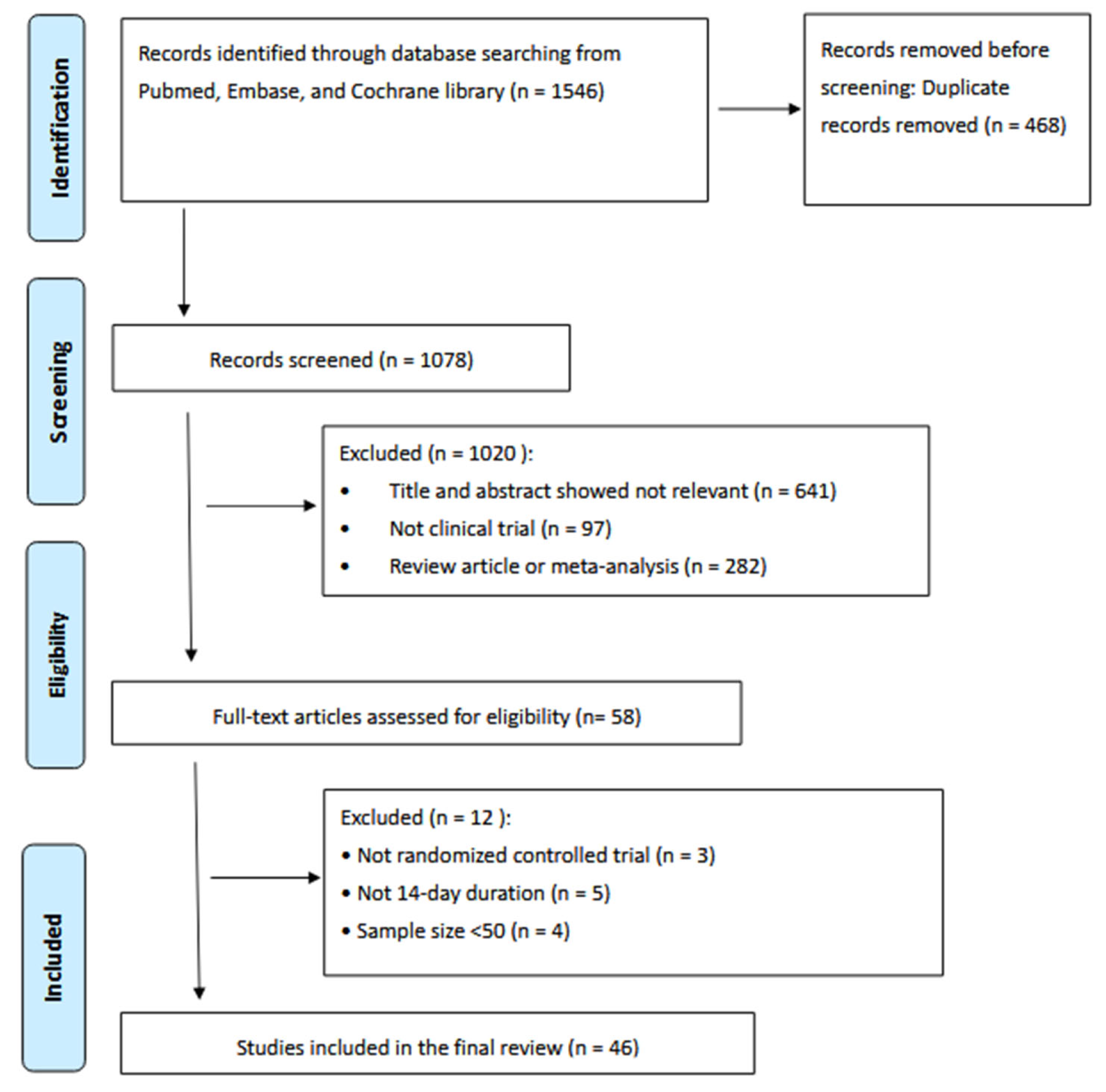
2. Article Search
2.1. Dual Therapies with Regular-Dose Amoxicillin/High-Dose PPI and High-Dose Amoxicillin/High-Dose PPI in the First-Line Treatment of H. pylori Infection
2.2. Dual Therapies with Regular-Dose Amoxicillin/High-Dose Vonoprazan and High-Dose Amoxicillin/High-Dose Vonoprazan in the First-Line Treatment of H. pylori Infection

| 14-Day Regular-Dose Amoxicillin/High-Dose PPI Dual Therapy and High-Dose Amoxicillin/High-Dose PPI Dual Therapy | |||||||
|---|---|---|---|---|---|---|---|
| Author [Year] | Country | No. of Cases | Regimen | Eradication Rate | Adverse Events | ||
| ITT | PP | ||||||
| Regular-dose amoxicillin Sapmaz et al. [31] [2017] | Turkey | 98 | rabeprazole 20 mg tid, amoxicillin 750 mg tid | 84.7% (83/98) | 84.7% (83/98) | 13.3% (13/98) | |
| All | 84.7% (83/98) | 84.7% (83/98) | 13.3% (13/98) | ||||
| High-dose amoxicillin Yang et al. [27] [2015] | Taiwan | 150 | rabeprazole 20 mg qid, amoxicillin 750 mg qid | 95.3% (143/150) | 96.6% (143/148) | 23.0% (34/148) | |
| Hu et al. [32] [2017] | China | 87 | rabeprazole 20 mg qid, amoxicillin 750 mg qid | 81.6% (71/87) | 83.5% (71/85) | 3.4% (3/87) | |
| Tai et al. [33] [2019] | Taiwan | 120 | esomeprazole 40 mg tid, amoxicillin 750 mg qid | 91.7% (110/120) | 95.7% (110/115) | 9.6% (11/115) | |
| Yang et al. [16] [2019] | China | 116 | esomeprazole 20 mg qid, amoxicillin 750 mg qid | 87.9% (102/116) | 91.1% (102/112) | 6.3% (7/112) | |
| Yu et al. [34] [2019] | China | 80 | esomeprazole 40 mg bid, amoxicillin 1000 mg tid | 92.5% (74/80) | 96.1% (73/76) | 7.5% (6/80) | |
| Song et al. [35] [2020] | China | 380 | esomeprazole 20 mg qid, amoxicillin 750 mg qid | 87.1% (331/380) | 92.4% (329/356) | 17.6% (66/375) | |
| Zhang et al. [36] [2020] | China | 104 | esomeprazole 20 mg tid, amoxicillin 1000 mg tid | 83.5% (76/91) | 86.4% (76/88) | 5.0% (5/101) | |
| Hwong-Ruey et al. [37] [2020] | Malaysia | 97 | rabeprazole 20 mg qid, amoxicillin 1000 mg qid | 92.8% (90/97) | 93.8% (90/96) | 20.5% (20/97) | |
| Shen et al. [38] [2022] | China | 496 | esomeprazole 20 mg qid, amoxicillin 750 mg qid | 88.31% (438/496) | 91.63% (438/478) | 13.3% (66/496) | |
| Guan et al. [17] [2022] | China | 350 | esomeprazole 20 mg qid, amoxicillin 1000 mg tid | 89.4% (313/350) | 90.6% (308/340) | 12.9% (45/349) | |
| Han et al. [39] [2022] | China | 315 | esomeprazole 20 mg qid, amoxicillin 750 mg qid | 88.6% (279/315) | 90.4% (274/303) | 13.7% (43/314) | |
| Shao et al. [18] [2022] | China | 120 | rabeprazole 20 mg tid, amoxicillin 1000 mg tid | 85.8% (103/120) | 89.6% (103/115) | 13.0% (15/115) | |
| Bi et al. [40] [2022] | China | 329 | esomeprazole 40 mg tid, amoxicillin 1000 mg tid | 75.4% (248/329) | 81.3% (248/305) | 11.1% (34/305) | |
| Liu et al. [19] [2023] | China | 422 | esomeprazole 20 mg qid, amoxicillin 1000 mg tid | 90.3% (381/422) | 93.6% (381/407) | 13.5% (55/407) | |
| Hsu et al. [20] [2023] | Taiwan | 306 | rabeprazole 20 mg qid, amoxicillin 750 mg qid | 83% (255/306) | 87% (253/291) | 13.0% (40/305) | |
| Ding et al. [41] [2023] | China | 134 | esomeprazole 40 mg bid, amoxicillin 1000 mg tid | 73.1% (98/134) | 83.1% (98/118) | 6.0% (8/134) | |
| Yun et al. [42] [2023] | China | 108 | esomeprazole 40 mg tid, amoxicillin 750 mg qid | 65.7% (71/108) | 71.0% (71/100) | 2.0% (2/100) | |
| Zhang et al. [43] [2023] | China | 101 | ilaprazole 5 mg bid, amoxicillin 1000 mg tid | 92.1% (93/101) | 94.9% (93/98) | 13.9% (14/101) | |
| Macedo et al. [44] [2023] | Portugal | 50 | esomeprazole 40 mg bid, amoxicillin 1000 mg alternating with amoxicillin 500 mg qid | 96.2% (48/50) | 95.9% (47/49) | 2.0% (1/50) | |
| Valizadeh et al. [45] [2024] | Iran | 114 | esomeprazole 40 mg bid, amoxicillin 1000 mg tid | 76.3% (87/114) | 79.1% (87/110) | 12.2% (14/114) | |
| Han et al. [46] [2025] | China | 160 | ilaprazole 10 mg bid, amoxicillin 1000 mg tid | 88.7% (142/160) | 92.2% (142/154) | 10.8% (17/157) | |
| Yang et al. [47] [2025] | China | 221 | esomeprazole 40 mg qid, amoxicillin 750 mg qid | 70.59% (156/221) | 93.94% (155/165) | 4.98% (11/221) | |
| All | 85.3% (3709/4347) | 89.9% (3692/4109) | 12.1% (517/4283) | ||||
| 14-day regular-dose amoxicillin/high-dose vonoprazan dual therapy and high-dose amoxicillin/high-dose vonoprazan dual therapy | |||||||
| Regular-dose amoxicillin Zuberi et al. [49] [2022] | Pakistan | 96 | vonoprazan 20 mg bid, amoxicillin 1000 mg bid | 89.6% (86/96) | 93.5% (86/92) | 13.0% (12/92) | |
| Hu et al. [50] [2023] | China | 55 | vonoprazan 20 mg bid, amoxicillin 1000 mg bid | 89.1% (49/55) | 94.1% (48/51) | 29.1% (16/55) | |
| Hu et al. [51] 2024] | China | 95 | vonoprazan 20 mg bid, amoxicillin 1000 mg bid | 87.4% (83/95) | 96.5% (83/86) | 27.4% (26/95) | |
| Liu et al. [52] [2024] | China | 64 | vonoprazan 20 mg bid, amoxicillin 750 mg tid | 76.6% (49/64) | 90.6% (48/53) | 9.4% (6/64) | |
| Fan et al. [53] [2025] | China | 252 | vonoprazan 20 mg bid, amoxicillin 1000 mg bid | 79.4% (200/252) | 92.1% (197/214) | 27.2% (67/246) | |
| Peng et al. [54] [2025] | China | 239 | vonoprazan 20 mg bid, amoxicillin 1000 mg bid | 91.6% (219/239) | 91.5% (215/235) | 11.7% (35/300) | |
| Peng et al. [54] [2025] | China | 247 | vonoprazan 20 mg bid, amoxicillin 500 mg tid | 87.0% (215/247) | 86.8% (211/243) | 13.0% (39/300) | |
| All | 86.0% (901/1048) | 91.2% (888/974) | 17.4% (201/1152) | ||||
| High-dose amoxicillin Chey et al. [55] [2022] | USA | 265 | vonoprazan 20 mg bid, amoxicillin 1000 mg tid | 78.5% (208 /265) | 81.2% (177/218) | 29.9% (104/348) | |
| Yang et al. [56] [2023] | China | 200 | vonoprazan 20 mg bid, amoxicillin 1000 mg tid | 86% (172/200) | 92.5% (172/186) | 9.5% (17/200) | |
| Peng et al. [57] [2023] | China | 158 | vonoprazan 20 mg bid, amoxicillin 750 mg qid | 89.9% (142/158) | 97.9% (142/145) | 19.0% (30/158) | |
| Hu et al. [58] [2023] | China | 97 | vonoprazan 20 mg bid, amoxicillin 1000 mg tid | 88.6% (86/97) | 95.5% (86/90) | 16.67% (15/90) | |
| Hu et al. [50] [2023] | China | 55 | vonoprazan 20 mg bid, amoxicillin 1000 mg tid | 87.3% (48/55) | 95.9% (47/49) | 20.0% (11/55) | |
| Jiang et al. [59] [2024] | China | 200 | vonoprazan 20 mg bid, amoxicillin 1000 mg tid | 94.0% (188/200) | 97.9% (188/192) | 19.0% (38/200) | |
| Huang et al. [60] [2024] | China | 102 | vonoprazan 20 mg bid, amoxicillin 1000 mg tid | 92.2% (94/102) | 93.9% (93/99) | 13.7% (14/102) | |
| Cheung et al. [61] [2024] | China | 100 | vonoprazan 20 mg bid, amoxicillin 1000 mg tid | 96.0% (96/100) | 96.7% (89/92) | 39.0% (39/100) | |
| Liu et al. [52] [2024] | China | 64 | vonoprazan 20 mg bid, amoxicillin 1000 mg tid | 79.7% (51/64) | 94.3% (50/53) | 7.8% (5/64) | |
| Lin et al. [62] [2024] | China | 125 | vonoprazan 20 mg bid, amoxicillin 1000 mg tid | 91.20% (114/125) | 93.39% (113/121) | 36.1% (44/122) | |
| Peng et al. [54] [2025] | China | 251 | vonoprazan 20 mg bid, amoxicillin 1000 mg tid | 93.2% (234/251) | 93.2% (233/250) | 15.3% (46/300) | |
| Song et al. [63] [2025] | China | 209 | vonoprazan 20 mg bid, amoxicillin 1000 mg tid | 88.0% (184/209) | 95.3% (181/190) | 17.6% (36/204) | |
| Yang et al. [47] [2025] | China | 183 | vonoprazan 20 mg bid, amoxicillin 1000 mg tid | 84.2% (154/183) | 96.8% (149/154) | 9.84% (18/165) | |
| All | 88.2% (1771/2009) | 93.5% (1720/1839) | 19.8% (417/2108) | ||||
| 14-day bismuth/regular-dose amoxicillin/high-dose vonoprazan triple therapy and bismuth/high-dose amoxicillin/high-dose vonoprazan triple therapy | |||||||
| Regular-dose amoxicillin Liang et al. [66] [2024] | China | 300 | vonoprazan 20 mg bid, amoxicillin 750 mg tid, bismuth 220 mg bid | 83.7% (251/300) | 90.9% (251/276) | 13.7% (41/300) | |
| Qi et al. [67] [2025] | China | 85 | vonoprazan 20 mg bid, amoxicillin 1000 mg bid, bismuth 220 mg bid | 89.4% (76/85) | 92.7% (76/82) | 4.9% (4/82) | |
| All | 84.9% (327/385) | 91.3% (327/358) | 11.8% (45/382) | ||||
| High-dose amoxicillin Hsu et al. [68] [2026] | Taiwan | 120 | vonoprazan 20 mg bid, amoxicillin 750 mg qid, bismuth 300 mg qid | 95.8% (115/120) | 98.4% (115/117) | 10.0% (12/120) | |
| All | 95.8% (115/120) | 98.4% (115/117) | 10.0% (12/120) | ||||
2.3. Triple Therapies with Bismuth/Regular-Dose Amoxicillin/High-Dose Vonoprazan and Bismuth/High-Dose Amoxicillin/High-Dose Vonoprazan in the First-Line Treatment of H. pylori Infection
2.4. Long-Term Consequences of Prolonged High-Dose Amoxicillin Exposure
3. Limitations
4. Conclusions
Supplementary Materials
Author Contributions
Funding
Institutional Review Board Statement
Informed Consent Statement
Data Availability Statement
Conflicts of Interest
References
- Suerbaum, S.; Michetti, P. Helicobacter pylori infection. N. Engl. J. Med. 2002, 347, 1175–1186. [Google Scholar] [CrossRef]
- Graham, D.Y.; Lew, G.M.; Klein, P.D.; Evans, D.G.; Evans, D.J., Jr.; Saeed, Z.A.; Malaty, H.M. Effect of treatment of Helicobacter pylori infection on the long-term recurrence of gastric or duodenal ulcer. A randomized, controlled study. Ann. Intern. Med. 1992, 116, 705–708. [Google Scholar] [CrossRef]
- Sung, J.J.; Chung, S.C.; Ling, T.K.; Yung, M.Y.; Leung, V.K.; Ng, E.K.; Li, M.K.; Cheng, A.F.; Li, A.K. Antibacterial treatment of gastric ulcers associated with Helicobacter pylori. N. Engl. J. Med. 1995, 332, 139–142. [Google Scholar] [CrossRef]
- Asaka, M.; Kato, M.; Takahashi, S.; Fukuda, Y.; Sugiyama, T.; Ota, H.; Uemura, N.; Murakami, K.; Satoh, K.; Sugano, K.; et al. Guidelines for the management of Helicobacter pylori infection in Japan: 2009 revised edition. Helicobacter 2010, 15, 1–20. [Google Scholar] [CrossRef]
- Liou, J.M.; Malfertheiner, P.; Hong, T.C.; Cheng, H.C.; Sugano, K.; Shah, S.; Sheu, B.S.; Chen, M.J.; Chiang, T.H.; Chen, Y.C.; et al. Screening and eradication of Helicobacter pylori f or gastric cancer prevention: Taipei Global Consensus II. Gut 2025, 74, 1767–1791. [Google Scholar] [CrossRef]
- Shih, C.A.; Shie, C.B.; Hsu, P.I. Update on the first-line treatment of Helicobacter pylori infection in areas with high and low clarithromycin resistances. Therap. Adv. Gastroenterol. 2022, 15, 17562848221138168. [Google Scholar] [CrossRef]
- Wu, P.J.; Tsay, F.W.; Wu, D.C.; Yang, J.C.; Chuah, S.K.; Chen, K.Y.; Chen, C.L.; Lee, C.L.; Shih, C.A.; Liu, Y.H.; et al. Sequential changes of antibiotic resistances of Helicobacter pylori in Taiwan from 2019 to 2024. World. J. Gastroenterol. 2025, 31, 111380. [Google Scholar] [CrossRef]
- Sugano, K.; Tack, J.; Kuipers, E.J.; Graham, D.Y.; El-Omar, E.M.; Miura, S.; Haruma, K.; Asaka, M.; Uemura, N.; Malfertheiner, P. Kyoto global consensus report on Helicobacter pylori gastritis. Gut 2015, 64, 1353–1367. [Google Scholar] [CrossRef]
- Hsu, P.I.; Wu, D.C.; Wu, J.Y.; Graham, D.Y. Modified sequential Helicobacter pylori therapy: Proton pump inhibitor and amoxicillin for 14 days with clarithromycin and metronidazole added as a quadruple (hybrid) therapy for the final 7 days. Helicobacter 2011, 16, 139–145. [Google Scholar] [CrossRef]
- Fallone, C.A.; Chiba, N.; van Zanten, S.V.; Fischbach, L.; Gisbert, J.P.; Hunt, R.H.; Jones, N.L.; Render, C.; Leontiadis, G.I.; Moayyedi, P.; et al. The Toronto Consensus for the Treatment of Helicobacter pylori Infection in Adults. Gastroenterology 2016, 151, 51–69. [Google Scholar] [CrossRef]
- Malfertheiner, P.; Megraud, F.; Rokkas, T.; Gisbert, J.P.; Liou, J.M.; Schulz, C.; Gasbarrini, A.; Hunt, R.H.; Leja, M.; O’Morain, C.; et al. Management of Helicobacter pylori infection: The Maastricht VI/Florence consensus report. Gut 2022, 71, 1724–1762. [Google Scholar] [CrossRef]
- Liou, J.M.; Fang, Y.J.; Chen, C.C.; Bair, M.J.; Chang, C.Y.; Lee, Y.C.; Chen, M.J.; Chen, C.C.; Tseng, C.H.; Hsu, Y.C.; et al. Concomitant, bismuth quadruple, and 14-day triple therapy in the first-line treatment of Helicobacter pylori: A multicentre, open-label, randomised trial. Lancet 2016, 388, 2355–2365. [Google Scholar] [CrossRef]
- Malfertheiner, P.; Bazzoli, F.; Delchier, J.C.; Celiñski, K.; Giguère, M.; Rivière, M.; Mégraud, F.; Pylera Study Group. Helicobacter pylori eradication with a capsule containing bismuth subcitrate potassium, metronidazole, and tetracycline given with omeprazole versus clarithromycin-based triple therapy: A randomised, open-label, non-inferiority, phase 3 trial. Lancet 2011, 377, 905–913, Erratum in Lancet 2011, 378, 1778. [Google Scholar]
- Hsu, P.I.; Tsay, F.W.; Graham, D.Y.; Tsai, T.J.; Tsai, K.W.; Kao, J.Y.; Peng, N.J.; Kuo, C.H.; Kao, S.S.; Wang, H.M.; et al. Equivalent Efficacies of Reverse Hybrid and Bismuth Quadruple Therapies in Eradication of Helicobacter pylori Infection in a Randomized Controlled Trial. Clin. Gastroenterol. Hepatol. 2018, 16, 1427–1433. [Google Scholar] [CrossRef]
- Tsay, F.W.; Wu, D.C.; Yu, H.C.; Kao, S.S.; Lin, K.H.; Cheng, J.S.; Wang, H.M.; Chen, W.C.; Sun, W.C.; Tsai, K.W.; et al. A Randomized Controlled Trial Shows that both 14-Day Hybrid and Bismuth Quadruple Therapies Cure Most Patients with Helicobacter pylori Infection in Populations with Moderate Antibiotic Resistance. Antimicrob. Agents Chemother. 2017, 61, e00140-17. [Google Scholar] [CrossRef]
- Yang, J.; Zhang, Y.; Fan, L.; Zhu, Y.J.; Wang, T.Y.; Wang, X.W.; Chen, D.F.; Lan, C.H. Eradication Efficacy of Modified Dual Therapy Compared with Bismuth-Containing Quadruple Therapy as a First-Line Treatment of Helicobacter pylori. Am. J. Gastroenterol. 2019, 114, 437–445, Erratum in Am. J. Gastroenterol. 2019, 114, 835. [Google Scholar] [CrossRef]
- Guan, J.L.; Hu, Y.L.; An, P.; He, Q.; Long, H.; Zhou, L.; Chen, Z.F.; Xiong, J.G.; Wu, S.S.; Ding, X.W.; et al. Comparison of high-dose dual therapy with bismuth-containing quadruple therapy in Helicobacter pylori-infected treatment-naive patients: An open-label, multicenter, randomized controlled trial. Pharmacotherapy 2022, 42, 224–232. [Google Scholar] [CrossRef]
- Shao, Q.Q.; Yu, X.C.; Yu, M.; Ma, J.; Zhao, J.B.; Yuan, L.; Qi, Y.B.; Hu, R.B.; Wei, P.R.; Xiao, W.; et al. Rabeprazole plus amoxicillin dual therapy is equally effective to bismuth-containing quadruple therapy for Helicobacter pylori eradication in central China: A single-center, prospective, open-label, randomized-controlled trial. Helicobacter 2022, 27, e12876. [Google Scholar] [CrossRef]
- Liu, D.N.; Wang, Q.Y.; Li, P.Y.; Wu, D.H.; Pan, J.; Chen, Z.Y.; Li, Y.Q.; Han, X.Y.; Lan, C.; Tang, J.; et al. Comparing high-dose dual therapy with bismuth-containing quadruple therapy for the initial eradication of Helicobacter pylori infection on Hainan Island: A randomized, multicenter clinical trial. Clin. Res. Hepatol. Gastroenterol. 2023, 47, 102125. [Google Scholar] [CrossRef]
- Hsu, P.I.; Chen, K.Y.; Tai, W.C.; Yang, J.C.; Tsay, F.W.; Liu, Y.H.; Chen, C.L.; Lee, C.L.; Yeh, H.Z.; Kuo, C.H.; et al. Hybrid, High-Dose Dual and Bismuth Quadruple Therapies for First-Line Treatment of Helicobacter pylori Infection in Taiwan: A Multicenter, Open-Label, Randomized Trial. Am. J. Gastroenterol. 2023, 118, 1184–1195. [Google Scholar] [CrossRef]
- Smith, S.M.; O’Morain, C.; McNamara, D. Helicobacter pylori resistance to current therapies. Curr. Opin. Gastroenterol. 2019, 35, 6–13. [Google Scholar] [CrossRef]
- Kuo, Y.T.; Liou, J.M.; El-Omar, E.M.; Wu, J.Y.; Leow, A.H.R.; Goh, K.L.; Das, R.; Lu, H.; Lin, J.T.; Tu, Y.K.; et al. Primary antibiotic resistance in Helicobacter pylori in the Asia-Pacific region: A systematic review and meta-analysis. Lancet Gastroenterol. Hepatol. 2017, 2, 707–715. [Google Scholar] [CrossRef]
- Rauws, E.A.; Langenberg, W.; Houthoff, H.J.; Zanen, H.C.; Tytgat, G.N. Campylobacter pyloridis-associated chronic active antral gastritis. A prospective study of its prevalence and the effects of antibacterial and antiulcer treatment. Gastroenterology 1988, 94, 33–40. [Google Scholar] [CrossRef]
- Glupczynski, Y.; Burette, A.; Labbe, M.; Deprez, C.; De Reuck, M.; Deltenre, M. Campylobacter pylori-associated gastritis: A double-blind placebo-controlled trial with amoxicillin. Am. J. Gastroenterol. 1988, 83, 365–372. [Google Scholar]
- Oderda, G.; Dell’Olio, D.; Morra, I.; Ansaldi, N. Campylobacter pylori gastritis: Long term results of treatment with amoxicillin. Arch. Dis. Child 1989, 64, 326–329. [Google Scholar] [CrossRef]
- Suzuki, S.; Gotoda, T.; Kusano, C.; Ikehara, H.; Ichijima, R.; Ohyauchi, M.; Ito, H.; Kawamura, M.; Ogata, Y.; Ohtaka, M.; et al. Seven-day vonoprazan and low-dose amoxicillin dual therapy as first-line Helicobacter pylori treatment: A multicentre randomised trial in Japan. Gut 2020, 69, 1019–1026. [Google Scholar] [CrossRef]
- Yang, J.C.; Lin, C.J.; Wang, H.L.; Chen, J.D.; Kao, J.Y.; Shun, C.T.; Lu, C.W.; Lin, B.R.; Shieh, M.J.; Chang, M.C.; et al. High-dose dual therapy is superior to standard first-line or rescue therapy for Helicobacter pylori infection. Clin. Gastroenterol. Hepatol. 2015, 13, 895–905. [Google Scholar] [CrossRef]
- Inatomi, N.; Matsukawa, J.; Sakurai, Y.; Otake, K. Potassium-competitive acid blockers: Advanced therapeutic option for acid-related diseases. Pharmacol. Ther. 2016, 168, 12–22. [Google Scholar] [CrossRef]
- Sakurai, Y.; Mori, Y.; Okamoto, H.; Nishimura, A.; Komura, E.; Araki, T.; Shiramoto, M. Acid-inhibitory effects of vonoprazan 20 mg compared with esomeprazole 20 mg or rabeprazole 10 mg in healthy adult male subjects--A randomised open-label cross-over study. Aliment. Pharmacol. Ther. 2015, 42, 719–730. [Google Scholar] [CrossRef]
- Page, M.J.; McKenzie, J.E.; Bossuyt, P.M.; Boutron, I.; Hoffmann, T.C.; Mulrow, C.D.; Shamseer, L.; Tetzlaff, J.M.; Akl, E.A.; Brennan, S.E.; et al. The PRISMA 2020 Statement: An Updated Guideline for Reporting Systematic Reviews. BMJ 2021, 372, n71. [Google Scholar] [CrossRef]
- Sapmaz, F.; Kalkan, I.H.; Atasoy, P.; Basyigit, S.; Guliter, S. A Non-Inferiority Study: Modified Dual Therapy Consisting Higher Doses of Rabeprazole Is as Successful as Standard Quadruple Therapy in Eradication of Helicobacter pylori. Am. J. Ther. 2017, 24, e393–e398. [Google Scholar] [CrossRef]
- Hu, J.L.; Yang, J.; Zhou, Y.B.; Li, P.; Han, R.; Fang, D.C. Optimized high-dose amoxicillin-proton-pump inhibitor dual therapies fail to achieve high cure rates in China. Saudi J. Gastroenterol. 2017, 23, 275–280. [Google Scholar]
- Tai, W.C.; Liang, C.M.; Kuo, C.M.; Huang, P.Y.; Wu, C.K.; Yang, S.C.; Kuo, Y.H.; Lin, M.T.; Lee, C.H.; Hsu, C.N.; et al. A 14 day esomeprazole- and amoxicillin-containing high-dose dual therapy regimen achieves a high eradication rate as first-line anti-Helicobacter pylori treatment in Taiwan: A prospective randomized trial. J. Antimicrob. Chemother. 2019, 74, 1718–1724. [Google Scholar] [CrossRef]
- Yu, L.; Luo, L.; Long, X.; Liang, X.; Ji, Y.; Graham, D.Y.; Lu, H. High-dose PPI-amoxicillin dual therapy with or without bismuth for first-line Helicobacter pylori therapy: A randomized trial. Helicobacter 2019, 24, e12596. [Google Scholar] [CrossRef]
- Song, Z.; Zhou, L.; Xue, Y.; Suo, B.; Tian, X.; Niu, Z. A comparative study of 14-day dual therapy (esomeprazole and amoxicillin four times daily) and triple plus bismuth therapy for first-line Helicobacter pylori infection eradication: A randomized trial. Helicobacter 2020, 25, e12762. [Google Scholar] [CrossRef]
- Zhang, Y.; Zhu, Y.J.; Zhao, Z.; Zhao, J.T.; Wang, T.Y.; Yang, J.; Chen, D.F.; Lan, C.H. Efficacy of modified esomeprazole-amoxicillin dual therapies for Helicobacter pylori infection: An open-label, randomized trial. Eur. J. Gastroenterol. Hepatol. 2020, 32, 563–568. [Google Scholar] [CrossRef]
- Hwong-Ruey Leow, A.; Chang, J.V.; Goh, K.L. Searching for an optimal therapy for H pylori eradication: High-dose proton-pump inhibitor dual therapy with amoxicillin vs. standard triple therapy for 14 days. Helicobacter 2020, 25, e12723. [Google Scholar] [CrossRef]
- Shen, C.; Li, C.; Lv, M.; Dai, X.; Gao, C.; Li, L.; Zhang, Q.; Pan, W.; Liu, C.; Han, S.; et al. The prospective multiple-centre randomized controlled clinical study of high-dose amoxicillin-proton pump inhibitor dual therapy for H. pylori infection in Sichuan areas. Ann. Med. 2022, 54, 426–435. [Google Scholar] [CrossRef]
- Han, Y.Y.; Long, H.; Lin, Y.; He, Q.; Chen, W.G.; Ding, X.W.; Zhou, L.; An, P.; Wang, F.; Zhang, Z.Y.; et al. Optimized dual therapy for treatment-naive patients of Helicobacter pylori infection: A large-scale prospective, multicenter, open-label, randomized controlled study. Helicobacter 2022, 27, e12922. [Google Scholar] [CrossRef]
- Bi, H.; Chen, X.; Chen, Y.; Zhao, X.; Wang, S.; Wang, J.; Lyu, T.; Han, S.; Lin, T.; Li, M.; et al. Efficacy and safety of high-dose esomeprazole-amoxicillin dual therapy for Helicobacter pylori rescue treatment: A multicenter, prospective, randomized, controlled trial. Chin. Med. J. 2022, 135, 1707–1715. [Google Scholar] [CrossRef]
- Ding, Z.H.; Huang, Y.; Chen, J.N.; Luo, L.S.; Zhang, W.; Liang, X.; Lu, H. A randomized superiority clinical trial: Metronidazole improved the efficacy of high-dose dual therapy in Helicobacter pylori rescue treatment. J. Antimicrob. Chemother. 2023, 78, 828–831. [Google Scholar] [CrossRef] [PubMed]
- Yun, J.W.; Wang, C.; Yu, Y.; Xu, H.M.; Gou, L.Z.; Li, X.L.; Yi, G.R.; Lin, Y.M.; Han, T.Y.; Zhang, D.K. High-dose amoxicillin-proton pump inhibitor dual therapy as first-line treatment for Helicobacter pylori infection in Northwest China: A prospective, randomised controlled trial. Br. J. Clin. Pharmacol. 2023, 89, 232–241. [Google Scholar] [CrossRef]
- Zhang, X.D.; Zhang, D.Y.; Chen, R.X.; Chen, S.J.; Chen, C.; Zeng, F.; Huang, S.M.; Li, D.; Bai, F.H. Ilaprazole-amoxicillin dual therapy at high dose as a first-line treatment for Helicobacter pylori infection in Hainan: A single-center, open-label, noninferiority, randomized controlled trial. BMC Gastroenterol. 2023, 23, 249. [Google Scholar] [CrossRef]
- Macedo Silva, V.; Lima Capela, T.; Freitas, M.; Boal Carvalho, P.; Magalhães, J.; Cotter, J. A “new” option in Helicobacter pylori eradication: High-dose amoxicillin dual therapy outperforms bismuth quadruple therapy in a high dual resistance setting. Helicobacter 2023, 28, e12962. [Google Scholar] [CrossRef]
- Valizadeh Toosi, S.M.; Feyzi, S.; Kazemi, A. Comparison of the Efficacy of 12-day Concomitant Quadruple Therapy versus 14-day High dose Dual Therapy as a First-line Eradication Regimen. Korean J. Gastroenterol. 2024, 83, 150–156. [Google Scholar] [CrossRef] [PubMed]
- Han, Q.; Zu, M.; Du, S.; Guo, Y.; Zhu, Y.; Wang, Y.; Liu, X.; Guo, H.; Cheng, Y.; Ding, S. Different Doses of Ilaprazole for Dual Therapy Versus Bismuth-Quadruple Therapy for Helicobacter pylori Infection: A Three-Arm, Randomized Clinical Trial. Helicobacter 2025, 30, e70086. [Google Scholar] [CrossRef] [PubMed]
- Yang, X.E.; Zhang, S.J.; Liu, Y.; Yao, S.Y.; Zhang, S.X.; Liu, X.M.; Liang, L.X.; Wang, F. Amoxicillin high-dose dual therapy for Helicobacter pylori primary eradication: Proton pump inhibitor and potassium-competitive acid blocker, which’s better? World J. Gastroenterol. 2025, 31, 100863. [Google Scholar] [CrossRef]
- Guan, J.L.; Han, Y.Y.; Wang, M.R.; Xia, S.H.; Li, J.Y.; Zhang, M.Y.; Zhao, K.; Feng, L.N.; Zhang, Y.; Dong, R.N.; et al. Impact of body size on efficacy of high-dose dual therapy for Helicobacter pylori eradication. Helicobacter 2023, 28, e12953. [Google Scholar] [CrossRef]
- Zuberi, B.F.; Ali, F.S.; Rasheed, T.; Bader, N.; Hussain, S.M.; Saleem, A. Comparison of Vonoprazan and Amoxicillin Dual Therapy with Standard Triple Therapy with Proton Pump Inhibitor for Helicobacter Pylori eradication: A Randomized Control Trial. Pak. J. Med. Sci. 2022, 38, 965–969. [Google Scholar] [CrossRef]
- Hu, Y.; Xu, X.; Liu, X.S.; He, C.; Ouyang, Y.B.; Li, N.S.; Xie, C.; Peng, C.; Zhu, Z.H.; Xie, Y. Fourteen-day vonoprazan and low- or high-dose amoxicillin dual therapy for eradicating Helicobacter pylori infection: A prospective, open-labeled, randomized non-inferiority clinical study. Front. Immunol. 2023, 13, 1049908. [Google Scholar] [CrossRef]
- Hu, Y.; Huang, X.H.; Zhou, B.; Liu, M.L.; Liu, Y.F.; Yu, T.; Sun, P.; Tan, B.B.; Hu, Y.; Cheng, F. Vonoprazan and amoxicillin dual therapy for 14 days as the first-line treatment of Helicobacter pylori infection: A non-inferiority, randomized clinical trial. Helicobacter 2024, 29, e13045. [Google Scholar] [CrossRef]
- Liu, Z.; Sun, D.; Kou, L.; Jia, L.; Hao, J.; Zhou, J.; Zheng, W.; Gao, F.; Chen, X. Vonoprazan-amoxicillin dual therapy with different amoxicillin dosages for treatment-naive patients of Helicobacter pylori infection in China: A prospective, randomized controlled study. Eur. J. Gastroenterol. Hepatol. 2024, 36, 712–719. [Google Scholar] [CrossRef]
- Fan, X.; Shi, Y.; Li, Y.; Lin, X. Comparison of Vonoprazan and Low-Dose Amoxicillin Dual Therapy with Bismuth-Containing Quadruple Therapy for Naïve Helicobacter pylori Eradication: A Single-Center, Open-Label, Randomized Control Trial. Antibiotics 2025, 14, 990. [Google Scholar] [CrossRef]
- Peng, R.; Cai, P.; Zhang, Z.; Lv, S.; Chen, G.; Xu, Y.; He, B.; Sun, M.; Dai, X.; Yan, K. Efficacy of Three Amoxicillin Doses in Vonoprazan Dual Therapy for Helicobacter pylori Eradication: A Randomized Noninferiority Trial. Helicobacter 2025, 30, e70050. [Google Scholar] [CrossRef]
- Chey, W.D.; Mégraud, F.; Laine, L.; López, L.J.; Hunt, B.J.; Howden, C.W. Vonoprazan Triple and Dual Therapy for Helicobacter pylori Infection in the United States and Europe: Randomized Clinical Trial. Gastroenterology 2022, 163, 608–619. [Google Scholar] [CrossRef]
- Yang, F.; Yu, B.; Qin, L.; Dai, X. A randomized clinical study on the efficacy of vonoprazan combined with amoxicillin duo regimen for the eradication of Helicobacter pylori. Medicine 2023, 102, e35610. [Google Scholar] [CrossRef] [PubMed]
- Peng, X.; Chen, H.W.; Wan, Y.; Su, P.Z.; Yu, J.; Liu, J.J.; Lu, Y.; Zhang, M.; Yao, J.Y.; Zhi, M. Combination of vonoprazan and amoxicillin as the first-line Helicobacter pylori eradication therapy: A multicenter, prospective, randomized, parallel-controlled study. Clin. Exp. Med. 2023, 23, 4011–4019. [Google Scholar] [CrossRef] [PubMed]
- Hu, J.; Mei, H.; Su, N.Y.; Sun, W.J.; Zhang, D.K.; Fan, L.L.; He, P.; Pan, J.; Wang, X.W.; Zou, P.Y.; et al. Eradication rates of Helicobacter pylori in treatment-naive patients following 14-day vonoprazan-amoxicillin dual therapy: A multicenter randomized controlled trial in China. Helicobacter 2023, 28, e12970. [Google Scholar] [CrossRef]
- Jiang, G.; Luo, M.; Zheng, P.; Cong, Y.; Feng, Y.; Zhou, F. Eradication rate and safety of vonoprazan-amoxicillin dual therapy for Helicobacter pylori eradication: A randomized controlled trial. Scand. J. Gastroenterol. 2024, 59, 1229–1233. [Google Scholar] [CrossRef] [PubMed]
- Huang, X.P.; Liu, Y.J.; Lin, S.W.; Shao, Y.F.; Qiu, F.; Qiu, Q.W.; Xu, Z.K.; Chen, J.X.; Chen, L.H.; Lin, Z.Q.; et al. Vonoprazan-amoxicillin dual therapy for Helicobacter pylori eradication in Chinese population: A prospective, multicenter, randomized, two-stage study. World J. Gastroenterol. 2024, 30, 3304–3313. [Google Scholar] [CrossRef]
- Cheung, K.S.; Lyu, T.; Deng, Z.; Han, S.; Ni, L.; Wu, J.; Tan, J.T.; Qin, J.; Ng, H.Y.; Leung, W.K.; et al. Vonoprazan Dual or Triple Therapy Versus Bismuth-Quadruple Therapy as First-Line Therapy for Helicobacter pylori Infection: A Three-Arm, Randomized Clinical Trial. Helicobacter 2024, 29, e13133. [Google Scholar] [CrossRef] [PubMed]
- Lin, A.; Lin, Z.; Liu, Y.; Chen, S.; Shao, Y.; Qiu, F.; Xiao, Z.; Xu, Z.; Chen, L.; Chen, L. Ten-day versus 14-day vonoprazan-amoxicillin high-dose dual therapy for Helicobacter pylori eradication in China: A multicenter, open-label, randomized study. J. Gastroenterol. Hepatol. 2024, 39, 2645–2653. [Google Scholar] [CrossRef]
- Song, Z.; Zuo, X.; Zhang, Z.; Wang, X.; Lin, Y.; Li, Y.; Xu, X.; Huang, Y.; Wang, Q.; Shi, Y. Ten-Day Versus 14-Day Vonoprazan and Amoxicillin Dual Therapy for the Firstline Eradication of Helicobacter pylori Infection: A Multicenter, Randomized Controlled Trial. Helicobacter 2025, 30, e70070. [Google Scholar] [CrossRef] [PubMed]
- Hsu, P.I.; Shih, C.A.; Chen, C.L.; Chuah, S.K.; Yang, J.C.; Wu, D.C. Both 14-day vonoprazan triple therapy and 14-day rabeprazole reverse hybrid therapy are superior to 14-day vonoprazan high-dose dual therapy for the first-line anti-H. pylori treatment in populations with high rates of antibiotic resistance. Gastroenterology 2024, 166, S-431. [Google Scholar] [CrossRef]
- Eto, H.; Suzuki, S.; Kusano, C.; Ikehara, H.; Ichijima, R.; Ito, H.; Kawabe, K.; Kawamura, M.; Yoda, Y.; Nakahara, M.; et al. Impact of body size on first-line Helicobacter pylori eradication success using vonoprazan and amoxicillin dual therapy. Helicobacter 2021, 26, e12788. [Google Scholar] [CrossRef]
- Liang, J.W.; Xiong, S.; Jia, Y.G.; Xiao, D.; Tan, S.Y.; Cao, J.W.; Sun, J.; Tian, X.; Li, S.Y.; Chen, R.H.; et al. Comparison of vonoprazan bismuth-containing triple therapy with quadruple therapy in Helicobacter pylori-infected treatment-naive patients: A prospective multicenter randomized controlled trial. J. Gastroenterol. Hepatol. 2024, 39, 2293–2298. [Google Scholar] [CrossRef]
- Qi, Y.B.; Li, X.T.; Shao, Q.Q.; Xu, L.; Zhang, W.J.; Song, S.B.; Yan, Q.N.; Shi, S.Y.; Hu, R.B.; Mekky, A. Vonoprazan-containing Dual and Triple Therapies are Non-inferior to Bismuth-quadruple Therapy for Helicobacter pylori Eradication: A Single-center, Prospective, Open-label, Real-World Study. J. Gastrointestin. Liver Dis. 2025, 34, 295–303. [Google Scholar] [CrossRef] [PubMed]
- Hsu, P.I.; Wu, D.C. Transforming amoxicillin therapy into a grade-A eradication regimen with vonoprazan and bismuth: A multicenter randomized trial. Gastroenterology 2026, in press. [Google Scholar]
- Dhariwal, A.; Haugli Bråten, L.C.; Sturød, K.; Salvadori, G.; Bargheet, A.; Åmdal, H.; Junges, R.; Berild, D.; Zwart, J.A.; Storheim, K.; et al. Differential response to prolonged amoxicillin treatment: Long-term resilience of the microbiome versus long-lasting perturbations in the gut resistome. Gut Microbes 2023, 15, 2157200. [Google Scholar] [CrossRef]
- Hu, Y.; Xu, X.; Ouyang, Y.B.; He, C.; Li, N.S.; Xie, C.; Peng, C.; Zhu, Z.H.; Shu, X.; Xie, Y.; et al. Altered Gut Microbiota and Short-Chain Fatty Acids After Vonoprazan-Amoxicillin Dual Therapy for Helicobacter pylori Eradication. Front. Cell. Infect. Microbiol. 2022, 12, 881968. [Google Scholar] [CrossRef]

| Author [Year] | Country | No. of Cases | Duration | Regimen | Eradication Rate |
|---|---|---|---|---|---|
| Rauws et al. [23] [1988] | Netherlands | 22 | 4 weeks | amoxicillin 375 mg bid | 22.7% (5/22) |
| Glupczynski et al. [24] [1988] | Belgium | 45 | 8 days | amoxycillin suspension 20 mL (1000 g) bid | 0% (0/45) |
| Oderda et al. [25] [1989] | Italy | 42 | 4 weeks | amoxicillin 25 mg/kg bid | 27% (8/30) |
Disclaimer/Publisher’s Note: The statements, opinions and data contained in all publications are solely those of the individual author(s) and contributor(s) and not of MDPI and/or the editor(s). MDPI and/or the editor(s) disclaim responsibility for any injury to people or property resulting from any ideas, methods, instructions or products referred to in the content. |
© 2026 by the authors. Licensee MDPI, Basel, Switzerland. This article is an open access article distributed under the terms and conditions of the Creative Commons Attribution (CC BY) license.
Share and Cite
Shih, C.-A.; Wu, I.-T.; Wu, D.-C.; Lei, W.-Y.; Tsay, F.-W.; Tsai, T.-J.; Tsai, C.-H.; Wu, Y.-C.; Tai, W.-C.; Hsu, P.-I. Evolution of Amoxicillin-Based Mono-Antibiotic Regimens for Helicobacter pylori Eradication: From Ineffectiveness to Innovation—A Systematic Review. Microorganisms 2026, 14, 625. https://doi.org/10.3390/microorganisms14030625
Shih C-A, Wu I-T, Wu D-C, Lei W-Y, Tsay F-W, Tsai T-J, Tsai C-H, Wu Y-C, Tai W-C, Hsu P-I. Evolution of Amoxicillin-Based Mono-Antibiotic Regimens for Helicobacter pylori Eradication: From Ineffectiveness to Innovation—A Systematic Review. Microorganisms. 2026; 14(3):625. https://doi.org/10.3390/microorganisms14030625
Chicago/Turabian StyleShih, Chih-An, I-Ting Wu, Deng-Chyang Wu, Wei-Yi Lei, Feng-Woei Tsay, Tzung-Jiun Tsai, Chung-Hung Tsai, Ya-Chi Wu, Wei-Chen Tai, and Ping-I Hsu. 2026. "Evolution of Amoxicillin-Based Mono-Antibiotic Regimens for Helicobacter pylori Eradication: From Ineffectiveness to Innovation—A Systematic Review" Microorganisms 14, no. 3: 625. https://doi.org/10.3390/microorganisms14030625
APA StyleShih, C.-A., Wu, I.-T., Wu, D.-C., Lei, W.-Y., Tsay, F.-W., Tsai, T.-J., Tsai, C.-H., Wu, Y.-C., Tai, W.-C., & Hsu, P.-I. (2026). Evolution of Amoxicillin-Based Mono-Antibiotic Regimens for Helicobacter pylori Eradication: From Ineffectiveness to Innovation—A Systematic Review. Microorganisms, 14(3), 625. https://doi.org/10.3390/microorganisms14030625