Plant Growth-Promoting Microorganisms Mediate Plant Metabolic Reprogramming to Manage the Rhizospheric Microbiome


Abstract
1. Introduction
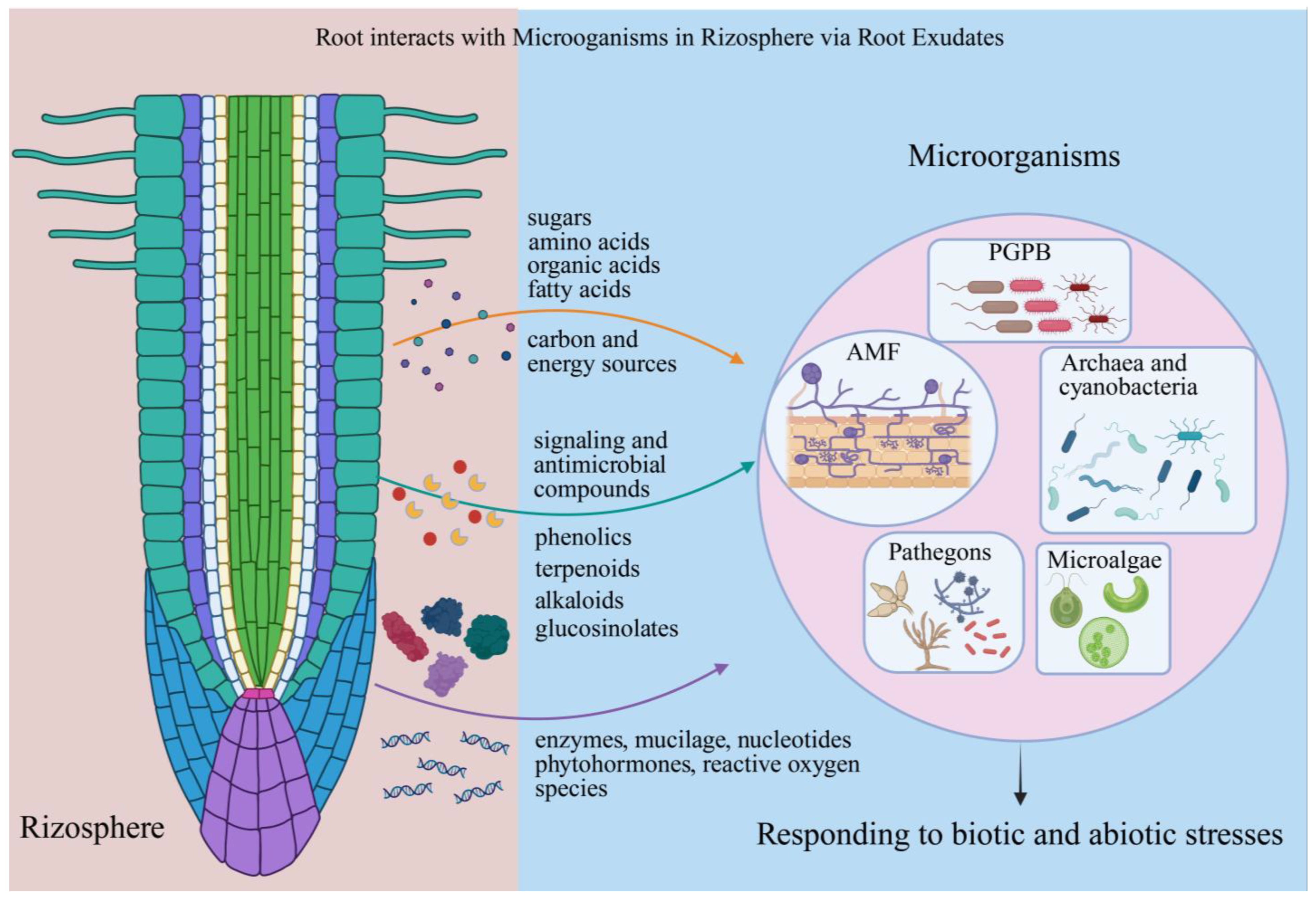
2. Root Exudates: The Currency of Root Microenvironment Exchange
3. Rhizosphere Microbes-Mediated Plant Metabolic Reprogramming

| Plant Species | PGPM Strain | PGPM Type | Key Metabolic Changes | Function | References |
|---|---|---|---|---|---|
| Brassica napus L. | Bacillus amyloliquefaciens | Bacteria | flavonoid and anthocyanin biosynthesis ↑ | Plant growth-promoting | [53] |
| A. thaliana | P. simiae | Bacteria | MYB72/FRO2/IRT1/FIT ↑ | induced systemic resistance, iron acquisition | [54] |
| A. thaliana | P. simiae, P. capeferrum | Bacteria | MYB72/BGLU42 ↑, scopoletin ↑ | improved niche establishment for the microbial partner | [55] |
| A. thaliana | B. amyloliquefaciens, T. harzianum | Bacteria, Fungi | SA and JA/ET signaling pathways activation | induced systemic resistance | [60,61] |
| A. thaliana | T. harzianum | Fungi | MYB72 expression ↑, NO accumulation | ISR against Botrytis cinerea | [62] |
| Solanum lycopersicum (tomato) | Rhizosphere microbiome (undefined) | Microbial consortium | Azelaic acid hexose ↑, SIREM activation | Systemic metabolic reprogramming, stress resilience | [6] |
| Triticum aestivum (wheat) | Bacillus velezensis | Bacteria | Proline ↑, GABA ↑, flavonoids ↑ | Drought stress tolerance | [63] |
| Oryza sativa (rice) | Chlorella vulgaris, N2-fixing bacteria | Microalgae-bacteria consortium | Biomass ↑, N content ↑ | Enhanced N availability, improved germination | [64] |
| Glycine max (soybean) | Bradyrhizobium japonicum | Bacteria | Flavonoid exudation ↑, nodulation ↑ | N2 fixation enhancement | [65] |
| Cucumis sativus (cucumber) | PGPR consortium | Bacteria | Phenolic acids ↑, flavonoids ↑ | Resistance against Fusarium oxysporum | [66] |
| Chlamydomonas reinhardtii | Methylobacterium aquaticum | Alga, Bacteria | IAA (from alga) ↑, IAA (degraded by bacterium) ↓ | Mutualistic growth promotion |
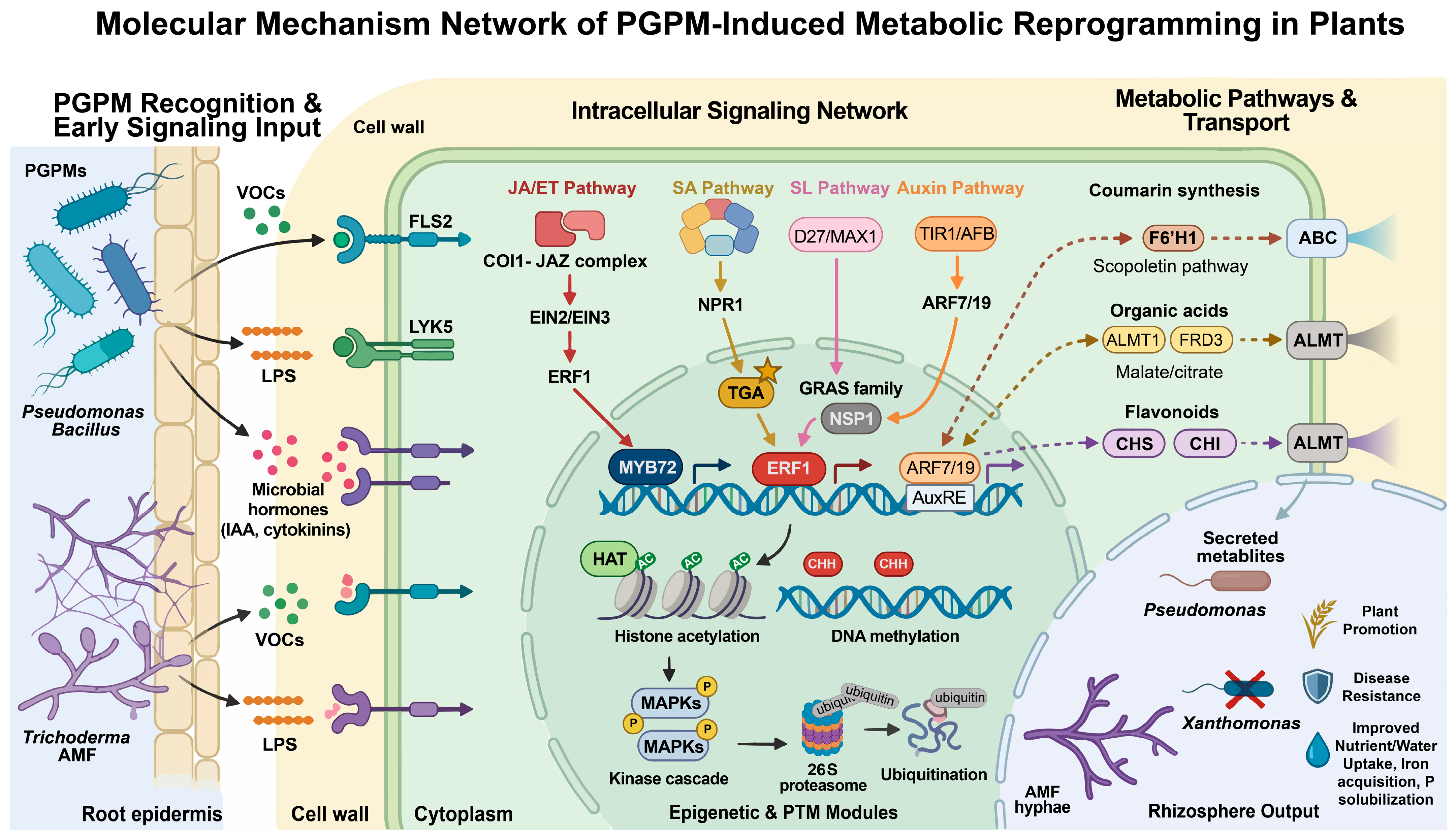
4. Molecular Mechanisms of PGPMs-Induced Metabolic Reprogramming
4.1. Phytohormone Signaling: The Central Orchestrator
4.2. Transcriptional Reprogramming: Key Regulators and Their Targets
4.3. Epigenetic and Post-Translational Regulation
4.4. Regulation of Transporters: Gatekeepers of Exudation
5. Application Advantages of PGPMs Mediated Metabolic Reprogramming
5.1. Shaping a Disease-Suppressive Microbiome
5.2. Enhancing Abiotic Stress Tolerance
5.3. Improving Nutrient Acquisition and Use Efficiency
5.4. Toward Sustainable Agricultural Practices
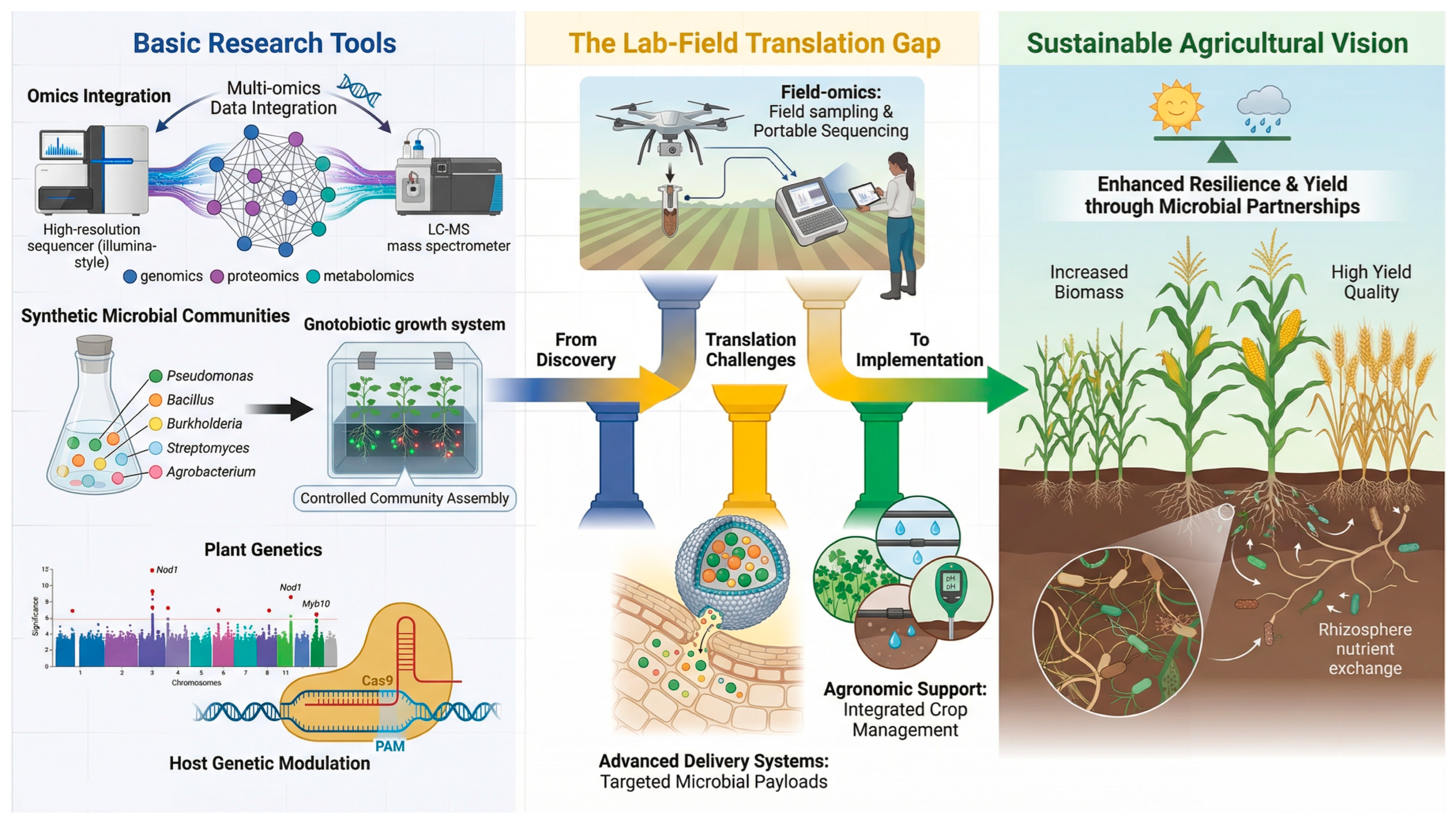
6. Methodological Approaches and Future Directions
6.1. Integrated Multi-Omics: Unraveling Complex Interactions
6.2. Synthetic Microbial Communities: Testing Function in Defined Systems
6.3. Leveraging Plant Genetics and Genome Editing
6.4. Future Directions and Challenges
7. Conclusions
Funding
Institutional Review Board Statement
Informed Consent Statement
Data Availability Statement
Conflicts of Interest
References
- Kitz, F.; Wachter, H.; Spielmann, F.; Hammerle, A.; Wohlfahrt, G. Root and rhizosphere contribution to the net soil COS exchange. Plant Soil 2024, 498, 325–339. [Google Scholar] [CrossRef]
- Zhang, K.; Rengel, Z.; Zhang, F.; White, P.J.; Shen, J. Rhizosphere engineering for sustainable crop production: Entropy-based insights. Trends Plant Sci. 2023, 28, 390–398. [Google Scholar] [CrossRef]
- Rowson, M.; Jolly, M.; Dickson, S.; Gifford, M.L.; Carré, I. Timely symbiosis: Circadian control of legume-rhizobia symbiosis. Biochem. Soc. Trans. 2024, 52, 1419–1430. [Google Scholar] [CrossRef] [PubMed]
- Yue, H.; Yue, W.; Jiao, S.; Kim, H.; Lee, Y.-H.; Wei, G.; Song, W.; Shu, D. Plant domestication shapes rhizosphere microbiome assembly and metabolic functions. Microbiome 2023, 11, 70. [Google Scholar] [CrossRef] [PubMed]
- Stassen, M.J.J.; Hsu, S.-H.; Pieterse, C.M.J.; Stringlis, I.A. Coumarin communication along the microbiome–root–shoot axis. Trends Plant Sci. 2021, 26, 169–183. [Google Scholar] [CrossRef]
- Korenblum, E.; Dong, Y.; Szymanski, J.; Panda, S.; Jozwiak, A.; Massalha, H.; Meir, S.; Rogachev, I.; Aharoni, A. Rhizosphere microbiome mediates systemic root metabolite exudation by root-to-root signaling. Proc. Natl. Acad. Sci. USA 2020, 117, 3874–3883. [Google Scholar] [CrossRef]
- Zhou, X.; Zhang, J.; Khashi u Rahman, M.; Gao, D.; Wei, Z.; Wu, F.; Dini-Andreote, F. Interspecific plant interaction via root exudates structures the disease suppressiveness of rhizosphere microbiomes. Mol. Plant 2023, 16, 849–864. [Google Scholar] [CrossRef]
- Wang, E. Deciphering plant-microbe symbioses: A molecular blueprint for precision agriculture. J. Mol. Biol. 2026, 438, 169668. [Google Scholar] [CrossRef]
- Zhalnina, K.; Louie, K.B.; Hao, Z.; Mansoori, N.; da Rocha, U.N.; Shi, S.; Cho, H.; Karaoz, U.; Loqué, D.; Bowen, B.P.; et al. Dynamic root exudate chemistry and microbial substrate preferences drive patterns in rhizosphere microbial community assembly. Nat. Microbiol. 2018, 3, 470–480. [Google Scholar] [CrossRef]
- Berendsen, R.L.; Pieterse, C.M.J.; Bakker, P.A.H.M. The rhizosphere microbiome and plant health. Trends Plant Sci. 2012, 17, 478–486. [Google Scholar] [CrossRef] [PubMed]
- Pantigoso, H.A.; Ossowicki, A.; Stringlis, I.A.; Carrión, V.J. Hub metabolites at the root-microbiome interface: Unlocking plant drought resilience. Trends Plant Sci. 2025, 30, 1046–1059. [Google Scholar] [CrossRef] [PubMed]
- Trivedi, P.; Leach, J.E.; Tringe, S.G.; Sa, T.; Singh, B.K. Plant–microbiome interactions: From community assembly to plant health. Nat. Rev. Microbiol. 2020, 18, 607–621, Erratum in Nat. Rev. Microbiol. 2021, 19, 72. https://doi.org/10.1038/s41579-020-00490-8. PMID: 32788714. [Google Scholar] [CrossRef]
- Zhang, L.; Zhou, J.; George, T.S.; Limpens, E.; Feng, G. Arbuscular mycorrhizal fungi conducting the hyphosphere bacterial orchestra. Trends Plant Sci. 2022, 27, 402–411. [Google Scholar] [CrossRef]
- Singh, B.K.; Hu, H.-W.; Macdonald, C.A.; Xiong, C. Microbiome-facilitated plant nutrient acquisition. Cell Host Microbe 2025, 33, 869–881. [Google Scholar] [CrossRef]
- Kramer, J.; Maréchal, S.; Figueiredo, A.R.T.; Kümmerli, R. Strain identity effects contribute more to Pseudomonas community functioning than strain interactions. ISME J. 2025, 19, wraf025. [Google Scholar] [CrossRef] [PubMed]
- Bakker, P.A.H.M.; Berendsen, R.L.; Van Pelt, J.A.; Vismans, G.; Yu, K.; Li, E.; Van Bentum, S.; Poppeliers, S.W.M.; Sanchez Gil, J.J.; Zhang, H.; et al. The Soil-borne identity and microbiome-assisted agriculture: Looking back to the future. Mol. Plant 2020, 13, 1394–1401. [Google Scholar] [CrossRef] [PubMed]
- Carrión, V.J.; Perez-Jaramillo, J.; Cordovez, V.; Tracanna, V.; de Hollander, M.; Ruiz-Buck, D.; Mendes, L.W.; van Ijcken, W.F.J.; Gomez-Exposito, R.; Elsayed, S.S.; et al. Pathogen-induced activation of disease-suppressive functions in the endophytic root microbiome. Science 2019, 366, 606–612. [Google Scholar] [CrossRef]
- Pieterse, C.M.J.; Zamioudis, C.; Berendsen, R.L.; Weller, D.M.; Van Wees, S.C.M.; Bakker, P.A.H.M. Induced Systemic Resistance by Beneficial Microbes. Annu. Rev. Phytopathol. 2014, 52, 347–375. [Google Scholar] [CrossRef]
- Singh, A.; Mazahar, S.; Chapadgaonkar, S.S.; Giri, P.; Shourie, A. Phyto-microbiome to mitigate abiotic stress in crop plants. Front. Microbiol. 2023, 14, 1210890. [Google Scholar] [CrossRef]
- Fadiji, A.E.; Santoyo, G.; Yadav, A.N.; Babalola, O.O. Efforts towards overcoming drought stress in crops: Revisiting the mechanisms employed by plant growth-promoting bacteria. Front. Microbiol. 2022, 13, 962427. [Google Scholar] [CrossRef]
- Khawula, S.; Daniel, A.I.; Nyawo, N.; Ndlazi, K.; Sibiya, S.; Ntshalintshali, S.; Nzuza, G.; Gokul, A.; Keyster, M.; Klein, A.; et al. Optimizing plant resilience with growth-promoting Rhizobacteria under abiotic and biotic stress conditions. Plant Stress 2025, 17, 100949. [Google Scholar] [CrossRef]
- Shahid, M.; Singh, U.B.; Khan, M.S.; Singh, P.; Kumar, R.; Singh, R.N.; Kumar, A.; Singh, H.V. Bacterial ACC deaminase: Insights into enzymology, biochemistry, genetics, and potential role in amelioration of environmental stress in crop plants. Front. Microbiol. 2023, 14, 1132770. [Google Scholar] [CrossRef]
- Kaushal, P.; Ali, N.; Saini, S.; Pati, P.K.; Pati, A.M. Physiological and molecular insight of microbial biostimulants for sustainable agriculture. Front. Plant Sci. 2023, 14, 1041413. [Google Scholar] [CrossRef] [PubMed]
- Chieb, M.; Gachomo, E.W. The role of plant growth promoting rhizobacteria in plant drought stress responses. BMC Plant Biol. 2023, 23, 407. [Google Scholar] [CrossRef]
- Bianco, C. Plant-Growth-Promoting Bacteria. Plants 2024, 13, 1323. [Google Scholar] [CrossRef] [PubMed]
- Masi, A.; Leonelli, F.; Scognamiglio, V.; Gasperuzzo, G.; Antonacci, A.; Terzidis, M.A. Chlamydomonas reinhardtii: A factory of nutraceutical and food supplements for human health. Molecules 2023, 28, 1185. [Google Scholar] [CrossRef] [PubMed]
- Raphael, B.; Nicolás, M.; Martina, J.; Daphnée, B.; Daniel, W.; Pierre-Emmanuel, C. The fine-tuning of mycorrhizal pathway in sorghum depends on both nitrogen−phosphorus availability and the identity of the fungal partner. Plant Cell Environ. 2022, 45, 3354–3366, Erratum in Plant Cell Environ. 2023, 46, 1743. https://doi.org/10.1111/pce.14577. PMID: 36030544. [Google Scholar] [CrossRef]
- Woo, S.L.; Hermosa, R.; Lorito, M.; Monte, E. Trichoderma: A multipurpose, plant-beneficial microorganism for eco-sustainable agriculture. Nat. Rev. Microbiol. 2023, 21, 312–326. [Google Scholar] [CrossRef]
- Naseema Rasheed, R.; Pourbakhtiar, A.; Mehdizadeh Allaf, M.; Baharlooeian, M.; Rafiei, N.; Alishah Aratboni, H.; Morones-Ramirez, J.R.; Winck, F.V. Microalgal co-cultivation -recent methods, trends in omic-studies, applications, and future challenges. Front. Bioeng. Biotechnol. 2023, 11, 1193424. [Google Scholar] [CrossRef]
- Moon, J.; Park, Y.J.; Choi, Y.B.; Truong, T.Q.; Huynh, P.K.; Kim, Y.B.; Kim, S.M. Physiological effects and mechanisms of Chlorella vulgaris as a biostimulant on the growth and drought tolerance of Arabidopsis thaliana. Plants 2024, 13, 3012. [Google Scholar] [CrossRef]
- Tang, S.; Rao, Y.; Huang, S.; Xu, Y.; Zeng, K.; Liang, X.; Ling, Q.; Liu, K.; Ma, J.; Yu, F.; et al. Impact of environmental factors on the ammonia-oxidizing and denitrifying microbial community and functional genes along soil profiles from different ecologically degraded areas in the siding mine. J. Environ. Manage. 2023, 326, 116641. [Google Scholar] [CrossRef]
- Mmotla, K.; Allie, F.; Mafuna, T.; Mashabela, M.D.; Mhlongo, M.I. Metabolic reprogramming in PGPR reveals cross-feeding-driven physiological shifts and metabolic adaptations. Front. Microbiol. 2025, 16, 1668025. [Google Scholar] [CrossRef]
- Mashabela, M.D.; Piater, L.A.; Dubery, I.A.; Tugizimana, F.; Mhlongo, M.I. Rhizosphere tripartite interactions and PGPR-mediated metabolic reprogramming towards isr and plant priming: A metabolomics review. Biology 2022, 11, 346. [Google Scholar] [CrossRef]
- Wen, Z.; Yang, M.; Han, H.; Fazal, A.; Liao, Y.; Ren, R.; Yin, T.; Qi, J.; Sun, S.; Lu, G.; et al. Mycorrhizae Enhance Soybean Plant Growth and Aluminum Stress Tolerance by Shaping the Microbiome Assembly in an Acidic Soil. Microbiol. Spectr. 2023, 11, e03310–e03322. [Google Scholar] [CrossRef]
- Ali, S.; Tyagi, A.; Mir, R.A.; Rather, I.A.; Anwar, Y.; Mahmoudi, H. Plant beneficial microbiome a boon for improving multiple stress tolerance in plants. Front. Plant Sci. 2023, 14, 1266182. [Google Scholar] [CrossRef] [PubMed]
- Zhou, J.; Uribe Acosta, M.; Stassen, M.J.J.; Qi, R.; de Jonge, R.; White, F.; Kramer, G.; Dong, L.; Pieterse, C.M.J.; Stringlis, I.A. Arabidopsis root defense barriers support beneficial interactions with rhizobacterium Pseudomonas simiae WCS417. New Phytol. 2025, 248, 2021–2039. [Google Scholar] [CrossRef] [PubMed]
- Tzipilevich, E.; Russ, D.; Dangl, J.L.; Benfey, P.N. Plant immune system activation is necessary for efficient root colonization by auxin-secreting beneficial bacteria. Cell Host Microbe 2021, 29, 1507–1520. [Google Scholar] [CrossRef] [PubMed]
- Ansari, M.M.; Bisht, N.; Singh, T.; Chauhan, P.S. Symphony of survival: Insights into cross-talk mechanisms in plants, bacteria, and fungi for strengthening plant immune responses. Microbiol. Res. 2024, 285, 127762. [Google Scholar] [CrossRef]
- Mateus, I.D.; Rojas, E.C.; Savary, R.; Dupuis, C.; Masclaux, F.G.; Aletti, C.; Sanders, I.R. Coexistence of genetically different Rhizophagus irregularis isolates induces genes involved in a putative fungal mating response. ISME J. 2020, 14, 2381–2394. [Google Scholar] [CrossRef]
- Martínez-Medina, A.; Van Wees, S.C.M.; Pieterse, C.M.J. Airborne signals from Trichoderma fungi stimulate iron uptake responses in roots resulting in priming of jasmonic acid-dependent defences in shoots of Arabidopsis thaliana and Solanum lycopersicum. Plant Cell Environ. 2017, 40, 2691–2705. [Google Scholar] [CrossRef]
- Calatrava, V.; Hom, E.F.Y.; Guan, Q.; Llamas, A.; Fernández, E.; Galván, A. Genetic evidence for algal auxin production in Chlamydomonas and its role in algal-bacterial mutualism. iScience 2024, 27, 108762. [Google Scholar] [CrossRef]
- Zhang, Z.; Xu, M.; Fan, Y.; Zhang, L.; Wang, H. Using microalgae to reduce the use of conventional fertilizers in hydroponics and soil-based cultivation. Sci. Total Environ. 2024, 912, 169424. [Google Scholar] [CrossRef]
- Yadav, S.; Srivastava, R.; Singh, N.; Kanda, T.; Verma, E.; Choudhary, P.; Yadav, S.; Atri, N. Cyanobacteria-pesticide interactions and their implications for sustainable rice agroecosystems. Int. J. Microbiol. 2025, 2025, 7265036. [Google Scholar] [CrossRef]
- Panchal, P.; Preece, C.; Peñuelas, J.; Giri, J. Soil carbon sequestration by root exudates. Trends Plant Sci. 2022, 27, 749–757. [Google Scholar] [CrossRef]
- Pal, G.; Wagner, M.R.; Kleiner, M. Root-secreted proteins: An underexplored component of root exudates. Trends Plant Sci. 2025, 30, 1197–1200. [Google Scholar] [CrossRef]
- Chai, Y.N.; Schachtman, D.P. Root exudates impact plant performance under abiotic stress. Trends Plant Sci. 2022, 27, 80–91. [Google Scholar] [CrossRef] [PubMed]
- Vurukonda, S.S.K.P.; Chaudhary, S.; Bodhankar, S. An Overview: Interaction between Microbial Endophytes and Root Exudates. Int. J. Plant Soil Sci. 2022, 34, 25–38. [Google Scholar] [CrossRef]
- Sasse, J.; Martinoia, E.; Northen, T. Feed your friends: Do plant exudates shape the root microbiome? Trends Plant Sci. 2018, 23, 25–41. [Google Scholar] [CrossRef]
- Zhang, W.; Luo, X.; Mei, Y.-Z.; Yang, Q.; Zhang, A.-Y.; Chen, M.; Mei, Y.; Ma, C.-Y.; Du, Y.-C.; Li, M.; et al. Priming of rhizobial nodulation signaling in the mycosphere accelerates nodulation of legume hosts. New Phytol. 2022, 235, 1212–1230. [Google Scholar] [CrossRef] [PubMed]
- Tian, B.; Pei, Y.; Huang, W.; Ding, J.; Siemann, E. Increasing flavonoid concentrations in root exudates enhance associations between arbuscular mycorrhizal fungi and an invasive plant. ISME J. 2021, 15, 1919–1930. [Google Scholar] [CrossRef] [PubMed]
- Singh, K.; Chandra, R.; Purchase, D. Unraveling the secrets of rhizobacteria signaling in rhizosphere. Rhizosphere 2022, 21, 100484. [Google Scholar] [CrossRef]
- Afridi, M.S.; Kumar, A.; Javed, M.A.; Dubey, A.; de Medeiros, F.H.V.; Santoyo, G. Harnessing root exudates for plant microbiome engineering and stress resistance in plants. Microbiol. Res. 2024, 279, 127564. [Google Scholar] [CrossRef] [PubMed]
- Pei, S.; Yue, D.; Yaoying, Y.; Zijin, H.; Zhongmei, Z.; Xiaoxiang, Y.; Lei, Z.; Yong, L.; Xiaoqin, H. Elucidating the growth-promoting factors of Bacillus amyloliquefaciens on rapeseed through metabolomics. BMC Plant Biol. 2025, 25, 1507, Erratum in BMC Plant Biol. 2025, 25, 1696. https://doi.org/10.1186/s12870-025-07901-z. PMID: 41193968; PMCID: PMC12587698. [Google Scholar] [CrossRef]
- Zamioudis, C.; Korteland, J.; Van Pelt, J.A.; van Hamersveld, M.; Dombrowski, N.; Bai, Y.; Hanson, J.; Van Verk, M.C.; Ling, H.-Q.; Schulze-Lefert, P.; et al. Rhizobacterial volatiles and photosynthesis-related signals coordinate MYB72 expression in Arabidopsis roots during onset of induced systemic resistance and iron-deficiency responses. Plant J. 2015, 84, 309–322. [Google Scholar] [CrossRef]
- Stringlis, I.A.; Yu, K.; Feussner, K.; de Jonge, R.; Van Bentum, S.; Van Verk, M.C.; Berendsen, R.L.; Bakker, P.A.H.M.; Feussner, I.; Pieterse, C.M.J. MYB72-dependent coumarin exudation shapes root microbiome assembly to promote plant health. Proc.Natl. Acad. Sci. USA 2018, 115, E5213–E5222. [Google Scholar] [CrossRef]
- Wang, X.; Feng, H.; Wang, Y.; Wang, M.; Xie, X.; Chang, H.; Wang, L.; Qu, J.; Sun, K.; He, W.; et al. Mycorrhizal symbiosis modulates the rhizosphere microbiota to promote rhizobia–legume symbiosis. Mol. Plant 2021, 14, 503–516. [Google Scholar] [CrossRef]
- Voges, M.J.E.E.E.; Bai, Y.; Schulze-Lefert, P.; Sattely, E.S. Plant-derived coumarins shape the composition of an Arabidopsis synthetic root microbiome. Proc. Natl. Acad. Sci. USA 2019, 116, 12558–12565. [Google Scholar] [CrossRef]
- Xu, X.; Fang, P.; Zhang, H.; Chi, C.; Song, L.; Xia, X.; Shi, K.; Zhou, Y.; Zhou, J.; Yu, J. Strigolactones positively regulate defense against root-knot nematodes in tomato. J. Exp. Bot. 2019, 70, 1325–1337. [Google Scholar] [CrossRef] [PubMed]
- Zenteno-Alegría, C.O.; Yarzábal Rodríguez, L.A.; Ciancas Jiménez, J.; Álvarez Gutiérrez, P.E.; Gunde-Cimerman, N.; Batista-García, R.A. Fungi beyond limits: The agricultural promise of extremophiles. Microb. Biotechnol. 2024, 17, e14439. [Google Scholar] [CrossRef] [PubMed]
- Yu, Y.; Gui, Y.; Li, Z.; Jiang, C.; Guo, J.; Niu, D. Induced systemic resistance for improving plant immunity by beneficial microbes. Plants 2022, 11, 386. [Google Scholar] [CrossRef]
- Ilham, B.; Noureddine, C.; Philippe, G.; Mohammed, E.G.; Brahim, E.; Sophie, A.; Martine, N.; Muriel, M. Induced systemic resistance (ISR) in Arabidopsis thaliana by Bacillus amyloliquefaciens and Trichoderma harzianum used as seed treatments. Agriculture 2019, 9, 166. [Google Scholar] [CrossRef]
- Pescador, L.; Fernandez, I.; Pozo, M.J.; Romero-Puertas, M.C.; Pieterse, C.M.J.; Martínez-Medina, A. Nitric oxide signalling in roots is required for MYB72-dependent systemic resistance induced by Trichoderma volatile compounds in Arabidopsis. J. Exp. Bot. 2022, 73, 584–595. [Google Scholar] [CrossRef]
- Abd El-Daim, I.A.; Bejai, S.; Meijer, J. Bacillus velezensis 5113 Induced metabolic and molecular reprogramming during abiotic stress tolerance in wheat. Sci. Rep. 2019, 9, 16282. [Google Scholar] [CrossRef] [PubMed]
- Sanchez-Zurano, A.; Vilaró-Cos, S.; Figueiredo, D.; Melkonyan, L.; Ferreira, A.; Acién, F.G.; Lafarga, T.; Gouveia, L. Optimizing Chlorella vulgaris production and exploring its impact on germination through microalga-N2-fixing bacteria consortia. J. Biotechnol. 2025, 408, 244–253. [Google Scholar] [CrossRef]
- Hu, L.; Robert, C.A.M.; Cadot, S.; Zhang, X.; Ye, M.; Li, B.; Manzo, D.; Chervet, N.; Steinger, T.; van der Heijden, M.G.A.; et al. Root exudate metabolites drive plant-soil feedbacks on growth and defense by shaping the rhizosphere microbiota. Nat. Commun. 2018, 9, 2738. [Google Scholar] [CrossRef]
- Yang, K.; Zhou, G.; Chen, C.; Liu, X.; Wei, L.; Zhu, F.; Liang, Z.; Chen, H. Joint metabolomic and transcriptomic analysis identify unique phenolic acid and flavonoid compounds associated with resistance to fusarium wilt in cucumber (Cucumis sativus L.). Front. Plant Sci. 2024, 15, 1447860. [Google Scholar] [CrossRef] [PubMed]
- Raza, W.; Wang, J.; Jousset, A.; Friman, V.-P.; Mei, X.; Wang, S.; Wei, Z.; Shen, Q. Bacterial community richness shifts the balance between volatile organic compound-mediated microbe–pathogen and microbe–plant interactions. Proc. R. Soc. B Biol. Sci. 2020, 287, 20200403. [Google Scholar] [CrossRef]
- Safara, S.; Harighi, B.; Bahramnejad, B.; Ahmadi, S. Antibacterial activity of endophytic bacteria against sugar beet root rot agent by volatile organic compound production and induction of systemic resistance. Front. Microbiol. 2022, 13, 921762. [Google Scholar] [CrossRef]
- Grossi, C.E.M.; Tani, A.; Mori, I.C.; Matsuura, T.; Ulloa, R.M. Plant growth-promoting abilities of Methylobacterium sp. 2A involve auxin-mediated regulation of the root architecture. Plant Cell Environ. 2024, 47, 5343–5357. [Google Scholar] [CrossRef]
- Zhao, H.; Sun, N.; Xu, J.; Li, Y.; Lin, X.; Sun, C.; Zhu, Y. Pseudomonas chlororaphis subsp. aurantiaca stimulates lateral root development by integrating auxin and reactive oxygen species signaling in Arabidopsis. J. Agric. Food Chem. 2024, 72, 23776–23789. [Google Scholar] [CrossRef] [PubMed]
- Liu, X.; Du, Y.; Na, X.; Wang, M.; Qu, Y.; Ge, L.; Wang, Y.; Gao, L.; Bai, W.; Bi, Y.; et al. Integrative transcriptome and metabolome revealed the molecular mechanism of Bacillus megaterium BT22-mediated growth promotion in Arabidopsis thaliana. J. Plant Physiol. 2023, 285, 153995. [Google Scholar] [CrossRef] [PubMed]
- Ortíz-Castro, R.; Valencia-Cantero, E.; López-Bucio, J. Plant growth promotion by Bacillus megaterium involves cytokinin signaling. Plant Signal. Behav. 2008, 3, 263–265. [Google Scholar] [CrossRef]
- Wang, J.Y.; Chen, G.-T.E.; Braguy, J.; Al-Babili, S. Distinguishing the functions of canonical strigolactones as rhizospheric signals. Trends Plant Sci. 2024, 29, 925–936. [Google Scholar] [CrossRef]
- Soliman, S.; Wang, Y.; Han, Z.; Pervaiz, T.; El-kereamy, A. Strigolactones in plants and their interaction with the ecological microbiome in response to abiotic stress. Plants 2022, 11, 3499. [Google Scholar] [CrossRef]
- Klein, M.; Bisot, C.; Oyarte Gálvez, L.; Kokkoris, V.; Shimizu, T.S.; Dong, L.; Weedon, J.T.; Bouwmeester, H.; Kiers, E.T. The potential of strigolactones to shift competitive dynamics among two Rhizophagus irregularis strains. Front. Microbiol. 2024, 15, 1470469. [Google Scholar] [CrossRef] [PubMed]
- Wu, X.; Jia, Y.; Ma, Q.; Wang, T.; Xu, J.; Chen, H.; Wang, M.; Song, H.; Cao, S. The transcription factor bZIP44 cooperates with MYB10 and MYB72 to regulate the response of Arabidopsis thaliana to iron deficiency stress. New Phytol. 2024, 242, 2586–2603. [Google Scholar] [CrossRef] [PubMed]
- Liang, G. Iron uptake, signaling, and sensing in plants. Plant Commun. 2022, 3, 100349. [Google Scholar] [CrossRef]
- Shi, L.-N.; Lu, L.-X.; Ye, J.-R.; Shi, H.-M. The endophytic strain ZS-3 enhances salt tolerance in Arabidopsis thaliana by regulating photosynthesis, osmotic stress, and ion homeostasis and inducing systemic tolerance. Front. Plant Sci. 2022, 13, 820837. [Google Scholar] [CrossRef]
- Isidra-Arellano, M.C.; Singh, J.; Valdés-López, O. Unraveling the potential of the strigolactones-NSP1/NSP2 friendship in crop improvement. Trends Plant Sci. 2024, 29, 501–503. [Google Scholar] [CrossRef]
- Li, X.-R.; Sun, J.; Albinsky, D.; Zarrabian, D.; Hull, R.; Lee, T.; Jarratt-Barnham, E.; Chiu, C.H.; Jacobsen, A.; Soumpourou, E.; et al. Nutrient regulation of lipochitooligosaccharide recognition in plants via NSP1 and NSP2. Nat. Commun. 2022, 13, 6421. [Google Scholar] [CrossRef]
- Li, E.; de Jonge, R.; Liu, C.; Jiang, H.; Friman, V.-P.; Pieterse, C.M.J.; Bakker, P.A.H.M.; Jousset, A. Rapid evolution of bacterial mutualism in the plant rhizosphere. Nat. Commun. 2021, 12, 3829. [Google Scholar] [CrossRef]
- Zhang, W.; Gao, S.; Zhou, X.; Chellappan, P.; Chen, Z.; Zhou, X.; Zhang, X.; Fromuth, N.; Coutino, G.; Coffey, M.; et al. Bacteria-responsive microRNAs regulate plant innate immunity by modulating plant hormone networks. Plant Mol. Biol. 2011, 75, 93–105, Erratum in Plant Mol. Biol. 2011, 76, 205–206. PMID: 21153682; PMCID: PMC3005105. [Google Scholar] [CrossRef]
- Bukhat, S.; Imran, A.; Javaid, S.; Shahid, M.; Majeed, A.; Naqqash, T. Communication of plants with microbial world: Exploring the regulatory networks for PGPR mediated defense signaling. Microbiol. Res. 2020, 238, 126486. [Google Scholar] [CrossRef]
- Ge, M.; Gong, M.; Jiao, Y.; Li, Y.; Shen, L.; Li, B.; Wang, Y.; Wang, F.; Zhang, S.; Yang, J. Serratia marcescens-S3 inhibits Potato virus Y by activating ubiquitination of molecular chaperone proteins NbHsc70-2 in Nicotiana benthamiana. Microb. Biotechnol. 2022, 15, 1178–1188. [Google Scholar] [CrossRef]
- Gomez-Osuna, A.; Calatrava, V.; Galvan, A.; Fernandez, E.; Llamas, A. Identification of the MAPK cascade and its relationship with nitrogen metabolism in the green alga Chlamydomonas reinhardtii. Int. J. Mol. Sci. 2020, 21, 3417. [Google Scholar] [CrossRef] [PubMed]
- Wang, P.; Du, Y.; Li, Y.; Ren, D.; Song, C.-P. Hydrogen peroxide–mediated activation of MAP Kinase 6 modulates nitric oxide biosynthesis and signal transduction in Arabidopsis. Plant Cell 2010, 22, 2981–2998. [Google Scholar] [CrossRef]
- Liu, C.; Jiang, M.; Yuan, M.M.; Wang, E.; Bai, Y.; Crowther, T.W.; Zhou, J.; Ma, Z.; Zhang, L.; Wang, Y.; et al. Root microbiota confers rice resistance to aluminium toxicity and phosphorus deficiency in acidic soils. Nat. Food 2023, 4, 912–924. [Google Scholar] [CrossRef] [PubMed]
- Li, C.; Ma, X.; Wang, Y.; Sun, Q.; Chen, M.; Zhang, C.; Ding, S.; Dai, Z. Root-mediated acidification, phosphatase activity and the phosphorus-cycling microbial community enhance phosphorus mobilization in the rhizosphere of wetland plants. Water Res. 2024, 255, 121548. [Google Scholar] [CrossRef]
- Khourchi, S.; Elhaissoufi, W.; Loum, M.; Ibnyasser, A.; Haddine, M.; Ghani, R.; Barakat, A.; Zeroual, Y.; Rchiad, Z.; Delaplace, P.; et al. Phosphate solubilizing bacteria can significantly contribute to enhance P availability from polyphosphates and their use efficiency in wheat. Microbiol. Res. 2022, 262, 127094. [Google Scholar] [CrossRef]
- Ji, H.; Qi, Y.; Zhang, X.; Yang, G. Transcriptomics and metabolomics analysis revealed the ability of Microbacterium ginsengiterrae S4 to enhance the saline-alkali tolerance of rice (Oryza sativa L.) seedlings. Agronomy 2024, 14, 649. [Google Scholar] [CrossRef]
- Saikia, J.; Kotoky, R.; Debnath, R.; Kumar, N.; Gogoi, P.; Yadav, A.; Saikia, R. De novo genomic analysis of Enterobacter asburiae EBRJ12, a plant growth-promoting rhizobacteria isolated from the rhizosphere of Phaseolus vulgaris L. J. Appl. Microbiol. 2023, 134, lxac090. [Google Scholar] [CrossRef]
- Benmrid, B.; Ghoulam, C.; Ammar, I.; Nkir, D.; Saidi, R.; Staropoli, A.; Iacomino, G.; Elhajjami, E.; Cheto, S.; Geistlinger, J.; et al. Drought-tolerant rhizobacteria with predicted functional traits enhanced wheat growth and P uptake under moderate drought and low P-availability. Microbiol. Res. 2024, 285, 127795. [Google Scholar] [CrossRef]
- Elhaissoufi, W.; Khourchi, S.; Ibnyasser, A.; Ghoulam, C.; Rchiad, Z.; Zeroual, Y.; Lyamlouli, K.; Bargaz, A. Phosphate Solubilizing Rhizobacteria Could Have a Stronger Influence on Wheat Root Traits and Aboveground Physiology Than Rhizosphere P Solubilization. Front. Plant Sci. 2020, 11, 00979. [Google Scholar] [CrossRef] [PubMed]
- Kong, Z.; Liu, H. Modification of Rhizosphere Microbial Communities: A Possible Mechanism of Plant Growth Promoting Rhizobacteria Enhancing Plant Growth and Fitness. Front. Plant Sci. 2022, 13, 920813. [Google Scholar] [CrossRef] [PubMed]
- Kang, S.-M.; Khan, I.; Asaf, S.; Yun, B.-W.; Lee, I.-J. Genome characterisation of Priestia megaterium mj1212 and its synergistic effect with n-acetylglucosamine in enhancing soybean salt stress tolerance. Plant Cell Environ. 2025, 48, 8006–8023. [Google Scholar] [CrossRef] [PubMed]
- Moon, Y.S.; Ali, S. Possible mechanisms for the equilibrium of ACC and role of ACC deaminase-producing bacteria. Appl. Microbiol. Biotechnol. 2022, 106, 877–887. [Google Scholar] [CrossRef]
- Naing, A.H.; Maung, T.-T.; Kim, C.K. The ACC deaminase-producing plant growth-promoting bacteria: Influences of bacterial strains and ACC deaminase activities in plant tolerance to abiotic stress. Physiol. Plant 2021, 173, 1992–2012. [Google Scholar] [CrossRef]
- Paffrath, V.; Tandron Moya, Y.A.; Weber, G.; von Wirén, N.; Giehl, R.F.H. A major role of coumarin-dependent ferric iron reduction in strategy I-type iron acquisition in Arabidopsis. Plant Cell 2024, 36, 642–664. [Google Scholar] [CrossRef]
- Van Dijck, L.; Esposto, D.; Huelsmann, C.; Malisic, M.; Piro, A.; Giehl, R.F.H.; Balcke, G.U.; Tissier, A.; Parker, J.E. Cooperation between a root fungal endophyte and host-derived coumarin scopoletin mediates Arabidopsis iron nutrition. New Phytol. 2025, 248, 857–871. [Google Scholar] [CrossRef]
- Haskett, T.L.; Cooke, L.; Green, P.; Poole, P.S. Regulation of rhizobial nodulation genes by flavonoid-independent NodD supports nitrogen-fixing symbioses with legumes. Environ. Microbiol. 2025, 27, e70014. [Google Scholar] [CrossRef]
- Llamas, A.; Leon-Miranda, E.; Tejada-Jimenez, M. Microalgal and nitrogen-fixing bacterial consortia: From interaction to biotechnological potential. Plants 2023, 12, 2476. [Google Scholar] [CrossRef]
- Zhou, Q.; Niu, C.; Feng, L.; Dong, M.; Li, X.; Kong, B.; Li, C. Chemistry and chemical biology tools contributing to the discovery and functional characterization of strigolactones. Front. Plant Sci. 2025, 16, 1618437. [Google Scholar] [CrossRef]
- Li, L.; Cheng, K.; Du, Y.; Zhang, Y.; Zhou, Y.; Jin, Y.; He, X. Rhizosphere microbes from Populus euphratica conferred salt stress resistance to Populus alba × Populus glandulosa. Plant Cell Environ. 2025, 48, 8743–8755. [Google Scholar] [CrossRef]
- Saeed, Q.; Mustafa, A.; Ali, S.; Tobiloba, L.H.; Rebi, A.; Baloch, S.B.; Mumtaz, M.Z.; Naveed, M.; Farooq, M.; Lu, X. Advancing crop resilience through nucleic acid innovations: Rhizosphere engineering for food security and climate adaptation. Int. J. Biol. Macromol. 2025, 310, 143194. [Google Scholar] [CrossRef]
- Rocha, I.; Ma, Y.; Souza-Alonso, P.; Vosátka, M.; Freitas, H.; Oliveira, R.S. Seed Coating: A Tool for Delivering Beneficial Microbes to Agricultural Crops. Front. Plant Sci. 2019, 10, 01357. [Google Scholar] [CrossRef]
- Górski, R.; Niewiadomska, A.; Płaza, A.; Wolna-Maruwka, A.; Swędrzyńska, D.; Głuchowska, K.; Rosa, R. Enhancing soil microbial activity and spelt (Triticum spelta L.) yield in organic farming through biofertilizer and green manure applications. Agronomy 2024, 14, 2845. [Google Scholar] [CrossRef]
- Garcia Arredondo, M.; Kew, W.; Chu, R.; Jones, M.E.; Boiteau, R.M.; Cardon, Z.G.; Keiluweit, M. Differential exudation creates biogeochemically distinct microenvironments during rhizosphere evolution. Environ. Sci. Technol. 2024, 58, 18713–18722. [Google Scholar] [CrossRef] [PubMed]
- Papadopoulou, A.; Ainalidou, A.; Mellidou, I.; Karamanoli, K. Metabolome and transcriptome reprogramming underlying tomato drought resistance triggered by a Pseudomonas strain. Plant Physiol. Biochem. 2023, 203, 108080. [Google Scholar] [CrossRef]
- Durand, M.; Besseau, S.; Papon, N.; Courdavault, V. Unlocking plant bioactive pathways: Omics data harnessing and machine learning assisting. Curr. Opin. Biotechnol. 2024, 87, 103135. [Google Scholar] [CrossRef] [PubMed]
- Bai, W.; Li, C.; Li, W.; Wang, H.; Han, X.; Wang, P.; Wang, L. Machine learning assists prediction of genes responsible for plant specialized metabolite biosynthesis by integrating multi-omics data. BMC Genom. 2024, 25, 418. [Google Scholar] [CrossRef] [PubMed]
- Vishnuvardhan, K.; Roy, G.; Chandra, A.; Rao, Y.D.; Amir, M. A comprehensive review on integration of omics data: Pioneering approaches in plant systems biology. Int. J. Res. Agron. 2025, 8, 22–30. [Google Scholar] [CrossRef]
- Leão, A.P.; Bittencourt, C.B.; Carvalho da Silva, T.L.; Rodrigues Neto, J.C.; Braga, Í.D.; Vieira, L.R.; de Aquino Ribeiro, J.A.; Abdelnur, P.V.; de Sousa, C.A.; Souza Júnior, M.T. Insights from a Multi-Omics Integration (MOI) study in oil palm (Elaeis guineensis Jacq.) response to abiotic stresses: Part two—Drought. Plants 2022, 11, 2786. [Google Scholar] [CrossRef] [PubMed]
- Peyraud, R.; Dubiella, U.; Barbacci, A.; Genin, S.; Raffaele, S.; Roby, D. Advances on plant–pathogen interactions from molecular toward systems biology perspectives. Plant J. 2017, 90, 720–737. [Google Scholar] [CrossRef] [PubMed]
- Sun, H.; Jiang, S.; Jiang, C.; Wu, C.; Gao, M.; Wang, Q. A review of root exudates and rhizosphere microbiome for crop production. Environ. Sci. Pollut. Res. Int. 2021, 28, 54497–54510. [Google Scholar] [CrossRef]
- Mitter, E.K.; Tosi, M.; Obregón, D.; Dunfield, K.E.; Germida, J.J. Rethinking Crop Nutrition in Times of Modern Microbiology: Innovative Biofertilizer Technologies. Front. Sustain. Food Syst. 2021, 5, 606815. [Google Scholar] [CrossRef]
- Liu, Y.; Wang, H.; Qian, X.; Gu, J.; Chen, W.; Shen, X.; Tao, S.; Jiao, S.; Wei, G. Metagenomics insights into responses of rhizobacteria and their alleviation role in licorice allelopathy. Microbiome 2023, 11, 109. [Google Scholar] [CrossRef]
- Arif, S.M.; Khan, I.; Saeed, M.; Chaudhari, S.K.; Ghorbanpour, M.; Hasan, M.; Mustafa, G. Exploring omics solutions to reduce micro/nanoplastic toxicity in plants: A comprehensive overview. Sci. Total Environ. 2025, 974, 179220. [Google Scholar] [CrossRef]
- Mehlferber, E.C.; Arnault, G.; Joshi, B.; Partida-Martinez, L.P.; Patras, K.A.; Simonin, M.; Koskella, B. A cross-systems primer for synthetic microbial communities. Nat. Microbiol. 2024, 9, 2765–2773. [Google Scholar] [CrossRef]
- Durán, P.; Vailleau, F.; Roux, F. Building microbial synthetic communities: Get inspired by the design of synthetic plant communities. New Phytol. 2025, 246, 402–405. [Google Scholar] [CrossRef]
- Deng, S.; Caddell, D.F.; Xu, G.; Dahlen, L.; Washington, L.; Yang, J.; Coleman-Derr, D. Genome wide association study reveals plant loci controlling heritability of the rhizosphere microbiome. ISME J. 2021, 15, 3181–3194. [Google Scholar] [CrossRef]
- Weissbrod, O.; Rothschild, D.; Barkan, E.; Segal, E. Host genetics and microbiome associations through the lens of genome wide association studies. Curr. Opin. Biotechnol. 2018, 44, 9–19. [Google Scholar] [CrossRef]
- Alzate Zuluaga, M.Y.; Fattorini, R.; Cesco, S.; Pii, Y. Plant-microbe interactions in the rhizosphere for smarter and more sustainable crop fertilization: The case of PGPR-based biofertilizers. Front. Microbiol. 2024, 15, 1440978. [Google Scholar] [CrossRef]
- Afridi, M.S.; Fakhar, A.; Kumar, A.; Ali, S.; Medeiros, F.H.V.; Muneer, M.A.; Ali, H.; Saleem, M. Harnessing microbial multitrophic interactions for rhizosphere microbiome engineering. Microbiol. Res. 2022, 265, 127199. [Google Scholar] [CrossRef] [PubMed]
- Huang, X.; Liu, Y.; Huang, J.; Fernando, W.G.D.; Li, X.; Xia, S. Activation of NLR-Mediated Autoimmunity in Arabidopsis Early in Short Days 4 Mutant. Front. Plant Sci. 2022, 13, 881212. [Google Scholar] [CrossRef]
- Afridi, M.S.; Ali, S.; Salam, A.; César Terra, W.; Hafeez, A.; Sumaira; Ali, B.; S. AlTami, M.; Ameen, F.; Ercisli, S.; et al. Plant microbiome engineering: Hopes or hypes. Biology 2022, 11, 1782. [Google Scholar] [CrossRef] [PubMed]
- Dukare, A.; Mhatre, P.; Maheshwari, H.S.; Bagul, S.; Manjunatha, B.S.; Khade, Y.; Kamble, U. Delineation of mechanistic approaches of rhizosphere microorganisms facilitated plant health and resilience under challenging conditions. 3 Biotech 2022, 12, 57. [Google Scholar] [CrossRef]
- Taheri, P.; Puopolo, G.; Santoyo, G. Plant growth-promoting microorganisms: New insights and the way forward. Microbiol. Res. 2025, 297, 128168, Correction in: Microbiol. Res. 2025, 299, 128234. https://doi.org/10.1016/j.micres.2025.128234. [Google Scholar] [CrossRef] [PubMed]
- Abhilash, P.C.; Dubey, R.K.; Tripathi, V.; Gupta, V.K.; Singh, H.B. Plant growth-promoting microorganisms for environmental sustainability. Trends Biotechnol. 2016, 34, 847–850. [Google Scholar] [CrossRef]
- Wang, Y.; Zhang, G.; Huang, Y.; Guo, M.; Song, J.; Zhang, T.; Long, Y.; Wang, B.; Liu, H. A Potential Biofertilizer—Siderophilic Bacteria Isolated From the Rhizosphere of Paris polyphylla var. yunnanensis. Front. Microbiol. 2022, 13, 870413. [Google Scholar] [CrossRef]
- Bradáčová, K.; Florea, A.S.; Bar-Tal, A.; Minz, D.; Yermiyahu, U.; Shawahna, R.; Kraut-Cohen, J.; Zolti, A.; Erel, R.; Dietel, K.; et al. Microbial consortia versus single-strain inoculants: An advantage in pgpm-assisted tomato production? Agronomy 2019, 9, 105. [Google Scholar] [CrossRef]
- Xiong, C.; Zhu, Y.-G.; Wang, J.-T.; Singh, B.; Han, L.-L.; Shen, J.-P.; Li, P.-P.; Wang, G.-B.; Wu, C.-F.; Ge, A.-H.; et al. Host selection shapes crop microbiome assembly and network complexity. New Phytol. 2021, 229, 1091–1104. [Google Scholar] [CrossRef] [PubMed]
- Ghorbel, S.; Aldilami, M.; Zouari-Mechichi, H.; Mechichi, T.; AlSherif, E.A. Isolation and characterization of a plant growth-promoting rhizobacterium strain MD36 that promotes barley seedlings and growth under heavy metals stress. 3 Biotech 2023, 13, 145. [Google Scholar] [CrossRef] [PubMed]
- Cerecetto, V.; Smalla, K.; Nesme, J.; Garaycochea, S.; Fresia, P.; Sørensen, S.J.; Babin, D.; Leoni, C. Reduced tillage, cover crops and organic amendments affect soil microbiota and improve soil health in Uruguayan vegetable farming systems. FEMS Microbiol. Ecol. 2021, 97, fiab023. [Google Scholar] [CrossRef] [PubMed]
- Arnab, B.; Mara, C.; Emily, B.; Mary Ann, B. Underexplored microbial metabolisms for enhanced nutrient recycling in agricultural soils. AIMS Microbiol. 2017, 3, 826–845. [Google Scholar] [CrossRef]


| PGPM Group | Representative Genera | Key Functions | Examples | References |
|---|---|---|---|---|
| Bacteria | Pseudomonas, Bacillus, Rhizobium, Azospirillum, Burkholderiar | N2 fixation, P solubilization, IAA production, ISR induction | P. simiae WCS417 induces ISR in Arabidopsis via MYB72; B. velezensis FZB42 promotes growth and suppresses pathogens in multiple crops | [36,37] |
| Fungi (AMF) | Rhizophagus, Funneliformis, Glomus | P and N acquisition, water uptake, soil aggregation | R. irregularis enhances P uptake in maize under low-P conditions; AMF colonization improves drought tolerance in wheat | [38,39] |
| Fungi (Biocontrol) | Trichoderma spp. | Mycoparasitism, antibiotic production, ISR induction | T. harzianum T-78 triggers ISR against Botrytis cinerea in Arabidopsis via MYB72 and NO signaling | [40] |
| Microalgae | Chlamydomonas, Chlorella, Scenedesmus | IAA production, O2 provision, biofilm formation | C. reinhardtii produces IAA via LAO1, promoting mutualism with Methylobacterium; Chlorella-bacteria consortia enhance N availability in rice | [30,41] |
| Cyanobacteria | Anabaena, Nostoc, Synechococcus | N2 fixation, EPS production, soil stabilization | Anabaena enhanced the length of cucumber seedling stems; cyanobacterial inoculants improve rice yield | [42,43] |
| Regulator/Transporter | Type | Induced by | Target Process/Metabolite | Function in Rhizosphere | References |
|---|---|---|---|---|---|
| MYB72 | Transcription Factor | Pseudomonas spp. | Coumarin biosynthesis | Iron chelation, pathogen suppression | [52,67,68] |
| ERF1 | Transcription Factor | JA/ET signaling | Antimicrobial synthesis | Broad-spectrum defense | [69,70,71] |
| GRAS (e.g., NSP1) | Transcription Factor | AMF | Strigolactone biosynthesis | Hyphal branching, symbiosis | [72,73] |
| ALMT1 | Transporter | PGPM, Low Pi, Acid soil | Malate, Citrate efflux | P solubilization, pH modulation | [77,78,79] |
| ABC transporters | Transporter | Iron deficiency, PGPR | Coumarin secretion | Microbial recruitment, Fe uptake | [80,81] |
| Application Domain | Specific Mechanism | Representative PGPMs | Key Plant Metabolites/Processes |
|---|---|---|---|
| Shaping a disease-suppressive microbiome | Selective recruitment of beneficial microbes; direct production of pathogen-inhibiting compounds. | Pseudomonas spp. (e.g., P. simiae), Bacillus spp., specific fungi | Benzoxazinoids, phenolic acids, flavonoids, coumarins (e.g., scopoletin) |
| Enhancing abiotic stress tolerance | Improvement of soil environment (e.g., water retention); direct assistance in stress response (e.g., ion homeostasis, ROS scavenging). | Bacillus spp., Pseudomonas spp., AMF | Osmolytes (e.g., proline), exopolysaccharides, organic acids, ACC deaminase activity |
| Improving nutrient acquisition and use efficiency | Chelation of sparingly soluble nutrients; signaling molecules to promote beneficial symbioses. | Pseudomonas spp., Rhizobia, AMF, specific microalgae-N2-fixing bacteria consortia | Coumarins (e.g., scopoletin), organic acids (e.g., citrate, malate), flavonoids, SLs |
| Induce plant systemic resistance | ISR via JA/ET signaling pathways | Pseudomonas spp. (e.g., P. simiae, P. capeferrum), Bacillus spp. (e.g., B. amyloliquefaciens), Trichoderma spp. | MYB72 activation |
| Method | Core Principle | Advantages | Limitations |
|---|---|---|---|
| Multi-omics (genomics, transcriptomics, metabolomics, metatranscriptomics) | High-throughput molecular profiling to identify genes, transcripts, metabolites, and microbial functions | Comprehensive, unbiased, hypothesis-generating; reveals novel pathways and biomarkers | Data heterogeneity across platforms; distinguishing biological signals from technical artifacts; correlation ≠ causation; high cost and expertise required |
| SynComs | Defined consortia of culturable microbes designed to recapitulate key functions of native microbiomes | Reductionist approach enables causal testing of microbial interactions and functions; reproducible under controlled conditions | May oversimplify natural complexity; community stability uncertain under field conditions; requires extensive isolation and characterization |
| Genome Editing (CRISPR-Cas) | Precise modification of plant genes involved in signaling (e.g., MYB72), transport (e.g., ABC transporters), and exudate biosynthesis | Enables causal testing of gene function; potential to create “microbe-recruiting” crop varieties | Off-target effects; regulatory constraints; ecological risks (gene flow, non-target effects); trade-offs (carbon cost, pathogen susceptibility) |
| Advanced Formulation Technologies (nano-encapsulation, alginate microencapsulation, fluidized bed drying) | Physical protection of microbial cells to enhance survival during storage and after application | Extended shelf-life; protection from desiccation, temperature stress, and predation | Cost; scalability; carrier material biocompatibility; inconsistent field performance across soil types |
| Field-Omics | Longitudinal multi-omics monitoring under real-world agricultural conditions | Identifies environmental and agronomic factors governing PGPM success; validates lab findings in situ | High complexity; confounding variables; requires extensive replication across sites and seasons |
Disclaimer/Publisher’s Note: The statements, opinions and data contained in all publications are solely those of the individual author(s) and contributor(s) and not of MDPI and/or the editor(s). MDPI and/or the editor(s) disclaim responsibility for any injury to people or property resulting from any ideas, methods, instructions or products referred to in the content. |
© 2026 by the authors. Licensee MDPI, Basel, Switzerland. This article is an open access article distributed under the terms and conditions of the Creative Commons Attribution (CC BY) license.
Share and Cite
Song, P.; Deng, Y.; Yu, Y.; Zhang, L.; Liu, Y. Plant Growth-Promoting Microorganisms Mediate Plant Metabolic Reprogramming to Manage the Rhizospheric Microbiome. Microorganisms 2026, 14, 578. https://doi.org/10.3390/microorganisms14030578
Song P, Deng Y, Yu Y, Zhang L, Liu Y. Plant Growth-Promoting Microorganisms Mediate Plant Metabolic Reprogramming to Manage the Rhizospheric Microbiome. Microorganisms. 2026; 14(3):578. https://doi.org/10.3390/microorganisms14030578
Chicago/Turabian StyleSong, Pei, Yue Deng, Yaoying Yu, Lei Zhang, and Yong Liu. 2026. "Plant Growth-Promoting Microorganisms Mediate Plant Metabolic Reprogramming to Manage the Rhizospheric Microbiome" Microorganisms 14, no. 3: 578. https://doi.org/10.3390/microorganisms14030578
APA StyleSong, P., Deng, Y., Yu, Y., Zhang, L., & Liu, Y. (2026). Plant Growth-Promoting Microorganisms Mediate Plant Metabolic Reprogramming to Manage the Rhizospheric Microbiome. Microorganisms, 14(3), 578. https://doi.org/10.3390/microorganisms14030578