
Fixed-Time Disturbance Observer-Based Connectivity-Preserving Formation Control for High-Order Multi-Agent Systems with Actuator Faults

Abstract
1. Introduction
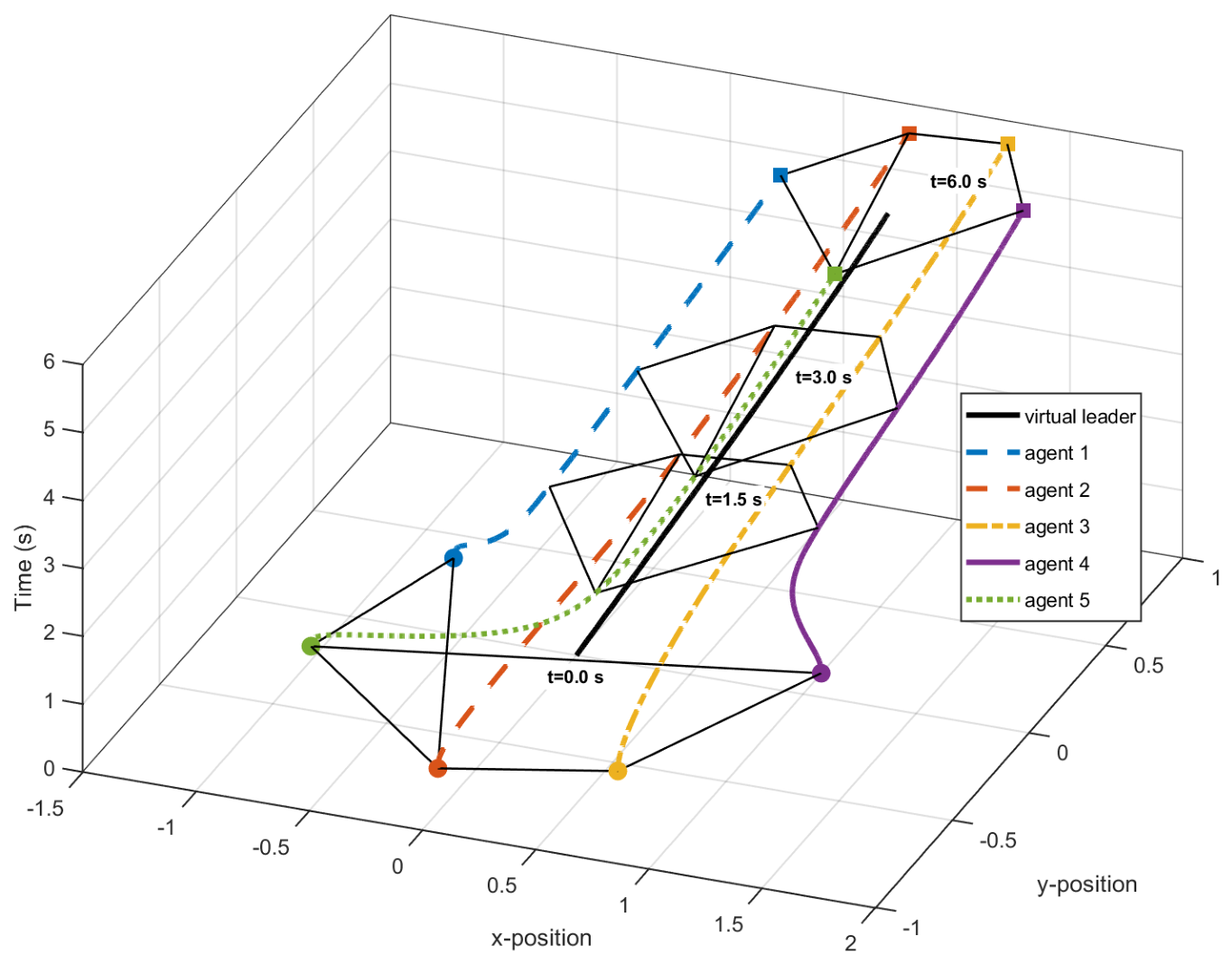
- A switching distance-dependent graph model is equipped with a connectivity-certified switching condition. A candidate topology is accepted only when its post-switch algebraic connectivity has a prescribed positive safety margin, thereby excluding unsafe discontinuous jumps.
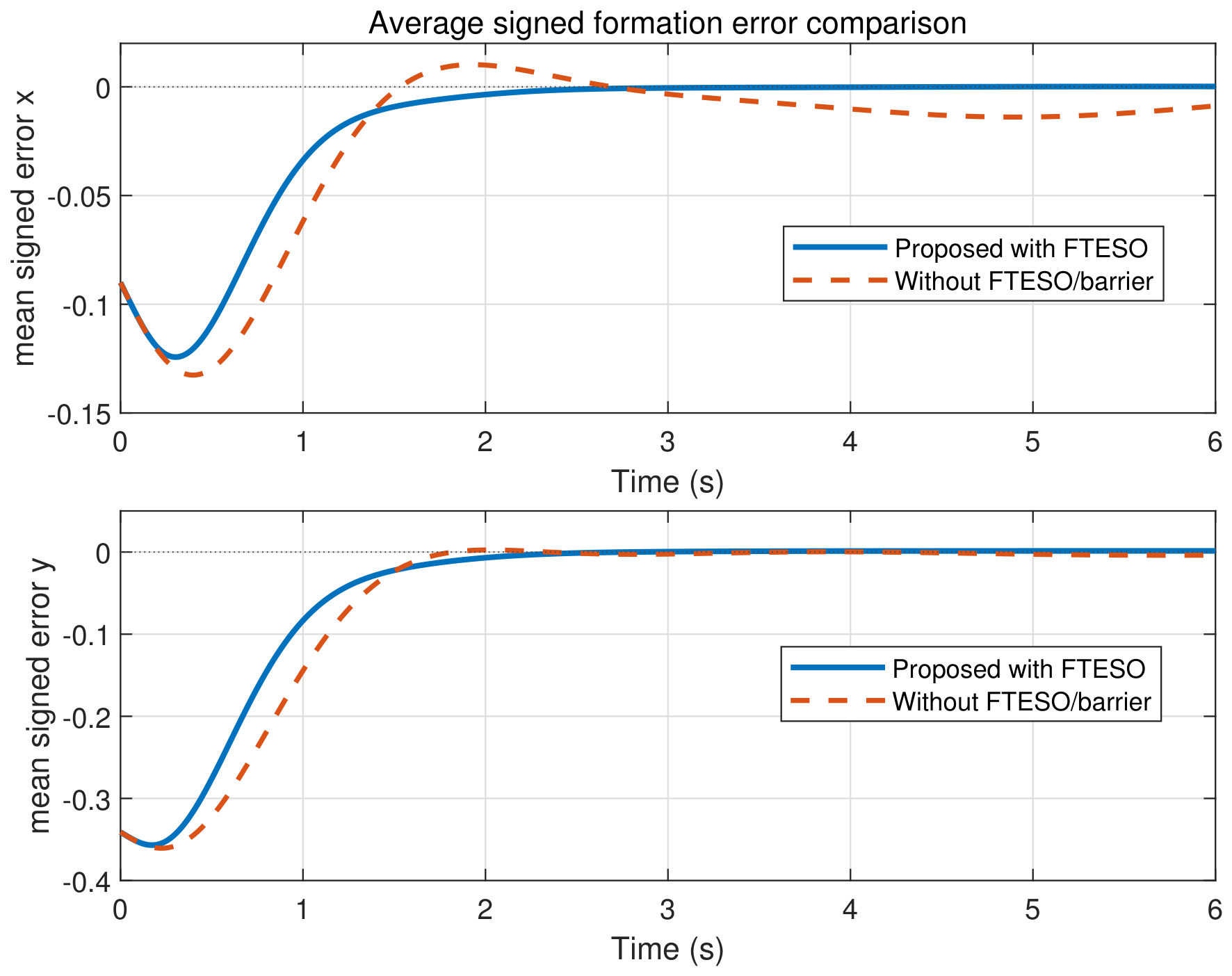
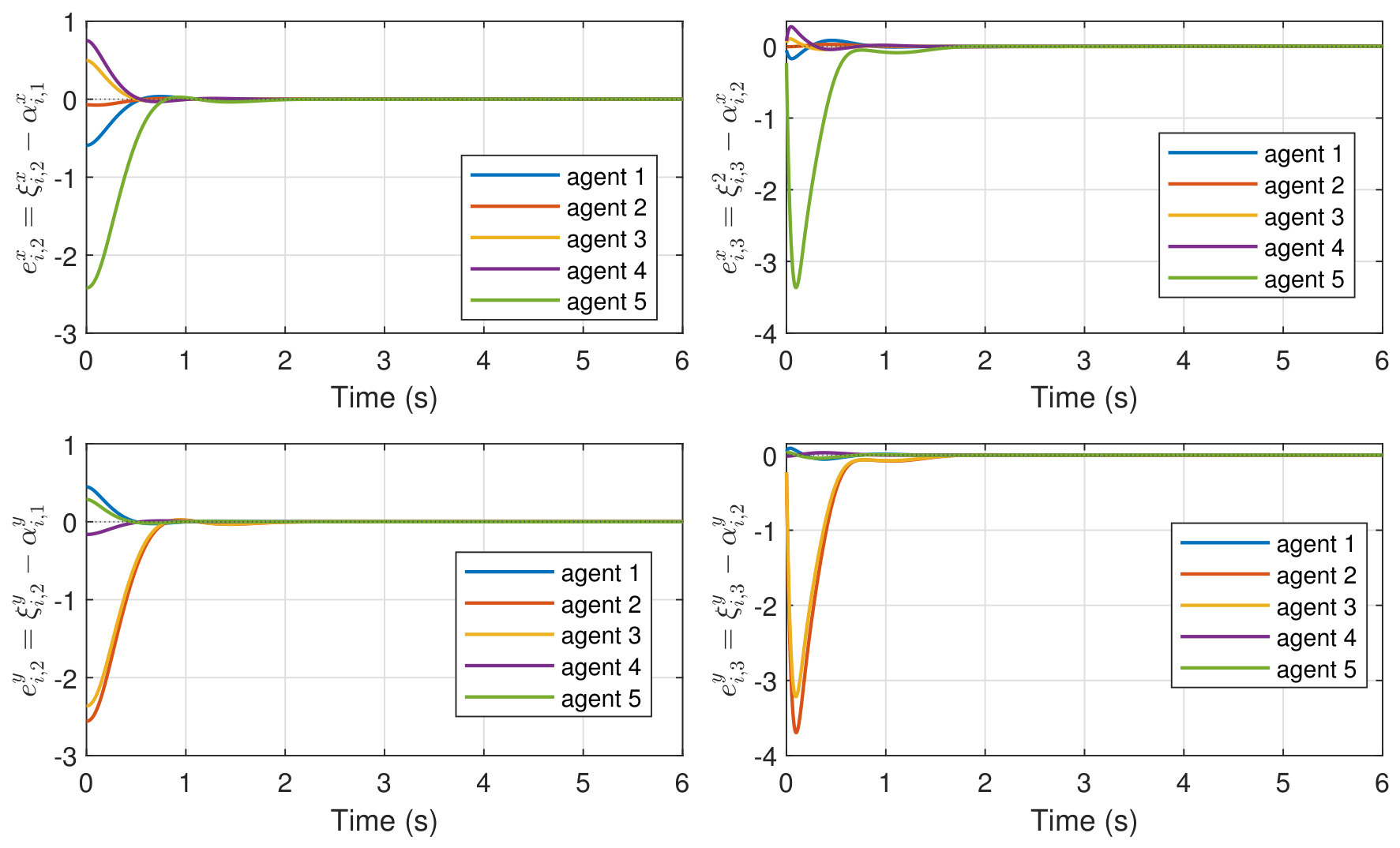
- An algebraic-connectivity-dependent barrier signal is incorporated into a recursive high-order controller. The continuous evolution between switching instants is treated separately from the jump condition, and the centralized connectivity-evaluation architecture and its computational complexity are stated explicitly.
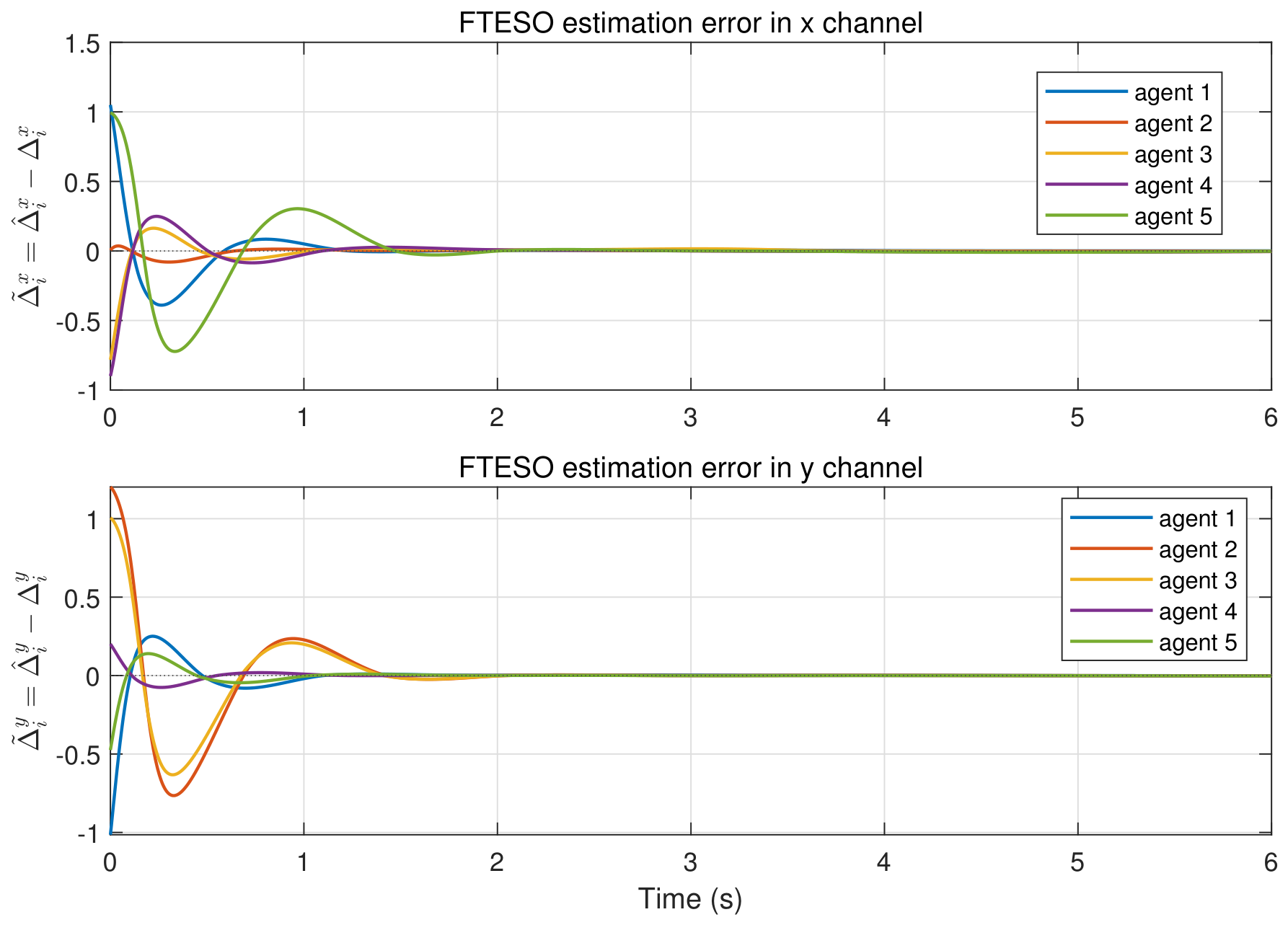
- A fixed-time extended state observer is developed for the matched uncertainty generated by actuator loss of effectiveness, additive faults and external disturbances. Explicit ultimate estimation bounds and a fixed convergence-time upper bound are derived. The command filters and smooth actuator saturation used in the numerical implementation are included in the stability analysis through bounded residual terms.
2. Problem Formulation
2.1. Switching Distance-Dependent Topology
2.2. High-Order Dynamics with Actuator Faults
3. Main Results
3.1. Fixed-Time Extended State Observer
3.2. Connectivity-Preserving Barrier and Hybrid Safety Conditions
3.3. Recursive Controller and Implementation Residuals
3.4. Stability Analysis
4. Simulation
5. Conclusions
Author Contributions
Funding
Data Availability Statement
Conflicts of Interest
References
- Olfati-Saber, R.; Fax, J.A.; Murray, R.M. Consensus and cooperation in networked multi-agent systems. Proc. IEEE 2007, 95, 215–233. [Google Scholar] [CrossRef] [Scilit]
- Cao, Y.; Yu, W.; Ren, W.; Chen, G. An overview of recent progress in the study of distributed multi-agent coordination. IEEE Trans. Ind. Inform. 2013, 9, 427–438. [Google Scholar] [CrossRef] [Scilit]
- Zhang, C.; Qin, W.; Fan, M.C.; Wang, T.; Shen, M.Q. A Q-learning-based parameters adaptive algorithm for formation tracking control of multi-mobile robot systems. Complexity 2022, 2022, 5093277. [Google Scholar] [CrossRef] [Scilit]
- Rezaee, H.; Abdollahi, F. Consensus problem in high-order multiagent systems with Lipschitz nonlinearities and jointly connected topologies. IEEE Trans. Syst. Man Cybern. Syst. 2017, 47, 741–748. [Google Scholar] [CrossRef] [Scilit]
- Li, K.; Hua, C.C.; You, X.; Guan, X.P. Distributed consensus control for nonlinear multiagent systems under directed graphs of dynamic frequency switches. IEEE Trans. Autom. Control 2021, 66, 841–848. [Google Scholar] [CrossRef] [Scilit]
- Yang, P.; Freeman, R.; Gordon, G.; Lynch, K.; Srinivasa, S.; Sukthankar, R. Decentralized estimation and control of graph connectivity for mobile sensor networks. Automatica 2010, 46, 390–396. [Google Scholar] [CrossRef] [Scilit]
- Griparic, K.; Polic, M.; Krizmancic, M.; Bogdan, S. Consensus-based distributed connectivity control in multi-agent systems. IEEE Trans. Netw. Sci. Eng. 2022, 9, 1264–1281. [Google Scholar] [CrossRef] [Scilit]
- Cui, R.; Hua, C.; Li, Y.; Li, K.; Cui, H. Connectivity-preserving formation control of multiagent systems under time-varying topology. IEEE Trans. Autom. Control 2026, 1–14. [Google Scholar] [CrossRef] [Scilit]
- Krizmancic, M.; Bogdan, S. Adaptive connectivity control in networked multi-agent systems: A distributed approach. PLoS ONE 2024, 19, e0314642. [Google Scholar] [CrossRef] [Scilit] [PubMed]
- Mehdifar, F.; Bechlioulis, C.P.; Hashemzadeh, F.; Baradarannia, M. Prescribed performance distance-based formation control of multi-agent systems. Automatica 2020, 119, 109086. [Google Scholar] [CrossRef] [Scilit]
- Park, B.S.; Yoo, S.J. Connectivity-maintaining and collision-avoiding performance function approach for robust leader-follower formation control of multiple uncertain underactuated surface vessels. Automatica 2021, 127, 109501. [Google Scholar] [CrossRef] [Scilit]
- Liu, Z.; Zhang, H.; Sun, J.; Wan, L. All agents connectivity-preserving and error-based cooperative learning control with data-filter memory-based event-triggered strategy. IEEE Trans. Autom. Sci. Eng. 2025, 22, 5566–5577. [Google Scholar] [CrossRef] [Scilit]
- Han, J. From PID to active disturbance rejection control. IEEE Trans. Ind. Electron. 2009, 56, 900–906. [Google Scholar] [CrossRef] [Scilit]
- Chen, W.H.; Yang, J.; Guo, L.; Li, S. Disturbance-observer-based control and related methods: An overview. IEEE Trans. Ind. Electron. 2016, 63, 1083–1095. [Google Scholar] [CrossRef] [Scilit]
- Li, S.; Yang, J.; Chen, W.H.; Chen, X. Disturbance Observer-Based Control: Methods and Applications; CRC Press: Boca Raton, FL, USA, 2014. [Google Scholar]
- Polyakov, A. Nonlinear feedback design for fixed-time stabilization of linear control systems. IEEE Trans. Autom. Control 2012, 57, 2106–2110. [Google Scholar] [CrossRef] [Scilit]
- Parsegov, S.E.; Polyakov, A.E.; Shcherbakov, P.S. Fixed-time consensus algorithm for multi-agent systems with integrator dynamics. IFAC Proc. Vol. 2013, 46, 110–115. [Google Scholar] [CrossRef] [Scilit]
- Liu, Z.; Zhang, O.; Gao, Y.; Zhao, Y.; Sun, Y.; Liu, J. Adaptive neural network-based fixed-time control for trajectory tracking of robotic systems. IEEE Trans. Circuits Syst. II Express Briefs 2023, 70, 241–245. [Google Scholar] [CrossRef] [Scilit]
- Liu, Z.; Zhang, O.; Zhao, Y.; Zhu, Q.; Liu, J. Adaptive neural network-based fixed-time control for robots with input saturation and prescribed performance. Nonlinear Dyn. 2025, 113, 18229–18241. [Google Scholar] [CrossRef] [Scilit]
- Mhemdi, A.; Kharrat, M.; Gargouri, A.; Mercorelli, P. Adaptive tracking control of nonstrict-feedback nonlinear systems with actuator faults and input delay via a fuzzy funnel approach. Actuators 2026, 15, 384. [Google Scholar] [CrossRef] [Scilit]
- Alhazmi, H.; Kharrat, M.; Al-Jaser, A.; Mercorelli, P. Adaptive fixed-time prescribed performance command-filtered control for nonlinear systems with unknown control gains and actuator faults. Mathematics 2026, 14, 1781. [Google Scholar] [CrossRef] [Scilit]
- Wu, X.; Guo, Z.; Liu, X.; Xie, T. Fault-tolerant time-varying formation tracking control for multi-agent systems with actuator faults and switching topologies. IEEE Access 2023, 11, 131140–131151. [Google Scholar] [CrossRef] [Scilit]
- Zhang, C.; Zhang, G.; Han, W.; Lv, X.; Shi, Z. Distributed fixed-time control for high-order multi-agent systems with FTESO and feasibility constraints. J. Frankl. Inst. 2024, 361, 107219. [Google Scholar] [CrossRef] [Scilit]
- Shi, Z.; Han, W.; Zhang, C.; Zhang, G. A modular prescribed performance formation control scheme of a high-order multi-agent system with a finite-time extended state observer. Electronics 2025, 14, 1783. [Google Scholar] [CrossRef] [Scilit]
- Chai, X.; Liu, J.; Yu, Y.; Sun, C. Observer-based self-triggered control for time-varying formation of multi-agent systems. Sci. China Inf. Sci. 2021, 64, 132205. [Google Scholar] [CrossRef] [Scilit]
- Deng, Y.; Zhu, W.; Zheng, H. Observer-based event-triggered time-varying formation control of linear multi-agent systems with distributed infinite delays. Meas. Control 2025, 58, 97–109. [Google Scholar] [CrossRef] [Scilit]
- Ning, B.; Han, Q.-L.; Ding, L. Distributed finite-time secondary frequency and voltage control for islanded microgrids with communication delays and switching topologies. IEEE Trans. Cybern. 2021, 51, 3988–3999. [Google Scholar] [CrossRef] [Scilit] [PubMed]




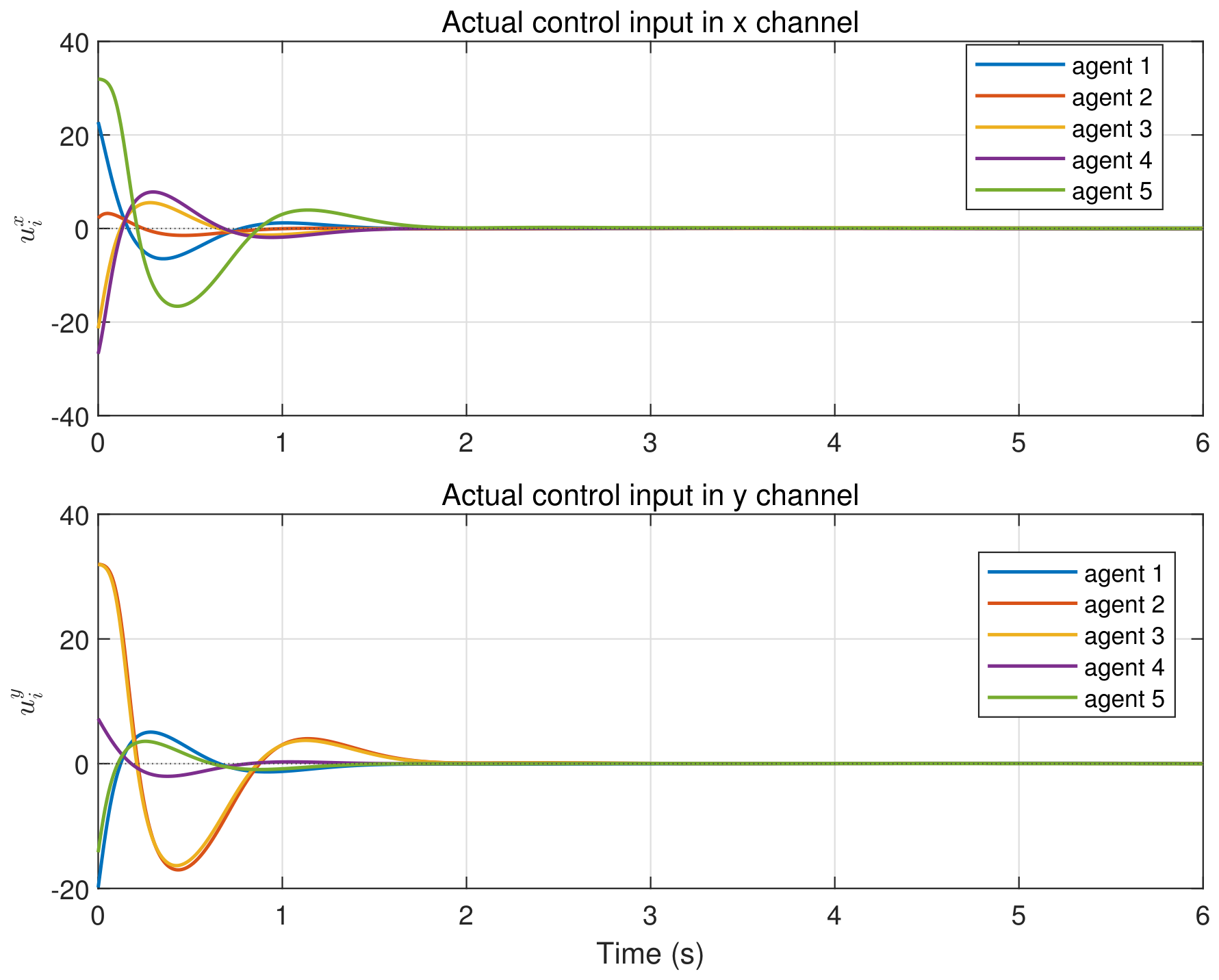


| Case | RMS- | Final- | MaxMean- | RMS-ESO | ||
|---|---|---|---|---|---|---|
| Proposed with FTESO/barrier | 0.186 | 0.001 | 0.813 | 0.425 | 0.125 | 31.977 |
| Without FTESO/barrier | 0.209 | 0.012 | 0.814 | 0.425 | – | 20.965 |
Disclaimer/Publisher’s Note: The statements, opinions and data contained in all publications are solely those of the individual author(s) and contributor(s) and not of MDPI and/or the editor(s). MDPI and/or the editor(s) disclaim responsibility for any injury to people or property resulting from any ideas, methods, instructions or products referred to in the content. |
© 2026 by the authors. Licensee MDPI, Basel, Switzerland. This article is an open access article distributed under the terms and conditions of the Creative Commons Attribution (CC BY) license.
Share and Cite
Yang, W.; Zhang, C.; Xu, Y.; Lu, C.; Yan, P.; Shi, Z. Fixed-Time Disturbance Observer-Based Connectivity-Preserving Formation Control for High-Order Multi-Agent Systems with Actuator Faults. Actuators 2026, 15, 418. https://doi.org/10.3390/act15080418
Yang W, Zhang C, Xu Y, Lu C, Yan P, Shi Z. Fixed-Time Disturbance Observer-Based Connectivity-Preserving Formation Control for High-Order Multi-Agent Systems with Actuator Faults. Actuators. 2026; 15(8):418. https://doi.org/10.3390/act15080418
Chicago/Turabian StyleYang, Wenjing, Chen Zhang, Yajun Xu, Chao Lu, Pingyuan Yan, and Zhihan Shi. 2026. "Fixed-Time Disturbance Observer-Based Connectivity-Preserving Formation Control for High-Order Multi-Agent Systems with Actuator Faults" Actuators 15, no. 8: 418. https://doi.org/10.3390/act15080418
APA StyleYang, W., Zhang, C., Xu, Y., Lu, C., Yan, P., & Shi, Z. (2026). Fixed-Time Disturbance Observer-Based Connectivity-Preserving Formation Control for High-Order Multi-Agent Systems with Actuator Faults. Actuators, 15(8), 418. https://doi.org/10.3390/act15080418