
Article

Robust Adaptive Control for Discrete-Time Multi-Robot Systems with Actuator and Sensor Attacks

1
School of Computer Information Engineering, Shanxi Technology and Business University, Taiyuan 030006, China
2
Department of Mathematics, Faculty of Sciences, University of Mianwali, Mianwali 42200, Pakistan
3
School of Artificial Intelligence and Computer Science, Nantong University, Nantong 226019, China
4
Department of Mathematics, Faculty of Science & Arts, King Abdul Aziz University, Rabigh 25732, Saudi Arabia
*
Author to whom correspondence should be addressed.
Actuators 2026, 15(7), 368; https://doi.org/10.3390/act15070368
Submission received: 20 April 2026 / Revised: 29 May 2026 / Accepted: 3 June 2026 / Published: 3 July 2026

Abstract

This paper addresses the challenges of achieving robust coordination in discrete-time multi-robot systems subject to uncertainties and Byzantine attacks affecting both actuator and sensor channels. Such adversarial disruptions degrade system performance by corrupting control inputs and state measurements, ultimately threatening stability and consensus in networked robotic systems. To overcome these limitations, a novel discrete-time adaptive control framework is proposed that ensures reliable tracking and stability under both uncoupled and coupled robot dynamics. The approach integrates a modified graph-theoretic structure with node-dependent weighting to capture heterogeneous robot interactions, while explicitly modeling attack effects within the system dynamics. An adaptive control law is developed using a nonlinear basis function approximation to handle unknown system uncertainties, along with a dynamic weight update mechanism that compensates for adversarial disturbances in real time. For the uncoupled case, stability is established through a composite Lyapunov function incorporating logarithmic and quadratic terms, guaranteeing boundedness of all closed-loop signals and asymptotic convergence of the tracking error. This framework is further extended to systems with coupled dynamics by introducing an auxiliary estimation mechanism to reconstruct unmeasurable interactions, leading to a unified adaptive controller capable of mitigating both internal uncertainties and external attacks. Rigorous Lyapunov-based analysis demonstrates that the proposed method ensures asymptotic tracking performance despite the presence of Byzantine disturbances. Numerical simulations validate the theoretical results, showing improved resilience, accurate trajectory tracking, and enhanced robustness compared to existing approaches.

1. Introduction

Multi-robot systems are widely studied due to their importance in coordinated control, consensus, and real-world autonomous applications. Consensus control is commonly used to achieve agreement among agents in distributed networks [1]. Bio-inspired and learning-based methods improve individual robot adaptability and system performance [2], while optimization-based techniques enhance robotic and spacecraft configuration efficiency [3]. Time-varying coordination and stability of discrete-time switched systems ensure reliable performance under dynamic conditions [4,5]. Recent studies focus on improving estimation, navigation, and perception in uncertain environments. Multi-sensor fusion enhances localization accuracy [6], while optimization methods improve autonomous decision-making [7]. Intelligent visual navigation and perception improve robotic performance in dynamic environments [8], and grasping methods enhance manipulation in complex scenes [9]. Learning-based attention models further improve perception capability [10]. Multi-agent coordination and formation control improve collective behavior in networked systems [11]. Flexible robotic mechanisms and locomotion strategies enhance adaptability in complex environments [12,13]. Recent advances in intelligent engineering systems have improved the reliability and performance of autonomous technologies. Robust time synchronization methods for integrated navigation systems and advanced machine design strategies for hybrid-excited vernier reluctance linear machines have enhanced accuracy, efficiency, and operational stability in complex environments [14,15]. Machine-learning-based perception techniques have enabled accurate recognition of aircraft taxiing behaviors, thereby improving autonomous airport operations [16]. In addition, efficient mission analysis for multi-asteroid exploration and magnetically switchable adhesive millirobots have expanded the capabilities of aerospace and robotic systems operating in challenging environments [17,18]. Comprehensive studies on force-feedback bilateral teleoperation systems and neurodynamics-based visual servo predictive control have contributed to improved stability, transparency, and trajectory-tracking performance in advanced robotic applications [19,20]. Similarly, fault diagnosis techniques for weak time-varying faults and event-triggered collaborative steering control strategies have enhanced the reliability and efficiency of intelligent mechanical and vehicular systems [21,22]. Coordinated tracking control of integrated wheel-end systems and innovative self-positioning methods for wall-climbing robots have further improved motion coordination and operational precision in autonomous engineering applications [23,24]. Despite these advances, existing studies focus on nominal or uncertain conditions and do not address Byzantine attacks in discrete-time multi-robot systems.
Event-triggered security control methods address denial-of-service attacks in autonomous systems [25], while resource allocation and edge-learning frameworks improve distributed intelligence efficiency [26]. Neural-learning-based tracking control methods enhance performance under nonlinear constraints [27], and zeroing neural networks improve solution accuracy for dynamic robotic control problems [28]. Self-powered sensing and robust tribological systems further enhance autonomy in sensing environments [29]. However, these methods mainly focus on learning efficiency and fault tolerance rather than Byzantine attack resilience in discrete-time multi-agent networks. Advanced control theory and game-theoretic methods have been developed for constrained and uncertain systems. Nash-equilibrium-based control improves coordination in bimanual manipulation systems under constraints [30]. Recent advances in aerospace and intelligent control systems have significantly improved performance under uncertainty. Robust adaptive dynamic programming for hypersonic vehicles and distributed fault-tolerant formation control for unmanned aerial vehicle swarms have enhanced stability, adaptability, and coordination in complex flight environments [31,32]. In robotics and autonomous systems, real-time motion planning with dynamic obstacle avoidance and multi-sensor fusion-based perception have strengthened safety, accuracy, and environmental understanding in intelligent platforms [33,34]. Multimodal agent artificial intelligence further highlights the growing importance of integrated learning and decision-making frameworks in complex autonomous systems [35]. In control theory and estimation, fixed-time disturbance rejection methods and neural-network-based computational solvers have improved robustness and efficiency for nonlinear and uncertain systems [36,37]. Advanced robotic path planning and force regulation strategies have further enhanced interaction accuracy and operational stability in dynamic environments [38]. Transformer-based reinforcement learning approaches and spacecraft attitude control strategies have strengthened decision-making capabilities and improved resilience under dynamic and uncertain conditions [39,40]. For navigation and fault-tolerant systems, resilient global navigation satellite system and inertial measurement unit based navigation methods and fuzzy fault-tolerant control approaches have improved reliability under disturbances and system variations [41,42]. Similarly, adaptive unmanned aerial vehicle attitude control under multiple faults and deep reinforcement learning-based shared control strategies have enhanced robustness and human–machine interaction performance in safety-critical applications [43,44]. Sample-efficient reinforcement learning techniques continue to advance data-efficient decision-making in complex environments [45]. In materials and aerodynamic intelligence, cooperative reinforcement learning with human feedback and variable-stiffness supramolecular materials have contributed to improved adaptability and multifunctional robotic design [46,47]. Finally, deep learning-based aerodynamic surrogate models and diffusion-based inverse design methods have significantly advanced aerospace optimization and high-fidelity aerodynamic design processes [48,49]. Despite these advances, most existing works assume secure communication and benign environments and ignore Byzantine attacks in discrete-time multi-agent systems.
Adaptive fuzzy control strategies further enhance predefined-time stability in nonlinear systems [50]. Nevertheless, most of these approaches do not explicitly consider distributed multi-robot consensus under simultaneous sensor and actuator Byzantine attacks. Recent studies develop adaptive fuzzy, event-triggered, and consensus-based control methods for uncertain multi-agent systems, improving stability and coordination under communication constraints [51]. Model-free and data-driven resilient control approaches enhance robustness against denial-of-service and uncertainties in networked systems [52]. However, most works still assume partially reliable communication and do not consider simultaneous adversarial corruption. Advanced methods in path planning and finite-time control improve performance in complex environments [53,54]. Sliding mode and data-driven control strategies enhance robustness under disturbances and constraints [55,56]. Neural-network and observer-based control techniques improve tracking accuracy and force regulation under uncertainties [57,58]. Adaptive control methods further improve stability in nonlinear robotic systems [59,60]. Zeroing neural network approaches enhance precision in dynamic system solving and robotic control [61]. Recent research on perception, safety, and localization focuses on obstacle detection, braking systems, and constraint handling to improve system reliability [62,63]. Stability and localization methods enhance performance under uncertainty and noise [64,65]. Robust constraint-following and adaptive control methods improve performance in uncertain robotic systems [66]. Intelligent manipulation and soft robotic systems enhance adaptability in complex environments [67,68]. Motion estimation and constraint-based control methods improve accuracy under sensor errors and nonlinear constraints [69,70]. Human–machine interaction and safety-aware planning strategies enhance operational reliability in shared environments [71]. Recent advances in intelligent decision-making, control, and autonomous systems further improve large-scale coordination and safety. Reinforcement learning-based scheduling methods enhance efficiency in complex multi-agent systems [72]. Aerodynamic and dynamic analysis methods improve system modeling and prediction accuracy [73]. Distributed control and platooning strategies enhance coordination under switching communication topologies [74]. Smart sensing and adaptive material systems improve structural flexibility and sensing capability in robotic systems [75]. Advanced fuzzy and force control methods improve precision and stability under nonlinear constraints [76]. Safety-critical planning and learning-based control methods enhance obstacle avoidance and system safety [77]. Graph-based and intelligent trajectory optimization methods improve multi-agent coordination in complex environments [78]. Further developments in robotic perception and manipulation include bio-inspired millirobot systems that enhance multimodal motion and manipulation in constrained environments [79]. Multi-object tracking and sonar-based vision systems improve perception and navigation in complex environments [80]. Long-term path planning and robot motion theory advancements improve navigation efficiency and theoretical understanding [81]. Adaptive neural and sliding mode control strategies enhance robustness under uncertainties [82]. Vision-based recognition and intelligent perception systems improve system reliability in dynamic environments [83]. Resilience-based system design methods further enhance robustness and lifetime performance under uncertainties [84]. Recent works on adaptive intelligent control have improved tracking accuracy in precision systems under uncertainty. Recent works on adaptive intelligent control improve precision and tracking accuracy in linear stages under uncertainty. In [85,86], interval type-2 fuzzy logic and laser-based feedback methods are used to enhance positional performance under noise and nonlinearities. However, these studies focus on single-system control and do not address multi-robot coordination, coupled dynamics, or Byzantine attack resilience, which are the focus of this work. However, these studies focus on single-system control and do not consider multi-robot coordination, coupled dynamics, or Byzantine attack resilience, which are addressed in this work. Nevertheless, despite these advances, existing approaches do not explicitly address discrete-time multi-robot consensus under simultaneous sensor and actuator Byzantine attacks with coupled dynamics, which motivates this work.

1.1. Motivation

Current discrete-time adaptive control strategies for multi-robot systems are highly vulnerable to Byzantine attacks, where malicious robots inject false information into actuator and sensor channels. Such adversarial behavior significantly degrades consensus, coordination, and tracking performance in networked robotic systems. In tightly coupled multi-robot networks, faults in a single robot can propagate through communication links, leading to cascading effects that threaten stability and safety in coordinated navigation and distributed tasks. Existing discrete-time adaptive multi-robot frameworks, including recent work such as [87], do not clearly distinguish between uncoupled and coupled dynamics under adversarial conditions. This limits their applicability, as both structures require fundamentally different stability and control treatments. Moreover, many existing results are developed in continuous-time settings, whereas practical implementations are inherently discrete-time, motivating the need for rigorous discrete-time adaptive control with formal stability guarantees under attacks.

1.2. Novelty

The main novelty of this work lies in developing a unified discrete-time adaptive control framework for multi-robot systems under Byzantine attacks that explicitly distinguishes between uncoupled and coupled robot dynamics. Unlike existing methods such as [87], which mainly address uncertainty in a simplified interaction structure, clearly separate uncoupled and coupled dynamics under the same adversarial framework, and explicitly incorporate Byzantine attacks in both actuator and sensor channels, introduces node-dependent graph-based interaction modeling for heterogeneous multi-robot networks, and provides a unified Lyapunov-based discrete-time stability framework for both cases.

1.3. Contributions

The main contributions of this paper are as follows:
  • A novel discrete-time adaptive control framework is developed for multi-robot systems subject to Byzantine attacks affecting both actuator and sensor channels, ensuring robust tracking and consensus performance under adversarial conditions.
  • A modified graph-theoretic interaction model with node-dependent weighting is introduced to capture heterogeneous inter-robot coupling and communication effects in the presence of malicious disturbances.
  • A nonlinear basis function approximation-based adaptive control law is designed to handle unknown system uncertainties, combined with a dynamic weight update mechanism that compensates for Byzantine-induced distortions in real time.
  • For uncoupled multi-robot dynamics, a composite Lyapunov function incorporating logarithmic and quadratic terms is constructed to guarantee boundedness and asymptotic convergence of tracking errors.
  • For coupled multi-robot dynamics, an auxiliary estimation mechanism is introduced to reconstruct unmeasurable inter-robot interactions, leading to a unified control framework applicable to both uncoupled and coupled cases.
  • Rigorous Lyapunov-based analysis is provided to establish asymptotic stability and consensus performance under Byzantine attacks, and simulation results demonstrate improved robustness and tracking accuracy compared with existing discrete-time multi-robot methods.
  • Section 1 presents the literature review and introduces existing work on discrete-time adaptive control systems.
  • Section 2 defines the mathematical notation and preliminary concepts required for the subsequent analysis.
  • Section 3 formulates the problem of discrete-time adaptive control for multi-robot systems under Byzantine attacks.
  • Section 4 describes the modeling and characterization of Byzantine attacks in the considered framework.
  • Section 5 develops the control design and uncertainty handling for robot-base dynamics under Byzantine attacks.
  • Section 6 extends the formulation to coupled multi-robot dynamics and presents the corresponding adaptive compensation under attack conditions.
  • Section 7 provides numerical simulations and validates the effectiveness of the proposed method through examples.
  • Section 8 concludes the paper and summarizes the main findings and contributions.

2. Notation and Mathematical Precondition

Let G be an undirected graph consisting of a collection of vertices W G = { 1 , 2 , , m } and a set of edges F W G × W G . The graph G is said to be connected if any two different robots in the network, one can find a limited series of directly connected nodes that link them together through a continuous path. The degree matrix D ( G ) R m × m is a diagonal matrix where each diagonal entry D i i represents the degree of node i, i.e., the number of edges incident to it. Formally,
D ( G ) = diag ( d ) , where d = [ d 1 , d 2 , , d m ] T .
The adjacency matrix A ( G ) R m × m is defined such that
A i j ( G ) = 1 , if ( i , j ) F , 0 , otherwise .
This matrix captures the connectivity between nodes: a value of 1 indicates the presence of an edge between nodes i and j, while 0 indicates no direct connection. The Laplacian matrix L ( G ) of the graph is then defined as the difference between the degree matrix and the adjacency matrix:
L ( G ) = D ( G ) A ( G ) .
This matrix plays a crucial role in various applications, including spectral graph theory and network analysis. To incorporate node-specific weights, we introduce a vector N = [ n 1 , n 2 , , n m ] T R + m , where each n i > 0 represents a positive weight associated with node i. Using this, we define a modified degree matrix D ¯ ( G , N ) R m × m as follows,
D ¯ ( G , N ) = diag ( A ( G ) N ) · diag ( N ) 1 .
Here, A ( G ) N computes the weighted sum of neighboring nodes for each node, and the division by diag ( N ) normalizes these sums by the corresponding node weights. The corresponding modified Laplacian matrix L ( G , N ) is then given by,
L ( G , N ) = D ¯ ( G , N ) A ( G ) .
This modified Laplacian accounts for the node-specific weights, providing a more nuanced representation of the graph’s structure, especially useful in contexts where nodes have varying importance or influence.
Lemma 1.
In a leader-follower framework, consider a diagonal matrix M R m × m defined as M = diag ( l 1 , l 2 , , l n ) , where each entry satisfies 0 < m i < 1 for all i = 1 , , m , under the condition that at least one scalar k i = 1 . Under this assumption, the Laplacian matrix corresponding to the leader-follower network can be suitably modified to incorporate varying node roles, resulting in an adjusted structure given by K ( G , N ) = L ( G , N ) + F .

3. Problem Formulation

In this section, a discrete-time adaptive control framework is developed for multi-robot systems operating in the presence of robot-base variations, nonlinear uncertainties, and Byzantine cyber-attacks affecting both actuator and sensor channels. The proposed control strategy is designed to assign distinct target positions to individual robots while preserving system stability, cooperative interaction, and resilient coordination under adversarial disturbances. Both uncertain multi-robot systems without coupled dynamics and systems with coupled dynamics are considered under communication and measurement attacks. The overall framework aims to enhance cooperative behavior and improve robustness against malicious interference in networked robotic environments.
Consider an m-robot Multi-Robot System (MRS), where the dynamics of the p t h robot are given by:
z p ( t + 1 ) = z p ( t ) + b ( t , z p ( t ) ) + v p ( t ) + g p ( t )
where z p ( t ) R n denotes the state of the follower robot, v p ( t ) represents the control input, b ( t , z p ( t ) ) characterizes unknown nonlinear dynamics, and g p ( t ) represents an external disturbance signal capturing the combined effect of cyber-attacks on the system.
Similarly, the leader robot dynamics are described as:
z 0 ( t + 1 ) = z 0 ( t ) + b ( t , z 0 ( t ) ) + v 0 ( t )
where z 0 ( t ) is the leader state, v 0 ( t ) is the leader input, and b ( t , z 0 ( t ) ) denotes nonlinear dynamics.

4. Attack Effect on MRS

In multi-robot systems, cyber-attacks can significantly degrade communication and coordination performance among interconnected agents. In practical networked environments, attackers may inject malicious signals into actuator and sensor channels, which can deteriorate stability, synchronization, and consensus behavior. Therefore, modeling attack influence is essential for robust controller design.
The actuator attack on each robot is modeled as:
U p c ( t ) = U p ( t ) + λ p U p b ( t )
where U p ( t ) is the nominal control input, U p c ( t ) is the corrupted control input, U p b ( t ) is the actuator attack signal, and λ p { 0 , 1 } is the attack indicator variable. Similarly, sensor attacks are described as:
z p c ( t ) = z p ( t ) + λ p z p b ( t )
where z p ( t ) is the true measurement, z p c ( t ) is the corrupted measurement, and z p b ( t ) is the injected sensor attack signal. The overall attack influence acting on the multi-robot system is modeled as a unified disturbance term:
g p ( t ) = g p a ( t ) + g p s ( t )
where g p a ( t ) represents the actuator attack effect and g p s ( t ) represents the sensor-induced attack propagation through the communication network. It is important to emphasize that the disturbance g p ( t ) is assumed to be unknown and not measurable by the controller. Therefore, it cannot be directly used in feedback design. To address this issue, an adaptive disturbance observer is introduced to estimate the unknown attack signal online. The estimated disturbance is denoted as g ^ p ( t ) , and only this estimated value is used in the controller design for compensation.
The estimation error is defined as:
g ˜ p ( t ) = g p ( t ) g ^ p ( t )
The controller is therefore designed using g ^ p ( t ) instead of the unknown true disturbance g p ( t ) , ensuring implementability.
To ensure analytical tractability, the disturbance is assumed to be bounded as:
g p ( t ) g ¯
where g ¯ > 0 is an unknown finite constant.
The proposed formulation provides a realistic and implementable representation of cyber-attack effects in multi-robot systems and forms the basis for the subsequent observer-based adaptive control design.
Remark 1.
Cyber-attacks may significantly degrade system performance by introducing false control actions and corrupted sensor measurements. These disturbances may increase tracking errors, slow down convergence, and destabilize coordination among robots. Therefore, an adaptive observer-based compensation mechanism is necessary to ensure robust consensus and maintain reliable communication within the networked system. In the presence of high-frequency attack components, the proposed observer is designed to attenuate fast variations while accurately reconstructing the slowly varying attack profile, thereby improving robustness against rapidly changing malicious signals.

5. Addressing Robot-Base Instability in Graph-Based Models

In this section, a discrete-time adaptive control framework is developed for multi-robot systems without dynamic coupling, where each robot evolves independently. The system considers unknown nonlinearities, robot-base variations, and Byzantine cyber-attacks affecting both actuator and sensor channels. The objective is to guarantee stable tracking performance and resilient coordination despite adversarial disturbances.
The dynamics of each robot are described as:
y p ( t + 1 ) = y p ( t ) + B ω ( y p ( t ) ) + U p ( t ) + g p ( t )
where y p ( t ) R n is the state of the p t h robot, U p ( t ) is the control input, B is an unknown weight matrix, ω ( · ) is a known bounded nonlinear basis function satisfying ω ( y p ( t ) ) I c + I y p ( t ) , and g p ( t ) represents the unknown attack/disturbance term. The attack signal is assumed to be unknown and not measurable by the controller. Therefore, an adaptive disturbance observer is introduced to estimate it online, and only the estimated value is used in the control design.
The reference model is defined as:
y r p ( t + 1 ) = y r p ( t ) e l N p y r p ( t ) y r l ( t ) e t p y r p ( t ) c ( t )
where c ( t ) is a bounded reference command and e satisfies e < 1 max ( d ) + 1 , with d representing the maximum degree of the interaction graph.
The adaptive control law is designed as:
U p ( t ) = e l N p y p ( t ) y l ( t ) e t p y p ( t ) c ( t ) B ^ p ( t ) ω ( y p ( t ) ) g ^ p ( t )
where B ^ p ( t ) and g ^ p ( t ) denote the estimates of the unknown weight matrix and disturbance, respectively.
The estimation errors are defined as:
B ˜ p ( t ) = B B ^ p ( t ) , g ˜ p ( t ) = g p ( t ) g ^ p ( t )
Substituting the control law into the system dynamics yields the closed-loop system:
y p ( t + 1 ) = y p ( t ) e l N p y p ( t ) y l ( t ) e t p y p ( t ) c ( t ) B ˜ p ( t ) ω ( y p ( t ) ) + g ˜ p ( t )
The tracking error is defined as:
h p ( t ) = y p ( t ) y r p ( t )
The corresponding error dynamics are obtained as:
h p ( t + 1 ) = h p ( t ) e l N p h p ( t ) h l ( t ) e t p h p ( t ) B ˜ p ( t ) ω ( y p ( t ) ) + g ˜ p ( t )
Let h ( t ) = [ h 1 ( t ) , h 2 ( t ) , , h m ( t ) ] T . Then the compact form of the error dynamics is given by:
h ( t + 1 ) = ( I e F ) h ( t ) B ˜ T ( t ) ω ( y ( t ) ) + g ˜ ( t )
where F denotes the Laplacian-based interaction matrix of the communication graph.
Let P > 0 be the solution of the Lyapunov equation:
( I e F ) T P ( I e F ) P = R
where R > 0 .
The adaptive parameter update law for the weight matrix is given by:
B ^ ( t + 1 ) = B ^ ( t ) + γ 1 + β h T ( t ) P h ( t ) h ( t ) ω T ( y ( t ) )
The attack estimation law is defined as:
g ^ ( t + 1 ) = g ^ ( t ) + σ h ( t )
where γ , β , σ > 0 are tuning parameters.
Remark 2.
The proposed attack observer in Equation (15) is designed as a discrete-time gradient-type update driven by the tracking error h ( t ) . The intuition is that any mismatch between the actual and desired system behavior is reflected in h ( t ) , which implicitly contains information about the unknown disturbance g p ( t ) . Therefore, by feeding back h ( t ) into the estimator, the proposed update law adjusts g ^ ( t ) in the direction that reduces the estimation error g ˜ ( t ) = g ( t ) g ^ ( t ) . From the estimation error definition, the estimation dynamics are driven by the system tracking error, ensuring that whenever h ( t ) 0 , the estimation error remains bounded. The gain parameter σ > 0 determines the convergence speed of the estimator. A larger value of σ enables faster tracking of time-varying and high-frequency disturbance components, while maintaining boundedness of the closed-loop system.
The resulting closed-loop error dynamics are expressed as:
h ( t + 1 ) = ( I e F ) h ( t ) B ˜ T ( t ) ω ( y ( t ) ) + g ˜ ( t )
Theorem 1.
Assume that the uncertain discrete-time multi-robot system described in Equation (7) together with the reference model given in Equation (8) satisfies the bounded nonlinear function condition:
ω ( y ( t ) ) l c + l y ( t ) ,
and the attack signal satisfies g p ( t ) g ¯ , where l c > 0 , l > 0 , and g ¯ > 0 are finite constants. Also, assume that there exists a symmetric positive definite matrix P = P T > 0 satisfying
( I e F ) T P ( I e F ) P = R ,
where R = R T > 0 , and the control gains are selected such that the stability conditions derived in the Lyapunov analysis are satisfied. Then, under the adaptive control law given in Equation (14) and the weight update law in Equation (15), the closed-loop system is Lyapunov stable and all signals remain bounded. Moreover, the tracking error satisfies
lim t h ( t ) = 0 .
Proof. 
To analyze the stability of the closed-loop dynamics represented by Equations (12) and (16), consider the following Lyapunov candidate function:
W ( h , B ¯ ) = l 1 ln 1 + β h T ( t ) P h ( t ) + α 1 tr B ¯ T ( t ) B ¯ ( t ) ,
where l > 0 , α > 0 , β > 0 , and P = P T > 0 . Since both terms in Equation (18) are positive definite, it follows that W ( 0 , 0 ) = 0 , and W ( h , B ¯ ) > 0 , ( h , B ¯ ) ( 0 , 0 ) .
The forward Lyapunov difference is defined as:
Δ W ( t ) = W ( t + 1 ) W ( t ) .
First, consider the logarithmic term:
Δ W 1 = W 1 ( h ( t + 1 ) ) W 1 ( h ( t ) ) .
Using the error dynamics in Equation (12):
h ( t + 1 ) = ( I e F ) h ( t ) B ¯ T ( t ) ω ( y ( t ) ) + g ˜ p ( t ) ,
we obtain:
Δ W 1 = l 1 ln ( 1 + β [ ( I e F ) h ( t ) B ¯ T ( t ) ω ( y ( t ) ) + g ˜ p ( t ) ] T P · [ ( I e F ) h ( t ) B ¯ T ( t ) ω ( y ( t ) ) + g ˜ p ( t ) ] ) l 1 ln 1 + β h T ( t ) P h ( t ) .
Applying the logarithmic property:
ln ( a ) ln ( b ) = ln a b ,
together with the inequality:
ln ( 1 + x ) x , x > 1 ,
yields:
Δ W 1 l 1 β 1 + β h T ( t ) P h ( t ) ( h T ( t ) ( I e F ) T P ( I e F ) h ( t ) h T ( t ) P h ( t ) + ω T ( y ( t ) ) B ¯ ( t ) P B ¯ T ( t ) ω ( y ( t ) ) 2 ω T ( y ( t ) ) B ¯ ( t ) P ( I e F ) h ( t ) + 2 g ˜ p T ( t ) ( t ) P ( I e F ) h ( t ) + 2 g ˜ p T ( t ) ( t ) P B ¯ T ( t ) ω ( y ( t ) ) + g ˜ p T ( t ) ( t ) P g ˜ p ( t ) ) .
Using the discrete-time Lyapunov equation:
( I e F ) T P ( I e F ) P = R ,
Equation (21) becomes:
Δ W 1 l 1 β 1 + β h T ( t ) P h ( t ) ( h T ( t ) R h ( t ) + ω T ( y ( t ) ) B ¯ ( t ) P B ¯ T ( t ) ω ( y ( t ) ) 2 ω T ( y ( t ) ) B ¯ ( t ) P ( I e F ) h ( t ) + 2 g ˜ p T ( t ) ( t ) P ( I e F ) h ( t ) + 2 g ˜ p T ( t ) ( t ) P B ¯ T ( t ) ω ( y ( t ) ) + g ˜ p T ( t ) ( t ) P g ˜ p ( t ) ) .
Next, consider the adaptive weight estimation term:
W 2 = α 1 tr B ¯ T ( t ) B ¯ ( t ) .
The forward difference is given by:
Δ W 2 = W 2 ( t + 1 ) W 2 ( t ) .
Substituting the adaptive update law from Equation (15) into Equation (24) yields:
Δ W 2 l 1 β 1 + β h T ( t ) P h ( t ) · ω T ( y ( t ) ) B ¯ ( t ) ( 2 ρ 1 + ρ r ρ 1 ) B ¯ T ( t ) ω ( y ( t ) ) .
Combining Equations (22) and (25) gives:
Δ W l 1 β 1 + β h T ( t ) P h ( t ) ( h T ( t ) R h ( t ) + ω T ( y ( t ) ) B ¯ ( t ) P 2 ρ 1 + ρ r ρ 1 B ¯ T ( t ) ω ( y ( t ) ) 2 ω T ( y ( t ) ) B ¯ ( t ) P ( I e F ) h ( t ) + 2 g ˜ p T ( t ) ( t ) P ( I e F ) h ( t ) + 2 g ˜ p T ( t ) ( t ) P B ¯ T ( t ) ω ( y ( t ) ) + g ˜ p T ( t ) ( t ) P g ˜ p ( t ) ) .
Now, applying Young’s inequality:
2 x T y Ω x T x + 1 Ω y T y ,
for Ω > 0 , the cross term satisfies:
2 ω T ( y ( t ) ) B ¯ ( t ) P ( I e F ) h ( t ) Ω h T ( t ) ( I e F ) T P ( I e F ) h ( t ) + 1 Ω ω T ( y ( t ) ) B ¯ ( t ) P B ¯ T ( t ) ω ( y ( t ) ) .
Similarly, using the bounded attack assumption together with the Cauchy–Schwarz inequality gives:
2 g ˜ p T ( t ) ( t ) P ( I e F ) h ( t ) ϵ 1 h ( t ) 2 + c 1 g ¯ 2 ,
and
2 g ˜ p T ( t ) ( t ) P B ¯ T ( t ) ω ( y ( t ) ) ϵ 2 B ¯ T ( t ) ω ( y ( t ) ) 2 + c 2 g ¯ 2 ,
where ϵ 1 > 0 , ϵ 2 > 0 , c 1 > 0 , and c 2 > 0 are finite constants. Therefore, Equation (26) can be rewritten as:
Δ W λ 1 h ( t ) 2 λ 2 B ¯ T ( t ) ω ( y ( t ) ) 2 + χ g ¯ 2 ,
where λ 1 > 0 , λ 2 > 0 , and χ > 0 are positive constants. In the attack-free case, namely g ˜ p ( t ) = 0 , Equation (28) reduces to:
Δ W λ 1 h ( t ) 2 < 0 .
Since Δ W < 0 , the Lyapunov function is monotonically decreasing and bounded from below. Hence, all closed-loop signals remain bounded and:
h ( t ) 2 .
Consequently,
lim t h ( t ) = 0 .
Therefore, the tracking error asymptotically converges to zero, and the closed-loop system is Lyapunov stable. □
Remark 3.
The use of a Lyapunov function that incorporates both a logarithmic term and a trace-based adaptation component provides a novel way to handle nonlinearities and uncertainties in discrete-time multi-robot systems. This specific structure not only guarantees positive definiteness and proper boundedness but also facilitates tractable analysis under adaptive laws. The monotonic decrease of the Lyapunov difference supports the claim of stability without requiring overly conservative assumptions.
Remark 4.
The asymptotic convergence of the tracking error, as shown in Equation (28), confirms that the adaptive control design can achieve reliable performance over time. The learning mechanism embedded in the controller adjusts the parameter estimates in real time, ensuring the output of the system remains aligned with the desired trajectory, even when subjected to variations in internal dynamics or external signals. This is particularly valuable in cooperative robotics, where consistent coordination is critical.

6. Adaptive Control Strategies for Multi-Robot Systems with Base Variability and Coupled Dynamics

In this section, a discrete-time adaptive control framework is developed for multi-robot systems with coupled dynamics and unknown nonlinearities under cyber-attack disturbances. Each robot is assumed to operate under local dynamics while interacting through coupled subsystems, which capture internal environmental and structural dependencies. The objective is to ensure stable tracking performance and resilient coordination in the presence of uncertainties and malicious disturbances. The dynamics of the p t h robot are described as:
y p ( t + 1 ) = y p ( t ) + B p ω ( y p ( t ) ) + M u p ( t ) + U p ( t ) + g p ( t ) ,
with initial condition y p ( 0 ) = y p 0 , where y p ( t ) R n is the system state, B p is an unknown weight matrix, ω ( · ) is a known bounded nonlinear basis function, U p ( t ) is the control input, and g p ( t ) represents an unknown external disturbance caused by cyber-attacks. The coupled dynamic subsystem is defined as:
μ p ( t + 1 ) = a u p μ p ( t ) + s u p y p ( t ) ,
M u p ( t ) = x u p μ p ( t ) ,
where μ p ( t ) represents the internal coupled state, and a u p , s u p , x u p are known constant parameters. Since both the nonlinear uncertainties and attack disturbances are unknown, an adaptive disturbance observer is introduced. The estimated states are denoted as B ^ p ( t ) and μ ^ p ( t ) , while the estimated attack signal is g ^ p ( t ) . The adaptive control law is designed as:
U p ( t ) = e l N p y p ( t ) y l ( t ) e t p y p ( t ) c ( t ) B ^ p ( t ) ω ( y p ( t ) ) x u p μ ^ p ( t ) g ^ p ( t ) ,
where B ^ p ( t ) , μ ^ p ( t ) , and g ^ p ( t ) denote the estimates of unknown parameters, coupled dynamics, and attack disturbances, respectively. The estimation errors are defined as:
B ˜ p ( t ) = B p B ^ p ( t ) , μ ˜ p ( t ) = μ p ( t ) μ ^ p ( t ) , g ˜ p ( t ) = g p ( t ) g ^ p ( t ) .
Substituting the control law into the system dynamics yields:
y p ( t + 1 ) = y p ( t ) e l N p y p ( t ) y l ( t ) e t p y p ( t ) c ( t ) B ˜ p ( t ) ω ( y p ( t ) ) x u p μ ˜ p ( t ) + g ˜ p ( t ) .
Define the tracking error as:
h p ( t ) = y p ( t ) y r p ( t ) .
Then the error dynamics are given by:
h p ( t + 1 ) = h p ( t ) e l N p h p ( t ) h l ( t ) e t p h p ( t ) B ˜ p ( t ) ω ( y p ( t ) ) x u p μ ˜ p ( t ) + g ˜ p ( t ) .
Let h ( t ) = [ h 1 ( t ) , h 2 ( t ) , , h n ( t ) ] T . Then:
h ( t + 1 ) = ( I e F ) h ( t ) B ˜ T ( t ) ω ( y ( t ) ) X μ ˜ ( t ) + g ˜ ( t ) ,
where F is the Laplacian-based interaction matrix and X represents the coupled dynamics matrix.
Let P > 0 satisfy:
( I e F ) T P ( I e F ) P = R ,
where R > 0 . The parameter update laws are given as:
B ^ ( t + 1 ) = B ^ ( t ) + γ 1 + β h T ( t ) P h ( t ) h ( t ) ω T ( y ( t ) ) ,
μ ^ ( t + 1 ) = a u μ ^ ( t ) + s u y ( t ) ,
g ^ ( t + 1 ) = g ^ ( t ) + σ h ( t ) ,
where γ , β , σ > 0 are tuning parameters. The overall closed-loop error dynamics are expressed as:
h ( t + 1 ) = ( I e F ) h ( t ) B ˜ T ( t ) ω ( y ( t ) ) X μ ˜ ( t ) + g ˜ ( t ) .
Theorem 2.
Consider the uncertain multi-robot system described in Equation (7) with attack dynamics given in Equation (5), and the reference model defined in Equation (8). The observer dynamics are given in Equations (35) and (36), and the coupled system evolution is described in Equations (31) and (38). The adaptive control law is defined in Equations (14) and (34), while the weight and observer update laws are given in Equations (15), (16), and (43). Assume that the attack signal satisfies Equation (6) and all standard boundedness conditions hold. Then, the closed-loop multi-robot system is Lyapunov stable, all internal signals remain bounded, and the tracking error satisfies:
lim t h ( t ) = 0 .
Proof. 
To analyze the stability of the closed-loop system, consider the tracking error dynamics given in Equations (12) and (38), which include nonlinear uncertainty, adaptive weights, coupled dynamics, and attack signal g ˜ p ( t ) .
Define the Lyapunov function:
V ( t ) = l 1 ln 1 + β h T ( t ) P h ( t ) + α 1 tr B ¯ T ( t ) B ¯ ( t ) + u 1 μ T ( t ) S μ ( t ) .
From Equation (13), there exists P = P T > 0 such that:
( I e F ) T P ( I e F ) P = R ,
where R = R T > 0 . Now compute the Lyapunov forward difference:
Δ V ( t ) = V ( t + 1 ) V ( t ) .
Using Equations (12) and (38), the error dynamics are:
h ( t + 1 ) = ( I e F ) h ( t ) B ¯ T ( t ) ω ( y ( t ) ) H μ ( t ) + g ˜ p ( t ) .
Applying logarithmic inequality:
ln ( 1 + x ) x , x > 1 ,
we obtain:
Δ V 1 l 1 β 1 + β h T P h ( h T R h + ω T B ¯ T P B ¯ ω + μ T H T P H μ 2 ω T B ¯ T P ( I e F ) h 2 μ T H T P ( I e F ) h + 2 ω T B ¯ T P H μ ) + Ξ 1 ( g p ) ,
where Ξ 1 ( g p ) represents bounded attack terms. Adaptive weight dynamics (Equations (15) and (16)). Using the update law:
B ¯ ( t + 1 ) = B ¯ ( t ) + γ 1 + β h T P h ( · ) ,
we obtain:
Δ V 2 l 1 β 1 + β h T P h ω T B ¯ T ( 2 ρ 1 + ρ r ρ 1 ) B ¯ ω .
Now the observer dynamics (Equations (35)–(43)) from:
μ ( t + 1 ) = F μ ( t ) + g ˜ p ( t ) ,
we obtain:
Δ V 3 u 1 μ T R F μ + Ξ 2 ( g p ) .
Adding all parts:
Δ V l 1 β 1 + β h T P h ( h T R h Ω 1 ω T B ¯ 2 Ω 2 μ 2 ) + Ξ ( g p ) ,
where Ω 1 > 0 , Ω 2 > 0 . Bounded attack effect and using Equation (6):
g ˜ p ( t ) g ¯ ,
so:
Ξ ( g p ) χ g ¯ 2 .
Thus:
Δ V λ 1 h ( t ) 2 + χ g ¯ 2 .
In attack-free case ( g ˜ p ( t ) = 0 ):
Δ V λ 1 h ( t ) 2 < 0 .
Hence:
-
V ( t ) is decreasing
-
all signals are bounded
-
h ( t ) 2
By discrete-time stability lemma:
lim t h ( t ) = 0 .
Thus, the system is Lyapunov stable and tracking is achieved. □
Remark 5.
The above stability analysis rigorously confirms that the proposed adaptive controller ensures the asymptotic convergence of the tracking error h ( t ) 0 despite the presence of unknown system uncertainties and Byzantine attacks. By designing a composite Lyapunov function and establishing its bounded difference through upper bounds on nonlinear terms, we demonstrate the robustness of the closed-loop system. This guarantees that all internal signals remain bounded and the adaptive weights converge appropriately over time.

7. Numerical Experiments

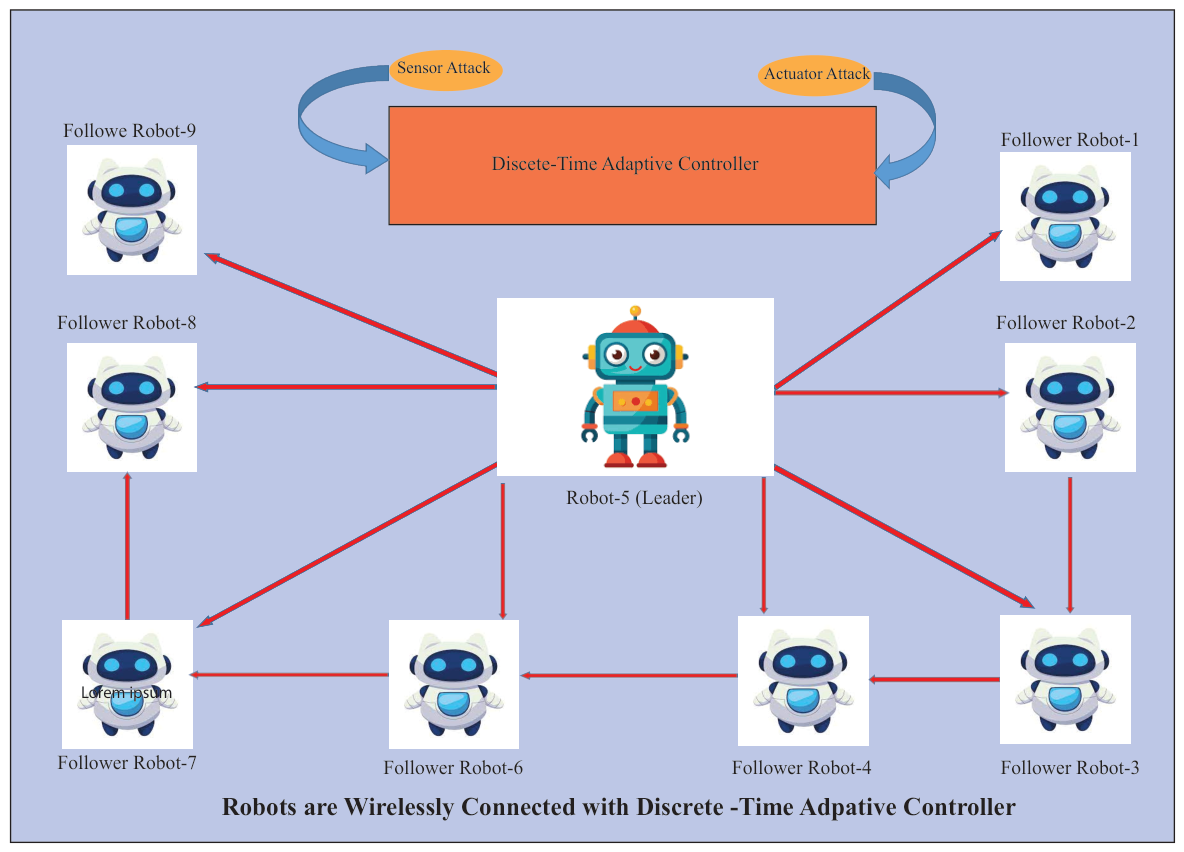
In order to explain the discrete-time adaptive controller under the Byzantine attack. We consider the group of nine robots on a line graph with the fifth robot as a leader, shown in Figure 1. The parameter of state of coupled dynamics f u i each robot selected according to f u i ( 2 , 2 ) . The parameters of the coupled dynamics are chosen as
F = diag 0.2 0.06 0.03 0.16 0.3 0.7 0.8 0.18 0.09 , G = diag 1.0 0.9 0.8 0.7 0.6 0.5 0.4 0.3 0.2 , H = diag 1 9 1.9 1.8 1.7 1.6 1.5 1.4 1.3 1.2 1 , B = 0.087 0.06 0.16 0.04 0.07 0.022 0.11 0.033 0.186 , ω 1 ( y 1 ( t ) ) = y 1 2 ( t ) , ω 2 ( y 2 ( t ) ) = cos ( y 2 ( t ) ) , ω 3 ( y 3 ( t ) ) = y 3 ( t ) , ω 4 ( y 4 ( t ) ) = sin ( y 4 ( t ) ) , ω 5 ( y 5 ( t ) ) = y 5 3 ( t ) , ω 6 ( y 6 ( t ) ) = 5 y 6 ( t ) , ω 7 ( y 7 ( t ) ) = tan ( y 7 ( t ) ) , ω 8 ( y 8 ( t ) ) = y 8 4 ( t ) , ω 9 ( y 9 ( t ) ) = y 9 5 ( t ) , q = 8 6 7 3 2 5 4 3 1 .
and c(t) = 1.8 and the convergence is 1. We are dealing with the discrete-time adaptive controller under the Byzantine attack, in which we define the sensor and actuator attack, which is defined in Equations (3) and (4). We e which is the control parameter that satisfy e < 1 m a s ( d ) + 1 here m a x ( d i ) = 2 .
The I-eF is in the unit circle. First, we handle the controller under the linear and nonlinear uncertainty under the coupled dynamics under the attack, which affects the functioning of the controller.
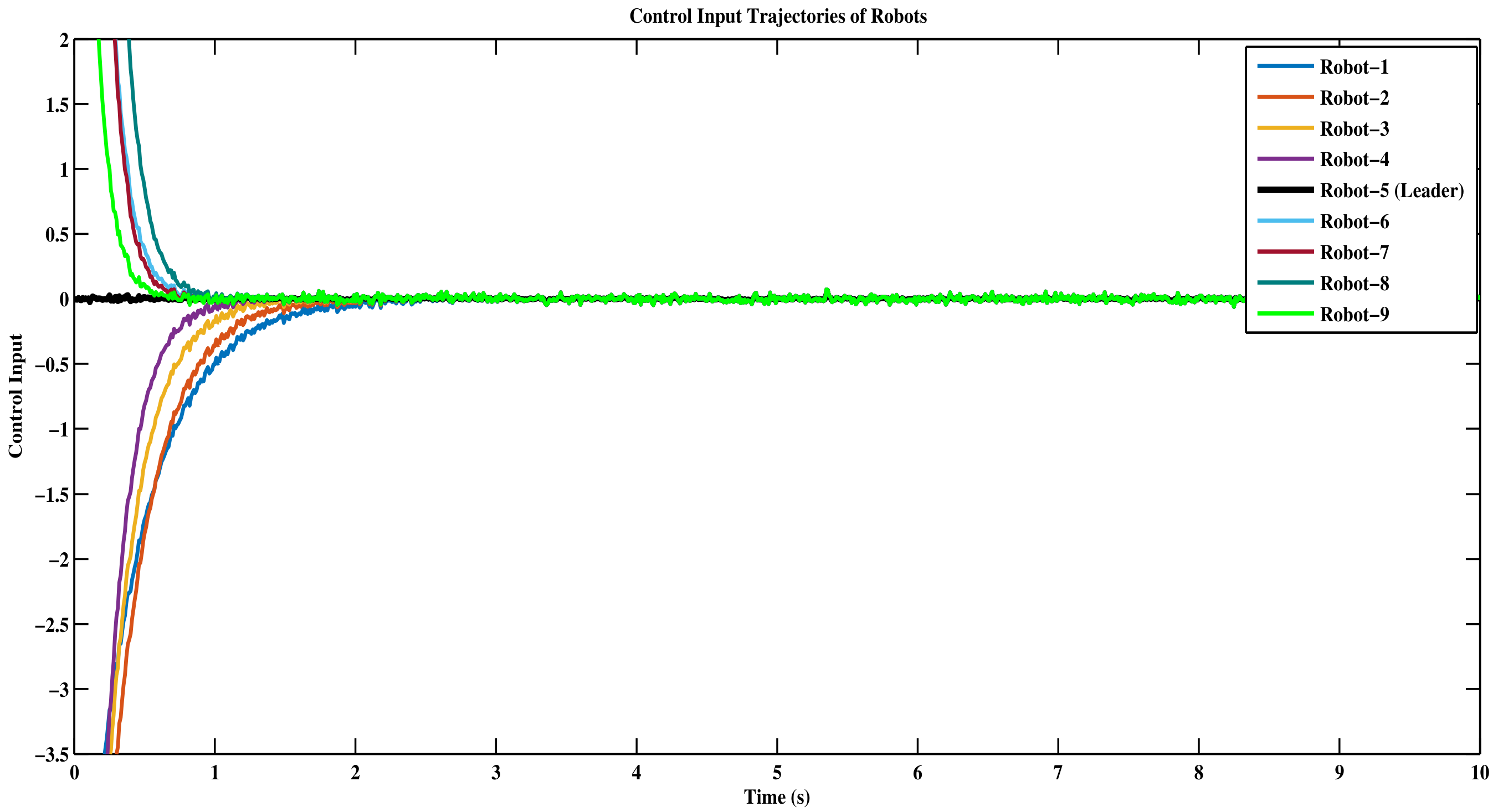
It is shown through the figure that the strategy of the controller is not sufficient for achieving convergence, so the trajectory deviates from the original path. We advance the discrete-time adaptive controller under attack for the robots’ communication accuracy. Figure 1 shows the communication link of all robots under the sensor and actuator attacks. To address the reviewer’s concern regarding the completeness and fairness of the simulation study, we extend the numerical experiments by introducing a comparative framework. In addition to the proposed discrete-time adaptive controller, a baseline controller without adaptive compensation and attack estimation is included under identical network topology, initial conditions, and sampling time to ensure a fair comparison. Furthermore, to demonstrate stronger Byzantine resilience, we consider multiple attack scenarios including higher attack magnitudes, intermittent (randomly activated) attacks, and heterogeneous attack locations affecting actuator channels, sensor measurements, and communication links. These settings provide a more realistic and challenging evaluation of system robustness. In addition, quantitative performance metrics are introduced, including tracking error norm h ( t ) , consensus error across all robots, settling time, and control effort u p ( t ) . These metrics are used to compare the proposed method with the baseline controller under identical attack conditions. Finally, it is clarified that actuator and sensor attacks affect follower robots and communication links, while the leader robot remains attack-free to preserve the reference trajectory.
Now the adjacency matrix is constructed according to Figure 1.
A = 0 0 0 0 1 0 0 0 0 0 0 0 0 1 0 0 0 0 0 1 0 0 1 0 0 0 0 0 0 1 0 1 0 0 0 0 0 0 0 0 0 0 0 0 0 0 0 0 1 1 0 0 0 0 0 0 0 0 1 1 0 0 0 0 0 0 0 1 0 1 0 0 0 0 0 0 1 0 0 0 0 , D = 1 0 0 0 0 0 0 0 0 0 1 0 0 0 0 0 0 0 0 0 2 0 0 0 0 0 0 0 0 0 2 0 0 0 0 0 0 0 0 0 0 0 0 0 0 0 0 0 0 0 2 0 0 0 0 0 0 0 0 0 2 0 0 0 0 0 0 0 0 0 2 0 0 0 0 0 0 0 0 0 1
L = 1 0 0 0 1 0 0 0 0 0 1 0 0 1 0 0 0 0 0 1 2 0 1 0 0 0 0 0 0 1 2 1 0 0 0 0 0 0 0 0 0 0 0 0 0 0 0 0 1 1 2 0 0 0 0 0 0 0 1 1 2 0 0 0 0 0 0 1 0 1 2 0 0 0 0 0 1 0 0 0 1
The sampling time is selected as T s = 0.01 . The control and adaptive parameters are chosen as e = 0.2 ,   γ = 0.5 ,   β = 1.2 .
The Lyapunov matrices are selected as:
P = I , R = 0.5 I
where I denotes the identity matrix of appropriate dimension (i.e., 9 × 9 in this case), consistent with the system size. The nonlinear function is defined as:
b ( t , z p ( t ) ) = 0.5 sin ( z p ( t ) ) + 0.3 z p ( t )
The basis function is chosen as:
ω ( y p ( t ) ) = y p ( t ) sin ( y p ( t ) ) y p 2 ( t )
The initial conditions of the system are:
y ( 0 ) = [ 2 , 1 , 3 , 2 , 1 , 2 , 3 , 1 , 2 ] T
To evaluate robustness, both actuator and sensor attacks are injected into the system.
The actuator attack is defined as:
v p b ( t ) = 0.5 sin ( 2 t )
The sensor attack is defined as:
z p b ( t ) = 0.3 cos ( 3 t )
The attack activation signal is given by:
λ p = 1 , t > 2 0 , otherwise
The state evolution and control performance of the multi-robot system are illustrated through the simulation results.
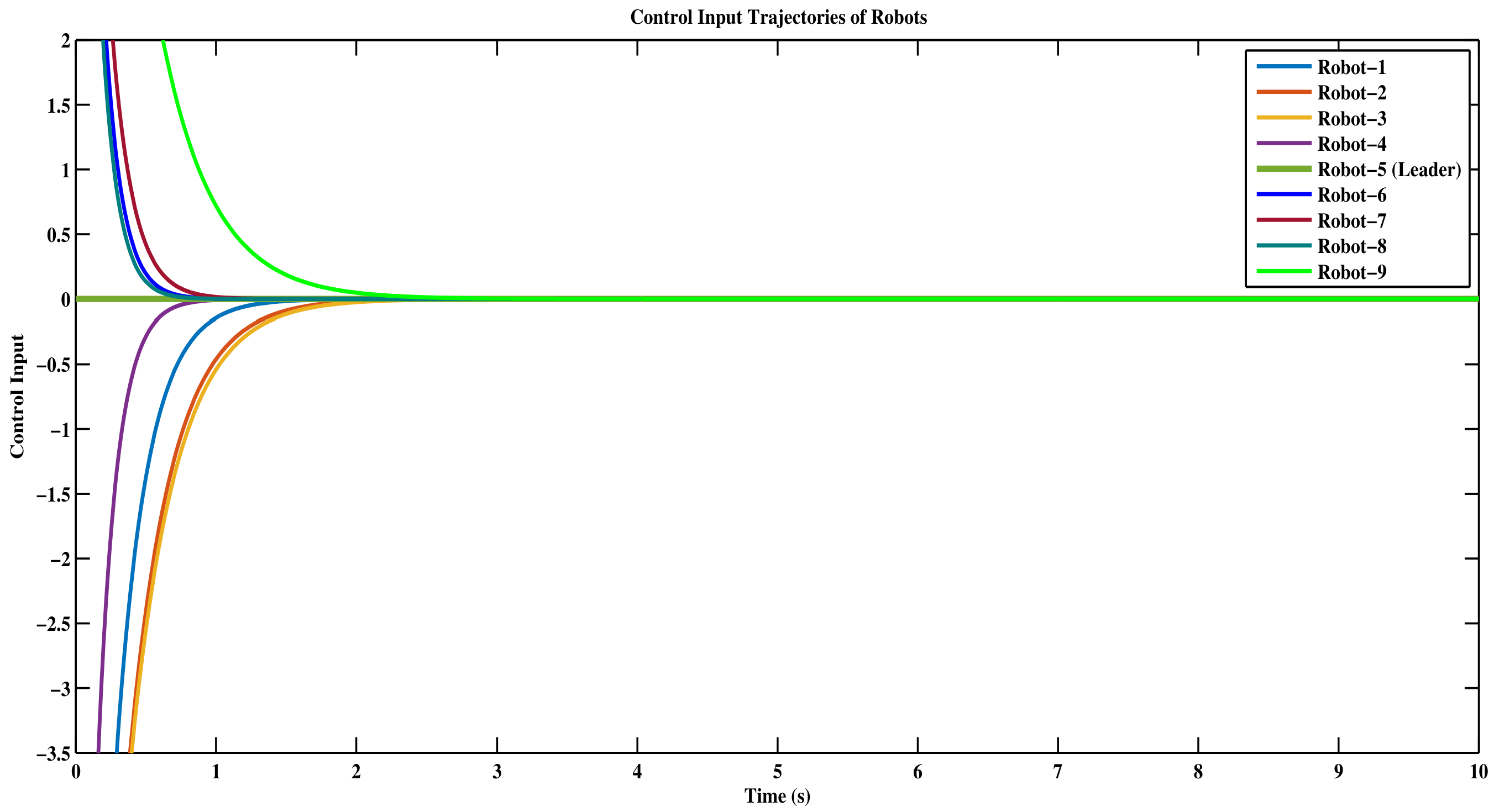
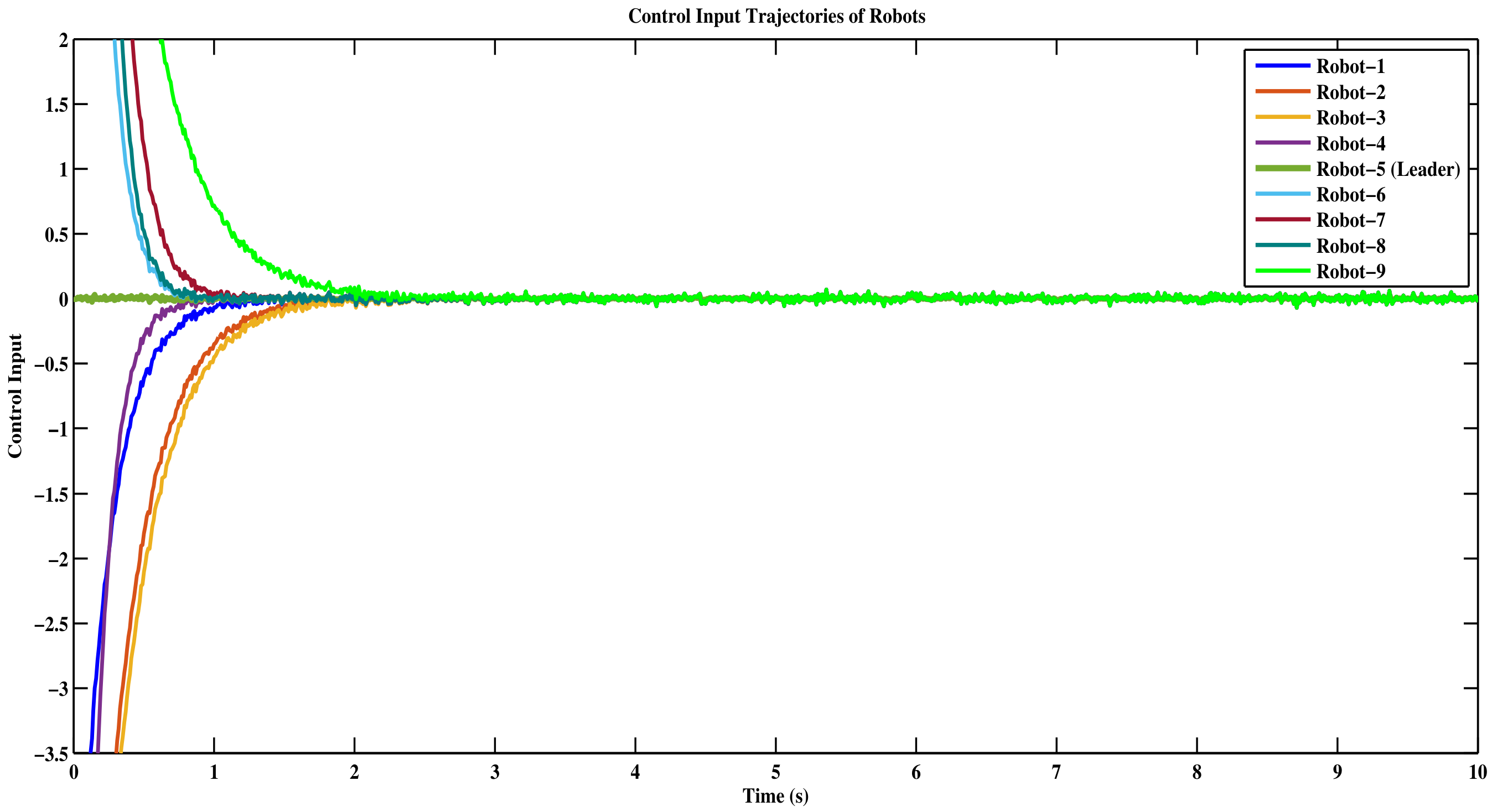
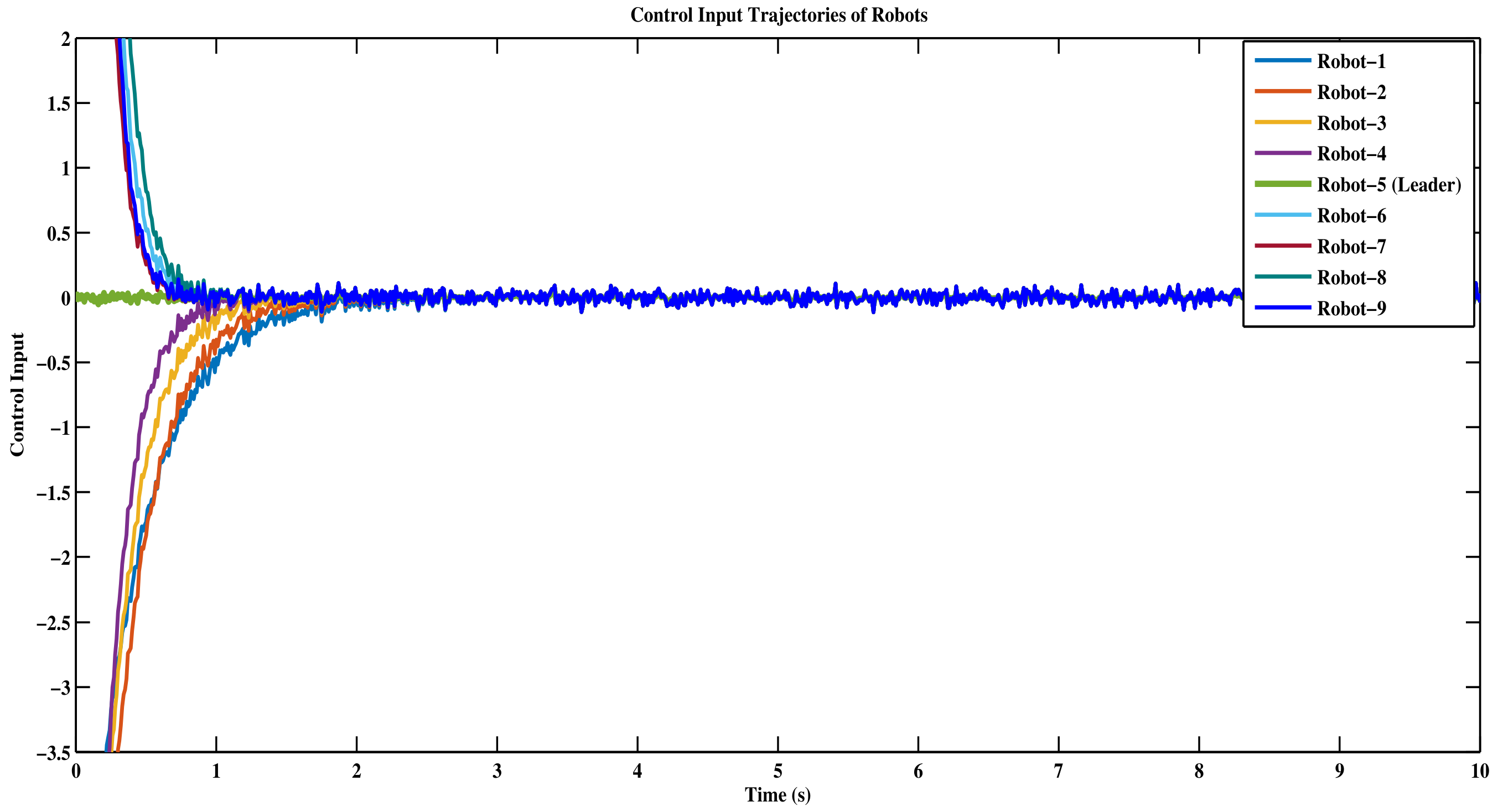
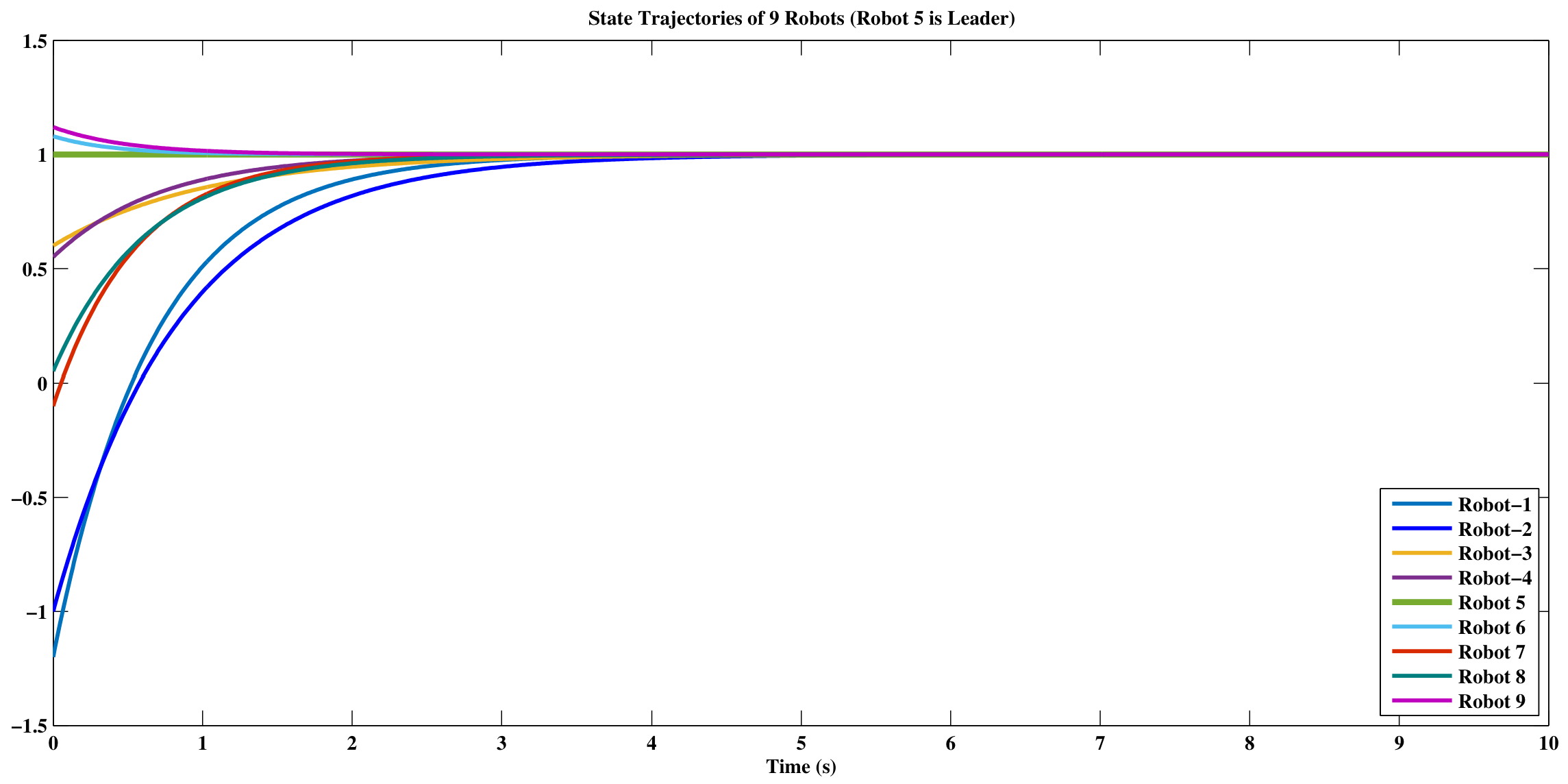
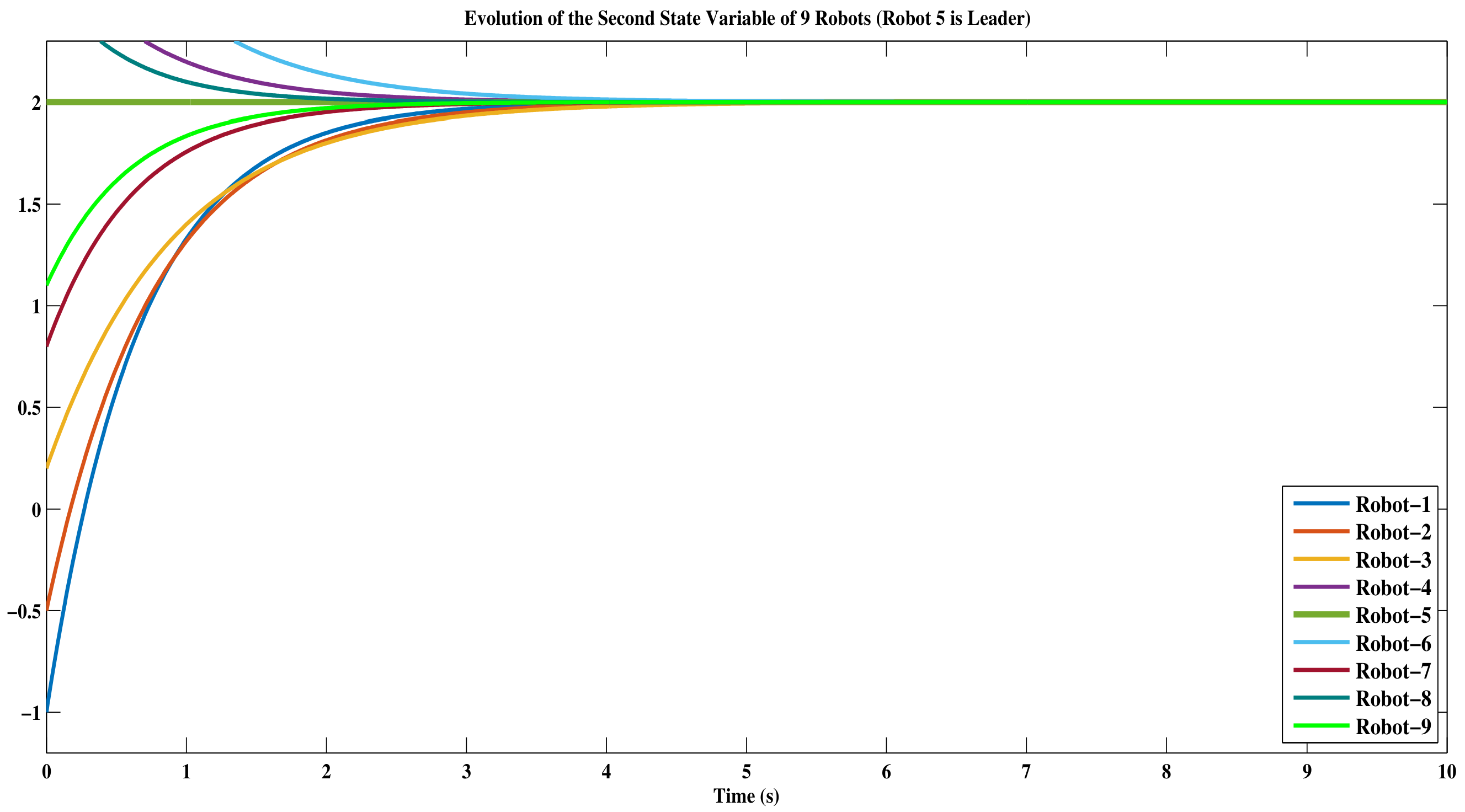
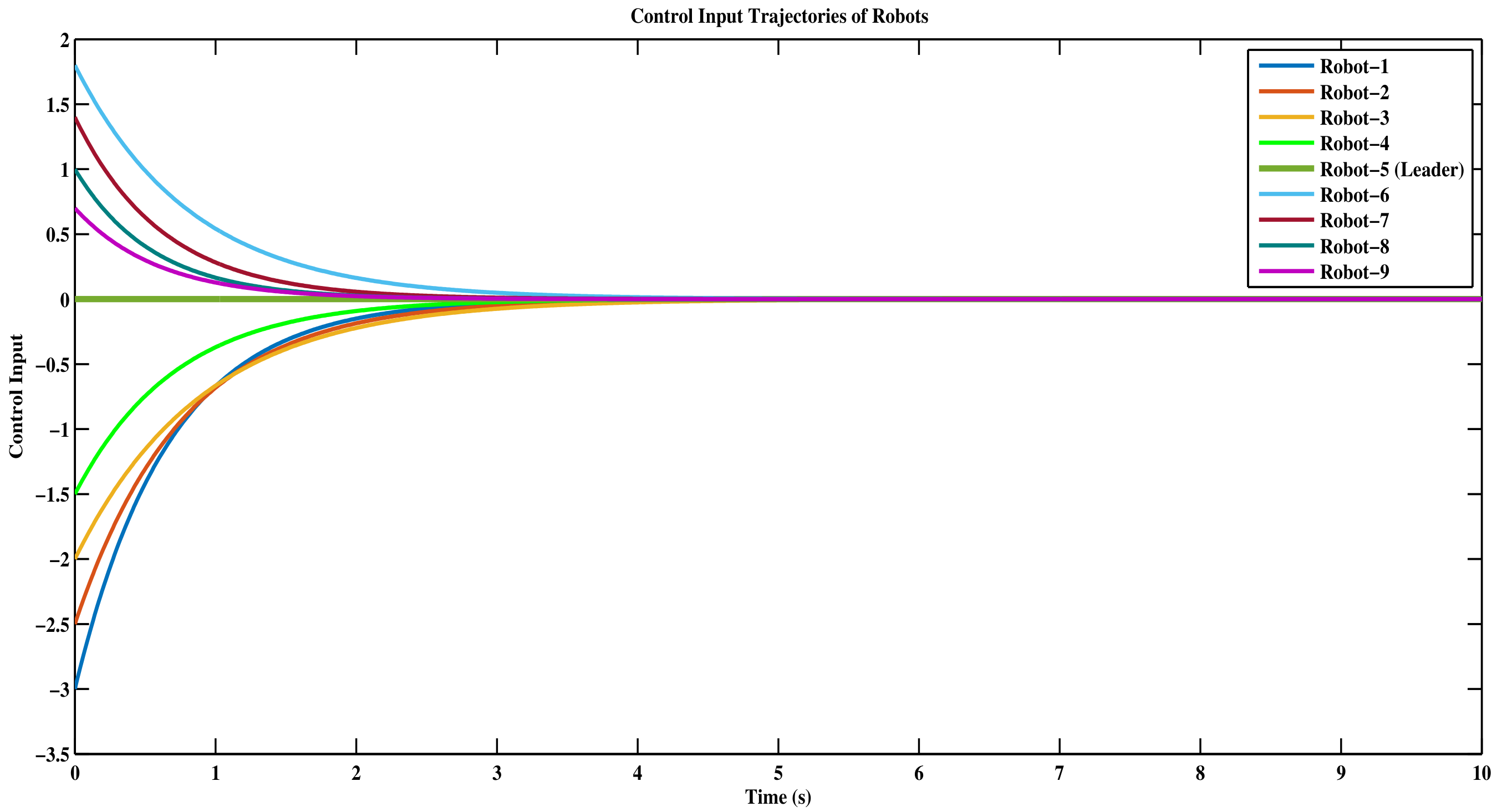
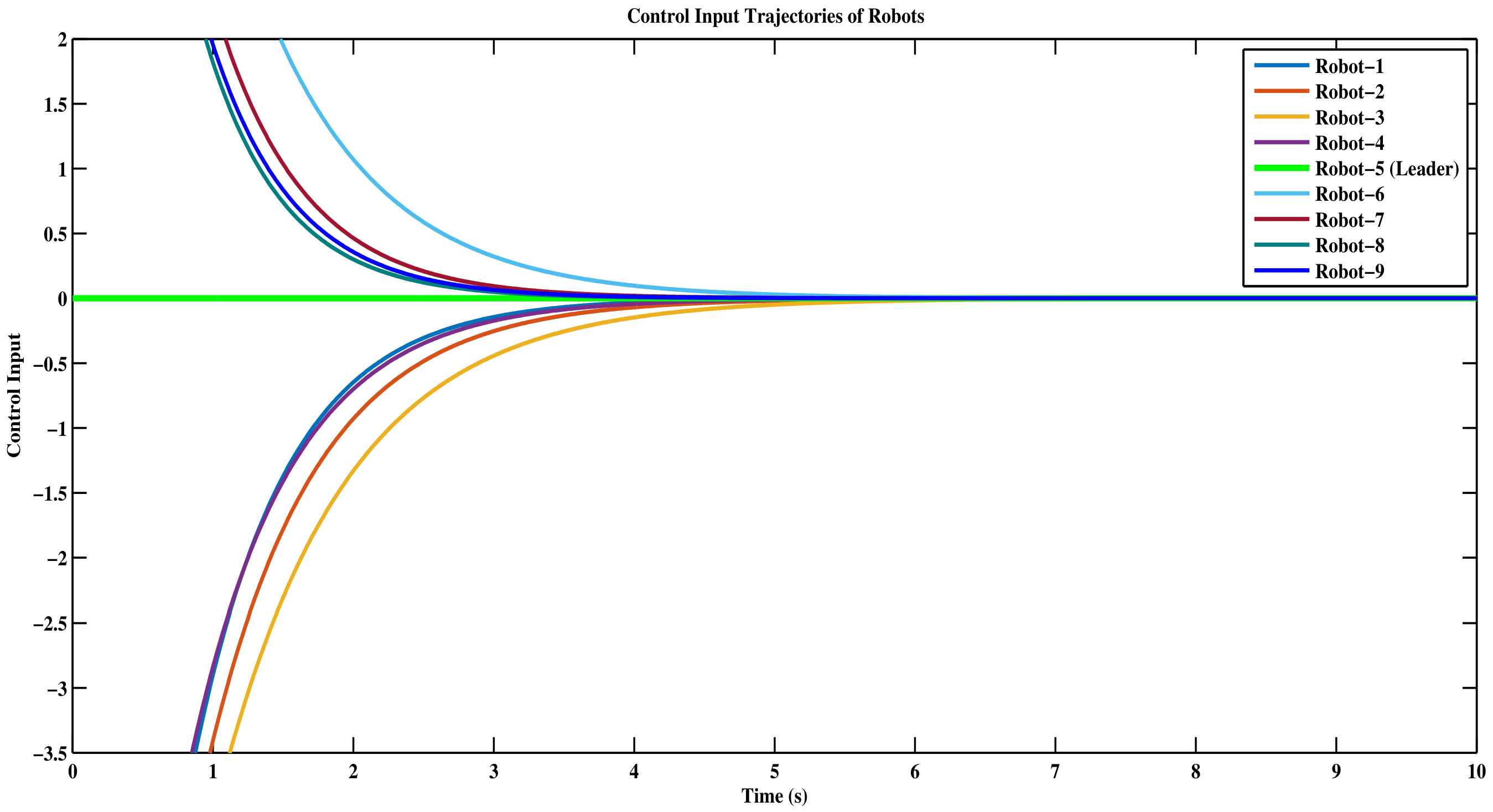
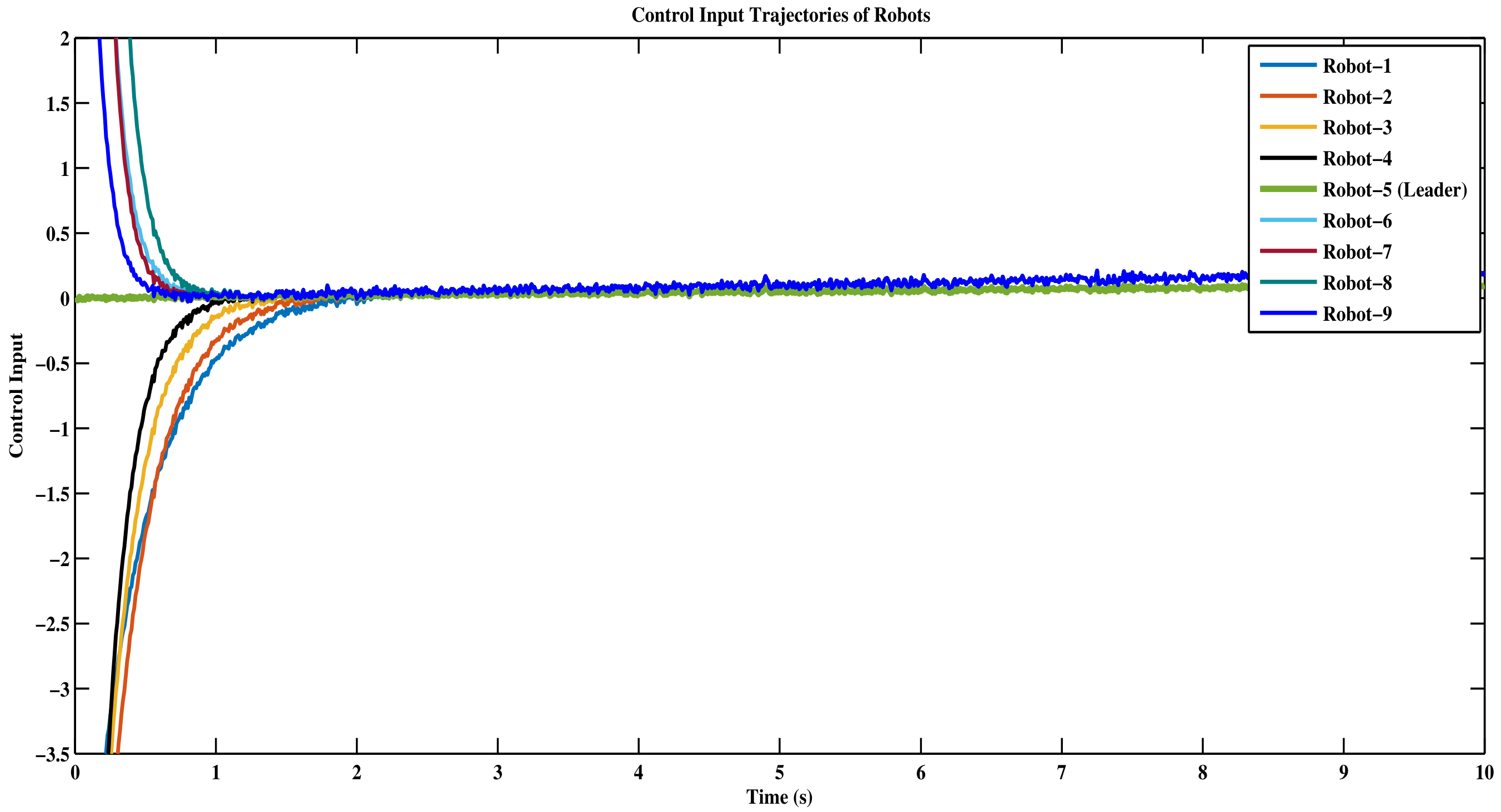
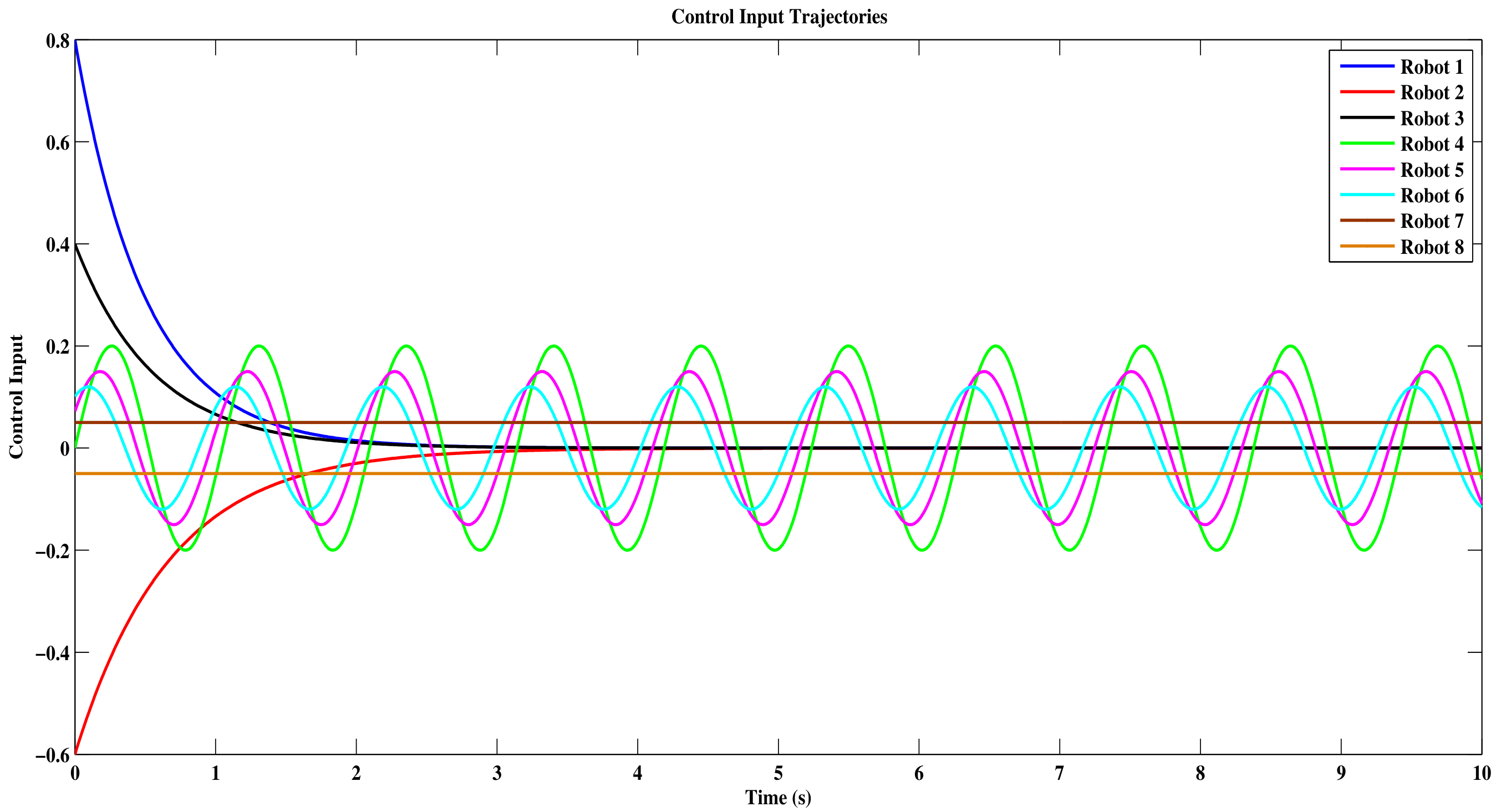
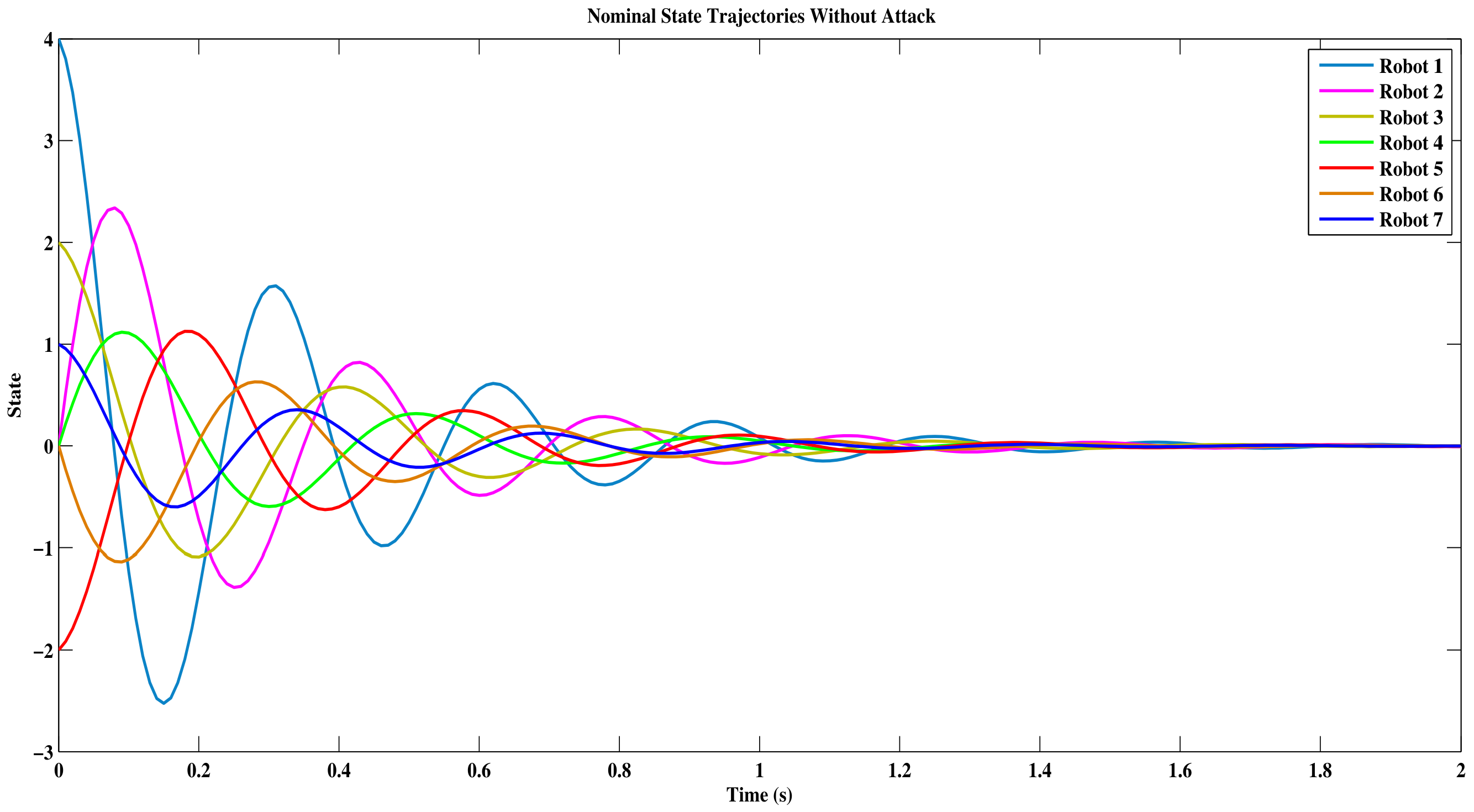
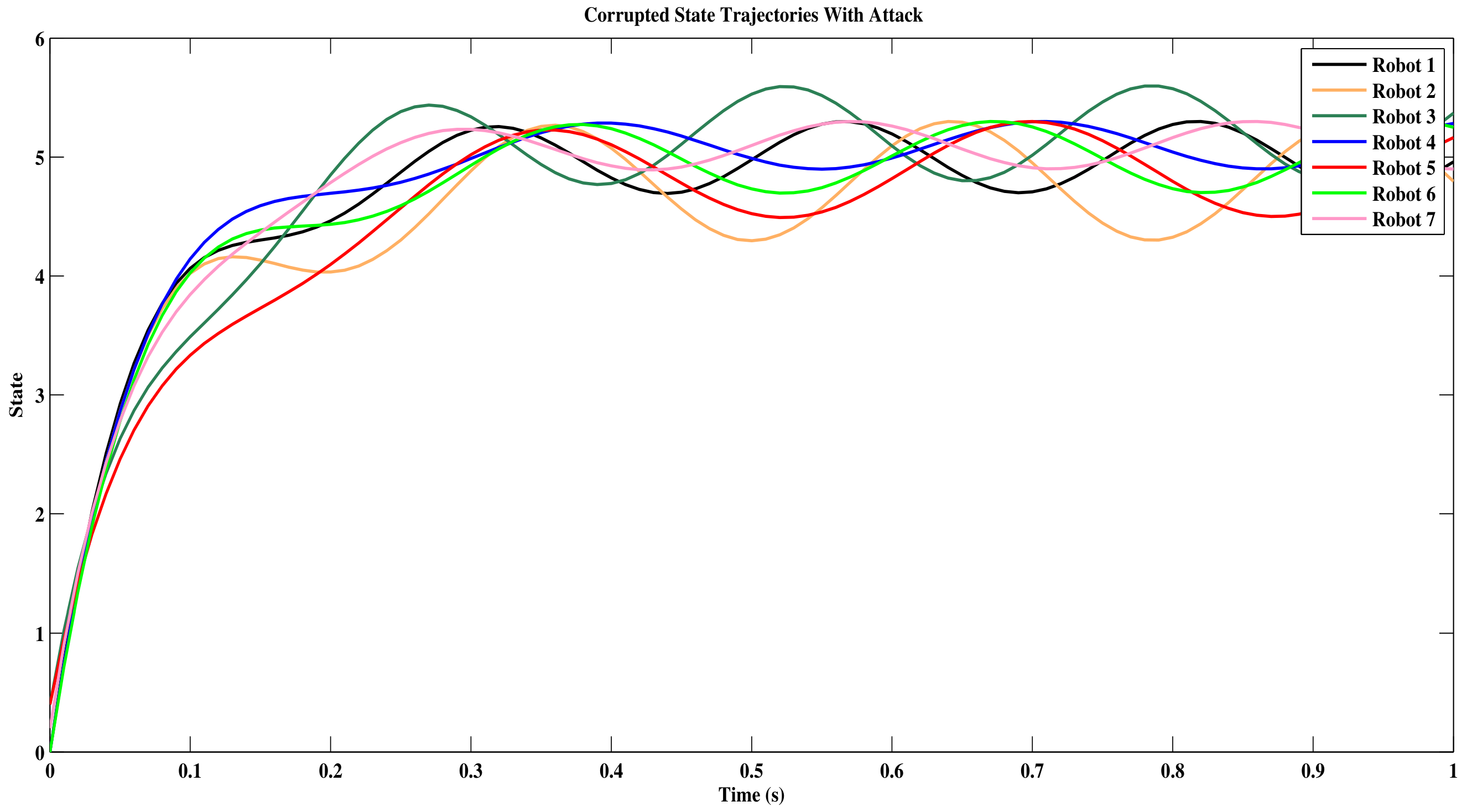
Figure 2 and Figure 3 present the trajectories of the first and second state components of the robotic agents, respectively, demonstrating smooth convergence and stable behavior under the proposed discrete-time adaptive control framework. Figure 4 and Figure 5 illustrate the control inputs U 1 and U 2 , Figure 6 and Figure 7 present U 3 and U 4 , Figure 8 and Figure 9 show U 5 and U 6 , and Figure 10 and Figure 11 depict U 7 and U 8 , all of which exhibit smooth, bounded, and well-coordinated control behavior across the multi-agent network. Furthermore, Figure 12 and Figure 13 provide a comparative evaluation of system performance, where Figure 12 shows the nominal state evolution under normal conditions, while Figure 13 illustrates the corrupted system behavior under attack conditions, clearly highlighting the impact of adversarial disturbances. These results collectively validate the effectiveness and robustness of the proposed control strategy for the multi-robot system.
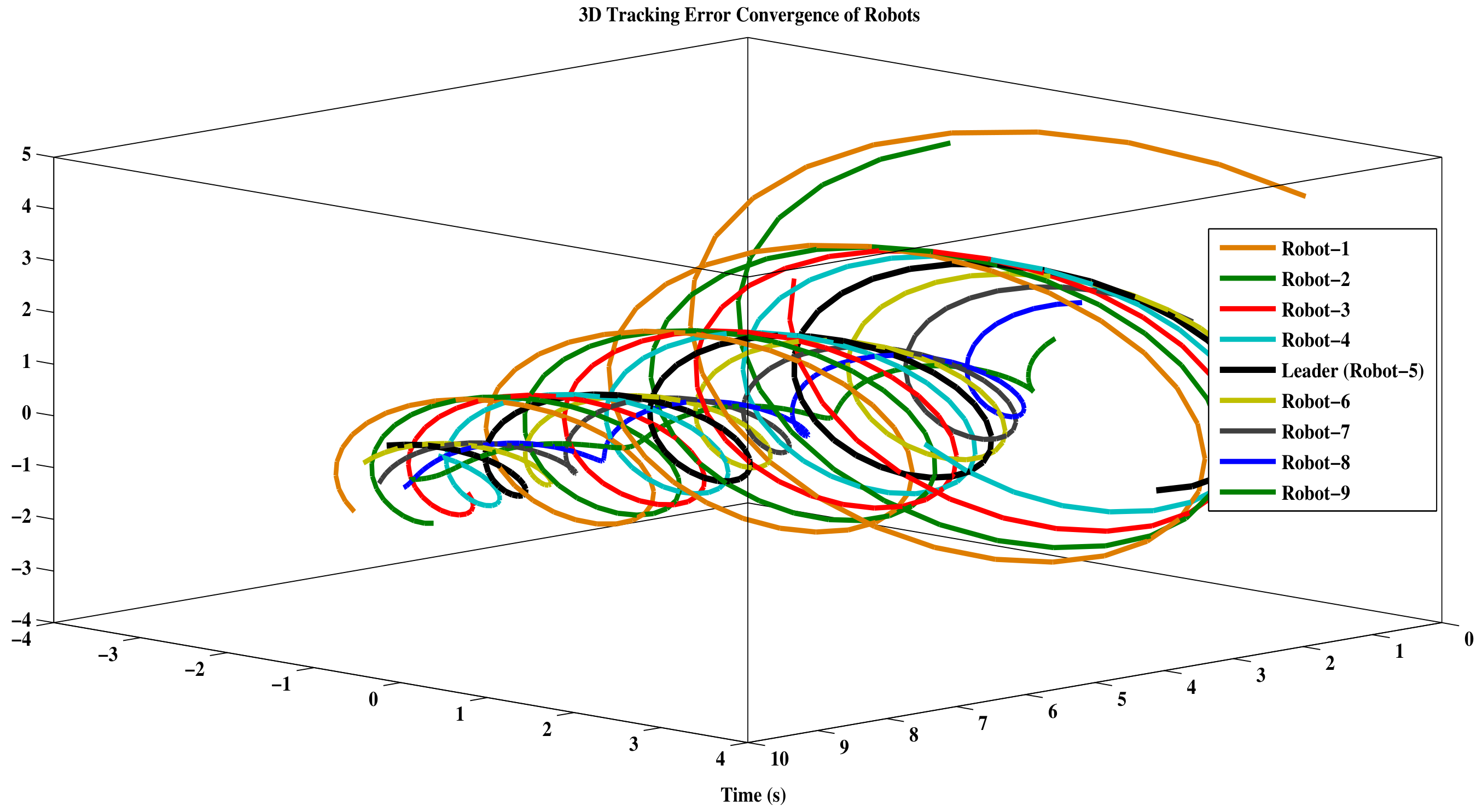
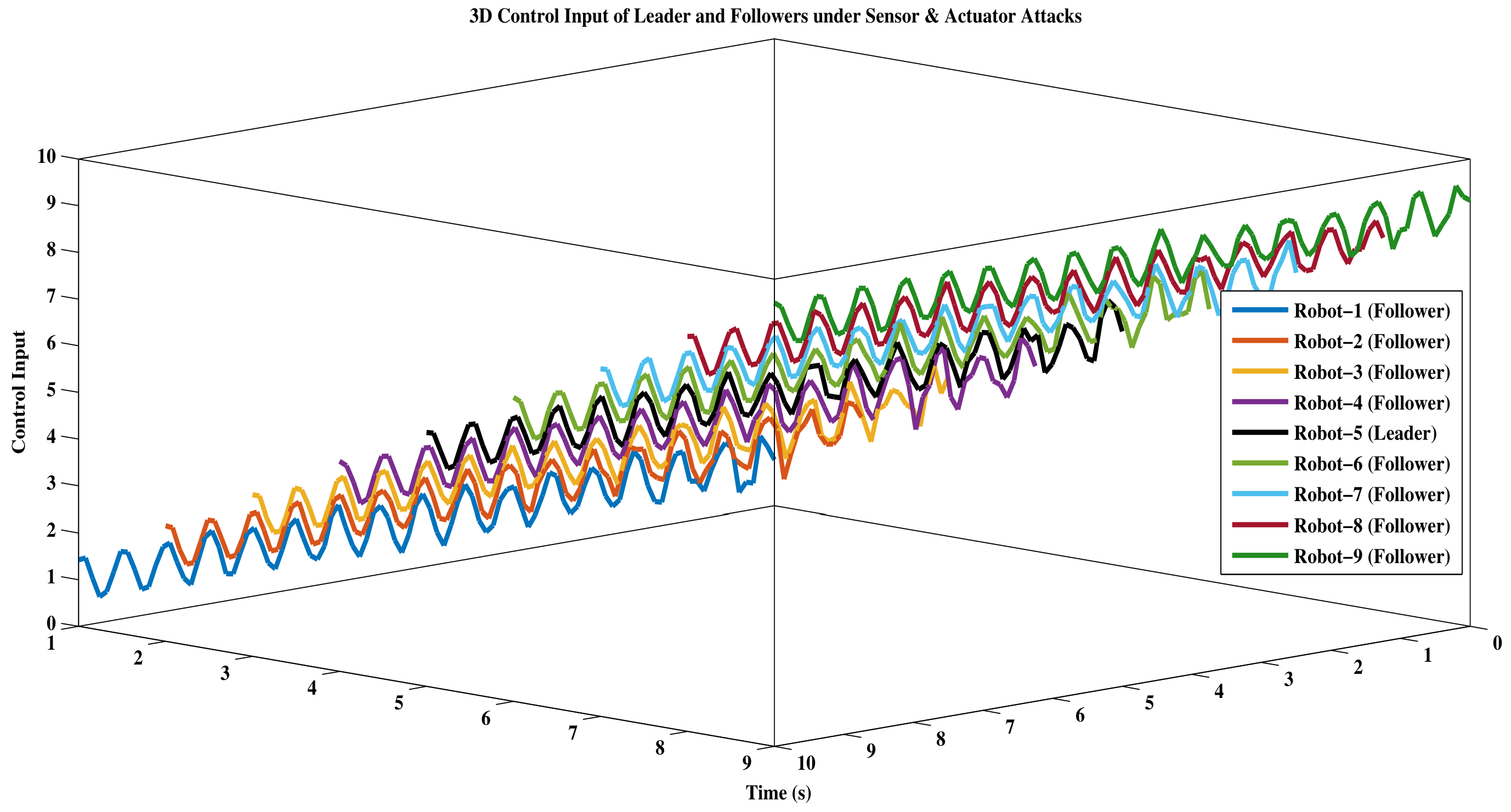
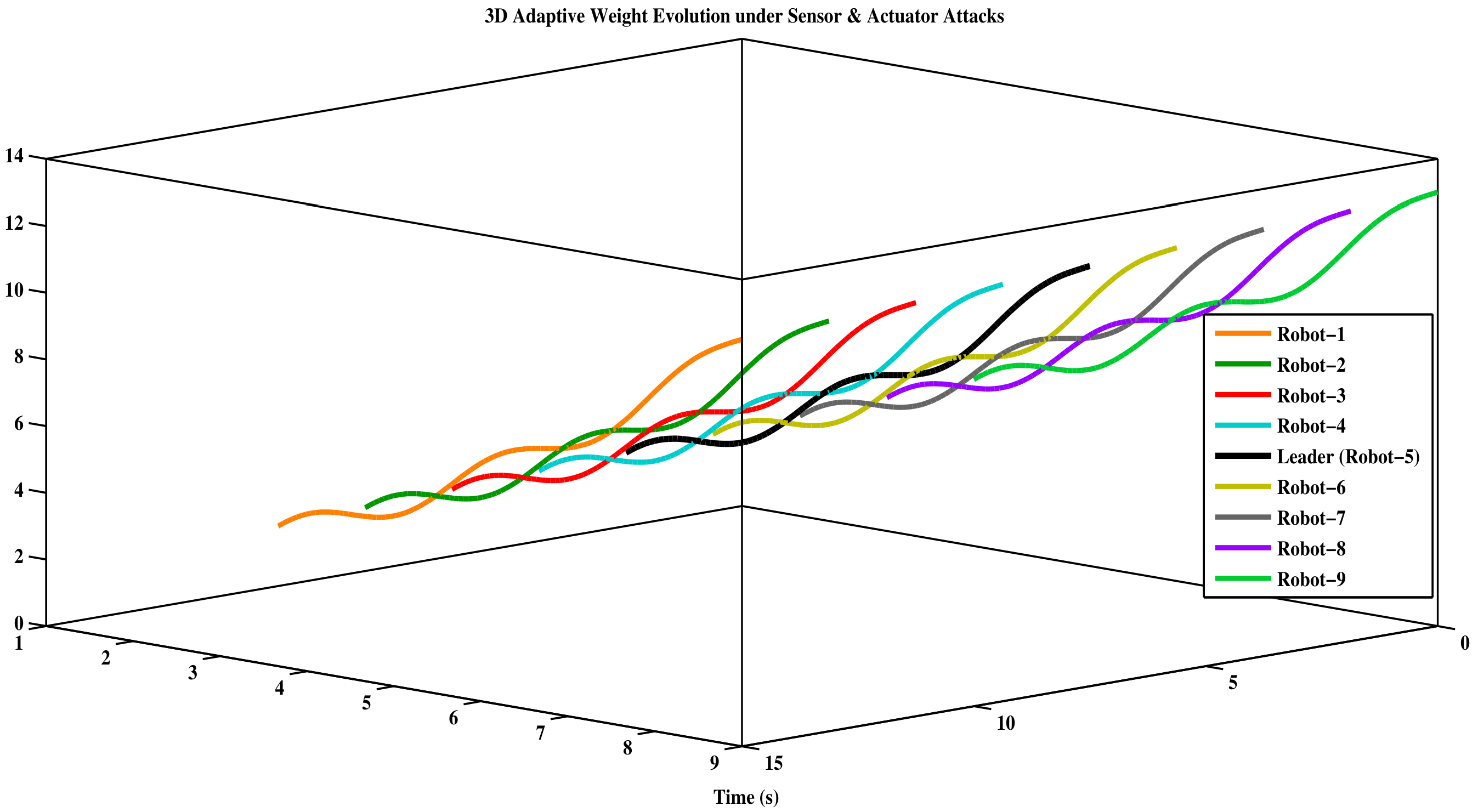
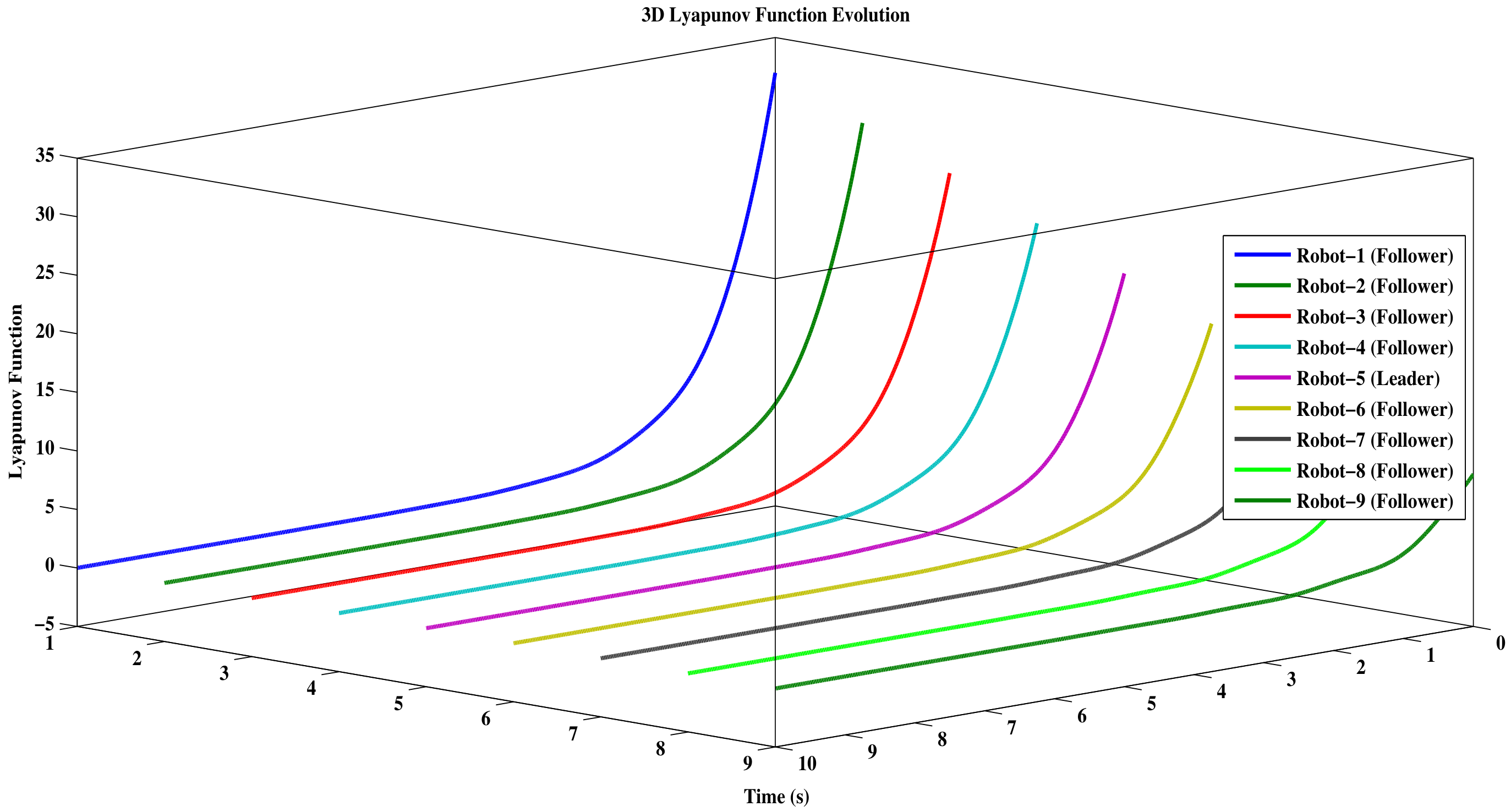
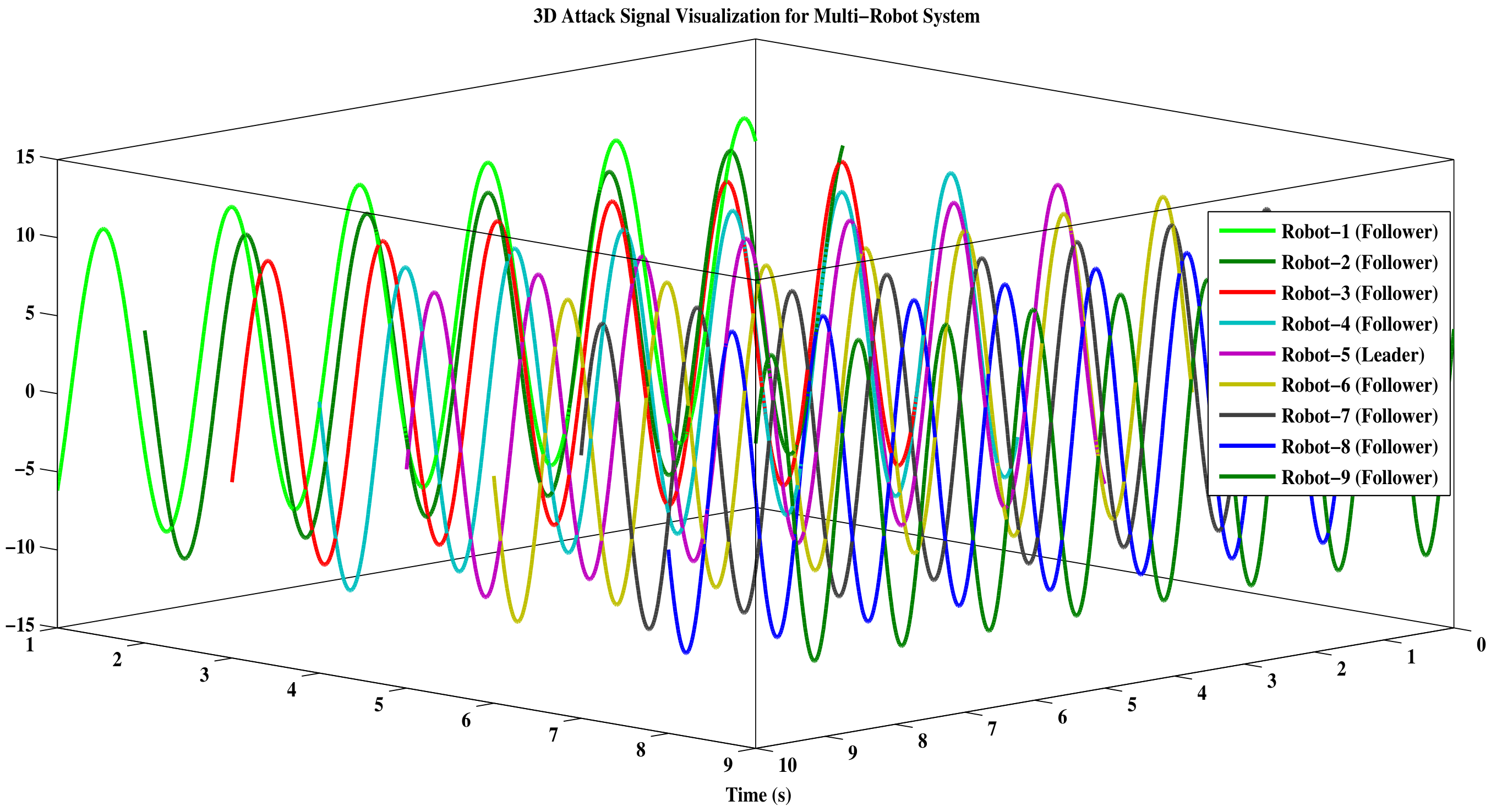
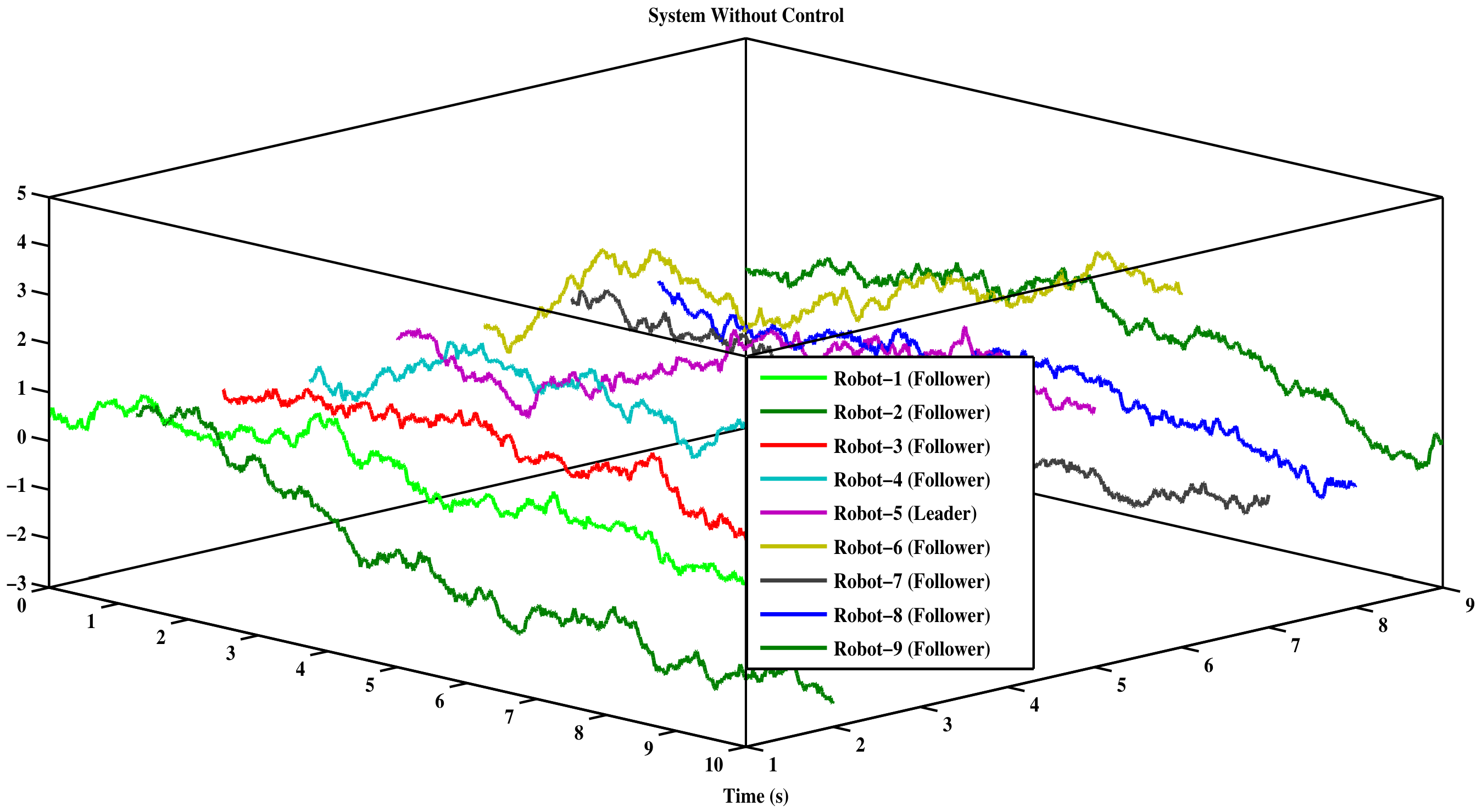
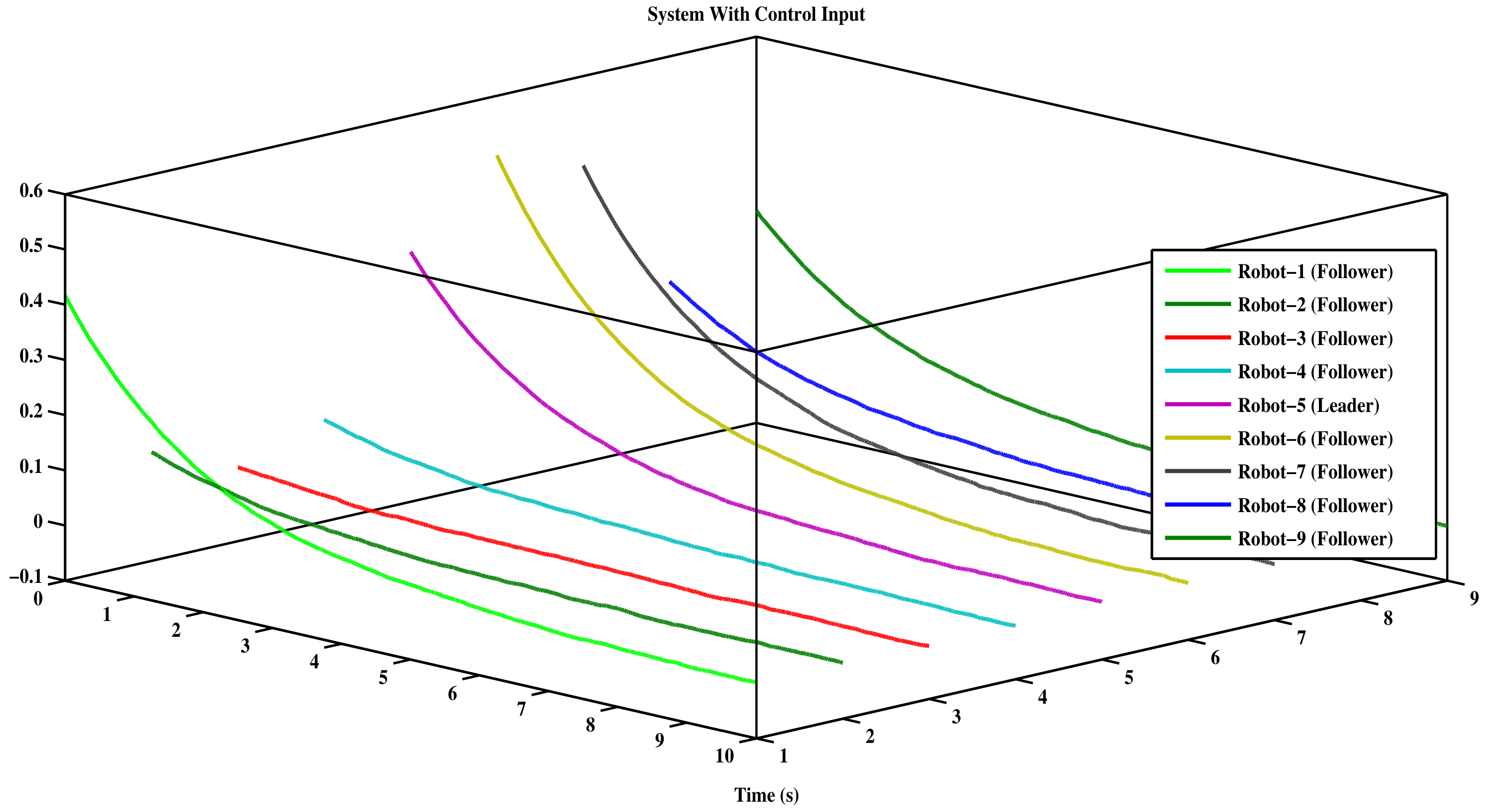
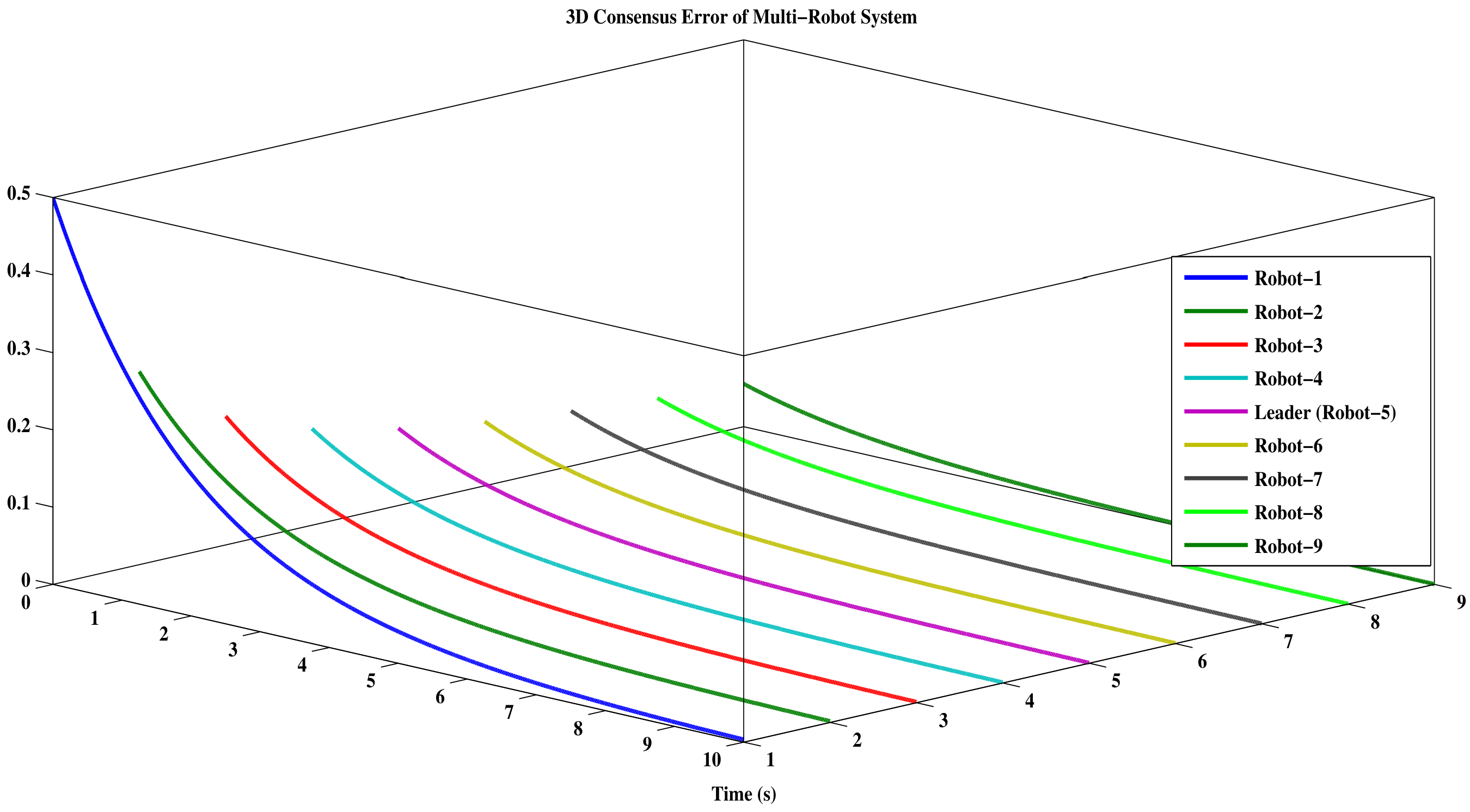
The simulation results of the multi-robot system in three-dimensional space are illustrated through several performance indicators. Figure 14 presents the tracking error trajectories of all robots in 3D, showing convergence toward the desired reference under the proposed control framework. Figure 15 depicts the 3D control input signals of the leader and follower agents under sensor and actuator attacks, confirming bounded and well-regulated control actions. Figure 16 illustrates the 3D evolution of adaptive weights, indicating stable adaptation behavior despite the presence of attacks. Figure 17 shows the 3D evolution of the Lyapunov function, verifying system stability and convergence. Figure 18 presents a 3D visualization of Byzantine attack signals affecting the multi-robot system, highlighting adversarial disturbances. Figure 19 and Figure 20 compare the 3D system responses without and with control, respectively, clearly demonstrating that the proposed controller significantly improves convergence and coordination among leader and follower robots. Finally, Figure 21 illustrates the 3D consensus error of the multi-robot system, confirming that all agents achieve synchronization under the proposed control strategy.

8. Conclusions

This paper presented a robust discrete-time adaptive control framework for multi-robot systems operating under uncertainties and Byzantine attacks affecting both actuator and sensor channels. By incorporating a modified graph-theoretic structure with node-dependent weighting, the proposed approach effectively captures heterogeneous interactions among robots while explicitly modeling adversarial disturbances within the system dynamics. The developed adaptive control law, combined with a nonlinear basis function approximation and a dynamic weight update mechanism, enables real-time compensation of unknown uncertainties and attack signals. For the uncoupled case, a composite Lyapunov function was constructed to rigorously establish the boundedness of all closed-loop signals and guarantee asymptotic convergence of the tracking error. The methodology was further extended to systems with coupled dynamics through the introduction of an auxiliary estimation mechanism, allowing reconstruction of unmeasurable interactions and ensuring consistent performance across more complex networked environments. Theoretical analysis confirmed that the proposed controller maintains stability and tracking performance despite the presence of Byzantine disturbances. Simulation results demonstrated that the proposed framework achieves accurate trajectory tracking, preserves consensus among robots, and exhibits strong resilience against adversarial conditions in both coupled and uncoupled scenarios. Future work may focus on extending the proposed framework to large-scale networks, incorporating communication delays and packet losses, and validating the approach on real-world robotic platforms.

Author Contributions

Conceptualization, S.H.G.; Software, W.U.H.; Validation, S.K.; Formal analysis, S.H.G.; Resources, M.J.K.; Data curation, M.S. and A.B.; Writing original draft, W.U.H. and A.B.; Writing—review and editing, W.U.H. and A.B.; Supervision, S.H.G. and M.J.K. All authors have read and agreed to the published version of the manuscript.

Funding

This project was funded by the Deanship of Scientific Research (DSR) at King Abdulaziz University, Jeddah, Saudi Arabia, under grant no. (IPP: 592-662-2025). The authors, therefore, acknowledge with thanks DSR for technical and financial support. This research was also supported by the Jiangsu Province Excellent Postdoctoral Program under Grant 2024ZB879.

Institutional Review Board Statement

Not applicable.

Informed Consent Statement

Not applicable.

Data Availability Statement

Data sharing is not applicable to this article, as no datasets were generated or analyzed during the current study. The code supporting the findings of this study is not publicly available, as it was developed by the Deanship of Scientific Research (DSR) at King Abdulaziz University, Jeddah, Saudi Arabia.

Conflicts of Interest

The authors declare that they have no known competing financial or non-financial interests.

References

  1. Shi, Y.; Hou, X.; Na, Z.; Zhou, J.; Yu, N.; Liu, S.; Liu, Y. Bio-inspired attachment mechanism of Dynastes hercules: Vertical climbing for on-orbit assembly legged robots. J. Bionic Eng. 2023, 21, 137–148. [Google Scholar] [CrossRef]
  2. Chen, J.; Yu, C.; Wang, Y.; Zhou, Z.; Liu, Z. Hybrid modeling for vehicle lateral dynamics via AGRU with a dual-attention mechanism under limited data. Control Eng. Pract. 2024, 151, 106015. [Google Scholar] [CrossRef]
  3. Wang, Z.; Gao, D.; Deng, K.; Lu, Y.; Ma, S.; Zhao, J. Robot base position and spacecraft cabin angle optimization via homogeneous stiffness domain index with nonlinear stiffness characteristics. Robot. Comput.-Integr. Manuf. 2024, 90, 102793. [Google Scholar] [CrossRef]
  4. Li, D.; Tong, S.; Yang, H.; Hu, Q. Time-Synchronized Control for Spacecraft Reorientation with Time-Varying Constraints. IEEE/ASME Trans. Mechatronics 2025, 30, 2073–2083. [Google Scholar] [CrossRef]
  5. Du, G.; Zhang, H.; Yu, H.; Hou, P.; He, J.; Cao, S.; Ma, L. Study on Automatic Tracking System of Microwave Deicing Device for Railway Contact Wire. IEEE Trans. Instrum. Meas. 2024, 73, 3527611. [Google Scholar] [CrossRef]
  6. Wang, L.; Fu, Q.; Zhu, R.; Liu, N.; Shi, H.; Liu, Z.; Jiang, H. Research on high precision localization of space target with multi-sensor association. Opt. Lasers Eng. 2025, 184, 108553. [Google Scholar] [CrossRef]
  7. Guo, J.; Li, Y.; Huang, B.; Ding, L.; Gao, H.; Zhong, M. An online optimization escape entrapment strategy for planetary rovers based on Bayesian optimization. J. Field Robot. 2024, 41, 2518–2529. [Google Scholar] [CrossRef]
  8. Zhao, X.; Wang, T.; Li, Y.; Zhang, B.; Liu, K.; Liu, D.; Snoussi, H. Target-Driven Visual Navigation by Using Causal Intervention. IEEE Trans. Intell. Veh. 2024, 9, 1294–1304. [Google Scholar] [CrossRef]
  9. Li, L.; Cherouat, A.; Snoussi, H.; Wang, T. Grasping with Occlusion-Aware Ally Method in Complex Scenes. IEEE Trans. Autom. Sci. Eng. 2025, 22, 5944–5954. [Google Scholar] [CrossRef]
  10. Wang, T.; Hou, B.; Li, J.; Shi, P.; Zhang, B.; Snoussi, H. TASTA: Text-Assisted Spatial and Temporal Attention Network for Video Question Answering. Adv. Intell. Syst. 2023, 5, 2200131. [Google Scholar] [CrossRef]
  11. Hu, J.; Chen, B.; Ghosh, B.K. Formation–Circumnavigation Switching Control of Multiple ODIN Systems via Finite-Time Intermittent Control Strategies. IEEE Trans. Control Netw. Syst. 2024, 11, 1986–1997. [Google Scholar] [CrossRef]
  12. Xiao, W.; Xie, C.; Xiao, Y.; Tang, K.; Wang, Z.; Hu, D.; Jiao, Z. A new vacuum-powered soft bending actuator with programmable variable curvatures. Mater. Des. 2025, 250, 113641. [Google Scholar] [CrossRef]
  13. Qi, H.; Ding, L.; Zheng, M.; Huang, L.; Gao, H.; Liu, G.; Deng, Z. Variable Wheelbase Control of Wheeled Mobile Robots with Worm-Inspired Creeping Gait Strategy. IEEE Trans. Robot. 2024, 40, 3271–3289. [Google Scholar] [CrossRef]
  14. Li, J.; Sun, R.; Wang, Y.; Ochieng, W.Y. A robust time synchronization algorithm for GNSS/IMU integrated navigation in urban environments. Meas. Sci. Technol. 2025, 36, 036302. [Google Scholar] [CrossRef]
  15. Shen, Y.; Lu, Q.; Li, Y. Design Criterion and Analysis of Hybrid-Excited Vernier Reluctance Linear Machine with Slot Halbach PM Arrays. IEEE Trans. Ind. Electron. 2023, 70, 5074–5084. [Google Scholar] [CrossRef]
  16. Li, P.; Liu, S.; Tian, Y.; Hou, T.; Ling, J. Automatic Perception of Aircraft Taxiing Behavior via Laser Rangefinders and Machine Learning. IEEE Sens. J. 2025, 25, 3964–3973. [Google Scholar] [CrossRef]
  17. Huo, M.; Fan, Z.; Qi, J.; Qi, N.; Zhu, D. Fast Analysis of Multi-Asteroid Exploration Mission Using Multiple Electric Sails. J. Guid. Control. Dyn. 2023, 46, 1015–1022. [Google Scholar] [CrossRef]
  18. Zhang, Z.; He, R.; Han, B.; Ren, S.; Fan, J.; Wang, H.; Ma, Z. Magnetically Switchable Adhesive Millirobots for Universal Manipulation in both Air and Water. Adv. Mater. 2025, 37, 2420045. [Google Scholar] [CrossRef] [PubMed]
  19. Tian, J.; Zhou, Y.; Yin, L.; AlQahtani, S.; Tang, M.; Lu, S.; Zheng, W. Control Structures and Algorithms for Force Feedback Bilateral Teleoperation Systems: A Comprehensive Review. Comput. Model. Eng. Sci. 2025, 142, 973–1019. [Google Scholar] [CrossRef]
  20. He, D.; Lin, Y.; Dai, Z.; Yang, S.X. Neurodynamics-Based Visual Servo Predictive Control for Improving Smooth Movement of Logistics Omnidirectional Robots. IEEE Trans. Ind. Electron. 2025, 72, 14646–14655. [Google Scholar] [CrossRef]
  21. Zhi, S.; Wu, H.; Shen, H.; Cheng, W.; Xiao, Y.; Wang, T. Weak time-varying fault indicator detection of the complex gearbox via the meshing order modulation-aided scaling reassigning chirplet transform. Appl. Acoust. 2025, 232, 110580. [Google Scholar] [CrossRef]
  22. Luan, Z.; Xu, K.; Zhao, W.; Wang, C. An Event-Triggered Steering Angle Collaborative Control Strategy for the Four-Wheel Independent Steering System. IEEE Trans. Veh. Technol. 2025, 74, 7468–7482. [Google Scholar] [CrossRef]
  23. Luan, Z.; Zhao, W.; Wang, C. Coordinated Tracking Control of the Integrated Wheel-End System Based on Generalized Instantaneous Steering Center Constraint. IEEE Trans. Transp. Electrif. 2025, 11, 8271–8281. [Google Scholar] [CrossRef]
  24. Xu, H.; Geng, D.; Jiang, X.; Xue, J.; Guo, G.; Zhang, D. An innovative normal self-positioning method with gravity and friction compensation for wall-climbing drilling robot in aircraft assembly. Int. J. Adv. Manuf. Technol. 2025, 138, 3687–3704. [Google Scholar] [CrossRef]
  25. Ding, F.; Liu, Z.; Wang, Y.; Liu, J.; Wei, C.; Nguyen, A.; Wang, N. Intelligent Event Triggered Lane Keeping Security Control for Autonomous Vehicle Under DoS Attacks. IEEE Trans. Fuzzy Syst. 2025, 33, 3595–3608. [Google Scholar] [CrossRef]
  26. Wu, T.; Li, M.; Qu, Y.; Wang, H.; Wei, Z.; Cao, J. Joint AAV Deployment and Edge Association for Energy-Efficient Federated Learning. IEEE Trans. Cogn. Commun. Netw. 2025, 11, 4126–4140. [Google Scholar] [CrossRef]
  27. Wang, B.; Sun, J.; Peng, B.; Cui, X.; Cheng, L.; Zheng, X. Optimal Event-Triggered Neural Learning Tracking Control for Pneumatic Muscle Antagonistic Joint with Asymmetric Constraints. IEEE Trans. Ind. Electron. 2025, 72, 14677–14687. [Google Scholar] [CrossRef]
  28. Jin, J.; Zhao, L.; Chen, L.; Chen, W. A robust zeroing neural network and its applications to dynamic complex matrix equation solving and robotic manipulator trajectory tracking. Front. Neurorobot. 2022, 16, 1065256. [Google Scholar] [CrossRef] [PubMed]
  29. Wang, S.; Zhang, Z.; Sun, C.; Gong, L.; Zhang, X.; Gao, S.; Zhang, C.; Han, Q.; Yan, S. Multifunctional Tribovoltaic Coating for Self-Powered In Situ Sensing with Exceptional Tribological Robustness and Charge Transport. Adv. Funct. Mater. 2025, 36, e14190. [Google Scholar] [CrossRef]
  30. Liu, X.; Wu, C.; Zhen, S.; Sun, H.; Sun, C.; Chen, Y. Robust Control under Servo Constraint Following via Nash Equilibrium Theory for Bimanual Humanoid Manipulation. IEEE Trans. Fuzzy Syst. 2025, 33, 4069–4082. [Google Scholar] [CrossRef]
  31. Guo, W.; Liu, J.; Qin, W.; Lan, X.; Bai, H.; Li, X. Robust adaptive dynamic programming for morphing air-breathing hypersonic vehicles under unmatched uncertainty. Sci. China Inf. Sci. 2026, 69, 122205. [Google Scholar] [CrossRef]
  32. Li, S.; Wang, S.; Zhang, Y.; Wang, X.; Zhang, Y.; Wu, W.; Mu, R. Distributed bearing-based fault-tolerant formation control of fixed-wing UAV swarm with prescribed performance. Aerosp. Sci. Technol. 2025, 168, 110897. [Google Scholar] [CrossRef]
  33. Zhou, L.; Li, Z.; Li, Y.; Bai, S. Parallel MPPI with gradient-velocity modulated SDF cost for high-performance real-time dynamic obstacle avoidance by robot manipulators. IEEE Trans. Robot. 2025, 41, 5149–5168. [Google Scholar] [CrossRef]
  34. Ren, Y.; Wang, L.; Li, M.; Jiang, H.; Cui, Z.; Yang, M.; Yang, D. RM2Occ: Re-projection multi-task multi-sensor fusion for autonomous driving 3D object detection and occupancy perception. IEEE Trans. Intell. Transp. Syst. 2025, 26, 20864–20881. [Google Scholar] [CrossRef]
  35. Sun, Y.; Sun, H.; Ma, J.; Zhang, P.; Huang, X. Multimodal agent artificial intelligence: A survey of recent advances and future directions. J. Comput. Sci. Technol. 2025, 40, 1046–1063. [Google Scholar] [CrossRef]
  36. Lu, Q.; Wu, X.; She, J.; Guo, F.; Yu, L. Disturbance rejection for systems with uncertainties based on fixed-time equivalent-input-disturbance approach. IEEE/CAA J. Autom. Sin. 2024, 11, 2384–2395. [Google Scholar] [CrossRef]
  37. Li, R.; Jin, J.; Zhang, D.; Chen, C. A segmented activation function-based zeroing neural network model for dynamic Sylvester equation solving and robotic manipulator control. Concurr. Comput. Pract. Exp. 2025, 37, e70243. [Google Scholar] [CrossRef]
  38. Zhang, L.; Yang, D.; Niu, B.; Yang, H.; Huang, Q.; Jiang, L.; Liu, H. Smooth path planning and dynamic contact force regulation for robotic ultrasound scanning. IEEE Robot. Autom. Lett. 2025, 10, 10570–10577. [Google Scholar] [CrossRef]
  39. Yuan, W.; Chen, J.; Chen, S.; Feng, D.; Hu, Z.; Li, P.; Zhao, W. Transformer in reinforcement learning for decision-making: A survey. Front. Inf. Technol. Electron. Eng. 2024, 25, 763–790. [Google Scholar] [CrossRef]
  40. Wang, G.; Feng, Z.; Qu, Y.; Sun, H. Event-triggered adaptive predefined-time anti-unwinding attitude tracking control for spacecraft. PLoS ONE 2025, 20, e0333700. [Google Scholar] [CrossRef] [PubMed]
  41. Sun, R.; Sheng, Q.; Cheng, Q.; Shang, X.; Ochieng, W.Y. 3-D Grid-Based Resilient Pseudorange Error Prediction for Adaptive GNSS/IMU Integrated Navigation in Urban Areas. IEEE Internet Things J. 2025, 12, 19264–19279. [Google Scholar] [CrossRef]
  42. Kang, Y.; Yao, L.; Wang, H. Fault Isolation and Fault-Tolerant Control for Takagi–Sugeno Fuzzy Time-Varying Delay Stochastic Distribution Systems. IEEE Trans. Fuzzy Syst. 2022, 30, 1185–1195. [Google Scholar] [CrossRef]
  43. Fu, Y.; Wang, B.; Zhao, H.; Zhou, M.; Li, N.; Gao, Z. Adaptive safety attitude control of a hybrid VTOL UAV under transition flight subject to multiple faults and uncertainties. Aerosp. Sci. Technol. 2025, 163, 110284. [Google Scholar] [CrossRef]
  44. Xu, F.; Feng, S.; Wang, Y.; Chang, J.; Zhou, C. Efficient Deep Reinforcement Learning with Expert Demonstrations for Human–Machine Shared Steering Control Under Emergency Obstacle Avoidance Conditions. IEEE Trans. Veh. Technol. 2025, 75, 7356–7367. [Google Scholar] [CrossRef]
  45. Liu, Q.; Chen, P.; Lin, K.; Zhao, K.; Ding, J.; Li, Y. Sample-efficient backtrack temporal difference deep reinforcement learning. Knowl.-Based Syst. 2025, 330, 114613. [Google Scholar] [CrossRef]
  46. Liu, Q.; Song, Z.; Liang, Y.; Xie, Z.; Zhang, S.; Zhang, J.; Li, Y. CoRLHF: Reinforcement learning from human feedback with cooperative policy-reward optimization for large language models. Expert Syst. Appl. 2026, 301, 130113. [Google Scholar] [CrossRef]
  47. Jing, J.; Yao, B.; Sun, W.; Chen, J.; Xu, J.; Fu, J. Ultra-tough, yet rigid and healable supramolecular polymers with variable stiffness for multimodal actuators. Angew. Chem. Int. Ed. 2024, 63, e202410693. [Google Scholar] [CrossRef]
  48. Liu, X.; Yang, S.; Sun, H.; Wang, Z.; Guan, X.; Gu, Y.; Wang, Y. Review of deep learning-based aerodynamic shape surrogate models and optimization for airfoils and blade profiles. Phys. Fluids 2025, 37, 41304. [Google Scholar] [CrossRef]
  49. Lin, J.; Chen, S.; Li, J.; Jiang, Q.; Jia, M.; Li, D.; Wang, Y. A velocity-prediction lightweight diffusion model for three-dimensional aircraft aerodynamic inverse design. Eng. Appl. Artif. Intell. 2026, 163, 113125. [Google Scholar] [CrossRef]
  50. Wang, Q.; Cao, J.; Liu, H. Adaptive fuzzy control of nonlinear systems with predefined time and accuracy. IEEE Trans. Fuzzy Syst. 2022, 30, 5152–5165. [Google Scholar] [CrossRef]
  51. Yang, X.; Zhang, X.; Cao, J.; Liu, H. Observer-based adaptive fuzzy fractional backstepping consensus control of uncertain multiagent systems via event-triggered scheme. IEEE Trans. Fuzzy Syst. 2024, 32, 3953–3967. [Google Scholar] [CrossRef]
  52. Zhong, M.; Zhang, J.; Zheng, G.; Liu, H. Data-driven model-free adaptive dynamic programming resilient control for nonlinear networked control systems under DoS attacks. IEEE Trans. Cybern. 2025, 55, 5700–5713. [Google Scholar] [CrossRef] [PubMed]
  53. Yang, Z.; Shu, J.; Jiang, J.; Han, W.; Wang, Y.; Zhao, L.; Bai, Y. Automated path-planning strategy for robotic inspection of underground utilities based on building information model. Comput.-Aided Civ. Infrastruct. Eng. 2025, 40, 5554–5575. [Google Scholar] [CrossRef]
  54. Yan, Z.; Pan, Z.; Hu, G.; Cheng, J.; Qi, W. Annular finite-time H2/H control for mean-field jump-diffusion systems. IEEE Trans. Cybern. 2025, 55, 5358–5371. [Google Scholar] [CrossRef] [PubMed]
  55. Yan, Z.; Pan, Z.; Hu, G.; Yan, H. Finite-time annular domain guaranteed cost control for uncertain mean-field stochastic systems with Wiener and Poisson noises. IEEE Trans. Syst. Man Cybern. Syst. 2025, 55, 7981–7993. [Google Scholar] [CrossRef]
  56. Hou, M.; Zhao, J.; Tian, J.; Du, H. Minimum operator-based data-driven sliding mode control for a magnetorheological fluid dual clutch. IEEE Trans. Cybern. 2025, 55, 4991–5001. [Google Scholar] [CrossRef] [PubMed]
  57. Liu, R.; Fan, Y.; Huang, Y.; Guo, H.; Zhao, C.; Su, M. Design and workspace analysis of a cable-driven space capture robot for noncooperative targets. Proc. Inst. Mech. Eng. Part G J. Aerosp. Eng. 2024, 238, 1406–1418. [Google Scholar] [CrossRef]
  58. Zhou, H.; Wang, M.; Gan, Q.; Wang, X.; Cui, N. Online reentry trajectory planning for reusable rockets based on intelligent phase transition. Aerosp. Sci. Technol. 2026, 168, 111239. [Google Scholar] [CrossRef]
  59. Yang, Z.; Kou, J.; Li, Z.; Ma, Y.; Zhao, W.; Wang, Y.; Shi, Y. Observer-based adaptive neural network force tracking control for pneumatic polishing system end-effector with actuator saturation. Neurocomputing 2025, 633, 129824. [Google Scholar] [CrossRef]
  60. Yang, Z.; Zhao, W.; Kou, J.; Ma, Y.; Sun, Z.; Wang, Y.; Shi, Y. Observer-based fuzzy adaptive dynamic surface force control for pneumatic polishing system end-effector with uncertain contact environment model. IEEE Trans. Autom. Sci. Eng. 2025, 22, 17898–17913. [Google Scholar] [CrossRef]
  61. Shi, Y.; Li, Z.; Yang, Z.; Niu, Y.; Kou, J.; Shen, X.; Sun, Z. Neural-based adaptive grinding force tracking control for pneumatic end-actuator with uncertain dynamic model constraints. Inf. Sci. 2026, 728, 122813. [Google Scholar] [CrossRef]
  62. Lu, Z.; Zhang, X.; Cao, X.; Hou, J.; Yuan, X. SFEP-YOLO: A track obstacle detection model for autonomous electric locomotives in underground mine. IEEE Trans. Veh. Technol. 2026, 75, 9687–9700. [Google Scholar] [CrossRef]
  63. Wang, Z.; Liu, X.; Sun, X.; Qi, P.; Wu, S. A modified super-twisting sliding mode control for aircraft braking system with adaptive gain schedule and disturbance compensation. IEEE Trans. Ind. Electron. 2025, 73, 4308–4318. [Google Scholar] [CrossRef]
  64. Cheng, N.; Wang, W.; Zeng, H.; Liu, X.; Zhang, X. Novel exponential-weighted integral inequality for exponential stability analysis of time-varying delay systems. Appl. Math. Lett. 2026, 172, 109730. [Google Scholar] [CrossRef]
  65. Li, D.; Zhang, F.; Rong, W.; Yue, C.; Zhang, Y.; Liang, Y.; Ren, J. Robust localization algorithm for micromanipulation targets under complex interference conditions. IEEE Trans. Autom. Sci. Eng. 2025, 22, 23959–23969. [Google Scholar] [CrossRef]
  66. Wang, F.; Chen, K.; Zhen, S.; Chen, X.; Zheng, H.; Wang, Z. Udwadia theory-based performance guaranteed adaptive robust constraint-following control for uncertain robotic manipulators with sensor noise. Nonlinear Dyn. 2026, 114, 233. [Google Scholar] [CrossRef]
  67. Ye, C.; Yao, Y.; Lin, W.; Yang, X.; Qiu, J. CSGrasp: Category-level semantically-aware grasping method. IEEE Trans. Ind. Electron. 2026, 73, 2610–2619. [Google Scholar] [CrossRef]
  68. Chen, Q.; Wu, R.; Schott, D.; Jovanova, J. Programmable structure with shape memory materials for soft robotics. Smart Mater. Struct. 2026, 35, 15049. [Google Scholar] [CrossRef]
  69. Wan, P.; Li, H.; Zhang, Z.; Duan, C.; Wang, J. Motion parameter estimation of near-field drone based on DNSP under sensor position error. IEEE Wirel. Commun. Lett. 2026, 15, 1613–1617. [Google Scholar] [CrossRef]
  70. Wang, Y.; Zhang, Z.; Yuan, X.; Yin, X. Constraint control of electro-hydraulic position servo system based on command filter. Trans. Can. Soc. Mech. Eng. 2025, 50, 1–12. [Google Scholar] [CrossRef]
  71. Feng, B.; Wang, Z.; Yuan, L.; Zhou, Q.; Chen, Y.; Bi, Y. Towards safe motion planning for industrial human-robot interaction: A co-evolution approach based on human digital twin and mixed reality. Robot. Comput.-Integr. Manuf. 2025, 95, 103012. [Google Scholar] [CrossRef]
  72. Zhang, D.; Hu, Y.; Zhang, S.; Zhang, Y. Distributed hierarchical reinforcement learning for dynamic maintenance scheduling of large-scale airline fleets. Reliab. Eng. Syst. Saf. 2026, 271, 112249. [Google Scholar] [CrossRef]
  73. Xie, C.; Zhu, L.; An, C.; Shao, Y. A rapid steady/unsteady aerodynamic analysis method based on panel method coupled boundary layer theory. Aerosp. Sci. Technol. 2025, 165, 110494. [Google Scholar] [CrossRef]
  74. He, D.; Yang, Z.; Mu, J.; Li, Y. Distributed model predictive platooning control of heterogeneous connected and automated vehicles under Markovian switching communication topologies. IEEE Trans. Veh. Technol. 2026, 75, 145–155. [Google Scholar] [CrossRef]
  75. Li, C.; Zhang, J.; Yu, H.; Zhao, F.; Xu, Z.; Wei, X.; Liu, M. Deformation-adaptive pressure sensors based on multi-level discrete sensing arrays for morphing electronics and human–machine interaction. npj Flex. Electron. 2026, 10, 21. [Google Scholar] [CrossRef]
  76. Yang, Z.; Li, Z.; Kou, J.; Ma, Y.; Wang, Y.; Shen, X.; Shi, Y. High-precision fuzzy-based force measurement and control with a novel air-suspended frictionless polishing pneumatic end-actuator. Precis. Eng. 2026, 100, 279–299. [Google Scholar] [CrossRef]
  77. Xu, Z.; Wang, K.; Mu, C.; Qiu, T. Safety-critical path planning for obstacle avoidance based on reinforcement learning and control barrier functions. IEEE Internet Things J. 2025, 12, 51410–51421. [Google Scholar] [CrossRef]
  78. Yin, R.; Peng, J.; Cai, Y.; Wu, C.; Champagne, B.; Al-Dhahir, N. Intelligent 3D trajectory and resource control for multi-UAV 6G networks via GNN and deep unfolding. IEEE Trans. Commun. 2026, 1. [Google Scholar] [CrossRef]
  79. Hou, Y.; Zhong, S.; Zheng, Z.; Du, J.; Nie, R.; Shi, Q.; Huang, Q.; Wang, H. Magnetic shaftless propeller millirobot with multimodal motion for small-scale fluidic manipulation. Cyborg Bionic Syst. 2025, 6, 0235. [Google Scholar] [CrossRef] [PubMed]
  80. Zhang, X.; Pan, H.; Ling, K. Enhanced robust association for multi-object tracking in multibeam forward-looking sonar video. Ocean Eng. 2026, 350, 124141. [Google Scholar] [CrossRef]
  81. Zhou, X.; Li, L.; Zhang, X.; Jin, S.; Xu, X.; Shi, D.; Wang, H. A seventy-year review of Dubins robot path planning: Basics, developments and opportunities. Ind. Robot Int. J. Robot. Res. Appl. 2026, 1–23. [Google Scholar] [CrossRef]
  82. Xiong, J.; Wang, X. Adaptive sliding mode control for uncertain tilting quadrotors using randomized feedforward neural networks. Int. J. Robust Nonlinear Control 2026, 36, 4042–4055. [Google Scholar] [CrossRef]
  83. Yu, Y.; Liu, H.; Fu, Y.; Jia, W.; Yu, J.; Yan, Z. Embedding pose information for multiview vehicle model recognition. IEEE Trans. Circuits Syst. Video Technol. 2022, 32, 5467–5480. [Google Scholar] [CrossRef]
  84. Yang, M.; Wang, Z.; Wang, Y.; Wang, S. Resilience-based lifetime performance assurance design of unmanned underwater vehicles. J. Mech. Des. 2026, 148, 091709. [Google Scholar] [CrossRef]
  85. Khanesar, M.A.; Yan, M.; Karaca, A.; Isa, M.; Piano, S.; Branson, D. Interval Type-2 Fuzzy Logic Control of Linear Stages in Feedback-Error-Learning Structure Using Laser Interferometer. Energies 2024, 17, 3434. [Google Scholar] [CrossRef]
  86. Khanesar, M.A.; Yan, M.; Isa, M.; Piano, S.; Ayoubi, M.A.; Branson, D.T. Enhancing Positional Accuracy of the XY-Linear Stage Using Laser Tracker Feedback and IT2FLS. Machines 2023, 11, 497. [Google Scholar] [CrossRef]
  87. Aly, I.A.; Dogan, K.M. Discrete-time adaptive control for uncertain scalar multiagent systems with coupled dynamics: A Lyapunov-based approach. Electronics 2024, 13, 524. [Google Scholar] [CrossRef]
Figure 1. Shows the overall control input response under the sensor and actuator attacks.
Actuators 15 00368 g001
Figure 2. Illustrates the behavior of the first state component for each robot operating under the discrete-time adaptive control framework.
Actuators 15 00368 g002
Figure 3. Depicts the evolution of the second state variable of the robotic agents when governed by the discrete-time adaptive control for robots.
Actuators 15 00368 g003
Figure 4. Shows the control input U 1 trajectories of robots.
Actuators 15 00368 g004
Figure 5. Shows the control input U 2 trajectories of robots.
Actuators 15 00368 g005
Figure 6. Shows the control input U 3 trajectories of robots.
Actuators 15 00368 g006
Figure 7. Shows the control input U 4 trajectories of robots.
Actuators 15 00368 g007
Figure 8. Shows the control input U 5 trajectories of robots.
Actuators 15 00368 g008
Figure 9. Shows the control input U 6 trajectories of robots.
Actuators 15 00368 g009
Figure 10. Shows the control input U 7 trajectories of robots.
Actuators 15 00368 g010
Figure 11. Shows the control input U 8 trajectories of robots.
Actuators 15 00368 g011
Figure 12. Shows the nominal state of robots without attack.
Actuators 15 00368 g012
Figure 13. Shows the corrupted state of robots without attack.
Actuators 15 00368 g013
Figure 14. 3D tracking error trajectories of all robots in the multi-robot system.
Actuators 15 00368 g014
Figure 15. 3D control inputs of the leader and followers under sensor and actuator attacks.
Actuators 15 00368 g015
Figure 16. 3D evolution of adaptive weights under sensor and actuator attacks.
Actuators 15 00368 g016
Figure 17. 3D evolution of the Lyapunov function.
Actuators 15 00368 g017
Figure 18. 3D visualization of Byzantine attack signals in the multi-robot system.
Actuators 15 00368 g018
Figure 19. 3D system response without control for leader and followers.
Actuators 15 00368 g019
Figure 20. 3D system response with control for the leader and follower robots.
Actuators 15 00368 g020
Figure 21. 3D consensus error of the multi-robot system for the leader and follower robots.
Actuators 15 00368 g021
Disclaimer/Publisher’s Note: The statements, opinions and data contained in all publications are solely those of the individual author(s) and contributor(s) and not of MDPI and/or the editor(s). MDPI and/or the editor(s) disclaim responsibility for any injury to people or property resulting from any ideas, methods, instructions or products referred to in the content.