1. Introduction
The control of Twin-Rotor Multi-Input Multi-Output (TRMS) systems represents a classic benchmark in aerospace engineering, serving as a high-fidelity laboratory model for validating flight control algorithms intended for helicopters and Vertical Take-Off and Landing (VTOL) vehicles. Characterized by high nonlinearity, significant aerodynamic cross-coupling between the main and tail rotors, and intricate gyroscopic effects [
1], TRMS remains a formidable challenge for traditional control strategies. Recent advancements in nonlinear control, such as observer-enhanced Backstepping schemes [
2], have further highlighted the complexities involved in achieving robust performance for this platform. Consequently, linear methodologies, such as the Linear Quadratic Regulator (LQR) [
3] and Model Predictive Control (MPC) [
4], often struggle to maintain stability when the system operates beyond the localized linearized region or is subjected to significant model mismatch.
To address these nonlinearities, recursive control strategies such as Backstepping and Sliding Mode Control (SMC) have been widely adopted [
5]. Nevertheless, these conventional implementations exhibit inherent vulnerabilities; specifically, standard Backstepping relies heavily on the precision of model-based cancellation, rendering it sensitive to unmodeled dynamics [
6,
7], while SMC is prone to the “chattering” phenomenon, which can induce severe mechanical stress in the TRMS rotors.
Recent literature has addressed these limitations via two distinct paradigms:
hybridization and
intelligent optimization. The hybridization paradigm integrates multiple control structures to exploit their complementary strengths. The fusion of Backstepping and Sliding Mode Control (BSMC) is particularly compelling for TRMS-class systems: whereas pure Backstepping achieves model-based cancellation but fails under parametric mismatch [
7], the addition of a discontinuous sliding term passively rejects the residual unmodeled dynamics without requiring an explicit disturbance model. This structural advantage has been validated on TRMS platforms directly, including adaptive SMC designs for TRMS under rotor mass uncertainty [
8], and has been extended to lateral aircraft control [
9]. Beyond TRMS, BSMC architectures have demonstrated versatility across high-dynamic applications: deep-sea hydraulic manipulators [
10], series-connected PMSMs [
11], highly coupled UAVs [
12], wind energy conversion systems [
13], microgrids [
14], electric vehicle regulation [
15], and linear synchronous motors [
16]. The consistent conclusion across this body of literature is that the sliding mode term provides a structural safety net that compensates for the fundamental limitation of model-based cancellation—a conclusion that directly motivates the Hybrid BSMC proposed in this work.
The alternative paradigm focuses on
intelligent optimization, utilizing metaheuristic algorithms to tune control parameters without altering the underlying controller structure. This trend is evident in recent TRMS studies utilizing metaheuristic PID tuning [
17], multi-objective genetic algorithms for stability [
18], and fractional-order PID schemes [
19,
20], all of which improve nominal performance but remain sensitive to the unmodeled dynamics revealed under physical deployment. Active disturbance rejection via Particle Swarm Optimization (PSO) [
21] and optimized Backstepping for valve-controlled motors [
22] further highlight the potential of intelligent tuning. Emerging quantum-inspired methods, such as Quantum Black Hole Optimization (QBHO), offer superior convergence properties for high-dimensional tuning problems [
23], as evidenced by recent comparative studies against conventional training strategies [
24]. In the broader context of adaptive control for nonlinear multi-subsystem architectures, Zhao et al. [
25] recently proposed an adaptive fuzzy decentralized controller for large-scale cyber–physical systems under denial-of-service attacks, employing adaptive Backstepping with Lyapunov stability guarantees that share structural foundations with the decentralized topology adopted in the present work further underscoring the versatility of recursive adaptive control frameworks in complex MIMO settings.
Despite these advancements, there remains a critical need for comparative experimental validation of these two philosophies, Robustness vs. Intelligence, under strict real-time constraints on a physical TRMS rig. The prior hybridization studies cited above either rely on simulation-only validation or target different platforms, leaving a gap in hardware-validated comparisons for the TRMS benchmark. This paper addresses this gap by implementing and comparing two advanced strategies on a physical TRMS rig: (1) an Online Adaptive Backstepping controller tuned by the RS-QBHO algorithm and (2) a Robust Hybrid Backstepping-SMC (BSMC).
The remainder of this paper is organized as follows:
Section 2 details the TRMS mathematical model and the standard Backstepping baseline.
Section 3 presents the robust Hybrid BSMC architecture.
Section 4 introduces the Online RS-QBHO algorithm.
Section 5 provides the comparative evaluation through numerical simulation and real-time HIL implementation, followed by concluding remarks in
Section 6.
3. Robust Hybrid Control Law Implementation
This section details the synthesis of the Hybrid Backstepping–Sliding Mode Control (HBSMC). To guarantee asymptotic stability while counteracting unmodeled dynamics, the control law is derived using a step-by-step Lyapunov approach.
3.1. Pitch Axis Control Algorithm
The decentralized design model for the pitch subsystem, treating cross-coupling as external disturbances, is expressed as:
Step 1: Tracking Error Stabilization
We define the primary tracking error
for the pitch angle:
Its time derivative is given by:
Treating
as a virtual control input, we define a stabilizing function
and a second error variable
representing the discrepancy between the actual state and the virtual command:
To ensure
, we select the first Lyapunov candidate function:
The derivative with respect to time is:
To render this subsystem asymptotically stable, the virtual control
is chosen as:
where
. Consequently, the derivative becomes:
Clearly, if , then , ensuring asymptotic convergence.
Step 2: Virtual Control for Velocity
We compute the derivative of the second error
:
To isolate the thrust-related terms, we define an auxiliary variable
, and set a third error state
, where the second virtual control
is designed as:
with
. Augmenting the Lyapunov function to
, we obtain:
Step 3: Sliding Surface and Final Control Law
To introduce structural robustness, we define the sliding surface
. Its derivative is:
Using the complete Lyapunov function
, the time derivative is evaluated as:
To enforce negative definiteness, we select the reaching law:
The required derivatives are analytically expanded as:
Substituting the motor dynamics
, the equation becomes:
By isolating the control input
, the final robust hybrid control law is synthesized as:
Applying this control law reduces the Lyapunov derivative to:
Since
, this guarantees that:
Thus, global asymptotic stability of the origin is mathematically ensured, while the inclusion of the signum function actively mitigates bounded modeling uncertainties.
3.2. Yaw Axis Control Algorithm
Following a symmetrical design philosophy, the decentralized model for the yaw subsystem is extracted by treating the main rotor cross-coupling as a bounded disturbance. The decoupled dynamics are given by:
Step 1: Position Error and Virtual Control
Let
represent the tracking error for the yaw angle. Its time derivative is:
We define
as the virtual command input for this step, leading to the stabilizing control law
and the second error variable
:
Considering the Lyapunov function
, its time derivative is:
To ensure the asymptotic stability of the position error, the first virtual control
is chosen as:
where
. This yields
.
Step 2: Velocity Error and Auxiliary Dynamics
The derivative of the velocity error
is computed as:
To isolate the tail rotor thrust terms, we introduce an auxiliary variable
. We then define the third error state
representing the difference between
F and the second virtual control
:
The virtual control
is synthesized to stabilize
and cancel the remaining dynamic terms:
where
. Substituting this into the augmented Lyapunov function
yields:
Step 3: Sliding Surface and Final Yaw Control Law
To maximize structural robustness against the aerodynamic disturbances inherent in the horizontal plane, we define the sliding surface
. The time derivative is:
The final Lyapunov function for the yaw subsystem is
, with its derivative given by:
To ensure the derivative is negative definite, we impose the following reaching law condition:
The required analytical derivatives are computed as:
By substituting these derivatives into the stability condition and isolating the control input
, the final robust hybrid control law for the yaw axis is obtained:
Applying this control input forces the Lyapunov derivative to satisfy:
This mathematically guarantees global asymptotic stability for the yaw subsystem. The inclusion of the signum function ensures instantaneous, passive rejection of the reactive torques generated by the main rotor, providing the necessary robustness for real-time deployment.
4. Online Adaptive Tuning via Rate-Constrained
Sequential QBHO
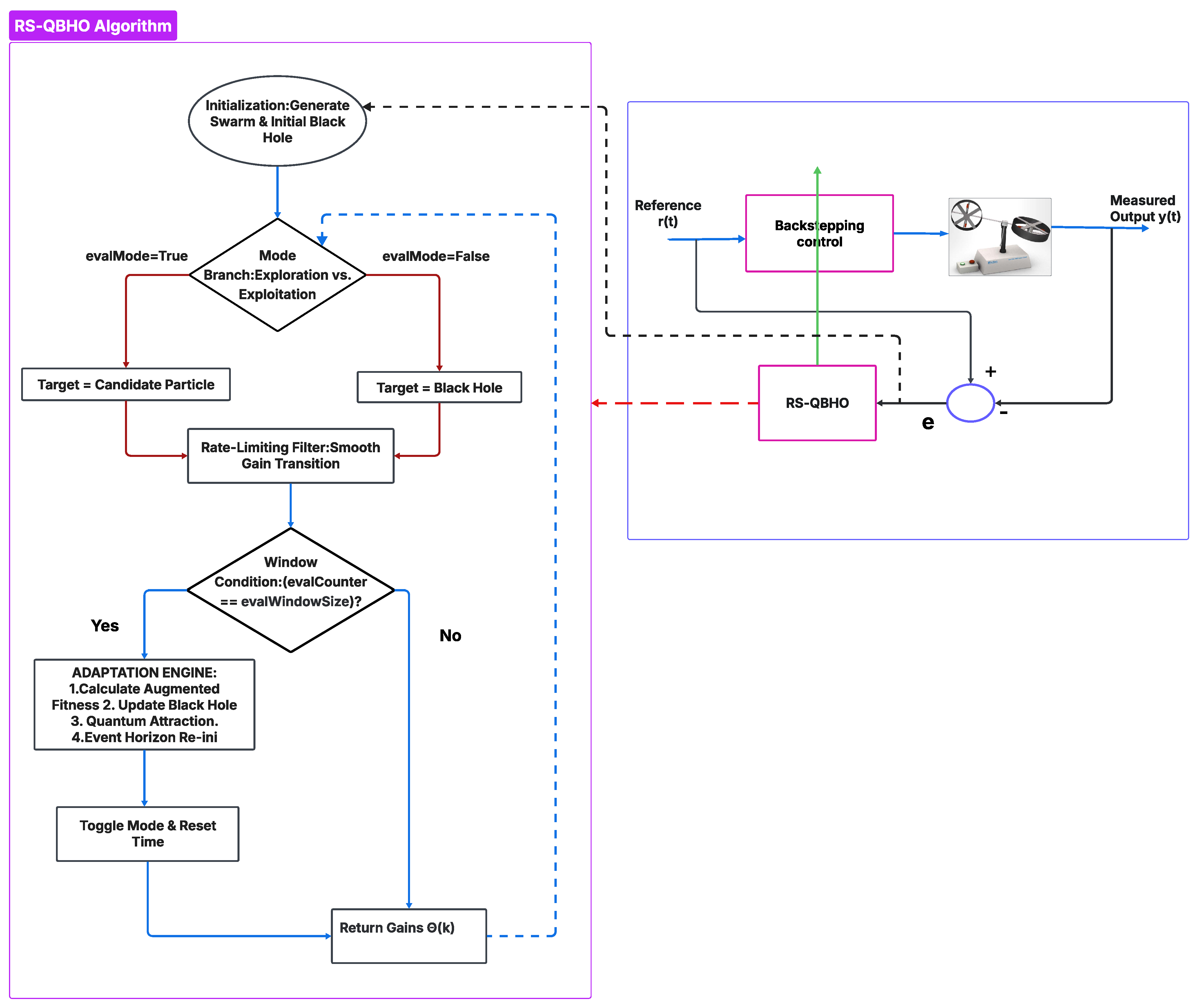
While the Hybrid BSMC architecture provides structural robustness against unmodeled dynamics, its tracking performance is highly sensitive to the selection of the control gains. To address this sensitivity, we propose the Rate-Constrained Sequential QBHO (RS-QBHO), which introduces three key innovations beyond the standard QBHO framework [
28]:
(1) Sequential single-candidate evaluation, which reformulates the standard batch population evaluation (all
N candidates per iteration) into a time-distributed process evaluating only one candidate per sample period, thereby resolving the real-time computational bottleneck;
(2) a rate-limiting transition filter that smooths inter-candidate gain transitions to prevent mechanical stress in the physical actuators; and
(3) a stability-augmented fitness function that penalizes aggressive parameter deviations, preventing plant destabilization during the online exploration phase. These innovations make the algorithm deployable within the strict
s real-time loop of the TRMS rig.
Consistent with the decentralized control topology established in
Section 3, we implement an intelligent adaptation layer comprising two parallel instances of the RS-QBHO algorithm.
4.1. Decentralized Optimization Topology
Optimizing the full gain vector simultaneously in real-time can lead to slow convergence due to the “curse of dimensionality.” To ensure rapid adaptation, the tuning problem is decomposed into two lower-dimensional subspaces:
Pitch Optimizer: Tunes by minimizing the pitch tracking error .
Yaw Optimizer: Tunes by minimizing the yaw tracking error .
Both optimizers operate independently but simultaneously, treating the aerodynamic cross-coupling effects as exogenous disturbances to be rejected.
4.2. Sequential Evaluation Logic
Standard meta-heuristics require evaluating an entire population in a single iteration, which is computationally prohibitive for real-time control loops ( s). To resolve this, the proposed RS-QBHO reformulates the optimization as a sequential process distributed over time. Each optimizer manages a swarm of particles. The algorithm evaluates only one candidate per subsystem at a time, alternating between two operational modes.
The swarm size represents a balance between exploration diversity and computational feasibility for real-time deployment: it is large enough to sample the gain space representatively across the sinusoidal reference cycle while ensuring that all candidates can be evaluated within a practically relevant time horizon. The evaluation window samples (0.5 s) was empirically calibrated such that sufficient ITAE accumulation occurs within the expected settling dynamics of each TRMS subsystem, while remaining short enough to allow multiple candidate evaluations before aerodynamic operating conditions change significantly. This sequential architecture reduces the per-sample computational burden to a single ITAE accumulation, one rate-limited gain update, and a quantum attraction step executed only at window boundaries—making the algorithm fully compatible with the strict s control loop.
4.2.1. Exploration Mode (Test Phase)
For a deterministic window of
samples, the controller applies the gains from the
i-th candidate particle
. The system’s tracking performance is monitored using the subsystem-specific Integral of Time-weighted Absolute Error (ITAE):
where
.
4.2.2. Exploitation Mode (Settle Phase)
Immediately following the test phase, the algorithm reverts to the current “Black Hole” (global best) gains . This phase is critical for experimental safety, as it allows the TRMS to stabilize and eliminates residual transient effects before the next candidate is evaluated.
4.3. Rate Limiting and Stability Augmentation
To prevent “Gain Jitter” and mechanical stress on the TRMS propellers, two safety mechanisms are integrated into the adaptive law.
1. Rate-Limiting Transition: The transition between the current gains and the target gains (
) is smoothed using a first-order lag filter:
where
is the smoothing factor. The value
was selected through a sensitivity study: smaller values produce smoother transitions but slow adaptation, while larger values risk introducing gain jitter. This value was found to provide the best compromise between adaptation speed and actuator smoothness under the TRMS operating conditions.
2. Augmented Fitness Function: To encourage smooth adaptation, the fitness function
incorporates a stability penalty based on the parameter deviation:
where
is the stability weighting factor. The coefficient
was chosen to impose a soft penalty on large parameter deviations without overly constraining the search space. A sensitivity analysis confirmed that values in the range
yield stable operation on the physical rig, with lower values prioritizing tracking accuracy and higher values prioritizing parameter smoothness. The selected value of
provides the optimal trade-off under the identified TRMS operating envelope. This ensures that the optimizer seeks gains that provide high tracking accuracy without inducing aggressive parameter fluctuations.
4.4. Quantum Update Law
At the end of an evaluation cycle, the swarm evolves. If the tested particle outperforms the Black Hole for its respective axis, it captures the global best position. The remaining particles are then updated via the quantum attraction rule derived from Hatamlou [
28]:
where
is a stochastic vector representing the quantum uncertainty. The complete sequence of the RS-QBHO tuning process is summarized in Algorithm 1, and the overall adaptive architecture is illustrated in
Figure 2.
| Algorithm 1 Online RS-QBHO Tuning (Executed for Pitch and Yaw in Parallel) |
- Require:
Subsystem error , previous gains , rate limit , stability weight . - Ensure:
Tuned gains . -
Initialization (First Call Only): - 1:
Initialize particles and set - 2:
Set , , -
Main Execution (Per Sample k): - 3:
- 4:
▹ Accumulate ITAE - 5:
if
then - 6:
▹ Test Candidate - 7:
else - 8:
▹ Settle at Best - 9:
end if - 10:
▹ Apply Equation ( 40) - 11:
if
then - 12:
if then - 13:
Compute fitness using Equation ( 41) - 14:
Update - 15:
Evolve swarm using Quantum Update Equation ( 42) - 16:
- 17:
end if - 18:
, , - 19:
end if - 20:
Return
|
6. Real-Time Experimental Validation and Discussion
The transition from a deterministic numerical environment to a physical laboratory setup represents the most rigorous validation for any flight control strategy. While simulation results established a theoretical baseline, the physical TRMS rig introduces non-linear friction, mechanical cable tension, and high-frequency aerodynamic turbulence that are omitted in idealized models. This section details the hardware-in-the-loop (HIL) configuration and provides a comparative critique of the performance trade-offs between the proposed intelligent and robust strategies.
6.1. Experimental Setup and HIL Configuration
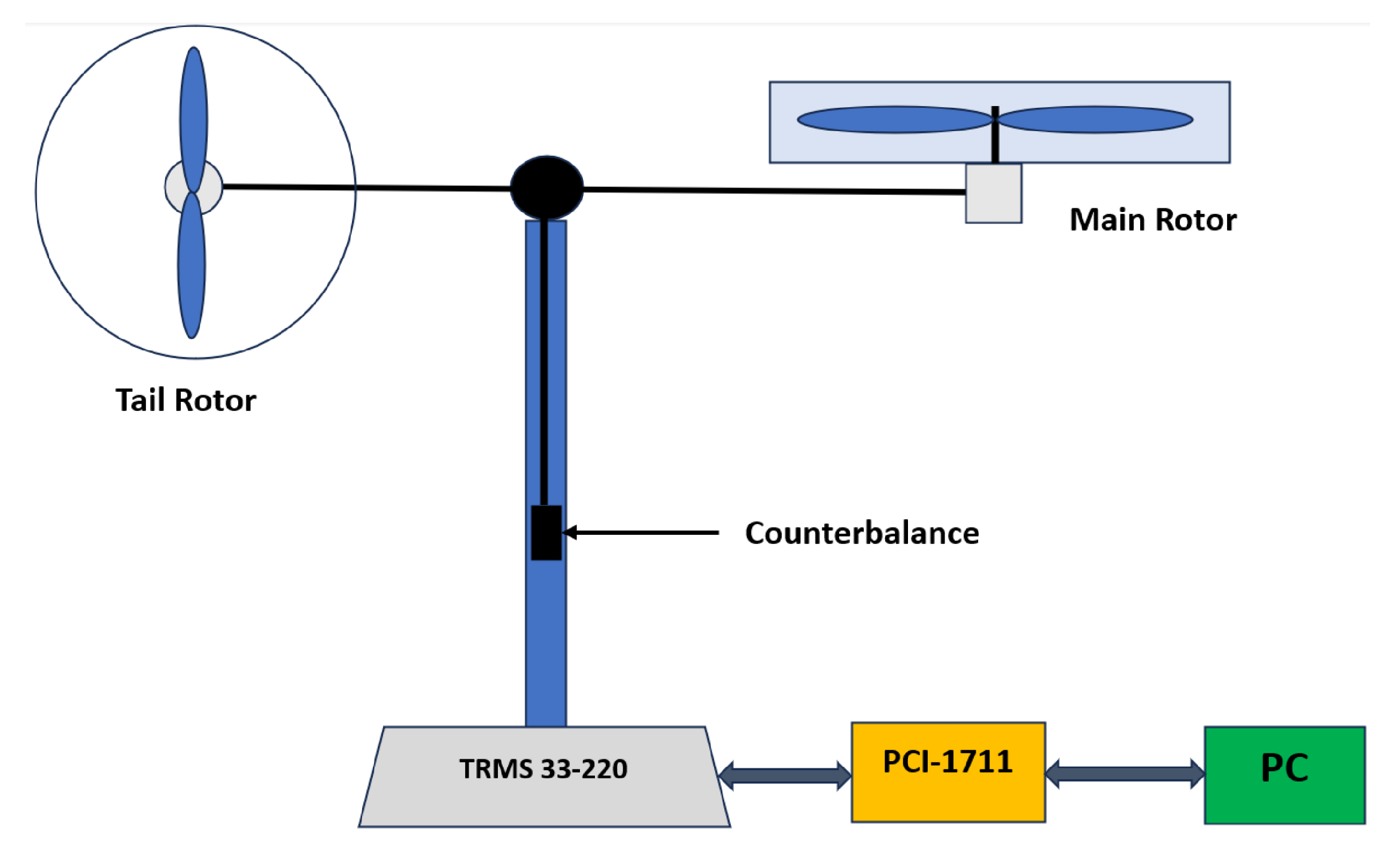
The experimental platform utilized in this study is the Twin Rotor Multi-Input Multi-Output System (TRMS), shown in
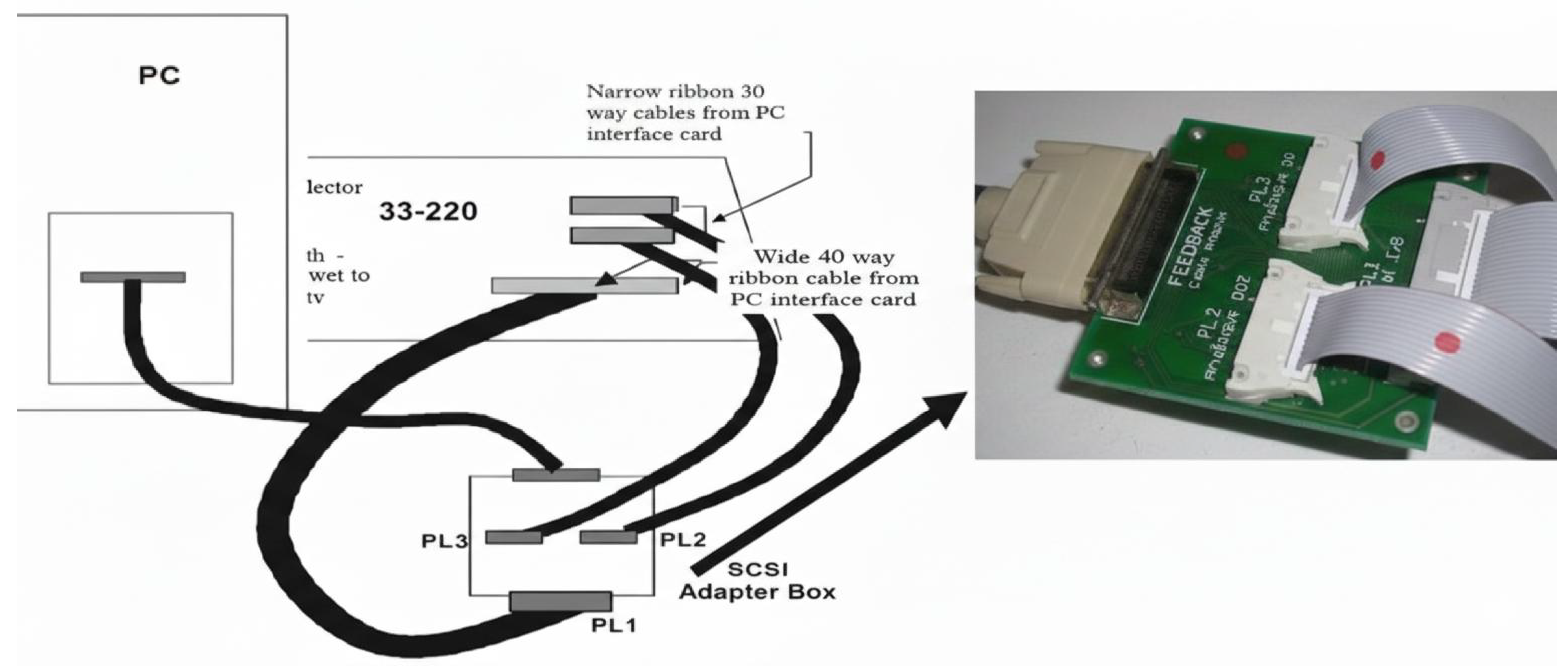
Figure 1, a high-fidelity laboratory benchmark. To bridge the gap between the discrete control law and the continuous plant dynamics, a deterministic HIL architecture was established, as illustrated in
Figure 6.
The workstation, operating under the Simulink Desktop Real-Time kernel, executes the control algorithms at a sampling frequency of 100 Hz ( s). Interfacing with the TRMS rig is facilitated by an Advantech PCI-1711 (Advantech Co., Ltd., Taipei, Taiwan) data acquisition board. This card serves as the critical communication bridge, utilizing its 12-bit DAC channels to modulate the motor voltages while simultaneously processing high-speed digital pulses from the quadrature optical encoders. With a sensing resolution of 2000 pulses per revolution, the HIL setup provides the high-fidelity state feedback necessary for the derivative-intensive Backstepping terms. To ensure the safety of the DC motors, all control commands were strictly saturated at V.
6.2. Empirical Evaluation of the Conventional Backstepping (Baseline)
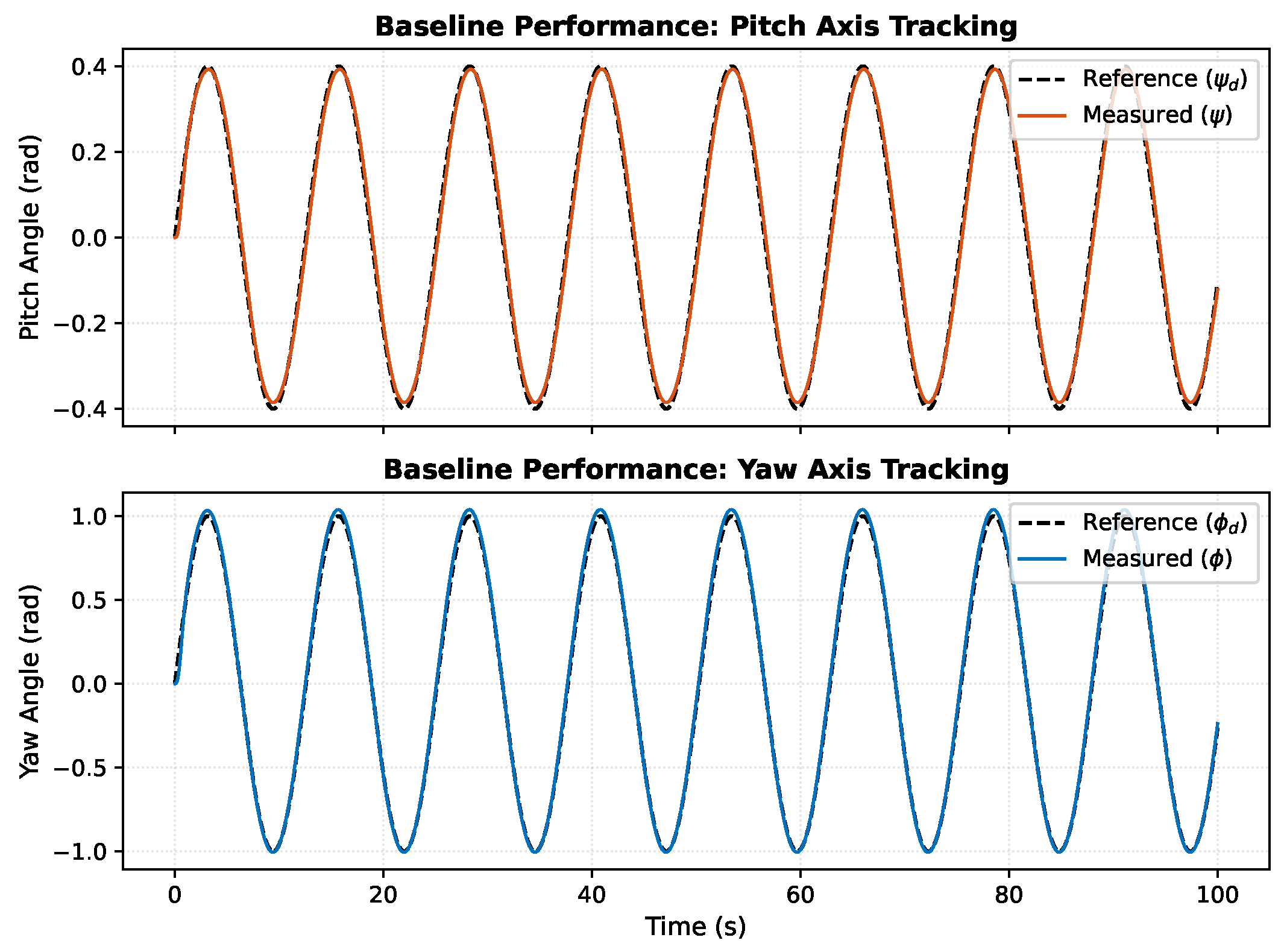
The experimental sequence began with the deployment of the Conventional Backstepping controller derived in
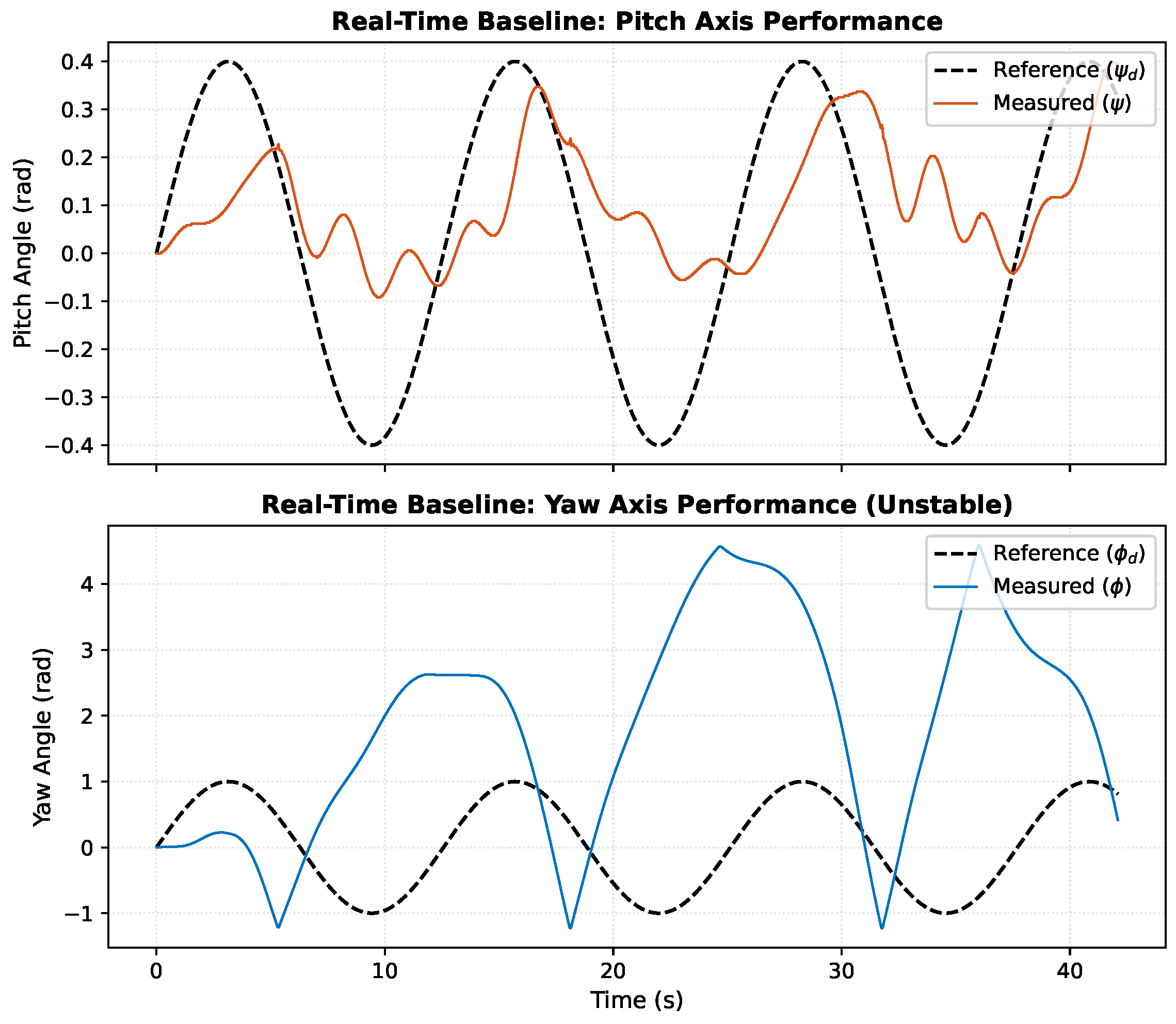
Section 2. While numerically stable in simulation, the physical results (
Figure 7) revealed a significant and quantifiable sensitivity to model mismatch. Although the pitch axis maintained marginal stability, the yaw subsystem suffered from
divergent oscillations, yielding a failure-state RMSE of
rad.
This instability is a direct consequence of the “model-reality gap.” The physical tail rotor is subjected to significant aerodynamic drag and friction that were not captured in the nominal design model. Because standard Backstepping relies on the exact cancellation of dynamics, these unmodeled terms were interpreted by the recursive law as state variations, causing the controller to over-compensate and drive the yaw subsystem into an unstable limit cycle. This observation underscores the necessity of the robust and adaptive layers proposed in this study.
6.3. Intelligent Adaptation via Online RS-QBHO
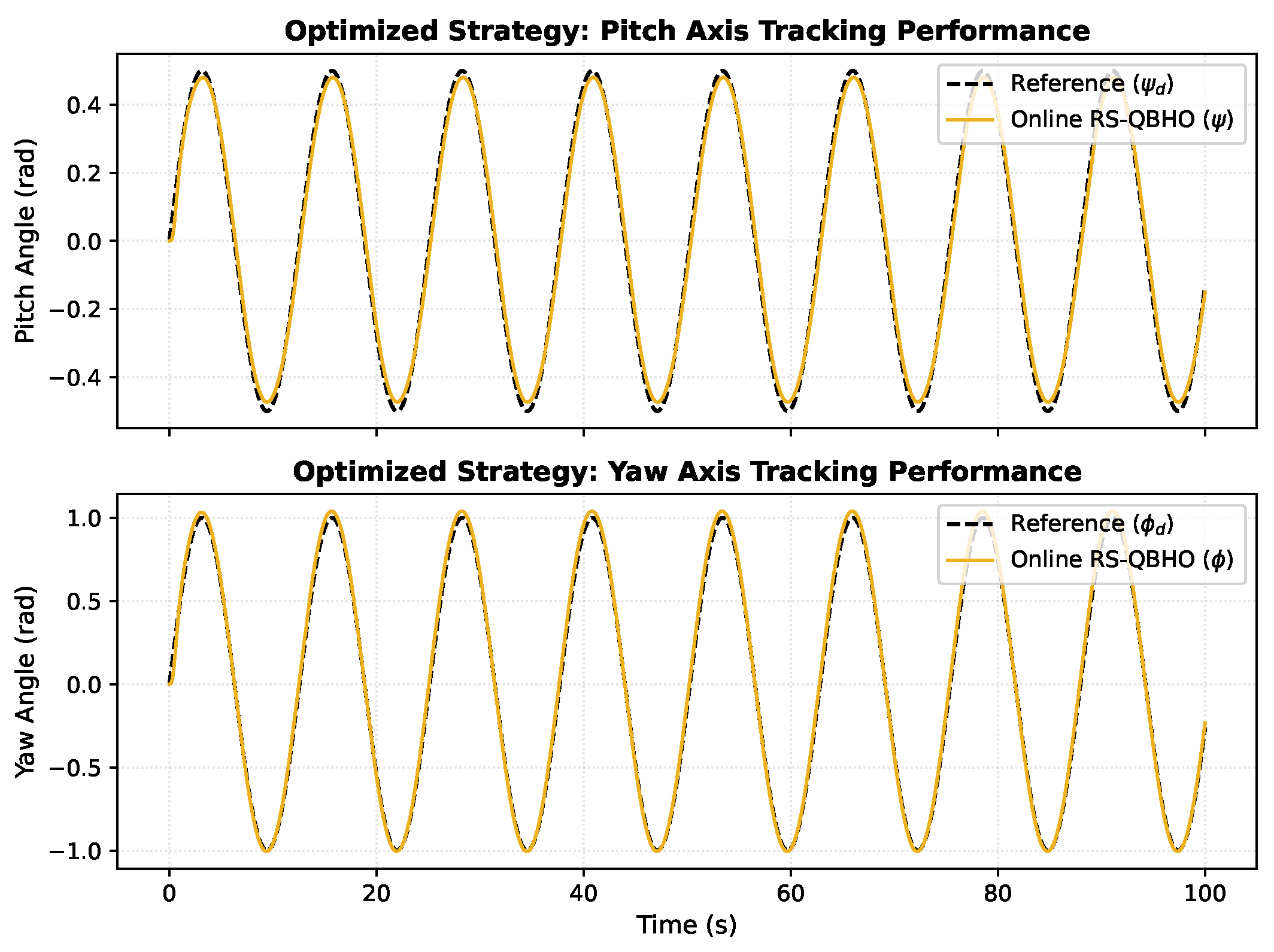
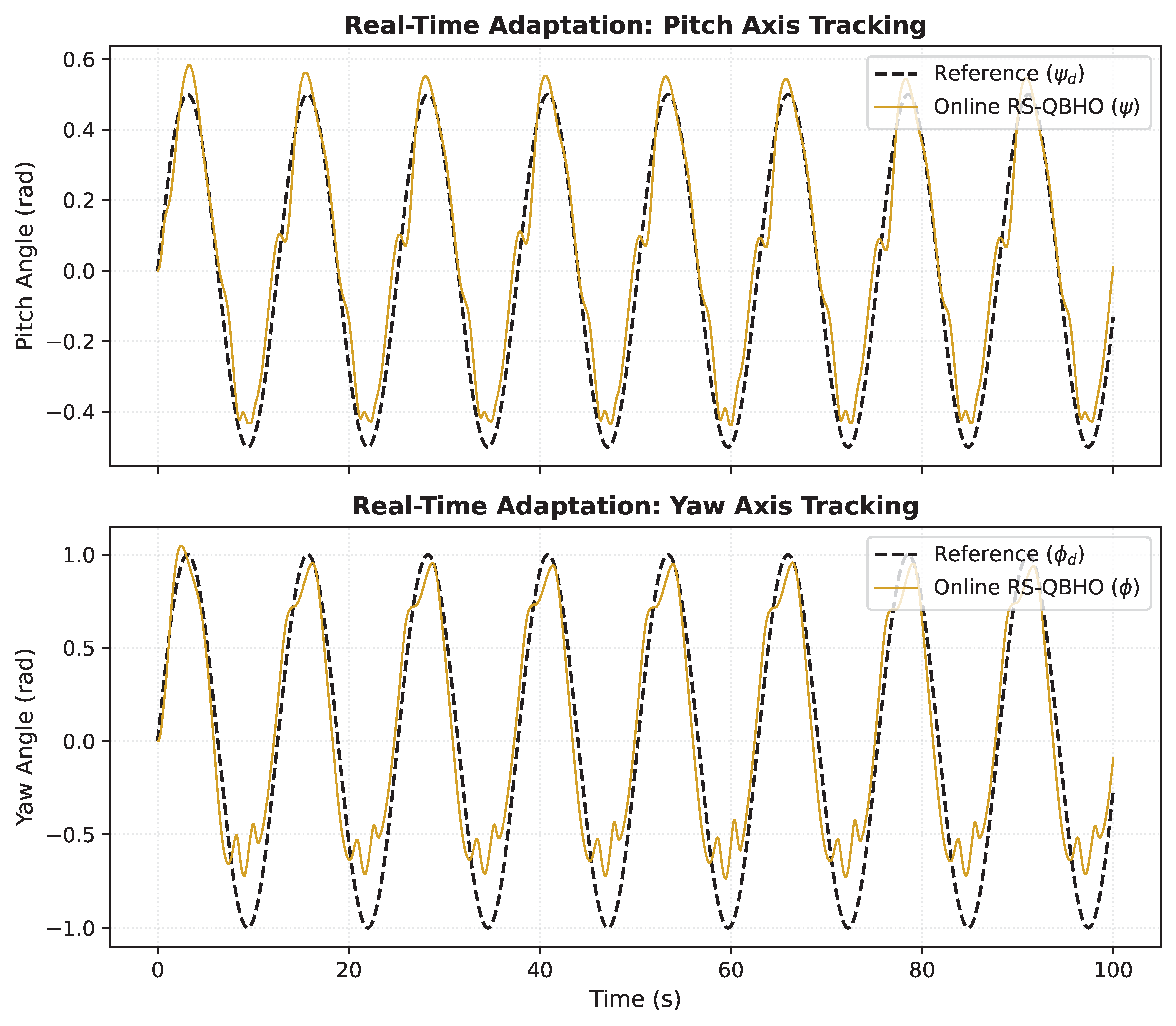
To address the baseline failure, the Online RS-QBHO strategy was implemented. As shown in
Figure 8, the adaptive tuner successfully stabilized the plant. By sequentially evaluating candidate gain sets, the algorithm identified the optimal stiffness required to reject the physical cross-coupling.
MIMO Parameter Convergence Analysis
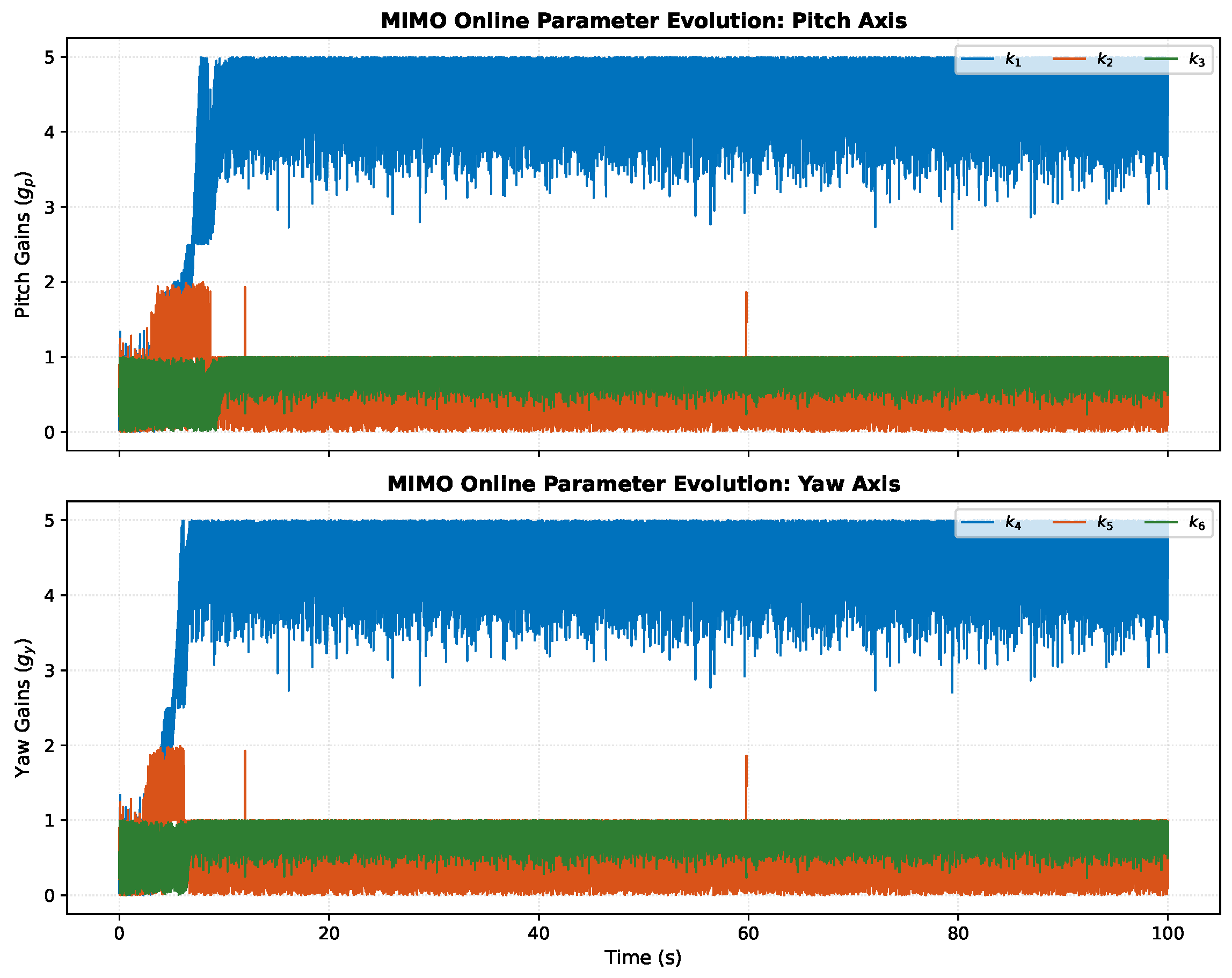
The real-time evolution of the 6-DOF control gains is presented in
Figure 9. A rigorous analysis of these trajectories reveals a distinct two-stage adaptive process. During the first 10 s, the swarm undergoes an intensive
exploration phase, characterized by high-frequency parameter fluctuations as the QBHO evaluates the initial population. Following this transient, the gains converge toward an optimal “uncertainty cloud.”
Notably, the proportional gains (
and
) reach the predefined saturation limit of
, suggesting that the algorithm correctly identified the maximum allowable loop-gain to minimize tracking error within the safety bounds of the “event horizon.” The derivative and integral gains exhibit smooth, bounded variations, providing empirical proof that the rate-limiting filter (Equation (
40)) effectively suppresses gain jitter. This sustained adaptation allows the controller to remain optimal even as the aerodynamic conditions vary throughout the sinusoidal cycle.
6.4. Performance Analysis of the Hybrid BSMC
Strategy
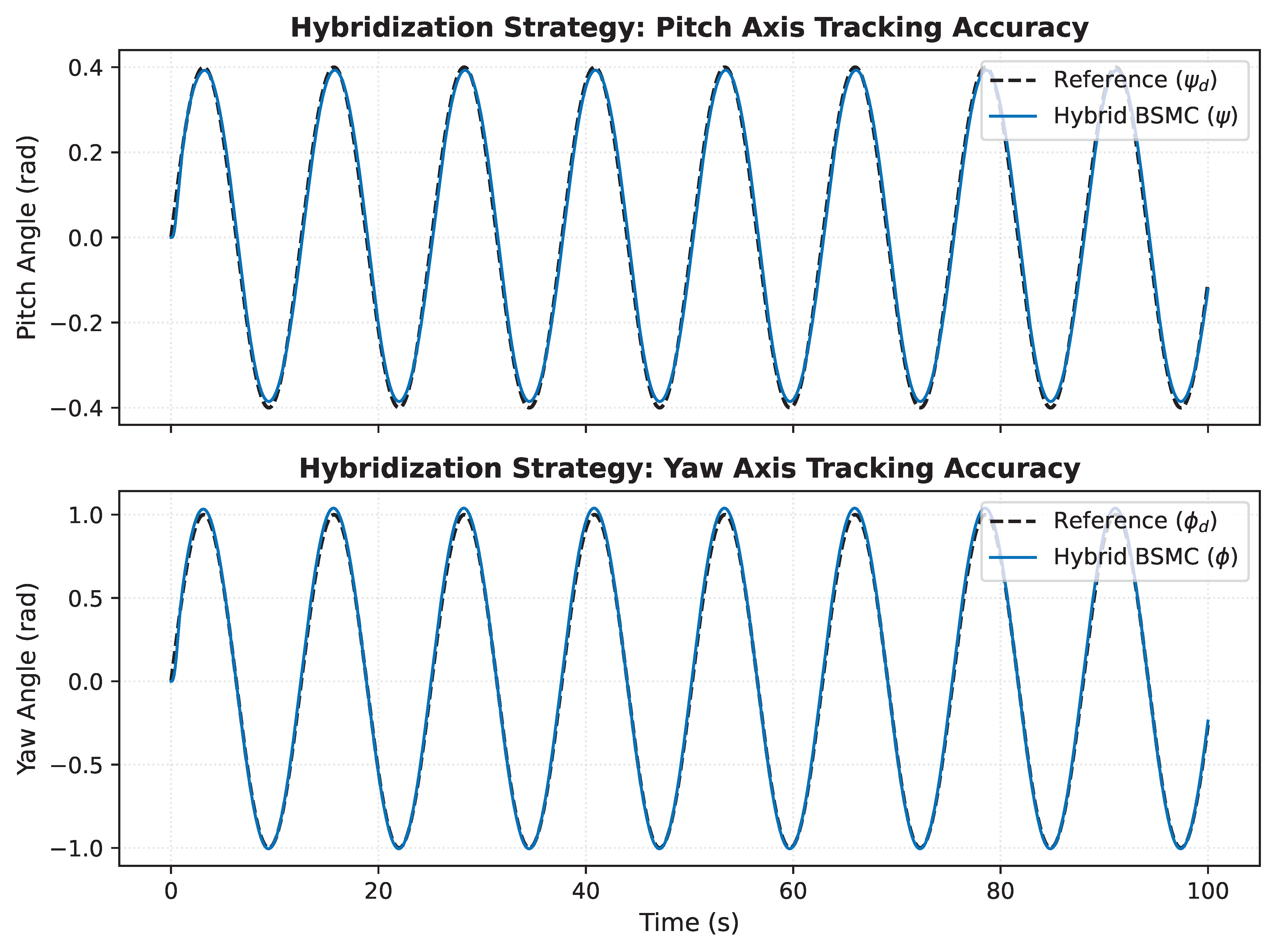
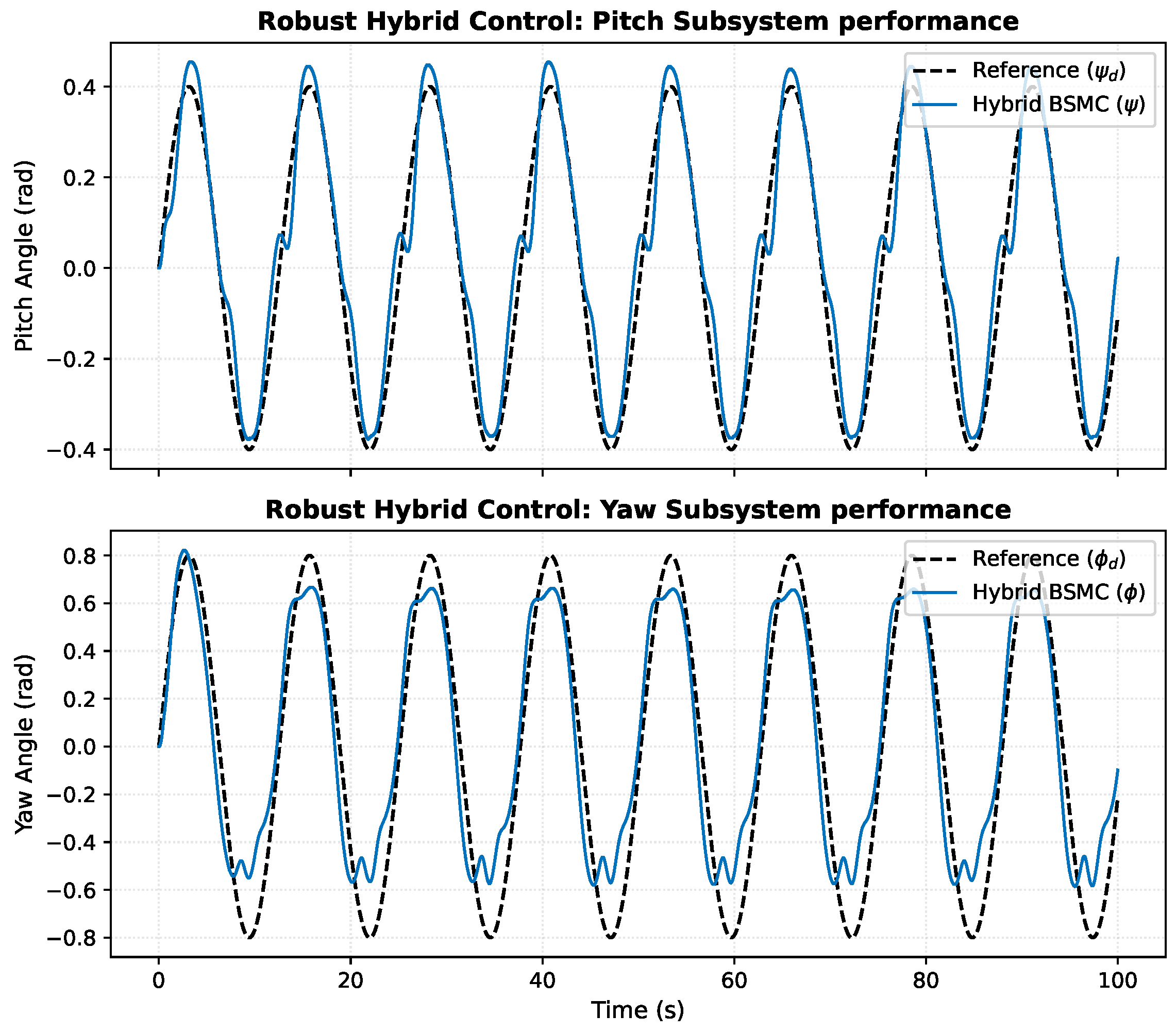
The Hybrid BSMC strategy was subsequently implemented to evaluate structural robustness. As illustrated in
Figure 10, this strategy provided the most consistent tracking performance. Unlike the QBHO, which must iteratively search for optimal gains, the Hybrid BSMC utilizes its sliding mode component to
passively and instantaneously reject disturbances. This allows for superior tracking with significantly reduced phase lag and minimal overshoot compared to the adaptive tuner. The structural robustness is particularly evident in the yaw axis, where the sliding term successfully mitigated the reactive torques generated by the main rotor.
Regarding the chattering behavior inherent to sliding mode control, the -modification of the signum function implemented as with a small boundary layer parameter converts the ideal discontinuous relay action into a smooth, bounded approximation within a thin layer around the sliding surface. This modification confines switching activity to frequencies within the bandwidth of the motor drive system, as confirmed by the physical control signal profiles recorded throughout the 100 s experimental run. No high-frequency mechanical vibration was detected in the rotor shafts, providing empirical evidence that the boundary layer approach successfully suppresses actuator chattering under the operating conditions of the TRMS rig.
6.5. Comparative Synthesis and Quantitative Analysis
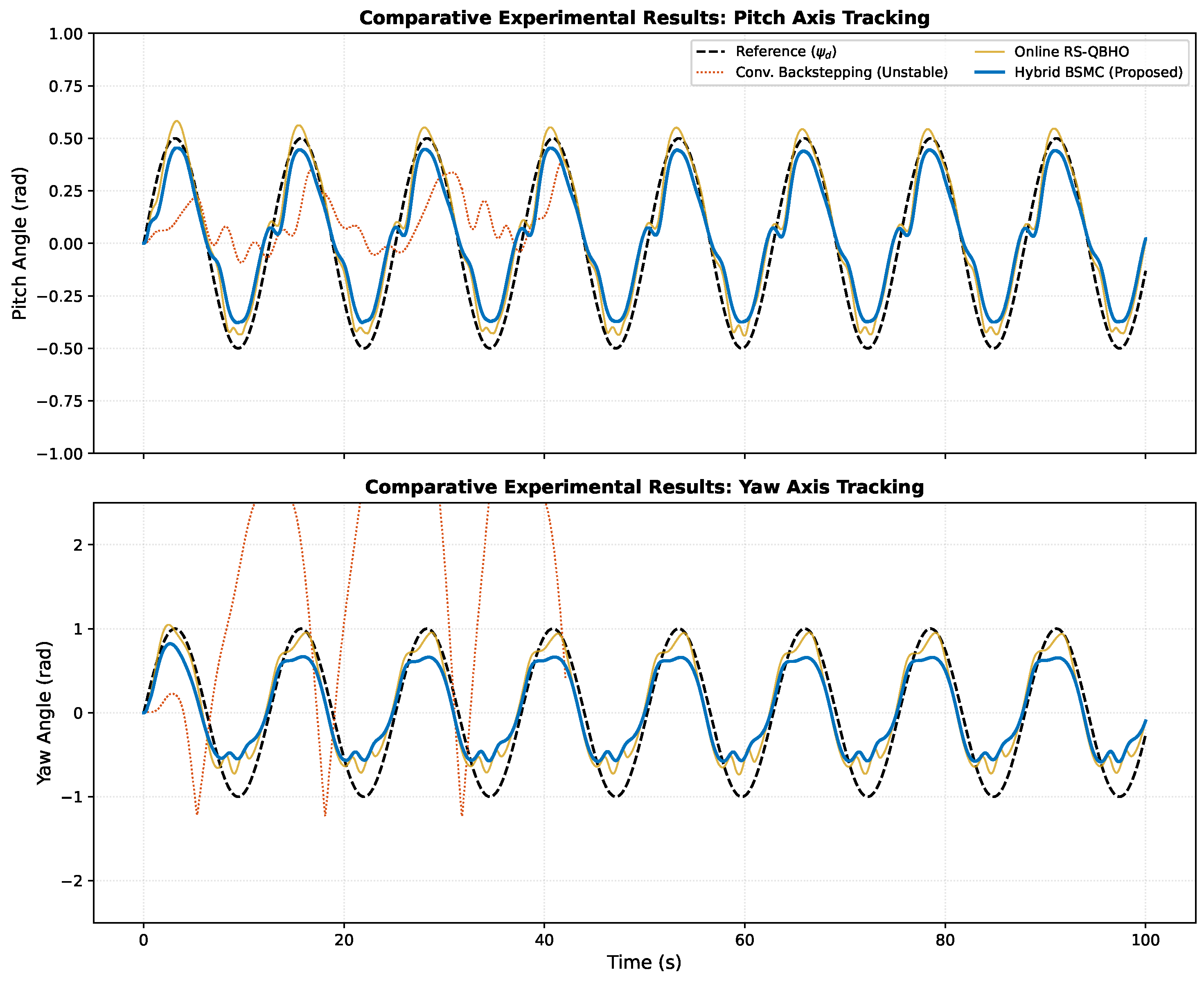
The final comparative performance is summarized in
Figure 11 and
Table 3. While both proposed strategies achieved stabilization, the Hybrid BSMC achieved lower values across all recorded performance metrics, reaching an RMSE of
rad for pitch and the lowest ITAE among all tested controllers.
It is important to interpret the RS-QBHO ITAE values in their correct context. The elevated cumulative error relative to the Hybrid BSMC is primarily attributable to the stochastic exploration transient during the first
s of operation, during which the algorithm evaluates suboptimal candidate gain sets before converging to the global best (as visible in the gain trajectories of
Figure 9). Once convergence is achieved, the steady-state tracking precision as quantified by the post-convergence RMSE is substantially improved relative to the baseline Backstepping controller. This transient exploration cost is an inherent and expected characteristic of online metaheuristic adaptation, and the RS-QBHO remains a viable alternative in scenarios where structural modifications to the control architecture are not permissible.
The synthesis of these results leads to a critical scientific insight: while intelligent meta-heuristic optimization (QBHO) is a powerful tool for compensating for parametric mismatches, the passive structural robustness of a Hybrid BSMC architecture is more efficacious for mitigating the high-dynamic, unmodeled aerodynamic fluctuations of the TRMS platform.
7. Conclusions
This study presented a comprehensive comparative evaluation of three nonlinear control strategies on the Twin-Rotor MIMO System (TRMS), bridging the gap between theoretical derivation and physical implementation. By deploying each controller under identical hardware-in-the-loop conditions, we exposed the inherent fragility of purely model-dependent control and validated two advanced layers, intelligent adaptation and structural robustness, as effective mechanisms for ensuring flight stability in the presence of unmodeled dynamics.
The experimental findings yield three principal scientific insights. First, the Conventional Backstepping controller, despite its mathematical guarantees under nominal conditions, failed on the physical rig due to the “simulation-to-reality” discrepancy: unmodeled aerodynamic drag and non-linear friction were misinterpreted by the recursive law, driving the yaw subsystem into divergent oscillation with a failure-state RMSE of 2.5624 rad. Second, the Online RS-QBHO strategy demonstrated the effectiveness of intelligent adaptation, successfully navigating the non-convex parameter space to achieve stabilization. The elevated ITAE relative to the Hybrid BSMC is attributable to the initial stochastic exploration phase and represents an expected, transient cost of online learning rather than a deficiency in steady-state performance. Third, the Hybrid BSMC architecture proved to be an effective and practically validated approach for high-dynamic aerodynamic MIMO systems: by integrating a sliding mode switching term into the Backstepping framework, the controller passively and instantaneously rejected unmodeled disturbances without requiring a learning phase, achieving the lowest RMSE values of 0.0682 rad and 0.1858 rad for the pitch and yaw subsystems, respectively.
In conclusion, this work demonstrates that while meta-heuristic optimization is an invaluable tool for parametric gain-scheduling, the direct, passive rejection capability of a hybrid robust architecture is more efficacious for mitigating rapid, unmodeled aerodynamic fluctuations of MIMO flight platforms. It should be noted that the experimental validation was conducted under fixed environmental conditions, and the robustness of both proposed architectures under time-varying parametric perturbations or structured external disturbances remains a subject for future investigation. Future research will focus on the integration of neural-network-based observers to provide active estimation of the unmodeled dynamics, potentially combining the strengths of intelligent estimation with the proven stability of structural sliding-mode robustness, while also extending the validation to more extreme, disturbance-rich flight-like scenarios.



 ,
,