
Article

Attitude Control of a Vehicle with Active Airfoil and Suspension Systems Using Integral Action for Body Angle and Tire Deflection

Department of Mechanical and Aerospace Engineering, Gyeongsang National University, 501 Jinju-daero, Jinju 52828, Gyeongnam, Republic of Korea
*
Author to whom correspondence should be addressed.
Actuators 2026, 15(6), 317; https://doi.org/10.3390/act15060317 (registering DOI)
Submission received: 13 March 2026 / Revised: 29 April 2026 / Accepted: 1 June 2026 / Published: 4 June 2026
(This article belongs to the Special Issue Actuation and Robust Control Technologies for Aerospace Applications)

Abstract

This paper presents a novel approach to design an attitude motion control strategy of a vehicle to mitigate lateral or longitudinal inertial forces acting on the passenger during cornering, braking, and acceleration maneuvers. The collaboration of active suspension system and active airfoil substantially enhances the attitude motion of a vehicle. By incorporating integral control action for both the desired body attitude roll or pitch angle and zero dynamic tire deflection within the performance index, the optimal controller maintains the ideal roll or pitch angle while preserving the road holding capability. The computer simulations were conducted to evaluate the dynamic performance of the proposed system in comparison with various other suspension systems based on a 4-degree-of-freedom half-car model. Four scenarios for rolling and pitching motions were simulated as follows: the first case examines the rolling response to a one-sided bump input applied to a lateral half-car model during straight-line driving. The second case investigates the rolling performance during a cornering maneuver. The third and fourth cases analyze the pitching responses to braking and acceleration using a longitudinal half-car model. The simulation results demonstrate that the proposed system maintains the ideal body attitude, attenuates the effect of the lateral or longitudinal inertial forces and keeps an ideal road holding capability. As a result, the proposed control system substantially improves ride comfort while enhancing the dynamic safety of the vehicle.

1. Introduction

1.1. Vehicle Suspension System

The vehicle suspension system is an integral component of a vehicle designed to enhance both ride comfort and handling capability. Suspension systems connect the wheels to the chassis and attenuate the transmission of external disturbances between the road and the vehicle body. Various suspension systems are employed in road vehicles. The passive suspension system (PSS) is widely used in the automotive industry owing to its simple structure and low cost. However, it cannot offer robust performance across varying speeds and different road conditions [1,2]. Semi-active suspension systems (SASS) require minimal energy to adjust the damper orifice in response to the driving irregularities. But due to the nonlinear control architecture and hysteretic behavior, it can only dissipate energy [3]. The active suspension system (ASS) is widely reported for its adaptive characteristics and vibration-isolation performance [4]. The active actuator force of ASS can effectively improve ride quality and handling performance by effectively attenuating the impact of external road-induced excitations and inertial body forces [5,6].

1.2. Literature Review

Generally, ride comfort and road holding are regarded as conflicting objectives [7,8]. In the past, numerous control approaches and techniques have been developed to optimize the suspension performance for different vehicle configurations and operating conditions [9,10]. For better ride comfort and road holding, a hybrid proportional–integral–derivative sliding mode controller (PID-SMC) was employed to mitigate parametric uncertainties and external disturbances. Results indicate a decrease in body displacement and vertical acceleration in the quarter-car model [11]. In a related study, a non-linear ASS for a full-car model was investigated using SMC. The control design was further enhanced by modifying the sliding surface using a PID controller combined with particle swarm optimization (PSO) to minimize the undesirable effect on heave, roll, and pitch motion. A 60% improvement in disturbance rejection under double-road bump excitation was reported [12].
Many works also consider the preview controller, which consists of a feedback and a feedforward controller. In this regard, ref. [13] established a predictive control strategy utilizing a preview controller that was applied to a half-car model for attitude tracking control. The proposed controller successfully mitigated the effects of hypothetical inertial forces on the suspension system, achieving the desired roll and pitch motions. However, the dynamic deformation and suspension travel requirement were not considered. In another study, a preview controller employing light detection and ranging (LiDAR) technology was applied to extract bump and dip features from the road surface. Through adaptive smoothing, the reported results demonstrated high accuracy and robustness in road profile estimation. However, the study focused solely on the recognition of the bump and dip irregularities, and the potential offset in the preview performance was reported for only a limited number of scanning layers [14]. A preview-based optimal disturbance-mitigation linear-quadratic (LQ) controller was developed using both quarter-car and half-car models. By introducing a virtual disturbance (VD), the proposed approach achieved a significant reduction in sprung-mass response, with a decrease of 41% in vertical acceleration and 84% in pitch rate, contributing to improved ride comfort and mitigation of motion sickness. However, the study does not address the parametrization of the virtual disturbance, which may affect the practical implementation [15]. To address the adverse effect of time delay in the suspension system under broadband road excitation, a vibration-reduction control strategy incorporating time-varying delay compensation (TVDC) was developed. A short-time Fourier transform (STFT) was conducted to establish time–frequency analysis for a given preview length. The control parameters were optimized using particle swarm optimization (PSO). Compared with the conventional control design, the proposed approach achieved a notable reduction in the RMS values of the vehicle body displacement, velocity, and acceleration, demonstrating enhanced ride comfort performance [16].
Improving the attitude motion of the road vehicle requires mitigating the effect of external body inertial forces while maintaining a stable body posture [17]. In this regard, an active tilting control structure was implemented on a full-car model using AS to reduce lateral acceleration. The simulation results highlighted how the control design effectively skewed the vehicle inward during certain steering maneuvers. However, ride comfort was degraded due to the increase in angular acceleration introduced by the integral base H-infinity controller [18]. Tchamna employed a variable-stiffness-based attitude-control strategy for a ground-vehicle linear model using ASS and SASS. The primary objective was to examine how different SASS configurations can closely approximate the performance of ASS, during various cornering maneuvers. Despite these contributions, the reported work mainly focused on improving the rolling performance and minimizing the deviation in the suspension working space [19]. Wu-Liang investigated an active disturbance rejection control (ADRC) strategy to address the attitude-tracking problem of a nonlinear ASS. The effectiveness of the proposed algorithm was validated on a four-wheel-leg-vehicle (FWLV), demonstrating improved control performance. A sinusoidal and road–pavement dynamic excitations were considered for external disturbance attenuation analysis. However, the study primarily focused on the tracking stability of the vehicle due to the differences in stability-time caused by the signal delay [20].
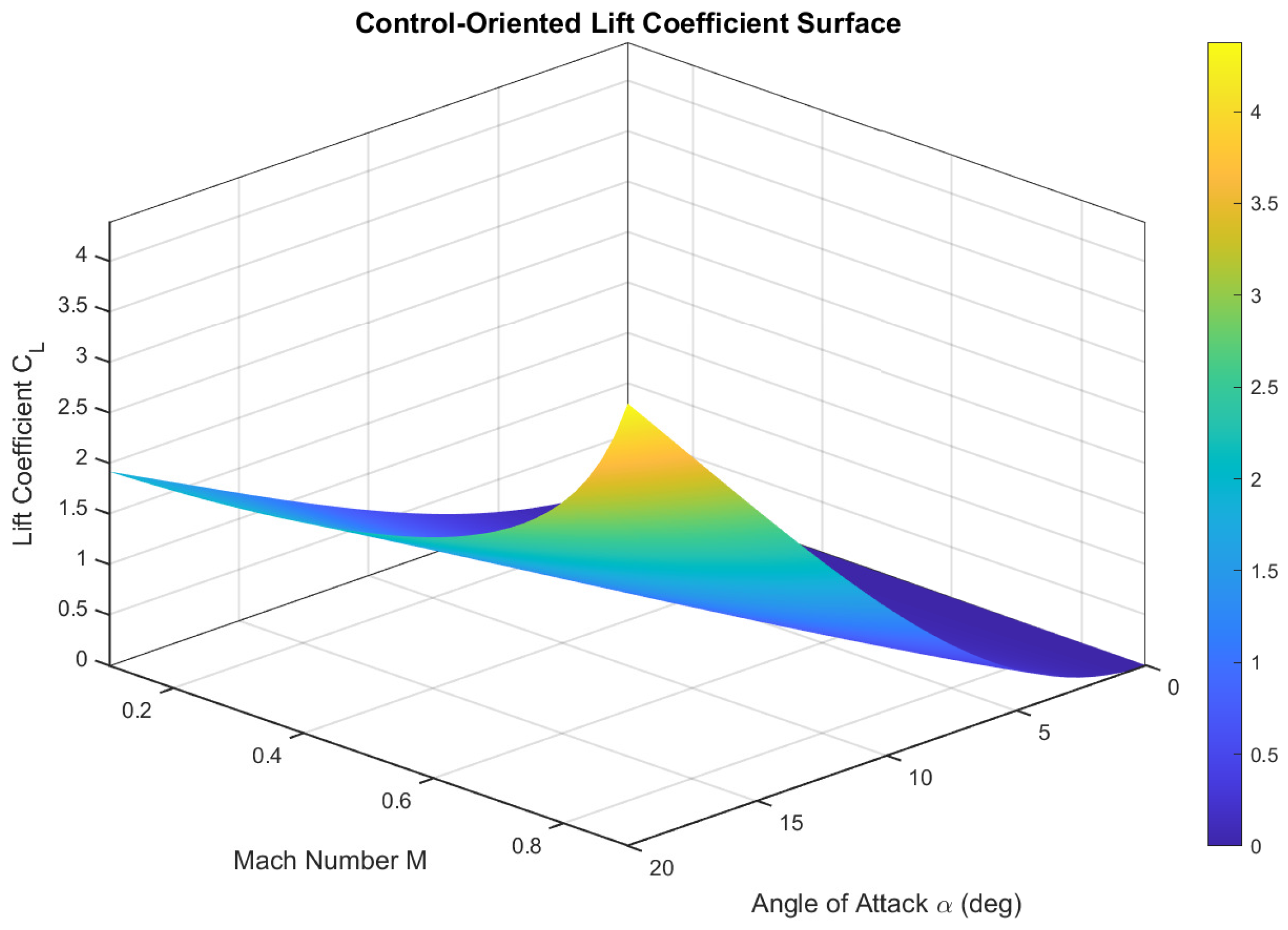
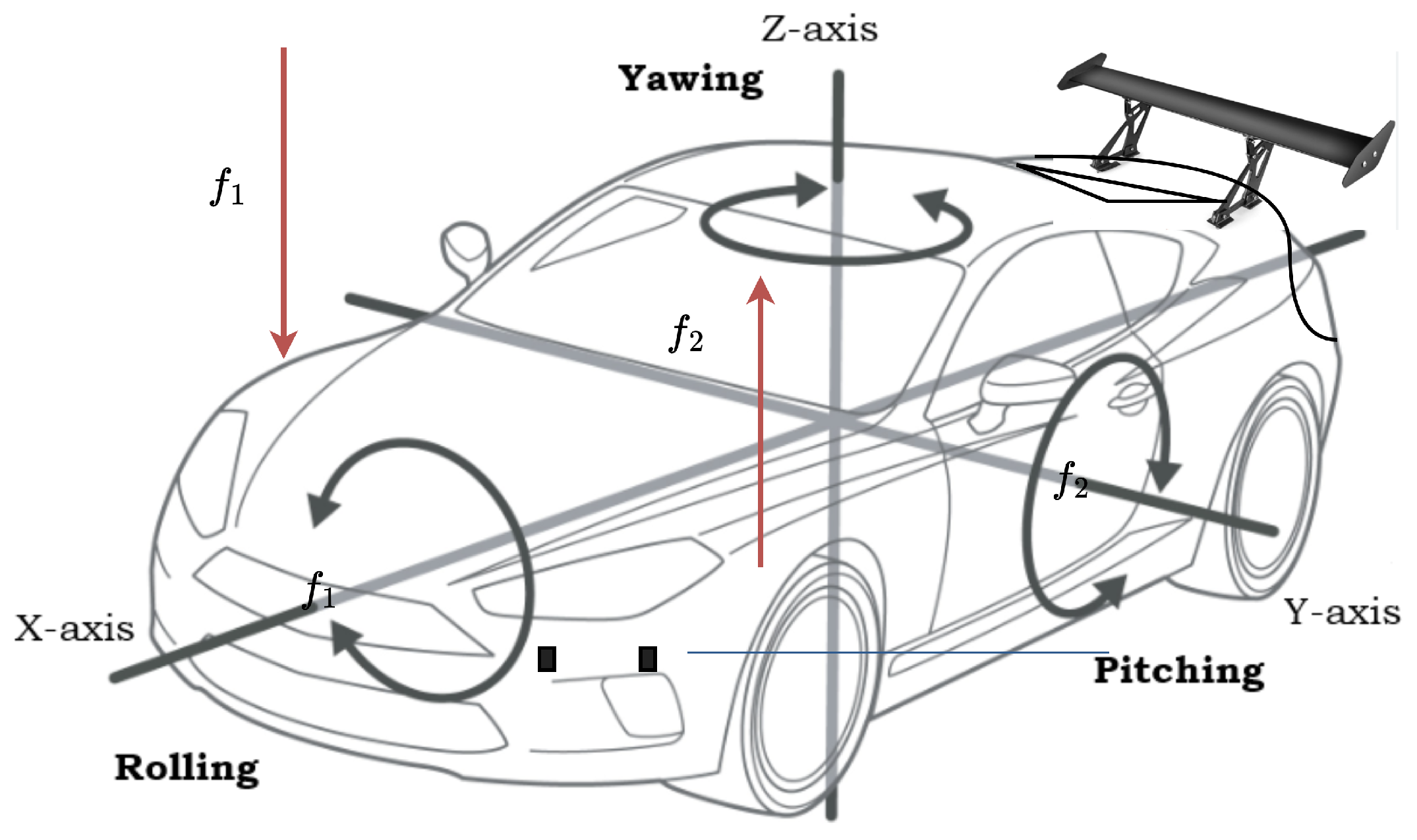
The existence of a pressure difference between the upper and lower surfaces of the airfoil generates a net lift force. Figure 1 illustrates that the pressure gradient depends on the Mach number, relative velocity, angle of attack, and airfoil geometry [21]. To circumvent the effect of the upward lift force, inverted wings are installed to produce a ’negative lift’ or ’downward’ force. This downward force generated by the rear wings can increase the traction force and the cornering speed of the high-performance sports car during sharp turns. This force also prevents the slipping of the tire and unbalanced force due to the lateral load transfer [22]. Figure 2 shows the rear spoiler mechanism, featuring a movable spoiler on the trailing edge, which changes the vehicle’s vertical load dynamics. This not only reduces the braking distance and time but also enhances the handling performance of the vehicle [23,24].
To study the impact of downward aerodynamic force, a wind tunnel test was conducted on a car model with several aerodynamic moving elements and moving spoiler configurations. The computational fluid analysis (CFD) simulation demonstrated that a significant downward force can be generated by mounting AAS on the trailing edge. This not only enhances vehicle performance but also improves stability and fuel efficiency [25]. A predictive control strategy was introduced to reduce the body jerk and enhance driving stability for attitude motion control. The vehicle model was augmented by AAS for the desired angle tracking control. The RMS values of the results indicate reduced jerk and vibration, albeit at the expense of slower angle tracking [26]. A detailed analysis of various physical parameters, including road roughness, velocity, and vehicle mass, was conducted using SASS. The results showcased an approximately 30% improvement in ride comfort at the cost of complex mechatronic circuitry and power requirement [27]. The author in [28] examined the integration of an asymmetrical configuration of an aerodynamic wing on the front or rear axle (or both). The results indicate that the downward aerodynamic force can maximize the dynamic grip utilization under higher lateral and longitudinal acceleration.
Based on the above research findings, this study proposed a novel attitude motion control strategy for a half-car model subjected to road excitations and inertial body forces during different driving maneuvers. By exploiting the aerodynamic force generated by an active airfoil, the pressure loading on the suspension mounting points is evenly distributed during the lateral or longitudinal load transfer. As a result, the proposed approach simultaneously improves both the passenger ride comfort and enhances the tire grip on the road surface while maintaining a stable body attitude. This control strategy ensures leaning inward during cornering, skewing forward during the initial acceleration, and leaning backward during sudden braking. The objectives of the study are briefly summarized as:
  • To develop attitude motion control strategy based on the collaborative mechanism of an active suspension system and aerodynamic system to address passenger ride comfort and handling performance using an optimal controller.
  • The design is further reinforced through the inclusion of integral action for tire deflection and the difference between the actual and desired angle ( ϕ ϕ d ) in the performance index to follow the desired attitude motion and to improve the road gripping performance.
  • To evaluate the performance of the proposed control strategy in the presence of velocity excitation during straight line driving and external inertial forces during rolling and pitching motions.
  • To conduct comprehensive comparative analyses of the proposed system with the conventional configurations of suspension systems to validate the efficacy of the proposed control approach.
The remainder of the paper is organized as follows: Section 2 explains the basic structure of the vehicle modeling, and vehicle Attitude Control against Load Transfer. Section 3 describes the control methodology of the proposed study. Section 4 briefly describes the design of the attitude motion controller. The Results and Discussion are presented in Section 5. Finally, Section 6 concludes the paper while briefly summarizing the study’s research findings.

2. Vehicle Modeling

2.1. Half-Car Dynamic Model

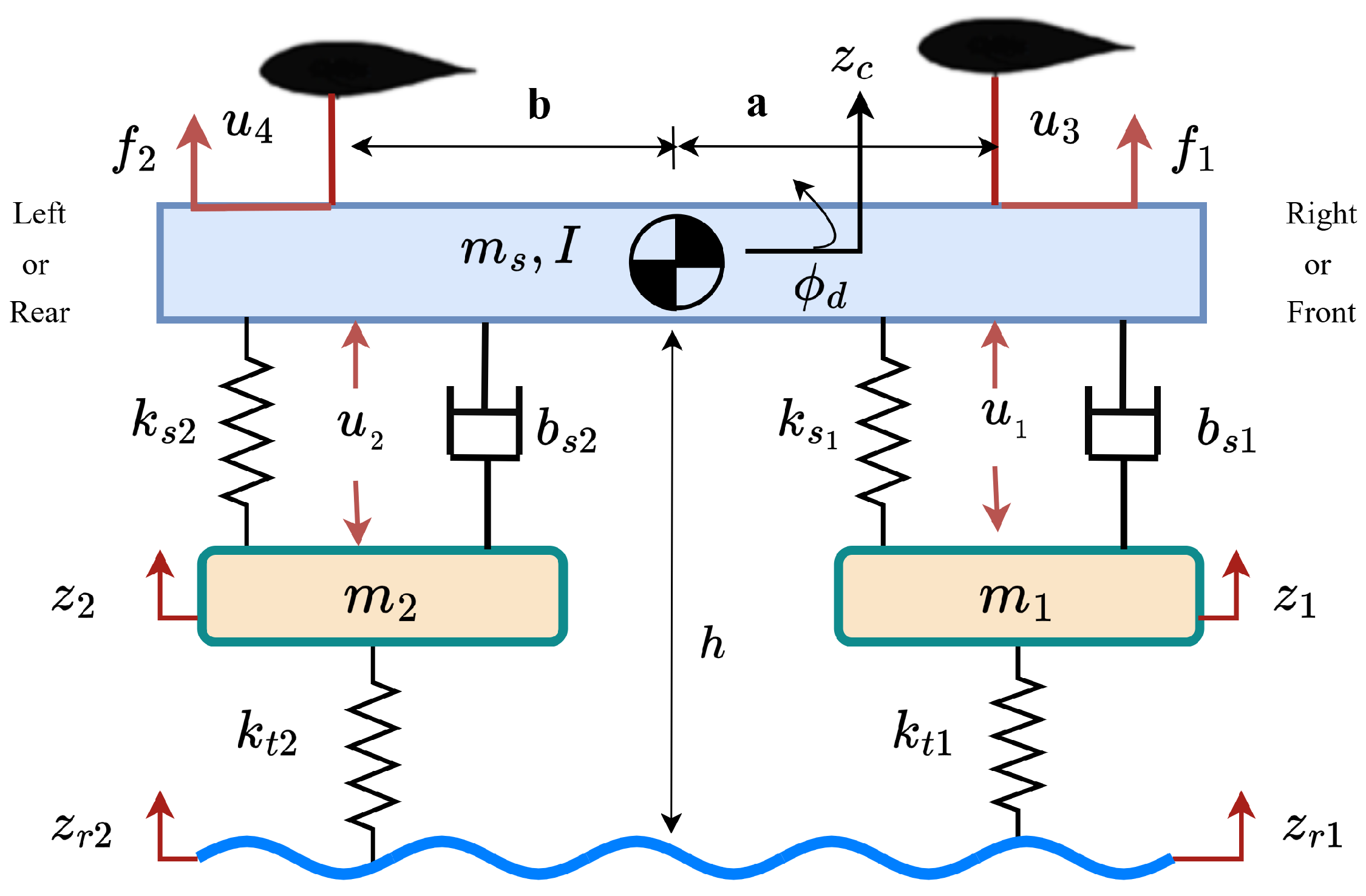
The dynamic analysis model of a 4-DoF half-car for attitude motion control is presented in Figure 3. The linearized half-car model has been widely used in the literature to analyze vehicle suspension [29]. However, the proposed vehicle model provides a reliable approximation of the non-linear vehicle dynamics up to 25 , beyond which its ability to track the system response deteriorates. The figure below illustrates the actuator damping forces, active airfoil force, and body forces acting on the vehicle for both pitch and roll motions.
In our earlier study, this vehicle model was augmented with an active aerodynamic control surface to enhance the performance of the passive suspension system using an optimal preview controller [26]. Equations (1) and (2) give the dynamic equations of motion for heaving and rolling (or pitching) in the fixed-body frame.
m s z ¨ c = f r + u 3 + f l + u 4
I ϕ ¨ = ( f r + f 1 + u 3 ) a ( f l + f 2 + u 4 ) b
where m s is the sprung mass, I is the moment of inertia, and a and b are the distances from the center of mass to the suspension mounting points. The active actuator forces are denoted by u 1 and u 2 , while the active airfoil forces are represented as u 3 and u 4 . The damping forces of the active suspension system act between sprung mass and unsprung mass while the aerodynamic forces act on the right (or front) and left (or rear) side of the vehicle sprung mass. Equation (3) describes the resultant suspension elastic forces of the spring and damper acting at the suspension mounting points.
f r = k s 1 ( z 1 z c a ϕ ) + b s 1 ( z ˙ 1 z ˙ c a ϕ ˙ ) + u 1 f l = k s 2 ( z 2 z c + b ϕ ) + b s 2 ( z ˙ 2 z ˙ c + b ϕ ˙ ) + u 2
whereas z c is the sprung mass heave displacement, k s 1 and k s 2 represent spring stiffness coefficients, and b s 1 and b s 2 are the damping coefficients on the right and left side. Equation (4) gives the magnitude of tire elastic forces acting on the unsprung mass for the right and left side of the suspension.
m 1 z ¨ 1 = k t 1 ( z 1 z r 1 ) f r m 2 z ¨ 2 = k t 2 ( z 2 z r 2 ) f l
where z r 1 and z r 2 are the elevation of road input excitations. The unsprung mass for the two tires and the corresponding elastic stiffness coefficients of the tire are represented as m 1 , m 2 , k t 1 , and k t 2 , respectively. Table 1 summarizes the nomenclature of the suspension parameters for the rolling and pitching motion. Additionally, the effect of tire damping is neglected, owing to its limited contribution during vehicle motion [30].
The airfoils are geometrically positioned relative to the center of mass. The distance ( a + b ) describes the wheel base. These distances determine the corresponding moments for the rolling and pitching motions around the suspension mounting points. These moments are caused by the centrifugal forces during cornering and the inertial forces during straight-line braking or initial acceleration, degrading the ride comfort, and may result in vehicle rollover or dynamic instability. The airfoils inserted on the car body counterbalance the moments arising from these inertial forces. The state vector defining the state variables is described in Equation (5).
x ( t ) = [ z c , z ˙ c , ϕ , ϕ ˙ , ( z 1 z r 1 ) , z ˙ 1 , ( z 2 z r 2 ) , z ˙ 2 , z 1 , z 2 , 0 t ( ϕ ϕ d ) d t , 0 t ( z 1 z r 1 ) d t , 0 t ( z 2 z r 2 ) d t ]
where z ˙ c is the sprung mass vertical velocity, ϕ is the actual state roll (or pitch) angle and ϕ d is the desired roll (or pitch) angle. The terms z 1 and z 2 represent the unsprung mass displacement on the right and left side. The terms ( z 1 z r 1 ) and ( z 2 z r 2 ) in the state vector represent the tire deflection and their integral of the right and left tire, respectively, while the term 0 t ( ϕ ϕ d ) d t denotes the integral of the difference between the actual roll (or pitch) angle and the desired angle. Equation (6) gives the control input vector, and the disturbance vector representing dynamic road excitations, external body forces ( f 1 , f 2 ) and the desired angle as
u = u 1 u 2 u 3 u 4 , w = z ˙ r 1 z ˙ r 2 f 1 f 2 r
For convenience, Equation (7) split the w vector into input disturbances and the desired input signal of the car body for the rolling and pitching motions.
v = z ˙ r 1 z ˙ r 2 f 1 f 2 , r = ϕ d or θ d
Modeling the lift/downward forces u 3 and u 4 using higher-order (first- or second-order) dynamics could introduce additional delays or induce oscillatory behavior, which may degrade control performance. In this numerical study, the airfoil lift/downward force is included to evaluate the potential improvement in attitude motion control, in addition to the active suspension system. A simplified linear representation is adopted for these aerodynamic forces to facilitate control-oriented analysis.

2.2. Vehicle Attitude Control Against Load Transfer

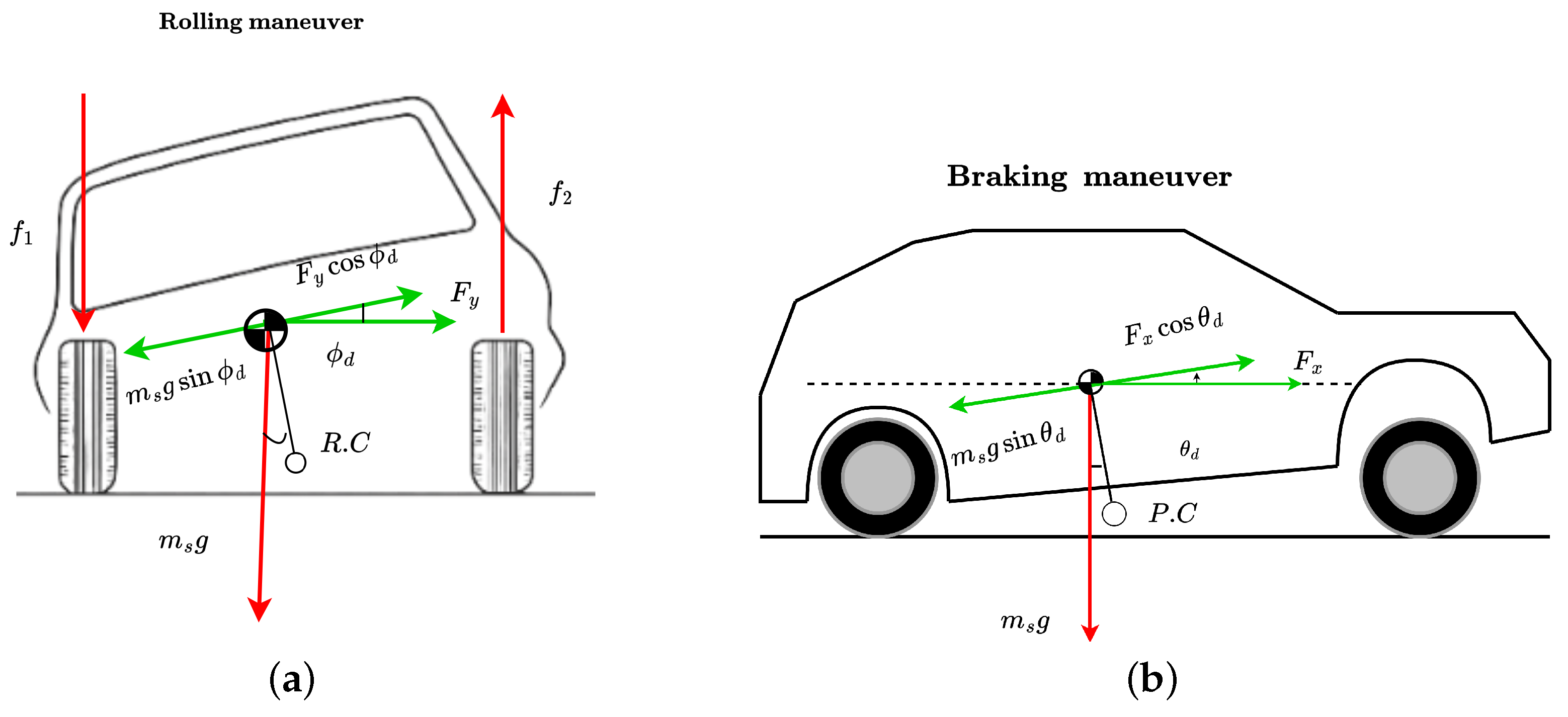
During the cornering and pitching maneuvers, longitudinal and lateral load transfer (LLT) occurs due to the inertial forces. These forces not only degrade passenger comfort but also impact the operational safety and stability of the vehicle. During a cornering maneuver, when the vehicle is steered, the outer wheel is subjected to a heavier load compared to the inner wheel, resulting in unbalanced normal forces on the tires. As shown in Figure 4a, the combined effect of lateral acceleration and an elevated center of mass of the vehicle, causes inertial forces, and creates a roll movement that may induce a roll-over tendency during aggressive cornering. Equation (8) gives the magnitude of the desired roll angle against the lateral acceleration produced due to the cornering maneuver and the corresponding controller action to counter these forces.
m s g h sin ϕ d = m s v 2 R h cos ϕ d ϕ d = arctan v 2 R g
For LTT, when the capacity of the transferred becomes equal to half of the vehicle’s weight, the vehicle will start to overturn. The magnitude of LLT also depends upon other suspension parameters that include the height of the unsprung mass assembly, the roll center, and the distance between the center of mass and its corresponding roll axis.
Generally, the vehicle experiences forward pitch (dive) under sudden braking and a rearward pitch (squat) during the initial phase of the acceleration caused by longitudinal load transfer between the front and rear axles. Equation (9) gives the magnitude of the desired pitching angle as a function of longitudinal acceleration generated due to the braking maneuver. Figure 4b illustrates the vehicle posture for compensating the pitching down maneuver. The PS cannot provide sufficient force to stabilize the vehicle against rolling and pitching movements. However, if the vehicle is equipped with an active tilt control mechanism, the effects of lateral and longitudinal acceleration can be partially or fully compensated, thereby reducing the amount of discomfort to which passengers are exposed.
m s g h sin θ d = m s a x cos θ d θ d = arctan v 2 R g
Equations (10) and (11) illustrate the magnitude of these body forces acting on the vehicle during rolling and pitching motions. These inertial forces acting on the suspension mounting points are equal and opposite in direction, causing a rolling or pitching moment.
f r 1 , 2 = m s v 2 R . h ( a + b )
f p 1 , 2 = m s a x . h ( a + b )

3. Methodology

This section presents a comprehensive description of the control methodology employed to establish the attitude motion control system using a full-state feedback controller.

Control Architecture

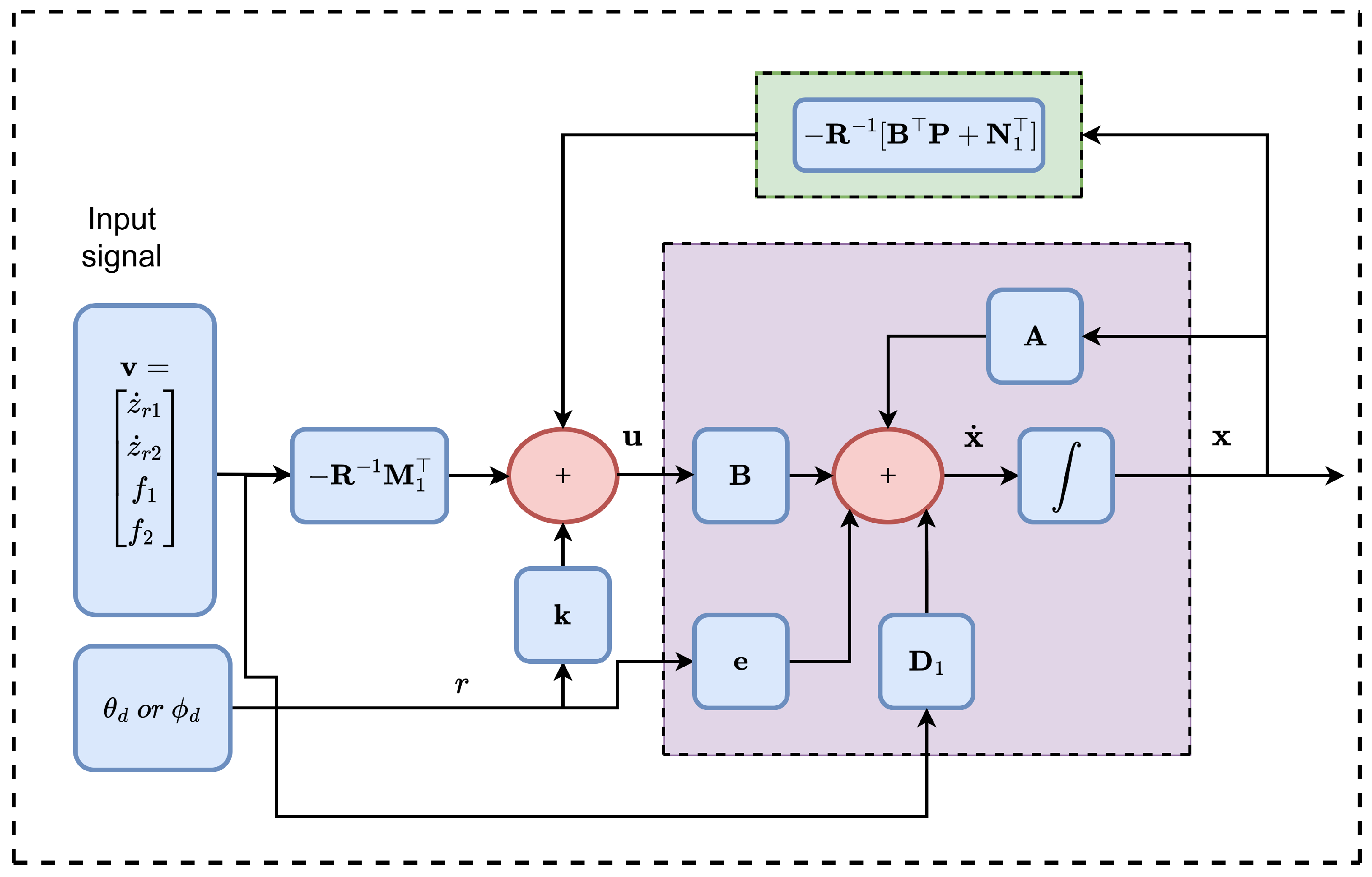
Improving the vehicle dynamics response is a multiobjective problem that requires coupling of the aerodynamic lift/downward control force with the actuator force of the ASS. The magnitude of longitudinal and lateral load transfer affects the tire and steering dynamics. Therefore, the control methodology incorporates an active tilt system to prevent the roll-over of the vehicle during cornering, a control rearward tilt (squat) mechanism during acceleration, and an anti-dive mechanism during braking maneuvers. Figure 5 illustrates the block diagram to achieve the desired control objectives. The input block selects the driving condition, such as straight line driving, cornering, or pitching maneuvers. Based on this selection, the body forces acting at the mounting points are calculated using Equations (10) and (11), and the desired attitude angle is introduced to the state-space model as a reference signal.
Equation (12) describes the standard dynamic continuous time state-space representation of the vehicle block diagram.
x ˙ = A x + B u + D 1 v + e r
The control force minimizing the performance cost function is given in Equation (13).
u = R 1 [ ( B P + N 1 ) x + M 11 v ] + k r
where R 1 M 1 w = > R 1 M 11 v + k r . The resultant time-invariant closed-loop full-state feedback attitude motion controller is given in Equation (14).
x ˙ = A c x + D n w
where the matrix A c = ( A n B R 1 B P ) represents the closed-loop system matrix and is asymptotically stable under the proposed full-state feedback control law. The controller is developed based on the dynamic programming and the Bellman equation that minimizes the quadratic cost function with constraints given in Equation (12) [31]. Equation (15) describes the two matrices A n and D n according to the state-space model.
A n = A B R 1 N 1 , D n = D B R 1 M 1
The optimal controller computes the required control gain inputs, based on the actuator force of ASS and the aerodynamic force generated by the active airfoil. These control inputs are applied to the vehicle dynamic model represented in state space form. The system state variables defined in Equation (5) evolve in response to both the control inputs and external disturbances. This combined control framework leads to a coordinated control mechanism for regulating ride comfort and the dynamic handling performance of the vehicle. The magnitude of the drag force during the straight-line motion mainly affects the traction and energy consumption, and the dominant frequency range of the drag force differs from the sensitive frequency range of the human body. Therefore, its effect on the suspension system is neglected [32]. The following assumptions are made for the computer simulation.
  • All the states are extracted from the output of the full-state feedback controller for the purpose of processing the input information.
  • For the numerical simulations, all actuator damping forces of the active suspension system and aerodynamic forces are considered unconstrained.
  • The yaw dynamics and the sideslip angle of the tire are neglected during the steering process as they are associated with a full-vehicle model.

4. Attitude Motion Controller Design

Road-induced asymmetric excitations and the rolling and pitching moments of the vehicle body adversely affect ride comfort and handling performance. Although the design objectives vary with road conditions and vehicle speed, choosing between lateral and longitudinal control, and the control strategy that may be connected in cascade, coupled, or coordinated, is an essential task [33]. Equation (16) presents the formulation of the quadratic performance index of the proposed controller.
J = lim T 1 2 T 0 T [ x ˙ 2 2 + x ˙ 4 2 + ρ 1 ( x 1 + a x 3 x 9 ) 2 + ρ 1 ( x 1 b x 3 x 10 ) 2   + ρ 2 ( x 5 2 + x 7 2 ) + ρ 3 x 11 2 + ρ 4 ( x 12 2 + x 13 2 ) + ρ 5 ( u 1 2 + u 2 2 ) + ρ 6 ( u 3 2 + u 4 2 ) ] d t
where the states x ˙ 2 and x ˙ 4 represent the vertical heave acceleration and roll (or pitch) acceleration, respectively. The terms ( x 1 + a x 3 x 9 ) and ( x 1 b x 3 x 10 ) are defined as suspension deflections of the two sides. The performance index is optimized with respect to the car body heave acceleration, rolling acceleration (or pitch), suspension deflections, tire deflections, actual role (or pitch) angle, integral of the difference of the actual role (or pitch) and the desired angle ( ϕ ϕ d ) , integral of the tire deflection, control forces ( u 1 , u 2 ) , and aerodynamic forces ( u 3 , u 4 ) . Table 2 describes the values of the weighting factor where each term is scaled by a designated weighting factor, ranging from ρ 1 to ρ 6 . These values are optimized based on the trial and error method to achieve the desired performance. These coefficients depend upon operating conditions like speed, road surface, radius of curvature, and a specific road maneuver. The integral action associated with the desired angle and dynamic tire deflection is intended to eliminate steady-state error for the safety of the vehicle and is primarily effective for constant or slowly varying trajectories. The corresponding performance index can be expressed in the compact matrix using Equation (17).
J = lim T 1 2 T 0 T x Q x + 2 x N 1 u + 2 x N 2 w + 2 w M 1 u + w M 2 w + u R u d t
All matrices A , B , e , D 1 , Q , D , R , N 1 , N 2 , M 1 and M 2 are of appropriate dimensions, and are defined in the Appendix A. The simulation is performed provided the necessary condition is met that the pair ( A n , B ) must be stabilizable and ( A n , Q n 1 / 2 ) is detectable. The design of the attitude motion controller in conjunction with the AAS is realized in Equation (18) by solving the algebraic Riccati equation (ARE) [34,35].
A n P + PA n PB n P + Q n = 0
Meanwhile, Equation (19) describes how the given matrices are defined to compute a positive definite symmetric P matrix through ARE in the control simulation.
B n = B R 1 B Q n = Q N 1 R 1 N 1 ,

5. Results and Discussion

The proposed control methodology of the attitude motion control of the half-car model is implemented using computer numerical simulation. The performance of the proposed attitude controller is assessed under the action of a road velocity input and the magnitude of inertial forces. A total of four different scenarios are considered. Table 2 presents the optimized set of weighting constants suitably tuned based on the passenger comfort preference by choosing ρ 2 = 10 4 for the tire deflection. The subsequent section presents a comparative analysis of the passive suspension, active suspension system, airfoil-only system, and proposed system. The evaluation is mainly based on vertical vibration isolation, keeping the desired body attitude angle, and handling characteristics during various driving maneuvers.

5.1. Road-Bump Analysis

In the first case to evaluate the transient performance of the suspension system, a road bump is typically employed to excite the system [36]. The response from this dynamic excitation is used to evaluate how the competing objectives of passenger comfort and tire deflection are achieved while keeping the suspension travel constraints within safe limits. Equation (20) and Equation (21) define the elevation of the road bump of amplitude 0.1 m and the subsequent velocity vector, respectively.
z r 1 ( t ) = A 1 cos 20 π ( t 1.25 ) , 1.25 t 1.4 , 0 , elsewhere
z ˙ r 1 ( t ) = 20 A π sin 20 π ( t 1.25 ) , 1.25 t 1.4 , 0 , elsewhere .
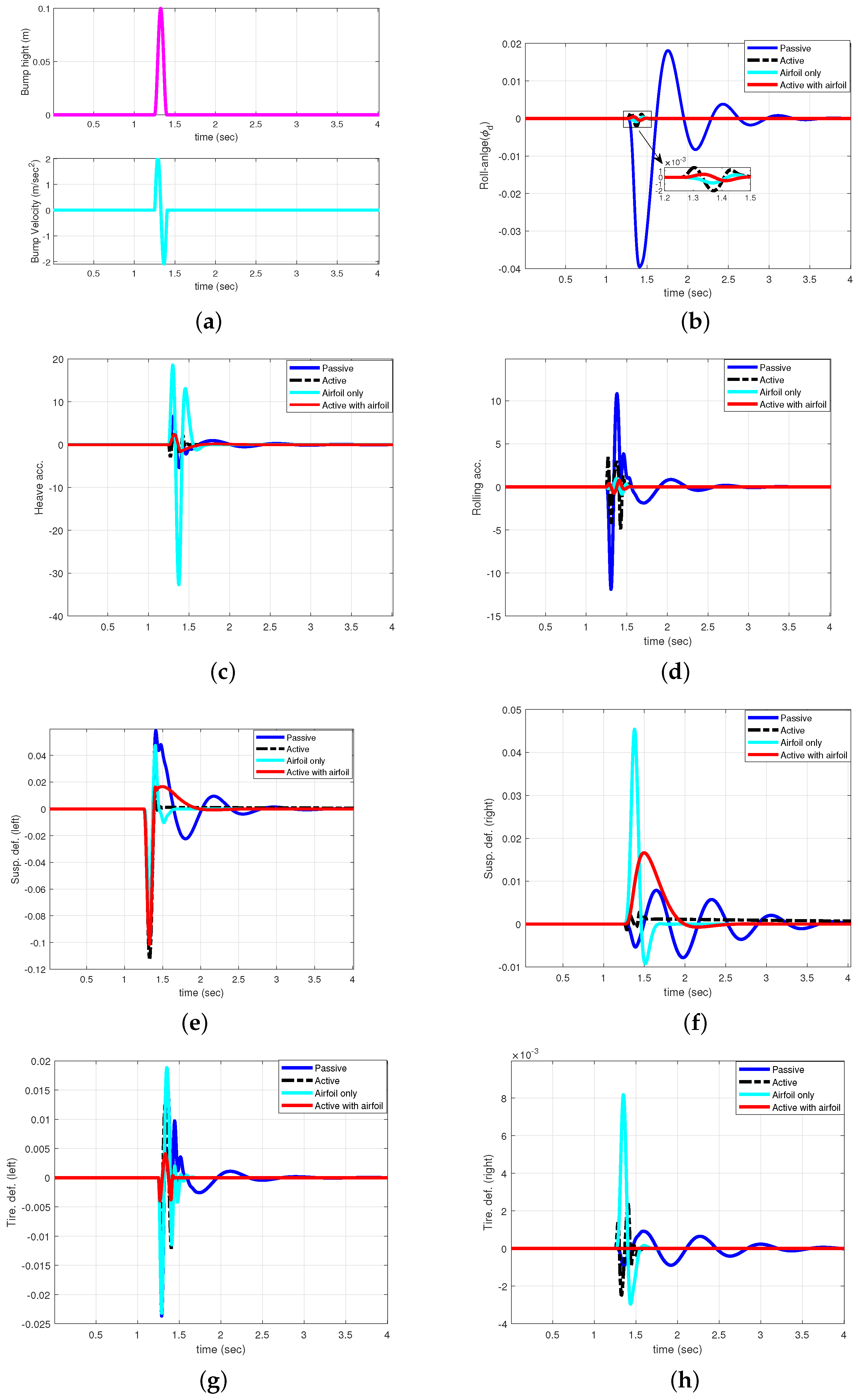
Figure 6a–h show the road input velocity and the corresponding responses of the car body roll angle, heaving acceleration, roll acceleration, suspension deflection of the two sides, and tire deflections, respectively. The velocity input disturbance is applied to the left tire of the lateral vehicle model during straight-line driving. Table 3 presents the results based on mean-squared values of the target suspension parameters. Figure 6b shows a large deviation in the passive suspension system for the desired rolling angle, whereas the response of the proposed system shows attenuation of 99% compared to the passive system. Regarding the heave acceleration, which quantifies passenger comfort, Figure 6c exhibits mitigations of 84% and 14%, respectively, relative to the passive and active systems. Furthermore, Figure 6d reveals an improvement of more than 90% compared to the two systems, indicating that the vehicle significantly reduces deviation in roll acceleration. The suspension deflection of the proposed system for the left side of Figure 6e remains well below that of the active system; however, the right side deflection in Figure 6f is worse than the active system. This indicates the presence of a trade-off between the vehicle handling performance and suspension deflection. Figure 6g,h show the tire–road contact (footprint) by minimizing the deviation in the tire deflection. The road-holding metric for the two tires is also improved and remains more than 90%, which is important for the dynamic safety of the vehicle. The active airfoil-only system fails to provide disturbance isolation and sufficient traction to keep the tires’ contact on the road surface. Hence, the proposed attitude controller effectively resolves the trade-off between ride comfort and holding metrics by leveraging an active suspension system and active aerodynamic force.

5.2. Roll Maneuver Analysis

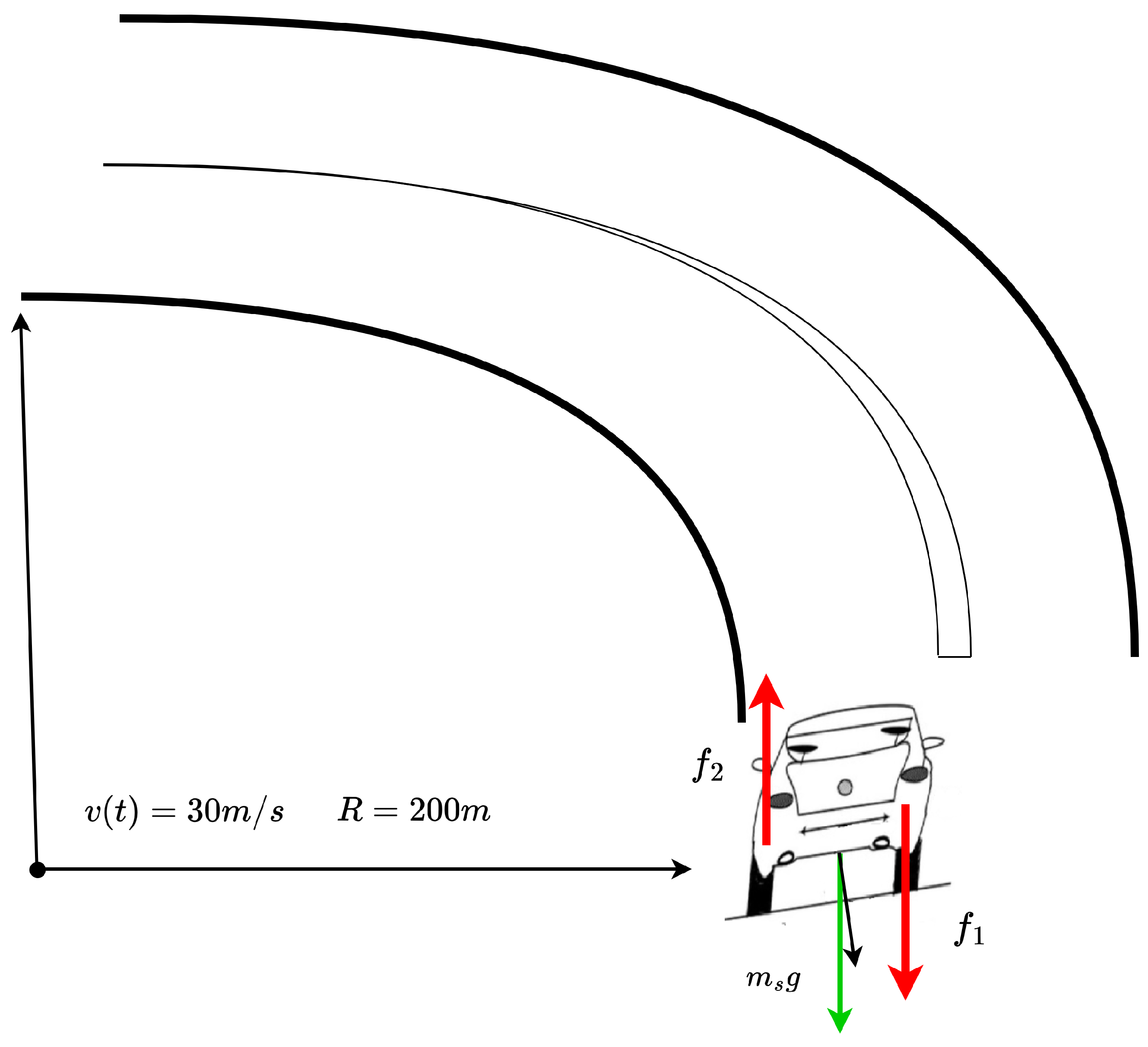
This section presents detailed simulation results for a vehicle undertaking a left cornering maneuver, as shown in Figure 7. The lateral acceleration acting on the car causes a lateral sway during cornering, potentially compromising passenger comfort and safety. The lateral acceleration creates a roll moment about the roll axis. Equations (22) and (23) give the magnitude of roll moment and the corresponding roll angle in the steady state.
M r o l l = m s a y h
ϕ d ( t ) = m s a y h k ϕ
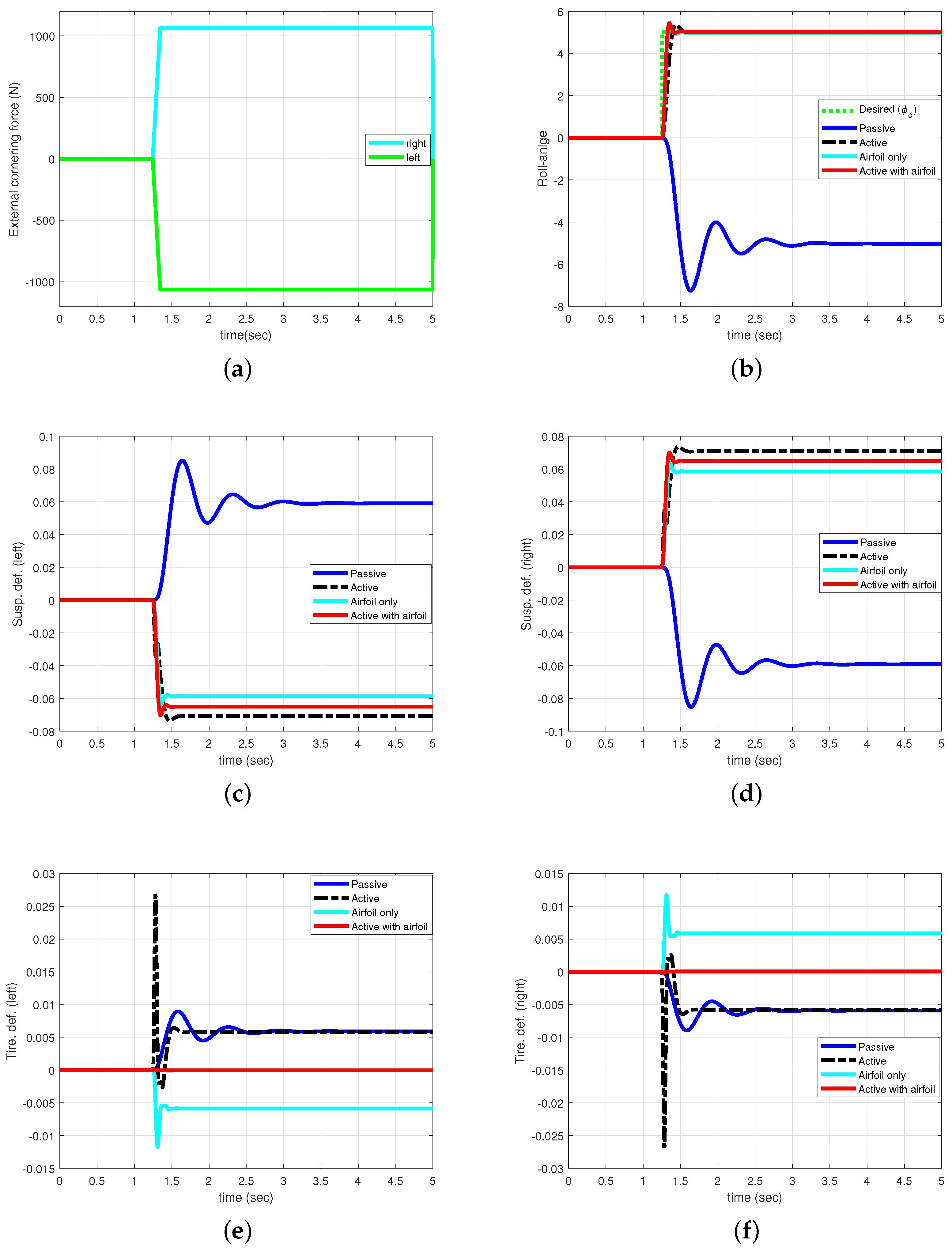
where k ϕ is the rolling stiffness. Figure 8a illustrates that two equal and opposite external inertial body forces of 1064 N are acting on the right and left side, and the vehicle follows a desired roll angle of 5 . The speed of the vehicle is 30 m/s, and the radius of curvature is 200 m. The corresponding responses of the different systems are shown in Figure 8b–f. Figure 8b shows the active tilt control of ASS, in collaboration with aerodynamic forces, which counteracts the roll-over effect and attempts to skew the vehicle’s posture inward. Unlike the passive, the proposed system follows the desired angle with a minimum rise time and overshoot. Figure 8c,d depict that the suspension rattle space requirement of different configurations remains within the same operating limits, whereas the passive suspension exhibits a larger deflection, due to the absence of active control force. Figure 8e,f show the tire deflection where the integral action further substantially reduces the deviation in the tire deflection. However, a steady-state error persists in the dynamic tire deformation for other systems while following the desired input roll angle.

5.3. Pitching Maneuver Analysis

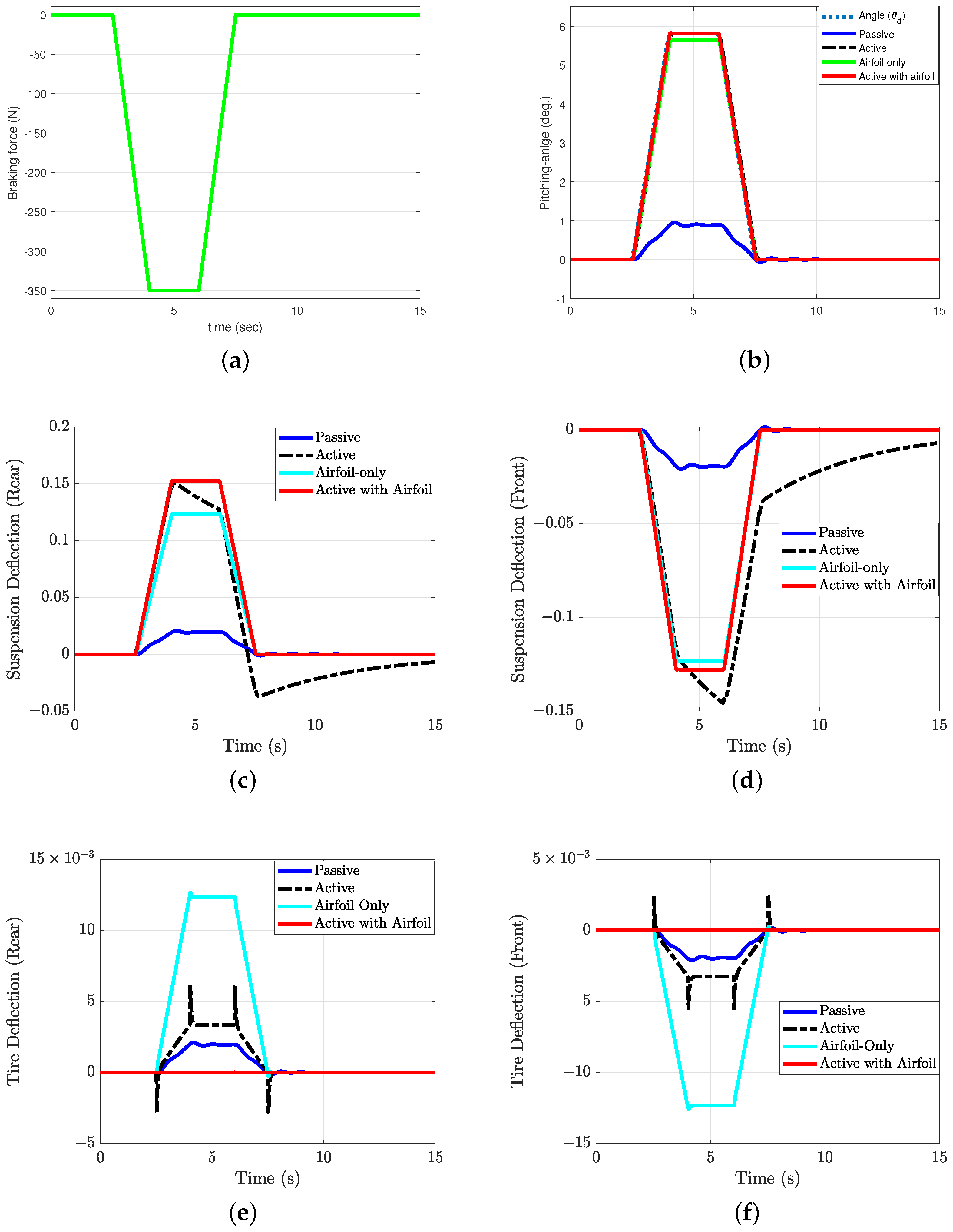
During longitudinal motion, such as braking or acceleration, longitudinal inertial forces act on the vehicle body, which degrades passenger comfort and compromises pitching stability. During braking, passengers tend to lean forward due to longitudinal load transfer on the front axle. This causes suppression of the front suspension system. Figure 9a depicts the magnitude of the negative braking forces. Figure 9b shows the mitigation of the effects of these forces; the active tilt controller applies an anti-dive control mechanism on the rearward side of the vehicle. Figure 9c–f illustrate the responses of suspension working space and tire deflection of different configurations during a braking maneuver. The response of the proposed control strategy remains almost flat without any deviation, while a large steady-state error exists in the tire deflection for the airfoil-only case. The response of the suspension working space of AS overshoots their desired values, which may cause structural damage to the suspension system.
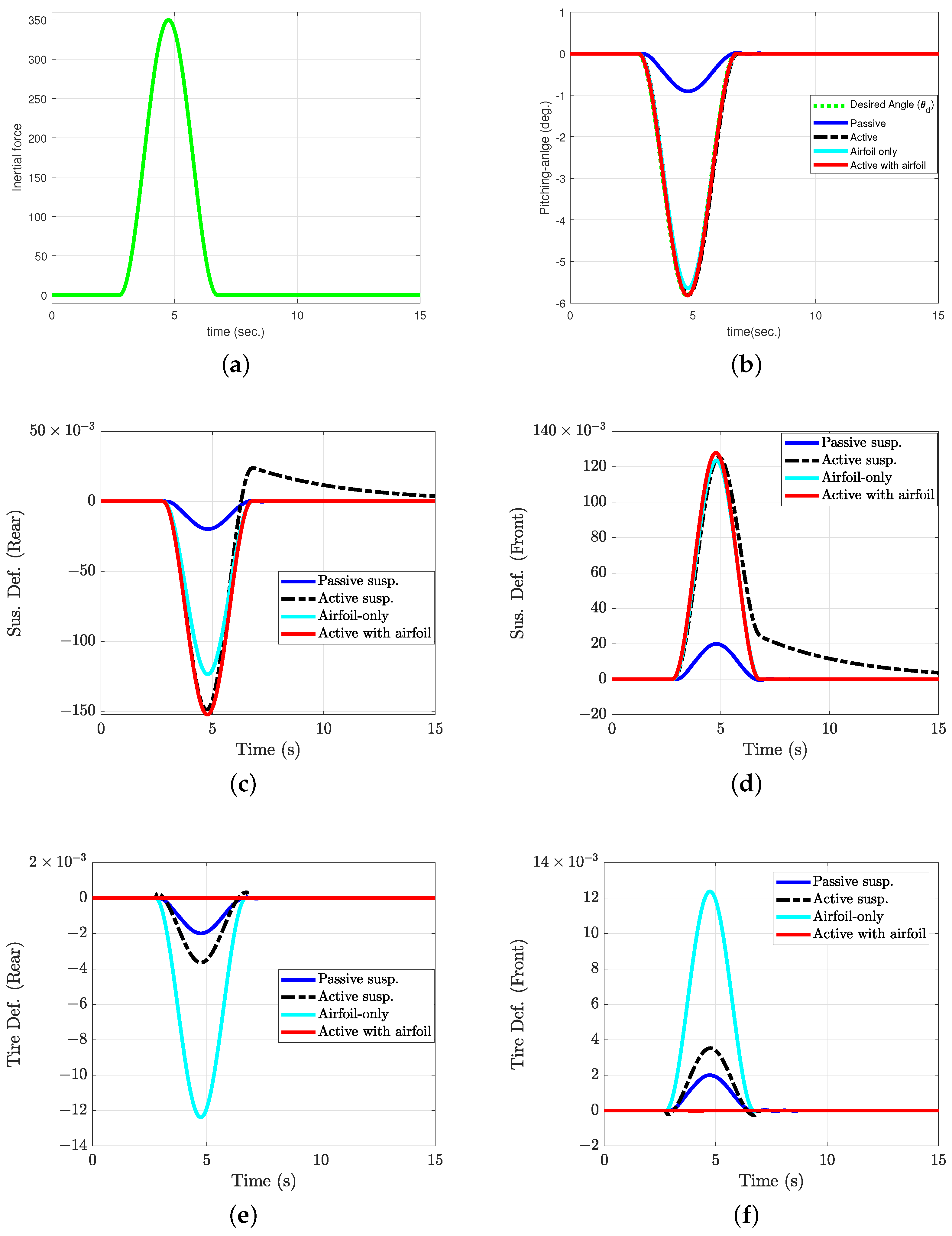
In the second case, the vehicle is suddenly accelerated, the inertial load is transferred to the rear axle, and the passenger feels a squat sensation in the rearward direction. The magnitude of input acceleration force and body responses are shown in Figure 10a,b, respectively. Figure 10c–f depict the resulting suspension rattle space and the dynamic tire deflection. The pitch-angle response in Figure 10b illustrates the control forward tilt mechanism to compensate for the resultant squat. The PS experiences a limited response during the acceleration maneuver, while the airfoil-only case reveals a small steady-state error in the pitch angle and a large steady-state deviation in the tire holding metric.

6. Conclusions

This study explored the collaboration of an active suspension system with an active aerodynamic system for attitude motion control using an optimal controller. The application of the active airfoil downward force in addition to the active system counterbalances the effect of the inertial forces during sudden cornering and pitching maneuvers. The synthesized controller, incorporating integral action for the tire-deflection and difference of the actual and desired roll (or pitch) angles ( ϕ ϕ d ) in the performance index, enhanced the performance of the car body attitude and road-gripping performance. The simulation results demonstrate that the tailored control algorithm achieved enhanced system performance for the desired roll angle (or pitch), rolling acceleration (or pitching ), heaving acceleration, and dynamic tire deflection, using an optimized set of weighting factors. The key findings of the study are summarized briefly as:
  • In the first case, negotiating a sudden road elevation bump velocity input, the control scheme effectively attenuated the impact of the road disturbance. The mean squared values revealed improvement exceeding 90% for the roll angle and rolling acceleration compared to passive and active systems. This shows a stable vehicle body posture in response to the one-sided road velocity input excitation. Furthermore, the heave acceleration shows 84% improvement over the passive system, which is an important consideration for minimizing occupant discomfort. Compared to the two systems, the tire dynamic deflection was remarkably reduced (up to 99%), which is critical for road-holding and thus enhances the vehicle handling characteristics. Despite these improvements, the suspension deflection response for the right side was observed to be greater than that of the active suspension system, which shows that a trade-off exists between the suspension travel and desired road handling capability.
  • In the second case, the effect of external rolling movements that tend to degrade the passenger ride comfort and safety during a cornering maneuver was considered. The active tilt control mechanism enhanced the lateral stability by keeping the ideal road holding of both tires to avoid the rollover effect. Furthermore, it helped to maintain the desired body attitude by accurately following the desired rolling angle. However, for the airfoil-only case, the response highlights the existence of a steady-state error in the tire deflection. Although the AS successfully tracked the desired trajectory, it responds slowly to the desired angle compared to the proposed system. For the AS and airfoil-only case, a substantial steady error in the tire deformation was observed.
  • In the third case, pitching dynamics were examined in detail during initial acceleration and braking maneuvers. The combined ASS and AAS base controller regulates the vehicle’s longitudinal motion by inducing controlled forward tilt during initial acceleration and rearward tilt during sudden braking. The proposed control scheme proactively mitigated the effect of load transfer associated with these maneuvers. A large steady-state error in the pitching angle was observed in addition to a large deviation in the tire deformation for the airfoil-only case.
Overall, the proposed attitude controller substantially improved the target performance indices by efficiently utilizing the aerodynamic system under lateral and longitudinal load transfer, with a particular emphasis on the road holding metric. This collaborative control algorithm offers invaluable insights for incorporating the aerodynamic control system into future advanced car and passenger vehicles for performance up-gradation. However, the reported improvement in ride comfort, road holding, and dynamic safety is limited to simulation-based evaluation under the considered scenarios. The feasibility of the proposed model in a real vehicle, combining detailed aerodynamic effects, sensor robustness, and an advanced actuator, requires further study.

Author Contributions

S.B.A. surveyed the research work, performed detailed simulation and prepared the initial draft of the manuscript. I.Y. designed the control strategy and helped validate the research work and MATLAB® R2025b simulations. Furthermore, I.Y. reviewed the manuscript and assisted in technical writing. All authors have read and agreed to the published version of the manuscript.

Funding

This research received no external funding.

Institutional Review Board Statement

Not applicable.

Informed Consent Statement

Not applicable.

Data Availability Statement

All data are contained within the article.

Conflicts of Interest

The authors declare no conflicts of interest.

Appendix A

The entries of the system matrix A = a i j R 13 × 13 are given as,
A = 0 1 0 0 0 0 0 0 0 0 0 0 0 k s 1 + k s 2 m s b s 1 + b s 2 m s k s 1 a k s 2 b m s b s 1 a b s 2 b m s 0 b s 1 m s 0 b s 2 m s k s 1 m s k s 2 m s 0 0 0 0 0 0 1 0 0 0 0 0 0 0 0 0 k s 1 a k s 2 b I b s 1 a b s 2 b I k s 1 a 2 + k s 2 b 2 I b s 1 a 2 + b s 2 b 2 I 0 b s 1 a I 0 b s 2 b I k s 1 a I k s 2 b I 0 0 0 0 0 0 0 0 1 0 0 0 0 0 0 0 k s 1 m 1 b s 1 m 1 k s 1 a m 1 b s 1 a m 1 k t 1 m 1 b s 1 m 1 0 0 k s 1 m 1 0 0 0 0 0 0 0 0 0 0 0 1 0 0 0 0 0 k s 2 m 2 b s 2 m 2 k s 2 b m 2 b s 2 b m 2 0 0 k t 2 m 2 b s 2 m 2 0 k s 2 m 2 0 0 0 0 0 0 0 0 1 0 0 0 0 0 0 0 0 0 0 0 0 0 0 1 0 0 0 0 0 0 0 1 0 0 0 0 0 0 0 0 0 0 0 0 0 0 1 0 0 0 0 0 0 0 0 0 0 0 0 0 0 1 0 0 0 0 0 0
B R 13 × 4 , D 1 R 13 × 4 , e R 13 × 1 , D R 13 × 5 .
B = 0 0 0 0 1 m s 1 m s 1 m s 1 m s 0 0 0 0 a I b I a I b I 0 0 0 0 1 m 1 0 0 0 0 0 0 0 0 1 m 2 0 0 0 0 0 0 0 0 0 0 0 0 0 0 0 0 0 0 0 0 0 0 , D 1 = 0 0 0 0 0 0 1 m s 1 m s 0 0 0 0 0 0 a I b I 1 0 0 0 0 0 0 0 0 1 0 0 0 0 0 0 0 0 0 0 0 0 0 0 0 0 0 0 0 0 0 0 0 0 0 0 , e = 0 0 0 0 0 0 0 0 0 0 1 0 0 , D = 0 0 0 0 0 0 0 1 m s 1 m s 0 0 0 0 0 0 0 0 a I b I 0 1 0 0 0 0 0 0 0 0 0 0 1 0 0 0 0 0 0 0 0 0 0 0 0 0 0 0 0 0 0 0 0 0 0 1 0 0 0 0 0 0 0 0 0 0
Q i j = A 2 , i A 2 , j + A 4 , i A 4 , j R 13 × 13 , q i j = q j i , i , j = 1 , , 13
q 1 , 1 = A 2 , 1 2 + A 4 , 1 2 + 2 ρ 1 q 1 , 3 = A 2 , 1 A 2 , 3 + A 4 , 1 A 4 , 3 + ρ 1 ( a b ) q 1 , 9 = A 2 , 1 A 2 , 9 + A 4 , 1 A 4 , 9 ρ 1 q 1 , 10 = A 2 , 1 A 2 , 10 + A 4 , 1 A 4 , 10 ρ 1 q 3 , 3 = A 2 , 3 2 + A 4 , 3 2 + ρ 1 ( a 2 + b 2 ) q 3 , 9 = A 2 , 3 A 2 , 9 + A 4 , 3 A 4 , 9 ρ 1 a q 3 , 10 = A 2 , 3 A 3 , 10 + A 4 , 3 A 4 , 10 ρ 1 b q 5 , 5 = ρ 2 q 7 , 7 = ρ 2 q 9 , 9 = A 2 , 9 2 + A 4 , 9 2 + ρ 1 q 10 , 10 = A 2 , 10 2 + A 4 , 10 2 + ρ 1 q 11 , 11 = A 2 , 11 2 + A 4 , 11 2 + ρ 3 q 12 , 12 = A 2 , 12 2 + A 4 , 12 2 + ρ 4 q 13 , 13 = A 2 , 13 2 + A 4 , 13 2 + ρ 4
N 1 R 13 × 4 , n 1 i j = A 2 , i B 2 , j + A 4 , i B 4 , j , i = 1 , , 13 ,   j = 1 , , 4 N 2 R 13 × 5 , n 2 i j = A 2 , i D 2 , j + A 4 , i D 2 , j , i = 1 , , 13 j = 1 , , 5 M 11 R 4 × 4 , n 1 i j = D 2 , i B 2 , j + D 4 , i B 4 , j , i = 1 , , 4 ,   j = 1 , , 4 M 1 R 5 × 4 , n 1 i j = D 2 , i B 2 , j + D 4 , i B 4 , j , i = 1 , , 5 ,   j = 1 , , 4 M 2 R 5 × 5 , n 2 i j = D 2 , i D 2 , j + D 4 , i D 2 , j , i = 1 , , 5 j = 1 , , 5

References

  1. Nguyen, T.A. Approaching fuzzy sliding mode strategy for automotive suspension based on the view of enhancing ride comfort and vehicle stability. Meas. Control 2025, 58, 266–280. [Google Scholar] [CrossRef]
  2. Hariharan, A.; Rajeswara Rao, K.; Hruthik, K.; Patil, A.S.; Krishna, V.; Kinange, S.; Yadav, A. Simulation-based comparison of robust control and deep reinforcement learning control techniques for active suspension systems. Syst. Sci. Control Eng. 2025, 13, 2600770. [Google Scholar] [CrossRef]
  3. Zhang, K.; As’arry, A.; Zhu, L.; Hairuddin, A.A.; Hassan, M.K.; Md Zain, M.Z. Enhancing ride comfort of semi-active suspension through collaboration control using dung beetle optimizer optimized Fuzzy PID controller. Adv. Mech. Eng. 2025, 17. [Google Scholar] [CrossRef]
  4. Chen, J.; Xi, D.; Hu, W.; Wu, Y. Improving Ride Comfort in Heavy-Duty Vehicles Through Performance-Guaranteed Control of Active Seat Suspension. Appl. Sci. 2025, 15, 7273. [Google Scholar] [CrossRef]
  5. Büyükköprü, M.; Uzunsoy, E.; Mouton, X. Implementation of semi-active suspension control methods in a full car model and a comparative study in terms of ride comfort and road holding. Proc. Inst. Mech. Eng. Part J. Automob. Eng. 2023, 237, 1830–1843. [Google Scholar] [CrossRef]
  6. Yu, Y.; Li, B.; Zhao, L.; Ma, C.; Jiao, G. A novel optimal control strategy for active suspension systems with control weighting coefficient dynamically adjusted based on operating conditions. Mech. Syst. Signal Process. 2026, 244, 113752. [Google Scholar] [CrossRef]
  7. Basargan, H.; Mihály, A.; Gáspár, P.; Sename, O. Cloud-based adaptive semi-active suspension control for improving driving comfort and road holding. IFAC-PapersOnLine 2022, 55, 89–94. [Google Scholar] [CrossRef]
  8. Yatak, M.Ö.; Şahin, F. Ride comfort-road holding trade-off improvement of full vehicle active suspension system by interval type-2 fuzzy control. Eng. Sci. Technol. Int. J. 2021, 24, 259–270. [Google Scholar] [CrossRef]
  9. Wu, L.; Zhang, W.; Ni, L.; Jia, W.; Youn, I. Attitude Tracking Control of All-Terrain Vehicle with Tandem Active–Passive Suspension. Int. J. Automot. Technol. 2024, 25, 1091–1111. [Google Scholar] [CrossRef]
  10. Jia, W.; Zhang, W.; Ma, F.; Wu, L. Attitude control of vehicle based on series active suspensions. Actuators 2023, 12, 67. [Google Scholar] [CrossRef]
  11. Nguyen, T.A. Applying a PID-SMC synthetic control algorithm to the active suspension system to ensure road holding and ride comfort. PLoS ONE 2023, 18, e0283905. [Google Scholar] [CrossRef]
  12. Samsuria, E.; Sam, Y.M.; Hassan, F. Enhanced sliding mode control for a nonlinear active suspension full car model. Int. J. Robot. Control Syst. 2021, 1, 501–522. [Google Scholar] [CrossRef]
  13. Youn, I.; Wu, L.; Youn, E.; Tomizuka, M. Attitude motion control of the active suspension system with tracking controller. Int. J. Automot. Technol. 2015, 16, 593–601. [Google Scholar] [CrossRef]
  14. Seok, J.; Jo, J.; Kim, Y.; Kim, H.; Jung, I.; Jeong, M.; Kim, N.; Jo, K. LiDAR-based Road Height Profile Estimation and Bump Detection for Preview Suspension. IEEE Trans. Intell. Veh. 2024, 10, 4679–4694. [Google Scholar] [CrossRef]
  15. Yim, S. Preview Control with Virtual Disturbance for Active Suspension Systems. Appl. Sci. 2025, 15, 12743. [Google Scholar] [CrossRef]
  16. Ma, K.; Shao, S.; Zhang, T.; Lu, L.; Li, L.; Ren, C. A time-varying delay control method based on equivalent frequency band for preview suspension systems. Eur. J. Control 2025, 87, 101445. [Google Scholar] [CrossRef]
  17. Shen, Y.; Ren, H.; Zhang, S.Y.; Lin, J.; Yang, X.; Liu, Y. Vehicle semi-active air inerter-spring-damper suspension with frequency-varying negative stiffness: Design, control, and experimental validation. Mech. Syst. Signal Process. 2026, 244, 113740. [Google Scholar] [CrossRef]
  18. Wang, J.; Shen, S. Integrated vehicle ride and roll control via active suspensions. Veh. Syst. Dyn. 2008, 46, 495–508. [Google Scholar] [CrossRef]
  19. Tchamna, R.; Lee, M.; Youn, I. Attitude control of full vehicle using variable stiffness suspension control. Optim. Control Appl. Methods 2015, 36, 936–952. [Google Scholar] [CrossRef]
  20. Wu, L.; Zheng, B.; Zhang, W.; Youn, I.; Jia, W. Nonlinear attitude tracking control for four-wheel-leg-vehicle with series active suspension. J. Frankl. Inst. 2024, 361, 107225. [Google Scholar] [CrossRef]
  21. Zhang, Y.; Zhou, R.; Su, C.; Zhang, Z.; Zang, X. Aerodynamic optimization of car top box design for drag reduction using CFD and Kriging modeling. J. Eng. Res. 2025, 14, 324–334. [Google Scholar] [CrossRef]
  22. Chiplunkar, V.; Gujar, R.; Adiverekar, A.; Kulkarni, R.; Thonge, A. Computational fluid dynamics analysis for an active rear-wing design to improve cornering speed for a high-performance car. Mater. Today Proc. 2023, 77, 887–896. [Google Scholar] [CrossRef]
  23. Karaki, A.; Sirreya, M.A.; Zalloum, M.; Amro, H. Enhancing vehicle performance through the application of airfoils as spoilers with movable trailing edge. F1000Research 2025, 14, 469. [Google Scholar] [CrossRef]
  24. Haggag, S.; Marzbali, M. Longitudinal dynamics of a vehicle equipped with an active rear spoiler. Sae Int. J. Passeng. Veh. Syst. 2022, 15, 183–194. [Google Scholar] [CrossRef]
  25. Kurec, K.; Remer, M.; Mayer, T.; Tudruj, S.; Piechna, J. Flow control for a car-mounted rear wing. Int. J. Mech. Sci. 2019, 152, 384–399. [Google Scholar] [CrossRef]
  26. Ahmad, E.; Youn, I. Performance improvement during attitude motion of a vehicle using aerodynamic-surface-based anti-jerk predictive controller. Sensors 2023, 23, 5714. [Google Scholar] [CrossRef]
  27. Corno, M.; Bottelli, S.; Panzani, G.; Spelta, C.; Tanelli, M.; Savaresi, S.M. Performance assessment of active aerodynamic surfaces for comfort and handling optimization in sport cars. IEEE Trans. Control Syst. Technol. 2015, 24, 189–199. [Google Scholar] [CrossRef]
  28. Rijns, S.; Teschner, T.R.; Blackburn, K.; Siampis, E.; Brighton, J. Optimising vehicle performance with advanced active aerodynamic systems. Veh. Syst. Dyn. 2025, 1–29. [Google Scholar] [CrossRef]
  29. Ahmed, A.A.; Ramadhan, H.F.; El Malki, M.; Nassar, Y.F. Modeling and control of a half car active suspension system using sliding mode controller and linear quadratic regulator controller. In Proceedings of the 2023 8th International Engineering Conference on Renewable Energy & Sustainability (ieCRES), Gaza, Palestine, 8–9 May 2023; IEEE: New York, NY, USA, 2023; pp. 1–7. [Google Scholar] [CrossRef]
  30. van der Sande, T.P.; Merks, M.; Lindeman, E.; Nijmeijer, H. Rule-based control of a semi-active suspension system for road holding using limited sensor information: Design and experiments. Veh. Syst. Dyn. 2022, 60, 4226–4244. [Google Scholar] [CrossRef]
  31. Rouhi, M.; Amjadifard, R. Optimal Control Based on Reinforcement Learning for a Class of Nonlinear Singularly Perturbed Systems. In Proceedings of the 2025 11th International Conference on Control, Instrumentation and Automation (ICCIA), Tehran, Iran, 11–13 November 2025; IEEE: New York, NY, USA, 2025; pp. 1–6. [Google Scholar] [CrossRef]
  32. Zhang, Z.; Xiao, X.; Sun, Z.; Xu, H.; Lou, F. Human vibration comfort analysis for a train entering a tunnel. Int. J. Mech. Sci. 2025, 306, 110822. [Google Scholar] [CrossRef]
  33. Kebbati, Y.; Ait-Oufroukh, N.; Ichalal, D.; Vigneron, V. Lateral control for autonomous wheeled vehicles: A technical review. Asian J. Control 2023, 25, 2539–2563. [Google Scholar] [CrossRef]
  34. Rustagi, V.; Sultan, C. Closed-form solutions to continuous-time algebraic riccati equation for second-order systems. J. Appl. Mech. 2024, 91, 061010. [Google Scholar] [CrossRef]
  35. Batume, B.N.; Chacha, C.S. A fast-converging Newton-based iterative scheme for the algebraic Riccati equation with step-size optimization. Results Control Optim. 2025, 21, 100631. [Google Scholar] [CrossRef]
  36. Zeng, Q.; Shi, Q.; Liu, L.; Liu, Y.J. Adaptive fuzzy output-feedback finite-time control of vehicle suspension systems: An accelerated observation approach. Mech. Syst. Signal Process. 2025, 238, 113146. [Google Scholar] [CrossRef]
Figure 1. Variation of the lift coefficient as a function of Mach number and angle of attack.
Actuators 15 00317 g001
Figure 2. Vehicle dynamics under the influence of the aerodynamic system and lateral inertial forces.
Actuators 15 00317 g002
Figure 3. Half-cart model with an active airfoil.
Actuators 15 00317 g003
Figure 4. Improving the attitude control includes: (a) Desired vehicle posture to eliminate the resulting centrifugal forces on car body during the cornering maneuver. (b) Desired vehicle posture to eliminate the forward dive during braking.
Actuators 15 00317 g004
Figure 5. Block diagram for the attitude control of the half-car model.
Actuators 15 00317 g005
Figure 6. Responses under road bump excitation applied on the left-hand side: (a) road velocity input; (b) car body roll angle response; (c) car body heave acceleration; (d) car body roll acceleration; (e) left suspension deflection; (f) right suspension deflection; (g) left tire deflection; (h) right tire deflection.
Actuators 15 00317 g006
Figure 7. Car executing a cornering maneuver with the given speed and radius of curvature.
Actuators 15 00317 g007
Figure 8. Responses under cornering maneuver: (a) body forces acting on vehicle; (b) roll angle responses of various systems; (c) left suspension deflection; (d) right suspension deflection; (e) left tire deflection; (f) right tire deflection.
Actuators 15 00317 g008
Figure 9. Responses under braking maneuver: (a) negative braking force applied to the front tire; (b) pitch angle responses of various systems; (c) rear suspension deflection; (d) front suspension deflection; (e) rear tire deflection; (f) front tire deflection.
Actuators 15 00317 g009
Figure 10. Responses under acceleration maneuver: (a) inertial longitudinal force; (b) pitch angle responses of various systems; (c) rear suspension deflection; (d) front suspension deflection; (e) rear tire deflection; (f) front tire deflection.
Actuators 15 00317 g010
Table 1. Typical suspension parameters for the half-car model.
DescriptionSymbolUnitPitchRoll
Vehicle body mass m s kg500500
Moment of inertiaIkg·m21200200
Unsprung mass (front/rear or left/right) m 1 , m 2 kg2525
Suspension stiffness k s 1 , k s 2 kN/m1818
Tire stiffness k t 1 , k t 2 kN/m180180
Damping coefficient b s 1 , b s 2 kN·s/m11
C.M. distance (front/right)am1.250.74
C.M. distance (rear/left)bm1.510.74
C.M. height from the groundhm0.700.70
Table 2. Weighting coefficients used to penalize the target performance indices in the simulation study.
Target IndicesDescription of Weighting Coeff.Value
Suspension deflections ρ 1 10 3
Tire deflections ρ 2 10 4
Integral of ( ϕ ϕ d ) roll/pitch angle ρ 3 10 10
Integral of tire deflections ρ 4 10 10
ASS actuator force ρ 5 10 6
Airfoil actuator force ρ 6 10 6
Table 3. Mean squared values of the target indices for bump input.
TypeAct. with AASAirfoil Only.Active Susp.Passive Sus.
Rolling acce.0.380.5312.82100%
Heaving acce.15.12 2.04 × 10 3 17.57100%
Roll angle.0.00660.01370.0851100%
Tire def. (left)3.6196.8840.47100%
Tire def. (right) 1.79 × 10 04 908.9996.00100%
Sus. def. (left)74.9845.2280.79100%
Sus. def. (right)216.71464.529.64100%
Disclaimer/Publisher’s Note: The statements, opinions and data contained in all publications are solely those of the individual author(s) and contributor(s) and not of MDPI and/or the editor(s). MDPI and/or the editor(s) disclaim responsibility for any injury to people or property resulting from any ideas, methods, instructions or products referred to in the content.