Article

Structural Design and Modeling Analysis of an Active Magnetic Levitation Vibration Isolation System


College of Intelligence Science and Technology, National University of Defense Technology, Changsha 410073, China
*
Author to whom correspondence should be addressed.
Actuators 2026, 15(2), 120; https://doi.org/10.3390/act15020120
Submission received: 9 January 2026 / Revised: 3 February 2026 / Accepted: 12 February 2026 / Published: 14 February 2026
(This article belongs to the Special Issue Advanced Theory and Application of Magnetic Actuators—3rd Edition)

Abstract

This paper addresses the stringent requirements of high-precision equipment for broadband, contactless active vibration isolation by tackling three key research gaps: the lack of an integrated design deeply coupling vertical and lateral subsystems, the absence of explicit characterization of the base-to-load vibration transmission chain in dynamic models, and the disconnect between theory and application due to spatial sensor–actuator mismatch. To bridge these gaps, a novel five-degree-of-freedom active magnetic levitation vibration isolation system is proposed. Its core contributions are threefold. First, an electromagnetic-structure co-design method based on the equal magnetic reluctance principle is introduced, enabling a globally optimized, integrated actuator layout that maximizes force density within spatial constraints. Second, a dynamic model incorporating explicit base kinematic excitation is established, clearly revealing the complete physical mechanism of vibration transmission through the suspension gap and providing an accurate foundation for model-based control. Third, a coordinate reconstruction control model is constructed, which transforms the ideal center-of-mass-based dynamics into a design model using only measurable gap signals via systematic coordinate transformations, thereby fundamentally eliminating control deviations from physical spatial mismatch. This work provides a comprehensive theoretical framework and solution for next-generation high-performance active vibration isolation platforms, encompassing integrated design, precise modeling, and engineering implementation.

1. Introduction

High-precision vibration isolation technology serves as the fundamental core for the stable operation of modern ultra-precision machining, advanced optical instruments, micro–nano manufacturing, and space science experimental equipment [1]. As requirements for dynamic stability, isolation bandwidth, and multi-degree-of-freedom coordinated control in related fields become increasingly stringent, traditional passive vibration isolation technologies face inherent limitations in principle, encountering bottlenecks particularly in low-frequency and broadband vibration suppression. Magnetic levitation active vibration isolation technology, leveraging its inherent advantages of non-contact operation, frictionless nature, and high dynamic response, offers a hig y promising solution for achieving broadband, full-degree-of-freedom dynamic stability [2]. This technology has evolved over several decades, accumulating rich academic foundations ranging from fundamental theories and innovative structural designs to advanced control algorithms. Its developmental trajectory clearly centers on core themes such as breakthroughs in low-frequency performance, decoupling of multi-degree-of-freedom systems, and intelligent disturbance rejection control.
In the pursuit of breakthroughs in low-frequency vibration isolation performance, the research focus has centered on introducing nonlinear stiffness to overcome the theoretical limitations of traditional linear isolators. The pioneering static and dynamic analysis of a three-spring quasi-zero-stiffness isolator by Carrella et al. laid the theoretical foundation for this field [3,4]. Subsequently, research diversified towards high-performance solutions: Zhu et al. demonstrated the excellent broadband vibration isolation performance of a six-degree-of-freedom quasi-zero-stiffness magnetic levitation device [5]; Yu et al. proposed a rhombic magnetic levitation structure, achieving a tunable quasi-zero-stiffness region by integrating permanent magnet motion and geometric nonlinearity [6]; while Yang et al. designed a multi-layer quasi-zero-stiffness platform that ingeniously addressed the challenge of adaptive vibration isolation under variable load conditions [7]. Furthermore, for space-constrained scenarios such as aerospace applications, systematic design methods for compact quasi-zero-stiffness isolators have been summarized [8]. Regarding reducing system energy consumption, zero-power levitation technology is a significant direction. From the early feasibility demonstration by Mizuno et al. [9] to recent research combining permanent magnet and electromagnetic technologies with Hall sensors to achieve zero-power levitation across a wide load range [10], the continuous advancement in this area is evident. Furthermore, researchers have explored combining quasi-zero-stiffness units with semi-active control based on magnetorheological elastomers to construct hybrid vibration isolation systems capable of addressing both low-frequency and mid-to-high-frequency challenges [11].
In terms of modeling, decoupling, and coordinated control of multi-degree-of-freedom magnetic levitation systems, the core challenges stem from the system’s multi-input multi-output, strongly coupled, and open-loop unstable nature. Preumont’s work established a classic framework for the analysis of such systems [12]. To achieve effective decoupling control, researchers have explored various approaches, including optimizing electromagnetic layouts and designing dynamic decoupling algorithms. However, in practical engineering, non-ideal factors such as the out-of-plane arrangement of sensors and actuators, and load eccentricity introduce complex coupling [13]. To address this, strategies combining intelligent optimization algorithms with advanced control laws have been proposed to optimize dynamic performance while maintaining stable levitation [14]. For large-scale coupled systems like maglev trains, studies on vehicle–bridge coupled dynamics have revealed the complex interactions between the levitation system and flexible tracks [15].
In addressing external disturbances, particularly foundation vibrations, research has advanced into complex dynamic environments. For magnetic bearing-rotor systems, foundation motion can significantly affect their dynamic characteristics. Zhang Yue et al. established an electromechanical integrated model that accounts for foundation motion and proposed a control method based on an adaptive narrowband disturbance observer, effectively suppressing related vibrations [16,17]. This indicates that explicitly modeling and compensating for foundation excitation as a disturbance is key to achieving high-precision vibration isolation. Meanwhile, smart materials such as magnetorheological dampers, due to their high reliability, are widely used in semi-active suspension systems, providing engineering references for hybrid control system design [18]. Weiyu Zhang proposes an adaptive switching iterative learning control (ASILC) strategy for vehicle-mounted flywheel batteries to enhance robustness against road-induced disturbances, which reduces the average deviation by 76.6% under continuous disturbances compared to traditional methods [19,20].
Although existing research has achieved significant results in their respective directions, there remain three critical gaps to bridge in order to meet the stringent demands of next-generation high-load-capacity, ultra-precision, fully integrated vibration isolation platforms:first, in terms of structural design, most efforts focus on optimizing single-degree-of-freedom structures dedicated to either vertical vibration isolation or lateral levitation [21]. There is a lack of integrated configuration designs that deeply synergize vertical high-precision vibration isolation with lateral full-degree-of-freedom stable levitation based on electromagnetic principles. Systematic methodologies for the co-optimization of magnetic and electrical circuits under global constraints remain unclear [22]. Second, in terms of modeling, most existing dynamic models treat foundation disturbances as force disturbances or address them implicitly. They fail to explicitly and structurally incorporate multi-directional, broadband base vibration acceleration as independent kinematic input variables into the multi-body dynamic equations. Consequently, the complete transmission chain from base motion to the absolute vibration of the floater cannot be clearly characterized [23,24]. Third, in terms of control engineering implementation, theoretical decoupling models typically rely on the idealized assumption of a center of mass. They severely overlook the inevitable spatial offset between the sensor measurement plane and the electromagnetic force application plane, which is also a bottleneck limiting the transition from theoretical models to high-precision engineering applications [25,26].
To systematically address these research gaps, this paper proposes a novel overall scheme for a five-degree-of-freedom active magnetic levitation vibration isolation system [27]. The core innovations and contributions of this work are demonstrated across three interconnected levels: firstly, an electromagnetic-structural co-design method based on the principle of equal magnetic reluctance is proposed. It integrates and globally optimizes the layout of vertical and lateral actuators, aiming to maximize electromagnetic force density and load-bearing capacity under given spatial constraints. Secondly, a multi-body dynamic model incorporating explicit base kinematic excitation inputs is established. By introducing base displacement and acceleration as independent variables into the equations, this model fully and clearly reveals the physical mechanism of vibration transmission to the payload through the suspension gap. This lays a solid model foundation for controller design with the direct objective of suppressing the absolute vibration of the payload. Lastly, a coordinate reconstruction control model tailored to the sensor–actuator layout is constructed. Through systematic coordinate chain transformations, the center-of-mass-based dynamic model is converted into a design model entirely based on measurable gap signals, thereby fundamentally eliminating control deviations caused by physical spatial mismatch.

2. Structural Design of a Magnetic Levitation Active Vibration Isolation System

2.1. Structural Configuration of the Magnetic Levitation Active Vibration Isolation System

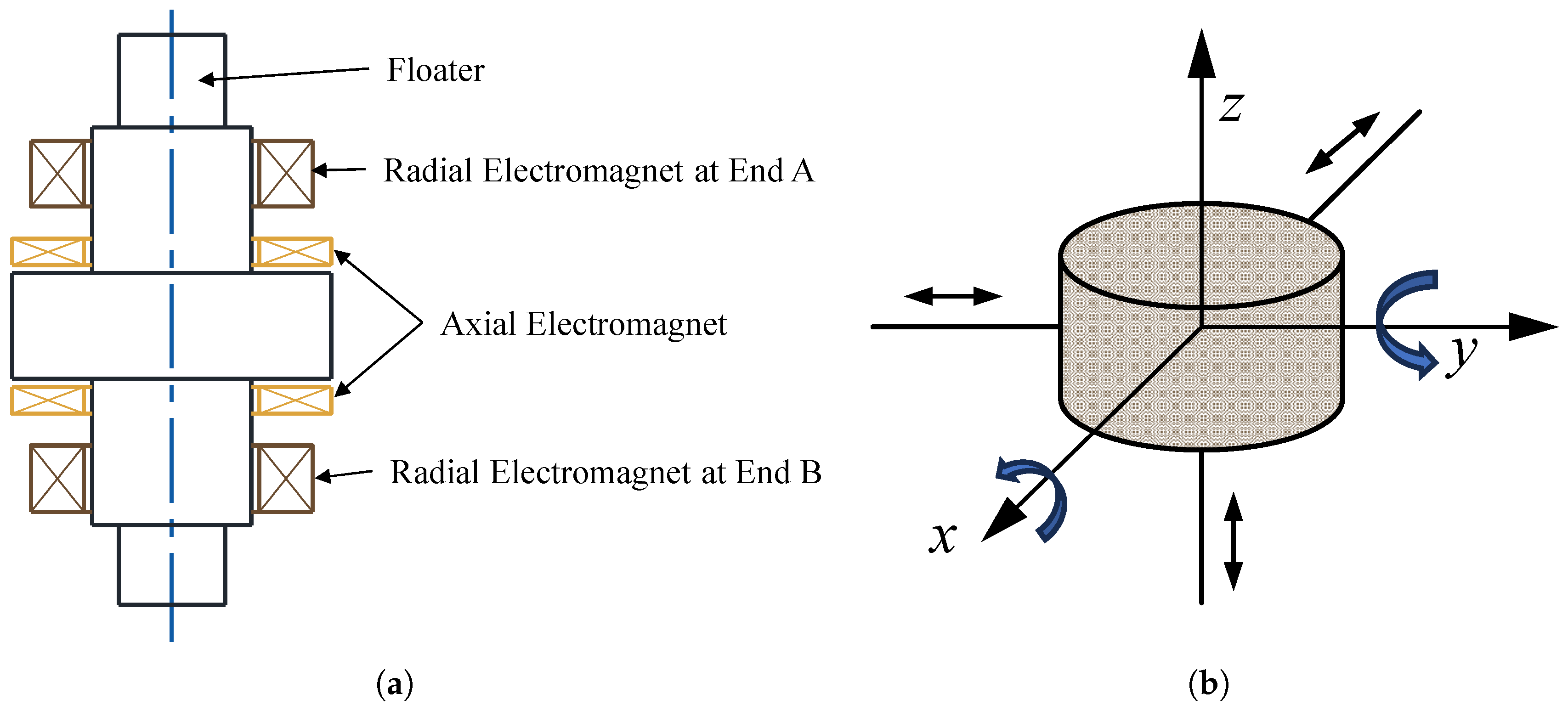
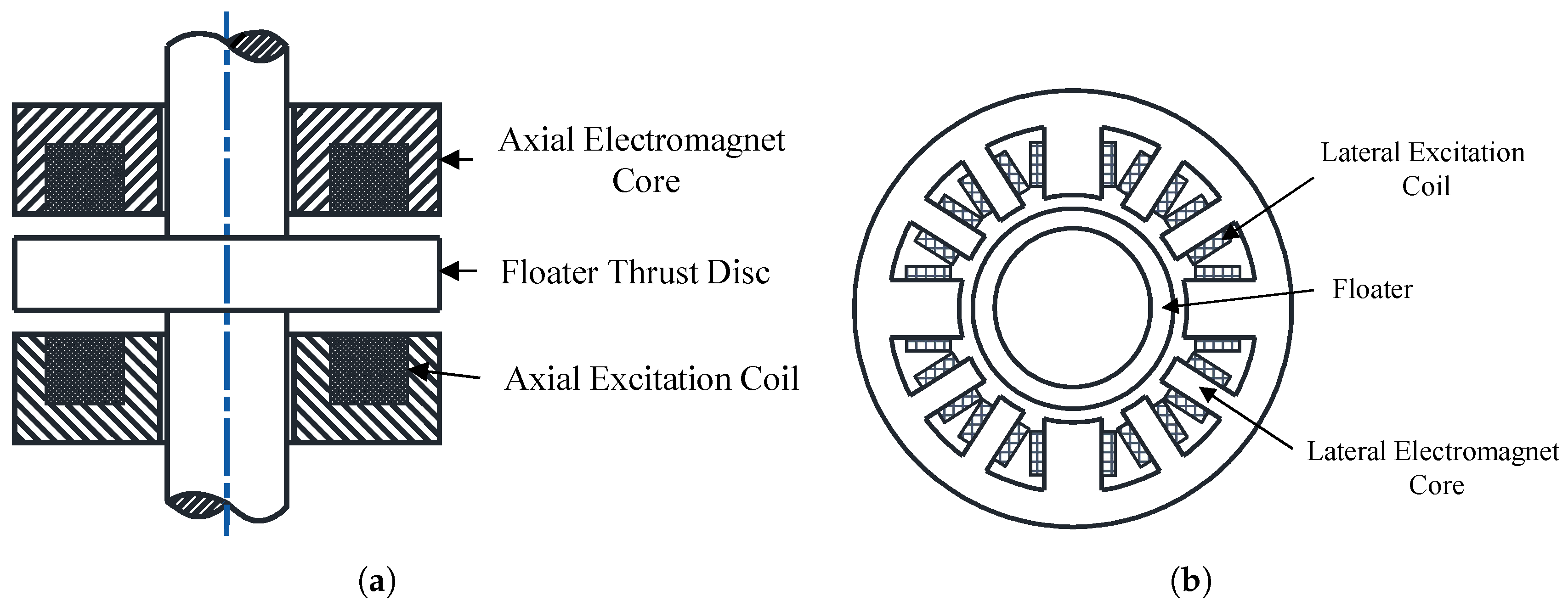
The operational principle and overall layout of the five-degree-of-freedom magnetic levitation vibration isolation system are illustrated in Figure 1. The base where the electromagnets are installed is defined as the stator, while the isolated part carrying the payload is defined as the floater. Electromagnetic actuators are employed to precisely control the five-degree-of-freedom motion of the floater: translation along the X, Y, and Z directions, as well as tilting around the X and Y axes, as shown in Figure 1a. The corresponding layout is depicted in Figure 1b.
To achieve the aforementioned multi-degree-of-freedom control, the system’s actuators can be decomposed into two orthogonal parts: vertical and lateral. The vertical actuator is responsible for controlling the translational motion of the floater along the Z-axis. Its structure consists of a thrust disc located at the center of the floater and a pair of vertical electromagnets positioned on both sides of the stator, as shown in Figure 2a. By applying a differential control current to this pair of electromagnets, the vertical position of the floater can be precisely adjusted. In the research presented in this paper, these vertical electromagnets are not only used to stably levitate the floater at its equilibrium position in the vertical direction but, more importantly, they primarily serve the function of achieving vertical vibration suppression.The lateral actuators control the remaining four degrees of freedom and are handled by two sets of lateral electromagnets located at ends A and B of the floater, respectively. The layout of a single side is shown in Figure 2b. These two symmetrically designed sets of lateral actuators work in coordination to generate lateral levitation forces for achieving translational motion along the X and Y axes, and to create a moment difference for achieving tilt around the X and Y axes. They replace mechanical guide rods by providing contactless horizontal constraint for the system through lateral electromagnetic forces [28].
In the structural optimization design of electromagnets, establishing an electromagnetic force model oriented toward geometric parameters requires comprehensive consideration of physical characteristics and engineering constraints. Based on ideal assumptions including segmented uniformity of the air-gap magnetic field and neglecting magnetic flux leakage and hysteresis, the quantitative relationship between the electromagnetic force and structural parameters such as the magnetic pole area A and coil cavity area A c u can be expressed as [29]:
F = λ 2 μ 0 J 2 4 x 2 A A cu 2
where λ represents the winding fill factor (with a value range of 0.6–0.8), J denotes the allowable current density (with a value range of 2–5 A/mm2), μ 0 is the vacuum permeability, and x is the working air gap. This equation directly correlates the electromagnetic force with the key geometric parameters A and A c u , serving as the objective function and design basis for subsequent structural optimization.
From Equation (1), it can be seen that when the working air gap x, current density J, and winding fill factor λ are determined, the magnitude of the electromagnetic force is directly determined by the two geometric dimensions: magnetic pole area A and coil cavity area A c u . Therefore, the structural optimization of electromagnetic actuators can generally be summarized into the following two categories. The first category: Under constraints of total volume (or size), how to allocate the ratio between A and A c u to maximize the electromagnetic force. The second category: Under requirements for a specified electromagnetic force, how to allocate the ratio between and to minimize the actuator’s volume and weight. Whether for vertical or lateral levitation systems, the core of the design lies in solving the above optimization problems based on specific load requirements and operating conditions, thereby determining the optimal volume allocation ratio between the magnetic circuit (iron) A and A c u the electrical circuit (copper).

2.2. Structural Design of the Vertical Magnetic Levitation System

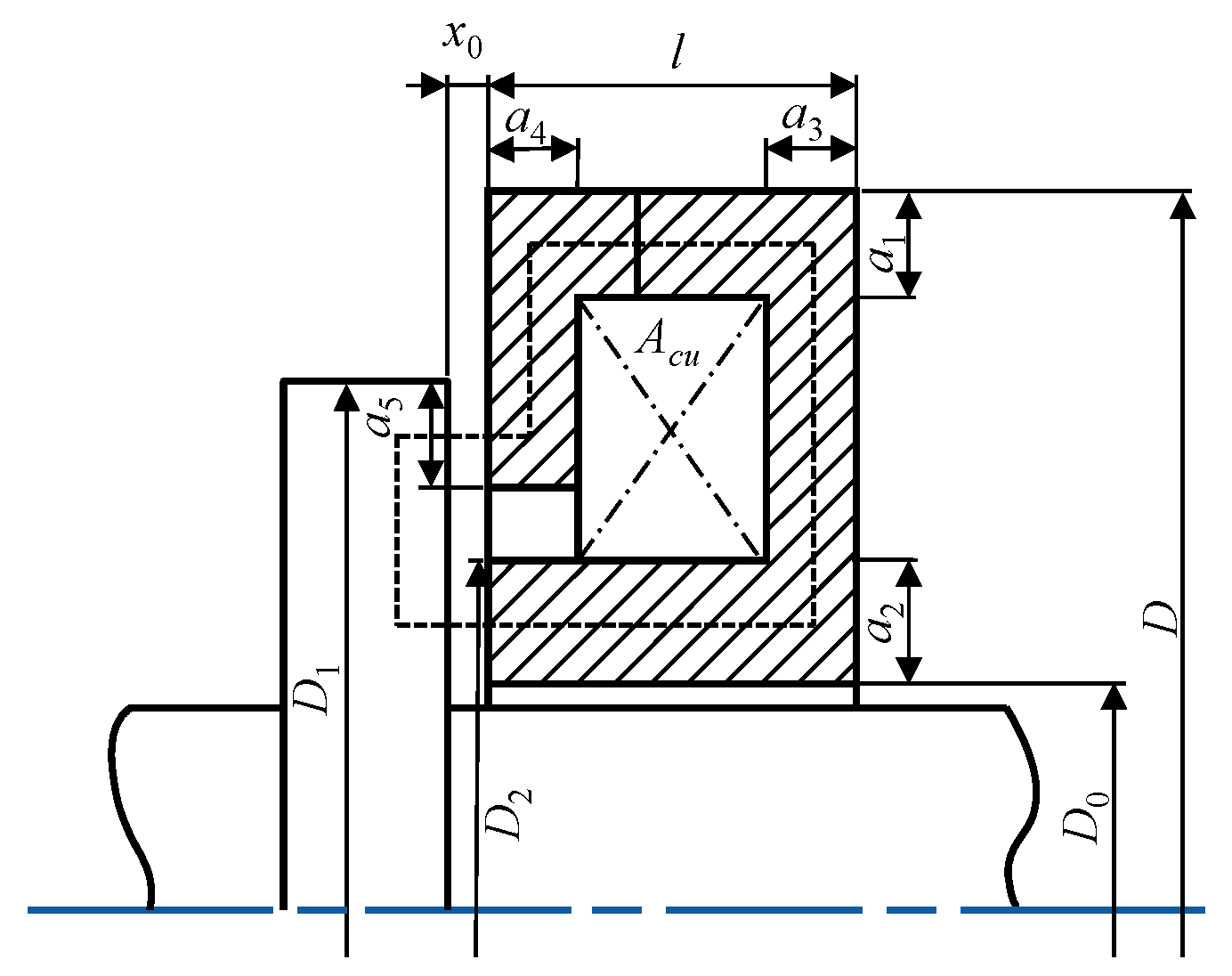
This subsection applies the aforementioned general design methodology to the structural design of the vertical magnetic levitation system. The structure of the vertical magnetic levitation system is shown in Figure 3. By introducing additional magnetic circuit branches, the output of electromagnetic force and space utilization efficiency are effectively enhanced, achieving non-contact support while ensuring an efficient layout of the magnetic circuit.
Based on the geometric relationships shown in Figure 3, the magnetic pole areas of each segment of the magnetic circuit can be expressed as:
A 1 = π a 1 ( D a 1 ) A 2 = π a 2 ( D 0 + a 2 ) A 3 = π a 3 ( D 0 + 2 a 2 ) A 4 = π a 4 ( D 1 2 a 5 ) A 5 = π a 5 ( D 1 a 5 )
In order to achieve uniform magnetic circuit saturation and make full use of magnetic materials, the design adopts the principle of equal magnetic reluctance, which means making the magnetic pole areas of each segment equal:
A 1 = A 2 = A 3 = A 4 = A 5 = A
When employing the equal magnetic reluctance principle for design, its structural characteristic is that the outer magnetic poles are relatively narrow, while the inner magnetic poles are relatively wide. Under this condition, given the external dimensions ( D , D 0 , D 1 , l ) of the vertical structure—meaning the overall design volume is fixed—the following relationship between the magnetic pole area A and the coil cavity area A c u can be established:
A cu = ( π l D a D c A D a A D c ) ( D b D a ) 2 π D a D c
where D a = D 0 2 + 4 A / π , D b = D 2 4 A / π , D c = D 1 2 4 A / π .
Substituting this geometric constraint into the electromagnetic force calculation Formula (1) derived in the previous section yields the core optimization problem of this subsection: under the condition of a given total system volume, how to reasonably allocate between the magnetic pole area A and the coil cavity area A c u to maximize the vertical electromagnetic force. To prevent magnetic saturation in the magnetic material, the coil cavity area A c u must satisfy the following condition:
A cu 2 B s x λ J μ 0
where B s is the magnetic saturation flux density of the core material.
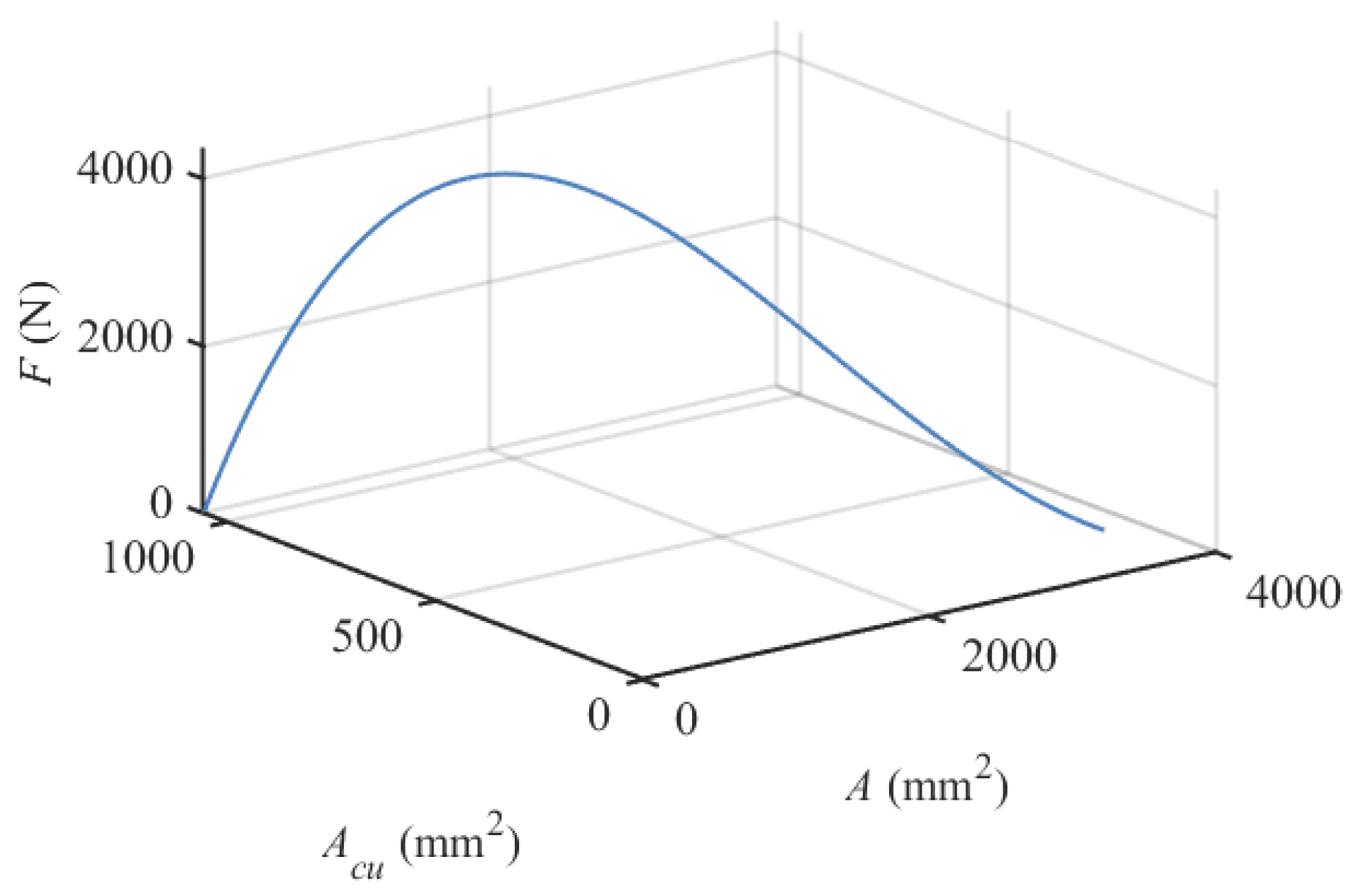
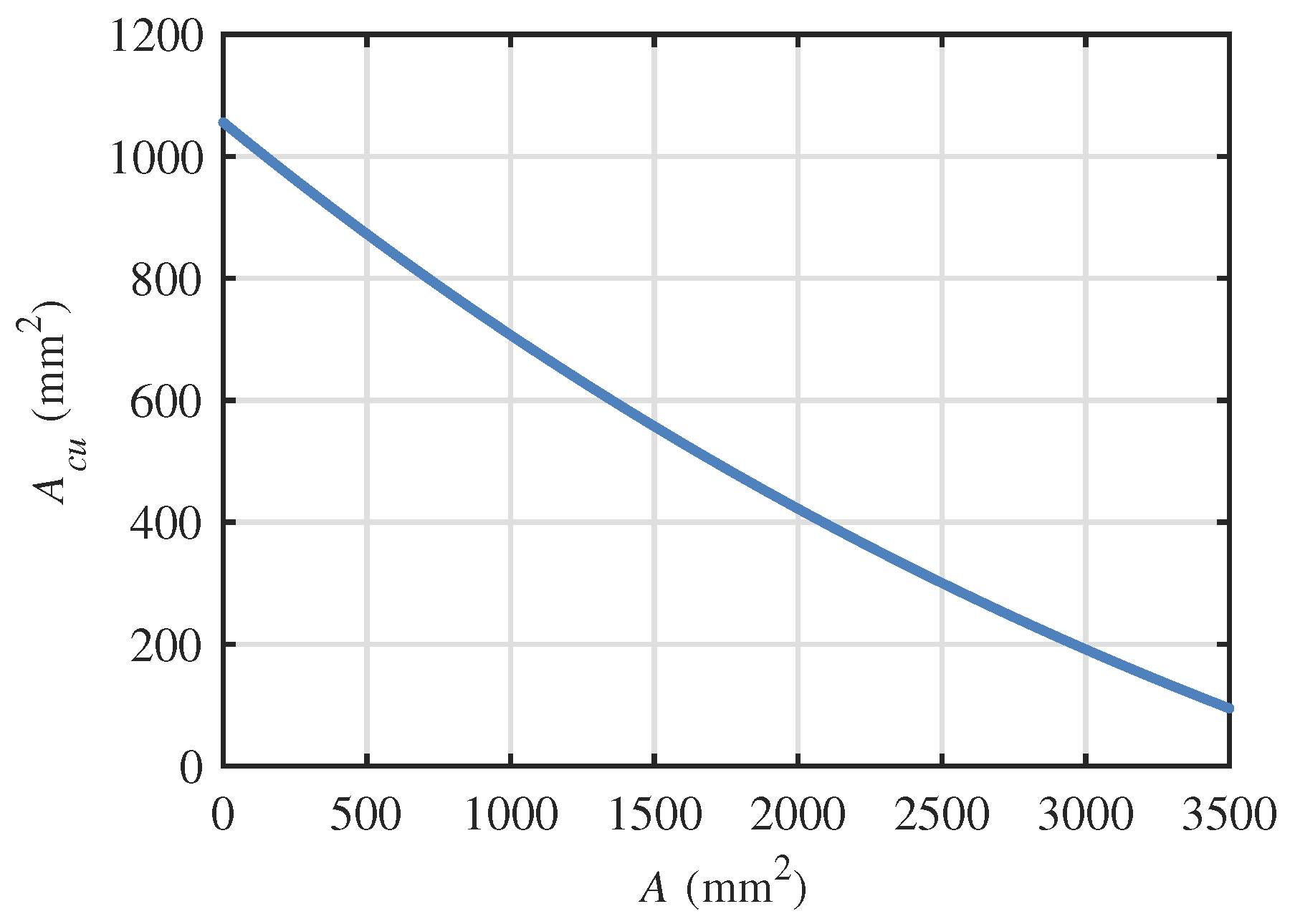
Taking the parameters D 0 = 94 mm, D 1 = 137 mm, D = 190 mm, l = 22 mm, x 0 = 0.4 mm, J = 3A/mm2 and λ = 0.7 as an example, the relationship between the magnetic pole area A and the coil cavity area A c u is shown in Figure 4. This relationship indicates that the magnetic pole area A and the coil cavity area A c u are inversely proportional. In other words, when more of the design volume is allocated to the magnetic circuit (iron), the volume available for the electrical circuit (copper) correspondingly decreases. The variation of the electromagnetic force F with respect to the magnetic pole area A and the coil cavity area A c u is shown in Figure 5. Under the conditions of this calculation example, the optimal magnetic pole area A is 1096.5966 mm 2 , and the optimal coil cavity area A c u is 676.8654 mm 2 . The corresponding maximum electromagnetic force F max is 4350 N.
By integrating the relationship curves from Figure 4 and Figure 5, along with the saturation constraint given in Equation (5), the maximum electromagnetic force F can be determined. The optimal magnetic pole area A is then selected, and the corresponding coil cavity area A c u is identified, thereby completing the structural design of the vertical electromagnetic actuator.

2.3. Structural Design of the Lateral Magnetic Levitation System

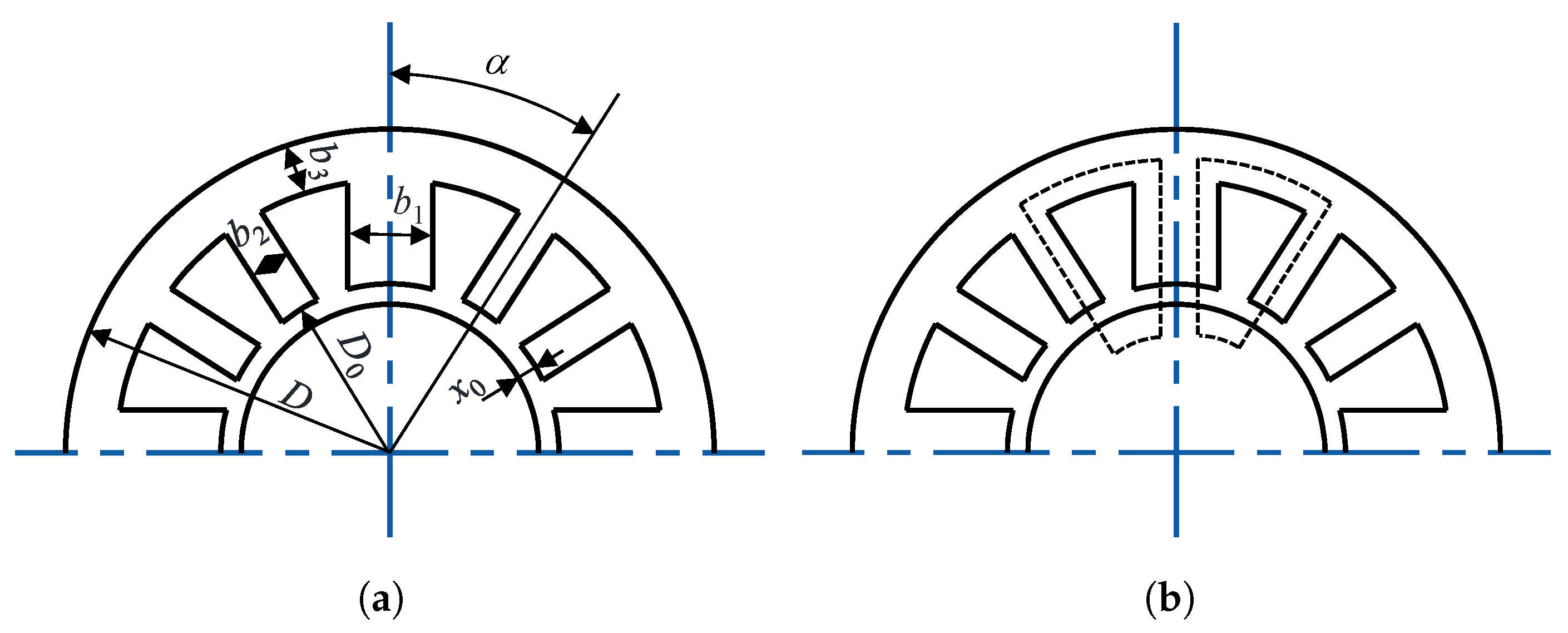
The lateral magnetic levitation system needs to simultaneously control four degrees of freedom, making its structural design more complex compared to the vertical magnetic levitation system. The structure of the lateral electromagnetic core is shown in Figure 6. This design utilizes a 12-tooth configuration, where each electromagnetic pole unit consists of one main tooth and its two adjacent auxiliary teeth, all sharing a common coil winding. The overall configuration is an E-core electromagnet, and the 12-tooth structure can be regarded as a combination of four E-core electromagnets. By appropriately designing the winding arrangement, it ensures that the resultant electromagnetic force generated by each unit aligns with the direction of the control coordinate axes.
In this design, the key geometric parameters are the tooth width b 1 , b 2 , b 3 . Based on the geometric relationships shown in Figure 6, the magnetic pole areas of the main tooth A 1 and the auxiliary tooth A 2 can be expressed as:
A 1 = D 0 l arcsin b 1 D 0 A 2 = D 0 l arcsin b 2 D 0
where l is the thickness of the lateral magnetic poles.
The area of a single coil cavity is:
A cu = π ( D + D 0 2 b 3 ) ( D D 0 2 b 3 ) ( b 1 + b 2 ) ( D D 0 b 3 ) 48
To ensure uniformity in the magnetic circuit, the design follows the principle of equal magnetic pole areas. Since one electromagnetic pole unit includes one main tooth and two auxiliary teeth, we have:
A 1 = 2 A 2
Under the condition that the tooth widths b 1 and b 2 are much smaller than the stator diameter D 0 , the approximate relationship between the tooth widths can be derived from Equation (8) as:
b 1 2 b 2
To simplify the design variables, let:
b 3 = b 2 = b
By combining Equations (7) and (10), the coil cavity area A c u can be simplified to a function determined solely by the single variable b:
A cu = π D + D 0 2 b D D 0 2 b 3 b D D 0 b 48
From Equation (6), it can be seen that when the external dimensional parameters ( D 0 , D, l) are selected, both the magnetic pole area A 1 ,   A 2 and the coil cavity area A c u can be determined solely by the single variable b. Substituting this relationship into the electromagnetic force Formula (1) further yields the functional relationship between the electromagnetic force and the tooth width b.
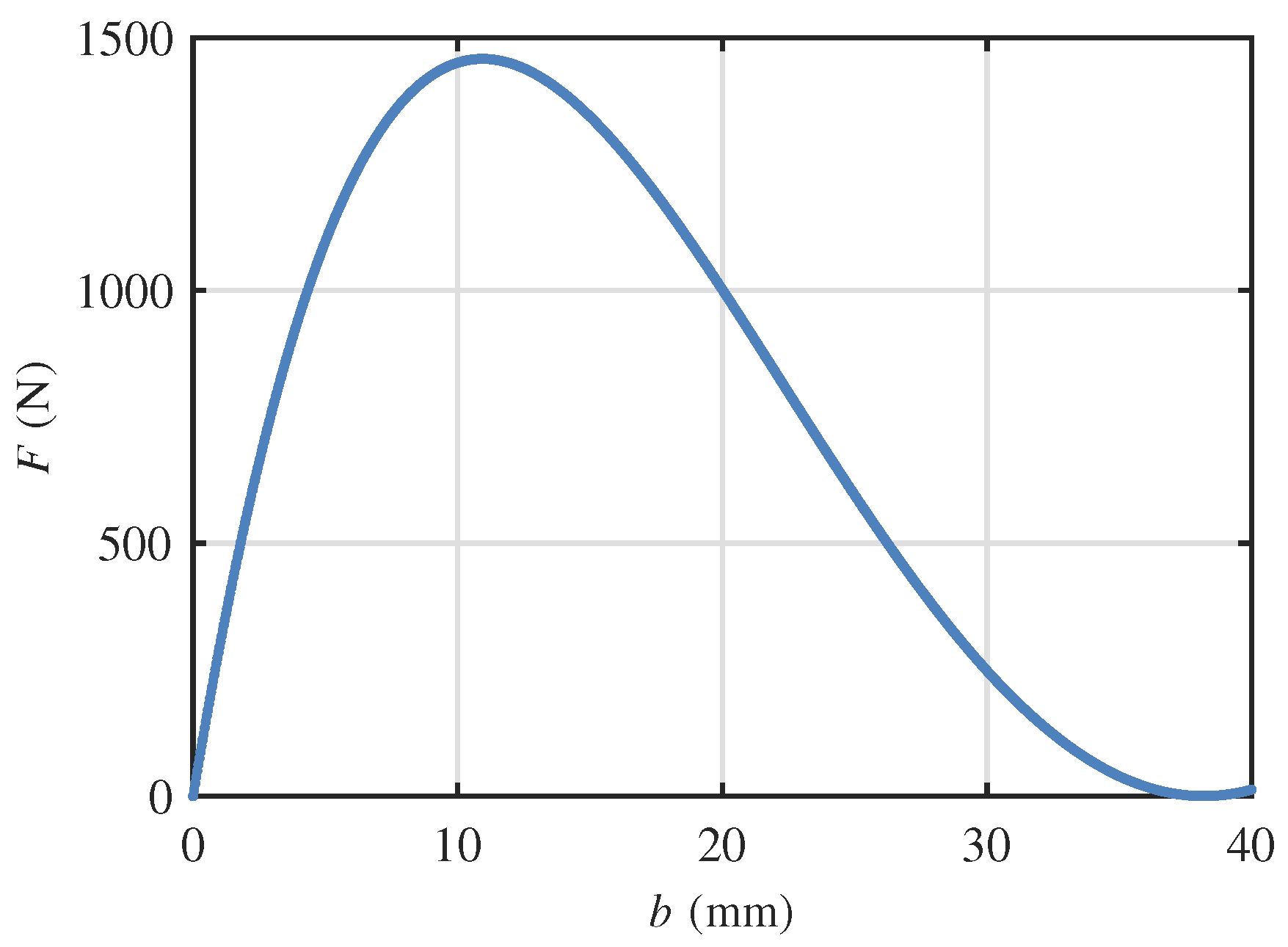
Taking specific parameters D 0 = 92.8 mm, D = 178 mm, l = 30 mm, x 0 = 0.4 mm, J = 4A/ mm 2 and λ = 0.7 as an example, the variation of electromagnetic force with magnetic pole width b is shown in Figure 7. The results indicate that the electromagnetic force exhibits non-monotonic characteristics with respect to b, meaning that excessively large or small tooth widths both lead to a decrease in electromagnetic force, and an optimal design point exists. Under the conditions of this calculation example, the optimal tooth width b is 10.93 mm, and the corresponding maximum electromagnetic force F max is 1458 N.

3. Electromagnetic Force Analysis and Calculation of the Magnetic Levitation Active Vibration

3.1. Analysis and Calculation of Vertical Electromagnetic Force

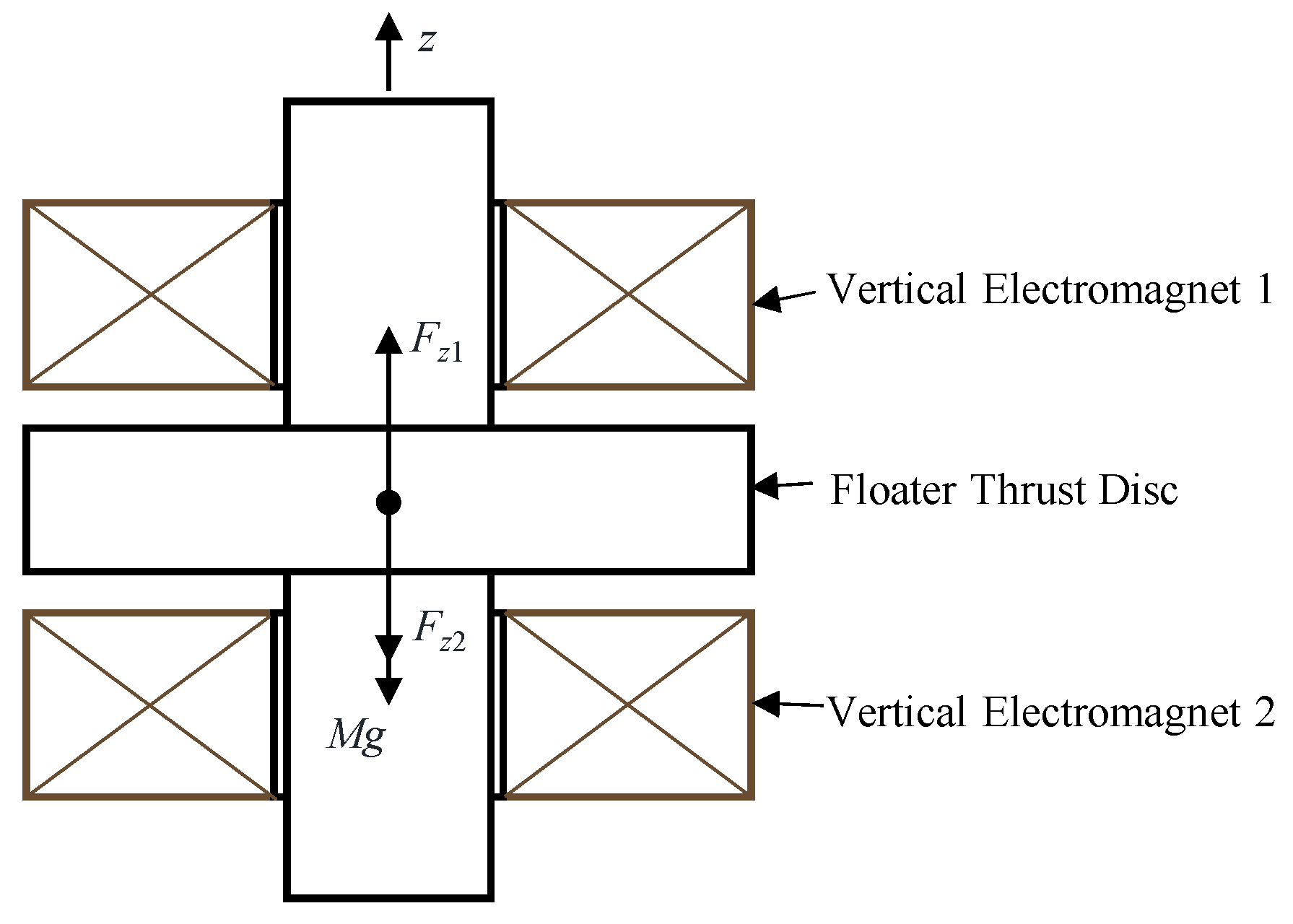
Vertical levitation is achieved through differential control by a pair of electromagnets located on both sides of the floater. The force analysis is illustrated in Figure 8. To establish the electromagnetic force model, while based on ideal assumptions of segmented uniformity in the air-gap magnetic field and neglecting magnetic flux leakage and hysteresis, it is assumed that the vertical electromagnetic force acts at the center of the floater [30].
Thus, the vertical electromagnetic force F z acting on the floater is the difference between the attractive forces of the two electromagnets on either side. It can be expressed as a nonlinear function of the control current i z and the displacement z:
F z ( i z , z ) = F z 1 ( i z 1 , z 1 ) F z 2 ( i z 2 , z 2 ) = k a ( i z 0 + i z ) 2 ( z 0 z ) 2 ( i z 0 i z ) 2 ( z 0 + z ) 2
where design parameters and the dynamic model and stiffness coefficients are introduced as follows (Table 1):

3.2. Analysis and Calculation of Lateral Electromagnetic Force

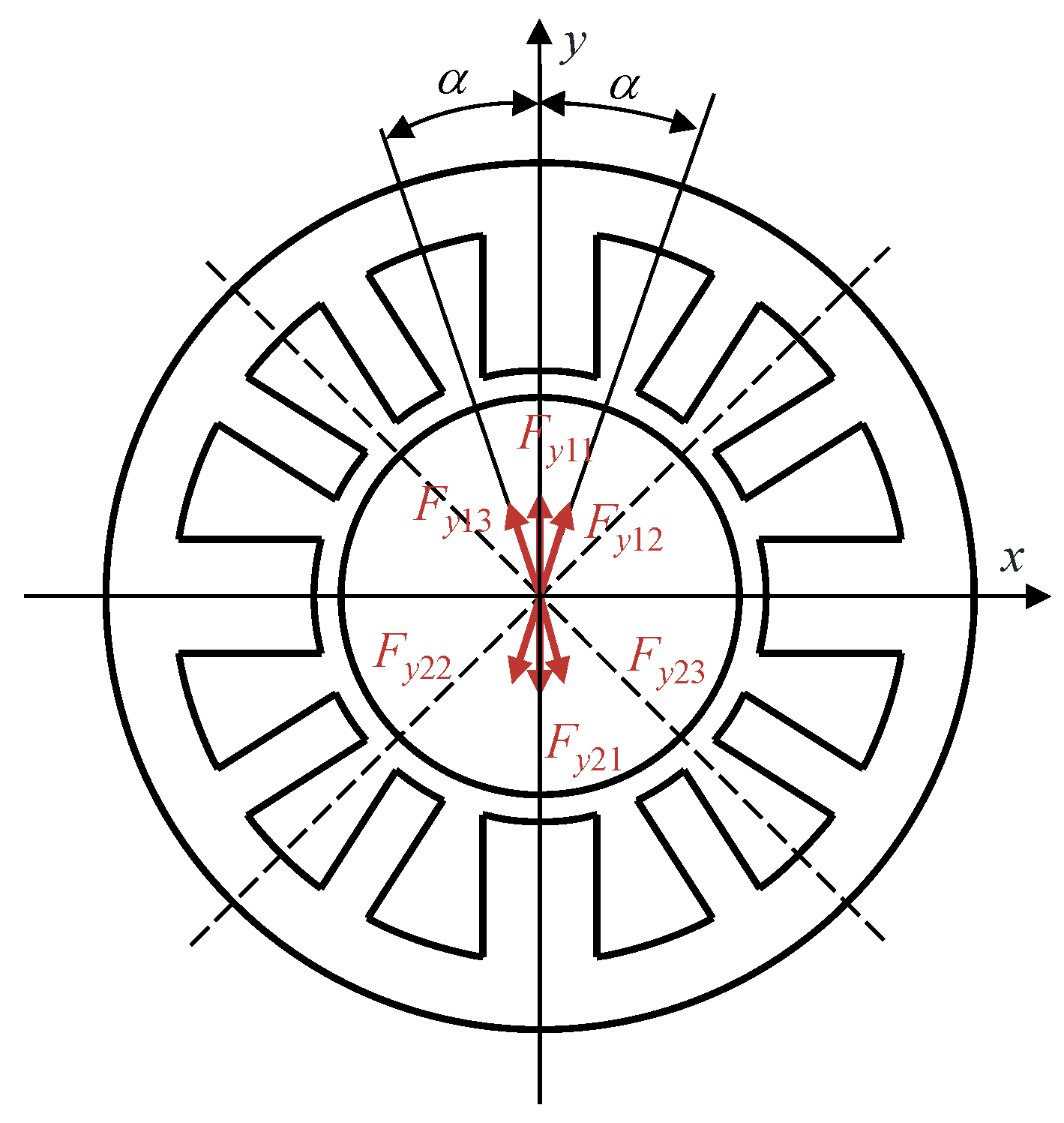
The lateral electromagnetic core adopts a combined structure consisting of one main tooth and its two adjacent auxiliary teeth, as shown in Figure 9. Taking the positive direction of the Y-axis as the reference, the electromagnetic force F y 1 along the Y-axis is composed of the resultant force from the electromagnetic force of one main tooth F y 11 and the electromagnetic forces of two auxiliary teeth F y 12 and F y 13 . A total of four sets are arranged in the system to achieve control over four degrees of freedom.
First, the electromagnetic force of a set of electromagnets (one main tooth and two auxiliary teeth) can be equivalently expressed as the resultant force acting along the principal axis:
F y 1 = F y 11 + F y 12 cos α + F y 13 cos α = μ 0 N r 1 2 A r 1 4 i y 1 y 1 2 + 2 × μ 0 N r 2 2 A r 2 cos α 4 i y 1 y 1 2 = k r i y 1 y 1 2
where k r = μ 0 4 N r 1 2 A r 1 + 2 N r 2 2 A r 2 cos α , A r 1 is the magnetic pole area of the main tooth, N r 1 is the number of coil turns of the main tooth, A r 2 is the magnetic pole area of the auxiliary tooth, N r 2 is the number of coil turns of the auxiliary tooth, and α is the angle between the center of the tooth slot and the main tooth. Since the structural parameters of the lateral magnetic levitation system are consistent in the X and Y axis directions, the lateral electromagnetic force coefficient is uniformly denoted by k r .
Similar to the vertical structure, the lateral electromagnetic cores also employ a differential control method. Both ends A and B each contain two orthogonal differential pairs. Taking end A as an example, its nonlinear electromagnetic force can be expressed as:
F a x 1 = k r ( i x a 1 ) 2 ( x a 1 ) 2 = k r ( i x 0 + i x a ) 2 ( x a 0 x a ) 2 F a x 2 = k r ( i x a 2 ) 2 ( x a 2 ) 2 = k r ( i x 0 i x a ) 2 ( x a 0 + x a ) 2 F a y 1 = k r ( i y a 1 ) 2 ( y a 1 ) 2 = k r ( i y 0 + i y a ) 2 ( y a 0 y a ) 2 F a y 2 = k r ( i y a 2 ) 2 ( y a 2 ) 2 = k r ( i y 0 i y a ) 2 ( y a 0 + y a ) 2
The resultant forces of the lateral electromagnetic cores at end A along the X and Y coordinate axes are:
F a x = F a x 1 F a x 2 F a y = F a y 1 F a y 2
Similarly, the electromagnetic forces ( F b x 1 , F b x 2 , F b y 1 , F b y 2 ) for the two sets of differential electromagnetic cores at end B can be expressed by the same formulas:
F b x 1 = k r ( i x b 1 ) 2 ( x b 1 ) 2 = k r ( i x 0 + i x b ) 2 ( x b 0 x b ) 2 F b x 2 = k r ( i x b 2 ) 2 ( x b 2 ) 2 = k r ( i x 0 i x b ) 2 ( x b 0 + x b ) 2 F b y 1 = k r ( i y b 1 ) 2 ( y b 1 ) 2 = k r ( i y 0 + i y b ) 2 ( y b 0 y b ) 2 F b y 2 = k r ( i y b 2 ) 2 ( y b 2 ) 2 = k r ( i y 0 i y b ) 2 ( y b 0 + y b ) 2
The resultant forces of the lateral electromagnetic cores at end B along the X and Y coordinate axes are:
F b x = F b x 1 F b x 2 F b y = F b y 1 F b y 2
The lateral force vector F r is formed by the combined contributions from both ends A and B:
F r = [ F a x , F b x , F a y , F b y ] T
where design parameters and the dynamic model and stiffness coefficients are introduced as follows (Table 2):

4. Modeling and Analysis of the Active Magnetic Levitation Vibration Isolation System

Based on the analysis of electromagnetic forces, this section further derives the multi-degree-of-freedom rigid-body dynamics equations of the system. By integrating the electromagnetic force models with the dynamics equations, a model of the active magnetic levitation vibration isolation system is established.

4.1. Dynamics Analysis of the Active Magnetic Levitation Vibration Isolation System

The dynamic model of the magnetic levitation vibration isolation system serves as the foundation for analyzing system characteristics and designing control strategies. First, the coordinate system is defined, and then a five-degree-of-freedom dynamic model describing the translational and rotational motions of the floater is established based on rigid-body dynamics theory.
Definition of the Coordinate System
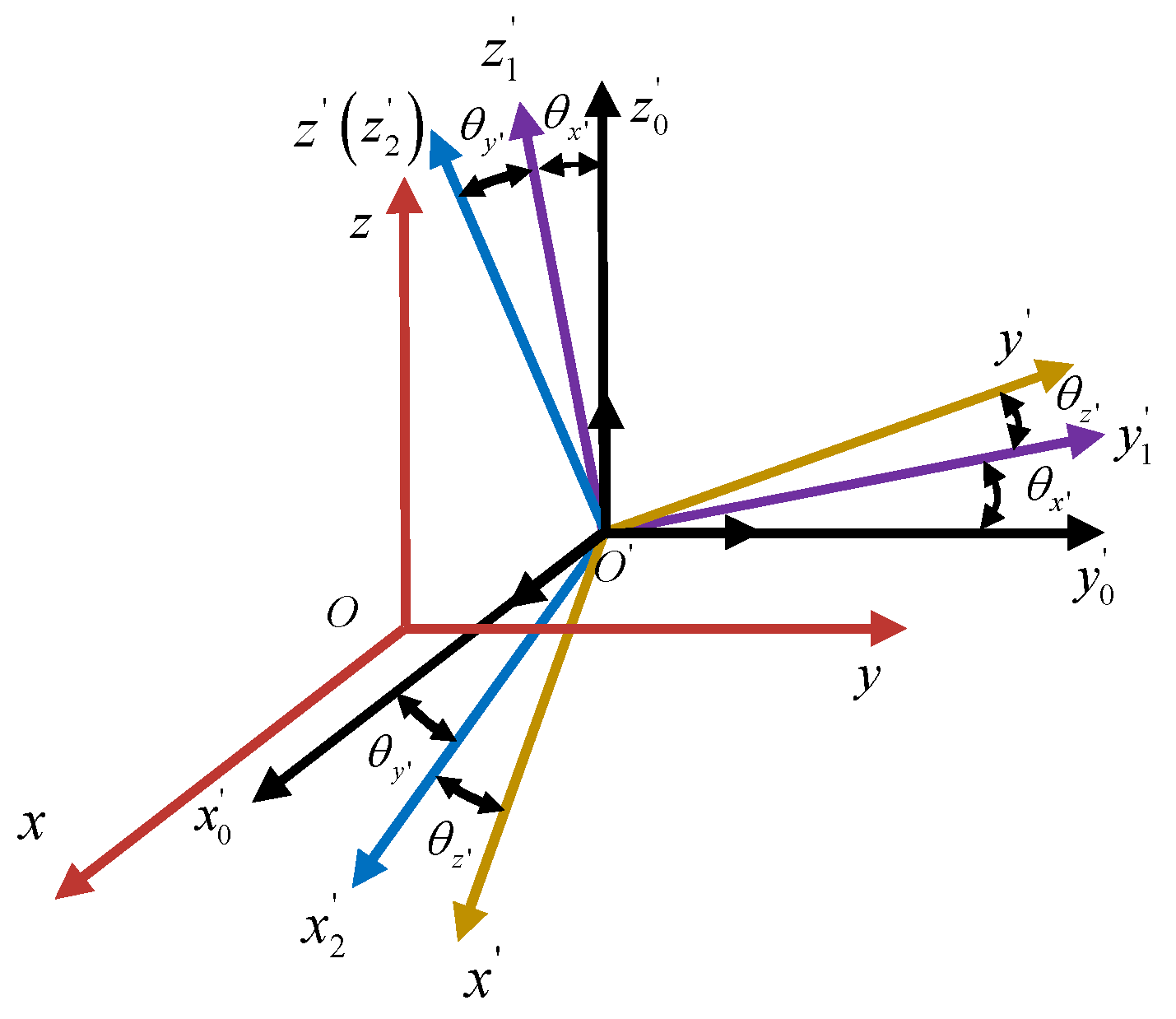
To characterize the motion of the floater, the base coordinate system Oxyz and the body-fixed coordinate system O x y z are defined, as shown in Figure 10. The coordinate transformation from the base coordinate system to the body-fixed coordinate system can be achieved through three Euler angle rotations (using the Z–Y–X sequence), and the corresponding rotation matrix is denoted as A r :
A r = R x , θ x · R y , θ y · R z , θ z = cos θ y cos θ z cos θ y sin θ z sin θ y cos θ z sin θ x sin θ y cos θ x sin θ z cos θ x cos θ z + sin θ x sin θ y sin θ z cos θ y sin θ x sin θ x sin θ z + cos θ x cos θ z sin θ y cos θ x sin θ y sin θ z cos θ z sin θ x cos θ x cos θ y
Since the system operates near the equilibrium point and the tilt angles of the floater around the X-axis and Y-axis are sufficiently small, a small-angle approximation can be applied.
The small-angle approximation is employed under the design assumption that the floater’s angular motion is actively regulated within a small range (e.g., θ x , θ y < 10 ) during normal vibration isolation operation. This is consistent with the system’s performance objectives and physical constraints. The linearized dynamic model derived therefrom is therefore the basis for nominal controller synthesis. The controller’s stability and performance robustness are designed to accommodate transient excursions beyond this nominal linear range caused by large, unforeseen disturbances. Under this condition, the rotation matrix can be approximately simplified to A t :
A t = R x , θ x · R y , θ y · R z , θ z = cos θ z sin θ z 0 sin θ z cos θ z 0 0 0 1
This transformation matrix is an orthogonal matrix, and thus satisfies:
A t 1 = A t
In the body-fixed coordinate system of the floater, the directions of the angular velocities corresponding to the three Euler angles are, respectively, along the z , y , and x axes of the body-fixed coordinate system. In this coordinate system O x y z , z , y and x represent the three central principal axes of inertia of the floater. From the transformation matrix A t , it follows that: θ ˙ x θ ˙ y θ ˙ z = A t θ ˙ x θ ˙ y θ ˙ z .
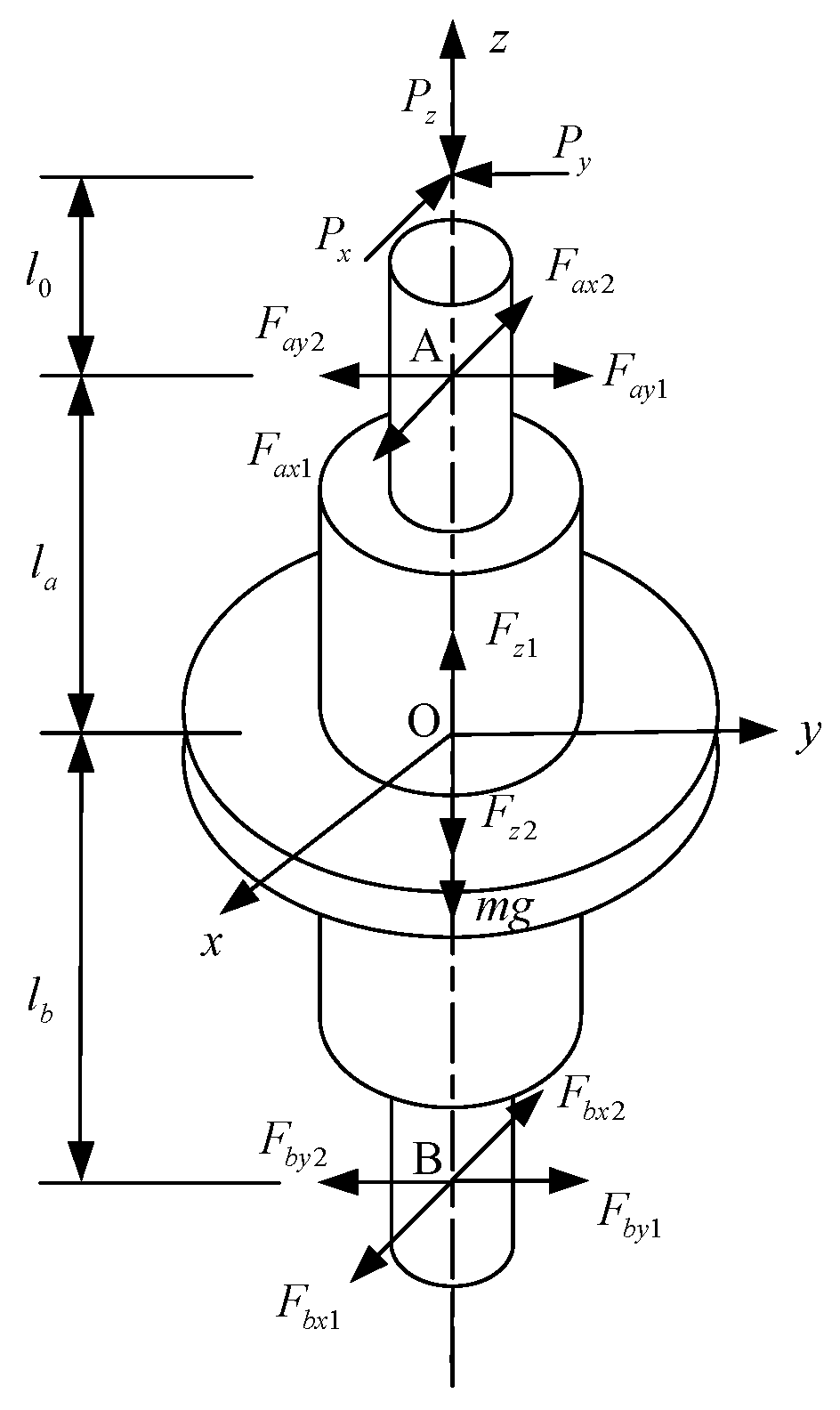
The magnetic levitation vibration isolation system is designed as a non-contact configuration, relying on electromagnetic forces for support. The floater is treated as a rigid body, and a magnetic levitation body-fixed coordinate system is established, with the center of mass at the equilibrium position set as the origin. To simplify the dynamic modeling, the electromagnetic forces are simplified as concentrated forces acting at corresponding points. The simplified force diagram of the floater is shown in Figure 11. F a x 1 and F a x 2 represent the electromagnetic attractive forces of the lateral electromagnetic cores at end A in the X-axis direction; F a y 1 and F a y 2 represent the electromagnetic attractive forces of the lateral electromagnetic cores at end A in the Y-axis direction; F b x 1 and F b x 2 represent the electromagnetic attractive forces of the lateral electromagnetic cores at end B in the X-axis direction; F b y 1 and F b y 2 represent the electromagnetic attractive forces of the lateral electromagnetic cores at end B in the Y-axis direction; F z 1 and F z 2 represent the electromagnetic attractive forces in the Z-axis direction; P x , P y and P z are the components of external forces along the X, Y, and Z axes, respectively; and m is the mass of the floater.
Assuming the floater is a rigid body and levitated with five degrees of freedom without contact with the external environment, it can be considered as undergoing free motion. The differential equations describing its motion [31] are:
m d V c d t = F d H c d t + ω 1 × H c = M
where V c is the translational motion of the center of mass, ω 1 is the angular velocity in the body-fixed coordinate system, H c is the angular momentum of the floater relative to the center of mass, and F , M are the external force and external moment, respectively.
Derived from Newton’s second law, the translational dynamics of the system are expressed as:
m x ¨ c = F x m y ¨ c = F y m z ¨ c = F z
where x ¨ c , y ¨ c , and z ¨ c are the centroid accelerations in the X, Y, and Z-axis directions, respectively; F x is the resultant force acting on the floater in the X-axis direction; F y is the resultant force in the Y-axis direction; and F z is the resultant force in the Z-axis direction.
The total resultant force F = [ F x , F y , F z ] T acting on the center of mass of the floater is:
F x = F a x 1 F a x 2 + F b x 1 F b x 2 P x F y = F a y 1 F a y 2 + F b y 1 F b y 2 P y F z = F z 1 F z 2 P z m g
In the rotating coordinate system, counterclockwise rotation is defined as positive, and the total resultant moment M = [ M x , M y , M z ] T is:
M x = F a y 1 F a y 2 l a + F b y 1 F b y 2 l b + P y l 0 + l a M y = F a x 1 F a x 2 l a F b x 1 F b x 2 l b P x l 0 + l a M z = 0
where M x is the moment about the X-axis, M y is the moment about the Y-axis, and M z is the moment about the Z-axis.
After comprehensively considering that the floater possesses lateral symmetry, that is, the moments of inertia about the x axis and y axis are equal ( J x = J y = J ) and given that rotation about the z axis is not considered in this magnetic levitation vibration isolation system (i.e., θ ˙ z = 0 and θ ¨ z = 0 ), and applying the previously described coordinate transformation relationships [31], the rotational dynamics equations of the system in the base coordinate system are finally obtained as:
J θ ¨ x = M x J θ ¨ y = M y 0 = M z
Combining the translational Equation (23) and the rotational Equation (26), the five-degree-of-freedom dynamic model describing the system’s motion is obtained as:
m x ¨ c = F a x 1 F a x 2 + F b x 1 F b x 2 P x m y ¨ c = F a y 1 F a y 2 + F b y 1 F b y 2 P y m z ¨ c = F z 1 F z 2 P z m g J θ ¨ x = F a y 1 F a y 2 l a + F b y 1 F b y 2 l b + P y l 0 + l a J θ ¨ y = F a x 1 F a x 2 l a F b x 1 F b x 2 l b P x l 0 + l a
From the rigid-body dynamics Equation (27), it can be observed that the third equation describing vertical translation ( z c ) is an independent second-order differential equation in form, and its state variables do not include lateral degree-of-freedom variables. In contrast, the four equations describing lateral motion ( x c , y c , θ x , θ y ) contain coupling terms, forming a typical multivariable coupled system. This indicates that the vertical and lateral degrees of freedom exhibit decoupling characteristics in the rigid-body dynamics structure, providing a theoretical basis for decomposing the system into two independent subsystems and designing controllers for them separately.
Dynamic Model of the Vertical Magnetic Levitation System
Substituting the vertical electromagnetic force Equation (12) into the second-order differential equation for vertical translation, the vertical nonlinear dynamic equation can be expressed as:
m z ¨ c = F z 1 F z 2 P z m g = k a i z 0 + i z 2 z 0 z 2 i z 0 i z 2 z 0 + z 2 P z m g
To facilitate system analysis and controller design, this nonlinear electromagnetic force model is linearized by performing a first-order Taylor expansion around the operating point ( z = 0 , i z = 0 ) [30], yielding its linearized form:
F z ( i z , z ) = F z 1 F z 2 k z z + k i z i z
where k z = 4 k a i z 0 2 / z 0 3 is the displacement stiffness coefficient, and k i z = 4 k a i z 0 / z 0 2 is the current stiffness coefficient.
The nonlinear vertical force for a single electromagnet is given by F ( i / z ) 2 . The linearized model F k z × z + k i × i approximates this relationship. A common and conservative engineering criterion is to limit the gap variation (z) to a small fraction of the nominal gap ( z 0 ), such that the force deviation due to nonlinearity is within an acceptable margin (e.g., <10%).
Substituting Equation (29) into Equation (28) yields the linear dynamic equation of the vertical magnetic levitation system:
m z ¨ c = k z z + k i z i z P z m g
In Equation (30), the term z ¨ c on the left-hand side represents the absolute acceleration of the floater’s center of mass in inertial space, while the term z on the right-hand side represents the variation in the suspension gap between the floater and the base. The geometric compatibility relationship between these two directly determines the vibration transmission path within the system and is a key focus in the subsequent modeling for vibration suppression control.
Substituting the lateral electromagnetic force Equations (14) and (16) into Equation (27) yields the nonlinear dynamic equations for the four lateral degrees of freedom:
m x ¨ c = k r i x a 1 2 x a 1 2 k r i x a 2 2 x a 2 2 + k r i x b 1 2 x b 1 2 k r i x b 2 2 x b 2 2 P x m y ¨ c = k r i y a 1 2 y a 1 2 k r i y a 2 2 y a 2 2 + k r i y b 1 2 y b 1 2 k r i y b 2 2 y b 2 2 P y J θ ¨ x = k r r i y a 1 2 y a 1 2 k r i y a 2 2 y a 2 2 l a k r i y b 1 2 y b 1 2 k r i y b 2 2 y b 2 2 l b P y l 0 + l a J θ ¨ y = k r i x a 1 2 x a 1 2 k r i x a 2 2 x a 2 2 l a + k r i x b 1 2 x b 1 2 k r i x b 2 2 x b 2 2 l b + P x l 0 + l a
For ease of controller design, the nonlinear lateral force vector F r from Equation (18) is linearized. By performing a first-order Taylor series expansion around the operating point, the linearized approximate expression for the lateral force is:
F r = F a x F b x F a y F b y = k r i x 0 + i x a 2 x a 0 x a 2 k r i x 0 i x a 2 x a 0 + x a 2 k r i x 0 + i x b 2 x b 0 x b 2 k r i x 0 i x b 2 x b 0 + x b 2 k r i y 0 + i y a 2 y a 0 y a 2 k r i y 0 i y a 2 y a 0 + y a 2 k r i y 0 + i y b 2 y b 0 y b 2 k r i y 0 i y b 2 y b 0 + y b 2 = k x a x a + k i x a i x a k x b x b + k i x b i x b k y a y a + k i y a i y a k y b y b + k i y b i y b
Among them, k x a = 4 k r i x 0 2 / x a 0 3 , k i x a = 4 k r i x 0 / x a 0 2 , k x b = 4 k r i x 0 2 / x b 0 3 , k i x b = 4 k r i x 0 / x b 0 2 , k y a = 4 k r i y 0 2 / y a 0 3 , k i y a = 4 k r i y 0 / y a 0 2 , k y b = 4 k r i y 0 2 / y b 0 3 , k i y b = 4 k r i y 0 / y b 0 2 . k x a , k x b , k y a , k y b are displacement stiffness coefficients, and k i x a , k i x b , k i y a , k i y b are current stiffness coefficients. Under the assumption that the system’s structural and electrical parameters are consistent, we have k x a = k x b = k y a = k y b as well as k i x a = k i x b = k i y a = k i y b . The linearized electromagnetic force vector (32) can be expressed in matrix form as:
F r = K x X + K i l I x
where X = x a , x b , y a , y b T is the lateral suspension gap matrix, I x = i x a , i x b , i y a , i y b T is the input current matrix, K x = diag k x a , k x b , k y a , k y b is the displacement stiffness coefficient matrix, and K i = diag k i x a , k i x b , k i y a , k i y b is the current stiffness coefficient matrix.
Taking the center-of-mass displacement vector X c = x c , θ y , y c , θ x T , and substituting Equation (32) into Equation (31), the linearized four-degree-of-freedom lateral dynamic model can be obtained, which can be expressed in matrix form as:
M c X ¨ c = A c K x X + A c K i I x + D c P m
where M c = m 0 0 0 0 J 0 0 0 0 m 0 0 0 0 J , A c = 1 1 0 0 l a l b 0 0 0 0 1 1 0 0 l a l b , D c = 1 0 l 0 + l a 0 0 1 0 l 0 + l a , P m = P x P y .

4.2. Modeling and Analysis of the Vertical Magnetic Levitation Vibration Suppression Control System

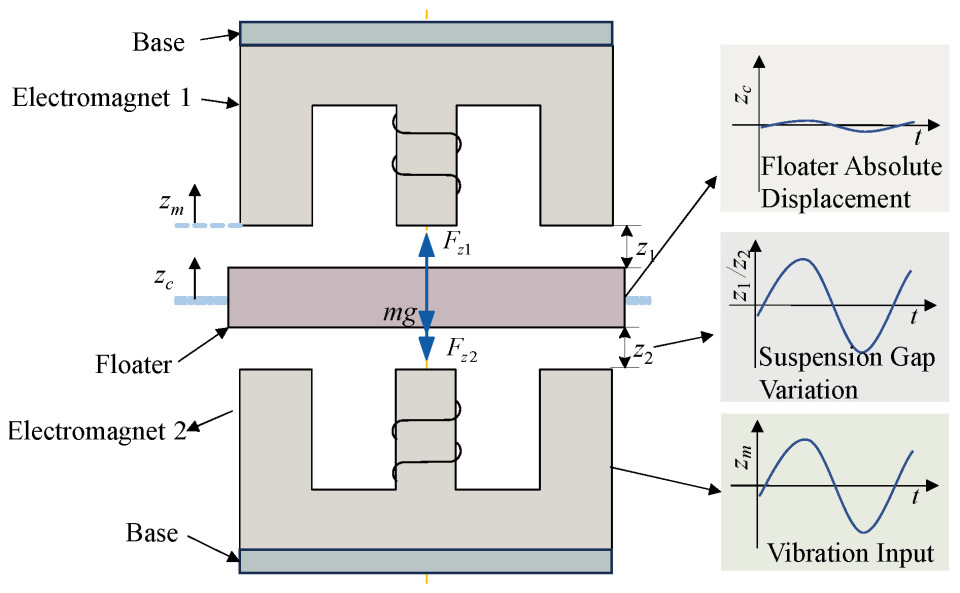
The dynamic model established in the previous chapters is based on the ideal assumption of a stationary base. However, in vibration isolation systems, the base is often subjected to continuous broadband vibrations. Specifically, the system targets environmental micro-vibrations and random disturbances typical of high-precision applications (such as optical platforms and space experiments). These excitations are characterized by a broad frequency spectrum, with a particular emphasis on suppressing low-frequency components where traditional passive isolators are less effective. The fundamental task of the vertical vibration suppression system is to mitigate the transmission of such vibrational disturbances. To this end, this section incorporates base motion as an external disturbance input into the dynamic model to fully describe the mechanism of vibration transmission. As illustrated in Figure 12 on vibration transmission, the vertical system employs a differential electromagnetic suspension structure, which replaces traditional mechanical rigid connections with controllable electromagnetic forces, thereby interrupting rigid vibration transmission paths. To construct a system model that includes base excitation, it is first necessary to clarify the geometric relationships among the base, the floater, and the suspension gap from a kinematic perspective.
The dynamic equations of the system are established in the inertial coordinate system, whereas the key variable determining the electromagnetic force is the relative displacement between the electromagnet and the floater, i.e., the suspension gap. For a unified description, based on Figure 12, the following coordinate variables are defined: let z c be the absolute displacement of the floater’s center of mass in the inertial coordinate system, z m be the absolute displacement of the base, let z 1 be the relative suspension gap between the floater and the upper electromagnet 1, and z 2 be the relative suspension gap between the floater and the lower electromagnet 2. According to the geometric constraint relationship, the upper air gap z 1 can be expressed as:
z 1 = z m z c
In control system analysis, greater emphasis is placed on the dynamic deviations of each quantity relative to the equilibrium point. Therefore, the absolute displacement is decomposed into the sum of the equilibrium position value and the dynamic deviation:
z 1 = z 0 z z c = z c 0 + z c r z m = z m 0 + z m r z c 0 = z m 0 z 0
where z 0 is the equilibrium suspension gap value, z is the deviation of the suspension gap from the equilibrium position, z c 0 is the equilibrium position of the floater, z c r is the deviation of the floater from its equilibrium position, z m 0 is the equilibrium position of the base, and z m r is the deviation of the base from its equilibrium position.
Substituting Equation (36) into Equation (35) and eliminating the equilibrium terms yields:
z c r = z m r + z
Equation (37) reveals the kinematic relationship among the absolute motion of the floater, the vibration disturbance of the base, and the relative suspension gap. It follows that the suspension gap signal measured by the sensor is actually a superposition of the floater’s motion and the base’s vibration. This means that the vibrational displacement of the base z m r acts as a kinematic interference, directly superimposed on the position feedback signal, thereby influencing the absolute motion state of the floater through the closed-loop control force. Therefore, in the analysis of vibration isolation performance, it is necessary to explicitly treat the base vibration as an external disturbance input to the system based on this equation, in order to accurately describe the mechanism by which vibrations are transmitted from the base to the floater.
The vertical dynamic equation after linearizing the electromagnetic force is:
m z ¨ c r = k z z + k i z i z + f d z
where f d z = P z m g .
According to Equation (37), the kinematic relationship of vibration transmission is:
z ¨ c r = z ¨ m r + z ¨
The ideal objective of vibration isolation is to make the absolute acceleration of the floater tend toward zero. According to the kinematic relationship expressed in Equation (37), this implies that the control system must adjust the suspension gap acceleration z ¨ to fully counteract the base vibration acceleration z ¨ m r .
The electrical equation of a single electromagnet can be equivalently represented as a first-order inertial element [32,33]. Similarly, the electrical equation of a differential electromagnet can also be modeled as a first-order inertial element, typically by designing a current inner loop in the electromagnet drive circuit. Assuming this current loop has sufficiently high bandwidth, the control current i z ( t ) can rapidly and precisely track the input command u z ( t ) . Therefore, its transfer function can be approximated as:
G z i ( s ) = I z ( s ) U z ( s ) = 1
It is worth noting that in practical engineering applications, continuous operation inevitably causes a rise in coil temperature, leading to variations in the winding resistance. However, the implemented high-bandwidth closed-loop current control effectively mitigates the impact of these resistance changes. By dynamically adjusting the driving voltage based on the feedback error, the current loop ensures that the actual current precisely tracks the command signal, maintaining consistent electromagnetic force output despite thermal effects.
Substituting Equations (40) and (37) into Equation (38), we obtain:
m z ¨ m r + z ¨ = k z z + k i z u z + f d z
For convenience in frequency domain analysis and controller design, the Laplace transform is applied to Equation (41), yielding the open-loop transfer functions from the control input U z ( s ) , force disturbance F d z ( s ) , and base vibration Z m r ( s ) to the suspension gap Z ( s ) [32,33,34]:
Z s = k i z m s 2 k z U z s + 1 m s 2 k z F d z s m s 2 m s 2 k z Z m r s
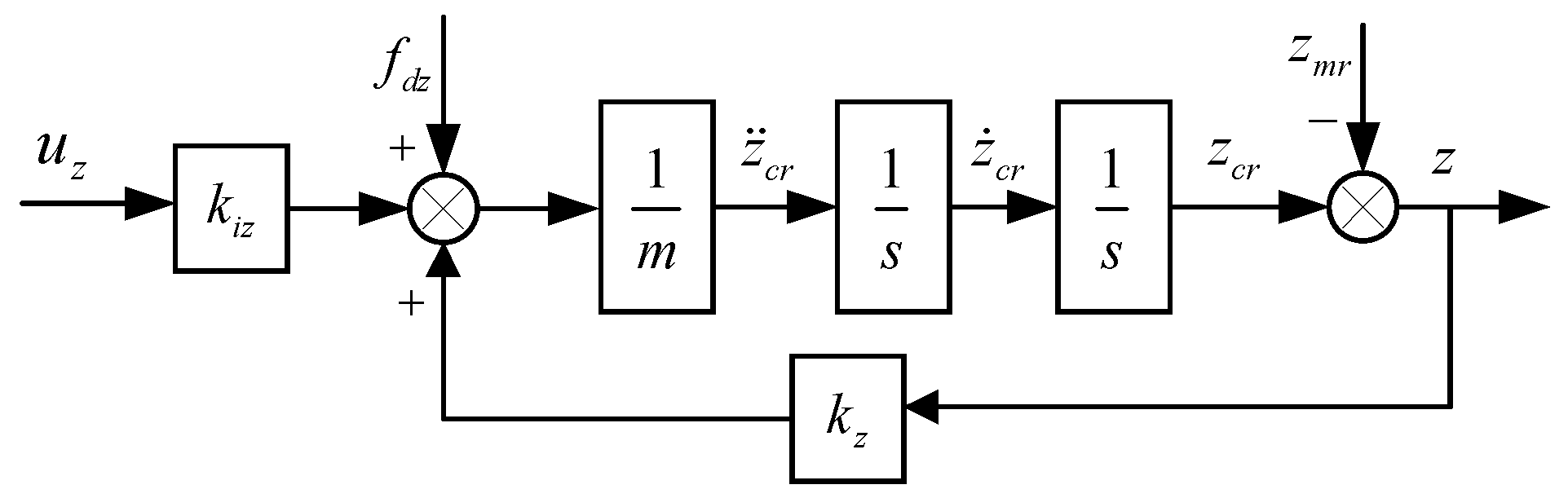
The transfer function model shown in Equation (42) describes the influence of the control input, external disturbances, and base vibration on the suspension gap. The corresponding open-loop control block diagram is illustrated in Figure 13.

4.3. Modeling and Analysis of the Lateral Magnetic Levitation Control System

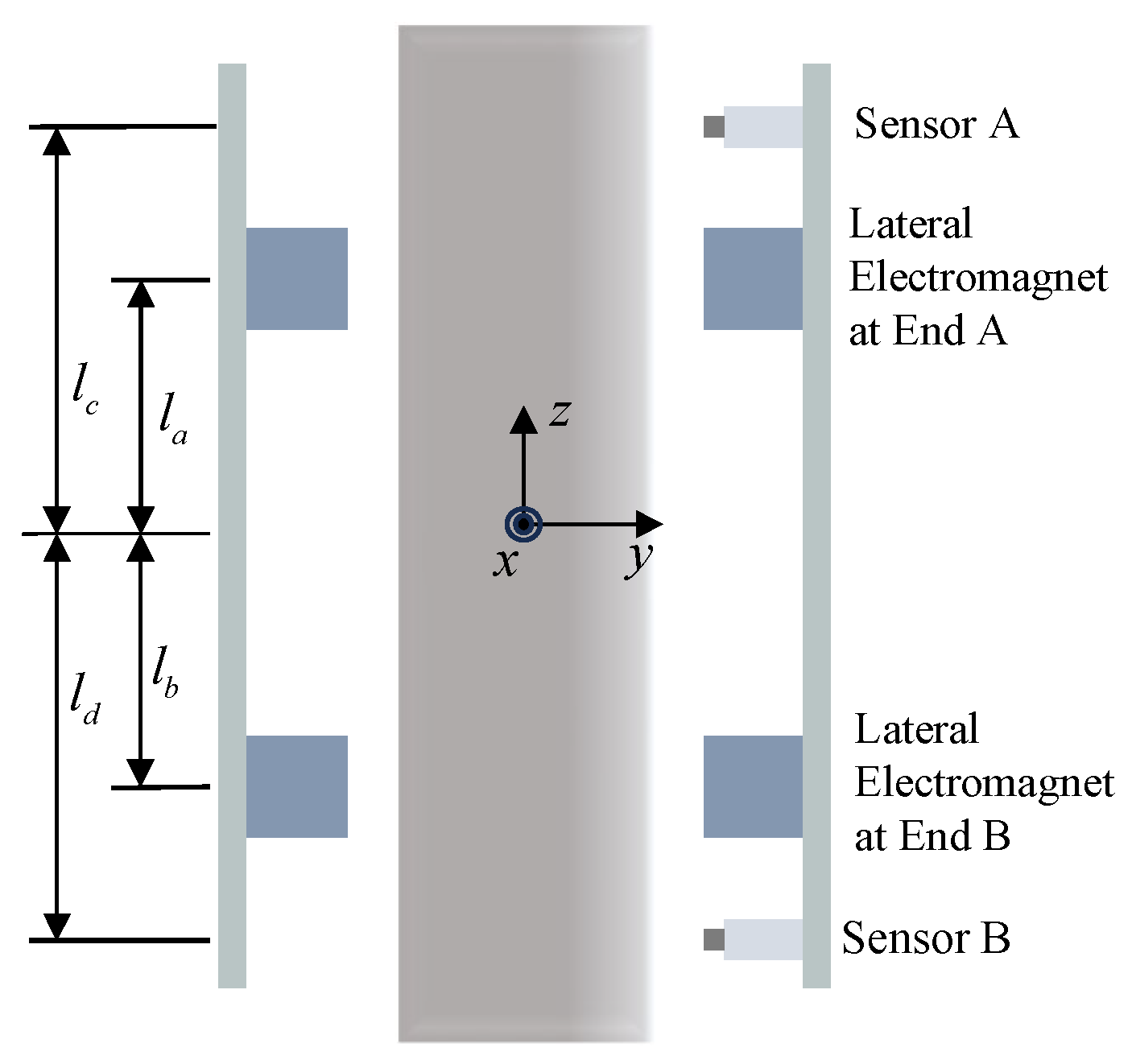
Based on the analysis of the dynamic Equation (34) from the previous section, the motion of the lateral magnetic levitation system includes translation along the X and Y axes as well as rotation about the X and Y axes. Near the ideal equilibrium position, the lateral and vertical degrees of freedom exhibit decoupling characteristics in terms of rigid-body dynamics. Simultaneously, stable lateral levitation is a necessary foundation for achieving fully levitated operation of the system. This section will focus on modeling the lateral magnetic levitation system [13,35,36]. It is important to note that the dynamic Equation (34) are described based on the center-of-mass displacement vector X c . However, in practical engineering systems, the physical quantities that the controller can directly observe and feedback are the suspension gaps at the sensor locations, rather than the center-of-mass state. The distribution of lateral electromagnets and sensor installation positions are shown in Figure 14.
Therefore, it is necessary to transform the center-of-mass displacement vector X c into the suspension point displacement vector X b . This conversion is achieved by the matrix T c b :
X c = T c b X b
The transformation matrix T c b is:
T c b = 1 l a + l b l b l a 0 0 1 1 0 0 0 0 l b l a 0 0 1 1
Given that the structural parameters l a and l b are positive real numbers representing physical lengths, the determinant of T c b is non-zero. Thus, the matrix is non-singular, ensuring a reversible mapping between the center-of-mass coordinates and the suspension point coordinates.
After the matrix transformation, the dynamic equation is:
X ¨ b = A b K x X + A b K i I x + D b P m
where A b = T c b 1 M c 1 A c , D b = T c b 1 M c 1 D c , A b = 1 m + l a 2 J 1 m l a l b J 0 0 1 m l a l b J 1 m + l b 2 J 0 0 0 0 1 m + l a 2 J 1 m l a l b J 0 0 1 m l a l b J 1 m + l b 2 J , D b = 1 m l a ( l 0 + l a ) J 0 l b ( l 0 + l a ) J 1 m 0 0 1 m l a ( l 0 + l a ) J 0 l b ( l 0 + l a ) J 1 m .
It should be specifically noted that the variable X in the electromagnetic force model represents relative coordinates, characterizing the variation in the suspension gap; whereas X b in the dynamic equations typically refers to absolute displacement based on the inertial space. Under the premise of neglecting the lateral motion of the base, these two vectors are numerically equivalent, satisfying:
X b = X
Substituting Equation (46) into the dynamic Equation (45) yields:
X ¨ = A b K x X + A b K i I x + D b P m
Further considering the actual layout of the lateral electromagnetic cores: as shown in Figure 14, the installation cross-section of the sensors and the cross-section where the electromagnetic forces act typically have a geometric offset in the vertical position, meaning they are not at the same height. Since the controller feedback can only rely on the gap vector X s measured by the sensors, whereas the system’s dynamic response depends on the gap vector X at the electromagnetic force application points, it is necessary to establish a geometric mapping relationship from the measurement location X s to the electromagnetic force application point X :
X = T b s X s
This mapping can be represented by the transformation matrix T b s :
T b s = 1 l c + l d l a + l d ( l a l c ) 0 0 ( l b l d ) l b + l c 0 0 0 0 l a + l d ( l a l c ) 0 0 ( l b l d ) l b + l c
Based on the distinct geometric arrangement of the sensors and actuators (where l c , l d > 0 ), the transformation matrix T b s is inherently non-singular. This guarantees that the system states remain fully observable and controllable after coordinate reconstruction.
Substituting Equation (48) into the dynamic Equation (47), and defining the system output as the displacement measured by the sensors Y = X s , the second-order differential equation for the system dynamic model with measurement signals as output variables can be derived as follows:
X ¨ = A a X + B a I x + F d Y = C a X
where
A a = A b K x = k x a 1 m + l a 2 J k x b 1 m l a l b J 0 0 k x a 1 m l a l b J k x b 1 m + l b 2 J 0 0 0 0 k y a 1 m + l a 2 J k y b 1 m l a l b J 0 0 k y a 1 m l a l b J k y b 1 m + l b 2 J
B a = A b K i = k i x a 1 m + l a 2 J k i x b 1 m l a l b J 0 0 k i x a 1 m l a l b J k i x b 1 m + l b 2 J 0 0 0 0 k i y a 1 m + l a 2 J k i y b 1 m l a l b J 0 0 k i y a 1 m l a l b J k i y b 1 m + l b 2 J
F d = D b P m = P x 1 m + l a ( l 0 + l a ) J P x 1 m l b ( l 0 + l a ) J P y 1 m + l a ( l 0 + l a ) J P y 1 m l b ( l 0 + l a ) J
C a = T b s 1 = 1 l a + l b l b + l c l a l c 0 0 l b l d l a + l d 0 0 0 0 l b + l c l a l c 0 0 l b l d l a + l d
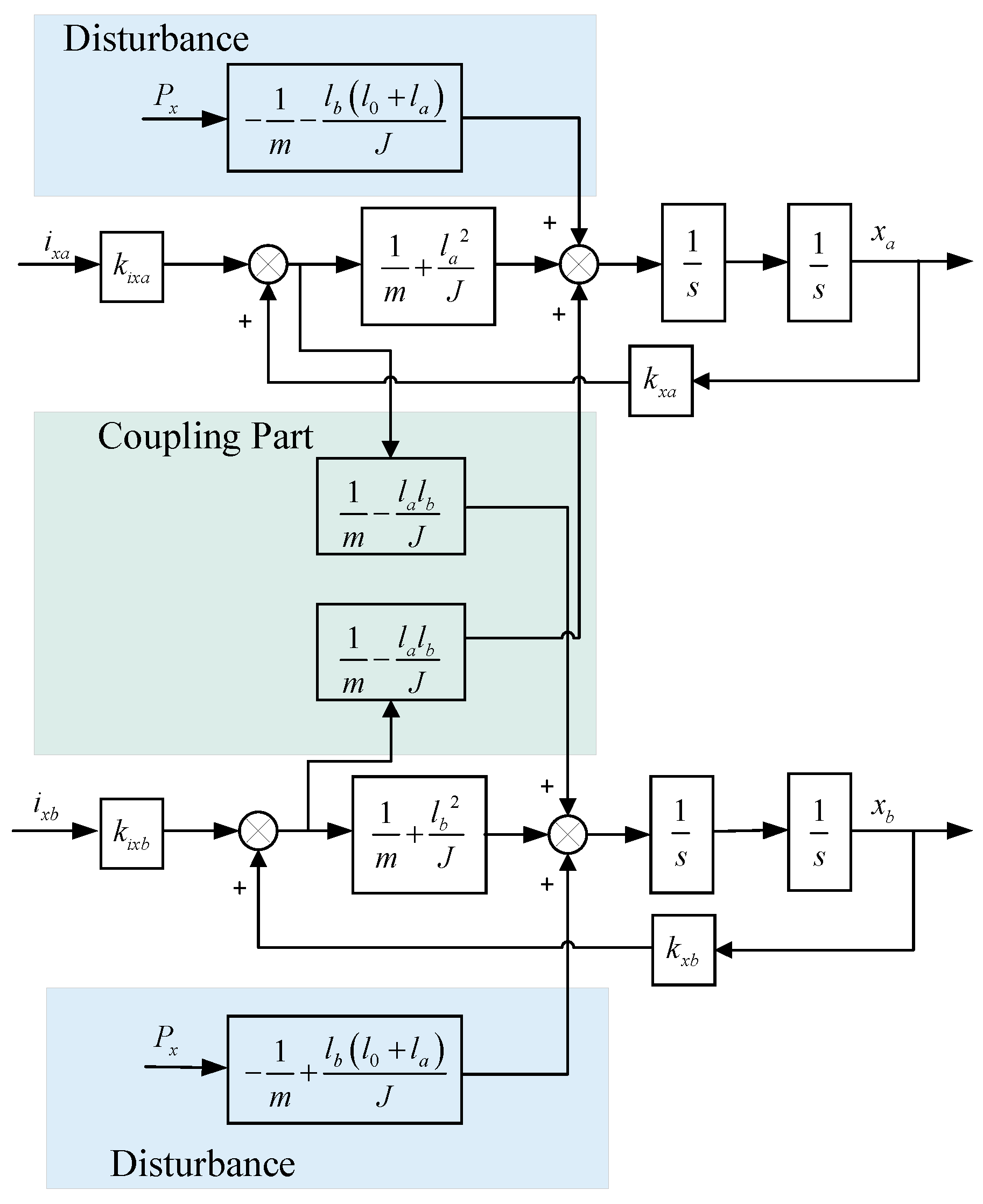
Thus, the spatial mapping from the system state vector X c (center-of-mass displacement) to the sensor suspension gap vector X has been completed. Through this coordinate transformation, the subsequent design and performance analysis of the four-degree-of-freedom lateral controller will be directly based on the observable gap signals x a , x b , y a , y b . By further applying the Laplace transform to the dynamic Equation (50), the input–output transfer model of the system in the frequency domain can be constructed. Analysis shows that the system output Y ( s ) results from the linear superposition of the control input I x ( s ) and the disturbance force F d ( s ) . Based on this, considering the structural symmetry, the open-loop control block diagram of the lateral magnetic levitation system (taking the X-axis as an example) is established as shown in Figure 15.
While this analysis focuses on the vertical channel for clarity, the developed MIMO modeling framework (Equation (48), Figure 15)) is directly applicable to the synthesis of controllers for the simultaneous rejection of complex, multi-axis disturbances. The evaluation of such coupled control performance under multi-directional base motion is a key objective of the planned simulation and experimental studies outlined in the following work.

5. Summary

This paper systematically presents the structural design, electromagnetic force modeling, dynamic analysis, and control system construction of a five-degree-of-freedom active magnetic levitation vibration isolation system. The main work and conclusions are as follows:
System Structural Design: A decoupled design scheme for the vertical and lateral magnetic levitation subsystems is proposed. The vertical system employs a symmetric differential electromagnetic actuator layout. Through optimized allocation of the magnetic pole area and coil cavity area, maximum electromagnetic force output and efficient magnetic circuit utilization are achieved. The lateral system adopts a 12-tooth E-core electromagnet combination structure. Precise non-contact control of four degrees of freedom (translation along the X and Y axes, and tilt about the X and Y axes) is realized through the coordinated action of main and auxiliary teeth with differential control.
Modeling and Theoretical Analysis: Based on the principles of electromagnetism and rigid-body dynamics, nonlinear analytical models for the vertical and lateral electromagnetic forces were derived separately. Linearization around the operating point yielded key displacement stiffness and current stiffness coefficients. A five-degree-of-freedom rigid-body dynamic equation of the system in the inertial coordinate system was established. The decoupling characteristics between vertical and lateral motions in their dynamic forms were demonstrated, laying a theoretical foundation for independent controller design.
Control System Model Construction: The base vibration is considered as a key disturbance input, and the geometric kinematic relationship of vibration transmission through the suspension gap is analyzed in depth. On this basis, open-loop control block diagrams and frequency-domain transfer function models for the single-degree-of-freedom vertical subsystem and the four-degree-of-freedom lateral subsystem are established separately. These models clearly reveal the influence paths of the control input, external force disturbances, and base vibration on the system output (suspension gap), providing a complete plant model for subsequent controller design.
Key Innovations: Structural Optimization Method: Proposed a volume allocation optimization method for the magnetic circuit (iron) and electrical circuit (copper) aimed at maximizing electromagnetic force under volume constraints. Decoupled Design: Leveraged the system’s symmetry to achieve inherent decoupling of vertical and lateral dynamics in the model, simplifying the control problem. Disturbance Modeling: Explicitly incorporated base motion into the dynamic equations, accurately characterizing the core mechanism of vibration transmission in the isolation system.
Although this paper has established a relatively comprehensive theoretical model and design framework for the active magnetic levitation vibration isolation system, several directions warrant further in-depth exploration:
Application of Advanced Control Strategies: Current models are based on linearized assumptions. Future research could investigate advanced strategies such as nonlinear model predictive control (NMPC), adaptive control, or robust H∞ control to better address system nonlinearities, parameter uncertainties, and broadband disturbance suppression, particularly under large-motion or high-disturbance operating conditions.
Deepening of Dynamic Models: Practical factors such as the structural flexibility of the floater, eddy current effects, and thermal effects of the electromagnets could be further considered to establish high-precision models incorporating rigid-flexible coupling or multi-physics coupling, thereby enhancing the accuracy of system simulation and prediction.
Integrated Design and Experimental Verification: This paper primarily focuses on theoretical modeling and analysis. The derived state-space models and the corresponding open-loop block diagrams (Figure 13 and Figure 15) provide a ready-to-use framework for the synthesis of advanced MIMO control strategies, which will be the focus of our forthcoming research. This will serve to validate the correctness of the theoretical models and optimize engineering implementation details such as sensor layout, power drive systems, and real-time control algorithms.

Author Contributions

Conceptualization, C.D. and C.H.; methodology, C.D. and C.H.; software, C.H. and X.L. (Xinyu Liu); validation, C.D., C.H. and X.L. (Xinyu Liu); formal analysis, C.D. and C.H.; investigation, C.D. and X.L. (Xinyu Liu); resources, C.D. and C.H.; data curation, X.L. (Xinyu Liu); writing—original draft preparation, C.D.; writing—review and editing, C.D., C.H. and X.L. (Xinyu Liu); visualization, X.L. (Xinyu Liu); supervision, X.L. (Xiaolong Li); project administration, X.L. (Xiaolong Li); funding acquisition, X.L. (Xiaolong Li). All authors have read and agreed to the published version of the manuscript.

Funding

This work was funded by the National Natural Science Foundation of China (No. 52332011 and No. 52232013).

Institutional Review Board Statement

Not applicable.

Informed Consent Statement

Not applicable.

Data Availability Statement

The original contributions presented in this study are included in the article. Further inquiries can be directed to the corresponding author.

Conflicts of Interest

The authors declare no conflicts of interest. The funders had no role in the design of the study; in the collection, analyses, or interpretation of data; in the writing of the manuscript; or in the decision to publish the results.

References

  1. Kim, W.J.; Trumper, D.L. High-precision magnetic levitation stage for photolithography. Precis. Eng. 1998, 22, 66–77. [Google Scholar] [CrossRef]
  2. Schweitzer, G.; Maslen, E.H. Magnetic Bearings: Theory, Design, and Application to Rotating Machinery; China Machine Press: Beijing, China, 2012. [Google Scholar]
  3. Carrella, A.; Brennan, M.J.; Waters, T.P. Static analysis of a passive vibration isolator with quasi-zero-stiffness characteristic. J. Sound Vib. 2007, 301, 678–689. [Google Scholar] [CrossRef]
  4. Kovacic, I.; Brennan, M.J.; Waters, T.P. A study of a nonlinear vibration isolator with a quasi-zero stiffness characteristic. J. Sound Vib. 2008, 315, 700–711. [Google Scholar] [CrossRef]
  5. Zhu, T.; Cazzolato, B.; Robertson, W.S.P.; Zander, A. Vibration isolation using six degree-of-freedom quasi-zero stiffness magnetic levitation. J. Sound Vib. 2015, 358, 48–73. [Google Scholar] [CrossRef]
  6. Yu, N.; Fei, X.; Sun, H.; Wu, Z.; Yan, B. Rhombus-type magnetic-levitation structure for low-frequency vibration isolation. Mech. Syst. Signal Process. 2025, 225, 112289. [Google Scholar] [CrossRef]
  7. Yang, S.; Sun, X.; Qian, J.; Xu, J.; Li, K. Design, Optimization, and Realization of a Magnetic Multi-Layer Quasi-Zero-Stiffness Isolation Platform Supporting Different Loads. Materials 2025, 18, 1676. [Google Scholar] [CrossRef] [PubMed]
  8. Zhu, Y.; Yang, Q.; Liu, S.; Chai, K. Design Methodology and Application Dynamics of Compact Quasi-Zero Stiffness Isolators. Appl. Sci. 2025, 15, 3478. [Google Scholar] [CrossRef]
  9. Mizuno, T.; Takasaki, M.; Suzuki, H.; Ishino, Y. Development of a Three-Axis Active Vibration Isolation System Using Zero-Power Magnetic Suspension. In Proceedings of the 42nd IEEE Conference on Decision and Control, Maui, HI, USA, 9–12 December 2003; IEEE: Piscataway, NJ, USA, 2003; Volume 15, pp. 4493–4498. [Google Scholar]
  10. Zhang, Z.; Chen, L.; Luo, X.; Yan, S. Transformed magnetic force model of zero power permanent electromagnetic suspension system by using Hall effect based distance sensor. Sci. Rep. 2025, 15, 10952. [Google Scholar] [CrossRef]
  11. Lin, Y.; Wen, G.; Liu, C.; He, J.; Liu, J. A magnetorheological elastomer-based hybrid vibration isolation system with semi-active control and quasi-zero stiffness performance. Int. J. Non-Linear Mech. 2025, 174, 105063. [Google Scholar] [CrossRef]
  12. Preumont, A. Vibration Control of Active Structures: An Introduction; Springer International Publishing: Cham, Switzerland, 2018. [Google Scholar]
  13. Rasid, S.M.R.; Mizuno, T.; Ishino, Y.; Takasaki, M.; Hara, M.; Yamaguchi, D. Design and control of active vibration isolation system with an active dynamic vibration absorber operating as accelerometer. J. Vib. Control 2019, 438, 175–190. [Google Scholar] [CrossRef]
  14. Tang, J.; Li, C.; Zhou, J.; Wei, W.; Wu, Z. Vibration suppression control and anti-eccentric load correction mechanism of magnetic levitation decoupling platform. Mech. Syst. Signal Process. 2025, 225, 112314. [Google Scholar] [CrossRef]
  15. Xia, W.; Zeng, J.; Dou, F.; Long, Z. Method of Combining Theoretical Calculation With Numerical Simulation for Analyzing Effects of Parameters on the Maglev Vehicle-Bridge System. IEEE Trans. Veh. Technol. 2021, 70, 2250–2257. [Google Scholar] [CrossRef]
  16. Zhang, Y.; Xu, Y.; Zhou, J.; Zhou, Y.; Mahfoud, J. Vibration Control of AMB-Rotor System Under Base Motions Based on Disturbance Observer. IEEE/ASME Trans. Mechatronics 2025, 30, 5398–5407. [Google Scholar] [CrossRef]
  17. Slotine, J.-J.E.; Li, W. Applied Nonlinear Control; China Machine Press: Beijing, China, 2004. [Google Scholar]
  18. Faragallah, M.M.; Metered, H.; Essam, M.A. Vibration Mitigation of Semi-active Vehicle Suspension System Incorporating Magnetorheological Damper using hybrid control. In 2025 SAE World Congress Experience; SAE International: Warrendale, PA, USA, 2025; WCX 2025 Detroit 2025. [Google Scholar]
  19. Zhang, W.; Ran, H. Adaptive Switching Iterative Learning Control Strategy of Vehicle-Mounted Flywheel Battery System Based on Error Compensation of Road Conditions. IEEE Trans. Ind. Electron. 2026, 73, 1008–1019. [Google Scholar] [CrossRef]
  20. Zhang, W.; Gu, X.; Ji, H. Robust Sensorless Control of Vehicle-Mounted Flywheel Battery Against Continuous Road Disturbances. IEEE Trans. Transp. Electrif. 2025, 11, 12052–12062. [Google Scholar] [CrossRef]
  21. Wu, T.; Gu, X. Review on Key Development of Magnetic Bearing. Machines 2025, 13, 113. [Google Scholar] [CrossRef]
  22. Tian, L.; Zhang, K.; Wang, D.; Tian, Q.; Liu, J.; Li, Z. Research on the Levitation and Guidance Magnetic Force of Permanent Magnetic Guideway. Proc. CSEE 2008, 28, 135–139. [Google Scholar]
  23. Wu, Q. Research of Six Degrees of Freedom Maglev Vibration Isolation System and Mechanical Characteristics. Ph.D. Thesis, Harbin Institute of Technology, Harbin, China, 2016. [Google Scholar]
  24. Wu, Q.; Chen, S.; Chen, Y.; Yue, H.; Liu, R.-q. Nonlinear dynamics modeling and simulation of maglev vibration isolation system. J. Vib. Shock 2015, 34, 161–166. [Google Scholar]
  25. Feng, Y.; Shuo, D.; Liu, C. Design of Active Hybrid Control System for Quasi Zero Stiffness Magnetic Suspension Isolation Platform. Comput. Meas. Control 2024, 32, 222–227. [Google Scholar]
  26. Heng, Z.; Cai, S.; Shen, Z.; Li, L.; Zhang, P.; Huang, J. Optimization Research on Control System of Magnetic Levitation Blower Considering Rotor Elastic Dynamic Characteristic. J. Jimei Univ. (Nat. Sci.) 2025, 30, 61–67. [Google Scholar]
  27. Huang, C.; Yang, Y.; Dai, C.; Long, Z. Tracking-Differentiator-Based Position and Acceleration Feedback Control in Active Vibration Isolation with Electromagnetic Actuator. Actuators 2023, 12, 271. [Google Scholar] [CrossRef]
  28. Robertson, W.; Cazzolato, B.; Zander, A. Axial Force Between a Thick Coil and a Cylindrical Permanent Magnet:Optimizing the Geometry of an Electromagnetic Actuator. IEEE Trans. Magn. 2012, 48, 2479–2487. [Google Scholar] [CrossRef]
  29. Liu, C.; Yu, K. Design and experimental study of a quasi-zero-stiffness vibration. Arch. Civ. Mech. Eng. 2020, 20, 67. [Google Scholar] [CrossRef]
  30. Huang, F.; Liu, J.; Ren, Z. Error Analysis and Correction of Electromagnetic force calculation of magnetic bearing by magnetic circuit method. J. Qingdao Univ. Technol. 2017, 38, 72–79. [Google Scholar]
  31. Goldstein, H.; Poole, C.P.; Safko, J.L. Classical Mechanics; Pearson Education: London, UK, 2014. [Google Scholar]
  32. Li, Y.; Ke, Z.; Cheng, H. Error Analyzing and Optimizing Design of Current-Loop in the Magnetic Levitation Controller on Maglev Vehicle. J. Natl. Univ. Def. Technol. 2006, 28, 94–97. [Google Scholar]
  33. Li, Y.; Chang, W. Cascade control of an EMS maglev vehicle’s levitation control system. Acta Autom. Sin. 1999, 25, 107–111. [Google Scholar]
  34. Hu, Y.; Chen, C.; Wu, H.; Song, C. Study on structural optimization design and cascade PID control of maglev actuator for active vibration isolation system. J. Vib. Control 2018, 24, 1829–1847. [Google Scholar] [CrossRef]
  35. Javed, A.; Mizuno, T.; Takasaki, M.; Ishino, Y.; Hara, M.; Yamaguchi, D. Proposal of lateral vibration control based on force detection in magnetic suspension system. Int. J. Appl. Electromagn. Mech. 2016, 52, 223–229. [Google Scholar] [CrossRef]
  36. Ishino, Y.; Mizuno, T.; Takasaki, M.; Yamaguchi, D. Stabilization of Magnetic Suspension System by Using Only a First-Order Reset Element without a Derivative Element. Actuators 2019, 8, 24. [Google Scholar] [CrossRef]
Figure 1. Schematic Diagram of the Five-Degree-of-Freedom Magnetic Levitation Operational Principle and Layout: (a) Schematic diagram of the operational principle. (b) Schematic diagram of the structural layout of the device.
Actuators 15 00120 g001
Figure 2. Schematic Diagram of the Five-Degree-of-Freedom Magnetic Levitation Operational Principle and Layout: (a) Diagram of the Floater’s Vertical Support Structure. (b) Diagram of the Floater’s Lateral Support Structure.
Actuators 15 00120 g002
Figure 3. Structure of the Vertical Magnetic Levitation System.
Actuators 15 00120 g003
Figure 4. Relationship between the Coil Cavity and Magnetic Pole Area in the Vertical Magnetic Levitation System.
Actuators 15 00120 g004
Figure 5. Variation Curve of the Vertical Electromagnetic Force with Respect to the Magnetic Pole Area and Coil Cavity Area.
Actuators 15 00120 g005
Figure 6. Schematic Diagram of the Lateral Magnetic Levitation Support Structure and Magnetic Circuit: (a) Schematic Diagram of the Lateral Magnetic Levitation Support Structure. (b) Schematic Diagram of the Magnetic Circuit of the Lateral Magnetic Levitation Support Structure.
Actuators 15 00120 g006
Figure 7. Relationship between the Lateral Electromagnetic Force and the Magnetic Pole Width.
Actuators 15 00120 g007
Figure 8. Diagram of Vertical Electromagnetic Force Analysis.
Actuators 15 00120 g008
Figure 9. Diagram of Lateral Electromagnetic Force Analysis.
Actuators 15 00120 g009
Figure 10. Rotating Coordinate System of the Magnetic Levitation Vibration Isolation System.
Actuators 15 00120 g010
Figure 11. Schematic Force Diagram of the Floater in the Five-Degree-of-Freedom Magnetic.
Actuators 15 00120 g011
Figure 12. Vibration Transmission Analysis Diagram of the Vertical Differential Suspension System.
Actuators 15 00120 g012
Figure 13. Open-Loop Control Block Diagram of the Vertical Magnetic Levitation System.
Actuators 15 00120 g013
Figure 14. Electromagnet Distribution and Sensor Installation Locations of the Lateral Magnetic Levitation System.
Actuators 15 00120 g014
Figure 15. Open-loop control block diagram of the lateral magnetic levitation system.
Actuators 15 00120 g015
Table 1. System Design Parameters of Vertical Electromagnetic Force Analysis.
Parameter CategorySymbolDescription
Geometry z 0 Nominal Levitation Gap
GeometryzOffset of the Nominal Levitation Gap
Geometry z 1 , z 1 Gaps between the Two Electromagnets and the Floater
Electromagnetics i z 1 , i z 2 Currents of Vertical Electromagnet 1and 2
Electromagnetics i z 0 Bias Current of the Two Vertical Electromagnets
Electromagnetics i z Control Current of the Two Vertical Electromagnets
Electromagnetics A z 0 Magnetic Pole Area of the Vertical Electromagnet
Electromagnetics N z Number of the coil turns of the vertical electromagnet
Stiffness Coeff. k a Electromagnetic Force Structural Constant
Table 2. System Design Parameters of Lateral Electromagnetic Force Analysis.
Parameter CategorySymbolDescription
Geometry x a 0 Stable Levitation Gap
Geometry x a Gap of the floater Deviation from the Equilibrium Position
Geometry y a 0 Stable Levitation Gap
Geometry y a Gap of the floater Deviation from the Equilibrium Position
Geometry x a 1 , x a 2 Gaps on Both Sides of the Differential Control in the X-direction at end A
Geometry y a 1 , y a 2 Gaps on Both Sides of the Differential Control in the X-direction at end A
Geometry x b 1 , x b 2 Gaps on Both Sides of the Differential Control in the X-direction at end B
Geometry y b 1 , y b 2 Gaps on Both Sides of the Differential Control in the Y-direction at end B
Electromagnetics i x a 1 , i x a 2 Input Currents of a Set of Differential Electromagnetic Cores In the X-direction at end A
Electromagnetics i y a 1 , i y a 2 Input Currents of a Set of Differential Electromagnetic Cores In the X-direction at end A
Electromagnetics i x b 1 , i x b 2 Input Currents of a Set of Differential Electromagnetic Cores In the X-direction at end B
Electromagnetics i y b 1 , i y b 2 Input Currents of a Set of Differential Electromagnetic Cores In the Y-direction at end B
Electromagnetics i x a Differential Control Current in the X-direction at End A
Electromagnetics i y a Differential Control Current in the Y-direction at End A
Electromagnetics i x b Differential Control Current in the X-direction at End B
Electromagnetics i y b Differential Control Current in the Y-direction at End B
Electromagnetics A r 1 Magnetic Pole Area of the Main Tooth
Electromagnetics N r 1 Number of the coil turns of the Main Tooth
Electromagnetics A r 2 Magnetic Pole Area of the Auxiliary Tooth
Electromagnetics N r 2 Number of the coil turns of the Auxiliary Tooth
Stiffness Coeff. k r Electromagnetic Force Structural Constant
Disclaimer/Publisher’s Note: The statements, opinions and data contained in all publications are solely those of the individual author(s) and contributor(s) and not of MDPI and/or the editor(s). MDPI and/or the editor(s) disclaim responsibility for any injury to people or property resulting from any ideas, methods, instructions or products referred to in the content.