


Abstract
In permanent magnet synchronous motor (PMSM) drive systems, the nonlinearity of the inverter and non-sinusoidal nature of back EMF generate harmonics in the stator current, resulting in torque ripple and reduced motor efficiency. Although the proportional resonant (PR) controller is widely employed for harmonic suppression, the standard resonant controller is constrained by its narrow bandwidth and can only suppress a single harmonic order. To address these issues, an adaptive harmonic suppression strategy using a proportional multi-resonant (PMR) controller based on the generalized frequency selector (GFS) is proposed. Firstly, the sources and characteristics of the stator current harmonics were analyzed based on the mathematical model of PMSM. Subsequently, a proportional resonance controller was designed according to the tracking filtering characteristics of the GFS, and a proportional multi-resonance controller targeting multi-order harmonics was constructed. The stability of the current closed-loop system under the algorithm was analyzed. Finally, simulation and experimental results demonstrated that the proposed algorithm effectively suppressed current harmonics and significantly improved the current waveform.
1. Introduction
The permanent magnet synchronous motor (PMSM) is widely used in power transmission and industrial control applications, owing to its outstanding features, including high power density, efficiency, and reliability. However, factors such as the inverter’s nonlinearity and the distortion of magnetic field in the air gap generate harmonic currents, which not only increase motor losses and cause torque ripple but also lead to vibration and noise during operation. This negatively impacts the operational performance of the equipment [1,2,3]. Therefore, developing strategies for suppressing current harmonics is crucial for high-performance drive systems.
Existing research on current harmonic suppression generally falls into two categories: motor body optimization and driver-side improvements [4]. To optimize motor structure design and reduce air-gap magnetic field distortion, many studies have sought to decrease harmonic components by modifying winding configurations, stator structures [5], and rotor pole distributions [6]. While these methods effectively reduce harmonic currents caused by magnetic field distortion, they have not addressed harmonics generated by inverter nonlinearity. Driver-side strategies mainly encompass hardware and software solutions. The primary hardware-based method for suppressing current harmonics involves modifying the inverter by introducing series reactors or filters to reduce harmonic currents [7,8]. Series reactors increase the motor’s equivalent inductance, enhancing the sinusoidal nature of the current waveform, though this effect is confined to a narrow range [9]. The use of filters can significantly reduce harmonic currents, but the risk of series resonance may damage the filters. Zhang et al. [10] proposed an LCCR filter-based method to effectively suppress harmonics and improve power quality. However, the approach essentially relies on passive components, making it incapable of adapting to dynamic variations in grid impedance or complex load conditions. While Essien et al. [11] presented a detailed modeling and design procedure for LCL filters, their design overlooks potential resonance issues caused by changing grid conditions.
From the perspective of system control, compensation algorithms can be employed to suppress current harmonics. Liu et al. [12] proposed a compensation method that reduces the inverter dead time to improve current distortion. However, this method relies on precise current polarity detection, which is prone to errors near zero-crossing points. Kang et al. [13] developed a generalized super-twisting algorithm with an adaptive law to enhance the performance of PMSM drives, and proposed an event-triggered control scheme that integrates disturbance observers to achieve robust tracking with reduced communication burden [14]. Chatterjee et al. [15] achieved current sensor-less dead-time compensation using a power function from load voltage, yet its performance depends on sensing accuracy and may lag during load transients. Liu et al. [16] suppressed PMSM harmonics by SOGI-based voltage injection, but the approach is limited to low-frequency harmonics and parameter-sensitive. Xu et al. [17] suppressed 11th and 13th harmonics using MSRFT and current reconstruction, but the extraction accuracy depends on the precise reconstruction of the fundamental current. Sun and Benrabahh et al. [18,19] employed an Active Disturbance Rejection Controller (ADRC) to replace conventional PI current control and used an extended state observer to monitor all disturbances, significantly suppressing current harmonics. The drawback of this method, however, lies in the limitation of observer and numerous parameters that need to be tuned. Song et al. [20] designed an adaptive notch filter, which suppresses harmonic components by injecting harmonic voltage, but suffers from a complex online parameter tuning algorithm to extract sub-harmonics. Wu et al. [21] proposed an enhanced repetitive control strategy with Lagrange interpolation and phase compensation to suppress PMSM current harmonics, though its dynamic response may be sluggish. Consequently, a significant gap remains for a control strategy that can simultaneously handle multi-order harmonics with high precision while maintaining robustness against frequency fluctuations inherent in variable-speed drives.
In this paper, a proportional multi-resonant (PMR) controller rooted in the theoretical framework of generalized frequency selector (GFS) was proposed, which has resonant points for precise multi-order harmonic suppression and synthesizes a Quasi-PR structure incorporating a low-pass filter to widen its bandwidth. The rest of paper is organized as follows: Firstly, the mathematical model of PMSM was utilized to analyze the sources and characteristics of stator current harmonics. Subsequently, the equivalence between the resonant controller and generalized selective filter is examined, leading to the analogous design of a PMR controller. A filter is incorporated to decrease the system’s sensitivity to frequency fluctuations. To demonstrate the advantages of proposed scheme, a method based on MSRFTs is provided for comparison [17]. Finally, simulations and experiments demonstrate the effectiveness of PMR controller in suppressing current harmonics.
2. Current Harmonics in PMSM
2.1. Sources of Low-Order Harmonics
The harmonics present in the stator current of a PMSM are caused by both temporal and spatial harmonics. The primary causes of temporal harmonics are the inverter’s dead time and the voltage drop across the power switching components. On the other hand, spatial harmonics result from the distortion of the magnetic field in the air gap, which are influenced by design factors like manufacturing imperfections, cogging effects, and magnetic saturation. These distortions lead to the deformation of the back electromotive force waveform, with the 5th and 7th harmonics being the most prominent [21].
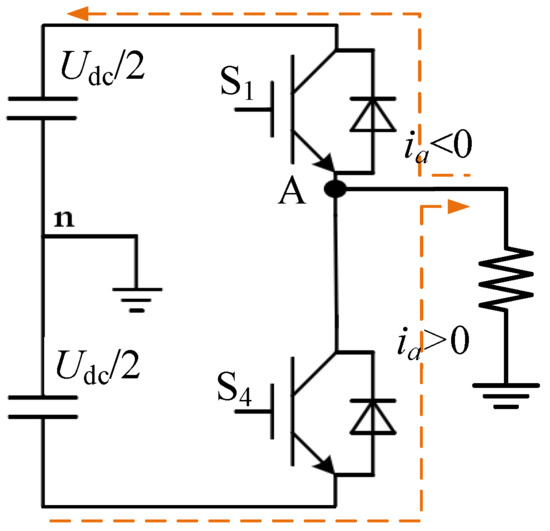
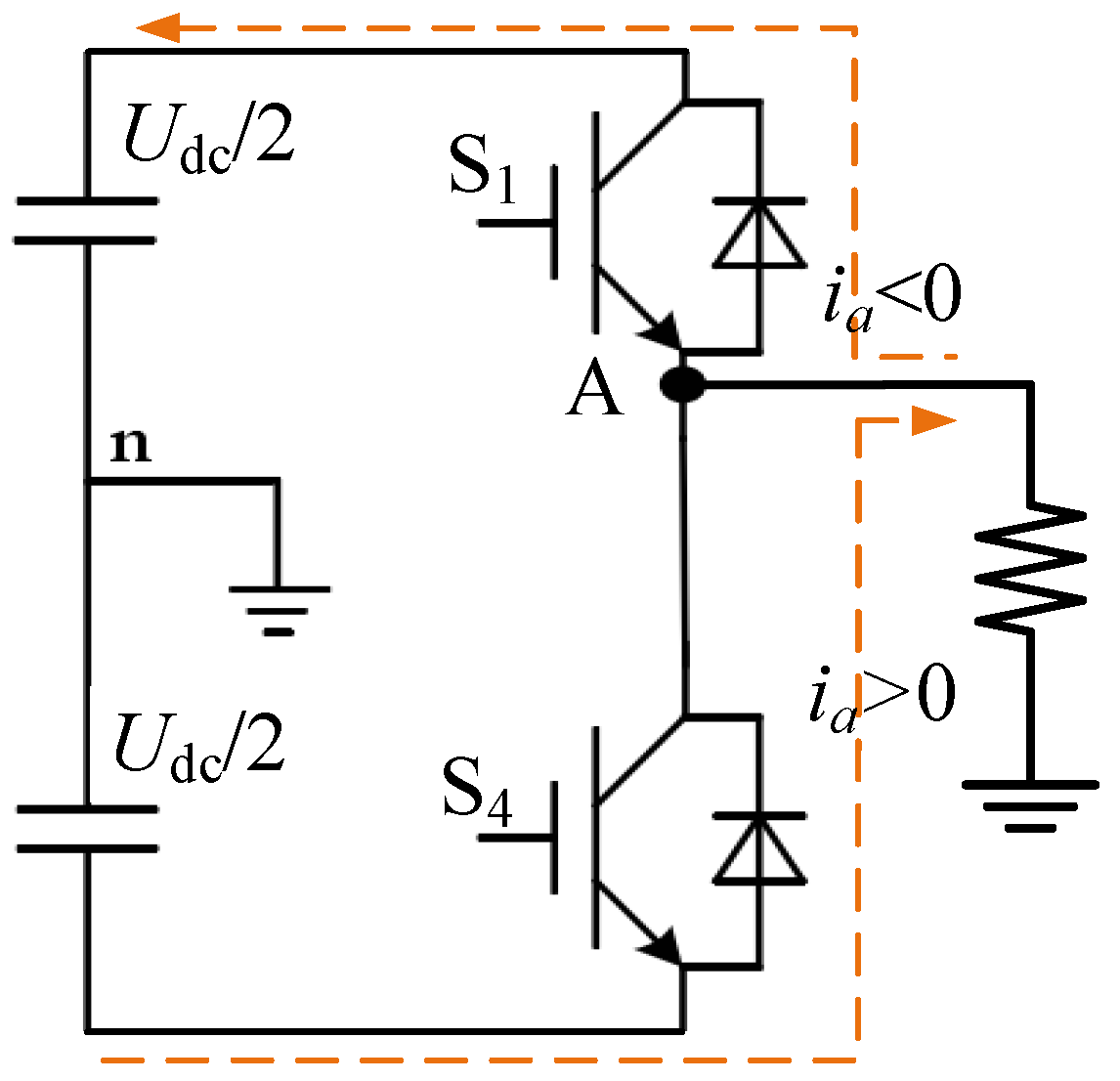
In the drive system, the inverter’s dead time and voltage drop add further nonlinearities to the system. As illustrated in Figure 1, the voltage error in the inverter output caused by the dead time is analyzed, using the phase A voltage as an example. The three-phase output voltage within a switching cycle depends on the current’s polarity, as shown in Equation (1), where Δua, Δub, and Δuc represent the voltage errors of the three-phase output; ia, ib, and ic denote the current errors of the three phases; and Udead refers to the average voltage error induced by the dead time during a single switching cycle.
Figure 1.
A-phase bridge arm of inverter.
Figure 2a shows the output voltage and current error waveforms in the A-B-C coordinate system after adding the dead time. The voltage error waveform in the α-β coordinate system is illustrated in Figure 2b, and its Fourier decomposition is expressed in Equation (2). Figure 2c presents the voltage error waveform in the d-q coordinate system, with its Fourier decomposition provided in Equation (3). It can be observed that voltage harmonics of the (6k ± 1)-order appear in the A-B-C coordinate systems. By Clarke transformation, the order of voltage harmonics in α-β coordinate systems is 6k ± 1 as well. In contrast, in the d-q coordinate system, the voltage error is expressed as a combination of a DC component and 6k-order harmonic components by Park transformation.
where k = 1, 2, 3…; and γ represents the angle between the current vector and the q-axis.
Figure 2.
Output voltage error waveform of inverter: (a) waveforms of output voltage and current errors in A-B-C coordinate system after incorporating dead time; (b) voltage error waveform in α-β coordinate system; (c) voltage error waveform in d-q coordinate system.
Similarly, the voltage drop of inverter also induces (6k ± 1)-order voltage harmonics. Furthermore, since the permanent magnet motor studied in this paper uses a Y-connection without a neutral line and has a symmetrical structure, the stator current does not contain integer multiples of third-order harmonics. Therefore, in the motor powered by SVPWM, (6k ± 1)-order harmonic voltages are present, with the 5th, 7th, 11th, and 13th harmonics being the dominant components. As the harmonic order increases, the amplitude of the harmonics gradually diminishes [22].
2.2. Harmonics Modeling in the d-q Coordinate System
Equation (4) illustrates the voltage equations of the permanent magnet motor in the d-q coordinate system. Taking into account the harmonics produced by the nonlinear characteristics of both the motor and the inverter, these harmonics primarily manifest as 6th- and 12th-order fluctuations in the d-q coordinate system, as represented in Equation (5). Meanwhile, the winding currents contain current harmonics of the same frequencies, as shown in Equation (6).
where ud, uq, id, iq, Ld, and Lq correspond to the stator voltage, current, and inductance components along the d- and q-axis, respectively; Ed = 0, Eq = ωeψf represents the motor’s induced electromotive force; and ωe represents the motor’s electrical angular velocity, P represents the derivative operator.
The d-q axis voltage containing harmonics can be formulated as:
where Ui denotes the amplitude of the voltage, while θi represents the initial phase angle. The subscript i = 1, 5, 7, 11, 13… refers to the fundamental frequency and the 5th, 7th, 11th, and 13th-order harmonics, respectively.
The d-q axis current containing harmonics can be formulated as:
From Equation (6), it can be observed that in the d-q rotating coordinate system, the fundamental current is represented as a DC component, while the 5th, 7th, 11th, and 13th harmonics are converted into 6th- and 12th-order AC components. Among these, the 5th and 11th harmonics correspond to negative-sequence components, while the 7th and 13th harmonics correspond to positive-sequence components.
Building on the analysis in this section, the harmonic characteristics of both voltage and current in a permanent magnet motor using SVPWM modulation technology are shown in Table 1, with higher-order harmonics present at relatively lower levels.
Table 1.
Harmonic distribution of voltage and current in PMSM.
3. PMSM Current Harmonic Suppression
3.1. PMR Controller Design
From the previous analysis, the harmonics generated by the inverter are mainly the 6th and 12th orders in the d-q coordinate system. Based on the internal model principle, the PI controller can effectively eliminate steady-state errors, ensuring precise tracking of DC components. In the d-q coordinate system, the harmonic components present in the motor stator current are converted into AC components; thus, current harmonics cannot be eliminated in conventional motor vector control. Nevertheless, the resonant controller is capable of ensuring zero steady-state error when tracking sinusoidal components [23,24,25]. In this section, multiple proportional-resonant (PR) controllers in parallel are adopted to effectively reduce the impact of specific harmonic orders.
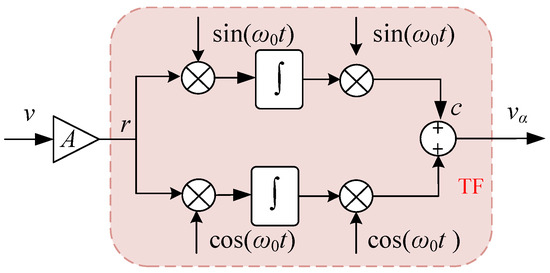
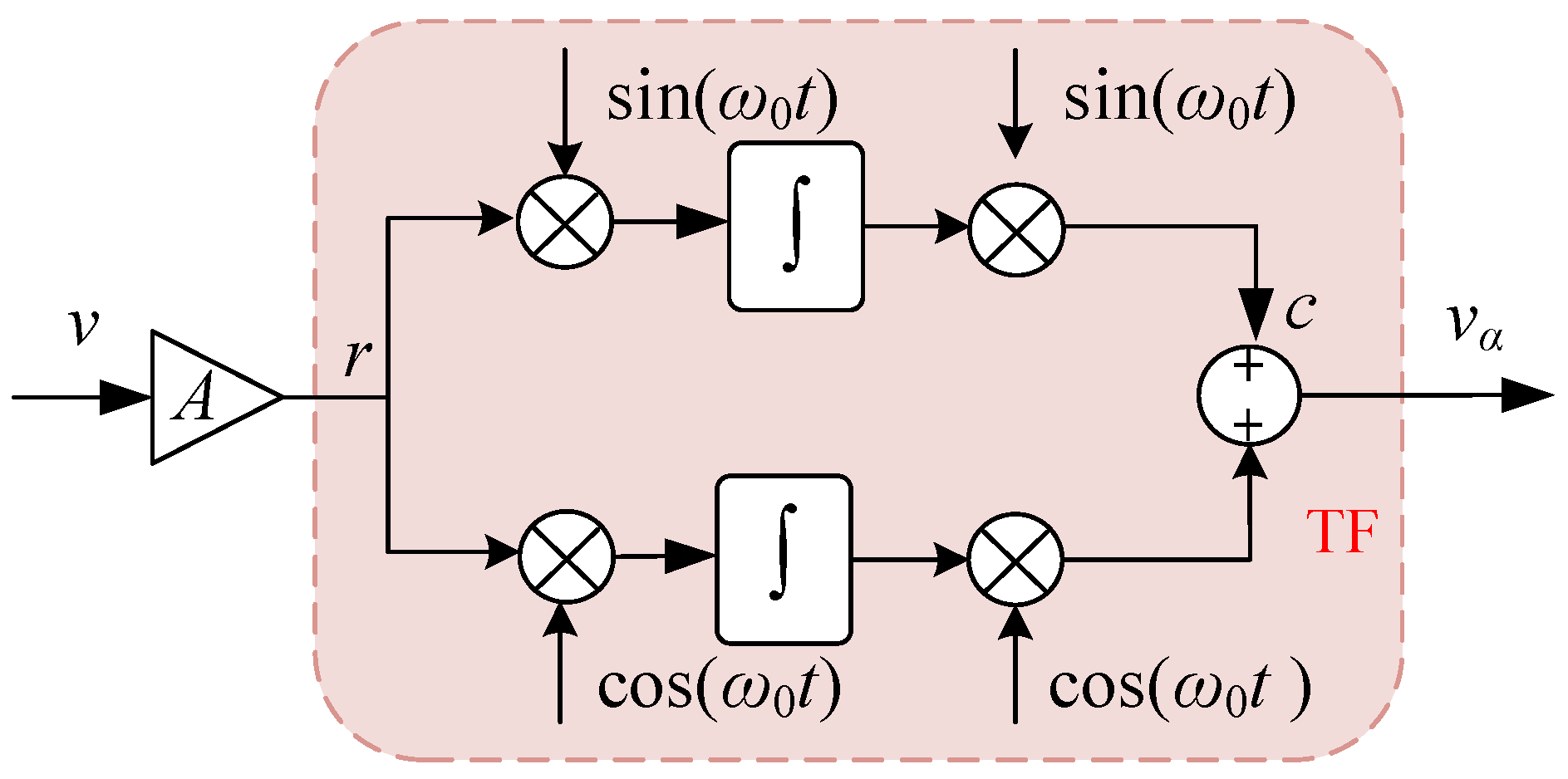
The PMR controller consists of multiple PR controllers in parallel to reduce the impact of multi-order current harmonics. The PR controller builds upon the resonant controller by integrating a PI mechanism, enhancing its ability to regulate harmonics effectively [26]. The principle of the resonant controller is similar to that of the traditional GFS. The structure of the traditional GFS is shown in Figure 3, and it is essentially a frequency-adaptive tracking filter (TF).
Figure 3.
Structure of generalized frequency selector.
Let r(t) and c(t) be the input and output signals of the intermediate stage, respectively. From the above figure, it can be obtained that:
Taking the second derivative of Equation (7):
Applying the Laplace transform to Equation (8) yields:
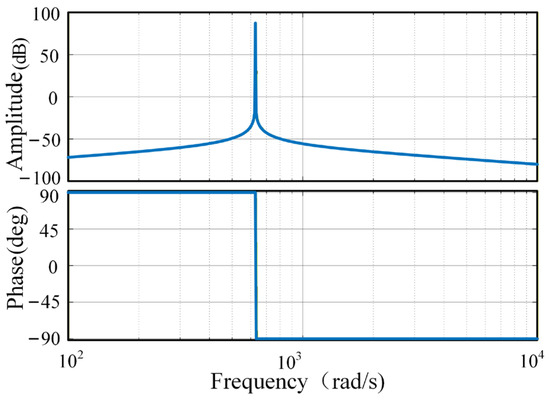
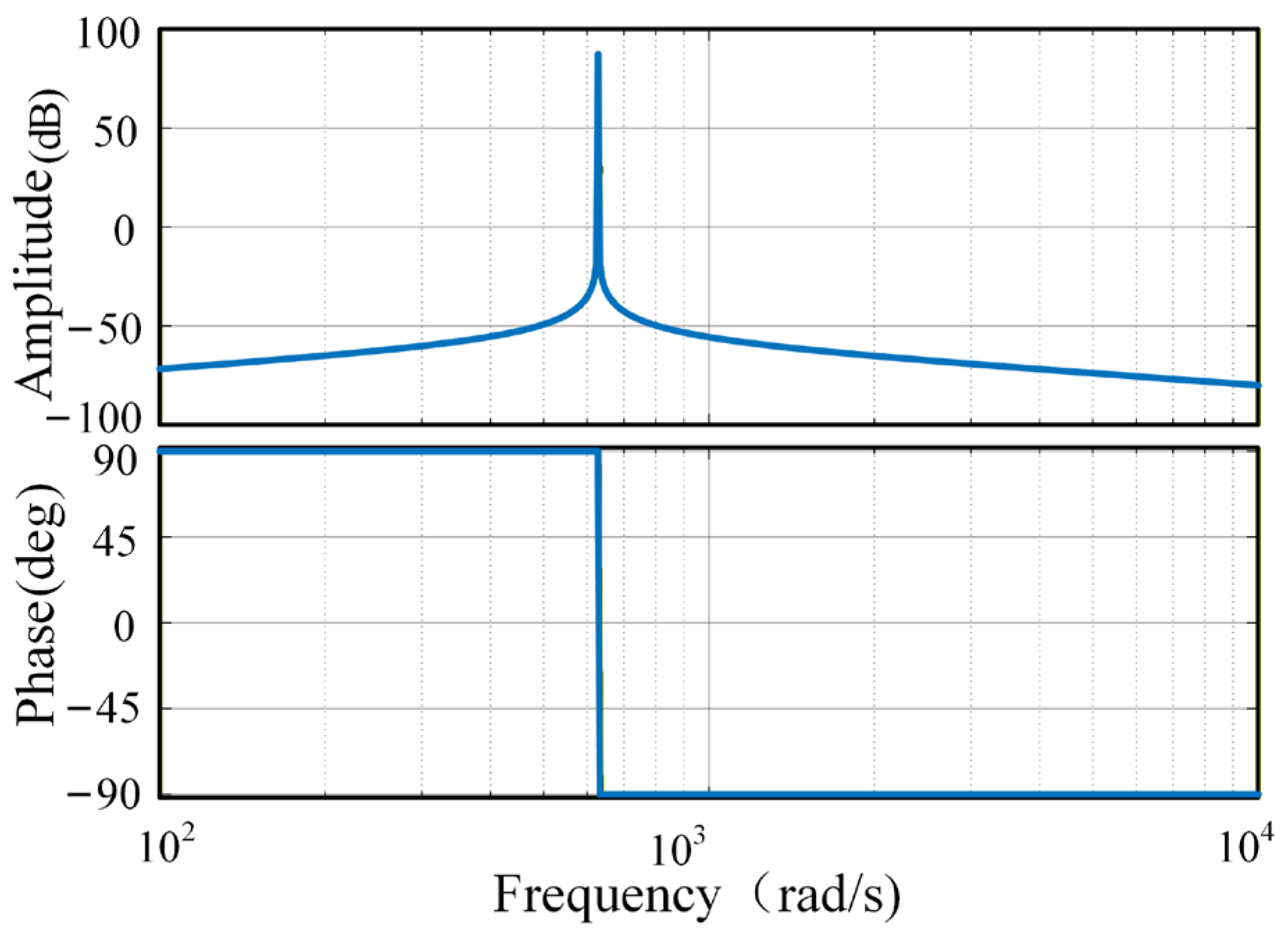
It is evident that the TF and the resonant controller operate on a shared principle, as both incorporate a sinusoidal internal model. This design ensures zero steady-state error tracking for sinusoidal signals at identical frequencies, effectively mitigating harmonic currents. The amplitude-frequency and phase-frequency response curves of GTF(s) are shown in Figure 4. At the resonant frequency, it demonstrates infinite gain, enabling efficient control of harmonic currents. However, due to its excessively narrow bandwidth, the control performance deteriorates when there are frequency fluctuations in the controlled signal, thereby affecting system stability.
Figure 4.
Bode diagram of generalized frequency selector.
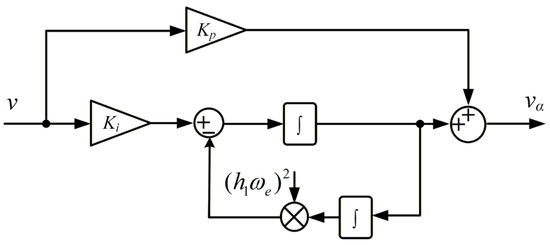
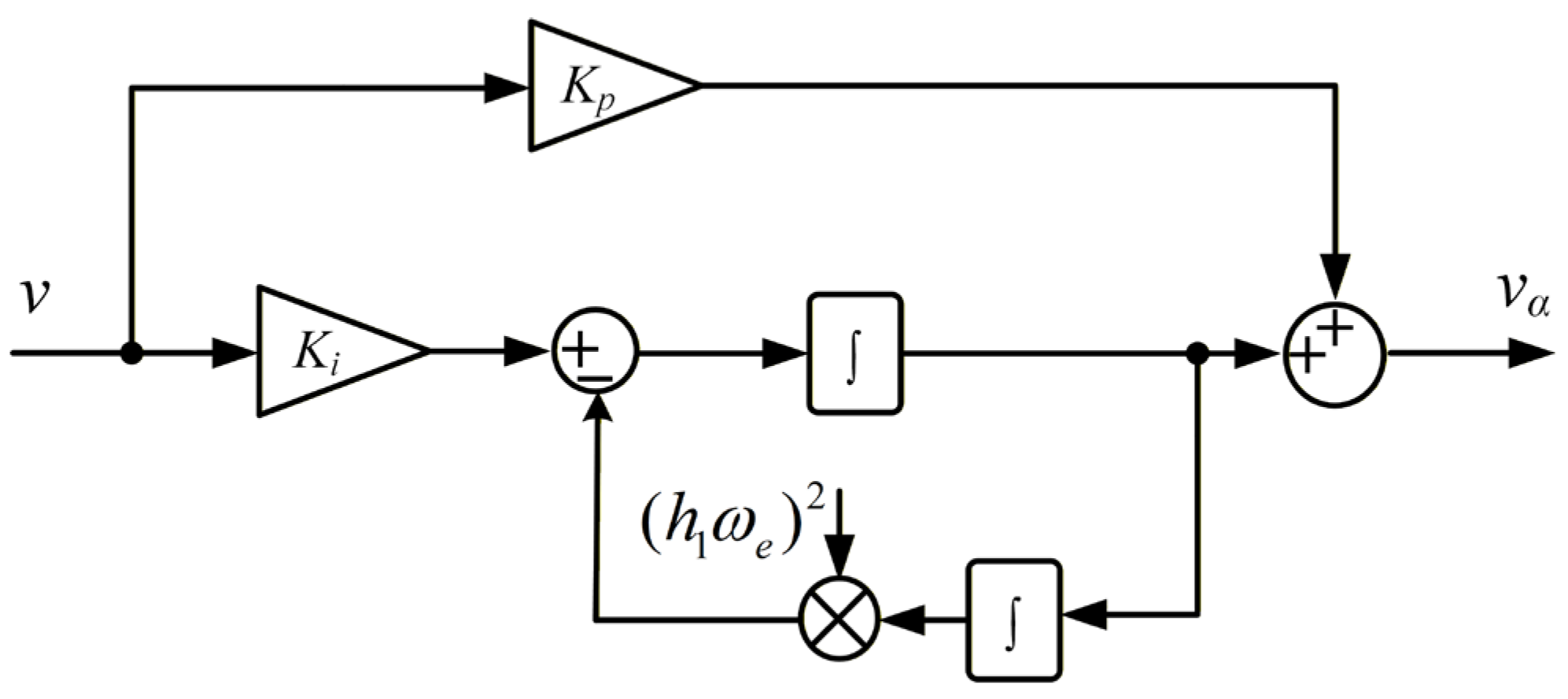
The resonant controller is essentially a GFS, with the addition of a PI component forming the PR controller. Its structure is shown in Figure 5, and its transfer function is given by:
Figure 5.
Structure block diagram of PR controller.
In the equation, Kp, Ki, and ω0 represent the controller’s proportional gain, resonant gain, and resonant frequency, respectively.
Similar to the GFS, the PR controller achieves high gain at the resonant frequency. However, its narrow bandwidth makes it particularly sensitive to variations in the system signal’s frequency parameters. In practice, when there are motor frequency fluctuations, its ability to suppress current harmonics weakens. Therefore, the integral term in the PR structure is improved by replacing it with a first-order low-pass filter. The modified transfer function is given by:
In the equation, ωc represents the cutoff frequency of the filter, and ωc ≪ ω0.
Since the cutoff frequency of the filter is much lower than the resonant frequency, the above equation can be simplified as follows:
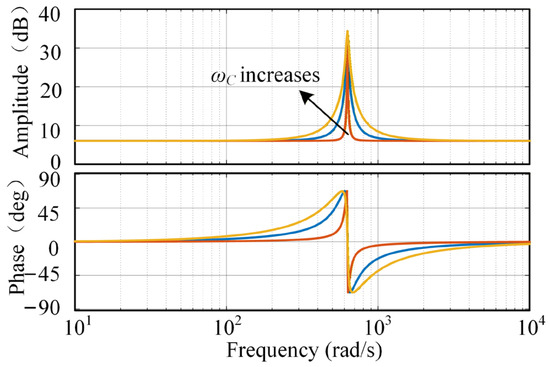
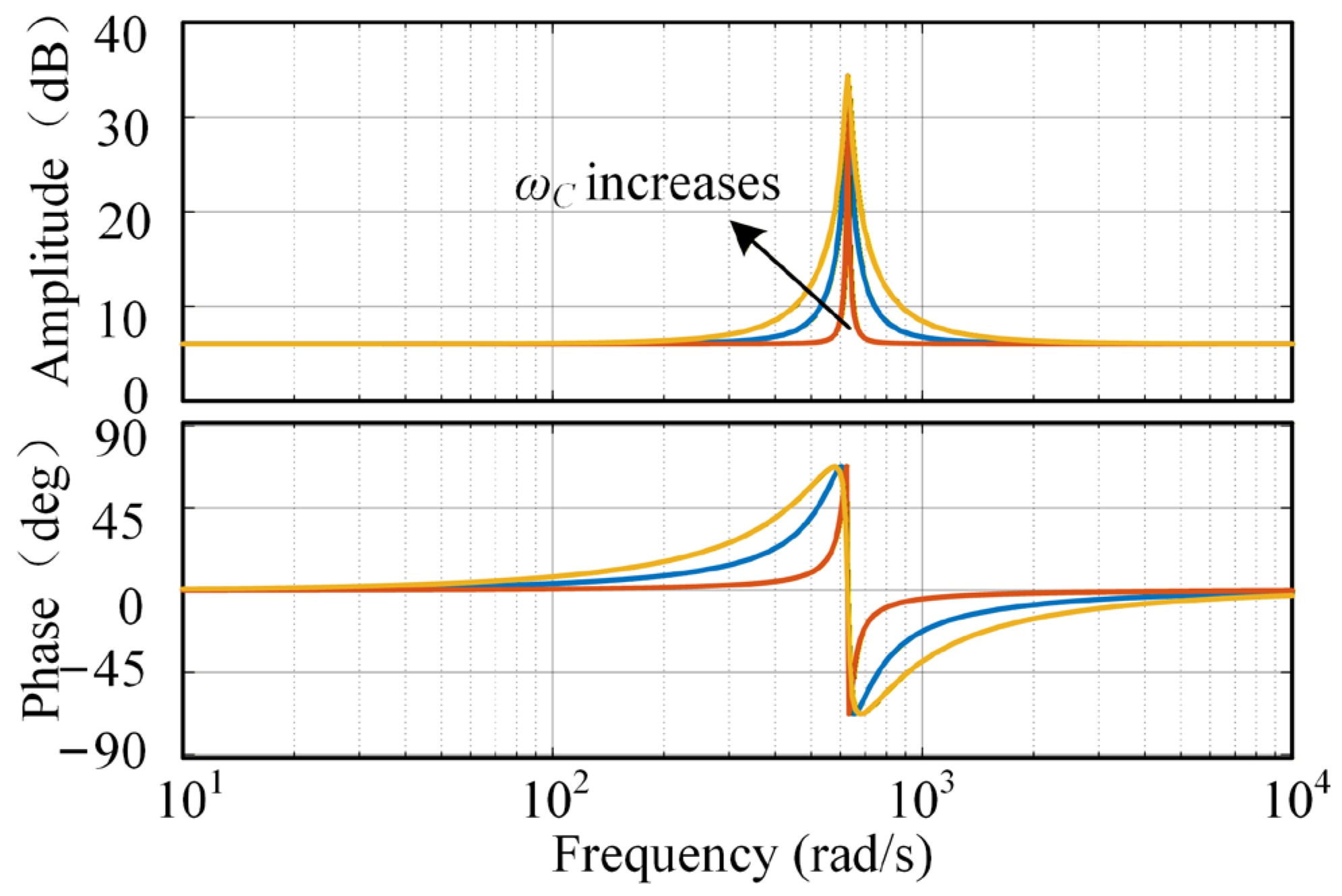
The Bode plot of the modified PR controller is displayed in Figure 6. As ωc increases, the bandwidth of the controller expands, making it more capable of adapting to frequency fluctuations in the controlled signal. However, if the bandwidth is excessively broadened, it may compromise the system’s ability to selectively target frequencies. Thus, it is essential to minimize the bandwidth as much as possible, while maintaining system stability, to enhance the accuracy of harmonic suppression.
Figure 6.
Bode diagram of GQPR under different ωc.
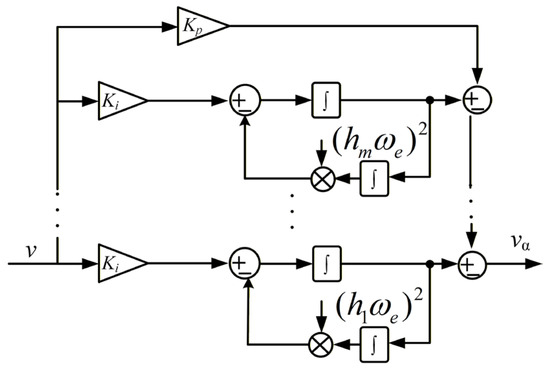
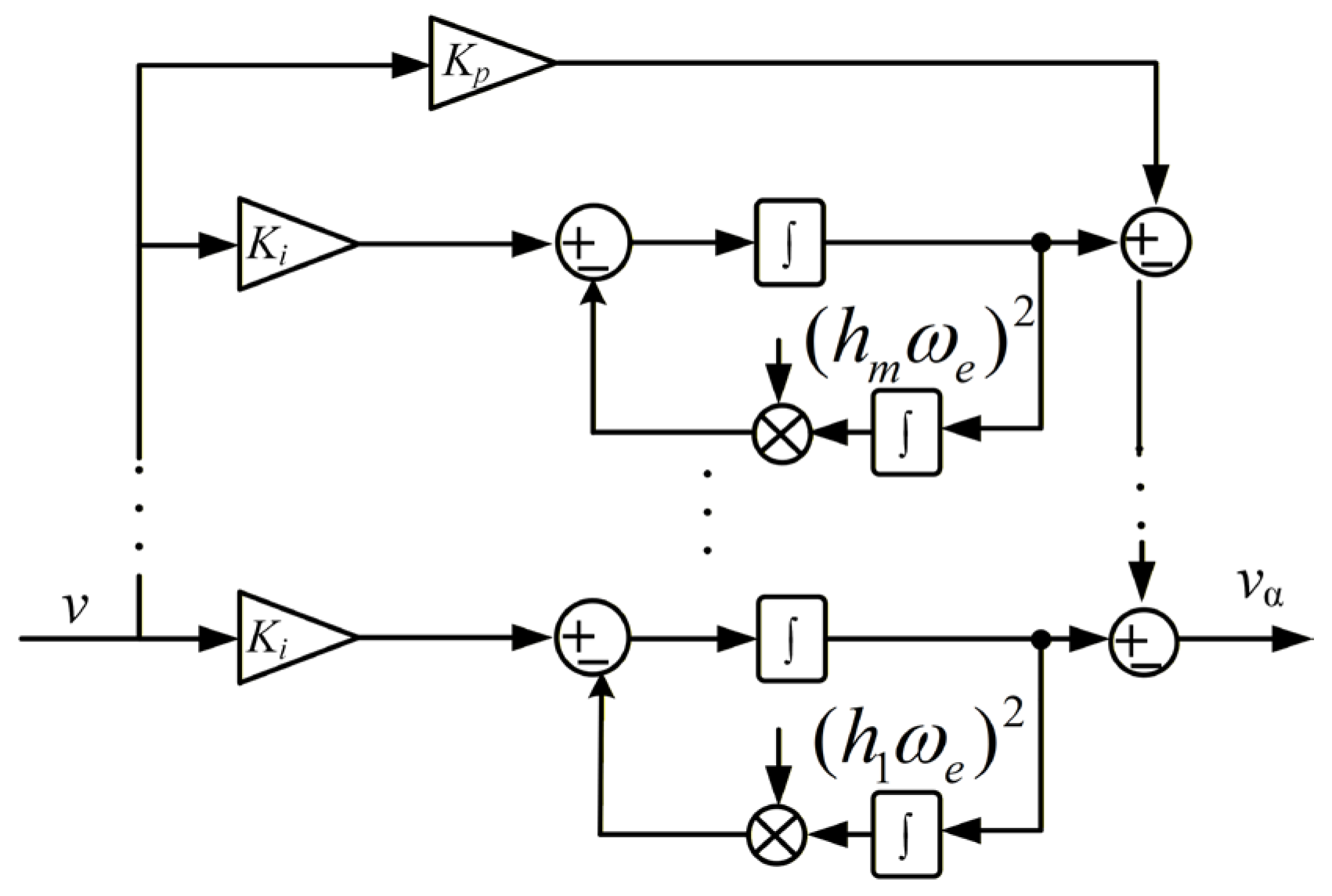
A single PR controller can only suppress harmonic currents of a single frequency. To address the multiple harmonics presented in the stator current of permanent magnet motors, a PMR controller is proposed. Its structure is shown in Figure 7. This controller shares a proportional term, and the integral parameter Ki is the same for all harmonics. Based on the Principle of Superposition, PR controllers are connected in parallel for harmonics of different orders.
Figure 7.
Structure block diagram of PMR controller.
Based on the structure illustrated in Figure 7, the transfer function of modified PMR controller is derived by replacing integral terms with first-order low-pass filters:
where hm and ωe represent harmonic order in synchronous rotating coordinate system and electrical angular velocity of PMSM.
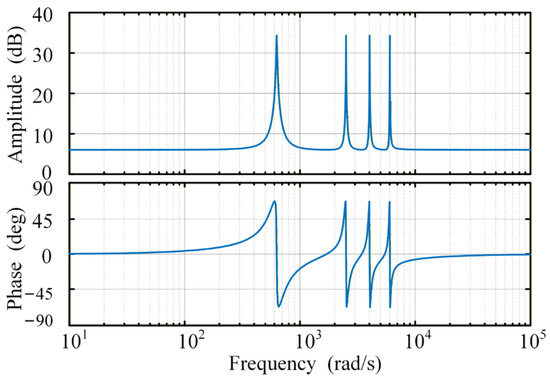
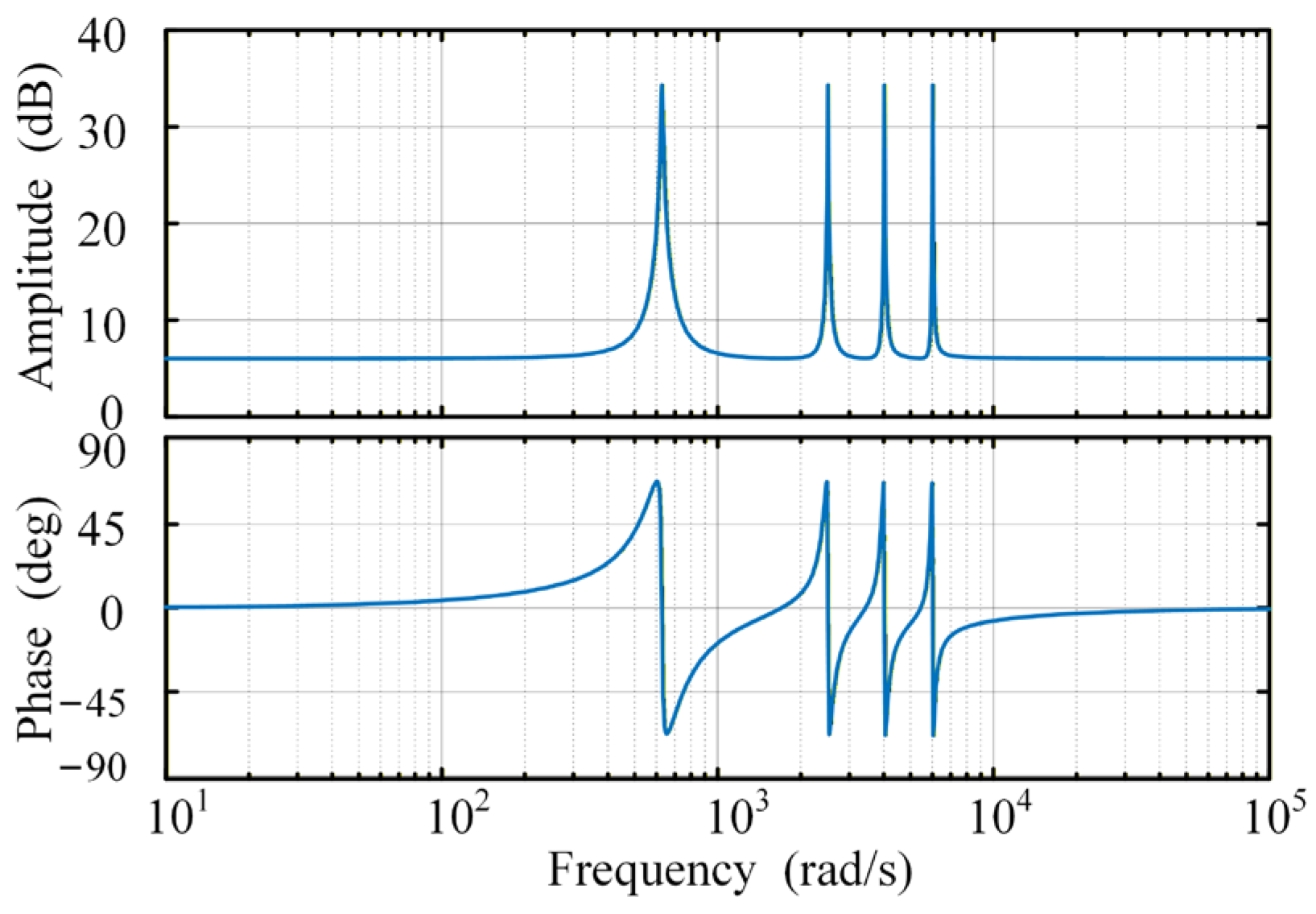
Figure 8 shows the Bode diagram of the PMR controller, which produces high-gain peaks precisely at the targeted resonant frequencies of 6ωe and 12ωe. The narrow bandwidth confirms its selective suppression of specific harmonics without affecting other frequency bands.
Figure 8.
Bode diagram of PMR controller.
3.2. Stability Analysis
Figure 8 shows that the interaction between parallel branches tuned to different harmonic orders is negligible. PMR controller comprises multiple parallel resonant controllers, so the current loop’s stability can be assessed by analyzing a single resonant frequency.
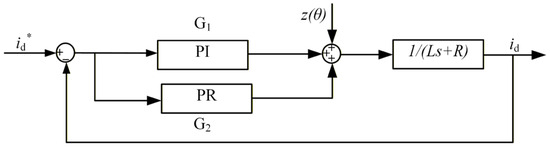
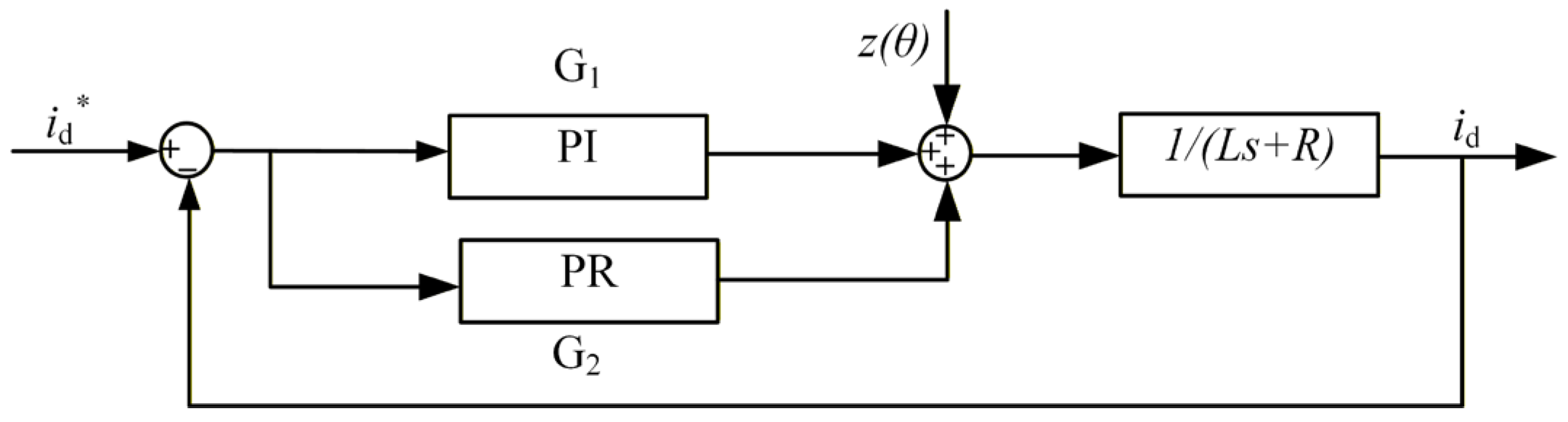
For illustration, the current in the d-axis consists of both DC and AC components. A PI controller is used for the DC component, while a PR controller is used for the AC component. Through parallel connection of the two controllers, precise tracking of the reference signal with zero steady-state error is accomplished. Figure 9 presents the schematic representation of harmonic current suppression utilizing the PR controller.
Figure 9.
Current loop control structure based on PR controller.
As illustrated in Figure 9, the open-loop transfer function of the motor control system’s current loop is expressed as:
where G1(s) = kp + ki/s, G2(s) = Kp + (2Kiωcs)/(s2 + 2ωcs + ω02).
By considering a certain order harmonic caused by the nonlinearities of the inverter and motor as a sinusoidal disturbance, i.e., z(θ) = sin(ω0t), the closed-loop steady-state response of id is derived from the structure in Figure 9 as:
To analyze steady-state harmonic suppression capability, the magnitude of current error is evaluated at resonant frequency s = jω0. At this frequency, the magnitude of PI controller gain |G1(jω0)| is relatively small due to low-pass characteristic of the integral term. In contrast, the PR controller provides a significantly high gain peak. Substituting s = jω0 into the PR transfer function:
Consequently, the magnitude of steady-state current distortion caused by the disturbance Z(jω0) is:
Although modified PR controller does not possess infinite gain, the resonant gain parameter Ki is typically designed to be sufficiently large. Therefore, the denominator in Equation (17) becomes dominated by Ki, reducing steady-state error to a negligible level:
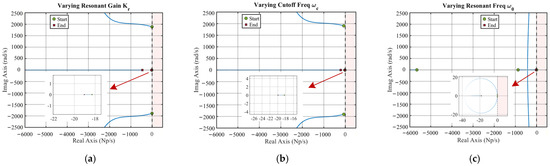
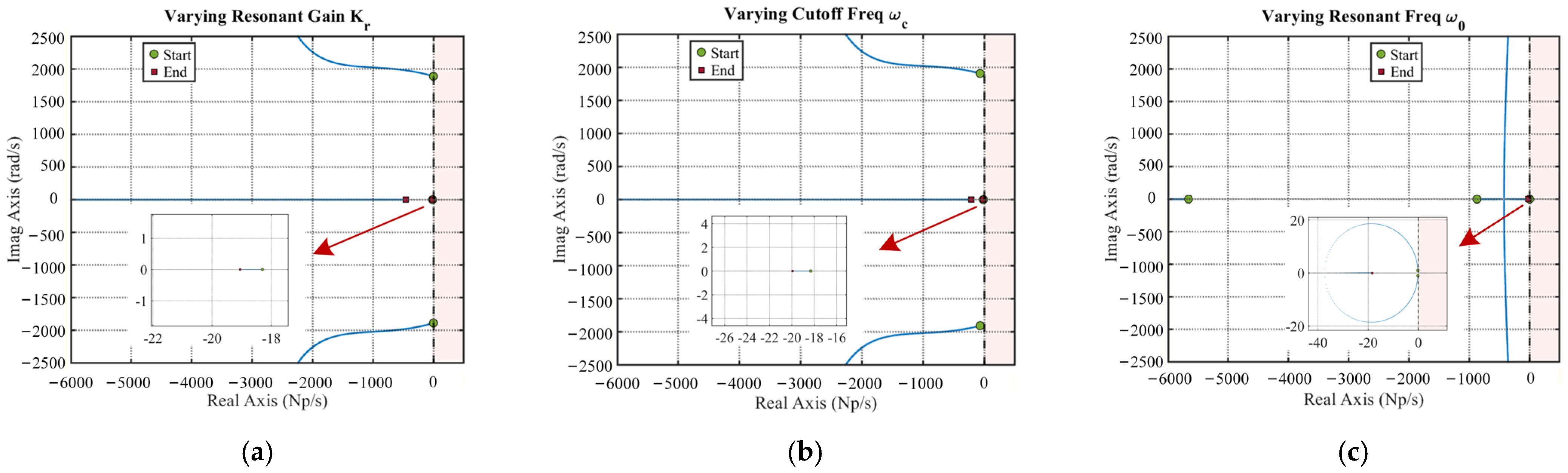
From Equation (18), it is evident that modified PR controller can effectively suppress harmonic disturbances by leveraging high gain at the resonance frequency, ensuring high-precision current tracking. To illustrate stability under varying parameters, root loci of the closed-loop system are plotted in Figure 10. In this analysis, Ki varies from 0 to 20,000, ωc ranges from 1 to 100 rad/s, and ω0 ranges from 1 to 600 Hz. The results indicate that the system is stable over entire tested range. In practice, Ki is determined empirically, while ωc is typically 3 or 5 rad/s. This selection balances robustness against ω0 fluctuations and with the bandwidth required to suppress harmonics precisely.
Figure 10.
Root loci with varying parameters.
The PMR controller is composed of PR controllers tuned to different resonant frequencies connected in parallel, which does not affect the stability of the control system. Therefore, the PMR controller can suppress the multi-order harmonic disturbances present in the d-axis and q-axis currents.
4. Simulation Analysis of PMR Controller
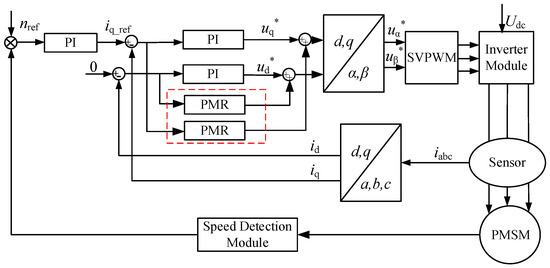
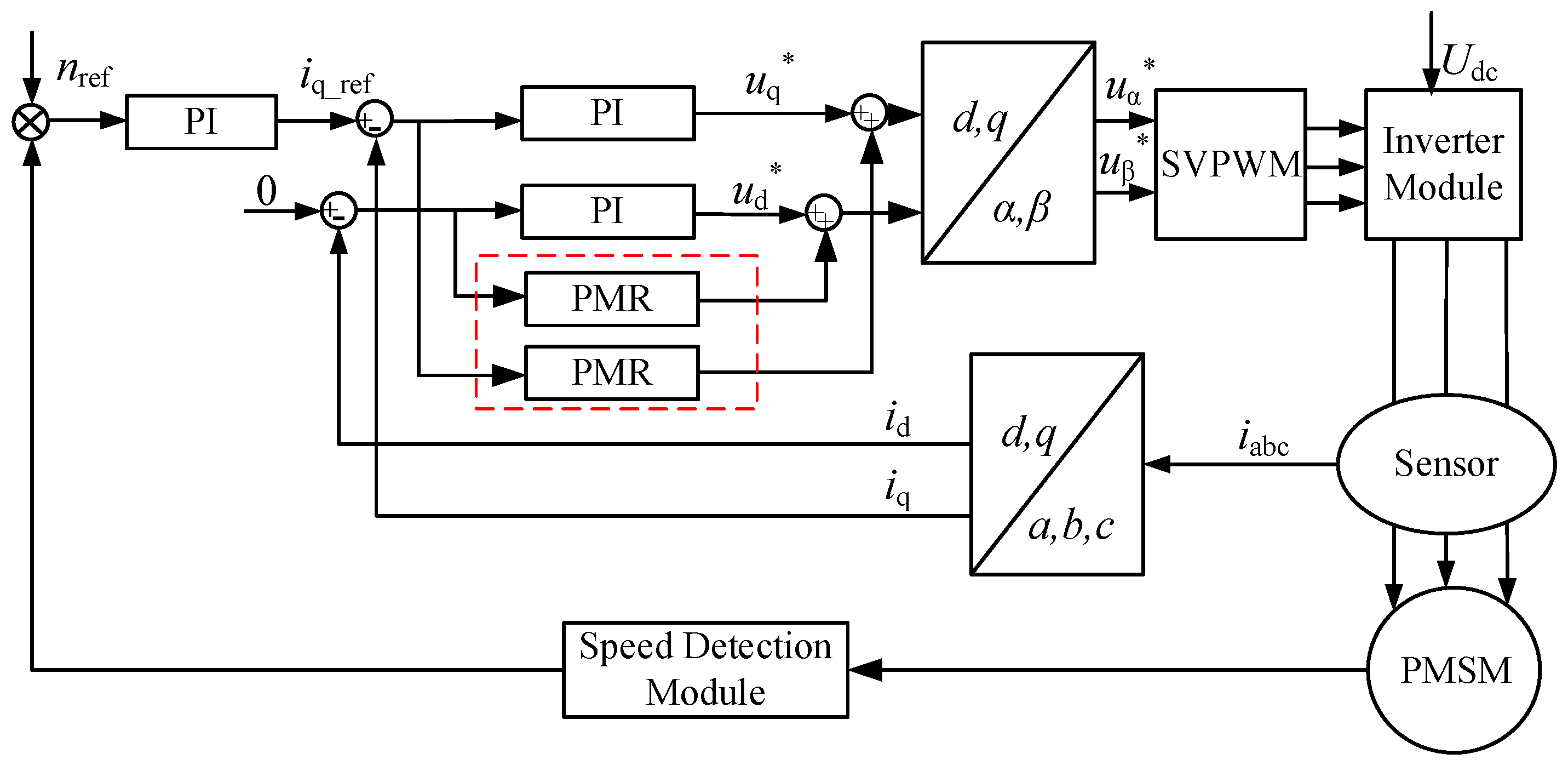
Based on the design of the aforementioned PMR controller, a harmonic current suppression model is built as shown in Figure 11. The PMR controller in this section includes PR control for suppressing 6th and 12th harmonics. The PI controller of the current loop is connected in parallel with the PMR controller, and the resonant frequency is automatically adjusted online as a variable. Specifically, the resonant frequency of the PMR controller is dynamically adjusted in real time based on the speed detected by the speed detection module, realizing adaptive PMR control. The PMR controller extracts the current harmonic components and calculates the harmonic voltage compensation value, which is injected into the reference voltage to eliminate the effects of specific harmonics.
Figure 11.
Block diagram of current harmonic suppression based on PMR.
The main parameters of the PMSM and driver used in the simulation are shown in Table 2. During the simulation, the influence of the permanent magnet’s magnetic field on the current is not considered. Harmonic components are introduced into the stator current by setting dead time and voltage drop across the switches.
Table 2.
Main parameters of PMSM and its driver.
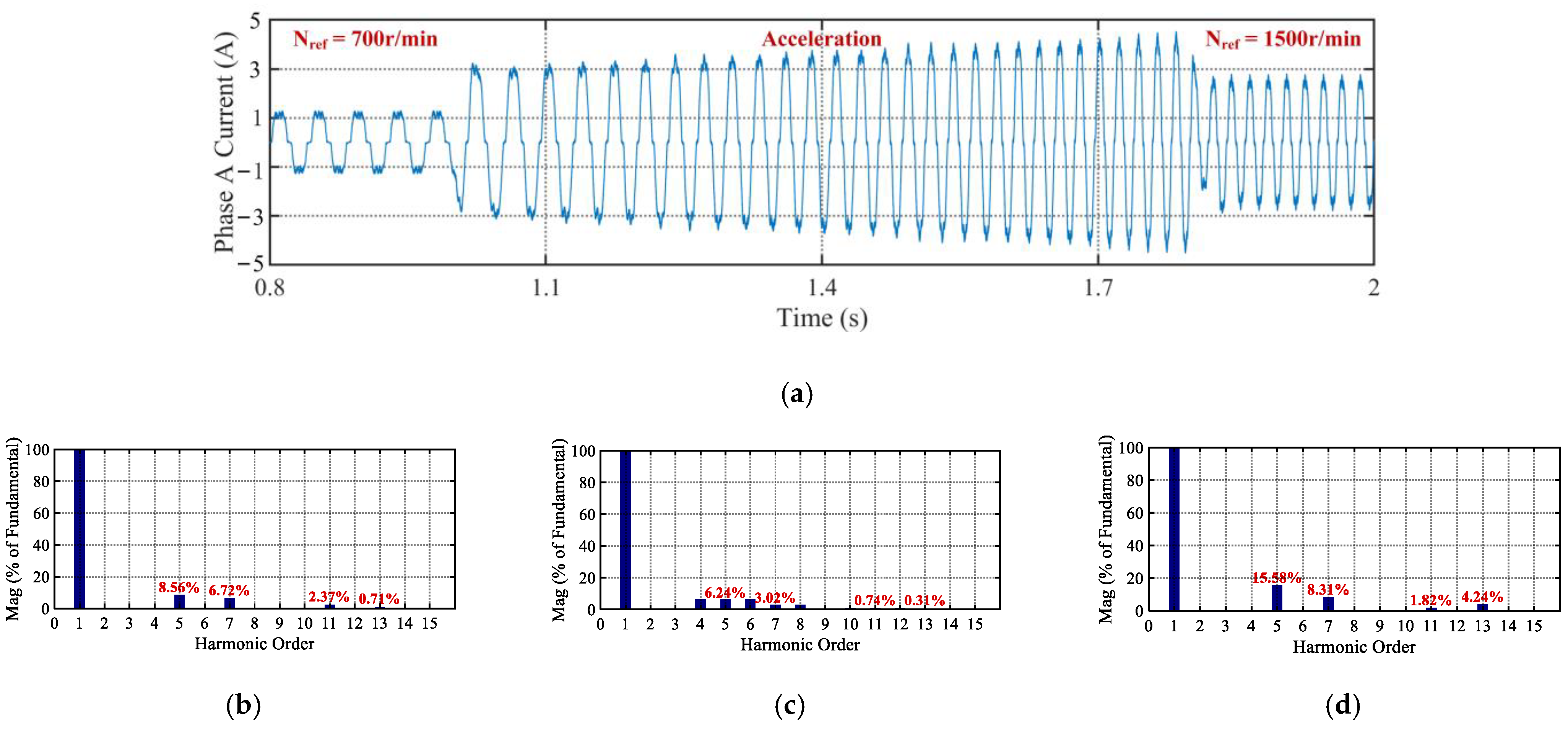
The simulation results utilizing the id = 0 double closed-loop vector control strategy without harmonic suppression are presented in Figure 12, where the reference speed nref steps from 700 r/min to 1500 r/min under a constant load torque of 0.5 N·m. As shown in Figure 12a, inverter dead-time effects cause severe waveform distortion, characterized by zero-current clamping. At the initial steady state of 700 r/min shown in Figure 12b, the 5th and 7th harmonic contents are recorded at 8.56% and 6.72%, respectively, with 11th and 13th harmonics at 2.37% and 0.71%. Figure 12c shows that during the acceleration transition, the harmonic content fluctuates, with the 5th, 7th, 11th, and 13th orders measuring 6.24%, 3.02%, 0.74%, and 0.31%, respectively. Figure 12d shows that at the rated speed of 1500 r/min, the nonlinear driver effects become most pronounced, causing the 5th and 7th harmonics to surge to 15.58% and 8.31%, while the 11th and 13th harmonics reach 1.82% and 4.24%. These components correspond to the 6th and 12th order harmonics in the synchronous reference frame.
Figure 12.
Simulation results without harmonic suppression during acceleration: (a) Phase current; (b) FFT of phase current when nref = 700 r/min; (c) FFT of phase current during acceleration; (d) FFT of phase current when nref = 1500 r/min.
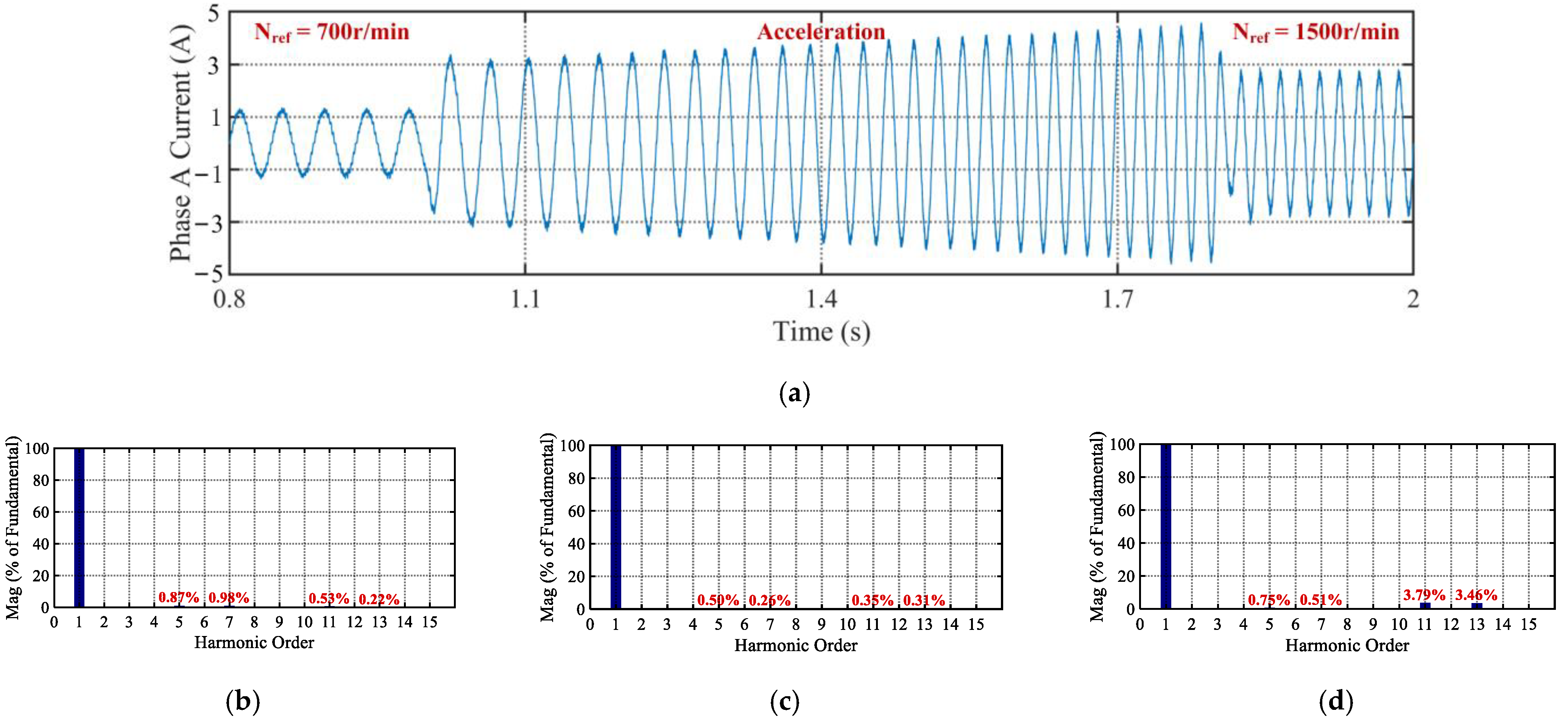
The PMR controller is implemented in parallel with the conventional PI controller, and the corresponding simulation results are presented in Figure 13. As shown in Figure 13a, the phase current maintains high sinusoidal quality across the speed range from 700 r/min to 1500 r/min, with no clamping or peak collapse phenomena.
Figure 13.
Simulation results with harmonic suppression based on PMR controller: (a) Phase current; (b) FFT of phase current when nref = 700 r/min; (c) FFT of phase current during acceleration; (d) FFT of phase current when nref = 1500 r/min.
The fast Fourier transform analysis in Figure 13b demonstrates the effectiveness of controller at a steady state reference speed of 700 r/min. With the PMR controller engaged, the 5th, 7th, 11th, and 13th harmonics are suppressed to 0.87%, 0.98%, 0.53%, and 0.22%, respectively. Consequently, the total harmonic distortion of current decreases from 11.93% to 6.57%. Furthermore, Figure 13c displays the spectral analysis during the acceleration phase, where the controller maintains robust harmonic suppression with values of 0.50%, 0.26%, 0.35%, and 0.31%. Finally, Figure 13d depicts the performance at the higher reference speed of 1500 r/min. In this state, the 5th and 7th harmonics remain low at 0.75% and 0.51%, while the 11th and 13th components increase to 3.79% and 3.46%.
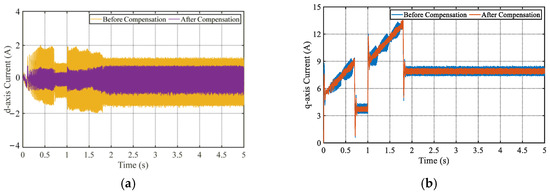
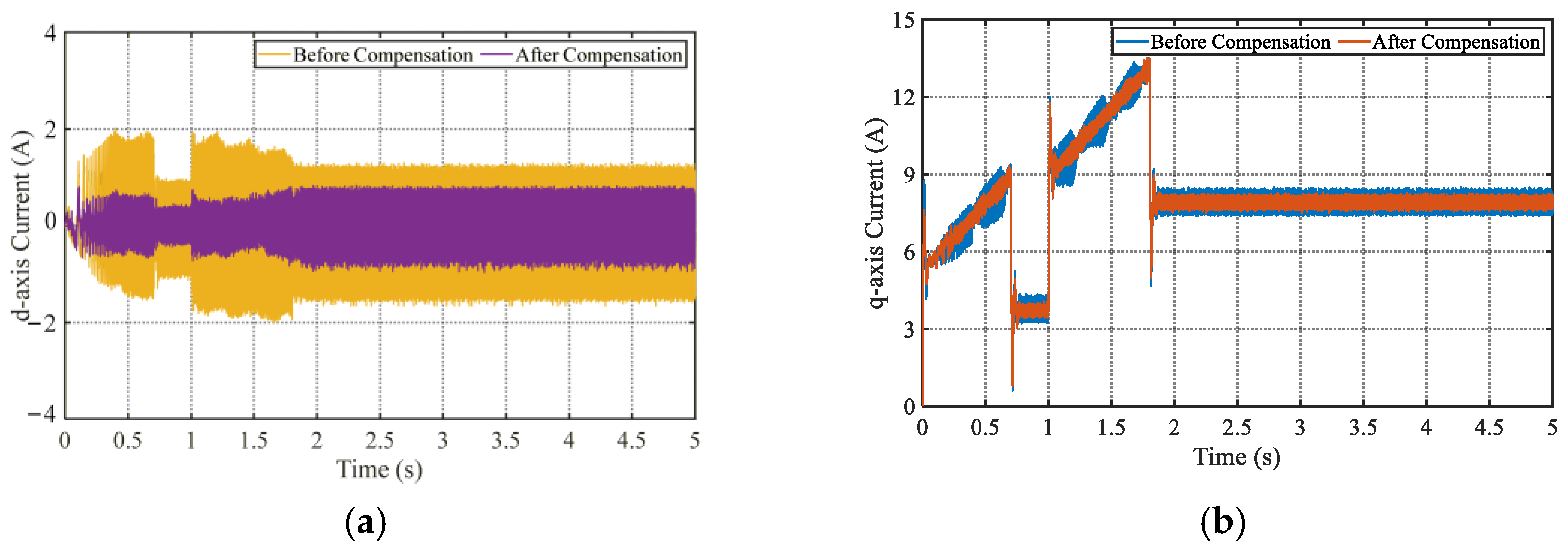
Figure 14 provides a comparison of id and iq before and after harmonic compensation. The waveforms for both id and iq show a distinct reduction in ripple magnitude after compensation, confirming that the PMR controller effectively mitigates current harmonics.
Figure 14.
Simulation comparison before and after harmonic suppression: (a) Waveforms of id; (b) Waveforms of iq.
5. Experimental Study
5.1. Experimental Setup
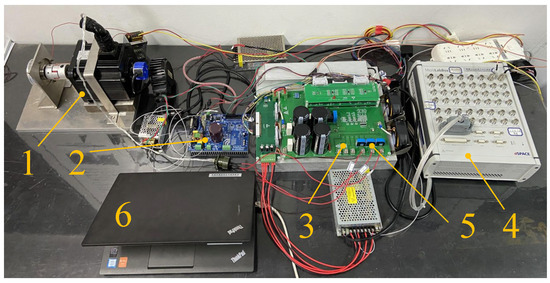
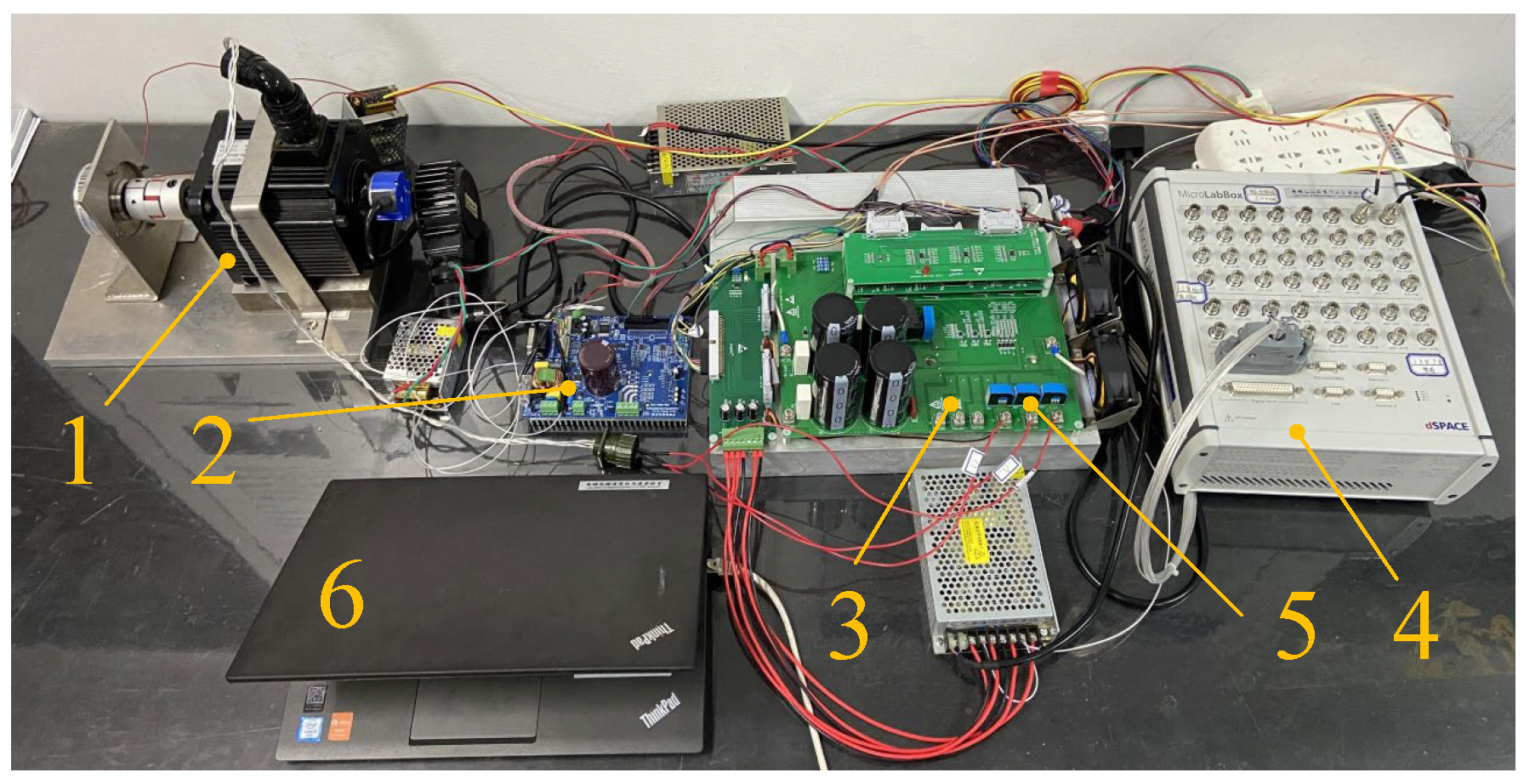
The experiment is conducted using a permanent magnet motor test bench, as illustrated in Figure 15. Control algorithms are implemented on a host computer that interfaces with a dSPACE1202 system for real-time signal processing. The dSPACE platform acquires sensor feedback and sends control commands to the motor driver. The system sampling and control frequencies are both set to 10 kHz. Rotor position is measured using an incremental encoder (TS5213N500) with an angular resolution of 0.176°, while phase currents are directly sampled via Hall-effect sensors. The detailed parameters of PMSM are listed in Table 2, and components of experimental setup are listed in Table 3.
Figure 15.
Experimental platform: 1. Motor, 2. Encoder Signal Conversion Module, 3. Motor Driver, 4. dSPACE1202, 5. Hall Current Sensor, 6. Host Computer.
Table 3.
Detailed components of experimental setup.
5.2. Experimental Design
(1) Experimental I: To experimentally verify the steady-state harmonic suppression of the PMR controller, the inverter dead time was set to 5 μs. This setting induces current harmonics characteristic of inverter non-linearity and mechanical structural effects. Under these conditions, the motor operates stably at 1500 r/min with a load torque of 0.5 N·m.
(2) Experimental II: To experimentally verify the dynamic harmonic suppression of the PMR controller, the inverter dead time was set to 5 μs. Under these conditions, a speed step command from 1000 r/min to 1500 r/min is applied to the motor with a constant load torque of 0.5 N·m.
5.3. Experimental Results
(1) Experimental I: The steady-state experimental results are presented in Figure 16, Figure 17 and Figure 18. As illustrated in Figure 16a, when the dead time is set to 5 μs, the experimental results align well with the simulation results. The sinusoidal quality of the stator current deteriorates, with significant distortion, zero current clamping occurring at the zero-crossing points, and noticeable sag at the peak positions. After the fast Fourier transform, Figure 16b demonstrates that the THD of the Phase A current is 14.77%, with higher harmonic content at the 5th, 7th, 11th, and 13th orders, reaching 7.57%, 4.83%, 1.72%, and 1.39%, respectively, corresponding to 6th and 12th harmonic components in the d-q axis coordinate system. Harmonics caused by the motor’s inherent winding asymmetry, such as 2nd and 3rd orders, are not considered in this paper.
Figure 16.
Experimental results without the harmonic suppression when nref = 1500 r/min: (a) Phase current. (b) FFT of phase current. (c) Waveforms and reference signals of id and iq.
Figure 17.
Experimental results with the harmonic suppression based on MSRFTs when nref = 1500 r/min: (a) Phase current. (b) FFT of phase current. (c) Waveforms and reference signals of id and iq.
Figure 18.
Experimental results with harmonic suppression based on PMR controller when nref = 1500 r/min: (a) Phase current. (b) FFT of phase current. (c) Waveforms and reference signals of id and iq.
To provide a comparison for evaluating the proposed scheme, a prevailing method based on MSRFTs was applied Figure 17. While this method noticeably improves current quality by reducing the THD to 4.94%, it exhibits limitations in fully suppressing harmonics. As indicated in the spectrum, the 5th and 7th harmonics are reduced to 3.25% and 1.80%, yet residual distortion persists.
Based on a proportional controller suppressing the 5th and 7th harmonics, a resonant controller suppressing the 11th and 13th harmonics is connected in parallel, forming a PMR controller. The superior efficacy of proposed PMR controller is demonstrated in Figure 18. Compared to the case without harmonic controllers, the current THD decreases from 14.77% to 3.94%, and the 5th, 7th, 11th, and 13th harmonic contents drop to 2.03%, 1.20%, 0.99%, and 0.43%, respectively. Since the 11th and 13th harmonic contents are much smaller than those of the 5th and 7th harmonics, the harmonic suppression effect of the PMR controller is better, resulting in a smaller reduction in current THD. However, as illustrated in Figure 18, the sinusoidal quality of the current waveform is significantly improved, with the peak collapse and zero-point clamping phenomena being mitigated.
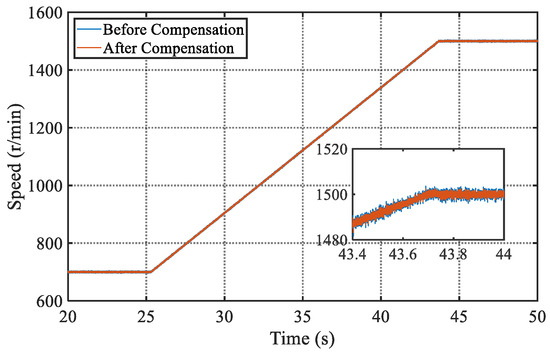
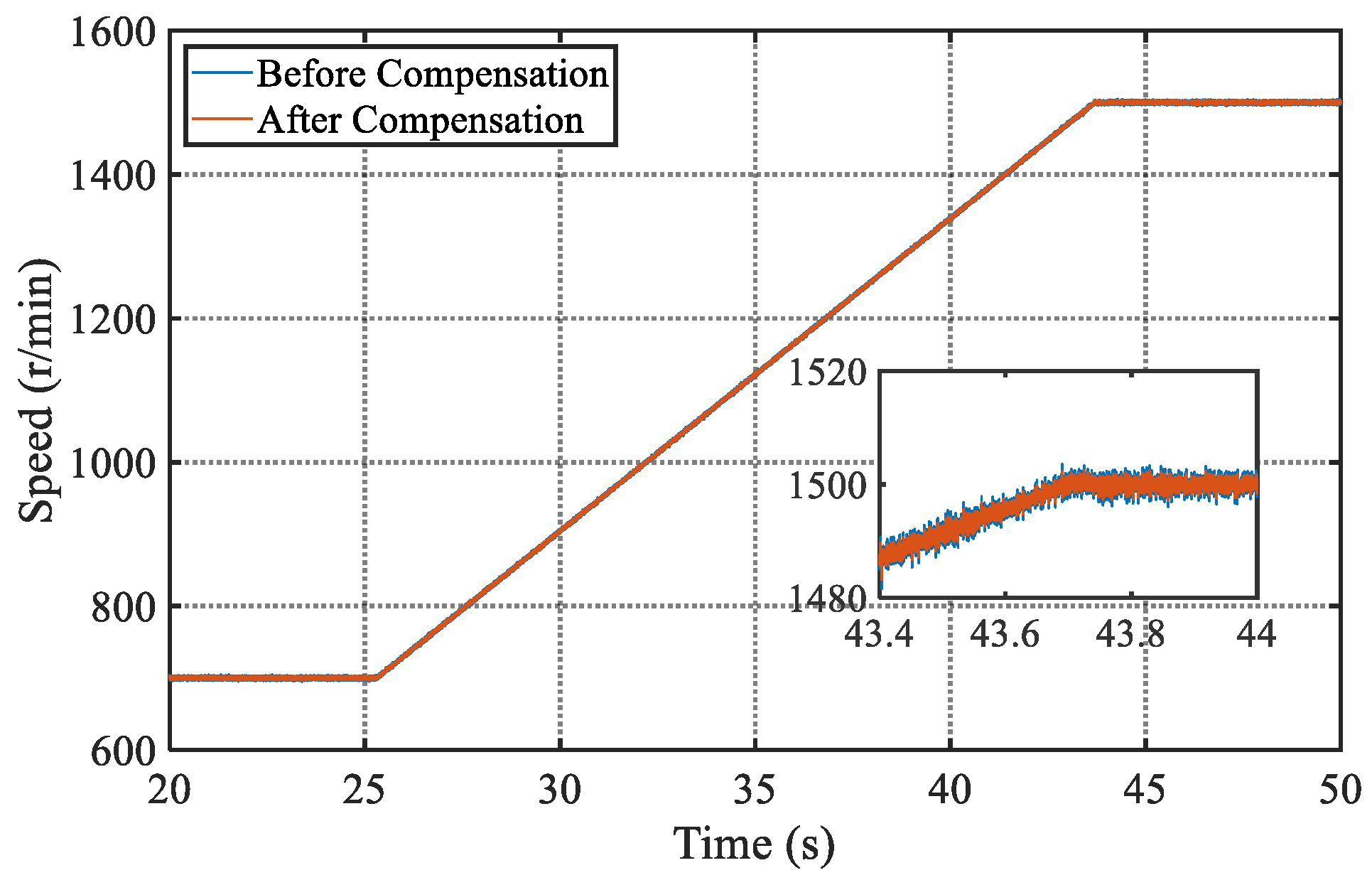
(2) Experimental II: The dynamic-state experimental results are presented in Figure 19, Figure 20, Figure 21 and Figure 22. The rotor speed response to a step command from 700 r/min to 1500 r/min is illustrated in Figure 19. The harmonic-induced torque ripples and speed fluctuations are effectively mitigated with the PMR controller. Figure 20 displays the transient response without harmonic compensation. During the acceleration phase, the current waveform suffers from severe distortion due to the aggravated influence of inverter non-linearities at varying frequencies. The spectral analysis reveals a high THD of 15.33%. Detailed decomposition shows that the harmonic content is substantial, with the 5th, 7th, 11th, and 13th orders occupying 8.02%, 4.44%, 1.76%, and 1.27%, respectively.
Figure 19.
Experimental comparison of rotor speed with and without PMR controller.
Figure 20.
Experimental results without harmonic suppression during acceleration: (a) Phase current. (b) FFT of phase current. (c) Waveforms and reference signals of id and iq.
Figure 21.
Experimental results with harmonic suppression based on MSRFTs during acceleration: (a) Phase current. (b) FFT of phase current. (c) Waveforms and reference signals of id and iq.
Figure 22.
Experimental results with harmonic suppression based on PMR controller during acceleration: (a) Phase current. (b) FFT of phase current. (c) Waveforms and reference signals of id and iq.
The performance of method based on MSRFTs during this dynamic transition is illustrated in Figure 21. While this strategy effectively improves the current quality compared to the uncompensated case, lowering the THD to 6.72%, it still exhibits limitations in suppressing specific orders during speed transients. Specifically, the 5th harmonic content remains at 3.55%, while the 7th, 11th, and 13th orders are recorded at 2.04%, 1.47%, and 0.74%, respectively.
In contrast, the proposed PMR controller exhibits superior dynamic robustness, as evidenced in Figure 22. Under the same acceleration conditions, the proposed scheme achieves the lowest distortion, further suppressing the current THD to 5.32%. Notably, the dominant 5th harmonic is significantly reduced to 2.33%, while the 7th, 11th, and 13th harmonics are maintained at 2.04%, 1.47%, and 0.74%. This comparison confirms that the PMR strategy maintains higher sinusoidal current quality and tracking stability even during rapid speed variations.
6. Conclusions
This paper presents a current harmonic suppression algorithm utilizing the PMR controller. Based on theoretical derivation, simulations, and experimental studies, the following conclusions can be drawn:
Harmonics in the stator current of the PMSM lead to torque ripple, higher losses, and reduced system efficiency. To address this, the characteristics of current harmonics were analyzed, revealing that (6k ± 1)-order harmonics in the stationary frame translate into (6k)-order harmonics in the synchronous rotating frame.
The generalized selective frequency filter is essentially equivalent to a resonant controller. Based on this, the PMR control was introduced to mitigate multi-order current harmonics. The PMR controller features a simple structure, is largely insensitive to frequency fluctuations of the controlled signal, and exhibits outstanding frequency adaptability.
With the PMR controller, the current waveform becomes more sinusoidal, effectively reducing the harmonic distortion rate of the stator current and enhancing the stability of the motor control system.
Author Contributions
Conceptualization, K.Z.; Methodology, Y.X.; Software, Y.Z.; Formal analysis, Y.X.; Investigation, K.Z.; Resources, J.Z.; Data curation, Y.Z.; Writing—original draft preparation, K.Z.; Writing—review and editing, Q.G.; Visualization, Q.G.; Supervision, Y.X.; Project administration, J.Z. All authors have read and agreed to the published version of the manuscript.
Funding
This research was funded by National Key R&D Program of China, grant number 2024YFB3410004.
Data Availability Statement
The original contributions presented in this study are included in the article. Further inquiries can be directed to the corresponding author.
Conflicts of Interest
The authors declare no conflicts of interest.
References
- Yan, L.; Zhu, Z.; Shao, B.; Qi, J.; Ren, Y.; Gan, C.; Brockway, S.; Hilton, C. Arbitrary current harmonic decomposition and regulation for permanent magnet synchronous machines. IEEE Trans. Ind. Electron. 2022, 72, 4392–4404. [Google Scholar] [CrossRef] [Scilit]
- Okamoto, S.; Denis, N.; Kato, Y.; Ieki, M.; Fujisaki, K. Core loss reduction of an interior permanent-magnet synchronous electrical machine using amorphous stator core. IEEE Trans. Ind. Appl. 2016, 52, 2261–2268. [Google Scholar] [CrossRef] [Scilit]
- Ruan, Z.; Song, W.; Yan, Y. Current harmonic suppression for dual three-phase permanent magnet synchronous motor drives. IEEE Access 2019, 7, 177764–177773. [Google Scholar] [CrossRef] [Scilit]
- Wang, L.; Xu, J.; Chen, Q.; Chen, Z.; Huang, R. An Improved Trapezoidal Voltage Method for Dead-Time Compensation in Three-Phase Voltage Source Converter. IEEE Trans. Power Electron. 2022, 37, 8785–8789. [Google Scholar] [CrossRef] [Scilit]
- Zhang, X.; Zhang, C.; Yu, J.; Du, P.; Li, L. Analytical model of magnetic field of a permanent magnet synchronous motor with a trapezoidal Halbach permanent magnet array. IEEE Trans. Magn. 2019, 55, 8105205. [Google Scholar] [CrossRef] [Scilit]
- Contreras, M.D.J.; Kazemikia, D.; Khan, S.; Gardner, M. A Parameterized Nonlinear Magnetic Equivalent Circuit Model for Fast Design and Comparison of Surface Permanent Magnet Synchronous Machines. In Proceedings of the 2025 IEEE International Electric Machines & Drives Conference, Houston, TX, USA, 18–21 May 2025; pp. 1040–1045. [Google Scholar]
- Seadati, S.A.S.; Niasar, A.H. Optimal design and finite element analysis of a high speed, axial-flux permanent magnet synchronous motor. In Proceedings of the Annual Power Electronics, Drives Systems and Technologies Conference, Tehran, Iran, 13–15 February 2018; pp. 462–467. [Google Scholar]
- Xue, C.; Ding, L.; Li, Y. Model predictive control with reduced common-mode current for transformerless current-source PMSM drives. IEEE Trans. Power Electron. 2021, 36, 8114–8127. [Google Scholar] [CrossRef] [Scilit]
- Venkataraman, G. Evaluation of Inverter Topology Options for Low Inductance Motors. In Proceedings of the Conference Record of the 1993 IEEE Industry Applications Conference Twenty-Eighth IAS Annual Meeting, Toronto, ON, Canada, 2–8 October 1993; pp. 1041–1047. [Google Scholar]
- Zhang, Y.; Li, T.; Zhang, X.; Sun, Y.; Zhang, G.; Yi, H. A LCCR Filter Based Harmonic Suppression Method for Power Quality Improvement. Energy Rep. 2023, 9, 549–557. [Google Scholar] [CrossRef] [Scilit]
- Essien, A.U.; Ilo, F.U.; Udebunu, F. Modelling, Design and Performance Analysis of LCL Filter for Grid Connected Three Phase Power Converters. J. Energy Res. Rev. 2022, 12, 36–51. [Google Scholar] [CrossRef] [Scilit]
- Liu, G.; Wang, D.; Jin, Y.; Wang, M.; Zhang, P. Current-detection-independent dead-time compensation method based on terminal voltage A/D conversion for PWM VSI. IEEE Trans. Ind. Electron. 2017, 64, 7689–7699. [Google Scholar] [CrossRef] [Scilit]
- Kang, Z.; Lin, X.; Liu, Z.; Shen, X.; Gao, Y.; Liu, J. Adaptive Generalized Super-Twisting Sliding Mode Control for PMSM Drives. IEEE Trans. Energy Convers. 2025. [Google Scholar] [CrossRef] [Scilit]
- Kang, Z.; Lin, X.; Shen, X.; Liu, Z.; Gao, Y.; Liu, J. Event-Triggered Generalized Super-Twisting Sliding Mode Control for Position Tracking of PMSMs. IEEE Trans Ind. Informat. 2025, 21, 5701–5711. [Google Scholar] [CrossRef] [Scilit]
- Chatterjee, D.; Chakraborty, C.; Dalapati, S. Current Sensor-Less Dead Time Distortion Compensation in Single-Phase PWM Inverter. IEEE Trans. Ind. Electron. 2025, 72, 4696–4709. [Google Scholar] [CrossRef] [Scilit]
- Liu, Y.; Liu, X.; Zhou, J.; Miao, H.; Liang, T.; Ge, Y. Research on Minimizing Speed Harmonics of PMSM by Injecting Voltage Harmonics Based on Second-Order Generalized Integrator. In Proceedings of the 2024 14th International Conference on Power and Energy Systems (ICPES), Chengdu, China, 13–16 December 2024; pp. 47–51. [Google Scholar]
- Xu, Y.; Miao, Q.; Zeng, P.; Lin, Z.; Li, Y.; Li, X. Multiple Synchronous Rotating Frame Transformation-Based 12th Current Harmonic Suppression Method for an IPMSM. World Electr. Veh. J. 2022, 13, 194. [Google Scholar] [CrossRef] [Scilit]
- Sun, G.; Li, Y.; Jin, W.; Bu, L. A nonlinear three-phase phase-locked loop based on linear active disturbance rejection controller. IEEE Access 2017, 5, 21548–21556. [Google Scholar] [CrossRef] [Scilit]
- Benrabah, A.; Xu, D.; Guo, Z. Active disturbance rejection control of LCL filtered grid-connected inverter using Padé approximation. IEEE Trans. Ind. Appl. 2018, 54, 6179–6189. [Google Scholar] [CrossRef] [Scilit]
- Song, Z.; Yang, J.; Mei, X.; Tao, T.; Xu, M. Harmonic current suppression method with adaptive filter for permanent magnet synchro-nous motor. Int. J. Electron. 2021, 108, 983–1013. [Google Scholar] [CrossRef] [Scilit]
- Wu, Y.; Song, X.; Li, H.; Chen, B. Suppression of harmonic current in permanent magnet synchro-nous motors using improved repetitive controller. Electron. Lett. 2019, 55, 47–49. [Google Scholar] [CrossRef] [Scilit]
- Wang, W.; Liu, C.; Liu, S.; Song, Z.; Zhao, H.; Dai, B. Current harmonic suppression for permanent magnet synchronous motor based on Chebyshev filter and PI controller. IEEE Trans. Magn. 2021, 57, 8201406. [Google Scholar] [CrossRef] [Scilit]
- Jang, S.; Cho, H.; Choi, S. Design and analysis of a high-speed brushless DC motor for centrifugal compressor. IEEE Trans. Energy Convers. 2012, 27, 646–652. [Google Scholar] [CrossRef] [Scilit]
- Golestan, S.; Guerrero, J.M.; Musavi, F.; Vasquez, J.C. Single-phase frequency-locked loops: A comprehensive review. IEEE Trans. Power Electron. 2019, 34, 11791–11811. [Google Scholar] [CrossRef] [Scilit]
- Xu, Y.; Zheng, B.; Wang, G.; Yan, H.; Zou, J. Current harmonic suppression in dual three-phase permanent magnet synchronous machine with extended state observer. IEEE Trans. Power Electron. 2020, 35, 12166–12180. [Google Scholar] [CrossRef] [Scilit]
- Golestan, S.; Ebrahimzadeh, E.; Guerrero, J.M.; Vasquez, J.C. An adaptive resonant regulator for single-phase grid-tied VSCs. IEEE Trans. Power Electron. 2018, 33, 2207–2217. [Google Scholar] [CrossRef] [Scilit]















Disclaimer/Publisher’s Note: The statements, opinions and data contained in all publications are solely those of the individual author(s) and contributor(s) and not of MDPI and/or the editor(s). MDPI and/or the editor(s) disclaim responsibility for any injury to people or property resulting from any ideas, methods, instructions or products referred to in the content. |
© 2026 by the authors. Licensee MDPI, Basel, Switzerland. This article is an open access article distributed under the terms and conditions of the Creative Commons Attribution (CC BY) license.