

An Innovative Three-Dimensional Mathematical–Physical Model for Describing Load-Carrying Characteristic of Hydraulic Supports
Abstract
1. Introduction
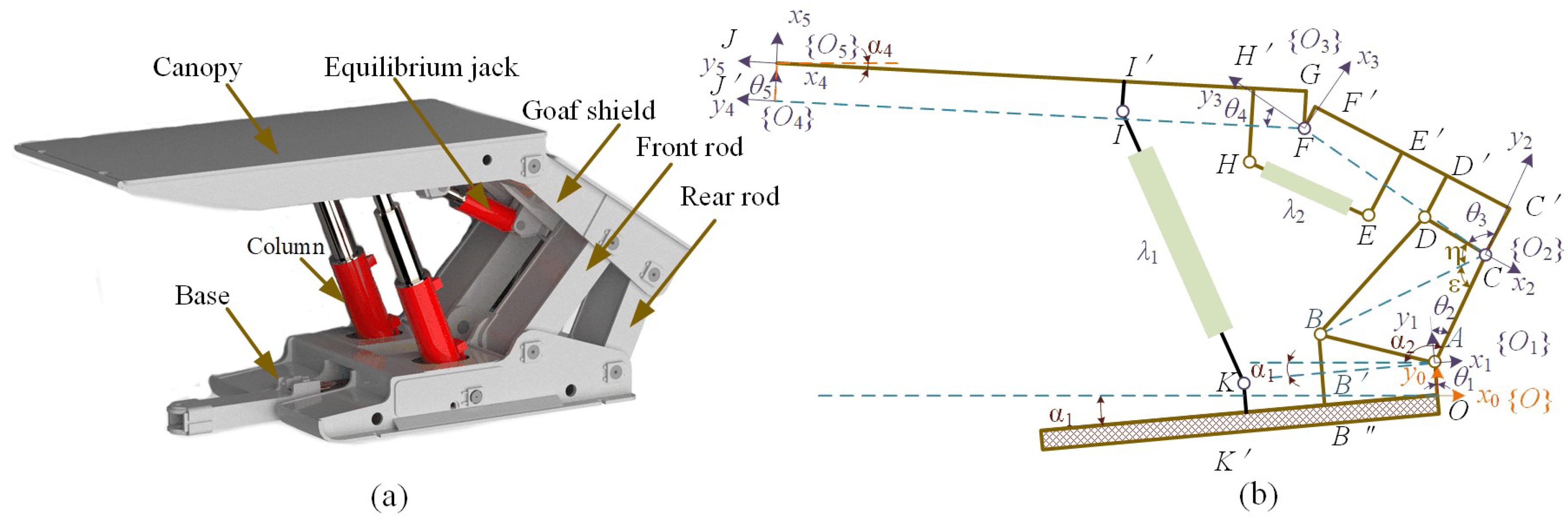
2. Kinematic Model Analysis of Powered Support
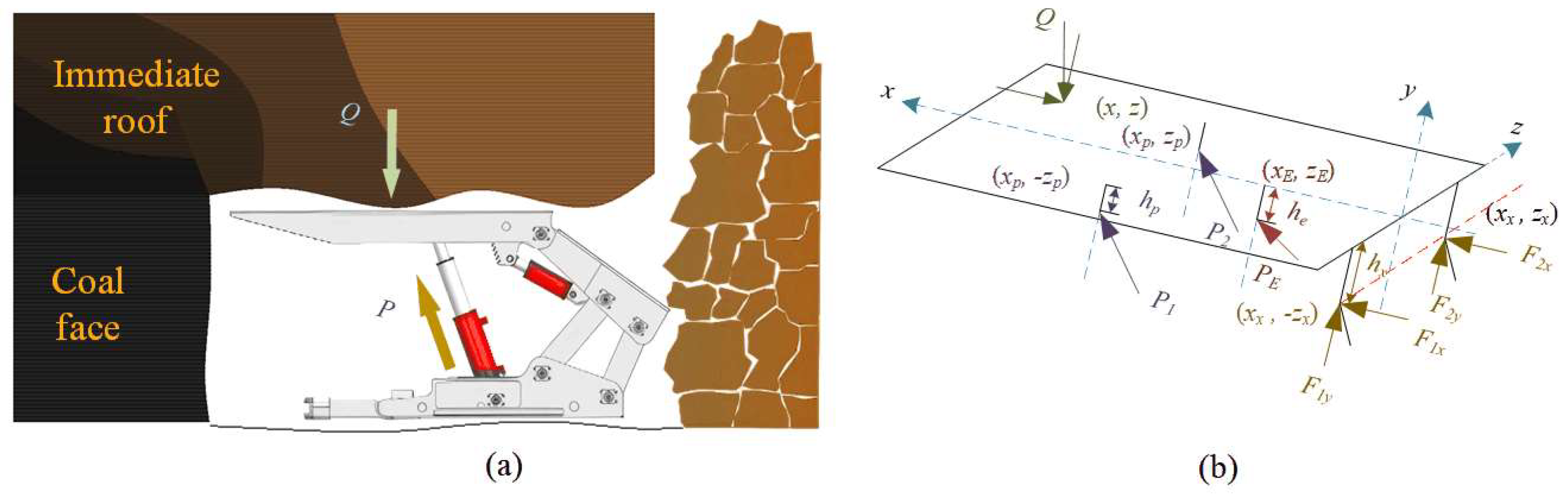
3. Analysis of the Supporting Behavior
- (1)
- The moment expression considering the canopy is obtained.
- (2)
- The moment expression perpendicular to the canopy can be mathematically expressed as
- (3)
- As shown in Figure 2b, the moment in the XOY plane is horizontal, so that the moment expression can be expressed as
- (4)
- The moment concerning the XOY plane in the vertical direction, and the moment equation can be calculated.
- (5)
- Taking the moment on the Z-axis, the torque balance equation can be written as
4. Canopy Loading Characteristic Based on Column Adaptive Model
- (1)
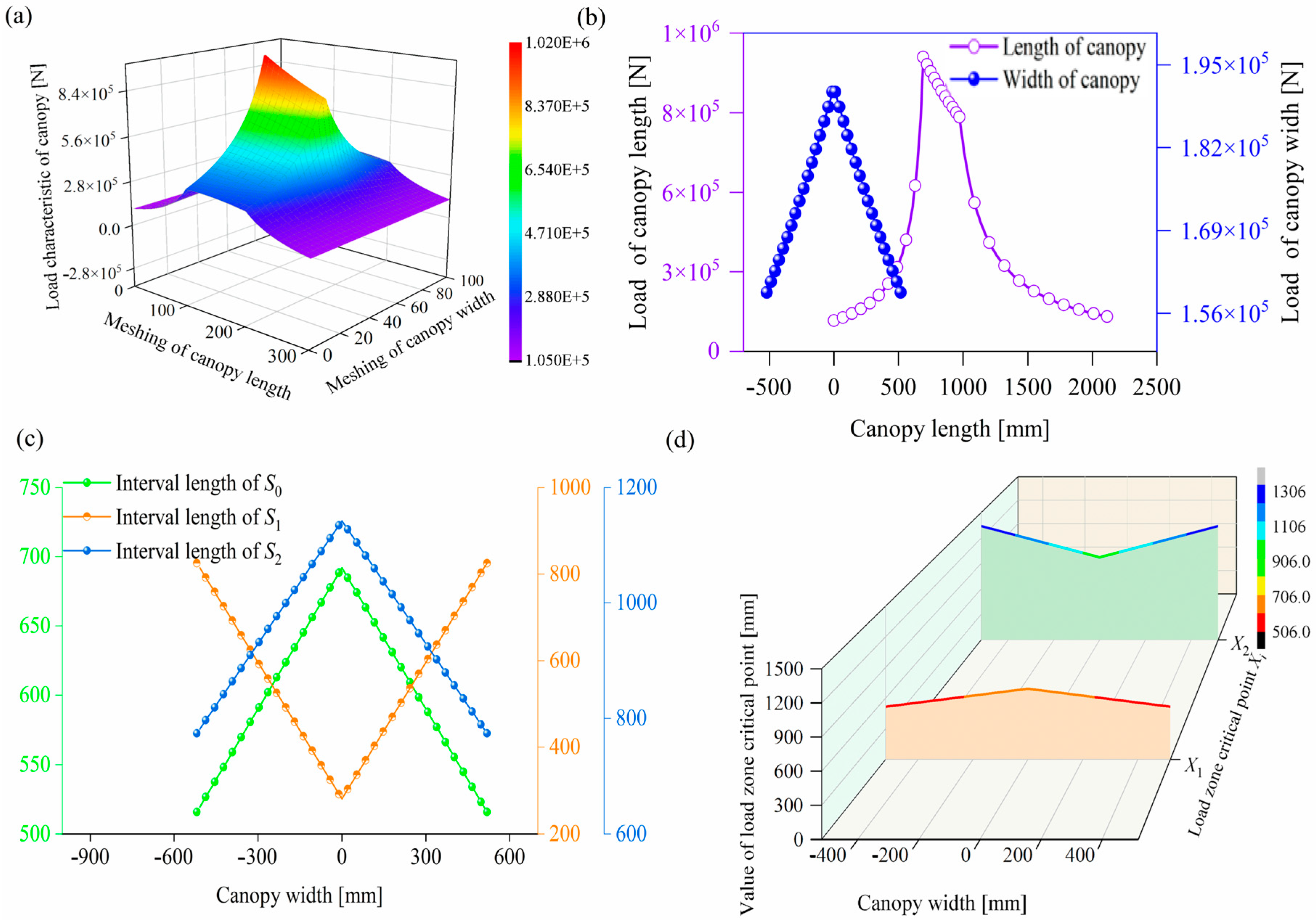
- The carrying characteristic of the canopy in this interval can be mathematically expressed as:
- (2)
- The carrying characteristic of the canopy in the column working area can be expressed by the following equation:
- (3)
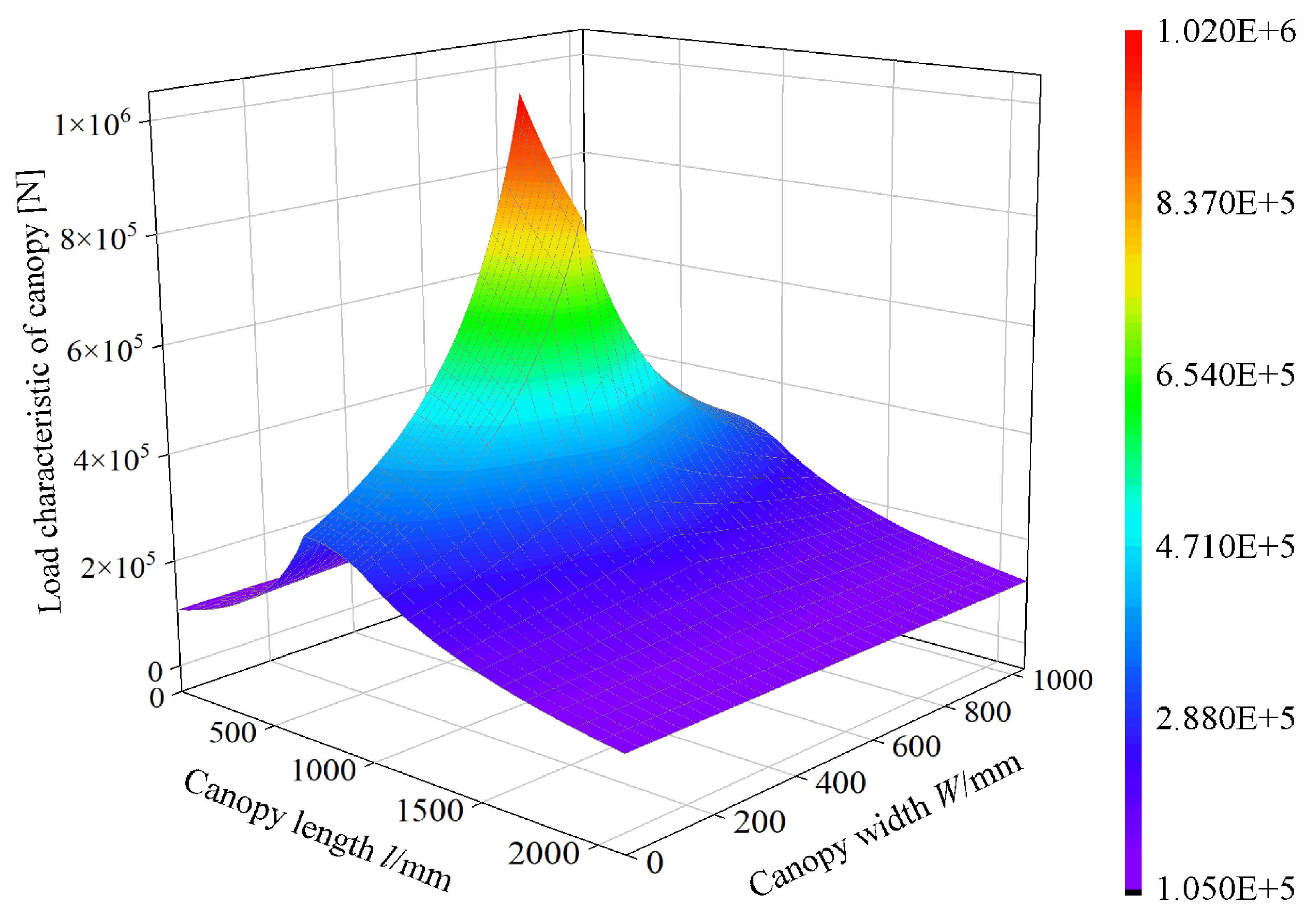
- The expression for the load characteristic of the canopy can be obtained from the following expression.
5. Response Characteristics of the Left and Right Pins
- (1)
- The moment expression parallel to the canopy direction can be written as
- (2)
- The moment expression perpendicular to the canopy is given by
- (3)
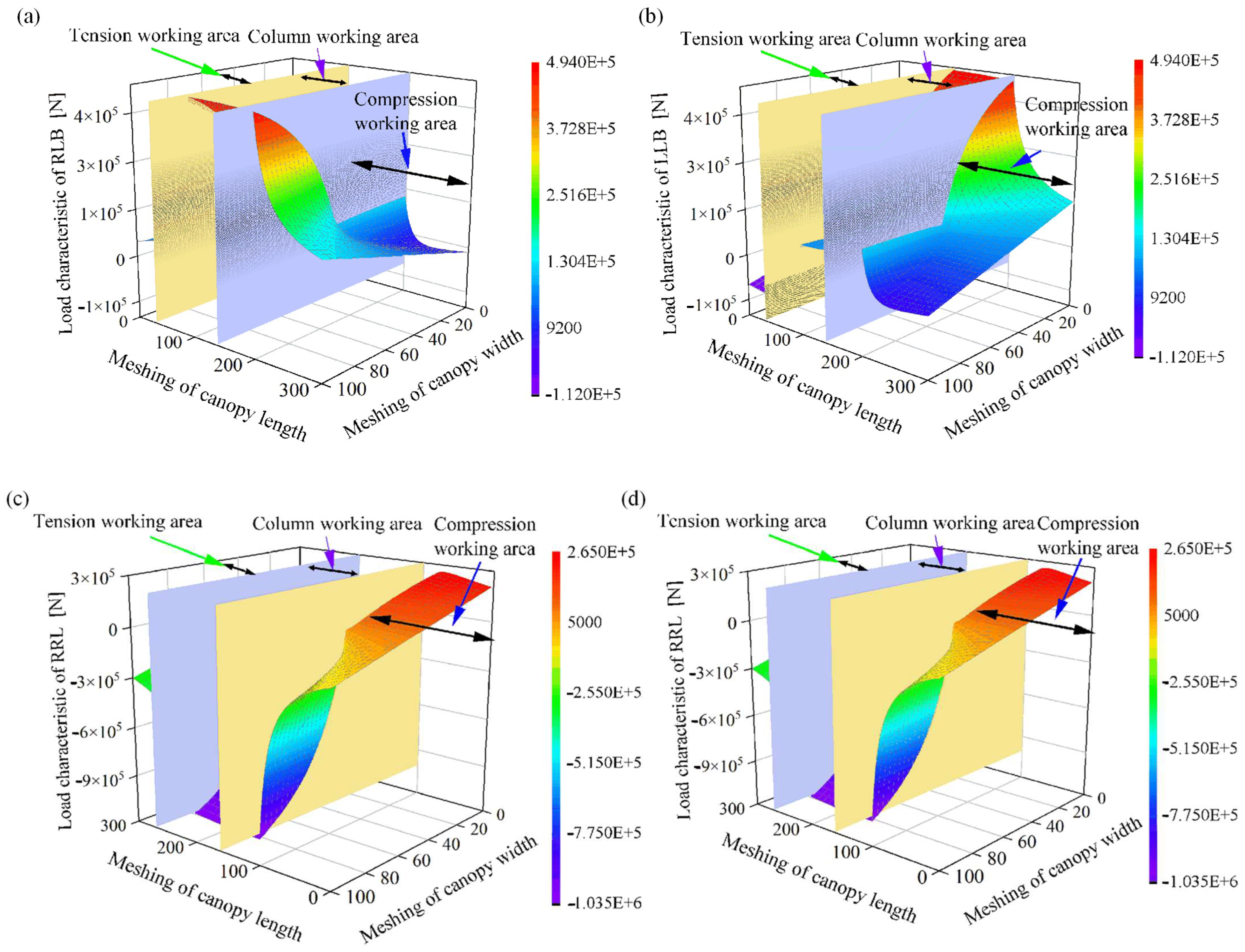
- Taking the moment in the horizontal direction on the XOY plane, the torque balance equation can be written as
- (4)
- Taking the moment in the vertical direction on the XOY plane, the moment balance equation can be expressed.
6. Response of the Four Connecting Bars of Powered Supports
7. Base Responsiveness Characteristics
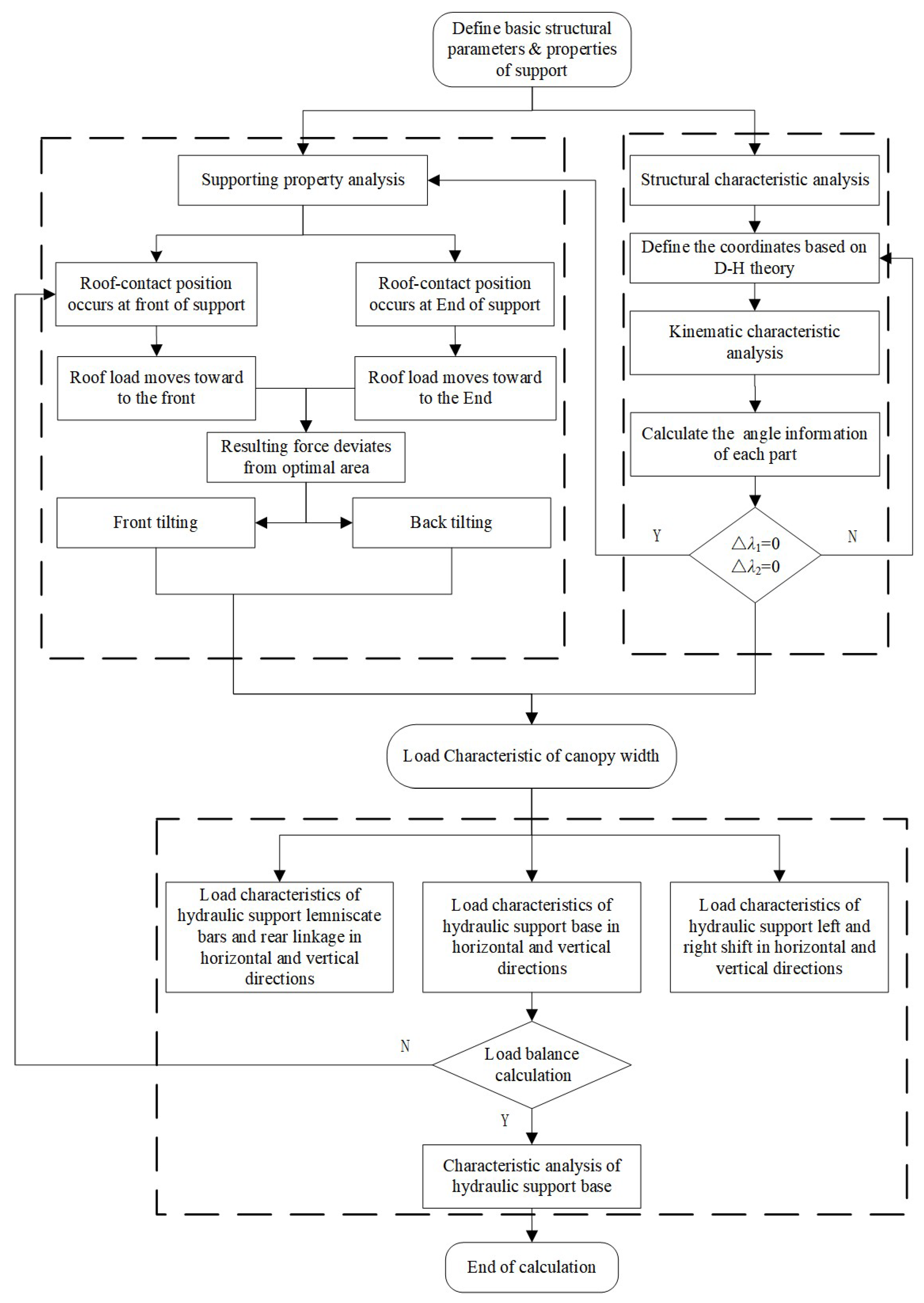
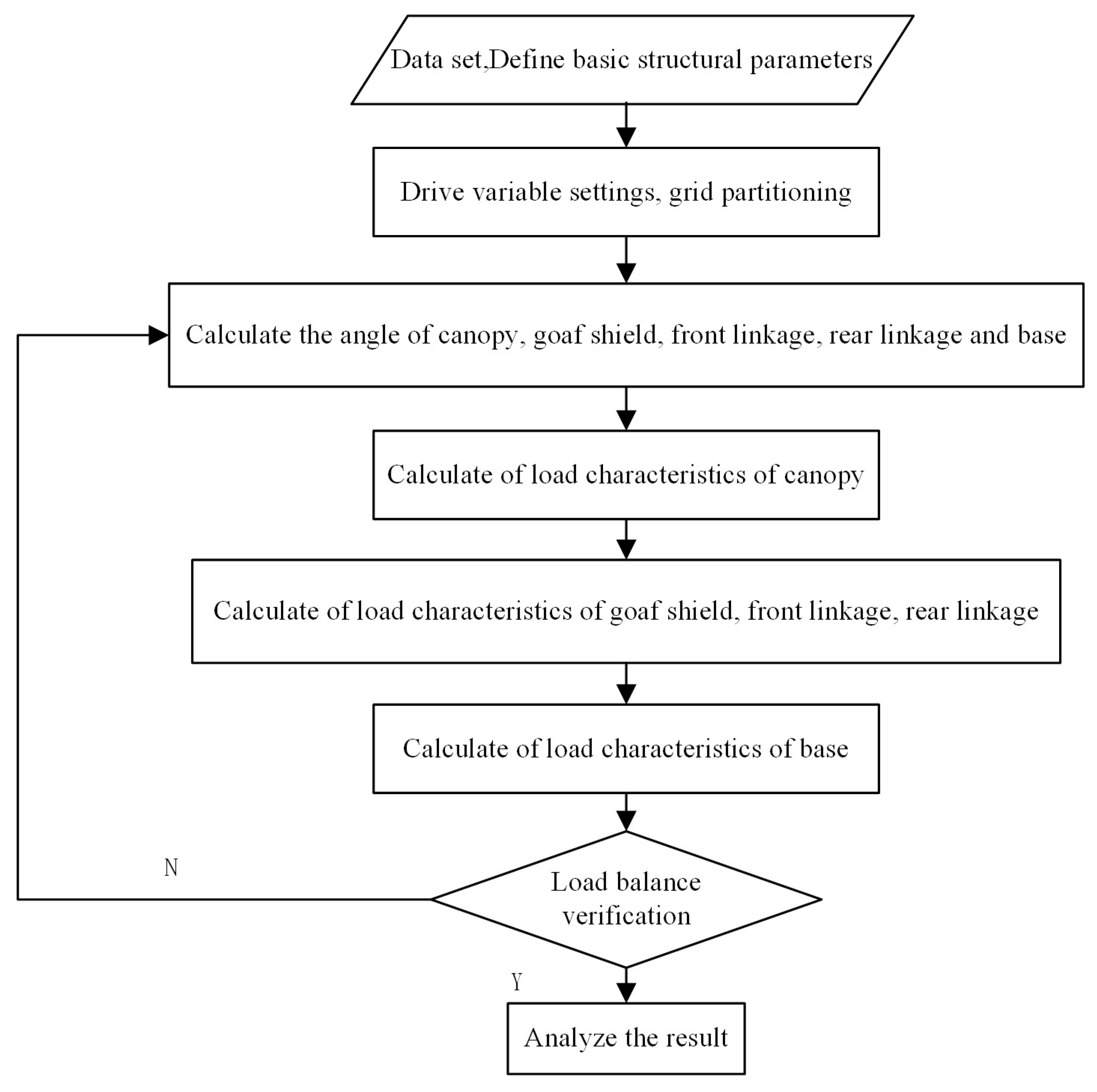
8. Computational Scheme
9. Experimental Work
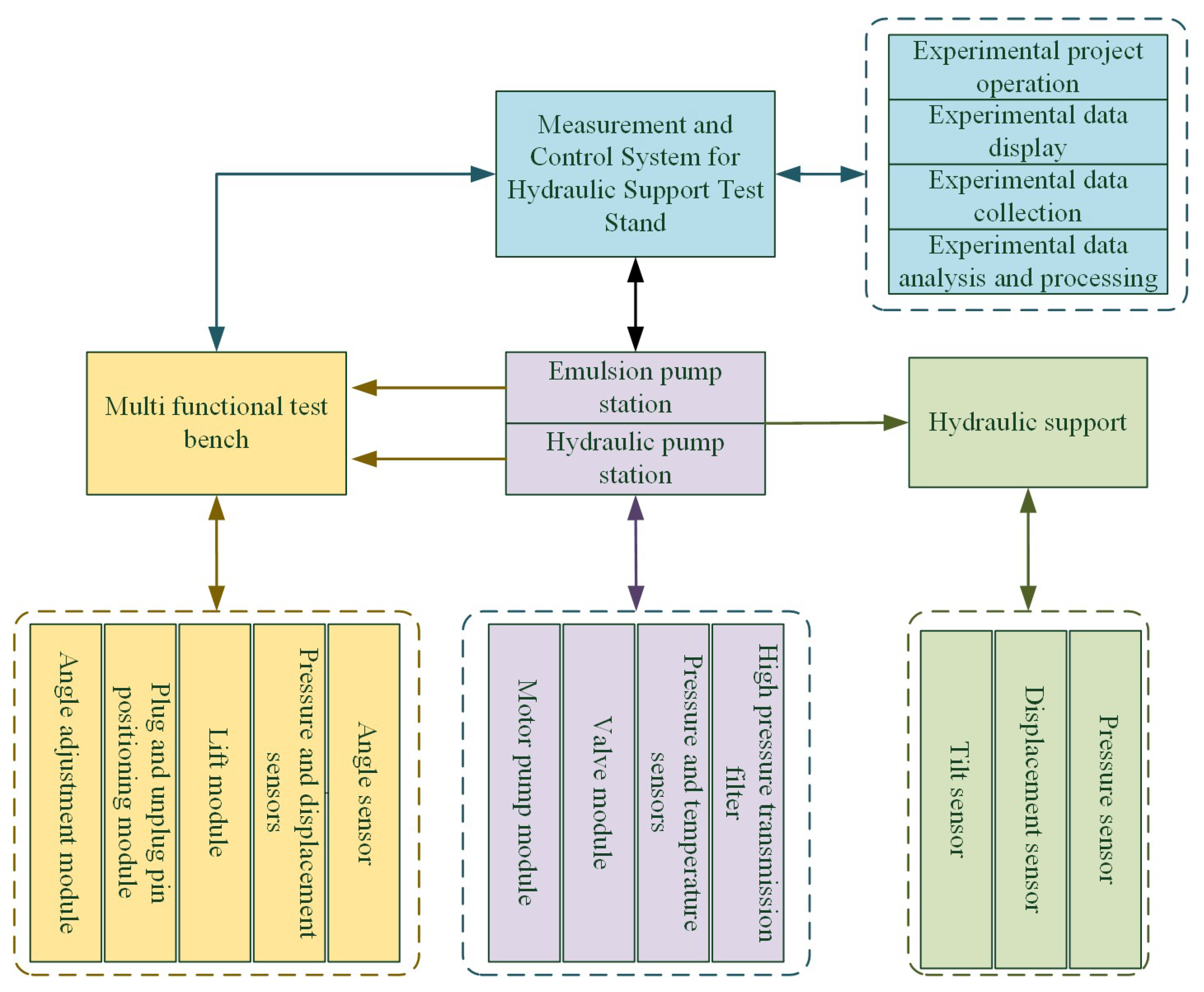
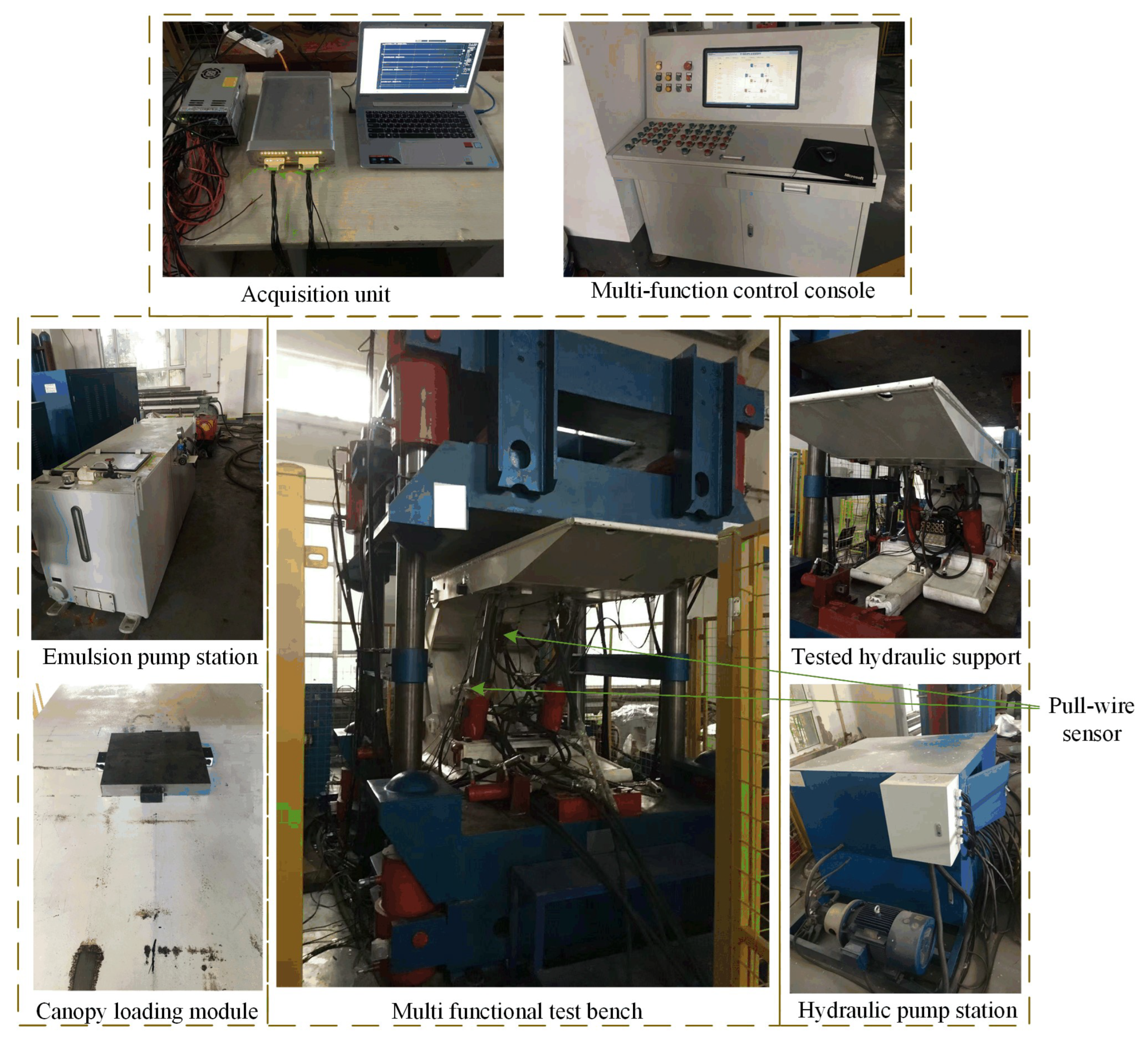
9.1. Experimental Arrangement
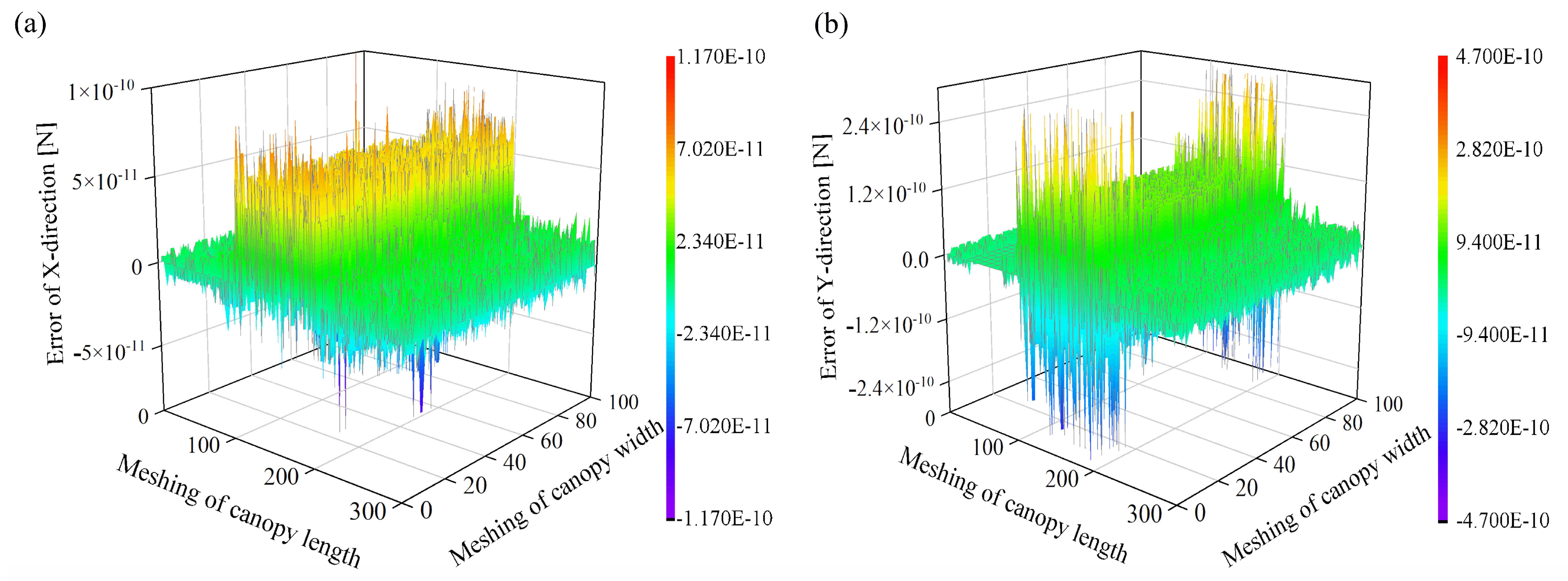
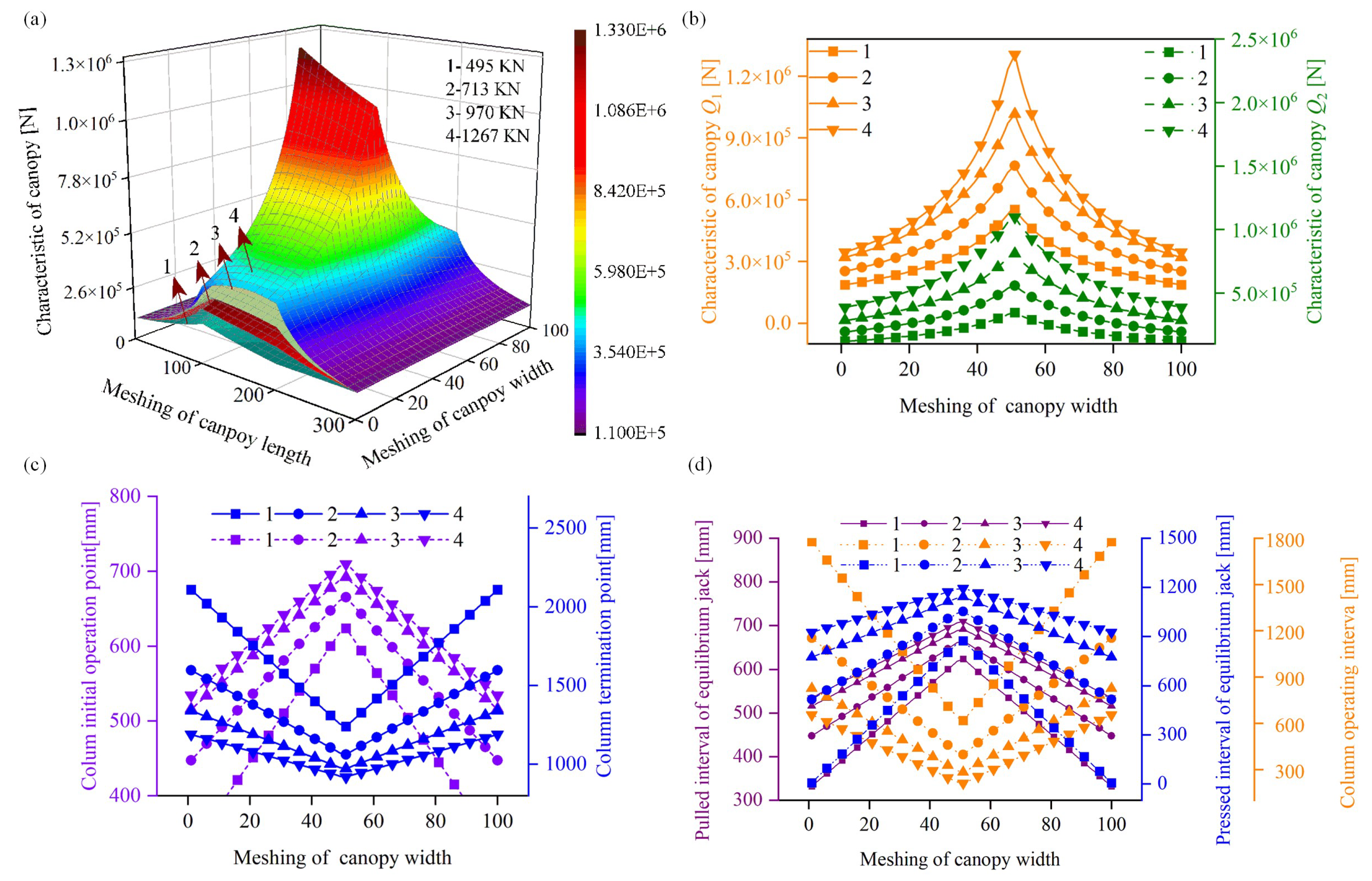
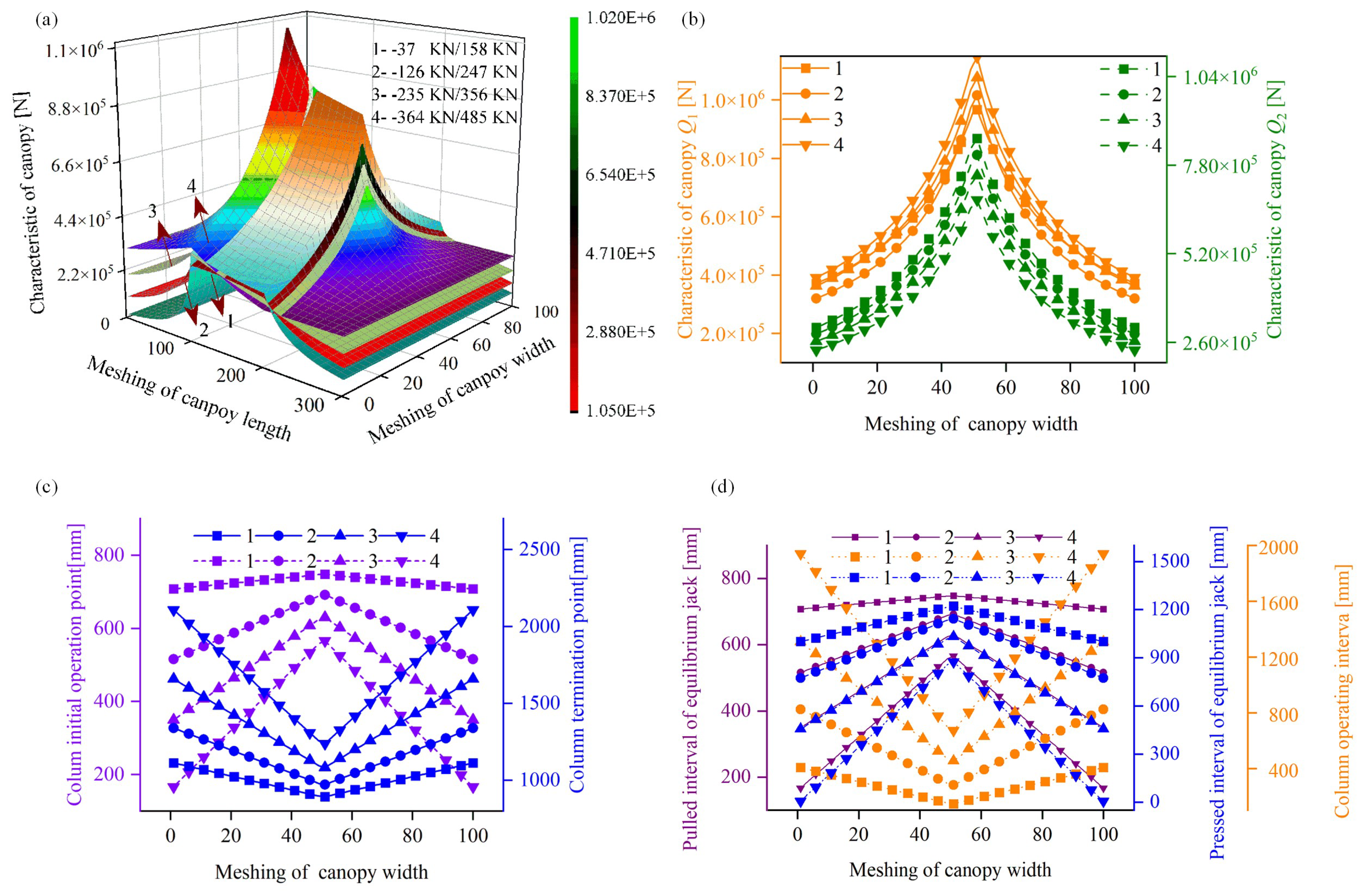
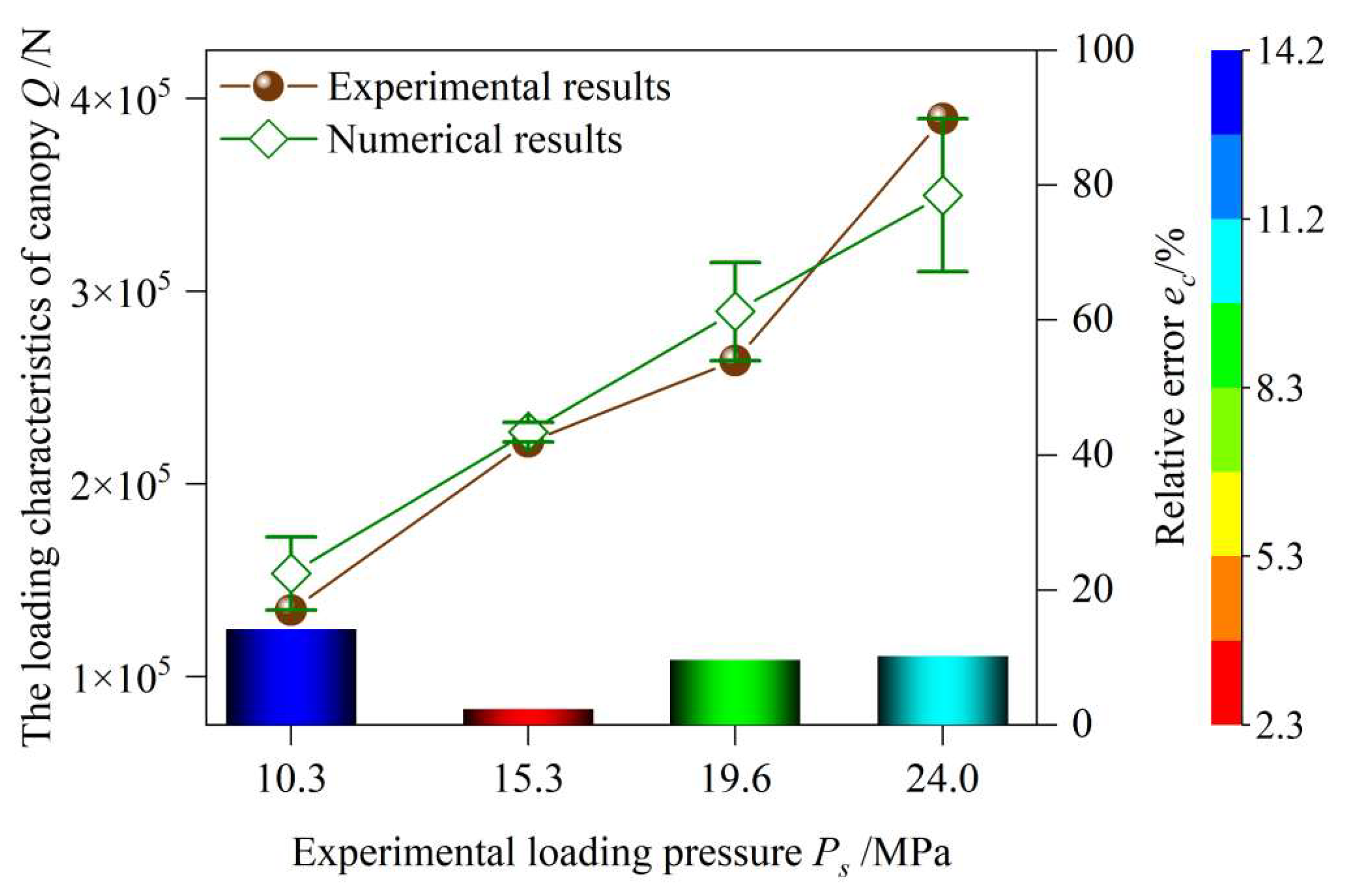
9.2. Experimental Results
10. Conclusions
11. Further Work
Author Contributions
Funding
Institutional Review Board Statement
Informed Consent Statement
Data Availability Statement
Conflicts of Interest
Nomenclature
| bc | mm | Distance from the instantaneous center of four-link mechanism to canopy |
| f | / | Friction coefficient between canopy and immediate top |
| f1 | / | Friction coefficient between base and bottom plate |
| F1 | N | Force on the left front rod |
| F1′ | N | Force on the right front rod |
| F2 | N | Force on the left rear rod |
| F2′ | N | Force on the right rear connecting rod |
| F1s | N | Force on the left shaft |
| F2s | N | Force on the right shaft |
| F1X | N | Force on the left shaft parallel to canopy |
| F2X | N | Force on the right shaft parallel to canopy |
| F1Y | N | Force on the left shaft in the vertical direction of canopy |
| F2Y | N | Force on the right shaft in the vertical direction of canopy |
| H0 | mm | the distance from the hinge position of goaf shield to the canopy |
| he | mm | Dstance of the equilibrium jack in the vertical direction of canopy |
| hP | mm | Vertical distance between column and canopy |
| hT | mm | distance from the junction point of equilibrium jack and canopy to the column |
| hx | mm | Distance of shaft in the vertical direction of canopy |
| NC | / | Column length node |
| NE | / | Equilibrium jack length node |
| n1 | / | Canopy length direction divides the nodes |
| n2 | / | Canopy width direction divides the nodes |
| O′ | / | Instantaneous hinge point of four rods |
| P | N | Working resistance of column |
| P1 | N | Operating pressure of left column |
| P2 | N | Operating pressure of right column |
| PE | N | Operating pressure of equilibrium jack |
| PL | N | Tension working resistance of equilibrium jack |
| Pmax | N | Maximum operating pressure of column |
| PY | N | Compression working resistance of equilibrium jack |
| Q | N | Load of canopy |
| QFX | N | Load of X direction of shaft |
| QFY | N | Load of Y direction of shaft |
| Qf | N | Load of front rod |
| QH | N | Load on the base in the horizontal direction |
| QV | N | Load on the base in the vertical direction |
| Qi_Ti | N | Load in two different areas on the left or right |
| Qi_P1 | N | Load corresponding to the force of left column of the ith working area |
| Qi_P2 | N | Load corresponding to the force of right column of the ith working area |
| Qi_P1max | N | Load corresponding to the operating pressure of left column of the ith working area |
| Qi_P2max | N | Load corresponding to the operating pressure of right column of the ith working area |
| Qi_T | N | Load corresponding to the effective interval of equilibrium jack of the ith working area |
| Qr | N | Load of rear lenkage |
| QV | N | Load of the base in the vertical direction |
| r1 | mm | Vertical distance to the column between the shaft of canopy and the shield |
| r2 | mm | Vertical distance from O′ point to column |
| t | mm | Vertical distance from point O′ to equilibrium jack |
| xP | mm | distance from the end of the canopy to the installation point of column |
| xT | mm | distance from the end of canopy to the installation point of equilibrium jack |
| X′ | mm | Position of base load |
| x1_Pi | mm | Boundary point between the tension working area of the equilibrium jack corresponding to the left and right columns and the working area of the columns. |
| x2_Pi | mm | Boundary point between the working area of the left and right columns and the compressed working area of the equilibrium jack |
| zB | mm | Coordinate of the base load in the Z-axis direction |
| zE | mm | Coordinate between equilibrium jack and canopy in the width direction |
| zp | mm | Coordinate of the articulation point between column and canopy in the width direction of canopy |
| zJ | mm | Coordinate of the equilibrium in the width direction of canopy |
| zx | mm | Coordinate of the shaft of canopy and the shield in the coordinate of the width direction of canopy |
| α1 | ° | Inclination of the front linkage relative to the horizontal opposite |
| α2 | ° | Inclination of the rear linkage relative to the horizontal opposite |
| α1,z | ° | Coupling angle between base and base plate |
| α2,z | ° | Attitude of rear linkage |
| α3,z | ° | Attitude of shield goaf |
| α4,z | ° | Coupling attitude of canopy relative to immediately roof |
| α11 | ° | Vertical attitude of column relative to canopy |
| α22 | ° | Angle between the equilibrium jack and the direction perpendicular to the canopy |
| β | ° | Force acting on the left and right rear linkages |
| β11 | ° | Vertical attitude between column and base in the base direction |
| β22 | ° | Attitude between the front bar and base perpendicular to base |
| β33 | ° | Attitude of the rear bar relative to base in the vertical direction of base |
| ψ | ° | Angle between the instantaneous center of the four-link mechanism and the hinge position of the goaf shield and canopy, and the X-axis direction |
References
- Wang, G.; Xu, Y.; Ren, H. Intelligent and ecological coal mining as well as clean utilization technology in China: Review and prospects. Int. J. Min. Sci. Technol. 2019, 29, 161–169. [Google Scholar] [CrossRef]
- Tian, Y.; Yang, X.; Yang, J.; Mao, K.; Yao, Y.; Liang, H. Evolution dynamic of intelligent construction strategy of coal mine enterprises in China. Heliyon 2022, 8, e10933. [Google Scholar] [CrossRef] [PubMed]
- Zhang, K.; Kang, L.; Chen, X.; He, M.; Zhu, C.; Li, D. A Review of Intelligent Unmanned Mining Current Situation and Development Trend. Energies 2022, 15, 513. [Google Scholar] [CrossRef]
- Zhang, Y.; Li, M.; Wang, B.; Yuan, J.; Tong, R. Developing a taxonomy and a dependency assessment model of performance influencing factors for intelligent coal mines. Process Saf. Environ. Prot. 2022, 168, 150–165. [Google Scholar] [CrossRef]
- Li, S.; Xie, J.; Wang, X.; Mei, Z. MHDA-KD: A Multi-Granularity hybrid driven approach of Knowledge-Data for pose detection in complex dynamic operating system. Expert Syst. Appl. 2025, 267, 126227. [Google Scholar] [CrossRef]
- Noy, S.; Zhang, W. Experimental evidence on the productivity effects of generative artificial intelligence. Science 2023, 381, 187–192. [Google Scholar] [CrossRef]
- Samadi-Koucheksaraee, A.; Chu, X. Development of a novel modeling framework based on weighted kernel extreme learning machine and ridge regression for streamflow forecasting. Sci. Rep. 2024, 14, 30910. [Google Scholar] [CrossRef]
- Samadi-Koucheksaraee, A.; Shirvani-Hosseini, S.; Ahmadianfar, I.; Gharabaghi, B. Optimization Algorithms Surpassing Metaphor. In Computational Intelligence for Water and Environmental Sciences; Bozorg-Haddad, O., Zolghadr-Asli, B., Eds.; Springer Nature: Singapore, 2022; pp. 3–33. [Google Scholar]
- Fang, Y.; Ahmadianfar, I.; Samadi-Koucheksaraee, A.; Azarsa, R.; Scholz, M.; Yaseen, Z.M. An accelerated gradient-based optimization development for multi-reservoir hydropower systems optimization. Energy Rep. 2021, 7, 7854–7877. [Google Scholar] [CrossRef]
- Ahmadianfar, I.; Heidari, A.A.; Gandomi, A.H.; Chu, X.; Chen, H. RUN beyond the metaphor: An efficient optimization algorithm based on Runge Kutta method. Expert Syst. Appl. 2021, 181, 115079. [Google Scholar] [CrossRef]
- Ahmadianfar, I.; Bozorg-Haddad, O.; Chu, X. Gradient-based optimizer: A new metaheuristic optimization algorithm. Inf. Sci. 2020, 540, 131–159. [Google Scholar] [CrossRef]
- Wang, G.; Wang, H.; Ren, H.; Zhao, G.; Pang, Y.; Du, Y.; Zhang, J.; Hou, G. 2025 scenarios and development path of intelligent coal min. J. China Coal Soc. 2018, 43, 295–305. [Google Scholar]
- Mei, Z.; Wang, X.; Xie, J.; Li, S.; Liu, J. A sensing system and solving method for dynamic detection of relative pose of hydraulic support group. Measurement 2025, 243, 116145. [Google Scholar] [CrossRef]
- Yang, Y.; Zhou, W.; Jiskani, I.M.; Wang, Z. Extracting unstructured roads for smart Open-Pit mines based on computer vision: Implications for intelligent mining. Expert. Syst. Appl. 2024, 249, 123628. [Google Scholar] [CrossRef]
- Yang, B.; Yang, S.; Wang, P.; Wang, H.; Jiang, J.; Ni, R.; Yang, C. FRPNet: An improved Faster-ResNet with PASPP for real-time semantic segmentation in the unstructured field scene. Comput. Electron. Agric. 2024, 217, 108623. [Google Scholar] [CrossRef]
- van der Gaast, N.; Bagave, P.; Assink, N.; Broos, S.; Jaarsma, R.L.; Edwards, M.J.R.; Hermans, E.; Ijpma, F.F.A.; Ding, A.Y.; Doornberg, J.N.; et al. Deep learning for tibial plateau fracture detection and classification. Knee 2025, 54, 81–89. [Google Scholar] [CrossRef] [PubMed]
- Hadir, A.; Adjou, M.; Assainova, O.; Palka, G.; Elbouz, M. Comparative study of agricultural parcel delineation deep learning methods using satellite images: Validation through parcels complexity. Smart Agric. Technol. 2025, 10, 100833. [Google Scholar] [CrossRef]
- Murray, L.; Castillo, T.; Martín de Diego, I.; Weber, R.; González-Olabarria, J.R.; García-Gonzalo, J.; Weintraub, A.; Carrasco-Barra, J. Deep reinforcement learning for optimal firebreak placement in forest fire prevention. Appl. Soft Comput. 2025, 175, 113043. [Google Scholar] [CrossRef]
- Cheng, Q.; Ren, H.; Meng, X.; Li, A.; Xie, L. Real-time seismic response prediction method of high-rise buildings based on deep learning for earthquake early warning. Int. J. Disaster Risk Reduct. 2025, 119, 105294. [Google Scholar] [CrossRef]
- Leng, B.; Gao, S.; Xia, T.; Pan, E.; Seidelmann, J.; Wang, H.; Xi, L. Digital twin monitoring and simulation integrated platform for reconfigurable manufacturing systems. Adv. Eng. Inform. 2023, 58, 102141. [Google Scholar] [CrossRef]
- Zhang, G.; Zhang, K.; Shen, W.; Xu, G.; Lin, Y. Intelligent fault diagnosis of multi-way directional valves in hydraulic systems using digital twin and deep learning approaches. Mech. Syst. Signal Process. 2025, 230, 112579. [Google Scholar] [CrossRef]
- Chen, H.; Chen, Q.; Yang, X.; Wang, X.; Chen, H. Omni-directional attitude detection of advanced hydraulic support relative to roadway based on visual measurement principle. Opt. Laser Technol. 2024, 179, 111329. [Google Scholar] [CrossRef]
- Liang, M.; Zheng, D.; Fang, X.; Li, K.; Gu, C.; Wu, G.; Chen, N.; Feng, H. Research on attitude monitoring and decision-making of hydraulic support based on FBG sensor and BP neural network. Opt. Fiber Technol. 2025, 93, 104219. [Google Scholar] [CrossRef]
- Hao, Z.; Xie, J.; Wang, X.; Feng, Z.; Meng, H. A method for reconstructing the pose of hydraulic support group based on point cloud and digital twin. Measurement 2024, 225, 113977. [Google Scholar] [CrossRef]
- Jiao, X.; Xie, J.; Wang, X.; Yan, Z.; Hao, Z.; Wang, X. Intelligent decision method for the position and attitude self-adjustment of hydraulic support groups driven by a digital twin system. Measurement 2022, 202, 111722. [Google Scholar] [CrossRef]
- Chen, H.; Chen, Q.; Chen, H.; Yang, X.; Wang, X. Measurement of displacement and top beam attitude angle of advanced hydraulic support based on visual detection. Measurement 2023, 219, 113264. [Google Scholar] [CrossRef]
- Li, S.; Xie, J.; Wang, X.; Mei, Z.; Cai, N. A digital twin-based bi-directional deduction method for the full-pose of the Floating connection mechanism. Measurement 2024, 224, 113905. [Google Scholar] [CrossRef]
- Witek, M.; Prusek, S. Numerical calculations of shield support stress based on laboratory test results. Comput. Geotech. 2016, 72, 74–88. [Google Scholar] [CrossRef]
- Wan, L.; Yu, X.; Zeng, X.; Ma, D.; Wang, J.; Meng, Z.; Zhang, H. Performance analysis of the new balance jack of anti-impact ground pressure hydraulic support. Alex. Eng. J. 2023, 62, 157–167. [Google Scholar] [CrossRef]
- Hu, X.; Ji, X.; Liu, Y.; Du, Y. Study on instability mechanism of hydraulic support in downdip and updip coal face. Alex. Eng. J. 2023, 81, 304–318. [Google Scholar] [CrossRef]
- Ren, H.; Zhang, D.; Gong, S.; Zhou, K.; Xi, C.; He, M.; Li, T. Dynamic impact experiment and response characteristics analysis for 1:2 reduced-scale model of hydraulic support. Int. J. Min. Sci. Technol. 2021, 31, 347–356. [Google Scholar] [CrossRef]
- Yang, X.; Wang, R.; Wang, H.; Yang, Y. A novel method for measuring pose of hydraulic supports relative to inspection robot using LiDAR. Measurement 2020, 154, 107452. [Google Scholar] [CrossRef]
- Liang, M.; Fang, X.; Li, S.; Wu, G.; Ma, M.; Zhang, Y. A fiber bragg grating tilt sensor for posture monitoring of hydraulic supports in coal mine working face. Measurement 2019, 138, 305–313. [Google Scholar] [CrossRef]
- Luo, C.; Fan, X.; Ni, J.; Yang, H.; Zhang, X.; Li, W. Positioning accuracy evaluation for the collaborative automation of mining fleet with the support of memory cutting technology. IEEE Access 2016, 4, 5764–5775. [Google Scholar] [CrossRef]
- Jasiulek, D.; Bartoszek, S.; Perutka, K.; Korshunov, A.; Jagoda, J.; Plonka, M. Shield support monitoring system—Operation during the support setting. Acta Montan Slovaca 2019, 24, 391–401. [Google Scholar]
- Zhang, Y.; Zhang, H.; Gao, K.; Xu, W.; Zeng, Q. New method and experiment for detecting relative position and posture of the hydraulic support. IEEE Access 2019, 7, 181842–181854. [Google Scholar] [CrossRef]
- Gao, K.; Xu, W.; Zhang, H.; Zhang, Y.; Zeng, Q.; Sun, L. Relative position and posture detection of hydraulic support based on particle swarm optimization. IEEE Access 2020, 8, 200789–200811. [Google Scholar] [CrossRef]
- Ge, X.; Xie, J.; Wang, X.; Liu, Y.; Shi, H. A virtual adjustment method and experimental study of the support attitude of hydraulic support groups in propulsion state. Measurement 2020, 158, 107743. [Google Scholar] [CrossRef]
- Chen, H.; Chen, H.; Xu, Y.; Zhang, D.; Ma, Y.; Mao, J. Research on attitude monitoring method of advanced hydraulic support based on multi-sensor fusion. Measurement 2022, 187, 110341. [Google Scholar] [CrossRef]
- Tutak, M.; Brodny, J.; Galecki, G. Applying CFD model studies to determine zones at risk of methane explosion and spontaneous combustion of coal in goaves. Acta Montan Slovaca 2022, 27, 651–666. [Google Scholar]
- Cai, N.; Xie, J.; Wang, X.; Liu, S.; Du, W. Method for the relative pose reconstruction of hydraulic supports driven by digital twins. IEEE Sens. J. 2023, 23, 4707–4719. [Google Scholar] [CrossRef]
- Feng, Z.; Xie, J.; Yan, Z.; Mei, Z.; Zheng, Z.; Li, T. An information processing method of software and hardware coupling for VR monitoring of hydraulic support groups. Multimed. Tools Appl. 2023, 82, 19067–19089. [Google Scholar] [CrossRef]
- Peng, S.S.; Hsiung, S.M.; Jiang, Y.M. Evaluation of shield support performance by numerical analysis. Min. Sci. Technol. 1988, 7, 19–30. [Google Scholar] [CrossRef]
- Peng, S.; Cheng, Z.; Che, L.; Zheng, Y.; Cao, S. Kinematic performance analysis of a parallel mechanism for loading test of hydraulic support. Mech. Mach. Theory 2022, 168, 104592. [Google Scholar] [CrossRef]
- Guo, W.; Wang, H.; Dong, G.; Li, L.; Huang, Y. A case study of effective support working resistance and roof support technology in thick seam fully-mechanized face mining with hard roof conditions. Sustainability 2017, 9, 935. [Google Scholar] [CrossRef]
- Kang, H.; Gao, F.; Xu, G.; Ren, H. Mechanical behaviors of coal measures and ground control technologies for China’s deep coal mines – A review. J. Rock Mech. Geotech. Eng. 2023, 15, 37–65. [Google Scholar] [CrossRef]
- Meng, Z.; Zeng, Q.; Gao, K.; Kong, S.; Liu, P.; Wan, L. Failure analysis of super-large mining height powered support. Eng. Fail. Anal. 2018, 92, 378–391. [Google Scholar] [CrossRef]
- Zhang, Q.; Shi, P.; Li, M.; Zong, T.; Song, W. A design method and application of backfilling hydraulic supports in reforming top-coal caving hydraulic supports. Appl. Sci. 2023, 13, 987. [Google Scholar] [CrossRef]
- Meng, Z.; Zeng, Q.; Wan, L.; Liu, P. Pose adjusting simulation of hydraulic support based on mechanical-electrical-hydraulic coordination. Teh. Vjesn. Tech. Gaz. 2018, 25, 1110–1118. [Google Scholar]
- Guan, E.; Miao, H.; Li, P.; Liu, J.; Zhao, Y. Dynamic model analysis of hydraulic support. Adv. Mech. Eng. 2019, 11, 1687814018820143. [Google Scholar] [CrossRef]
- Yang, Z.; Sun, Z.; Jiang, S.; Mao, Q.; Liu, P.; Xu, C. Structural analysis on impact-mechanical properties of ultra-high hydraulic support. Int. J. Simul. Model. 2020, 19, 17–28. [Google Scholar] [CrossRef]
- Singh, G.; Singh, U. A numerical modeling approach for assessment of progressive caving of strata and performance of hydraulic powered support in longwall workings. Comput. Geotech. 2009, 36, 1142–1156. [Google Scholar] [CrossRef]
- Verma, A.; Deb, D. Numerical Analysis of an Interaction between Hydraulic-Powered Support and Surrounding Rock Strata. Int. J. Geomech. 2013, 13, 181–192. [Google Scholar] [CrossRef]
- Ralston, J.C.; Reid, D.C.; Dunn, M.T.; Hainsworth, D.W. Longwall automation: Delivering enabling technology to achieve safer and more productive underground mining. Int. J. Min. Sci. Technol. 2015, 25, 865–876. [Google Scholar] [CrossRef]
- Cao, L.; Sun, S.; Zhang, Y.; Guo, H.; Zhang, Z. The research on characteristics of hydraulic support advancing control system in coal mining face. Wirel. Pers. Commun. 2018, 102, 2667–2680. [Google Scholar] [CrossRef]
- Cheng, J.; Wan, Z.; Ji, Y. Shield-roof interaction in longwall panels: Insights from field data and their application to ground control. Adv. Civ. Eng. 2018, 2018, 3031714. [Google Scholar] [CrossRef]
- Zeng, X.; Meng, G.; Zhou, J. Analysis on the pose and dynamic response of hydraulic support under dual impact loads. Int. J. Simul. Model. 2018, 17, 69–80. [Google Scholar] [CrossRef] [PubMed]
- Zeng, Q.; Li, Y.; Yang, Y. Dynamic analysis of hydraulic support with single clearance. Fac. Mech. Eng. 2021, 67, 53–66. [Google Scholar] [CrossRef]
- Yang, Y.; Zhang, Y.; Zeng, Q.; Wan, L.; Zhang, Q. Simulation research on impact contact behavior between coal gangue particle and the hydraulic support: Contact response differences induced by the difference in impacted location and impact material. Materials 2022, 15, 3890. [Google Scholar] [CrossRef]
- Yuan, X.; Xie, J.; Gao, F.; Lian, Z. Assessment of shield support performance based on an innovative mathematical-physical model in longwall faces. Proc. Inst. Mech. Eng. Part C J. Mech. Eng. Sci. 2022, 236, 8935–8954. [Google Scholar] [CrossRef]
- Zhai, G.; Yang, X. Modelling and analysis of a hydraulic support prop under impact load. J. South. Afr. Inst. Min. Metall. 2022, 122, 397–405. [Google Scholar] [CrossRef]
- Li, Y.; Zeng, Q.; Wan, L. Dynamics analysis and motion prediction of caving mechanism with clearance of hydraulic support. Alex. Eng. J. 2024, 105, 783–797. [Google Scholar] [CrossRef]
- Guo, J.; Huang, W.; Feng, G.; Bai, J.; Li, L.; Wang, Z.; Yu, L.; Wen, X.; Zhang, J.; Feng, W. Stability analysis of longwall top-coal caving face in extra-thick coal seams based on an innovative numerical hydraulic support model. Int. J. Min. Sci. Technol. 2024, 34, 491–505. [Google Scholar] [CrossRef]
- Zhou, Y. Study of two-leg shield supporting ability areas theroy. J. Fuxin Minging Inst. 1993, 12, 46–49. [Google Scholar]





| Parameter | Label | Rotation Angle, | Torsion Angle, | The Distance of Joint, di |
|---|---|---|---|---|
| Auxiliary linkage | 0 | 0 | ||
| Auxiliary canopy | 0 | 0 | ||
| Goaf shield | 0 | 0 | ||
| Rear linkage | 0 | 0 | ||
| Base | 0 | 0 |
| Base | Goaf Shield | Canopy | Four-Bar Linkage | ||||
|---|---|---|---|---|---|---|---|
| Parameters | Values | Parameters | Values | Parameters | Values | Parameters | Values |
| LOA | 131 | LEE′ | 288 | LFG | 150 | LCC′ | 206 |
| LBB″ | 282 | LC′F′ | 873 | LGJ | 2115 | LDD′ | 188 |
| LOB″ | 450 | LD′F′ | 588 | LHH′ | 300 | LC′D′ | 285 |
| LOI′ | 763 | LFF′ | 96 | LGH′ | 211 | LAC | 484 |
| LII′ | 114 | LC′E′ | 482 | LGI′ | 730 | LBD | 632 |
| Selected Device Name | Model Specifications | Equipment Measurement Accuracy | Equipment Measurement range |
|---|---|---|---|
| Acquisition system | INV3060S (which is manufactured by Beijing Oriental Institute of Vibration and Noise Technology located in Beijing, China) | 24 bits | / |
| Pullwire sensor | KSM58-J (which is manufactured by Shanghai Kangqiao Electronic Technology Co., Ltd. in Shanghai, China) | ±2 BIT | 1000 mm |
| Laser displacement sensor | LZR-300-U (which is manufactured by Shanghai Kangqiao Electronic Technology Co., Ltd. in Shanghai, China) | 1 mm | 3000 mm |
| Wired tilt sensor | SVT620T (which is manufactured by Maike Sensing Technology Co., Ltd. in Wuxi, China) | 0.01° | 180° |
Disclaimer/Publisher’s Note: The statements, opinions and data contained in all publications are solely those of the individual author(s) and contributor(s) and not of MDPI and/or the editor(s). MDPI and/or the editor(s) disclaim responsibility for any injury to people or property resulting from any ideas, methods, instructions or products referred to in the content. |
© 2026 by the authors. Licensee MDPI, Basel, Switzerland. This article is an open access article distributed under the terms and conditions of the Creative Commons Attribution (CC BY) license.
Share and Cite
Yuan, X.; Yu, B.; Zhu, J.; Zhou, X.; Xie, Y. An Innovative Three-Dimensional Mathematical–Physical Model for Describing Load-Carrying Characteristic of Hydraulic Supports. Actuators 2026, 15, 55. https://doi.org/10.3390/act15010055
Yuan X, Yu B, Zhu J, Zhou X, Xie Y. An Innovative Three-Dimensional Mathematical–Physical Model for Describing Load-Carrying Characteristic of Hydraulic Supports. Actuators. 2026; 15(1):55. https://doi.org/10.3390/act15010055
Chicago/Turabian StyleYuan, Xiang, Boyi Yu, Jinghao Zhu, Xinhao Zhou, and Yifan Xie. 2026. "An Innovative Three-Dimensional Mathematical–Physical Model for Describing Load-Carrying Characteristic of Hydraulic Supports" Actuators 15, no. 1: 55. https://doi.org/10.3390/act15010055
APA StyleYuan, X., Yu, B., Zhu, J., Zhou, X., & Xie, Y. (2026). An Innovative Three-Dimensional Mathematical–Physical Model for Describing Load-Carrying Characteristic of Hydraulic Supports. Actuators, 15(1), 55. https://doi.org/10.3390/act15010055