Article

Research and Realization of an OCT-Guided Robotic System for Subretinal Injections

1
School of Biomedical Engineering (Suzhou), Division of Life Sciences and Medicine, University of Science and Technology of China, Hefei 230026, China
2
Jiangsu Province Key Laboratory of Medical Optics, Suzhou Institute of Biomedical Engineering and Technology, Chinese Academy of Sciences, Suzhou 215163, China
3
Hangzhou Institute of Medicine, Chinese Academy of Sciences, Hangzhou 310022, China
*
Author to whom correspondence should be addressed.
Actuators 2026, 15(1), 53; https://doi.org/10.3390/act15010053
Submission received: 4 December 2025 / Revised: 29 December 2025 / Accepted: 8 January 2026 / Published: 13 January 2026

Abstract

For retinal degenerative diseases, advanced therapies such as gene therapy and retinal stem cell therapy have emerged as promising treatments, which are often delivered through subretinal injection. However, clinical subretinal injection remains challenging due to the extremely high precision requirements, lack of depth information, and the physiological limitations of manual operation, often leading to complications such as hypotony and globe atrophy. To address these challenges, this study proposes a novel ophthalmic surgical robotic system designed for high-precision subretinal injections. The robotic system incorporate a remote center of motion mechanism for its mechanical structure and employs a master–slave control system to achieve motion scaling. A microscope-integrated optical coherence tomography device is applied to provide real-time microscopic imaging and depth information. The design and performance of the proposed system are validated through simulations and experiments. Precision tests demonstrate that the system achieves an overall positioning accuracy of less than 30 μ m, with injection positioning accuracy under 20 μ m. Subretinal injection experiments conducted on artificial eye models further validate the clinical feasibility of the robotic system.

1. Introduction

Retinal degenerative diseases, including age-related macular degeneration (AMD), inherited retinal dystrophies (IRDs), have become leading causes of irreversible vision loss globally [1,2]. Advanced therapies such as gene therapy and retinal stem cell therapy have emerged as promising treatment paradigms for retinal diseases. These therapies usually require vitreoretinal surgery (VS) to deliver the drug to the target area. Typical drug delivery methods include intravitreal injection, subretinal injection and suprachoroidal injection [3]. Among these methods, subretinal injection has been recognized as a particularly efficient and suitable approach due to the anatomical advantages of the subretinal space, which provides a immune-privileged environment while minimizing required doses [4].
Despite the widespread clinical utilization in VS, subretinal injection remain a technically challenging procedure as manual approaches are constrained by workspace limitations, extremely high precision, and lack of depth information. Specifically, during VS, the surgical instrument is inserted through a 3 mm scleral incision, which confines all surgical operations to a limited workspace [5,6]. The inherent fragility of target structures demand high precision, which is further compromised by manual approaches. For instance, the thickness of the internal limiting membrane (ILM) is less than 20 μ m, while the physiological tremor of the surgeon’s hand is typically around 100 μ m, which may result in vibration of the surgical instrument and cause damage to the fundus tissue [7]. In addition, conventional surgical microscopes lack depth information, making it difficult to locate the tip of the instrument and differentiate between various retinal layers [8]. Overall, subretinal injections by manual approach with handheld devices are difficult to perform and might cause complications such as hypotony and globe atrophy [3,5,9].
To enhance surgical precision and address the limitations of manual operation in VS, robotic systems have emerged as critical assistive technologies since the 1980s [10]. Based on the operational modalities, ophthalmic surgical robots can be categorized into three primary architectures: co-manipulation robots, handheld robots, and master–slave systems. Co-manipulation robots and hand-held robots mainly focus on tremor elimination and force sensing. Co-manipulation robots require the surgeon to manually hold the end-effector to perform surgical operations. Notable examples include the SHER robot developed by Taylor et al. in 1999 [11], the surgical robot developed by Katholieke Universiteit Leuven in 2013 [12] and the multiple degrees-of-freedom (DOFs) surgical robot developed at University College London in 2018 [13]. Handheld robots, in contrast, adopt a miniaturized design integrated with conventional surgical instruments, with essentially no major changes to existing workflows. Representative hand-held robots include the ITrem designed by Latt et al. in 2009 [14], the micro-forceps designed by Gonenc et al. from Johns Hopkins University in 2014 [15,16], and the force-sensing microneedle developed by Zhang et al. in 2022 [17].
Unlike the two categories mentioned above, master–slave robots do not require the surgeon to manually hold the end-effector, instead, these systems operate via a master controller that translates the surgeon’s manual inputs into precise instrument motions at the surgical site. The master–slave system is the dominant configuration for ophthalmic surgical robots due to its ability to integrate advanced functions including motion scaling, tremor suppression and force sensing, while enabling a lager operation space by separating the surgeon from the operative field. The slave robot in such systems typically applies a remote center of motion (RCM) mechanism, which constrains surgical instruments to move around a fixed point. In 2011, researchers at Eindhoven University of Technology developed the Preceyes system, which applies a parallelogram RCM mechanism on the slave robot equipped with force sensing. This system achieved a milestone later when researchers at the University of Oxford completed the world’s first-in-human study of robot-assisted surgery in patients undergoing the removal of retinal membranes using Preceyes [18]. In 2013, Gijbels et al. developed a master–slave surgical robot for VS [19], also using an RCM mechanism based on a parallelogram mechanism, and completed the world’s first in-human trial of retinal vein cannulation in 2017 [20]. In 2022, Wang et al. designed a surgical robot with 5 DOFs for VS and verified the feasibility by performing membrane peeling on an eggshell [7].
To address the lack of depth information during the surgery, optical coherence tomography (OCT)-based navigation systems have been introduced into VS. As a non-invasive imaging technique, OCT enables real-time imaging with no physical contact. Compared with conventional ophthalmic imaging devices, OCT can better identify fundus structures with the depth information it provides [21,22]. With the development of integration technology, microscope-integrated OCT (MIOCT) began to be widely used in VS. Ex vivo experiments and clinical trials guided by MIOCT have demonstrated its ability to optimize operation strategy and improve surgical precision [23,24,25]. The integration of OCT with surgical robotic systems further amplifies these advantages, offering closed-loop feedback mechanisms for intraocular manipulation.
Motivated by the precision demands and unique constraints of VS, this study proposes a master–slave ophthalmic surgical robot (MOSR) specifically designed for subretinal injection procedures. The system adopts a novel RCM mechanism based on a dual-parallelogram architecture, coupled with a precision linear actuation subsystem to optimize stability and energy efficiency. A microneedle for ophthalmic surgery is integrated into the end-effector and driven by a syringe pump. For surgical navigation, an MIOCT device with a 1060 nm central wavelength was used to provide real-time microscopic images and depth information. In previously reported OCT-guided robotic vitreoretinal surgeries, most studies utilized MIOCT systems that required observation through eyepieces [18,26]. In contrast, the MIOCT system employed in this study features a heads-up display (HUD) device. The incorporation of HUD enables multiple operators to observe OCT images remotely from the surgical area. In addition, the OCT B-scan line can be adjusted directly on the display, thereby facilitating more precise alignment between the needle tip and scanning line. Furthermore, this system is equipped with three-dimensional (3D) imaging capabilities, which assist in measuring the three-dimensional coordinates of the instrument tip, enabling the assessment of robotic positioning accuracy.
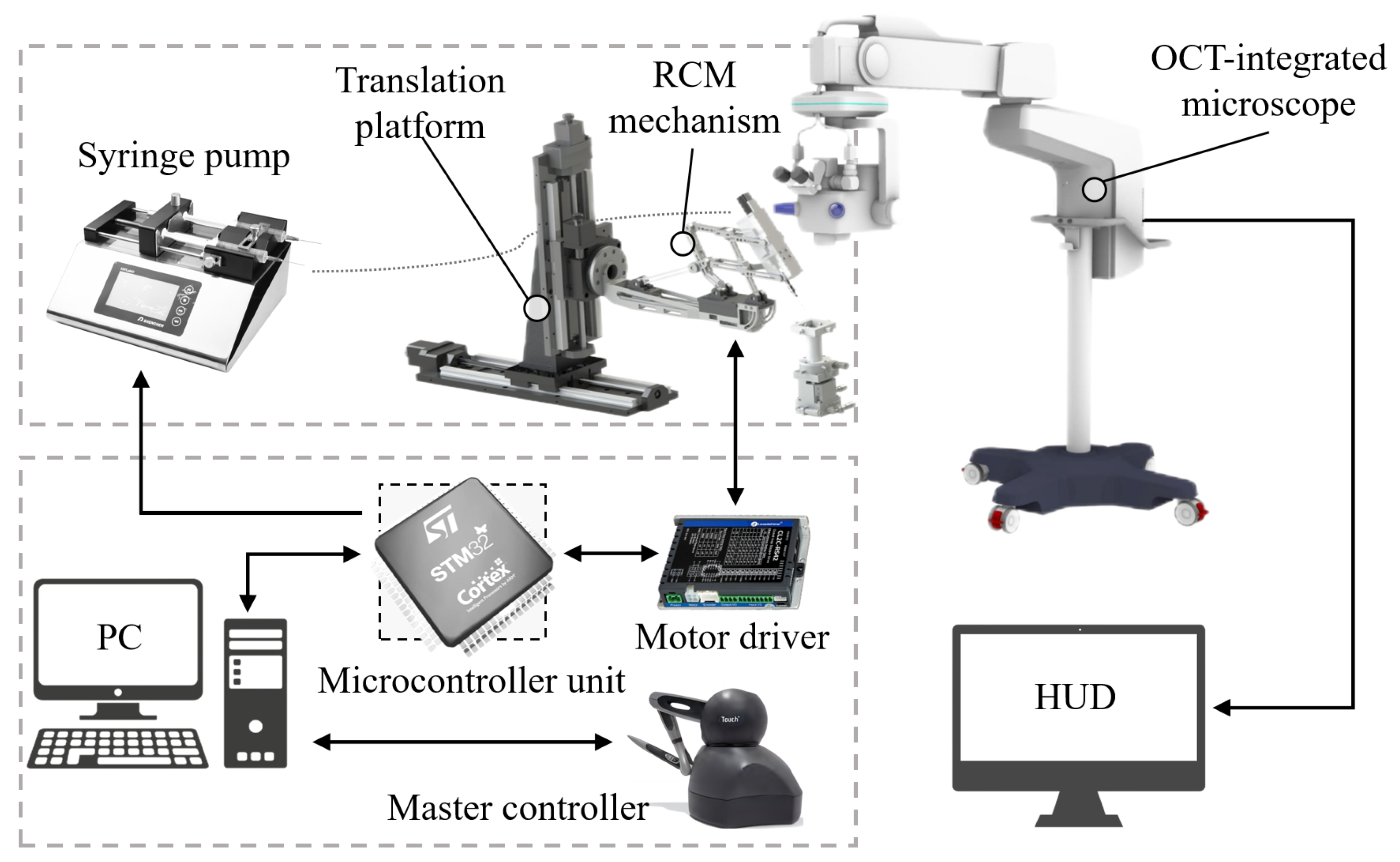
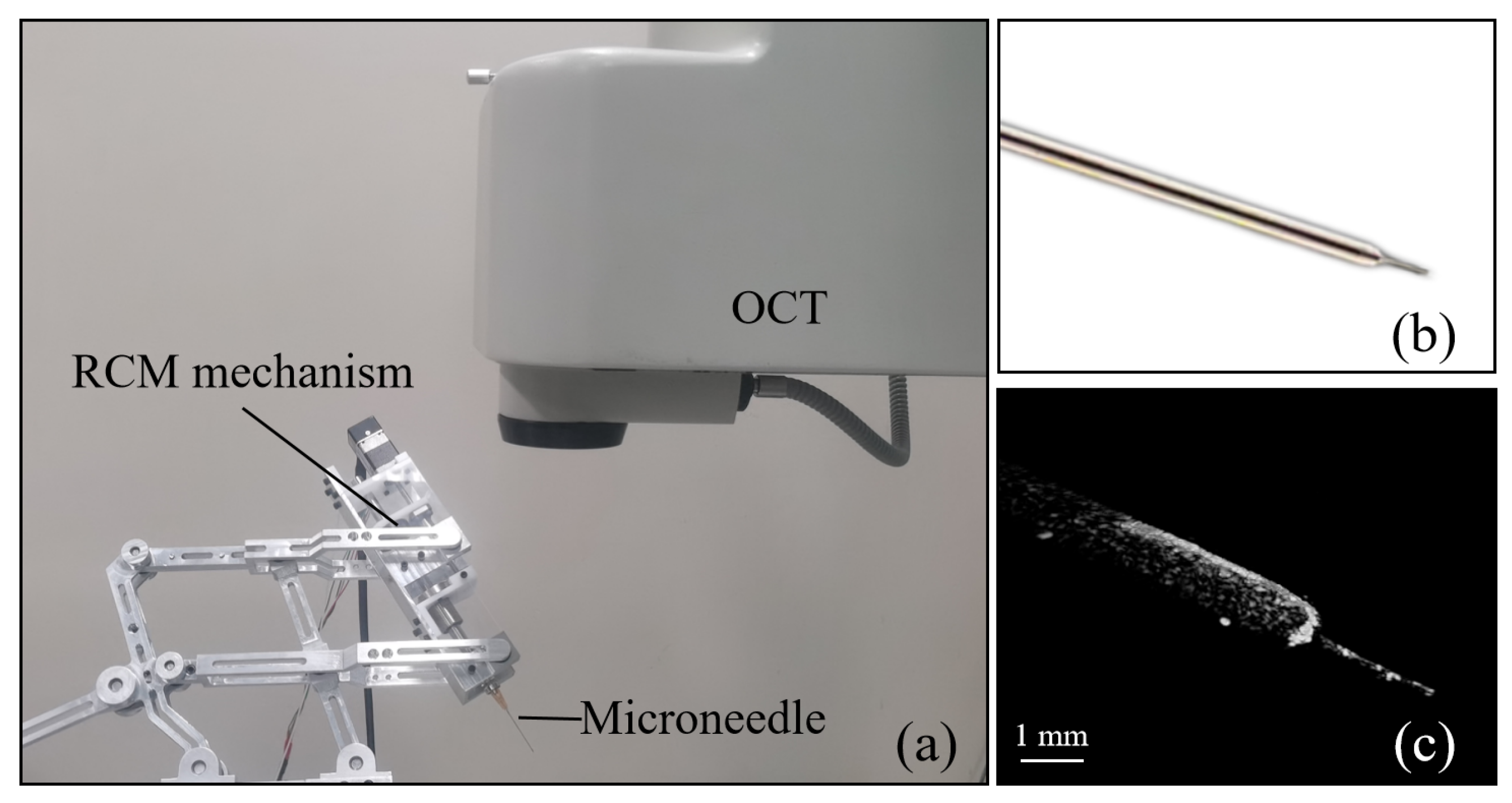
An overview of the MOSR is presented in Figure 1. In Section 2 the mechanical design is presented with analysis of its forward and inverse kinematics. The workspace is also sketched based on the kinematics. Section 3 describes the components of the MOSR system along with the control system. Experimental validation is presented in Section 4, where motion accuracy is evaluated via 3D OCT imaging, followed by subretinal injection experiments on an eye model. Finally, the conclusions are drawn in Section 5.

2. Mechanism Design

2.1. Optimized Double Parallelogram Mechanism Design

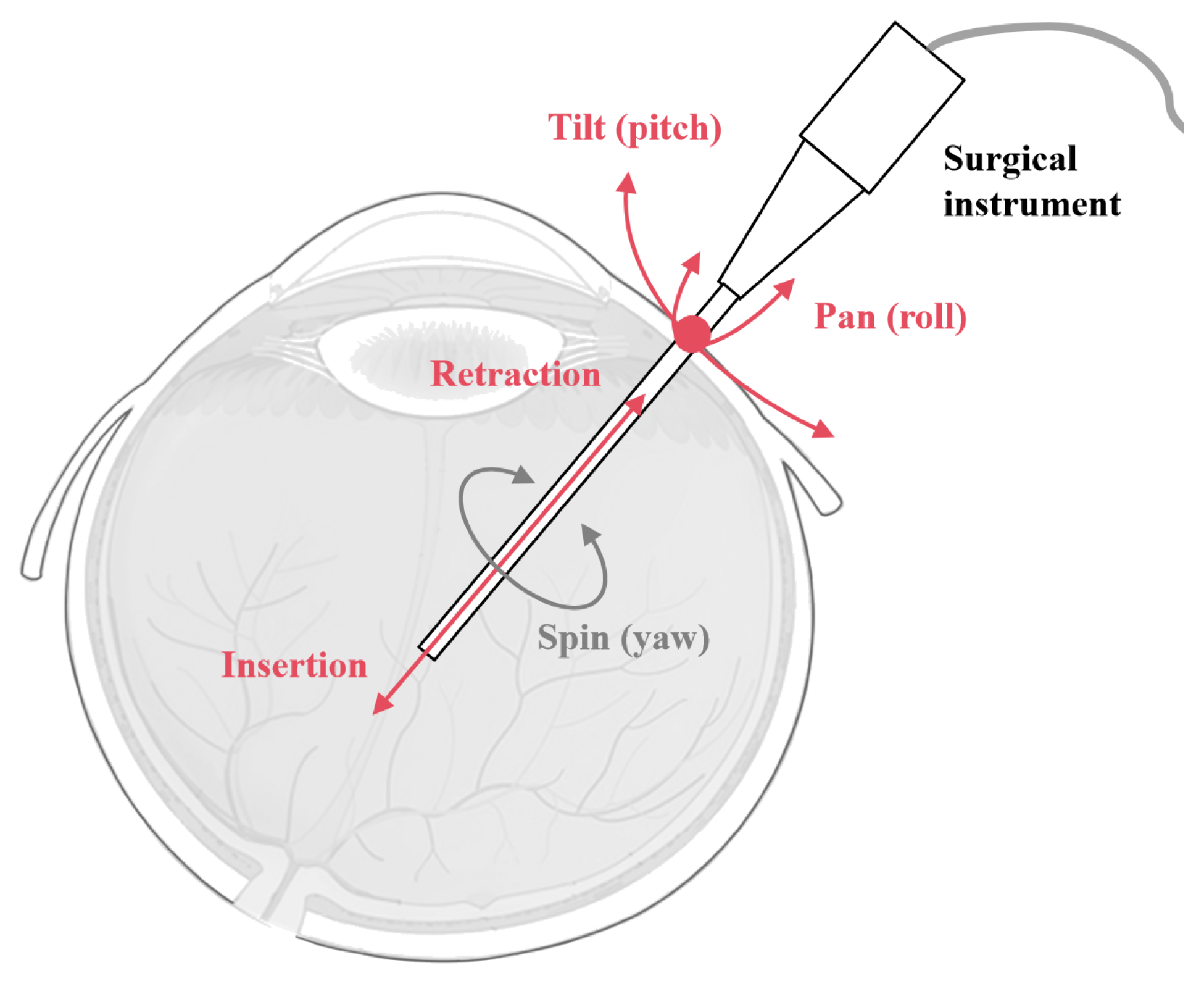
During VS, surgical instruments are inserted into the intraocular space through a scleral incision. As shown in Figure 2, when the scleral incision is regarded as an RCM point, the instrument’s motion can be described as pan-tilt-spin rotations (or roll-pitch-yaw motions in kinematics) centered at the incision point and an axial translation for the insertion and retraction. When the instrument is a microneedle, its spin (yaw) can be considered irrelevant. In conclusion, an RCM mechanism designed for subretinal injection requires three DOFs, comprising two rotational DOFs and one translational DOF.
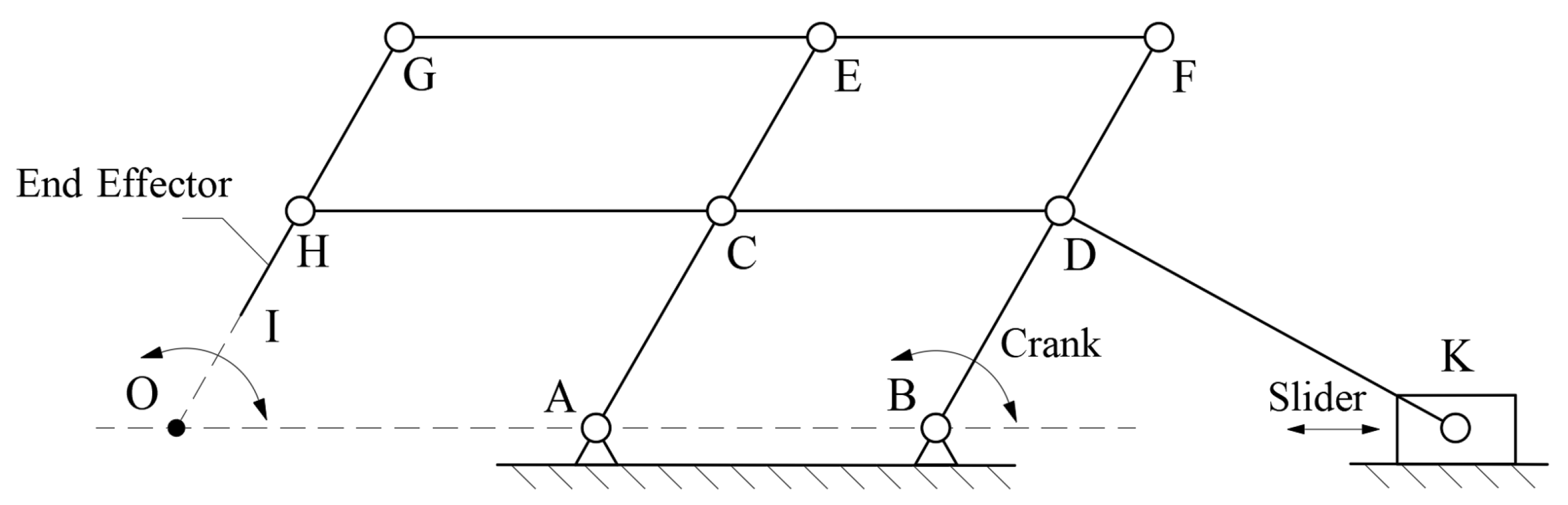
The design schematic of the planar RCM mechanism for the MOSR is illustrated in Figure 3. A simplified diagram of a conventional 1-DOF double parallelogram mechanism is presented, where rigid links are connected via revolute joints at points A~H. Points A and B are located on the base, with link HI designed as the end-effector. During holistic rotation of the mechanism, parallelogram segment ABCD (ABCD) is selected as the actuation component, while CEGH functions as the output segment. From the geometric properties of the parallelogram, it is known that when the actuation component rotates about points A and B, the extended line of GI always passes through point O. This geometric constraint establishes point O as the RCM point of the mechanism.
Despite its widespread adoption in ophthalmic robots, the conventional configuration exhibits critical limitations. When the drive motor is mounted at point A or B, the mechanism has poor force transmission quality and requires excessive torque to overcome the overall gravity. Such requirements necessitate the use of high-torque actuators, which results in a larger and heavier planar mechanism. Consequently, the increased load on the rotating seat and the mobile position platform that carries the planar mechanism will compress the space available for other equipment in the surgery.
To obtain a lightweight design and enhance the force transmission, a crank-slider mechanism is introduced as shown in Figure 3. This mechanism allows the conversion between the rotation of the crank and the translation of the slider. Specifically, the original linkage BD from the double parallelogram mechanism is reconfigured as a crank, integrated with a prismatic joint to form the hybrid mechanism. The actuation strategy is revised such that the translational input is applied at slider K, while the rotational output around RCM point O is preserved.
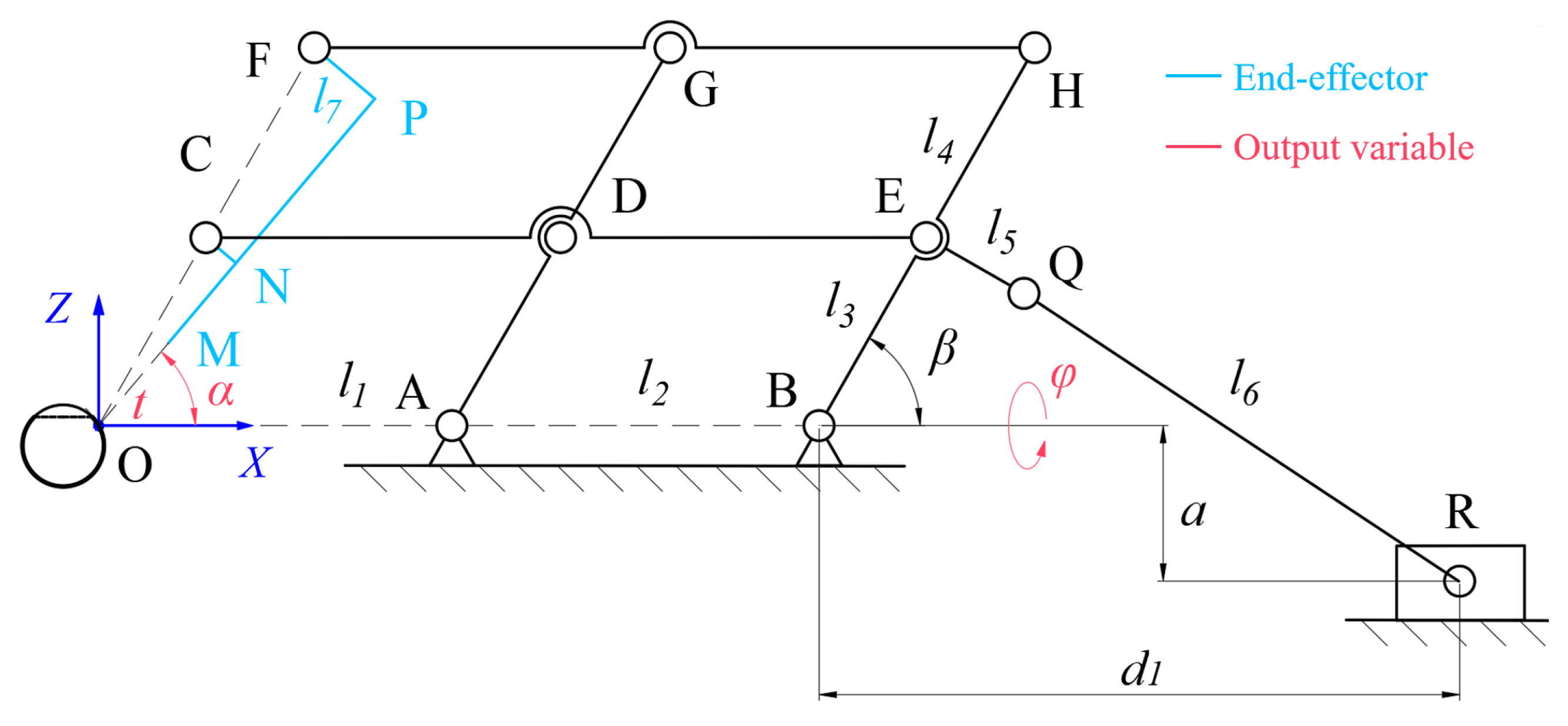
The optimized RCM mechanism for the MOSR is presented in Figure 4, with critical design parameters marked. The parallelogram linkages can be determined uniquely by parameters l 1 , l 2 , l 3 and l 4 . In order to facilitate the mounting of surgical instruments and to increase the intraocular workspace coverage, the end-effector is augmented with auxiliary limbs that are perpendicular to each other, namely PF and PM. It can be seen from the geometrical properties that PM (or its extension) maintains continuous alignment with the RCM point O throughout the mechanism’s motion. The distance between the instrument tip M and point O is denoted by t. In the crank-slider section, limb EQ is extended from base linkage BH to avoid stress concentration at joint E, where EQ and BH remain perpendicular. To optimize the transmission quality, the translational guideway for slider R is set to deviate from OB with the deviation denoted as a.
In the mechanism shown in Figure 4, there are three mutually independent output variables: angle α , angle φ and distance t. Since the planar mechanism can only provide one planar rotational DOF, additional actuators are implemented to realize the other two DOFs.
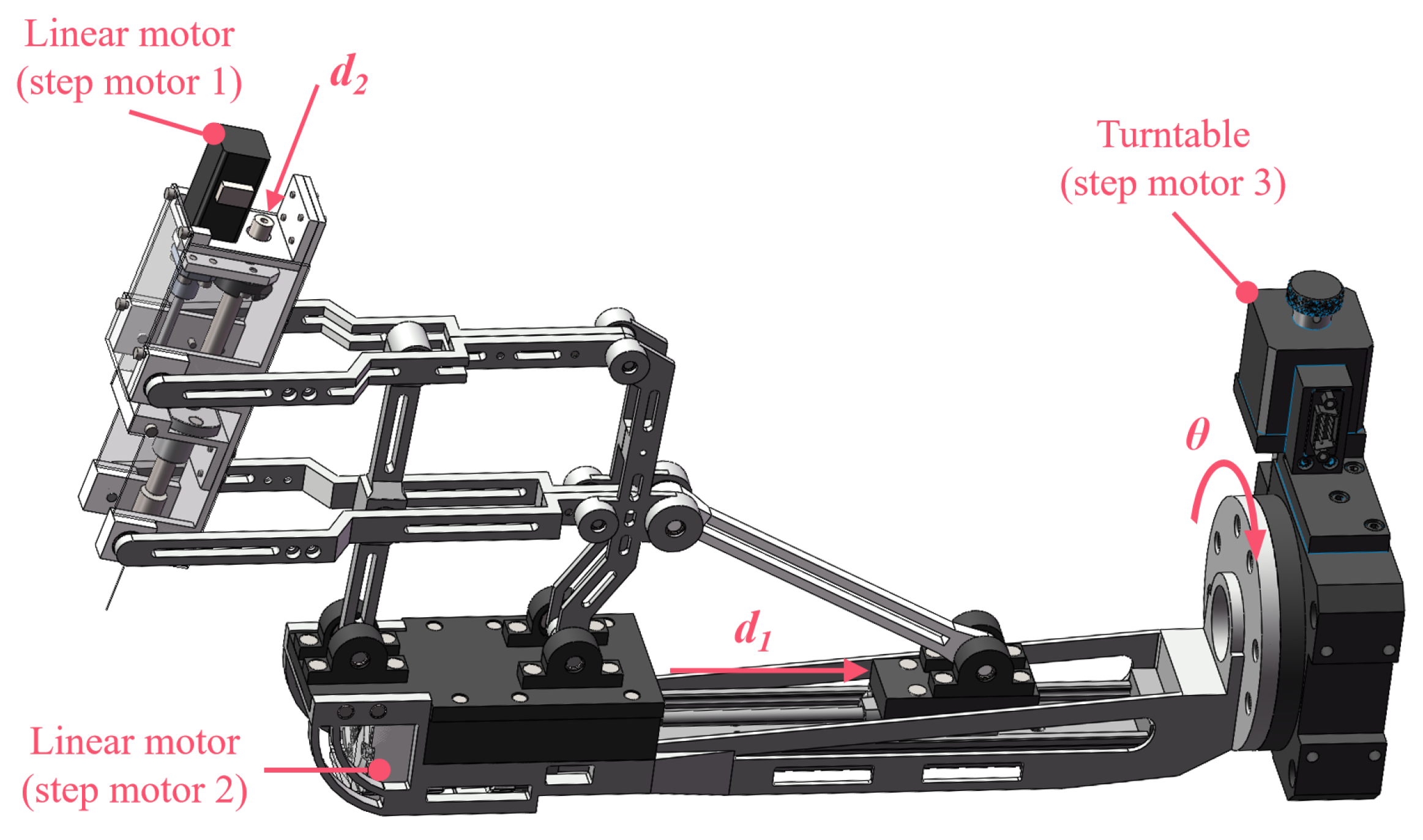
Figure 5 shows the implemented mechanical structure, featuring two linear motors and a rotary table. The system’s input parameters consist of linear displacements d 1 and d 2 controlled by the linear motors, and angle θ controlled by the rotary table. The output variables α , φ , and t correspond to d 1 , d 2 and θ respectively, with no existing motion coupling.

2.2. Forward Kinematics

A function of input parameters ( d 1 , d 2 , θ ) is applied to describe the motion of the proposed mechanism, where the resulting mechanism configuration is fully described by the end-effector variables ( α , φ , t ) .
( α ,   φ ,   t ) = FK ( d 1 ,   d 2 ,   θ )
Since the surgical instrument and the mechanism frame are independently controlled by the linear motor and the turntable at the base respectively, there is no motion translation or motion scaling, so φ and t can be expressed as:
φ = θ
t = d 2
From the geometric relationship, it follows that:
α = β sin 1 l 7 l 3 + l 4
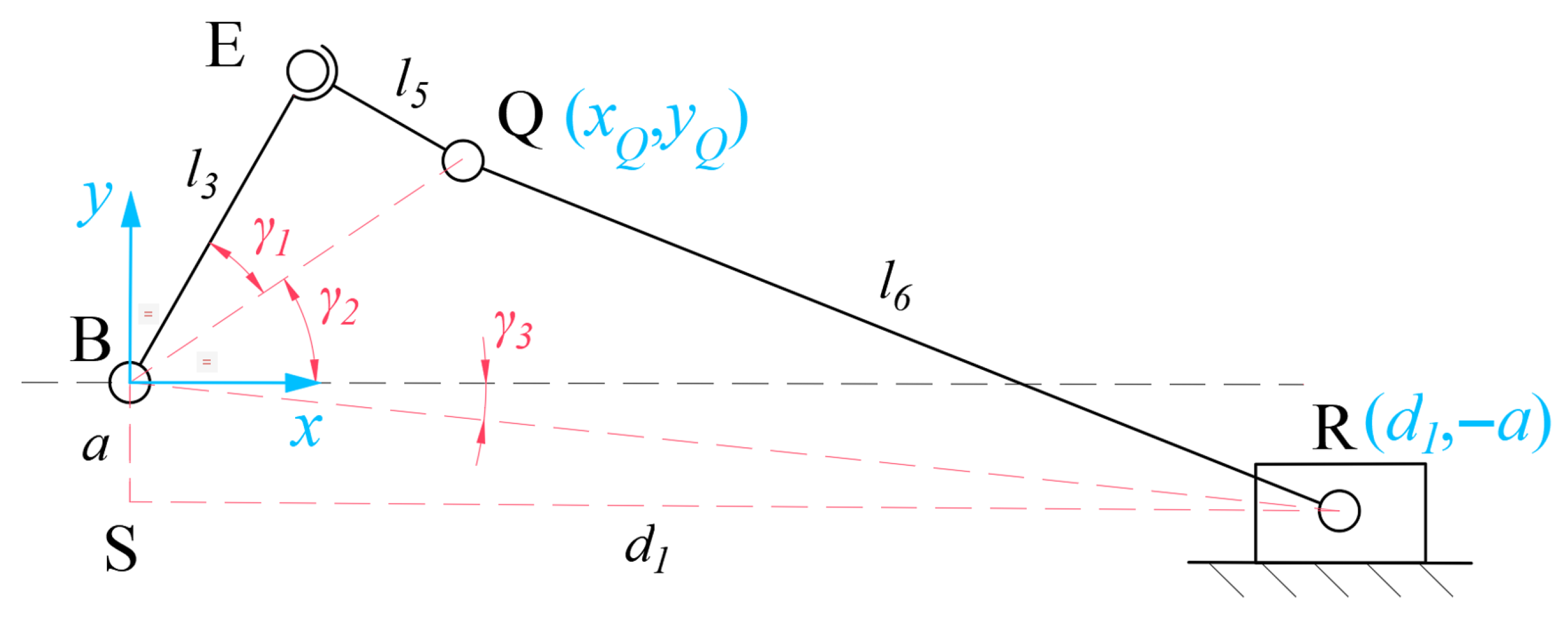
As shown in Figure 6, the crank-slider section is illustrated with reference lines for kinematics analysis. Points BQ and BR are connected via straight lines, and a vertical line passing through point B intersects a horizontal line through point R at point S. Specifically, the length of BS is denoted as a, while the length of SR is marked as d 1 . Furthermore, three critical angular parameters γ 1 , γ 2 , and γ 3 are labeled.
By correspondence:
β = γ 1 + γ 2
from the geometric relationship:
γ 1 = tan 1 l 1 l 3
γ 3 = tan 1 a d 1
γ 2 + γ 3 = cos 1 l 3 2 + l 5 2 + a 2 + d 1 2 l 6 2 2 l 3 2 + l 5 2 · a 2 + d 1 2
From Equations (2)–(8), the forward kinematics as defined in Equation (1) can be derived as:
  α = tan 1 l 5 l 3 + cos 1 l 3 2 + l 5 2 + a 2 + d 1 2 l 6 2 2 l 3 2 + l 5 2 · a 2 + d 1 2 tan 1 a d 1 sin 1 l 7 l 3 + l 4 φ = θ t = d 2

2.3. Inverse Kinematics

A function of end-effector variables ( α ,   φ ,   t ) is applied to describe the motion of the proposed mechanism, where the resulting mechanism configuration is fully described by the input parameters ( d 1 ,   d 2 ,   θ ) .
( d 1 ,   d 2 ,   θ ) = IK ( α ,   φ ,   t )
From the geometric relationship, combined with Equations (4) and (5):
γ 2 = α sin 1 l 7 l 3 + l 4 tan 1 l 5 l 3
As shown in Figure 6, a coordinate system is established with the origin at point B. The coordinates of R can be expressed as ( d 1 , a ) , with the coordinates of Q set as ( x Q ,   y Q ) , which can be expressed as:
  x Q = l 3 2 + l 5 2 · cos γ 2   y Q = l 3 2 + l 5 2 · sin γ 2
The length of QR can be expressed using coordinates as:
( x Q d 1 ) 2 + ( y Q + a ) 2 = l 6 2
From Equations (2), (3), (11) and (12), the inverse kinematics of the mechanism defined by Equation (10) can be expressed as:
d 1 = l 3 2 + l 5 2 · cos γ 2 + l 6 2 ( l 3 2 + l 5 2 ) sin 2 γ 2 a 2 2 a l 3 2 + l 5 2 · sin γ 2 d 2 = t θ = φ
Note that γ 2 here is denoted by Equation (11).

2.4. Parameters and Workspace

The planar mechanism configuration can be uniquely determined by l 1 l 7 and a marked in Figure 4, and the values of each parameter are shown in Table 1.
Considering the parameters of the motors, the mechanism size, the interference factors, and the characteristics of vitreoretinal surgery, the ranges of values for the three input parameters of MOSR are determined and presented in Table 2.
During vitreoretinal surgery, surgical instruments typically enter the eye through a scleral incision. The scleral incision is usually located about 3 mm from the corneal limbus, which can be approximately located based on ocular anatomy [27,28]. As shown in Figure 4, the RCM point O of the robot is set to coincide with the scleral incision, and a right hand coordinate system is established with point O as the origin. Assume that when the plane of the RCM mechanism is aligned with the XZ plane, θ = φ = 0 ° , and when the tip of the instrument is positioned at point O, t = d 2 = 0 . Note that Figure 4 is schematic only and not drawn to scale.
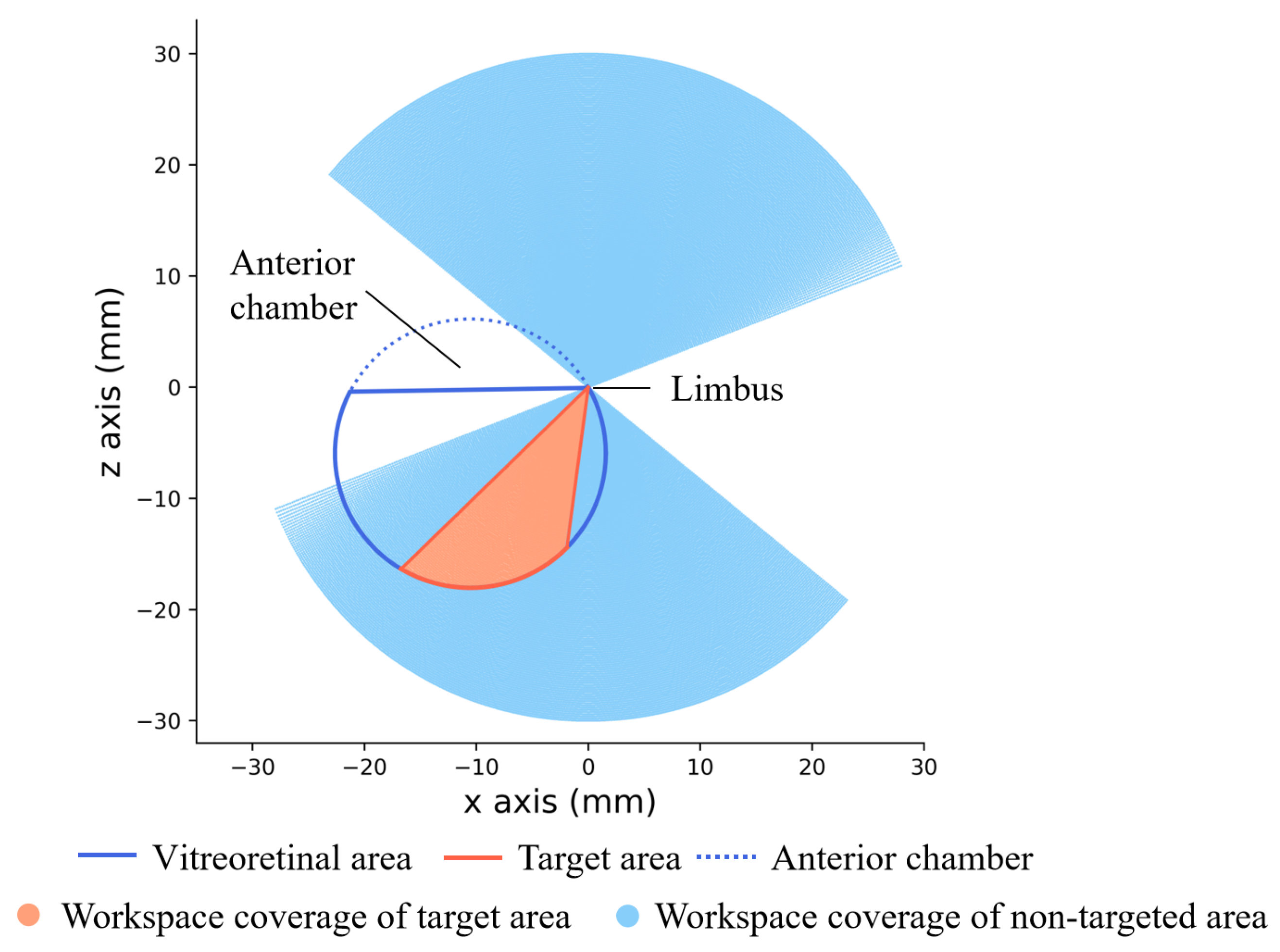
In the previous study, the target area for vitreoretinal surgery was mapped on the ocular anatomical cross-section within the XZ plane [29]. To evaluate the robot’s workspace in this section, a simulation analysis was conducted. As shown in Figure 7, the ocular structure is abstracted as a 24.2 mm diameter circular profile, with delineation of both the vitreoretinal extent and the specific surgical target area. The robot’s workspace in the XZ plane was computationally generated based on the forward kinematics in Equation (9) and the input parameter ranges in Table 2. Simulation results demonstrate that the robot’s workspace in the XZ plane can completely cover the target area while achieving 89% coverage of the vitreoretinal area. Therefore, the robot’s workspace in this plane is confirmed to satisfy the surgical requirements.
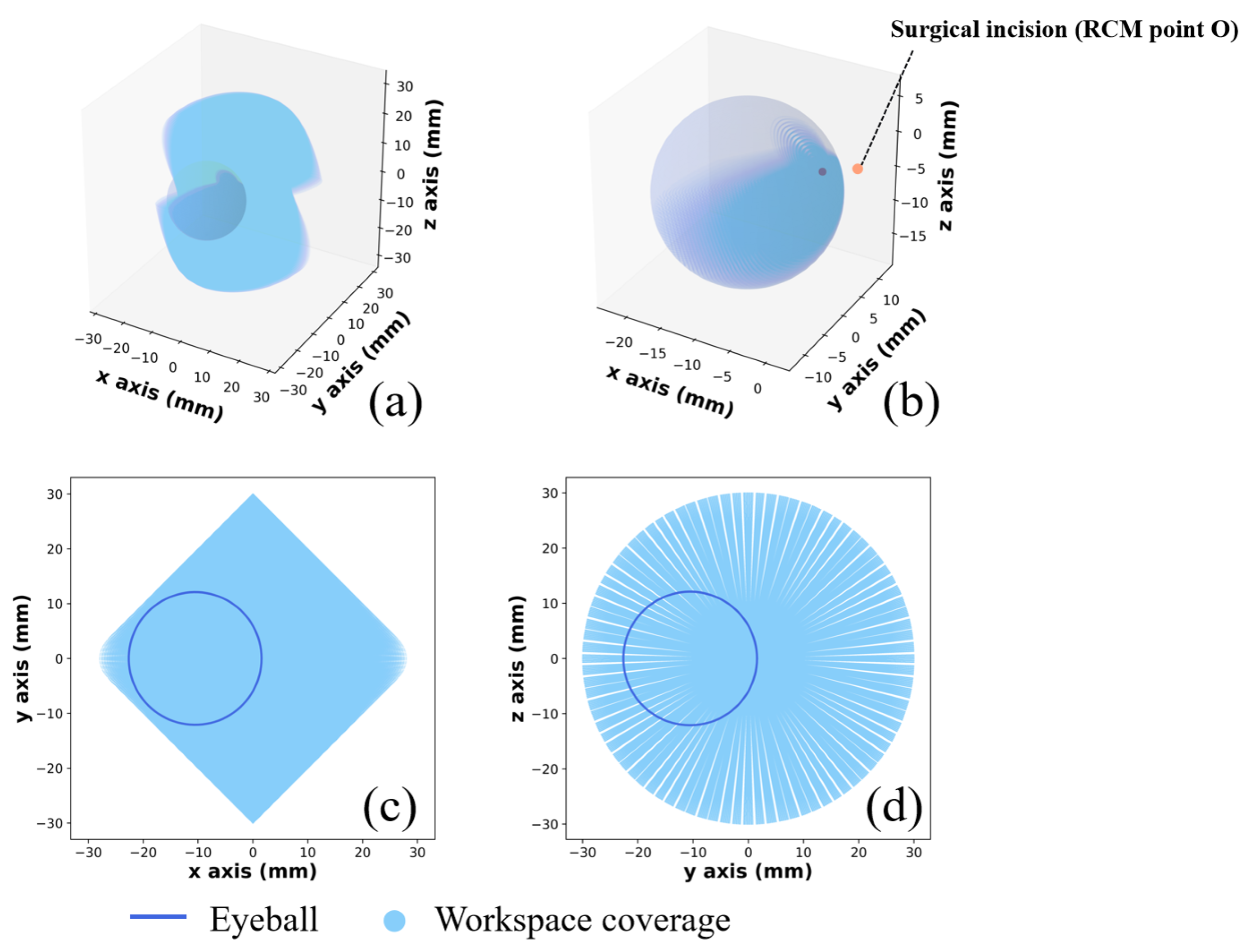
Based on the forward kinematics and the input parameter ranges, a 3D workspace is represented as a spatial point cloud, which is generated through discretization of actuation parameters. The discretization step is set to 0.5 mm for both d 1 and d 2 , and a discretization of 0.5° is set for θ . The simulation results are presented in Figure 8, illustrating the 3D workspace, intraocular workspace, and projections on the XY and YZ planes, respectively. As evidenced by the results, the mechanism’s workspace has a sufficiently large vitreoretinal coverage, indicating that the robot’s spatial workspace is adequate to meet the surgical requirements.

3. Robotic System

3.1. Robotic System Implementation

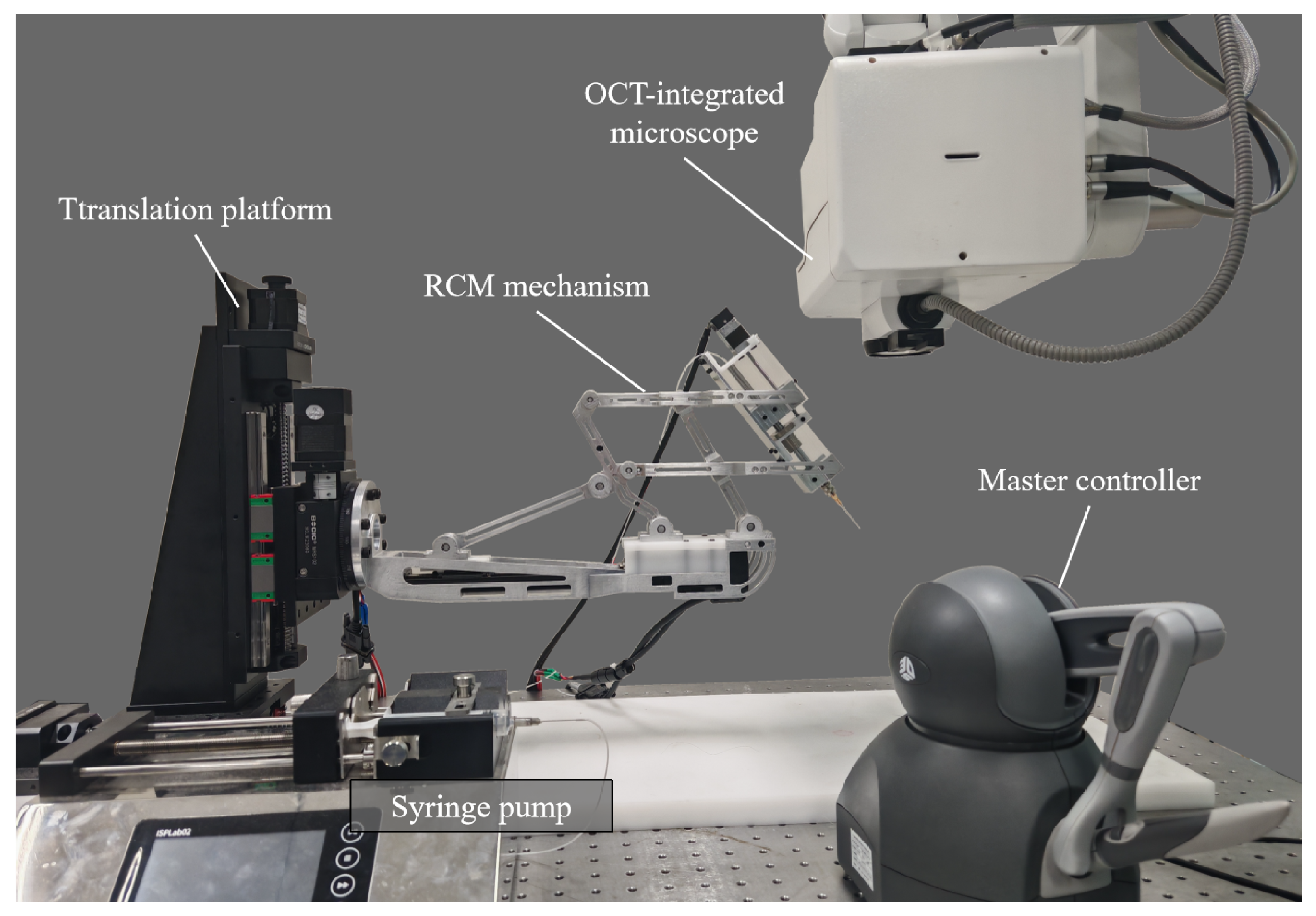
To address the specific requirements of VS, a prototype surgical robotic system was designed and implemented as illustrated in Figure 1, with its structure in Figure 9.
As shown in Figure 9, the robotic system consists of two main sections: the execution section and the control section. The main body of the execution section is a slave robot based on the RCM mechanism, which is mounted on a translation platform (BeiJing Optical Century Instrument Co., Ltd., Beijing, China). The translation platform provides 3 additional translational DOFs, which are used exclusively for aligning the RCM point and scleral incision before the surgery. The robotic system’s end-effector is equipped with a surgical microneedle connected to a digitally controlled syringe pump, enabling remotely controlled injection. The control section consists of a haptic device (3D Systems Inc., San Diego, CA, USA) serving as the master controller, an STM32-based microcontroller unit, a PC host computer, and several motor drivers. Furthermore, the system integrates an MIOCT for intraoperative imaging. Real-time microscope images and OCT images are displayed on a HUD device for surgical guidance.

3.2. Control System Design

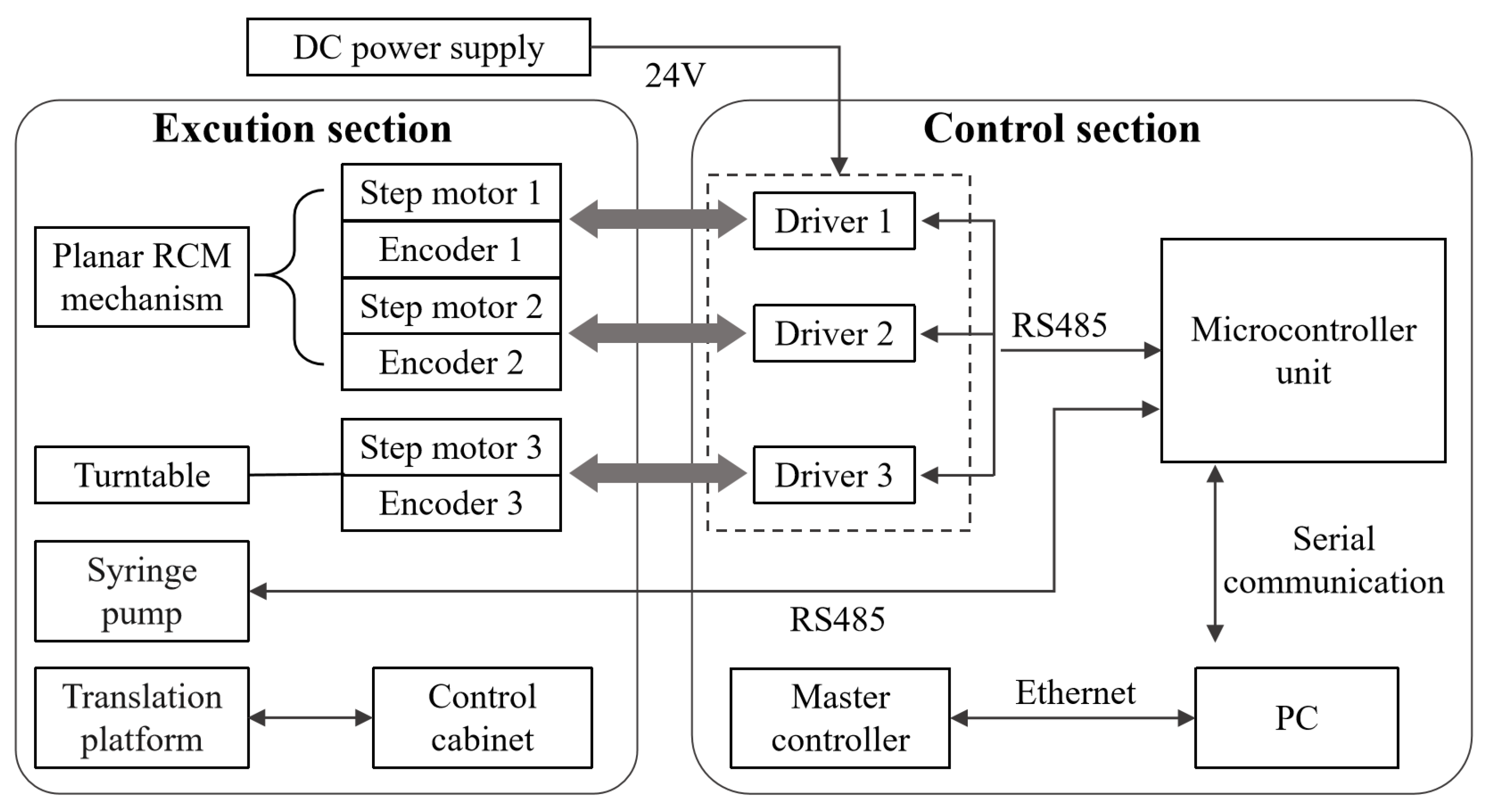
As presented in Figure 10, the robotic control system employs three step motors to realize the 3 DOFs of the robot: motor 1 (GSSD20, Shanghai KGG Robot Co., Ltd., Shanghai, China) and motor 2 (42CME04, China Leadshine Technology Co., Ltd., Shenzhen, China) control the planar RCM mechanism while motor 3 (42CME04, China Leadshine Technology Co., Ltd., Shenzhen, China) controls the rotation of the turn table. Each step motor is driven independently by a driver (CL42C, China Leadshine Technology Co., Ltd., Shenzhen, China) and equipped with a manufacturer-provided encoder with a resolution of 2000 CPR (counts per revolution). The motions of the robot and the injection function of the syringe pump are controlled by the master controller, and relevant parameters or information will be displayed on the human machine interface (HMI) of the PC. In addition, the HMI can also send instructions with higher priority to block the operation instructions of the master controller, thereby avoiding accidental situations such as operation errors. Since this study is limited to model eyes, and the translation platform is only used for aligning the RCM point and the surgical incision without affecting the surgical operation, the movement of the translation platform is controlled by a separate control cabinet (BeiJing Optical Century Instrument Co., Ltd., Beijing, China) and not integrated into the master controller.
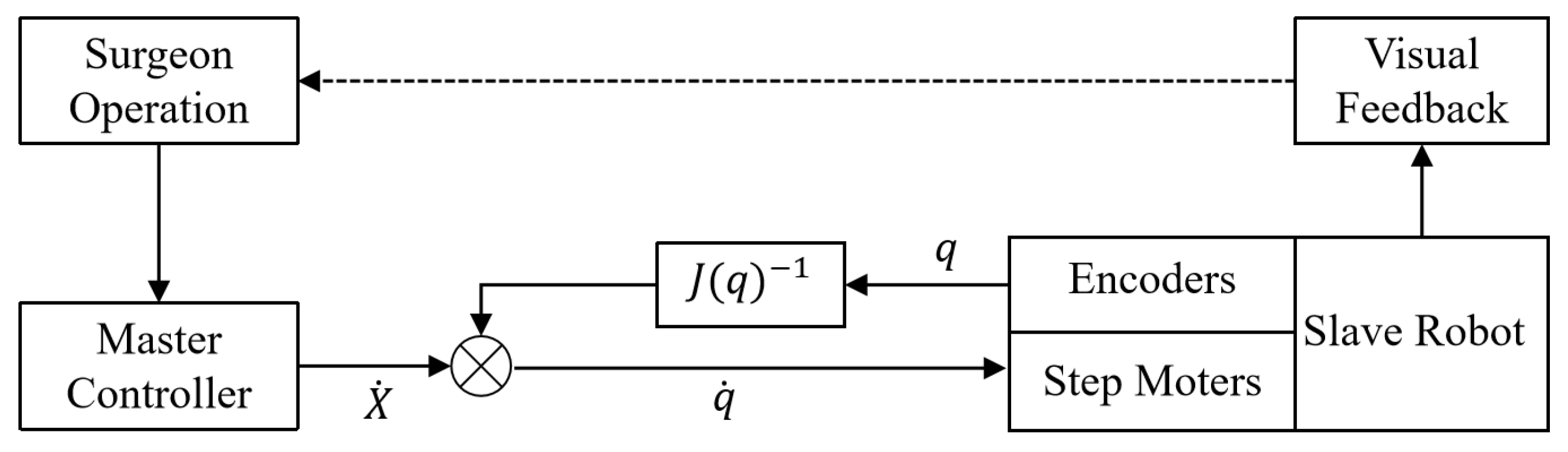
The master–slave control system is based on velocity control and its basic principle is illustrated in Figure 11. The surgeon applies a desired velocity X ˙ to the end-effector of the slave robot by manipulating the master controller, where X ˙ represents the output velocity ( α ˙ ,   φ ˙ ,   t ˙ ) . Simultaneously, the motor encoders return the real-time state q of the slave robot, specifically the real-time values of the three input parameters ( d 1 ,   d 2 ,   θ ) . Through differential kinematics, the corresponding motor velocity q ˙ is computed and applied to achieve the desired motion.
The differential kinematics of the robot can be expressed as:
X ˙ = J ( q ) q ˙
where J ( q ) depends only on the real-time values of the input parameters, and when q is determined, the motor velocity q ˙ can also be uniquely determined:
q ˙ = J ( q ) 1 X ˙
J ( q ) can be obtained by taking partial derivatives of the forward kinematics given in Equation (9) as:
J ( q ) = J 1 , 1 0 0 0 0 1 0 1 0
where
J 1 , 1 = a a 2 + d 1 2 + d 1 σ · ( a 2 + d 1 2 + l 3 2 l 5 2 + l 6 2 )
σ = 2 1 ( a 2 + d 1 2 + l 3 2 + l 5 2 l 6 2 ) 2 4 ( a 2 + d 1 2 ) · ( l 3 2 + l 5 2 ) · ( a 2 + d 1 2 ) 3 2 · l 3 2 + l 5 2

4. Experiments and Results

4.1. Positioning Accuracy

For surgical robotic systems, positioning accuracy serves as the fundamental indicator for evaluating reliability. To assess the reliability of the proposed robotic system, experimental measurements and analysis were conducted to evaluate the accuracy of each individual joint as well as the overall system performance.
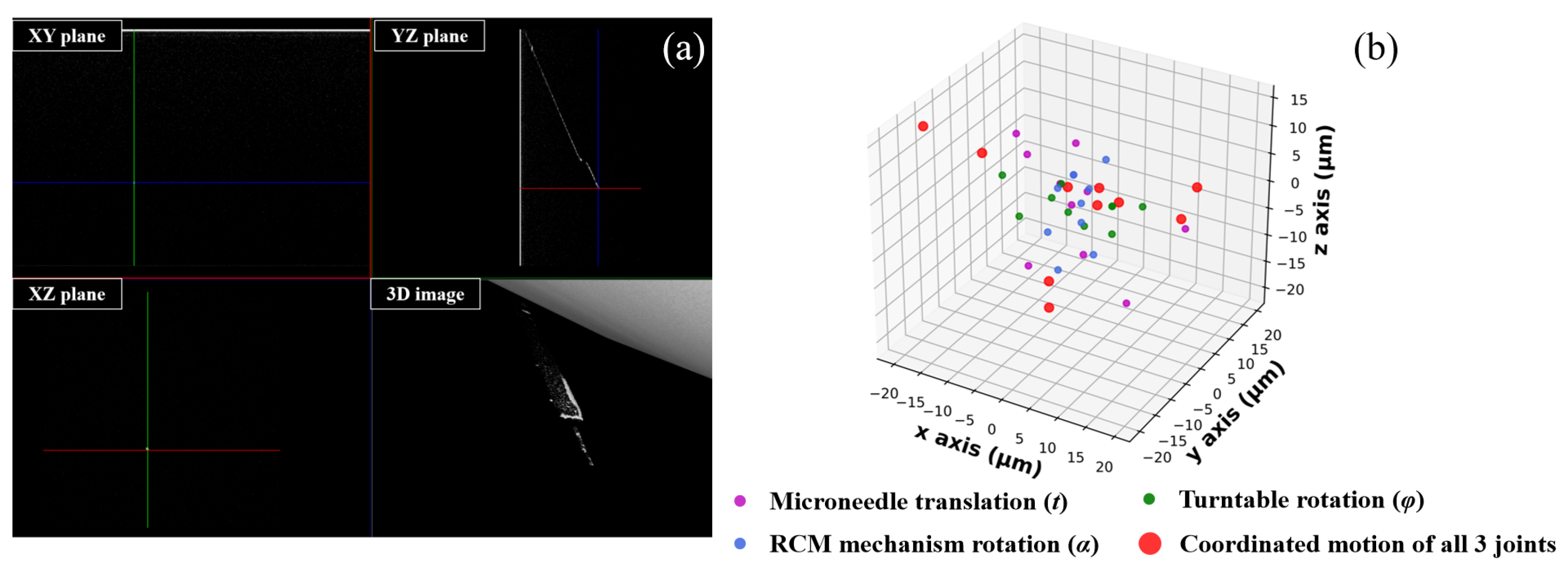
Since the end-effector applies a 48G microneedle with a diameter of only 60 μ m (Figure 12b), it is difficult for conventional coordinate measurement equipment to accurately locate the needle tip. As shown in Figure 12a, a 3D-OCT equipment is employed to reconstruct the 3D image of the microneedle. With a resolution of 0.5 μ m and the non-invasive nature, the 3D-OCT system is able to obtain the precise position of the needle tip with no deformation induced through physical contact. In practical operations, the positioning accuracy primarily relies on manual control via the master controller, with actual tip position assessed through OCT and microscopic imaging. During this process, the RCM point location is visually challenging to determine. As the origin of the robot coordinate system, the RCM point directly impacts the calculation accuracy of end-effector displacement and rotation angles. Therefore, after manually calibrating the RCM point, the robotic system is controlled to align the needle tip’s theoretical coordinates with the RCM point, which is chosen as the evaluation point for accuracy assessment. Subsequently, a set of 3D-OCT image is acquired to obtain the coordinate of the evaluation point. During the accuracy experiment, the needle tip is commanded to move to a distant position and then relocated to the evaluation point, with a set of 3D-OCT image acquired when the needle is stable. This procedure is repeated 10 times for each independent motion as well as the coordinated motion of all 3 joints, generating a total of 40 datasets. Throughout these trials, each joint was actuated over a displacement equivalent to 50% of its maximum travel range.
Figure 13 illustrates all experimentally measured needle tip positions within the OCT measurement frame, where the coordinates are calibrated using 3D image processing software Amira (6.0.1) (Figure 13a). The coordinates ( x o i ,   y o i ,   z o i ) of each point set measured in individual experimental trials are denoted as X o i ( i = 1 ,   2 ,   10 ) . For visualization purposes, the transformed coordinates X t i are obtained using the following formula:
X t i = X 0 i i = 1 10 X 0 i 10
The positioning accuracy is quantified by the minimum radius of the sphere encompassing all measured points. The minimum radius is 22.6 μ m for the RCM mechanism rotation ( α ), 15.5 μ m for the turntable rotation ( φ ), 17.7 μ m for the microneedle translation (t), and 27.8 μ m for the coordinated motion of all 3 joints. Normally, subretinal injection requires a needle tip accuracy within 25 μ m [30]. Therefore, further optimization of the mechanical structure and control algorithms is necessary to improve the overall accuracy. Since the coordinated motion of all 3 joints is typically not required after the microneedle enters the eye, the individual joint accuracy is considered sufficient to meet surgical requirements, thereby enabling its application in preliminary experiments.

4.2. Subretinal Injection Experiment

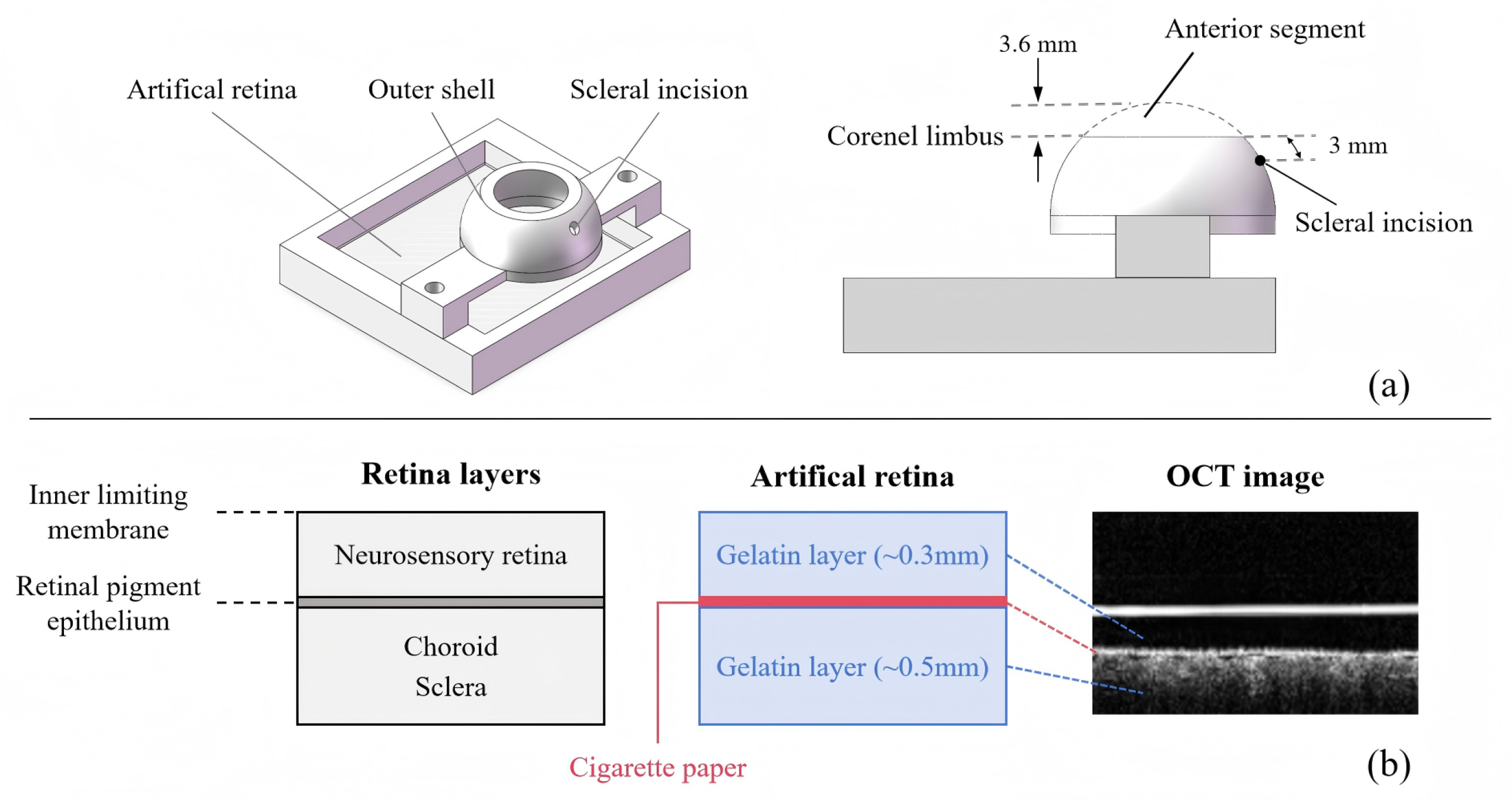
To validate the feasibility of the robotic system in surgical scenarios, simulated subretinal injection experiments were conducted on an artificial eye model. The structure of the eye model is illustrated in Figure 14. The outer shell of the model is constructed as a spherical structure with a diameter of 24.2 mm, which has no physical structure of the anterior segment. An aperture is created at the corneal limbus to enable imaging of the fundus via the OCT-integrated microscope. Additionally, a scleral incision is made near the limbus to allow the microneedle enter the eye. For the artificial retina, only the critical structures relevant to the injection procedure are considered, and these structures are constructed using two gelatin layers and a thin layer of cigarette paper. The upper gelatin layer (~0.3 mm) simulates the neurosensory retina, with its upper surface representing the inner limiting membrane (ILM). The bottom gelatin layer (~0.5 mm) simulates the choroid and sclera, while the cigarette paper between the two gelatin layers simulates the retinal pigment epithelium (RPE) layer. Biomedical gelatin (~100 g Bloom, Aladdin, Shanghai, China) was prepared according to the manufacturer’s specifications, achieving biomembrane properties upon full solidification. During fabrication, care was taken to ensure that each gelatin layer exhibited a smooth surface without wrinkles or air bubbles.
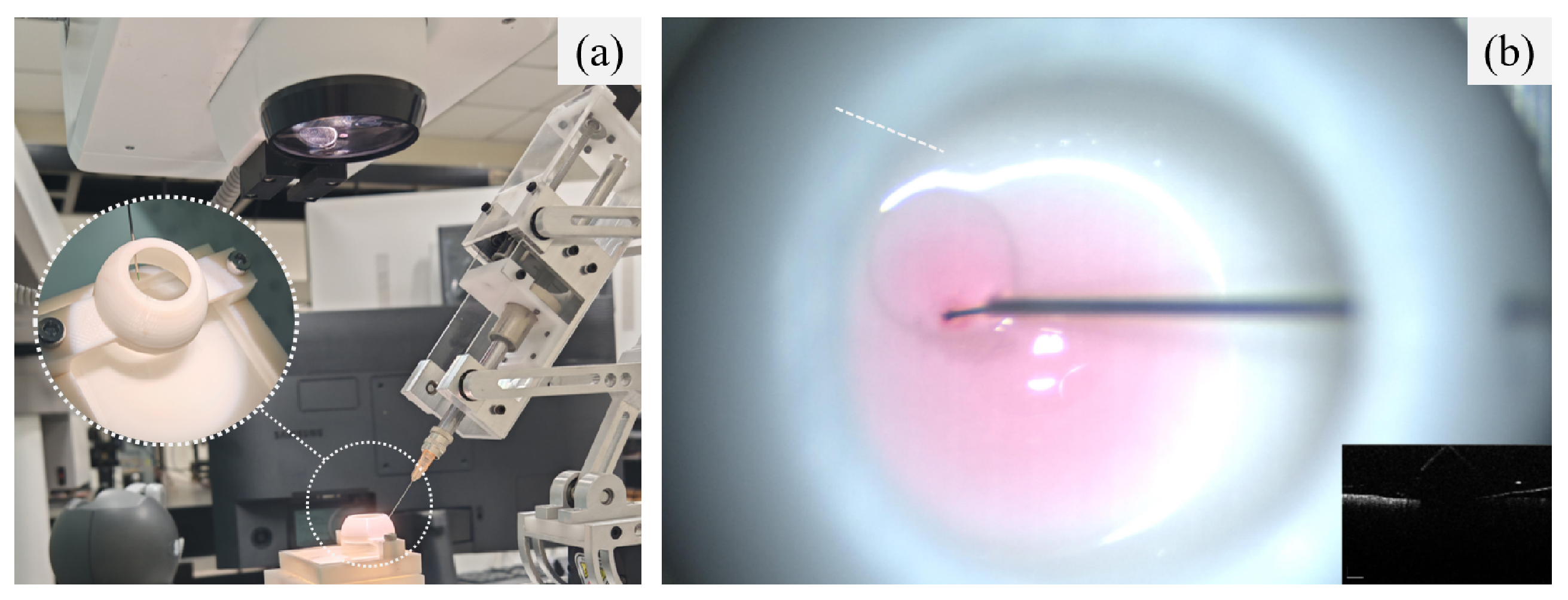
The experiment setup and intraoperative image is presented in Figure 15. To begin with, the needle tip was precisely aligned with the RCM point. Subsequently, the translational platform was actuated to align the RCM point with the scleral incision. Upon the steps above, the needle tip was positioned at the center of the scleral incision. The end-effector pose was then adjusted by controlling the master controller to achieve an optimal injection posture for the microneedle. Upon the posture adjustment, the microneedle was advanced into the eye model through the scleral incision.
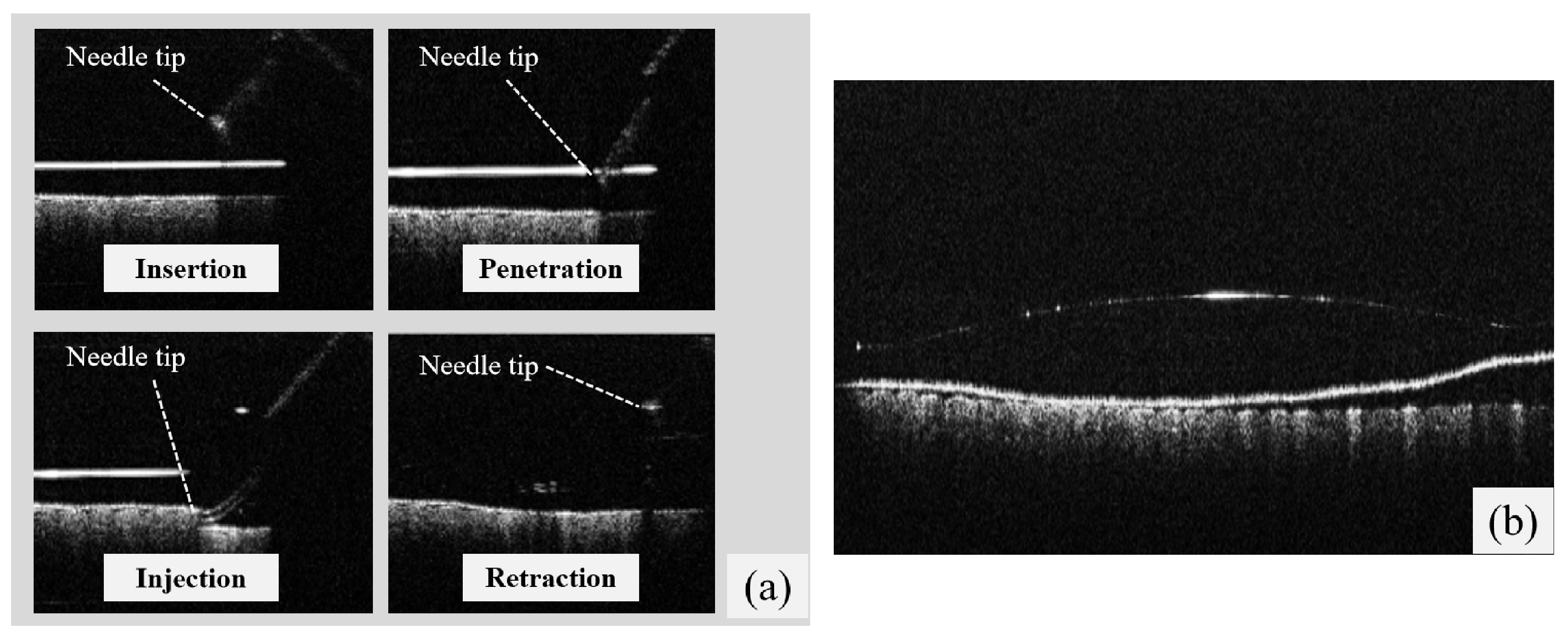
The procedures conducted inside the eye model consists of four steps: insertion, penetration, injection and retraction. Three distinct velocity profiles were implemented for intraocular manipulation: high-speed (2 mm/s), medium-speed (0.1 mm/s), and precision-speed (5 μ m/s). First, the insertion procedure was initiated by advancing the microneedle into the eye model, until the needle tip entered the workspace of the microscope. Subsequently, under the guidance of the microscope, the OCT scanning beam was aligned with the microneedle to acquire OCT image of the needle tip. The needle continued advancing at medium-speed until approaching the surface of the artificial retina. The velocity was then reduced to precision-speed for the penetration procedure. Upon penetrating the upper gelatin layer and reaching the cigarette paper layer, the needle tip maintained its position while injecting saline stained with red ink to form a bleb. 0.3 mL of fluid was injected at a constant rate of 10 μ L/s throughout the procedure, executed by the syringe pump connected to the microneedle. Finally, the needle was retracted through the gelatin layer and withdrew from the eye model, completing the experiment. The entire injection procedure required 5 min and 30 s. Representative OCT and microscopic images are presented in Figure 15b. These results demonstrate the clinical feasibility of the system for subretinal injection tasks.
Figure 16 presents the intraoperative OCT images of each experimental step along with the OCT image of the bleb. Multiple successful injections were completed, all resulting in stable bleb formation. Among the successful cases, the shortest procedure time recorded was 5 min and 30 s, with the detailed time for each step presented in Table 3. Note that the injection duration includes the time required for multiple operations such as connecting the injection tubing and operating the infusion pump. These results preliminarily validate the prototype’s capability to perform subretinal injections.

5. Conclusions

In this study, a novel RCM mechanism was proposed. A crank-slider mechanism was integrated into a conventional double parallelogram mechanism to enhance the transmission capability and precision. A master–slave robotic system was developed based on the proposed mechanism, featuring an end-effector equipped with an ophthalmic microneedle for subretinal injection surgery. The system integrates a precision syringe pump and an OCT-integrated microscope to achieve surgical functionality. Experimental validation was conducted using an eye model with artificial retina, where successful injection trials demonstrated the system’s feasibility.
In current research, several limitations remain to be addressed. Below are the key challenges and corresponding solutions: (1) RCM point calibration: Currently, the RCM calibration relies on visual alignment aided by mechanical tools, which is time-consuming and lacks precision. In future work, a laser-assisted calibration module will be developed to improve the efficiency and accuracy of the RCM point alignment process. (2) OCT imaging limitations: During injection experiments, the microneedle obstructs the OCT scanning beam, leading to unclear imaging of intraocular structures at certain stages, making it difficult to determine the relative position between the needle tip and intraocular structures. Additionally, after injection begins, the presence of fluid causes significant distortion in OCT images, preventing accurate assessment of the condition inside the bulb. To address this, a micro-force sensor will be developed and integrated into the end-effector to provide real-time haptic feedback, optimizing accuracy and efficiency. (3) Lack of intraocular illumination: Due to the absence of illumination fibers, experiments were limited to eye models with no vitreous. When using porcine eyes, the microscope is unable to image the interior of the eyeball, making it impossible to align the OCT scanning line with the needle tip. Future experiments will incorporate intraocular illumination and conduct further validation ex vivo and in vivo porcine eyes.
Future research will also focus on developing advanced control algorithms and calibration methods to enhance the precision. Furthermore, a modular tool interface will be implemented to enable rapid exchange of specialized instruments, expanding the system’s applicability to diverse vitreoretinal surgeries.

Author Contributions

Conceptualization, Y.L.; methodology, Y.L.; software, S.W.; validation, Y.L. and S.W.; writing—original draft preparation, Y.L.; writing—review and editing, G.S. All authors have read and agreed to the published version of the manuscript.

Funding

This research was funded by National Key R&D Program of China (2021YFF0700503, 2022YFC2404201, 2021YFF0700700); Natural Science Foundation of Jiangsu Province (BK20220263, BK20240024); Suzhou Pilot Program for Basic Research (SSD2023018); Youth Innovation Promotion Association of the Chinese Academy of Sciences (Y2023087); National Natural Science Foundation of China (62075235) and Entrepreneurship and innovation talents in Jiangsu Province (Innovation of scientific research institutes).

Institutional Review Board Statement

Not applicable.

Informed Consent Statement

Not applicable.

Data Availability Statement

The original contributions presented in this study are included in the article. Further inquiries can be directed to the corresponding author.

Conflicts of Interest

The authors declare that they have no known competing financial interests or personal relationships that could have appeared to influence the work reported in this paper.

References

  1. World Health Organization and Others. World Report on Vision. 2019. Available online: https://www.who.int/publications/i/item/world-report-on-vision (accessed on 7 January 2020).
  2. Coco-Martin, R.T.; Pastor-Idoate, S.; Pastor, J.C. Cell replacement therapy for retinal and optic nerve diseases: Cell sources, clinical trials and challenges. Pharmaceutics 2021, 13, 865. [Google Scholar] [CrossRef]
  3. Irigoyen, C.; Alonso, A.A.; Sanchez-Molina, J.; Rodríguez-Hidalgo, M.; Lara-López, A.; Ruiz-Ederra, J. Subretinal injection techniques for retinal disease: A review. J. Clin. Med. 2022, 11, 4717. [Google Scholar] [CrossRef] [PubMed]
  4. Varela-Fernández, R.; Díaz-Tomé, V.; Luaces-Rodríguez, A.; Conde-Penedo, A.; García-Otero, X.; Luzardo-Alvarez, A.; Fernández-Ferreiro, A.; Otero-Espinar, F.J. Drug Delivery to the Posterior Segment of the Eye: Biopharmaceutic and Pharmacokinetic Considerations. Pharmaceytics 2020, 12, 269. [Google Scholar] [CrossRef] [PubMed]
  5. Ribeiro, L.; Oliveira, J.; Kuroiwa, D.; Kolko, M.; Fernandes, R.; Junior, O.; Moraes, N.; Vasconcelos, H.; Oliveira, T.; Maia, M. Advances in vitreoretinal surgery. J. Clin. Med. 2022, 11, 6428. [Google Scholar] [CrossRef] [PubMed]
  6. Jin, H.Y.; Zhang, Q.; Zhao, P.Q. Modification of the wound construction to prevent dehiscence of radial keratotomy incision in cataract surgery: Wave-shaped scleral incision. J. Cataract. Refract. Surg. 2017, 43, 449–455. [Google Scholar] [CrossRef]
  7. Wang, N.; Zhang, X.D.; Li, M.Y.; Zhang, H.B.; Stoyanov, D.; Stilli, A. A 5-DOFs Robot for Posterior Segment Eye Microsurgery. IEEE Robot. Autom. Lett. 2022, 7, 10128–10135. [Google Scholar] [CrossRef]
  8. Spitznas, M. Motorized teleguided stereotactic micromanipulator for vitreous microsurgery. Arch. Ophthalmol. 1983, 101, 623–630. [Google Scholar] [CrossRef]
  9. Zandi, S.; Pfister, I.B.; Traine, P.G.; Tappeiner, C.; Despont, A.; Rieben, R.; Skowronska, M.; Garweg, J.G. Biomarkers for PVR in rhegmatogenous retinal detachment. PloS ONE 2019, 14, e0214674. [Google Scholar] [CrossRef]
  10. Molaei, A.; Abedloo, E.; de Smet, M.D.; Safi, S.; Khorshidifar, M.; Ahmadieh, H.; Khosravi, M.A.; Daftarian, N. Toward the art of robotic assisted vitreoretinal surgery. J. Ophthalmic Vis. Res. 2017, 12, 212–218. [Google Scholar]
  11. Taylor, R.; Jensen, P.; Whitcomb, L.; Barnes, A.; Kumar, R.; Stoianovici, D.; Gupta, P.; Wang, Z.X.; deJuan, E.; Kavoussi, L. A steady-hand robotic system for microsurgical augmentation. Int. J. Robot. Res. 1999, 18, 1201–1210. [Google Scholar] [CrossRef]
  12. Gijbels, A.; Wouters, N.; Stalmans, P.; Van Brussel, H.; Reynaerts, D.; Vander Poorten, E. Design and realisation of a novel robotic manipulator for retinal surgery. In Proceedings of the 2013 IEEE/RSJ International Conference on Intelligent Robots and Systems, Tokyo, Japan, 3–7 November 2013; pp. 3598–3603. [Google Scholar]
  13. Mablekos-Alexiou, A.; Ourselin, S.; da Cruz, L.; Bergeles, C. Requirements based design and end-to-end dynamic modeling of a robotic tool for vitreoretinal surgery. In Proceedings of the 2018 IEEE International Conference on Robotics and Automation (ICRA), Brisbane, Australia, 21–25 May 2018; pp. 135–141. [Google Scholar]
  14. Latt, W.T.; Tan, U.X.; Shee, C.Y.; Ang, W.T. A compact hand-held active physiological tremor compensation instrument. In Proceedings of the 2009 IEEE/ASME International Conference on Advanced Intelligent Mechatronics, Singapore, 14–17 July 2009; pp. 711–716. [Google Scholar]
  15. Gonenc, B.; Feldman, E.; Gehlbach, P.; Handa, J.; Taylor, R.H.; Iordachita, I. Towards robot-assisted vitreoretinal surgery: Force-sensing micro-forceps integrated with a handheld micromanipulator. In Proceedings of the 2014 IEEE International Conference on Robotics and Automation (ICRA), Hong Kong, China, 31 May–7 June 2014; pp. 1399–1404. [Google Scholar]
  16. Gonenc, B.; Gehlbach, P.; Taylor, R.H.; Iordachita, I. Motorized force-sensing micro-forceps with tremor cancelling and controlled micro-vibrations for easier membrane peeling. In Proceedings of the 5th IEEE RAS/EMBS International Conference on Biomedical Robotics and Biomechatronics, Sao Paulo, Brazil, 12–15 August 2014; pp. 244–251. [Google Scholar]
  17. Zhang, T.C.; Chen, B.J.; Zuo, S.Y. A novel 3-DOF force sensing microneedle with integrated fiber Bragg grating for microsurgery. IEEE Trans. Ind. Electron. 2021, 69, 940–949. [Google Scholar] [CrossRef]
  18. Edwards, T.L.; Xue, K.; Meenink, H.C.M.; Beelen, M.J.; Naus, G.J.L.; Simunovic, M.P.; Latasiewic, M.; Farmery, A.D.; de Smet, M.D.; MacLaren, R.E. First-in-human study of the safety and viability of intraocular robotic surgery. Nat. Biomed. Eng. 2018, 2, 649–656. [Google Scholar] [PubMed]
  19. Gijbels, A.; Vander Poorten, E.B.; Gorissen, B.; Devreker, A.; Stalmans, P.; Reynaerts, D. Experimental validation of a robotic comanipulation and telemanipulation system for retinal surgery. In Proceedings of the 5th IEEE RAS/EMBS International Conference on Biomedical Robotics and Biomechatronics, Sao Paulo, Brazil, 12–15 August 2014; pp. 144–150. [Google Scholar]
  20. Gijbels, A.; Smits, J.; Schoevaerdts, L.; Willekens, K.; Vander Poorten, E.B.; Stalmans, P.; Reynaerts, D. In-human robot-assisted retinal vein cannulation, a world first. Ann. Biomed. Eng. 1999, 46, 1676–1685. [Google Scholar] [CrossRef] [PubMed]
  21. Behrens, A.; Stark, W.J.; Pratzer, K.A.; McDonnell, P.J. Dynamics of small-incision clear cornea wounds after phacoemulsification surgery using optical coherence tomography in the early postoperative period. J. Refract. Surg. 2008, 24, 46–49. [Google Scholar] [CrossRef] [PubMed]
  22. Carrasco-Zevallos, O.M.; Viehland, C.; Keller, B.; Draelos, M.; Kuo, A.N.; Toth, C.A.; Izatt, J.A. Review of intraoperative optical coherence tomography: Technology and applications. Biomed. Opt. Express 2017, 8, 1607–1637. [Google Scholar] [CrossRef]
  23. Ehlers, J.P.; Han, J.; Petkovsek, D.; Kaiser, P.K.; Singh, R.P.; Srivastava, S.K. Membrane peeling-induced retinal alterations on intraoperative OCT in vitreomacular interface disorders from the PIONEER study. Investig. Ophthalmol. Vis. Sci. 2015, 56, 7324–7330. [Google Scholar] [CrossRef]
  24. Jayadev, C.; Dabir, S.; Vinekar, A.; Shah, U.; Vaid, T.; Yadav, N.K. Microscope-integrated optical coherence tomography: A new surgical tool in vitreoretinal surgery. Indian J. Ophthalmol. 2015, 63, 399–403. [Google Scholar] [CrossRef]
  25. Tuifua, T.S.; Sood, A.B.; Abraham, J.R.; Srivastava, S.K.; Kaiser, P.K.; Sharma, S.; Rachitskaya, A.; Singh, R.P.; Reese, J.; Ehlers, J.P. Epiretinal membrane surgery using intraoperative OCT-guided membrane removal in the DISCOVER study versus conventional membrane removal. Ophthalmol. Retin. 2021, 5, 1254–1262. [Google Scholar] [CrossRef]
  26. Cehajic-Kapetanovic, J.; Xue, K.; Edwards, T.L.; Meenink, T.C.; Beelen, M.J.; Naus, G.J.; de Smet, M.D.; MacLaren, R.E. First-in-Human robot-assisted subretinal drug delivery under local anesthesia. Am. J. Ophthalmol. 2022, 237, 104–113. [Google Scholar] [CrossRef]
  27. Lemley, C.A.; Han, D.P. An age-based method for planning sclerotomy placement during pediatric vitrectomy: A 12-year experience. Retina 2007, 27, 974–977. [Google Scholar] [CrossRef]
  28. Artal, P. Optics of the eye and its impact in vision: A tutorial. Adv. Opt. Photonics 2014, 6, 340–367. [Google Scholar] [CrossRef]
  29. Li, Y.Y.; Wu, S.J.; Fan, J.Y.; Jiang, T.L.; Shi, G.H. Design and analysis of a spatial 2r1t remote center of motion mechanism for a subretinal surgical robot. Actuators 2024, 13, 124. [Google Scholar] [CrossRef]
  30. Zhou, M.C.; Huang, K.; Eslami, A.; Roodaki, H.; Zapp, D.; Maier, M.; Lohmann, C.P.; Knoll, A.; Nasseri, M.A. Precision needle tip localization using optical coherence tomography images for subretinal injection. In Proceedings of the 2018 IEEE International Conference on Robotics and Automation (ICRA), Brisbane, Australia, 21–25 May 2018; pp. 4033–4040. [Google Scholar]
Figure 1. Overview of the robotic system.
Actuators 15 00053 g001
Figure 2. The motions of the surgical instrument during VS.
Actuators 15 00053 g002
Figure 3. Design schematic of the planar RCM mechanism for MOSR.
Actuators 15 00053 g003
Figure 4. Final design of the RCM mechanism employed by the MOSR.
Actuators 15 00053 g004
Figure 5. Mechanical structure of the proposed mechanism.
Actuators 15 00053 g005
Figure 6. Crank-slider section with auxiliary lines to derive kinematics.
Actuators 15 00053 g006
Figure 7. Workspace coverage in the XZ plane.
Actuators 15 00053 g007
Figure 8. 3D workspace of the 2R1T mechanism. (a) 3D workspace; (b) intraocular workspace; (c) workspace projection in the XY plane; (d) workspace projection in the YZ plane.
Actuators 15 00053 g008
Figure 9. Structure of the robotic system.
Actuators 15 00053 g009
Figure 10. Control system schematics.
Actuators 15 00053 g010
Figure 11. Implementation of the master–slave control system.
Actuators 15 00053 g011
Figure 12. Experimental measurement of the end-effector position. (a) experimental setup with the robot and the 3D-OCT device; (b) 48G microneedle attached on a 25G cannula; (c) 3D image of the microneedle.
Actuators 15 00053 g012
Figure 13. Accuracy experiment results. (a) needle tip coordinates determined using 3D image processing software; (b) experimentally measured needle tip positions.
Actuators 15 00053 g013
Figure 14. Schematics of the eye model Used in the Subretinal Injection Experiment. (a) schematic of the outer shell; (b) schematic of the artificial retina.
Actuators 15 00053 g014
Figure 15. Injection experiment on an eye model. (a) experimental setup; (b) intraoperative microscope and OCT image on HUD.
Actuators 15 00053 g015
Figure 16. Experiment result. (a) OCT images of each experimental step; (b) OCT image of teh bleb.
Actuators 15 00053 g016
Table 1. MOSR parameters.
ParameterValue (mm)ParameterValue (mm)
l 1 105 l 5 31
l 2 85 l 6 152
l 3 62.5 l 7 22.5
l 4 75a12
Table 2. Range of input parameters.
ParameterRange
d 1 95~220 mm
d 2 −30~30 mm
θ −75 ° ~75 °
Table 3. Detailed procedure time.
InsertionPenetrationInjectionRetractionTotal
118 s92 s76 s44 s5 min 30 s
Disclaimer/Publisher’s Note: The statements, opinions and data contained in all publications are solely those of the individual author(s) and contributor(s) and not of MDPI and/or the editor(s). MDPI and/or the editor(s) disclaim responsibility for any injury to people or property resulting from any ideas, methods, instructions or products referred to in the content.