Article

Design, Modeling, and Experimental Study of a Constant-Force Floating Compensator for a Grinding Robot


1
Henan Provincial Key Laboratory of Intelligent Manufacturing of High-End Equipment, Zhengzhou University of Light Industry, Zhengzhou 450001, China
2
Guangdong HUST Industrial Technology Research Institute, Dongguan 523808, China
3
Key Laboratory of High Efficiency and Clean Mechanical Manufacture of Ministry of Education, School of Mechanical Engineering, National Demonstration Center for Experimental Mechanical Engineering Education, Shandong University, Jinan 250061, China
4
Henan Aizto Science & Technology Co., Ltd., Pingdingshan 467000, China
*
Author to whom correspondence should be addressed.
Actuators 2026, 15(1), 4; https://doi.org/10.3390/act15010004
Submission received: 30 October 2025 / Revised: 14 December 2025 / Accepted: 17 December 2025 / Published: 21 December 2025

Abstract

Robot grinding requires a constant interaction force between the tool and the workpiece, even under inclination changes. This paper proposes a compact single-axis pneumatic constant-force floating compensator (CFFC) to achieve constant force output. The proportional pressure valve and pressure sensor are used to regulate the cylinder’s pressure. Pneumatic components and sensors are integrated into the narrow space between the cylinder and the slide rail. Embedded controller, power, and communication modules are developed and integrated into a control box and interact with the operator by a touch screen. The mathematical models of the compensator are established and the stability and response dynamics are analyzed through transfer functions. A dual-loop force controller based on active disturbance rejection control (ADRC) is designed to address bias load, inclination change, friction, and the sealing cover spring effect. The outer loop is compensated by displacement, tilt, and pressure sensors, and the unmodeled dynamics are estimated by an extended state observer (ESO) and a recursive least square (RLS). Finally, the CFFC is installed on a testing platform to simulate grinding conditions. The experimental results show that even under large floating stroke, inclination changes, and biased load, the CFFC can still quickly and stably output the desired grinding force.

1. Introduction

Robots are increasingly being used in dusty and toxic environments such as grinding, polishing, and chemical operations, etc. [1,2]. The quality of the workpiece surface mainly depends on the surface shape and grinding depth [3]. The accuracy of the grinding shape is mainly constrained by the robot path’s planning and following accuracy, while the depth of the grinding area is mainly controlled by the accuracy and stability of the normal force applied on the surface [4]. Therefore, in robot grinding, it is often necessary to perform position and force control [5]. There are many advanced methods that can achieve closed-loop compensation for surface grinding shape accuracy, such as machine vision [6], structured light in place detection [7], and laser scanning [8], etc. However, grinding depth control is often complex, and with the trend of personalized product development, grinding characteristics are becoming increasingly complex, which poses a huge challenge to the force control of robot grinding [9].
For robot grinding, active compliant control and passive floating transmission are mainly adopted [10,11]. To achieve active compliant control, a force sensor is often installed between the robot end and grinding tool, and an accurate robot dynamics model is usually developed; the use of force–position hybrid control for grinding has been widely studied [12,13]. To estimate the interaction stiffness between the grinding system and the workpiece, impedance control has also been widely used [14]. However, it is limited by the noise, zero drift, and accuracy of the force sensor. When grinding a complex surface, the robot may not quickly perceive sudden force changes, which can lead to overload or damage. Therefore, it is suitable for lightweight robots. The robot grinding programming and calibration based on this method is tedious, making it difficult to adapt to the personalized product [10]. With the rapid development of intelligent algorithms to solve the impact and the parameter optimization in robot grinding, a press-and-release model is combined with model-based reinforcement learning to achieve rapid force convergence and improved surface quality, demonstrating the good prospects of data-driven methods in solving the force-tracking challenge in grinding [15].
Designing a compliant mechanism between the robot end and the grinding tool to achieve constant force control (CFC) has gradually become mainstream [16]. This method can decouple the end force and position from the essence of mechanical transmission. Although the system cost increases slightly, the dynamic characteristics and universality of force control are better [17]. Passive floating compliant mechanisms are mainly divided into structural-controlled and mechanism-controlled types. The structural-controlled type achieves CFC by flexible connections or material state changes, which include positive and negative stiffness combinations, such as curved beams with shape optimization [18] and nonlinear elastic elements [19], etc. This type of CFFC has the characteristics of no clearance and high precision. In addition, CFC can also be achieved by material property control such as piezoelectricity, shape memory, and electrode magnetic field effects [20,21]. However, the small constant force range, load capacity, and floating stroke make it less adaptable to surface grinding with significant undulations. Therefore, it is more suitable for 3C products or micro/nano-manufacturing.
The mechanism-controlled compensator includes mechanical, pneumatic, electric drive, and air–electric–hybrid drive [22]. Compliant constant force mechanisms have been designed based on linkage, spring, or cam [23]. The cost of such schemes is relatively low, and the floating stroke and constant force bandwidth are significantly improved. However, the load capacity may be constrained by flexible mechanisms. Due to the compressibility and cleanliness, the pneumatic constant-force floating mechanism has become the mainstream solution for grinding [24]. Pushcart from Texas, USA, FerRobotics from Austria, and other companies have commercially developed pneumatic CFFCs. FerRobotics’ ACF flange can achieve high force control accuracy, with a passive floating stroke of up to 100 mm, which is widely used in the grinding fields of automobile, wind power, and aerospace, etc. [3]. Other scholars have also developed various pneumatic CFFCs for specific grinding needs, to achieve floating and gravity compensation [25,26,27], but the hysteresis of the pneumatic system also constrains highly dynamic CFC. Therefore, a voice coil motor is used to drive the grinding tool to achieve floating control over the external contact force, which greatly improves the response speed of CFC [28]. To improve consistency, a variable impedance control strategy that does not consider workpiece stiffness is proposed to handle contact uncertainty during robot grinding [29], which greatly enhances the robustness and disturbance resistance of the electric constant force actuator. In addition, based on electromagnetic variable stiffness, EMVSA has been developed [30]. With CFC and variable stiffness adjustments, the robot grinding system can better adapt to the weak stiffness parts. However, the weight of the end motion part of a CFFC is often heavy, which can seriously weaken the force control accuracy and response speed. Therefore, a pneumatic–electric hybrid CFFC has been proposed [31], which uses cylinders for gravity compensation and parallel voice coil motors to achieve high response speed.
The uncertain interaction between the compensator and complex environments always makes high-precision and robust CFC a serious challenge [32]. For engineering practicality, proportion-integral-derivative (PID) control is widely used in pneumatic CFC, but its parameter-tuning process is complicated. Therefore, methods such as fuzzy rules [22,33], BP neural networks [34], and adaptive neural fuzzy logic [35] are used to automatically adjust the PID parameters, which significantly improves the adaptability of force control. In addition, an optimal parameter-finding algorithm based on SAC (Soft-Actor-Critic) was designed to dynamically adjust the parameters of the PID controller in complex environments [36], achieving constant force grinding control for robots, which represents the trend of using reinforcement learning to optimize force control parameters, and provides a modern benchmark against classical controllers. However, the physical interaction between the workpiece and the grinding tool, especially on a complex surface, is significant disturbance for the CFFC. The mechanical model of this interaction is difficult to accurately obtain, and the CFFC itself also has many unmodeled dynamics [37]. Therefore, ADRC has been widely adopted for its convenience in observing and compensating for total disturbances [20,38,39]. By designing a sign function and polynomial hysteresis model with a switching operator, the hysteresis is well separated from the pneumatic CFFC, which also reduces the modeling complexity [40]. To cope with the contact impact during grinding, an integrated impact management and force–stiffness control is proposed, which has strong robustness without a distance sensor by switching strategies and smoothing responses [41]. In addition, for the unknown areas in the workpiece model, a force–position control has been designed for robot grinding [1], which integrates unknown areas modeling and real-time contact attitude estimation, ultimately achieving high-quality force control. In recent years, reinforcement learning [40] and adaptive learning, etc., have also been introduced into CFC [42], enabling the robot to attenuate disturbance in non-repetitive tasks and compensate for position-related disturbances by iteration in repetitive tasks. Due to the computational complexity, they are limited to scenarios that require high real-time performance. Learning grinding skills from human craftsmen by imitation learning has become an exciting research attempt, motion-primitive frameworks such as geodesic-length dynamic motion primitives (DMPs) have been developed for synchronized force–position control in complex surface grinding [43], which can achieve synchronized force–position control for compliant robot grinding.
To balance response performance, force capacity, and deployment flexibility, this paper proposes a compact pneumatic CFFC specifically for grinding applications with large surface undulations (typically > 5 mm) and heavy tool configurations. Compared with the electric or hybrid mechanisms, the CFFC exhibits higher force density, larger passive floating stroke, and better environmental robustness. In contrast, electric or hybrid compensators are more suitable for light load, high-bandwidth polishing tasks such as 3C or optical polishing. Therefore, a compact single-axis pneumatic CFFC is adopted as a trade-off for the specific application. Furthermore, to enhance the engineering practicality for rapid deployment on robots, an independent control box has been designed and integrated with STM32 MCU, a human–machine interaction (HMI) system, and a communication module. Only a bus connection is required between the control box and compensator. The output force of the CFFC is controlled by the dual-loop cascade control of the outer–loop force and inner–loop pressure with feedforward compensation. Pressure sensor and extended state observations are used to estimate and control the output force of the CFFC. Compared with prior compact compensators, the CFFC developed in this paper provides several improvements in novelty and performance:
(1)
Eccentric load-aware compensation. The tool’s eccentric loading encountered during grinding is explicitly incorporated into the controller’s design, enabling stable constant force control even under torque disturbances of at least 27 N·m.
(2)
Utilization of nonlinear sealing stiffness. The nonlinear spring effect of the compensator’s sealing cover is introduced into the compensation mechanism, allowing for the effective use of displacement sensor feedback and improving force accuracy during passive floating on complex and highly varying surfaces.
(3)
High integration and enhanced engineering practicality. The proposed design achieves a nominal force density of 105.2 N/kg and a ±25 mm floating stroke and integrates an STM32-based control box with redundant communication and simplified connection, eliminating the need for an end force sensor and supporting rapid deployment.
The remaining parts of this paper are arranged as follows: Section 2 introduces the driving principle, mechanical mechanism, and control system design of the CFFC. Section 3 introduces the pneumatic model of the valve and cylinder, as well as the macroscopic dynamic model of the compensator, and derives the system transfer function to analyze its inherent characteristics. Section 4 presents the designed dual-loop PI controller based on ADRC and simulation. Section 5 presents the experimental platform and comparison results. Grinding system errors, the parameter-tuning strategy, and the limitations of the CFFC are discussed in Section 6. Finally, a conclusion is provided in Section 7.

2. Design of the CFFC

2.1. Driving Principle of the CFFC

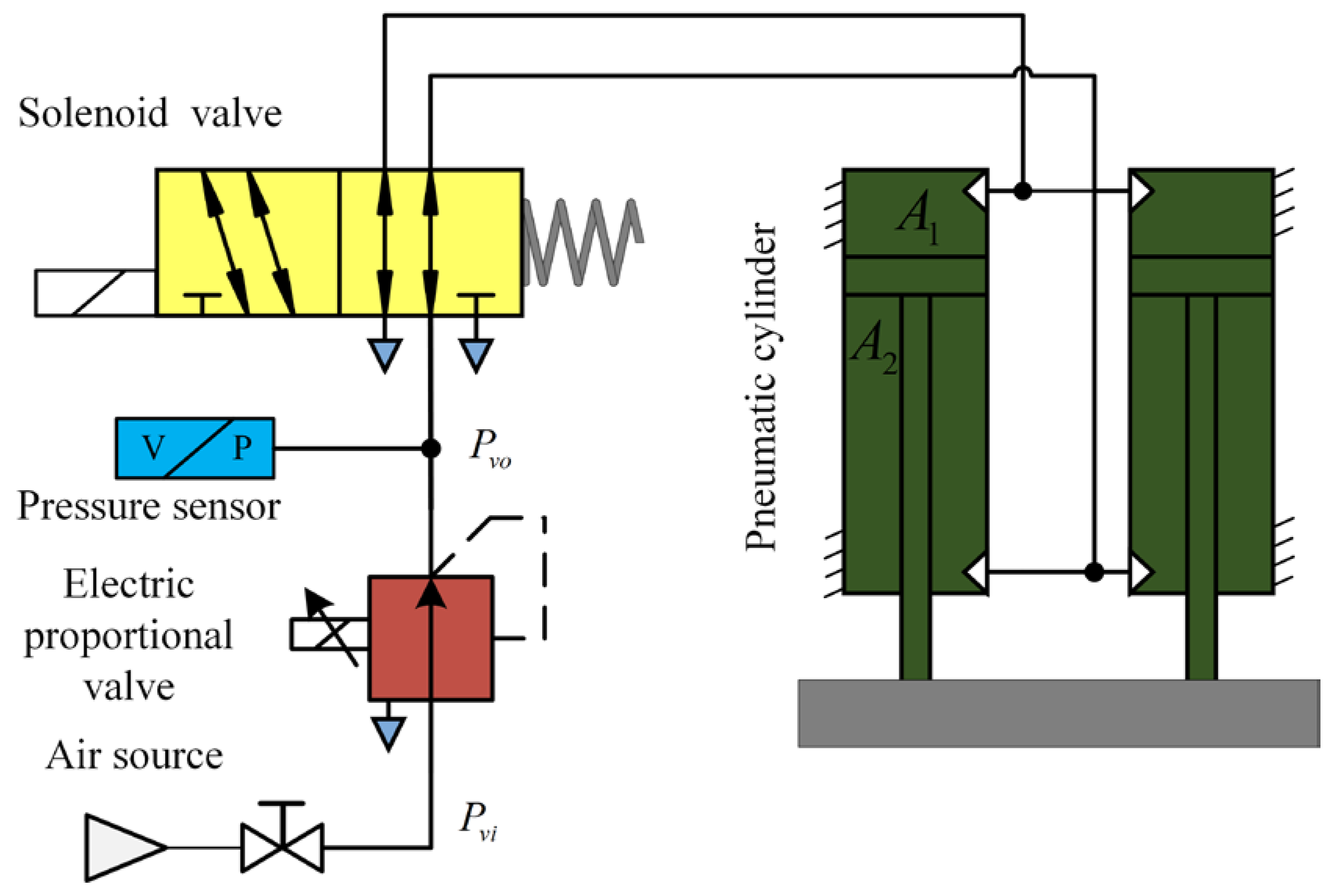
As shown in Figure 1, the proposed CFFC adopts pneumatic transmission and its core components include an electrical proportional valve for adjusting the air pressure, a five-way electromagnetic directional valve for cylinder direction control, and a pair of low-friction cylinders connected in parallel for outputting the desired grinding force. The compressed air delivered from the air source passes through the components mentioned above, and the compressed air from the solenoid valve enters the rod chamber and rodless chamber of the cylinder, respectively. By adjusting the output pressure of the electrical proportional valve, the driving force of the cylinder can be adjusted. To improve load sensing and control accuracy, a pressure sensor is connected in parallel between the electrical proportional valve and the solenoid valve for real-time estimation of changes in load force. Compared to the traditional solution [26], this design only uses one electrical proportional valve, which helps to reduce control complexity and cost.

2.2. Mechanical Structure Integration Design of the CFFC

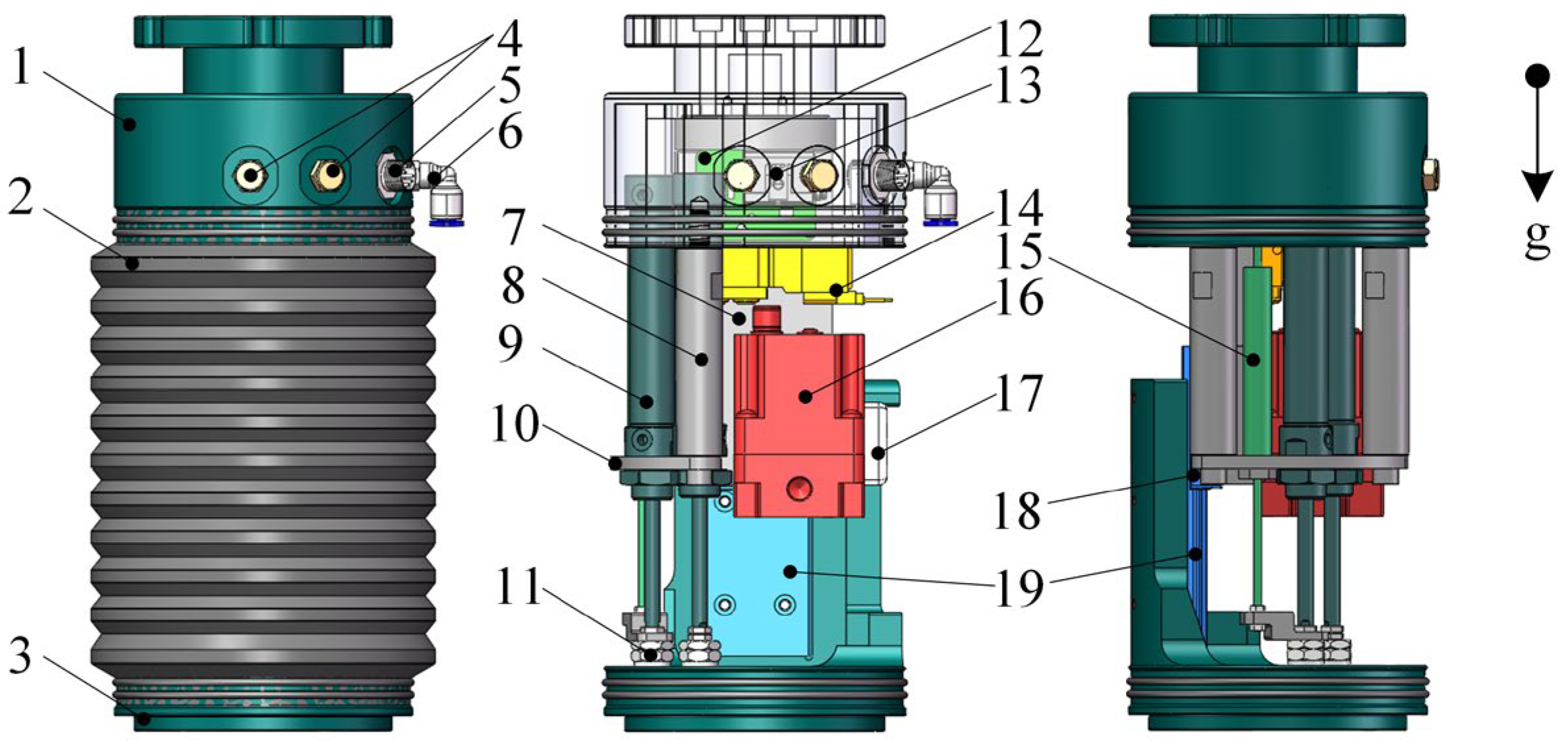
As shown in Figure 2, the CFFC mainly includes structural components, pneumatic components, sensors, and accessories.
(1)
The structural components include a robot connection flange (1), which is used to install the CFFC to the end of a robot (tool moving and grinding-deployment scheme) or fix it on a workbench (workpiece moving and grinding-deployment scheme). One end of the rail mounting plate (7) is fixedly connected to the interior of the one-robot connection flange (1), used for fixing the slider and internal components of the linear rail. The linear guide rail (19) is installed on the tool connection flange (3), and the two become the main moving parts. Its axial movement range is limited by the limit block (17) installed on the side of the guide rail installation (7) plate and the slot length on the side of the tool connection flange (3), to avoid cylinder damage caused by overtravel movement. The end of the flange (3) connected to the tool can be equipped with various grinding tools. One end of the two columns (8) is installed on the robot connection flange (1), and the other end is equipped with a cylinder mounting plate (10).
(2)
The pneumatic components mainly include two cylinders (9; one end fixed with threads) installed on the cylinder mounting plate (10), and their piston rod ends are connected to a tool connection flange (3) through a floating hinge (11). The floating hinge (11) can move radially and swing axially to a certain extent, thereby compensating for the installation error between the cylinder and the guide rail and avoiding jamming. The solenoid valve (14) and electrical proportional valve (16) are both fixed on the rail mounting plate (7), achieving full utilization of the internal space of the CFFC.
(3)
The sensors include a tilt sensor (12), which is installed at the fixed end of the rail mounting plate (7) to measure the tilt angle of the CFFC relative to its vertical axis. The pressure sensor (13) is also fixed on the rail mounting plate (7) and connected in parallel to the pipeline between the outlet of the electrical proportional valve and the inlet of the solenoid valve by a pneumatic hose, indirectly measuring the interaction force acting on the CFFC. The housing of the displacement sensor (15) is fixed to the cylinder mounting plate (10) with its end threaded, and the end of the motion rod is connected to the piston rod of the cylinder (9) to measure the expansion and contraction displacement of the CFFC.
(4)
The accessories include a sealing cover (2), customized from rubber material, fixed at both ends on the robot connection flange (1) and the tool connection flange (3) to prevent dust pollution of the moving parts of the CFFC during grinding. Its natural length is designed to be within the effective stroke of the CFFC. The muffler (4) is installed on the robot connection flange (1) and used to balance the internal air pressure changes during the expansion and contraction process of the sealing cover (2). A bus connector (5) is designed on the robot connection flange (1), which aggregates the circuits of electronic components inside the CFFC to achieve bus interaction with the control box. The air source connector (6) is also installed on the robot connection flange (1) and connected internally to the inlet of the electrical proportional valve through a hose. The connector can rotate around the circumference to avoid pipeline damage or bending, which may cause blockage of the air path.
This design integrates pneumatic components onto the CFFC, reducing the complexity and pressure loss of the pneumatic system. The internal space of the compensator is fully utilized, which achieves compact integration. Only one bus cable is needed to interact between the CFFC and the controller, making it easy to deploy quickly on different types of robots or grinding workstations. The selection and design parameters of the main components are shown in Table 1. In addition, in order to avoid the problem of fastener loosening caused by vibration during the grinding process, anti-loosening glue can be used at the main connection parts.

2.3. Electrical Control System Design for CFFC

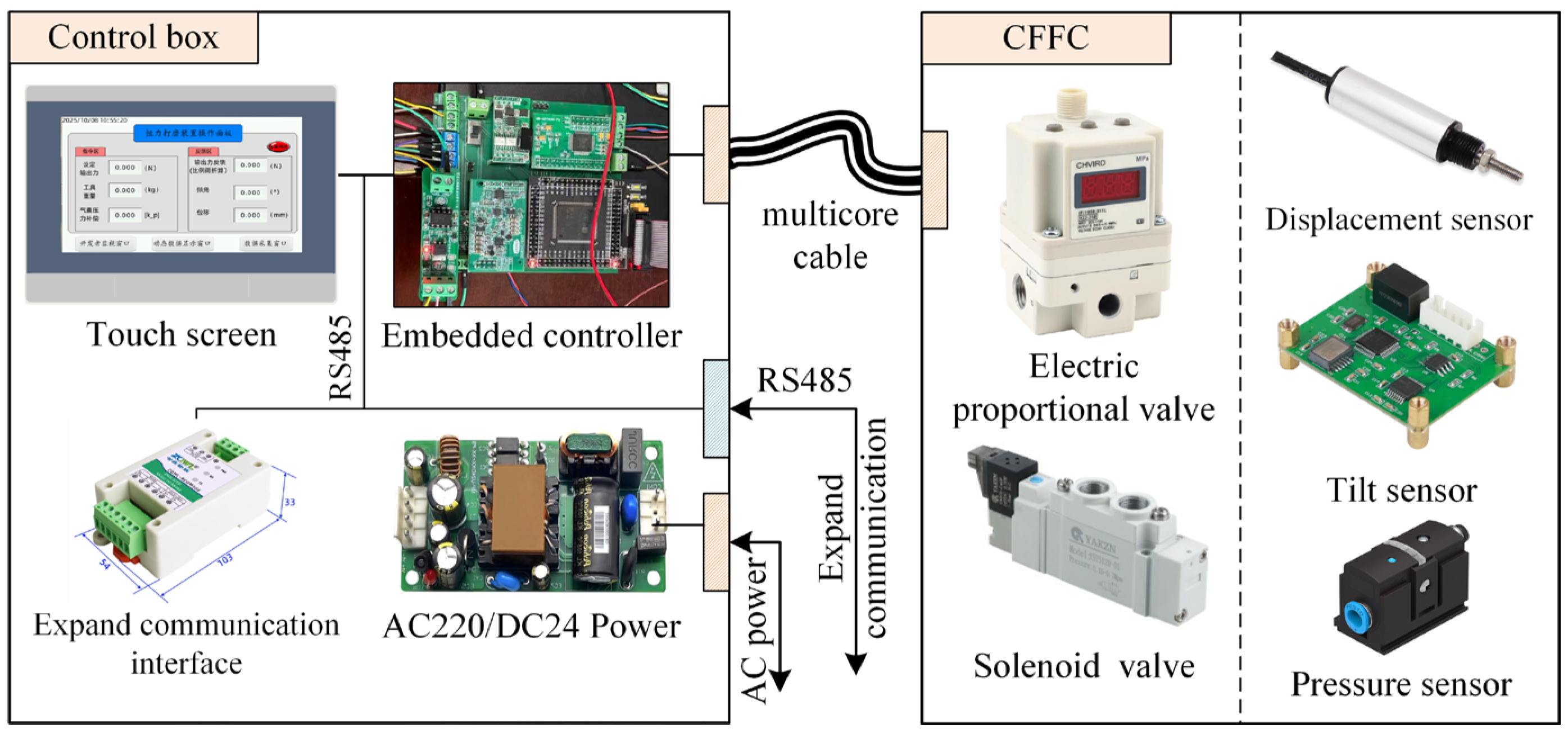
When performing grinding tasks, the CFFC inevitably has certain vibration problems. In order to avoid the relatively fragile control circuit from being damaged by vibration if integrated inside the CFFC, a mechanical and electrical separation design is adopted to separate the control circuit from the mechanical body of the CFFC, as shown in Figure 3. As an independent unit, the control box is developed with an embedded controller based on an STM32 chip, which includes four channels and an analog input function for collecting feedback signals from the displacement sensor, tilt sensor, and pressure sensor. The analog output function of two channels is used to send control voltage signals to the electrical proportional valve. One channel’s digital output function is used to control the solenoid valve. In addition, there are several digital input functions that serve as backup secondary development channels along with the aforementioned redundant channels.
In order to facilitate independent control of the output force and status feedback monitoring of the entire CFFC, a touch screen is adopted, mainly used for the design of the configuration interface, data acquisition, and storage, and ultimately achieves the HMI function. The operator can input the two core parameters of the target grinding force and tool weight through virtual buttons on the touch screen. The operation is very simple, and the CFFC status can be monitored during the grinding process through status feedback, the dynamic data display window, and data acquisition window. The selected data will also be saved according to the set sampling frequency. The RS485 communication protocol is adopted between the touch screen and embedded controller. The control box and CFFC mechanical body are quickly connected through a multi-core wire and aviation plug, enabling completely independent deployment and control. Considering the industrial grinding scenario, the CFFC needs to integrate with the user’s workstation control system to achieve remote automatic control. Therefore, an additional serial communication port is developed on the embedded controller, and communication interaction with the user control system is achieved by expanding the communication module.
The main components of the entire system are powered by DC24 V. Due to the low power consumption design of the entire system (<18 W), a 30 W AC-to-DC switching power supply is adopted. The electrical control components are all integrated into a control box, which only has multi-core wire plugs, user expansion communication interfaces, and AC power interfaces on the outside. The overall structure is compact and simple. The main electronic component models inside the control box and CFFC are shown in Table 2.

3. Mathematic Model of the CFFC

3.1. Pneumatic Model of Electrical Proportional Valve

The principle of an electrical proportional valve is to use two high-speed servo or solenoid valves to increase or decrease air pressure as needed to achieve pressure adjustments. It is a closed-loop system that essentially controls the coil current to generate electromagnetic forces of different sizes, thereby driving the valve core to move and, ultimately, controlling the air flow rate, completing the control of the cylinder output pressure [34]. Given the complexity of air flow states, in order to simplify the calculation and analysis of the dynamic and static characteristics of the pneumatic loading system, air compressibility, expansion, and viscosity are ignored. The working medium (air) is assumed to be ideal air, and atmospheric pressure, air source pressure, and exhaust pressure are assumed to remain constant. The kinetic and potential energy of the air and the pressure loss of the electromagnetic directional valve are ignored. Firstly, mathematical modeling is conducted on the electrical proportional valve to obtain the relationship between its mass flow rate, input voltage, and inlet and outlet pressures. We assume that the mass flow rate into or out of the electrical proportional valve is determined by the effective opening area of the valve and the upstream-to-downstream pressure ratio. Then, the air flow through the valve port of the electrical proportional valve is approximated as the one-dimensional isentropic flow of an ideal air through a contraction nozzle. Referring to the Sanville flow equation [26], the flow rate q v of the proportional valve can be obtained as follows:
q v = C q A v P v i 2 R T ψ P v o P v i = C q x v W P v i 2 R T ψ P v o P v i
where C q is the flow coefficient, A v = x v W is the opening area of the proportional valve, x v represents the displacement of its valve core, W is valve opening gradient, R = 9.31 J/(mol K) is the ideal air constant, T = 293 K is the absolute temperature of the air, and P v i and P v o are the inlet and outlet pressures of the proportional valve, respectively.
Due to the complexity and difficulty in the precise observation of air flow, the inflation chamber is generally considered to flow in a subsonic state, and the exhaust chamber is considered to flow in a supersonic state. At the same time, it is assumed that the valve opening areas of the two chambers are equal. Then,
ψ P v o P v i = r r 1 P v o P v i 2 / r P v o P v i ( r + 1 ) / r     0 . 528 < P v o P v i 1 2 r + 1 1 r 1 r r + 1           0 P v o P v i 0.528
where r is the adiabatic coefficient.
Based on experience, in actual grinding processes, in order to improve grinding accuracy and system stability, low grinding pressure and repeated grinding processes are often used. The required positive pressure for grinding is mostly below 100 N, and the outlet pressure of the electrical proportional valves is mostly between 0.01 and 0.5 MPa. Referring to Equation (2), due to the precise closed-loop control strategy adopted by the electric proportional valve, in an ideal state, the flow dynamics derived from Equations (1) and (2) can be approximately linearized as follows:
q ˙ v = K v u ˙ v + K b P ˙ v o
where K v is the gain controlled by the proportional valve amplifier, K b is the gain of the outlet air pressure and flow rate, and u v is the control analog voltage for the electrical proportional valve.

3.2. Dynamic Model of Cylinder Pressure

Referring to the pressure control circuit designed in Figure 1, theoretically, the compressed air flows completely into the cylinder after passing through the electrical proportional valve and solenoid valve. We assume that the air inside the cylinder is ideal air; the temperature and air source pressure changes during air flow are ignored. In addition, referring to the CFFC designed in Figure 2, due to the high integration of the actuator, extremely compact structure, and relatively short pipeline length from the air source to the cylinder, the slight pressure loss and state change in the compressed air in the pipeline can be ignored. However, it should be noted that due to the use of SMC’s low-friction cylinders, there is a clearance fit between the piston and cylinder body, resulting in significant internal leakage. According to the relevant specifications provided in the cylinder catalog from the SMC Corporation, the amount of internal leakage and the supply pressure of the cylinder can be approximated as follows:
q L = 9375   P d 2 + 156.25
where P d P v o is the driving side air pressure of the cylinder and q L is the internal leakage flow rate of the cylinder (unit: cm3/min). It is worth noting that since the operating pressures of the selected cylinder and electric proportional valve are 0.01–0.7 MPa and 0.005–0.9 MPa, respectively, the applicable range of Equation (4) is P v o [ 0.01 , 0.7 ]   MPa .
Therefore, the dynamic mass flow rate of internal leakage in the cylinder is
m ˙ L = ρ q L = P a b s q L R s T
where ρ is the air density, P a b s = P o + P v o is the absolute pressure, R s = R / m c is the specific air constant that can be approximated as 311 J/(K kg), and m c 0.029 kg/mol is the molar mass of the dry air, which is derived from experience.
The driving chamber volume of a cylinder is defined as follows:
V ( x ) = V 0 + A p Δ x p
where V is the volume of the cylinder’s drive-side chamber, V 0 is the initial volume, A p is the effective working area of the piston on the cylinder drive side, and x p [ 25 ,   25 ] is the piston displacement.
The equation for the state of an ideal air is as follows:
P a b s V = m R s T
where m = m i n m L is the net mass flow rate of the driving cylinder and m i n is the mass of air flowing into the cylinder, which is defined as follows:
m ˙ i n ρ q v
In the actual grinding process, the floating displacement of the cylinder is relatively small. The pressure fluctuation of the cylinder during the constant force grinding process is also relatively gentle. To simplify the problem, the temperature change in the air is ignored. Equation (7) is derived over time, and then combined with Equations (4)–(8); the pressure dynamic of the cylinder can be obtained as follows:
P ˙ v o = R s T m ˙ i n ( P o + P v o ) A p x ˙ p q L ( P o + P v o ) / V

3.3. Macro Dynamic Model of the CFFC

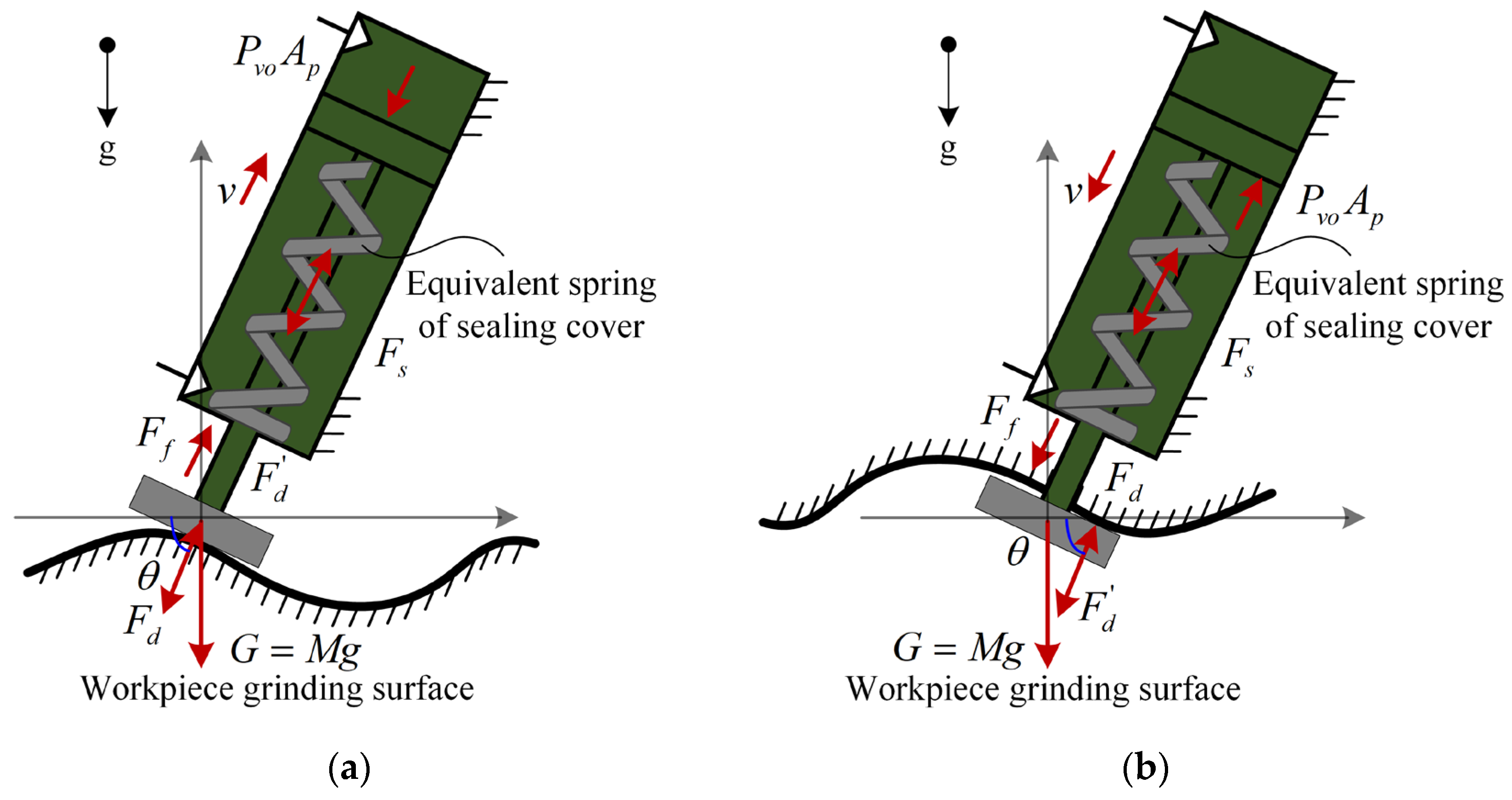
As shown in Figure 4, the force distribution of the entire CFFC can be equivalent to a scenario where a cylinder acts on the surface of a workpiece, where the role of the sealing cover is equivalent to an additional equivalent spring added to the cylinder. The stiffness of this spring is temporarily unknown and requires parameter identification. The influence of gravity on the output force of the compensator is constrained by the attitude (or inclination) of the constant force compensator, which will be discussed in detail in the next section. In addition, when the CFFC outwardly outputs force, it may be constrained by the geometric characteristics of the ground workpiece, the robot workspace, and the surrounding fixtures, and may be in either the extended or retracted working mode. However, the force application direction and the driving side of the cylinder are the main factors causing changes. The specific side of the cylinder driven by the piston needs to be analyzed in detail based on the influence of the gravity term.
According to Newton’s second law, the force balance of the CFFC is defined as follows:
P v o A p + M g sin θ F f F s = F d + M x ¨ p + B x ˙ p
where M is the equivalent floating motion mass of the piston rod, tool connection flange, guide rail, and grinding tool, θ is the angle measured by the tilt sensor, F f is the equivalent frictional force caused by moving parts such as cylinders and guide rails, F s is the equivalent elastic force of the sealing cover, F d is the grinding force or grinding contact reaction force output by the actuator, B is the viscous damping coefficient, and A p is the effective working area of the piston on the driving side of the cylinder, which can be defined as follows:
A p = A 1 , e x t e n d   w o r k i n g   m o d e A 2 , r e t r a c t   w o r k i n g   m o d e  
In the actual grinding process, when the end tool of the CFFC comes into contact with the workpiece, under the constraint of the undulating workpiece’s grinding surface, the CFFC must ensure a constant output force and the piston floating phenomenon will inevitably occur. This dynamic process is like using a spring to press against the surface of the ground workpiece, and the spring’s stiffness can be adjusted by controlling the driving air pressure. The reaction force generated is defined as follows:
F d = K a Δ x p
where K a is the equivalent stiffness of the compensator.

3.4. Transfer Function and System Characteristics of the CFFC

For industrial compressed air sources, the temperature fluctuation during normal operation is typically about ΔT ≤ 2∼4 °C. During actual continuous contact grinding, due to the constraints of the grinding parameters, the axial floating displacement and speed of the CFFC are often relatively small. According to grinding experience, under the condition of a floating stroke of 20 mm, the floating speed of the cylinder is less than 5 mm/s, and the temperature increase caused by its floating friction is slight. The corresponding air density fluctuation (from ideal gas) is about Δ ρ / ρ = Δ T / T 0.7 % 1 % . For the CFFC, the pressure fluctuations are mainly caused by fluctuations in the air source pressure and pressure control response of the proportional valve. The air source pressure Pvi, normally varies within ±5%. Sensitivity analysis of the derived transfer function is about G ( s ) Δ P v i / P v i < 1 % , which means that ±5% pressure ripple causes <1% variation in the system gain. If an independent air source is used, this fluctuation will be smaller. In order to quantitatively analyze the pneumatic valve-controlled cylinder system mentioned above, reveal the inherent dynamic characteristics of the system, and design a reliable force controller with targeted design, the slight disturbances of the system (such as small fluctuations in density, temperature, and pressure, etc.) are temporarily ignored, which will be compensated by the controller, and the system transfer function is derived. Referring to Equation (3), the Laplace transform form of the flow pressure dynamic of the electrical proportional valve can be obtained as
Q v ( s ) = K v U ( s ) + K b P ( s )
Regarding cylinder dynamics, taking the derivative of Equation (4) on the input air pressure P v o yields a linearized internal leakage of the cylinder in a small amount of time. Assuming V V 0 in a small amount of time, linearization of small disturbances yields the following:
Δ m ˙ L ( t ) = C L Δ P ( t )
where the instantaneous steady-state constant C L is as follows:
C L = P a b s 0 d q L d P 0 + q L 0 R s T
Performing the Laplace transform on the pressure dynamic equation (Equation (9)) of the cylinder yields the following:
P ( s ) = P a b s 0 V 0 K v U ( s ) + K b P ( s ) R s T V 0 s C L P ( s ) P a b s 0 A p V 0 X ( s )
Simplifying it to obtain the transmission relationship between cylinder pressure, electrical proportional valve voltage, and cylinder displacement yields the following:
P ( s ) = α s U ( s ) k s X ( s ) ( 1 β ) s + γ
where the instantaneous steady-state constant term is defined as follows:
α = P a b s 0 K v / V 0 k = P a b s 0 A p / V 0 β = P a b s 0 K b / V 0 γ = R s T C L / V 0
Regarding the dynamic process of the entire CFFC, the elastic effects of gravity, friction, and sealing cover in Equation (10) are taken as the lumped disturbance D(s), and its Laplace transform is obtained as
F d ( s ) = A p P ( s ) ( M s 2 + B s ) X ( s ) + D ( s )
Obviously, when approaching the steady state, when the end of the CFFC is restricted (e.g., Δ x p = 0 ), or when the passive floating (x) during grinding is considered as a disturbance component, the inertia and damping terms of the CFFC can be ignored. Therefore, the transfer function between its output force and the output air pressure of the electric proportional valve is as follows:
F d ( s ) P ( s ) A p
Then, Equation (17) degenerates into a first-order system:
P ( s ) U ( s ) = α s ( 1 β ) s + γ
Under approximate steady state, the overall transfer function of the system is as follows:
F d ( s ) U ( s ) A p P ( s ) U ( s ) = A p α s ( 1 β ) s + γ
In the constant force grinding process of the CFFC, if the surfaces being ground are complex with significant fluctuations, there will inevitably be significant passive floating dynamics in the CFFC. Therefore, the Laplace transform of Equation (12) is as follows:
F d ( s ) = K a X ( s )
After combining the above equations, the transfer function of the system during the dynamic grinding process is obtained as follows:
F d ( s ) U ( s ) = K a A p α s ( 1 β ) M s 3 + ( 1 β ) B s 2 + ( 1 β ) K a + γ M + k A p s + γ ( B + K a )
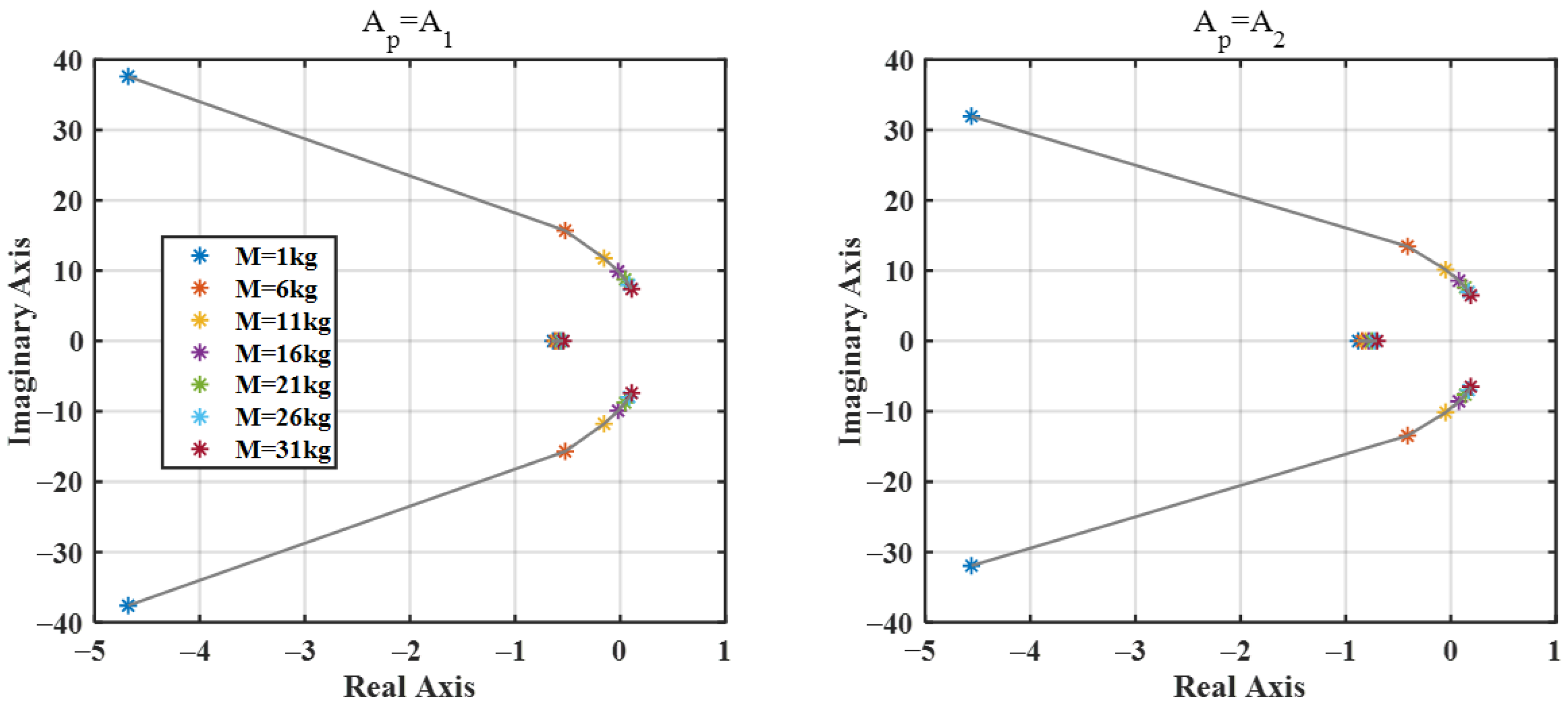
Then, the entire system is equivalent to a second-order mechanical system consisting of mass–spring–damping, connected in series with a first-order aerodynamic hysteresis system, where the natural frequency of the mechanical system is ω n = K a / M . The delay frequency of the pneumatic system is ω a = γ / ( 1 β ) . As shown in Figure 5, it is evident that the system has one zero point and three poles. Since the pressure feedback coefficient of the proportional valve β is less than one and the cylinder leakage coefficient γ is positive, the open-loop system tends to be stable. However, if the internal leakage of the cylinder is relatively large compared to its maximum chamber volume, and the CFFC end tool is too heavy, whether in its extended working mode ( A p = A 1 ) or retracted working mode ( A p = A 2 ), a pair of conjugate poles of the system will move towards the right half of the complex plane. If load is too heavy, the CFFC may become unstable.
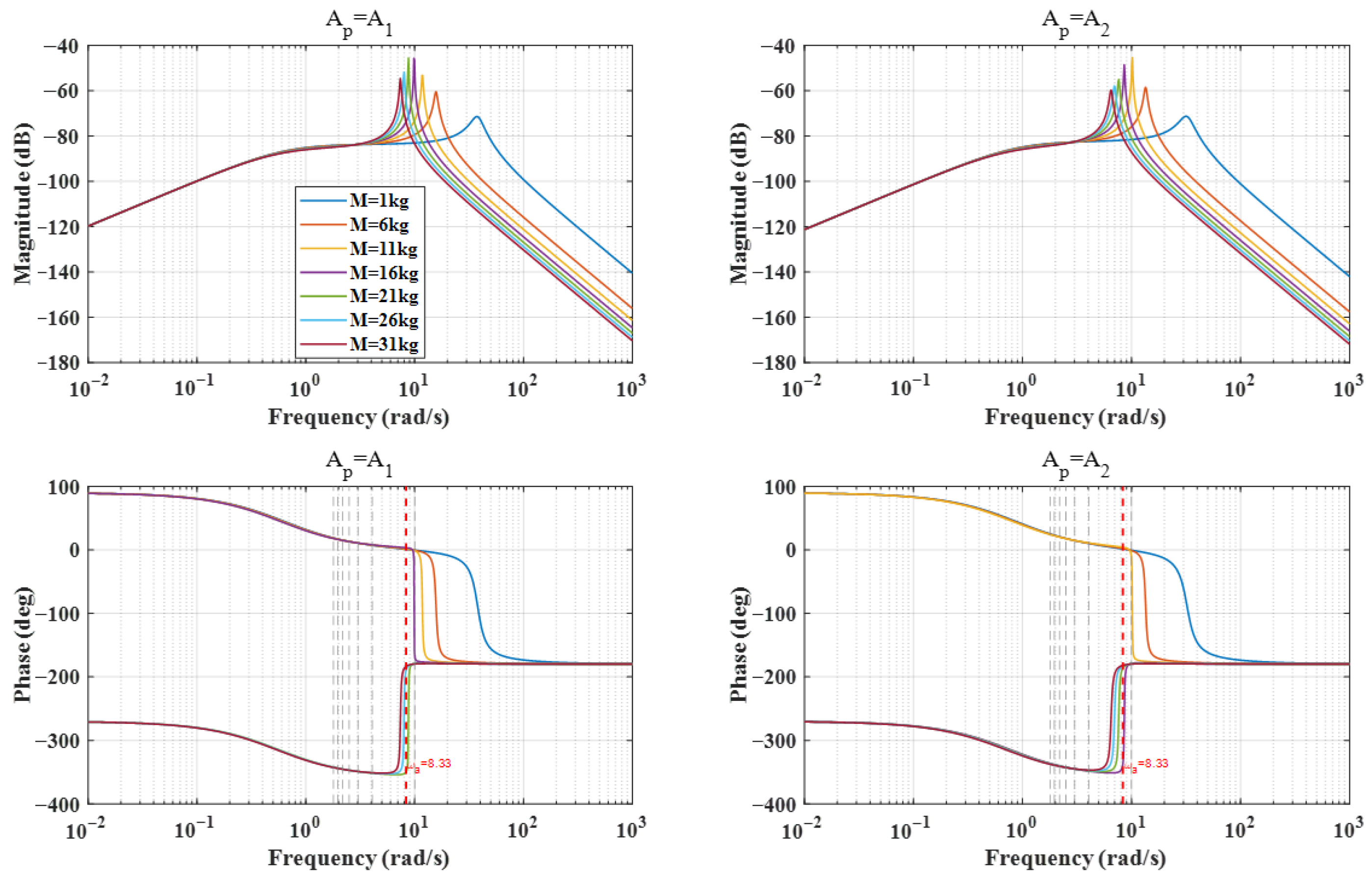
As shown in Figure 6, with the increase in load, the mechanical resonance frequency of the system gradually decreases. In the low-frequency range, the cylinder’s output force can accurately follow the input, which is the main working range for constant force grinding and slow displacement scenarios. But with the increase in load, mechanical inertia increases and aerodynamic delay is significant. The floating compensation of the CFFC has phase lag and it is necessary to introduce gravity compensation in a timely manner in the controller’s design, and it is even necessary to implement feedforward compensation. In the mid-frequency range, the amplitude begins to decrease, the slope increases, and the effects of aerodynamic delay and mechanical inertia increase. When the frequency exceeds the aerodynamic delay frequency ω a , the aerodynamic delay part will limit the response speed. In the high-frequency range, the amplitude rapidly decreases, and the CFFC system cannot respond quickly to high-speed disturbances, indicating its strong ability to suppress high-frequency interference. This is a natural low-pass filter for grinding or vibration noise, and the fundamental reason is the delay effect of the pneumatic link. However, the phase margin is insufficient, and oscillation is prone to occur if using high-frequency closed-loop control. To avoid this working range, the closed-loop force control bandwidth should be designed as small as possible within the range of min ( ω a , ω n ) .

4. Controller Design for CFFC

4.1. Analysis of Adverse Factors for Force Control

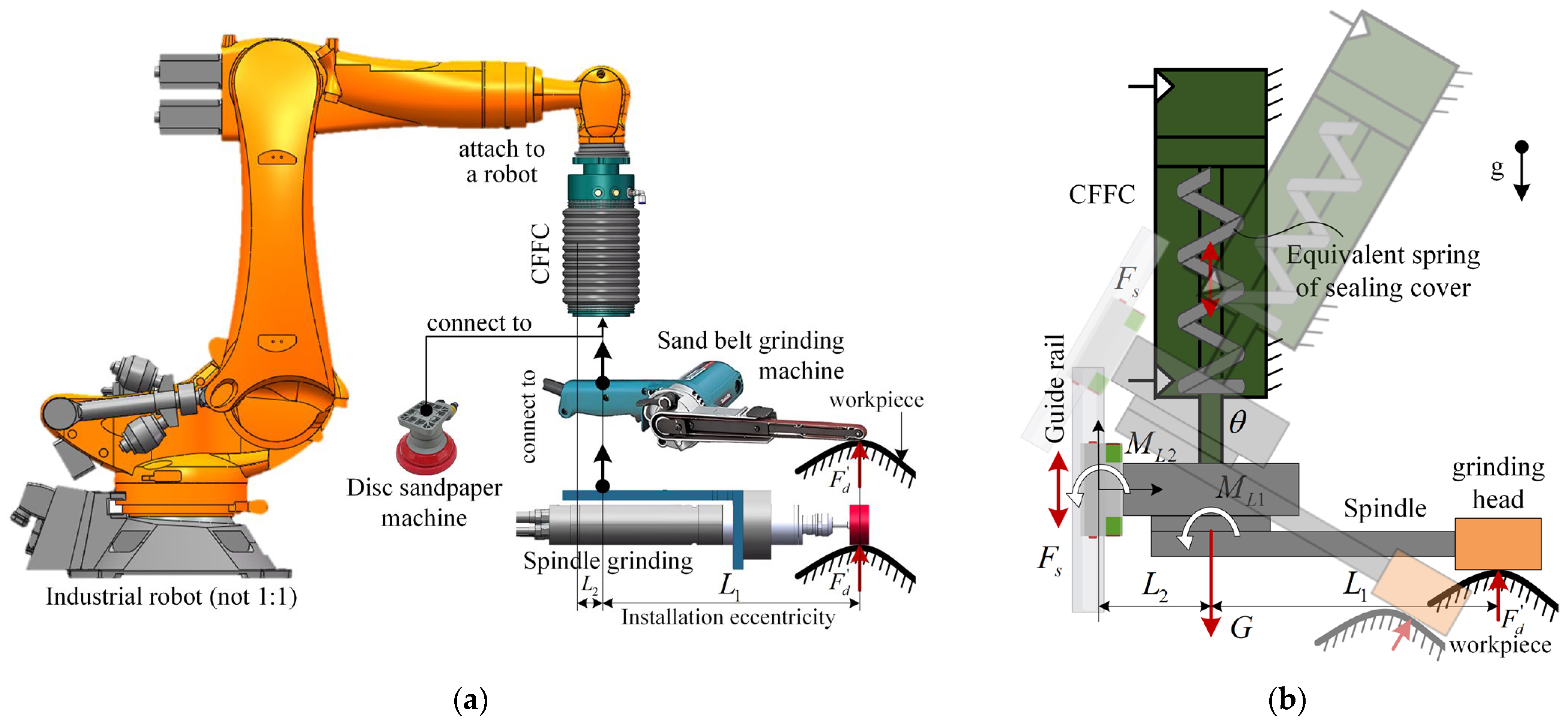
From the perspective of precise control of the grinding force, if the friction of the CFFC’s motion pair is lower, the weight of the moving parts and tools is lighter, and the grinding contact force is more collinear with the guide rail, then the grinding force control will be simpler, more stable, and more accurate. As shown in Figure 7a, in many cases, the CFFC is often installed at the end of a robot, where the grinding parts are fixedly installed on a base. Of course, there are also some cases where the relative installation positions of the CFFC and parts are exactly opposite. In practical engineering applications, the CFFC’s end grinding tools mainly include disk pneumatic sandpaper machines, sand belt grinding machines, spindle-shaped grinding machines, or other customized tools. As the shape of the workpiece being ground becomes increasingly complex (narrow spaces and curved surfaces, etc.), the grinding surface becomes more refined, and the application of sand belt grinding machines and spindle-type grinding machines becomes more and more widespread [10]. To avoid interference or meet the accessibility of narrow spaces, it is often necessary to use a grinding head with a relatively long overhang length L1, resulting from the installation eccentricity to contact the surface of a workpiece.
However, as shown in Figure 7b, if these two long-handled grinding tools are eccentrically installed at the end of the CFFC, it often leads to the formation of a force arm L 1 , between the grinding contact force and the axis of the CFFC and the guide rail L 2 , which in turn causes the guide rail to experience eccentric torque, resulting in significant friction. The CFFC device itself has inevitable friction, mainly caused by the installation parallelism errors of components such as cylinders and guide rails. The guide rails themselves also have significant friction. It is worth noting that due to the floating hinge connection between the end of the cylinder’s piston rod and the tool connection flange, and the low-friction type of the cylinder, the motion friction of the cylinder component can be ignored. For robot grinding, the CFFC is often integrated at the end of the robot. In order to avoid interference between the size of the robot’s body and the workpiece being ground, the CFFC is often installed horizontally. Sometimes, the installation suspension length of the grinding tool along the radial flange at the end of the robot is increased as much as possible. This further increases the eccentric torque on the guide rail, which is unfavorable for the uniformity of force and service life of the guide rail.
The CFFC device itself has inevitable friction, mainly caused by the installation parallelism errors of components such as cylinders and guide rails, and the guide rails themselves also have significant frictional forces. In order to resist this unavoidable eccentric moment, the rated load of the guide rail and the strength of the tool connection flange must be sufficiently large, which results in a large self-weight of the moving parts of the CFFC. The interface flange required for the long-handled grinding tool is also relatively complex, which further increases the weight of the end moving parts. Robots equipped with CFFCs often experience drastic pose changes when performing complex part grinding operations, with the disturbance of gravity on the grinding force being particularly prominent and having a certain degree of uncertainty. In addition, in order to adapt to the increasingly complex shapes of workpiece grinding surfaces, reduce the difficulty of robot grinding path planning, and minimize the risk of hard overtravel contact during grinding contact, the floating stroke of the CFFC is designed to be as large as possible. This leads to a more pronounced spring effect of the sealing cover with the increase in floating stroke, which is also a disturbance factor for precise grinding force control. Furthermore, the contact force of the end tool during grinding is often determined by the user’s on-site conditions and grinding process relative to the force arm of the guide rail, making it difficult to accurately calibrate.
The nonlinear tool loading characteristics mentioned above have a direct impact on the controller’s design in actual machining. Due to the interference caused by eccentric torque, friction changes, and gravity constantly changing with the robot’s posture and tool direction, the effective equipment dynamics of the CFFC become very time-varying and difficult to parameterize using a fixed linear model. This leads to significant uncertainty in the steady-state force pressure mapping and transient response. In this case, when the tool load changes, controllers that rely solely on precise model recognition or fixed gains may exhibit decreased robustness, increased overshoot, or instability. Therefore, the force control strategy must include anti-interference, real-time adaptability to friction changes, and insensitivity to structural nonlinearity. These requirements will naturally guide people to choose a control architecture that clearly estimates and compensates for unknown disturbances, while maintaining a simple implementation suitable for embedded pneumatic actuators. This consideration forms the basis for the controller design in the next section.

4.2. Dual-Loop Force Controller Based on ADRC

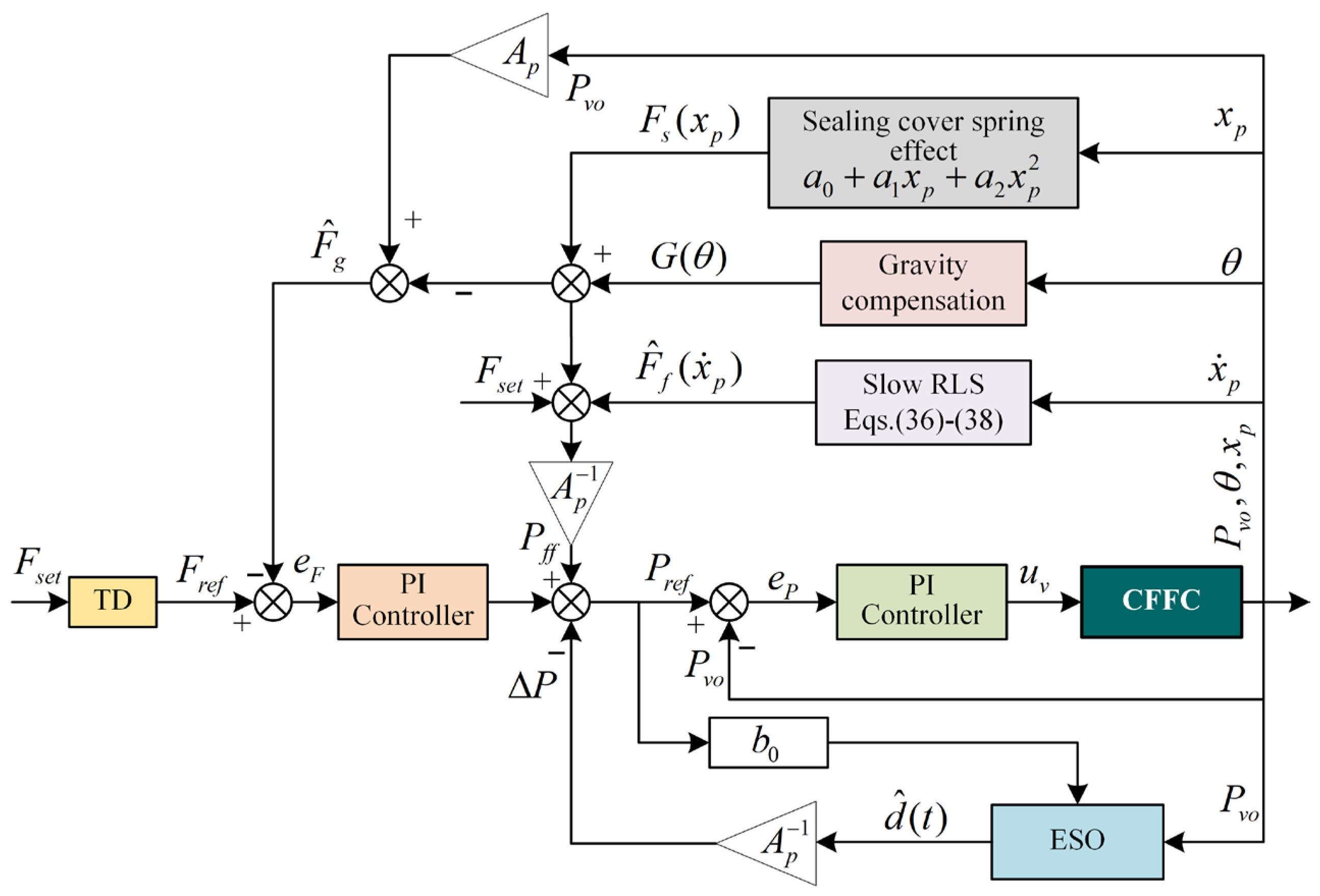
According to the above analysis, the overall control objective is to adjust the proportional valve voltage u v ( t ) , to ensure that the cylinder output force F d ( t ) , stably tracks the desired set force F s e t ( t ) . Considering the characteristics of the grinding process, this desired set force is usually a slow or step signal, and a closed-loop controller needs to be designed to enable the system to stably track the set force even in the presence of gravity, friction, sealing springs, unmodeled dynamics, and contact uncertainties. The gravity effect of the grinding system can be compensated by offline calibration and online measurement of the tilt sensor. The spring effect of the sealing cover can be measured and fitted through offline experiments for feedforward compensation. However, the friction force of the system is highly uncertain due to the constraints of the robot’s grinding posture and tool installation suspension length, and there are certain errors in gravity compensation and sealing cover spring effect compensation. These errors, friction, unmodeled dynamics, and uncertain travel fluctuations during the contact process (which can be observed through the displacement sensor) are equivalent to a total disturbance of the system. In addition, considering the feasibility of engineering applications, the designed controller must be able to run stably on an embedded controller based on STM32. Therefore, this paper proposes to use a combination of active disturbance rejection control and PID control to address these uncertain disturbances. For the convenience of control design, the force domain is used as the outer-loop’s control variable (i.e., the output force is the target of the outer loop), and the actual measurable pressure is used as the inner-loop’s control variable. The above uncertain terms and unmodeled dynamics are regarded as lumped disturbance terms. Furthermore, the complex third-order system is reduced to an equivalent second-order form.
From the perspective of the grinding process, the low-frequency dynamics of the CFFC’s mechanical system often dominate. Therefore, Equation (10) can be approximated as a static force status:
F d P v o A p + G F f F s
where G = M g sin θ is the gravity along the axis of the cylinder.
Despite the inherent nonlinearity of pneumatic systems due to compressible flow and valve orifice characteristics, pressure changes in the focused constant force grinding task remain within a relatively narrow operating region around the nominal chamber pressure. In this case, the effective bulk modulus and flow pressure gain of the proportional valve exhibit quasi linear behavior, which makes the first-order approximation sufficiently accurate for controller synthesis. Similar linearization-based modeling methods have been widely adopted in recent studies [26,34,39]. In addition, any residual nonlinearity or flow-induced interferences will be compensated by the controller. Therefore, referring to Equation (17), the pressure dynamics of the pneumatic subsystem can be linearized in the time domain (small disturbance) as a first-order approximation:
τ a P ˙ v o + P v o = K p v u v + w p ( t )
where τ a is the aerodynamic time constant, which can be calibrated by ( 1 β ) / γ ; K p v is the static gain of pressure on voltage (including constants and, etc.); and w p ( t ) is the disturbance term caused by piston displacement coupling and leakage, which will be estimated and compensated by an extended state observer (ESO).
As shown in Figure 8, a control architecture consisting of a cascaded dual-loop, active disturbance rejection control (ADRC) and slow recursive least square (RLS) friction identification is designed as a whole. The outer-loop control mainly calculates the pressure correction term Δ P , of the cylinder for grinding force control, including the feedforward term of the gravity G ( θ ) , the sealing cover spring effect F s ( x p ) , and the friction estimation F ^ f ( x ˙ p ) output by slow RLSs, which is converted into the total feedforward pressure P f f . We embed an ESO in the outer loop to estimate and compensate for merged disturbances (primarily for residual disturbances in the outer loop). The inner-loop control is mainly based on the pressure loop of the PI controller, which is used to track the reference pressure P r e f = P f f + Δ P and convert it into the reference control voltage u v . To ensure the system’s response speed, the inner-loop speed is faster than the outer-loop speed, and the bandwidth is about 5–10 times that of the outer loop. The reference tracking differentiator (TD) generates a smooth reference and estimated derivative for F s e t (used in state feedback or ESO design to avoid direct differential amplification noise).

4.2.1. Design of Tracking Differentiator (TD)

TDs are commonly used in ADRC to generate a smooth reference signal r 1 ( t ) and its derivative r 2 ( t ) . TDs are beneficial in avoiding overshoot caused by step reference directly entering the high-bandwidth closed loop and can extract differential signals well. They can also arrange transition processes for signals with sudden changes. In engineering applications, first-order or second-order smoothing filters are commonly used, which can be replaced by low-pass filters or second-order filters when there are limited resources. Based on the aerodynamic control system presented above, a second-order tracking differentiator is designed as follows [39]:
r ˙ 1 = r 2 r ˙ 2 = α 1 sign ( r 1 F s e t ) α 2 ( r 2 0 )
where α 1 and α 2 are the design bandwidth parameters of the TD, also known as the signal acceleration factor and damping factor.

4.2.2. Design of Extended State Observer (ESO)

The ESO is used to estimate the total disturbance of the controlled variable. In order to reduce costs and facilitate engineering deployment, the proposed CFFC measures the pressure changes on the cylinder drive side through an air pressure sensor at the end and indirectly estimates the grinding contact force of the end tool, which has certain errors. Therefore, for the estimation of the outer-loop grinding force, the ESO is designed to estimate the total disturbance in the force domain, including unmeasured friction residuals and unmodeled dynamics, etc. Assume that the controlled variable y = F d in the outer loop approximately satisfies the following:
y ¨ = b 0 u p + d ( t )
where b 0 is the gain coefficient, u p is the pressure reference input implemented by the inner loop, and d ( t ) is the combined disturbance.
Define the state variables, x 1 = y , x 2 = y ˙ , construct the extended state x 3 = d ( t ) , and a second-order state observer can be designed as follows:
x ^ ˙ 1 = x ^ 2 + β 1 ( y x ^ 1 ) x ^ ˙ 2 = x ^ 3 + b 0 u p + β 2 ( y x ^ 1 ) x ^ ˙ 3 = β 3 ( y x ^ 1 )
where β i is the bandwidth gain of the observer, which is usually parameterized as β 1 = 3 ω o , β 2 = 3 ω o 2 , β 3 = ω o 3 , where ω o is the observer bandwidth.

4.2.3. Design of Dual-Loop PI Controller

Considering the feasibility of the controller running on an STM32-based MCU while avoiding the complex parameter tuning of nonlinear feedback laws, the nonlinear state error feedback in ADRC is replaced by approximately linear PI control. For the bottom layer of the force control of the outer loop, a basic PI control is designed as follows:
Δ P ( t ) = k p F e F ( t ) + 1 T i F 0 t e F ( τ ) d τ
where T i F is the operating cycle and the force following deviation is as follows:
e F ( t ) = F s e t F ^ g
where F ^ g is the estimated value after the pressure sensor:
F ^ g = P v o A p G + F ^ s ( x p )
Compensate for the generation of reference pressure in the inner loop based on ESO observations:
P r e f = P f f + Δ P d ^ ( t ) / A p
The feedforward term is as follows:
P f f ( t ) = F s e t G ( θ ) + F ^ s ( x p ) + F ^ f / A p
where F ^ f is the friction force that needs to be estimated and F ^ s ( x p ) is the fitted sealing cover spring effect.
Assuming that the guide rail slider of the CFFC is the main source of friction, a simplified form of Coulomb friction and viscosity model is adopted [38]:
F f ( x ˙ p ) F c sign ( x ˙ p ) + b v x ˙ p
where F c is the Coulomb friction coefficient and b v is the viscous friction coefficient.
After linearization, it yields the following:
F f ( x ˙ p ) ξ 1 sign ( x ˙ p ) + ξ 2 x ˙ p
where ξ = [ ξ 1 , ξ 2 ] T is the parameter to be estimated.
Take the estimation error of grinding force as a reference, and assume that the measurement equation is
y k = ϕ k T ξ + ε k
where y k = F ^ d G ( θ ) F ^ s ( x p ) , F ^ f = ϕ T ξ k can be used as part of the outer-loop feedforward compensation.
The updated law of the RLS is as follows:
K k = P k 1 ϕ k / λ + ϕ k T P k 1 ϕ k ξ k = ξ k 1 + K k ( y k ϕ k T ξ k 1 ) P k = ( P k 1 K k ϕ k T P k 1 ϕ k ) / λ
where λ is the forgetting factor.
For the pressure of the inner loop, its first-order inertia characteristics are obvious. Thus, a basic PI control is adopted to ensure the stable and fast response of air pressure:
u v = k p P e P ( t ) + 1 T i P 0 t e P ( τ ) d τ
where e P ( t ) = P r e f P v o .
To further clarify the implementation of the controller, as shown in Algorithm 1, the control logic is summarized in the form of pseudocode. Although the previous block diagram and mathematical formulas describe the controller’s structure, the pseudocode below provides a step-by-step representation of the actual calculation process performed at each sampling moment, which also provides a reference for practical implementation in digital control systems.
Algorithm 1. ADRC-based Dual-Loop (DL-ADRC) Force Control.
Inputs: F_set[k], P_vo[k], x_p[k], theta[k], Ts
Outputs: u_v[k]
1. Initialization: TD states (r1, r2), ESO states (x1, x2, x3), and PI integrals (e_F, e_P).
2. For k = 0, 1, 2, … do
3.//Tracking Differentiator (TD)
 Update r1[k+1], r2[k+1] from r1[k], r2[k], F_set[k] for reference generation.
4.//Force estimation and gravity compensation
 F_hat[k] ← x1[k] − G(theta[k]).
5.//Outer-loop force error
 e_F[k] ← r1[k] − F_hat[k].
6.//Outer-loop PI
 P_ref[k] ← Kpf × e_F[k] + Kif × (e_F accumulated).
7.//Inner-loop pressure error
 e_P[k] ← P_ref[k] − P_vo[k].
8.//Pressure PI
 u_PI[k] ← Kpp × e_P[k] + Kip × (e_P accumulated).
9.//ESO (inner-loop disturbance observer)
 Update x1[k], x2[k], x3[k] using x_p[k] and u_PI[k].
10.//Disturbance compensation
 u_v[k] ← u_PI[k] − x3[k]/b0.
11.//Saturation
 u_v[k] ← clamp(u_v[k], u_min, u_max).
12. Update all states and integrals.
13. END For
14. Return u_v[k].
For the sake of clarity on the compensation of the controller, Table 3 summarizes the main disturbances that affect the grinding force. Each type of disturbance and its compensation mechanism in the proposed dual-loop ADRC controller is listed to help illustrate the overall handling structure.

4.3. Simulation Analysis for the CFFC

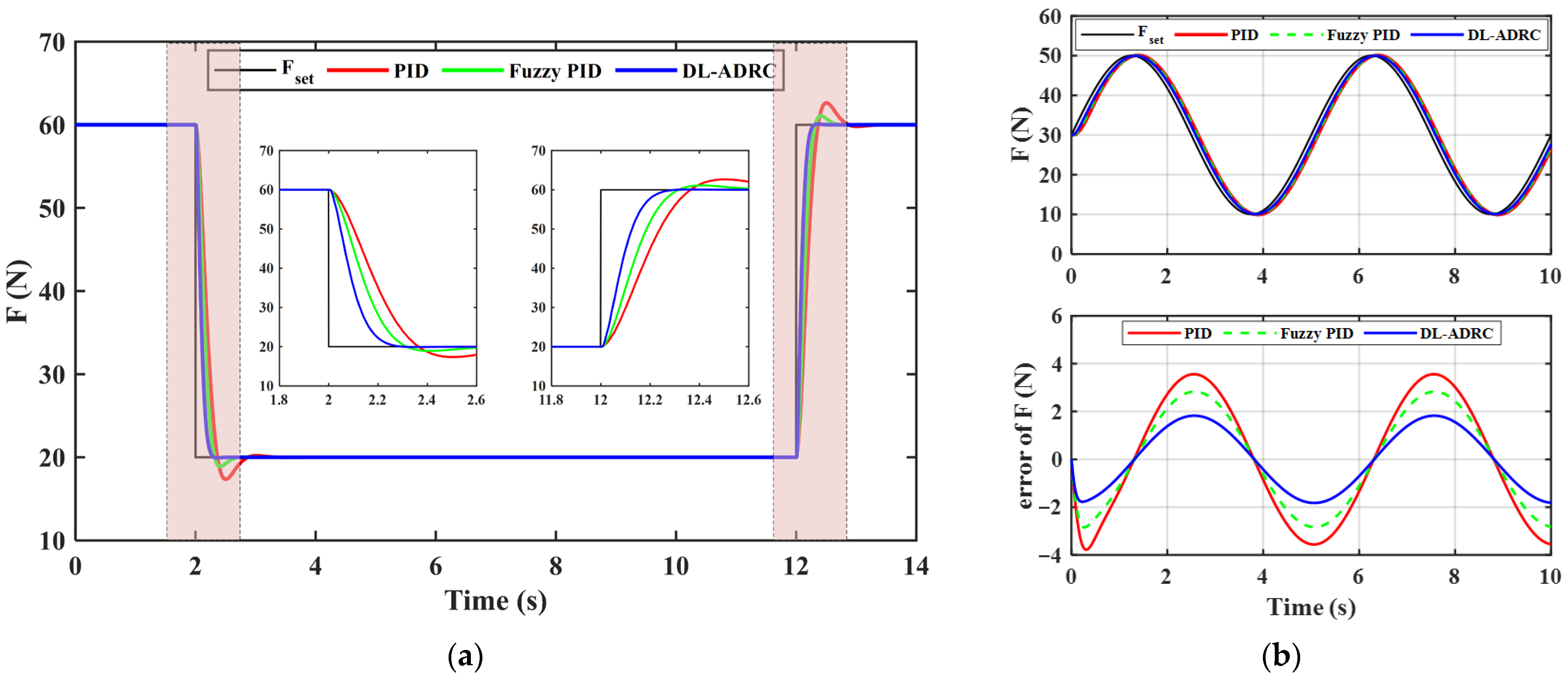
To evaluate the performance of the established pneumatic model and controller, PID and fuzzy PID controllers are selected for simulation comparison with the proposed DL-ADRC. As shown in Figure 9a, in response to a step signal with a bidirectional amplitude of 40 N, all three controllers can reach the set force. However, in terms of response sensitivity, taking the step response of the falling edge as an example, the DL-ADRC controller surpasses the other two controllers by about 0.066 s and 0.126 s, respectively. The response speed of DL-ADRC controller is also fast, and the rise time is shortened by about 0.065 s and 0.127 s compared to the PID and fuzzy PID controllers, respectively. During the adjustment process, the overshoot of the DL-ADRC controller is slight (0.21%), but the overshoots of the PID and fuzzy PID controllers are about 6.61% and 2.71%, respectively, and the adjustment time is significantly longer than that of DL-ADRC controller. Due to the integration part, the steady-state errors of all three controllers are close to zero. In the step response of the rising edge, it has similar response characteristics.
As shown in Figure 9b, in the tracking of a sine signal with an amplitude of 30 N and a frequency of 0.2 Hz, all three controllers can smoothly follow the command signal, but show a certain degree of following lag. The lag of the DL-ADRC controller is smaller than that of the fuzzy PID controller, and the lag of the fuzzy PID controller is smaller than that of the PID controller. The maximum tracking error of the PID controller is 3.78 N and the average error is 2.52 N. The maximum tracking error of the fuzzy PID controller is 2.84 N and the average error is 1.98 N. The maximum tracking error of the DL-ADRC controller is 1.83 N and the average error is 1.28 N.
Obviously, among the three controllers, the DL-ADRC controller has the best comprehensive force control regulation performance.

5. Prototype and Experiments

5.1. Experimental Condition Configuration

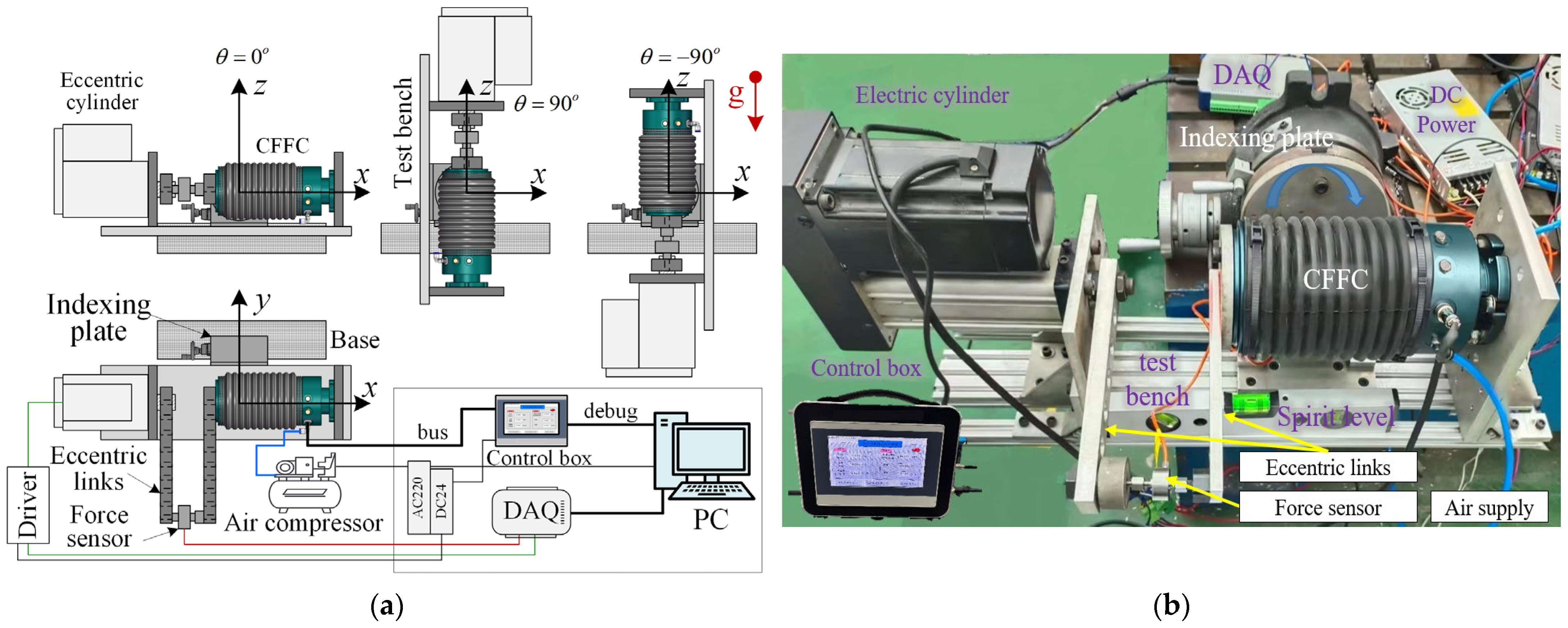
In order to comprehensively evaluate the performance of the designed CFFC, a testing platform, as shown in Figure 10, is built, which consists of a high-precision rotary indexing plate, an electric cylinder, and accessories. The CFFC and electric cylinder are installed on the test bench, with adjustable eccentric links and a force sensor connected in the middle. The test bench adopts industrial aluminum profiles, which can easily adjust the installation distance between the electric cylinder and the CFFC and facilitate the addition of mass blocks (simulating tool weight) at the end of the CFFC. It should be noted that in order to simulate the contact process during actual grinding, one end of the force sensor is only constrained on the side of the eccentric link. The eccentric link is designed to simulate and test the constant force control effect when different suspension length grinding tools are installed at the end of the CFFC. In order to simulate the passive stretching and floating effects caused by surface undulations of the workpiece during actual grinding processes, the electric cylinder is controlled to perform reciprocating loading on the CFFC. We compare the actual output force measured by the force sensor with the command force. The platform is installed as a whole on a high-precision rotating indexing plate, and the force control characteristics of the CFFC are tested on ±90° attitude to verify the effectiveness of its gravity compensation method. The control and data of the CFFC are completed by its control box, while the control and data of peripheral testing components such as the electric cylinder and force sensor are completed by the data acquisition card. Before each experiment, basic parameters such as tool (or load) weight, sampling frequency, and setting force can be written into the touch screen, and the control box can independently adjust the CFFC. Some key performance parameters of the CFFC are shown in Table 4.

5.2. Controller Parameters Tuning

The parameter-tuning steps of the controller follow the inner loop first, then the outer loop, followed by ESO parameters, and then RLS parameters. Each step is based on step or disturbance experiments combined with frequency or time-domain observations.
(1)
To ensure high speed and stable pressure tracking in the inner loop, the bandwidth of the controller can be set to ω c = 20   rad / s . The inner-loop bandwidth is set to ω p 5 10 ω c = 100 200   rad / s . The PI controller of the pressure loop shown in Figure 8 is initialized to k p P = 1.8 , T i P = 0.015 . We performed a step response to avoid excessive noise until the response time reaches the expected value (about 1 / ω p ), overshoot < 10%, and steady-state error < 0.1 bar. The inner loop PI parameters are finally tuned to k p P = 2.33 , T i P = 0.024 . Meanwhile, apply a small step current command Δ u v , record the pressure increment Δ P v o , and preliminarily determine the initial parameter of the ESO as b 0 = 0.5 Δ P v o / Δ u v .
(2)
The parameters of the force loop PI controller shown in Figure 8 are initialized to k p F = ω c 2 = 400 , T i F 1 / ω c = 0.05 . Note that at this point, the estimation of total disturbance d ( t ) by the ESO should be turned off, that is, temporarily set to β 1 = β 2 = β 3 = 0 . Due to differences in design, installation, and other factors, if there is significant overshoot or oscillation in the response, a certain differential needs to be introduced, and the differential gain can refer to k d F = 2 ω c = 40 . The tuning goal is still to make the output force response time close to 1 / ω p , with minimal overshoot and no low-frequency oscillations.
(3)
Enable the ESO and set ω o = 4 6 ω c = 80 120   rad / s . Apply a small step signal to observe whether the transition of z 3 is reasonable. If the response of z 3 is slow, increase ω o appropriately. If z 3 contains a large amount of high-frequency noise or jitter, reduce ω o or even introduce a filter. In the end, the gain of ESO follows β 1 = 3 ω o , β 2 = 3 ω o 2 , β 3 = ω o 3 . Furthermore, the input gain b 0 can be refined, following the principle of reducing b 0 if the pressure response overshoot is too large and, finally, set b 0 = 0.62 .
(4)
Introducing the feedforward compensation, the key parameters of RLSs are initialized to P 0 = 2000 , λ = 0.95 . Then, in several floating runs of the CFFC, the convergence behavior of parameter ξ is observed. If the convergence is slow, the forgetting factors of λ or P 0 can be reduced. If oscillation occurs, a low-pass filter can be introduced, and the final tuning result of this experiment is P 0 = 1455 , λ = 0.975 .

5.3. Basic Performance Testing

5.3.1. Frequency Response Test

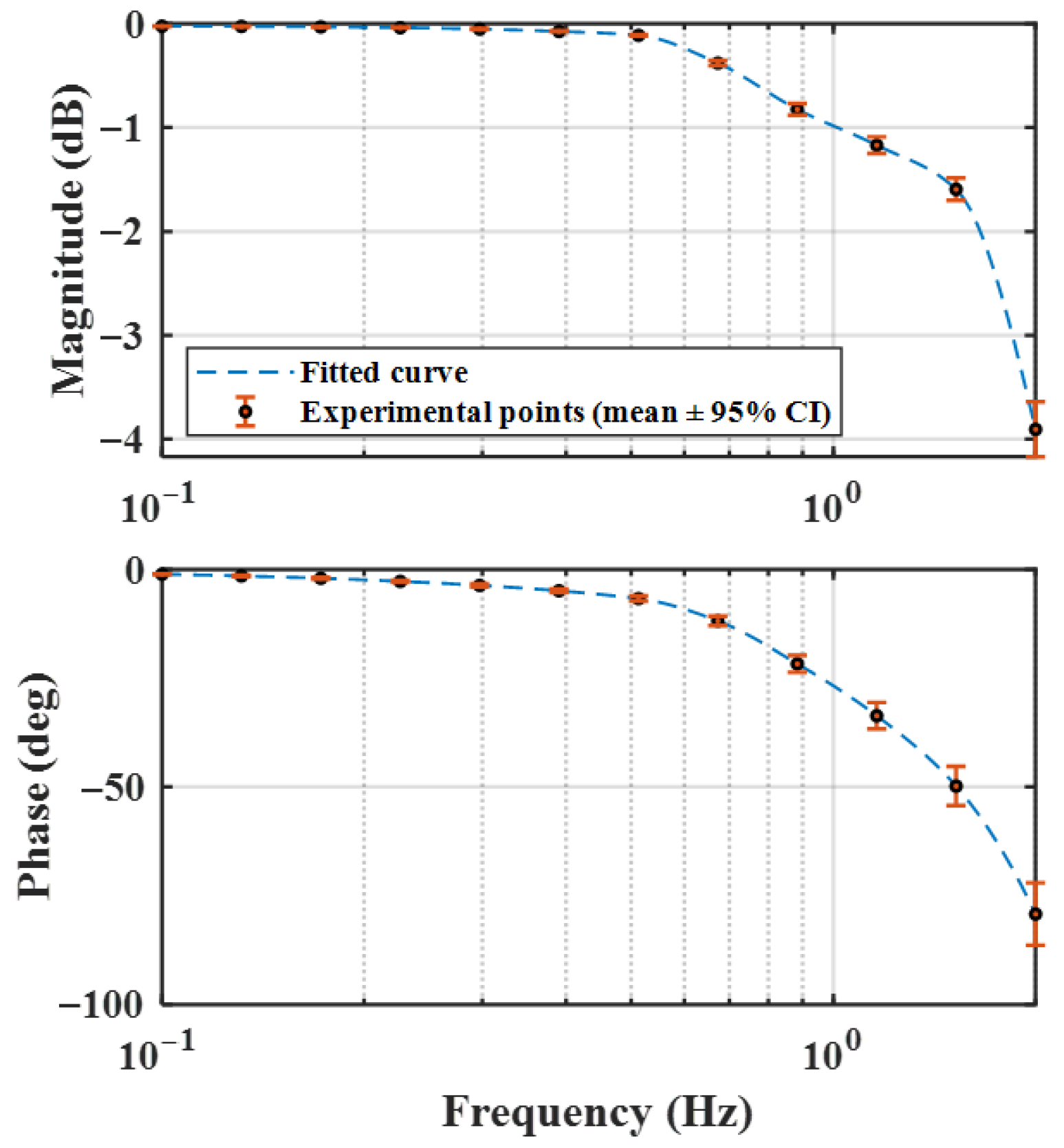
To evaluate the dynamic behavior of the CFFC and support the analysis of dynamic errors, a frequency response experiment is conducted. During the test, the tool connection flange of the CFFC is mechanically fixed to eliminate displacement, and a sinusoidal voltage signal is applied to the system with a pointwise frequency sweep from 0.1 to 2 Hz, which covers the effective bandwidth of the pneumatic system in grinding applications. The supply pressure is set to 5 bar and the input voltage amplitude is ±2 V. For each frequency, three repeated experiments are performed after steady-state convergence, and the pressure amplitude attenuation and phase delay are calculated. As shown in Figure 11, the experimental results indicate that below 0.5 Hz, the attenuation can be ignored (<1.3%) and the delay is very small (<0.04 s), while above 1 Hz, the attenuation is significant (up to 36.2%) and the delay exceeds 0.1 s. Error bars based on three repeated trials (95% confidence interval, CI) are also provided to illustrate experimental repeatability. These trends are consistent with the theoretical analysis, which predicts a limited pneumatic bandwidth and increased high-frequency phase lag. At higher frequencies, the quantitative differences between the theory and experiment are mainly attributed to unmodeled valve dynamics, air compressibility, and leakage effects, which are concentrated as generalized disturbances in the ADRC framework and will be effectively compensated for in closed-loop force control experiments.

5.3.2. Step Response and Force-Tracking Tests

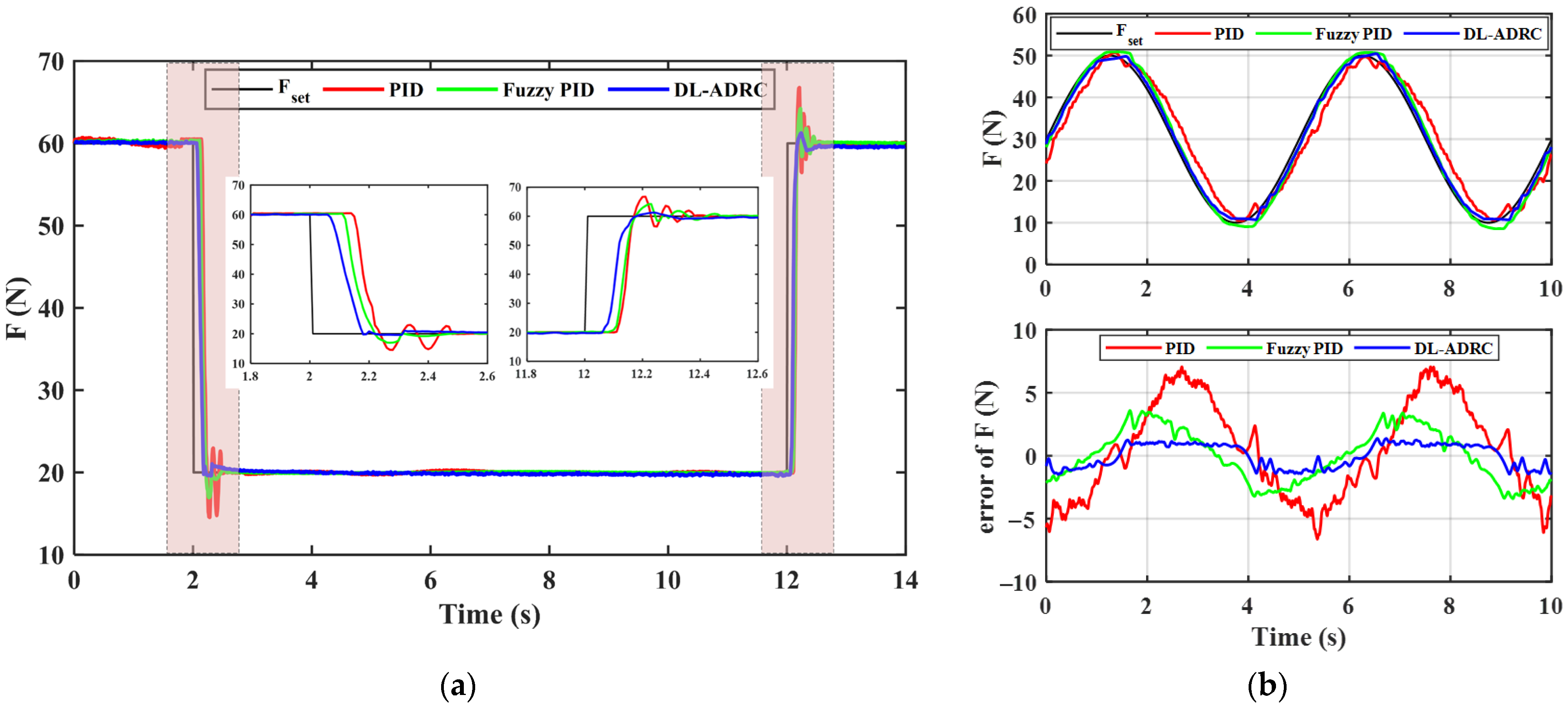
For ease of comparison, the experimental results of step response and sinusoidal force-tracking are shown in Figure 12, and the corresponding statistical features are listed in Table 5. As shown in Figure 12a, in the step response with a bidirectional amplitude of 40 N, all three controllers can still reach the target force. However, in terms of response sensitivity, taking the step response of the falling edge as an example again, the DL-ADRC controller leads the other two controllers by about 0.07 s and 0.14 s, respectively. The response speed of the DL-ADRC controller is still fast, and the settling time is shortened by about 0.28 s and 0.83 s compared to the PID and fuzzy PID controllers, respectively. During the adjustment process, the overshoot of the DL-ADRC controller is slight (2.21%), but the overshoot of the PID and fuzzy PID controllers is about 15.36% and 9.15%, respectively, and the adjustment time is significantly longer than that of the DL-ADRC controller. Due to the integration part, the steady-state errors of all three controllers are close to zero. The step response of the rising edge has similar response characteristics.
As shown in Figure 12b, in sinusoid force tracking, all three controllers can still follow the command signal, but show a certain degree of fluctuation. The lag of the DL-ADRC controller is smaller than that of the fuzzy PID controller, and the lag of fuzzy PID controller is smaller than that of the PID controller. The maximum tracking error of the PID controller is 7.06 N and the average error is 3.74 N. The maximum tracking error of the fuzzy PID controller is 3.59 N and the average error is 2.86 N. The maximum tracking error of the DL-ADRC controller is 2.37 N and the average error is 1.52 N. In addition, the fluctuation characteristics of the experimental errors are significantly higher than the simulation.
By comparing the simulation and experiment results, it can be found that the response delay, adjustment time, steady-state error, and tracking fluctuation in the experimental stage are higher than those in simulation, mainly due to some unmodeled dynamics and uncertain disturbances. Overall, the proposed DL-ADRC method performs well in constant force control and force tracking of the CFFC.

5.4. Constant Force Control Testing

5.4.1. Constant Force Control Under Passive Floating Condition

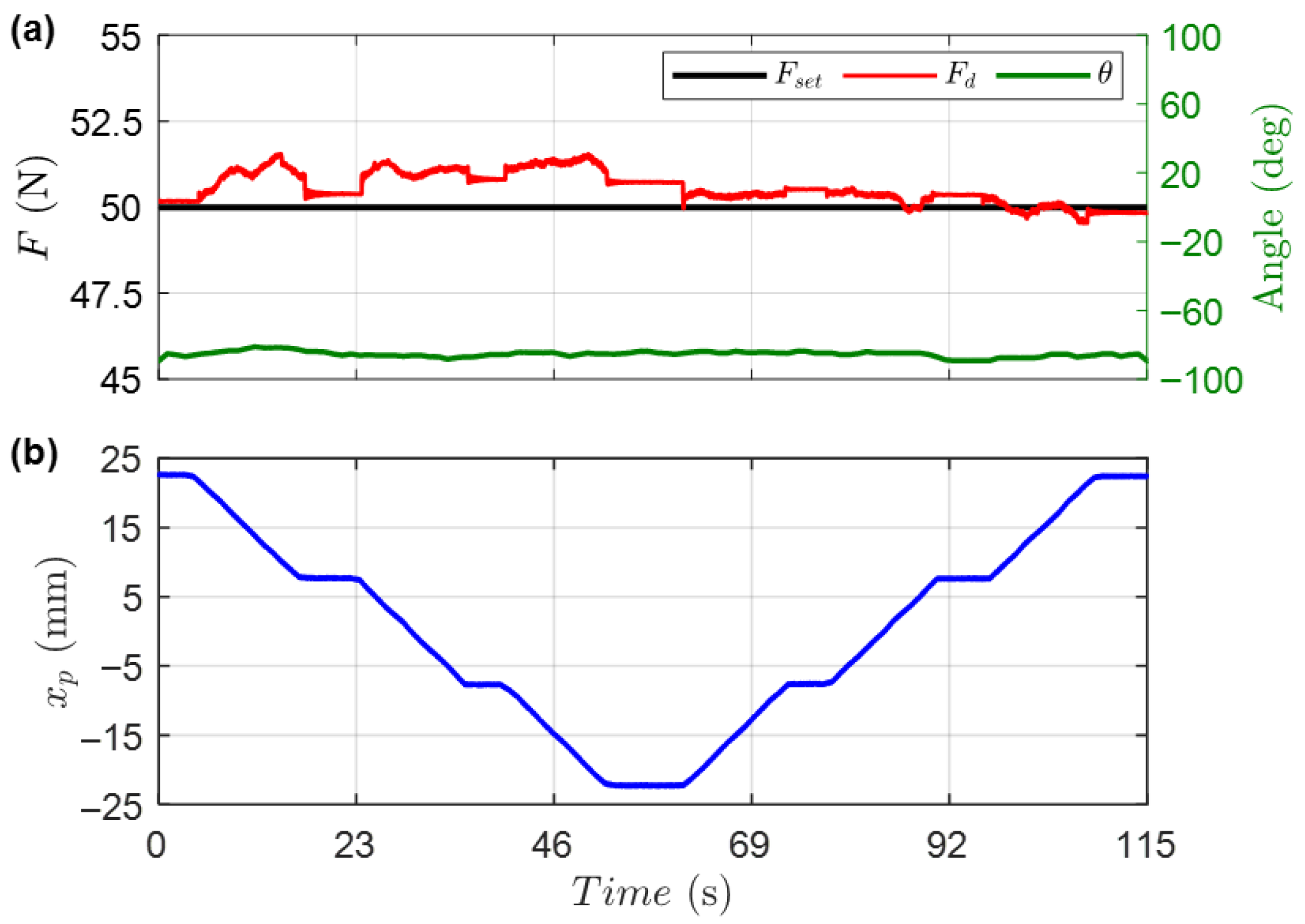
In order to verify the constant force retention of the CFFC under passive floating and approximate non-floating conditions during the simulated machining of curved surfaces and machining of flat surfaces, the CFFC is installed in the manner shown in Figure 10. Then, the CFFC is adjusted vertically downward without bias load, and loaded by the electric cylinder according to the trajectory shown in Figure 13b. To avoid damage to the prototype, the float stroke of the CFFC is approximately within ±22.5 mm (less than the designed ±25 mm). The displacement increment of the electric cylinder during reciprocating loading movement is approximately 15 mm. After each movement to a new position, the electric cylinder pauses for approximately 5–8 s. Therefore, the processes of displacement change and displacement pause remain unchanged and simulate the passive floating state during the CFFC’s machining of surfaces and planes. As shown in Figure 13a, the output force of the CFFC is set to 50 N and the attitude is maintained at approximately −90°. Obviously, during the passive floating process, the actual output force will change to some extent, but the maximum error does not exceed 1.67 N, and the fluctuation amplitude and density are also slight. When the electric cylinder pauses loading, the output force also tends to stabilize, and although there is a certain static error, the maximum error does not exceed 0.73 N, which proves the stability of the designed actuator and controller in such simulated working conditions. In addition, from the data curve in Figure 10, it can be seen that when the electric cylinder is retracted in reverse, the output force-tracking error of the CFFC does not increase, indicating that its lag during the modification process is slight, which proves the effectiveness of the dual-loop control strategy mentioned above.

5.4.2. Constant Force Control Under Attitude Change Condition

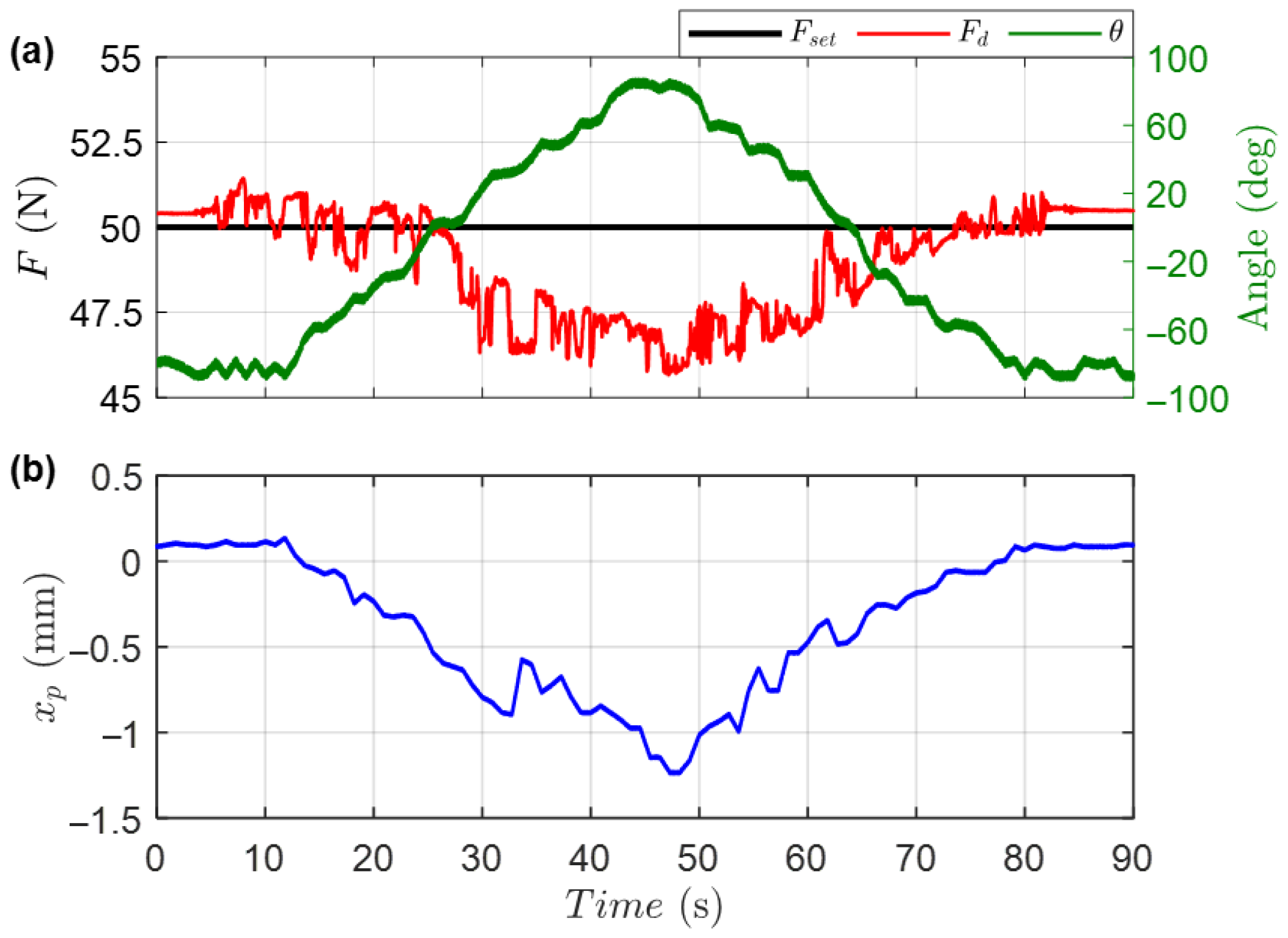
Under the above passive floating condition, the CFFC is kept in a vertical downward posture, but there is no change in posture during the experiment. Therefore, it is more suitable for flat or low-curvature surface grinding occasions. In order to verify the constant force control performance of the CFFC under the condition of severe attitude changes during complex surface grinding, as shown in Figure 14a, the expected output force is still set to 50 N. But the force control characteristics of the CFFC are recorded by rotating the test bench shown in Figure 10 within a tilt angle range of ±90 degrees. To simulate actual working conditions, a 5 kg mass is installed at the end of the CFFC. As shown in Figure 14a, when the inclination angle of the CFFC changes from −90° to +90°, there is a significant fluctuation in the output force, and the overall reduction is small. When approaching the horizontal posture (at 0°), there is a larger fluctuation, mainly due to the instantaneous change in the solenoid valve direction caused by gravity compensation.
However, the force control error does not exceed 3 N. It can also be seen from the displacement curve in Figure 14b that this reversal fluctuation causes a certain displacement fluctuation, but the displacement fluctuation amplitude is relatively slight and does not exceed 0.5 mm. It should be noted that manual adjustment is used throughout the rotation process, so there are local fluctuations in the angle curve, which in turn cause more obvious fluctuations in the output force curve. This working condition is more suitable for CFFC inspection because it is more stringent. As the inclination angle of the CFFC continues to increase, the deviation of output force also increases. When the CFFC is completely upward, the maximum deviation of the output force is about 4.36 N and the displacement deviates from the initial value by about 1.24 mm. This is mainly due to the decreased accuracy of the tilt sensor at both ends of the stroke. The use of a small independent compressor for the air source also results in a certain range of pressure fluctuations. Overall, during the full-stroke attitude change process, the average force control error of the CFFC is less than 1.056 N, and the steady-state displacement average deviation is less than 0.6 mm, which can be completely ignored for applications that are usually soft contact grinding.

5.4.3. Constant Force Control Under Biased Load Installation Condition

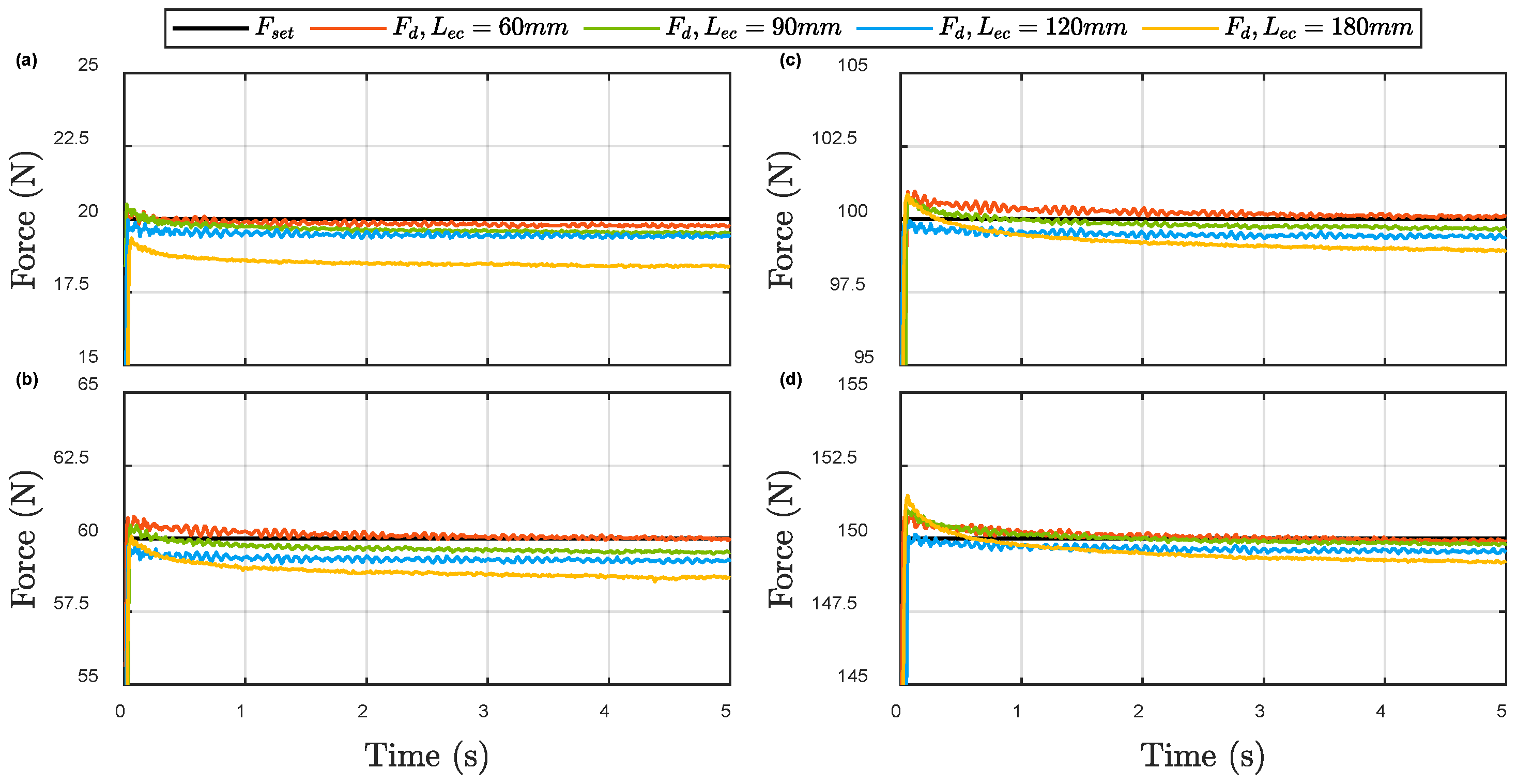
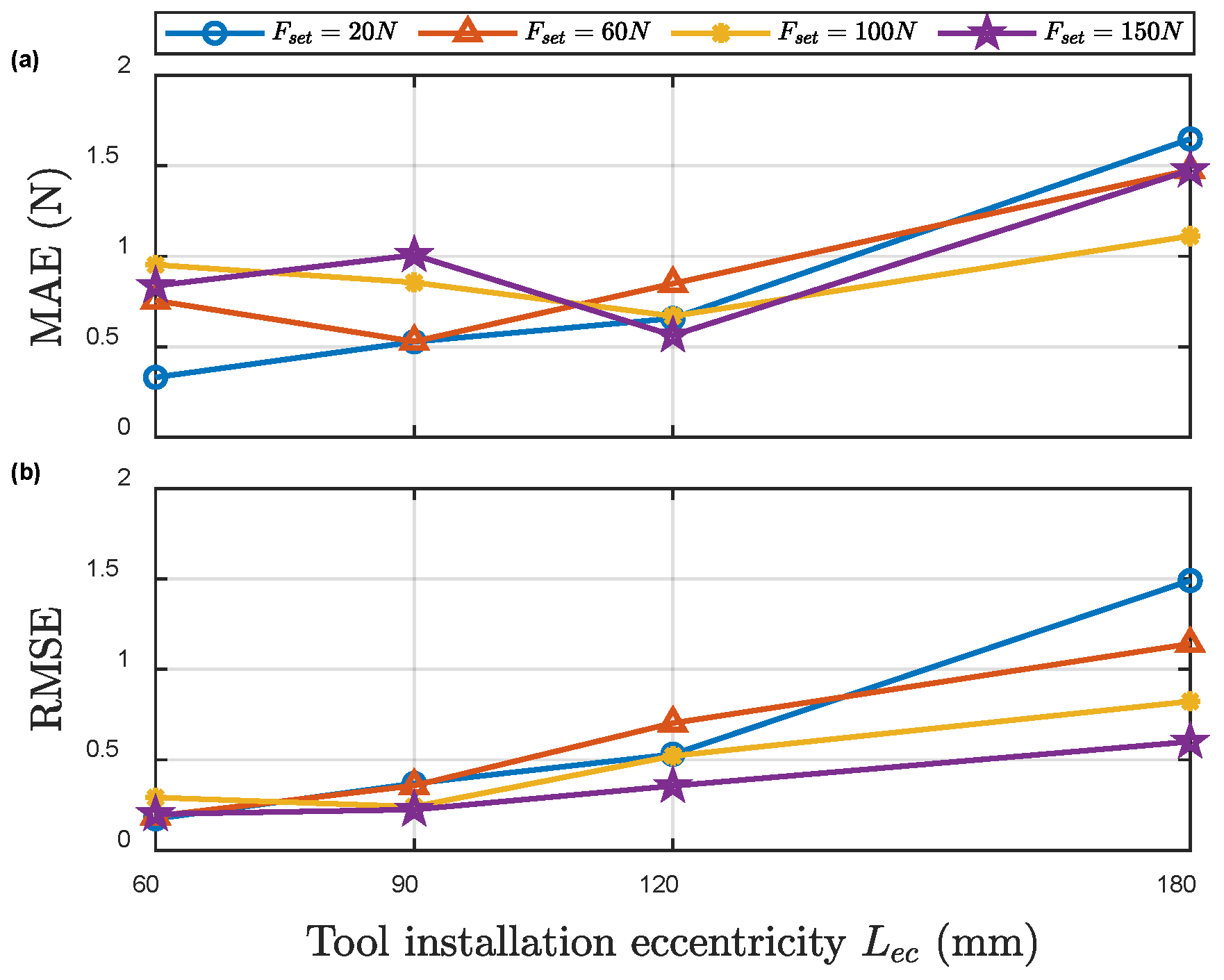
In the above experimental process, the detection of output force is in the axial direction of the CFFC. However, in actual polishing processing, due to different polishing tools used by suppliers or users, the long-handled tool shown in Figure 7 is extremely common in complex curved surface polishing in confined spaces. Therefore, based on the above experiment, the CFFC is set vertically downwards, but the biased load position relative to the CFFC is changed. By setting different output forces, the biased load characteristics are analyzed to verify the effective estimation of friction force by the above controller. As shown in Figure 15, the force control effects are investigated under operating conditions with output forces of 20 N, 60 N, 100 N, and 150 N at bias installation distances of 60 mm, 90 mm, 120 mm, and 180 mm. The statistical results are shown in Figure 16. Obviously, under a specific output force state, as the bias distance increases, the force control error and fluctuation both increase. The maximum average error of the output force (MAE = 1.65 N) occurs in the working condition where the target force is 20 N and the offset distance is 180 mm. At this time, due to the small target force, it is not enough to overcome the frictional force caused by the unmodeled dynamic and uncertain installation errors of the experimental device.
Moreover, due to its long bias length, there is also a certain degree of elastic deformation in the eccentric link. In practical applications, this situation can be further improved by installing structural components with precision design tools. Although the response overshoot increases with the increase in output force, it is often used in the rough grinding stage due to high output force. Therefore, the overshoot and force control tracking error can be completely ignored. As shown in Figure 16a, when the bias distance is constant, the force control error is not significantly different under different target forces, which proves the stability of the control method. When examining a certain set force, the force control tracking error will fluctuate and increase with the increase in the bias distance, but not exceed 2 N. As shown in Figure 16b, from the perspective of root mean square error (RMSE), as the bias distance increases, the fluctuation of the output force deviating from the set target becomes more significant. The smaller the target force, the more significant this fluctuation becomes. This is because when the output force is small, the unmodeled dynamics of the system dominate, and the lag of the pneumatic transmission system further exacerbates the fluctuation. However, overall, the force control deviation is relatively slight, which once again proves the effectiveness of the designed CFFC and control method.

6. Discussion

6.1. Grinding System Errors with the CFFC from Robot and Calibration Methods

The industrial robot used will also contribute to the overall system error, and the designed system will therefore also require a suitable calibration methodology. To ensure that the proposed CFFC can be robustly integrated with an industrial robot, several robot-related error sources must be considered.
(1)
After installation of the CFFC and grinding tool, the robot requires a standard tool-center-point (TCP) calibration so that the end-effector geometry and compliance are correctly reflected in the robot’s kinematic chain. As shown in Figure 4a, if the CFFC is operating in extended mode, it is recommended to adjust its output force to the maximum to fully extend it to the stroke limit and maintain stability and then perform TCP calibration. On the contrary, as shown in Figure 4b, if the CFFC is operating in retraction mode, it is recommended to open the solenoid valve and adjust its output force to the maximum to fully retract it to the stroke limit and maintain stability, and then perform TCP calibration. If necessary, it is recommended to use a reference force sensor to finely calibrate the bias force in its system installation state.
(2)
Using inertial recognition programs from robot manufacturers or external weighing sensors can help eliminate joint torque deviations caused by gravity and improve the accuracy of the robot’s internal dynamic model.
(3)
Since the CFFC does not use direct force sensors, the pneumatic pressure is mapped to the end effector force through a calibration model. If necessary, it is recommended to perform a force calibration step for the end effector to further improve the accuracy of force control. This can be achieved offline by using a reference six-axis F/T sensor to improve pressure force mapping, or online by utilizing joint torque feedback and small probing motion to compensate for force deviations during grinding.
(4)
Robot path-planning errors may cause deviations from the desired surface normal, leading to force direction errors. These effects can be reduced by geometric calibration of the workpiece and robot pose with high-precision measurement methods and path-correction methods. If necessary, multiple CFFCs can be configured along the compensation direction to achieve constant-force floating compensation for multiple degrees of freedom.

6.2. Tuning Strategy and Sensitivity Analysis of the Proposed Controller

The ADRC-based dual-loop controller contains a TD module, an outer force PI controller, and an inner pressure loop with an ESO. Although it involves multiple tuning parameters, the tuning procedure is structured and practical for engineering implementation. The parameters k1 and k2 shape the commanded force trajectory. Higher k1 accelerates convergence, while k2 provides damping. Since the TD acts only on the reference signal, its influence on stability is weak. The PI gains ( k p F , k i F ) of the outer-loop force controller are tuned to be slower than the inner pressure dynamics, ensuring time-scale separation. A practical method is to adjust k p F with a step signal to a level where the system response is fast enough but the overshoot is below 10%. Then, k i F can be introduced to remove steady-state errors. Considering the safety of physical interactions during the grinding process, the outer-loop PI gains are tuned to ensure critical damping response without overshoot. The inner loop regulates chamber pressure Pvo, and is independent of the force dynamics. Due to the compactness of the CFFC, the pressure loss from the valve to the cylinder can be ignored, which makes the PI gains of the inner loop easy. The pressure regulation of the proportional valve is excellent, and users only need to adjust the PI parameters according to their grinding environment. The ESO gains β 1 , β 2 , β 3 are not manually tuned. Instead, they are determined analytically from the observer bandwidth ω o = 3 5 ω c . ω c is the inner-loop control bandwidth, which can be obtained by a step response experiment. Once ω o is determined, the ESO gains follow directly from the canonical ADRC formulation, which significantly reduce the tuning effort.
In terms of the sensitivity of the controller’s parameters, the outer-loop PI has an impact on steady-state force tracking, but the dual-loop architecture helps to isolate these gains from actuator dynamics, thereby reducing sensitivity. The inner-loop PI gains primarily affect rise time and pressure ripple; variations in ±20% did not destabilize the system. The ESO gains show low sensitivity as long as the observer bandwidth exceeds the system’s dominant dynamics. Experimental tests showed stable behavior over a ±30% gain variation. The disturbance compensation term (−x3/b0) makes the controller inherently robust against unmodelled dynamic. All parameters were adjusted on the STM32 embedded controller through simple step-response testing and empirical tuning. Once tuned, the controller runs consistently in the experiment without the need for readjustment, proving that the dual-loop ADRC scheme is practical and does not require excessive tuning work [20]. In addition, some complex and advanced algorithms, such as fuzzy PID [26], neural networks [34], and active disturbance rejection impedance control (ADRIC) [39], etc., have also been proven to have practical engineering significance for robot grinding with constant force control.

6.3. Limitations of the Proposed System

Although the proposed dual-loop ADRC combined with compound friction feedforward compensation substantially enhances the dynamic force-tracking performance, several inherent limitations of pneumatic actuation remain. First, due to air compressibility and finite valve bandwidth, the system exhibits an intrinsic actuation latency, with the dominant chamber valve time constant typically falling within several tens of milliseconds. This delay is largely compensated for by the inner-loop ESO, yet a small phase lag persists during high-bandwidth force transients. Second, variations in the air supply may introduce mild gain fluctuations; for example, a ±5% upstream pressure deviation can lead to measurable changes in the effective pressure force conversion ratio. Third, long-term effects such as leakage, seal wear, and temperature-induced density changes introduce gradual model mismatch beyond the scope of the chamber approximation. The latest developments in hybrid or multi-mode pneumatic actuators also provide advanced flexible control strategies that combine aerodynamics with auxiliary drive to improve response bandwidth and stability [44]. This method provides useful insights for managing nonlinear aerodynamic behavior, but typically involves increased structural complexity or cost, which may not be suitable for large-stroke, high-force grinding applications.
Nevertheless, these limitations do not undermine the practical utility of the proposed method. From an engineering standpoint, many compliant interaction tasks, such as robotic grinding, deburring, or surface finishing, do not require perfectly invariant force regulation but inherently tolerate small fluctuations. The pneumatic delay can be further mitigated through reference shaping, model-based feedforward, or higher bandwidth valve configurations. Fortunately, the pneumatic components of the CFFC are highly integrated into a small space and the length (about 28 mm) of the pipeline between the air source and the cylinder can be almost ignored, which greatly reduces the physical delay of pneumatic transmission. Likewise, the influence of air supply pressure variations can be reduced through an independent air source or by incorporating an accumulator and pressure regulator within the system. Therefore, within typical industrial operating conditions, the proposed control framework remains both effective and economically advantageous.

7. Conclusions

This paper proposes a compact constant-force floating compensator and develops an independently operable controller based on STM32 MCU, which facilitates rapid deployment and improves the compactness and portability of the system. A dual-loop output force control algorithm based on ADRC was designed to address the issues of attitude changes, expansion, and contraction of the sealing cover during the floating process and uncertain friction faced by the integrated end effector of industrial robots. The configuration parameters that meet the stability requirements of the CFFC system were derived and analyzed through transfer function derivation. The nonlinear impact of the end tool load on the stability and response speed of the CFFC’s constant force control was analyzed.
In order to investigate the force control performance of the designed CFFC and ADRC dual-loop controllers, rigorous comparative experiments were conducted. Under passive floating conditions and approximate full-stroke floating loading, the maximum dynamic tracking error of the CFFC does not exceed 1.67 N and the static holding error does not exceed 0.73 N, which proves the rationality of the CFFC mechanism and the stability of the controller. Under the condition of significant attitude changes throughout the vertical range of the entire stroke, the maximum output force-tracking error of the CFFC is less than 4.36 N, the average error is less than 1.056 N, and the displacement wave momentum is less than 1.24 mm, with an average of less than 0.6 mm. This proves that the CFFC has high constant-force floating robustness when grinding complex surfaces under significant attitude changes at the robot end. In addition, the constant force control experiment under biased installation conditions has demonstrated the adverse impact trend of bias distance on force control, and it is necessary to design high-rigidity transmission systems in practical engineering applications.
Although the designed CFFC has shown high force control accuracy and stability and can float and change posture within a large stroke, there is uncertainty surrounding the process parameters in actual machining processes. In future work, a more systematic evaluation of machining-related uncertainties will be conducted to further verify and enhance the robustness of the proposed CFFC system and the controller. First, a controlled grinding test platform will be established to independently examine the effects of self-excited vibration induced by grinding wheel rotation, the coupling between grinding direction and robot feed direction, and the influence of grinding speed on force stability [45]. Second, multi-axis force/torque sensing and high-frequency motion measurement will be integrated to quantitatively characterize the interaction dynamics between the robot end-effector and the workpiece under various operating conditions. Third, the experimentally identified disturbance characteristics will be incorporated into an extended dynamic model of the CFFC mechanism, forming the basis for robustness analysis and potential controller adaptation strategies. These efforts will provide a clearer understanding of process-induced disturbances and enable further improvement of constant-force floating performance in practical industrial machining applications.

Author Contributions

Conceptualization, K.G.; investigation, Y.X. and S.W.; methodology, W.M.; formal analysis, K.Z. and J.M.; software, W.M.; validation, Y.X. and S.W.; writing—original draft, Y.X. and K.Z.; writing—review and editing, K.G. and J.M.; visualization, K.Z.; project administration, K.G. and Y.Y. All authors have read and agreed to the published version of the manuscript.

Funding

This research was funded by the Guangdong Basic and Applied Basic Research Foundation (No. 2025A1515011067), the Major Science and Technology Project of Henan Province (No. 251100220300), the Key R&D Program of Shandong Province (No. 2022CXGC020202), the Shandong Province Enterprise Innovation Enhancement Project (No. 2022TSGC2568), the Key R&D Program of Jining City (No. 2022KJHZ013), and the Taishan Young Scholar of Shandong Province (No. tsqn202408041).

Institutional Review Board Statement

Not applicable.

Informed Consent Statement

Not applicable.

Data Availability Statement

The original contributions presented in this study are included in the article. Further inquiries can be directed to the corresponding author.

Conflicts of Interest

Author Yuanpeng Ye was employed by the company Henan Aizto Science & Technology Co., Ltd. The remaining authors declare that the research was conducted in the absence of any commercial or financial relationships that could be construed as a potential conflict of interest.

Abbreviations

The following abbreviations and symbols are used in this manuscript:
CFFCConstant-Force Floating Compensator
CFCConstant Force Control
PIDProportion-Integral-Derivate
RLSRecursive Least Square
ADRCActive Disturbance Rejection Control
ESOExtended State Observer
TDTracking Differentiator
HMIHuman Machine Interaction
q v The flow rate of the proportional valve
P v i , P v o The inlet and outlet air pressures of the electrical proportional valve
P d The driving side air pressure of the cylinder
K v The gain controlled by the proportional valve amplifier
K b The gain of outlet air pressure and flow rate
u v The control analog voltage for the electrical proportional valve
q L The internal leakage flow rate of the cylinder
ρ The air density
A p The effective working area of the piston on the cylinder drive side
x p The piston displacement
V, V0The volume and initial volume of the cylinder drive chamber
MThe equivalent floating motion mass
B The viscous damping coefficient
θ The tilt angle of the CFFC
m L The mass of the internal leakage in the cylinder
R , R s The ideal and specific air constant
TThe air temperature
P o , P a b s The atmospheric pressure and the absolute pressure
K a The equivalent stiffness of the compensator
F d The grinding force or grinding contact reaction force
F s The equivalent elastic force of the sealing cover
F f The equivalent frictional force
C L The instantaneous steady-state constant
F s e t ( t ) The desired set force
G The gravity along the axis of the cylinder

References

  1. Li, J.; Guan, Y.; Chen, H.; Wang, B.; Zhang, T. Robotic Polishing of Unknown-Model Workpieces with Constant Normal Contact Force Control. IEEE/ASME Trans. Mechatron. 2023, 28, 1093–1103. [Google Scholar] [CrossRef]
  2. Ming, W.; Xu, Y.; Chang, H.; Zhang, G.; Wang, Y.; Zhang, Z. Bio-inspired designing and fabricating hydrophobic functional surface for advanced fuel cell applications: A review. Renew. Sustain. Energ. Rev. 2025, 223, 116066. [Google Scholar] [CrossRef]
  3. Yu, C.; Qiao, J.; Liu, N.; Hu, X.; Yang, Z.; Zhou, S.; Shi, Y.; Li, Z.; Yu, S.; Yuan, H.; et al. Robotic grinding technology of multi-scale complex components based on 3D point clouds: A review. Measurement 2025, 257, 118663. [Google Scholar] [CrossRef]
  4. Torres-Izu, R.; Iriarte, X.; Mata, S.; Aginaga, J.; Barrenetxea, D. Compensation strategy to minimize over-cut effects in robotic belt grinding with passive-compliant tools. J. Manuf. Process. 2025, 141, 1433–1443. [Google Scholar] [CrossRef]
  5. Li, M.; Wang, W.; Zou, L.; Lv, C.; Zhang, J.; Huang, Y. Robotic grinding of complex surfaces with an internal structured compliant tool: Multi-performance optimization in confined spaces. Robot. Comput. Integr. Manuf. 2025, 94, 102974. [Google Scholar] [CrossRef]
  6. Guo, W.; Qi, B.; Ren, X.; Chen, H.; Chen, X. Vision-based closed-loop robotic fine grinding of aeroengine turbine seals utilizing Gabor Wavelet Transform. Mech. Syst. Signal Process. 2024, 220, 111632. [Google Scholar] [CrossRef]
  7. Tao, Z.; Hou, Z.; Wang, Y.; Sun, Y.; Qi, J.; Zhang, D. On-machine measurement and quantitative evaluation of belt wear in robotic grinding using line structured light scanning. J. Manuf. Process. 2025, 150, 555–569. [Google Scholar] [CrossRef]
  8. Li, B.; Li, Z.; Ge, C.; Liu, C.; Qin, S.; He, Z. Dimensionality reduction calibration of a robotic grinding head’s 3D coordinate system using a 1D laser sensor. Opt. Laser Technol. 2025, 187, 112831. [Google Scholar] [CrossRef]
  9. Qi, Q.; Yang, J.; Ding, H. A Feedrate-Force Planning Algorithm Considering the Hybrid Dynamic Constraints of the Robotic Compliant Grinding System With Active Force Control. IEEE/ASME Trans. Mechatron. 2025. Early Access. [Google Scholar] [CrossRef]
  10. Ke, X.; Yu, Y.; Li, K.; Wang, T.; Zhong, B.; Wang, Z.; Kong, L.; Guo, J.; Huang, L.; Idir, M.; et al. Review on robot-assisted polishing: Status and future trends. Robot. Comput. Integr. Manuf. 2023, 80, 102482. [Google Scholar] [CrossRef]
  11. Wu, C.; Guo, K.; Sun, J.; Liu, Y.; Zheng, D. Active vibration control in robotic grinding using six-axis acceleration feedback. Mech. Syst. Signal Process. 2024, 214, 111379. [Google Scholar] [CrossRef]
  12. Wang, Y.; Chen, C.; Hong, Y.; Zheng, Z.; Guo, Z.; Peng, F. PI2-BDMPs in Combination With Contact Force Model: A Robotic Polishing Skill Learning and Generalization Approach. IEEE/ASME Trans. Mechatron. 2025, 30, 978–988. [Google Scholar] [CrossRef]
  13. Huang, R.; Li, B.; He, X.; Zhang, B. Modeling and real-time compliance control of robotic automatic polishing for turbine blades. Int. J. Adv. Manuf. Technol. 2025, 137, 151–166. [Google Scholar] [CrossRef]
  14. Li, L.; Wang, Z.; Zhu, G.; Zhao, J. Position-based force tracking adaptive impedance control strategy for robot grinding complex surfaces system. J. Field Robot. 2023, 40, 1097–1114. [Google Scholar] [CrossRef]
  15. Zhang, T.; Xiao, M.; Zou, Y.; Xiao, J. Robotic constant-force grinding control with a press-and-release model and model-based reinforcement learning. Int. J. Adv. Manuf. Technol. 2020, 106, 589–602. [Google Scholar] [CrossRef]
  16. Samadikhoshkho, Z.; Saive, E.; Lipsett, M.G. A review of compliant mechanisms for contact robotics applications. Robot. Auton. Syst. 2025, 186, 104902. [Google Scholar] [CrossRef]
  17. Liu, D.; Zhang, J.; Guo, H.; Yang, S.; Song, A. Optimal Trajectory Planning and Multimodal Force Control for Robotic Large Surface Rapid Grinding. IEEE Trans. Instrum. Meas. 2025, 74, 7506715. [Google Scholar] [CrossRef]
  18. Shao, Y.; Wang, Z.; Sun, Y.; Shi, D.; Feng, Y.; Liu, F.; Ding, X.; Zhang, W. Design of an Adjustable Constant Force Mechanism Based on Integrated Magnet-beam Structures and an Adjustable Lever Mechanism. Mech. Mach. Theory 2025, 209, 105997. [Google Scholar] [CrossRef]
  19. Wu, Z.; Wang, X.; Lyu, Z.; Xu, Q. Design of a Novel Passive Polishing End-Effector With Adjustable Constant Force and Wide Operating Angle. IEEE/ASME Trans. Mechatron. 2024, 29, 4330–4340. [Google Scholar] [CrossRef]
  20. Jiang, C.; Yang, Z.; Zheng, J.; Fu, B.; Bai, Y. Research on Active Disturbance Rejection Control of Rigid–Flexible Coupled Constant Force Actuator. Actuators 2025, 14, 325. [Google Scholar] [CrossRef]
  21. Tong, Z.; Zhang, X.; Wang, G. Automatic Optimization for Compliant Constant Force Mechanisms. Actuators 2023, 12, 61. [Google Scholar] [CrossRef]
  22. Ahmad, A.R.; Lin, C.-Y.; Shah, S.; Cheng, Y.-S. Design of a Compliant Robotic End-Effector Tool for Normal Contact Estimation. IEEE Sens. J. 2023, 23, 1515–1526. [Google Scholar] [CrossRef]
  23. Zhang, J.; Zhao, L.; Li, L.; Ma, F.; Chen, G. Design of Passive Constant-Force End-Effector for Robotic Polishing of Optical Reflective Mirrors. Chin. J. Mech. Eng. 2022, 35, 141. [Google Scholar] [CrossRef]
  24. Mu, Z.; Jin, Y.; Tong, Y.; Yang, Y.; Li, S. Adaptive control of pneumatic end-effector polishing force based on dual extended state observer. Int. J. Adv. Manuf. Technol. 2024, 132, 4087–4102. [Google Scholar] [CrossRef]
  25. Rei, C.; Wang, Q.; Yan, X.; Fu, L.; Zhang, P.; Wang, C. An adaptive electropneumatic end effector for constant force robot grinding with steel wire brush. Adv. Mech. Eng. 2024, 16, 16878132241244918. [Google Scholar] [CrossRef]
  26. Zhang, X.; Sun, Y. Development of Pneumatic Force-Controlled Actuator for Automatic Robot Polishing Complex Curved Plexiglass Parts. Machines 2023, 11, 446. [Google Scholar] [CrossRef]
  27. Liu, Y.; Wu, L.; Lu, E.; Ju, J. Vibration coupling characteristics and grinding force control of an elastic component grinding system. Mech. Sci. 2024, 15, 123–136. [Google Scholar] [CrossRef]
  28. Li, X.; Zhao, H.; Zhou, H.; Cai, Y.; Yin, Y.; Ding, H. Robotic grinding and polishing of complex aeroengine blades based on new device design and variable impedance control. Robot. Comput. Integr. Manuf. 2025, 92, 102875. [Google Scholar] [CrossRef]
  29. Xu, D.; Yin, L.; Wang, J. Grinding force estimation and control of grinding robot with variable impedance control strategy. Int. J. Adv. Manuf. Technol. 2025, 137, 2011–2024. [Google Scholar] [CrossRef]
  30. Tang, X.; Yang, J.; Ding, H. A novel electromagnetic variable stiffness actuator for robotic grinding: Design, modeling, optimization, and control. Int. J. Robot. Res. 2025, 02783649251347661. [Google Scholar] [CrossRef]
  31. Ouyang, L.; Yang, M.; Huang, X.; Qiu, S.; Zhang, C.; Feng, K. Design of a Pneumatic-Electric Hybrid Linear End-effector for Robot Polishing. In Proceedings of the 13th International Symposium on Linear Drives for Industry Applications (LDIA), Wuhan, China, 1–3 July 2021; IEEE: New York City, NY, USA, 2021. [Google Scholar] [CrossRef]
  32. Chen, F.; Bao, R.; Peng, J.; Lv, Z.; Wang, K. Recent advances in high precision grinding and polishing of robots for complex surface. Int. J. Adv. Manuf. Technol. 2025, 140, 5795–5821. [Google Scholar] [CrossRef]
  33. Dong, J.; Shi, J.; Ma, Z.; Yu, T. Research of the FLC + PID switching control strategy based on real-time error for the pneumatic polishing force regulating system. Eng. Sci. Technol. Int. J. 2024, 51, 101659. [Google Scholar] [CrossRef]
  34. Pei, G.; Yu, M.; Xu, Y.; Ma, C.; Lai, H.; Chen, F.; Lin, H. An Improved PID Controller for the Compliant Constant-Force Actuator Based on BP Neural Network and Smith Predictor. Appl. Sci. 2021, 11, 2685. [Google Scholar] [CrossRef]
  35. Yang, Z.; Kou, J.; Li, Z.; Zhao, W.; Ma, Y.; Wang, Y.; Shi, Y. Neural network adaptive force control for pneumatic polishing end-actuator with external disturbances and full-state constrains. Eng. Appl. Artif. Intell. 2025, 160, 111876. [Google Scholar] [CrossRef]
  36. Rei, C.; Wang, Q.; Chen, L.; Yan, X.; Zhang, P.; Fu, L.; Wang, C.; Liu, X. Constant force grinding controller for robots based on sac optimal parameter finding algorithm. Sci. Rep. 2024, 14, 14127. [Google Scholar] [CrossRef]
  37. Dai, J.; Chen, C.-Y.; Zhu, R.; Yang, G.; Wang, C.; Bai, S. Suppress Vibration on Robotic Polishing with Impedance Matching. Actuators 2021, 10, 59. [Google Scholar] [CrossRef]
  38. Wu, C.; Guo, K.; Sun, J. Dual PID Adaptive Variable Impedance Constant Force Control for Grinding Robot. Appl. Sci. 2023, 13, 11635. [Google Scholar] [CrossRef]
  39. Xue, Y.; Liu, X.; Li, H.; Fan, D. Research on the constant force control method of wind turbine blade grinding robots based on improved active disturbance rejection impedance control. J. Braz. Soc. Mech. Sci. Eng. 2025, 47, 461. [Google Scholar] [CrossRef]
  40. Tang, H.; Liu, Z.; Yang, T.; Sun, L.; Fang, Y.; Jing, X. Reinforcement-learning-based robust force control for compliant grinding via inverse hysteresis compensation. IEEE/ASME Trans. Mechatron. 2023, 28, 3364–3375. [Google Scholar] [CrossRef]
  41. Yang, J.; Tang, X.; Ding, H.; Yin, Y. A novel electromagnetic end-effector with adaptive force-stiffness coordinated control for robotic grinding with variable workpiece stiffness. CIRP Ann. 2025, 74, 541–545. [Google Scholar] [CrossRef]
  42. Li, Y.; Wang, Y.; Li, Z.; Lv, Y.; Chai, J.; Dong, E. Deep reinforcement learning-based variable impedance control for grinding workpieces with complex geometry. Robot. Intell. Autom. 2025, 45, 159–172. [Google Scholar] [CrossRef]
  43. Ke, S.; Zhao, H.; Li, X.; Wei, Z.; Yin, Y.; Ding, H. Robotic grinding skills learning based on geodesic length dynamic motion primitives. IEEE/ASME Trans. Mechatron. 2025. Early Access. [Google Scholar] [CrossRef]
  44. Le, X.; Gunawardane, P.D.S.H.; Mallikarachchi, S.; Chiao, M.; Godage, I.S. Hybrid control of 3D-printed multimodal soft pneumatic actuators. In Proceedings of the 2024 IEEE International Conference on Mechatronics and Automation (ICMA), Tianjin, China, 4–7 August 2024; IEEE: New York City, NY, USA, 2024; pp. 1753–1758. [Google Scholar] [CrossRef]
  45. Klimchik, A.; Bondarenko, D.; Pashkevich, A.; Sébastien, B.; Benoît, F. Compliance error compensation in robotic-based milling. Lect. Notes Electr. Eng. 2014, 283, 197–216. [Google Scholar] [CrossRef]
Figure 1. Schematic diagram of the constant-force floating compensator.
Actuators 15 00004 g001
Figure 2. Three-dimensional model of the CFFC. 1—robot connection flange, 2—sealing cover, 3—tool connection flange, 4—mufflers, 5—bus connector, 6—air source connector, 7—rail mounting plate, 8—column, 9—cylinder, 10—cylinder mounting plate, 11—floating hinge, 12—tilt sensor, 13—pressure sensor, 14—solenoid valve, 15—displacement sensor, 16—electric proportional valve, 17—limit block, 18—slider, and 19—linear guide rail.
Actuators 15 00004 g002
Figure 3. Electrical system architecture for the CFFC.
Actuators 15 00004 g003
Figure 4. Schematic diagram of equivalent force distribution of the CFFC. (a) Extend working mode. (b) Retract working mode.
Actuators 15 00004 g004
Figure 5. Diagram of poles position changes.
Actuators 15 00004 g005
Figure 6. Bode plot of the system under load changes.
Actuators 15 00004 g006
Figure 7. Adverse factors caused by eccentric grinding, gravity, and friction. (a) Common combinations of grinding tools. (b) Eccentric grinding diagram.
Actuators 15 00004 g007
Figure 8. Block diagram of dual-loop force control system based on ADRC.
Actuators 15 00004 g008
Figure 9. Simulation results. (a) Step response. (b) Sine signal tracking.
Actuators 15 00004 g009
Figure 10. Experimental configuration. (a) Scheme of the device. (b) Physical experimental platform.
Actuators 15 00004 g010
Figure 11. Experimental frequency response of the CFFC.
Actuators 15 00004 g011
Figure 12. Experiment results. (a) Step response. (b) Sine signal tracking.
Actuators 15 00004 g012
Figure 13. Constant force control results under passive floating conditions with a constant inclination under the retract working mode. (a) Force tracking and angle curves. (b) The displacement of CFFC.
Actuators 15 00004 g013
Figure 14. Constant force control results under changing posture and constant contact conditions with the retract working mode. (a) Force tracking and angle curves. (b) The displacement of CFFC.
Actuators 15 00004 g014
Figure 15. Constant force control results under constant posture and biased load conditions. (a) Response to a target force of 20 N. (b) Response to a target force of 60 N. (c) Response to a target force of 100 N. (d) Response to a target force of 150 N.
Actuators 15 00004 g015
Figure 16. Statistical information. (a) Maximum absolute error. (b) Root mean square error.
Actuators 15 00004 g016
Table 1. CFFC and main components of the mechanical system.
ComponentsBrand or ModelCore Specifications
Pneumatic cylinderSMC (Tokyo, Japan), MQMLB20H-60DStroke: 60 mm, low friction
Linear guidewayHIWIN (Kunshan, China), HGH20HAStroke: 60 mm, low preload
Floating hingeAirTAC (Ningbo, China), F-M6 × 080FFree floating
Sealing coverSelf-designedRubber
Cylinder mounting plateSelf-designedStainless steel
Actuator effective strokeSelf-designed50 mm
Actuator sizeSelf-designed(L230–L280) × φ 118 mm
Table 2. Main component models of the electrical system.
ComponentsBrand or ModelCore Specifications
Displacement sensorWXXY, PM11-1-60Linear error: 0.02%
Tilt sensorYC, SCT716H-90±90°, absolute accuracy: 0.02°
Pressure sensorFESTO (Esslingen, Germany), SDE5-D10-O-Q4E-V-KMax. 10 bar, output: 0–10 V
Solenoid valveCHELIC, SM-5101-DC24-L5/2 way, DC24 V
Electric proportional valveSMC (Tokyo, Japan), ITV1050-311LMax. 9 bar, input: 0–10 V, output: 1–5 V
Embedded controllerSelf-designed,/Based on STM32H7
PowerMW, AC220V/DC24VPCB type, 30 W
Touch screenWeinview (Shenzhen, China), TK6072IPDC24 V
Expand communication interfaceWX, RS485Two-way, 250 bps, DC24 V
Table 3. Disturbance summary and handling strategy.
DisturbancesDefinitionOriginCompensation
Gravity G ( θ ) Load orientation Feedforward   by   M g sin θ
Sealing spring effect F s ( x p ) sealing cover deformationFitted model by experiment in feedforward
Friction F f ( x ˙ p ) Guide rail/sliderRLS-based online identification in Equations (35)–(38)
Pressure coupling and leakage w p ( t ) Air dynamics and chamber volume change As   a   part   of   d ( t ) compensated by ESO
Unmodeled
dynamics
d ( t ) Structural flexibility and residual nonlinearities Estimated   as   d ^ ( t )   by   ESO   and   compensated   in   P r e f
Table 4. Core characteristic parameters of the CFFC.
ParametersValueUnit
Self-weight6.53kg
Maximum load31kg-(under 6 bar)
Nominal force control range (Extend working mode)0–687N (with load)
Nominal force control range(Retract working mode)0–627N (with load)
Floating range±25mm
Table 5. Comparison of simulation and experimental performance of the CFFC.
TypeIndicatorsPIDFuzzy PIDDL-ADRC
Simulation
Step response
Delay time (s)0.140.120.09
Max. overshoot (%)6.612.710.21
Settling time (s)0.910.850.78
Steady state error (N)0.090.010.001
Simulation
Sinusoid tracking
Max. error (N)3.782.841.83
Average error (N)2.521.981.28
RMSE (N)2.501.971.27
Experimental
Step response
Delay time (s)0.310.240.17
Max. overshoot (%)15.369.152.21
Settling time (s)1.691.140.86
Steady state error (N)0.420.330.21
Experimental
Sinusoid tracking
Max. error (N)7.063.592.37
Average error (N)3.742.861.93
RMSE (N)3.232.381.52
Disclaimer/Publisher’s Note: The statements, opinions and data contained in all publications are solely those of the individual author(s) and contributor(s) and not of MDPI and/or the editor(s). MDPI and/or the editor(s) disclaim responsibility for any injury to people or property resulting from any ideas, methods, instructions or products referred to in the content.