Article

Wrench Model with Rotation Angles for Magnetically Levitated Actuators

School of Microelectronics, Shanghai University, Shanghai 200444, China
*
Author to whom correspondence should be addressed.
Actuators 2025, 14(11), 562; https://doi.org/10.3390/act14110562
Submission received: 22 October 2025 / Revised: 16 November 2025 / Accepted: 17 November 2025 / Published: 18 November 2025
(This article belongs to the Special Issue Actuators in Magnetic Levitation Technology and Vibration Control)

Abstract

Magnetic levitation actuators (MLAs) are frequently employed in photolithography, precise positioning and transportation. The actuator, which consists of racetrack coils and one-dimensional 3 Halbach arrays, has the capacity to calculate the wrench model in real time. However, the high computational demands of the high-dimensional wrench model will result in a prolonged control cycle. Based on a levitation plane composed of three groups of magnetic levitation actuators, this paper proposes a wrench model considering six dimensions to calculate the output current required by the actuator in real time. This method simplifies the expression form of the formula and directly calculates the expression of the current conversion matrix, thereby enabling the system’s computing speed to reach 3 KHz. The system’s step response and trajectory-tracking performance were simulated and compared under the models with and without angular consideration. It has been demonstrated that when rotation angles are incorporated into the magnetic levitation plane, the wrench model considering angles achieves better performance than the wrench model without rotation angles.

1. Introduction

Magnetic levitation technology is widely applied in various scenarios due to its advantages of being contactless, frictionless, vibration-free, and low-pollution. MLAs are commonly used in photolithography [1,2], precise positioning [3,4], transportation [5], vacuum working environments [6] and haptic devices [7]. In these applications, MLAs enable motion without mechanical contact, thereby eliminating wear and allowing for high positioning resolution and response speed. Moreover, the elimination of guiding or bearing mechanisms enables systems with multi-degree-of-freedom motion capability within a compact envelope. Typically, such systems consist of single-magnet or magnet-array movers with coil-array stators [8,9], or coil-array movers with magnet-array stators [10,11].
In scanning probe microscopes and micro/nanomachining tools, a specimen only moves within a very small range, and the thrust is usually provided by several independent Lorenz force actuators [3,12]. The accuracy of these systems can reach several nanometers, but the stroke is very small. In the domain of semiconductor manufacturing, longer stroke is required to improve productivity. In order to maintain stability during long stroke, accurate description of the magnetic field distribution spanning a large range of motion is necessary, whether magnet-moving or coil-moving [13]. In the case of structures exhibiting complex magnetic field distributions, such as disc-type magnetic levitation actuators, the wrench model is typically obtained through the use of multidimensional lookup tables (LUTs) [14]. However, multidimensional LUTs demand large memory resources and are susceptible to interpolation errors during computation [15]. In [16], a neural network-based approach was proposed to replace the real-time analytical model of the wrench computation. For Halbach array maglev actuators, the wrench model can be computed in real time through first-order harmonic analysis. Nevertheless, real-time computation of the wrench model requires substantial computational resources. In [17,18], the wrench model was found to have only three translational degrees of freedom that satisfied real-time control requirements. However, this reduced the precision of the system when the platform rotated.
Xu et al. [19,20] proposed an FPGA-based real-time model to accelerate computation and demonstrated the influence of the yaw angle on system performance. However, the influence of the remaining rotational angles—pitch and roll—on magnetic levitation performance has not yet been comprehensively examined. In multi-axis motion platforms, the neglect of rotational coupling can result in torque miscalculations and subsequent instability. In order to further investigate the effects of the remaining rotational angles on magnetic levitation actuators, a 6-DoF magnetic levitation system has been designed and simulated in this article. The system employs three MLAs, and the current wrench model is established by considering all rotational angles through harmonic analysis, the Lorentz integral law, and rotational coordinate transformations. As the angular parameters are incorporated as input variables, the resulting model remains valid over a wide rotational range. Based on this solution, a current conversion matrix is constructed to decouple the forces and torques among different axes.The rest of this article is organized as follows. Section 2 details the operating principles of the proposed MLA and the modeling of 6-DoF forces and torques. Section 3 presents the physical modeling and simulation framework. In Section 4, a comparison is drawn between the enhanced wrench model and the model without rotation angles. In Section 5 and Section 6, the improvement directions of the system were discussed and a summary of this article was made.

2. Maglev Platform and MLA Model

2.1. Maglev Platform

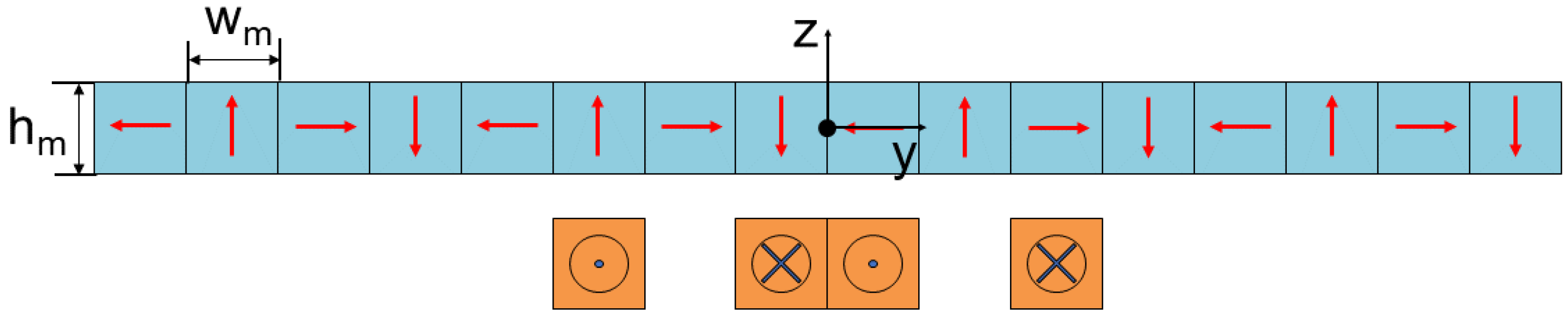
The magnetic field distribution of a Halbach array has been demonstrated in previous studies [21]. When permanent magnets are arranged with specific magnetization orientations along a single direction, an enhanced and well-organized magnetic field is generated on one side of the magnet array. As illustrated in Figure 1, the resulting magnetic flux distribution can be expressed as the coupling of two directional magnetic field components. The magnetic flux density in a single direction can be expressed as [20]:
B y ( y , z ) = k = 0 + B 0 ( n ) · e ( z · λ ) · s i n ( λ · y + 1 4 π )
B z ( y , z ) = k = 0 + B 0 ( n ) · e ( z · λ ) · c o s ( λ · y + 1 4 π )
B 0 ( n ) = ( 2 2 B r ) n π ( e h m 2 λ e h m 2 λ )
B r represents the remanence of the magnets, λ is the spatial wave number solved by λ = 2 n π / 4 w m . l m , w m , and h m are the length, width, and height of a single magnet, n = 4 k + 1 .
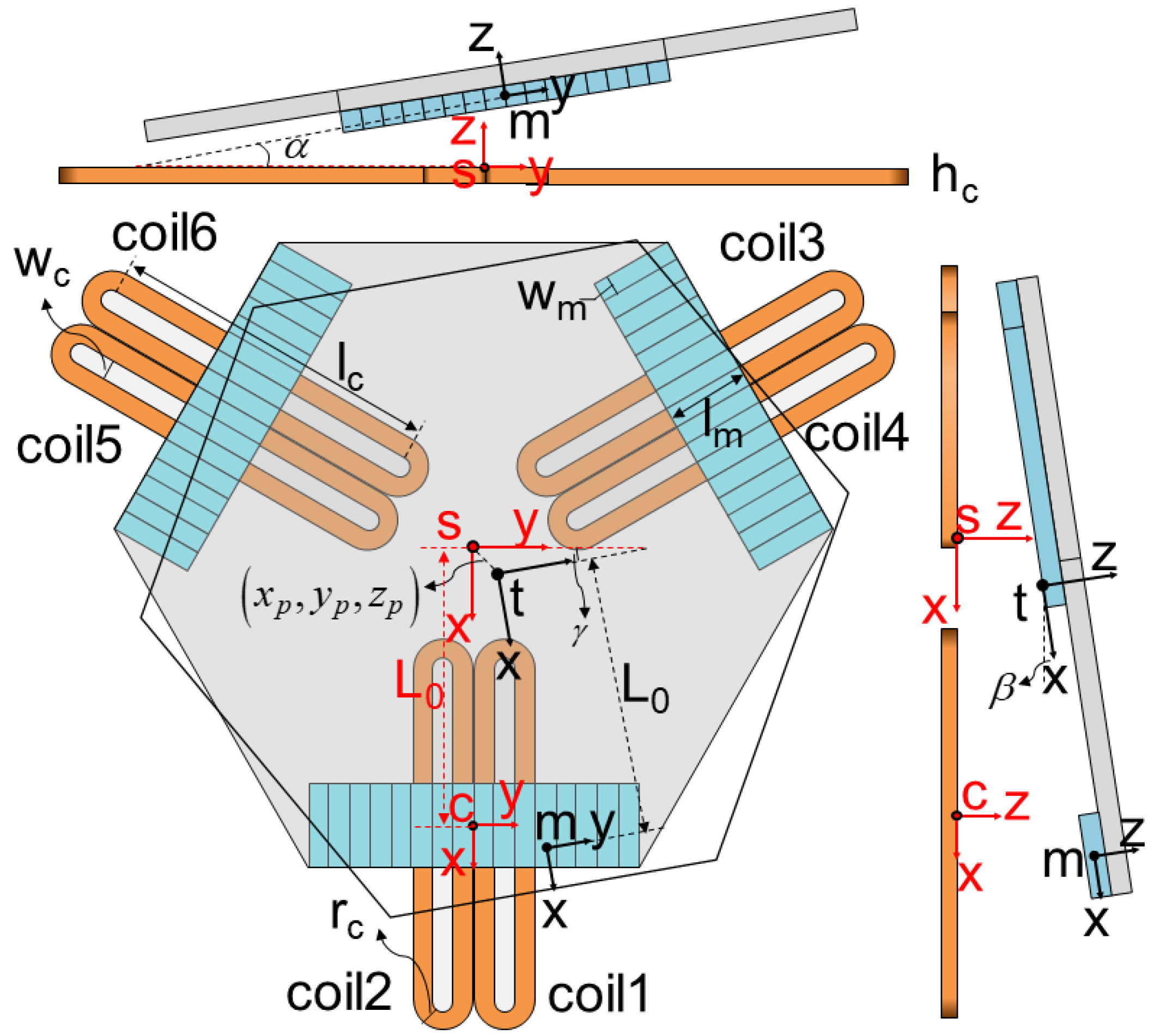
When combined with racetrack coils, the Halbach array generates a resultant force on each coil that can be decomposed into a levitation force and a horizontal driving force. To support the 6-DoF motion of the levitated platform, the actuator configuration adopts the magnet–coil assembly structure shown in Figure 2. The structure consists of three sets of MLA units arranged symmetrically at 120° intervals. In order to enhance system controllability and reduce the required current magnitude per coil, each MLA unit is composed of one Halbach magnet array and two racetrack coils.
During operation, the coils remain stationary, and the stator coordinate frame { s } is defined such that its origin lies at the intersection point of the central axes of the three coil sets, positioned at the same height as the top surfaces of the coils. The distance between the coil center and the stator origin is L 0 . The mover coordinate frame { t } is attached to the center of the floating platform, which is located on the same plane as the bottom surface of the magnets. The centroid of the magnets is represented in the { t } coordinate frame as ( L 0 , 0 , h m / 2 ) . When the platform moves, the spatial motion of the mover is expressed as ( x p , y p , z p , α , β , γ ) . In the initial equilibrium state, the origins of the mover and stator coordinate frames coincide. To minimize the influence of the coil’s curved sections [22], the translational range of the magnets is constrained within the long-side region of the racetrack coil l c .

2.2. Force and Torque Analysis

The net forces and torques acting on the levitated platform are generated by current excitation in the magnetic field, and the direction of the resultant Lorentz force follows left-hand rule. The coil coordinate frame { A c , B c , C c } is to be attached to the center point on the top surface of a coil group, and the magnet coordinate frame { A m , B m , C m } is to be attached to the centroid of the magnet array. Treating the platform as a rigid body with six degrees of freedom, the transformation relationship between any point P c in the coil coordinate system and P m in the magnet coordinate system is expressed as
P A m = R r 1 · R l · R t · P A c P ( B , C ) m = R z ( B , C ) 1 · R l 2 ( B , C ) 1 · R l · R t 1 · R r · R z ( B , C ) · R l · P ( B , C ) c
R l = [ L 0 , 0 , 0 , 1 ] T R l 2 ( B ) = [ L 0 · sin ( π / 6 ) , L 0 · cos ( π / 6 ) , 0 , 1 ] T R l 2 ( C ) = [ L 0 · sin ( π / 6 ) , L 0 · cos ( π / 6 ) , 0 , 1 ] T
R r is the product of the rotation matrices of the three axes. R z ( B , C ) represents the rotation matrices of 120° and 240° respectively around the z-axis. The translation transformation matrix from the origin of the { s } coordinate system to the center of the R t magnetic coordinate system can be expressed as
R t = 1 0 0 x p L 0 ( cos β cos γ + sin α sin β sin γ ) 0 1 0 y p L 0 cos α sin γ 0 0 1 z p h m 2 + L 0 ( cos γ sin β + cos β sin α sin γ ) 0 0 0 1
The magnet is installed on the mover, and the magnetic field applied to the coil will change with the position of the mover. The magnetic field at any point on a coil can be obtained by multiplying the magnitude of the magnetic field at that point in the magnetic field coordinate system with the rotation matrix, which is defined as
B ( x , y , z ) c = R r · B ( x , y , z ) m
For Halbach array, the magnetic field will rapidly decrease to 0 after leaving the magnetic array range [20], and the change in position and attitude will cause the magnetic field boundary on the coil to change. During the platform movement, the intersection line of the edge cross section of the magnet and the coil plane is the magnetic field range on the coil.
P m ( x ) l m 2 = 0 P m ( x ) + l m 2 = 0 P c ( z ) = 0
Substituting Equation (8) into Equation (4) yields the upper and lower limit equations of the magnetic field
x m i n = ξ x + C 1 x m a x = ξ x + C 2
ξ = cos ( α ) · sin ( γ ) cos ( β ) · cos ( γ ) + sin ( α ) · sin ( β ) · sin ( γ )
C 1 and C 2 are values that vary with position. The force and torque generated on the coil can be expressed as equations with ( x p , y p , z p , α , β , γ ) as the variable. The force equation generated by coil 1 is as
F z , 1 s = h c 0 0 r c w c + r c w c + 2 r c x min x max J · B y c d V F y , 1 s = h c 0 0 r c w c + r c w c + 2 r c x min x max J · B z c d V
Here, J represents the current density within the coil. Since the edge of the control magnet moves along the linear part of the coil, it can be considered that the current density within the coil is uniform. N is the number of turns of the coil, I is the magnitude of the current on the coil, r c is the width of the coil, and h c is the thickness of the coil. J is expressed as
J = N · I r c · h c
The resultant reaction force acting on the Halbach array acts on the center of mass of the magnetic array, and the torque is shown in
T A s = r A × F 1 s + F 2 s / 2 T B s = r B × F 3 s + F 4 s / 2 T C s = r C × F 5 s + F 6 s / 2
r is the torque arm vector corresponding to MLA. The total torque acting on the suspended platform is the sum of the torques generated by the three groups of MLA.

2.3. Dynamics Analysis and Current Decoupling

Neglecting air friction, the mover is subjected only to magnetic and gravitational forces during motion. The position parameters of the mover ( x p , y p , z p , α , β , γ ) , are determined by the corresponding components of the resultant force and torque.
m · [ x ¨ p ( t ) , y ¨ p ( t ) , z ¨ p ( t ) ] T = F ( t ) [ 0 , 0 , m g ] T diag ( I x x , I y y , I z z ) · [ α ¨ ( t ) , β ¨ ( t ) , γ ¨ ( t ) ] T = T ( t )
Here, m is the mass of the mover, and I x x , I y y , I z z is the moment of inertia in the three principal axes. The translational dynamics of the system are expressed through six independent equations [23]. The system input u = [ F , T ] T governs the dynamic response of the system. In practice, the forces and torques acting on the magnetic levitation platform are generated by the Lorentz forces produced by the coil currents. According to the force and torque analysis presented in the previous section, the desired forces and torques are functions of the coil currents.
u d e s i r e = Γ · I
The relationship between u d e s i r e and the coil currents ( I 1 , I 2 , I 3 , I 4 , I 5 , I 6 ) can be represented by a 6 × 6 conversion matrix Γ , which is a function of the platform’s position. To avoid the case where Γ becomes rank-deficient and its inverse does not exist, the transformation from force and torque to coil current is obtained using the least-squares method, resulting in the pseudo-inverse matrix Γ * .
I = Γ T · Γ · Γ T 1 · u d e s i r e = Γ * · u d e s i r e
Using current commutation matrix Γ * , the required current for each coil can be directly computed from the desired forces and torques. In the actual system implementation, these computed current signals can be applied to the corresponding current driver modules to realize the desired actuation.

3. Construction of the Simulation System

3.1. Control Block Diagram

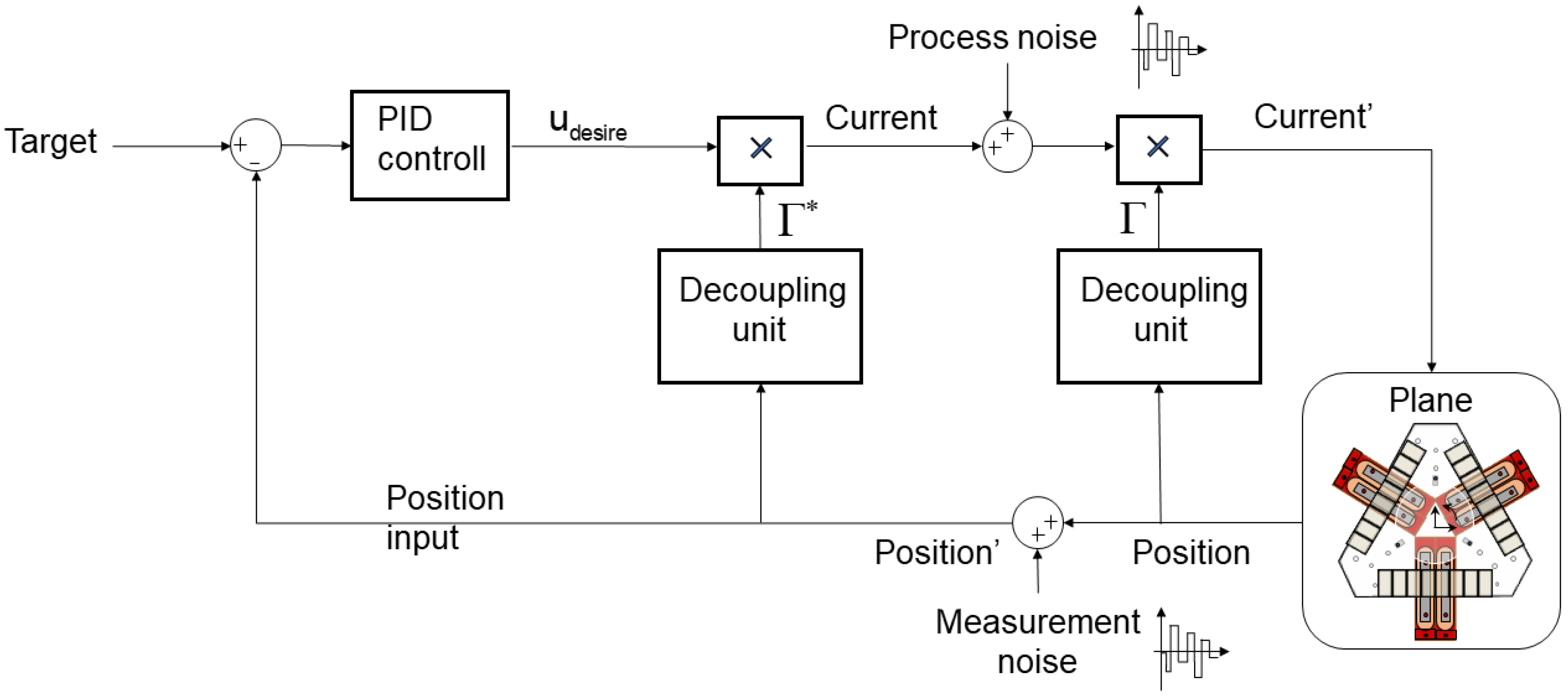
The overall control logic of the magnetic levitation system is illustrated in Figure 3. Due to unavoidable factors such as machining tolerances, assembly errors, thermal deformation, and measurement noise, it is difficult to establish an accurate physical model for the entire system. To ensure stable operation under these modeling uncertainties, a PID control algorithm is adopted.
Each of the six output variables of the system—three translational and three rotational degrees of freedom—is regulated by an independent PID controller. The primary control objectives are to achieve a fast response and minimal overshoot while maintaining system stability. Considering that the current in the coils cannot increase indefinitely due to hardware limitations, the proportional gains of the PID controllers are constrained to prevent current saturation and excessive heating. The final tuning results of the PID parameters are summarized in Table 1.

3.2. Physical Model Construction

In the MATLAB 2025a/Simulink module, a module is built to simulate the motion of the levitation platform. The input of the module is the control quantity of the system ( F , T ) . According to the dynamic analysis of the levitation platform proposed in the previous text, the differential equation is solved by using the integrator module. The second-order parameters are integrated to obtain the first-order parameters, and the first-order parameters are further integrated by the integrator module to obtain the position. Through this module, the changes in system variables over time can be obtained. The process of generating force from current and the process described by the equation are the same. The complex decoupling process is realized through the function feature in the MATLAB 2025a/Simulink module. Equation (11) takes a lot of time to run, so in order to speed up the calculation and meet the control requirements, Equation (7) is decomposed in MATLAB 2025a. Ignoring the higher harmonics of the magnetic field [17], B y c , B z c can be simplified as
B y c = e ( a x + b y + c z + d ) · sin ( e x + f y + g z + h ) B z c = e ( a x + b y + c z + d ) · cos ( e x + f y + g z + h )
Among them, a , b , c , d , e , f , g , h are all values that change with position. By substituting Equations (12) and (17) into (11), the function expression related to position can be calculated. Through this function, the system calculation speed can reach 3 KHz. Furthermore, since there are no ideal sensors and systems in the real world, the modeling of the system cannot be 100 percent accurate. Therefore, considering the position sensors and current drivers that will be used in the actual construction process, measurement noise is added to the position output of the model to simulate the error of the sensors, and process noise is added to the current output to simulate the disturbance of the current. Measurement noise is represented as white noise within the range of ±0.5 μm, and process noise is represented as white noise within the range of ±1 mA.

4. Simulation

4.1. Coupling in Motion

To verify the reliability of the wrench model proposed in this paper, an identical model was constructed by finite element method. The currents intensity of each of the six coils were set to 1 A, and finite element simulations were performed to calculate the forces generated by the levitation platform along the specified trajectory. The levitation platform moves within an approximate range of 5 × 5 mm2, with a maximum yaw angle of 5°, and a maximum pitch angle of 0.2°.
x p = 5 cos π 5 t y p = 5 sin π 5 t z p = 1 + t 10 α = π 900 sin ( π 5 t ) β = π 900 sin ( π 5 t ) γ = π 36 sin ( π 5 t )
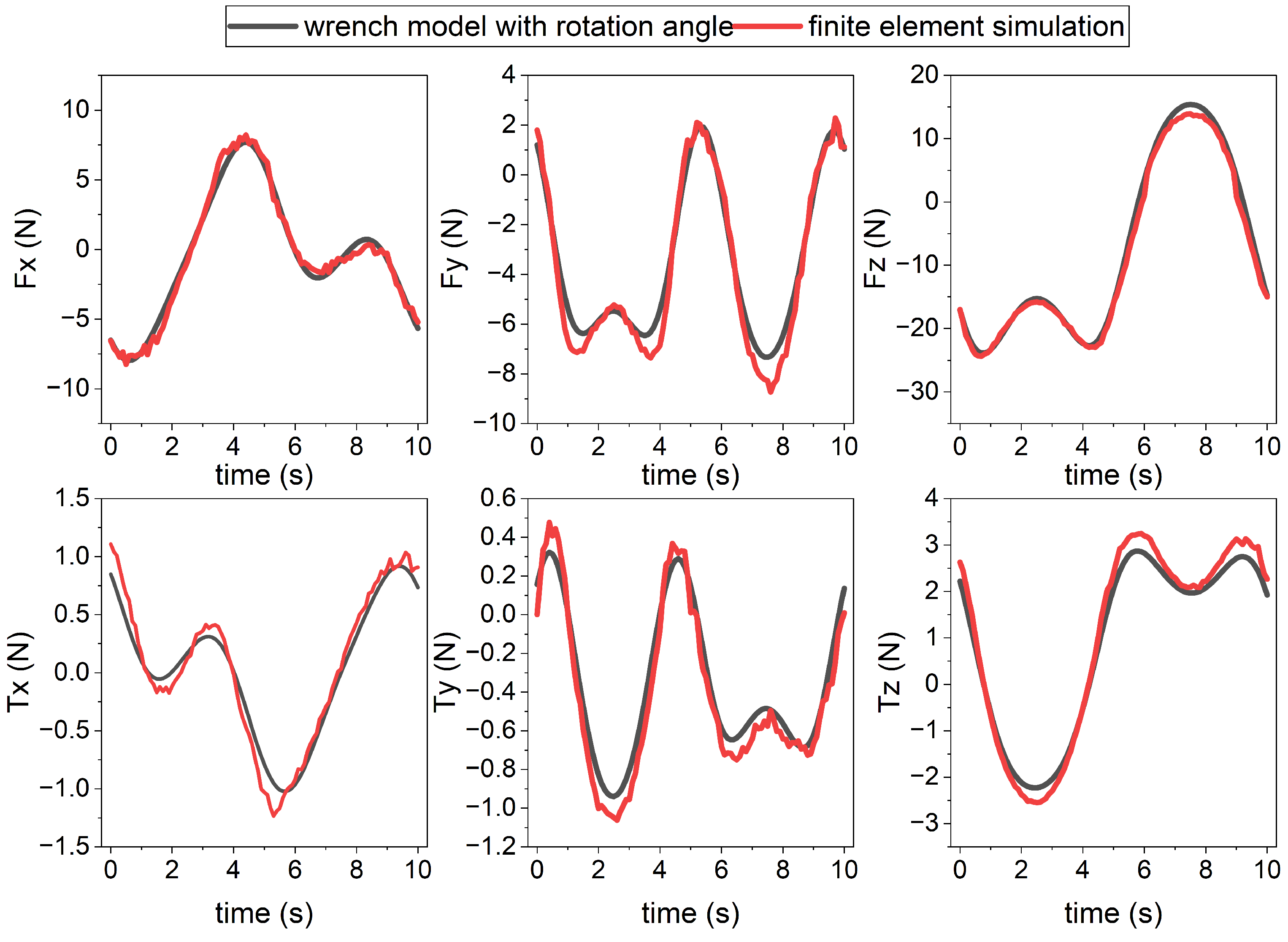
Figure 4 compares the results obtained from the proposed wrench model and the finite element simulation. It can be observed that the two results are highly consistent, with a fitting coefficient R 2 over 0.97. The remaining discrepancies are likely due to the mesh resolution in finite element simulation and the neglect of higher-order harmonics in the wrench model.
As shown in Figure 4, the finite element simulation required approximately 4 h of computation, whereas the proposed model achieved comparable results within only 1 ms. Such computational efficiency is indispensable for real-time control applications.
In previous studies [17,18], when analyzing the wrench model, the influence of rotation is often neglected, or only the effect of a single angular component on the transformation matrix is considered. In this work, the currents in all six coils are set to 1   A , and the levitation platform is subjected to a predefined motion trajectory.
x p = 5 cos π 5 t y p = 5 sin π 5 t z p = 1 + t 10 α = π 180 sin ( π 5 t ) β = π 180 sin ( π 5 t ) γ = π 36 sin ( π 5 t )
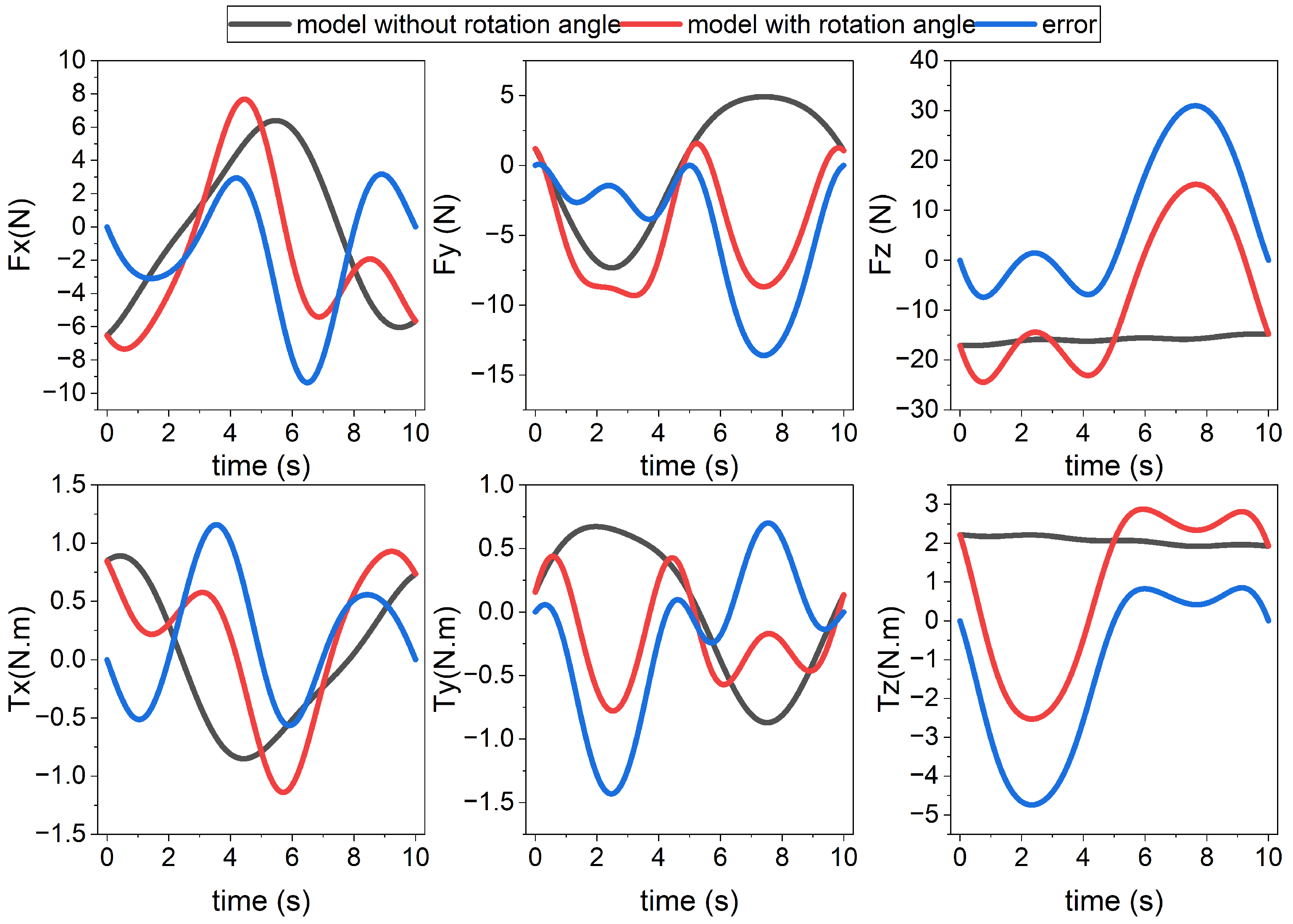
The variations in the resultant forces and torques under the two models, as well as the computational errors between them, are illustrated in Figure 5. The units for the x, y, and z directions are millimeters (mm), while the units for the rotational directions are radians (rad). Time t is expressed in seconds (s). The levitation platform moves within an approximate range of 5 × 5 mm, with a maximum yaw angle of 5°, with a maximum pitch angle of 1°.
Examining the error variations in Figure 5 shows that when the platform exhibits no angular deflection, the forces and torques computed from the two models are identical. As the angular deviation increases, the magnitude of error grows approximately in proportion to the angle. The computational errors in force and torque estimation cause deviations in the desired current values, thereby degrading the accuracy of the system response. The current conversion matrices and their inverse of the two models at the fourth second are presented in Appendix A.
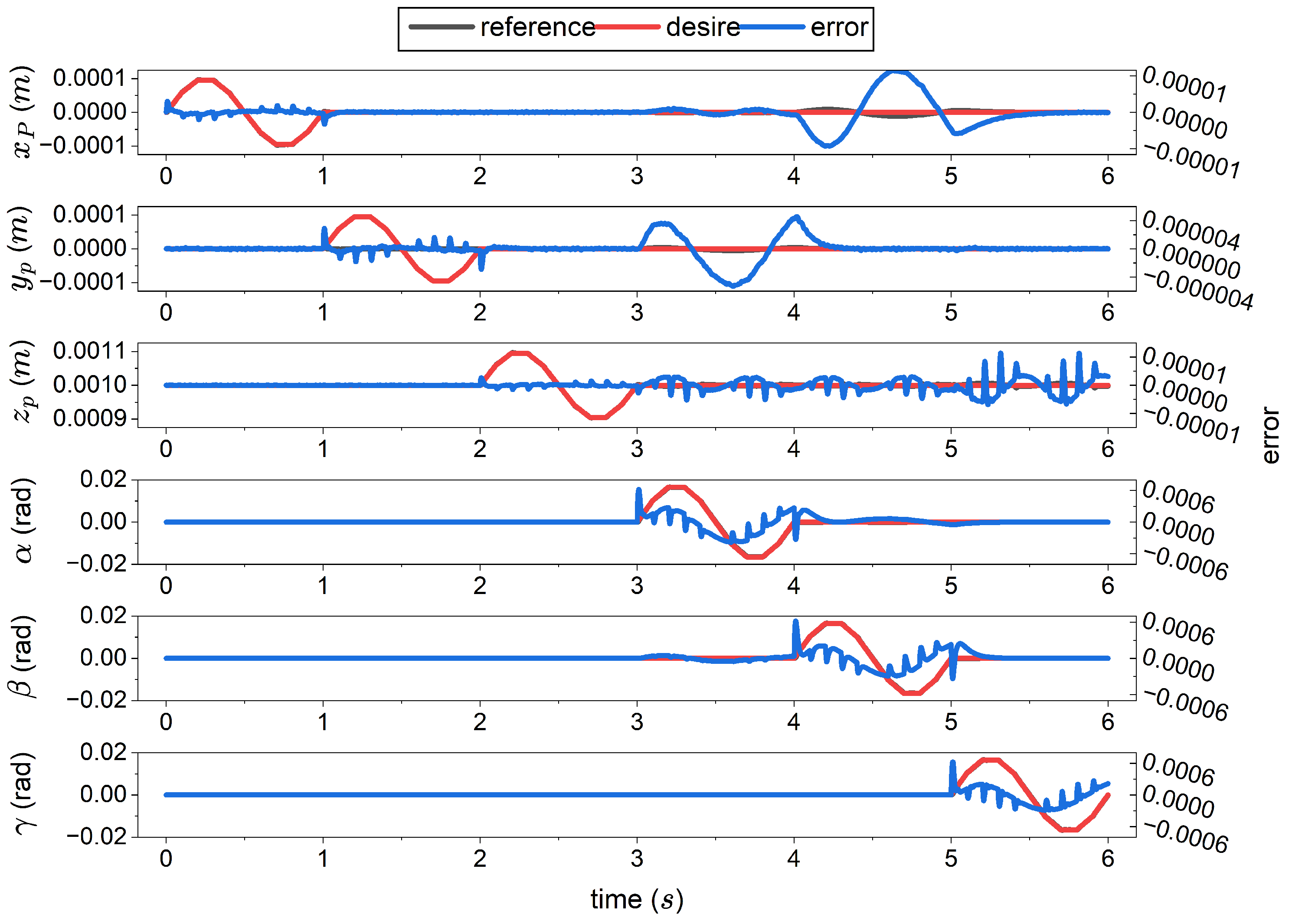
To further investigate the coupling behavior, independent sinusoidal signals with a duration of 1 s are applied to each axis. The amplitude of the translational sinusoidal signals is 0.1 mm, while that of the rotational signals is 1°. Figure 6 illustrates the influence of motion in each degree of freedom under the wrench model without rotation angles. It can be seen that translation along any of the three axes produces negligible effects on the other degrees of freedom. However, when rotational motion occurs, the unexcited axes exhibit significant fluctuations around their reference positions. Therefore, to improve the system’s performance with larger angular displacements, the effects of rotation must be considered. Subsequent simulations will compare the performance of the two models.

4.2. Step Response and Trajectory Tracking

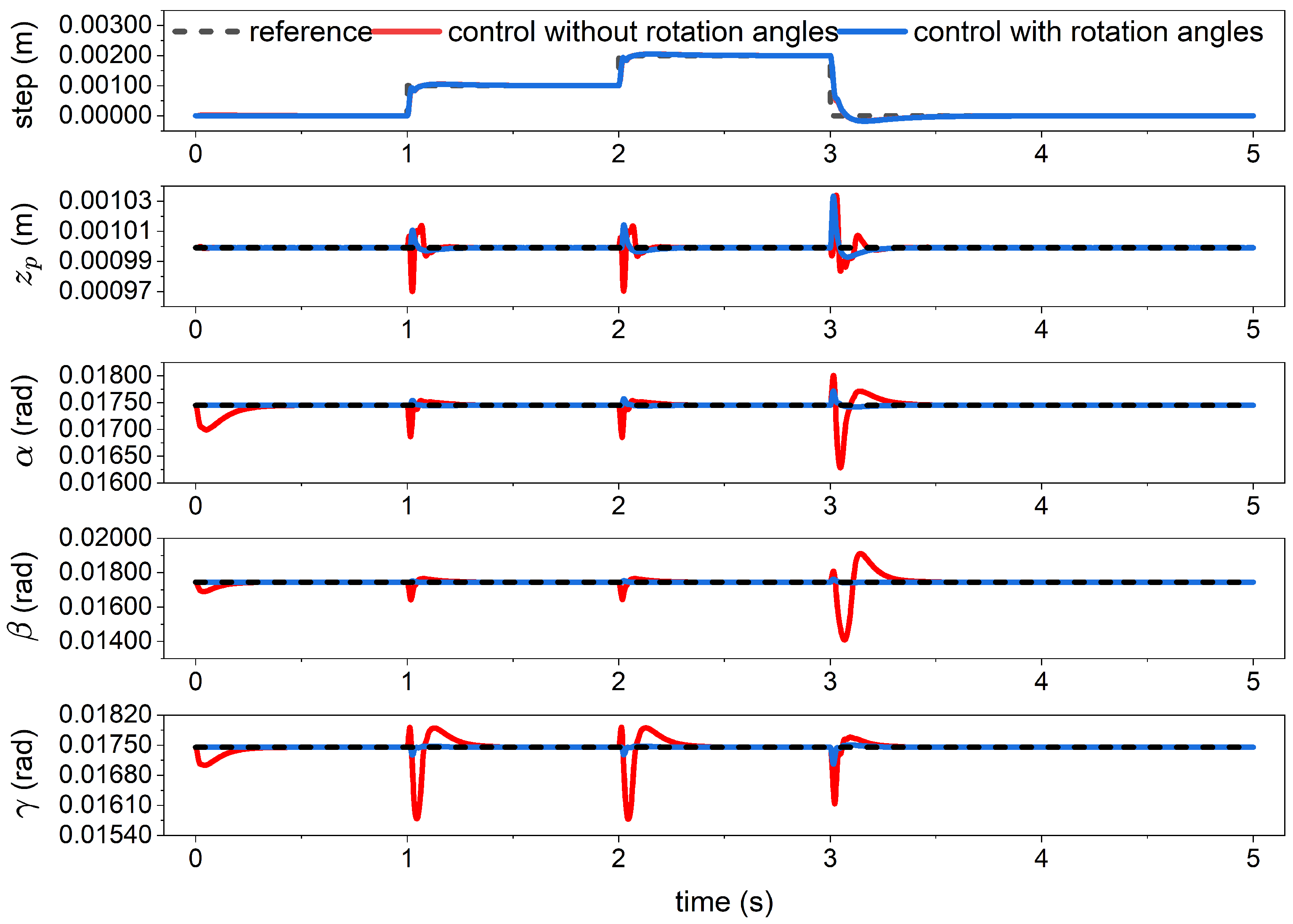
In this test, the levitation platform starts from the point of origin (0 mm, 0 mm, 1 mm) with three sets of initial orientation angles: (1°, 1°, 1°). The platform is then commanded to perform a 1 mm step response along the vector direction ( 2 /2, 2 /2) within the horizontal plane, while the disturbances on the other axes are recorded. Two different wrench models are employed to compute the current commutation matrix in Equation (16): one is the 6D wrench model with rotation angles in Section 2. The other one is a 3D wrench model without rotation angles.
The simulation results shown in Figure 7 indicate that the wrench model with angular correction exhibits smaller disturbances on each axis during motion. This improvement arises from a more accurate model formulation, which reduces the errors in force and torque generation, as well as mitigating the effects of angular coupling on the motion of the other axes. These results demonstrate that employing a wrench model incorporating angular analysis effectively reduces the steady-state error of the system. Furthermore, the time required for the system to reach stability is significantly shorter under the improved model, indicating that the improved model also enhances the transient response performance of the magnetic levitation system.
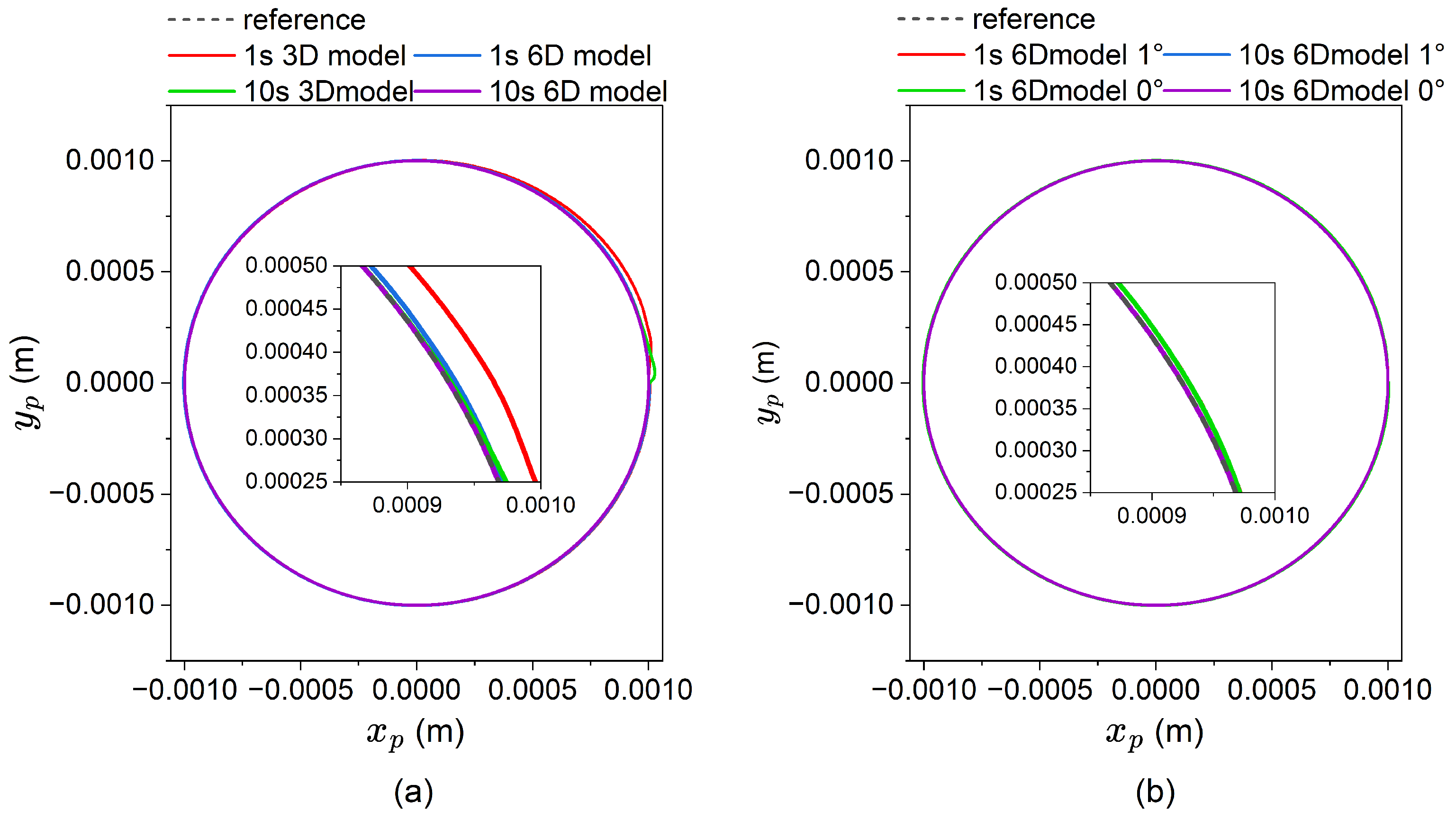
The levitation platform is further controlled to track circular trajectories in space with various deflection angles and velocities within the x s y s plane. Velocity is represented by the time required for the platform to complete one revolution. Figure 8a illustrates the tracking performance when the platform follows a circular trajectory with deflection angles of (1°, 1°, 1°).
When the platform velocity is low, the simulation results of the improved model almost coincide with the reference trajectory, whereas the wrench model without rotation angles exhibits significant deviations at the start of motion. As the motion speed increases, both models show larger tracking errors due to overshoot. Figure 8b shows the simulation results of the improved model under different angles and velocities. It can be observed that that the trajectories obtained under deflected motion are similar to those obtained under zero deflection. The positional accuracy under different conditions is given in the Table 2.
These results suggest that while higher motion speeds lead to larger overall errors, rotational variations do not contribute additional deviations. Hence, the wrench model with rotation angles effectively mitigates coupling-induced disturbances within the system.

5. Discussion

For the magnetic levitation actuator composed of racetrack coils and a 1D Halbach array, increasing the gap between the magnets and coils leads to a reduction in the magnetic field intensity experienced by the coils. Consequently, larger coil currents are required to meet the control demands. However, in practical experiments, there exists an inherent trade-off between a large current range and high current resolution. A smaller gap range is typically selected, which indirectly limits the allowable range of angular motion. The wrench model proposed in this paper takes structural constraints into account, limiting the angular deviation within the range of (1°, 1°, 5°).
Furthermore, the current density distribution in the curved segments of the coils differs from that in the straight sections. When the magnet moves into the arc region, this nonuniform current density may introduce additional errors into the system. Such errors can be mitigated by appropriately designing the dimensions of the magnets and coils to prevent the magnets from entering the curved region. Alternatively, the error can be reduced through precise modeling of the coil’s circular section combined with accurate position sensing and compensation techniques.

6. Conclusions

Derived from a magnetic levitation system that utilises three sets of MLAs, a 6-DOF force model of the MLA was deduced with the objective of reducing decoupling errors caused by misalignment between the Halbach arrays and their corresponding coils. The corresponding current commutation model was also formulated. A PID controller was implemented, and a simulation program was developed to emulate the physical process. Comparative simulations were conducted in Simulink between the wrench model with and without rotation angles. In the force tests along the specified motion trajectory, it was observed that the difference between the forces generated by the two models increased with the rotation angle. The sinusoidal signal tests further demonstrate that, in the 3D wrench model, angular variations produce coupling effects that influence other axes. The simulations presented in Section 3 consistently indicate that the 6D wrench model exhibits superior dynamic response performance, thus confirming that the proposed improved model is meaningful for enhancing the angular control capability of the magnetic levitation platform.
In subsequent studies, the modeling of the curved sections of the coils will be considered to make the proposed method more general and widely applicable. Additionally, expanding the motion range of each degree of freedom of the levitation platform by modifying the system structure will be an important step in further improving the system.

Author Contributions

Conceptualization, H.X. and K.G.; methodology, H.X.; software, H.X.; validation, H.X.; formal analysis, H.X.; data curation, H.X.; writing—original draft preparation, H.X.; writing—review and editing, H.X. and X.L.; visualization, H.X.; supervision, X.L.; project administration, X.L.; funding acquisition, X.L. All authors have read and agreed to the published version of the manuscript.

Funding

This research was funded by The National Natural Science Foundation of China grant number 22090013.

Data Availability Statement

The original contributions presented in this study are included in the article. Further inquiries can be directed to the corresponding author.

Conflicts of Interest

The authors declare no conflicts of interest.

Abbreviations

The following abbreviations are used in this manuscript:
MLAMagnetic levitation actuator
LUTLookup table
DOFDegree of freedom
FPGAField Programmable Gate Array
PIDProportional Integral Derivative

Appendix A

The simulation data of the MLAs are as follows: b r = 1.35 T, h m = 11 mm, h c = 13 mm, L 0 = 130 mm, r c = 10 mm, l c = 160 mm, N = 168, w c = 12 mm, l m = 60 mm, w m = 11 mm, m = 4.5 kg, I x x = 0.0746   kg · m 2 , I y y = 0.0746   kg · m 2 , I z z = 0.1491   kg · m 2 .
Current conversion matrix of 6D wrench model:
0 0 4.2113 1.7440 1.7316 5.9235 7.7515 2.0802 2.4314 1.0069 0.9997 3.4199 0.9248 7.9242 1.3311 4.6950 7.0688 0.9525 0.0160 0.0502 0.1497 0.5104 0.8189 0.1083 0.1201 1.0287 0.0863 0.3350 0.4171 0.0598 1.0063 0.2701 0.6313 0.2614 0.2596 0.8880
Current conversion matrix’s inverse of 6D wrench model:
0.0001 0.0835 0.0109 0.0086 0.1682 0.3202 0.0004 0.0093 0.0408 0.0321 0.6267 0.0410 0.1062 0.0617 0.0263 0.3398 0.2201 0.4721 0.0304 0.0165 0.0635 0.8205 0.5315 0.1351 0.0103 0.0061 0.0454 0.6216 0.3176 0.0534 0.0814 0.0469 0.0133 0.1817 0.0928 0.3598
Current conversion matrix of 3D wrench model:
0 0 1.9729 5.6133 3.4696 4.0289 3.0610 6.2510 1.1390 3.2408 2.0032 2.3261 5.8662 2.1940 6.2117 1.3711 5.2713 4.7081 0.0430 0.0067 0.6798 0.1436 0.6091 0.5464 0.7616 0.2848 0.4354 0.1072 0.3138 0.2762 0.3974 0.8115 0.2957 0.8414 0.5201 0.6040
Current conversion matrix’s inverse of 3D wrench model:
0.0005 0.0342 0.0480 0.0378 0.7379 0.1257 0.0002 0.0899 0.0235 0.0185 0.3614 0.3492 0.0181 0.0112 0.0498 0.6431 0.4166 0.0803 0.0827 0.0475 0.0175 0.2260 0.1464 0.3679 0.0632 0.0363 0.0357 0.4897 0.2502 0.2749 0.0697 0.0404 0.0308 0.4217 0.2155 0.3152

References

  1. Kim, W.; Trumper, D.L. High-precision magnetic levitation stage for photolithography. Precis. Eng. 1998, 22, 66–77. [Google Scholar] [CrossRef]
  2. EUV Lithography Systems. Available online: https://www.asml.com/en/products/euv-lithography-systems (accessed on 20 October 2025).
  3. Kim, W.; Verma, S.; Shakir, H. Design and precision construction of novel magnetic-levitation-based multi-axis nanoscale positioning systems. Precis. Eng. 2007, 31, 337–350. [Google Scholar] [CrossRef]
  4. Zhang, Z.; Menq, C.H. Six-Axis magnetic levitation and motion control. Trans. Robot. 2007, 23, 196–205. [Google Scholar] [CrossRef]
  5. Kim, C.H.; Kim, K.J.; Yu, J.S.; Cho, H.W. Dynamic performance evaluation of 5-DOF magnetic levitation and guidance device by using equivalent magnetic circuit Model. IEEE Trans. Magn. 2013, 49, 4156–4159. [Google Scholar] [CrossRef]
  6. Laro, D.; Boots, E.; van Eijk, J.; Sanders, L. Design and control of a through wall 450 mm vacuum compatible wafer stage. In Proceedings of the 13th Euspen International Conference, Berlin, Germany, 27–31 May 2013. [Google Scholar]
  7. Lu, X.; Yan, Y.; Qi, B.; Qian, H.; Sun, J.; Quigley, A. Contactless haptic display through magnetic field control. IEEE Trans. Haptics 2022, 15, 328–338. [Google Scholar] [CrossRef]
  8. Hesse, S.; Huaman, A.; Katzschmann, M.; Leistritz, B.; Herzog, L. NPS6D200—A long range nanopositioning stage with 6D closed loop control. Appl. Sci. 2024, 14, 6972. [Google Scholar] [CrossRef]
  9. Zhang, K.; Xu, F.; Xu, X. Observer-based fast nonlinear MPC for multi-DOF maglev positioning system: Theory and experiment. Control Eng. Pract. 2021, 114, 104860. [Google Scholar] [CrossRef]
  10. Jeong, J.; Ryu, J.; Gweon, D. Feedforward reference compensation using bilinear interpolation for long range motion of six degrees-of-freedom magnetic levitation planar motor. In Proceedings of the 2017 8th International Conference on Mechanical and Aerospace Engineering (ICMAE), Prague, Czech, 22–25 July 2017; pp. 75–78. [Google Scholar]
  11. Li, M.; Zhu, Y.; Yang, K.; Yang, L.; Hu, C.; Mu, H. Convergence rate oriented iterative feedback tuning with application to an ultraprecision wafer stage. IEEE Trans. Ind. Electron. 2019, 66, 1993–2003. [Google Scholar] [CrossRef]
  12. Holmes, M.; Trumper, D. Magnetic/fluid-bearing stage for atomic-scale motion control (the angstrom stage). Precis. Eng. 1996, 18, 38–49. [Google Scholar] [CrossRef]
  13. Zhou, L.; Wu, J. Magnetic levitation technology for precision motion systems: A review and future perspectives. Int. J. Autom. Technol. 2022, 16, 386–402. [Google Scholar] [CrossRef]
  14. Berkelman, P.; Dzadovsky, M. Magnetic levitation over large translation and rotation ranges in all directions. IEEE/ASME Trans. Mechatronics 2011, 18, 44–52. [Google Scholar] [CrossRef]
  15. Wang, Y.; Xu, Z.; Khamesee, M.B. Magnet-coil role-switching real-time wrench model for magnetic levitated motors with extendable motion range. IEEE Trans. Ind. Electron. 2025, 72, 2863–2871. [Google Scholar] [CrossRef]
  16. Wang, Y.; Khamesee, M.B. Deep learning-based wrench model for magnetically levitated actuators. IEEE Trans. Ind. Electron. 2024, 71, 14663–14672. [Google Scholar] [CrossRef]
  17. Nguyen, V.H.; Kim, W. Two-phase lorentz coils and linear Halbach array for multiaxis precision-positioning stages with magnetic levitation. IEEE/ASME Trans. Mechatron. 2017, 22, 2662–2672. [Google Scholar] [CrossRef]
  18. Zhu, H.; Teo, T.J.; Pang, C.K. Design and modeling of a six-degree-of-freedom magnetically levitated positioner using square coils and 1-D Halbach arrays. IEEE Trans. Ind. Electron. 2017, 64, 440–450. [Google Scholar] [CrossRef]
  19. Xu, F.; Lv, Y.; Xu, X.; Dinavahi, V. FPGA-based real-time wrench model of direct current driven magnetic levitation actuator. IEEE Trans. Ind. Electron. 2018, 65, 9635–9645. [Google Scholar] [CrossRef]
  20. Xu, F.; Lu, X.; Zheng, T.; Xu, X. Motion control of a magnetic levitation actuator based on a wrench model considering yaw angle. IEEE Trans. Ind. Electron. 2020, 67, 8545–8554. [Google Scholar] [CrossRef]
  21. Smith, A.C. High-Precision Planar Magnetic Levitation. Ph.D. Thesis, Miassachusetts Institute of Technology, Cambridge, UK, 1997. [Google Scholar]
  22. Jansen, J.W.; Van Lierop, C.M.M.; Lomonova, E.A.; Vandenput, A.J.A. Modeling of magnetically levitated planar actuators with moving magnets. IEEE Trans. Magn. 2007, 43, 15–25. [Google Scholar] [CrossRef]
  23. Ma, J.; Cheng, Z.; Zhu, H.; Li, X.; Tomizuka, M.; Lee, T.H. Convex parameterization and optimization for robust tracking of a magnetically levitated planar positioning system. IEEE Trans. Ind. Electron. 2021, 69, 3798–3809. [Google Scholar] [CrossRef]
Figure 1. 1D-Halbach magnet array distribution.
Actuators 14 00562 g001
Figure 2. Three views of the magnetic levitation plane containing three MLAs.
Actuators 14 00562 g002
Figure 3. Control block of magnetic levitation system.
Actuators 14 00562 g003
Figure 4. Comparison of force and torque calculated by wrench models and finite element simulations.
Actuators 14 00562 g004
Figure 5. Comparison of force and torque calculated by two different wrench models under a fixed current.
Actuators 14 00562 g005
Figure 6. Evaluation of the impact of each axis’s movement on other axes in a wrench model without considering angles.
Actuators 14 00562 g006
Figure 7. The continuous step response of the platform in the translation direction at an attitude Angle of (1°, 1°, 1°).
Actuators 14 00562 g007
Figure 8. (a) Trajectory comparison of the two models at different speeds in (1°, 1°, 1°). (b) Trajectory tracking of the wrench model considering angles at different angles and speeds.
Actuators 14 00562 g008
Table 1. The PID parameters of each axis.
PID
x p 35,270349,138873
y p 45,463451,2431034
z p 45,143527,944874
α 667626316
β 741881814
γ 160917,29733
Table 2. The positional accuracy under different conditions in trajectory tracking.
Test ModelTime (s)Rotation AngleRmse (m)Maximum Deviation (m)
3D1(1°, 1°, 1°) 1.33529 × 10 5 3.42313 × 10 5
3D10(1°, 1°, 1°) 3.80933 × 10 6 3.21325 × 10 5
6D1(1°, 1°, 1°) 4.99436 × 10 6 3.08641 × 10 5
6D1(0°, 0°, 0°) 4.9942 × 10 6 3.08638 × 10 5
6D10(1°, 1°, 1°) 1.3189 × 10 7 3.10713 × 10 6
6D10(0°, 0°, 0°) 1.31434 × 10 7 3.10688 × 10 6
Disclaimer/Publisher’s Note: The statements, opinions and data contained in all publications are solely those of the individual author(s) and contributor(s) and not of MDPI and/or the editor(s). MDPI and/or the editor(s) disclaim responsibility for any injury to people or property resulting from any ideas, methods, instructions or products referred to in the content.