Review

Potential of Piezoelectric Actuation and Sensing in High Reliability Precision Mechanisms and Their Applications in Medical Therapeutics


Group of Electrical Engineering—Paris (GeePs), CNRS, University of Paris-Saclay and Sorbonne University, F91190 Gif sur Yvette, France
*
Author to whom correspondence should be addressed.
Actuators 2025, 14(11), 528; https://doi.org/10.3390/act14110528
Submission received: 1 October 2025 / Revised: 23 October 2025 / Accepted: 27 October 2025 / Published: 31 October 2025

Abstract

The present contribution aims to analyze and highlight the potential of piezoelectric materials in actuation and sensing duties, obtaining reliable high-precision outcomes in cutting-edge applications including medical interventions. This involves high-precision actuations of robotized procedures, as well as monitoring and controlling various physical phenomena via structural sensing. The characteristics of these applications offer enhanced precision machinery and robotic tools, medical robotic precise interventions, and high-accuracy structural sensing. The paper exposed, analyzed, reviewed and discussed different subjects related to piezoelectric actuators, involving their displacement and positioning strategies, piezoelectric sensors, medical applications of piezoelectric actuators and sensors, including robotic actuation for medical interventions, and structural sensing in the monitoring of wearable healthcare tools. Discussions among others on the advantages and limitations of piezoelectric sensors and actuators in general, as well as future research perspectives in medical involvements, are also presented at the end of the article. The specific features in the illustrated applications reflect crucial behaviors in robotic actuation for medical interventions, structural sensing in the monitoring of healthcare wearable tools, and the control of various structural physical occurrences.

1. Introduction

Motion and positioning are frequently exercised in advanced energy mechanisms, e.g., robotic junctions, spatial arrangements, precision machinery, etc. Such duties can be accomplished by means of actuators exhibiting high degrees of displacement resolution and positioning accuracy along with swift responses, high stiffness and actuation potency, simple configuration, flexible stroke, endurance to electromagnetic (EM) interference, and scalable arrangements with unimportant sizes. On the other hand, the accurate sensing of different quantities can play a significant role in such advanced tools, particularly for monitoring and controlling various structural and physical occurrences. Actuators and sensors utilizing piezoelectric materials are on-track contenders for such features [1,2,3,4,5,6,7,8]. Actuators can be incorporated for movement and/or positioning in energy implements [2,4], or for setting up self-ruling robots [1,5]. Such actuators operate by obeying the piezoelectric inverse effect. Actually, a piezoelectric material creates electric potential under an applied compression, which is the direct effect, while an applied electric potential on the material generates mechanical deformation, which is the inverse effect. The direct effect is operated in structural sensors and energy transducers as well as damping and energy harvesting systems, while the inverse one is achieved using actuating tools. Such actuating tools can be exploited by themselves or via an amplified action depending on the actuated strength application [9,10,11]. Such amplification displays double-conversion electric–mechanic (inverse piezoelectric effect—small displacement) and mechanic–mechanic (displacement magnifying) structures, typifying the movement fashioned by the amplified actuator.
The recent precision revolution impacted sophisticated innovative industrial processes and medical therapeutics in both actuation and sensing tasks. Both occurrences are related to displacement resolution and positioning accuracy, but are mostly involved in robotized procedures as well as pressure detection. In both industrial and medical domains, piezoelectric materials can contribute to effectively accomplishing their duties. The industrial applications involved are mainly related to precision machinery and robotic tools [12,13,14] as well as pressure sensing [15]. In the case of healthcare, the concerned therapeutics are related to wearable pressure detection tools [16] and robotic interventional surgery and drug delivery [17]. In this context, chronologically, the strategies involved were robotized laparoscopic, computerized robotic, and image-guided robotic interventions [18]. Furthermore, in addition to the important role of piezoelectric materials in sensing and actuation, their voltage-dependent actuating action allows the performance of energy harvesting and structural health monitoring. This occurrence fashions piezoelectric sensors and actuators valuable for monitoring and controlling various physical observable facts, such as vibration, tremor, position, shift, pressure, deformation, etc. [19,20]. In addition, the more specific involvement of piezoelectric materials could be found in different recent applications; for instance, an ultra-high load-to-weight ratio [21] and long-range positioning with a nanometer resolution [22].
Various research has been published on specific applications of the studied topic. This contribution aims to evaluate and merge some related approaches, focusing on analyzing and demonstrating the potential of piezoelectric reliable actuation and sensing tasks in revolutionary industrial and medical fields.
The aim of this paper is the assessment of piezoelectric material use in actuation and sensing duties, performing reliable towering precision solutions in recent industrial and medical involvements. This work particularly concerns the actuation of robotic procedures in medical interventions, as well as structural detection and assistance in wearable medical tools. The high-reliability precision mechanisms used in these specific cases in the medical field are directly linked to patient safety and staff ease. The different themes addressed in this paper, although autonomous, are supported by examples from the literature, allowing a deeper comprehension.
In the present contribution, after a general introduction on actuation and sensing devices involving piezoelectric materials, different related characteristics will be exposed, analyzed, reviewed, and discussed. Section 2 concerns piezoelectric actuators, including different categories of actuators and traveling wave piezoelectric robots as well as displacement and positioning strategies focusing on the analysis of displacement resolution and positioning accuracy. Section 3 is related to piezoelectric sensors, including their use in monitoring and controlling various structural physical occurrences. Section 4 is devoted to medical applications of piezoelectric actuators and sensors. These concern robotic actuation for medical interventions and structural sensing in monitoring of healthcare wearable tools. Section 5 deals with discussions related to details on points from the previous sections, including comments on the advantages and limitations of piezoelectric sensors and actuators as well as research perspectives. Section 6 is devoted to conclusions and a summary of possible future work.

2. Piezoelectric Actuators

Topical progresses in technology have resulted in a rapid increase in revolutionary high-accuracy positioning and directing skills. Piezoelectric actuators exhibit resolution dominance in the nanometer-range, swift response, and invulnerability to EM interference, outclassing their pairs, such as magnetostrictive and shape–memory alloy actuators [23,24,25], in the uses of precision engineering, movement yield, medical handling, and microfluidics management. Furthermore, the mechanical scalability and outstanding load aptitude, make piezoelectric actuators an promising candidate in the fields of automation, robotics, industrial assessment, healthcare, defense, and aerospace.

2.1. Different Categories of Piezoelectric Actuators

Piezoelectric actuators are often classified in different manners related to, for instance, material, performance, structure, vibration condition, cutting-edge performance, etc. In general, from such classifications, an outcome indicates the different adaptabilities of an actuator to a specific application. However, while selecting a viable kind of actuator for diverse use situations, assorted issues ought to be deliberated, accounting for accuracy, velocity, power intake, mechanical intricacy, control complication, and price [6,26]. The classifications of piezoelectric actuators have been investigated in many published works, e.g., [6,8,27], and they are not in the scope of the present work.
The present contribution focuses on actuated procedures exhibiting high degrees of displacement resolution, positioning accuracy, and swift response. We will consider, in this context, different robotic procedures, depending on the intended application, utilizing piezoelectric materials.
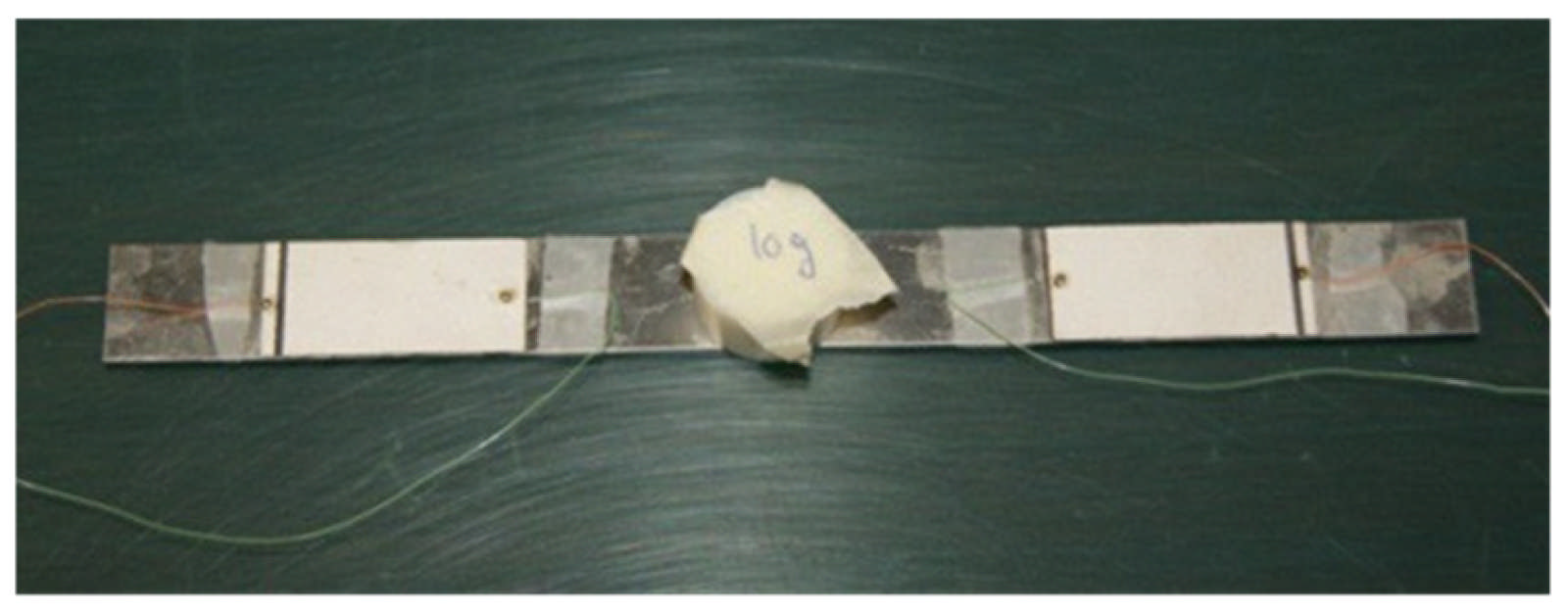
The first concerns robotic structures actuated directly by piezoelectric incorporated materials [28] in the form of bonded pieces. These are traveling wave (TW) beams and plates which are generally employed in miniaturized form in applications involving controlled precise displacements of small masses on a smooth surface or other mediums, in general [5,28,29], or of liquids in conduits as mini or micro pumps [4,30,31]. Such actuators are generally used in precision processes that need accuracy, repeatability, and reliability, like in robotics and automation as they require great load facility, a higher move span, and soft displacement. Figure 1 shows an example of a TW piezoelectric integrated minirobot moving on a smooth surface [5]. Figure 2 shows the same robot loaded by a small masse moving on a rough surface [5].
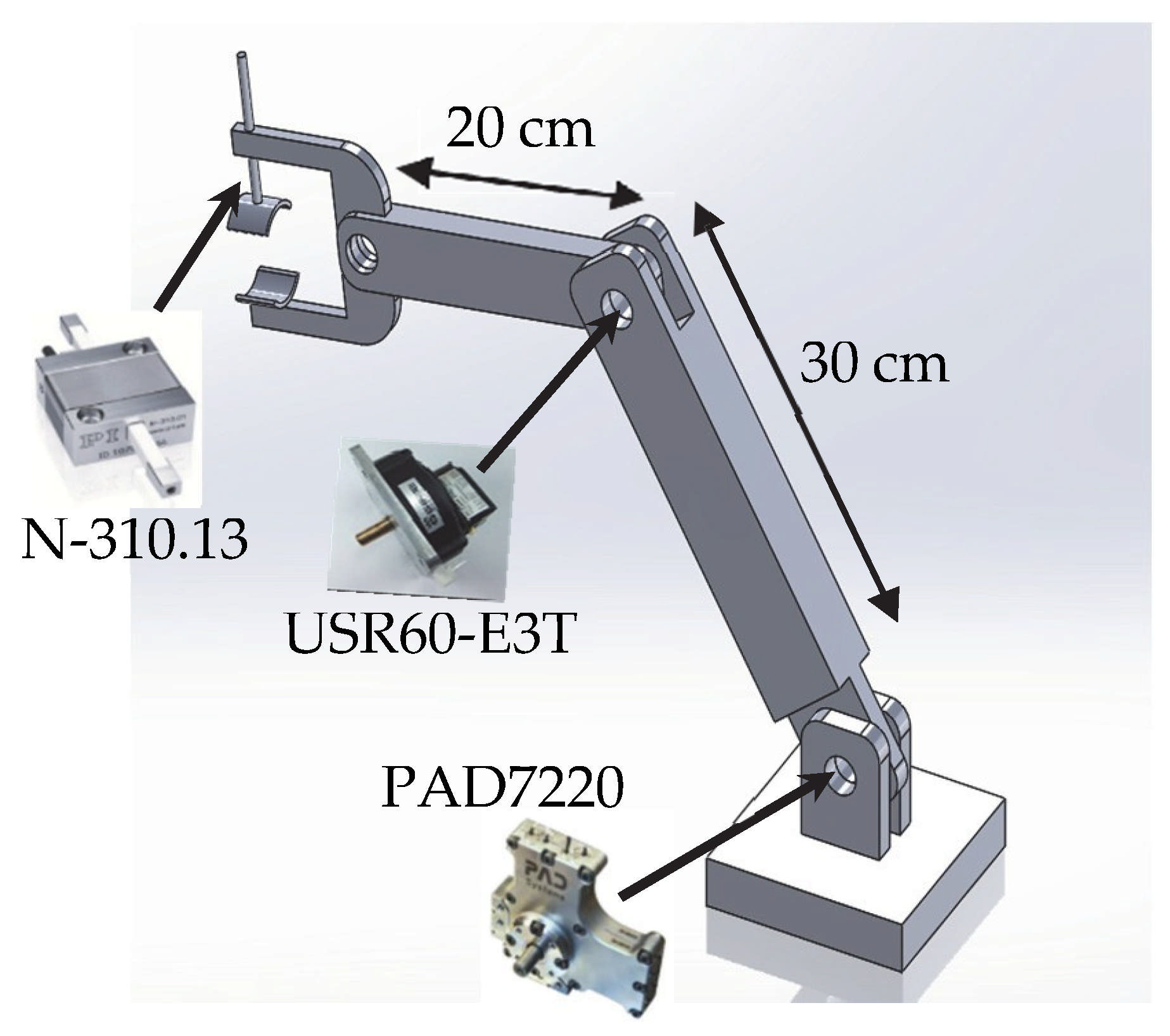
The second concerns actuated robotic joints using actuators functioning on the conversion of the piezoelectric material deformation into indirect displacement through complex configurations using techniques such as repeating and/or stepping, permitting larger strokes and higher degrees of freedom [32]. Such a category includes stepping actuators [8,33] and ultrasonic actuators [27]. These are characterized by rapid responsiveness, high efficiency, and invulnerability to EM interference, making them particularly suitable for medical and aerospace applications. Stepper actuators have slower movement but offer better mechanical flexibility and lower cost. Figure 3 illustrates, in the context of actuated robotic joints, an example of a prototype of an actuated robotic arm [3].
Note that piezoelectric materials can be used, in addition to the abovementioned actuation procedures, in different applications, e.g., piezo surgery, which is an osteotomy technique requiring the use of micro vibrations of blades at ultrasonic frequency. Piezo surgery is therefore an ultrasonic transduction obtained by the contraction and expansion of piezoelectric ceramic [34]. Another example is the use of ultrasound transducers for hyperthermia tumor treatment. This technique uses intracavitary ultrasound applicators acting as a multi-element ultrasound transducer that distributes adapted power deposited in the tissue volume by controlling each element, thus allowing selective tissue eradication, which is an alternate to conventional surgery [35].

2.2. TW Piezoelectric Robotic Structures

Generally, a structural wave can be generated in a material by a vibration source interacting with that substance. This wave propagates in the material, transporting energy from one position to another. The ability to generate and propagate a wave motion in a restricted material can be reached by specific actuation means. TWs can be obtained in one-dimensional mode in beams actuated at their ends, or in two-dimensional mode in plates with actuators positioned at different positions depending on the intended propagation. These actuators generate controlled structural vibrations consistent with their specific excitations, which define the features of the fashioned progressive waves.

2.2.1. TW Piezoelectric Beam Robots

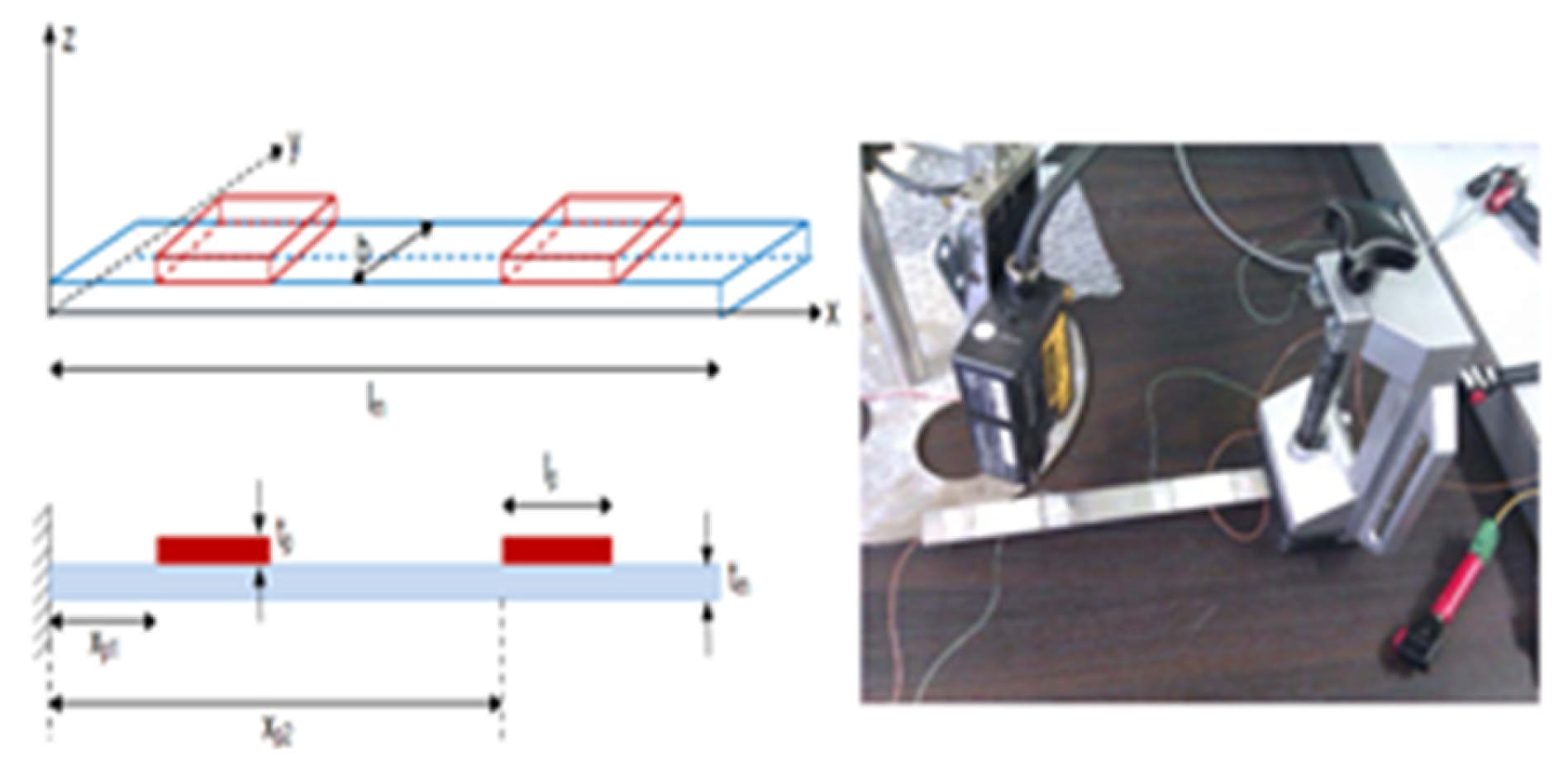
Regarding piezoelectric ultrasonic actuators, consisting of a fixed excited stator and a moving slider, the linear version of these actuators [35] initiates the concept of traveling wave (TW) piezoelectric beam robots. In this case, the entire robotic beam moves forward by itself rather than moving the slider as in the case of an ultrasonic actuator. The involved motion can be produced by a single or dual excitation mode. In reality, pure TWs can only exist in very long structures. Furthermore, in finite configurations, e.g., beams, the TW vibration is partly restored when it hits the edges. The mentioned excitation modes allow for the circumvention of the wave reflection. In the case of one-mode excitation, two piezoelectric transducers are placed at each end of the beam, with one acting as an actuator generating at resonance frequency as the TW, and the other acting as a sensor permitting the management of vibrations via their active control regulation down the beam or via electric power dissipation through a passive RL circuit. In the two-mode case, again, two transducers are placed at each end of the beam but both act as an actuator producing beam vibration, developing a TW via active control by simultaneously applying in the two transducers two neighboring beam natural mode shapes at the same frequency but phased at 90°. TW and motion direction can be reversed by the exchange of the two transducers in the one-mode excitation and switching the phase of the two transducers from 90° to −90° in the two-mode case [5,36]. Figure 4 illustrates the schematics of a piezoelectric TW beam robot and a prototype of such a beam minirobot [5].

2.2.2. TW of Piezoelectric Patches Bonded on Thin Structures

Thin structures enfolding piezoelectric materials are largely utilized for vibration control [37], for structural damage and fatigue reveal [38], for designing motors with vibrations at the micrometer level [39], etc.
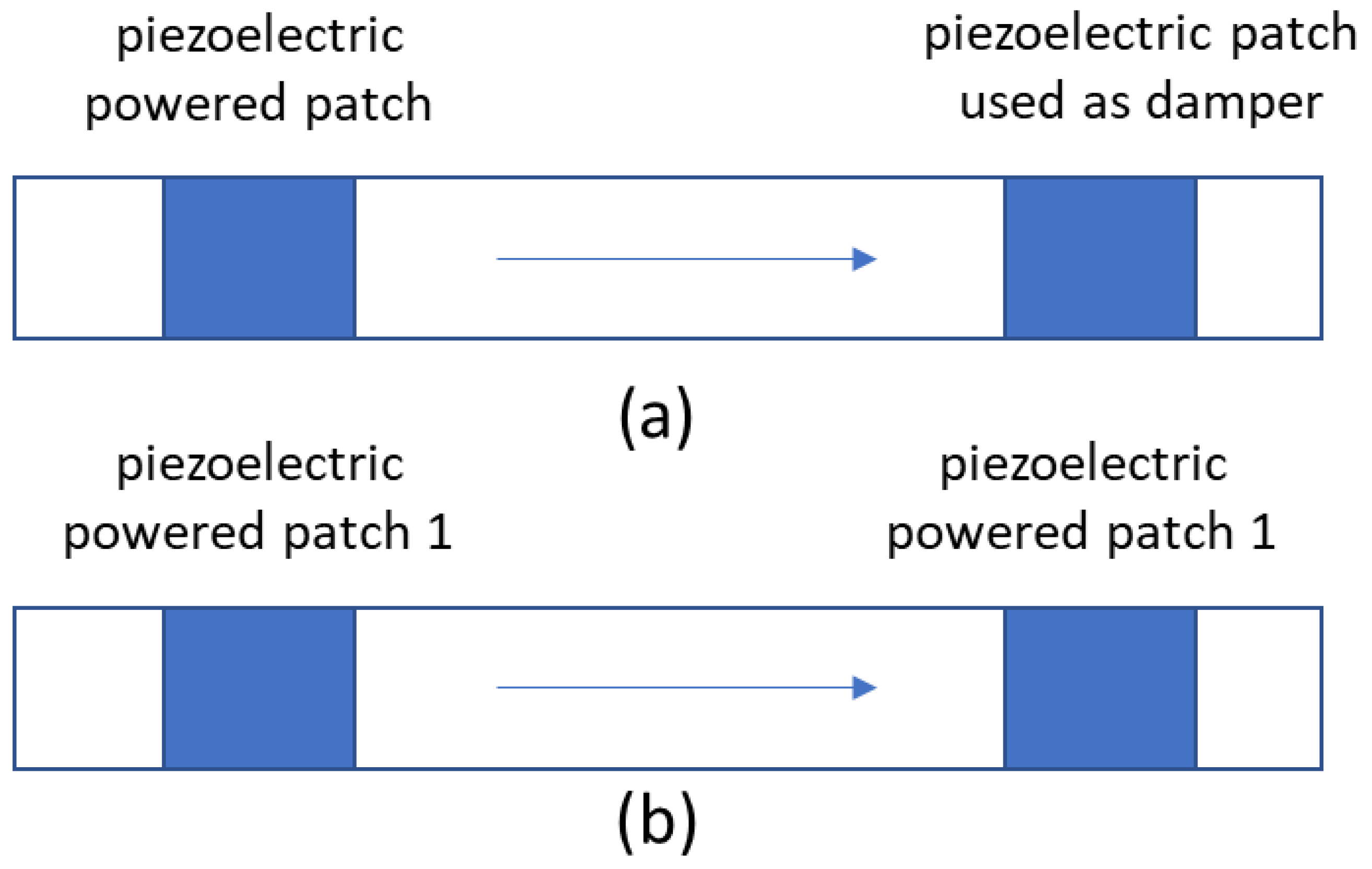
Small-scale robots utilizing piezoelectric patches or sheets attached on thin structures are operated for various uses concerning beam and plate structures and generally feature miniature robots. A significant class of these relates to beam robots that allow linear motion involving actions of two piezoelectric patches joined on the two beam ends. As discussed in the previous section, such behaviors can be of actuator–sensor nature or an actuator–actuator one [36]. In the case of miniature plate robots, they permit movements in different directions contingent on the actions and locations of piezoelectric patches bonded on the plate [29]. Figure 5 illustrates a representation of a beam robot with two piezoelectric patches on its ends performing in mode 1 (actuator–sensor: vibrating–absorbing) and mode 2 (actuator–actuator: vibrating–vibrating) [5]. In this figure, an aluminum strip is equipped with two bonded patches. In the first case, (a), one of the patches creates the wave, which is absorbed by the second. Different damping techniques can be used. In the second case, (b), the two patches are powered by a voltage 90° out of phase between the left and right patches.

2.3. Displacement and Positioning

The inverse piezoelectric effect, as mentioned before, is the ruling law for piezoelectric actuators. Compared to EM ones that reflect good execution in far-reaching force/movement with relatively important displacements, piezoelectric actuators can permit motions of mm or nm. Due to their distinctive benefits of swift response, great motion resolution, high stiffness, actuation potency, and scalable arrangement, as well as endurance to EM interference, piezoelectric materials are often employed in precision displacement, including integration into other systems where space is limited [40].
Piezoelectric actuators are used in precision motion and vibration control applications. Hence, they provide position and speed control, high accuracy and repeatability, and reduced unwanted vibration for smooth, safe, and efficient operation. It should be noted that the displacement and positioning realized by piezoelectric actuation can be detected by piezoelectric sensors, as will be shown in the next section. The combination of highly accurate displacement and positioning actuation and sensing permits reliable robotic management for procedures involving high degrees of sensitivity in zone-restricted actions, like in neurosurgery, restricted drug delivery, etc. [17,18]. In reality, the actuation accuracy in a delimited area can be controlled by sensor detection. Piezoelectric devices allow the detection, actuation, or integration of two tasks; this operation corresponds to a multifunctional tool capable of integrating different tasks on its own component (see Section 5.3).

3. Piezoelectric Sensors

Piezoelectric sensors create an electric charge when submitted to mechanical stress and put forward elevated sensitivity to dynamic variations and valuable process within a wide-ranging frequency. They are generally utilized in structural integrity monitoring, ultrasonic assessing, vibration testing, and are largely used in controlling various industrial structural physical occurrences [19].

3.1. Force Detecting

Piezoelectric force sensors are broadly known for their great sensitivity and well linear response, making them perfect for several force-sensing requests. They function following the principle of direct piezoelectric effect and present a wide-ranging sensing range, from m. newton to k. newton, satisfying varied uses like in healthcare and medical interventions [41,42,43,44].

3.2. Structural Integrity Supervising

Structural integrity monitoring is a vital use of piezoelectric sensing in mechanical and civil domains. It is the practice of constantly supervising the structural health of an edifice and identifying any variations or deficiency that might arise [45,46]. A piezoelectric sensor fits well for such supervision since it is particularly sensitive to slight variations in strain. Such supervision is exploited for the integrity checking of bridges, constructions, and other edifices for detecting strain changes and further parameters indicating structural weakening or degradation [47,48,49,50]. Moreover, it is frequently exploited to sense and examine structural vibrations triggered by blustery weather, earthquakes, etc. [51,52].

3.3. Movement and Position Detection

As mentioned above, displacement and positioning achieved by piezoelectric actuation can also be detected by piezoelectric sensors in real time due to their great sensitivity and swift response time in many applications involving high precision. Thus, the sensor can identify minor displacement or position changes, which are vital for accurate movement and distance control in applications such as precision machinery, automotive sensing, robotics, and domestic smart appliances [53,54]. Note that an actuator can use self-sensing to detect changes in displacement or position.

4. Examples of Medical Applications of Piezoelectric Actuators and Sensors

Various recurring applications promote a novel well-being owing to health-connected tactics that call attention to safety, comfort, and salutary outcomes. Topical medical advancements have made it possible to determine the sources of many illnesses and institute methodologies to handle them from diagnosis by providing therapeutic assistance and surgical interventions. The efficacy of these treatments is directly connected to the abovementioned patient’s health-linked tactics, which suggest that procedures should be minimally invasive (MI) and accurately supervised.
Two main therapeutic categories in this context call for piezoelectric actuators and sensors, namely robotic actuation for medical interventions and structural sensing in the monitoring of healthcare wearable tools. Moreover, as mentioned before, some other therapeutics directly use piezoelectric materials, e.g., piezo surgery [34] and ultrasound transducers for hyperthermia [35].

4.1. Robotic Actuation for Medical Involvements

In medical robotic procedures, as discussed in Section 2.1, robotic structures actuated directly by incorporated piezoelectric materials can be used in miniature form or through robotic joints using actuators by converting the deformation of piezoelectric materials into indirect displacement, which can be used in medical interventions. Directly actuated self-propelled miniature robotic structures will be discussed in Section 5.2 and Section 5.7.3. Actuated robotic joints for medical interventions are detailed in the following paragraphs.

4.1.1. Robotic Medical Interventions

Recently, medical interventional procedures have resulted in fast-developing specialties wherever groundbreaking expertise are rapidly introduced and disseminated across diverse surgical fields and skillsets. In addition, interventional approaches have advanced significantly and are constantly improving through open, laparoscopic, and robotic interventions. Progress in practiced medical procedures have generated numerous benefits to patients. Alternatively, procedural intricacy has augmented, and the responsibilities of surgeons have altered considerably; see, for example, [55].
From the time the first surgery was performed, the open practice has usually been exercised to “see fully” and is still utilized today in circumstances associated with intricate frameworks and challenging procedures. On the other hand, the invasive nature of open interventions presents several risks in different specific circumstances and MI procedures would be preferred.
Laparoscopic intervention has meaningfully renovated the long-recognized open procedure due to the various advantages it offers to patients through the MI technique [56,57]. The MI technique has transformed the approach to specific zones of the body by delivering an enlarged view through using a small camera and a light on the end of a miniscule instrument [58,59]. Furthermore, the laparoscopic technique is associated with abridged postoperative pain and quicker recovery, allowing for shorter clinical periods [58,59,60]. Moreover, it grants significant profits. For instance, it allows for better aesthetics of lesions and a reduced threat of impediment [58] and can play a specific role in diagnostic laparoscopy [61]. Nevertheless, laparoscopic processes exercising lengthened instruments in addition to 2-D visualization revelations might result in some ergonomic problems during operation [56,62] and possible increased postoperative risk [63]. A robotic MI laparoscopic procedure can avoid such problems. In fact, particular processes that are complex or widespread might require open or more sophisticated robot-supported laparoscopic (for sew up, and tissue deal in) procedures [64]. Consequently, only a computerized robotic MI intervention can avoid all of the abovementioned limitations.
In the case of computerized robotics, interventional ingenuity and ergonomics are enhanced due to 3-D vision, robotically amplified degree of freedom, contributing to broader growth in MI intervention practices, e.g., [65,66,67]. The practice of robotic intervention has progressed from minimal inert actions for instrument withdrawal, or occupying machines such as rail-fixed implements or camera directing, to dynamic robotic arrangements whose movement extent of mechanisms permits improved execution and enhanced precision for ending and suturing while utilizing a MI methodology in autonomous procedures, e.g., [68,69,70], and with staff in the loop, e.g., [71,72,73]. Furthermore, it eliminates tactile shakes and laparoscopic intervention pivot effects. Robotic wrist implements propose ample degrees of freedom to surmount the restrictions of laparoscopic tools, which typically do not allow its pointer to reach the tissue anterior and authorize suturing in problematic ergonomic postures.
The above analysis shows that a patient’s health and well-being depends on diverse issues linked to the extent of tissue invasiveness, pursuing precision, intervention duration, healing rapidity, etc. These aspects are connected, in addition to the patient, to the therapeutic team in terms of dexterity, ergonomics, and execution ease. The abilities of the staff involved in the different interventional procedures are fairly state-specific, regarding the patient, staff, interventional intricacy, expense, etc.
The expectation of secure, self-ruling MI intervention [74] with skill-substituted tactile and visual abilities, altogether with “staff in the loop”, was a dream that has been realized today through digital intelligence. Thus, in addition to patient well-being, staff ease, and MI benefits, the expected accurate positioning and visual ability could be achieved by reliable interventional robotic procedures assisted by imaging scanners. In fact, image-assisted robotic intervention looks to be an obvious advancement of laparoscopic and robotic interventions, alongside skill augmentation and surgeons embracing improved posture during the whole intervention [17,18,75,76]. Moreover, such image-guided robotic interventional procedures are well-adapted for intricate surgeries [77,78,79,80] or restricted drug distributions [81,82,83], and both call for actions in a circumscribed area to safeguard healthy tissues from touching the troubled zone.

4.1.2. Interventional Robotic Actuation

The various robotic procedures discussed in the previous section, namely robotic laparoscopy, computerized robotics, and image-assisted robotics, all require the actuation means necessary for robotic movements. Different actuator technologies are available, with the most common being pneumatic, hydraulic, EM, and smart actuators such as piezoelectric, shape–memory alloy, electroactive polymer, magnetostrictive, and photomechanical actuators. Their difference lies in the type of energy conversion into motion. They present different specific characteristics and applications related to the robotic force, speed, precision, environment, etc.
The different abovementioned interventional robotics can use the most well-adapted actuation technology based on the nature of the intended intervention related to the displacement resolution, positioning accuracy, response speed, stiffness, actuation potency, configuration complexity, stroke flexibility, endurance to EM interference, size scalability, etc.
We have seen in the last section that secure, self-ruling MI intervention with accurate positioning and visual ability could be accomplished by consistent interventional robotic procedures assisted by imaging scanners. Such security, in this context, is related to the intervention nature and duration that is closely allied to the scanner technology. For relatively long imaging intervals such as medical interventions, magnetic resonance imaging (MRI) and ultrasound scanners are generally employed [77,78,79,80]. Note that the robotic tools in this context perform close to or inside the scanner.
MRI scanners are progressively and increasingly used in surgery and drug administration, primarily due to their superior ability to distinguish tumors, or affected areas in general, from healthy tissue during procedures related to tumor removal [84,85,86,87] or drug administration [17,18]. Moreover, they can be used in all tissue categories, unlike ultrasound scanners, which are limited to body parts devoid of air and bone.
As mentioned earlier, piezoelectric actuation, in addition to the specific requirements of robotics, have a resolution above the nanometer scale, rapid responsiveness, and invulnerability to EM interference, thus surpassing their counterparts in the smart actuation category, as well as common pneumatic, hydraulic, and EM actuators. These characteristics are perfectly compatible with MRI scanners as well as ultrasound scanners.
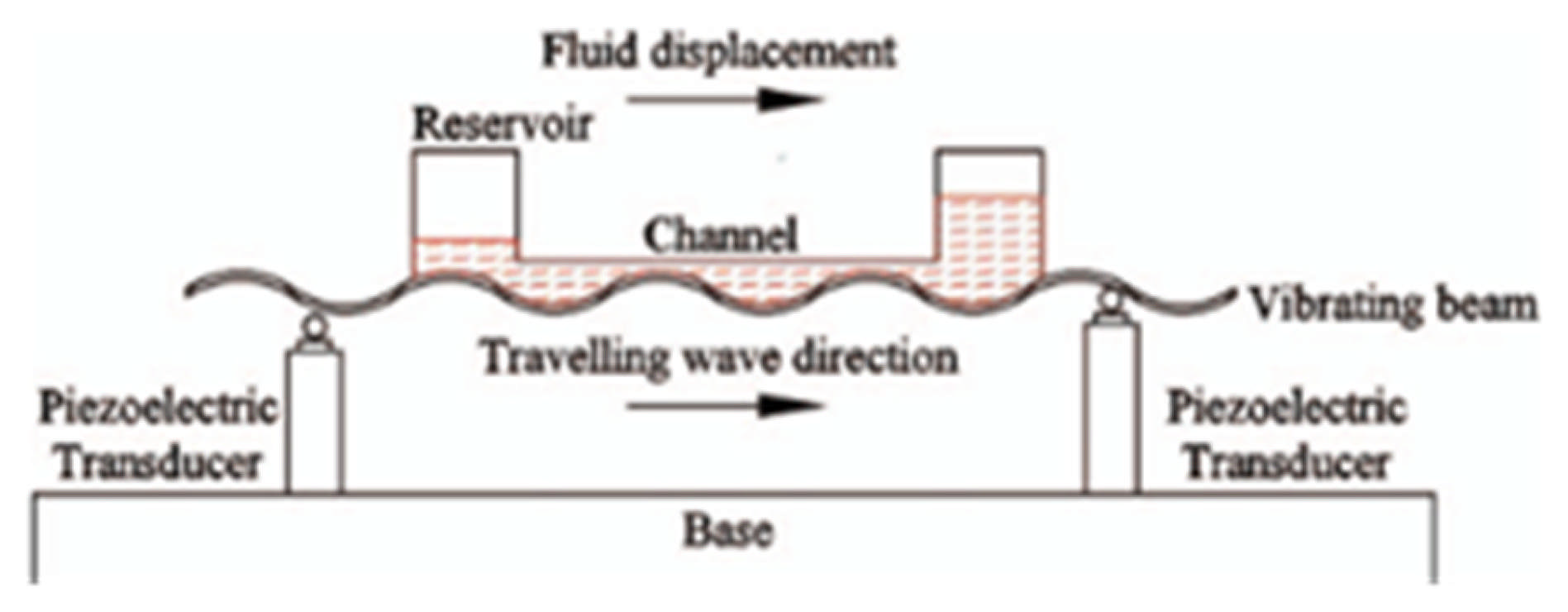
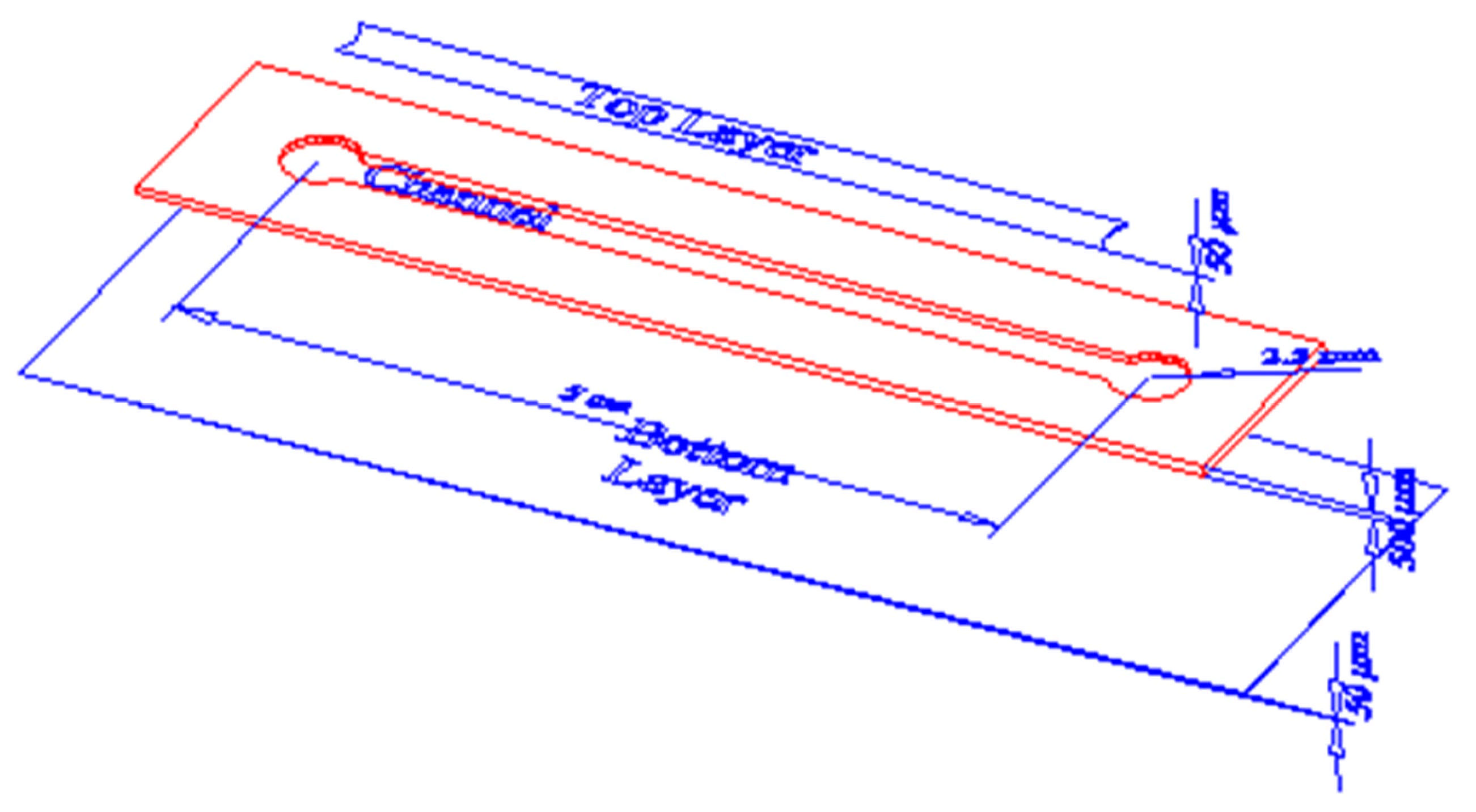
It is worth noting that the different robotic procedures using piezoelectric materials, depending on the intended medical application, can be divided into two categories: robotic structures actuated directly by incorporated piezoelectric materials and robotic joints actuated by converting piezoelectric deformation into indirect displacement. In fact, the first category corresponds to traveling wave beams and plates, which are generally used in miniaturized form in applications involving precise and controlled displacements of small masses on a surface or other mediums in general [5,28,29,36] or liquids in pipes such as mini or micro pumps [4,30,31]. These robots are generally used in precision processes that require repeatability, reliability, high load capacity, greater range of motion and smooth displacement; see Section 2 and Section 5.2. Figure 6 shows the functioning principal of a TW piezoelectric mini-pump accurately delivering controlled liquid. Figure 7 illustrates the prototype constituents of the mini-pump of Figure 6 [4].
Figure 7 shows one of the possibilities for using a traveling wave. In this figure, the bottom layer is the one in which the traveling wave propagates. We deposit a PDMS channel which is then covered by the top layer. When liquid is placed in the 2.5 mm wide and 5 cm long channel, it is driven by the vibrations of the bottom layer. We have created a pump that can drive small quantities of liquid.
Additionally, the second category uses techniques such as repetition and/or stepping, allowing larger strokes and higher degrees of freedom (DOF) [32]; these include stepper actuators [8,33] and ultrasonic actuators [27], which are particularly suitable for medical interventions as will be shown in the next section.

4.1.3. MRI-Assisted Robotic Actuation

As mentioned in the previous section, MRI scanners require an environment that is immune to EM interference to operate. This includes protection from exposure to external EM fields (EMFs) and the exclusion of EMF-sensitive materials in the scanner scaffold. Without these mandatory precautions, serious disturbances would alter the image [17,18]. Thus, robotic machines, housed in the scaffold near the involved body tissues, should generally be MRI compatible, i.e., free of materials sensitive to EMFs, such as magnetic or massive conductive materials. Most robotic mechanisms, including interventional tools and structures, can be constructed with MRI-compatible materials. Regarding robotic actuation tasks, few actuators of acceptable performance offer such compatibility, such as pneumatic and piezoelectric actuators. As mentioned previously, the latter outperform in several respects, particularly in terms of responsiveness [17,18,75,76].
Actuation piezoelectric machineries reflecting MRI compatibility come in different styles of configuration, composition, construction, and use [88,89]. Different examples could be found in the literature for stepping actuation [8,33], stick-slip multi DOF [32] with flexure hinge and bionic imitating body movement actuations [90,91,92], and for ultrasonic [27] standing wave miniature linear and multidimensional motion actuators [93,94,95]. Furthermore, cases of piezo robotic hands for micro-to-macro motion manipulation and adaptive miniature piezoelectric robots are given in [1,96,97,98] and cases of micro-motion robotic surgery tool and image-based biopsy using OCT control are given in [99,100]. Cases concerning the role of robotics in image-guided interventions and in healthcare robotics are given in [101,102].
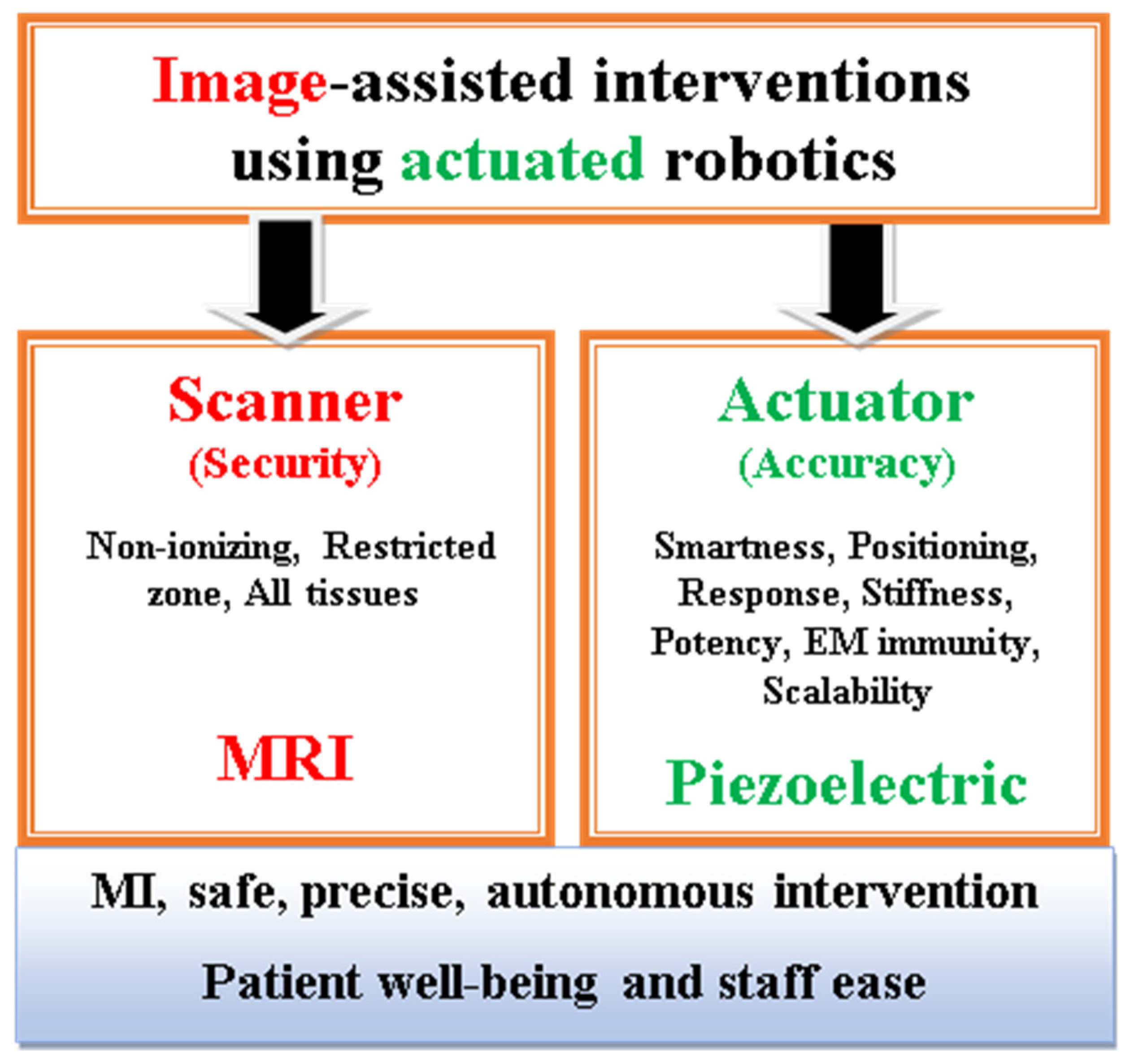
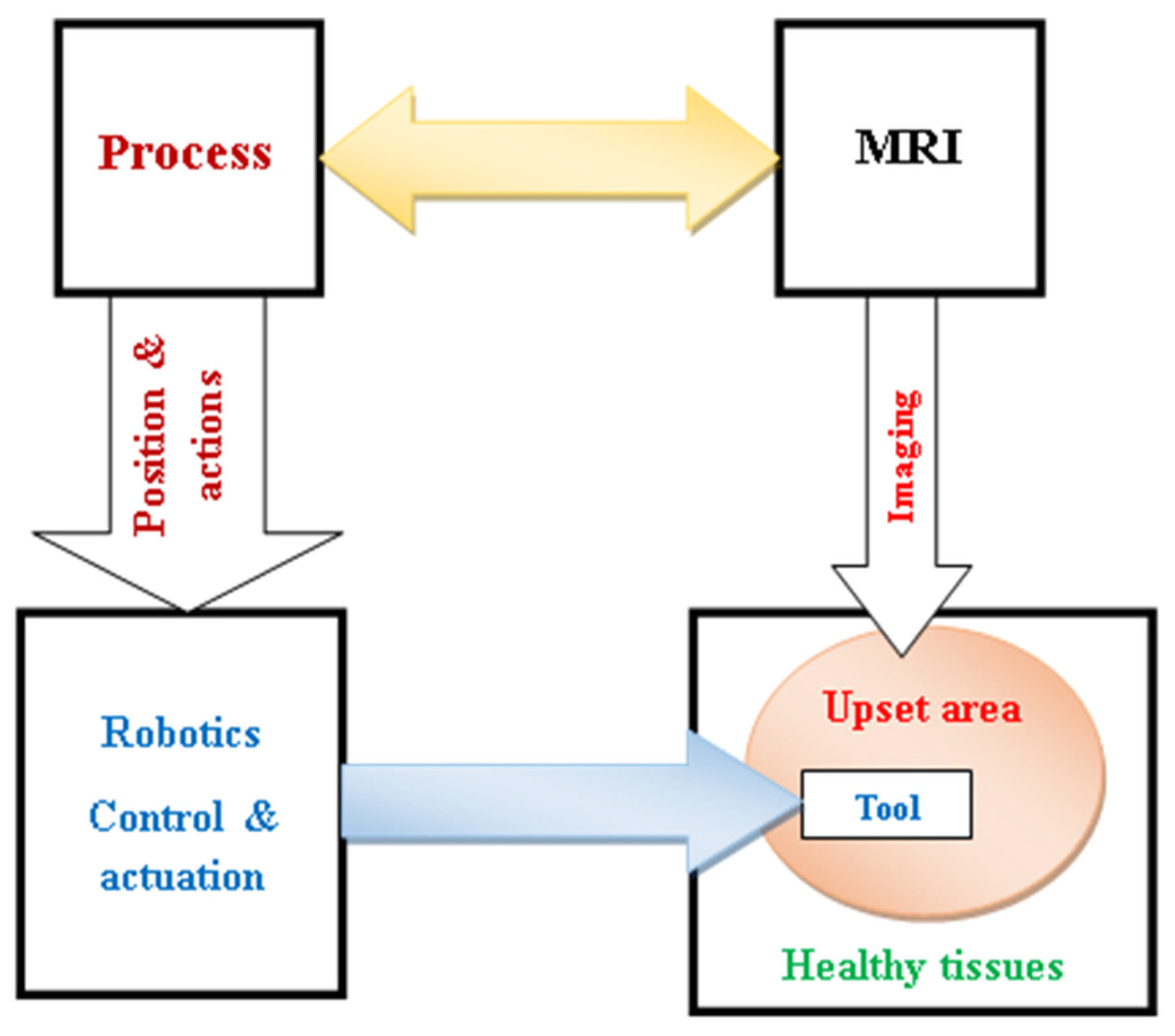
Figure 8 schematically summarizes the above conclusions relative to scanner and robotic actuating means in an image-assisted robotic intervention.

4.2. Structural Sensing and Monitoring of Healthcare Wearable Tools

Wearable healthcare tools that are close to or integrated in the body generally correspond to portable, removable, or incorporated tools. They can perform passive or focused duties engaged in body tissues. Such tasks are related to sensing or assisting activities.
Sensing activity includes detection [103,104,105], diagnostic [106,107], monitoring [108,109,110], and control [111,112], and can be involved in diagnosis support, health monitoring and prognosis, heart rate monitoring, respiratory monitoring, measurement of blood pressure, personalized pain medicine, etc.
Assisting activity comprises stimulating, such as pacemakers and defibrillators [113], drug release, such as implanted delivery devices [114], monitoring, such as implants in the spinal cord and head [115,116], and assisting, such as cardiac devices assisting continuous blood-flow [117], and MRI-guided robot-assisted surgery and interventions [17,78].
These two activities could be distinctive or networked and autonomous or remotely steered and perform continuously in real time. In addition to tasks of surveillance, forecast, maintenance, stimulation, etc., of wearable tools, these allow the administration of post-treatment situations after preceding treatments. This includes by-passing relocations, transpositions, transfers, etc., replacing face-to-face treatment with an incorporated joined watch over the line of attack.
Sensing duties require portable pressure sensors that reflect non-invasive, real-time, and uninterrupted supervision of health vitals. They permit healthcare staff to collect consistent and precise information. By monitoring pressure, several biological issues, such as wrist pulse, heart rate, and joint and muscle behavior, can be evaluated. Portable pressure sensors present the benefit of permitting patients to carry out their everyday tasks while staying monitored. As mentioned before, piezoelectric pressure sensors possess high sensitivity and large linear response, making them suitable for several wide-ranging pressure-sensing requests, like in the management of dynamic signal detection. For instance, they are used in accurate wrist pulse signal acquisition [41], assessment of Parkinson’s tremor [42], and robot-assisted MI surgeries [43,44].
Assisting duties are MI and use, as mentioned before, in addition to sensor control, and actuating means. As stated above, they could be integrated in tissues for health upkeep and stimulation of diverse body parts, or enclosed in tissues for image-assisted medical interventions. Both integrated and enclosing devices are robotically based and can, respectively, directly use piezoelectric patches [4,5,28,29,30,31] or be indirectly actuated by piezoelectric actuators [8,27,33]. Such activity has been largely developed in Section 4.1 “Robotic Actuation for Medical Involvements”.

5. Discussion

In the analyses concerned in the preceding sections, a number of points merit further discussion:

5.1. Advantages and Limitations of Piezoelectric Sensors and Actuators

The recent progression of piezoelectric sensors and actuators (in general and for medical applications) is related to groundbreaking materials with enhanced assets such as augmented stability, endurance, and electric behavior, and to cutting-edge manufacturing techniques such as nanotechnology that allowed for the development of nanogenerators, resulting in the conversion of mechanical vibrations at low-frequency to electrical output.
In the instance of the above-discussed wearable sensors, soft pliable materials such as PVDF (polyvinylidene fluoride) and flexible piezoelectric composites (FPCs) allow for efficient heath supervision in real time, movement sensing, and biomechanical motion harvesting, all possibly integrated in intelligent fabrics [16,118]. Moreover, they have encouraging projections in addition to wearable devices, such as in the fields of biology, aerospace, electromechanical, etc. [119].
In the case of an efficient precision actuator, thanks to an innovative laser processing manufacturing technique, high-frequency vibration control has been made possible [120].
Regarding the limitations of piezoelectric sensors and actuators, these are mainly related to functional and material behaviors.
For instance, in the case of wearable sensing tools, piezo materials tackle a balance of structural elasticity and electric yield. For example PVDF present good compliance but weak piezoelectric modulus compared to inflexible ceramics, which are easily broken and hence unreliable for dynamic wearables. Furthermore, endurance under repetitive mechanical pressure poses further issues [19]. Additionally, ceramics such as PZT (Lead Zirconate Titanate) contain Lead (Pb), which poses additional issues related to Section 5.7.2 on biocompatibility, biodegradability, and non-toxicity.

5.2. Piezoelectric Microrobots and Bio-Inspired Concepts

Piezoelectric actuation is ideally suited for control techniques for executing movements using miniaturized configurations. Microactuators thus play a key role in micromachining technology and in exploring or modifying the microscopic world with objects ranging from cells to molecules. These microscopic entities can be maneuvered by interacting with a microrobot, or a high-precision macrorobot combined with a suitable end effector. Microrobots are particularly suitable, due to their lightness and flexibility, for biological and medical fields, like drug distribution and disease diagnosis.
Piezoelectric microrobots are potentially adapted to perform in difficult atmospheres, such as inside the human body. Another peculiarity lies in their execution, which is often based on bio-inspired concepts. For example, a robot with a thin and flexible plate structure actuated by specifically located fixed piezoelectric patches [5,29] can illustrate movements of crawling on the surface, flying in the air, or swimming in water. Different instances of bio-inspired robotic actuation could be found in the literature, such as a multilegged piezoelectric robot [121], earthworm [122], rhinoceros beetle [123], grasshopper [124], rotatory galloping gait [125], squirrel’s galloping gait [126], octopus-crawling [127], and untethered levitation [128].

5.3. Piezoelectric Multifunctional Deeds and Flexible Wearable Tools

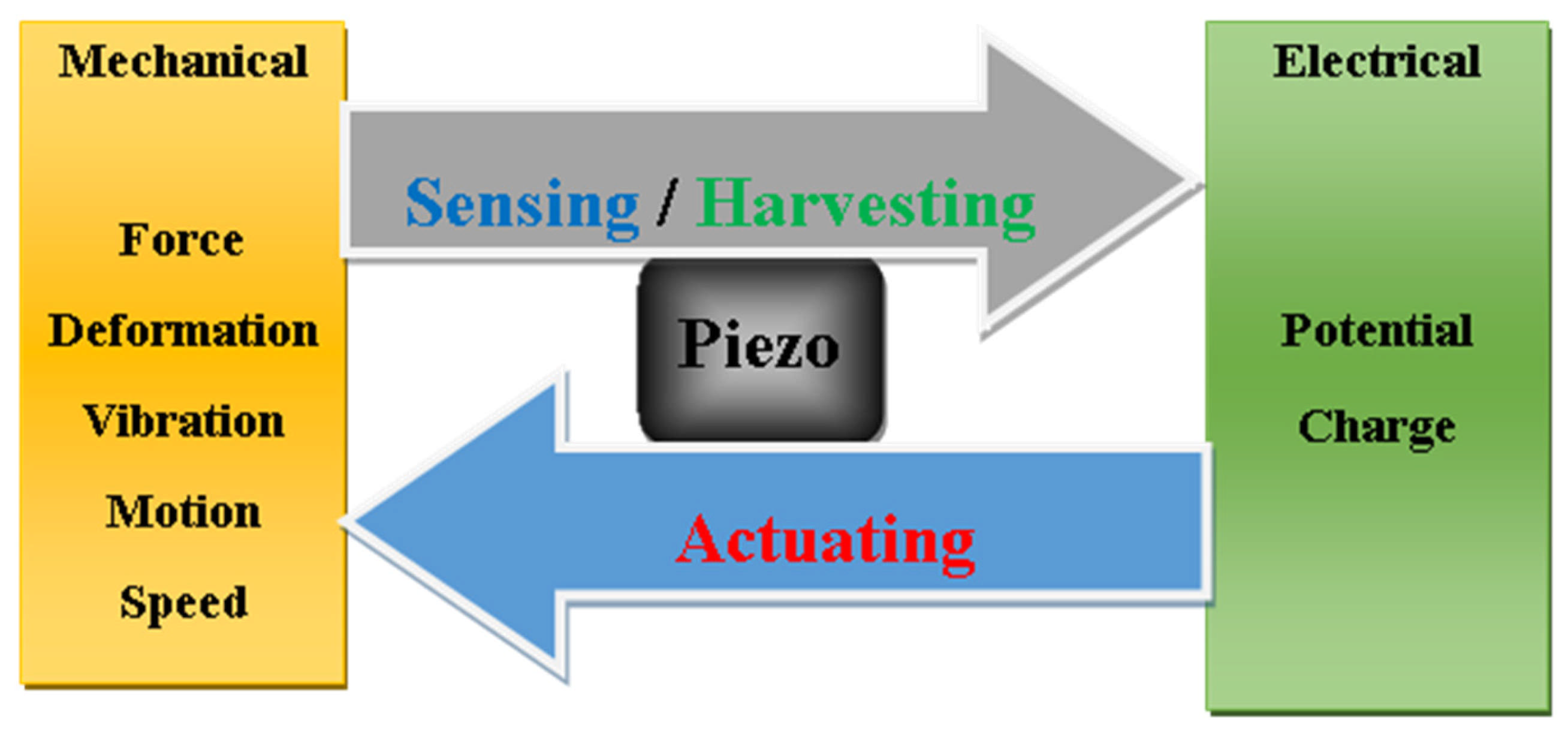
Piezoelectric materials exhibit direct (sensing) and inverse (actuating) conversions as stated previously. Such electromechanical two-way conversion is not limited to piezoelectricity, but piezoelectric materials matched to their competitors displaying such conversion present towering electromechanical effectiveness and notable scalability, making them applicable for miniaturization. Thus, they are broadly employed in sensing, actuating, or integrated purposes [129].
Along with sensing and actuating, in wearable devices, for example, energy harvesting generated by human movement activities can be realized by piezoelectric flexible material (PFM) devices that are well-adapted to great deformations [130].
A multifunctional tool is normally able to integrate different tasks through its own components. Such amalgamation can lead to further compacted outcomes. The natural multifunctional integration combines the sensing and harvesting tasks, resulting in a self-driven sensor. Figure 9 shows schematics of a multifunctional piezoelectric device involving sensing and harvesting functions, following mechanical-to-electrical conversion and inversely for actuating functions.

5.3.1. Wearable Tools and Flexibility

As mentioned above, structural flexibility plays a significant role in wearable tools, which are generally miniature and weightless to ensure they are portable. This flexibility concerns not only PFM but also neighboring support sheets and electrodes, thus providing a reliable multifunctional flexible piezoelectric tool. Such wearable flexibility reflects the adaptation to dynamic movements of humans [130].
Energy harvesting in wearable devices can involve heart rate [131,132], respiration [133,134], pulse [135], and deformation within the gastric cavity [136].

5.3.2. PFM Main Categories

PFM can be obtained through polymers [137,138], composites [139,140], and inorganic thin films [141,142]. These three categories of PFM possess mutual characteristics of flexibility and piezoelectric but their performing features display substantial distinctions. Organic polymers are naturally fully flexible, but possess the lowest piezoelectric features; inorganic thin films hold the best features of crystalline piezoelectric thin layers, but are physically more brittle; and composites that are a crystal–polymer blend have behavior that falls somewhere between the previous two, where flexibility and piezoelectric properties can be adjusted based on structural design or blend ratios. These distinctive performance characteristics suggest the operational adaptability of each PFM in specific situations. For example, organic PFM polymers may be more suitable for motion management on complex surfaces or substrates, while inorganic PFMs meet higher sensitivity requirements. Also, thin-film or composite PFMs are better at meeting actuation and energy harvesting requirements.

5.4. Endurance of Piezoelectric Medical Devices to EM Interference

The operation of various medical instruments can be disrupted by EM interference. This can be caused by external EMF radiation on the instrument or by the inclusion, attachment, or insertion of objects sensitive to EMFs, due to their effects on the instrument’s own fields, as is the case of MRI scanners [17]. Moreover, such interference could be produced by a combined EMF radiation and presence of EMF-sensitive matters in the tool structure, such as the case of wearable tools [143]. In both cases, the use of actuation or sensing devices incorporating materials with reliable resistance to EM interference is recommended. Piezoelectric materials used in MRI-assisted medical procedures (see Section 4.1.3), whether in microrobotics or for the actuation of robotic interventions, as well as for the detection of portable tools, offer a dependable solution in this context. These actuation or detection devices are mainly made, as mentioned above, of dielectric piezoelectric materials insensitive to EMFs, but furnished with thin conductors, allowing for electrical conversion. These electrodes have a theoretical sensitivity to EMFs, a skinny nature, and can be structurally adjusted [17], making it possible to largely alleviate their effects. In fact, the importance of the eddy currents, induced in these conductors and responsible for the disturbances, depends on the surface of the conductor perpendicular to the field concerned, so if the orientation of the device is such that such a surface corresponds to the trivial thickness of the electrode, there would be no problem.
Verification of the immunity of a piezoelectric device to EM interference, when necessary, can be carried out by an EM compatibility (EMC) analysis; see, for example, [144]. In general, such immunity exists when the EMF distribution in the host application (MRI scaffold field or wearable sensing tool radiated field) involving the piezoelectric device would be the same with and without the device (see Figures 8 and 9 in [17]). In fact, for example, in an MRI scanner, the radiofrequency field in the scanner scaffold, which is directly associated with living tissue images, displays a 3-D field distribution depending on the targeted problem details. The perturbation of such distribution alters the image through artifacts, leading to a wrong interpretation. The introduction of external objects in the scaffold alongside living tissues could perturb the field distribution. Thus, if the field distribution remains the same with and without a piezoelectric device, this indicates the device is insensitive to EMFs and is hence immune to EM interference.

5.5. Digital Monitoring of MRI-Assisted Robotic Interventions

As mentioned earlier, a safe and autonomous MI intervention, with precise positioning and good visual capability, could be efficiently performed by a consistent interventional robotic procedure, assisted by imaging scanners, and actuated by an adequate positioning device. Moreover, for relatively long intervention intervals and a better ability to distinguish affected areas from healthy tissues, MRI assistance would be suitable for procedures related to tumor ablation or drug delivery in all tissue categories. Additionally, robotic components, including actuation devices in such an MRI-assisted procedure, would be immune to EM interference, favoring the choice of piezoelectric devices known for their precise positioning.

5.5.1. Closed-Loop Controlled MRI-Assisted Autonomous Scenery

In fact, patient safety is linked to the therapeutic limitation attributed to the targeted area, which mainly depends on actuation accuracy of the interventional device and its spatial positioning. Thus, a cooperative arrangement includes the MRI scanner, interventional tool, location and duties assigned, robotic actuation, and control alongside the imaged, restricted troubled zone, all performed in a closed-loop controlled autonomous procedure as exemplified in Figure 10.
The involved accuracy in this control procedure would be dependent on the different issues comprising the complexity level of its interacting components, their linked uncertainty features, and unforeseen exterior threat events, together with MRI compatibility issues related to robotic immunity to EM interference, including the piezoelectric actuating device. It is only by managing such potentially tormenting problems that reliable performance can be achieved.

5.5.2. Digital Twin Administration of MRI-Assisted Interventions

The depreciation of the menacing distresses, together with respect to particular personalized data, are necessary for reliable operational MRI-assisted controlled procedures. These might be achieved by supervising the implicated parameters in a corresponding real–virtual couple by way of a digital twin (DT) implement [145].
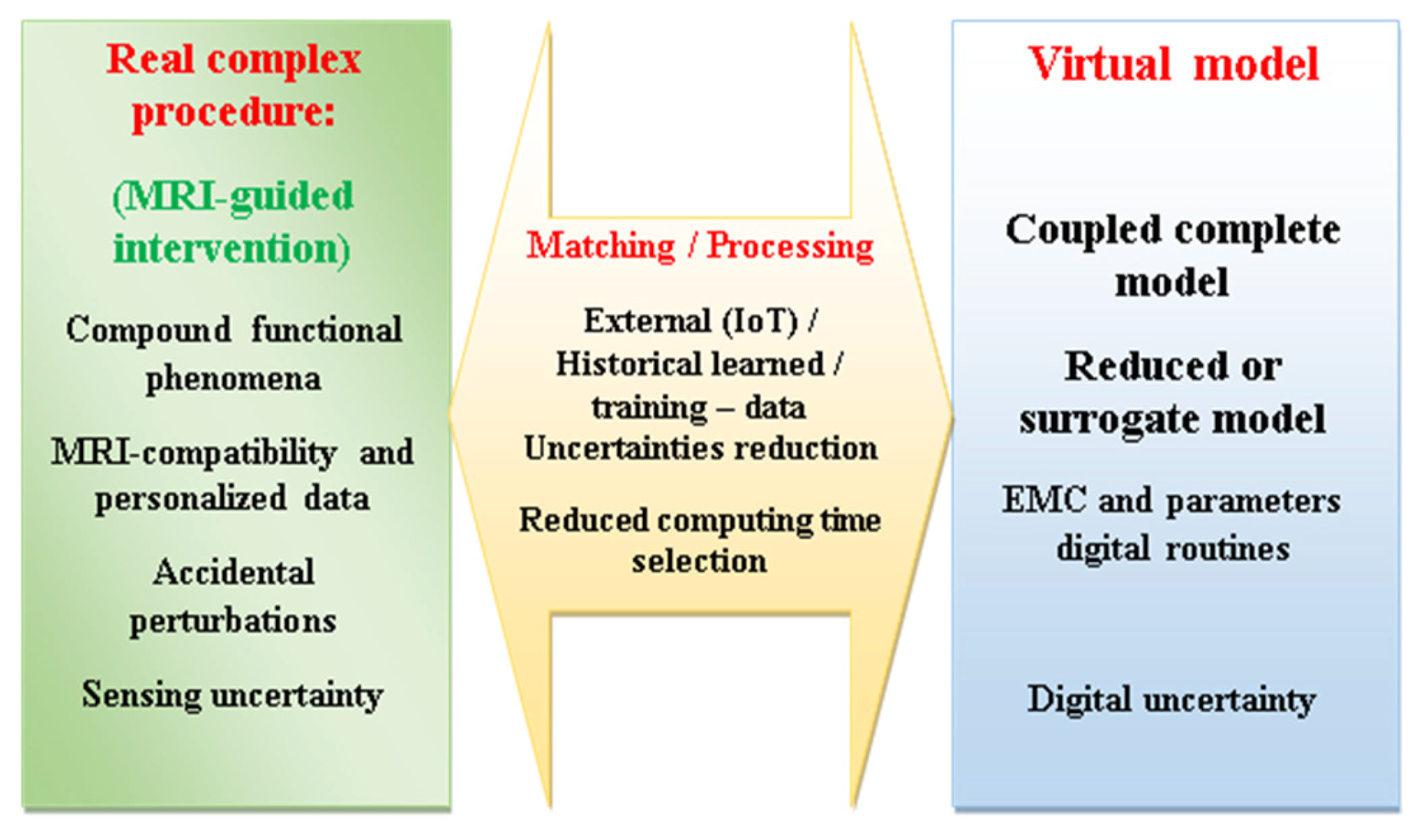
A DT consists of a physical element, a virtual picture of that element, and a quasi-real-time, two-way data flow between those two elements. In other words, a DT is considered as an integration of information into a real-life experiment and its digital copy, thus forming a pair of bidirectional routines. This methodology is performed in the administration of intricacy in controlled processes [146] and organized as a real–virtual couple permitting self-adapting tasks. Hence, the real part distributes treated detected information to its virtual part; however, the latter conveys control instructions to the real part. Such self-adaptation corresponding assists, in addition to complexity monitoring, in decreasing uncertainties within the pair and unforeseen hazards in the perturbing dynamics of MRI-assisted robotic control. In fact, the matching of physical and model sides allows each side to correct and adjust the other. This self-adaptation aids in reducing uncertainties (physical and computational) as well as unforeseen hazards. The assistance in managing complexity comes from representation of interconnected physical phenomena involved in MRI-assisted controlled robotic interventions (the scanner fields, robot instruments, actuation system, and living tissues) by a coupled mathematical model. The matching of these physical interconnected phenomena with their coupled model permits, again, their self-adaptation and hence, adjustment.
It is worth noting that the DT concept has been progressively proposed recently in healthcare, nursing, and extended administration; see, e.g., reviews illuminating therapies, supervising, and administrations [147,148,149,150,151,152].
A comprehensive DT administration of an MRI-assisted robotic control through exchanges between its real–virtual wings involves the delivery of sensed treated data by the real wing, which is paralleled and adapted by exterior Internet of Things “IoT” information as well as the historical learnt data. The result, after a data analysis form training, is transferred, together with a suitable proposal of model reduction, to the DT virtual wing. In fact, a rapid matching among the DT wings dictates a realistic model with a short computation interval. Consequently, the complete model, which accurately characterizes the real process, would be abridged, permitting restrained execution time while conserving the representation of the physical process. Figure 11 shows the topographies of a monitoring DT of a MRI-guided robotic intervention. This DT monitoring can be exploited for training of medical personnel, forecasts by means of real phantoms along with their digital replicas, or a physical patient–virtual model, containing self-decision matching plus keeping staff “in the loop”. It should be noted that the DT concept is also applicable to the monitoring of industrial robotic procedures, including piezoelectric actuations [145].

5.5.3. Digital Augmented DT in MRI-Assisted Interventions

The abovementioned involvement of staff associated with robotics permits a cutting-edge MRI-guided monitoring of medical interventions, therefore decreasing the patient risk and guaranteeing a dependable result for staff [153,154,155]. Furthermore, artificial intelligence (AI) practices in these treatments support staff by reducing the data-acquisition and post-processing complexities and accomplish repeated scheduled training duties [156,157]. Additionally, the intervention can be meaningfully enhanced via extended staff–robot links, progressing the whole organization across augmented reality (AR)-supported robotic activities. Hence, AR joined to a MRI can diminish intricate interventional risks such as tissue injury, bleeding, and distress post-intervention. Moreover, DTs can execute a significant task in AR-aided interventional robotics. Therefore, the likely disorder origin and its intervention method can be precisely identified through personal patient examination via deep learning databanks. Likewise, a number of further benefits of fused AR-DT are linked to enhanced suturing precision, fastening, and repairing, which are comparable to manual tasks [158,159,160,161,162].
DT practice is a type of digital treatment and is commonly utilized in personalized medical therapies that can be used in nursing, recognition, tutoring, or interventions. DTs are frequently connected, in addition to AI and AR tools, with virtual reality (VR); for instance, VR training improves the skill needed to reproduce daily training circumstances while providing the facility to correctly measure performance. Also, the preparation of DTs permits staff to perceive the development of the disorders and adjust cure strategies to choose the best appropriate therapy. Such preparation in personalized scheduling supports the progression of early diagnosis and search for novel cures or interventions [163,164]. It should be noted that such digital treatment contributes to the high-reliability precision of medical therapies allowing for patient safety and staff ease.

5.6. Matching of Performance Indicators with Application Scenarios

In the present paper the potential of piezoelectric actuation and sensing in high reliability precision in medical therapeutics was investigated. We have seen that these devices surpass, in this context, their competitors’, particularly for high reliability precision involved in intricate tasks. This section illustrates some comparisons of device performances and medical scenarios. Table 1 shows a comparison of piezoelectric actuators with traditional electromagnetic, hydraulic, or shape–memory alloy actuation methods in terms of resolution, response time, driving force, and MRI compatibility.
Table 2 illustrates a comparison of different actuators in the two scenarios of computerized and MRI-assisted robotic interventions.
Table 3 illustrates a comparison between piezoelectric sensors and other types related to EM interference.

5.7. Future Research Perspectives on Piezoelectric Implications in the Medical Field

This section is devoted to possible future perspectives of the involvement of piezoelectric devices in medical applications, and particularly in robotic interventions and wearable tools investigated in this paper. When evaluating such involvement, we refer to piezoelectric materials, their device structures, their intended requests, and their specific performance. The main features include piezoelectric performance, structure flexibility, multifunctional behavior, adaptation upon request, embedded biocompatibility, and biodegradability [165,166,167].

5.7.1. Wearable and Implantable Medical Tools

An important goal in wearable and implantable tools is to focus, via technological tasks, on improving both structure flexibility and piezoelectric performance as well as biocompatibility in case of embedded concerns. These allow multifunctional and miniaturized tools that require less energy intake and are more safe. Moreover, in implanted tools, actuating and harvesting duties would be possible by the incorporation of energy storage means.

5.7.2. Biocompatibility, Biodegradability, Non-Toxicity, and Piezoelectric Biomaterials

In many medical applications, supervision, monitoring, or intervention tasks are performed within or near living tissues. Most of these tasks impose biocompatibility and non-toxicity, and in some cases, biodegradability. Furthermore, the presence of natural piezoelectric effects in several parts of the body, such as bones, tendons, skin, and other tissues, highlights the potential of biomaterials in biomedicine to improve or substitute biological tasks [168]. Thus, biosecurity, biocompatibility, non-toxicity, and the absence of immune rejection are guaranteed. Augmented medicine and sustainable evolution related to human requests [169,170] put forward the exploration of piezoelectric biomaterials in medical applications.

5.7.3. Dependable Self-Moving Miniature Robots

Continuous developments in fabricating and assembling strategies have led to improvements in autonomous (self-moving) robots, including different forms (beam, plate, rod, conduit, etc.) with a piezoelectric actuation systems (bonded, embedded, loaded, etc.). The bonded form, favored by flexible and widely available mechanical designs, has generated a high demand for precision tools, especially in medical robotics. Potential explorations of miniature robotics in this context are possible, including increased degrees of freedom, transport and positioning capabilities [171], extended torque and speed range [172], large working stroke and thrust force [173], millisecond-scale response time, millinewton output force, high-speed operation, sub-micrometer-level resolution [174], and centimeter-scale reconfigurable robots [175].

5.7.4. MRI Compatibility in Image-Guided Robotic Interventions

As mentioned previously, in addition to the intrinsic benefits of image-assisted robotic interventions (closed-loop control procedure) related to patient and staff comfort, MRI and robots each have their own advantages. MRI allows for better distinction between affected areas and healthy tissue during tumor ablation or drug administration in all tissue categories, and exhibits non-ionizing behavior ensuring patient safety over relatively long intervention intervals. Robotic action reflects precise movement and positioning directly related to its actuation device. The combination of MRI and robots requires robotic components immune to EM interference (MRI compatibility). Piezoelectric actuation devices perfectly provide this precision and EM immunity [17,18,78].
The issue of MRI compatibility generally concerns body-embedded devices as implants and near-body instruments as all robotic components, and its deficiencies, can lead to image artifacts that compromise the outcome of the procedure. Further research on MRI-compatible materials and structural features, including piezoelectric devices, remains necessary [176,177]. Furthermore, since image artifacts are generally unavoidable [178], their assessment is important for image analysis and the adoption of a fitting correction strategy, based on body pre-scans, scan parameters, and shimming. Further research on artifact correction methods, image processing techniques, and scanning routines assisted by digital monitoring strategies are needed (see Section 5.5.3).

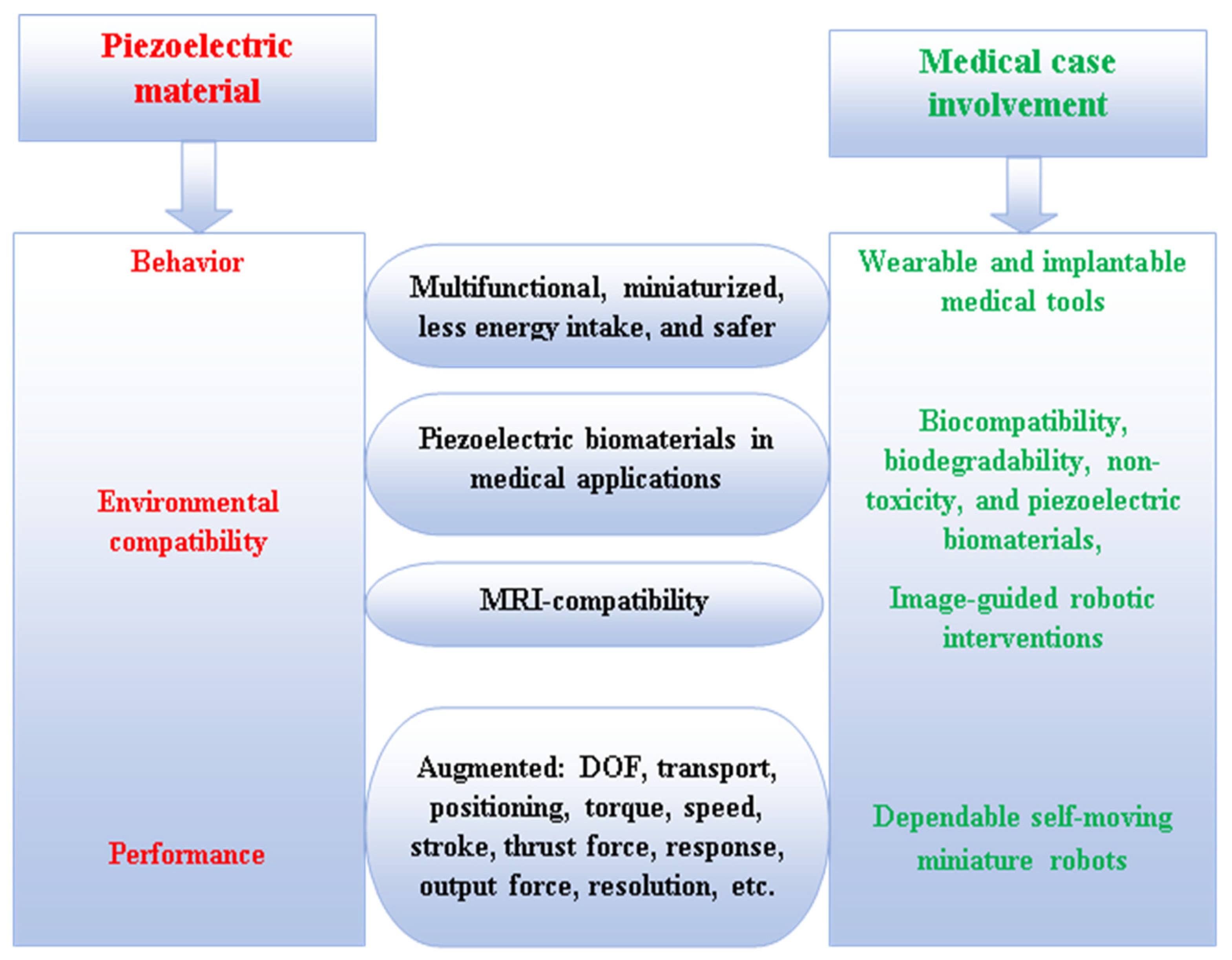
5.7.5. Summarized Illustration of Future Research Perspectives

Figure 12 illustrates a summary of the abovementioned future research perspectives.

6. Conclusions

The present contribution analyzed and emphasized the possibilities of piezoelectric strategies in precision duties and their involvement in the health field. The paper underlined the potential of such strategies in medical interventional procedures and monitoring through wearable healthcare tools. The high-reliability precision medical procedures in question have been shown to be associated with improved patient safety and staff ease.
In interventional tasks, the article illustrated the role of piezoelectric robotic actuation involving precise control of displacement and positioning. Moreover, the interventional commission performed by miniaturized piezoelectric robots, based on bio-inspired concepts, was shown to be potentially suitable for operation inside the human body. Both tasks exhibit accurate MI interventions that can be used in surgery or implanted drug delivery.
Regarding wearable health tools, the article highlighted the potential of flexible piezoelectric materials in miniaturized monitoring tools involving sensing, actuation, and energy harvesting. These tools provide non-invasive, real-time, and uninterrupted monitoring of vital indications, as well as assistive functions of MI using actuation means in addition to sensor control.
Different perspectives for future research on piezoelectric implications in the medical field suggest further investigations on the following (for details, see Section 5.7):
  • Wearable and implantable medical tools;
  • Biocompatibility, biodegradability, non-toxicity, and piezoelectric biomaterials;
  • Dependable self-moving miniature robots;
  • MRI compatibility in image-guided robotic interventions.

Author Contributions

A.R. and Y.B. have contributed equally to all items. All authors have read and agreed to the published version of the manuscript.

Funding

This research received no external funding.

Informed Consent Statement

Not applicable.

Data Availability Statement

The original contributions presented in this study are included in the article. Further inquiries can be directed to the corresponding author.

Conflicts of Interest

The authors declare no conflicts of interest.

References

  1. Li, J.; Deng, J.; Zhang, S.; Chen, W.; Zhao, J.; Liu, Y. Developments and challenges of miniature piezoelectric robots: A review. Adv. Sci. 2023, 10, 2305128. [Google Scholar] [CrossRef] [Scilit] [PubMed]
  2. Yuan, Z.; Zhou, S.; Hong, C.; Xiao, Z.; Zhang, Z.; Chen, X.; Zeng, L.; Wu, J.; Wang, Y.; Li, X. Piezo-actuated smart mechatronic systems for extreme scenarios. Int. J. Extrem. Manuf. 2025, 7, 022003. [Google Scholar] [CrossRef] [Scilit]
  3. Brahim, M. Modeling and Position Control of Piezoelectric Motors. Ph.D. Thesis, University of Paris XI, Gif-sur-Yvette, France, 2017. Available online: https://theses.hal.science/tel-01689921v1/file/72356_BRAHIM_2017_diffusion.pdf (accessed on 1 October 2025). (In English)
  4. Hernandez, C. Realization of Piezoelectric Micro Pumps. Ph.D. Thesis, University of Paris XI, Gif-sur-Yvette, France, 2010. (In French) [Google Scholar]
  5. Hariri, H. Design and Realization of a Piezoelectric Mobile for Cooperative Use. Ph.D. Thesis, University of Paris XI, Gif-sur-Yvette, France, 2012. Available online: https://theses.hal.science/tel-01124059v1/file/2012PA112321.pdf (accessed on 1 October 2025). (In English)
  6. Zhou, X.; Wu, S.; Wang, X.; Wang, Z.; Zhu, Q.; Sun, J.; Huang, P.; Wang, X.; Huang, W.; Lu, Q. Review on piezoelectric actuators: Materials, classifications, applications, and recent trends. Front. Mech. Eng. 2024, 19, 6. [Google Scholar] [CrossRef] [Scilit]
  7. Maqbool, S.A.; Touqeer, M.; Esmaeilzadeh, B.; Yang, S.; Meng, W.; Wang, J.; Feng, Q.; Hou, Y.; Lu, Q. A compact multi-degree-of-freedom piezoelectric motor with large travel capability. Rev. Sci. Instrum. 2025, 96, 043702. [Google Scholar] [CrossRef] [Scilit] [PubMed]
  8. Wang, S.; Rong, W.; Wang, L.; Xie, H.; Sun, L.; Mills, J.K. A survey of piezoelectric actuators with long working stroke in recent years: Classifications, principles, connections and distinctions. Mech. Syst. Signal Process. 2019, 123, 591–605. [Google Scholar] [CrossRef] [Scilit]
  9. Wei, W.; Ding, Z.; Wu, J.; Wang, L.; Yang, C.; Rong, X.; Song, R.; Li, Y. A miniature piezoelectric actuator with fast movement and nanometer resolution. Int. J. Mech. Sci. 2024, 273, 109249. [Google Scholar] [CrossRef] [Scilit]
  10. Ling, M.; Zhang, C.; Chen, L. Optimized design of a compact multi-stage displacement amplification mechanism with enhanced efficiency. Precis. Eng. 2022, 77, 77–89. [Google Scholar] [CrossRef] [Scilit]
  11. Ma, S.K.; Yang, Y.L.; Cui, Y.G.; Wu, G.H.; Wei, Y.D. A purely centered and non-redundant piezoelectric stick-slip rotary stage with force amplification. Mech. Syst. Signal Process. 2024, 220, 111689. [Google Scholar] [CrossRef] [Scilit]
  12. Zhong, B.W.; Liao, Z.; Hu, H.Z.; Liu, S.L.; He, C.G.; Sun, L.N. A review of recent studies on piezoelectric stick-slip actuators. Precis. Eng. 2025, 94, 175–190. [Google Scholar] [CrossRef] [Scilit]
  13. He, L.; Liu, X.; Huang, Z.; Liu, F.; Tian, H.; Dong, Y.; Ge, X. Inertial impact rotary piezoelectric motor with non-reversing properties and a clamping mechanism. Smart Mater. Struct. 2025, 34, 055028. [Google Scholar] [CrossRef] [Scilit]
  14. Wang, X.; An, D.; Qin, Z.; Wang, C.; Liu, Y.; Yang, Y. Nonlinearity Characterization of Flexible Hinge Piezoelectric Stages Under Dynamic Preload via a Force-Dependent Prandtl–Ishlinskii Model with a Force-Analyzed Finite Element Method. Actuators 2025, 14, 411. [Google Scholar] [CrossRef] [Scilit]
  15. Zhi, C.; Shi, S.; Wu, H.; Si, Y.; Zhang, S.; Lei, L.; Hu, J. Emerging Trends of Nanofibrous Piezoelectric and Triboelectric Applications: Mechanisms, Electroactive Materials, and Designed Architectures. Adv. Mater. 2024, 36, e2401264. [Google Scholar] [CrossRef] [Scilit] [PubMed]
  16. Zhi, C.; Shi, S.; Si, Y.; Fei, B.; Huang, H.; Hu, J. Recent Progress of Wearable Piezoelectric Pressure Sensors Based on Nanofibers, Yarns, and Their Fabrics via Electrospinning. Adv. Mater. Technol. 2023, 8, 2201161. [Google Scholar] [CrossRef] [Scilit]
  17. Razek, A. Image-Guided Surgical and Pharmacotherapeutic Routines as Part of Diligent Medical Treatment. Appl. Sci. 2023, 13, 13039. [Google Scholar] [CrossRef] [Scilit]
  18. Razek, A. From Open, Laparoscopic, or Computerized Surgical Interventions to the Prospects of Image-Guided Involvement. Appl. Sci. 2025, 15, 4826. [Google Scholar] [CrossRef] [Scilit]
  19. Mangi, M.A.; Elahi, H.; Ali, A.; Jabbar, H.; Bin Aqeel, A.; Farrukh, A.; Bibi, S.; Altabey, W.A.; Kouritem, S.A.; Noori, M. Applications of piezoelectric-based sensors, actuators, and energy harvesters. Sens. Actuators Rep. 2025, 9, 100302. [Google Scholar] [CrossRef] [Scilit]
  20. White, A.; Little, I.; Artyuk, A.; McKibben, N.; Kouchi, F.R.; Chen, C.; Estrada, D.; Deng, Z. On-demand fabrication of piezoelectric sensors for in-space structural health monitoring. Smart Mater Struct. 2024, 33, 055053. [Google Scholar] [CrossRef] [Scilit]
  21. Liang, S.; Wang, S.; Haoyu, G.; Zhang, Y.; Shao, S.; Xu, M. A micro-piezoelectric inertial robot with an ultra-high load-to-weight ratio: Design and experimental evaluation. Smart Mater. Struct. 2025, 34, 075017. [Google Scholar] [CrossRef] [Scilit]
  22. Guo, Z.-R.; Tan, H.-S.; Chang, C.-S.; Hwang, I.-S.; Hwu, E.-T.; Liao, H.-S. The Design of a Closed-Loop Piezoelectric Friction–Inertia XY Positioning Platform with a Centimeter Travel Range. Actuators 2025, 14, 265. [Google Scholar] [CrossRef] [Scilit]
  23. Gao, C.D.; Zeng, Z.H.; Peng, S.P.; Shuai, C.J. Magnetostrictive alloys: Promising materials for biomedical applications. Bioact. Mater. 2021, 8, 177–195. [Google Scholar] [CrossRef] [Scilit]
  24. Kumar, D.; Daudpoto, J.; Chowdhry, B.S. Challenges for practical applications of shape memory alloy actuators. Mater. Res. Express 2020, 7, 073001. [Google Scholar] [CrossRef] [Scilit]
  25. Berhil, A.; Barati, M.; Bernard, Y.; Daniel, L. Accurate sensorless displacement control based on the electrical resistance of the shape memory actuator. J. Intell. Mater. Syst. Struct. 2023, 34, 1097–1103. [Google Scholar] [CrossRef] [Scilit]
  26. Kanchan, M.; Santhya, M.; Bhat, R.; Naik, N. Application of Modeling and Control Approaches of Piezoelectric Actuators: A Review. Technologies 2023, 11, 155. [Google Scholar] [CrossRef] [Scilit]
  27. Tian, X.; Liu, Y.; Deng, J.; Wang, L.; Chen, W. A review on piezoelectric ultrasonic motors for the past decade: Classification, operating principle, performance, and future work perspectives. Sens. Actuators A Phys. 2020, 306, 111971. [Google Scholar] [CrossRef] [Scilit]
  28. Ding, Z.; Cui, M.; Wu, J.; Wei, W.; Rong, X.; Li, Y. Development of an Untethered Self-Moving Piezoelectric Actuator with Load-Carriable, Fast, and Precise Movement Driven by Piezoelectric Stack Plates. IEEE Trans. Ind. Electron. 2025, 99, 11635–11646. [Google Scholar] [CrossRef] [Scilit]
  29. Hariri, H.; Bernard, Y.; Razek, A. 2-D Traveling Wave Driven Piezoelectric Plate Robot for Planar Motion. IEEE/ASME Trans. Mechatron. 2018, 23, 242–251. [Google Scholar] [CrossRef] [Scilit]
  30. Yang, Z.; Dong, L.; Wang, M.; Liu, G.; Li, X.; Li, Y. A wearable insulin delivery system based on a piezoelectric micropump. Sens. Actuators A Phys. 2022, 347, 113909. [Google Scholar] [CrossRef] [Scilit]
  31. Hernandez, C.; Bernard, Y.; Razek, A. Design and manufacturing of a piezoelectric traveling-wave pumping device. IEEE Trans. Ultrason. Ferroelectr. Freq. Control 2013, 60, 1949–1956. [Google Scholar] [CrossRef] [Scilit]
  32. Spanner, K.; Koc, B. Piezoelectric Motors, an Overview. Actuators 2016, 5, 6. [Google Scholar] [CrossRef] [Scilit]
  33. Ghenna, S.; Bernard, Y.; Daniel, L. Design and experimental analysis of a high force piezoelectric linear motor. Mechatronics 2023, 89, 102928. [Google Scholar] [CrossRef] [Scilit]
  34. Suárez-Pérez, L.; Peralta-Mamani, M.; Velázquez-Cayón, R.T. A comparison of piezoelectric surgery and conventional techniques in the enucleation of cysts and tumors in the jaws: A systematic review and meta-analysis. Med. Oral Patol. Oral Cir. Bucal 2025, 30, e333–e344. [Google Scholar] [CrossRef] [Scilit]
  35. Zubair, M.; Uddin, I.; Dickinson, R.; Diederich, C.J. Delivering Volumetric Hyperthermia to Head and Neck Cancer Patient-Specific Models Using an Ultrasound Spherical Random Phased Array Transducer. Bioengineering 2025, 12, 14. [Google Scholar] [CrossRef] [Scilit] [PubMed]
  36. Hariri, H.; Bernard, Y.; Razek, A. A traveling wave piezoelectric beam robot. Smart Mater. Struct. 2014, 23, 025013. [Google Scholar] [CrossRef] [Scilit]
  37. Cui, M.; Liu, H.; Jiang, H.; Zheng, Y.; Wang, X.; Liu, W. Active vibration optimal control of piezoelectric cantilever beam with uncertainties. Meas. Control 2022, 55, 359–369. [Google Scholar] [CrossRef] [Scilit]
  38. Roy, G.; Panigrahi, B.; Pohit, G. Crack identification in beam-type structural elements using a piezoelectric sensor. Nondestruct. Test. Eval. 2020, 36, 597–615. [Google Scholar] [CrossRef] [Scilit]
  39. Li, C.; Lu, C. Investigation of a flat-type piezoelectric motor using in-plane vibrations. Rev. Sci. Instrum. 2025, 96, 015003. [Google Scholar] [CrossRef] [Scilit]
  40. Čeponis, A.; Mažeika, D.; Vasiljev, P. Flat Cross-Shaped Piezoelectric Rotary Motor. Appl. Sci. 2020, 10, 5022. [Google Scholar] [CrossRef] [Scilit]
  41. Gao, T.; Qiu, X.; Xu, P.; Hu, Z.; Yan, J.; Xiang, Y.; Xuan, F.Z. Piezoelectret-based dual-mode flexible pressure sensor for accurate wrist pulse signal acquisition in health monitoring. Measurement 2025, 242, 116283. [Google Scholar] [CrossRef] [Scilit]
  42. Xie, Q.; Han, L.; Liu, J.; Zhang, W.; Zhao, L.; Liu, Y.; Chen, Y.; Li, Y.; Zhou, Q.; Dong, Y.; et al. Kirigami-Inspired Stretchable Piezoelectret Sensor for Analysis and Assessment of Parkinson’s Tremor. Adv. Healthc. Mater. 2025, 14, 2402010. [Google Scholar] [CrossRef] [Scilit]
  43. Hao, Y.; Zhang, H.; Zhang, Z.; Hu, C.; Shi, C. Development of Force Sensing Techniques for Robot-Assisted Laparoscopic Surgery: A Review. IEEE Trans. Med. Robot. Bionics 2024, 6, 868–887. [Google Scholar] [CrossRef] [Scilit]
  44. Wang, W.; Wang, J.; Luo, Y.; Wang, X.; Song, H. A Survey on Force Sensing Techniques in Robot-Assisted Minimally Invasive Surgery. IEEE Trans. Haptics 2023, 16, 702–718. [Google Scholar] [CrossRef] [Scilit]
  45. Jiao, P.; Egbe, K.-J.I.; Xie, Y.; Matin Nazar, A.; Alavi, A.H. Piezoelectric Sensing Techniques in Structural Health Monitoring: A State-of-the-Art Review. Sensors 2020, 20, 3730. [Google Scholar] [CrossRef] [Scilit]
  46. Çakir, F.H.; Er, Ü.; Tekkalmaz, M. Monitoring the wear of turning tools with the electromechanical impedance technique. J. Intell. Mater. Syst. Struct. 2022, 34, 1341–1352. [Google Scholar] [CrossRef] [Scilit]
  47. Hoshyarmanesh, H.; Abbasi, A. Structural health monitoring of rotary aerospace structures based on electromechanical impedance of integrated piezoelectric transducers. J. Intell. Mater. Syst. Struct. 2018, 29, 1799–1817. [Google Scholar] [CrossRef] [Scilit]
  48. Elahi, H. The investigation on structural health monitoring of aerospace structures via piezoelectric aeroelastic energy harvesting. Microsyst. Technol. 2021, 27, 2605–2613. [Google Scholar] [CrossRef] [Scilit]
  49. Wang, Y.; Qiu, L.; Luo, Y.; Ding, R.; Jiang, F. A piezoelectric sensor network with shared signal transmission wires for structural health monitoring of aircraft smart skin. Mech. Syst. Signal Process. 2020, 141, 106730. [Google Scholar] [CrossRef] [Scilit]
  50. Ahmadi, J.; Feirahi, M.H.; Farahmand-Tabar, S.; Fard, A.H.K. A novel approach for non-destructive EMI-based corrosion monitoring of concrete-embedded reinforcements using multi-orientation piezoelectric sensors. Constr. Build. Mater. 2021, 273, 121689. [Google Scholar] [CrossRef] [Scilit]
  51. Bani-Hani, M.A.; Almomani, A.M.; Aljanaideh, K.F.; Kouritem, S.A. Mechanical modeling and numerical investigation of earthquake-induced structural vibration self-powered sensing device. IEEE Sens. J. 2022, 22, 19237–19248. [Google Scholar] [CrossRef] [Scilit]
  52. Yu, Y.; Qin, X.; Hussain, S.; Hou, W.; Weis, T. Pedestrian Counting Based on Piezoelectric Vibration Sensor. Appl. Sci. 2022, 12, 1920. [Google Scholar] [CrossRef] [Scilit]
  53. Zhang, Y.; Miao, B.; Wang, G.; Zhou, H.; Zhang, S.; Hu, Y.; Wu, J.; Yu, X.; Li, J. ScAlN Film-Based Piezoelectric Micromechanical Ultrasonic Transducers with Dual-Ring Structure for Distance Sensing. Micromachines 2023, 14, 516. [Google Scholar] [CrossRef] [Scilit]
  54. Zhang, Q.; Wang, Y.; Li, D.; Xie, J.; Tao, K.; Hu, P.; Zhou, J.; Chang, H.; Fu, Y. Multifunctional and Wearable Patches Based on Flexible Piezoelectric Acoustics for Integrated Sensing, Localization, and Underwater Communication. Adv. Funct. Mater. 2023, 33, 2209667. [Google Scholar] [CrossRef] [Scilit]
  55. Ahmed, O.; Wang, M.; Zhang, B.; Irving, R.; Begg, P.; Du, X. Robotic Systems for Cochlear Implant Surgeries: A Review of Robotic Design and Clinical Outcomes. Electronics 2025, 14, 2685. [Google Scholar] [CrossRef] [Scilit]
  56. Tetteh, E.; Wang, T.; Kim, J.Y.; Smith, T.; Norasi, H.; Van Straaten, M.G.; Lal, G.; Chrouser, K.L.; Shao, J.M.; Hallbeck, M.S. Optimizing ergonomics during open, laparoscopic, and robotic-assisted surgery: A review of surgical ergonomics literature and development of educational illustrations. Am. J. Surg. 2024, 235, 115551. [Google Scholar] [CrossRef] [Scilit] [PubMed]
  57. Alkatout, I.; Mechler, U.; Mettler, L.; Pape, J.; Maass, N.; Biebl, M.; Gitas, G.; Laganà, A.S.; Freytag, D. The Development of Laparoscopy-A Historical Overview. Front. Surg. 2021, 8, 799442. [Google Scholar] [CrossRef] [Scilit] [PubMed]
  58. Barrios, E.L.; Polcz, V.E.; Hensley, S.E.; Sarosi, G.A., Jr.; Mohr, A.M.; Loftus, T.J.; Upchurch, G.R., Jr.; Sumfest, J.M.; Efron, P.A.; Dunleavy, K.; et al. A narrative review of ergonomic problems, principles, and potential solutions in surgical operations. Surgery 2023, 174, 214–221. [Google Scholar] [CrossRef] [Scilit] [PubMed]
  59. Bittner, R. Laparoscopic surgery—15 years after clinical introduction. World J. Surg. 2006, 30, 1190–1203. [Google Scholar] [CrossRef] [Scilit] [PubMed]
  60. Bracale, U.; Corcione, F.; Pignata, G.; Andreuccetti, J.; Dolce, P.; Boni, L.; Cassinotti, E.; Olmi, S.; Uccelli, M.; Gualtierotti, M.; et al. Impact of neoadjuvant therapy followed by laparoscopic radical gastrectomy with D2 lymph node dissection in Western population: A multi-institutional propensity score-matched study. J. Surg. Oncol. 2021, 124, 1338–1346. [Google Scholar] [CrossRef] [Scilit]
  61. Bizzarri, N.; Pedone Anchora, L.; Teodorico, E.; Certelli, C.; Galati, G.; Carbone, V.; Gallotta, V.; Naldini, A.; Costantini, B.; Querleu, D.; et al. The role of diagnostic laparoscopy in locally advanced cervical cancer staging. Eur. J. Surg. Oncol. 2024, 50, 108645. [Google Scholar] [CrossRef] [Scilit]
  62. Pérez-Salazar, M.J.; Caballero, D.; Sánchez-Margallo, J.A.; Sánchez-Margallo, F.M. Comparative Study of Ergonomics in Conventional and Robotic-Assisted Laparoscopic Surgery. Sensors 2024, 24, 3840. [Google Scholar] [CrossRef] [Scilit]
  63. Li, S.Y.; Wang, Y.; Xin, C.; Ji, L.Q.; Li, S.H.; Jiang, W.D.; Zhang, C.M.; Zhang, W.; Lou, Z. Laparoscopic surgery is associated with increased risk of postoperative peritoneal metastases in T4 colon cancer: A propensity score analysis. Int. J. Color. Dis. 2025, 40, 2. [Google Scholar] [CrossRef] [Scilit]
  64. Taghavi, K.; Glenisson, M.; Loiselet, K.; Fiorenza, V.; Cornet, M.; Capito, C.; Vinit, N.; Pire, A.; Sarnacki, S.; Blanc, T. Robot-assisted laparoscopic adrenalectomy: Extended application in children. Eur. J. Surg. Oncol. 2024, 50, 108627. [Google Scholar] [CrossRef] [Scilit] [PubMed]
  65. Williamson, T.; Song, S.E. Robotic Surgery Techniques to Improve Traditional Laparoscopy. J. Soc. Laparosc. Robot. Surg. 2022, 26, e2022.00002. [Google Scholar] [CrossRef] [Scilit] [PubMed]
  66. Rivero-Moreno, Y.; Echevarria, S.; Vidal-Valderrama, C.; Pianetti, L.; Cordova-Guilarte, J.; Navarro-Gonzalez, J.; Acevedo-Rodríguez, J.; Dorado-Avila, G.; Osorio-Romero, L.; Chavez-Campos, C.; et al. Robotic Surgery: A Comprehensive Review of the Literature and Current Trends. Cureus 2023, 15, e42370. [Google Scholar] [CrossRef] [Scilit] [PubMed]
  67. Lima, V.L.; de Almeida, R.C.; Neto, T.R.; Rosa, A.A.M. Chapter 72—Robotic ophthalmologic surgery. In Handbook of Robotic Surgery; Zequi, S.C., Ren, H., Eds.; Academic Press: Cambridge, MA, USA, 2025; pp. 701–704. [Google Scholar] [CrossRef] [Scilit]
  68. Rivero-Moreno, Y.; Rodriguez, M.; Losada-Muñoz, P.; Redden, S.; Lopez-Lezama, S.; Vidal-Gallardo, A.; Machado-Paled, D.; Cordova Guilarte, J.; Teran-Quintero, S. Autonomous Robotic Surgery: Has the Future Arrived? Cureus 2024, 16, e52243. [Google Scholar] [CrossRef] [Scilit] [PubMed]
  69. Han, J.; Davids, J.; Ashrafian, H.; Darzi, A.; Elson, D.S.; Sodergren, M. A systematic review of robotic surgery: From supervised paradigms to fully autonomous robotic approaches. Int. J. Med. Robot. 2022, 18, e2358. [Google Scholar] [CrossRef] [Scilit] [PubMed]
  70. Lee, A.; Baker, T.S.; Bederson, J.B.; Rapoport, B.I. Levels of autonomy in FDA-cleared surgical robots: A systematic review. NPJ Digit. Med. 2024, 7, 103. [Google Scholar] [CrossRef] [Scilit]
  71. Wan, Q.; Shi, Y.; Xiao, X.; Li, X.; Mo, H. Review of Human–Robot Collaboration in Robotic Surgery. Adv. Intell. Syst. 2024, 7, 2400319. [Google Scholar] [CrossRef] [Scilit]
  72. Liu, T.; Wang, J.; Wong, S.; Razjigaev, A.; Beier, S.; Peng, S.; Do, T.N.; Song, S.; Chu, D.; Wang, C.H.; et al. A Review on the Form and Complexity of Human–Robot Interaction in the Evolution of Autonomous Surgery. Adv. Intell. Syst. 2024, 6, 2400197. [Google Scholar] [CrossRef] [Scilit]
  73. Schreiter, J.; Schott, D.; Schwenderling, L.; Hansen, C.; Heinrich, F.; Joeres, F. AR-Supported Supervision of Conditional Autonomous Robots: Considerations for Pedicle Screw Placement in the Future. J. Imaging 2022, 8, 255. [Google Scholar] [CrossRef] [Scilit]
  74. Dagnino, G.; Kundrat, D. Robot-assistive minimally invasive surgery: Trends and future directions. Int. J. Intell. Robot. Appl. 2024, 8, 812–826. [Google Scholar] [CrossRef] [Scilit]
  75. Chinzei, K.; Hata, N.; Jolesz, F.A.; Kikinis, R. Surgical Assist Robot for the Active Navigation in the Intraoperative MRI: Hardware Design Issues. In Proceedings of the 2000 IEEE/RSJ International Conference on Intelligent Robots and Systems (IROS 2000) (Cat. No.00CH37113), Takamatsu, Japan, 31 October–5 November 2000; pp. 727–732. [Google Scholar] [CrossRef] [Scilit]
  76. Tsekos, N.V.; Khanicheh, A.; Christoforou, E.; Mavroidis, C. Magnetic resonance-compatible robotic and mechatronics systems for image-guided interventions and rehabilitation: A review study. Annu. Rev. Biomed. Eng. 2007, 9, 351–387. [Google Scholar] [CrossRef] [Scilit]
  77. Faoro, G.; Maglio, S.; Pane, S.; Iacovacci, V.; Menciassi, A. An artificial intelligence-aided robotic platform for ultrasound-guided transcarotid revascularization. IEEE Robot. Autom. Lett. 2023, 8, 2349–2356. [Google Scholar] [CrossRef] [Scilit]
  78. Su, H.; Kwok, K.W.; Cleary, K.; Iordachita, I.I.; Çavuşoğlu, M.C.; Desai, J.P.; Fischer, G.S. State of the art and future opportunities in MRI-guided robot-assisted surgery and interventions. Proc. IEEE Inst. Electr. Electron. Eng. 2022, 110, 968–992. [Google Scholar] [CrossRef] [Scilit] [PubMed]
  79. Padhan, J.; Tsekos, N.; Al-Ansari, A.; Abinahed, J.; Deng, Z.; Navkar, N.V. Dynamic Guidance Virtual Fixtures for Guiding Robotic Interventions: Intraoperative MRI-guided Transapical Cardiac Intervention Paradigm. In Proceedings of the 2022 IEEE 22nd International Conference on Bioinformatics and Bioengineering (BIBE), Taichung, Taiwan, 7–9 November 2022; pp. 265–270. [Google Scholar] [CrossRef] [Scilit]
  80. Singh, S.; Torrealdea, F.; Bandula, S. MR imaging-guided intervention: Evaluation of MR conditional biopsy and ablation needle tip artifacts at 3T using a balanced fast field echo sequence. J. Vasc. Interv. Radiol. 2021, 32, 1068–1074. [Google Scholar] [CrossRef] [Scilit] [PubMed]
  81. Xu, L.; Pacia, C.P.; Gong, Y.; Hu, Z.; Chien, C.Y.; Yang, L.; Gach, H.M.; Hao, Y.; Comron, H.; Huang, J.; et al. Characterization of the targeting accuracy of a neuronavigation-guided transcranial FUS system in vitro, in vivo, and in silico. IEEE Trans. Biomed. Eng. 2023, 70, 1528–1538. [Google Scholar] [CrossRef] [Scilit]
  82. Navarro-Becerra, J.A.; Borden, M.A. Targeted Microbubbles for Drug, Gene, and Cell Delivery in Therapy and Immunotherapy. Pharmaceutics 2023, 15, 1625. [Google Scholar] [CrossRef] [Scilit]
  83. Delaney, L.J.; Isguven, S.; Eisenbrey, J.R.; Hickok, N.J.; Forsberg, F. Making waves: How ultrasound-targeted drug delivery is changing pharmaceutical approaches. Mater. Adv. 2022, 3, 3023–3040. [Google Scholar] [CrossRef] [Scilit]
  84. Jia, X.; Zhang, Y.; Du, H.; Yu, Y. Experimental study of double cable-conduit driving device for MRI compatible biopsy robots. J. Mech. Med. Biol. 2021, 21, 2140014. [Google Scholar] [CrossRef] [Scilit]
  85. Li, X.; Young, A.S.; Raman, S.S.; Lu, D.S.; Lee, Y.H.; Tsao, T.C.; Wu, H.H. Automatic needle tracking using Mask R-CNN for MRI-guided percutaneous interventions. Int. J. Comput. Assist. Radiol. Surg. 2020, 15, 1673–1684. [Google Scholar] [CrossRef] [Scilit]
  86. Bernardes, M.C.; Moreira, P.; Lezcano, D.; Foley, L.; Tuncali, K.; Tempany, C.; Kim, J.S.; Hata, N.; Iordachita, I.; Tokuda, J. In Vivo Feasibility Study: Evaluating Autonomous Data-Driven Robotic Needle Trajectory Correction in MRI-Guided Transperineal Procedures. IEEE Robot. Autom. Lett. 2024, 9, 8975–8982. [Google Scholar] [CrossRef] [Scilit]
  87. Wu, D.; Li, G.; Patel, N.; Yan, J.; Monfaredi, R.; Cleary, K.; Iordachita, I. Remotely Actuated Needle Driving Device for MRI-Guided Percutaneous Interventions: Force and Accuracy Evaluation. In Proceedings of the 2019 41st Annual International Conference of the IEEE Engineering in Medicine & Biology Society (EMBC), Berlin, Germany, 23–27 July 2019; pp. 1985–1989. [Google Scholar] [CrossRef] [Scilit]
  88. Mohith, S.; Upadhya, A.R.; Navin, K.P.; Kulkarni, S.M.; Rao, M. Recent trends in piezoelectric actuators for precision motion and their applications: A review. Smart Mater. Struct. 2020, 30, 013002. [Google Scholar] [CrossRef] [Scilit]
  89. Gao, X.; Yang, J.; Wu, J.; Xin, X.; Li, Z.; Yuan, X.; Shen, X.; Dong, S. Piezoelectric actuators and motors: Materials, designs, and applications. Adv. Mater. Technol. 2020, 5, 1900716. [Google Scholar] [CrossRef] [Scilit]
  90. Qiao, G.; Li, H.; Lu, X.; Wen, J.; Cheng, T. Piezoelectric stick-slip actuators with flexure hinge mechanisms: A review. J. Intell. Mater. Syst. Struct. 2022, 33, 1879–1901. [Google Scholar] [CrossRef] [Scilit]
  91. Wang, S.; Zhou, S.; Zhang, X.; Xu, P.; Zhang, Z.; Ren, L. Bionic stepping motors driven by piezoelectric materials. J. Bionic. Eng. 2023, 20, 858–872. [Google Scholar] [CrossRef] [Scilit]
  92. Yang, Z.; Li, X.; Tang, J.; Huang, H.; Zhao, H.; Cheng, Y.; Liu, S.; Li, C.; Xiong, M. A bionic stick-slip piezo-driven positioning platform designed by imitating the structure and movement of the crab. J. Bionic. Eng. 2023, 20, 2590–2600. [Google Scholar] [CrossRef] [Scilit]
  93. Liu, J.; Gao, X.; Jin, H.; Ren, K.; Guo, J.; Qiao, L.; Qiu, C.; Chen, W.; He, Y.; Dong, S.; et al. Miniaturized electromechanical devices with multi-vibration modes achieved by orderly stacked structure with piezoelectric strain units. Nat. Commun. 2022, 13, 6567. [Google Scholar] [CrossRef] [Scilit] [PubMed]
  94. Fu, D.K.; Fan, P.Q.; Yuan, T.; Wang, Y.S. A novel hybrid mode linear ultrasonic motor with double driving feet. Rev. Sci. Instrum. 2022, 93, 025003. [Google Scholar] [CrossRef] [Scilit] [PubMed]
  95. Li, Z.; Guo, Z.; Han, H.; Su, Z.; Sun, H. Design and characteristic analysis of multi-degree-of-freedom ultrasonic motor based on spherical stator. Rev. Sci. Instrum. 2022, 93, 025004. [Google Scholar] [CrossRef] [Scilit]
  96. Zhang, S.; Liu, Y.; Deng, J.; Gao, X.; Li, J.; Wang, W.; Xun, M.; Ma, X.; Chang, Q.; Liu, J.; et al. Piezo robotic hand for motion manipulation from micro to macro. Nat. Commun. 2023, 14, 500. [Google Scholar] [CrossRef] [Scilit]
  97. Wu, G.; Wang, Z.; Wu, Y.; Zhao, J.; Cui, F.; Zhang, Y.; Chen, W. Development and Improvement of a Piezoelectrically Driven Miniature Robot. Biomimetics 2024, 9, 226. [Google Scholar] [CrossRef] [Scilit]
  98. Shen, J.; Fang, X.; Liu, J.; Liu, L.; Lu, H.; Lou, J. Design, manufacture, and two-step calibration of a piezoelectric parallel microrobot at the millimeter scale for micromanipulation. Mech. Mach. Theory 2025, 206, 105928. [Google Scholar] [CrossRef] [Scilit]
  99. Chen, X.; Kiziroglou, M.E.; Yeatman, E.M. Onboard visual micro-servoing on robotic surgery tools. Microsyst. Nanoeng. 2025, 11, 112. [Google Scholar] [CrossRef] [Scilit]
  100. Del Giudice, G.; Orekhov, A.L.; Shen, J.H.; Joos, K.; Simaan, N. Investigation of Micro-motion Kinematics of Continuum Robots for Volumetric OCT and OCT-guided Visual Servoing. IEEE ASME Trans. Mechatron. 2021, 26, 2604–2615. [Google Scholar] [CrossRef] [Scilit] [PubMed]
  101. Altun, I.; Nezami, N. Role of Robotics in Image-Guided Trans-Arterial Interventions. Tech. Vasc. Interv. Radiol. 2024, 27, 101005. [Google Scholar] [CrossRef] [Scilit] [PubMed]
  102. Babaheidarian, P.; Soltanattar, A.; Sajadi, S.K.; Rostamian, L.; Foroutani, L.; Soleymanpourshamsi, T.; Zarrazvand, E.; Farshid, A.; Dadpour, M.; Janbozorgi, S.; et al. Robotics in Healthcare. Kindle 2025, 5, 1–178. Available online: https://preferpub.org/index.php/kindle/article/view/Book50 (accessed on 24 August 2025).
  103. Liu, E.; Cai, Z.; Ye, Y.; Zhou, M.; Liao, H.; Yi, Y. An Overview of Fslexible Sensors: Development, Application, and Challenges. Sensors 2023, 23, 817. [Google Scholar] [CrossRef] [Scilit]
  104. Devi, D.H.; Duraisamy, K.; Armghan, A.; Alsharari, M.; Aliqab, K.; Sorathiya, V.; Das, S.; Rashid, N. 5G Technology in Healthcare and Wearable Devices: A Review. Sensors 2023, 23, 2519. [Google Scholar] [CrossRef] [Scilit]
  105. Mukhopadhyay, S.C.; Suryadevara, N.K.; Nag, A. Wearable Sensors for Healthcare: Fabrication to Application. Sensors 2022, 22, 5137. [Google Scholar] [CrossRef] [Scilit]
  106. Chakrabarti, S.; Biswas, N.; Jones, L.D.; Kesari, S.; Ashili, S. Smart Consumer Wearables as Digital Diagnostic Tools: A Review. Diagnostics 2022, 12, 2110. [Google Scholar] [CrossRef] [Scilit]
  107. Escobar-Linero, E.; Muñoz-Saavedra, L.; Luna-Perejón, F.; Sevillano, J.L.; Domínguez-Morales, M. Wearable Health Devices for Diagnosis Support: Evolution and Future Tendencies. Sensors 2023, 23, 1678. [Google Scholar] [CrossRef] [Scilit]
  108. Pantelopoulos, A.; Bourbakis, N.G. A survey on wearable sensor-based systems for health monitoring and prognosis. IEEE Trans. Syst. Man. Cybern. Part C 2010, 40, 1–12. [Google Scholar] [CrossRef] [Scilit]
  109. Ahmed, M.R.; Newby, S.; Potluri, P.; Mirihanage, W.; Fernando, A. Emerging Paradigms in Fetal Heart Rate Monitoring: Evaluating the Efficacy and Application of Innovative Textile-Based Wearables. Sensors 2024, 24, 6066. [Google Scholar] [CrossRef] [Scilit] [PubMed]
  110. Moon, K.S.; Lee, S.Q. A Wearable Multimodal Wireless Sensing System for Respiratory Monitoring and Analysis. Sensors 2023, 23, 6790. [Google Scholar] [CrossRef] [Scilit] [PubMed]
  111. Khan Mamun, M.M.R.; Sherif, A. Advancement in the Cuffless and Noninvasive Measurement of Blood Pressure: A Review of the Literature and Open Challenges. Bioengineering 2023, 10, 27. [Google Scholar] [CrossRef] [Scilit]
  112. Xing, Y.; Yang, K.; Lu, A.; Mackie, K.; Guo, F. Sensors and Devices Guided by Artificial Intelligence for Personalized Pain Medicine. Cyborg Bionic Syst. 2024, 13, 0160. [Google Scholar] [CrossRef] [Scilit]
  113. Bhuva, A.N.; Moralee, R.; Brunker, T.; Lascelles, K.; Cash, L.; Patel, K.P.; Lowe, M.; Sekhri, N.; Alpendurada, F.; Pennell, D.J.; et al. Evidence to support magnetic resonance conditional labelling of all pacemaker and defibrillator leads in patients with cardiac implantable electronic devices. Eur. Heart J. 2022, 43, 2469–2478. [Google Scholar] [CrossRef] [Scilit]
  114. Joo, H.; Lee, Y.; Kim, J.; Yoo, J.S.; Yoo, S.; Kim, S.; Arya, A.K.; Kim, S.; Choi, S.H.; Lu, N.; et al. Soft Implantable Drug Delivery Device Integrated Wirelessly with Wearable Devices to Treat Fatal Seizures. Sci. Adv. 2021, 7, eabd4639. [Google Scholar] [CrossRef] [Scilit]
  115. Cheng, Y.; Xie, D.; Han, Y.; Guo, S.; Sun, Z.; Jing, L.; Man, W.; Liu, D.; Yang, K.; Lei, D.; et al. Precise management system for chronic intractable pain patients implanted with spinal cord stimulation based on a remote programming platform: Study protocol for a randomized controlled trial (PreMaSy study). Trials 2023, 24, 580. [Google Scholar] [CrossRef] [Scilit]
  116. Thotahewa, K.M.S.; Redouté, J.; Yuce, M.R. Electromagnetic and thermal effects of IR-UWB wireless implant systems on the human head. In Proceedings of the 2013 35th Annual International Conference of the IEEE Engineering in Medicine and Biology Society (EMBC), Osaka, Japan, 3–7 July 2013; pp. 5179–5182. [Google Scholar] [CrossRef] [Scilit]
  117. Gordon, J.S.; Maynes, E.J.; O’Malley, T.J.; Pavri, B.B.; Tchantchaleishvili, V. Electromagnetic interference between implantable cardiac devices and continuous-flow left ventricular assist devices: A review. J. Interv. Card. Electrophysiol. 2021, 61, 1–10. [Google Scholar] [CrossRef] [Scilit]
  118. Gui, J.; Liu, X.; Dou, H. Effects of Processing Parameters on the Structure and Mechanical Property of PVDF/BN Nanofiber Yarns. Polymers 2025, 17, 1931. [Google Scholar] [CrossRef] [Scilit]
  119. Gao, T.; Liao, Q.; Si, W.; Chu, Y.; Dong, H.; Li, Y.; Liao, Y.; Qin, L. From fundamentals to future challenges for flexible piezoelectric actuators. Cell Rep. Phys. Sci. 2024, 5, 101789. [Google Scholar] [CrossRef] [Scilit]
  120. Yang, T.; Zhou, S.; Litak, G.; Jing, X. Recent advances in correlation and integration between vibration control, energy harvesting and monitoring. Nonlinear Dyn. 2023, 111, 20525–20562. [Google Scholar] [CrossRef] [Scilit]
  121. Yu, H.; Liu, Y.; Deng, J.; Li, J.; Zhang, S.; Chen, W.; Zhao, J. Bioinspired Multilegged Piezoelectric Robot: The Design Philosophy Aiming at High-Performance Micromanipulation. Adv. Intell. Syst. 2022, 4, 2100142. [Google Scholar] [CrossRef] [Scilit]
  122. Deng, J.; Liu, Z.; Li, J.; Zhang, S.; Liu, Y. Development of a Highly Adaptive Miniature Piezoelectric Robot Inspired by Earthworms. Adv. Sci. 2024, 11, e2403426. [Google Scholar] [CrossRef] [Scilit]
  123. Suzuki, M.; Iida, Y.; Tsukui, Y.; Kusama, H.; Kinoshita, R.; Kusui, E.; Sunohara, Y.; Minegishi, R.; Sugiyama, Y.; Nishimura, Y.; et al. Automatic Holonomic Mobile Micromanipulator for Submillimeter Objects Inspired by the Rhinoceros Beetle. Adv. Intell. Syst. 2024, 6, 2300517. [Google Scholar] [CrossRef] [Scilit]
  124. Wang, Y.; Zhang, B.; Deng, J.; Zhang, S.; Chen, W.; Liu, Y. A Grasshopper-Inspired Miniature Piezoelectric Actuator Integrated with Three Vibrating Units. Int. J. Mech. Sci. 2025, 300, 110458. [Google Scholar] [CrossRef] [Scilit]
  125. Wu, J.; Ding, Z.; Wang, L.; Zhang, R.; Zhang, Y.; Rong, X.; Song, R.; Dong, H.; Zhao, J.; Li, Y. Development of an Untethered Ultrasonic Robot with Fast and Load-Carriable Movement Imitating Rotatory Galloping Gait. IEEE/ASME Trans. Mechatron. 2025, 30, 1001–1013. [Google Scholar] [CrossRef] [Scilit]
  126. Li, X.; Ding, Z.; Jiang Wu, J.; Wei, W.; Wang, L.; Zhang, Y.; Li, D.; Rong, X.; Song, R.; Li, Y. A Miniature Pole-climbing Piezoelectric Robot with Fast and Load-Towable Movement Inspired by Squirrel’s Galloping Gait. IEEE Trans. Ind. Electron. 2025, 72, 5221–5233. [Google Scholar] [CrossRef] [Scilit]
  127. Zhu, B.; Wang, Y.Q. Octopus-crawling-inspired highly agile miniature piezoelectric robot with strong load-bearing capacity. Int. J. Mech. Sci. 2025, 291, 110130. [Google Scholar] [CrossRef] [Scilit]
  128. Sunohara, Y.; Ueno, S.; Minegishi, R.; Sekine, C.; Kitamura, Y.; Sugiyama, Y.; Ando, S.; Fuchiwaki, O. Ultrafast Untethered Levitation Device Utilized Squeeze Film for Omni-Directional Transport. Adv. Intell. Syst. 2025, 2401098. [Google Scholar] [CrossRef] [Scilit]
  129. Du, P.; Chen, W.; Deng, J.; Liu, Y. Sensing–Actuating Integrated Ultrasonic Device for High-Precision and High-Efficiency Burnishing. IEEE Trans. Ind. Electron. 2025, 72, 5199–5209. [Google Scholar] [CrossRef] [Scilit]
  130. Chen, B.; Feng, Z.; Yao, F.Z.; Zhang, M.H.; Wang, K.; Wei, Y.; Gong, W.; Röde, J. Flexible piezoelectrics: Integration of sensing, actuating and energy harvesting. npj Flex. Electron. 2025, 9, 58. [Google Scholar] [CrossRef] [Scilit]
  131. Dagdeviren, C.; Yang, B.D.; Su, Y.; Tran, P.L.; Joe, P.; Anderson, E.; Xia, J.; Doraiswamy, V.; Dehdashti, B.; Feng, X.; et al. Conformal piezoelectric energy harvesting and storage from motions of the heart, lung, and diaphragm. Proc. Natl. Acad. Sci. USA 2014, 111, 1927–1932. [Google Scholar] [CrossRef] [Scilit] [PubMed]
  132. Hwang, G.T.; Byun, M.; Jeong, C.K.; Lee, K.J. Flexible piezoelectric thin-film energy harvesters and nanosensors for biomedical applications. Adv. Healthc. Mater. 2015, 4, 646–658. [Google Scholar] [CrossRef] [Scilit] [PubMed]
  133. Raj, N.P.M.J.; Alluri, N.R.; Vivekananthan, V.; Chandrasekhar, A.; Khandelwal, G.; Kim, S.J. Sustainable yarn type-piezoelectric energy harvester as an eco-friendly, cost-effective battery-free breath sensor. Appl. Energy 2018, 228, 1767–1776. [Google Scholar] [CrossRef] [Scilit]
  134. He, Q.; Briscoe, J. Piezoelectric Energy Harvester Technologies: Synthesis, Mechanisms, and Multifunctional Applications. ACS Appl. Mater. Interfaces 2024, 16, 29491–29520. [Google Scholar] [CrossRef] [Scilit]
  135. Kang, S.; Kim, S.H.; Lee, H.B.; Mhin, S.; Ryu, J.H.; Kim, Y.W.; Jones, J.L.; Son, Y.; Lee, N.K.; Lee, K.; et al. High-power energy harvesting and imperceptible pulse sensing through peapod-inspired hierarchically designed piezoelectric nanofibers. Nano Energy 2022, 99, 107386. [Google Scholar] [CrossRef] [Scilit]
  136. Dagdeviren, C.; Javid, F.; Joe, P.; von Erlach, T.; Bensel, T.; Wei, Z.; Saxton, S.; Cleveland, C.; Booth, L.; McDonnell, S.; et al. Flexible piezoelectric devices for gastrointestinal motility sensing. Nat. Biomed. Eng. 2017, 1, 807–817. [Google Scholar] [CrossRef] [Scilit]
  137. Murayama, N.; Nakamura, K.; Obara, H.; Segawa, M. The strong piezoelectricity in polyvinylidene fluroide (PVDF). Ultrasonics 1976, 14, 15–24. [Google Scholar] [CrossRef] [Scilit]
  138. Mohammadpourfazeli, S.; Arash, S.; Ansari, A.; Yang, S.; Mallick, K.; Bagherzadeh, R. Future prospects and recent developments of polyvinylidene fluoride (PVDF) piezoelectric polymer; fabrication methods, structure, and electro-mechanical properties. RSC Adv. 2023, 13, 370–387. [Google Scholar] [CrossRef] [Scilit]
  139. Verma, K.; Kumar, A.; Sharma, R. Development of flexible piezoelectric nanogenerator based on PVDF/KNN/ZnO nanocomposite film for energy harvesting application. J. Mater. Sci. Mater. Electron. 2024, 35, 1732. [Google Scholar] [CrossRef] [Scilit]
  140. Sasmal, A.; Patra, A.; Maiti, P.; Sahu, B.; Krahne, R.; Arockiarajan, A. Microstructuring of conductivity tuned piezoelectric polydimethylsiloxane/(Ba0.85Ca0.15)(Ti0.90Hf0.10)O3 composite for hybrid mechanical energy harvesting. Polym. Compos. 2025, 46, 1–16. [Google Scholar] [CrossRef] [Scilit]
  141. Kum, H.S.; Lee, H.; Kim, S.; Lindemann, S.; Kong, W.; Qiao, K.; Chen, P.; Irwin, J.; Lee, J.H.; Xie, S.; et al. Heterogeneous integration of single-crystalline complex-oxide membranes. Nature 2020, 578, 75–81. [Google Scholar] [CrossRef] [Scilit] [PubMed]
  142. Ren, Z.; Deng, S.; Shao, J.; Yangyang, S.; Zhou, C.; Luo, J.; Wang, T.; Li, J.; Li, J.; Liu, H.; et al. Ultrahigh-power-density flexible piezoelectric energy harvester based on freestanding ferroelectric oxide thin films. Nat. Commun. 2025, 16, 3192. [Google Scholar] [CrossRef] [Scilit] [PubMed]
  143. Razek, A. Biological and Medical Disturbances Due to Exposure to Fields Emitted by Electromagnetic Energy Devices—A Review. Energies 2022, 15, 4455. [Google Scholar] [CrossRef] [Scilit]
  144. Razek, A. Assessment of a Functional Electromagnetic Compatibility Analysis of Near-Body Medical Devices Subject to Electromagnetic Field Perturbation. Electronics 2023, 12, 4780. [Google Scholar] [CrossRef] [Scilit]
  145. Tao, F.; Sui, F.; Liu, A.; Qi, Q.; Zhang, M.; Song, B.; Guo, Z.; Lu, S.C.Y.; Nee, A.Y.C. Digital twin-driven product design framework. Int. J. Prod. Res. 2019, 57, 3935–3953. [Google Scholar] [CrossRef] [Scilit]
  146. Grieves, M.; Vickers, J. Digital twin: Mitigating unpredictable, undesirable emergent behavior in complex systems. In Trans-Disciplinary Perspectives on Complex Systems; Springer: Cham, Switzerland, 2017; pp. 85–113. [Google Scholar] [CrossRef] [Scilit]
  147. Sun, T.; He, X.; Li, Z. Digital twin in healthcare: Recent updates and challenges. Digit. Health 2023, 9, 20552076221149651. [Google Scholar] [CrossRef] [Scilit]
  148. De Benedictis, A.; Mazzocca, N.; Somma, A.; Strigaroet, C. Digital twins in healthcare: An architectural proposal and its application in a social distancing case study. IEEE J. Biomed. Health Inform. 2022, 27, 5143–5154. [Google Scholar] [CrossRef] [Scilit]
  149. Haleem, A.; Javaid, M.; Singh, R.P.; Suman, R. Exploring the revolution in healthcare systems through the applications of digital twin technology. Biomed. Technol. 2023, 4, 28–38. [Google Scholar] [CrossRef] [Scilit]
  150. Mohamed, N.; Al-Jaroodi, J.; Jawhar, I.; Kesserwan, N. Leveraging digital twins for healthcare systems engineering. IEEE Access 2023, 11, 69841–69853. [Google Scholar] [CrossRef] [Scilit]
  151. Ricci, A.; Croatti, A.; Montagna, S. Pervasive and connected digital twins-a vision for digital health. IEEE Internet Comput. 2022, 26, 26–32. [Google Scholar] [CrossRef] [Scilit]
  152. Wickramasinghe, N.; Ulapane, N.; Sloane, E.B.; Gehlot, V. Digital Twins for More Precise and Personalized Treatment. Stud. Health Technol. Inform. 2024, 310, 229–233. [Google Scholar] [CrossRef] [Scilit] [PubMed]
  153. Song, Y. Human digital twin, the development and impact on design. J. Comput. Inf. Sci. Eng. 2023, 23, 060819. [Google Scholar] [CrossRef] [Scilit]
  154. Burattini, S.; Montagna, S.; Croatti, A.; Gentili, N.; Ricci, A.; Leonardi, L.; Pandolfini, S.; Tosi, S. An Ecosystem of Digital Twins for Operating Room Management. In Proceedings of the 2023 IEEE 36th International Symposium on Computer-Based Medical Systems (CBMS), L’Aquila, Italy, 22–24 June 2023; pp. 770–775. [Google Scholar] [CrossRef] [Scilit]
  155. Hagmann, K.; Hellings-Kuß, A.; Klodmann, J.; Richter, R.; Stulp, F.; Leidner, D. A digital twin approach for contextual assistance for surgeons during surgical robotics training. Front. Robot. AI 2021, 8, 735566. [Google Scholar] [CrossRef] [Scilit] [PubMed]
  156. Katsoulakis, E.; Wang, Q.; Wu, H.; Shahriyari, L.; Fletcher, R.; Liu, J.; Achenie, L.; Liu, H.; Jackson, P.; Xiao, Y.; et al. Digital twins for health: A scoping review. npj Digit. Med. 2024, 7, 77. [Google Scholar] [CrossRef] [Scilit]
  157. Cusumano, D.; Boldrini, L.; Dhont, J.; Fiorino, C.; Green, O.; Güngör, G.; Jornet, N.; Klüter, S.; Landry, G.; Mattiucci, G.C.; et al. Artificial intelligence in magnetic resonance guided radiotherapy: Medical and physical considerations on state of art and future perspectives. Phys. Med. 2021, 85, 175–191. [Google Scholar] [CrossRef] [Scilit]
  158. Seetohul, J.; Shafiee, M.; Sirlantzis, K. Augmented reality (AR) for surgical robotic and autonomous systems: State of the art, challenges, and solutions. Sensors 2023, 23, 6202. [Google Scholar] [CrossRef] [Scilit]
  159. Avrumova, F.; Lebl, D.R. Augmented reality for minimally invasive spinal surgery. Front. Surg. 2023, 9, 1086988. [Google Scholar] [CrossRef] [Scilit]
  160. Long, Y.; Cao, J.; Deguet, A.; Taylor, R.H.; Dou, Q. Integrating Artificial Intelligence and Augmented Reality in Robotic Surgery: An Initial dVRK Study Using a Surgical Education Scenario. In Proceedings of the International Symposium on Medical Robotics (ISMR), Atlanta, GA, USA, 13–15 April 2022; pp. 1–8. [Google Scholar] [CrossRef] [Scilit]
  161. Fu, J.; Rota, A.; Li, S.; Zhao, J.; Liu, Q.; Iovene, E.; Ferrigno, G.; De Momi, E. Recent Advancements in Augmented Reality for Robotic Applications: A Survey. Actuators 2023, 12, 323. [Google Scholar] [CrossRef] [Scilit]
  162. Qian, L.; Wu, J.Y.; DiMaio, S.P.; Navab, N.; Kazanzides, P. A review of augmented reality in robotic-assisted surgery. IEEE Trans. Med. Robot. Bionics 2020, 2, 1–16. [Google Scholar] [CrossRef] [Scilit]
  163. Kukushkin, K.; Ryabov, Y.; Borovkov, A. Digital twins: A systematic literature review based on data analysis and topic modeling. Data 2022, 7, 173. [Google Scholar] [CrossRef] [Scilit]
  164. Giansanti, D.; Morelli, S. Exploring the Potential of Digital Twins in Cancer Treatment: A Narrative Review of Reviews. J. Clin. Med. 2025, 14, 3574. [Google Scholar] [CrossRef] [Scilit] [PubMed]
  165. Cheng, Y.; Wang, T.; Zhu, H.; Hu, X.; Mi, J.; Li, L.; Zhang, Y.; Yang, J.; Dong, L.; Li, Y.; et al. Molecular Engineering of Amino Acid Crystals with Enhanced Piezoelectric Performance for Biodegradable Sensors. Angew. Chem. Int. Ed. Engl. 2025, 64, e202500334. [Google Scholar] [CrossRef] [Scilit] [PubMed]
  166. Cui, J.; Du, L.; Meng, Z.; Gao, J.; Tan, A.; Jin, X.; Zhu, X. Ingenious Structure Engineering to Enhance Piezoelectricity in Poly (vinylidene fluoride) for Biomedical Applications. Biomacromolecules 2024, 25, 5541–5591. [Google Scholar] [CrossRef] [Scilit]
  167. Pourmadadi, M.; Ahmari, A.; Mirshafiei, M.; Omrani, Z.; Yazdian, F.; Rahdar, A.; Fathi-karkan, S.; Aboudzadeh, M.A. Polyvinylidene fluoride in biomedical applications: Properties, challenges, and future prospects. Eur. Polym. J. 2025, 231, 113889. [Google Scholar] [CrossRef] [Scilit]
  168. Nain, A.; Chakraborty, S.; Barman, S.R.; Gavit, P.; Indrakumar, S.; Agrawal, A.; Lin, Z.H.; Chatterjee, K. Progress in the development of piezoelectric biomaterials for tissue remodeling. Biomaterials 2024, 307, 122528. [Google Scholar] [CrossRef] [Scilit]
  169. Vinchurkar, K.; Bukke, S.P.N.; Jain, P.; Bhadoria, J.; Likhariya, M.; Mane, S.; Suryawanshi, M.; Veerabhadrappa, K.V.; Eftekhari, Z.; Onohuean, H. Advances in sustainable biomaterials: Characterizations, and applications in medicine. Discov. Polym. 2025, 2, 2. [Google Scholar] [CrossRef] [Scilit]
  170. Chen, C.; Zhang, Y.; Zheng, Y.; Zhang, Y.; Liu, H.; Wu, J.; Yang, L.; Yang, Z. Topology in Biological Piezoelectric Materials. Adv. Mater. 2025, 37, e2500466. [Google Scholar] [CrossRef] [Scilit]
  171. Liu, J.; Ding, Z.; Zhu, Z.; Wu, J.; Rong, X.; Song, R.; Li, Y. A Multi-DOF Self-Moving Piezoelectric Actuator with High Carrying/Positioning Capability by Constructing a Multi-Vibration-Tailored Non-uniformly Distributed Electrode. IEEE/ASME Trans. Mechatron. 2025, 1–12. [Google Scholar] [CrossRef] [Scilit]
  172. Xu, R.; Yang, Y.; Jin, B.; Wang, L. Adaptive multi-mode piezoelectric actuator with extended torque-speed bandwidth. Int. J. Mech. Sci. 2025, 303, 110675. [Google Scholar] [CrossRef] [Scilit]
  173. Sun, J.; Deng, J.; Li, J.; Zhang, S.; Xun, M.; Liu, Y. Development of a Stick-Slip Piezoelectric Screw Actuator with High Thrust Force Density. IEEE Trans. Ind. Electron. 2025, 1–10. [Google Scholar] [CrossRef] [Scilit]
  174. Wang, Y.; Deng, J.; Li, J.; Zhang, S.; Chen, W.; Liu, Y. Progress, Challenges, and Prospects of Miniature Ultrasonic Motors. Adv. Mater. Technol. 2025, e00711. [Google Scholar] [CrossRef] [Scilit]
  175. Gao, Y.; Li, J.; Zhang, S.; Deng, J.; Chen, W.; Liu, Y. Centimeter-Scale Reconfiguration Piezo Robots with Built-in-Ceramic Actuation Unit. Engineering 2025, in press. [CrossRef] [Scilit]
  176. Zhao, Z.; Bales, C.; Fischer, G. Design and Characterization of MRI-compatible Plastic Ultrasonic Motor. arXiv 2024, arXiv:2409.04006. [Google Scholar] [CrossRef] [Scilit]
  177. Li, H.; Li, X.; Wang, W.; Fang, H.; Xu, W.; Du, Z. Dual-foot asynchronous MRI-compatible piezoelectric actuator with backward motion suppression for neurosurgical puncture. Sens. Actuators A Phys. 2025, 393, 116857. [Google Scholar] [CrossRef] [Scilit]
  178. Rafiee, M.J.; Eyre, K.; Leo, M.; Benovoy, M.; Friedrich, M.G.; Chetrit, M. Comprehensive review of artifacts in cardiac MRI and their mitigation. Int. J. Cardiovasc. Imaging 2024, 40, 2021–2039. [Google Scholar] [CrossRef] [Scilit]
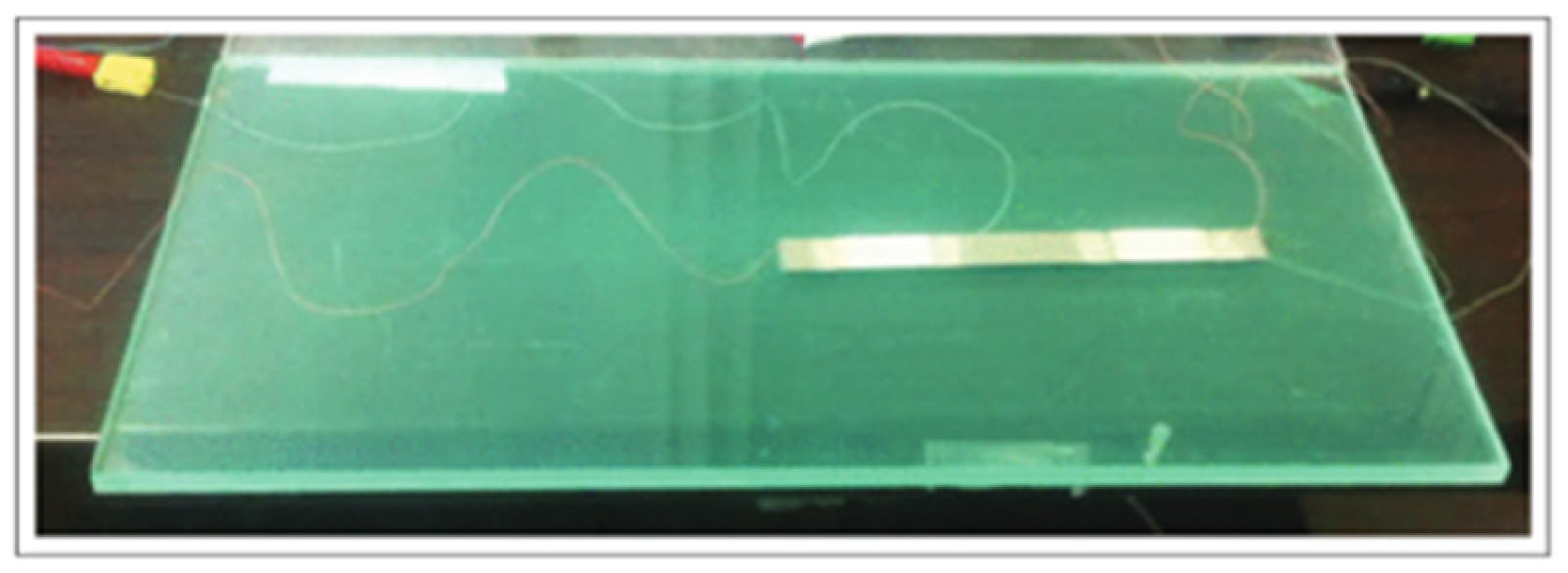
Figure 1. Example of a TW piezoelectric integrated minirobot moving on a smooth surface [5].
Actuators 14 00528 g001
Figure 2. The same robot as in Figure 1, loaded by a small masse moving on a rough surface [5].
Actuators 14 00528 g002
Figure 3. Illustration of actuated robotic joints in a prototype of robotic arm actuated by PZM technologies [3].
Actuators 14 00528 g003
Figure 4. Schematic representation of the shape of a piezoelectric TW beam robot (left) and a prototype of such a beam minirobot (right) [5].
Actuators 14 00528 g004
Figure 5. Schematic illustration for piezoelectric beam robot excitation modes: (a) actuator–sensor, (b) actuator–actuator [5].
Actuators 14 00528 g005
Figure 6. Schematics of a TW piezoelectric mini-pump moving accurately controlled fluid [4].
Actuators 14 00528 g006
Figure 7. Structural prototype elements (schematic representation of the shape) of a fluid-controlled delivery using a TW mini-pump [4].
Actuators 14 00528 g007
Figure 8. Summarized selection strategies relative to scanner and robotic actuating means in an image-assisted robotic intervention.
Actuators 14 00528 g008
Figure 9. Schematics of multifunctional piezoelectric device involving sensing and harvesting functions as well as actuating functions.
Actuators 14 00528 g009
Figure 10. Schematics of a closed-loop controlled autonomous cooperative procedure including the MRI scanner, interventional tool, location and duties assigned, robotic actuation, and control alongside the imaged, restricted troubled zone.
Actuators 14 00528 g010
Figure 11. Summarized topographies of a monitoring DT of a MRI-guided robotic intervention.
Actuators 14 00528 g011
Figure 12. Summarized illustration of future research perspectives (medical case involvements) related to piezoelectric material features (behavior, environmental compatibility, and performance).
Actuators 14 00528 g012
Table 1. Comparison of performances of different actuating devices involved in medical interventions.
ActuatorResolutionResponse TimeDriving ForceMRI Compatibility
piezoelectricnanometermicrosecondNewtonsHigh
electromagnetictens of micrometersmillisecondNewtonsLow
hydraulicmicrometermillisecondNewtonsHigh
shapememory alloynanometersecondNewtonsMedium
Table 2. Comparison of actuators in two interventional scenarios.
ActuatorComputerized Robotic Common InterventionMRI-Assisted Robotic Intricate Intervention
PiezoelectricV. GoodV. Good
ElectromagneticGoodNo
HydraulicModerateModerate
Shapememory alloyGoodNo
Table 3. Illustration of piezoelectric sensors regarding EM interference.
SensorsSensing Without EMF ExposuresSensing in EMF Exposure Environment
PiezoelectricGoodGood
OthersGoodNeed shields
Disclaimer/Publisher’s Note: The statements, opinions and data contained in all publications are solely those of the individual author(s) and contributor(s) and not of MDPI and/or the editor(s). MDPI and/or the editor(s) disclaim responsibility for any injury to people or property resulting from any ideas, methods, instructions or products referred to in the content.