
Baseline Characterization of the Gut Microbiota of Field and Colony Populations of Phlebotomus tobbi and Preliminary Assessment of the Anti-Leishmanial Activity of Cultivable Bacteria



Abstract
1. Introduction
2. Materials and Methods
2.1. Study Area and Sand Fly Collection
2.2. Establishment of Laboratory Colonies
2.3. Midgut Dissections and Bacterial Diversity
2.4. Leishmanicidal Activity of Bacterial Isolates
2.5. Molecular Surveillance of Leishmania Infections in Field-Collected Sand Flies
3. Results
3.1. Sand Fly Collections and Species Composition

| Species | Female (n) | Male (n) | Total (n) | % of Total |
|---|---|---|---|---|
| Phlebotomus tobbi | 660 | 652 | 1312 | 75.5% |
| Ph. papatasi | 176 | 162 | 338 | 19.4% |
| Sergentomyia dentata | 22 | 22 | 44 | 2.5% |
| Ph. major s.l. | 12 | 11 | 23 | 1.3% |
| Ph. perfiliewi s.l. | 4 | 4 | 8 | 0.5% |
| Ph. sergenti | 4 | 4 | 8 | 0.5% |
| Adlerius sp. | - | 2 | 2 | 0.1% |
3.2. Surveillance of Leishmania Infection
3.3. Bacterial Diversity in Field and Colony Specimens
| Bacterial Taxon * | Field Female | Field Male | Colony Female | Colony Male |
|---|---|---|---|---|
| E. aphidicola/persicina | 46.3% | 63.6% | 41.4% | 46.3% |
| S. marcescens/nematodiphila | 20.8% | 9.7% | 5.6% | 6.4% |
| P. ananatis | 2.9% | 13.9% | — | — |
| B. fungorum | 18.5% | — | — | — |
| S. maltophilia | 14.9% | — | 30.1% | 23.4% |
| R. pickettii | 7.9% | 4.7% | — | — |
3.4. Cultivable Bacteria and MALDI-TOF Identification
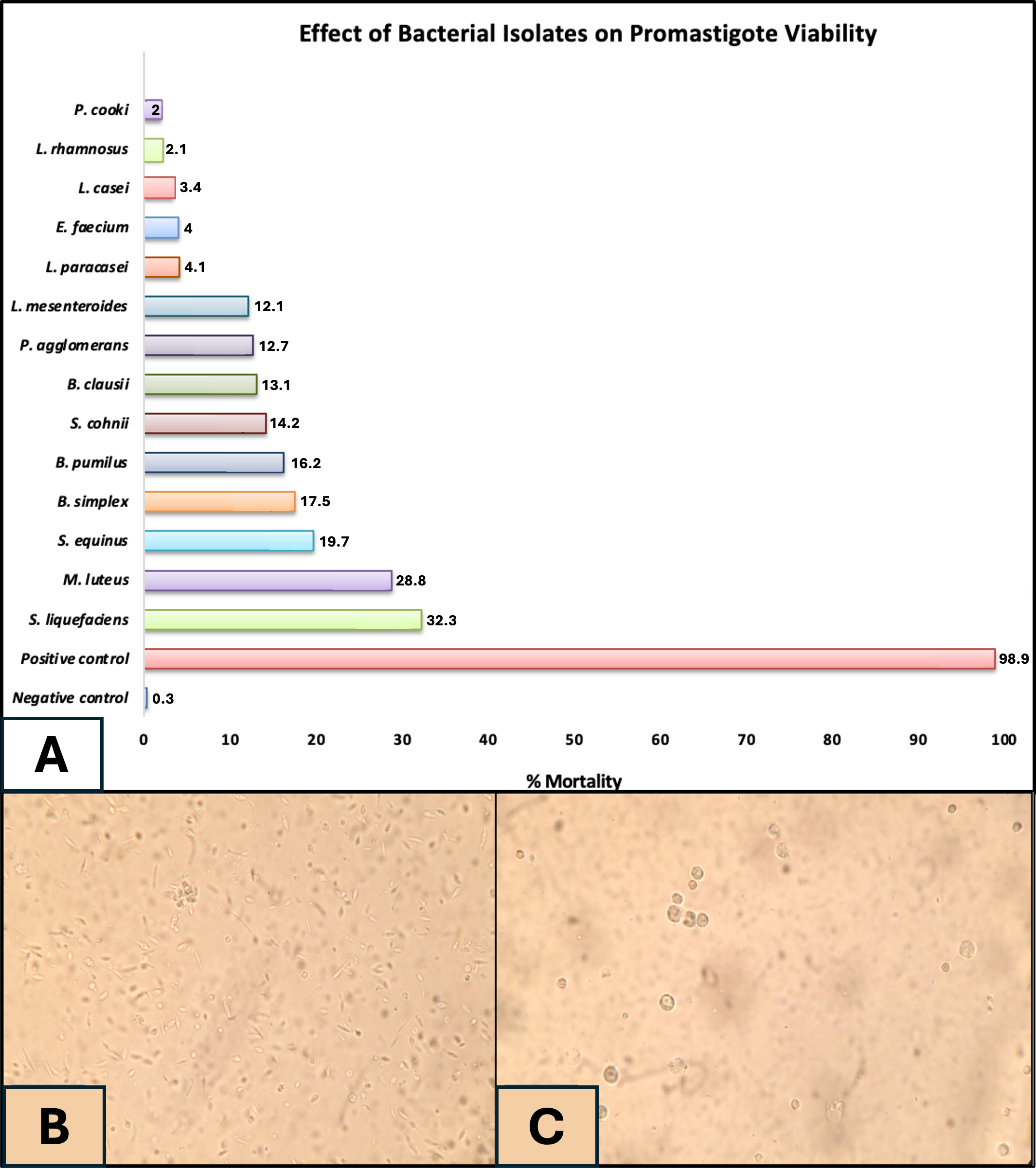
3.5. Leishmanicidal Activity of Sellected Bacterial Isolates
4. Discussion
5. Conclusions
6. Study Limitations
Supplementary Materials
Author Contributions
Funding
Institutional Review Board Statement
Informed Consent Statement
Data Availability Statement
Acknowledgments
Conflicts of Interest
Abbreviations
| TSA | Tryptic Soy Agar |
| PCA | Plate Count Agar |
| MHB | Mueller–Hinton Broth |
| NB | Nutrient Broth |
| CL | Cutaneous Leishmaniasis |
| VL | Visceral Leishmaniasis |
| CanL | Canine Leishmaniasis |
| CDC | Centers for Disease Control and Prevention |
| MALDI-TOF | Matrix-Assisted Laser Desorption/Ionization Time-of-Flight |
References
- WHO. Global Leishmaniasis Surveillance Updates 2024: Consolidating Gains and New Initiatives; WHO: Geneva, Switzerland, 2025. [Google Scholar]
- Alvar, J.; Yactayo, S.; Bern, C. Leishmaniasis and Poverty. Trends Parasitol. 2006, 22, 552–557. [Google Scholar] [CrossRef] [PubMed]
- Mann, S.; Frasca, K.; Scherrer, S.; Henao-Martínez, A.F.; Newman, S.; Ramanan, P.; Suarez, J.A. A Review of Leishmaniasis: Current Knowledge and Future Directions. Curr. Trop. Med. Rep. 2021, 8, 121–132. [Google Scholar] [CrossRef] [PubMed]
- Kelly, P.H.; Bahr, S.M.; Serafim, T.D.; Ajami, N.J.; Petrosino, J.F.; Meneses, C.; Kirby, J.R.; Valenzuela, J.G.; Kamhawi, S.; Wilson, M.E. The Gut Microbiome of the Vector Lutzomyia longipalpis Is Essential for Survival of Leishmania infantum. mBio 2017, 8, e01121-16. [Google Scholar] [CrossRef] [PubMed]
- McGwire, B.S.; Satoskar, A.R. Leishmaniasis: Clinical Syndromes and Treatment. QJM 2014, 107, 7–14. [Google Scholar] [CrossRef] [PubMed]
- Ok, Ü.Z.; Balcıoğlu, İ.C.; Taylan Özkan, A.; Özensoy, S.; Özbel, Y. Leishmaniasis in Turkey. Acta Trop. 2002, 84, 43–48. [Google Scholar] [CrossRef] [PubMed]
- Özbilgin, A.; Töz, S.; Harman, M.; Günaştı Topal, S.; Uzun, S.; Okudan, F.; Güngör, D.; Erat, A.; Ertabaklar, H.; Ertuğ, S.; et al. The Current Clinical and Geographical Situation of Cutaneous Leishmaniasis Based on Species Identification in Turkey. Acta Trop. 2019, 190, 59–67. [Google Scholar] [CrossRef] [PubMed]
- Erisoz Kasap, O.; Linton, Y.M.; Karakus, M.; Ozbel, Y.; Alten, B. Revision of the Species Composition and Distribution of Turkish Sand Flies Using DNA Barcodes. Parasit. Vectors 2019, 12, 410. [Google Scholar] [CrossRef] [PubMed]
- Alten, B.; Maia, C.; Afonso, M.O.; Campino, L.; Jiménez, M.; González, E.; Molina, R.; Bañuls, A.L.; Prudhomme, J.; Vergnes, B.; et al. Seasonal Dynamics of Phlebotomine Sand Fly Species Proven Vectors of Mediterranean Leishmaniasis Caused by Leishmania infantum. PLoS Negl. Trop. Dis. 2016, 10, e0004458. [Google Scholar] [CrossRef] [PubMed]
- Votýpka, J.; Kasap, O.E.; Volf, P.; Kodym, P.; Alten, B. Risk Factors for Cutaneous Leishmaniasis in Cukurova Region, Turkey. Trans. R. Soc. Trop. Med. Hyg. 2012, 106, 186–190. [Google Scholar] [CrossRef] [PubMed]
- Telleria, E.L.; Martins-da-Silva, A.; Tempone, A.J.; Traub-Csekö, Y.M. Leishmania, Microbiota and Sand Fly Immunity. Parasitology 2018, 145, 1336–1353. [Google Scholar] [CrossRef] [PubMed]
- Tabbabi, A.; Mizushima, D.; Yamamoto, D.S.; Kato, H. Effects of Host Species on Microbiota Composition in Phlebotomus and Lutzomyia Sand Flies. Parasit. Vectors 2023, 16, 310. [Google Scholar] [CrossRef] [PubMed]
- Volf, P.; Kiewegová, A.; Nemec, A. Bacterial Colonisation in the Gut of Phlebotomus duboscqi (Diptera: Psychodidae): Transtadial Passage and the Role of Female Diet. Folia Parasitol. 2002, 49, 73–77. [Google Scholar] [CrossRef] [PubMed]
- Monteiro, C.C.; Villegas, L.E.M.; Campolina, T.B.; Pires, A.C.M.A.; Miranda, J.C.; Pimenta, P.F.P.; Secundino, N.F.C. Bacterial Diversity of the American Sand Fly Lutzomyia intermedia Using High-Throughput Metagenomic Sequencing. Parasit. Vectors 2016, 9, 480. [Google Scholar] [CrossRef] [PubMed]
- De Pablos, L.; Ferreira, T.; Walrad, P. Developmental Differentiation in Leishmania Lifecycle Progression: Post-Transcriptional Control Conducts the Orchestra. Curr. Opin. Microbiol. 2016, 34, 82–89. [Google Scholar] [CrossRef] [PubMed]
- Kraeva, N.; Butenko, A.; Hlaváčová, J.; Kostygov, A.; Myškova, J.; Grybchuk, D.; Leštinová, T.; Votýpka, J.; Volf, P.; Opperdoes, F.; et al. Leptomonas seymouri: Adaptations to the Dixenous Life Cycle Analyzed by Genome Sequencing, Transcriptome Profiling and Co-Infection with Leishmania donovani. PLoS Pathog. 2015, 11, e1005127. [Google Scholar] [CrossRef] [PubMed]
- Ratcliffe, N.A.; Furtado Pacheco, J.P.; Dyson, P.; Castro, H.C.; Gonzalez, M.S.; Azambuja, P.; Mello, C.B. Overview of Paratransgenesis as a Strategy to Control Pathogen Transmission by Insect Vectors. Parasit. Vectors 2022, 15, 112. [Google Scholar] [CrossRef] [PubMed]
- Hurwitz, I.; Hillesland, H.; Fieck, A.; Das, P.; Durvasula, R. The Paratransgenic Sand Fly: A Platform for Control of Leishmania Transmission. Parasit. Vectors 2011, 4, 82. [Google Scholar] [CrossRef] [PubMed]
- Vivero, R.J.; Castañeda-Monsalve, V.A.; Romero, L.R.; D. Hurst, G.; Cadavid-Restrepo, G.; Moreno-Herrera, C.X. Gut Microbiota Dynamics in Natural Populations of Pintomyia evansi under Experimental Infection with Leishmania infantum. Microorganisms 2021, 9, 1214. [Google Scholar] [CrossRef] [PubMed]
- Vaselek, S.; Sarac, B.E.; Uzunkaya, A.D.; Yilmaz, A.; Karaaslan, C.; Alten, B. Identification of Ochrobactrum as a Bacteria with Transstadial Transmission and Potential for Application in Paratransgenic Control of Leishmaniasis. Parasitol. Res. 2024, 123, 82. [Google Scholar] [CrossRef] [PubMed]
- Karakuş, M.; Töz, S.; Ertabaklar, H.; Paşa, S.; Atasoy, A.; Arserim, S.K.; Ölgen, M.K.; Ziya Alkan, M.; Durrant, C.; Özbel, Y. Evaluation of Conjunctival Swab Sampling in the Diagnosis of Canine Leishmaniasis: A Two-Year Follow-up Study in Çukurova Plain, Turkey. Vet. Parasitol. 2015, 214, 295–302. [Google Scholar] [CrossRef] [PubMed]
- Léger, N.; Pesson, B. Taxonomy and Geographic Distribution of Phlebotomus (Adlerius) Chinensis s. l. and P. (Larroussius) Major s. l. (Psychodidae-Diptera). Status of Species Present in Greece. Bull. Soc. Pathol. Exot. Fil. 1987, 80, 252–260. [Google Scholar]
- Lewis, D.J. The Biology of Phlebotomidae in Relation to Leishmaniasis. Annu. Rev. Entomol. 1974, 19, 363–384. [Google Scholar] [CrossRef] [PubMed]
- Lawyer, P.; Killick-Kendrick, M.; Rowland, T.; Rowton, E.; Volf, P. Laboratory Colonization and Mass Rearing of Phlebotomine Sand Flies (Diptera, Psychodidae). Parasite 2017, 24, 42. [Google Scholar] [CrossRef] [PubMed]
- Volf, P.; Volfova, V. Establishment and Maintenance of Sand Fly Colonies. J. Vector Ecol. 2011, 36, S1–S9. [Google Scholar] [CrossRef] [PubMed]
- Karakuş, M.; Karabey, B.; Orçun Kalkan, Ş.; Özdemir, G.; Oǧuz, G.; Erişöz Kasap, Ö.; Alten, B.; Töz, S.; Özbel, Y. Midgut Bacterial Diversity of Wild Populations of Phlebotomus (P.) Papatasi, the Vector of Zoonotic Cutaneous Leishmaniasis (ZCL) in Turkey. Sci. Rep. 2017, 7, 14812. [Google Scholar] [CrossRef] [PubMed]
- Dingle, T.C.; Butler-Wu, S.M. MALDI-TOF Mass Spectrometry for Microorganism Identification. Clin. Lab. Med. 2013, 33, 589–609. [Google Scholar] [CrossRef] [PubMed]
- Yıldırım, A.; Aksoy, T.; Balcıoğlu, İ.C. Comparative Assessment of Colorimetric Assays in Evaluating Intracellular Drug Susceptibility of Leishmania tropica against Conventional Antileishmanial Drugs. Parasitol. Int. 2025, 106, 103021. [Google Scholar] [CrossRef] [PubMed]
- Rodgers, M.R.; Popper, S.J.; Wirth, D.F. Amplification of Kinetoplast DNA as a Tool in the Detection and Diagnosis of Leishmania. Exp. Parasitol. 1990, 71, 267–275. [Google Scholar] [CrossRef] [PubMed]
- Gunathilaka, N.; Perera, H.; Wijerathna, T.; Rodrigo, W.; Wijegunawardana, N.D.A.D. The Diversity of Midgut Bacteria among Wild-Caught Phlebotomus argentipes (Psychodidae: Phlebotominae), the Vector of Leishmaniasis in Sri Lanka. BioMed Res. Int. 2020, 2020, 5458063. [Google Scholar] [CrossRef] [PubMed]
- Heerman, M.; Weng, J.L.; Hurwitz, I.; Durvasula, R.; Ramalho-Ortigao, M. Bacterial Infection and Immune Responses in Lutzomyia longipalpis Sand Fly Larvae Midgut. PLoS Negl. Trop. Dis. 2015, 9, e0003923. [Google Scholar] [CrossRef] [PubMed]
- Svobodová, M.; Alten, B.; Zídková, L.; Dvořák, V.; Hlavačková, J.; Myšková, J.; Šeblová, V.; Kasap, O.E.; Belen, A.; Votýpka, J.; et al. Cutaneous Leishmaniasis Caused by Leishmania infantum Transmitted by Phlebotomus tobbi. Int. J. Parasitol. 2009, 39, 251–256. [Google Scholar] [CrossRef] [PubMed]
- Karimian, F.; Vatandoost, H.; Rassi, Y.; Maleki-Ravasan, N.; Mohebali, M.; Shirazi, M.H.; Koosha, M.; Choubdar, N.; Oshaghi, M.A. Aerobic Midgut Microbiota of Sand Fly Vectors of Zoonotic Visceral Leishmaniasis from Northern Iran, a Step toward Finding Potential Paratransgenic Candidates. Parasit. Vectors 2019, 12, 10. [Google Scholar] [CrossRef] [PubMed]
- Karimian, F.; Koosha, M.; Choubdar, N.; Oshaghi, M.A. Comparative Analysis of the Gut Microbiota of Sand Fly Vectors of Zoonotic Visceral Leishmaniasis (ZVL) in Iran; Host-Environment Interplay Shapes Diversity. PLoS Negl. Trop. Dis. 2022, 16, e0010609. [Google Scholar] [CrossRef] [PubMed]
- Tang, K.; Zhang, Y.; Meneses, C.; Rogerio, L.A.; Willen, L.; Iniguez, E.; Kamhawi, S.; Valenzuela, J.G.; Oliveira, F.; Cecilio, P. Phlebotomus duboscqi Gut Microbiota Dynamics in the Context of Leishmania Infection. Front. Immunol. 2026, 16, 1717935. [Google Scholar] [CrossRef] [PubMed]
- Tabbabi, A.; Mizushima, D.; Yamamoto, D.S.; Kato, H. Sand Flies and Their Microbiota. Parasitologia 2022, 2, 71–87. [Google Scholar] [CrossRef]
- Vaselek, S. Overview of Microbial Studies in Sandflies and Their Progress toward Development of Paratransgenic Approach for the Control of Leishmania sp. Front. Trop. Dis. 2024, 5, 1369077. [Google Scholar] [CrossRef]
- Akhoundi, M.; Bakhtiari, R.; Guillard, T.; Baghaei, A.; Tolouei, R.; Sereno, D.; Toubas, D.; Depaquit, J.; Abyaneh, M.R. Diversity of the Bacterial and Fungal Microflora from the Midgut and Cuticle of Phlebotomine Sand Flies Collected in North-Western Iran. PLoS ONE 2012, 7, e50259. [Google Scholar] [CrossRef] [PubMed]
- Louradour, I.; Monteiro, C.C.; Inbar, E.; Ghosh, K.; Merkhofer, R.; Lawyer, P.; Paun, A.; Smelkinson, M.; Secundino, N.; Lewis, M.; et al. The Midgut Microbiota Plays an Essential Role in Sand Fly Vector Competence for Leishmania major. Cell. Microbiol. 2017, 19, e12755. [Google Scholar] [CrossRef] [PubMed]
- Campolina, T.B.; Villegas, L.E.M.; Monteiro, C.C.; Pimenta, P.F.P.; Secundino, N.F.C. Tripartite Interactions: Leishmania, Microbiota and Lutzomyia longipalpis. PLoS Negl. Trop. Dis. 2020, 14, e0008666. [Google Scholar] [CrossRef] [PubMed]
- Sabbahi, R.; Hock, V.; Azzaoui, K.; Hammouti, B. Leishmania–Sand Fly Interactions: Exploring the Role of the Immune Response and Potential Strategies for Leishmaniasis Control. J. Parasit. Dis. 2024, 48, 655–670. [Google Scholar] [CrossRef] [PubMed]
- Cecilio, P.; Rogerio, L.A.; D. Serafim, T.; Tang, K.; Willen, L.; Iniguez, E.; Meneses, C.; Chaves, L.F.; Zhang, Y.; dos Santos Felix, L.; et al. Leishmania Sand Fly-Transmission Is Disrupted by Delftia tsuruhatensis TC1 Bacteria. Nat. Commun. 2025, 16, 3571. [Google Scholar] [CrossRef] [PubMed]
- Diaz-Albiter, H.; Sant’Anna, M.R.V.; Genta, F.A.; Dillon, R.J. Reactive Oxygen Species-Mediated Immunity against Leishmania mexicana and Serratia marcescens in the Phlebotomine Sand Fly Lutzomyia longipalpis. J. Biol. Chem. 2012, 287, 23995–24003. [Google Scholar] [CrossRef] [PubMed]
- Ghassemi, M.; Akhavan, A.A.; Zahraei-Ramezani, A.; Yakhchali, B.; Zarean, M.R.; Jafari, R.; Oshaghi, M.A. Assessing Survival of Transgenic Bacteria, Serratia AS1 and Enterobacter cloacae, in Sugar Bait, White Saxaul Plant (Haloxylon persicum) and Rodent Barrow’s Soil, A Contained-Field Study for Paratransgenesis Approach. J. Arthropod. Borne. Dis. 2024, 18, 12. [Google Scholar] [CrossRef] [PubMed]
- Duque-Granda, D.; Vivero-Gómez, R.J.; Junca, H.; Cadavid-Restrepo, G.; Moreno-Herrera, C.X. Interaction and Effects of Temperature Preference under a Controlled Environment on the Diversity and Abundance of the Microbiome in Lutzomyia longipalpis (Diptera: Psychodidae). Biotechnol. Rep. 2024, 44, e00857. [Google Scholar] [CrossRef] [PubMed]
- Daoudi, M.; Outammassine, A.; Redouane, E.; Loqman, S.; Hafidi, M.; Boumezzough, A.; Olivier, M.; Boussaa, S.; Ndao, M. Characterization of Gut Bacteria in Natural Populations of Sand Flies (Diptera: Psychodidae) from Endemic and Non-Endemic Areas of Leishmaniasis in Morocco. Microorganisms 2025, 13, 2279. [Google Scholar] [CrossRef] [PubMed]
- Yaghoobi, M.; Moridi Farimani, M.; Khan, A.; Asadollahi, M.; Omrani, M.; Luyten, W.; Hu, H. Investigation of Phytochemical Profiling and Biological Activities of Methanol Extract from Eryngium billardieri: Antimicrobial, Antibiofilm, and Anthelmintic Properties. Front. Plant Sci. 2025, 16, 1667335. [Google Scholar] [CrossRef] [PubMed]
- Alabaz, D.; Eroğlu, F.; Elçi, H.; Çay, Ü. Identification of Leishmania tropica from Pediatric Visceral Leishmaniasis in Southern Mediterranean Region of Turkey. Mediterr. J. Hematol. Infect. Dis. 2022, 14, e2022053. [Google Scholar] [CrossRef] [PubMed]
- Cleanclay, W.D.; Kernyuy, F.B.; Kintung, I.F.; Yensii, N.G.; Chick, J.A.; Obi, A.M.M. Evaluating Paratransgenesis Using Engineered Symbiotic Bacteria for Plasmodium Inhibition in Mosquito Vectors: A Systematic Review. PLoS Negl. Trop. Dis. 2026, 20, e0013654. [Google Scholar] [CrossRef] [PubMed]
- Sassera, D.; Epis, S.; Pajoro, M.; Bandi, C. Microbial Symbiosis and the Control of Vector-Borne Pathogens in Tsetse Flies, Human Lice, and Triatomine Bugs. Pathog. Glob. Health 2013, 107, 285–292. [Google Scholar] [CrossRef] [PubMed]
- Yilmaz, A.; Kasap, O.E. Prevalence of Wolbachia in Natural Sand Fly (Diptera: Psychodidae) Populations from Türkiye and Its Potential Role in Mitochondrial Divergence. Parasit. Vectors 2025, 19, 16. [Google Scholar] [CrossRef] [PubMed]
- Karami, M.; Hassan Moosa-Kazemi, S.; Ali Oshaghi, M.; Vatandoost, H.; Mehdi Sedaghat, M.; Rajabnia, R.; Hosseini, M.; Maleki-Ravasan, N.; Yahyapour, Y.; Ferdosi-Shahandashti, E. Wolbachia Endobacteria in Natural Populations of Culex Pipiens of Iran and Its Phylogenetic Congruence. J. Arthropod-Borne Dis. 2016, 10, 347. [Google Scholar] [PubMed]
- Brelsfoard, C.; Tsiamis, G.; Falchetto, M.; Gomulski, L.M.; Telleria, E.; Alam, U.; Doudoumis, V.; Scolari, F.; Benoit, J.B.; Swain, M.; et al. Presence of Extensive Wolbachia Symbiont Insertions Discovered in the Genome of Its Host Glossina morsitans morsitans. PLoS Negl. Trop. Dis. 2014, 8, e2728. [Google Scholar] [CrossRef] [PubMed]
- Kiplagat, S.; Matoke-Muhia, D.; Owino, B.O.; Tchouassi, D.P.; Masiga, D.K.; Hurst, G.D.D.; Villinger, J. Sand Fly Endosymbionts in Kenya: Rickettsia and Wolbachia Associations with Leishmania and Detection of Rickettsia africae. Parasit. Vectors 2026, 19, 117. [Google Scholar] [CrossRef] [PubMed]

Disclaimer/Publisher’s Note: The statements, opinions and data contained in all publications are solely those of the individual author(s) and contributor(s) and not of MDPI and/or the editor(s). MDPI and/or the editor(s) disclaim responsibility for any injury to people or property resulting from any ideas, methods, instructions or products referred to in the content. |
© 2026 by the authors. Licensee MDPI, Basel, Switzerland. This article is an open access article distributed under the terms and conditions of the Creative Commons Attribution (CC BY) license.
Share and Cite
Karakuş, M.; Yılmaz, A.; Okbay, M.; Pekağırbaş, M.; Erisoz Kasap, O. Baseline Characterization of the Gut Microbiota of Field and Colony Populations of Phlebotomus tobbi and Preliminary Assessment of the Anti-Leishmanial Activity of Cultivable Bacteria. Pathogens 2026, 15, 658. https://doi.org/10.3390/pathogens15070658
Karakuş M, Yılmaz A, Okbay M, Pekağırbaş M, Erisoz Kasap O. Baseline Characterization of the Gut Microbiota of Field and Colony Populations of Phlebotomus tobbi and Preliminary Assessment of the Anti-Leishmanial Activity of Cultivable Bacteria. Pathogens. 2026; 15(7):658. https://doi.org/10.3390/pathogens15070658
Chicago/Turabian StyleKarakuş, Mehmet, Ayda Yılmaz, Mert Okbay, Metin Pekağırbaş, and Ozge Erisoz Kasap. 2026. "Baseline Characterization of the Gut Microbiota of Field and Colony Populations of Phlebotomus tobbi and Preliminary Assessment of the Anti-Leishmanial Activity of Cultivable Bacteria" Pathogens 15, no. 7: 658. https://doi.org/10.3390/pathogens15070658
APA StyleKarakuş, M., Yılmaz, A., Okbay, M., Pekağırbaş, M., & Erisoz Kasap, O. (2026). Baseline Characterization of the Gut Microbiota of Field and Colony Populations of Phlebotomus tobbi and Preliminary Assessment of the Anti-Leishmanial Activity of Cultivable Bacteria. Pathogens, 15(7), 658. https://doi.org/10.3390/pathogens15070658