Increased Expression of CXCL9, CXCL10, and CXCL11 in Epstein–Barr Virus-Associated Infectious Mononucleosis and the Role of CXCL5 as a Candidate Biomarker of Disease Severity

 , and
, and
Abstract
1. Introduction
2. Materials and Methods
2.1. Study Design, Patients, and Data Collection
2.2. Classification of Patients Based on Disease Severity
2.3. Chemokine Quantification
2.4. Statistical Analysis
3. Results
3.1. Demographic and Clinical Data
3.2. Assessment of Disease Severity
3.3. Analysis of Chemokine Levels in EBV-Associated IM According to Disease Severity
3.4. Analysis of Chemokine Concentrations by Logistic Regression
4. Discussion
Supplementary Materials
Author Contributions
Funding
Institutional Review Board Statement
Informed Consent Statement
Data Availability Statement
Conflicts of Interest
Abbreviations
| EBV | Epstein–Barr virus |
| IM | infectious mononucleosis |
| SOM | Severity of Mononucleosis Scale |
| BHS | β-hemolytic streptococcus group A |
| IQR | interquartile range |
| WBC | white blood cells |
| ANC | absolute neutrophil count |
| CRP | C-reactive protein |
| AST | aspartate aminotransferase |
| ALT | alanine aminotransferase |
| LDH | lactate dehydrogenase |
References
- International Committee for the Taxonomy of Viruses. Genus: Lymphocryptovirus. Available online: https://ictv.global/report/chapter/orthoherpesviridae/orthoherpesviridae/lymphocryptovirus (accessed on 9 October 2025).
- Chang, C.M.; Yu, K.J.; Mbulaiteye, S.M.; Hildesheim, A.; Bhatia, K. The extent of genetic diversity of Epstein-Barr virus and its geographic and disease patterns: A need for reappraisal. Virus Res. 2009, 143, 209–221. [Google Scholar] [CrossRef]
- Houldcroft, C.J.; Kellam, P. Host genetics of Epstein-Barr virus infection, latency and disease. Rev. Med. Virol. 2015, 25, 71–84. [Google Scholar] [CrossRef]
- Fafi-Kremer, S.; Morand, P.; Brion, J.P.; Pavese, P.; Baccard, M.; Germi, R.; Genoulaz, O.; Nicod, S.; Jolivet, M.; Ruigrok, R.W.H.; et al. Long-term shedding of infectious Epstein-Barr virus after infectious mononucleosis. J. Infect. Dis. 2005, 191, 985–989. [Google Scholar] [CrossRef]
- Hadinoto, V.; Shapiro, M.; Greenough, T.C.; Sullivan, J.L.; Luzuriaga, K.; Thorley-Lawson, D.A. On the dynamics of acute EBV infection and the pathogenesis of infectious mononucleosis. Blood 2008, 111, 1420–1427. [Google Scholar] [CrossRef]
- Tomkinson, B.E.; Wagner, D.K.; Nelson, D.L.; Sullivan, J.L. Activated lymphocytes during acute Epstein-Barr virus infection. J. Immunol. 1987, 139, 3802–3807. [Google Scholar] [CrossRef]
- Prtorić, L.; Šokota, A.; Karabatić Knezović, S.; Tešović, G.; Zidovec-Lepej, S. Clinical features and laboratory findings of hospitalized children with infectious mononucleosis caused by Epstein-Barr virus from Croatia. Pathogens 2025, 14, 374. [Google Scholar] [CrossRef]
- Bennett, J.E.; Blaser, M.J.; Dolin, R. Epstein–Barr virus (infectious mononucleosis, Epstein–Barr virus-associated malignant diseases, and other diseases). In Mandell, Douglas, and Bennett’s Principles and Practice of Infectious Diseases, 9th ed.; Mandell, G.L., Bennett, J.E., Dolin, R., Eds.; Elsevier: Amsterdam, The Netherlands, 2019; pp. 1754–1770. [Google Scholar]
- Horwitz, C.A.; Henle, W.; Henle, G.; Goldfarb, M.; Kubic, P.; Gehrz, R.C.; Balfour, H.H., Jr.; Fleisher, G.R.; Krivit, W. Clinical and laboratory evaluation of infants and children with Epstein-Barr virus-induced infectious mononucleosis: Report of 32 patients (aged 10–48 months). Blood 1981, 57, 933–938. [Google Scholar] [CrossRef] [PubMed]
- Monem, S.A.; O’Connor, P.F.; O’Leary, T.G. Peritonsillar abscess and infectious mononucleosis: An association or a different presentation of the same condition? Ir. Med. J. 1999, 92, 278–280. [Google Scholar] [PubMed]
- Aldrete, J.S. Spontaneous rupture of the spleen in patients with infectious mononucleosis. Mayo Clin. Proc. 1992, 67, 910–912. [Google Scholar] [CrossRef]
- Fauci, A.S.; Kasper, D.L.; Longo, D.L.; Hauser, S.L.; Jameson, J.L.; Loscalzo, J. Epstein–Barr virus infections, including infectious mononucleosis. In Harrison’s Principles of Internal Medicine, 17th ed.; Fauci, A.S., Kasper, D.L., Longo, D.L., Hauser, S.L., Jameson, J.L., Loscalzo, J., Eds.; McGraw-Hill: New York, NY, USA, 2010; pp. 745–749. [Google Scholar]
- Daskalogianni, C.; Pyndiah, S.; Apcher, S.; Mazars, A.; Manoury, B.; Ammari, N.; Nylander, K.; Voisset, C.; Blondel, M.; Fåhraeus, R. Epstein-Barr virus-encoded EBNA1 and ZEBRA: Targets for therapeutic strategies against EBV-carrying cancers. J. Pathol. 2015, 235, 334–341. [Google Scholar] [CrossRef]
- Cohen, J.I.; Fauci, A.S.; Varmus, H.; Nabel, G.J. Epstein-Barr virus: An important vaccine target for cancer prevention. Sci. Transl. Med. 2011, 3, 107fs7. [Google Scholar] [CrossRef]
- Weinreb, M.; Day, P.J.; Niggli, F.; EPowell, J.; Raafat, F.; Hesseling, P.B.; Schneider, J.W.; Hartley, P.S.; Tzortzatou-Stathopoulou, F.; Khalek, E.R.; et al. The role of Epstein-Barr virus in Hodgkin’s disease from different geographical areas. Arch. Dis. Child. 1996, 74, 27–31. [Google Scholar] [CrossRef] [PubMed]
- Shi, J.; Chu, C.; Yu, M.; Zhang, D.; Li, Y.; Fan, Y.; Yu, Y.; Luo, Y.; Zhou, W. Clinical warning of hemophagocytic syndrome caused by Epstein-Barr virus. Ital. J. Pediatr. 2021, 47, 3. [Google Scholar] [CrossRef] [PubMed]
- Myers, J.L.; Kurtin, P.J.; Katzenstein, A.L.; Tazelaar, H.D.; Colby, T.V.; Strickler, J.G.; Lloyd, R.V.; Isaacson, P.G. Lymphomatoid granulomatosis: Evidence of immunophenotypic diversity and relationship to Epstein-Barr virus infection. Am. J. Surg. Pathol. 1995, 19, 1300–1312. [Google Scholar] [CrossRef]
- Hanto, D.W. Classification of Epstein-Barr virus-associated posttransplant lymphoproliferative diseases: Implications for understanding their pathogenesis and developing rational treatment strategies. Annu. Rev. Med. 1995, 46, 381–394. [Google Scholar] [CrossRef]
- Bjornevik, K.; Cortese, M.; Healy, B.C.; Kuhle, J.; Mina, M.J.; Leng, Y.; Elledge, S.J.; Niebuhr, D.W.; Scher, A.I.; Munger, K.L.; et al. Longitudinal analysis reveals a high prevalence of Epstein-Barr virus associated with multiple sclerosis. Science 2022, 375, 296–301. [Google Scholar] [CrossRef]
- Loebel, M.; Eckey, M.; Sotzny, F.; Hahn, E.; Bauer, S.; Grabowski, P.; Zerweck, J.; Holenya, P.; Hanitsch, L.G.; Wittke, K.; et al. Serological profiling of the EBV immune response in chronic fatigue syndrome using a peptide microarray. PLoS ONE 2017, 12, e0179124. [Google Scholar] [CrossRef]
- Jason, L.A.; Katz, B.Z. Predisposing and precipitating factors in Epstein–Barr virus-caused myalgic encephalomyelitis/chronic fatigue syndrome. Microorganisms 2025, 13, 702. [Google Scholar] [CrossRef]
- Hughes, C.E.; Nibbs, R.J.B. A guide to chemokines and their receptors. FEBS J. 2018, 285, 2944–2971. [Google Scholar] [CrossRef]
- Sheridan, G.K.; Wdowicz, A.; Pickering, M.; Watters, O.; Halley, P.; O’Sullivan, N.C.; Mooney, C.; O’Connell, D.J.; O’Connor, J.J.; Murphy, K.J. CX3CL1 is up-regulated in the rat hippocampus during memory-associated synaptic plasticity. Front. Cell. Neurosci. 2014, 8, 233. [Google Scholar] [CrossRef] [PubMed]
- Lei, Y.; Takahama, Y. XCL1 and XCR1 in the immune system. Microbes Infect. 2012, 14, 262–267. [Google Scholar] [CrossRef]
- Nakayama, T.; Hieshima, K.; Nagakubo, D.; Sato, E.; Nakayama, M.; Kawa, K.; Yoshie, O. Selective induction of Th2-attracting chemokines CCL17 and CCL22 in human B cells by latent membrane protein 1 of Epstein-Barr virus. J. Virol. 2004, 78, 1665–1674. [Google Scholar] [CrossRef]
- Tsai, S.-C.; Lin, S.-J.; Lin, C.-J.; Chou, Y.-C.; Lin, J.-H.; Yeh, T.-H.; Chen, M.-R.; Huang, L.-M.; Lu, M.-Y.; Huang, Y.-C.; et al. Autocrine CCL3 and CCL4 induced by the oncoprotein LMP1 promote Epstein-Barr virus-triggered B cell proliferation. J. Virol. 2013, 87, 9041–9052. [Google Scholar] [CrossRef] [PubMed]
- Jorapur, A.; Marshall, L.A.; Jacobson, S.; Xu, M.; Marubayashi, S.; Zibinsky, M.; Hu, D.X.; Robles, O.; Jackson, J.J.; Baloche, V.; et al. EBV+ tumors exploit tumor cell-intrinsic and -extrinsic mechanisms to produce regulatory T cell-recruiting chemokines CCL17 and CCL22. PLoS Pathog. 2022, 18, e1010200. [Google Scholar] [CrossRef]
- Ehlin-Henriksson, B.; Mowafi, F.; Klein, G.; Nilsson, A. Epstein-Barr virus infection negatively impacts the CXCR4-dependent migration of tonsillar B cells. Immunology 2006, 117, 379–385. [Google Scholar] [CrossRef] [PubMed]
- Katz, B.Z.; Reuter, C.; Lupovitch, Y.; Gleason, K.; McClellan, D.; Cotler, J.; Jason, L.A. A validated scale for assessing the severity of acute infectious mononucleosis. J. Pediatr. 2019, 209, 130–133. [Google Scholar] [CrossRef]
- Fevang, B.; Wyller, V.B.B.; Mollnes, T.E.; Pedersen, M.; Asprusten, T.T.; Michelsen, A.; Ueland, T.; Otterdal, K. Lasting immunological imprint of primary Epstein-Barr virus infection with associations to chronic low-grade inflammation and fatigue. Front. Immunol. 2021, 12, 715102. [Google Scholar] [CrossRef]
- Delecluse, S.; Baccianti, F.; Zala, M.; Steffens, A.; Drenda, C.; Judt, D.; Holland-Letz, T.; Poirey, R.; Sujobert, P.; Delecluse, H.-J. Epstein-Barr virus induces aberrant B cell migration and diapedesis via FAK-dependent chemotaxis pathways. Nat. Commun. 2025, 16, 4581. [Google Scholar] [CrossRef]
- Luo, Z.; Chen, Y.; Gu, M.; Zhao, F.; Liang, J.; Tang, Y.; Xu, X. Interferon-gamma and C-X-C motif chemokine ligand 9: Which is better for haemophagocytic lymphohistiocytosis diagnosis and monitoring? Br. J. Haematol. 2025, 207, 1618–1621. [Google Scholar] [CrossRef] [PubMed]


| N (%)/Median (Range) | ||||
|---|---|---|---|---|
| Parameter | All Patients (N = 64) | SOM = 0 (N = 25) | SOM = 1 (N = 28) | SOM ≥ 2 (N = 11) |
| Age (months) | 165 (4–216) | 167 (4–200) | 134 (25–212) | 180 (96–216) |
| Gender (male) | 28 (43.8%) | 10 (40.0%) | 12 (42.9%) | 6 (54.6%) |
| Day of disease on admission | 5 (2–21) | 6.5 (2–21) | 5 (2–9) | 5 (2–14) |
| Hospitalization | 10 (15.6%) | 2 (8.0%) | 3 (10.7%) | 5 (54.6%) |
| Hospitalization length (days) | 5 (4–12) | 5 (5–5) | 4 (4–4) | 5 (4–12) |
| Fever Maximal (°C) Duration (days) | 45 (70.3%) 39.0 (37.2–40.4) 5 (0–17) | 15 (60.0%) 39.2 (37.2–40.4) 4 (0–17) | 19 (67.9%) 39.0 (37.5–40.0) 5 (0–13) | 11 (100.0%) 39.6 (38.3–40.0) 9 (4–15) |
| Respiratory symptoms | 39 (60.9%) | 15 (60.0%) | 18 (63.3%) | 6 (54.6%) |
| Angina Hyperemic pharynx Exudate on tonsils Pseudomembranous angina | 51 (78.5%) 5 (7.8%) 40 (62.5%) 6 (9.4%) | 18 (72.0%) 1 (4.0%) 17 (68.0%) 0 (0.0%) | 25 (89.3%) 3 (10.7%) 17 (60.7%) 5 (17.9%) | 8 (72.7%) 1 (9.1%) 6 (54.6%) 1 (9.1%) |
| Hepatomegaly | 9 (14.1%) | 2 (8.0%) | 6 (21.4%) | 1 (9.1%) |
| Splenomegaly | 2 (3.1%) | 0 (0.0%) | 2 (7.1%) | 0 (0.0%) |
| Hepatosplenomegaly | 22 (34.4%) | 6 (24.0%) | 8 (28.6%) | 8 (72.2%) |
| Lymphadenitis Bilateral cervical Unilateral cervical | 48 (75.0%) 47 (73.5%) 1 (1.6%) | 16 (64.0%) 16 (64.0%) 0 (0.0%) | 22 (78.6%) 22 (78.6%) 0 (0.0%) | 10 (90.1%) 9 (81.8%) 1 (9.1%) |
| Edema Peri-glandular edema Upper facial edema | 17 (26.6%) 10 (15.6%) 7 (10.9%) | 5 (20.0%) 4 (16.0%) 1 (4.0%) | 7 (25.0%) 4 (14.3%) 3 (10.7%) | 5 (54.6%) 2 (18.2%) 3 (27.3%) |
| Rash Macular Maculopapular | 8 (12.5%) 1 (1.6%) 7 (10.9%) | 6 (24.0%) 1 (4.0%) 5 (20.0%) | 1 (3.6%) 0 (0.0%) 1 (3.6%) | 1 (9.1%) 0 (0.0%) 1 (9.1%) |
| Hypertrophic tonsils with potential obstruction | 5 (7.8%) | 0 (0.0%) | 3 (10.7%) | 2 (18.2%) |
| Corticosteroid admission Day of admission Duration (days) | 6 (9.4%) 5.5 (2–21) 2 (1–4) | 1 (4.0%) 2 (2–2) | 3 (10.7%) 6 (5–9) | 2 (18.2%) 12 (3–21) |
| BHS coinfection | 4 (6.3%) | 1 (4.0%) | 1 (3.6%) | 2 (18.2%) |
| Antibiotics Phenoxymethylpenicillin First-generation cephalosporins Third-generation cephalosporins Clindamycin Doxycycline | 9 (14.1%) 1 (1.6%) 2 (3.1%) 4 (6.3%) 1 (1.6%) 1 (1.6%) | 4 (16.0%) 1 (4.0%) 1 (4.0%) 2 (8.0%) 0 (0.0%) 0 (0.0%) | 1 (3.6%) 0 (0.0%) 1 (3.6%) 0 (0.0%) 0 (0.0%) 0 (0.0%) | 4 (36.4%) 0 (0.0%) 0 (0.0%) 2 (18.2%) 1 (9.1%) 1 (9.1%) |
| Median (IQR) | ||||
|---|---|---|---|---|
| Parameter | All Patients (N = 64) | SOM = 0 (N = 25) | SOM = 1 (N = 28) | SOM ≥ 2 (N = 11) |
| WBC count (admission) (×109/L) | 11.9 (8.3–14.8) | 11.9 (8.1–15.6) | 13.3 (9.7–16.2) | 7.6 (4.9–12.1) |
| WBC count (maximal) (×109/L) | 11.9 (9.1–15.4) | 11.9 (8.2–15.7) | 13.4 (9.8–19.0) | 11.2 (9.5–12.9) |
| WBC count (minimal) (×109/L) | 9.9 (6.7–13.5) | 11.6 (7.2–14.7) | 9.9 (8.0–14.1) | 5.3 (4.6–9.6) |
| Lymphocyte count (admission) (×109/L) | 6.2 (4.2–8.3) | 5.9 (4.0–8.6) | 7.0 (5.8–9.3) | 4.0 (1.5–5.1) |
| Lymphocyte count (maximal) (×109/L) | 6.8 (5.3–10.8) | 6.1 (4.5–8.7) | 7.3 (6.0–11.4) | 6.4 (5.0–8.8) |
| Atypical lymphocytes (admission) (%) | 22.0 (10.8–29.3) | 21.5 (6.5–28.8) | 25.0 (18.3–30.0) | 11.5 (8–20.3) |
| Atypical lymphocytes (maximal) (%) | 22.0 (16.0–28.5) | 23.0 (13.8–28.8) | 27.0 (18.5–31.0) | 18.0 (14.3–32.0) |
| ANC (×109/L) | 2.5 (1.8–4.0) | 2.7 (1.8–4.0) | 3.2 (2.1–4.2) | 1.9 (1.5–2.9) |
| Hemoglobin (admission) (g/L) | 126 (120–140) | 129 (120–137) | 128 (119–142) | 124 (121–139) |
| Hemoglobin (minimal) (g/L) | 125 (117–136) | 124 (119–138) | 126 (117–136) | 117 (107–128) |
| Platelet count (admission) (×109/L) | 178 (146–253) | 248 (178–274) | 172 (144–207) | 133 (108–179) |
| Platelet count (minimal) (×109/L) | 176 (142–244) | 236 (171–272) | 170 (142–196) | 123 (105–174) |
| CRP (admission) (mg/L) | 11.2 (5.8–28.1) | 10.0 (4.3–20.4) | 8.5 (5.5–21.6) | 26.9 (13.6–34.1) |
| Bilirubin (admission) (umol/L) | 11 (9–19) | 10 (9–12) | 14 (9–12) | 11 (11–20) |
| Bilirubin (maximal) (umol/L) | 11 (9–20) | 10 (9–12) | 15 (11–21) | 16 (11–67) |
| AST (admission) (U/L) | 92 (43–207) | 43 (39–120) | 101 (48–213) | 202 (124–252) |
| AST (maximal) (U/L) | 97 (43–207) | 44 (39–128) | 103 (49–220) | 237 (189–294) |
| ALT (admission) (U/L) | 103 (43–258) | 57 (30–166) | 142 (42–271) | 237 (107–371) |
| ALT (maximal) (U/L) | 105 (43–314) | 64 (34–169) | 143 (48–276) | 338 (253–523) |
| LDH (admission) (U/L) | 408 (303–503) | 329 (282–474) | 454 (343–548) | 470 (388–647) |
| LDH (maximal) (U/L) | 409 (322–506) | 335 (282–480) | 454 (345–548) | 514 (402–657) |
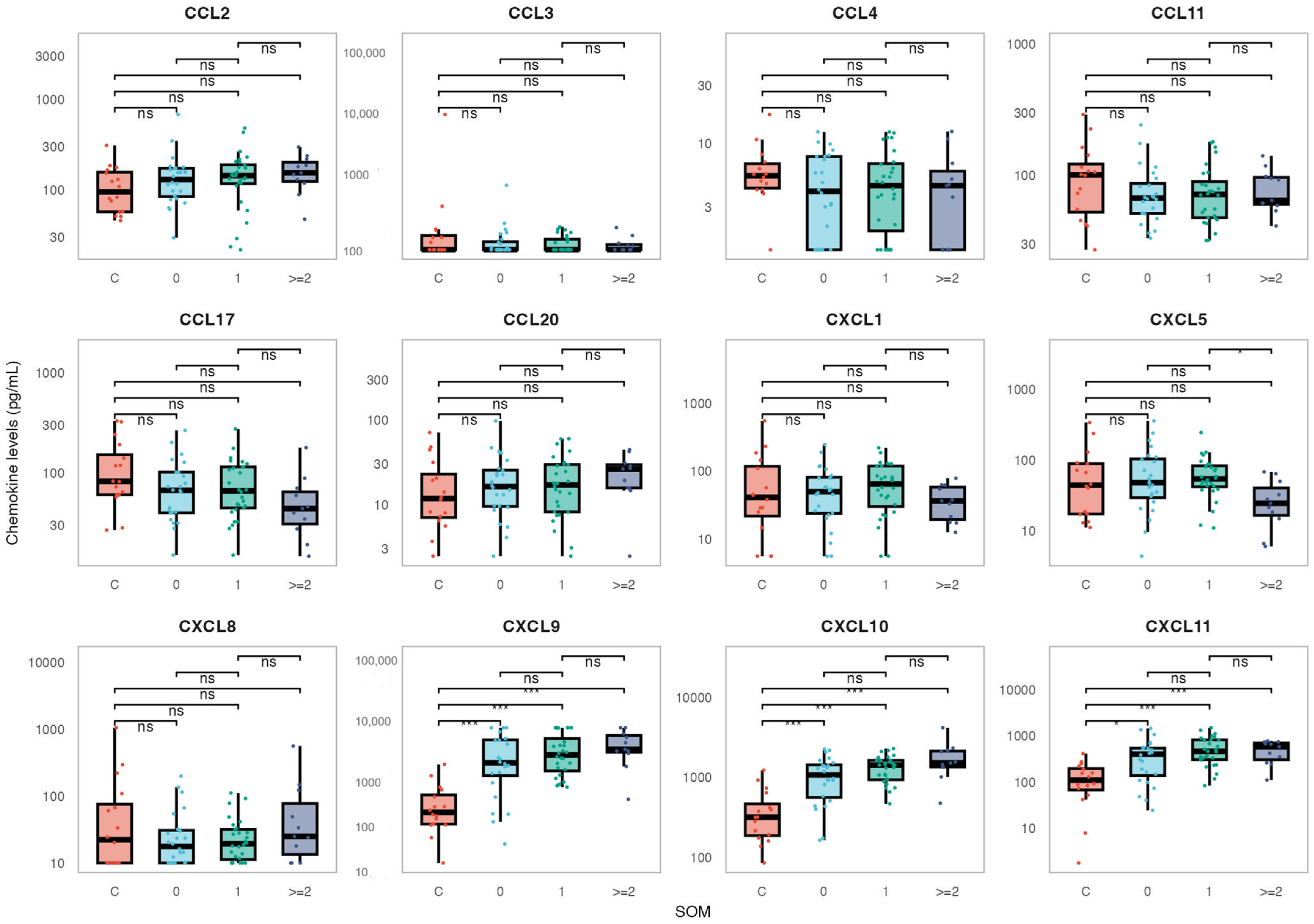
| p | ||||
|---|---|---|---|---|
| Comparison | CXCL5 | CXCL9 | CXCL10 | CXCL11 |
| C vs. SOM = 0 | 0.646 | <0.001 | 0.002 | 0.011 |
| C vs. SOM = 1 | 0.417 | <0.001 | <0.001 | <0.001 |
| C vs. SOM ≥ 2 | 0.098 | <0.001 | <0.001 | 0.002 |
| SOM = 0 vs. SOM = 1 | 0.380 | 0.691 | 0.258 | 0.372 |
| SOM = 0 vs. SOM ≥ 2 | 0.143 | 0.456 | 0.102 | 0.492 |
| SOM = 1 vs. SOM ≥ 2 | 0.037 | 0.691 | 0.326 | 0.988 |
| Predictor | Coefficient | Std. Error | OR (95% CI) | p |
|---|---|---|---|---|
| CXCL9 | 0.43 | 0.19 | 1.54 (1.06–2.23) | 0.024 |
| CXCL10 | 1.64 | 0.39 | 5.15 (2.42–10.96) | <0.001 |
Disclaimer/Publisher’s Note: The statements, opinions and data contained in all publications are solely those of the individual author(s) and contributor(s) and not of MDPI and/or the editor(s). MDPI and/or the editor(s) disclaim responsibility for any injury to people or property resulting from any ideas, methods, instructions or products referred to in the content. |
© 2026 by the authors. Licensee MDPI, Basel, Switzerland. This article is an open access article distributed under the terms and conditions of the Creative Commons Attribution (CC BY) license.
Share and Cite
Nikčević, A.; Radmanić Matotek, L.; Šiftar, S.; Stemberger Marić, L.; Tešović, G.; Zidovec-Lepej, S. Increased Expression of CXCL9, CXCL10, and CXCL11 in Epstein–Barr Virus-Associated Infectious Mononucleosis and the Role of CXCL5 as a Candidate Biomarker of Disease Severity. Pathogens 2026, 15, 487. https://doi.org/10.3390/pathogens15050487
Nikčević A, Radmanić Matotek L, Šiftar S, Stemberger Marić L, Tešović G, Zidovec-Lepej S. Increased Expression of CXCL9, CXCL10, and CXCL11 in Epstein–Barr Virus-Associated Infectious Mononucleosis and the Role of CXCL5 as a Candidate Biomarker of Disease Severity. Pathogens. 2026; 15(5):487. https://doi.org/10.3390/pathogens15050487
Chicago/Turabian StyleNikčević, Andrea, Leona Radmanić Matotek, Silva Šiftar, Lorna Stemberger Marić, Goran Tešović, and Snjezana Zidovec-Lepej. 2026. "Increased Expression of CXCL9, CXCL10, and CXCL11 in Epstein–Barr Virus-Associated Infectious Mononucleosis and the Role of CXCL5 as a Candidate Biomarker of Disease Severity" Pathogens 15, no. 5: 487. https://doi.org/10.3390/pathogens15050487
APA StyleNikčević, A., Radmanić Matotek, L., Šiftar, S., Stemberger Marić, L., Tešović, G., & Zidovec-Lepej, S. (2026). Increased Expression of CXCL9, CXCL10, and CXCL11 in Epstein–Barr Virus-Associated Infectious Mononucleosis and the Role of CXCL5 as a Candidate Biomarker of Disease Severity. Pathogens, 15(5), 487. https://doi.org/10.3390/pathogens15050487