Subverting Host Defense from Within: Innate Immune Modulation by Coxiella burnetii

Abstract
1. Introduction
1.1. C. burnetii Infection in Humans and Animals
1.2. C. burnetii Intracellular Lifecycle
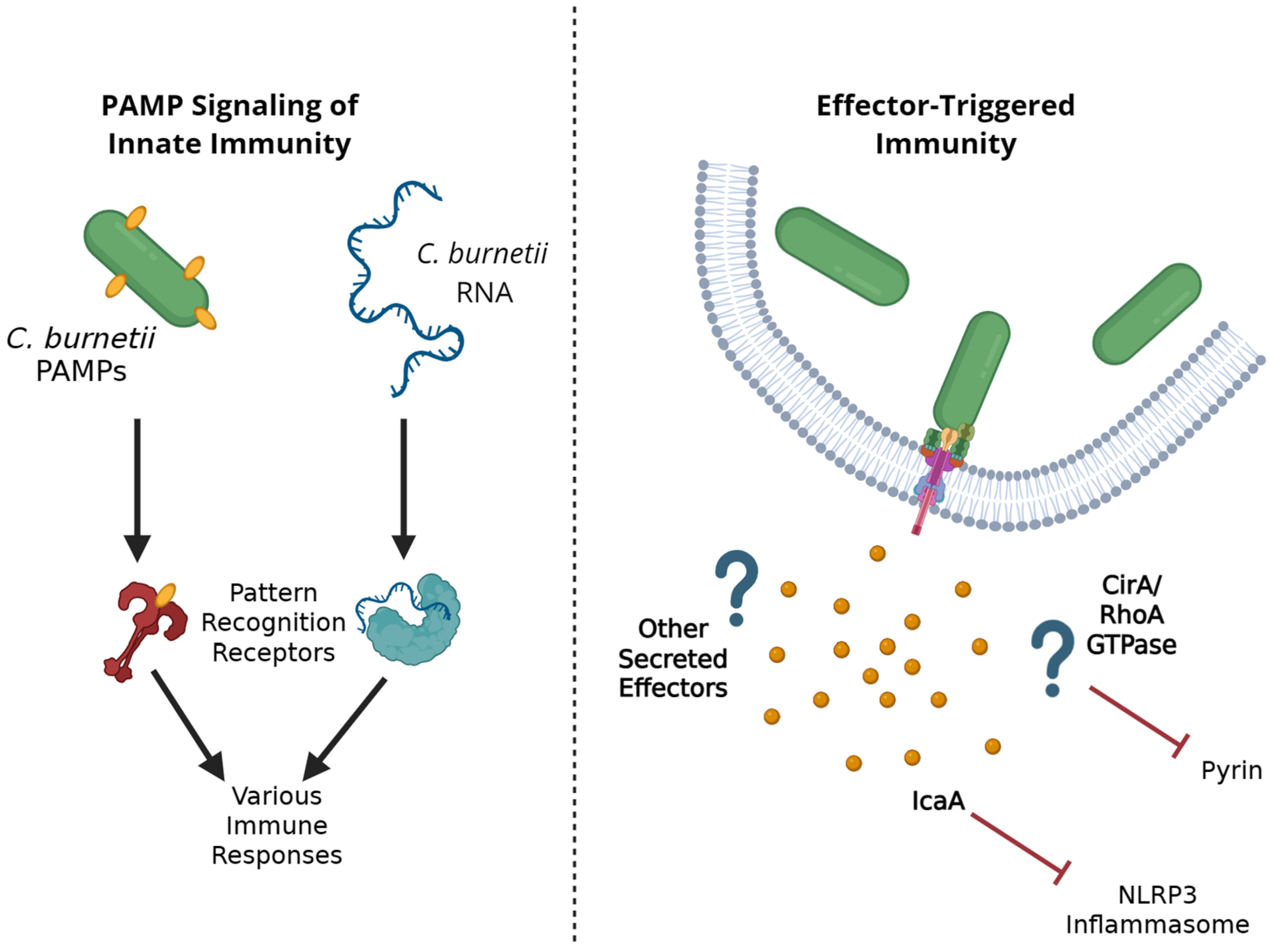
2. The Innate Immune System, PAMP-Triggered Immunity, and Effector-Triggered Immunity
2.1. Toll-like Receptors
2.2. Nucleotide-Binding Leucine Rich Repeat Receptors (NLRs)
2.3. Retinoic Acid-Inducible Gene I (RIG-I)-Like Receptors (RLRs)
2.4. cGAS-STING Pathway
3. Innate Immune Pathways Detrimental to Coxiella burnetii
3.1. Type I Interferon
3.2. Type II Interferon
3.3. NF-κB
4. Potential Coxiella-Stimulated ETI
4.1. RhoA ETI Mechanisms
4.2. Potential Cb ETI Mechanisms
5. Coxiella burnetii Experimental Challenges
5.1. Coxiella burnetii LPS
5.2. Potential Coxiella burnetii Immunization Methods
5.3. Coxiella burnetii Virulence, Pathotypes, and Host Innate Immunity
5.4. Cell Culture Models for Coxiella burnetii Infection
5.5. Animal Models for Coxiella burnetii Infection
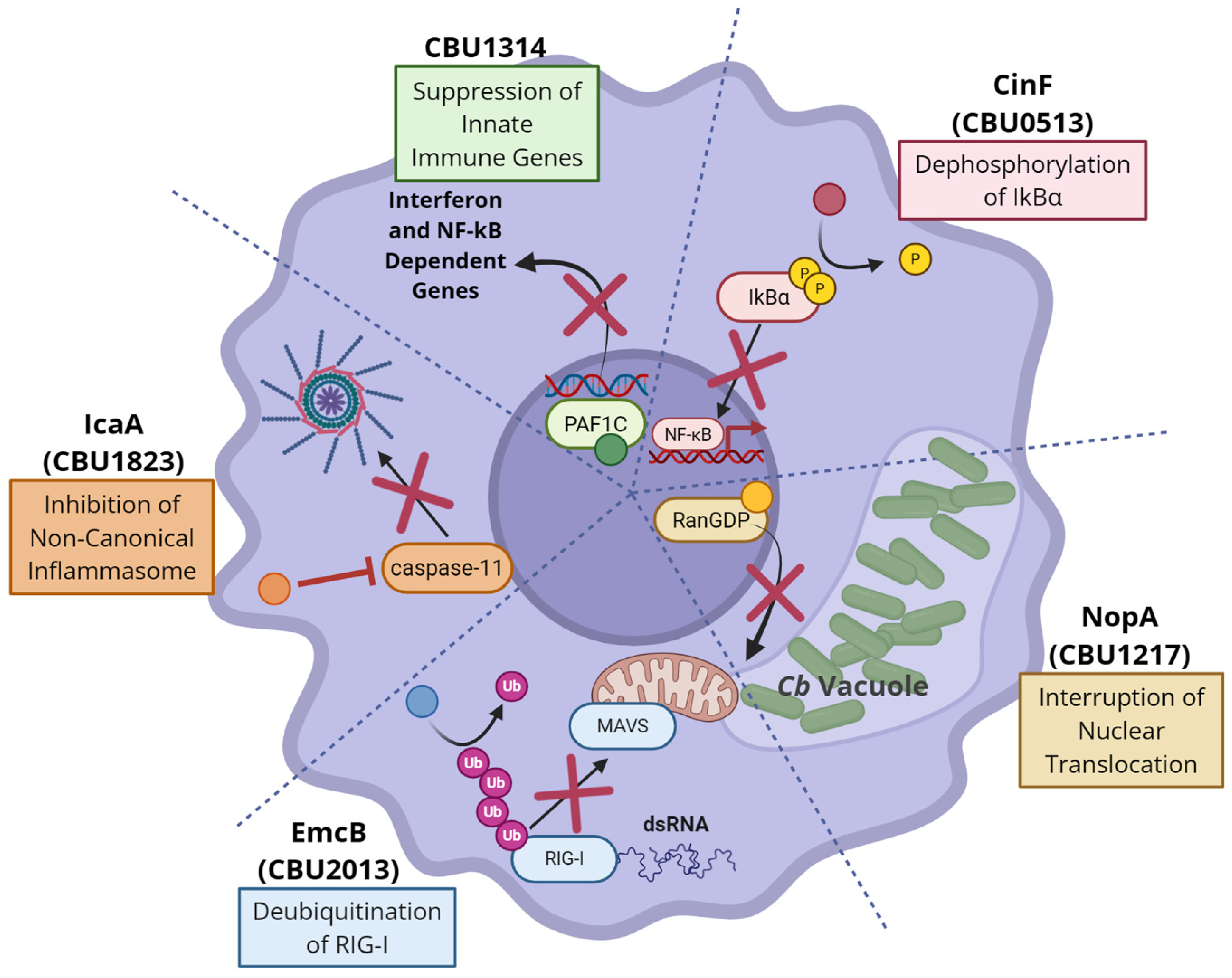
6. Coxiella burnetii Effectors That Inhibit the Innate Immune System
6.1. CinF (CBU0513)
6.2. NopA (CBU1217)
6.3. EmcB (CBU2013)
6.4. IcaA (CBU1823)
6.5. CBU1314
7. Conclusions and Future Perspectives
Author Contributions
Funding
Institutional Review Board Statement
Informed Consent Statement
Data Availability Statement
Acknowledgments
Conflicts of Interest
Abbreviations
| Cb | Coxiella burnetii |
| T4BSS | Type IVB secretion system |
| CCV | Coxiella-containing vacuole |
| PAMP | Pathogen-associated molecular pattern |
| LPS | Lipopolysaccharide |
| PRR | Pattern recognition receptor |
| SCV | Small-cell variant |
| LCV | Large-cell variant |
| BMDM | Bone marrow-derived macrophages |
| PTI | PAMP-triggered immunity |
| ETI | Effector-triggered immunity |
| TLR | Toll-like receptor |
| CLR | C-type lectin receptor |
| RLR | Retinoic acid-inducible gene I-like receptor |
| NLR | Nucleotide-binding domain, leucine-rich repeat-containing receptor |
| ZBP1 | Z-DNA-binding protein 1 |
| HAMP | Homeostasis-altering molecular pattern |
| DAMP | Damage-associated molecular pattern |
| NF-κB | Nuclear factor-κB |
| IRF3 | Interferon regulatory factor 3 |
| AP-1 | Activator protein-1 |
| CARD | Caspase activation and recruitment domain |
| GSDMD | Gasdermin D |
| NAIP | Neuronal apoptosis inhibitory protein |
| MAVS | Mitochondrial antiviral signaling protein |
| OMV | Outer membrane vesicle |
| TBK1 | TANK-binding kinase 1 |
| JAK-STAT | Janus kinase-signal transducer and activator of transcription |
| ISG | Interferon stimulated gene |
| iNOS | Inducible nitric oxide synthase |
References
- Case Elizabeth Di, R.; Mahapatra, S.; Hoffpauir Caitlyn, T.; Konganti, K.; Hillhouse Andrew, E.; Samuel James, E.; Van Schaik Erin, J. Primary Murine Macrophages as a Tool for Virulence Factor Discovery in Coxiella burnetii. Microbiol. Spectr. 2022, 10, e02484-21. [Google Scholar] [CrossRef] [PubMed]
- Gordon, S.; Plüddemann, A.; Martinez Estrada, F. Macrophage heterogeneity in tissues: Phenotypic diversity and functions. Immunol. Rev. 2014, 262, 36–55. [Google Scholar] [CrossRef] [PubMed]
- Osbron, C.A.; Goodman, A.G. To die or not to die: Programmed cell death responses and their interactions with Coxiella burnetii infection. Mol. Microbiol. 2022, 117, 717–736. [Google Scholar] [CrossRef] [PubMed]
- Zamboni, D.S.; Campos, M.A.; Torrecilhas, A.C.T.; Kiss, K.; Samuel, J.E.; Golenbock, D.T.; Lauw, F.N.; Roy, C.R.; Almeida, I.C.; Gazzinelli, R.T. Stimulation of Toll-like Receptor 2 by Coxiella burnetii Is Required for Macrophage Production of Pro-inflammatory Cytokines and Resistance to Infection. J. Biol. Chem. 2004, 279, 54405–54415. [Google Scholar] [CrossRef]
- Larson, C.L.; Martinez, E.; Beare, P.A.; Jeffrey, B.; Heinzen, R.A.; Bonazzi, M. Right on Q: Genetics begin to Unravel Coxiella burnetii host cell Interactions. Future Microbiol. 2016, 11, 919–939. [Google Scholar] [CrossRef]
- van Schaik, E.J.; Chen, C.; Mertens, K.; Weber, M.M.; Samuel, J.E. Molecular pathogenesis of the obligate intracellular bacterium Coxiella burnetii. Nat. Rev. Microbiol. 2013, 11, 561–573. [Google Scholar] [CrossRef]
- Maurin, M.; Raoult, D. Q Fever. Clin. Microbiol. Rev. 1999, 12, 518–553. [Google Scholar] [CrossRef]
- Pérez-Arellano, J.-L.; Curbelo, J.; Carranza-Rodriguez, C. A Comprehensive Review of the Mechanisms of Human Q Fever: Pathogenesis and Pathophysiology. Pathogens 2025, 14, 589. [Google Scholar] [CrossRef]
- Kersh, G.J. Antimicrobial therapies for Q fever. Expert Rev. Anti-Infect. Ther. 2013, 11, 1207–1214. [Google Scholar] [CrossRef]
- Rahal, M.; Salhi, O.; Ouchetati, I.; Khelifi Touhami, N.A.; Ouchene, N. Global epidemiology and molecular typing of Coxiella burnetii: A systematic review of Q fever in humans and animals. Comp. Immunol. Microbiol. Infect. Dis. 2025, 123, 102401. [Google Scholar] [CrossRef]
- Rabaza, A.; Fraga, M.; Corbellini, L.G.; Turner, K.M.; Riet-Correa, F.; Eisler, M.C. Molecular prevalence of Coxiella burnetii in bulk-tank milk from bovine dairy herds: Systematic review and meta-analysis. One Health 2021, 12, 100208. [Google Scholar] [CrossRef]
- Baca, O.G.; Klassen, D.A.; Aragon, A.S. Entry of Coxiella burnetii into host cells. Acta Virol. 1993, 37, 143–155. [Google Scholar] [PubMed]
- Howe, D.; Shannon, J.G.; Winfree, S.; Dorward, D.W.; Heinzen, R.A. Coxiella burnetii Phase I and II Variants Replicate with Similar Kinetics in Degradative Phagolysosome-Like Compartments of Human Macrophages. Infect. Immun. 2010, 78, 3465–3474. [Google Scholar] [CrossRef] [PubMed]
- van Schaik, E.J.; Case, E.D.; Martinez, E.; Bonazzi, M.; Samuel, J.E. The SCID Mouse Model for Identifying Virulence Determinants in Coxiella burnetii. Front. Cell. Infect. Microbiol. 2017, 7, 25. [Google Scholar] [CrossRef] [PubMed]
- Carey, K.L.; Newton, H.J.; Lührmann, A.; Roy, C.R. The Coxiella burnetii Dot/Icm System Delivers a Unique Repertoire of Type IV Effectors into Host Cells and Is Required for Intracellular Replication. PLoS Pathog. 2011, 7, e1002056. [Google Scholar] [CrossRef]
- Beare, P.A.; Gilk, S.D.; Larson, C.L.; Hill, J.; Stead, C.M.; Omsland, A.; Cockrell, D.C.; Howe, D.; Voth, D.E.; Heinzen, R.A. Dot/Icm Type IVB Secretion System Requirements for Coxiella burnetii Growth in Human Macrophages. mBio 2011, 2, 10-1128. [Google Scholar] [CrossRef]
- Newton, H.J.; McDonough, J.A.; Roy, C.R. Effector Protein Translocation by the Coxiella burnetii Dot/Icm Type IV Secretion System Requires Endocytic Maturation of the Pathogen-Occupied Vacuole. PLoS ONE 2013, 8, e54566. [Google Scholar] [CrossRef]
- Shepherd, D.C.; Kaplan, M.; Vankadari, N.; Kim, K.W.; Larson, C.L.; Dutka, P.; Beare, P.A.; Krzymowski, E.; Heinzen, R.A.; Jensen, G.J.; et al. Morphological remodeling of Coxiella burnetii during its biphasic developmental cycle revealed by cryo-electron tomography. iScience 2023, 26, 107210. [Google Scholar] [CrossRef]
- Ruart, D.; Riedinger, J.; Zitouni, S.; Bienvenu, A.; Bonazzi, M.; Martinez, E. Bacterial Puppeteering: How the Stealth Bacterium Coxiella Pulls the Cellular Strings. Pathogens 2025, 14, 896. [Google Scholar] [CrossRef]
- Cockrell, D.C.; Long, C.M.; Robertson, S.J.; Shannon, J.G.; Miller, H.E.; Myers, L.; Larson, C.L.; Starr, T.; Beare, P.A.; Heinzen, R.A. Robust growth of avirulent phase II Coxiella burnetii in bone marrow-derived murine macrophages. PLoS ONE 2017, 12, e0173528. [Google Scholar] [CrossRef]
- Chauhan, M.; Osbron, C.A.; Koehler, H.S.; Goodman, A.G. STING dependent BAX-IRF3 signaling results in apoptosis during late-stage Coxiella burnetii infection. Cell Death Dis. 2024, 15, 195. [Google Scholar] [CrossRef] [PubMed]
- Joshi, N.; Walter, J.M.; Misharin, A.V. Alveolar Macrophages. Cell. Immunol. 2018, 330, 86–90. [Google Scholar] [CrossRef] [PubMed]
- Soltysiak, K.A.; van Schaik, E.J.; Samuel, J.E. Surfactant Protein D Binds to Coxiella burnetii and Results in a Decrease in Interactions with Murine Alveolar Macrophages. PLoS ONE 2015, 10, e0136699. [Google Scholar] [CrossRef] [PubMed]
- Carpenter, S.; O’Neill, L.A.J. From periphery to center stage: 50 years of advancements in innate immunity. Cell 2024, 187, 2030–2051. [Google Scholar] [CrossRef]
- Janeway, C.A., Jr.; Medzhitov, R. Innate Immune Recognition. Annu. Rev. Immunol. 2002, 20, 197–216. [Google Scholar] [CrossRef]
- Galanos, C.; Freudenberg, M.A. Mechanisms of endotoxin shock and endotoxin hypersensitivity. Immunobiology 1993, 187, 346–356. [Google Scholar] [CrossRef]
- Takeuchi, O.; Akira, S. Pattern Recognition Receptors and Inflammation. Cell 2010, 140, 805–820. [Google Scholar] [CrossRef]
- Kanneganti, T.D. Intracellular innate immune receptors: Life inside the cell. Immunol. Rev. 2020, 297, 5–12. [Google Scholar] [CrossRef]
- Remick, B.C.; Gaidt, M.M.; Vance, R.E. Effector-Triggered Immunity. Annu. Rev. Immunol. 2023, 41, 453–481. [Google Scholar] [CrossRef]
- Nguyen, Q.M.; Iswanto, A.B.B.; Son, G.H.; Kim, S.H. Recent Advances in Effector-Triggered Immunity in Plants: New Pieces in the Puzzle Create a Different Paradigm. Int. J. Mol. Sci. 2021, 22, 4709. [Google Scholar] [CrossRef]
- Lamkanfi, M.; Dixit, V.M. Inflammasomes: Guardians of cytosolic sanctity. Immunol. Rev. 2009, 227, 95–105. [Google Scholar] [CrossRef] [PubMed]
- Adhvaryu, H.; Huang, L.; Long, C.M.; Voth, D.E. The intracellular agent of Q fever, Coxiella burnetii, alters human alveolar macrophage metabolism and mitochondrial physiology. mBio 2025, 16, e01436-25. [Google Scholar] [CrossRef] [PubMed]
- Ghigo, E.; Pretat, L.; Desnues, B.; Capo, C.; Raoult, D.; Mege, J.-L. NYAS Publications. Ann. N. Y. Acad. Sci. 2009, 1166, 55–66. [Google Scholar] [CrossRef] [PubMed]
- Heinzen, R.A. Intracellular Development of Coxiella burnetii; Springer: Boston, MA, USA, 2002. [Google Scholar] [CrossRef]
- Melton-Celsa, A.R. Shiga Toxin (Stx) Classification, Structure, and Function. Microbiol. Spectr. 2014, 2, 10-1128. [Google Scholar] [CrossRef]
- Belyi, Y.; Jank, T.; Aktories, K. Cytotoxic glucosyltransferases of Legionella pneumophila. Curr. Top. Microbiol. Immunol. 2013, 376, 211–226. [Google Scholar] [CrossRef]
- Youngner, J.S.; Stinebring, W.R.; Taube, S.E. Influence of inhibitors of protein synthesis on interferon formation in mice. Virology 1965, 27, 541–550. [Google Scholar] [CrossRef]
- Fitzgerald, K.A.; Kagan, J.C. Toll-like Receptors and the Control of Immunity. Cell 2020, 180, 1044–1066. [Google Scholar] [CrossRef]
- Ariffin, J.K.; Sweet, M.J. Differences in the repertoire, regulation and function of Toll-like Receptors and inflammasome-forming Nod-like Receptors between human and mouse. Curr. Opin. Microbiol. 2013, 16, 303–310. [Google Scholar] [CrossRef]
- Kagan, J.C.; Magupalli, V.G.; Wu, H.; Kagan, J.C.; Magupalli, V.G.; Wu, H. SMOCs: Supramolecular organizing centres that control innate immunity. Nat. Rev. Immunol. 2014, 14, 821–826. [Google Scholar] [CrossRef]
- Sundaram, B.; Tweedell, R.E.; Prasanth Kumar, S.; Kanneganti, T.-D. The NLR family of innate immune and cell death sensors. Immunity 2024, 57, 674–699. [Google Scholar] [CrossRef]
- Diamond, C.E.; Khameneh, H.J.; Brough, D.; Mortellaro, A. Novel perspectives on non-canonical inflammasome activation. ImmunoTargets Ther. 2015, 4, 131–141. [Google Scholar] [CrossRef] [PubMed]
- Sun, Y.-H.; Rolán, H.G.; Tsolis, R.M. Injection of Flagellin into the Host Cell Cytosol by Salmonella enterica Serotype Typhimurium. J. Biol. Chem. 2007, 282, 33897–33901. [Google Scholar] [CrossRef] [PubMed]
- Das, S.; Ray, S.; Arunima, A.; Sahu, B.; Suar, M. A ROD9 island encoded gene in Salmonella Enteritidis plays an important role in acid tolerance response and helps in systemic infection in mice. Virulence 2020, 11, 247–259. [Google Scholar] [CrossRef] [PubMed]
- Yang, J.; Zhao, Y.; Shi, J.; Shao, F. Human NAIP and mouse NAIP1 recognize bacterial type III secretion needle protein for inflammasome activation. Proc. Natl. Acad. Sci. USA 2013, 110, 14408–14413. [Google Scholar] [CrossRef]
- Mansilla Pareja, M.E.; Bongiovanni, A.; Lafont, F.; Colombo, M.I. Alterations of the Coxiella burnetii Replicative Vacuole Membrane Integrity and Interplay with the Autophagy Pathway. Front. Cell. Infect. Microbiol. 2017, 7, 112. [Google Scholar] [CrossRef]
- Qiu, M.; Li, J.; Wu, W.; Ren, J.; Wu, X. The dual role of type I interferons in bacterial infections: From immune defense to pathogenesis. mBio 2025, 16, e01481-25. [Google Scholar] [CrossRef]
- Duncan-Lowey, J.; Crabill, E.; Jarret, A.; Reed, S.C.O.; Roy, C.R. The Coxiella burnetii effector EmcB is a deubiquitinase that inhibits RIG-I signaling. Proc. Natl. Acad. Sci. USA 2023, 120, e2217602120. [Google Scholar] [CrossRef]
- Arunima, A.; Niyakan, S.; Butler, S.M.; Clark, S.D.; Pinson, A.; Kwak, D.; Case, E.D.R.; Qian, X.; de Figueiredo, P.; van Schaik, E.J.; et al. CYP1B1-AS1 regulates CYP1B1 to promote Coxiella burnetii pathogenesis by inhibiting ROS and host cell death. Nat. Commun. 2025, 16, 7493. [Google Scholar] [CrossRef]
- Warrier, I.; Hicks, L.D.; Battisti, J.M.; Raghavan, R.; Minnick, M.F. Identification of Novel Small RNAs and Characterization of the 6S RNA of Coxiella burnetii. PLoS ONE 2014, 9, e100147. [Google Scholar] [CrossRef]
- Stead, C.M.; Omsland, A.; Beare, P.A.; Sandoz, K.M.; Heinzen, R.A. Sec-mediated secretion by Coxiella burnetii. BMC Microbiol. 2013, 13, 222. [Google Scholar] [CrossRef]
- Hopfner, K.-P.; Hornung, V.; Hopfner, K.-P.; Hornung, V. Molecular mechanisms and cellular functions of cGAS–STING signalling. Nat. Rev. Mol. Cell Biol. 2020, 21, 501–521. [Google Scholar] [CrossRef] [PubMed]
- Andoh, M.; Zhang, G.; Russell-Lodrigue, K.E.; Shive, H.R.; Weeks, B.R.; Samuel, J.E. T Cells Are Essential for Bacterial Clearance, and Gamma Interferon, Tumor Necrosis Factor Alpha, and B Cells Are Crucial for Disease Development in Coxiella burnetii Infection in Mice. Infect. Immun. 2007, 75, 3245–3255. [Google Scholar] [CrossRef] [PubMed]
- Zhang, G.; Russell-Lodrigue, K.E.; Andoh, M.; Zhang, Y.; Hendrix, L.R.; Samuel, J.E. Mechanisms of Vaccine-Induced Protective Immunity against Coxiella burnetii Infection in BALB/c Mice. J. Immunol. 2007, 179, 8372–8380. [Google Scholar] [CrossRef] [PubMed]
- Turco, J.; Thompson, H.; Winkler, H. Interferon-gamma inhibits growth of Coxiella burnetii in mouse fibroblasts. Infect. Immun. 1984, 45, 781–783. [Google Scholar] [CrossRef]
- Dellacasagrande, J.r.m.; Capo, C.; Raoult, D.; Mege, J.-L. IFN-γ-Mediated Control of Coxiella burnetii Survival in Monocytes: The Role of Cell Apoptosis and TNF1. J. Immunol. 1999, 162, 2259–2265. [Google Scholar] [CrossRef]
- Schreiber, G. The molecular basis for differential type I interferon signaling. J. Biol. Chem. 2017, 292, 7285–7294. [Google Scholar] [CrossRef]
- Schneider, W.M.; Chevillotte, M.D.; Rice, C.M. Interferon-stimulated genes: A complex web of host defenses. Annu. Rev. Immunol. 2014, 32, 513–545. [Google Scholar] [CrossRef]
- Hedges, J.F.; Robison, A.; Kimmel, E.; Christensen, K.; Lucas, E.; Ramstead, A.; Jutila, M.A. Type I interferon counters or promotes Coxiella burnetii replication dependent on tissue. Infect. Immun. 2016, 84, 1815–1825. [Google Scholar] [CrossRef]
- Waag, D.; Kende, M.; Damrow, T.; Wood, O.; Williams, J. Injection of inactivated phase I Coxiella burnetii increases non-specific resistance to infection and stimulates lymphokine production in mice. Ann. N. Y. Acad. Sci. 1990, 590, 203–214. [Google Scholar] [CrossRef]
- Chan, G.C.; Fish, J.E.; Mawji, I.A.; Leung, D.D.; Rachlis, A.C.; Marsden, P.A. Epigenetic Basis for the Transcriptional Hyporesponsiveness of the Human Inducible Nitric Oxide Synthase Gene in Vascular Endothelial Cells. J. Immunol. 2005, 175, 3846–3861. [Google Scholar] [CrossRef]
- Biswas, R.; Bagchi, A. NFkB pathway and inhibition: An overview. Comput. Mol. Biol. 2016, 6, 1–20. [Google Scholar] [CrossRef]
- Clemente, T.M.; Mulye, M.; Justis, A.V.; Nallandhighal, S.; Tran, T.M.; Gilk, S.D. Coxiella burnetii Blocks Intracellular Interleukin-17 Signaling in Macrophages. Infect. Immun. 2018, 86, 10-1128. [Google Scholar] [CrossRef] [PubMed]
- Burette, M.; Allombert, J.; Lambou, K.; Maarifi, G.; Nisole, S.; Di Russo Case, E.; Blanchet, F.P.; Hassen-Khodja, C.; Cabantous, S.; Samuel, J.; et al. Modulation of innate immune signaling by a Coxiella burnetii eukaryotic-like effector protein. Proc. Natl. Acad. Sci. USA 2020, 117, 13708–13718. [Google Scholar] [CrossRef] [PubMed]
- Mahapatra, S.; Gallaher, B.; Smith, S.C.; Graham, J.G.; Voth, D.E.; Shaw, E.I. Coxiella burnetii Employs the Dot/Icm Type IV Secretion System to Modulate Host NF-κB/RelA Activation. Front. Cell. Infect. Microbiol. 2016, 6, 188. [Google Scholar] [CrossRef] [PubMed]
- Kordus, S.L.; Thomas, A.K.; Lacy, D.B. Clostridioides difficile toxins: Mechanisms of action and antitoxin therapeutics. Nat. Rev. Microbiol. 2022, 20, 285–298. [Google Scholar] [CrossRef]
- Aguilera, M.; Salinas, R.; Rosales, E.; Carminati, S.; Colombo Maria, I.; Berón, W. Actin Dynamics and Rho GTPases Regulate the Size and Formation of Parasitophorous Vacuoles Containing Coxiella burnetii. Infect. Immun. 2009, 77, 4609–4620. [Google Scholar] [CrossRef]
- Weber, M.M.; Faris, R.; van Schaik, E.J.; McLachlan, J.T.; Wright, W.U.; Tellez, A.; Roman, V.A.; Rowin, K.; Case, E.D.R.; Luo, Z.-Q.; et al. The Type IV Secretion System Effector Protein CirA Stimulates the GTPase Activity of RhoA and Is Required for Virulence in a Mouse Model of Coxiella burnetii Infection. Infect. Immun. 2016, 84, 2524–2533. [Google Scholar] [CrossRef]
- Cunha, L.D.; Ribeiro, J.M.; Fernandes, T.D.; Massis, L.M.; Khoo, C.A.; Moffatt, J.H.; Newton, H.J.; Roy, C.R.; Zamboni, D.S. Inhibition of inflammasome activation by Coxiella burnetii type IV secretion system effector IcaA. Nat. Commun. 2015, 6, 10205. [Google Scholar] [CrossRef]
- Yi, Y.S. Caspase-11 Non-Canonical Inflammasome: Emerging Activator and Regulator of Infection-Mediated Inflammatory Responses. Int. J. Mol. Sci. 2020, 21, 2736. [Google Scholar] [CrossRef]
- Park, B.S.; Song, D.H.; Kim, H.M.; Choi, B.-S.; Lee, H.; Lee, J.-O. The structural basis of lipopolysaccharide recognition by the TLR4–MD-2 complex. Nature 2009, 458, 1191–1195. [Google Scholar] [CrossRef]
- Narasaki, C.; Toman, R. Lipopolysaccharide of Coxiella burnetii. In Coxiella burnetii: Recent Advances and New Perspectives in Research of the Q Fever Bacterium; Toman, R., Heinzen, R.A., Samuel, J.E., Mege, J.-L., Eds.; Advances in Experimental Medicine and Biology; Springer: Dordrecht, The Netherlands, 2012; Volume 984, pp. 65–90. [Google Scholar]
- Honstettre, A.l.; Ghigo, E.; Moynault, A.; Capo, C.; Toman, R.; Akira, S.; Takeuchi, O.; Lepidi, H.; Raoult, D.; Mege, J.-L. Lipopolysaccharide from Coxiella burnetii Is Involved in Bacterial Phagocytosis, Filamentous Actin Reorganization, and Inflammatory Responses through Toll-Like Receptor 41. J. Immunol. 2004, 172, 3695–3703. [Google Scholar] [CrossRef]
- Conti, F.; Boucherit, N.; Baldassarre, V.; Trouplin, V.; Toman, R.; Mottola, G.; Mege, J.-L.; Ghigo, E. Coxiella burnetii lipopolysaccharide blocks p38α-MAPK activation through the disruption of TLR-2 and TLR-4 association. Front. Cell. Infect. Microbiol. 2015, 4, 182. [Google Scholar] [CrossRef] [PubMed]
- Francisco, S.; Billod, J.-M.; Merino, J.; Punzón, C.; Gallego, A.; Arranz, A.; Martin-Santamaria, S.; Fresno, M. Induction of TLR4/TLR2 Interaction and Heterodimer Formation by Low Endotoxic Atypical LPS. Front. Immunol. 2022, 12, 748303. [Google Scholar] [CrossRef] [PubMed]
- Ramstead, A.G.; Robison, A.; Blackwell, A.; Jerome, M.; Freedman, B.; Lubick, K.J.; Hedges, J.F.; Jutila, M.A. Roles of Toll-Like Receptor 2 (TLR2), TLR4, and MyD88 during Pulmonary Coxiella burnetii Infection. Infect. Immun. 2016, 84, 940–949. [Google Scholar] [CrossRef] [PubMed]
- Narasaki, C.T.; Toman, R. Lipopolysaccharide of Coxiella burnetii. Adv. Exp. Med. Biol. 2012, 984, 65–90. [Google Scholar] [CrossRef]
- Kumaresan, V.; Alam, S.; Zhang, Y.; Zhang, G. The Feasibility of Using Coxiella burnetii Avirulent Nine Mile Phase II Viable Bacteria as a Live Attenuated Vaccine Against Q fever. Front. Immunol. 2021, 12, 754690. [Google Scholar] [CrossRef]
- Sam, G.; Stenos, J.; Graves, S.R.; Rehm, B.H.A. Q fever immunology: The quest for a safe and effective vaccine. npj Vaccines 2023, 8, 133. [Google Scholar] [CrossRef]
- Gregory, A.E.; van Schaik, E.J.; Fratzke, A.P.; Russell-Lodrigue, K.E.; Farris, C.M.; Samuel, J.E. Soluble antigens derived from Coxiella burnetii elicit protective immunity in three animal models without inducing hypersensitivity. Cell Rep. Med. 2021, 2, 100461. [Google Scholar] [CrossRef]
- Long, C.M.; Beare, P.A.; Cockrell, D.C.; Larson, C.L.; Heinzen, R.A. Comparative virulence of diverse Coxiella burnetii strains. Virulence 2019, 10, 133–150. [Google Scholar] [CrossRef]
- Kumaresan, V.; Wang, J.; Zhang, W.; Zhang, Y.; Xu, D.; Zhang, G. Coxiella burnetii Virulent Phase I and Avirulent Phase II Variants Differentially Manipulate Autophagy Pathway in Neutrophils. Infect. Immun. 2022, 90, e00534-21. [Google Scholar] [CrossRef]
- Herb, M.; Schatz, V.; Hadrian, K.; Hos, D.; Holoborodko, B.; Jantsch, J.; Brigo, N. Macrophage variants in laboratory research: Most are well done, but some are RAW. Front. Cell. Infect. Microbiol. 2024, 14, 1457323. [Google Scholar] [CrossRef]
- Dragan, A.L.; Kurten, R.C.; Voth, D.E. Characterization of Early Stages of Human Alveolar Infection by the Q Fever Agent Coxiella burnetii. Infect. Immun. 2019, 87, 10-1128. [Google Scholar] [CrossRef] [PubMed]
- Fernandes, T.D.; Cunha, L.D.; Ribeiro, J.M.; Massis, L.M.; Lima-Junior, D.S.; Newton, H.J.; Zamboni, D.S. Murine Alveolar Macrophages Are Highly Susceptible to Replication of Coxiella burnetii Phase II In Vitro. Infect. Immun. 2016, 84, 2439–2448. [Google Scholar] [CrossRef] [PubMed]
- Ying, W.; Cheruku, P.S.; Bazer, F.W.; Safe, S.H.; Zhou, B. Investigation of Macrophage Polarization Using Bone Marrow Derived Macrophages. J. Vis. Exp. JoVE 2013, 76, 50323. [Google Scholar] [CrossRef]
- Jones, C.V.; Williams, T.M.; Walker, K.A.; Dickinson, H.; Sakkal, S.; Rumballe, B.A.; Little, M.H.; Jenkin, G.; Ricardo, S.D.; Jones, C.V.; et al. M2 macrophage polarisation is associated with alveolar formation during postnatal lung development. Respir. Res. 2013, 14, 41. [Google Scholar] [CrossRef]
- Marrie, T.J.; Stein, A.; Janigan, D.; Raoult, D. Route of Infection Determines the Clinical Manifestations of Acute Q Fever. J. Infect. Dis. 1996, 173, 484–487. [Google Scholar] [CrossRef]
- Khavkin, T.; Tabibzadeh, S.S. Histologic, immunofluorescence, and electron microscopic study of infectious process in mouse lung after intranasal challenge with Coxiella burnetii. Infect. Immun. 1988, 56, 1792–1799. [Google Scholar] [CrossRef]
- Russell-Lodrigue, K.E.; Zhang, G.Q.; McMurray, D.N.; Samuel, J.E. Clinical and Pathologic Changes in a Guinea Pig Aerosol Challenge Model of Acute Q Fever. Infect. Immun. 2006, 74, 6085–6091. [Google Scholar] [CrossRef]
- Scott, G.H.; Burger, G.T.; Kishimoto, R.A. Experimental Coxiella burnetii infection of guinea pigs and mice. Lab. Anim. Sci. 1978, 28, 673–675. [Google Scholar]
- Gregory, A.E.; Schaik, E.J.v.; Russell-Lodrigue, K.E.; Fratzke, A.P.; Samuel, J.E. Coxiella burnetii Intratracheal Aerosol Infection Model in Mice, Guinea Pigs, and Nonhuman Primates. Infect. Immun. 2019, 87, 10-1128. [Google Scholar] [CrossRef]
- Zhang, Y.; Fu, J.; Liu, S.; Wang, L.; Qiu, J.; Schaik, E.J.v.; Samuel, J.E.; Song, L.; Luo, Z.-Q.; Zhang, Y.; et al. Coxiella burnetii inhibits host immunity by a protein phosphatase adapted from glycolysis. Proc. Natl. Acad. Sci. USA 2021, 119, e2110877119. [Google Scholar] [CrossRef]
- Fischer, N.L.; Boyer, M.A.; Bradley, W.P.; Spruce, L.A.; Fazelinia, H.; Shin, S. A Coxiella burnetii effector interacts with the host PAF1 complex and suppresses the innate immune response. bioRxiv 2022. [Google Scholar] [CrossRef]
- Cordsmeier, A.; Rinkel, S.; Jeninga, M.; Schulze-Luehrmann, J.; Ölke, M.; Schmid, B.; Hasler, D.; Meister, G.; Häcker, G.; Petter, M.; et al. The Coxiella burnetii T4SS effector protein AnkG hijacks the 7SK small nuclear ribonucleoprotein complex for reprogramming host cell transcription. PLoS Pathog. 2022, 18, e1010266. [Google Scholar] [CrossRef]
- Bisle, S.; Klingenbeck, L.; Borges, V.; Sobotta, K.; Schulze-Luehrmann, J.; Menge, C.; Heydel, C.; Gomes, J.P.; Lührmann, A. The inhibition of the apoptosis pathway by the Coxiella burnetii effector protein CaeA requires the EK repetition motif, but is independent of survivin. Virulence 2016, 7, 400–412. [Google Scholar] [CrossRef]
- Klingenbeck, L.; Eckart, R.A.; Berens, C.; Lührmann, A. The Coxiella burnetii type IV secretion system substrate CaeB inhibits intrinsic apoptosis at the mitochondrial level. Cell. Microbiol. 2013, 15, 675–687. [Google Scholar] [CrossRef]



| Pathway | Stimulated by | Signals to |
|---|---|---|
| Toll-Like Receptors | LPS, zymosan, DNA, peptidoglycan, variety of Cb PAMPs | MyD88 or TRIF, then to Nuclear TFs |
| NLRs | TLRs engagement or PAMPs | Inflammasome |
| RIG-I-Like Receptors | Non-self RNA | MAVS |
| cGAS-STING | Cytoplasmic DNA | TANK1, Interferon |
| Type I/II Interferon | IFN-α/β/γ | ISRE/GAS in nucleus |
| NF-κB | TLRs | TNF-α, IL-1α/β, IL-2, IL-6, IL-17 |
| Effector Name | Localization | Inhibited Pathway |
|---|---|---|
| CinF (CBU0513) | Cytoplasmic | NF-κB80 |
| NopA (CBU1217) | Nuclear | Type I IFN/NF-κB61 |
| EmcB (CBU2013) | Cytoplasmic | RIG-I44 |
| IcaA (CBU1823) | Cytoplasmic | Inflammasome81 |
| CBU1314 | Nuclear | IFN/NF-κB82 |
Disclaimer/Publisher’s Note: The statements, opinions and data contained in all publications are solely those of the individual author(s) and contributor(s) and not of MDPI and/or the editor(s). MDPI and/or the editor(s) disclaim responsibility for any injury to people or property resulting from any ideas, methods, instructions or products referred to in the content. |
© 2026 by the authors. Licensee MDPI, Basel, Switzerland. This article is an open access article distributed under the terms and conditions of the Creative Commons Attribution (CC BY) license.
Share and Cite
Busbee, A.O.; Arunima, A.; Samuel, J.E.; van Schaik, E.J. Subverting Host Defense from Within: Innate Immune Modulation by Coxiella burnetii. Pathogens 2026, 15, 444. https://doi.org/10.3390/pathogens15040444
Busbee AO, Arunima A, Samuel JE, van Schaik EJ. Subverting Host Defense from Within: Innate Immune Modulation by Coxiella burnetii. Pathogens. 2026; 15(4):444. https://doi.org/10.3390/pathogens15040444
Chicago/Turabian StyleBusbee, Anna O., Aryashree Arunima, James E. Samuel, and Erin J. van Schaik. 2026. "Subverting Host Defense from Within: Innate Immune Modulation by Coxiella burnetii" Pathogens 15, no. 4: 444. https://doi.org/10.3390/pathogens15040444
APA StyleBusbee, A. O., Arunima, A., Samuel, J. E., & van Schaik, E. J. (2026). Subverting Host Defense from Within: Innate Immune Modulation by Coxiella burnetii. Pathogens, 15(4), 444. https://doi.org/10.3390/pathogens15040444