Article

First Identification of BoLA-DRB3 Alleles Associated with Differential Susceptibility to Bovine Leukemia Virus Infection and Proviral Load in Chinese Holstein Cattle


1
Laboratory of Global Infectious Diseases Control Science, Graduate School of Agricultural and Life Sciences, The University of Tokyo, 1-1-1 Yayoi, Bunkyo-ku, Tokyo 113-8657, Japan
2
Laboratory of Global Animal Resource Science, Graduate School of Agricultural and Life Sciences, The University of Tokyo, 1-1-1 Yayoi, Bunkyo-ku, Tokyo 113-8657, Japan
3
Shandong Binzhou Animal Science and Veterinary Medicine Academy, Binzhou 256600, China
4
Shandong Lvdu Biological Technology Co., Ltd., Binzhou 256600, China
*
Authors to whom correspondence should be addressed.
Pathogens 2026, 15(1), 34; https://doi.org/10.3390/pathogens15010034
Submission received: 5 December 2025 / Revised: 19 December 2025 / Accepted: 24 December 2025 / Published: 25 December 2025

Abstract

Bovine leukemia virus (BLV), the most prevalent neoplastic disease of cattle worldwide, is the causative agent of enzootic bovine leukosis. Polymorphisms in the bovine leukocyte antigen (BoLA)-DRB3 gene can influence host immune responses to pathogens, including BLV. However, the associations between specific BoLA-DRB3 alleles, BLV proviral load (PVL), a useful index for estimating disease progression and transmission risk, and BLV infection in Chinese cattle remain unknown. In this study, we identified 28 previously reported alleles in 289 Holstein cattle from Shandong Province, China, using polymerase chain reaction sequence-based typing. We further investigated whether BoLA-DRB3 polymorphisms influenced infection status and identified BoLA-DRB3*011:01 as an allele associated with susceptibility to BLV infection. An association analysis of allele frequencies between cattle with high and low PVL demonstrated that BoLA-DRB3*014:01:01 was significantly associated with low PVL. Farms with a higher frequency of cattle carrying BoLA-DRB3*014:01:01 had lower mean PVL values than farms with a lower frequency, indicating that resistant alleles are linked to low PVL levels. To our knowledge, this is the first study to demonstrate that BoLA-DRB3 polymorphisms associate with differential susceptibility to BLV infection and PVL in Holstein cattle in China. These findings may contribute to BLV control and eradication efforts through genetic selection.

1. Introduction

The major histocompatibility complex (MHC) plays a central role in the adaptive immune response in all vertebrate animals [1]. The discovery of the cattle MHC has been attributed to Amorena and Stone [2], and Spooner et al. [3]. Genetic regions identified using serological reagents produced by skin transplantation and alloimmunization were named the bovine leukocyte antigen (BoLA) system [4]. The BoLA region on chromosome 23 is organized similarly to the human MHC, although notable differences exist, including the division of class II loci into two regions, designated IIa and IIb [5]. Among the BoLA class II loci, BoLA-DRB3 is the most polymorphic, with 387 alleles registered in the Immuno Polymorphism Database (IPD)-MHC database (https://www.ebi.ac.uk/ipd/mhc/group/BoLA/, accessed on 24 November 2025) [6], many of which are associated with various diseases. In infectious diseases, BoLA-DRB3 has been associated with mastitis [7,8,9], tick-borne diseases [10,11], foot-and-mouth disease [12,13], bovine herpesvirus 1 [14], bovine papillomavirus-induced bladder cancer [15], neosporosis [16], Staphylococcus spp. [8], and Escherichia coli [8], but not with susceptibility to bovine tuberculosis [17]. Moreover, BoLA-DRB3 polymorphisms influence dairy productivity traits, such as milk quality and production during mastitis infection [18], the microbiota of colostrum and milk [19], and reproduction rates in neosporosis [16]. Notably, BoLA-DRB3 is consistently associated with mastitis and somatic cell count [9,20,21,22,23,24].
The association between BoLA-DRB3 and bovine leukemia virus (BLV) has been one of the most intensively studied topics. BLV, a retrovirus closely related to human T-cell leukemia virus type 1 (HTLV-1), causes enzootic bovine leukosis (EBL), the most common neoplastic disease in cattle [25,26,27,28,29,30]. BLV infection results in substantial economic losses, including reduced meat and milk production, shorter productive life [31,32,33,34,35,36], increased premature culling and carcass condemnation [34,37,38,39,40], higher veterinary and management costs linked to immunosuppression [41,42], trade restrictions [27,43,44], and losses associated with the disposal of lymphoma-affected animals [31,45].
As a retrovirus, BLV integrates its genome into host DNA as a provirus, resulting in lifelong infection [25]. Proviral load (PVL) correlates with viral transmission risk and disease outcome and is therefore recognized as a key marker for BLV control and disease monitoring [46,47,48,49,50,51,52,53]. PVL is also influenced by BoLA-DRB3 polymorphism. Resistant alleles associated with low PVL (LPVL) and susceptible alleles associated with high PVL (HPVL) have been identified in Japanese Black and Holstein cattle [49,54,55,56]. Cattle carrying susceptible alleles show higher infectivity and elevated PVL, placing them at greater risk of horizontal transmission. In contrast, cattle with resistant alleles have lower PVL and reduced infectivity, resulting in a lower transmission risk [47,57,58]. Vertical transmission risk is also markedly reduced in dams and calves with resistant alleles compared with those carrying susceptible alleles [46]. A large-scale field study across four farms in Japan demonstrated that an integrated eradication strategy, using resistant cattle as a biological barrier and preferentially eliminating susceptible cattle, effectively reduced BLV prevalence and PVL, even under group-housing conditions. One farm achieved BLV-free status after 3 years, and another after 6 years [58]. Similar approaches may be effective in free-stall barns, free barns, and grazing systems by gradually increasing the proportion of resistant cattle to reduce contact between BLV-negative animals and animals with HPVL. Thus, eradication strategies guided by resistant and susceptible BoLA-DRB3 alleles represent a practical tool for controlling BLV infection. However, despite more than 15.2 billion cattle worldwide (https://www.globalnote.jp/post-15229.html, accessed on 24 November 2025), most BoLA-DRB3 diversity remains uncharacterized.
Holstein cattle were first introduced into China in the mid-19th century by European and North American merchants and missionaries. During this period, Holstein cattle were imported from North America, Russia, and Europe for local breeding or crossbreeding with indigenous Chinese Yellow cattle [59]. As of February 2025, the Chinese dairy herd numbered 6.11 million animals, including 659,000 in Shandong Province [60]. Despite the large and expanding dairy population, the diversity of the BoLA-DRB3 gene in Chinese Holstein cattle has not yet been fully investigated.
BLV is highly prevalent in most regions worldwide [61], except in several Western European countries that have successfully implemented eradication programs [62,63]. In countries without compulsory control measures, the virus continues to spread because of the absence of effective treatment options. Reported BLV seroprevalence in China ranges from 21.1% to 41.9% [64,65,66]. Therefore, genetic selection may contribute to disease control and eradication efforts in China. Understanding the distribution of BoLA-DRB3 alleles in Chinese cattle is essential for developing such strategies. However, no analysis of BoLA-DRB3 has been conducted in China. The objective of this study was to characterize the distribution of BoLA-DRB3 alleles in Holstein cattle and identify alleles associated with BLV PVL and BLV infection in Shandong Province, China.

2. Materials and Methods

2.1. Animals, Sampling, DNA Extraction, and Serum Isolation

From 2024 to 2025, whole blood samples were collected from 289 Holstein dairy cattle aged 3–5 years from three dairy farms in Binzhou City, Shandong Province, China. Blood was collected into tubes containing ethylenediaminetetraacetic acid (EDTA). Genomic DNA was extracted using UE Blood Genomic DNA Miniprep Kit (UElandy Corporation, Suzhou, China) according to the manufacturer’s instructions, and DNA concentration was measured using a NanoDrop One Spectrophotometer (Thermo Fisher Scientific, Waltham, MA, USA). DNA samples were adjusted to 30 ng/μL for use in the BLV-CoCoMo Dry Dual qPCR reagent (Dry Dual-CoCoMo assay) [67] to quantify BLV PVL. Plasma was separated by centrifugation for the detection of anti-BLV antibodies.

2.2. Ethical Approval

All animals were handled in accordance with the regulations of the Animal Ethics Committee of the Shandong Binzhou Animal Science and Veterinary Medicine Academy (Approval Number: 20240510-01; Approval date: 20 April 2024) and the Animal Experiments Committee of the University of Tokyo (Approval Number: p22-2-030; Approval date: 22 May 2022).

2.3. Detection of Anti-BLV gp51 Antibodies

Anti-BLV gp51 antibodies were detected using an anti-BLV antibody enzyme-linked immunosorbent assay (ELISA) Kit (Nippon Gene, Toyama, Japan) following the manufacturer’s instructions.

2.4. Quantification of BLV PVL Using the Dry Dual-CoCoMo Assay

BLV PVL was quantified using the Dry Dual-CoCoMo assay and GeneAce Probe qPCR Mix II (Nippon Gene), as previously described [53,67,68]. Briefly, a 183 bp fragment of the BLV long terminal repeat (LTR) region and a 151 bp sequence of the BoLA-DRA gene were amplified using CoCoMo-FRW (5′-AATCCMNMYCYKDAGCTGCTGAYYTCACCT-3′ and 5′-ATCCACACCCTGAGCTGCTGCACCTCACCT-3′ mixed with 1:10) and CoCoMo-REV (5′-TTGCCTTACCTGMCSSCTKSCGGATAGCCGA-3′), and DRA-FW (5′-CCCAGAGTATGAAGCTCCAGCCC-3′) and DRA-RW (5′-CCCTCGGCGTTCAACGGTGT-3′) primers pair, respectively. Detection was performed using the degenerate CoCoMo primer mix with a 6-carboxyfluorescein (FAM)-labeled LTR minor groove binder (MGB) probe (5′-FAM-CTCAGCTCTCGGTCC-NFQ-MGB-3′) and the BoLA-DRA primer mix with a VIC-labeled DRA MGB probe (5′-FAM-TGTGTGCCCTGGGC-NFQ-MGB-3′). The BoLA-DRA gene served as the internal control for normalization of host genomic DNA.
All qPCR reagents for the Dry Dual-CoCoMo assay were freeze-dried in 0.2 mL PCR tubes at Nippon Gene Co., Ltd., and stored at room temperature until use. For each reaction, 15 μL of PCR-grade water and 5 μL of DNA (30 ng/μL) were added to the tubes. After vortexing and brief centrifugation, qPCR was performed using a LightCycler® 480 System II (Roche Diagnostics, Mannheim, Germany) under the following cycling conditions: 95 °C for 10 min, followed by 45 cycles of 95 °C at 15 s and 60 °C for 1 min. PVL was calculated using the following formula:
(BLV LTR copy number/BoLA-DRA copy number) × 105.

2.5. Determination of BLV Infection

BLV infection status was determined by combining results from the Dry Dual-CoCoMo assay (BLV provirus detection) and ELISA (anti-BLV antibody detection) at the time of blood collection. Serum samples were diluted 1:50 and tested by ELISA according to the manufacturer’s instructions. Optical density values were used to calculate the S/P ratio, with a cut-off of 0.3 to distinguish BLV-positive and BLV-negative samples. For the Dry Dual-CoCoMo assay, cattle were considered BLV-negative (−) if PVL = 0 and BLV-positive (+) if PVL ≥ 1, following previous criteria [48]. Animals that tested positive by either ELISA or qPCR were classified as BLV-positive.

2.6. Genotyping of BoLA-DRB3

BoLA-DRB3 alleles were determined using the PCR sequence-based typing (SBT) method as described previously [69]. Exon 2 of BoLA-DRB3 was amplified using DRB3-forward (5′-CGCTCCTGTGAYCAGATCTATCC-3′) and DRB3-reverse (5′-CACCCCCGCGCTCACC-3′) primers. PCR products were purified using a Gel Purification Kit (spin-column) (Bioteke Corporation, Beijing, China) and sequenced by General Bio Co., Ltd. (Anhui, China). Alleles were identified with Assign 400ATF software (version 1.0.2.41; Conexio Genomics, Fremantle, Australia).

2.7. Statistical Analysis

Allele frequencies were determined by direct counting. Associations between BoLA-DRB3 alleles and BLV infection status were assessed using Fisher’s exact test by comparing allele frequencies between BLV-positive and BLV-negative cattle. Odds ratios (ORs) were calculated to estimate the strength of association. Similarly, the relationship between BoLA-DRB3 alleles and BLV PVL categories (LPVL vs. HPVL) was evaluated using Fisher’s exact test. Differences in the frequency of cattle with BoLA-DRB3*014:01:01 among farms were also analyzed using Fisher’s exact test. Statistical power was calculated from posterior probabilities, and a value of ≥0.8 was considered adequate. Statistical analyses were conducted using GraphPad Prism 7 (GraphPad Software Inc., La Jolla, CA, USA). A p-value < 0.05 was considered statistically significant and Bonferroni correction was applied for the strict statistical significance threshold at p-value < 0.05/number of alleles.

3. Results

3.1. Genotyping of BoLA-DRB3 of Chinese Holstein Cattle

To identify whether BoLA-DRB3 alleles are associated with susceptibility or resistance to BLV Infection and PVL in Chinese Holstein cattle, 289 dairy cattle from three BLV-positive farms in Binzhou City, Shandong Province, China, were genotyped for BoLA-DRB3 using a PCR-SBT assay (Table 1). Twenty-eight previously reported alleles were identified in the 289 cattle. Eight alleles were present at frequencies greater than 2%. These eight most frequent alleles were DRB3*001:01, DRB3*009:02, DRB3*010:01, DRB3*011:01, DRB3*012:01, DRB3*014:01:01, DRB3*015:01, and DRB3*027:03, with frequencies of 32.70%, 2.25%, 5.88%, 8.30%, 2.25%, 17.30%, 21.45%, and 2.08%, respectively. The results showed that DRB3*001:01 was the most abundant allele (32.70%), DRB3*015:01 was the second most frequent (21.45%), and DRB3*014:01:01 was the third most frequent (17.30%). In contrast, the remaining 20 alleles were detected at lower frequencies, ranging from 0.87% to 0.17%.

3.2. BLV Prevalence of Chinese Holstein Cattle by Dry Dual-CoCoMo Assay and Serological Tests

To determine BLV infection status in the 289 dairy cattle genotyped for BoLA-DRB3, as shown in Table 1, real-time PCR was performed using the Dry Dual-CoCoMo assay targeting the BLV LTR region, which has higher sensitivity than other real-time PCR assays for field samples [48,70]. Serological testing was also performed using ELISA, which is routinely used for BLV diagnosis in Japan (Table 2). Of the examined animals, 28 (31.5%) of 89 cows at H1 Farm, 18 (18.0.%) of 100 cows at H2 Farm, and 8 (8.0.%) of 100 cows at H3 Farm were positive for BLV provirus (Dry Dual-CoCoMo assay) and anti-BLV antibodies (ELISA). Overall, 54 (18.7.%) of the 289 cattle were positive by both methods. Conversely, 61 (68.5%) of 89 cows at H1 Farm, 79 (79.0.%) of 100 cows at H2 Farm, and 90 (90.0.%) of 100 cows at H3 Farm were negative for BLV provirus and anti-BLV antibodies. However, four cows (1.4%) were positive for the BLV provirus but negative for anti-BLV antibodies, and one cow (0.3%) was positive only for anti-BLV antibodies. In this study, animals with at least one positive (qPCR or ELISA) were classified as BLV-positive.

3.3. Analysis of the Association Between BoLA-DRB3 and BLV Infection in Chinese Holstein Cattle

To clarify the association between BoLA-DRB3 alleles and BLV infection, allele frequencies were compared between non-infected (n = 230) and infected (n = 59) cattle (Table 3). BoLA-DRB3*001:01 was the most frequent allele in both groups. Similarly, DRB3*015:01, DRB3*014:01:01, and DRB3*011:01 were the second, third, and fourth most frequent alleles in infected and non-infected cattle. In contrast, DRB3*002:01, DRB3*003:01:01, DRB3*003:02:01, DRB3*004:01, DRB3*006:01, DRB3*007:01, DRB3*008:01, DRB3*009:01, DRB3*009:02, DRB3*016:01, DRB3*027:01, DRB3*031:01, DRB3*032:02, DRB3*044:01, and DRB3*045:01 were present only in the non-infected group. Alleles with OR > 1 were considered candidates for susceptibility, and alleles with OR < 1 as candidates for resistant. Although OR values > 1 were observed for DRB3*001:01, DRB3*005:03, DRB3*011:01, DRB3*011:02, DRB3*015:01, and DRB3*018:01, only DRB3*011:01 showed a significant association (p < 0.01), indicating that this allele was associated with susceptibility to BLV infection. No allele showed a significant association with resistance.

3.4. Estimation of BLV PVL in Chinese Holstein Cattle and Classification into Three PVL Groups

PVL is an important diagnostic index for determining disease progression and transmission risk in BLV infection. PVL in peripheral blood correlates strongly with infection status, transmission potential, and disease development [51,53,71]. Therefore, PVL was measured in 289 dairy cattle using the Dry Dual-CoCoMo assay (Table 4). PVL values ranged from 0 to 128,378 copies per 105 cells, with a mean of 35,569 copies per 105 cells (Table 4). Following previous studies [72,73], cattle were classified into three groups based on PVL distribution: the top 30% as HPVL, the bottom 30% as LPVL, and the remaining animals as moderate PVL. As a result, the LPVL group included cattle with PVL values of 0 ≤ PVL ≤ 3606 (19 cows), the moderate PVL group included cattle with PVL values of 3720 ≤ PVL ≤ 50,743 (20 cows), and the HPVL group included cattle with PVL values of 51,531 ≤ PVL ≤ 128,378 (20 cows) (Table 5).

3.5. Analysis of the Association Between BoLA-DRB3 and BLV PVL in Chinese Holstein Cows

To identify whether BoLA-DRB3 alleles were associated with susceptibility or resistance to BLV PVL, we calculated the allelic frequencies and compared the frequency distribution of alleles in LPVL and HPVL cows using direct counting and OR and p-value calculations based on the chi-square test (Table 6). Alleles with an OR > 1 were categorized as resistant, whereas those with an OR < 1 were considered susceptible. Our results showed that BoLA-DRB3*001:01 (35.0%), DRB3*015:01 (25.0%), and DRB3*011:01 (20.0%) were the most frequent alleles in cattle with HPVL. In the LPVL group, the four most frequent alleles were BoLA-DRB3*001:01 (39.5%), DRB3*014:01:01 (23.7%), DRB3*011:01 (18.4%), and DRB3*15:01 (13.2%). A significant association was observed between BoLA-DRB3*014:01:01 and LPVL (p = 0.001; statistical power = 0.86), indicating that DRB3*014:01:01 is a resistant allele. Because this allele was present in the LPVL group but absent in the HPVL group, the OR could not be calculated. In contrast, no BoLA-DRB3 allele showed a significant association with the HPVL profile.

3.6. Comparison of BLV PVL and Frequency of Cattle Carrying the Resistant Allele BoLA-DRB3*014:01:01 in Three Dairy Farms

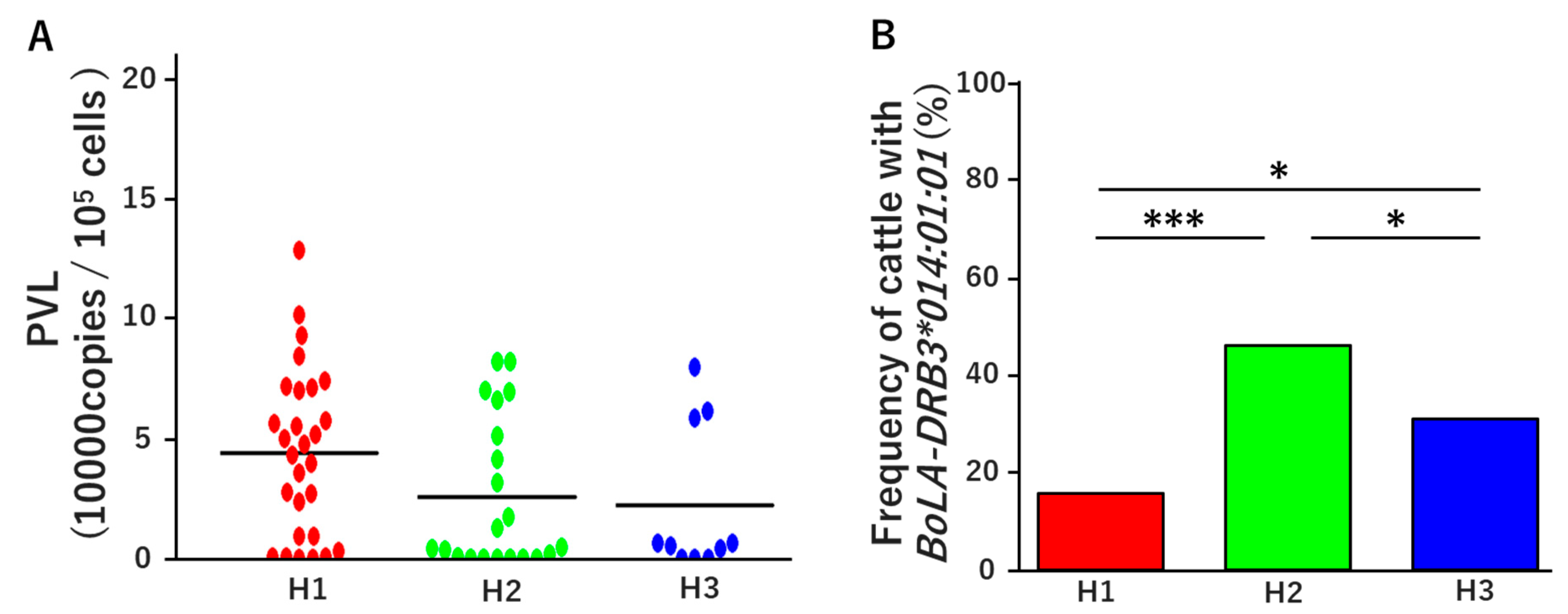
The BLV PVL was compared among the three farms. At H1 Farm, PVL ranged from 8 to 128,378 copies per 105 cells, with a mean of 43,772 copies per 105 cells. At H2 Farm, PVL ranged from 0 to 82,097 copies per 105 cells with a mean of 25,479 copies per 105 cells. At H3 Farm, PVL ranged from 9 to 79,832 copies per 105 cells, with a mean of 21,988 copies per 105 cells (Table 4 and Figure 1A). We also evaluated the number of cattle carrying the resistant allele BoLA-DRB3*014:01:01 on each farm: 14 cows (15.7%) at H1 Farm, 46 cows (46.0%) at H2 Farm, and 31 cows (31.0%) at H3 Farm (Figure 1B). Our results showed that Farms H2 and H3, which had a higher frequency of cattle carrying BoLA-DRB3*014:01:01, also had lower mean PVL values than Farm H1, which had a lower frequency of this resistant allele.

4. Discussion

This study provides information on the distribution of the BoLA-DRB3 allele and the identification of BoLA-DRB3 alleles associated with susceptibility or resistance to BLV infection and BLV PVL in Holstein cattle in China. First, we successfully identified 28 previously reported BoLA-DRB3 alleles in 289 Chinese Holstein cattle using the PCR-SBT method. To the best of our knowledge, this is the first study to report the distribution of BoLA-DRB3 alleles in Holstein cattle in China. Second, the frequencies of BLV-infected and uninfected cattle within each BoLA-DRB3 allele were compared. BoLA-DRB3*011:01 was identified as a susceptible allele for BLV infection in the tested Holsteins, whereas no other significant association between BoLA-DRB3 alleles and BLV infection was found. To our knowledge, this is the first report demonstrating that BoLA-DRB3 polymorphisms affect BLV infection in Holstein cattle in China. Third, our association analysis of BoLA-DRB3 alleles in individuals with HPVL and LPVL demonstrated for the first time that DRB3*014:01:01 is a resistant allele in Holstein cattle in China. Fourth, we found that farms with a higher frequency of cattle carrying the resistant allele BoLA-DRB3*014:01:01 had lower mean PVL values than farms with a lower frequency. This indicates that when the proportion of cattle carrying the resistant allele exceeds a certain threshold, PVL levels tend to be lower. This result suggests that the PVL-resistant BoLA-DRB3 allele is strongly linked to low PVL after BLV infection and is not associated with a high transmission risk. Thus, our results demonstrate that BoLA-DRB3 polymorphism influences susceptibility to BLV PVL and BLV infection in Holstein cattle in China. These results may be useful for BLV control and eradication through genetic selection.
In this study, samples from 289 Holstein cattle from three farms demonstrated animal- and herd-level BLV positivity rates of 18.7% and 100%, respectively, in Binzhou City, Shandong Province, China. In particular, we concluded that BLV PVL levels are well associated with animal-level prevalence under field conditions in China. For example, 28/89 samples (31.5%) at H1 Farm, 21/100 (21.0%) at H2 Farm, and 10/100 (10.0%) at H3 Farm were positive for BLV infection, with mean PVL values of 43,772 copies per 105 cells, 25,479 copies per 105 cells, and 21,988 copies per 105 cells, respectively. Furthermore, the proportions of cows carrying the resistant allele BoLA-DRB3*014:01:01 were 14 (15.7%) of 89 at H1 Farm, 46 (46.0%) of 100 at H2 Farm, and 31 (31.0%) of 100 at H3 Farm. These results clearly demonstrate that Farms H2 and H3, which had a higher proportion of cattle carrying BoLA-DRB3*014:01:01, had lower mean PVL values and BLV prevalence than Farm H1, which had a lower proportion. This indicates that BLV-infected cattle with resistant alleles are less likely to develop HPVL and are less likely to act as infection sources for BLV-free cattle in Chinese dairy herds, supporting the results of previous studies [47,54,55,57,58,74,75,76,77]. Thus, our results confirm that BLV-infected cattle carrying resistant alleles are at a low risk of BLV transmission because of their LPVL.
Our result demonstrated that DRB3*014:01:01 is a resistant allele for BLV PVL in Chinese Holstein cattle. This resistance finding is based on a count of 0 in the HPVL group, leading to an “infinite” OR. The p-value obtained from Fisher’s exact test met the significance level adjusted by the Bonferroni method. However, because this result is highly sensitive to sample size because it relies on the complete absence of the allele in one small subgroup (n = 20), we are currently planning to demonstrate the reproducibility of resistance for BLV PVL of BoLA-DRB3*014:01:01 in Chinese Holstein cattle using a large number of samples.
The kinetic study of BLV infectivity conducted in Japanese Holstein cattle from 2017 to 2019 showed that susceptible cattle exhibited stronger BLV infectivity than both resistant and neutral cattle, and the order of intensity of BLV infectivity ranked as follows: susceptible cattle > neutral cattle > resistant cattle [47]. In addition, BLV infectivity showed a strong positive correlation with PVL at each testing point [47]. Based on these results, it can be inferred that the BoLA-DRB3*014:01:01 alleles rerated with resistance to BLV PVL likely indicate long-term effectiveness rather than an observation at a single time point. By contrast, because long-term observations have not been conducted for BoLA-DRB3 alleles identified as resistant or susceptible to BLV infection, but not to PVL, it remains unclear non-infected cattle are simply unexposed to BLV or are in an early incubation period. Therefore, it is imperative to investigate the long-term effect of the BoLA-DRB3*011:01 allele, which was identified as conferring susceptibility to BLV infection in the present study.
BoLA-DRB3 is a highly polymorphic gene, with 387 alleles registered in the IPD-MHC database. Therefore, the diversity and distribution of BoLA-DRB3 in different geographic regions and breeds are of particular interest to cattle breeders and veterinary geneticists when designing breeding strategies to increase the number of disease-resistant offspring [78]. Documented BoLA-DRB3 diversity in Holstein cattle from different geographic regions is summarized in Table 7. Although allele diversity varies across locations, the major alleles BoLA-DRB3*001:01, DRB3*011:01, and DRB3*015:01 are commonly observed in Holstein cattle, which supports our results. In this study, 28 previously reported BoLA-DRB3 alleles were identified in 289 Holstein cattle in Binzhou City, Shandong Province, China, and DRB3*001:01, DRB3*015:01, and DRB3*014:01:01 were the most frequent alleles. Notably, BoLA-DRB3*001:01 and BoLA-DRB3*011:01, as well as BoLA-DRB3*014:01:01, are highly common in Holstein populations in other countries (Table 7). In contrast, different breeds show different major alleles; for example, the most abundant allele in Bolivian Nellore is BoLA-DRB3*028:01 [79], in Sudanese Kenana it is BoLA-DRB3*024:01 [80], and in Japanese Jersey it is BoLA-DRB3*045:01 [81], which is rarely found in Holstein cattle. As of February 2025, the Chinese dairy cow inventory totaled 6.11 million head, including 659,000 in Shandong Province [60]. By the end of 2024, the national beef cattle inventory reached 100.47 million head, with 1.798 million in Shandong Province [82]. However, the allelic diversity of the BoLA-DRB3 gene in most cattle breeds in China remains largely unclear. Therefore, there is an urgent need to clarify BoLA-DRB3 allele diversity across different cattle breeds in China.
To determine the effect of BoLA-DRB3 on BLV infection in Holstein cattle in China, we compared BoLA-DRB3 allele frequencies between BLV-infected cattle (59 heads) and BLV-non-infected cattle (230 heads). BoLA-DRB3*011:01 was the third most frequent allele present in the infected group and was associated with susceptibility to BLV infection in Chinese Holstein cattle (OR = 2.14; p < 0.01). In contrast, in two previous studies, BoLA-DRB3*011:01 was associated with resistance to disease progression to the lymphoma stage in Holstein cattle in Japan and Iran [51,70]. Likewise, one previous study reported that BoLA-DRB3*011:01 was associated with susceptibility to BLV infection in Vietnamese Holstein cattle [72]. In addition, BoLA-DRB3*011:01 was previously reported to be a neutral allele that was not associated with resistance or susceptibility to BLV PVL [72]. Thus, the association between BoLA-DRB3 and BLV infection profiles should be validated in future studies using a larger number of animals.
BLV PVL, which represents the number of copies of a provirus, is associated with disease progression [53,84,85] and transmission risk [47,51,53,57,58,71,86], suggesting that PVL determination is an important diagnostic marker. It has been reported that BLV-infected cows with HPVLs are at a higher risk of spreading the virus [86,87,88,89] and developing EBL [53,84,85]. Therefore, we attempted to identify BoLA-DRB3 alleles associated with susceptibility or resistance to BLV PVL. In this study, we found that BoLA-DRB3*014:01:01 (p = 0.001) was associated with LPVL in BVL-infected Chinese Holstein cattle. In particular, we confirmed that the PVL-resistant BoLA-DRB3*014:01:01 allele was strongly linked to low PVL, as shown by the correlation between PVL levels and the proportion of cattle carrying this resistant allele. However, previous study reported that the significant factors for the BLV transmission and PVL level were found to be cattle housing conditions, the presence of horseflies in summer, breeding systems, dehorning practices, and colostrum feeding using logistic model with a random herd effect [51,90]. Because the effects of prevalence of BLV, farm management practices, insect control, and biosecurity have not been examined in this study, more detailed analyses are required. On the other hand, our findings are supported by previous studies in which BoLA-DRB3*002:01 and DRB3*014:01:01 were associated with BLV resistance [55,75]. In addition, the BoLA-DRB3*009:02 allele is known to be strongly associated with persistent lymphocytosis resistance and the LPVL profile in Holstein cattle [55,57,76]. Previous PVL association studies have also reported BoLA-DRB3*015:01 and DRB3*012:01 as PVL-related alleles [55]. However, no BoLA-DRB3 allele showed a significant association with HPVL in the present study. Because BLV PVL is the most variable quantitative index for assessing BLV transmission risk [57,58], information on disease-susceptible and disease-resistant alleles may help eliminate BLV from farms without separating cows into multiple sheds. Therefore, it is important to examine the association between BoLA-DRB3 and BLV PVL in a larger number of animals. In addition, resistant or susceptible alleles may vary depending on cattle breed, geographic location, and sample collection [78]. Thus, studying the association between BoLA-DRB3 and BLV in different regions and cattle breeds in China is necessary.
Although BLV infects cattle worldwide, effective treatments and vaccines are currently unavailable. Therefore, breeding strategies based on BoLA-DRB3 polymorphism are promising for reducing the burden of BLV-induced lymphoma. Recent studies have shown that BLV infectivity in cattle with PVL-resistant BoLA-DRB3 alleles is lower and that these cattle have reduced horizontal [47,57,58] and vertical [46] transmission potential. This is also reflected in our data, which show that when the proportion of cattle carrying the resistant allele BoLA-DRB3*014:01:01 exceeds a certain threshold, PVL levels in the herd tend to be lower. Furthermore, BoLA-DRB3 polymorphism is known to be associated with PVL in milk [77]. Moreover, combining a biological barrier of resistant cattle in a stall-barn system with the preferential culling of susceptible cattle markedly reduces BLV prevalence and PVL, even when BLV-infected and uninfected animals are group-housed [58]. In free stalls, free barns, and grazing systems, PVL transmission risk can also be reduced by gradually increasing the proportion of resistant cattle in herds. Interestingly, cattle carrying the resistant allele BoLA-DRB3*014:01:01 were found in all three dairy farms examined in the present study. Thus, BoLA-DRB3 polymorphism may be used in farm management to prevent BLV transmission in China. Although more farms need to be examined, this study suggests the potential for BLV eradication using resistant cattle in China’s Holstein population. In addition, more than 1000 cattle breeds exist worldwide, and most of their BoLA-DRB3 diversity has not yet been investigated [91]. Therefore, to achieve BLV eradication across different farm systems, large-scale BLV surveys targeting Holstein farms as well as farms with other breeds in China and globally are necessary.

Author Contributions

Conceived and designed the study, Y.A.; collected the samples, J.W. (Jingyuan Wang), L.D., J.W. (Jinliang Wang), C.W., C.Y., F.W. and J.L.; acquired, analyzed, and interpreted the data, J.W. (Jingyuan Wang), R.M., S.W., A.B., N.F., L.D., G.G. and Y.A.; contributed reagents, materials, and analysis tools, J.W. (Jinliang Wang) and Y.A.; drafted and revised the manuscript, Y.A.; supervision, F.T., X.W., J.W. (Jinliang Wang), Y.M. and Y.A.; project administration, Y.A. and J.W. (Jinliang Wang); funding acquisition, Y.A. and J.W. (Jinliang Wang). All authors have read and agreed to the published version of the manuscript.

Funding

This study was supported by the Shandong Provincial Base and Talent Program (Project No. WSR2023086).

Institutional Review Board Statement

All animals were handled according to the regulations of the Animal Ethics Committee at the Shandong Binzhou Animal Science and Veterinary Medicine Academy in China (Approval Number: 20240510-01; Approval date: 20 April 2024) and by the Animal Experiments Committee of the University of Tokyo in Japan (Approval Number: p22-2-030; Approval date 22 May 2022).

Data Availability Statement

The data presented in this study are available upon request from the corresponding author.

Acknowledgments

The authors thank all the farmers, veterinarians, and veterinary officers for their help with blood sampling and collection of epidemiological data. We thank all the members of the Shandong Binzhou Animal Science and Veterinary Medicine Academy, China, and the Laboratory of Global Infectious Diseases Control Science, Graduate School of Agricultural and Life Sciences, The University of Tokyo, Japan, for their technical assistance, help, and suggestions.

Conflicts of Interest

X.W. (Xuebo Wang) is employed by Shandong Lvdu Biological Technology Co., Ltd. The remaining co-authors declare that they have no competing interests.

References

  1. Klein, J.; Gutknecht, J.; Fischer, N. The major histocompatibility complex and human evolution. Trends Genet. 1990, 6, 7–11. [Google Scholar] [CrossRef] [PubMed]
  2. Amorena, B.; Stone, W.H. Serologically Defined (SD) Locus in Cattle. Science 1978, 201, 159–160. [Google Scholar] [CrossRef]
  3. Spooner, R.L.; Leveziel, H.; Grosclaude, F.; Oliver, R.A.; Vaiman, M. Evidence for a possible major histocompatibility complex (BLA) in cattle. J. Immunogenet. 1978, 5, 335–346. [Google Scholar] [CrossRef]
  4. Spooner, R.L.; Millar, P.; Oliver, R.A. The production and analysis of antilymphocyte sera following pregnancy and skin grafting of cattle. Anim. Blood Groups Biochem. Genet. 1979, 10, 99–105. [Google Scholar] [CrossRef] [PubMed]
  5. Aida, Y.; Takeshima, S.N.; Baldwin, C.L.; Kaushik, A.K.; Ruvinsky, A. Bovine immunogenetics. In The Genetics of Cattle; Garrick, D.J., Ruvinsky, A., Eds.; C.A.B. International: Wallingford, UK, 2015. [Google Scholar]
  6. Maccari, G.; Robinson, J.; Barker, D.J.; Yates, A.D.; Hammond, J.A.; Marsh, S.G.E. The 2024 IPD-MHC database update: A comprehensive resource for major histocompatibility complex studies. Nucleic Acids Res. 2025, 53, D457–D461. [Google Scholar] [CrossRef]
  7. Oprzadek, J.M.; Brzozowska, A.M.; Urtnowski, P.; Rutkowska, K.; Lukaszewicz, M. Association of BoLA-DRB3 genotype with somatic cell count in milk of Polish Holstein cattle. Rev. Bras. De Zootec. 2018, 47, e20150290. [Google Scholar] [CrossRef]
  8. Yoshida, T.; Mukoyama, H.; Furuta, H.; Kondo, Y.; Takeshima, S.N.; Aida, Y.; Kosugiyama, M.; Tomogane, H. Association of BoLA-DRB3 alleles identified by a sequence-based typing method with mastitis pathogens in Japanese Holstein cows. Anim. Sci. J. 2009, 80, 498–509. [Google Scholar] [CrossRef]
  9. Yoshida, T.; Furuta, H.; Kondo, Y.; Mukoyama, H. Association of BoLA-DRB3 alleles with mastitis resistance and susceptibility in Japanese Holstein cows. Anim. Sci. J. 2012, 83, 359–366. [Google Scholar] [CrossRef]
  10. Duangjinda, M.; Jindatajak, Y.; Tipvong, W.; Sriwarothai, J.; Pattarajinda, V.; Katawatin, S.; Boonkum, W. Association of BoLA-DRB3 alleles with tick-borne disease tolerance in dairy cattle in a tropical environment. Vet. Parasitol. 2013, 196, 314–320. [Google Scholar]
  11. Martinez, M.L.; Machado, M.A.; Nascimento, C.S.; Silva, M.V.; Teodoro, R.L.; Furlong, J.; Prata, M.C.; Campos, A.L.; Guimarães, M.F.; Azevedo, A.L.; et al. Association of BoLA-DRB3.2 alleles with tick (Boophilus microplus) resistance in cattle. Genet. Mol. Res. 2006, 31, 513–524. [Google Scholar]
  12. Othman, O.E.; Khodary, M.G.; El-Deeb, A.H.; Hussein, H.A. Five BoLA-DRB3 genotypes detected in Egyptian buffalo infected with Foot and Mouth disease virus serotype O. J. Genet. Eng. Biotechnol. 2018, 16, 513–518. [Google Scholar] [CrossRef]
  13. Lei, W.; Liang, Q.; Jing, L.; Wang, C.; Wu, X.; He, H. BoLA-DRB3 gene polymorphism and FMD resistance or susceptibility in Wanbei cattle. Mol. Biol. Rep. 2012, 39, 9203–9209. [Google Scholar] [CrossRef] [PubMed]
  14. Morales, J.P.A.; López-Herrera, A.; Zuluaga, J.E. Association of BoLA DRB3 gene polymorphisms with BoHV-1 infection and zootechnical traits. Open Vet. J. 2020, 10, 331–339. [Google Scholar] [CrossRef] [PubMed]
  15. Longeri, M.; Russo, V.; Strillacci, M.G.; Perillo, A.; Carisetti, M.; Cozzi, M.C.; Neola, B.; Roperto, S. Association Between BoLA-DRB3.2 Polymorphism and Bovine Papillomavirus Infection for Bladder Tumor Risk in Podolica Cattle. Front. Vet. Sci. 2021, 8, 630089. [Google Scholar] [CrossRef]
  16. Schwab, A.E.; Geary, T.G.; Baillargeon, P.; Schwab, A.J.; Fecteau, G. Association of BoLA DRB3 and DQA1 alleles with susceptibly to Neospora caninum and reproductive outcome in Quebec Holstein cattle. Vet. Parasitol. 2009, 165, 136–140. [Google Scholar] [CrossRef]
  17. Eirin, M.; Carignano, H.; Shimizu, E.; Pando, M.A.; Zumárraga, M.; Magnano, G.; Macías, A.; Garbaccio, S.; Huertas, P.; Morsella, C.; et al. BoLA-DRB3 exon2 polymorphisms among tuberculous cattle: Nucleotide and functional variability and their association with bovine tuberculosis pathology. Res. Vet. Sci. 2020, 130, 118–125. [Google Scholar] [CrossRef] [PubMed]
  18. Zambrano, J.A.; Echeverri, J.Z.; López-Herrera, A. Association of gene BoLA DRB3.2 with production traits in a dairy herd of Antioquia, Colombia. Rev. MVZ Cordoba 2014, 19, 4116–4129. [Google Scholar] [CrossRef][Green Version]
  19. Derakhshani, H.; Plaizier, J.C.; De Buck, J.; Barkema, H.W.; Khafipour, E. Association of bovine major histocompatibility complex (BoLA) gene polymorphism with colostrum and milk microbiota of dairy cows during the first week of lactation. Microbiome 2018, 6, 203. [Google Scholar] [CrossRef]
  20. Rupp, R.; Hernandez, A.; Mallard, B.A. Association of bovine leukocyte antigen (BoLA) DRB3.2 with immune response, mastitis, and production and type traits in Canadian Holsteins. J. Dairy Sci. 2007, 90, 1029–1038. [Google Scholar] [CrossRef]
  21. Pashmi, M.; Qanbari, S.; Ghorashi, S.A.; Sharifi, A.R.; Simianer, H. Analysis of relationship between bovine lymphocyte antigen DRB3.2 alleles, somatic cell count and milk traits in Iranian Holstein population. J. Anim. Breed. Genet. 2009, 126, 296–303. [Google Scholar] [CrossRef]
  22. Sharif, S.; Mallard, B.A.; Wilkie, B.N.; Sargeant, J.M.; Scott, H.M.; Dekkers, J.C.; Leslie, K.E. Associations of the bovine major histocompatibility complex DRB3 (BoLA-DRB3) alleles with occurrence of disease and milk somatic cell score in Canadian dairy cattle. Anim. Genet. 1998, 29, 185–193. [Google Scholar] [CrossRef] [PubMed]
  23. Wu, X.X.; Yang, Z.P.; Wang, X.L.; Mao, Y.J.; Li, S.C.; Shi, X.K.; Chen, Y. Restriction fragment length polymorphism in the exon 2 of the BoLA-DRB3 gene in Chinese Holstein of the south China. J. Biomed. Sci. Eng. 2010, 3, 221–225. [Google Scholar] [CrossRef][Green Version]
  24. Zanotti, M.; Strillacci, M.G.; Taboni, I.; Samorè, A.B.; Longeri, M. Histocompatibility genes and somatic cell count (SCC) in Italian Holstein Friesian. Ital. J. Anim. Sci. 2003, 2, 85–87. [Google Scholar]
  25. Aida, Y.; Murakami, H.; Takahashi, M.; Takeshima, S. Mechanisms of pathogenesis induced by bovine leukemia virus as a model for human T-cell leukemia virus. Front. Microbiol. 2013, 4, 328. [Google Scholar] [CrossRef]
  26. El Hajj, H.; Nasr, R.; Kfoury, Y.; Dassouki, Z.; Nasser, R.; Kchour, G.; De Thé, H.; Hermine, O.; Bazarbachi, A. Animal models on HTLV-1 and related viruses: What did we learn? Front. Microbiol. 2012, 3, 333. [Google Scholar] [CrossRef]
  27. Burny, A.; Bex, F.; Chantrenne, H.; Cleuter, Y.; Dekegel, D.; Ghysdael, J.; Kettmann, R.; Leclercq, M.; Leunen, J.; Mammerickx, M.; et al. Bovine leukemia virus involvement in enzootic bovine leukosis. Adv. Cancer Res. 1978, 28, 251–311. [Google Scholar] [PubMed]
  28. Kettmann, R.; Portetelle, D.; Mammerickx, M.; Cleuter, Y.; Dekegel, D.; Galoux, M.; Ghysdael, J.; Burny, A.; Chantrenne, H. Bovine leukemia virus: An exogenous RNA oncogenic virus. Proc. Natl. Acad. Sci. USA 1976, 73, 1014–1018. [Google Scholar] [CrossRef]
  29. Reed, V.I. Enzootic bovine leukosis. Can. Vet. J. 1981, 22, 95–102. [Google Scholar]
  30. Burny, A.; Bruck, C.; Cleuter, Y.; Couez, D.; Deschamps, J.; Gregoire, D.; Ghysdael, J.; Kettmann, R.; Mammerickx, M.; Marbaix, G.; et al. Bovine leukaemia virus and enzootic bovine leukosis. Onderstepoort J. Vet. Res. 1985, 52, 133–144. [Google Scholar]
  31. Nakada, S.; Fujimoto, Y.; Kohara, J.; Adachi, Y.; Makita, K. Estimation of economic loss by carcass weight reduction of Japanese dairy cows due to infection with bovine leukemia virus. Prev. Vet. Med. 2021, 198, 105528. [Google Scholar] [CrossRef]
  32. Benitez, O.J.; Norby, B.; Bartlett, P.C.; Maeroff, J.E.; Grooms, D.L. Impact of bovine leukemia virus infection on beef cow longevity. Prev. Vet. Med. 2020, 181, 105055. [Google Scholar] [CrossRef]
  33. Nekouei, O.; VanLeeuwen, J.; Stryhn, H.; Kelton, D.; Keefe, G. Lifetime effects of infection with bovine leukemia virus on longevity and milk production of dairy cows. Prev. Vet. Med. 2016, 133, 1–9. [Google Scholar] [CrossRef]
  34. Norby, B.; Bartlett, P.; Byrem, T.; Erskine, R. Effect of infection with bovine leukemia virus on milk production in Michigan dairy cows. J. Dairy Sci. 2016, 99, 2043–2052. [Google Scholar] [CrossRef] [PubMed]
  35. Ott, S.; Johnson, R.; Wells, S.J. Association between bovine-leukosis virus seroprevalence and herd-level productivity on US dairy farms. Prev. Vet. Med. 2003, 61, 249–262. [Google Scholar] [CrossRef] [PubMed]
  36. Erskine, R.J.; Bartlett, P.C.; Byrem, T.M.; Render, C.L.; Febvay, C.; Houseman, J.T. Association between bovine leukemia virus, production, and population age in Michigan dairy herds. J. Dairy Sci. 2012, 95, 727–734. [Google Scholar] [CrossRef]
  37. Rhodes, J.K.; Pelzer, K.D.; Johnson, Y.J. Economic implications of bovine leukemia virus infection in mid-Atlantic dairy herds. J. Am. Vet. Med. Assoc. 2003, 223, 346–352. [Google Scholar] [CrossRef]
  38. White, T.L.; Moore, D.A. Reasons for whole carcass condemnations of cattle in the United States and implications for producer education and veterinary intervention. J. Am. Vet. Med. Assoc. 2009, 235, 937–941. [Google Scholar] [CrossRef] [PubMed]
  39. Bartlett, P.C.; Sordillo, L.M.; Byrem, T.M.; Norby, B.; Grooms, D.L.; Swenson, C.L.; Zalucha, J.; Erskine, R.J. Options for the control of bovine leukemia virus in dairy cattle. J. Am. Vet. Med. Assoc. 2014, 244, 914–922. [Google Scholar] [CrossRef]
  40. Benitez, O.J.; LaDronka, R.M.; Norby, B.; Grooms, D.L.; Bartlett, P.C. The effect of bovine leukemia virus on dairy cow longevity. JDS Commun. 2022, 3, 185–188. [Google Scholar] [CrossRef]
  41. Frie, M.C.; Coussens, P.M. Bovine leukemia virus: A major silent threat to proper immune responses in cattle. Vet. Immunol. Immunopathol. 2015, 163, 103–114. [Google Scholar] [CrossRef]
  42. Konnai, S.; Murata, S.; Ohashi, K. Immune exhaustion during chronic infections in cattle. J. Vet. Med. Sci. 2017, 79, 1–5. [Google Scholar] [CrossRef]
  43. USDA. Bovine Leukosis Virus (BLV) on U.S. Dairy Operations. 2007. Available online: https://www.aphis.usda.gov/animal_health/nahms/dairy/downloads/dairy07/Dairy07_is_BLV.pdf (accessed on 14 June 2025).
  44. Marawan, M.A.; Alouffi, A.; El Tokhy, S.; Badawy, S.; Shirani, I.; Dawood, A.; Guo, A.; Almutairi, M.M.; Alshammari, F.A.; Selim, A. Bovine leukaemia virus: Current epidemiological circumstance and future prospective. Viruses 2021, 13, 2167. [Google Scholar] [CrossRef]
  45. Kuczewski, A.; Hogeveen, H.; Orsel, K.; Wolf, R.; Thompson, J.; Spackman, E.; van der Meer, F. Economic evaluation of 4 bovine leukemia virus control strategies for Alberta dairy farms. J. Dairy Sci. 2019, 102, 2578–2592. [Google Scholar] [CrossRef]
  46. Borjigin, L.; Lo, C.W.; Bai, L.; Hamada, R.; Sato, H.; Yoneyama, S.; Yasui, A.; Yasuda, S.; Yamanaka, R.; Mimura, M.; et al. Risk Assessment of Bovine Major Histocompatibility Complex Class II DRB3 Alleles for Perinatal Transmission of Bovine Leukemia Virus. Pathogens 2021, 10, 502. [Google Scholar] [CrossRef]
  47. Bai, L.; Borjigin, L.; Sato, H.; Takeshima, S.N.; Asaji, S.; Ishizaki, H.; Kawashima, K.; Obuchi, Y.; Sunaga, S.; Ando, A.; et al. Kinetic Study of BLV Infectivity in BLV Susceptible and Resistant Cattle in Japan from 2017 to 2019. Pathogens 2021, 10, 1281. [Google Scholar] [CrossRef] [PubMed]
  48. Jimba, M.; Takeshima, S.N.; Murakami, H.; Kohara, J.; Kobayashi, N.; Matsuhashi, T.; Ohmori, T.; Nunoya, T.; Aida, Y. BLV-CoCoMo-qPCR: A useful tool for evaluating bovine leukemia virus infection status. BMC Vet. Res. 2012, 8, 167. [Google Scholar] [CrossRef]
  49. Juliarena, M.A.; Poli, M.; Sala, L.; Ceriani, C.; Gutierrez, S.; Dolcini, G.; Rodriguez, E.M.; Marino, B.; Rodriguez-Dubra, C.; Esteban, E.N. Association of BLV infection profiles with alleles of the BoLA-DRB3.2 gene. Anim. Genet. 2008, 39, 432–443. [Google Scholar] [CrossRef]
  50. Bartlett, P.C.; Ruggiero, V.J.; Hutchinson, H.C.; Droscha, C.J.; Norby, B.; Sporer, K.R.B.; Taxis, T.M. Current Developments in the Epidemiology and Control of Enzootic Bovine Leukosis as Caused by Bovine Leukemia Virus. Pathogens 2020, 9, 1058. [Google Scholar] [CrossRef] [PubMed]
  51. Ohno, A.; Takeshima, S.N.; Matsumoto, Y.; Aida, Y. Risk factors associated with increased bovine leukemia virus proviral load in infected cattle in Japan from 2012 to 2014. Virus Res. 2015, 210, 283–290. [Google Scholar] [CrossRef]
  52. Mekata, H.; Sekiguchi, S.; Konnai, S.; Kirino, Y.; Honkawa, K.; Nonaka, N.; Horii, Y.; Norimine, J. Evaluation of the natural perinatal transmission of bovine leukaemia virus. Vet. Rec. 2015, 176, 254. [Google Scholar] [CrossRef] [PubMed]
  53. Jimba, M.; Takeshima, S.N.; Matoba, K.; Endoh, D.; Aida, Y. BLV-CoCoMo-qPCR: Quantitation of bovine leukemia virus proviral load using the CoCoMo algorithm. Retrovirology 2010, 7, 91. [Google Scholar] [CrossRef] [PubMed]
  54. Lo, C.W.; Borjigin, L.; Saito, S.; Fukunaga, K.; Saitou, E.; Okazaki, K.; Mizutani, T.; Wada, S.; Takeshima, S.N.; Aida, Y. BoLA-DRB3 Polymorphism is Associated with Differential Susceptibility to Bovine Leukemia Virus-Induced Lymphoma and Proviral Load. Viruses 2020, 12, 352. [Google Scholar] [CrossRef] [PubMed]
  55. Takeshima, S.N.; Ohno, A.; Aida, Y. Bovine leukemia virus proviral load is more strongly associated with bovine major histocompatibility complex class II DRB3 polymorphism than with DQA1 polymorphism in Holstein cow in Japan. Retrovirology 2019, 16, 14. [Google Scholar] [CrossRef]
  56. Miyasaka, T.; Takeshima, S.N.; Jimba, M.; Matsumoto, Y.; Kobayashi, N.; Matsuhashi, T.; Sentsui, H.; Aida, Y. Identification of bovine leukocyte antigen class II haplotypes associated with variations in bovine leukemia virus proviral load in Japanese Black cattle. Tissue Antigens 2013, 81, 72–82. [Google Scholar] [CrossRef]
  57. Juliarena, M.A.; Barrios, C.N.; Ceriani, M.C.; Esteban, E.N. Hot topic: Bovine leukemia virus (BLV)-infected cows with low proviral load are not a source of infection for BLV-free cattle. J. Dairy Sci. 2016, 99, 4586–4589. [Google Scholar] [CrossRef]
  58. Borjigin, L.; Watanuki, S.; Hamada, R.; Bai, L.; Hirose, T.; Sato, H.; Yoneyama, S.; Yasui, A.; Yasuda, S.; Yamanaka, R.; et al. Effectiveness of integrated bovine leukemia virus eradication strategies utilizing cattle carrying resistant and susceptible histocompatibility complex class II DRB3 alleles. J. Dairy Sci. 2023, 106, 9393–9409. [Google Scholar] [CrossRef]
  59. Ministry of Agriculture and Rural Affairs of the People’s Republic of China. The Past, Present, and Future of the Dairy Cattle Breeding Industry. 2021. Available online: http://www.zys.moa.gov.cn/mhsh/202103/t20210317_6363914.htm (accessed on 5 August 2025).
  60. Nie, L.; Ling, X.; Shang, M. Problems and Suggestions on the Development of Dairy Cow Industry in China. China Cattle Sci. 2025, 51, 46–50. [Google Scholar]
  61. OIE. World Animal Health Infromation Database-Version: 1.4; World Organisation for Animal Health: Paris, France, 2009. [Google Scholar]
  62. Acaite, J.; Tamosiunas, V.; Lukauskas, K.; Milius, J.; Pieskus, J. The eradication experience of enzootic bovine leukosis from Lithuania. Prev. Vet. Med. 2007, 82, 83–89. [Google Scholar] [CrossRef]
  63. Nuotio, L.; Rusanen, H.; Sihvonen, L.; Neuvonen, E. Eradication of enzootic bovine leukosis from Finland. Prev. Vet. Med. 2003, 59, 43–49. [Google Scholar] [CrossRef] [PubMed]
  64. Yang, Y.; Fan, W.; Mao, Y.; Yang, Z.; Lu, G.; Zhang, R.; Zhang, H.; Szeto, C.; Wang, C. Bovine leukemia virus infection in cattle of China: Association with reduced milk production and increased somatic cell score. J. Dairy Sci. 2016, 99, 3688–3697. [Google Scholar] [CrossRef]
  65. Yu, C.; Wang, X.; Zhou, Y.; Wang, Y.; Zhang, X.; Zheng, Y. Genotyping bovine leukemia virus in dairy cattle of Heilongjiang, northeastern China. BMC Vet. Res. 2019, 15, 179. [Google Scholar] [CrossRef]
  66. Ma, J.G.; Zheng, W.B.; Zhou, D.H.; Qin, S.Y.; Yin, M.Y.; Zhu, X.Q.; Hu, G.X. First Report of Bovine Leukemia Virus Infection in Yaks (Bos mutus) in China. BioMed Res. Int. 2016, 2016, 9170167. [Google Scholar] [CrossRef]
  67. Watanuki, S.; Shoji, K.; Izawa, M.; Okami, M.; Ye, Y.; Bao, A.; Liu, Y.; Saitou, E.; Sugiyama, K.; Endo, M.; et al. Development of a dry- and liquid-duplex-reagent mix-based polymerase chain reaction assay as a novel tool for the rapid and easy quantification of bovine leukemia virus (BLV) proviral loads. Viruses 2024, 16, 1016. [Google Scholar] [CrossRef]
  68. Takeshima, S.N.; Kitamura-Muramatsu, Y.; Yuan, Y.; Polat, M.; Saito, S.; Aida, Y. BLV-CoCoMo-qPCR-2: Improvements to the BLV-CoCoMo-qPCR assay fobovine leukemia virus by reducing primer degeneracy and constructing an optimal standard curve. Arch. Virol. 2015, 160, 1325–1332. [Google Scholar] [CrossRef]
  69. Takeshima, S.N.; Matsumoto, Y.; Miyasaka, T.; Arainga-Ramirez, M.; Saito, H.; Onuma, M.; Aida, Y. A new method for typing bovine major histocompatibility complex class II DRB3 alleles by combining two established PCR sequence-based techniques. Tissue Antigens 2011, 78, 208–213. [Google Scholar] [CrossRef]
  70. Watanuki, S.; Bao, A.; Saitou, E.; Shoji, K.; Izawa, M.; Okami, M.; Matsumoto, Y.; Aida, Y. BLV-CoCoMo dual qPCR assay targeting LTR region for quantifying bovine leukemia virus: Comparison with multiplex real-time qPCR assay targeting pol region. Pathogens 2024, 13, 1111. [Google Scholar] [CrossRef] [PubMed]
  71. Sato, H.; Watanuki, S.; Murakami, H.; Sato, R.; Ishizaki, H.; Aida, Y. Development of a luminescence syncytium induction assay (LuSIA) for easily detecting and quantitatively measuring bovine leukemia virus infection. Arch. Virol. 2018, 163, 1519–1530. [Google Scholar] [CrossRef]
  72. Dung, T.; Vu, L.; Nguyen, S.; Duy, C.L.; Dao, T.; Bui, N.V.; Ogawa, H.; Imai, K.; Sugiura, K.; Aida, Y. Association between BoLA-DRB3 polymorphism and bovine leukemia virus proviral load in Vietnamese Holstein Friesian cattle. HLA 2022, 99, 105–112. [Google Scholar]
  73. Hamada, R.; Metwally, S.; Matsuura, R.; Borjigin, L.; Lo, C.-W.; Ali, A.O.; Mohamed, A.E.A.; Wada, S.; Aida, Y. BoLA-DRB3 Polymorphism Associated with Bovine Leukemia Virus Infection and Proviral Load in Holstein Cattle in Egypt. Pathogens 2023, 12, 1451. [Google Scholar] [CrossRef] [PubMed]
  74. Nikbakht Brujeni, G.; Ghorbanpour, R.; Esmailnejad, A. Association of BoLA-DRB3.2 alleles with BLV infection profiles (persistent lymphocytosis/lymphosarcoma) and lymphocyte subsets in Iranian Holstein cattle. Biochem. Genet. 2016, 54, 194–207. [Google Scholar] [CrossRef]
  75. Victoria, M.; Farias, N.; Caffaro, M.E.; Lendez, P.A.; Passucci, J.; Poli, M.; Ceriani, M.C.; Dolcini, G. A novel association of BoLA DRB3 alleles in BLV infected cattle with different proviral loads. Braz. J. Vet. Res. Anim. Sci. 2017, 54, 215–224. [Google Scholar]
  76. Hayashi, T.; Mekata, H.; Sekiguchi, S.; Kirino, Y.; Mitoma, S.; Honkawa, K.; Horii, Y.; Norimine, J. Cattle with the BoLA class II DRB3*0902 allele have significantly lower bovine leukemia proviral loads. J. Vet. Med. Sci. 2017, 79, 1552–1555. [Google Scholar] [CrossRef]
  77. Nakatsuchi, A.; Watanuki, S.; Borjigin, L.; Sato, H.; Bai, L.; Matsuura, R.; Kuroda, M.; Murakami, H.; Sato, R.; Asaji, S.; et al. BoLA-DRB3 Polymorphism Controls Proviral Load and Infectivity of Bovine Leukemia Virus (BLV) in Milk. Pathogens 2022, 11, 210. [Google Scholar] [CrossRef] [PubMed]
  78. Lo, C.W.; Aida, Y. Association of BoLA-DRB3 with bovine leukemia virus. Major Histocompat. Complex 2022, 29, 158–167. [Google Scholar] [CrossRef]
  79. Takeshima, S.N.; Corbi-Botto, C.; Giovambattista, G.; Aida, Y. Genetic diversity of BoLA-DRB3 in South American Zebu cattle populationns. BMC Genet. 2018, 19, 33. [Google Scholar] [CrossRef]
  80. Salim, B.; Takeshima, S.N.; Nakao, R.; Moustafa, M.A.M.; Ahmed, M.A.; Kambal, S.; Mwacharo, J.M.; Alkhaibari, A.M.; Giovambattista, G. BoLA-DRB3 gene haplotypes show divergence in native Sudanese cattle from taurine and indicine breeds. Sci. Rep. 2021, 11, 17202. [Google Scholar] [CrossRef] [PubMed]
  81. Takeshima, S.; Saitou, N.; Morita, M.; Inoko, H.; Aida, Y. The diversity of bovine MHC class II DRB3 genes in Japanese Black, Japanese Shorthorn, Jersey and Holstein cattle in Japan. Gene 2003, 316, 111–118. [Google Scholar] [CrossRef]
  82. Shandong Animal Husbandry and Veterinary Bureau. Analysis of the Development of the Beef Cattle Industry in Shandong Province in 2024 and Prospects for 2025. 2025. Available online: http://xm.shandong.gov.cn/art/2025/3/28/art_101455_10343871.html (accessed on 5 August 2025).
  83. Takeshima, S.N.; Giovambattista, G.; Okimoto, N.; Matsumoto, Y.; Rogberg-Muñoz, A.; Acosta, T.J.; Onuma, M.; Aida, Y. Characterization of bovine MHC class II DRB3 diversity in South American Holstein cattle populations. Tissue Antigens 2015, 86, 419–430. [Google Scholar] [CrossRef]
  84. Kobayashi, T.; Inagaki, Y.; Ohnuki, N.; Sato, R.; Murakami, S.; Imakawa, K. Increasing Bovine leukemia virus (BLV) proviral load is a risk factor for progression of Enzootic bovine leucosis: A prospective study in Japan. Prev. Vet. Med. 2019, 178, 104680. [Google Scholar] [CrossRef]
  85. Somura, Y.; Sugiyama, E.; Fujikawa, H.; Murakami, K. Comparison of the copy numbers of bovine leukemia virus in the lymph nodes of cattle with enzootic bovine leukosis and cattle with latent infection. Arch. Virol. 2014, 159, 2693–2697. [Google Scholar] [CrossRef]
  86. Mekata, H.; Sekiguchi, S.; Konnai, S.; Kirino, Y.; Horii, Y.; Norimine, J. Horizontal transmission and phylogenetic analysis of bovine leukemia virus in two districts of Miyazaki, Japan. J. Vet. Med. Sci. 2015, 77, 1115–1120. [Google Scholar] [CrossRef]
  87. Watanuki, S.; Takeshima, S.N.; Borjigin, L.; Sato, H.; Bai, L.; Murakami, H.; Sato, R.; Ishizaki, H.; Matsumoto, Y.; Aida, Y. Visualizing bovine leukemia virus (BLV)-infected cells and measuring BLV proviral loads in the milk of BLV seropositive dams. Vet. Res. 2019, 50, 102. [Google Scholar] [CrossRef] [PubMed]
  88. Yuan, Y.; Kitamura-Muramatsu, Y.; Saito, S.; Ishizaki, H.; Nakano, M.; Haga, S.; Matoba, K.; Ohno, A.; Murakami, H.; Takeshima, S.N.; et al. Detection of the BLV provirus from nasal secretion and saliva samples using BLV-CoCoMo-qPCR-2: Comparison with blood samples from the same cattle. Virus Res. 2015, 210, 248–254. [Google Scholar] [CrossRef] [PubMed]
  89. Kohara, J.; Bai, L.; Takeshima, S.N.; Matsumoto, Y.; Hirai, T.; Aida, Y. Correlation between the Biodistribution of Bovine Leukemia Virus in the Organs and the Proviral Load in the Peripheral Blood during Early Stages of Experimentally Infected Cattle. Pathogens 2023, 12, 130. [Google Scholar] [CrossRef] [PubMed]
  90. Kobayashi, S.; Tsutsui, T.; Yamamoto, T.; Hayama, Y.; Kameyama, K.; Konishi, M.; Murakami, K. Risk factors associated with within-herd transmission of bovine leukemia virus on dairy farms in Japan. BMC Vet. Res. 2010, 6, 1. [Google Scholar] [CrossRef]
  91. Felius, M. Cattle Breeds: An Encyclopedia; Trafalgar Square Publishing: North Pomfret, VT, USA, 2007. [Google Scholar]
Figure 1. Comparison of proviral loads (PVLs) (A) and frequencies of cattle carrying the resistant allele BoLA-DRB3*014:01:01 (B) among three dairy farms in China. A total of 289 blood samples were collected from three different farms (H1, H2, and H3) in Binzhou City, Shandong Province, China, and screened for BLV infection using enzyme-linked immunosorbent assay (ELISA) to detect anti-BLV gp51 antibodies and real-time PCR with the Dry Dual-CoCoMo assay. Animals with at least one positive result (ELISA or qPCR) were classified as BLV-positive. (A) Comparison of mean PVL across the three farms. The X-axis shows farm classification, and the Y-axis shows PVL. (B) Genomic DNA from all 289 cattle was typed for BoLA-DRB3 alleles using the PCR-SBT method. The frequency of cattle carrying the resistant allele BoLA-DRB3*014:01:01 was compared among farms, and p-values were calculated using Fisher’s exact test. The X-axis shows farm classification, and the Y-axis shows allele frequency. Asterisks indicate significant differences (* p < 0.05 and *** p < 0.001).
Pathogens 15 00034 g001
Table 1. BoLA-DRB3 allele frequencies in Holstein 289 cattle in China 1.
BoLA-DRB3
AlleleFrequency (%)
*001:01 232.70
*002:010.87
*003:01:010.17
*003:02:010.17
*004:010.17
*005:010.17
*005:030.35
*006:010.87
*007:010.87
*008:010.52
*009:010.69
*009:022.25
*010:015.88
*011:018.30
*011:020.35
*012:012.25
*014:01:0117.30
*015:0121.45
*016:010.35
*017:010.17
*018:010.87
*020:02:010.17
*027:010.17
*027:032.08
*031:010.35
*032:020.17
*044:010.17
*045:010.17
1 The most frequent alleles are underlined (greater than 5%). 2 BoLA-DRB3 alleles were identified using PCR sequence-based typing.
Table 2. Detection of BLV provirus and anti-BLV antibodies by Dry Dual-CoCoMo assay and ELISA 1.
H1H2H3Total
Head(%)Head(%)Head(%)Head(%)
Provirus(+)/Antibody(+)2831.51818.088.05418.7
Provirus(+)/Antibody(−)00.022.022.04 1.4
Provirus(−)/Antibody(+)00.011.000.01 0.3
Provirus(−)/Antibody(−)6168.57979.09090.023079.6
Total89 100 100 289
1 A total of 289 blood samples were collected from three different farms (H1, H2, and H3) in Binzhou City, Shandong Province, China, and screened for BLV infection using a combination of enzyme-linked immunosorbent assay (ELISA) to detect the anti-BLV gp51 antibody and a real-time PCR test with Dry Dual-CoCoMo at the time of blood collection. Between the two methods for detecting BLV provirus and anti-BLV antibodies, at least one result was considered positive for BLV infection.
Table 3. Association of BoLA-DRB3 alleles with BLV-infected and -non-infected Holstein cattle in China 1.
BoLA-DRB3 AllelesHolsteinFisher’s Exact TestSusceptibility 4
BLV-Infected Cattle
n 2 = 59
BLV-Non-Infected Cattle
n = 230
OR 3 (95%CI)p-Value 6
Number of
Alleles
Allele
Frequency (%)
Number of
Alleles
Allele
Frequency (%)
*001:01 73933.05 15032.611.01 (0.84–1.25)0.91-
*002:0100.0051.090.000.59-
*003:01:0100.0010.220.001.00-
*003:02:0100.0010.220.001.00-
*004:0100.0010.220.001.00-
*005:0110.8500.00Inf 50.20-
*005:0310.8510.223.90 (0.07–220)0.37-
*006:0100.0051.090.000.59-
*007:0100.0051.090.000.59-
*008:0100.0030.650.001.00-
*009:0100.0040.870.000.59-
*009:0200.00132.830.000.08-
*010:0175.93275.871.01 (0.64–1.61)1.00-
*011:011714.41316.742.14 (1.74–3.12)0.01S
*011:0210.8510.223.90 (0.07–220)0.37-
*012:0110.85122.610.32 (0.03–2.98)0.48-
*014:01:011815.258217.830.86 (0.64–1.07)0.58-
*015:012823.739620.871.14 (0.95–1.46)0.53-
*016:0100.0020.430.001.00-
*017:0110.8500.00Inf0.20-
*018:0121.6930.652.60 (0.46–15.0)0.27-
*020:02:0110.8500.00Inf0.20-
*027:0100.0010.220.001.00-
*027:0310.85112.390.35 (0.04–3.30)0.48-
*031:0100.0020.430.001.00-
*032:0200.0010.220.001.00-
*044:0100.0010.220.001.00-
*045:0100.0010.220.001.00-
1 Association between BoLA-DRB3 allele and BLV infection was determined based on Fisher’s exact test by comparing the frequency distribution of alleles between BLV-infected and non-infected Holstein cattle. 2 n, total number of cattle; 3 OR, odds ratio; 4 Susceptibility, S = Susceptibility, 5 Inf, Infinity. 6 p-values < 0.05 and <0.05/28 were considered statistically significant and strictly statistically significant, respectively. 7 BoLA-DRB3 alleles were identified using PCR sequence-based typing.
Table 4. The mean and range of proviral load (PVL) of BLV infected cattle from three farms.
Farm NumberNumber of Cattle
(Head)
PVL
Mean
(Copies/105 Cells)
Range
(Copies/105 Cells)
H18943,7228–128,378
H210025,4790–82,097
H310021,9889–79,832
Table 5. Summary of CoCoMo-qPCR-based proviral load (PVL) and gp51 antibodies determination for the BLV and classification criteria for PVL.
Number of Tested
Animals (Heads)
Number of Positive
Samples (Heads)
Mean PVL
(Copies/105 Cells)
PVL
Category
PVL Range
(Copies/105 Cells)
Number of Cattle
(Head)
2895933,569Low PVL (LPVL)0–360619
Moderate3720–50,74320
High PVL (HPVL)51,531–128,37820
Table 6. Association between BoLA-DRB3 alleles and BLV proviral load (PVL) in Holstein cattle in China 1.
BoLA-DRB3
Alleles
HolsteinFisher’s Exact TestSusceptibility 5
LPVL 2 (n 3 = 19)HPVL 2 (n = 20)OR 4 (95%CI)p-Value 8
Number of
Alleles
Allele
Frequency (%)
Number of
Alleles
Allele
Frequency (%)
*001:01 91539.51435.01.13 (0.58–2.54)0.81-
*005:0100.012.50.001.00-
*010:0100.0410.00.000.12-
*011:01718.4820.00.92 (0.35–2.30)1.00-
*011:0212.600.0Inf 60.48-
*012:0100.012.50.001.00-
*014:01:01923.700.0Inf0.001 7R
*015:01513.21025.00.53 (0.167–1.24)0.25-
*018:0100.025.000.49-
*020:02:0112.600.0Inf0.48-
1 Association between BoLA-DRB3 allele and PVL profile was determined based on Fisher’s exact test by comparing the frequency distribution of alleles between LPVL and HPVL cattle. 2 HPVL: high proviral load; LPVL: low proviral load; 3 n, total cattle number; 4 OR, odds ratio; 5 Susceptibility, R = resistance, 6 Inf, Infinity. 7 Statistical power was 0.86 and was considered adequate. 8 p-values < 0.05 and <0.05/10 were considered statistically significant and strictly statistically significant, respectively. 9 BoLA-DRB3 alleles were identified using PCR sequence-based typing.
Table 7. BoLA-DRB3 diversity in Holstein cattle.
CountryCattle No.Heard RegionNumber of Different
BoLA-DRB3 Allele
Major Alleles (Frequencies > 10%)Reference
Chinese289328*001:01,
*015:01,
*014:01:01
[this study]
Egyptian121318*015:01,
*011:01,
*001:01
[73]
Vietnamese81-27*001:01,
*012:01,
*015:01,
*027:03
[72]
Argentinean424433*001:01,
*015:01,
*011:01
[83]
Bolivian159223*015:01,
*009:02,
*011:01,
*010:01,
*006:01
[83]
Chilean113421*015:01,
*001:01,
*011:01
[83]
Japanese433-32*015:01,
*011:01,
*001:01
[54]
102-18*011:01,
*012:01,
*015:01,
*001:01
[81]
Paraguayan127526*001:01,
*015:01,
*011:01
[83]
Peruvian133220*015:01,
*011:01,
*001:01
[83]
Disclaimer/Publisher’s Note: The statements, opinions and data contained in all publications are solely those of the individual author(s) and contributor(s) and not of MDPI and/or the editor(s). MDPI and/or the editor(s) disclaim responsibility for any injury to people or property resulting from any ideas, methods, instructions or products referred to in the content.