Evidence of Spillover and Recombination Between Domestic Pigs and Wild Boars Provides New Insights into Porcine Circoviruses

 ,
,  , , ,
, , ,  and
and 
Abstract
1. Introduction
2. Materials and Methods
2.1. Sample Selection
2.2. Amplification of PCV2-Positive Samples by PCR and Sanger Sequencing
2.3. Amplification of PCV3-Positive Samples by Sequence-Independent Single Primer Amplification (SISPA)
2.4. MinION Sequencing of PCV3-Positive Samples
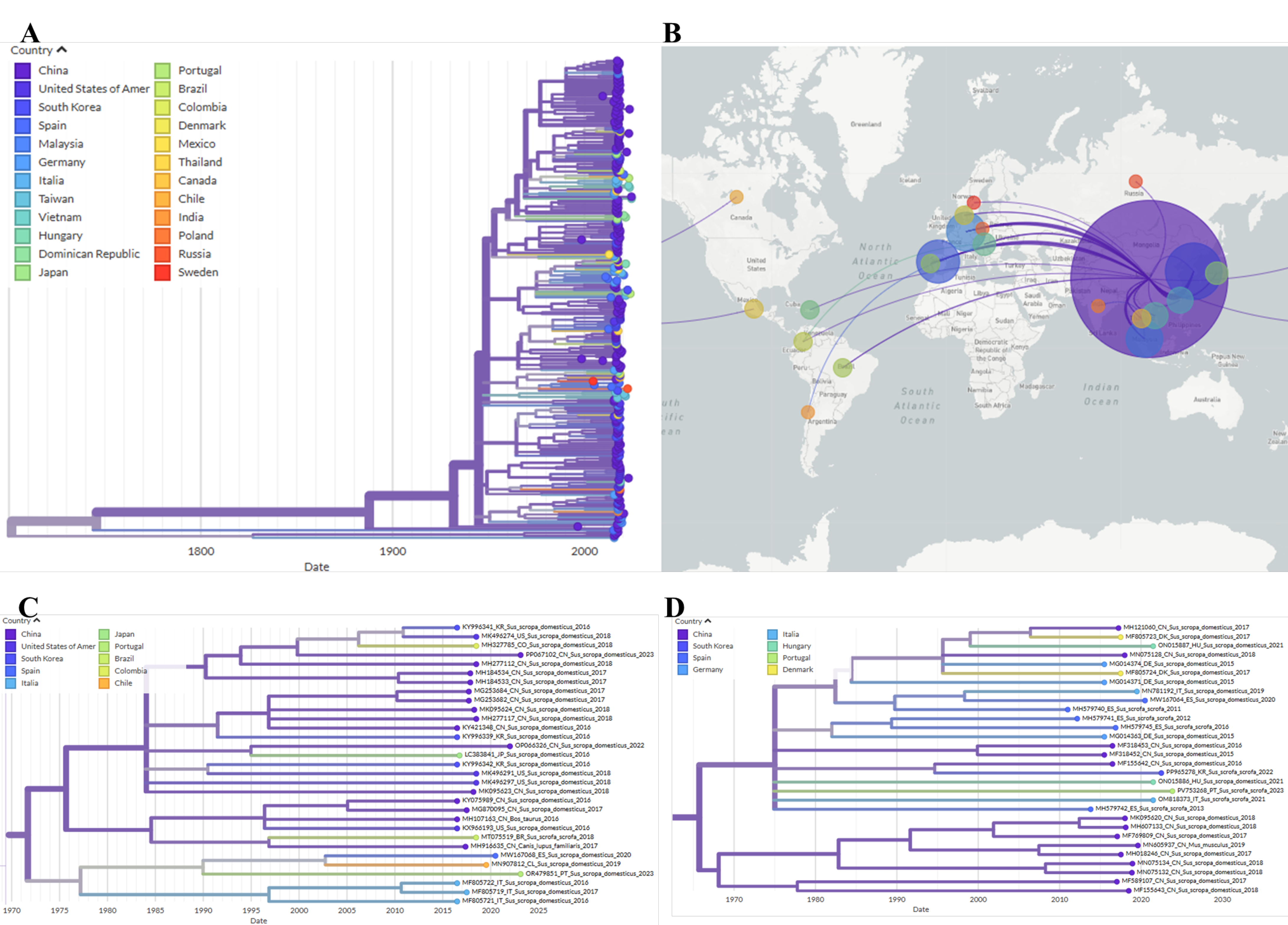
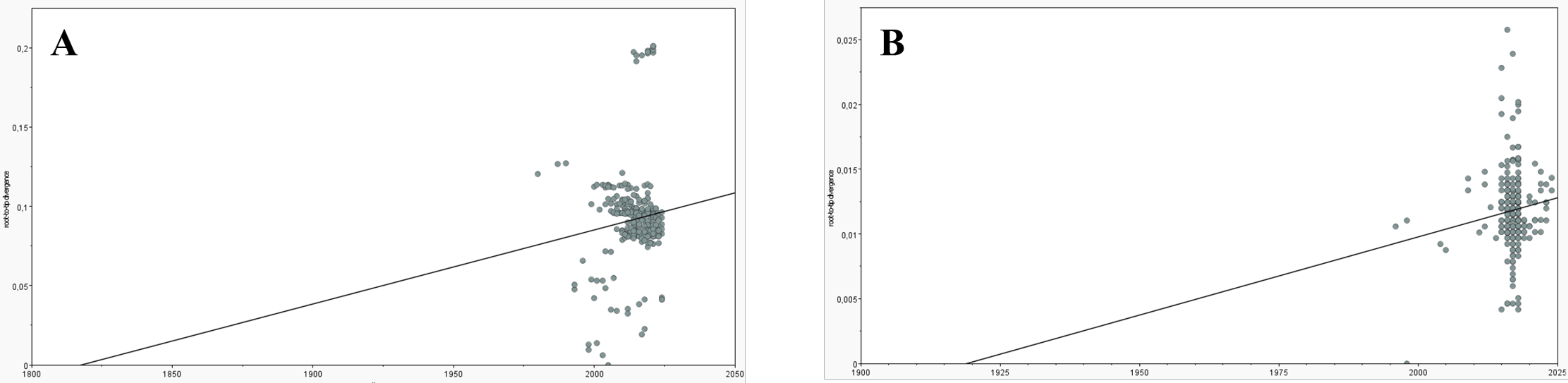
2.5. Phylogenetic and Phylogeographic Analysis
2.6. Recombination Analysis
3. Results
4. Discussion
5. Conclusions
Supplementary Materials
Author Contributions
Funding
Institutional Review Board Statement
Informed Consent Statement
Data Availability Statement
Acknowledgments
Conflicts of Interest
Abbreviations
| °C | Degrees Celsius |
| µL | Microliter |
| µM | Micromolar |
| BAM | Binary Alignment Map |
| bp | Base pairs |
| cDNA | Complementary DNA |
| CI | Confidence Interval |
| CRESS | Circular Rep-encoding Single-Stranded |
| DNA | Deoxyribonucleic acid |
| dNTP | Deoxyribonucleotide triphosphate |
| ds-cDNA | double-stranded complementary DNA |
| EDTA | Ethylenediaminetetraacetic acid |
| GTR | General Time Reversible |
| MFP | ModelFinder Plus |
| ng | Nanogram |
| nt | Nucleotide |
| ORF | Open Reading Frame |
| PCR | Polymerase chain reaction |
| PCV2 | Porcine circovirus type 2 |
| PCV3 | Porcine circovirus type 3 |
| PCVAD | Porcine-circovirus-associated disease |
| PMWS | Postweaning multisystemic wasting syndrome |
| RDP4 | Recombination Detection Program version 4 |
| SH-aLRT | Shimodaira–Hasegawa-like approximate Likelihood-Ratio Test |
| SISPA | Sequence-Independent Single Primer Amplification |
| TIM | Transitional model |
| × g | Relative centrifugal force (RCF) |
References
- Allan, G.M.; Ellis, J.A. Porcine circoviruses: A review. J. Vet. Diagn. Investig. 2000, 12, 3–14. [Google Scholar] [CrossRef]
- Segalés, J. Porcine circovirus type 2 (PCV2) infections: Clinical signs, pathology and laboratory diagnosis. Virus Res. 2012, 164, 10–19. Available online: https://linkinghub.elsevier.com/retrieve/pii/S0168170211004011 (accessed on 9 May 2025). [CrossRef]
- Phan, T.G.; Giannitti, F.; Rossow, S.; Marthaler, D.; Knutson, T.P.; Li, L.; Deng, X.; Resende, T.; Vannucci, F.; Delwart, E. Detection of a novel circovirus PCV3 in pigs with cardiac and multi-systemic inflammation. Virol. J. 2016, 13, 184. [Google Scholar] [CrossRef]
- Klaumann, F.; Correa-Fiz, F.; Giovanni, F.; Sibila, M.; Núñez, J.I.; Segalés, J. Current Knowledge on Porcine circovirus 3 (PCV-3): A Novel Virus With a Yet Unknown Impact on the Swine Industry. Front. Vet. Sci. 2018, 5, 315. [Google Scholar] [CrossRef] [PubMed]
- Palinski, R.; Piñeyro, P.; Shang, P.; Yuan, F.; Guo, R.; Fang, Y.; Byers, E.; Hause, B.M. A Novel Porcine Circovirus Distantly Related to Known Circoviruses Is Associated with Porcine Dermatitis and Nephropathy Syndrome and Reproductive Failure. J. Virol. 2016, 91, e01879-16. Available online: https://www.ncbi.nlm.nih.gov/pmc/articles/PMC5165205/ (accessed on 19 June 2025). [CrossRef] [PubMed]
- Fu, X.; Fang, B.; Ma, J.; Liu, Y.; Bu, D.; Zhou, P.; Wang, H.; Jia, K.; Zhang, G. Insights into the epidemic characteristics and evolutionary history of the novel porcine circovirus type 3 in southern China. Transbound. Emerg. Dis. 2018, 65, e296–e303. [Google Scholar] [CrossRef] [PubMed]
- Fux, R.; Söckler, C.; Link, E.K.; Renken, C.; Krejci, R.; Sutter, G.; Ritzmann, M.; Eddicks, M. Full genome characterization of porcine circovirus type 3 isolates reveals the existence of two distinct groups of virus strains. Virol. J. 2018, 15, 25. Available online: https://virologyj.biomedcentral.com/articles/10.1186/s12985-018-0929-3 (accessed on 30 September 2025). [CrossRef]
- Saporiti, V.; Martorell, S.; Cruz, T.F.; Klaumann, F.; Correa-Fiz, F.; Balasch, M.; Sibila, M.; Segalés, J. Frequency of Detection and Phylogenetic Analysis of Porcine circovirus 3 (PCV-3) in Healthy Primiparous and Multiparous Sows and Their Mummified Fetuses and Stillborn. Pathogens 2020, 9, 533. [Google Scholar] [CrossRef]
- Franzo, G.; Delwart, E.; Fux, R.; Hause, B.; Su, S.; Zhou, J.; Segales, J. Genotyping Porcine Circovirus 3 (PCV-3) Nowadays: Does It Make Sense? Viruses 2020, 12, 265. [Google Scholar] [CrossRef]
- Chung, H.C.; Nguyen, V.G.; Park, Y.H.; Park, B.K. Genotyping of PCV3 based on reassembled viral gene sequences. Vet. Med. Sci. 2021, 7, 474–482. [Google Scholar] [CrossRef]
- Vicente, J.; Domingo, M.; Segalés, J.; Höfle, U.; Balasch, M.; Plana-Durán, J.; Gortázar, C. Epidemiological study on porcine circovirus type 2 (PCV2) infection in the European wild boar (Sus scrofa). Vet. Res. 2004, 35, 243–253. [Google Scholar] [CrossRef]
- Reiner, G.; Hofmeister, R.; Willems, H. Genetic variability of porcine circovirus 2 (PCV2) field isolates from vaccinated and non-vaccinated pig herds in Germany. Vet. Microbiol. 2015, 180, 41–48. [Google Scholar] [CrossRef]
- Klaumann, F.; Dias-Alves, A.; Cabezón, O.; Mentaberre, G.; Castillo-Contreras, R.; López-Béjar, M.; Casas-Díaz, E.; Sibila, M.; Correa-Fiz, F.; Segalés, J. Porcine circovirus 3 is highly prevalent in serum and tissues and may persistently infect wild boar (Sus scrofa scrofa). Transbound. Emerg. Dis. 2019, 66, 91–101. Available online: https://pmc.ncbi.nlm.nih.gov/articles/PMC6912250/ (accessed on 3 December 2025). [CrossRef]
- Franzo, G.; Tucciarone, C.M.; Drigo, M.; Cecchinato, M.; Martini, M.; Mondin, A.; Menandro, M.L. First report of wild boar susceptibility to Porcine circovirus type 3: High prevalence in the Colli Euganei Regional Park (Italy) in the absence of clinical signs. Transbound. Emerg. Dis. 2018, 65, 957–962. [Google Scholar] [CrossRef]
- Prinz, C.; Stillfried, M.; Neubert, L.K.; Denner, J. Detection of PCV3 in German wild boars. Virol. J. 2019, 16, 25. [Google Scholar] [CrossRef] [PubMed]
- Almeida, B.; Duarte, M.D.; Duarte, A.; Fagulha, T.; Ramos, F.; Luís, T.; Caetano, I.; Barros, S.C.; dos Santos, F.A.; Henriques, A.M. Comprehensive Survey of PCV2 and PCV3 in Domestic Pigs and Wild Boars Across Portugal: Prevalence, Geographical Distribution and Genetic Diversity. Pathogens 2025, 14, 675. [Google Scholar] [CrossRef] [PubMed]
- Borges, V.; Pinheiro, M.; Pechirra, P.; Guiomar, R.; Gomes, J.P. INSaFLU: An automated open web-based bioinformatics suite “from-reads” for influenza whole-genome-sequencing-based surveillance. Genome Med. 2018, 10, 46. [Google Scholar] [CrossRef]
- Santos, J.D.; Sobral, D.; Pinheiro, M.; Isidro, J.; Bogaardt, C.; Pinto, M.; Eusébio, R.; Santos, A.; Mamede, R.; Horton, D.L.; et al. INSaFLU-TELEVIR: An open web-based bioinformatics suite for viral metagenomic detection and routine genomic surveillance. Genome Med. 2024, 16, 61. [Google Scholar] [CrossRef] [PubMed]
- Vilsker, M.; Moosa, Y.; Nooij, S.; Fonseca, V.; Ghysens, Y.; Dumon, K.; Pauwels, R.; Alcantara, L.C.; Vanden Eynden, E.; Vandamme, A.-M.; et al. Genome Detective: An automated system for virus identification from high-throughput sequencing data. Bioinformatics 2019, 35, 871–873. [Google Scholar] [CrossRef]
- Larsson, A. AliView: A fast and lightweight alignment viewer and editor for large datasets. Bioinformatics 2014, 30, 3276–3278. [Google Scholar] [CrossRef]
- Schmidt, H.A.; Strimmer, K.; Vingron, M.; von Haeseler, A. TREE-PUZZLE: Maximum likelihood phylogenetic analysis using quartets and parallel computing. Bioinformatics 2002, 18, 502–504. [Google Scholar] [CrossRef]
- Strimmer, K.; von Haeseler, A. Likelihood-mapping: A simple method to visualize phylogenetic content of a sequence alignment. Proc. Natl. Acad. Sci. USA 1997, 94, 6815–6819. [Google Scholar] [CrossRef]
- Hoang, D.T.; Chernomor, O.; von Haeseler, A.; Minh, B.Q.; Vinh, L.S. UFBoot2: Improving the Ultrafast Bootstrap Approximation. Mol. Biol. Evol. 2018, 35, 518–522. [Google Scholar] [CrossRef] [PubMed]
- Kalyaanamoorthy, S.; Minh, B.Q.; Wong, T.K.F.; von Haeseler, A.; Jermiin, L.S. ModelFinder: Fast Model Selection for Accurate Phylogenetic Estimates. Nat. Methods 2017, 14, 587–589. Available online: https://www.researchgate.net/publication/316750553_ModelFinder_Fast_Model_Selection_for_Accurate_Phylogenetic_Estimates (accessed on 19 June 2025). [CrossRef]
- Wong, T.K.F.; Ly-Trong, N.; Ren, H.; Baños, H.; Roger, A.J.; Susko, E.; Bielow, C.; De Maio, N.; Goldman, N.; Hahn, M.W.; et al. IQ-TREE 3: Phylogenomic Inference Software Using Complex Evolutionary Models. 2025. Available online: https://ecoevorxiv.org/repository/view/8916/ (accessed on 18 August 2025).
- Rambaut, A.; Lam, T.T.; Max Carvalho, L.; Pybus, O.G. Exploring the temporal structure of heterochronous sequences using TempEst (formerly Path-O-Gen). Virus Evol. 2016, 2, vew007. [Google Scholar] [CrossRef]
- Hadfield, J.; Megill, C.; Bell, S.M.; Huddleston, J.; Potter, B.; Callender, C.; Sagulenko, P.; Bedford, T.; Neher, R.A. Nextstrain: Real-time tracking of pathogen evolution. Bioinformatics 2018, 34, 4121–4123. [Google Scholar] [CrossRef]
- Martin, D.P.; Murrell, B.; Golden, M.; Khoosal, A.; Muhire, B. RDP4: Detection and analysis of recombination patterns in virus genomes. Virus Evol. 2015, 1, vev003. [Google Scholar] [CrossRef] [PubMed]
- Martin, D.; Rybicki, E. RDP: Detection of recombination amongst aligned sequences. Bioinformatics 2000, 16, 562–563. [Google Scholar] [CrossRef] [PubMed]
- Padidam, M.; Sawyer, S.; Fauquet, C.M. Possible emergence of new geminiviruses by frequent recombination. Virology 1999, 265, 218–225. [Google Scholar] [CrossRef]
- Smith, J.M. Analyzing the mosaic structure of genes. J. Mol. Evol. 1992, 34, 126–129. [Google Scholar] [CrossRef]
- Posada, D.; Crandall, K.A. Evaluation of methods for detecting recombination from DNA sequences: Computer simulations. Proc. Natl. Acad. Sci. USA 2001, 98, 13757–13762. [Google Scholar] [CrossRef]
- Gibbs, M.J.; Armstrong, J.S.; Gibbs, A.J. Sister-Scanning: A Monte Carlo procedure for assessing signals in recombinant sequences. Bioinformatics 2000, 16, 573–582. [Google Scholar] [CrossRef]
- Lam, H.M.; Ratmann, O.; Boni, M.F. Improved Algorithmic Complexity for the 3SEQ Recombination Detection Algorithm. Mol. Biol. Evol. 2018, 35, 247–251. [Google Scholar] [CrossRef]
- Weiller, G.F. Phylogenetic profiles: A graphical method for detecting genetic recombinations in homologous sequences. Mol. Biol. Evol. 1998, 15, 326–335. [Google Scholar] [CrossRef]
- Lemey, P.; Lott, M.; Martin, D.P.; Moulton, V. Identifying recombinants in human and primate immunodeficiency virus sequence alignments using quartet scanning. BMC Bioinform. 2009, 10, 126. Available online: https://www.ncbi.nlm.nih.gov/pmc/articles/PMC2684544/ (accessed on 28 August 2025). [CrossRef] [PubMed][Green Version]
- McGuire, G.; Wright, F. TOPAL 2.0: Improved detection of mosaic sequences within multiple alignments. Bioinformatics 2000, 16, 130–134. [Google Scholar] [CrossRef] [PubMed]
- Holmes, E.C.; Worobey, M.; Rambaut, A. Phylogenetic evidence for recombination in dengue virus. Mol. Biol. Evol. 1999, 16, 405–409. [Google Scholar] [CrossRef]
- Huang, Y.; Chen, X.; Long, Y.; Yang, L.; Song, W.; Liu, J.; Li, Q.; Liang, G.; Yu, D.; Huang, C.; et al. Epidemiological Analysis From 2018 to 2020 in China and Prevention Strategy of Porcine Circovirus Type 2. Front. Vet. Sci. 2021, 8, 753297. Available online: https://www.ncbi.nlm.nih.gov/pmc/articles/PMC8635018/ (accessed on 12 August 2025). [CrossRef] [PubMed]
- Oh, T.; Suh, J.; Park, K.H.; Yang, S.; Cho, H.; Chae, C. A Comparison of Pathogenicity and Virulence of Three Porcine Circovirus Type 2 (PCV2) Genotypes (a, b, and d) in Pigs Singularly Inoculated with PCV2 and Dually Inoculated with Mycoplasma hyopneumoniae and PCV2. Pathogens 2021, 10, 979. [Google Scholar] [CrossRef]
- Oh, T.; Cho, H.; Suh, J.; Chae, C. Virulence Comparison of Four Porcine Circovirus Type 2 (PCV2) Genotypes (2a, 2b, 2d and 2e) in Pigs Single-Infected with PCV2 and Pigs Dual-Infected with PCV2 and Mycoplasma hyopneumoniae. J. Comp. Pathol. 2022, 199, 88–98. Available online: https://www.sciencedirect.com/science/article/pii/S0021997522001219 (accessed on 12 August 2025). [CrossRef]
- Ham, S.; Suh, J.; Oh, T.; Kim, C.; Seo, B.J.; Chae, C. Efficacy of a novel bivalent vaccine containing porcine circovirus type 2d and Mycoplasma hyopneumoniae against a dual PCV2d and Mycoplasma hyopneumoniae challenge. Front. Vet. Sci. 2023, 10, 1176091. Available online: https://www.frontiersin.org/journals/veterinary-science/articles/10.3389/fvets.2023.1176091/full (accessed on 12 August 2025). [CrossRef]
- Jang, G.; Yoo, H.; Kim, Y.; Yang, K.; Lee, C. Genetic and phylogenetic analysis of porcine circovirus type 2 on Jeju Island, South Korea, 2019–2020: Evidence of a novel intergenotypic recombinant. Arch. Virol. 2021, 166, 1093–1102. [Google Scholar] [CrossRef]
- Li, J.; Xu, S.; Yuan, X.; Wang, G.; Shi, J.; Wu, J.; Cong, X.; Sun, W.; Du, Y.; Wang, J. Complete Genome Sequence of Recombinant Porcine Circovirus Type 2 Strain SD-3. J. Virol. 2012, 86, 13870. [Google Scholar] [CrossRef] [PubMed][Green Version]
- Ramos, N.; Mirazo, S.; Castro, G.; Arbiza, J. Molecular analysis of Porcine Circovirus Type 2 strains from Uruguay: Evidence for natural occurring recombination. Infect. Genet. Evol. 2013, 19, 23–31. [Google Scholar] [CrossRef] [PubMed]
- Firth, C.; Charleston, M.A.; Duffy, S.; Shapiro, B.; Holmes, E.C. Insights into the Evolutionary History of an Emerging Livestock Pathogen: Porcine Circovirus 2. J. Virol. 2009, 83, 12813–12821. Available online: https://www.ncbi.nlm.nih.gov/pmc/articles/PMC2786836/ (accessed on 7 September 2025). [CrossRef]
- Franzo, G.; Cortey, M.; Segalés, J.; Hughes, J.; Drigo, M. Phylodynamic analysis of porcine circovirus type 2 reveals global waves of emerging genotypes and the circulation of recombinant forms. Mol. Phylogenet. Evol. 2016, 100, 269–280. [Google Scholar] [CrossRef]
- Gainor, K.; Fortuna, Y.C.; Alakkaparambil, A.S.; González, W.; Malik, Y.S.; Ghosh, S. Detection and Complete Genomic Analysis of Porcine circovirus 3 (PCV3) in Diarrheic Pigs from the Dominican Republic: First Report on PCV3 from the Caribbean Region. Pathogens 2023, 12, 250. [Google Scholar] [CrossRef] [PubMed]
- Saraiva, G.L.; Vidigal, P.M.P.; Fietto, J.L.R.; Bressan, G.C.; Silva Júnior, A.; de Almeida, M.R. Evolutionary analysis of Porcine circovirus 3 (PCV3) indicates an ancient origin for its current strains and a worldwide dispersion. Virus Genes 2018, 54, 376–384. [Google Scholar] [CrossRef]
- Zhao, L.; Rosario, K.; Breitbart, M.; Duffy, S. Eukaryotic Circular Rep-Encoding Single-Stranded DNA (CRESS DNA) Viruses: Ubiquitous Viruses With Small Genomes and a Diverse Host Range. Adv Virus Res. 2019, 103, 71–133. [Google Scholar]



| Reaction | Primer Name | Sequence | nt Position | Target Gene |
|---|---|---|---|---|
| PCV2 PCR | CircSacF | 5′-CCGCGGGCTGGCTGAACTTTTGAAAGT-3′ | 491–517 | Replicase |
| CircEcoF | 5′-GAATTCAACCTTAACCTTTCTTATTCT-3′ | 1420–1446 | Capsid | |
| PCV2-SeqF | 5′-GCTGCCACATCGAGAAAGCS-3′ | 289–308 | Replicase | |
| CircSacR | 5′-CCGCGGAAATTTCTGACAAACGTTACA-3′ | 496–470 | Replicase | |
| CircEcoR | 5′-GAATTCTGGCCCTGCTCCCCCATCAC-3′ | 1425–1400 | Capsid | |
| PCV2-SeqR | 5′-CACAGTCTCAGTAGATCATCCC-3′ | 739–718 | Replicase | |
| AS4 | 5′-CCGCACCTTCGGATATACTGTC-3′ | 1585–1564 | Capsid | |
| PCV3 SISPA | FR20-N | 5′-GCCGAAGCTCTGCAGATATCNNNNNN-3′ | Random sequences | Random sequences |
| FR20 | 5′-GCCGAAGCTCTGCAGATATC-3′ |
Disclaimer/Publisher’s Note: The statements, opinions and data contained in all publications are solely those of the individual author(s) and contributor(s) and not of MDPI and/or the editor(s). MDPI and/or the editor(s) disclaim responsibility for any injury to people or property resulting from any ideas, methods, instructions or products referred to in the content. |
© 2025 by the authors. Licensee MDPI, Basel, Switzerland. This article is an open access article distributed under the terms and conditions of the Creative Commons Attribution (CC BY) license (https://creativecommons.org/licenses/by/4.0/).
Share and Cite
Almeida, B.; Duarte, M.D.; Duarte, A.; Barros, S.C.; Abade dos Santos, F.; Henriques, A.M. Evidence of Spillover and Recombination Between Domestic Pigs and Wild Boars Provides New Insights into Porcine Circoviruses. Pathogens 2025, 14, 1283. https://doi.org/10.3390/pathogens14121283
Almeida B, Duarte MD, Duarte A, Barros SC, Abade dos Santos F, Henriques AM. Evidence of Spillover and Recombination Between Domestic Pigs and Wild Boars Provides New Insights into Porcine Circoviruses. Pathogens. 2025; 14(12):1283. https://doi.org/10.3390/pathogens14121283
Chicago/Turabian StyleAlmeida, Bernardo, Margarida D. Duarte, Ana Duarte, Sílvia C. Barros, Fábio Abade dos Santos, and Ana Margarida Henriques. 2025. "Evidence of Spillover and Recombination Between Domestic Pigs and Wild Boars Provides New Insights into Porcine Circoviruses" Pathogens 14, no. 12: 1283. https://doi.org/10.3390/pathogens14121283
APA StyleAlmeida, B., Duarte, M. D., Duarte, A., Barros, S. C., Abade dos Santos, F., & Henriques, A. M. (2025). Evidence of Spillover and Recombination Between Domestic Pigs and Wild Boars Provides New Insights into Porcine Circoviruses. Pathogens, 14(12), 1283. https://doi.org/10.3390/pathogens14121283