1. Introduction
The integration of artificial intelligence (AI) tools into higher education is reshaping how educators teach and how students learn. Generative AI is widely regarded as offering opportunities to support student creativity, critical thinking, and the personalisation of learning. Generative AI tools such as ChatGPT and Bing Chat, which function as conversational chatbots, have been widely adopted across campuses because they can generate ideas, automate repetitive or routine tasks, and provide feedback tailored to the individual learner. A growing body of research highlights the potential of such tools to help develop competencies associated with success in the twenty-first century (e.g., creativity, collaboration, and problem solving), often through intelligent tutoring systems and AI-based learning dashboards. Generative AI is also described as valuable in supporting iterative creative processes in art and design education: students can use it to produce an initial idea and then refine and evolve that idea until it meets the desired criteria.
Despite these positive accounts, the long-term influence of AI on student creativity remains contested. Some researchers report that generative AI stimulates creative thought and improves workflow efficiency (
Smolansky et al. 2023;
Fakhri et al. 2024), whereas others caution that excessive reliance on generative tools can erode critical thinking and ultimately reduce the quality of learning (
Ogunleye et al. 2024;
Aisyah et al. 2024;
Klingbeil et al. 2024). This debate signals the need for a more theoretically grounded understanding of how AI tools shape creative learning outcomes, particularly in contexts that remain under-studied. Two such contexts coincide in the present study: non-Western higher education and the creative, non-STEM discipline of digital media.
This study investigated students’ perceptions of the effects of AI tools on their creativity in Digital Media coursework at an Egyptian university. A convergent mixed-methods design was used to examine students’ interactions with AI tools and their perceived effects on creative processes. We emphasise at the outset that the study measured perceptions of creative support rather than objectively assessed creative performance; this distinction is maintained throughout the manuscript. The findings are intended to inform pedagogical strategies for incorporating AI tools into higher education in ways that support student creativity while safeguarding academic integrity. To guide the inquiry, three research questions were formulated:
RQ1. How do undergraduate digital media students in Egypt perceive the influence of AI tools on their creative processes?
RQ2. To what extent is perceived creative support associated with overall learning satisfaction, and is this association independent of prior AI familiarity, comfort with new technology, and usage intensity?
RQ3. How do students themselves conceptualise “creativity” when describing AI-assisted creative work?
2. Literature Review and Theoretical Framework
2.1. Conceptualising Creativity
Because creativity is the central construct of this study, it requires explicit definition before its relationship with AI can be examined. Contemporary creativity scholarship converges on a “standard definition” in which a creative product or idea is both novel (original, unexpected) and useful (appropriate, valuable to a task) (
Runco and Jaeger 2012). This dual criterion has deep roots.
Guilford (
1967) distinguished divergent thinking—the fluent generation of many varied ideas—from convergent thinking, and divergent-thinking fluency, flexibility, and originality remain influential indicators of creative potential (
Torrance 1974).
Amabile (
1996) situated creativity within its social and motivational context through the componential model, arguing that domain-relevant skills, creativity-relevant processes, and, crucially, intrinsic task motivation jointly determine creative output.
Csikszentmihalyi (
1996) widened the lens further with a systems model in which creativity emerges from the interaction of the individual, a knowledge domain, and a gatekeeping field rather than residing in the person alone.
More recent socio-cultural and distributed accounts treat creativity as a relational and collaborative accomplishment that is mediated by tools, peers, and cultural artefacts (
Sawyer 2012;
Glăveanu 2014). This perspective is directly relevant to AI-assisted work, in which the “tool” is an active interlocutor. Equally relevant is the distinction between the eminent creativity of acknowledged innovators and the everyday creativity of learners. The Four-C model differentiates Big-C (eminent) and Pro-c (expert) creativity from little-c (everyday) and mini-c (the novel, personally meaningful insights that arise during learning) (
Kaufman and Beghetto 2009). Student creativity in coursework is best understood as little-c and mini-c creativity, a framing that calibrates expectations for what AI-assisted undergraduate work can plausibly demonstrate. Following this literature, the present study defines its target construct as perceived creative support: students’ subjective appraisal of the extent to which AI tools help them generate, structure, and realise ideas in their creative coursework. This definition deliberately does not equate perceived support with demonstrated originality, and the analysis is interpreted accordingly.
2.2. Constructivism, Mediated Learning, and Cognitive Load
This study is framed by constructivist learning theory, which holds that learners actively build knowledge through experience and social interaction rather than passively receiving it. Within this tradition,
Vygotsky’s (
1978) concept of the zone of proximal development (ZPD) describes the distance between what a learner can accomplish independently and what they can accomplish with the guidance of a more capable other. Feuerstein’s theory of mediated learning extends this view by emphasising the role of an intentional mediator in helping learners interpret and organise experience (
Presseisen and Kozulin 1992). A generative AI tool can be conceptualised as a non-human mediating agent that operates within the learner’s ZPD, offering prompts, structure, and feedback that the learner could not yet produce alone.
Cognitive load theory provides a complementary mechanism. It distinguishes intrinsic load (the inherent difficulty of material) from extraneous load (load imposed by how a task is presented) and germane load (effort devoted to building schemas) (
Sweller 1988;
Sweller et al. 2019). To the extent that AI tools offload routine sub-tasks such as formatting, searching, and drafting boilerplate, they may reduce extraneous load and free working-memory capacity for higher-order creative work. The same mechanism, however, carries a risk: if AI assumes the germane processing through which schemas and skills are normally built, the apparent reduction in effort may come at the cost of durable learning. This theoretical tension anticipates the empirical pattern reported below and is revisited in the discussion.
2.3. AI in Higher Education: Adoption and Pedagogical Impact
Artificial intelligence is being implemented in higher education at an accelerating pace. With the rapid advancement of generative systems such as ChatGPT, Gemini, and DeepSeek, these tools have become pervasive in academic life (
Alshahrani and Qureshi 2024). Students use AI for a wide range of purposes, from drafting written work to language learning. Research indicates that AI applications can improve structured learning and exert positive effects on students’ academic emotions and engagement (
Boubker 2024;
Yim and Su 2025). At the same time, scholars have urged caution about authorship, assessment validity, and integrity as these tools become embedded in coursework (
Dwivedi et al. 2023).
2.4. AI and Student Creativity: Opportunities and Concerns
Evidence on AI and creativity is genuinely two-sided. On the opportunity side, AI can support ideation: learners report developing both creative thought processes and improved problem-solving when using AI as a brainstorming aid (
Karanjakwut and Charunsri 2025), and reviews of AI in the creative industries document substantial generative and augmentative potential (
Anantrasirichai and Bull 2022). Some scholars argue for a collaborative human–AI model of creativity in which the technology functions as a co-creative partner rather than a substitute (
Vinchon et al. 2023). On the concern side, over-reliance can produce shallow learning and diminished opportunities to exercise critical thinking (
Karanjakwut and Charunsri 2025;
Klingbeil et al. 2024). The strongest counter-position is
Sternberg’s (
2024) contention that generative AI may already be compromising human creativity and intelligence by displacing the effortful, generative work from which creative capacity develops. This tension—augmentation versus erosion—is a central concern of the present study and is examined directly against our data in
Section 5.3.
2.5. Creativity and AI in Non-Western and Digital Media Contexts
Two further gaps motivate this study. First, the empirical base on AI and creativity is dominated by Western institutional settings, even though socio-cultural accounts of creativity predict that cultural context shapes both creative practice and the value placed on originality (
Sawyer 2012;
Glăveanu 2014). Evidence from Arab and North African higher education, where AI adoption is rapid but locally distinctive in infrastructure, language, and academic norms, remains scarce. Second, much of the AI-in-education literature centres on STEM disciplines, leaving creative, studio-based fields such as digital media comparatively under-examined. Digital media education is a hybrid discipline that combines technical production with aesthetic and conceptual judgement, making it an especially informative site for studying how learners negotiate the boundary between tool-assisted efficiency and creative authorship. By focusing on Egyptian digital media undergraduates, this study contributes evidence from a doubly under-represented context.
2.6. Mixed-Methods Approaches in AI-Education Research
Mixed-methods research is well suited to the complex, perception-laden questions surrounding AI integration in education. Combining quantitative and qualitative data allows researchers to examine both the magnitude of perceived effects and the meanings students attach to their experiences, yielding a more complete account than either strand alone (
Creswell and Clark 2018). A convergent design, in which the two strands are collected in parallel and integrated at the interpretation stage, is particularly appropriate for identifying convergence, divergence, and complementarity between measured perceptions and lived accounts.
2.7. Research Gap and Contribution
In sum, although the literature on AI in education is expanding rapidly, relatively little of it engages creativity as a defined theoretical construct, and less still does so in non-Western, non-STEM settings. The present study addresses these gaps by (i) grounding its central construct in established creativity theory; (ii) examining perceived creative support among Egyptian digital media undergraduates; and (iii) integrating quantitative and qualitative evidence to interrogate, rather than assume, the relationship between AI use and creativity. In doing so, it offers an empirically grounded, theoretically situated contribution to debates on human–AI collaboration in higher education.
3. Methodology
3.1. Research Design
This study employed an exploratory, cross-sectional, convergent mixed-methods design. The design was chosen because it allows emerging themes and patterns to surface from students’ own accounts while simultaneously quantifying the strength and distribution of their perceptions. Consistent with a constructivist orientation that foregrounds learners’ experiences and meaning-making rather than static background attributes, the primary analysis was specified, a priori, to centre on experiential and perceptual variables rather than demographic categories such as age, gender, or academic year. This was a design decision grounded in the study’s theoretical framing and not a post hoc reaction to the data. Demographic items were therefore not collected as primary predictors; the experiential moderators that were collected (prior AI familiarity, comfort with new technology, and weekly usage) were examined and are reported in full in
Section 4.2.
3.2. Participants and Ethical Procedures
Participants were 103 undergraduate students enrolled in Digital Media courses at a university in Egypt. All respondents had prior experience using AI tools as part of their coursework and could therefore speak from direct, relevant experience. Participation was voluntary and anonymous; no personal identifying information was collected. Students provided informed consent before completing the questionnaire, and they could withdraw at any point. The study followed institutional ethical guidelines for research involving human participants.
3.3. Instrumentation and Data Collection
Data were collected through a researcher-developed online questionnaire designed to capture three dimensions of the AI-assisted learning experience: perceived creative and learning impact, tool engagement and usability, and experiential barriers. The instrument comprised two components, which are described separately here to avoid conflating measurement items with sample-characterisation variables.
Closed-ended items. Twenty-four statements were rated on a seven-point agreement scale (1 = Strongly Disagree to 7 = Strongly Agree). From this battery, a four-item Perceived Creative Support subscale was specified to operationalise the study’s central construct: (i) “Using AI tools enhanced my understanding of key digital media concepts”; (ii) “AI tools helped me complete assignments more efficiently than traditional methods”; (iii) “The knowledge I gained through AI-assisted learning will be applicable to my future coursework”; and (iv) the dedicated creative-authorship item “Using AI tools enhanced rather than replaced my creative process.” The inclusion of item (iv) directly addresses the conceptual gap between perceived usefulness and perceived creative support. Overall learning satisfaction was measured with a single item (“After experiencing the AI tools in this digital media course, I feel very satisfied with my overall learning experience”). The full instrument is provided in
Appendix A.
Open-ended prompts. Four open-ended questions invited students to describe, in their own words, the aspects of AI use they found most valuable, the challenges they encountered, the improvements they would suggest, and the course activities for which they most often used AI. These prompts generated the qualitative corpus analysed in
Section 4.4.
Sample-characterisation variables. Separately from the perception items, three experiential variables characterised respondents’ backgrounds and usage: prior familiarity with AI technologies (five ordered levels), general comfort with adopting new technologies (five ordered levels), and average weekly hours of AI use for the course. These variables were treated as moderators, not as components of the perception scales.
3.4. Quantitative Analysis
Quantitative analyses were conducted in Python 3.12 (pandas, SciPy). Internal consistency was assessed using Cronbach’s alpha for the full 24-item battery and for the four-item Perceived Creative Support subscale. Descriptive statistics summarised the distribution of responses. Because the Likert items are ordinal and several distributions were non-normal, associations were examined using both Pearson and Spearman coefficients for robustness, and subgroup comparisons across familiarity, comfort, and usage levels used the Kruskal–Wallis H test. A two-tailed alpha of 0.05 was adopted throughout. All completed procedures are reported in the past tense.
3.5. Qualitative Analysis
Open-ended responses were analysed using
Braun and Clarke’s (
2006) six-phase reflexive thematic analysis: (1) familiarisation through repeated reading of the corpus; (2) generation of initial codes using both inductive (data-driven) and deductive (theory-informed) coding; (3) collation of codes into candidate themes; (4) review of candidate themes against coded extracts and the full data set; (5) definition and naming of final themes; and (6) selection of representative extracts for reporting. Two members of the research team coded the corpus independently and then met to compare codes; discrepancies were resolved through reflexive discussion and consensus rather than mechanical adjudication. Consistent with
Braun and Clarke’s (
2019,
2021) position that inter-rater reliability coefficients are conceptually inconsistent with reflexive thematic analysis—because coding is treated as an interpretive rather than a purely reliability-driven act—we did not compute a kappa statistic. Instead, analytical trustworthiness was established against
Lincoln and Guba’s (
1985) criteria: credibility (prolonged engagement with the data and team discussion), transferability (thick description of the context and verbatim extracts), dependability (an audit trail of coding decisions), and confirmability (grounding of every theme in participant language). Importantly, negative-case analysis was applied: responses that ran counter to the dominant positive narrative—expressing over-reliance, loss of originality, or erosion of independent thinking—were not discarded but were retained and developed into a distinct theme (
Section 4.4, Theme 5).
3.6. Mixed-Methods Integration
Following the convergent design, the quantitative and qualitative strands were analysed separately and then integrated at the interpretation stage (
Creswell and Clark 2018). Integration sought points of convergence (where the two strands reinforced one another), divergence (where they diverged), and complementarity (where qualitative accounts explained quantitative patterns). The integrated interpretation is presented in
Section 4.5 and developed in
Section 5.
4. Results
4.1. Descriptive Findings and Scale Reliability
Internal consistency was high: Cronbach’s alpha was 0.94 for the full 24-item battery and 0.82 for the four-item Perceived Creative Support subscale, both exceeding conventional thresholds for acceptable reliability. Overall sentiment toward AI-assisted creative work was favourable.
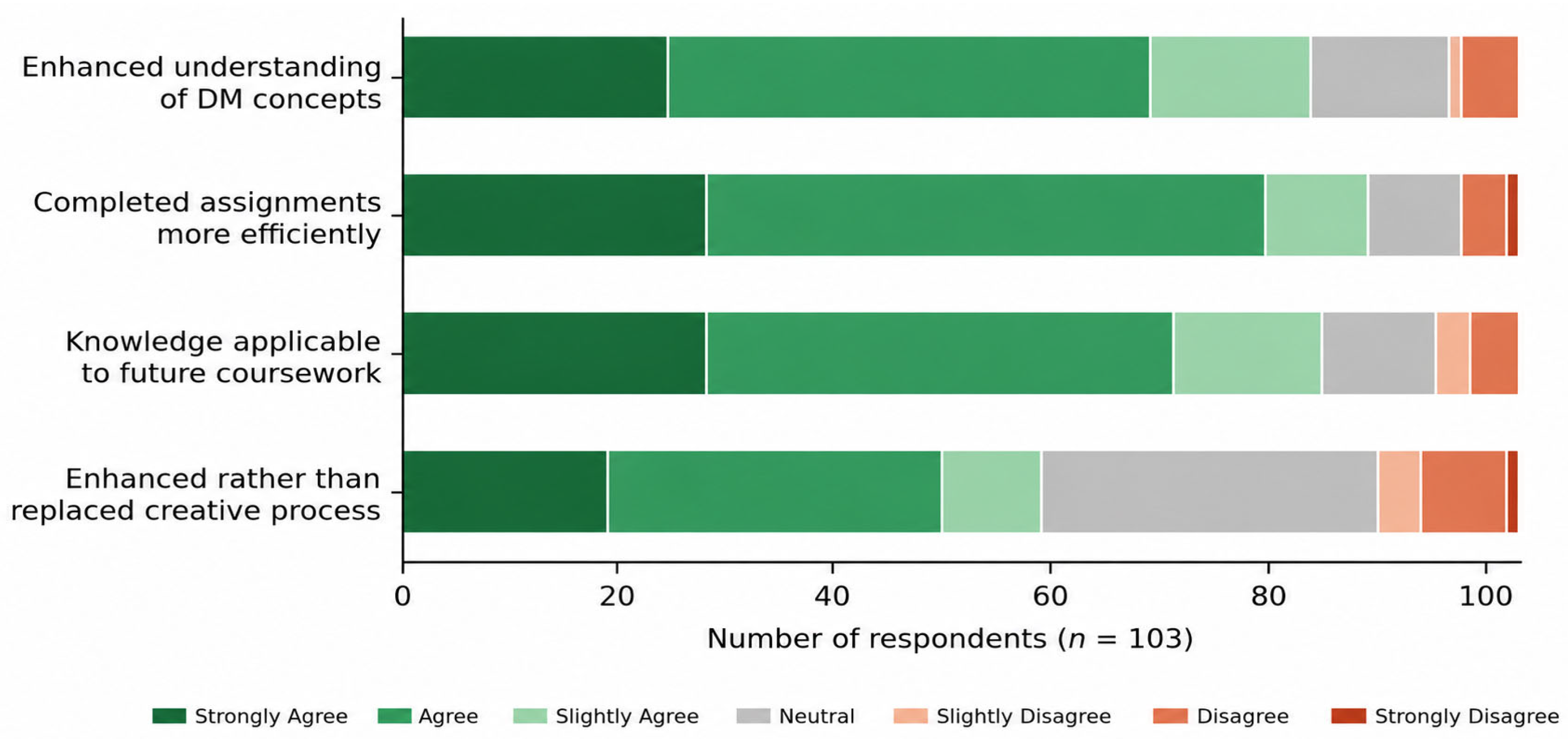
Figure 1 shows the distribution of responses to the four creativity-relevant items, and
Table 1 reports the full response frequencies for the same four items, which together constitute the Perceived Creative Support subscale. Endorsement was strong but uneven across items: the efficiency item attracted the highest agreement (87.4% selected some level of agreement; M = 5.83, SD = 1.24), followed by future applicability (83.5%; M = 5.72) and conceptual understanding (82.5%; M = 5.65). Notably, the dedicated creative-authorship item—“AI enhanced rather than replaced my creative process”—attracted markedly weaker endorsement (59.2% agreement; M = 5.09, SD = 1.52). This internal pattern is itself a finding: students endorsed the efficiency and usefulness of AI more strongly than its contribution to creative authorship, foreshadowing the functional conception of creativity developed below.
4.2. Subgroup Comparisons
Three experiential moderators were examined. Prior AI familiarity showed no significant association with perceived creative support (Kruskal–Wallis H = 4.51,
p = 0.341; Spearman ρ = 0.06,
p = 0.57): students with little prior exposure reported perceptions comparable to those of highly familiar peers. In contrast, general comfort with new technology was significantly associated with perceived creative support (H = 10.98,
p = 0.027; ρ = 0.36,
p < 0.001), and weekly usage intensity also differed significantly (H = 10.99,
p = 0.012). The usage pattern was non-linear: the strongest perceptions clustered among students using AI for one to six hours per week, while both very light (under one hour) and very heavy users were distributed across more neutral and lower categories.
Table 2 and
Table 3 present the cross-tabulations. These results substantiate, rather than merely assert, the moderator analyses, and they refine the inclusivity claim discussed in
Section 5.4.
4.3. Correlational Findings
The composite Perceived Creative Support subscale was positively and significantly correlated with overall learning satisfaction (r = 0.33,
p < 0.001,
n = 103; Spearman ρ = 0.33). The dedicated creative-authorship item alone showed the same direction of effect (r = 0.28,
p = 0.005), confirming the robustness of the association across operationalisations. By conventional benchmarks this is a small-to-moderate effect, and it is interpreted cautiously: students who perceived greater creative support also tended to report greater satisfaction, but the cross-sectional, self-report design precludes any causal inference. Prior AI familiarity was not significantly correlated with perceived creative support (r = 0.07,
p = 0.49), whereas comfort with new technology was (r = 0.35,
p < 0.001).
Table 4 summarises the correlations.
4.4. Qualitative Themes
Reflexive thematic analysis of the open-ended responses produced five themes. The first four capture the perceived benefits of AI use; the fifth captures a consistent strand of critical concern that emerged through negative-case analysis.
Theme 1—Task efficiency and time-saving. The most frequent benefit was efficiency. Students described AI as a way to streamline academic work, reduce effort, and save time: “Artificial intelligence saves time and provides quick access to the right information,” and “It completes assignments quickly; I just ask it and it finishes right away.”
Theme 2—Academic support and assignment fulfilment. Many students framed AI as instrumental in meeting assignment requirements and structuring content: “It helped me write my projects well—in the drama course it supported me in scriptwriting, character creation, and composing the soundtrack,” and “It summarises everything, writes in correct language, and organises the research.”
Theme 3—Creative stimulation and idea development. A smaller set of responses explicitly invoked creativity in the sense of ideation: “AI is useful in terms of creativity,” and “asking for the steps and ideas to make something from the beginning… the steps and details are by far the most important part to me.” Notably, such explicitly creative framings were less common than the efficiency and support framings, mirroring the quantitative pattern in
Section 4.1.
Theme 4—Information accessibility and quick reference. Students valued immediate access to information: “It gives me quick access to information and analyses it accurately,” and “AI helps in presenting information in a simplified way.”
Theme 5—Critical awareness: over-reliance, authenticity, and the erosion of independent thinking. In direct counterpoint, a substantial number of students voiced concern about dependency and its consequences for their own thinking and authorship. Some feared dependency outright (“I’m afraid of depending on it”; “We shouldn’t rely entirely on it”; “I regret relying on it”); others reported a perceived loss of cognitive engagement (“It completely disables thinking”; “We’ve stopped thinking”; “It takes away my critical thinking”); and a striking subset described managing the authenticity of their work (“I try to rewrite it in a more human-like way so that no one can tell it’s from AI”). Others noted the erosion of collaboration (“I stopped relying on my friends and group work; we used to do assignments as a group”) and called explicitly for balance (“When the balance is 70 to 30, the outcome is better”; “supporting personal creativity, not replacing it”). This theme demonstrates that students are not uncritical adopters; many hold a reflexive, ambivalent stance toward the very tools they find useful.
The inclusion of Theme 5 resolves an internal inconsistency present in earlier framings of this work, in which critical concerns were discussed without being represented in the thematic structure. These concerns are empirically present in the corpus and are now reported as a theme in their own right.
4.5. Integrated Findings
The two strands converge on a coherent account. Quantitatively, perceptions of AI’s impact were strongly positive for understanding, efficiency, and applicability, and perceived creative support was associated with greater learning satisfaction (r = 0.33,
p < 0.001). Qualitatively, the dominant themes—efficiency, academic support, idea development, and information access—explain the mechanisms behind those positive ratings. Crucially, both strands point in the same direction on a subtler matter: students endorsed creative authorship (the dedicated item; Theme 3) less strongly than they endorsed efficiency and support (Themes 1, 2, 4). When describing what they valued, students rarely invoked originality or novelty in the traditional, expressive sense; they emphasised structure, speed, and quality of output. Read together, the data suggest that, for these students, AI was experienced as supporting creativity primarily by reducing the cognitive load of execution and by accelerating access to ideas and information, rather than by generating original content autonomously. We frame the apparent shift—from creativity as autonomous, novel ideation toward creativity as efficient, well-structured production—as a hypothesis warranting confirmatory study, not as a demonstrated conceptual change (
Section 5.1). The divergent Theme 5 qualifies the positive picture: a meaningful minority perceive that this same offloading may be eroding the independent thinking on which creativity ultimately depends.
5. Discussion
5.1. Perceived Creativity as Functional Rather than Expressive
One tension organises the discussion that follows and runs through the study as a whole: the distance between creativity understood as original, expressive work and creativity understood as efficiency, organisation, and task completion. The most theoretically interesting result is how students construed creativity itself (RQ3). Against the standard definition of creativity as the joint production of novelty and usefulness (
Runco and Jaeger 2012), students’ accounts emphasised the usefulness pole almost exclusively—ideational structure, speed, and higher-quality outputs—while the novelty pole was largely absent. In
Guilford’s (
1967) terms, students described AI as aiding convergent refinement and fluency more than divergent originality. This functional conception aligns with the everyday, little-c and mini-c creativity that characterises undergraduate coursework (
Kaufman and Beghetto 2009) and with
Amabile’s (
1996) emphasis on domain-relevant skill, but it sits in tension with expressive, originality-centred ideals of creative work. We therefore advance, as a hypothesis rather than a conclusion, that sustained AI-mediated learning may be reshaping students’ working definition of creativity toward a pragmatic, production-oriented construal. Because the present design measured perceptions at a single time point, this proposition requires longitudinal and performance-based confirmation before it can be treated as an established conceptual shift.
5.2. AI as a Perceived Cognitive Scaffold
The pattern is well explained by the study’s theoretical framework. Students’ descriptions of AI providing ideas, structure, and organisation correspond closely to mediated learning within the zone of proximal development (
Vygotsky 1978;
Presseisen and Kozulin 1992): AI appears to function, in students’ perception, as a non-human mediating agent that enables performance just beyond independent capability. The efficiency theme maps directly onto cognitive load theory (
Sweller 1988;
Sweller et al. 2019): by offloading routine sub-tasks, AI is perceived to reduce extraneous load and free capacity for higher-order work, which plausibly underlies the link between perceived creative support and satisfaction. We stress the word perceived: the data establish that students experience AI as a scaffold, not that measurable creative performance improved. Whether the perceived reduction in effort reflects beneficial offloading of extraneous load or a detrimental offloading of germane processing—the very processing through which skills are built—cannot be resolved with perceptual, cross-sectional data and is precisely where Theme 5 and Sternberg’s critique become relevant.
5.3. The Augmentation–Erosion Tension
Sternberg (
2024) argues that generative AI may already be compromising human creativity by removing the effortful generation from which creative capacity grows. Our data neither confirm nor refute this claim, but they make it concrete. On one hand, the dominant themes and the positive correlations are consistent with augmentation: students perceive genuine creative and motivational benefit. On the other hand, Theme 5 gives voice to the erosion thesis from the students’ own perspective—“it completely disables thinking,” “we’ve stopped thinking,” “I’m afraid of depending on it.” The authenticity-management responses (rewriting AI output “so that no one can tell it’s from AI”) further reveal a normative grey zone in which students sense, but cannot easily resolve, the boundary between legitimate assistance and compromised authorship. Rather than adjudicating the debate, our contribution is to show that both positions are represented within a single student population and that the balance between them is an empirical and pedagogical variable that institutions can influence.
5.4. Beyond Experience-Independence: Disposition Matters
Perceived creative support was independent of prior AI familiarity, which is encouraging for equity: students did not need prior technical experience to perceive creative benefit, supporting the potential for inclusive adoption of well-designed tools (
Costa et al. 2024;
Sundar et al. 2025). However, the earlier claim that perceived benefit is independent of all background factors requires correction. Comfort with new technology—a dispositional rather than experiential characteristic—was significantly associated with perceived creative support (r = 0.35,
p < 0.001), as was moderate usage intensity. The implication is nuanced: the benefit is not gated by prior exposure, but it is associated with a general openness to technology and with a moderate, deliberate pattern of use. This refined finding is both more accurate to the data and more actionable, pointing toward the value of building students’ technological confidence rather than assuming uniform benefit.
5.5. A Tentative Framework for AI-Augmented Creative Learning
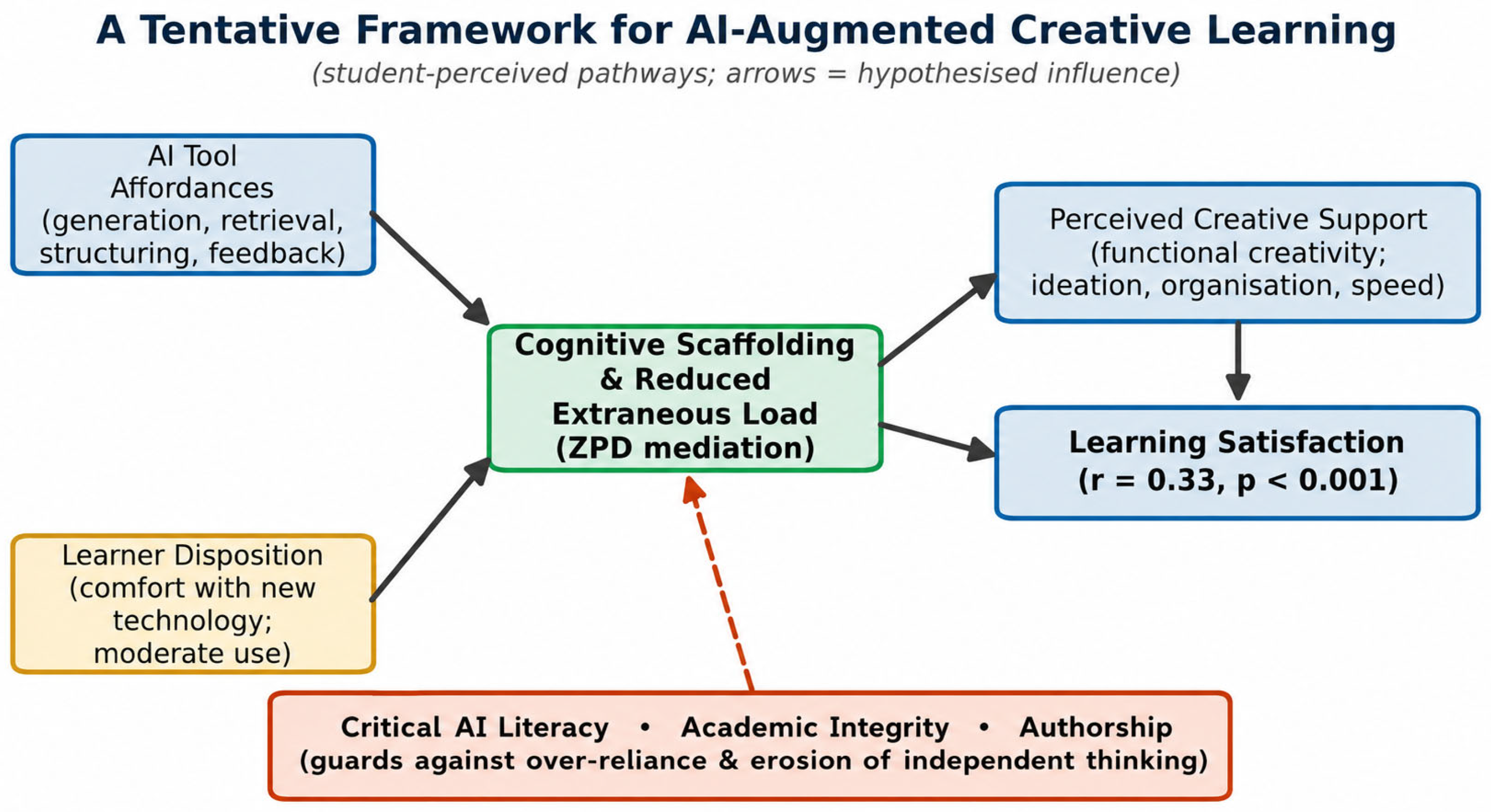
Synthesising the theoretical framing and the integrated findings, we propose the tentative framework in
Figure 2. The framework is explicitly perceptual and hypothetical: arrows denote student-perceived pathways rather than established causal effects. AI tool affordances (idea generation, retrieval, structuring, and feedback) and learner disposition (comfort with technology; moderate use) feed a mediating process of cognitive scaffolding and reduced extraneous load operating within the ZPD. This mediator supports perceived creative support, construed functionally, which in turn relates to learning satisfaction (the observed r = 0.33). Critically, the framework includes a guard condition—critical AI literacy, academic integrity, and authorship—that moderates the mediating process and protects against the over-reliance and erosion of independent thinking captured in Theme 5. We offer this framework not as a validated model but as a structured, testable articulation of the relationships suggested by the data, intended to guide confirmatory research and pedagogical design.
5.6. Implications for Educational Practice
The findings carry several concrete implications for educators in creative disciplines. First, assessment design should distinguish task facilitation from creative authorship. Because students readily use AI for efficiency, assessments that reward only polished output risk measuring tool fluency rather than creative learning; process-oriented assessment—requiring drafts, ideation logs, and reflective accounts of where and how AI was used—can re-centre originality and make authorship visible. Second, AI literacy should be taught explicitly. Students’ authenticity-management behaviour signals confusion about legitimate use; clear, discipline-specific guidance on acceptable assistance, disclosure, and integrity would replace covert workarounds with informed practice. Third, instruction should cultivate metacognition about offloading. Drawing on cognitive load theory, educators can help students decide when offloading routine work is beneficial and when retaining the effortful, germane processing is essential to building skill—precisely the judgement Theme 5 shows students struggling to make. Fourth, because comfort with technology (not prior experience) predicted perceived benefit, low-stakes onboarding activities that build confidence may broaden equitable access to AI’s creative affordances. Fifth, given the non-linear usage pattern, guidance might encourage moderate, purposeful use rather than either avoidance or saturation. Finally, the augmentation–erosion tension implies a calibration role for instructors: designing tasks that deliberately alternate between AI-supported execution and AI-free generation so that students experience both the leverage and the limits of the tools.
5.7. Limitations
Several limitations bound these conclusions. Most fundamentally, the study measured perceptions of creative support, not objectively assessed creative performance; the findings speak to how students experience AI, not to whether their creative outputs improved. Self-report data are vulnerable to social-desirability and recency biases, which may inflate positive perceptions. The design was cross-sectional and exploratory, precluding causal inference and any claim about change over time; the observed correlation is small-to-moderate and correlational. The sample was drawn from a single institution and a single national and disciplinary context, which constrains generalisability beyond Egyptian digital media undergraduates, even as it provides valuable evidence from an under-represented setting. A further limitation concerns measurement: the Perceived Creative Support subscale, although internally consistent, is newly constructed and combines four items that tap related but not identical constructs—conceptual understanding, task efficiency, future applicability, and creative authorship. Because these facets are conceptually distinct, the composite should be read as an exploratory index rather than a validated unidimensional measure, and its results interpreted with corresponding caution. The subscale would therefore benefit from formal psychometric validation, including confirmatory factor analysis on an independent sample, and from research that compares students’ self-reported creative support with external or expert assessments of their creative products. Finally, the qualitative corpus consisted of brief written responses rather than interviews, limiting the depth of some accounts. These limitations directly motivate the future directions outlined below.
6. Conclusions
This study examined how undergraduate digital media students in Egypt perceive the role of AI tools in their creativity. Across a 24-item battery (α = 0.94) and four open-ended prompts completed by 103 students, AI was widely perceived as a facilitator of creative work—not by replacing original thought, but by enabling faster, more structured, and more confident production. A four-item Perceived Creative Support subscale (α = 0.82) was associated with greater learning satisfaction (r = 0.33, p < 0.001), a small-to-moderate effect that was independent of prior AI familiarity but related to comfort with new technology and to moderate usage. Reflexive thematic analysis yielded five themes, including a critical-awareness theme in which students articulated concerns about over-reliance, authenticity, and the erosion of independent thinking.
The study’s central interpretive contribution is to show that, for these students, creativity was construed in functional rather than expressive terms, and to advance—as a hypothesis for confirmatory research—the proposition that AI-mediated learning may be reshaping students’ working definition of creativity. We position AI as a perceived cognitive scaffold, offer a tentative, testable framework for AI-augmented creative learning, and call for pedagogical models that make authorship visible and cultivate critical, student-centred tool use. Future research should employ longitudinal designs, objective and performance-based measures of creativity, multi-institutional and cross-disciplinary samples, and validation of the Perceived Creative Support scale, so as to test the hypotheses advanced here and to determine whether AI’s perceived creative benefits are matched by demonstrable creative gains.
Author Contributions
Conceptualisation, N.A.R. and M.I.Z.A.; methodology, N.A.R. and A.A.R.; formal analysis, A.A.R.; investigation and data curation, H.E. and A.A.; writing—original draft, M.I.Z.A. and N.A.R.; writing—review and editing, N.A.R., M.I.Z.A., A.A.R., A.A., and H.E. All authors have read and agreed to the published version of the manuscript.
Funding
This research was supported by the Higher Colleges of Technology (HCT) under the Applied Research Grant (Project ID: ARC_04_D006), titled “Preserving UAE Cultural Heritage through Generative AI and Immersive Technologies”.
Institutional Review Board Statement
The survey did not collect personally identifiable information, sensitive personal data, medical information, or any information that could place participants at risk. All responses were treated anonymously and analyzed only in aggregate form. Accordingly, the study was considered minimal-risk survey research with no foreseeable ethical concerns. Nevertheless, the research was conducted in accordance with standard ethical principles, including informed consent, voluntary participation, anonymity, confidentiality, and the participants’ right to withdraw at any time.
Informed Consent Statement
Informed consent was obtained from all subjects involved in the study.
Data Availability Statement
The anonymised data supporting the findings of this study are available from the corresponding author upon reasonable request.
Acknowledgments
The authors thank the students who participated in this study. During the preparation of this manuscript, the authors used generative AI tools solely for language editing and proofreading. All study design, data analysis, interpretation, and conclusions are the authors’ own; the authors reviewed and verified all content and take full responsibility for the published work.
Conflicts of Interest
The authors declare no conflicts of interest. The funders had no role in the design of the study; in the collection, analyses, or interpretation of data; in the writing of the manuscript; or in the decision to publish the results.
Appendix A. Survey Instrument (Likert Items)
All items were rated on a seven-point agreement scale: 1 = Strongly Disagree, 2 = Disagree, 3 = Slightly Disagree, 4 = Neutral, 5 = Slightly Agree, 6 = Agree, 7 = Strongly Agree. Items marked † constitute the Perceived Creative Support subscale.
Using AI tools enhanced my understanding of key digital media concepts. †
AI tools helped me complete assignments more efficiently than traditional methods. †
The knowledge I gained through AI-assisted learning will be applicable to my future coursework. †
The AI tools operated reliably without frequent technical issues.
The AI tools integrated smoothly with other course technologies.
The AI tools were accessible across different devices (desktop, mobile, etc.).
The information provided by AI tools was consistently accurate.
The AI-generated content was directly relevant to course objectives.
The AI-generated responses were well-structured and easy to understand.
Learning to operate the AI tools required minimal effort.
The interface of the AI tools was intuitive and user-friendly.
I could easily get the AI tools to do what I needed them to do.
Using AI tools increased my interest in course topics.
I was more actively involved in learning when using AI-enhanced activities.
I spent more time on course activities when using AI tools compared to traditional methods.
Technical support for AI tools was readily available when needed.
Clear guidelines were provided on how to effectively use AI tools for coursework.
Training resources for AI tools were comprehensive and helpful.
I understand the boundaries between acceptable AI assistance and academic dishonesty.
I have concerns about privacy issues related to the AI tools used in class.
Using AI tools enhanced rather than replaced my creative process. †
I intend to continue using AI tools in my future coursework if available.
I would recommend courses that integrate AI tools to other students.
I see value in developing skills in using AI for my future career.
After experiencing the AI tools in this digital media course, I feel very satisfied with my overall learning experience. (satisfaction outcome)
Open-ended prompts: (a) What specific aspects of using AI tools did you find most valuable for your learning experience? (b) What challenges or difficulties did you encounter when using the AI tools in this course? (c) What specific improvements would you suggest for the integration of AI tools in this course? (d) For which course activities did you most frequently use AI tools?
References
- Aisyah, Poppy Dwi Yulianti, Suci Yandhini, Adek Dwi Putri Sari, Irna Herawani, and Ira Oktarini. 2024. The influence of AI on students’ mind patterns. BICC Proceedings 2: 183–186. [Google Scholar] [CrossRef]
- Alshahrani, Khalid, and Muhammad Rizwan Jameel Qureshi. 2024. Review the prospects and obstacles of AI-enhanced learning environments: The role of ChatGPT in education. International Journal of Modern Education and Computer Science 16: 71–86. [Google Scholar] [CrossRef]
- Amabile, Teresa M. 1996. Creativity in Context: Update to the Social Psychology of Creativity. Boulder: Westview Press. [Google Scholar]
- Anantrasirichai, Nantheera, and David Bull. 2022. Artificial intelligence in the creative industries: A review. Artificial Intelligence Review 55: 589–656. [Google Scholar] [CrossRef]
- Boubker, Omar. 2024. From chatting to self-educating: Can AI tools boost student learning outcomes? Expert Systems with Applications 238: 121820. [Google Scholar] [CrossRef]
- Braun, Virginia, and Victoria Clarke. 2006. Using thematic analysis in psychology. Qualitative Research in Psychology 3: 77–101. [Google Scholar] [CrossRef]
- Braun, Virginia, and Victoria Clarke. 2019. Reflecting on reflexive thematic analysis. Qualitative Research in Sport, Exercise and Health 11: 589–97. [Google Scholar] [CrossRef]
- Braun, Virginia, and Victoria Clarke. 2021. One size fits all? What counts as quality practice in (reflexive) thematic analysis? Qualitative Research in Psychology 18: 328–52. [Google Scholar] [CrossRef]
- Costa, André, Firmino Silva, and José Joaquim Moreira. 2024. Towards an AI-driven user interface design for web applications. Procedia Computer Science 237: 179–86. [Google Scholar] [CrossRef]
- Creswell, John W., and Vicki L. Plano Clark. 2018. Designing and Conducting Mixed Methods Research, 3rd ed. Thousand Oaks: Sage. [Google Scholar]
- Csikszentmihalyi, Mihaly. 1996. Creativity: Flow and the Psychology of Discovery and Invention. New York: HarperCollins. [Google Scholar]
- Dwivedi, Yogesh K., Nir Kshetri, Laurie Hughes, Emma Louise Slade, Anand Jeyaraj, Arpan Kumar Kar, Abdullah M. Baabdullah, Alex Koohang, Vishnupriya Raghavan, Manju Ahuja, and et al. 2023. “So what if ChatGPT wrote it?” Multidisciplinary perspectives on opportunities, challenges and implications of generative conversational AI. International Journal of Information Management 71: 102642. [Google Scholar] [CrossRef]
- Fakhri, M. Miftach, Ansari Saleh Ahmar, Andika Isma, Rosidah, and Della Fadhilatunisa. 2024. Exploring generative AI tools frequency: Impacts on attitude, satisfaction, and competency in achieving higher education learning goals. EduLine: Journal of Education and Learning Innovation 4: 196–208. [Google Scholar] [CrossRef]
- Glăveanu, Vlad Petre. 2014. Distributed Creativity: Thinking Outside the Box of the Creative Individual. Cham: Springer. [Google Scholar]
- Guilford, Joy Paul. 1967. The Nature of Human Intelligence. New York: McGraw-Hill. [Google Scholar]
- Karanjakwut, Chalermsup, and Kamonwan Charunsri. 2025. Transforming AI chatbots for a brainstorming teaching technique of process writing. Malaysian Online Journal of Educational Technology 13: 1–18. [Google Scholar] [CrossRef]
- Kaufman, James C., and Ronald A. Beghetto. 2009. Beyond big and little: The Four C model of creativity. Review of General Psychology 13: 1–12. [Google Scholar] [CrossRef]
- Klingbeil, Artur, Cassandra Grützner, and Philipp Schreck. 2024. Trust and reliance on AI—An experimental study on the extent and costs of overreliance on AI. Computers in Human Behavior 160: 108352. [Google Scholar] [CrossRef]
- Lincoln, Yvonna S., and Egon G. Guba. 1985. Naturalistic Inquiry. Beverly Hills: Sage. [Google Scholar]
- Ogunleye, Bayode, Kudirat Ibilola Zakariyyah, Oluwaseun Ajao, Olakunle Olayinka, and Hemlata Sharma. 2024. Higher education assessment practice in the era of generative AI tools. Journal of Applied Learning & Teaching 7: 46–56. [Google Scholar] [CrossRef]
- Presseisen, Barbara Z., and Alex Kozulin. 1992. Mediated learning—The contributions of Vygotsky and Feuerstein in theory and practice. Psychology and Education. Available online: https://api.semanticscholar.org/CorpusID:73658614 (accessed on 13 February 2026).
- Runco, Mark A., and Garrett J. Jaeger. 2012. The standard definition of creativity. Creativity Research Journal 24: 92–96. [Google Scholar] [CrossRef]
- Sawyer, R. Keith. 2012. Explaining Creativity: The Science of Human Innovation, 2nd ed. New York: Oxford University Press. [Google Scholar]
- Smolansky, Adele, Andrew Cram, Corina Raduescu, Sandris Zeivots, Elaine Huber, and René F. Kizilcec. 2023. Educator and student perspectives on the impact of generative AI on assessments in higher education. In Proceedings of the Tenth ACM Conference on Learning@Scale. New York: ACM, pp. 378–82. [Google Scholar] [CrossRef]
- Sternberg, Robert J. 2024. Do not worry that generative AI may compromise human creativity or intelligence in the future: It already has. Journal of Intelligence 12: 69. [Google Scholar] [CrossRef] [PubMed]
- Sundar, Aparna, Tony Russell-Rose, Udo Kruschwitz, and Karen Machleit. 2025. The AI interface: Designing for the ideal machine-human experience. Computers in Human Behavior 160: 108539. [Google Scholar] [CrossRef]
- Sweller, John. 1988. Cognitive load during problem solving: Effects on learning. Cognitive Science 12: 257–85. [Google Scholar] [CrossRef] [PubMed]
- Sweller, John, Jeroen J. G. van Merriënboer, and Fred Paas. 2019. Cognitive architecture and instructional design: 20 years later. Educational Psychology Review 31: 261–92. [Google Scholar] [CrossRef]
- Torrance, E. Paul. 1974. Torrance Tests of Creative Thinking: Norms-Technical Manual. Lexington: Personnel Press. [Google Scholar]
- Vinchon, Florent, Todd Lubart, Sabrina Bartolotta, Valentin Gironnay, Marion Botella, Samira Bourgeois-Bougrine, Jean-Marie Burkhardt, Nathalie Bonnardel, Giovanni Emanuele Corazza, Vlad Glăveanu, and et al. 2023. Artificial intelligence & creativity: A manifesto for collaboration. Journal of Creative Behavior 57: 472–84. [Google Scholar] [CrossRef]
- Vygotsky, Lev S. 1978. Mind in Society: The Development of Higher Psychological Processes. Cambridge: Harvard University Press. [Google Scholar]
- Yim, Iris Heung Yue, and Jiahong Su. 2025. Artificial intelligence (AI) learning tools in K-12 education: A scoping review. Journal of Computers in Education 12: 93–131. [Google Scholar] [CrossRef]
| Disclaimer/Publisher’s Note: The statements, opinions and data contained in all publications are solely those of the individual author(s) and contributor(s) and not of MDPI and/or the editor(s). MDPI and/or the editor(s) disclaim responsibility for any injury to people or property resulting from any ideas, methods, instructions or products referred to in the content. |




 ,
,