1. Introduction
The conflict in Gaza, which has intensified significantly since 7 October 2023, has been described as genocide in recent research, including that of (
Goldschmidt 2023), the dedicated forum in the Journal of Genocide Research by scholars such as (
Moses 2026) and (
Levene 2024). Furthermore, the International Court of Justice, in its Order of 26 January 2024, indicated provisional measures directing Israel to take all measures within its power to prevent the commission of acts within the scope of Article II of the Genocide Convention in relation to Palestinians in Gaza. This is not an isolated event, but part of a chain of clashes that have affected the region for more than 75 years, as (
Martín 2024) argues. The continuity of the conflict is evidence of deep historical and geopolitical roots that continue to determine the reality of the Gazan population today.
Since the beginning of this new phase of violence, several reports have documented systematic human rights violations, particularly against civilians, including women and children. While the media initially played an important role in publicising these events, there has been a gradual decline in media coverage. This reduction not only weakens international pressure on the actors involved, but also contributes to a decline in global awareness of the gravity and persistence of the crisis.
In this critical context, the role of universities and academia in general is fundamental. Higher education institutions, as centres of knowledge and critical education, must not only provide rigorous and contextualised information about these events, but also foster in-depth analyses of their causes and consequences. According to Smith, it is crucial that universities challenge the simplified narratives promoted by the media and encourage a more complex and informed approach to international conflicts (
Goldschmidt 2023). Complementarily, Rivera argues that universities, given their strategic position in society, should take an active role in promoting human rights and a culture of social justice (
Martín 2024).
The situation of the Israeli–Palestinian conflict, especially in Gaza, has been the subject of increasing academic analysis in recent years. Several studies have shown how representations of the conflict are profoundly shaped by the political, cultural and media context. According to (
Musuruana and Aguilar 2022), the level of knowledge about the conflict directly influences attitudes and support towards the Palestinian population, with better-informed individuals more likely to show empathy and support. Furthermore, the study by (
Gómez et al. 2024) highlights the need to integrate a culture of peace into academia, so that students not only understand the dynamics of the conflict, but also develop a critical stance towards the simplified narratives that often prevail in the media. Smith argues that universities have a crucial role to play in this process by providing a space for in-depth analysis of international conflicts and by promoting reflection that overcomes reductionist approaches (
Goldschmidt 2023). This academic context becomes a key terrain for exploring how students, as future leaders and agents of change, approach the Palestinian conflict, especially when considering the various influences that cultural, educational and media frameworks may have on their understanding of the conflict.
In this sense, it is particularly relevant to understand the perception that university students have of the situation in Palestine. As future leaders and agents of social change, their vision and commitment are fundamental to building a culture of peace and respect for human rights. Analysing their perspectives will not only identify their degree of awareness and sensitivity to the conflict, but also enhance their capacity for critical and transformative action in contemporary society.
Recent research has begun to address public perceptions of the Israeli–Palestinian conflict, although studies focusing exclusively on academics are still limited. For example, research conducted in Argentina and Spain analysed how the level of knowledge about the conflict influences the degree of support and concern towards the Palestinian population, showing that more information is associated with more supportive attitudes (
Musuruana and Aguilar 2022). On the other hand, a comparative study between Spanish and Portuguese university students examined the perception and management of conflict in general, highlighting the need to integrate training in the culture of peace within the academic environment (
Gómez et al. 2024). Similarly, an analysis of Spanish citizens’ perceptions of the Palestinian refugee population revealed a notable lack of knowledge about the real situation, highlighting the urgency of educational strategies to raise awareness in society (
Unrwa España 2023). Taken together, these studies show that social perception—and in particular university perception—constitutes a fundamental field of study for strengthening the culture of peace and human rights in the contemporary context.
Therefore, considering the relevance of the role of young university students in the construction of a more just and committed society, this study aims to analyse the perceptions that current university students have about the situation in Palestine, based on a sample located in the north of Spain. To guide this analysis, the following research questions were established: (1) What are the main social representations of the Palestinian conflict among education students? (2) How do demographic variables such as gender and academic degree influence these representations? Based on the literature, we hypothesized that student discourses would predominantly reflect humanitarian and emotional concerns (H1) and that students from more socially and politically oriented degrees (such as Social Education) would exhibit a more politicized framework compared to Primary Education students (H2).
3. Results
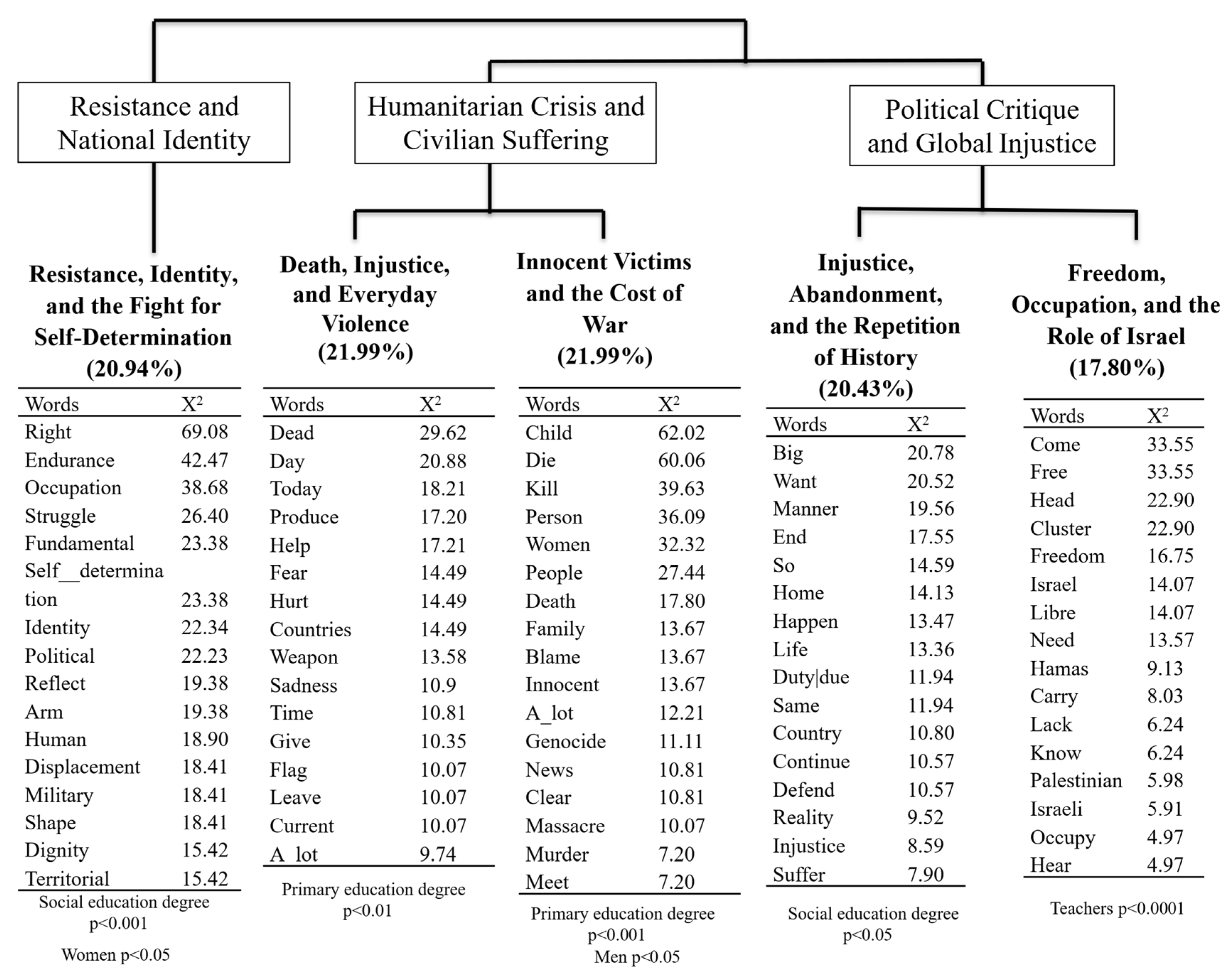
The Reinert method, utilizing descending hierarchical analysis, was employed to identify the core ideas expressed by participants regarding their representations of Palestine. Each theme or concept is encapsulated within a distinct set of characteristic words and text segments, collectively forming a lexical class. The analysis segmented the corpus into 230 sections, yielding five distinct classes, as illustrated in
Figure 1. A comprehensive discussion of these classes will be provided in the subsequent sections of this article.
The descending hierarchical dendrogram resulting from the Reinert analysis revealed three main clusters, each encompassing different lexical classes and thematic orientations. The first cluster, titled “Resistance and National Identity”, includes Class 1 and focuses on the Palestinian people’s struggle for self-determination, dignity, and collective identity. This class is marked by references to occupation, historical memory, and political resistance. The second cluster, named “Humanitarian Crisis and Civilian Suffering”, integrates Classes 2 and 3, and is characterized by emotionally charged narratives centered on death, fear, injustice, and the devastating effects of the conflict on civilians—especially children and women. Finally, the third cluster, titled “Political Critique and Global Injustice”, comprises Classes 4 and 5, which are more explicitly political. These classes emphasize systemic oppression, occupation, and the demand for Palestinian freedom, and include critical discourses on the role of Israel, global silence, and structural power imbalances. Together, the three clusters offer a comprehensive map of the social representations articulated by participants in relation to the Palestinian situation. The results will be presented class by class.
3.1. Class 1—Resistance, Identity, and the Fight for Self-Determination
“Resistance, Identity, and the Fight for Self-Determination” represents 20.94% of the total corpus and was significantly more mentioned by Social Education students (p < 0.001) and women (p < 0.05). This class reflects how participants understand the Palestinian struggle as a historical and political fight for dignity, rights, and national autonomy.
A key theme in this class is the concept of resistance as a multidimensional response to oppression—both physical and symbolic. Participants describe the long-term Israeli occupation as a form of control that affects not only territory but also identity and freedom. One participant writes, “Because it reflects the struggle of the Palestinian people to maintain their identity, their rights, and their territory. It describes the military and political control exercised by Israeli forces over Palestinian territories, amid a genocide that spans several decades of occupation, affecting their self-determination and freedom.” (χ2 = 287.75).
Participants emphasize the continuity and adaptability of Palestinian resistance. Another adds, “Palestinian resistance in various forms has been constant in the struggle for self-determination and in defending their rights and their territory. The conflict between Israelis and Palestinians is one of the longest and most complex territorial and political disputes in the world.” (χ2 = 241.77).
The occupation is also linked to global humanitarian concerns. One participant notes, “This territorial and political conflict has generated violence, international tensions, and deep divisions that have affected millions of people. For years, many Palestinians have fought for the right to self-determination and the creation of their own state.” (χ2 = 233.74).
In addition to territorial issues, cultural and historical preservation is a key idea. One student explains, “Palestinian resistance is reflected in how they defy attempts to erase their history and identity. This concept of resistance is deeply rooted in the Palestinian narrative as a moral and political right to counter oppression and reclaim self-determination.” (χ2 = 222.67).
The experience of displacement is also a central concern in this class. As one participant puts it, “Resistance represents the Palestinian people’s struggle for their rights and self-determination. Displacement refers to the situation of many Palestinians who have been forced to leave their homes as a consequence of the conflict.” (χ2 = 209.09).
Participants describe human rights violations as a direct result of the occupation. “The human rights of Palestinians have been violated over the years, especially due to the Israeli occupation, limiting their access to basic services and their freedom of movement. Resistance. Resistance.” (χ2 = 190.93).
They also discuss the symbolism of concepts like dignity. “The word displacement explains this situation. Dignity in the Palestinian context is used to reflect the struggle for rights and identity.” (χ2 = 177.51).
Military control and the situation in Gaza are seen as emblematic of the conflict. “The situation in Gaza is one of the main aspects of the conflict. The occupation entails military and political control over the territories that Palestinians claim as theirs, and it has generated major tensions.” (χ2 = 177.39).
Beyond physical resistance, some participants reflect on psychological and cultural endurance. “Building communities and keeping their traditions and culture alive despite the difficulties. This ability to overcome extreme situations and continue fighting for survival and rights reflects a resistance that is not only physical, but also psychological and emotional.” (χ2 = 176.81).
Finally, the theme of multiform resistance and forced migration emerges as a powerful conclusion. “Palestinian resistance in defense of their rights and territory has persisted for years in different forms, both peaceful and more active. Displacement has forced many Palestinians to leave their homes and become refugees.” (χ2 = 175.49).
3.2. Class 2—Death, Injustice, and Everyday Violence
“Death, Injustice, and Everyday Violence” represents 21.99% of the total corpus and was significantly more mentioned by students from the Primary Education program (p < 0.01). This class captures the emotional and humanitarian impact of the conflict in Palestine, focusing on the daily suffering, deaths, fear, and the perceived inaction of the international community. While Class 1 emphasized identity and resistance, Class 2 reflects on the current violence and the helplessness it evokes.
A dominant theme is the ongoing reality of death and devastation, often linked to the word “genocide.” One participant writes, “Genocide, because there are many deaths. It is an unfair injustice that something like this is happening today and nothing is being done to stop it. The sadness of seeing no change, no action. Nothing is being done to change the situation.” (χ2 = 105.22).
The scale and intensity of the violence, especially in Gaza, is frequently highlighted: “Genocide, because a genocide is taking place in Palestine. Today, most bombings are in Gaza. The bombings continue, many Palestinian children are dying in this genocide.” (χ2 = 98.50).
Participants also describe the situation as a geopolitical conflict between two countries, emphasizing its chaotic and destructive nature: “Conflict, because it happens between two countries. War, because there are many injured and dead. Chaos, because it is a large-scale conflict. Crisis, because the country faces a huge economic and social problem.” (χ2 = 86.47).
Emotional responses such as fear, helplessness, and invisibility also emerge: “Injustice, because they are being expelled from their territory and violence is not the solution. Fear, because this extreme situation has been going on for a long time and it doesn’t end. Invisible, because compared to other wars, like Ukraine, it receives much less governmental response.” (χ2 = 78.49).
The normalization of violence and daily suffering is also emphasized: “War, because it is something that is happening today in that territory. Genocide, genocide. Bombs, because every day people are killed. Weapons that are killing. These are conflicts because they have always had conflict.” (χ2 = 73.35).
The presence of symbols of the conflict, like the flag, reinforces the idea of omnipresent violence: “Flag, it’s everywhere. Conflict is the foundation of what is happening. Victims, the number of wounded and deaths keeps increasing every day. War, because that’s what has been going on for a long time.” (χ2 = 73.06).
Some participants express frustration at the lack of aid and the portrayal of Palestinians only as victims: “In the end, the information we receive about Palestine is about the war they are suffering. Victims. Unfortunately, the current situation is leaving many victims and injured people, and not enough is being done to help them.” (χ2 = 72.29).
Others describe the situation in terms of loneliness and despair: “I used the expression ‘at war’ because what’s happening there today is suffering. I wrote ‘suffering’ because those people are alone and have no opportunities.” (χ2 = 63.22).
There is also a recurring connection between bombings, suffering, and injustice: “I wrote ‘bombs’ because in Palestine there are bombings. ‘Deaths’ because there is war. ‘Suffering’ because the people suffer. ‘Injustice’ because they are forced to endure a war as innocent people.” (χ2 = 63.22).
Amid the pain, some mention hope for justice and an end to the violence: “Hope that this situation will improve and that we will achieve justice. Because many people have died. Because it’s an injustice. Because of everything that has happened, they are in a very bad situation.” (χ2 = 62.65).
Finally, the territorial dimension and collective sadness are also present: “They are at war. They are partly fighting over territory. There are many deaths. People are very sad.” (χ2 = 57.41).
3.3. Class 3—Innocent Victims and the Cost of War
“Innocent Victims and the Cost of War” represents 21.99% of the total corpus and was significantly more mentioned by students from the Primary Education degree (p < 0.001) and by men (p < 0.05). This class centers on the violence against civilians, particularly children, women, and families, and frames the conflict in Palestine as a humanitarian catastrophe. The emotional tone is marked by a sense of injustice, helplessness, and grief for the loss of innocent lives.
The dominant theme is the killing of non-combatants, especially minors. One participant writes, “Genocide—they accuse Israel of inciting genocide in Gaza. Death—because so many people are dying: children, women, men, the elderly. Suffering—there is so much suffering every day. Children are left orphaned. Injustice—this is an injustice. Innocent people are being killed.” (χ2 = 325.92).
Another adds, “Because in this conflict they are especially killing women and children. Deaths—I wrote the word ‘deaths’ because many people have died and continue to die because of this conflict.” (χ2 = 270.24).
The scale and brutality of the violence is also emphasized. One participant writes, “Because genocide is a word that is always mentioned. Pain—there is a lot of pain at the moment. Families and people suffer as they flee their homes from bombings and fires. Assassinations—children, women, men, entire families are being killed.” (χ2 = 230.37).
For many, war is the defining word: “War—because they are at war. Death—because people are being killed. Children—many children are dying. Civilians—people are staying despite the war.” (χ2 = 224.84).
Participants also describe the devastation of civilian life: “Because there is war. Hunger—children are being killed. The dead are suffering immensely. Their families, homes, and loved ones are being destroyed.” (χ2 = 223.33).
The situation in Gaza is mentioned explicitly, with references to innocent victims: “War—because of the current situation, that’s all we can think about. Gaza—one of the most affected places. Children—one of the groups most affected, completely innocent. Massacre—it seems like a massacre, with so many innocent people dying.” (χ2 = 215.79).
This sense of catastrophe and moral urgency is reflected in: “Catastrophe—what is happening there is a catastrophe, where many people are dying, especially children and women.” (χ2 = 205.49).
The call for a solution and recognition of personal loss is also present: “Conflict—because it’s the main problem in Palestine. We need a solution. Children—so many children and people are dying, crying. Many people feel terrible, for example because they’ve lost family members.” (χ2 = 201.38).
Participants also critique the long-standing mistreatment of civilians: “Because the country is one where genocide is killing everyone. For many years, children and women have been mistreated. All they talk about is war.” (χ2 = 196.27).
There are also references to displacement and the loss of childhood: “War—they are at war. Death—so many people are dying. Civilians—people have to flee their country and endure constant conflict. Children—their childhoods are being destroyed.” (χ2 = 182.43).
Finally, the impact of war and death is reiterated as the central concern: “War—the word war explains what’s happening. Many people are dying because of these conflicts. Death—death describes what these wars cause. All it does is lead to more death.” (χ2 = 179.56).
3.4. Class 4—Injustice, Abandonment, and the Repetition of History
“Injustice, Abandonment, and the Repetition of History” represents 17.28% of the total corpus and was significantly more mentioned by students in the Social Education degree (p < 0.05). This class focuses on perceptions of historical injustice, global indifference, and the moral responsibility to denounce and stop the violence in Palestine. It frames the conflict not only as a humanitarian catastrophe, but as a repetition of historical traumas that humanity has failed to prevent.
A key theme is the framing of the conflict as a deliberate and unjust extermination. One participant writes, “Genocide—they want to exterminate the Palestinians due to religious and political reasons. Massacre—what is happening is a massacre, as lives are being taken in a chaotic and unjust manner.” (χ2 = 92.93).
Participants also emphasize the overwhelming sense of injustice and silence: “Death—death is dominating the Palestinian people, and not enough is being said about it. Injustice—what is happening to them is a great injustice, as they are not to blame for being born there or for wanting to defend their country.” (χ2 = 92.13).
Many responses highlight expulsion, loss of land, and defenselessness: “Genocide—I refer to genocide when speaking about the current conflict in Palestine, as innocent and defenseless people are being expelled from their lands, homes, and territories, and in most cases, their lives are taken unjustly.” (χ2 = 76.17).
Another participant links the present situation with a repetition of historical atrocities: “Catastrophe—it is a great catastrophe because the same story is repeating again. Instead of humanity progressing and avoiding the mistakes of the past, the same terrible histories keep happening.” (χ2 = 75.81).
Participants also show awareness of child victimization and media disinformation: “Children—through the talk, I realized the role children suffer, treated like mere objects. Disinformation—I’ve become aware of the massive disinformation we face, as we only know 1% of the real situation.” (χ2 = 62.75).
Other statements reflect a cultural and political awareness, emphasizing the need to defend identity and resist stereotypes: “This affects childhood. Culture—because it is important to continue defending this country’s culture despite what is happening, and to adopt a critical attitude toward many of the stereotypes we hold about it.” (χ2 = 60.52).
Some highlight the asymmetry of power and resources: “Injustice—because the Palestinian population does not have enough resources to face Israel. Moreover, Israel receives significantly more support than Palestine. Sadness—that’s what conscious people feel.” (χ2 = 60.26).
The suffering is described as a hard and painful reality: “Reality—the harsh reality they are living. Sadness—for the people who are dying. Harsh—so many people are dying. Injustice—it’s unjust that Israel wants to continue the conflict.” (χ2 = 58.39).
One participant articulates a desire for peace: “Because injustice is not fair. Deaths—because the country is not fair to its people. I want the war to end.” (χ2 = 57.47).
Others describe a resilient struggle to survive and preserve identity: “Facing oppression and ethnic cleansing that has been happening for a decade in Palestine. Palestinians remain in their country, surviving as best they can and protecting their culture, customs, and way of life.” (χ2 = 57.46).
Finally, there is a powerful accusation of abandonment by the international community: “Injustice—because they’ve been expelled from their lands. Violence—because of the severe repression they are enduring. Genocide—because this is not a war. Abandonment—they’ve been abandoned by all countries, and no one has intervened to help.” (χ2 = 57.46).
3.5. Class 5—Freedom, Occupation, and the Role of Israel
Freedom, Occupation, and the Role of Israel represents 17.80% of the total corpus and was significantly more mentioned by teachers (p < 0.0001). This class centers on the political dynamics of the Israeli occupation, the demand for Palestinian freedom, and how Israel is perceived as the central actor in the conflict. The statements reflect a high level of political engagement and express strong views regarding occupation, genocide, and the right to live freely.
A recurring theme is the demand for liberation and the condemnation of Israeli policies. One participant writes, “Genocide—because what is happening is a genocide committed by Israel against Palestine and its people. Freedom—we need a free Palestine. Citizens need freedom to live in their country, free from the clutches of the Israeli genocidal regime. Resistance.” (χ2 = 103.71).
Others describe the long-standing lack of freedom due to military and political control: “For decades, they haven’t had that freedom because of Israel’s military and political pressure. War—the word that comes to mind is war, because currently it seems like they are at war, or that’s what the international media wants us to believe.” (χ2 = 91.68).
The perception of Israel as the core of the problem is central: “What is happening is extermination. Israel—I inevitably think of Israel, because nowadays, to understand Palestine, one must mention Israel and what it is doing to the Palestinian population.” (χ2 = 90.63).
Participants also highlight the lack of freedom and daily violence: “They are not free. Bombings—the first thing that comes to mind is the number of deaths happening. Tragic—it is a tragic situation, and that’s what comes to mind.” (χ2 = 90.01).
Several statements reflect how Israel and Palestine dominate the media discourse: “Asia—because it’s one of the most well-known countries in that region. Conflict—that’s the word that comes to mind, because it’s one of the most mediatised topics…” (χ2 = 68.75). This specific geographically incorrect response underscores that while students possess a strong emotional and ethical framing of the conflict, their foundational factual or geographic knowledge of the region can be uneven.
The class also includes explicit references to Hamas, occupation, and perceptions of a radicalized struggle: “They are at war—because Israel wants to occupy Palestine. The attacks—because they are under Palestinian attack. Hamas—because Hamas is the most well-known radical Palestinian group.” (χ2 = 65.49).
Some participants present war as the defining experience of the region: “War—the word war comes to mind because it is the most prominent thing happening in the country right now.” (χ2 = 65.24).
There are also reflections on poverty and unmet basic needs: “Poverty—the word poverty comes to mind, because from my perspective, people living in Palestine lack many necessities and are often forced to live in precarious conditions.” (χ2 = 62.44).
A few voices include Basque solidarity slogans, such as “Palestina askatu” (Free Palestine): “War—because they are at war. Genocide—because they are being exterminated. Palestina askatu—because that is what we say. Free.” (χ2 = 58.59).
Others mention the dual responsibility in the conflict but insist on the need for Palestinian freedom: “The conflict between Israel and Palestine. Free—because Palestine should be free. Israel—against Israel, this bitter conflict for the world. Murders—because there are many killings on both sides.” (χ2 = 56.51).
Statements also reflect the global visibility and silence: “Genocide—the genocide now taking place in Palestine, more than a war. Systematically, people and Palestinians are being attacked, including basic needs for survival, under the justification that they belong to the terrorist group Hamas.” (χ2 = 53.76).
Lastly, several participants emphasize the historical right to freedom and land: “Genocide—because genocide is being committed against the Palestinian population before the eyes of the whole world. Freedom—because they need the freedom they are asking for to live in their lands, just like their ancestors did for hundreds of years.” (χ2 = 53.75) “Palestine—Palestina askatu. They have to—stop. Free now.” (χ2 = 53.61).




 ,
,