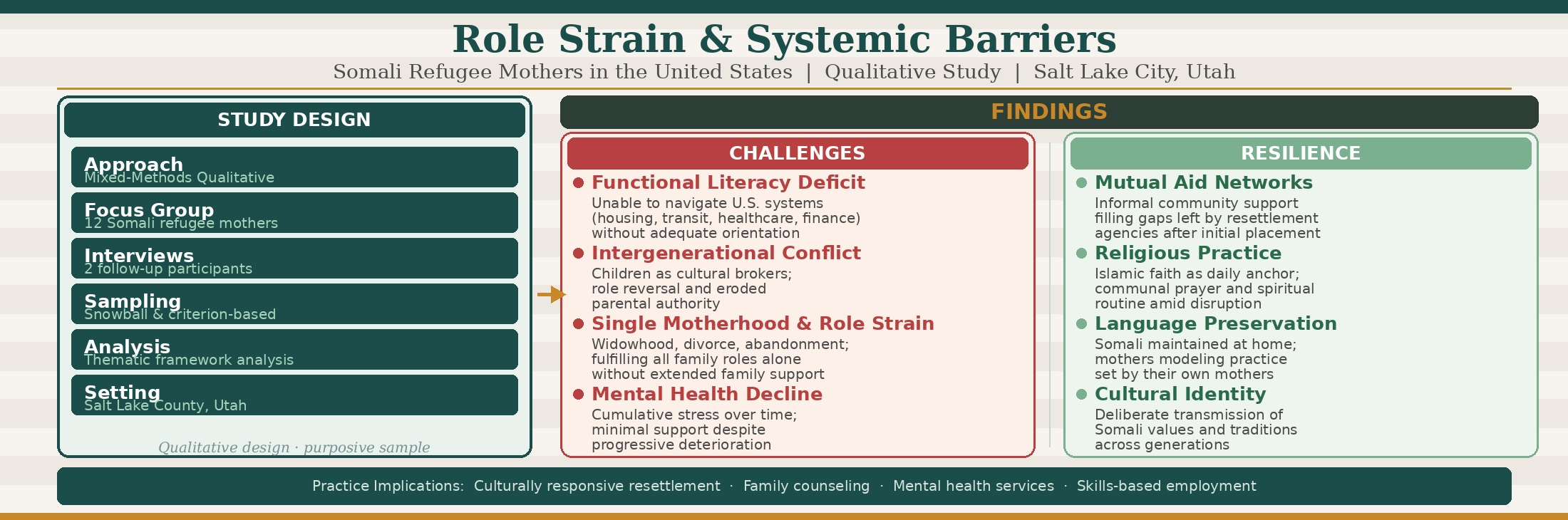
Role Strain and Systemic Barriers: A Qualitative Study of Somali Refugee Mothers in the United States

Abstract
1. Introduction
Conceptual Framework
2. Materials and Methods
2.1. Qualitative Research Aim
2.2. Research Design and Participants
2.3. Data Collection
2.4. Data Analysis
2.5. Background of the Researchers
2.6. Ethical Considerations
3. Results
3.1. Qualitative Findings
3.2. Structural and Systemic Barriers
3.2.1. Orientation and Information Gaps
They gave me a bus pass, but no one showed me how to use it. I did not know which bus to take or where it would go. So, I walked to get groceries. I left when the sun was high, and I did not come back until it was dark.—Participant J, age 45, 5 children
The lights went out. Everything went dark, and the heat stopped. I did not know what to do. I called my caseworker, but no one answered. I called again and again. It was the weekend. We sat in the cold and the dark for days, me and my children, until Sunday. I went outside and happened to find a man who spoke Arabic. I told him about the problem. He came and showed me a small switch on the wall. That was all it was. A small switch called a fuse box, and then we had light.—Participant F, age 41, 6 children
3.2.2. Financial Literacy and Housing
When I arrived, they gave me a card, like a plastic card. But nobody told me what it is or how to use it. And the rent, they said, I must pay with something called a money order. I did not know what this is. Where do I get it? How do I put the money on it? No one explained this to me. In Somalia, if you are a few days late, your landlord knows you. He is patient. He understands. I was so ashamed. I was scared. I did not know the rules were so different here.—Participant H, age 38, 6 children
When I saw that paper on my door, I did not understand it, but I felt something was wrong. My heart was beating fast. I took it to a neighbor, and she read it to me and said you must leave. I started to cry In Somalia, there is more talking between people. You go to your landlord, and you explain, and he listens. Here, there is just a paper. No talking. Just you must go.—Participant H, age 38, 6 children
3.2.3. Transportation and Healthcare Access
I do not know how to drive here. In Somalia, I never drove. But I had that paper, the eviction notice, and I did not know what to do or where to go, and there was no one to take me. So, I got in the car. I thought I must go and find help; I must show someone this paper. I was driving, and there was a light, and it turned red, but I did not know. I did not understand all the rules of the lights and the roads here. I went through it. Someone honked at me, and I was so scared I pulled over, and I was shaking. I was just trying to save my home for my children. I did not know what else to do.—Participant H, age 38, 6 children
They made the appointment for me, but they do not help me get there. I do not have a car. I do not know the bus. So, I tried to go early, I walked a long time to get there early, and they said, no, your appointment is not until later, you must leave and come back. But I cannot just wait there, I have my children. So, I went home. And then I could not get back in time. And then they sent me a paper saying I owe money because I did not come. I did not come because I had no way to come. And now I owe money I do not have. After that, I thought it is better not to go to the doctor. Every time I try to do the right thing, there is a penalty. I do not want another paper telling me I owe something. So, I just don’t go. But my children need to see a doctor.—Participant C, age 42, 7 children
3.2.4. Employment
In Somalia, I had skills. I had work that I knew how to do well. I was not an uneducated woman. But when I came here, they looked at me, and they gave me a mop. They said, “You will clean.” Nobody asked me what I can do. Nobody asked me what I know. I wanted to work. I was so ready to work, but not like this. Not because I am too proud, but because I have something to give and they did not want to see it. When you come to a new country, you already feel like you are starting from nothing. You have lost so much. And then someone hands you a mop and says this is your place here, it breaks something inside you. I am a mother, I am a woman who has survived very hard things, I have knowledge and ability. I wanted to build something here. I wanted to contribute something real. Instead, I felt invisible. Like they had already decided what I was before they ever spoke to me.—Participant D, age 26, 5 children
3.3. Acculturation and Intergenerational Conflict
3.3.1. Technology and Role Reversal
My child, she is ten years old, she takes my phone, and she shows me. She finds the place on the map, she tells me which way to go, and she helps me talk to people I do not understand. I am grateful for this. But inside I feel something that is hard to say. In Somalia, I was the one who knew things. I was the one my children came to. I was the guide. Here, my daughter looks at me sometimes like she is the mother, and I am the child who needs help. She does not mean to make me feel this way, she is a good girl, but when your child must teach you how to find the grocery store on a telephone, something shifts between you. I do not want her to carry this. She is a child. She should be playing. Instead, she is translating my life for me. It is a strange and painful thing to feel lost in front of your own children.—Participant A, age 23, 3 children
3.3.2. Economic Role Reversal and the Erosion of Elder Support
Every month, I send money to my mother and my father in Somalia. This is not a question for me. This is what a child does. This is what I have always done and what I will always do. But my children here, they have grown up in America now, they do not think this way anymore. They do not give to me. I do not say they are bad children. But something has changed in them that I do not fully understand. I raised them to know that family takes care of family. That’s when your mother is old, you are there. But America has taught them something different. And so, I am sending money to my parents with one hand, and with the other hand, I have nothing coming back to me. I am in the middle. I am holding both sides, and nobody is holding me. In Somalia, this would never happen. The children take care of the parents; this is the foundation of everything. When that breaks, something very deep breaks with it.—Participant D, age 26, 5 children
3.3.3. Parental Authority and Discipline
At home, I teach my children our way… the Somali way, the Muslim way. I teach them how we speak to elders, how we dress, what we value, what is right. But then they go to school, and they come back different. They hear other things. They see other things. And I am their mother, but I cannot be with them every moment. America is very powerful. It gets inside them. And I am just one woman in one house. What can I fight against? There is nothing I can do.—Participant C, age 42, 7 children
In Somalia, if your child does something wrong, you correct them. This is normal. This is what every mother does. This is how my mother raised me and her mother before her. It is not cruelty … it is love. It is how you teach a child to become a good person. But here they told me this is not allowed. That if I discipline my child the way I was taught, someone will come and take my children from me. And so, I stopped. I made myself stop. But when I stopped, my children knew. They knew I could not do what I used to do. And something changed. They do not listen the same way. I tell them no, and they look at me, and I can see they know I have no way to enforce it. I lost something as a mother that I do not know how to replace. Nobody gave me something to use instead. They just took away what I had and left me with nothing in its place.—Participant K, age 45, 3 children
3.4. Motherhood, Role Strain, and Mental Health
When they took him away, I felt something I did not expect. I felt relief. I will say that honestly. For the first time in a long time, I felt safe in my own home. And I was grateful—I was truly grateful that someone had seen what was happening and had stopped it. But then the door closed, and it was just me. Just me and my children in a country I do not know. No family nearby. No mother to call. No sister came to sit with me. In Somalia, even in hard times, there is always someone. Here, there was no one. I had to figure out everything alone, the rent, the school, the doctors, the bills, the bus, everything. When I came here, my mind was okay. I was strong. I had survived so much already, and I told myself I can survive this too. But it wore me down slowly. Every problem I could not solve, every paper I could not read, every night I could not sleep worrying about my children—it added up. After some time, I did not feel like myself anymore.—Participant A, age 23, 3 children
When I first came to America, I was okay. My mind was okay. I had been through hard things, but I was still strong, I could feel it. But then everything started coming at once. My child could not breathe, and I took her to the hospital and I did not understand what the doctors were saying, and I was alone. And now another child may need surgery, an operation, and again I am alone. I am the only one. There is no one to sit with me in the waiting room. No one to help me understand the papers they give me. No one to watch the other children while I am at the hospital. When I came here, I was healthy. But I am not the same now. Something has happened to me slowly. I can feel it.—Participant A, age 23, 3 children
Someone asked me if I was getting help, support for my mind, for how I was feeling. I thought about it. I wanted to give a real answer. But the real answer was “not much.” That is all. Not much.—Participant A, age 23, 3 children
People ask me how I do it. I do not know how to explain it. I am the mother, I hold them, I feed them, I comfort them when they cry at night. I am the father, I carry everything, I make every decision, I figure out every problem. I am the grandparent, I try to give them the wisdom, the stories, the roots, the sense of who they are and where they come from. All of it is me. Just me. In Somalia, these things are spread across many people. There is always someone. Here it is all on one pair of shoulders. My shoulders. I am the mother, the father, the grandparents. All of it. Every day.—Participant A, age 23, 3 children
People come to me now for help. I try to help everyone I can. But I want them to know, I was not always strong. There was a time when I could not get up. Every morning, I woke up, and I cried. Every single day I cried. I did not know how I would go on. I did not know how to do any of it, the language, the system, the loneliness, the cold. I felt like I was disappearing. Nobody knew this about me because I did not show it. But inside, I was not okay. I was not okay for a long time. I tell people this now because I want them to know that if I came through it, they can too. But it was very, very hard.—Participant D, age 26, 5 children
When the snow came, I did not know what to do. In Somalia, I had never seen snow like this. It was everywhere—on the ground, on the cars, on the stairs. I did not know how to walk in it. I did not know how to dress my children for it. And I looked outside, and there was nobody. No one on the street. No one sitting outside. In Somalia, there are always people. You walk outside, and you see your neighbor, and you talk. Here, the doors are closed, and the people are inside, and I do not know anyone. I wanted to go somewhere—anywhere—just to not feel so alone. But I could not leave my children. They are under twelve, and I was told I cannot leave them alone or I will be in trouble with the law. So I stayed inside. The snow outside and four walls around me, and nowhere to go and no one coming. It was a very lonely feeling. I did not know a person could feel so alone.—Participant H, age 38, 6 children
In Somalia, I wore sandals. That is what we wear, it is warm, it is simple. I came here, and suddenly I needed boots. Big heavy boots. And I did not know how to walk in them at first. My feet did not know what to do. It sounds like a small thing, but it is not a small thing. Every morning, putting on those boots, I felt how far I was from home. Even my feet did not recognize their life anymore.—Participants A, age 23, 3 children
In Somalia, when your child is twenty years old, they are an adult. They know how to live. They know the systems, they know the neighbors, they know how things work. You have done your job. But here, my child is twenty-two, twenty-three years old, and still, I must help them with everything. How to fill out this form. How to talk to this office. How to understand this letter that came in the mail. They are adults, but they are also lost, just like me. And so I am still fully a mother in a way I never expected to be at this stage of my life. In Somalia, I would have had some rest by now. I would have had some time for myself. Here, there is no rest. The parenting does not get lighter; it just changes its shape. I did not expect this. I did not know it would go on so long.—Participant C, age 42, 7 children
Someone asked me about my life, about me, not my children, not my cases, not the people I help. About me. And I had to stop and think. I have been doing everything alone for so long now. Everything falls on me. I wake up, and it falls on me, and I go to sleep, and it falls on me. And I realized, I am forgetting what it was like to be married. To have someone beside you. To not carry everything alone. I am forgetting that feeling. It has been so long.—Participant D, age 26, 5 children
3.5. Resilience and Community Support
3.5.1. Internal Community Networks
For one year, I was alone with all of it. One whole year. I was crying, and I needed help, and I would go to people, and they would see me crying, and they would turn away. Nobody wanted to be around someone who was struggling like that. Nobody wanted to take it on. I understand -everyone has their own problems. But I was drowning, and I could not find anyone to take my hand. And then I found her. I found D. And she did not turn away from me. She saw me crying, and she did not leave. She sat with me. She helped me. After one year of feeling like I was invisible, someone finally saw me. That changed everything for me. Everything.—Participant A, age 23, 3 children
3.5.2. Religious Practice and Spiritual Anchoring
When everything else was falling apart, when I did not understand the papers, when I did not have enough money, when I was lonely and scared—I still had my prayers. Five times a day, I stopped everything, and I prayed. It did not matter what was happening around me. That time belonged to Allah. And in those moments, I was not a confused woman in a strange country. I was just a servant of God, the same as I have always been. The same as my mother was. Prayer gave me a shape to my day when everything else felt like it had no shape. It reminded me who I am when everything around me was telling me I was nobody.—Participant E, age 48, 11 children
3.5.3. Language and Cultural Preservation
In my house, we speak Somali. This is the rule. My children go to school, and they speak English all day. I know this, I accept this. But when they come through my door, they speak Somali. My mother did this for me, and I understood why, even when I was young. Language is not just words. It is everything that comes with the words, the way we think, the way we show respect, the way we tell our stories. If my children lose the language, they lose a part of themselves they cannot get back. I will not let that happen inside my own home. That I can control. That I will protect.—Participant C, age 42, 7 children
I take my children to the Somali events, the celebrations, the gatherings, whenever I can find them. I want them to see other Somali people. I want them to hear the music and eat the food and be around people who look like them and talk like them. Because at school, they are immersed in another world completely. And I worry that if I do not show them where they come from, they will grow up not knowing. They will be caught between two worlds and belong fully to neither. When we go to these events, I watch my children, and I see something settle in them. Like they remembered something they had almost forgotten. That is why I go. That is why I will keep going.—Participant F, age 41, 6 children
3.6. A Comparative Perspective
4. Discussion
4.1. Systemic Barriers and Functional Literacy
4.2. Acculturation and Intergenerational Dynamics
4.3. Single Motherhood, Role Strain, and Mental Health
4.4. Resilience and Community Coping
4.5. Implications for Practice
4.6. Limitations
5. Conclusions
Author Contributions
Funding
Institutional Review Board Statement
Informed Consent Statement
Data Availability Statement
Acknowledgments
Conflicts of Interest
References
- Ahmad Ali, Mehrunnisa. 2024. Research with Refugee Children, Youth, and Families: Ethical Issues (Working Paper No. 2024/09); Toronto Metropolitan Centre for Immigration and Settlement. Available online: https://www.torontomu.ca/content/dam/centre-for-immigration-and-settlement/tmcis/publications/workingpapers/wp-2024-09-ali.pdf (accessed on 25 February 2026).
- Al Jazeera. 2025. Trump Plans Crackdown on Somali Communities in Minnesota: What We Know. Available online: https://www.aljazeera.com/news/2025/12/3/trump-plans-crackdown-on-somali-communities-in-minnesota-what-we-know (accessed on 25 February 2026).
- Atay, Erhan, and Serkan Bayraktaroglu. 2025. Refugees, family dynamics, and resilience: Integrating systemic disruptions and individual coping mechanisms. Journal of Family Issues. Advance online publication. [Google Scholar] [CrossRef] [Scilit]
- Berry, John W., Uichol Kim, Thomas Minde, and Doris Mok. 1987. Comparative studies of acculturative stress. International Migration Review 21: 491–511. [Google Scholar] [CrossRef] [Scilit]
- Betancourt, Theresa S., Saida Abdi, Brandon S. Ito, Grace M. Lilienthal, Naima Agalab, and Heidi Ellis. 2015. We left one war and came to another: Resource loss, acculturative stress, and caregiver-child relationships in Somali refugee families. Cultural Diversity and Ethnic Minority Psychology 21: 114–25. [Google Scholar] [CrossRef] [Scilit] [PubMed]
- Bhatia, Sunil, and Anjali Ram. 2009. Theorizing identity in transnational and diaspora cultures: A critical approach to acculturation. International Journal of Intercultural Relations 33: 140–49. [Google Scholar] [CrossRef] [Scilit]
- Bowie, Bonnie H., Danuta Wojnar, and Abdirashid Isaak. 2017. Somali families’ experiences of parenting in the United States. Western Journal of Nursing Research 39: 273–89. [Google Scholar] [CrossRef] [Scilit] [PubMed]
- Boyle, Elizabeth Heger, and Ahmed Ali. 2010. Culture, structure, and the refugee experience in Somali immigrant family transformation. International Migration 48: 47–79. [Google Scholar] [CrossRef] [Scilit]
- Brooks, Mohamad Adam, Melissa Meinhart, Luma Samawi, Trena Mukherjee, Ruba Jaber, Hani Alhomsh, Neeraj Kaushal, Raeda Al Qutob, Maysa’ Khadra, Nabila El-Bassel, and et al. 2022. Mental health of clinic-attending Syrian refugee women in Jordan: Associations between social ecological risks factors and mental health symptoms. BMC Women’s Health 22: 4. [Google Scholar] [CrossRef] [Scilit]
- Chan, Christian S., and Jean E. Rhodes. 2013. Religious coping, posttraumatic stress, psychological distress, and posttraumatic growth among female survivors four years after Hurricane Katrina. Journal of Traumatic Stress 26: 257–65. [Google Scholar] [CrossRef] [Scilit]
- Cheema, Abdur Rehman, Regina Scheyvens, Bruce Glavovic, and Muhammad Imran. 2014. Unnoticed but important: Revealing the hidden contribution of community-based religious institution of the mosque in disasters. Natural Hazards 71: 2207–29. [Google Scholar] [CrossRef] [Scilit]
- Clark-Kazak, Christina. 2017. Ethical considerations: Research with people in situations of forced migration. Refuge: Canada’s Journal on Refugees 33: 11–17. [Google Scholar] [CrossRef] [Scilit]
- CNN. 2025. Somali Immigrants in Minnesota Are Trump’s Next Target. Available online: https://www.cnn.com/2025/12/03/us/immigration-trump-somali-migrants-minnesota (accessed on 25 February 2026).
- Cohen, Jacob. 1960. A coefficient of agreement for nominal scales. Educational and Psychological Measurement 20: 37–46. [Google Scholar] [CrossRef] [Scilit]
- Connor, Phillip, and Jens Manuel Krogstad. 2016. 5 Facts About the Global Somali Diaspora. Washington, DC: Pew Research Center. Available online: https://www.pewresearch.org/short-reads/2016/06/01/5-facts-about-the-global-somali-diaspora/ (accessed on 25 February 2026).
- Deng, Santino Atem, and Jay M. Marlowe. 2013. Refugee resettlement and parenting in a different context. Journal of Immigrant & Refugee Studies 11: 416–30. [Google Scholar] [CrossRef] [Scilit]
- Department of Homeland Security. 2026. Termination of the designation of Somalia for Temporary Protected Status. Federal Register 91: 59135–43. Available online: https://www.federalregister.gov/documents/2026/01/14/2026-00596/termination-of-the-designation-of-somalia-for-temporary-protected-status (accessed on 25 February 2026).
- DeSa, Sarah, Akalewold T. Gebremeskel, Olumuyiwa Omonaiye, and Sanni Yaya. 2022. Barriers and facilitators to access mental health services among refugee women in high-income countries: A systematic review. Systematic Reviews 11: 62. [Google Scholar] [CrossRef] [Scilit] [PubMed]
- Ellis, B. Heidi, Helen Z. MacDonald, Alisa K. Lincoln, and Howard J. Cabral. 2008. Mental health of Somali adolescent refugees: The role of trauma, stress, and perceived discrimination. Journal of Consulting and Clinical Psychology 76: 184–93. [Google Scholar] [CrossRef] [Scilit] [PubMed]
- Gonzalez, Sydnee Chapman. 2023. ‘Salt Lake Is Totally Different’: Helping Utah’s Largest Refugee Community of 10,000. Salt Lake City: KSL News. Available online: https://www.ksl.com/article/news/utah/salt-lake-is-totally-different-helping-utahs-largest-refugee-community-of-10000/50580152 (accessed on 25 February 2026).
- Goode, William Josiah. 1960. A theory of role strain. American Sociological Review 25: 483–96. [Google Scholar] [CrossRef] [Scilit]
- Hamid, D. Deeqa, Angelea Panos, Patrick T. Panos, and Paige Lowe. 2025. Cross-cultural parenting practices: A comparative analysis of Western countries and Somalia. Transformative Social Impact: A Journal of Community-Based Teaching and Research 1: 3. [Google Scholar] [CrossRef] [Scilit]
- Jacobsen, Karen, and Loren B. Landau. 2003. The dual imperative in refugee research: Some methodological and ethical considerations in social science research on forced migration. Disasters 27: 185–206. [Google Scholar] [CrossRef] [Scilit]
- Lincoln, Yvonna S., and Egon G. Guba. 1985. Naturalistic Inquiry. London: Sage. [Google Scholar]
- Mackenzie, Catriona, Christopher McDowell, and Eileen Pittaway. 2007. Beyond ‘do no harm’: The challenge of constructing ethical relationships in refugee research. Journal of Refugee Studies 20: 299–319. [Google Scholar] [CrossRef] [Scilit]
- Masters, Clay. 2026. Minnesota Somali Community Bears Brunt of Trump Administration Policies. Washington: NPR. Available online: https://www.npr.org/2026/01/03/nx-s1-5662619/minnesota-somali-community-bears-brunt-of-trump-administration-policies (accessed on 25 February 2026).
- McMichael, Celia, Sandra M. Gifford, and Ignacio Correa-Velez. 2011. Negotiating family, navigating resettlement: Family connectedness amongst resettled youth with refugee backgrounds living in Melbourne, Australia. Journal of Youth Studies 14: 179–95. [Google Scholar] [CrossRef] [Scilit]
- Minnesota Department of Health. 2024. Somali Refugee Health Profile. Available online: https://www.health.state.mn.us/communities/rih/coe/profiles/somali.html (accessed on 25 February 2026).
- Nurdin, Muhammad Riza. 2024. Islamic faith-based organisations and their role in building social capital for post-disaster recovery in Indonesia. Disasters 48: e12635. [Google Scholar] [CrossRef] [Scilit]
- Osman, Fatumo, Eva Randell, Abdikerim Mohamed, and Emma Sorbring. 2021a. Dialectical processes in parent-child relationships among Somali families in Sweden. Journal of Child & Family Studies 30: 1752–62. [Google Scholar] [CrossRef] [Scilit]
- Osman, Fatumo, Linda Vixner, Renee Flacking, Marie Klingberg-Allvin, Ulla-Karin Schön, and Raziye Salari. 2021b. Impact of a culturally tailored parenting programme on the mental health of Somali parents and children living in Sweden: A longitudinal cohort study. BMJ Open 11: e045067. [Google Scholar] [CrossRef] [Scilit] [PubMed]
- Panos, Angelea, Ahmad Hamid Wahidy, Patrick T. Panos, Shiwa Askandari, and Nafisa Saeedi. 2025. Resilience amid rubble: Recovery after Afghanistan earthquakes. Medical Research Archives 13: 6967. [Google Scholar]
- Pavlish, Carol Lynn, Sahra Noor, and Joan Brandt. 2010. Somali immigrant women and the American health care system: Discordant beliefs, divergent expectations, and silent worries. Social Science & Medicine 71: 353–61. [Google Scholar] [CrossRef] [Scilit] [PubMed]
- Phillimore, Jenny, Gabriela D’Avino, Anna Papoutsi, Veronica Strain-Fajth, and Paladia Ziss. 2022. Refugee Resettlement Policy and Practice: A Systematic Literature Review. Birmingham: University of Birmingham. Available online: https://pure-oai.bham.ac.uk/ws/portalfiles/portal/285927995/refugee-resettlement-final-report.pdf (accessed on 25 February 2026).
- Qaralleh, Reema, Syed Naeem Ahmed, Shahid Abbas, Shazia Hamid, and Hafsa Hayee. 2025. Family dynamics and English language acquisition in multicultural households: A cross-country ethnographic study. Journal of Applied Linguistics and TESOL (JALT) 8: 2308–25. [Google Scholar] [CrossRef] [Scilit]
- Realigning the United States Refugee Admissions Program. 2025. Exec. Order No. 14163, 90 Fed. Reg. 8459. Available online: https://www.federalregister.gov/documents/2025/01/30/2025-02011/realigning-the-united-states-refugee-admissions-program (accessed on 25 February 2026).
- Ritchie, Jane, and Liz Spencer. 1994. Qualitative Data Analysis for Applied Policy Research. In Analyzing Qualitative Data. Edited by Alan Bryman and Robert G. Burgess. London: Routledge, pp. 173–94. [Google Scholar]
- Sharareh, Nasser, Rachel Dalrymple, Konstantinos N. Kambouris, Sierra Govett, Sarah Adams, Jacqueline M. Kent-Marvick, Rebecca G. Kim, Olutobi A. Sanuade, Fernando A. Wilson, Andrea S. Wallace, and et al. 2025. Addressing food insecurity among U.S. refugees, considering the temporal patterns of food insecurity after resettlement: Qualitative insights from Utah. PLoS ONE 20: e0327645. [Google Scholar] [CrossRef] [Scilit]
- Shaw, Stacey A., Mallory Funk, Elisabeth Schaerr Garlock, and Adhieu Arok. 2021. Understanding successful refugee resettlement in the US. Journal of Refugee Studies 34: 4034–52. [Google Scholar] [CrossRef] [Scilit]
- Suleiman, Johara, Wendy Haight, Sookyoung Park, and Shelby Flanagan. 2024. Somali parenting in Western contexts: Acculturative stressors and family strengths. Qualitative Social Work 23: 1058–76. [Google Scholar] [CrossRef] [Scilit]
- UNESCO. 2006. Education for All Global Monitoring Report: Literacy for Life. Paris: UNESCO Publishing. Available online: https://www.unesco.org/gem-report/en/publication/literacy-life (accessed on 25 February 2026).
- Ungar, Michael. 2011. Community resilience for youth and families: Facilitative physical and social capital in contexts of adversity. Children and Youth Services Review 33: 1742–48. [Google Scholar] [CrossRef] [Scilit]
- Usman, Wanda, John Sadik, Ran Elgedawy, Scott Ruoti, and Daniel Zappala. 2025. Security and privacy experiences of first- and second-generation Pakistani immigrants to the US: Perceptions, practices, challenges, and parent-child dynamics. In 2025 IEEE Symposium on Security and Privacy (SP). Piscataway: IEEE, pp. 2284–02. [Google Scholar] [CrossRef] [Scilit]
- Utah Department of Health and Human Services. 2024. Refugee Arrivals: Complete Health Indicator Report. Available online: https://ibis.utah.gov/ibisph-view/indicator/complete_profile/RefArr.html (accessed on 25 February 2026).
- Wahyuni, Dewi Sari, and Yenni Rozimela. 2025. A scoping review of the embedded sustainable way of living concept in education for refugees. International Conference on Interdisciplinary Studies 1: 137–45. Available online: https://journal.upy.ac.id/index.php/icis/article/view/9281 (accessed on 25 February 2026).

| Extended | ||||||
|---|---|---|---|---|---|---|
| Parenting | Arrived | Previous US | ||||
| # of | Adult | Experienced | U.S. as a | Residence | ||
| Participant | Age | Children | Children | Child Loss | Minor | Before Utah |
| A | 23 | 3 | yes | no | no | no |
| B | 39 | 7 | no | yes | no | no |
| C | 42 | 7 | no | no | no | no |
| D | 26 | 5 | no | no | no | no |
| E | 48 | 11 | no | yes | no | no |
| F | 41 | 6 | no | no | no | no |
| G | 28 | 4 | yes | no | no | no |
| H | 38 | 6 | no | yes | no | no |
| I | 50 | 3 | no | yes | no | no |
| J | 45 | 5 | no | no | no | no |
| K | 45 | 3 | no | no | no | no |
| L | 35 | 5 | no | no | no | no |
Disclaimer/Publisher’s Note: The statements, opinions and data contained in all publications are solely those of the individual author(s) and contributor(s) and not of MDPI and/or the editor(s). MDPI and/or the editor(s) disclaim responsibility for any injury to people or property resulting from any ideas, methods, instructions or products referred to in the content. |
© 2026 by the authors. Licensee MDPI, Basel, Switzerland. This article is an open access article distributed under the terms and conditions of the Creative Commons Attribution (CC BY) license.
Share and Cite
Panos, A.; Lowe, P.; Panos, P.T.; Hamid, D. Role Strain and Systemic Barriers: A Qualitative Study of Somali Refugee Mothers in the United States. Soc. Sci. 2026, 15, 343. https://doi.org/10.3390/socsci15060343
Panos A, Lowe P, Panos PT, Hamid D. Role Strain and Systemic Barriers: A Qualitative Study of Somali Refugee Mothers in the United States. Social Sciences. 2026; 15(6):343. https://doi.org/10.3390/socsci15060343
Chicago/Turabian StylePanos, Angelea, Paige Lowe, Patrick T. Panos, and Deeqa Hamid. 2026. "Role Strain and Systemic Barriers: A Qualitative Study of Somali Refugee Mothers in the United States" Social Sciences 15, no. 6: 343. https://doi.org/10.3390/socsci15060343
APA StylePanos, A., Lowe, P., Panos, P. T., & Hamid, D. (2026). Role Strain and Systemic Barriers: A Qualitative Study of Somali Refugee Mothers in the United States. Social Sciences, 15(6), 343. https://doi.org/10.3390/socsci15060343