
Review

Trauma and Autism: A Scoping Review of the Literature

by
Marie-Michèle Dufour
1,2,*,
Katia Kutlesa
3,
Jade Éliane Klemme
4,
Charlotte Moore
1,
Philippe Leroux
1,
Justine Larochelle-Guy
5,
Megane Jalbert
1 and
Isabelle Préfontaine
2,6
1
École de Psychoéducation, Succursale Centre-Ville, Université de Montréal, C.P. 6128, Montreal, QC H3C 3J7, Canada
2
Institut Universitaire en Déficience Intellectuelle et en Trouble du Spectre de L’autisme (IUDITSA), Trois-Rivières, QC G8T 2M2, Canada
3
Département de Psychologie, Université du Québec à Montréal (UQAM), 100 Sherbrooke St W, Montreal, QC H2X 3P2, Canada
4
Département de Psychoéducation et de Psychologie, Université du Québec en Outaouais (UQO), 283, Boulevard Alexandre-Taché, Gatineau, QC J9A 1L8, Canada
5
Faculté de Médecine et des Sciences de la Santé, Université de Sherbrooke, 3001 12 Ave N Immeuble X1, Sherbrooke, QC J1H 5H3, Canada
6
Département des Fondements et Pratiques en Éducation, Université Laval, 2320, Rue des Bibliothèques, Québec, QCG1V 0A6, Canada
*
Author to whom correspondence should be addressed.
Soc. Sci. 2026, 15(6), 344; https://doi.org/10.3390/socsci15060344
Submission received: 14 January 2026 / Revised: 20 March 2026 / Accepted: 24 March 2026 / Published: 22 May 2026

Abstract

Research on trauma in autistic individuals has proliferated in recent years. This scoping review aims to (1) provide a comprehensive overview of the literature on trauma and autism, (2) identify and synthesize key themes, and (3) highlight gaps to inform future research. Following Arksey and O’Malley’s methodological framework and the PRISMA-ScR guideline and checklist (Tricco et al.), we included articles published after 2000 in French or English that explicitly addressed trauma in autistic individuals. Four databases were searched: PsycINFO, Medline, ERIC, and Web of Science. A two-phase selection process yielded 199 eligible studies. Descriptive analyses and collaborative theme development were conducted to map the field. Findings show that most studies were published between 2018 and 2024, with the United States contributing the largest proportion. Four major themes were identified: (1) the relationship between autism and trauma, including prevalence, vulnerability, and consequences; (2) trauma-related symptoms and clinical manifestations; (3) assessment practices; and (4) intervention strategies. This review offers a critical synthesis of current knowledge, emphasizing the need for approaches that use broader definitions of trauma and reflect the diversity and lived experiences of autistic individuals. It also identifies significant methodological and conceptual gaps, calling for future research that addresses subgroup diversity and promotes equitable, trauma-informed practices for autistic individuals.

1. Introduction

Autistic individuals face an elevated risk of exposure to potentially traumatic events (PTEs), including, but not limited to, those that meet the clinical criteria for post-traumatic stress disorder (PTSD; Haruvi-Lamdan et al. 2018; Hoover 2015; Kerns et al. 2015). While the DSM-5-TR defines trauma narrowly through the lens of life-threatening events (e.g., sexual assault, physical abuse, witnessing violence, or natural disasters; American Psychiatric Association 2022), many researchers now emphasize the subjective nature of trauma, which depends not solely on the objective features of an event, but on how the individual interprets and experiences it (Boals and Schuettler 2009). This perspective is particularly relevant to autistic individuals, who may appraise a broader range of experiences as traumatic, including those typically considered low in magnitude, such as peer rejection, sensory overwhelm, or academic failure (Carmassi et al. 2020).
Importantly, trauma should not be conflated with PTSD, which is a specific psychiatric diagnosis characterized by well-defined symptom clusters. Trauma, more broadly, refers to the psychological and physiological responses to overwhelming or threatening experiences. This distinction is crucial for autistic populations, in whom trauma may manifest in diverse and sometimes atypical ways, without necessarily meeting PTSD diagnostic criteria. A narrow focus on PTSD may therefore obscure a broader array of trauma-related outcomes that affect autistic people’s functioning, development, and well-being.
Beyond the conceptual importance of distinguishing trauma from PTSD, there is a growing clinical and societal imperative to better understand how trauma impacts autistic individuals. Research has linked trauma exposure in this population to increased mental health difficulties, including anxiety, depression, self-injurious behaviors, and heightened suicide risk (Haruvi-Lamdan et al. 2018; Hoover and Kaufman 2018). Yet, despite these risks, many autistic individuals are underdiagnosed or underserved in trauma-related services, often due to the lack of adapted assessment tools and intervention frameworks, as well as the substantial overlap between core autistic features and trauma-related symptoms, which complicates accurate identification and diagnosis. Moreover, autistic people may encounter unique social and systemic vulnerabilities, including dependence on others, social isolation, family-related stress, communication challenges, and limited access to appropriate support, that compound the effects of trauma and remain insufficiently addressed in mainstream research (Dodds 2021; Hartley et al. 2024; Palmer and Dvir 2024). A deeper understanding of trauma in autistic populations is therefore essential to promote equity in mental health care, inform clinical practice, and guide the development of inclusive, trauma-informed supports.
Despite growing interest in the intersection of autism and trauma, the literature remains fragmented. Some syntheses have emerged, such as the cartographic analysis by Hernández-González et al. (2023), which mapped research trends but did not evaluate study content, and the systematic reviews by Quinton et al. (2024) and Rumball et al. (2020), which focused solely on PTSD. However, no review has comprehensively examined the full spectrum of traumatic experiences and responses in the context of autism. A broader synthesis is therefore needed to capture the diversity of experiences and methodological approaches in this field, in order to identify gaps in the literature and support more inclusive and responsive research and practice frameworks.
This scoping review addresses that gap by synthesizing studies (2000–2024) explicitly addressing trauma in autistic populations. Broad search terms were intentionally used (e.g., trauma, autism) to ensure inclusion of studies that adopt non-diagnostic or alternative conceptualizations of trauma. This strategy aligns with the need for a more inclusive and contextually grounded understanding of how trauma is experienced, measured, and addressed among autistic individuals.
This review contributes two key innovations to the current literature on trauma in autistic populations. First, it offers a comprehensive synthesis of studies published between 2000 and 2024, identifying prevailing trends, conceptual limitations, and methodological blind spots that hinder cumulative knowledge development. Second, it distills a set of overarching themes that cut across the literature, including conceptual links between autism and trauma, clinical manifestations, assessment practices, and intervention approaches.
The objectives of this review are to (1) provide a comprehensive map of studies examining trauma in autistic populations; (2) identify and synthesize key themes in the literature; and (3) highlight methodological and conceptual gaps to inform future research and practice.

2. Materials and Methods

We decided to do a scoping review to facilitate the comprehensive exploration of research regarding trauma and autism, with the aim of mapping evidence and concepts in this field. Scoping reviews offer a more expansive perspective on a specific subject compared to other knowledge synthesis methods like systematic reviews, with the goal of compiling and elucidating the existing body of evidence (Munn et al. 2022). Our decision to conduct a scoping review methodology was motivated by the absence of a recent synthesis of research on trauma and autism, allowing us to both ascertain the current state of knowledge and identify areas where knowledge is lacking. Our current scoping review followed the methodological framework of Arksey and O’Malley (2005): (1) identifying the research question, (2) identifying relevant studies, (3) selecting the studies, (4) charting the data, and (5) collating, summarizing, and reporting the results. The reporting of this review followed the PRISMA Extension for Scoping Reviews (PRISMA-ScR) reporting guidelines and checklist (Tricco et al. 2018). There was no community involvement in the reported study.

2.1. Eligibility Criteria

To be included in the review, articles had to (1) discuss trauma or PTSD in autistic individuals, (2) have been published after 2000, and (3) be accessible in French or in English. All research designs were eligible (theoretical paper, quantitative, qualitative, mixed-method designs). Due to resource restraints, only peer-reviewed articles were included, whereas theoretical articles were considered regardless of peer-review status. Articles about trauma experienced by individuals other than autistic individuals such as parents or siblings were excluded.

2.2. Search Strategy

Our research team used four databases: PsycINFO, Medline, ERIC, and Web of science. These databases were chosen because they allow a multidisciplinary perspective, creating a broader picture of the literature. We chose broad keywords and did not add strict limitations to the search terms (Arksey and O’Malley 2005). We applied the same search strategy to the four databases: [Autism OR Asperger OR “Pervasive Developmental Disorder”] for the population of interest, and [Trauma OR PTSD OR “Post-traumatic Stress Disorder”] for trauma. The research team did the first queries in September 2022. Seven months following the initial queries, we did a second one to identify recent articles for inclusion (April 2023). A third search was subsequently conducted in August 2024 to update the review and capture the most recent literature. We also hand-searched the reference and citation list of included articles to identify other eligible articles. We used EndnoteTM20 (EndNote 2013) to import and manage all references. Table A1 presents the complete strategy and the results for the four databases.

2.3. Article Selection and Data Extraction

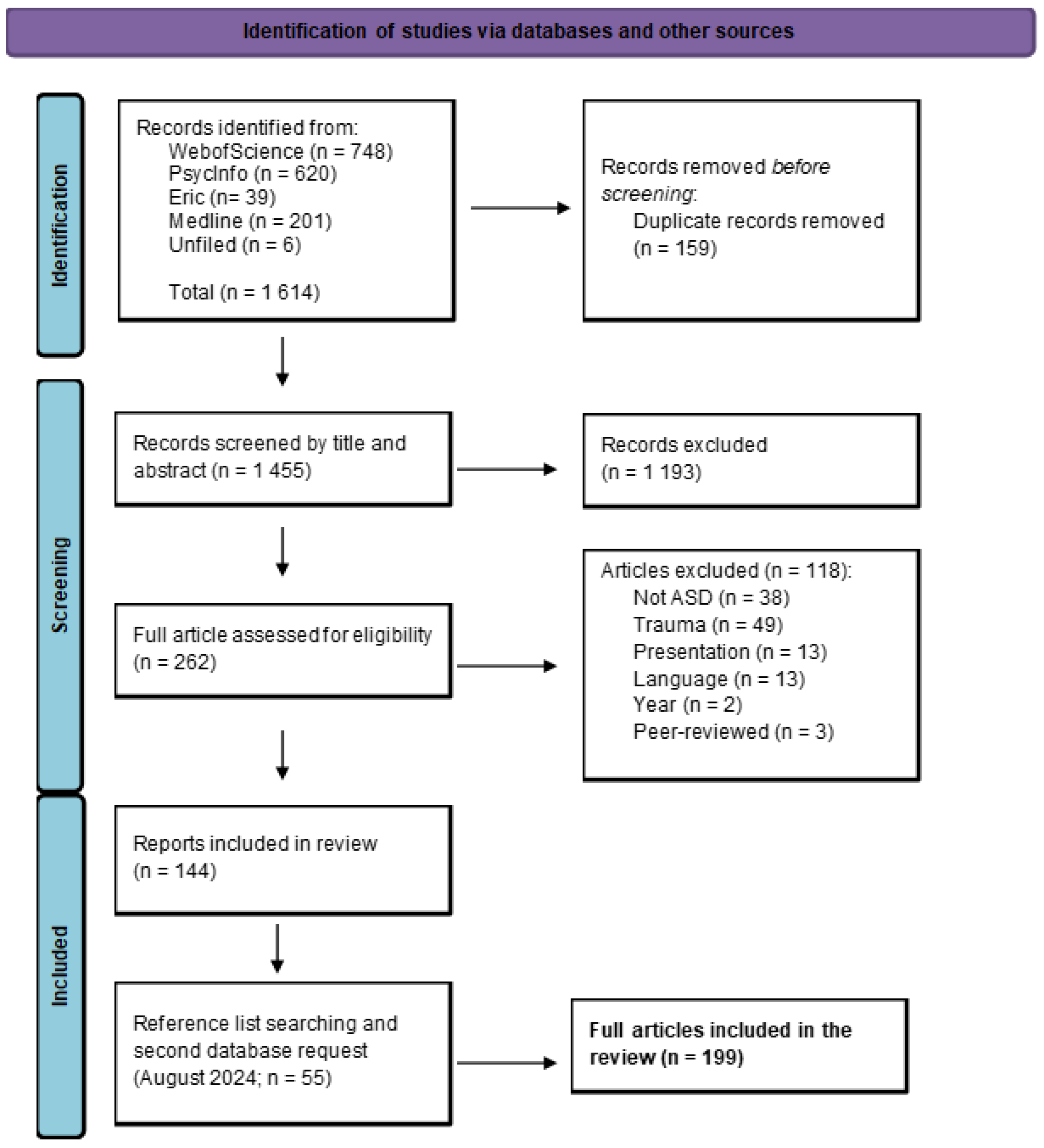
Overall, 1614 articles were found. The third author removed all duplicated titles (n = 159). Six reviewers were involved in the selection process. The totality of articles found was divided into eight units. Each unit was screened independently by two reviewers. The decision of the first reviewer was always hidden from the second reviewer to reduce the risk of bias. To do this, reviewers were asked to select three secret words to represent their choices (e.g., discard = blue, save = yellow, undecided = green). Articles were excluded (n = 118) if they (1) did not concern autistic individuals, (2) did not address psychological trauma (e.g., referred instead to physical or medical trauma such as traumatic brain injury), (3) were conference presentations or research posters for which only an abstract was available, (4) were not published in English or French, (5) were published before 2000, or (6) were not peer-reviewed. Secondly, they were asked to read the title and abstract of each article through EndNote and specify their choice. After this, 262 articles remained. To facilitate the second selection phase, the third author revealed the meaning behind the secret words. Of these 262 articles, 76 were included by mutual agreement, meaning that the two reviewers independently agreed on the inclusion of these articles. Thus, 186 articles remained for full text review due to disagreement between two reviewers or an “undecided” designation from one or both reviewers. The third author read all articles and decided whether they met the inclusion criteria. As some of the articles were still categorized as “undecided”, the first author evaluated them and gave her final decision. Therefore, the final number of articles included in this scoping review was 144. Finally, we hand-searched the reference list of all the papers included. The subsequent queries as well as the hand search of reference lists resulted in the addition of a further 19 references and the third query 36 references (n = 55). The total number of articles included in our scoping review is therefore 199 (see Figure 1).
The first author created an extraction template to allow the extraction of relevant study data (Peters et al. 2022). Extracted data were: (1) Authors, (2) Year of publication, (3) Country, (4) Study objectives, (5) Population of interest, (6) Sample size, (7) Methodology, (8) Research design, (9) Setting/context, (10) Sphere of focus, and (11) Main results (see Supplementary Materials Table S1 for the criteria’s definition). While reading the articles, one reviewer determined that one article did not meet the inclusion criteria and had to be discarded.

2.4. Summarizing the Data

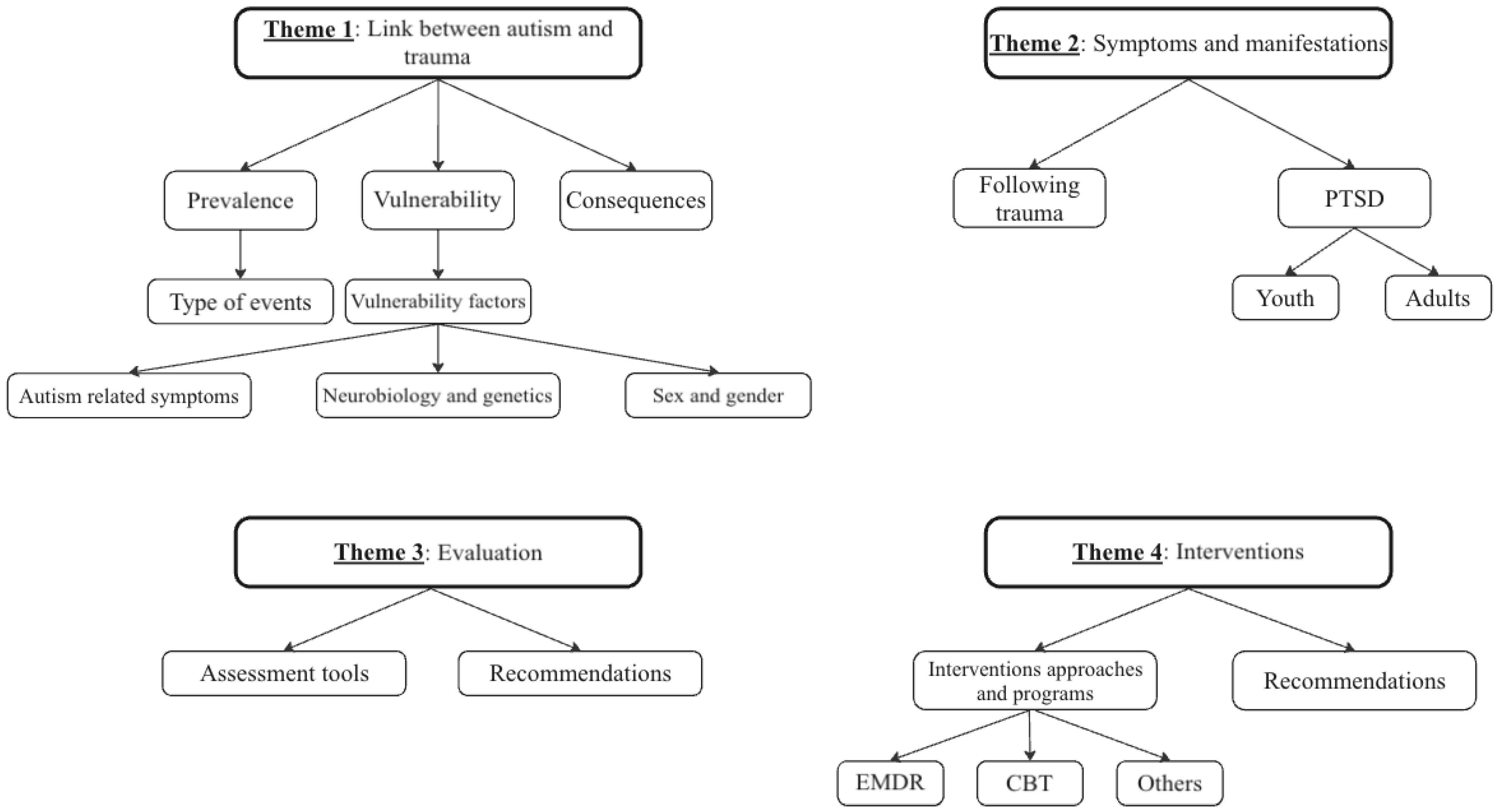
Descriptive analyses were carried out on the basic characteristics of the articles (year, country, methodology, research design, and sample) and will be presented in the Section 3. In collaboration with the co-authors, the first author surveyed all the articles included and drew out themes for discussion using a bottom-up approach (see Figure 2). This review was conducted within an interpretive approach to knowledge synthesis, recognizing that themes are constructed through the analytical engagement of the research team with the data. The research team includes researchers (MMD and IP) and graduate students (KK, JÉK, CM, PL, JLG and MJ) with expertise in autism, trauma, and psychoeducation, which informed the interpretation of the findings. In accordance with scoping review methodology, a formal critical appraisal of the included studies was not performed, as the aim of this review was to map the scope and characteristics of the existing literature rather than to evaluate the quality of the evidence. Four main themes were identified, along with 9 subthemes (see Figure 5). Elicit was used during the second database request to assist with information extraction. Artificial intelligence (AI) tools were also used for language editing. The authors retain full responsibility for the content and interpretation of the manuscript.

3. Results

3.1. Study Selection

The 199 studies included in the review are presented in Supplementary Materials Table S2. The findings presented in Supplementary Materials Table S2 have been directly reproduced from the original article and are included for informational purposes only; they do not represent the authors’ own interpretations or opinions.

3.2. Study Characteristics

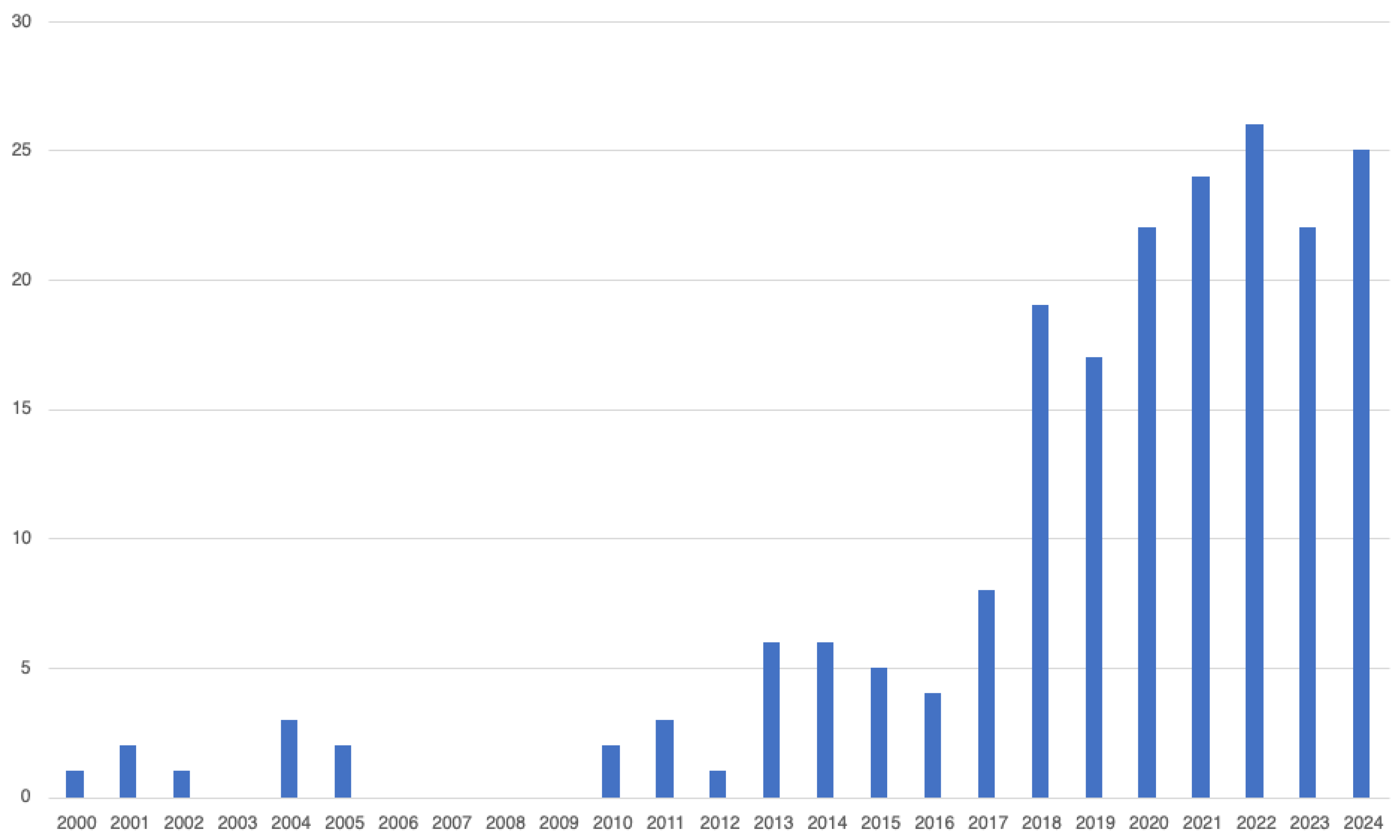
All studies were published between 2000 and 2024 due to the inclusion criterion. Most of the studies were published in the last seven years; 155 of the 199 (77.9%) papers were published between 2018 and 2024 (Figure 3).
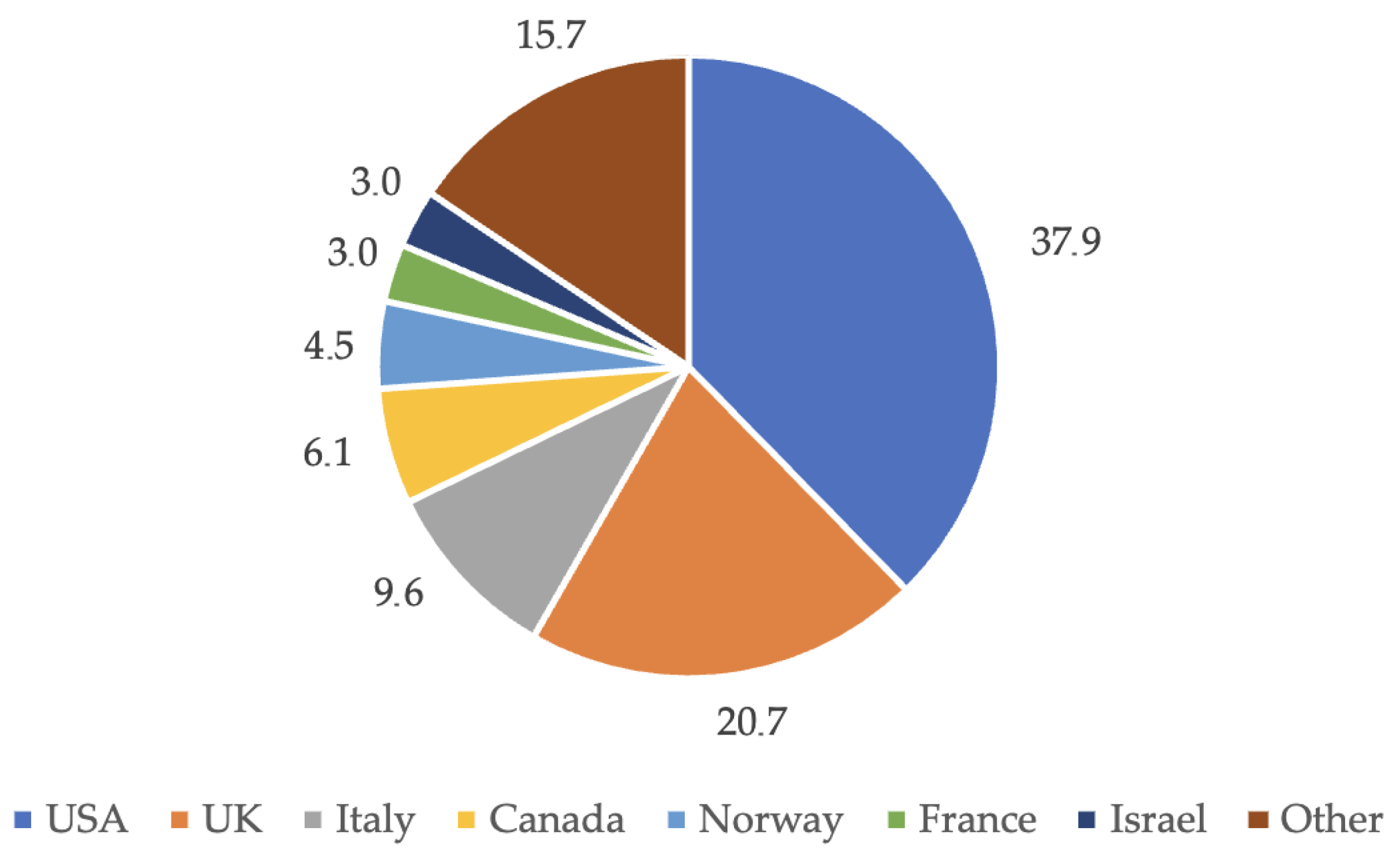
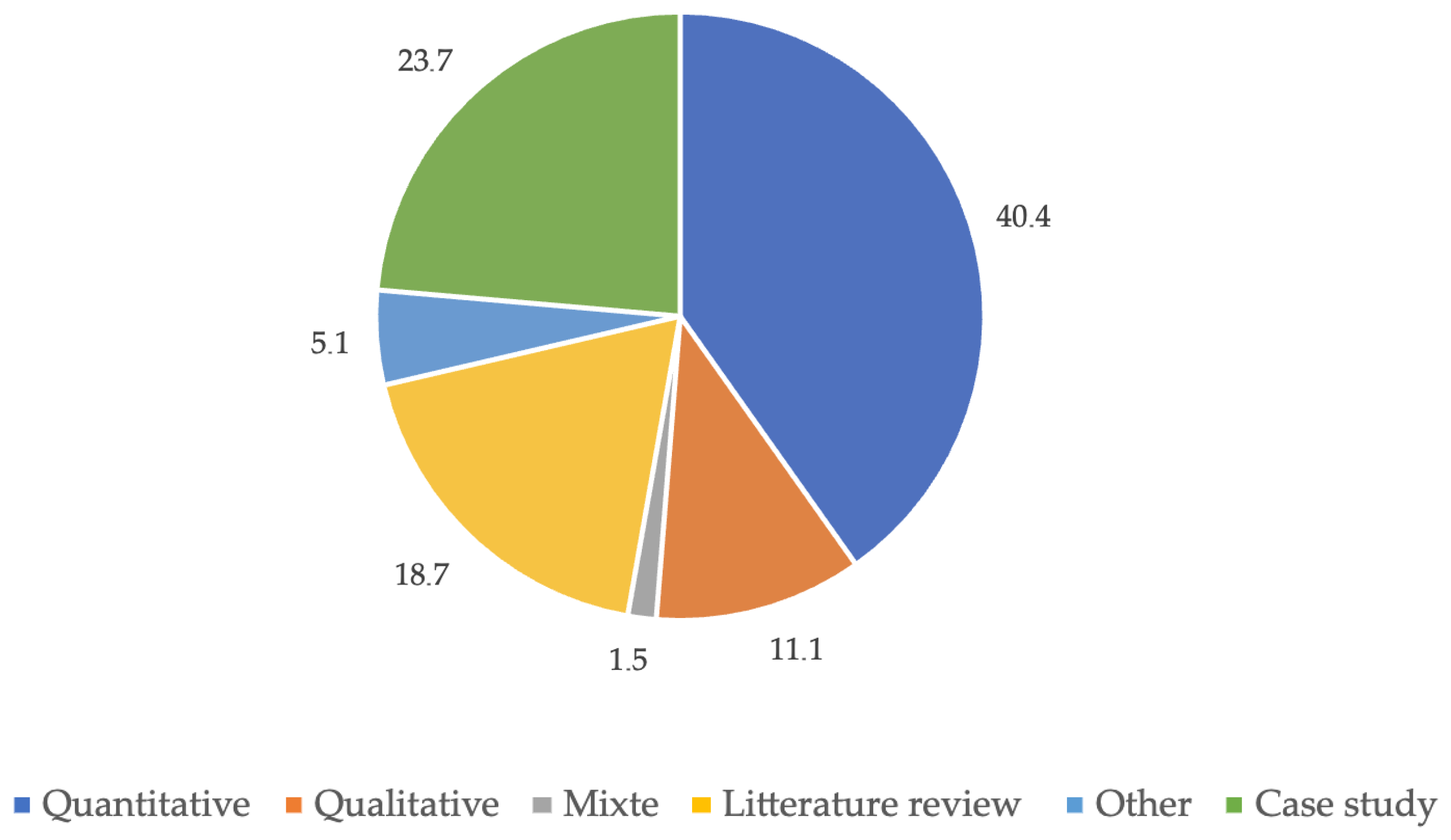
Although produced internationally, the four countries with the most published studies are: United States (37.9%), United Kingdom (20.7%), Italy (9.6%), and Canada (6.1%; Figure 4). In terms of methodology, 40.4% of the studies were quantitative (n = 80), 11.1% were qualitative (n = 22), 1.5% used mixed methods (n = 3), 18.7% were literature reviews (n = 37) and 23.7% were case studies (n = 46). The remaining 5.1% (n = 10) consisted of other types of publications that did not fit into the previous methodological categories, such as editorials, perspectives, recommendations, and theoretical papers (Figure 5). Of the quantitative research papers included, 74 used a cross-sectional design (37.2%) and only six used a longitudinal design (3%). Of the literature reviews included, 12 used a systematic approach (systematic review n = 9, scoping review n = 3) and 25 used a non-systematic approach. Regarding the sample targeted by the studies, 25.1% of the studies targeted children (n = 50) and 6% adolescents (n = 12). A further 16 studies had a mixed sample of children and adolescents (8%). Therefore, a total of 39.2% of the included articles targeted children and/or adolescents (n = 78). 76 articles in the final selection focused on autistic adults (38.2%). A small proportion of the articles retained (10.1%) contained heterogeneous samples in terms of age groups (children, adolescents, and adults; n = 20). Finally, 25 articles had no participant (literature review and/or theoretical text) and/or did not specify age (12.6%).
Most papers focused on trauma (78.8%; n = 156), while almost half dealt with PTSD (49%; n = 97). It should be noted that some articles referred to both (trauma and PTSD), which is why the sum of the proportions presented exceeds 100%. Finally, only four articles dealt with trauma-informed care for autistic people (2%). Nineteen papers (9.6%) were psychoanalytic contributions, typically clinical case reports or theoretical reflections, that did not include empirical data. Given their different epistemological stance and limited generalizability, these papers were not incorporated into the thematic synthesis; however, they were retained in our descriptive listing of interventions and explicitly identified as case studies.

3.3. Themes

Figure 2 presents the four themes and the 9 subthemes that were identified from the studies.

3.3.1. Theme 1—Link Between Autism and Trauma

This theme will present the subthemes of prevalence, factors that contribute to making autistic people more vulnerable to trauma, and the documented consequences of exposure to traumatic situations.
Prevalence 
Several studies report that the prevalence of trauma is higher in autistic than in neurotypical individuals (Carmassi et al. 2020; Cesarei 2005; Trelles Thorne and Khinda 2015; Dell’Osso et al. 2018; Dodds 2021; Gomberoff and Gomberoff 2000; Guest and Ohrt 2018; Heselton 2021; Hoover and Kaufman 2018; Kim 2014; Kitamura et al. 2021; Langenfeld et al. 2021; Manica 2018; Pelton et al. 2020; Rumball et al. 2020, 2021b; Stavropoulos et al. 2018; Wendt et al. 2022; Griffiths et al. 2019; Weiss and Fardella 2018; Zablotsky et al. 2013; Secci et al. 2023; Hernández-González et al. 2023; Kalisch et al. 2023; Giannotti et al. 2022; Al-Attar and Worthington 2024; Cleary et al. 2023; Dell’Osso et al. 2024; Haegele and Zhu 2023; Kildahl and Helverschou 2024; Douglas and Sedgewick 2024; Gibbs et al. 2023; Grove et al. 2025; Hartley et al. 2024; Kildahl et al. 2024; Li et al. 2024; Mehra et al. 2024; Okumura et al. 2024; Palmer and Dvir 2024; Quinton et al. 2024; Reuben et al. 2024; Rozenblat et al. 2024; Rumball et al. 2024; Underwood et al. 2024; Webb et al. 2024; Kitamura et al. 2023) Others highlight a high proportion of trauma among autistic people, but without a direct comparison to a neurotypical group (Barrows 2004; Ben-Shahar 2014; Ahumada 2005; Carmassi et al. 2020; Dababnah et al. 2019; Faccini and Allely 2021; Griffin-Shelley 2010; Harley et al. 2014; Higham et al. 2021; Hoover and Kaufman 2018; Kerns et al. 2022; Kildahl et al. 2019; Kildahl and Jørstad 2022; Kupferstein 2018, 2020; Leaf et al. 2018; Levi 2017; Lilley et al. 2022; Liu et al. 2017; Maiello 2001; Mori 2001; Pfeffer 2016; Siegel 2018; Singletary 2015; Spoladore 2013; Stewart et al. 2021; Taylor and Gotham 2016; van Nijnatten and Heestermans 2012; Carbajal and Praetorius 2020; Weiss and Fardella 2018; Dardani et al. 2023; Bradley and Korossy 2022; Anderson 2023; Nardi et al. 2022; Giannotti et al. 2022; Agebjörn et al. 2024; Carpita et al. 2023; Maroney et al. 2024; Pearson et al. 2023; Quinn et al. 2023; Dincel and Karayagmurlu 2025; Eroglu et al. 2024; Nadeem et al. 2024; Sadikova and Mazurek 2024; Song et al. 2024). Because studies define and measure trauma in different ways and sample characteristics are varied, estimates of prevalence among autistic individuals vary widely, ranging from 6.67% (Valenti et al. 2012) to 90% (Douglas and Sedgewick 2024).
Type of events. In particular, autistic people are more likely to experience certain types of traumatic events, such as adverse childhood experiences (ACEs) (Berg et al. 2018; Berger et al. 2021; Dodds 2021; Fuld 2018; Gerhardt and Smith 2020; Heselton 2021; Kerns et al. 2022; Kerns et al. 2015; Kitamura et al. 2021; Langenfeld et al. 2021; Cleary et al. 2023; Pearson et al. 2023; Kildahl et al. 2024; Quinton et al. 2024; Sadikova and Mazurek 2024; Kitamura et al. 2023), maltreatment (Guest and Ohrt 2018; Kildahl et al. 2019; McDonnell et al. 2019; Minnis et al. 2020; Wendt et al. 2022; Song et al. 2024), abuse (Faccini and Allely 2021; Gerhardt and Smith 2020; Siegel 2018; Hernández-González et al. 2023; Dardani et al. 2023; Kalisch et al. 2023; Agebjörn et al. 2024; Pearson et al. 2023; Quinn et al. 2023; Hartley et al. 2024; Song et al. 2024; Kitamura et al. 2023), physical neglect (Liu et al. 2017; McDonnell et al. 2019), physical assault (Haruvi-Lamdan et al. 2019; Dell’Osso et al. 2018; Kosatka and Ona 2014; Griffiths et al. 2019; Gibbs et al. 2023; Kildahl et al. 2024; Reuben et al. 2024), physical abuse (Gong et al. 2017; Stavropoulos et al. 2018; Bradley and Korossy 2022; Carbajal and Praetorius 2020; Douglas and Sedgewick 2024; Okumura et al. 2024; Webb et al. 2024), exposure to family violence (Kalisch et al. 2023), sexual violence (Schnabel and Bastow 2023; Douglas and Sedgewick 2024; Grove et al. 2025), sexual abuse (Gong et al. 2017; Kildahl et al. 2019; Stavropoulos et al. 2018; van Nijnatten and Heestermans 2012; Carbajal and Praetorius 2020; Cleary et al. 2023; Kildahl and Helverschou 2024; Okumura et al. 2024; Webb et al. 2024), childhood sexual abuse (Song et al. 2024; Maiello 2001), sexual assault (Dell’Osso et al. 2018; Haruvi-Lamdan et al. 2019; Griffiths et al. 2019; Agebjörn et al. 2024; Pearson et al. 2023; Gibbs et al. 2023; Kildahl et al. 2024; Reuben et al. 2024), intimate partner violence (Pearson et al. 2023; Schnabel and Bastow 2023), crime victimization (Webb et al. 2024), hate crime (Bradley and Korossy 2022), war related trauma (Dababnah et al. 2019) and serious physical injuries (Song et al. 2024). Although some of the categories presented may be included in the ACEs, we also present them separately since some studies have evaluated them independently. Autistic individuals are also at greater risk of experiencing situations that, while not included in the DSM-5-TR categorization of traumatic events, may nonetheless be perceived as traumatic (Li et al. 2024). In the literature, these experiences are often referred to as low-magnitude events. That is, situations not encompassed by the current DSM-5-TR definition yet have the potential to cause lasting traumatic effects (Carmassi et al. 2020). Such events may include, social stressors (Rumball et al. 2021a), social isolation (Bradley and Korossy 2022), health problems (Rumball et al. 2020), sensory trauma (Webb et al. 2024), social marginalization (Webb et al. 2024; Quinton et al. 2024), parental mental health (Hartley et al. 2024), internalized stigma (Maroney et al. 2024), discrimination (Kerns et al. 2022; Pearson et al. 2023; Quinton et al. 2024), relational trauma (Reuben et al. 2024; Andrzejewski et al. 2023), victimization and polyvictimization (Berger et al. 2021; Bitsika and Sharpley 2021; Trelles Thorne and Khinda 2015; Fuld 2018; Guest and Ohrt 2018; Hoover and Kaufman 2018; Kerns et al. 2022; Kosatka and Ona 2014; Paul et al. 2018; Sreckovic et al. 2014; Weiss and Fardella 2018; Cleary et al. 2023; Douglas and Sedgewick 2024; Gibbs et al. 2023; Kildahl et al. 2024; Okumura et al. 2024; Quinton et al. 2024; Underwood et al. 2024; Webb et al. 2024), bullying (Dell’Osso et al. 2018; Haruvi-Lamdan et al. 2019; Kildahl et al. 2019; Rumball et al. 2021a; Zablotsky et al. 2013; Secci et al. 2023; Dardani et al. 2023; McMaughan et al. 2023; Agebjörn et al. 2024; Carpita et al. 2023; Haegele and Zhu 2023; Quinn et al. 2023; Dincel and Karayagmurlu 2025; Douglas and Sedgewick 2024; Hartley et al. 2024; Li et al. 2024; Nadeem et al. 2024; Song et al. 2024; Webb et al. 2024; Pearson et al. 2023), discrimination related to gender or sexual minority (Maroney et al. 2024), physical restraint (Quinn et al. 2023), long term segregation (Quinn et al. 2023) and extended psychiatric hospitalization (Song et al. 2024), emotional abuse (Bleil Walters et al. 2013; Gong et al. 2017; Griffiths et al. 2019; Grove et al. 2025; Okumura et al. 2024; Webb et al. 2024), verbal abuse (Griffiths et al. 2019), financial abuse (Griffiths et al. 2019; Grove et al. 2025) and trauma associated with activities of daily living (e.g., accidental burns, restraint, seclusion; Rumball et al. 2024).
However, some studies have reported contradictory findings regarding the prevalence of trauma among autistic individuals. Two studies found a lower rate of sexual and physical abuse among autistic participants compared to the general population (Mehtar and Mukaddes 2011; Hernández-González et al. 2023). Similarly, two studies have reported that autistic children were not at greater risk of child maltreatment (Hernández-González et al. 2023; Hoover and Kaufman 2018). In another study, 23.5% of autistic children reported trauma, compared to 50.6% in a comparison group and 40.3% in a developmental disability group (Hoch and Youssef 2020). Autistic children were also less likely to report trauma than peers with other mental health diagnoses (odds ratio = 0.34) and had fewer PTSD diagnoses (4.25% vs. 29.81% and 14.83%; (Hoch and Youssef 2020). The authors noted, however, that these results likely reflect underreporting and under-identification of trauma in autism rather than a true lower prevalence.
Vulnerability 
The preceding data clearly highlights that autistic people have a certain vulnerability to traumatic situations. This section aims to extract data from the literature to answer the following question: What puts autistic people at greater risk of experiencing traumatic situations?
Vulnerability Factors 
Autism-related symptoms: Several symptoms associated with autism have been documented as risk factors to traumatic situations. Social naivety (Berg et al. 2018; Dodds 2021; Faccini and Allely 2021; Gerhardt and Smith 2020; Guest and Ohrt 2018; Kerns et al. 2020; Kerns et al. 2015; Rumball et al. 2021a; Griffiths et al. 2019; Haegele and Zhu 2023; Schnabel and Bastow 2023; Douglas and Sedgewick 2024; Gibbs et al. 2023; Ide-Okochi et al. 2024; Kildahl et al. 2024; Okumura et al. 2024), challenges with social boundaries (Gibbs et al. 2023; Palmer and Dvir 2024), communication difficulties (Berger et al. 2021; Dodds 2021; Fazel et al. 2020; Gerhardt and Smith 2020; Guest and Ohrt 2018; Hoch and Youssef 2020; Kerns et al. 2020; Kerns et al. 2015; Kitamura et al. 2021; Leaf et al. 2018; Liu et al. 2017; Maiello 2001; Griffiths et al. 2019; Bradley and Korossy 2022; Agebjörn et al. 2024; Al-Attar and Worthington 2024; Mercutio 2023; Quinn et al. 2023; Hartley et al. 2024; Kildahl et al. 2024; Li et al. 2024; Palmer and Dvir 2024; Rumball et al. 2024; Webb et al. 2024; Kitamura et al. 2023), difficulties understanding relationship and social norms (Carpita et al. 2023; Douglas and Sedgewick 2024), differences in adopting socially normative behaviors (Dell’Osso et al. 2019; Haegele and Zhu 2023; Hartley et al. 2024), difficulties in social information-processing (e.g., interpreting tones of voice and facial expressions or understanding what others think and how they feel; Faccini and Allely 2021; Hoch and Youssef 2020; Roberts et al. 2015; Cleary et al. 2023; Carpita et al. 2023; Schnabel and Bastow 2023; Gibbs et al. 2023), emotional regulation challenges (Kim 2014; Rumball et al. 2021a; Agebjörn et al. 2024; Li et al. 2024), limited coping strategies (Gerhardt and Smith 2020; Dell’Osso et al. 2024; Quinn et al. 2023; Kildahl et al. 2024), cognitive or behavioral rigidity (Maiello 2001; Bradley and Korossy 2022; Dell’Osso et al. 2024; Kitamura et al. 2023; Mercutio 2023) and sensory sensitivities (Maiello 2001; Bradley and Korossy 2022; Dell’Osso et al. 2024; Mercutio 2023; Quinn et al. 2023; Ide-Okochi et al. 2024; Rumball et al. 2024; Webb et al. 2024) have been shown to increase the risk to trauma. Consequences of autistic traits, such as reliance on others or compliance (Berger et al. 2021; Dodds 2021; Kerns et al. 2015; Bradley and Korossy 2022; Pearson et al. 2023) and social isolation or lack of social support (Higham et al. 2021; Singletary 2015; Zablotsky et al. 2013; Bradley and Korossy 2022; Agebjörn et al. 2024; Al-Attar and Worthington 2024; Gibbs et al. 2023; Hartley et al. 2024; Nadeem et al. 2024), may also increase their vulnerability to traumatic situations. Finally, autistic traits may influence the perception of events as being traumatic (Carmassi et al. 2020; Dell’Osso et al. 2022; Dell’Osso et al. 2019; Guest and Ohrt 2018; Heselton 2021; Kliman 2018; Kupferstein 2018; Rumball et al. 2021a; Agebjörn et al. 2024; Li et al. 2024; Nadeem et al. 2024), which supports the importance of considering events broader than those defined by the DSM-5-TR when looking at trauma in autistic people.
Neurobiology and genetics: Recent findings suggest that autism and PTSD share certain neurobiological and genetic mechanisms. Clinically, both conditions can present increased rumination, cognitive rigidity, avoidance behaviors, anger, and aggression (Allely and Faccini 2020; Haruvi-Lamdan et al. 2018). These manifestations are thought to be associated with shared neurobiological alterations in circuits involved in emotional regulation and stress reactivity. In line with this, Kerns et al. (2015) propose that shared neurobiological processes, particularly similarities in the structure and functional connectivity of the amygdala and prefrontal cortex, regions crucial for emotion regulation, may contribute to the increased risk of PTSD observed in autistic individuals.
Genetic research has shown that several DSM-5 disorders share common genetic components, and that autism and PTSD exhibit multiple overlapping genetic variants (Cao et al. 2022). When environmental adversity is controlled, a significant association has been reported between self-reported childhood trauma and polygenic scores for autism and PTSD (Peel et al. 2022). Growing evidence indicates that genetic factors not only influence individual traits but also shape the environments people experience, thereby contributing to differential vulnerability to trauma (Li et al. 2024). Several mechanisms have been proposed to explain this relationship. First, a genetic liability for autistic traits may increase social interaction challenges, thereby heightening exposure to adverse experiences such as neglect or abuse. Second, challenges in social, behavioral, and communication domains may contribute to limited coping strategies when facing traumatic experiences, thus increasing vulnerability to the consequences of such exposure (Gerhardt and Smith 2020). Third, a high genetic risk for autism may enhance sensitivity to environmental stimuli, making individuals more likely to interpret or report experiences as traumatic (Faccini and Allely 2021; Haruvi-Lamdan et al. 2019; Heselton 2021; Kerns et al. 2015; Peel et al. 2022). Moreover, autistic individuals show dysregulation of the hypothalamic–pituitary–adrenal (HPA) axis in response to stress, which may increase susceptibility to certain psychological stressors and behavioral stress reactions, such as depression, anxiety, and trauma (Fuld 2018). This dysregulation of the HPA axis and related brain regions can possibly explain the atypical processing of traumatic experiences in autism, where overactivation of the amygdala and reduced hippocampal involvement hinder the coherent encoding of traumatic memories (Fazel et al. 2020). Taken together, these findings underscore the complexity of gene–environment interactions in shaping vulnerability to trauma (Warrier and Baron-Cohen 2021).
Evidence also highlights the role of epigenetic mechanisms in mediating these processes. Exposure to environmental stressors, including trauma, during fetal development may alter gene expression, leading to lasting changes in neural circuits and increasing the risk of neurodevelopmental disorders such as autism and schizophrenia (Millan 2013). Finally, the temporality and directionality of the link between autism and trauma remain unclear. Evidence suggests a bidirectional relationship, whereby genetic and neurobiological vulnerabilities associated with autism may heighten susceptibility to trauma, while early traumatic may shape developmental trajectories and clinical presentations, without implying a causal role in the etiology of autism.
Sex and Gender: Of all the articles included in the review, 31.8% considered the notion of sex or gender in their analysis or reflexion (n = 63). Autistic women are at greater risk of exposure to traumatic situations (Carpita et al. 2019; Cazalis et al. 2022; Fuld 2018; Łucka 2018; Mehtar and Mukaddes 2011). They are also at greater risk of victimization and sexual abuse (Cazalis et al. 2022; Dike et al. 2022; Fazel et al. 2020; Lilley et al. 2022; McDonnell et al. 2019; Ohlsson Gotby et al. 2018; Griffiths et al. 2019; Schnabel and Bastow 2023; Douglas and Sedgewick 2024; Grove et al. 2025; Kildahl et al. 2024; Sadikova and Mazurek 2024) and some studies specify that this risk applies to gender minorities and non-binary autistic individuals (Dike et al. 2022; Reuben et al. 2021; Grove et al. 2025). Evidence indicates that autistic women are disproportionately exposed to social and interpersonal trauma (Haruvi-Lamdan et al. 2020; Reuben et al. 2021; Davies et al. 2023; Schnabel and Bastow 2023; Douglas and Sedgewick 2024; Reuben et al. 2024). Following trauma exposure, they demonstrate a heightened vulnerability to developing PTSD (Carmassi et al. 2019; Fuld 2018; Haruvi-Lamdan et al. 2020; Mehtar and Mukaddes 2011; Reuben et al. 2024; Agebjörn et al. 2024; Okumura et al. 2024; Quinton et al. 2024) and to experiencing more severe adverse outcomes (Reuben et al. 2021; Quinton et al. 2024). However, a recent literature review suggested that male participants and gender minorities may be underrepresented in research on trauma among autistic people; this observation was based on a limited set of four studies, in which female samples were overrepresented in certain studies (Webb et al. 2024). Also, a study suggested that the discrepancy in PTSD diagnoses between autistic men and women may stem from gender stereotypes (Reuben et al. 2024).
Consequences 
Several consequences of exposure to traumatic situations are documented in the literature. Being a victim of bullying and victimization puts autistic people at risk of developing PTSD or complex PTSD (Bitsika and Sharpley 2021; Paul et al. 2018). Victimization also has an impact on academic functioning and is linked to mental health symptoms, including suicidal thoughts and behaviors (Hoover and Kaufman 2018). Another study reports that suicidal thoughts and behaviors are common in young autistic people and are linked to depressive episodes and/or the experience of traumatic situations (Storch et al. 2013). Exposure to trauma also has physiological impacts, including physiological dysregulation that increases arousal and inflexibility (Scarpa et al. 2021). Documented changes include elevated heart rate (HR), low heart rate variability (HRV) and changes in the HPA axis following trauma (Scarpa et al. 2021). One study also demonstrated longitudinal brain effects in autistic adults who had experienced childhood sexual abuse or maltreatment (Okazaki et al. 2020). Exposure to a traumatic situation could also lead to cognitive dysfunctions in autistic people, such as challenges in theory of mind, central coherence, and executive functions (Im 2016).
Beyond its cognitive impact, exposure to trauma may also be a risk factor for the development of symptomatic elements in the mood field, including depression, emotional regulation deficits, high startle responses, and hyperarousal (difficulty concentrating, irritation, and more anger and anxiety; Dell’Osso et al. 2019; Dell’Osso et al. 2022; Scarpa et al. 2021). At the behavioral level, it has been hypothesized that exposure to trauma may lead to violent or challenging behavior in autistic people (Frizzell et al. 2019; Im 2016; Kildahl et al. 2020a). On the other hand, studies have sought to clarify this link by studying autistic adult offenders, and their results show that childhood trauma and abuse do not increase the risk of violent offending (Taylor and Gotham 2016). Autistic people who have experienced trauma may be at greater risk of presenting employability issues, which is a common challenge for many autistic people (Raymaker et al. 2022). A longitudinal effect of trauma has been documented in autistic parents who experienced trauma; they demonstrated extreme empathy, perfectionism, and a desire to protect their children from potential trauma (Smit and Hopper 2023). Overall, exposure to traumatic situations increases the risk of developing PTSD (King and Desaulnier 2011), which in turn exacerbates certain autistic symptoms, negatively impacting coping strategies and reducing help-seeking behaviors (Allely and Faccini 2020; Haruvi-Lamdan et al. 2018).
Finally, it is important to note that the consequences of trauma for autistic people depend on several factors, including characteristics linked to the trauma itself (the nature of the situation, the length of time since the situation was experienced and the age of the person at the time of the event) and characteristics specific to the individual (emotions, stress management, comorbidities; Scarpa et al. 2021).

3.3.2. Theme 2—Symptoms and Manifestations

The symptoms and manifestations following traumatic events or related to PTSD are manifold in autistic people, but above all, they differ from those observed in non-autistic people (Allely and Faccini 2020). This theme aims to highlight the manifestations and symptomatology identified in the literature.
Symptoms Following Trauma 
Several studies report behavioral symptoms following trauma: increased repetitive and stereotyped behaviors and aggression, agitation, hyperactivity, and self-injurious behaviors, as well as cognitive symptoms such as distractibility and decreased concentration and sleep disorders (Allely and Faccini 2020; Mehtar and Mukaddes 2011). Exposure to trauma is likewise said to have an impact on the social sphere by increasing the isolation of those exposed, increasing relational difficulties and deteriorating social communication skills (Allely and Faccini 2020; Mehtar and Mukaddes 2011). Finally, one study also identified synesthesia, a neurological mixing of the senses that could potentially impact how autistic people encode the traumatic event at the sensory level, presenting a challenge for therapists to identify potential antecedents to intrusive post-trauma symptoms (King 2010). A qualitative analysis revealed themes attributable to the reaction of autistic adults following the experience of trauma (Ng-Cordell et al. 2022a). The three themes are: (1) Engaging with trauma, which includes concrete actions following trauma (e.g., emotional expression, problem-solving, self-criticism, cognitive restructuring); (2) Disengaging with trauma, which includes all avoidance behaviors (e.g., problem avoidance, wishful thinking, social withdrawal); and (3) Self-regulatory coping (e.g., substance, self-stimulatory behaviors, emotional outbursts, self-injurious thoughts/behaviors; Ng-Cordell et al. 2022a). The authors put forward the interesting concept of overshadowing, according to which certain coping strategies could be misunderstood due to the diagnosis of autism and the overlap between trauma symptoms and certain autistic behaviors (Ng-Cordell et al. 2022b).
A study found that autistic people who had experienced physical, sexual, or emotional abuse reported more intrusive thoughts, distressing memories, loss of interest, irritability, and lethargy than those who had not experienced an episode of abuse (Brenner et al. 2017). Those with a clinical diagnosis of PTSD had more severe externalizing symptoms than those who had experienced abuse but did not have a diagnosis of PTSD (Brenner et al. 2017). These findings suggest that responses in autistic people extend beyond the PTSD criteria described in the DSM-5-TR, highlighting the need to develop assessment methods that are specifically adapted to autistic individuals and capture this broader range of symptoms.

3.3.3. Theme 3—Evaluation

There is unanimous agreement that there are challenges in identifying and assessing trauma and PTSD in autistic people, due to overshadowing, or overlapping symptoms (Al-Attar and Worthington 2024; Kildahl et al. 2020b; Kildahl and Helverschou 2024; Palmer and Dvir 2024), differences in clinical manifestations, and in some cases to the impossibility of verbally reporting the trauma experienced. As a result, these conditions are under-diagnosed (Carmassi et al. 2019), and people do not receive the care they need.
Assessment Tools 
In the literature, three tools and guidelines are put forward to evaluate trauma: Trauma Symptoms Investigation Form in Autistic Spectrum Disorders (TIF-ASD, see Mehtar and Mukaddes 2011), Diagnostic Manual Intellectual Disability (DM-ID, Fletcher et al. 2007) supported by many as the starting point (Allely and Faccini 2020) and the Trauma and Loss Spectrum-Self Report (TALS-SR, Dell’Osso et al. 2009). Technological innovations are also beginning to emerge, such as the Interactive Trauma-Scale (ITS), a web-based measure of trauma for autistic children. The results of the first study report high user satisfaction and a sensitivity level of between 70 and 75% for bullying (Hoover and Romero 2019). The assessment of PTSD in autistic individuals relies primarily on standardized semi-structured interviews. The Anxiety Disorders Interview Schedule for Children and Parents (ADIS C/P; Silverman and Albano 1996) is the most frequently used instrument and is currently the only one with preliminary support for its validity and reliability within this specific population (Rumball 2019). Other tools, such as the Diagnostic Interview Schedule for Children-Revised Version (DISC-R; Shaffer et al. 1993), the Child and Adolescent Psychiatric Assessment (CAPA; Angold and Costello 2000), the Schedule for Affective Disorders and Schizophrenia for School-age Children-Present and Lifetime version (K-SADS-PL; Kaufman et al. 1997), or the Structured clinical interview for DSM-IV clinical version (SCID-I/CV; First et al. 1997), are also mentioned in the literature, though their psychometric properties have not yet been formally validated for autistic individuals (Rumball 2019). PTSD specific assessment tools that have demonstrated strong reliability in the general population, such as the PTSD Checklist for DSM-5 (PCL5; Weathers et al. 2013) and the Child and Adolescent Trauma Screen (CATS; Sachser et al. 2017), are currently used with autistic individuals, despite the absence of validation studies confirming their suitability for this population (Quinton et al. 2024).
Recommendations 
Several authors have made two universal recommendations: (1) the need to develop, adapt and validate assessment tools (Allely and Faccini 2020; Kerns et al. 2015; King and Desaulnier 2011; McDonnell et al. 2019; Ng-Cordell et al. 2022b; Rumball 2019; Michna et al. 2023; Al-Attar and Worthington 2024; Quinton et al. 2024; Reuben et al. 2024) and (2) that trauma should be “ruled out” (as opposed to “ruled in”) in all assessment situation of an autistic person (Allely and Faccini 2020; Kerns et al. 2020; Kildahl et al. 2020b; Mehtar and Mukaddes 2011; Reuben et al. 2021). Screening for trauma should be universal in all assessments. In the same vein, some authors have proposed specific guidelines for autistic women in the differential diagnosis of adult autistic women of typical intelligence (Cumin et al. 2021). As part of a recent review of the literature on the clinical manifestations of trauma and autism, the authors created a clinical tool, the Practitioner Assessment Guide of Childhood Trauma and Autism Spectrum Disorder, to guide professionals in the assessment of trauma in autistic individuals (Michna et al. 2023). The tool includes questions that directly address trauma, while others focus on different areas of functioning: academic, emotional, behavioral, and social functioning (Michna et al. 2023).
Using a bottom-up approach informed by professional consensus, recent research has identified a set of general adaptations that should be considered when assessing trauma and PTSD in autistic individuals (Rumball et al. 2024). These adaptations aim to enhance accessibility and comprehension throughout the assessment process and include: (1) replacing numerical rating scales with alternative response formats; (2) simplifying or clarifying the language used in questionnaires; (3) completing assessment tools collaboratively with the individual; and (4) incorporating communication aids, such as the Picture Exchange Communication System (PECS), when appropriate. These adjustments should be applied on a case-by-case basis to match the individual’s communication profile and preferences. Although not specific to trauma or PTSD assessment, they reflect best practices for individualized care and are consistent with autism guidelines from the National Institute for Health and Care Excellence (NICE 2012).
Finally, some authors argue that the DSM-5-TR criteria remain a useful framework to guide assessment of PTSD, noting that certain symptom clusters, such as re-experiencing and avoidance, are more difficult to identify (Kildahl et al. 2019; Anderson 2023). These authors conclude that there is an urgent need to identify behavioral equivalents for all symptoms in the autistic population to recognize warning signs of trauma and abuse when these situations are not reported by parents or relatives (Kildahl et al. 2019). All these issues lead to misdiagnosis, which represents a direct barrier to access to treatment. Ultimately, strong emphasis is placed on the importance of adopting a multimethod and multi-informant assessment approach, combining self-reports, parent or caregiver reports, and clinical observations, in order to compensate for communication challenges that may hinder accurate symptom reporting in autistic individuals (Rumball 2019; Kildahl and Helverschou 2024; Rumball et al. 2024; Sadikova and Mazurek 2024).

3.3.4. Theme 4—Intervention

Currently, there is no evidence-based practice for the treatment of trauma in autistic individuals (Faccini and Allely 2021; Kildahl et al. 2019; Stack and Lucyshyn 2019; Kalisch et al. 2023; Quinton et al. 2024). However, several research efforts have been made to evaluate the effectiveness of interventions and to adapt existing intervention programs to meet the needs of autistic individuals. The most well-documented interventions are eye movement desensitization and reprocessing (EMDR; Fisher et al. 2022a, 2022b; Ipci et al. 2017; Kosatka and Ona 2014; Van Diest et al. 2022; Leuning et al. 2023) and trauma-focused cognitive–behavioral therapy (TF-CBT; Carrigan and Allez 2017; Dempsey and Ha 2017; King and Desaulnier 2011; Zakreski 2017; Holstead and Dalton 2013). Finally, the literature contains a wide variety of interventions, which are presented in the section «Others».
Eye Movement Desensitization and Reprocessing (EMDR) 
EMDR is a well-established eye-movement psychotherapy for individuals with symptoms of PTSD. During these sessions, the therapist explores specific elements related to the traumatic event with the individual (McGuire et al. 2014). Although controversial, the eye movement component is thought to contribute to distancing the individual from their memories and reducing the vividness of the emotionality associated with them (McGuire et al. 2014). Finally, bilateral eye movements would facilitate interaction between the brain’s hemispheres, thereby enhancing the process of improving memory processing (McGuire et al. 2014).
Of the seven studies that examine EMDR treatment for autistic people, two are case studies (Ipci et al. 2017; Kosatka and Ona 2014), two evaluate effectiveness (Leuning et al. 2023; Lobregt-van Buuren et al. 2019), and three include therapists to gain their perceptions of barriers to treatment and adaptations to meet the needs of autistic people (Fisher et al. 2022a, 2022b; Van Diest et al. 2022). The aim of the first efficacy study was to assess the feasibility of implementing EMDR therapy in autistic adults who had experienced adverse events without making treatment modifications (Lobregt-van Buuren et al. 2019). Results showed that implementing EMDR without adaptation was not only feasible but that participants showed clinical improvements in PTSD symptoms, psychological distress, trauma-related impairments in daily life and autistic characteristics related to social motivation and communication (Lobregt-van Buuren et al. 2019). The second study evaluating the efficacy of EMDR included 21 autistic adolescents between the ages of 12 and 19 and focused on the effect of treatment on reducing core autistic symptoms (decreasing experienced distress and increasing global functioning; Leuning et al. 2023). Results were mixed depending on the source of measures: no pre-post difference was observed on the Autism Diagnostic Observation Schedule—Second Edition (ADOS-2), but a clear improvement was shown on self-reported measures of stress and global functioning (Leuning et al. 2023).
Many barriers to the implementation of EMDR with autistic individuals have been identified: (1) client characteristics (communication, emotional regulation and fear of novelty, potential need for additional structure and routine, attentional differences, sensory profile); (2) therapist characteristics (lack of knowledge about autism); (3) therapists reported difficulty in assessing the quality of the therapeutic alliance; and (4) systemic issues (negative narratives about autism and poor understanding of the condition; Dilly and Pavlov 2022; Van Diest et al. 2022; Kalisch et al. 2023). Suggested adaptations to address these barriers include communication: using clear, understandable vocabulary and taking the time to understand the vocabulary used to describe emotional states (Dilly and Pavlov 2022). More general adaptations suggest celebrating the uniqueness of each person, demonstrating creativity and flexibility, and adopting an individualized and client-centered approach without assumptions based on diagnosis (Dilly and Pavlov 2022; Van Diest et al. 2022). Studies also report suggestions for clinical supervision (Dilly and Pavlov 2022; Fisher et al. 2022a, 2022b). Supervisors should have a good knowledge of autism, trauma, other neurodevelopmental conditions (dyslexia, ADHD), and attachment theory (Fisher et al. 2022a, 2022b; Van Diest et al. 2022). Time should be set aside to address concepts related to the development of the therapeutic alliance and the individualized adaptations that can be made to therapy (Dilly and Pavlov 2022; Van Diest et al. 2022).
Trauma-Focused Cognitive Behavioral Therapy (TF-CBT) 
TF-CBT is a psychosocial intervention that includes elements of several approaches (cognitive–behavioral, attachment, humanistic) and targets persons with PTSD (Holstead and Dalton 2013). With the aim of helping the individual to develop effective coping strategies, TF-CBT comprises several stages: psychoeducation about PTSD-related symptoms, learning stress management strategies, recognition of the triad (link between thoughts, emotions, and behaviors), creation of a trauma-related narrative (graduated exposure in which participants are asked to give more and more details about the traumatic situation), and in vivo desensitization (Holstead and Dalton 2013).
Amongst the effectiveness studies on TF-CBT, three are case studies (Carrigan and Allez 2017; Dempsey and Ha 2017; Zakreski 2017), one deals with adaptations of this treatment more specifically for people with intellectual disabilities (Dell’Osso et al. 2019), and one is a longitudinal study (Holstead and Dalton 2013). Among these studies, particular attention is given to the longitudinal study (Holstead and Dalton 2013), as it presents the strongest methodological design, including a larger sample size (n = 87), allowing for a more robust evaluation. This study evaluated the effectiveness of TF-CBT on adolescents with developmental and/or cognitive delays, and the results showed that TF-CBT was no more effective than behavioral intervention in treating trauma in this clientele (Holstead and Dalton 2013). The authors hypothesize that the complex trauma experience of certain autistic persons may represent a barrier to the effectiveness of TF-CBT, making it difficult to implement cognitive coping strategies (Holstead and Dalton 2013). The authors call for more studies with a larger sample and to evaluate the effects of treatment adaptations that could be made to better meet the needs of these individuals.
Although the effectiveness of these adaptations has not been evaluated, several have been suggested in the literature: visually supporting instructions and activities, integrating the young person specific interests, and increasing parental involvement throughout the intervention (Dempsey and Ha 2017; Kalisch et al. 2023). The authors suggest starting with stabilization skills, such as relaxation and other coping strategies, and keeping the creation of trauma-related narratives and in vivo desensitization at the core (Dempsey and Ha 2017; Quinton et al. 2024). Other suggested adaptations including conducting a functional behavioral assessment to inform about the function of problem behaviors if any, helping to identify antecedents that could represent triggers for trauma-related problem behaviors, and promoting generalization and maintenance of learning, which can represent a challenge for autistic people (Stack and Lucyshyn 2019).
Others 
Several other interventions have been identified in the literature, all of which has limited empirical support (only one article or only case studies per intervention). These interventions have been categorized and are presented in Table 1.
Recommendations 
Several authors agree that there is an urgent need to develop knowledge of trauma and autism to develop assessment tools adapted to this clientele and to be able to offer them evidence-based intervention (Heselton 2021; Kildahl et al. 2019; McDonnell et al. 2022; Michna et al. 2023; Kalisch et al. 2023; Mercutio 2023; Quinton et al. 2024). Recent reviews converge in indicating that, to date, no trauma-focused intervention can be considered evidence-based for autistic individuals, highlighting the need for caution in clinical translation and interpretation of existing findings (Kalisch et al. 2023; Quinton et al. 2024).
A team of researchers has identified five key priorities for mental health research that should be integrated into the work of researchers and practitioners working with autistic adults. One that was central was: conducting research to support trauma-informed care approaches (Benevides et al. 2020). Beyond intervention development, several authors emphasize that improved identification of trauma-related symptoms and enhanced clinician training in autism-specific trauma presentations are critical prerequisites to advancing effective care (Faccini and Allely 2021; Kildahl et al. 2019). Knowing that autistic people are significantly more at risk of exposure to traumatic events, it would be of great clinical relevance to train health and social services teams working with these individuals in trauma-informed approaches.

4. Discussion

The present scoping study aimed to (1) provide an overview of the research on trauma and autism; (2) identify and discuss main themes; and (3) point gaps for future studies. Following the methodological framework of Arksey and O’Malley (2005) and the PRISMA-ScR guideline and checklist (Tricco et al. 2018), we identified 199 articles that met our inclusion criteria. This number is consistent with that reported by Hernández-González et al. (2023) in their research mapping of evidence (n = 147 in 2023).
The first part of the analyses consisted of extracting descriptive statistics from these articles. Most of the studies identified were published within the last six years, which supports the relevance of this review of the literature. In terms of methodology, the literature was dominated by quantitative studies (40.4%, n = 80), while qualitative studies were considerably less frequent (11.1%, n = 22). Mixed-methods designs were notably rare, with only three studies identified (1.5%). This limited use of mixed methods represents an important gap, particularly given the complexity of the relationship between autism and trauma. Approximately a quarter of the studies were case studies (23.7%), and a very small proportion used a longitudinal design (3%). The second part of the analyses was more qualitative in nature and aimed to highlight the major themes that were identified from the literature and to draw out the main insights. The four themes are: (1) the link between autism and trauma (including prevalence, vulnerability, and consequences); (2) symptoms and manifestations; (3) evaluation; and (4) interventions.
Many studies suggest that autistic people may be at greater risk of exposure to traumatic situations of various kinds (e.g., ACEs, traumatic situations in general, victimization and/or bullying). Several authors highlight the importance of going beyond the categories of the DSM-5-TR when considering events that may be potentially traumatic for autistic individuals (Carmassi et al. 2020). Events of a social and sensory nature, for example, should be further investigated for their potential traumatic impact on autistic individuals. Failing to consider these low magnitude events may place autistic individuals at heightened risk of repeated exposure to potentially traumatic experiences, which may increase the likelihood of cumulative trauma and the development of complex trauma presentations. The nature of autistic symptoms, certain neurobiological mechanisms and the sex and gender are thought to be the main factors contributing to increase this risk. Yet very little is said about women, and even less about gender minorities, even though the literature suggests that these groups are more at risk of both experiencing traumatic situations and adverse consequences.
Several potential consequences of trauma experiences have been reported in the scientific literature, including mental health symptoms (suicidal thoughts and behaviors; Hoover and Kaufman 2018), physiological impacts (such as dysregulation of the stress response and heart rate; Okazaki et al. 2020), and symptomatic elements in the mood domain (depression, emotional regulation deficits; Dell’Osso et al. 2019; Dell’Osso et al. 2022; Scarpa et al. 2021). These consequences may also affect individual’s adaptive capacities and may have broader implications across different areas of life, including employability (Raymaker et al. 2022). Autistic individuals exposed to traumatic events may also be at a higher risk of developing symptoms related to PTSD (King and Desaulnier 2011).
As with symptomatology in general, the manifestations and symptoms associated with exposure to trauma and the development of PTSD appear highly heterogeneous in autistic people. Some studies suggest that symptomatology may differs in comparison to non-autistic people (Allely and Faccini 2020). Many researchers are calling for behavioral equivalents for autistic people, bearing in mind one major challenge: the great heterogeneity makes it utopian to derive lists of behaviors that will apply to everyone, regardless of where they are on the spectrum. The high heterogeneity of autism highlights the importance to continue advancing knowledge in this field, to be able to carry out rigorous and adapted evaluations with these individuals. These evaluation issues have a direct impact on the sphere of intervention and treatment. Without appropriate assessment tools tailored to autistic individuals, trauma and PTSD-related manifestations may remain undetected, thereby limiting clinicians’ ability to implement timely and effective interventions. Health and social services staff should be made aware of the potential increased risk of trauma among autistic people. The trauma-informed care approach would be appropriate and relevant, although the approach remains underexplored in the literature. Trauma should therefore be “ruled out” (as opposed to “ruled in”), and basic screening should be carried out.
The last theme suggests that there is currently limited evidence-based practice for trauma and/or PTSD in autistic people. That said, the interventions that have received the most attention from the scientific community are EMDR and TF-CBT. The absence of longitudinal studies and control groups, and the predominance of case studies in the current literature, raise questions about the validity of the conclusions.

4.1. Limitations

The first limitation of this scoping review is that it did not consider gray literature in its inclusion criteria. Unlike a systematic review, all articles were included, regardless of methodological quality. The strength of this approach is in documenting an exhaustive picture of existing knowledge on the subject. Its limitation lies in the inability to investigate intricacies on each of the themes. The four themes could themselves be the subject of a systematic review to explore them in greater detail. Finally, we opted to use only global terms in our search equations. The inclusion of more precise terms could have enabled us to broaden the articles found (e.g., ACE, neglect).

4.2. Future Research

Future research should focus on women and gender minorities within the autistic population, who are currently under-represented in studies, although many evidence suggest that these groups may face elevated risk of exposure to traumatic situations and of experiencing adverse consequences. Future studies should also actively involve autistic people themselves in order to access their lived experience. Such participatory research should include autistic individuals at all stages of research development. Methodologically, future work could benefit from on more rigorous designs, including randomized controlled trials and longitudinal studies. Future research should increase the use of mixed-methods designs to better capture the complexity of the relationship between autism and trauma. By integrating quantitative indicators with qualitative insights into lived experience and context, such approaches would enhance the validity and interpretability of findings. In addition, future studies should incorporate trauma-informed care approaches with autistic people and evaluate their potential effectiveness. Although their relevance for this population has been suggested, only a minority of the identified studies have examined such approaches. Finally, future research should clearly and explicitly define what is meant by trauma at a conceptual level. In the existing literature, trauma and posttraumatic stress disorder (PTSD) are frequently used interchangeably, despite referring to distinct constructs. This conceptual ambiguity has important implications for the current landscape of knowledge on autism and trauma, particularly with respect to prevalence estimates, assessment practices, and intervention development.

5. Conclusions

In conclusion, this scoping review highlighted the significant complexity in understanding the links between trauma and autism, calling for a more nuanced, inclusive, and diverse approach in future research to better understand potential underlying mechanisms and to inform improvements in evaluation and clinical practices.

Supplementary Materials

The following supporting information can be downloaded at: https://www.mdpi.com/article/10.3390/socsci15060344/s1, Table S1: Criteria’s Definition; Table S2: Studies included in the review.

Author Contributions

Conceptualization, M.-M.D.; methodology, M.-M.D. and J.É.K.; formal analysis, M.-M.D.; investigation, M.-M.D., J.É.K. and K.K.; data curation, K.K., J.É.K., C.M., P.L., J.L.-G. and M.J.; writing—original draft preparation, M.-M.D., J.É.K. and K.K.; writing—review and editing, M.-M.D., J.É.K., K.K., I.P.; visualization, M.-M.D., J.É.K., K.K.; supervision, M.-M.D.; project administration, M.-M.D. All authors have read and agreed to the published version of the manuscript.

Funding

This research received no external funding.

Institutional Review Board Statement

Not applicable.

Informed Consent Statement

Not applicable.

Data Availability Statement

The data supporting the findings of this study will be made available upon reasonable request.

Acknowledgments

During the preparation of this manuscript, the authors used ChatGPT (version 5.2) to assist with text editing and to improve the clarity and quality of the written English. The authors reviewed and edited all content and take full responsibility for the final version of the manuscript.

Conflicts of Interest

The authors declare no conflicts of interest.

Abbreviations

The following abbreviations are used in this manuscript:
PTEsPotentially Traumatic Events
PTSDPosttraumatic Stress Disorder
IDIdentification
ACEsAdverse Childhood Experiences
DSM-5-TRDiagnostic and Statistical Manual of Mental Disorders—Fifth Edition—Text Revision
HPAHypothalamic–Pituitary–Adrenal Axis
HRHeart Rate
HRVHeart Rate Variability
TIF-ASDTrauma Symptoms Investigation Form in Autistic Spectrum Disorders
DM-IDDiagnostic Manual—Intellectual Disability
TALS-SRTrauma and Loss Spectrum—Self Report
ITSInteractive Trauma Scale
ADIS C/PAnxiety Disorders Interview Schedule for Children and Parents
DISC-RDiagnostic Interview Schedule for Children—Revised Version
SCID-I/CVStructured Clinical Interview for DSM-IV—Clinical Version
PCL-5PTSD Checklist for DSM-5
CATSChild and Adolescent Trauma Screen
PECSPicture Exchange Communication System
NICENational Institute for Health and Care Excellence
EMDREye Movement Desensitization and Reprocessing
TF-CBTTrauma-Focused Cognitive Behavioral Therapy
ADOS-2Autism Diagnostic Observation Schedule—Second Edition
PBSPositive Behavioral Support
CPPChild–Parent Psychotherapy
MATCH-ADTCModular Approach to Therapy for Children with Anxiety, Depression, Trauma, or Conduct Problems
RNTReflective Network Therapy

Appendix A

Table A1. Search strategy for all databases.
DatabaseKeywords for Population of Interest Keywords for TraumaLimitsResults
ERICAutism
OR
Asperger
OR
Pervasive Developmental Disorder
ANDTrauma
OR
PTSD
OR
Posttraumatic Stress Disorder
English or French language, Year 2000-Current, Peer-reviewed39
Medline201
PsycINFO620
Web of Science748
Total 1608

References

  1. Agebjörn, Johan, Christopher Gillberg, Jonas Eberhard, Eva Billstedt, and Johan Nyrenius. 2024. Association between autism and PTSD among adult psychiatric outpatients. Journal of Autism and Developmental Disorders 55: 3343–53. [Google Scholar] [CrossRef] [Scilit]
  2. Ahumada, Luisa C. Busch De. 2005. From Mimesis to Agency: Clinical Steps in the Work of Psychic Two-Ness. The International Journal of Psychoanalysis 86: 721–36. [Google Scholar] [CrossRef] [Scilit]
  3. Al-Attar, Zainab, and Rachel Worthington. 2024. Trauma or autism?—Understanding how the effects of trauma and disrupted attachment can be mistaken for autism. Advances in Autism 10: 120–34. [Google Scholar] [CrossRef] [Scilit]
  4. Allely, Clare, and Lina Faccini. 2020. The Importance of Considering Trauma in Individuals with Autism Spectrum Disorder: Considerations and Clinical Recommendations. Journal of Forensic Practice 22: 23–28. [Google Scholar] [CrossRef] [Scilit]
  5. American Psychiatric Association. 2022. Diagnostic and Statistical Manual of Mental Disorders (DSM-5-TR), 5th ed. Washington, DC: American Psychiatric Publishing. [Google Scholar] [CrossRef] [Scilit]
  6. Anderson, Laura K. 2023. Autistic Experiences of Applied Behavior Analysis. Autism 27: 737–50. [Google Scholar] [CrossRef] [Scilit]
  7. Andrzejewski, Theresa, Elizabeth A. DeLucia, Olivia Semones, Sanaa Khan, and Christina G. McDonnell. 2023. Adverse Childhood Experiences in Autistic Children and Their Caregivers: Examining Intergenerational Continuity. Journal of Autism and Developmental Disorders 53: 2663–79. [Google Scholar] [CrossRef] [Scilit]
  8. Angold, Adrian, and Elizabeth Jane Costello. 2000. The Child and Adolescent Psychiatric Assessment (CAPA). Journal of the American Academy of Child and Adolescent Psychiatry 39: 39–48. [Google Scholar] [CrossRef] [Scilit]
  9. Arksey, Hilary, and Lisa O’Malley. 2005. Scoping Studies: Towards a Methodological Framework. International Journal of Social Research Methodology 8: 19–32. [Google Scholar] [CrossRef] [Scilit]
  10. Barrows, Paul. 2002. Becoming Verbal: Autism, Trauma and Playfulness. Journal of Child Psychotherapy 28: 53–72. [Google Scholar] [CrossRef] [Scilit]
  11. Barrows, Paul. 2004. “Playful” Therapy: Working with Autism and Trauma. International Forum of Psychoanalysis 13: 175–86. [Google Scholar] [CrossRef] [Scilit]
  12. Benevides, Teal W., Stephen M. Shore, Kate Palmer, Patricia Duncan, Alex Plank, May-Lynn Andresen, Reid Caplan, Barb Cook, Dena Gassner, Becca Lory Hector, and et al. 2020. Listening to the Autistic Voice: Mental Health Priorities to Guide Research and Practice in Autism from a Stakeholder-Driven Project. Autism 24: 822–33. [Google Scholar] [CrossRef] [Scilit]
  13. Ben-Shahar, Hagit. 2014. Reflections on the Effects of the Environment for Treating Autism. Body, Movement and Dance in Psychotherapy 9: 41–46. [Google Scholar] [CrossRef] [Scilit]
  14. Berg, Kristin L., Kruti Acharya, Cheng-Shi Shiu, and Michael E. Msall. 2018. Delayed Diagnosis and Treatment among Children with Autism Who Experience Adversity. Journal of Autism & Developmental Disorders 48: 45–54. [Google Scholar] [CrossRef] [Scilit]
  15. Berger, Emily, Levita D’Souza, and Amy Miko. 2021. School-Based Interventions for Childhood Trauma and Autism Spectrum Disorder: A Narrative Review. Educational and Developmental Psychologist 38: 186–93. [Google Scholar] [CrossRef] [Scilit]
  16. Bitsika, Vicki, and Christopher F. Sharpley. 2021. Direct and Inverse Correlates of Post-Traumatic Stress Disorder among School-Age Autistic Boys. International Journal of Environmental Research and Public Health 18: 5285. [Google Scholar] [CrossRef] [Scilit]
  17. Bleil Walters, Jessica, Tammy L. Hughes, Lawrence R. Sutton, Stephanie N. Marshall, Laura M. Crothers, Cathryn Lehman, Dave Paserba, Vanessa Talkington, Rochelle Taormina, and Ann Huang. 2013. Maltreatment and Depression in Adolescent Sexual Offenders with an Autism Spectrum Disorder. Journal of Child Sexual Abuse 22: 72–89. [Google Scholar] [CrossRef] [Scilit]
  18. Boals, Adriel, and Darnell Schuettler. 2009. PTSD Symptoms in Response to Traumatic and Non-Traumatic Events: The Role of Respondent Perception and A2 Criterion. Journal of Anxiety Disorders 23: 458–62. [Google Scholar] [CrossRef] [Scilit]
  19. Bradley, Elspeth, and Marika Korossy. 2022. Are Difficult Behaviours Described in Intellectual and Developmental Disabilities and Autism Actually Adaptive Responses to Feeling Unsafe? Journal on Developmental Disabilities 27: 1–26. [Google Scholar]
  20. Brenner, Jamie, Zhaoxing Pan, Carla Mazefsky, Kahsi A. Smith, Robin Gabriels, and Autism and Developmental Disorders Inpatient Research Collaborative (ADDIRC). 2017. Behavioral Symptoms of Reported Abuse in Children and Adolescents with Autism Spectrum Disorder in Inpatient Settings. Journal of Autism & Developmental Disorders 48: 3727–35. [Google Scholar] [CrossRef] [Scilit]
  21. Cao, Hongbao, Jun Wang, Ancha Baranova, and Fuquan Zhang. 2022. Classifying Major Mental Disorders Genetically. Progress in Neuro-Psychopharmacology and Biological Psychiatry 112: 110410. [Google Scholar] [CrossRef] [Scilit]
  22. Carbajal, Jose, and Regina T. Praetorius. 2020. How Does Autism Affect the Processing of Child Sexual Abuse Trauma? Journal of Human Services: Training, Research, and Practice 5: 4. Available online: https://scholarworks.sfasu.edu/jhstrp/vol5/iss1/4 (accessed on 20 March 2026).
  23. Carmassi, Claudia, Carlo Antonio Bertelloni, Gianluca Salarpi, Elisa Diadema, Maria Teresa Avella, Valerio Dell’Oste, and Liliana Dell’Osso. 2019. Is There a Major Role for Undetected Autism Spectrum Disorder with Childhood Trauma in a Patient with a Diagnosis of Bipolar Disorder, Self-Injuring, and Multiple Comorbidities? Case Reports in Psychiatry 2019: 4703795. [Google Scholar] [CrossRef] [Scilit]
  24. Carmassi, Claudia, Filippo Maria Barberi, Annalisa Cordone, Alessandra Maglio, Valerio Dell’Oste, and Liliana Dell’Osso. 2020. Trauma, PTSD and Post-Traumatic Stress Spectrum: 15 Years’ Experience on a Multidimensional Approach to Trauma Related Psychopathology. Journal of Psychopathology 26: 4–11. [Google Scholar]
  25. Carpita, Barbara, Benedetta Nardi, Cristiana Pronestì, Francesca Parri, Federico Giovannoni, Ivan Mirko Cremone, Stefano Pini, and Liliana Dell’Osso. 2023. May Female Autism Spectrum Be Masked by Eating Disorders, Borderline Personality Disorder, or Complex PTSD Symptoms? A Case Series. Brain Sciences 14: 37. [Google Scholar] [CrossRef] [Scilit]
  26. Carpita, Barbara, Dario Muti, Alessia Muscarella, Virginia Dell’Oste, Eleonora Diadema, Gabriele Massimetti, Maria Salvina Signorelli, Laura Fusar Poli, Camilla Gesi, Eugenio Aguglia, and et al. 2019. Sex Differences in the Relationship between PTSD Spectrum Symptoms and Autistic Traits in a Sample of University Students. Clinical Practice and Epidemiology in Mental Health: CP & EMH 15: 110–19. [Google Scholar] [CrossRef] [Scilit]
  27. Carrigan, Neil, and Kate Allez. 2017. Cognitive Behaviour Therapy for Post-Traumatic Stress Disorder in a Person with an Autism Spectrum Condition and Intellectual Disability: A Case Study. Journal of Applied Research in Intellectual Disabilities 30: 326–35. [Google Scholar] [CrossRef] [Scilit]
  28. Cazalis, Fabienne, Elisabeth Reyes, Séverine Leduc, and David Gourion. 2022. Evidence That Nine Autistic Women Out of Ten Have Been Victims of Sexual Violence. Frontiers in Behavioral Neuroscience 16: 852203. [Google Scholar] [CrossRef] [Scilit]
  29. Cesarei, Anna Oliva De. 2005. Early Trauma and Narcissism—Autism Bipolarity. The International Journal of Psychoanalysis 86: 657–75. [Google Scholar] [CrossRef] [Scilit]
  30. Cleary, Michelle, Sancia West, Rachel Kornhaber, and Catherine Hungerford. 2023. Autism, Discrimination and Masking: Disrupting a Recipe for Trauma. Issues in Mental Health Nursing 44: 799–808. [Google Scholar] [CrossRef] [Scilit]
  31. Cumin, Julie, Sandra Pelaez, and Laurent Mottron. 2021. Positive and Differential Diagnosis of Autism in Verbal Women of Typical Intelligence: A Delphi Study. Autism: The International Journal of Research and Practice 26: 1153–64. [Google Scholar] [CrossRef] [Scilit]
  32. Dababnah, Sarah, Serene Habayeb, Benjamin J. Bear, and Dana Hussein. 2019. Feasibility of a Trauma-Informed Parent–Teacher Cooperative Training Program for Syrian Refugee Children with Autism. Autism 23: 1300–10. [Google Scholar] [CrossRef] [Scilit]
  33. Dardani, Christina, Rik Schalbroeck, Paul Madley-Dowd, Hannah J. Jones, Daniela Strelchuk, Gemma Hammerton, Jazz Croft, Sarah A. Sullivan, Stan Zammit, Jean-Paul Selten, and et al. 2023. Childhood Trauma As a Mediator of the Association Between Autistic Traits and Psychotic Experiences: Evidence From the Avon Longitudinal Study of Parents and Children Cohort. Schizophrenia Bulletin 49: 364–74. [Google Scholar] [CrossRef] [Scilit]
  34. Davies, Camron, Moeed Moosa, Keelin McKenna, Jeenu Mittal, Idil Memis, Rahul Mittal, and Adrien A. Eshraghi. 2023. Quality of Life, Neurosensory Disorders and Co-Occurring Medical Conditions in Individuals on the Spectrum, with a Special Focus on Females Diagnosed with Autism: A Systematic Review. Journal of Clinical Medicine 12: 927. [Google Scholar] [CrossRef] [Scilit]
  35. Dell’Osso, Liliana, Barbara Carpita, Ivan Mirko Cremone, Dario Muti, Elisa Diadema, Filippo Maria Barberi, Gabriele Massimetti, Natascia Brondino, Beatrice Petrosino, Pierluigi Politi, and et al. 2019. The Mediating Effect of Trauma and Stressor Related Symptoms and Ruminations on the Relationship between Autistic Traits and Mood Spectrum. Psychiatry Research 279: 123–29. [Google Scholar] [CrossRef] [Scilit]
  36. Dell’Osso, Liliana, Claudia Carmassi, Paola Rucci, Ciro Conversano, M. Katherine Shear, Simona Calugi, Jack D. Maser, Jean Endicott, Andrea Fagiolini, and Giovanni B. Cassano. 2009. A Multidimensional Spectrum Approach to Post-Traumatic Stress Disorder: Comparison between the Structured Clinical Interview for Trauma and Loss Spectrum (SCI-TALS) and the Self-Report Instrument (TALS-SR). Comprehensive Psychiatry 50: 485–90. [Google Scholar] [CrossRef] [Scilit]
  37. Dell’Osso, Liliana, Giulia Amatori, Federico Giovannoni, Enrico Massimetti, Ivan Mirko Cremone, and Barbara Carpita. 2024. Rumination and Altered Reactivity to Sensory Input as Vulnerability Factors for Developing Post-Traumatic Stress Symptoms among Adults with Autistic Traits. CNS Spectrums 29: 119–25. [Google Scholar] [CrossRef] [Scilit]
  38. Dell’Osso, Liliana, Martina Corsi, C. Gesi, Carlo A. Bertelloni, Gabriele Massimetti, D. Peroni, A. Bonuccelli, Alessandro Orsini, and Claudia Carmassi. 2018. Adult Autism Subthreshold Spectrum (AdAS Spectrum) in Parents of Pediatric Patients with Epilepsy: Correlations with Post-Traumatic Stress Symptoms. Comprehensive Psychiatry 83: 25–30. [Google Scholar] [CrossRef] [Scilit]
  39. Dell’Osso, Liliana, Rodolfo Buselli, Martina Corsi, Sigrid Baldanzi, Carlo Antonio Bertelloni, Riccardo Marino, Davide Gravina, Martina Chiumiento, Antonello Veltri, Gabriele Massimetti, and et al. 2022. Do Autistic Traits Correlate with Post-Traumatic Stress and Mood Spectrum Symptoms among Workers Complaining of Occupational Stress? International Journal of Environmental Research and Public Health 19: 3809. [Google Scholar] [CrossRef] [Scilit]
  40. Dempsey, Allison G., and Carolyn Ha. 2017. Treating Complicated Grief in a Teenager with Autism: Comment on Zakreski (2017). Clinical Practice in Pediatric Psychology 5: 285–86. [Google Scholar] [CrossRef] [Scilit]
  41. Dike, Janey E., Elizabeth A. DeLucia, Olivia Semones, Theresa Andrzejewski, and Christina G. McDonnell. 2022. A Systematic Review of Sexual Violence among Autistic Individuals. Review Journal of Autism and Developmental Disorders 10: 576–94. [Google Scholar] [CrossRef] [Scilit]
  42. Dilly, Laura J., and Alexis Pavlov. 2022. Assessing Students in Foster Care for Autism Spectrum Disorders. Psychology in the Schools 59: 1402–18. [Google Scholar] [CrossRef] [Scilit]
  43. Dincel, Melodi, and Ali Karayagmurlu. 2025. An Investigation of Dissociative Symptoms and Related Factors in Autistic Adolescents. Journal of Autism and Developmental Disorders 55: 2858–72. [Google Scholar] [CrossRef] [Scilit]
  44. Dodds, Robin L. 2021. An Exploratory Review of the Associations between Adverse Experiences and Autism. Journal of Aggression, Maltreatment & Trauma 30: 1093–112. [Google Scholar] [CrossRef] [Scilit]
  45. Douglas, Sarah, and Felicity Sedgewick. 2024. Experiences of Interpersonal Victimization and Abuse among Autistic People. Autism: The International Journal of Research and Practice 28: 1732–45. [Google Scholar] [CrossRef] [Scilit]
  46. Eroglu, Mehtap, Gokce Yagmur Efendi, Rahime Duygu Temelturk, and Nese Yaksi. 2024. Living on with Autism after a Devastating Earthquake: Experiences of Children and Adolescents in Turkey. International Journal of Developmental Disabilities 70: 766–76. [Google Scholar] [CrossRef] [Scilit]
  47. Faccini, Lino, and Clare S. Allely. 2021. Dealing with Trauma in Individuals with Autism Spectrum Disorders: Trauma Informed Care, Treatment, and Forensic Implications. Journal of Aggression, Maltreatment & Trauma 30: 1082–92. [Google Scholar] [CrossRef] [Scilit]
  48. Fazel, Mina, Hannah J. Stratford, Eleanor Rowsell, Carmen Chan, Helen Griffiths, and Katy Robjant. 2020. Five Applications of Narrative Exposure Therapy for Children and Adolescents Presenting with Post-Traumatic Stress Disorders. Frontiers in Psychiatry 11: 19. [Google Scholar] [CrossRef] [Scilit] [PubMed]
  49. First, Michael B., Robert L. Spitzer, Miriam Gibbon, and Janet B. W. Williams. 1997. Structured Clinical Interview for DSM-IV Axis I Disorders, Clinical Version (SCID-I/CV). Washington, DC: American Psychiatric Press. [Google Scholar]
  50. Fisher, Naomi, Caroline van Diest, Marguerite Leoni, and Debbie Spain. 2022a. Using EMDR with Autistic Individuals: A Delphi Survey with EMDR Therapists. Autism 27: 43–53. [Google Scholar] [CrossRef] [Scilit] [PubMed]
  51. Fisher, Naomi, Henna Patel, Caroline Van Diest, and Debbie Spain. 2022b. Using Eye Movement Desensitisation and Reprocessing (EMDR) with Autistic Individuals: A Qualitative Interview Study with EMDR Therapists. Psychology and Psychotherapy: Theory, Research and Practice 95: 1071–89. [Google Scholar] [CrossRef] [Scilit]
  52. Fletcher, Robert J., National Association for the Dually Diagnosed, and American Psychiatric Association. 2007. DM-ID:Diagnostic Manual-Intellectual Disability: A Clinical Guide for Diagnosis of Mental Disorders in Persons with Intellectual Disability. Kingston, NY: NADD Press. [Google Scholar]
  53. Frizzell, William, Lindsay Howard, Henry Cameron Norris, and Joseph Chien. 2019. Homicidal Ideation and Individuals on the Autism Spectrum. Journal of Forensic Sciences 64: 1259–65. [Google Scholar] [CrossRef] [Scilit] [PubMed]
  54. Fuld, Samantha. 2018. Autism Spectrum Disorder: The Impact of Stressful and Traumatic Life Events and Implications for Clinical Practice. Clinical Social Work Journal 46: 210–19. [Google Scholar] [CrossRef] [Scilit] [PubMed]
  55. Gerhardt, Lisa, and Jill Smith. 2020. The Use of Minecraft in the Treatment of Trauma for a Child with Autism Spectrum Disorder. Journal of Family Therapy 42: 365–84. [Google Scholar] [CrossRef] [Scilit]
  56. Giannotti, Michele, Arianna Bentenuto, Paola Venuti, and Simona de Falco. 2022. Explicit and Implicit Attachment Representations in Cognitively Able School-Age Children with Autism Spectrum Disorder: A Window to Their Inner World. Clinical Child Psychology and Psychiatry 27: 1048–64. [Google Scholar] [CrossRef] [Scilit]
  57. Gibbs, Vicki, Emma Gallagher, Jennie Hudson, and Elizabeth Pellicano. 2023. Prevalence and Risk Factors Associated with Interpersonal Violence Reported by Autistic Adults: A Systematic Review. Review Journal of Autism and Developmental Disorders 13: 90–109. [Google Scholar] [CrossRef] [Scilit]
  58. Gomberoff, Mario, and Liliana Pualuan de Gomberoff. 2000. Autistic Devices in Small Children in Mourning. The International Journal of Psycho-Analysis 81: 907–20. [Google Scholar] [CrossRef] [Scilit]
  59. Gong, Jing-bo, Ya Wang, Simon S. Y. Lui, Eric F. C. Cheung, and Raymond C. K. Chan. 2017. Childhood Trauma Is Not a Confounder of the Overlap between Autistic and Schizotypal Traits: A Study in a Non-Clinical Adult Sample. Psychiatry Research 257: 111–17. [Google Scholar] [CrossRef] [Scilit]
  60. Griffin-Shelley, Eric. 2010. An Asperger’s Adolescent Sex Addict, Sex Offender: A Case Study. Sexual Addiction & Compulsivity 17: 46–64. [Google Scholar] [CrossRef] [Scilit]
  61. Griffiths, Sarah, Carrie Allison, Rebecca Kenny, Rosemary Holt, Paula Smith, and Simon Baron-Cohen. 2019. The Vulnerability Experiences Quotient (VEQ): A Study of Vulnerability, Mental Health and Life Satisfaction in Autistic Adults. Autism Research 12: 1516–28. [Google Scholar] [CrossRef] [Scilit]
  62. Grove, Rachel, Hayley Clapham, Tess Moodie, Sarah Gurrin, and Gabrielle Hall. 2025. ‘Nothing About Us, Without Us’: Research Priorities for Autistic Girls, Women and Gender Diverse People in Australia. Journal of Autism and Developmental Disorders 55: 2522–38. [Google Scholar] [CrossRef] [Scilit]
  63. Guest, Jessie D., and Jonathan H. Ohrt. 2018. Utilizing Child-Centered Play Therapy with Children Diagnosed with Autism Spectrum Disorder and Endured Trauma: A Case Example. International Journal of Play Therapy 27: 157–65. [Google Scholar] [CrossRef] [Scilit]
  64. Haegele, Justin A., and Xihe Zhu. 2023. Prevalence of Bullying Victimization and Perpetration Among Youth with Chronic Health Conditions in the United States. Journal of Child & Adolescent Trauma 16: 881–88. [Google Scholar] [CrossRef] [Scilit]
  65. Harley, Eliza K., Marian E. Williams, Irina Zamora, and Patricia P. Lakatos. 2014. Trauma Treatment in Young Children with Developmental Disabilities: Applications of the Child-Parent Psychotherapy (CPP) Model to the Cases of ‘James’ and ‘Juan’. Pragmatic Case Studies in Psychotherapy 10: 156–95. [Google Scholar] [CrossRef] [Scilit]
  66. Hartley, Gemma, Fuschia Sirois, Jack Purrington, and Yasmin Rabey. 2024. Adverse Childhood Experiences and Autism: A Meta-Analysis. Trauma, Violence, & Abuse 25: 2297–315. [Google Scholar] [CrossRef] [Scilit]
  67. Haruvi-Lamdan, Nirit, Danny Horesh, and Ofer Golan. 2018. PTSD and Autism Spectrum Disorder: Co-Morbidity, Gaps in Research, and Potential Shared Mechanisms. Psychological Trauma: Theory, Research, Practice, and Policy 10: 290–99. [Google Scholar] [CrossRef] [Scilit]
  68. Haruvi-Lamdan, Nirit, Danny Horesh, Shani Zohar, Meital Kraus, and Ofer Golan. 2020. Autism Spectrum Disorder and Post-Traumatic Stress Disorder: An Unexplored Co-Occurrence of Conditions. Autism 24: 884–98. [Google Scholar] [CrossRef] [Scilit] [PubMed]
  69. Haruvi-Lamdan, Nirit, Shiri Lebendiger, Ofer Golan, and Danny Horesh. 2019. Are PTSD and Autistic Traits Related? An Examination among Typically Developing Israeli Adults. Comprehensive Psychiatry 89: 22–27. [Google Scholar] [CrossRef] [Scilit]
  70. Hernández-González, Osvaldo, Andrés Fresno-Rodríguez, Rosario Elena Spencer-Contreras, Raúl Tárraga-Mínguez, Daniela González-Fernández, and Francisca Sepúlveda-Opazo. 2023. Research Mapping of Trauma Experiences in Autism Spectrum Disorders: A Bibliometric Analysis. Healthcare 11: 1267. [Google Scholar] [CrossRef] [Scilit]
  71. Heselton, Gabrielle A. 2021. Childhood Adversity, Resilience, and Autism: A Critical Review of the Literature. Disability & Society 38: 1251–70. [Google Scholar] [CrossRef] [Scilit]
  72. Higham, Lorraine, Alessandra Girardi, and Holly Victoria Edwards. 2021. Clinical and Criminal Profile of Internet Offenders with ASD. Journal of Intellectual Disabilities and Offending Behaviour 12: 61–74. [Google Scholar] [CrossRef] [Scilit]
  73. Hoch, John D., and Adriana M. Youssef. 2020. Predictors of Trauma Exposure and Trauma Diagnoses for Children with Autism and Developmental Disorders Served in a Community Mental Health Clinic. Journal of Autism and Developmental Disorders 50: 634–49. [Google Scholar] [CrossRef] [Scilit]
  74. Holstead, Jenell, and Jim Dalton. 2013. Utilization of Trauma-Focused Cognitive Behavioral Therapy (TF-CBT) for Children with Cognitive Disabilities. Journal of Public Child Welfare 7: 536–48. [Google Scholar] [CrossRef] [Scilit]
  75. Hoover, Daniel W. 2015. The Effects of Psychological Trauma on Children with Autism Spectrum Disorders: A Research Review. Review Journal of Autism and Developmental Disorders 2: 287–99. [Google Scholar] [CrossRef] [Scilit]
  76. Hoover, Daniel W., and Elizabeth M. G. Romero. 2019. The Interactive Trauma Scale: A Web-Based Measure for Children with Autism. Journal of Autism and Developmental Disorders 49: 1686–92. [Google Scholar] [CrossRef] [Scilit]
  77. Hoover, Daniel W., and Joan Kaufman. 2018. Adverse Childhood Experiences in Children with Autism Spectrum Disorder. Current Opinion in Psychiatry 31: 128–32. [Google Scholar] [CrossRef] [Scilit]
  78. Ide-Okochi, Ayako, Mu He, Tomofumi Tokieda, Satsuki Nakamura, and Nobutomo Matsunaga. 2024. Assessment of Sensory Processing Issues in Children with Neurodevelopmental Disorders and Experiences of Maltreatment. Children 11: 216. [Google Scholar] [CrossRef] [Scilit]
  79. Im, David S. 2016. Trauma as a Contributor to Violence in Autism Spectrum Disorder. Journal of the American Academy of Psychiatry and the Law (US) 44: 184–92. [Google Scholar]
  80. Ipci, Melis, Sevim Berrin Inci, Ülkü Akyol Ardiç, and Eyup Sabri Ercan. 2017. A Case of Asperger Syndrome with Comorbidity of Posttraumatic Stress Disorder and Selective Mutism: Significant Remission with the Combination of Aripiprazole and Eye Movement Desensitization and Reprocessing. Journal of Clinical Psychopharmacology 37: 109–10. [Google Scholar] [CrossRef] [Scilit]
  81. Kalisch, Lauren A., Katherine A. Lawrence, Jessie Baud, Megan Spencer-Smith, and Alexandra Ure. 2023. Therapeutic Supports for Neurodiverse Children Who Have Experienced Interpersonal Trauma: A Scoping Review. Review Journal of Autism and Developmental Disorders 11: 733–55. [Google Scholar] [CrossRef] [Scilit]
  82. Kaufman, Joan, Boris Birmaher, David Brent, Uma Rao, Candice Flynn, Paula Moreci, Douglas Williamson, and Neal Ryan. 1997. Schedule for Affective Disorders and Schizophrenia for School-Age Children—Present and Lifetime Version (K-SADS-PL): Initial Reliability and Validity Data. Journal of the American Academy of Child and Adolescent Psychiatry 36: 980–88. [Google Scholar] [CrossRef] [Scilit]
  83. Kerns, Connor M., Stephen Lankenau, Paul T. Shattuck, Diana L. Robins, Craig J. Newschaffer, and Steven J. Berkowitz. 2022. Exploring Potential Sources of Childhood Trauma: A Qualitative Study with Autistic Adults and Caregivers. Autism 26: 1987–98. [Google Scholar] [CrossRef] [Scilit]
  84. Kerns, Connor M., Steven J. Berkowitz, Lauren J. Moskowitz, Amy Drahota, Matthew D. Lerner, and Craig J. Newschaffer. 2020. Screening and Treatment of Trauma-Related Symptoms in Youth with Autism Spectrum Disorder Amongst Community Providers in the United States. Autism 24: 515–25. [Google Scholar] [CrossRef] [Scilit]
  85. Kerns, Connor Morrow, Craig J. Newschaffer, and Steven J. Berkowitz. 2015. Traumatic Childhood Events and Autism Spectrum Disorder. Journal of Autism and Developmental Disorders 45: 3475–86. [Google Scholar] [CrossRef] [Scilit]
  86. Kildahl, Arvid Nikolai, and Ingvild Jørstad. 2022. Post-Traumatic Stress Disorder Symptom Manifestations in an Autistic Man with Severe Intellectual Disability Following Coercion and Scalding. Journal of Intellectual & Developmental Disability 47: 190–94. [Google Scholar] [CrossRef] [Scilit]
  87. Kildahl, Arvid Nikolai, and Sissel Berge Helverschou. 2024. Post-Traumatic Stress Disorder and Experiences Involving Violence or Sexual Abuse in a Clinical Sample of Autistic Adults with Intellectual Disabilities: Prevalence and Clinical Correlates. Autism: The International Journal of Research and Practice 28: 1075–89. [Google Scholar] [CrossRef] [Scilit]
  88. Kildahl, Arvid Nikolai, Hanne Weie Oddli, and Sissel Berge Helverschou. 2020a. Potentially Traumatic Experiences and Behavioural Symptoms in Adults with Autism and Intellectual Disability Referred for Psychiatric Assessment. Research in Developmental Disabilities 107: 103788. [Google Scholar] [CrossRef] [Scilit]
  89. Kildahl, Arvid Nikolai, Kristin Storvik, Elisabeth Christina Wächter, Tom Jensen, Arvid Ro, and Inger Breistein Haugen. 2024. Distinguishing between Autism and the Consequences of Early Traumatisation during Diagnostic Assessment: A Clinical Case Study. Advances in Autism 10: 135–48. [Google Scholar] [CrossRef] [Scilit]
  90. Kildahl, Arvid Nikolai, Sissel Berge Helverschou, Trine Lise Bakken, and Hanne Weie Oddli. 2020b. ‘If We Do Not Look for It, We Do Not See It’: Clinicians’ Experiences and Understanding of Identifying Post-Traumatic Stress Disorder in Adults with Autism and Intellectual Disability. Journal of Applied Research in Intellectual Disabilities: JARID 33: 1119–32. [Google Scholar] [CrossRef] [Scilit] [PubMed]
  91. Kildahl, Arvid Nikolai, Trine Lise Bakken, Trine Elisabeth Iversen, and Sissel Berge Helverschou. 2019. Identification of Post-Traumatic Stress Disorder in Individuals with Autism Spectrum Disorder and Intellectual Disability: A Systematic Review. Journal of Mental Health Research in Intellectual Disabilities 12: 1–25. [Google Scholar] [CrossRef] [Scilit]
  92. Kim, Jinah. 2014. The Trauma of Parting: Endings of Music Therapy with Children with Autism Spectrum Disorders. Nordic Journal of Music Therapy 23: 263–81. [Google Scholar] [CrossRef] [Scilit]
  93. King, Robert. 2010. Commentary: Complex Post-Traumatic Stress Disorder: Implications for Individuals with Autism Spectrum Disorders—Part I. Journal on Developmental Disabilities 16: 91–100. [Google Scholar]
  94. King, Robert, and Cindy L. Desaulnier. 2011. Commentary: Complex Post-Traumatic Stress Disorder: Implications for Individuals with Autism Spectrum Disorders—Part II. Journal on Developmental Disabilities 17: 47–59. [Google Scholar]
  95. Kitamura, Soichiro, Kiwamu Matsuoka, Masato Takahashi, Hiroaki Yoshikawa, Akihiro Minami, Hiroki Ohnishi, Rio Ishida, Toshiteru Miyasaka, Yumi Tai, Tomoko Ochi, and et al. 2023. Association of Adverse Childhood Experiences and Cortical Neurite Density Alterations with Posttraumatic Stress Disorder Symptoms in Autism Spectrum Disorder. Frontiers in Psychiatry 14: 1215429. [Google Scholar] [CrossRef] [Scilit]
  96. Kitamura, Soichiro, Manabu Makinodan, Kiwamu Matsuoka, Masato Takahashi, Hiroaki Yoshikawa, Rio Ishida, Naoko Kishimoto, Fumihiko Yasuno, Yuka Yasuda, Ryota Hashimoto, and et al. 2021. Association of Adverse Childhood Experiences and Precuneus Volume with Intrusive Reexperiencing in Autism Spectrum Disorder. Autism Research 14: 1886–95. [Google Scholar] [CrossRef] [Scilit]
  97. Kliman, Gilbert. 2018. Reflective Network Therapy for Childhood Autism and Childhood PTSD. Neuropsychoanalysis 20: 73–86. [Google Scholar] [CrossRef] [Scilit]
  98. Kosatka, Donald, and Celia Ona. 2014. Eye Movement Desensitization and Reprocessing in a Patient with Asperger’s Disorder: Case Report. Journal of EMDR Practice and Research 8: 13–17. [Google Scholar] [CrossRef] [Scilit]
  99. Kupferstein, Henny. 2018. Evidence of Increased PTSD Symptoms in Autistics Exposed to Applied Behavior Analysis. Advances in Autism 4: 19–29. [Google Scholar] [CrossRef] [Scilit]
  100. Kupferstein, Henny. 2020. Why Caregivers Discontinue Applied Behavior Analysis (ABA) and Choose Communication-Based Autism Interventions. Advances in Autism 6: 72–80. [Google Scholar] [CrossRef] [Scilit]
  101. Langenfeld, Adam, Maria Kroupina, Alyssa Palmer, Kimara Gustafson, and Marilyn Augustyn. 2021. Importance of Trauma-Informed Practice in Evaluation of Children Diagnosed with Autism Spectrum Disorder. Journal of Developmental & Behavioral Pediatrics 42: 690–93. [Google Scholar] [CrossRef] [Scilit]
  102. Leaf, Justin Barrett, Robert K. Ross, Joseph H. Cihon, and Mary Jane Weiss. 2018. Evaluating Kupferstein’s Claims of the Relationship of Behavioral Intervention to PTSS for Individuals with Autism. Advances in Autism 4: 122–29. [Google Scholar] [CrossRef] [Scilit]
  103. Leuning, Esther Marion, Iris Van Den Berk-Smeekens, Martine Van Dongen-Boomsma, and Wouter G. Staal. 2023. Eye Movement Desensitization and Reprocessing in Adolescents with Autism; Efficacy on ASD Symptoms and Stress. Frontiers in Psychiatry 14: 981975. [Google Scholar] [CrossRef] [Scilit]
  104. Levi, Sheila. 2017. Measuring Change in Psychotherapeutic Work with a Traumatised Child on the Autistic Spectrum. Journal of Child Psychotherapy 43: 330–52. [Google Scholar] [CrossRef] [Scilit]
  105. Li, Sung-Tao, Wu-Chien Chien, Chi-Hsiang Chung, and Nian-Sheng Tzeng. 2024. Increased Risk of Acute Stress Disorder and Post-Traumatic Stress Disorder in Children and Adolescents with Autism Spectrum Disorder: A Nationwide Cohort Study in Taiwan. Frontiers in Psychiatry 15: 1329836. [Google Scholar] [CrossRef] [Scilit]
  106. Lilley, Rozanna, Wenn Lawson, Gabrielle Hall, Joanne Mahony, Hayley Clapham, Melanie Heyworth, Samuel R. C. Arnold, Julian N. Trollor, Michael Yudell, and Elizabeth Pellicano. 2022. ‘A Way to Be Me’: Autobiographical Reflections of Autistic Adults Diagnosed in Mid-to-Late Adulthood. Autism 26: 1395–408. [Google Scholar] [CrossRef] [Scilit]
  107. Liu, Jianbo, Jingbo Gong, Guanghui Nie, Yuqiong He, Bo Xiao, Yanmei Shen, and Xuerong Luo. 2017. The Mediating Effects of Childhood Neglect on the Association Between Schizotypal and Autistic Personality Traits and Depression in a Non-Clinical Sample. BMC Psychiatry 17: 352. [Google Scholar] [CrossRef] [Scilit]
  108. Lobregt-van Buuren, Ella, Bram Sizoo, Liesbeth Mevissen, and Ad de Jongh. 2019. Eye Movement Desensitization and Reprocessing (EMDR) Therapy as a Feasible and Potential Effective Treatment for Adults with Autism Spectrum Disorder (ASD) and a History of Adverse Events. Journal of Autism and Developmental Disorders 49: 151–64. [Google Scholar] [CrossRef] [Scilit]
  109. Łucka, Izabela. 2018. Asperger Syndrome with Concomitant Anorexia Nervosa or Transgenerational Transmission of Trauma? Psychiatria i Psychologia Kliniczna 18: 418–25. [Google Scholar] [CrossRef] [Scilit]
  110. Maiello, Suzanne. 2001. Prenatal Trauma and Autism. Journal of Child Psychotherapy 27: 107–24. [Google Scholar] [CrossRef]
  111. Manica, Mauro. 2018. From the Unrepresentable to the Intersubjective: The Case of a High-Functioning Autistic Adolescent. International Journal of Psychoanalysis 99: 181–207. [Google Scholar] [CrossRef] [Scilit]
  112. Maroney, Meredith R., Heidi M. Levitt, and Sharon G. Horne. 2024. Exploring the Efficacy of an Online Intervention in Processing Experiences of Heterosexism Among Autistic-LGBQ+ Individuals. Journal of Autism and Developmental Disorders 54: 2946–59. [Google Scholar] [CrossRef] [Scilit]
  113. McDonnell, Christina G., Andrea D. Boan, Catherine C. Bradley, Kristen D. Seay, Jane M. Charles, and Laura A. Carpenter. 2019. Child Maltreatment in Autism Spectrum Disorder and Intellectual Disability: Results from a Population-Based Sample. Journal of Child Psychology and Psychiatry 60: 576–84. [Google Scholar] [CrossRef] [Scilit]
  114. McDonnell, Christina G., Theresa Andrzejewski, and Janey Dike. 2022. Intergenerational Trauma: Parental PTSD and Parent-Reported Child Abuse Subtypes Differentially Relate to Admission Characteristics in the Autism Inpatient Collection. Autism Research 15: 745–54. [Google Scholar] [CrossRef] [Scilit]
  115. McGuire, Thomas M., Christopher W. Lee, and Peter D. Drummond. 2014. Potential of Eye Movement Desensitization and Reprocessing Therapy in the Treatment of Post-Traumatic Stress Disorder. Psychology Research and Behavior Management 7: 273–83. [Google Scholar] [CrossRef] [Scilit]
  116. McMaughan, Darcy Jones (Dj), Sara Imanpour, Abigail Mulcahy, Jennifer Jones, and Michael M. Criss. 2023. Mental Health–Related Hospitalizations among Adolescents and Emerging Adults with Autism in the United States: A Retrospective, Cross-Sectional Analysis of National Hospital Discharge Data. Autism 27: 1702–15. [Google Scholar] [CrossRef] [Scilit]
  117. Mego, Debbie. 2018. The Sandplay Process of a Man Diagnosed on the ASD Spectrum. Journal of Sandplay Therapy 27: 1. [Google Scholar] [CrossRef] [Scilit]
  118. Mehra, Saloni, Abraham A. Salinas-Miranda, Acadia W. Buro, Jennifer Marshall, and Russell S. Kirby. 2024. The Role of Adverse Childhood Experiences in Obesity Among Adolescents with Autism Spectrum Disorder: National Survey of Children’s Health 2018–2019. Disability and Health Journal 17: 101550. [Google Scholar] [CrossRef] [Scilit] [PubMed]
  119. Mehtar, Mohamad, and Nahit Motavalli Mukaddes. 2011. Posttraumatic Stress Disorder in Individuals with Diagnosis of Autistic Spectrum Disorders. Research in Autism Spectrum Disorders 5: 539–46. [Google Scholar] [CrossRef] [Scilit]
  120. Mercutio, Elektra. 2023. Addressing Social Trauma with existential-integrative Psychology in Adults with Autism Spectrum Disorder. Counselling and Psychotherapy Research 25: E12695. [Google Scholar] [CrossRef] [Scilit]
  121. Michna, George A., Sierra M. Trudel, Melissa A. Bray, Jessica Reinhardt, Jessica Dirsmith, Lea Theodore, Zheng Zhou, Ishani Patel, Paul Jones, and Matthew L. Gilbert. 2023. Best Practices and Emerging Trends in Assessment of Trauma in Students with Autism Spectrum Disorder. Psychology in the Schools 60: 479–94. [Google Scholar] [CrossRef] [Scilit]
  122. Millan, Mark J. 2013. An Epigenetic Framework for Neurodevelopmental Disorders: From Pathogenesis to Potential Therapy. Neuropharmacology 68: 2–82. [Google Scholar] [CrossRef] [Scilit]
  123. Minnis, Helen, Claudia-Martina Messow, Alex McConnachie, Paul Bradshaw, Andrew Briggs, Philip Wilson, and Christopher Gillberg. 2020. Autism and Attachment Disorder Symptoms in the General Population: Prevalence, Overlap, and Burden. Developmental Child Welfare 2: 37–51. [Google Scholar] [CrossRef] [Scilit] [PubMed]
  124. Moher, David, Alessandro Liberati, Jennifer Tetzlaff, and Douglas G. Altman. 2009. Preferred Reporting Items for Systematic Reviews and Meta-Analyses: The PRISMA Statement. PLoS Medicine 6: e1000097. [Google Scholar] [CrossRef] [Scilit] [PubMed]
  125. Moline, Rachel, Kristel Thomassin, and Sharon Hou. 2022. A Transdiagnostic, Modular Approach to Treating Pica in Young Girl. Clinical Practice in Pediatric Psychology 11: 58–65. [Google Scholar] [CrossRef] [Scilit]
  126. Mori, Sachiko. 2001. The Role of the Self-Object Experience in the Therapy of an Autistic Child: From Lying Flat to Launching a ‘Spaceship’. Journal of Child Psychotherapy 27: 159–73. [Google Scholar] [CrossRef]
  127. Munn, Zachary, Danielle Pollock, Hanan Khalil, Lyndsay Alexander, Patricia Mclnerney, Christina M. Godfrey, Micah Peters, and Andrea C. Tricco. 2022. What Are Scoping Reviews? Providing a Formal Definition of Scoping Reviews as a Type of Evidence Synthesis. JBI Evidence Synthesis 20: 950–52. [Google Scholar] [CrossRef] [Scilit] [PubMed]
  128. Nadeem, Nighat J., Abduallah Moawad, Sophie Howatson, Adeel Ahmed, and Diana Cassell. 2024. Case Report: Diagnostic Challenges in an Adolescent Case of Autistic Catatonia. Frontiers in Psychiatry 15: 1386949. [Google Scholar] [CrossRef] [Scilit]
  129. Nardi, Benedetta, Luca Del Prete, Giulia Amatori, Barbara Carpita, Claudia Carmassi, Maurizio Pompili, and Liliana Dell’Osso. 2022. An Attempted ‘Suicide Pact’ in Covid-19 Era—Psychiatric Perspectives. BMC Psychiatry 22: 686. [Google Scholar] [CrossRef] [Scilit]
  130. National Institute for Health and Care Excellence (NICE). 2012. Autism Spectrum Disorder in Adults: Diagnosis and Management (CG142). Updated 2021. London: NICE. Available online: https://www.nice.org.uk/guidance/cg142 (accessed on 14 March 2023).
  131. Ng-Cordell, Elise, Anika Rai, Hira Peracha, Tamara Garfield, Stephen E. Lankenau, Diana L. Robins, Steven J. Berkowitz, Craig Newschaffer, and Connor M. Kerns. 2022a. A Qualitative Study of Self and Caregiver Perspectives on How Autistic Individuals Cope with Trauma. Frontiers in Psychiatry 13: 825008. [Google Scholar] [CrossRef] [Scilit]
  132. Ng-Cordell, Elise, Victoria Wardell, Charlotte Stewardson, and Connor M. Kerns. 2022b. Anxiety and Trauma-Related Disorders in Children on the Autism Spectrum. Current Psychiatry Reports 24: 171–80. [Google Scholar] [CrossRef] [Scilit]
  133. Ohlsson Gotby, Vide, Paul Lichtenstein, Niklas Långström, and Erik Pettersson. 2018. Childhood Neurodevelopmental Disorders and Risk of Coercive Sexual Victimization in Childhood and Adolescence—A Population-Based Prospective Twin Study. Journal of Child Psychology and Psychiatry 59: 957–65. [Google Scholar] [CrossRef] [Scilit]
  134. Okazaki, Kosuke, Toyosaku Ota, Manabu Makinodan, Naoko Kishimoto, Kazuhiko Yamamuro, Rio Ishida, Masato Takahashi, Yuka Yasuda, Ryota Hashimoto, Junzo Iidaka, and et al. 2020. Associations of Childhood Experiences with Event-Related Potentials in Adults with Autism Spectrum Disorder. Scientific Reports 10: 13447. [Google Scholar] [CrossRef] [Scilit] [PubMed]
  135. Okumura, Kazuki, Tsutomu Takeda, Takashi Komori, Michihiro Toritsuka, Kazuhiko Yamamuro, Ryohei Takada, Minobu Ikehara, Kohei Kamikawa, Yuki Noriyama, Yuki Nishi, and et al. 2024. Adverse Childhood Experiences Exacerbate Peripheral Symptoms of Autism Spectrum Disorder in Adults. Psychiatry and Clinical Neurosciences 78: 580–87. [Google Scholar] [CrossRef] [Scilit]
  136. Palmer, Sarah J., and Yael Dvir. 2024. Trauma and Psychosocial Adversity in Youth with Autism Spectrum Disorder and Intellectual Disability. Frontiers in Psychiatry 15: 1322056. [Google Scholar] [CrossRef]
  137. Paul, Andy, C. Gallot, C. Lelouche, Manuel P. Bouvard, and A. Amestoy. 2018. Victimisation in a French Population of Children and Youths with Autism Spectrum Disorder: A Case Control Study. Child and Adolescent Psychiatry and Mental Health 12: 48. [Google Scholar] [CrossRef] [Scilit]
  138. Pearson, Amy, Kieran Rose, and Jon Rees. 2023. ‘I Felt Like I Deserved It Because I Was Autistic’: Understanding the Impact of Interpersonal Victimisation in the Lives of Autistic People. Autism 27: 500–11. [Google Scholar] [CrossRef] [Scilit]
  139. Peel, Alicia J., Kirstin L. Purves, Jessie R. Baldwin, Gerome Breen, Jonathan R. I. Coleman, Jean-Baptiste Pingault, Megan Skelton, Abigail R. ter Kuile, Andrea Danese, and Thalia C. Eley. 2022. Genetic and Early Environmental Predictors of Adulthood Self-Reports of Trauma. The British Journal of Psychiatry 221: 613–20. [Google Scholar] [CrossRef] [Scilit]
  140. Pelton, Mirabel K., Hayley Crawford, Ashley E. Robertson, Jacqui Rodgers, Simon Baron-Cohen, and Sarah Cassidy. 2020. Understanding Suicide Risk in Autistic Adults: Comparing the Interpersonal Theory of Suicide in Autistic and Non-autistic Samples. Journal of Autism and Developmental Disorders 50: 3620–37. [Google Scholar] [CrossRef] [Scilit]
  141. Peters, Micah D. J., Christina Godfrey, Patricia McInerney, Hanan Khalil, Palle Larsen, Casey Marnie, Danielle Pollock, Andrea C. Tricco, and Zachary Munn. 2022. Best Practice Guidance and Reporting Items for the Development of Scoping Review Protocols. JBI Evidence Synthesis 20: 953–68. [Google Scholar] [CrossRef] [Scilit] [PubMed]
  142. Pfeffer, Rebecca D. 2016. Childhood Victimization in a National Sample of Youth with Autism Spectrum Disorders. Journal of Policy and Practice in Intellectual Disabilities 13: 311–19. [Google Scholar] [CrossRef] [Scilit]
  143. Quinn, Alexis, Alicia Wood, Keri-Michèle Lodge, and Sheila Hollins. 2023. Listening to the Experts: Person-Centred Approaches to Supporting Autistic People and People with an Intellectual Disability in the Mental Health System. BJPsych Advances 29: 308–17. [Google Scholar] [CrossRef] [Scilit]
  144. Quinton, Alice M. G., Dorota Ali, Andrea Danese, Francesca Happé, and Freya Rumball. 2024. The Assessment and Treatment of Post-Traumatic Stress Disorder in Autistic People: A Systematic Review. Review Journal of Autism and Developmental Disorders 13: 110–44. [Google Scholar] [CrossRef] [Scilit]
  145. Raymaker, Dora M., Mirah Sharer, Joelle Maslak, Laurie E. Powers, Katherine E. McDonald, Steven K. Kapp, Ian Moura, Anna “Furra” Wallington, and Christina Nicolaidis. 2022. ‘[I] Don’t Wanna Just Be Like a Cog in the Machine’: Narratives of Autism and Skilled Employment. Autism 27: 65–75. [Google Scholar] [CrossRef] [Scilit]
  146. Reese, Shannonlee, and Stephanie Anne Deutsch. 2020. Sexual Assault Victimization Among Children and Youth with Developmental Disabilities: Responding with Trauma-Informed Care. Journal of Forensic Nursing 16: 55–60. [Google Scholar] [CrossRef] [Scilit]
  147. Reuben, Katherine E., Christopher M. Stanzione, and Jenny L. Singleton. 2021. Interpersonal Trauma and Posttraumatic Stress in Autistic Adults. Autism in Adulthood 3: 247–56. [Google Scholar] [CrossRef] [Scilit]
  148. Reuben, Katherine E., Shannon Self-Brown, and Erin Vinoski Thomas. 2024. PTSD in Autistic Adults: Correlates of Meeting DSM-5 Criteria and Predictors of Professional Diagnosis. Psychological Trauma: Theory, Research, Practice and Policy 16: 817–24. [Google Scholar] [CrossRef] [Scilit]
  149. Roberts, Andrea L., Karestan C. Koenen, Kristen Lyall, Elise B. Robinson, and Marc G. Weisskopf. 2015. Association of Autistic Traits in Adulthood with Childhood Abuse, Interpersonal Victimization, and Posttraumatic Stress. Child Abuse & Neglect 45: 135–42. [Google Scholar] [CrossRef] [Scilit]
  150. Robinson, Anna. 2018. Emotion-Focused Therapy for Autism Spectrum Disorder: A Case Conceptualization Model for Trauma-Related Experiences. Journal of Contemporary Psychotherapy: On the Cutting Edge of Modern Developments in Psychotherapy 48: 133–43. [Google Scholar] [CrossRef] [Scilit] [PubMed]
  151. Rozenblat, Shir, Tanya Nitzan, Tamar Matz Vaisman, Ronit Shusel, Yonat Rum, Michal Ashtamker, Ofer Golan, Ilan Dinstein, and Judah Koller. 2024. Autistic Children and Their Parents in the Context of War: Preliminary Findings. Stress and Health: Journal of the International Society for the Investigation of Stress 40: E3442. [Google Scholar] [CrossRef] [Scilit] [PubMed]
  152. Rumball, Freya. 2019. A Systematic Review of the Assessment and Treatment of Posttraumatic Stress Disorder in Individuals with Autism Spectrum Disorders. Review Journal of Autism and Developmental Disorders 6: 294–324. [Google Scholar] [CrossRef] [Scilit]
  153. Rumball, Freya, Francesca Happé, and Nick Grey. 2020. Experience of Trauma and PTSD Symptoms in Autistic Adults: Risk of PTSD Development Following DSM-5 and Non-DSM-5 Traumatic Life Events. Autism Research: Official Journal of the International Society for Autism Research 13: 2122–32. [Google Scholar] [CrossRef] [Scilit] [PubMed]
  154. Rumball, Freya, Kinga Antal, Francesca Happé, and Nick Grey. 2021a. Co-Occurring Mental Health Symptoms and Cognitive Processes in Trauma-Exposed ASD Adults. Research in Developmental Disabilities 110: 103836. [Google Scholar] [CrossRef] [Scilit]
  155. Rumball, Freya, Lucinda Brook, Francesca Happé, and Anke Karl. 2021b. Heightened Risk of Posttraumatic Stress Disorder in Adults with Autism Spectrum Disorder: The Role of Cumulative Trauma and Memory Deficits. Research in Developmental Disabilities 110: 103848. [Google Scholar] [CrossRef] [Scilit]
  156. Rumball, Freya, Rachel Parker, Ailbhe Elizabeth Madigan, Francesca Happe, and Debbie Spain. 2024. Elucidating the Presentation and Identification of PTSD in Autistic Adults: A Modified Delphi Study. Advances in Autism 10: 163–84. [Google Scholar] [CrossRef] [Scilit]
  157. Sachser, Cedric, Lucy Berliner, Torunn Holt, Tine K. Jensen, Nathaniel Jungbluth, Elizabeth Risch, Rita Rosner, and Lutz Goldbeck. 2017. International Development and Psychometric Properties of the Child and Adolescent Trauma Screen (CATS). Journal of Affective Disorders 210: 189–95. [Google Scholar] [CrossRef] [Scilit]
  158. Sadikova, Eleonora, and Micah O. Mazurek. 2024. The Association Between Adverse Childhood Experiences and Sleep in Children with Autism Spectrum Disorder. Journal of Autism and Developmental Disorders 55: 3498–504. [Google Scholar] [CrossRef] [Scilit]
  159. Scarpa, Angela, Deanna M. Swain, Reina S. Factor, Angela V. Dahiya, and Jennifer R. Bertollo. 2021. Enhancing Flexibility: A Biosocial Model for Resilience to Adversity in Youth with Autism. SAGE Open 11: 21582440211037997. [Google Scholar] [CrossRef] [Scilit]
  160. Schnabel, Alexandra, and Clem Bastow. 2023. Nothing for Us, without Us: A Review of the Clinical Literature and Discursive Evidence of Interpersonal Trauma in Autistic Women. Advances in Autism 9: 322–39. [Google Scholar] [CrossRef] [Scilit]
  161. Secci, Ilaria, Lucie Petigas, Alexandra Cuenod, Paul Klauser, Carole Kapp, Audrey Novatti, and Marco Armando. 2023. Case Report: Treatment-Resistant Depression, Multiple Trauma Exposure and Suicidality in an Adolescent Female with Previously Undiagnosed Autism Spectrum Disorder. Frontiers in Psychiatry 14: 1151293. [Google Scholar] [CrossRef] [Scilit] [PubMed]
  162. Shaffer, David, Madelyn E. Schwab-Stone, Prudence Fisher, Patricia Cohen, John Placentini, Mark Davies, C. Keith Conners, and Darrel Regier. 1993. The Diagnostic Interview Schedule for Children—Revised Version (DISC-R): I. Preparation, Field Testing, Interrater Reliability, and Acceptability. Journal of the American Academy of Child and Adolescent Psychiatry 39: 28–38. [Google Scholar] [CrossRef] [Scilit] [PubMed]
  163. Siegel, Matthew. 2018. The Severe End of the Spectrum: Insights and Opportunities from the Autism Inpatient Collection (AIC). Journal of Autism and Developmental Disorders 48: 3641–46. [Google Scholar] [CrossRef] [Scilit]
  164. Silverman, Wendy K., and Anne M. Albano. 1996. Anxiety Disorders Interview Schedule for Children for DSM-IV: Clinician Manual. San Antonio: Psychological Corporation. [Google Scholar]
  165. Singletary, William M. 2015. An Integrative Model of Autism Spectrum Disorder: ASD as a Neurobiological Disorder of Experienced Environmental Deprivation, Early Life Stress and Allostatic Overload. Neuropsychoanalysis 17: 81–119. [Google Scholar] [CrossRef] [Scilit]
  166. Smit, Simone, and Jeremy Hopper. 2023. Love, Joy, and a Lens of Childhood Trauma: Exploring Factors That Impact the Mental Health and Well-Being of Autistic Parents via Iterative Phenomenological Analysis. Autism in Adulthood: Challenges and Management 5: 63–75. [Google Scholar] [CrossRef] [Scilit]
  167. Song, Yuqing, Yi Zhao, Ancha Baranova, Hongbao Cao, Weihua Yue, and Fuquan Zhang. 2024. Causal Association of Attention-Deficit/Hyperactivity Disorder and Autism Spectrum Disorder with Post-Traumatic Stress Disorder. Psychiatric Genetics 34: 37–42. [Google Scholar] [CrossRef] [Scilit]
  168. Spoladore, Ana. 2013. A Young Boy Grows Away from Autism. Journal of Child Psychotherapy 39: 22–38. [Google Scholar] [CrossRef] [Scilit]
  169. Sreckovic, Melissa A., Nelson C. Brunsting, and Harriet Able. 2014. Victimization of Students with Autism Spectrum Disorder: A Review of Prevalence and Risk Factors. Research in Autism Spectrum Disorders 8: 1155–72. [Google Scholar] [CrossRef] [Scilit]
  170. Stack, Alexia, and Joseph Lucyshyn. 2019. Autism Spectrum Disorder and the Experience of Traumatic Events: Review of the Current Literature to Inform Modifications to a Treatment Model for Children with Autism. Journal of Autism and Developmental Disorders 49: 1613–25. [Google Scholar] [CrossRef] [Scilit]
  171. Stavropoulos, Katherine Kuhl-Meltzoff, Yasamine Bolourian, and Jan Blacher. 2018. Differential Diagnosis of Autism Spectrum Disorder and Post Traumatic Stress Disorder: Two Clinical Cases. Journal of Clinical Medicine 7: 71. [Google Scholar] [CrossRef] [Scilit]
  172. Stewart, Gavin R., Anne Corbett, Clive Ballard, Byron Creese, Dag Aarsland, Adam Hampshire, Rebecca A. Charlton, and Francesca Happé. 2021. Traumatic Life Experiences and Post-Traumatic Stress Symptoms in Middle-Aged and Older Adults with and without Autistic Traits. International Journal of Geriatric Psychiatry 37: 1–10. [Google Scholar] [CrossRef] [Scilit]
  173. Storch, Eric A., Michael L. Sulkowski, Josh Nadeau, Adam B. Lewin, Elysse B. Arnold, P. Jane Mutch, Anna M. Jones, and Tanya K. Murphy. 2013. The Phenomenology and Clinical Correlates of Suicidal Thoughts and Behaviors in Youth with Autism Spectrum Disorders. Journal of Autism and Developmental Disorders 43: 2450–59. [Google Scholar] [CrossRef] [Scilit]
  174. Taylor, Julie Lounds, and Katherine O. Gotham. 2016. Cumulative Life Events, Traumatic Experiences, and Psychiatric Symptomatology in Transition-Aged Youth with Autism Spectrum Disorder. Journal of Neurodevelopmental Disorders 8: 28. [Google Scholar] [CrossRef] [Scilit]
  175. Trelles Thorne, Maria del Pilar, and Navjot Khinda. 2015. Posttraumatic Stress Disorder in a Child with Autism Spectrum Disorder: Challenges in Management. Journal of Child and Adolescent Psychopharmacology 25: 514–17. [Google Scholar] [CrossRef] [Scilit]
  176. Tricco, Andrea C., Erin Lillie, Wasifa Zarin, Kelly K. O’Brien, Heather Colquhoun, Danielle Levac, David Moher, Micah D. J. Peters, Tanya Horsley, Laura Weeks, and et al. 2018. PRISMA Extension for Scoping Reviews (PRISMA-ScR): Checklist and Explanation. Annals of Internal Medicine 169: 467–73. [Google Scholar] [CrossRef] [Scilit]
  177. Underwood, Jack F. G., Paul Madley-Dowd, Christina Dardani, Laura Hull, Alex S. F. Kwong, Rebecca M. Pearson, Jeremy Hall, and Dheeraj Rai. 2024. Childhood Trauma as a Mediator between Autistic Traits and Depression: Evidence from the ALSPAC Birth Cohort. medRxiv: The Preprint Server for Health Sciences. [Google Scholar] [CrossRef] [Scilit]
  178. Valenti, Marco, Tiziana Ciprietti, Claudia Di Egidio, Maura Gabrielli, Francesco Masedu, Anna Rita Tomassini, and Germana Sorge. 2012. Adaptive Response of Children and Adolescents with Autism to the 2009 Earthquake in L’Aquila, Italy. Journal of Autism and Developmental Disorders 42: 954–60. [Google Scholar] [CrossRef] [Scilit]
  179. Van Diest, Caroline, Marguerite Leoni, Naomi Fisher, and Debbie Spain. 2022. Using EMDR with Autistic Clients: How Do Therapists Adapt? Journal of EMDR Practice and Research 16: 123–34. [Google Scholar] [CrossRef] [Scilit]
  180. van Nijnatten, Carolus, and Marianne Heestermans. 2012. Communicative Empowerment of People with Intellectual Disability. Journal of Intellectual and Developmental Disability 37: 100–11. [Google Scholar] [CrossRef] [Scilit]
  181. Warrier, Varun, and Simon Baron-Cohen. 2021. Childhood Trauma, Life-Time Self-Harm, and Suicidal Behaviour and Ideation Are Associated with Polygenic Scores for Autism. Molecular Psychiatry 26: 5. [Google Scholar] [CrossRef] [Scilit]
  182. Weathers, Frank W., Brett T. Litz, Terence M. Keane, Patrick A. Palmieri, Brian P. Marx, and Paula P. Schnurr. 2013. The PTSD Checklist for DSM-5 (PCL-5); National Center for PTSD. Available online: https://www.ptsd.va.gov (accessed on 9 April 2024).
  183. Webb, Elanor, Benedetta Lupattelli Gencarelli, Grace Keaveney, and Deborah Morris. 2024. Is Trauma Research Neglecting Neurodiverse Populations? A Systematic Review and Meta-Analysis of the Prevalence ACEs in Adults with Autistic Traits. Advances in Autism 10: 104–19. [Google Scholar] [CrossRef] [Scilit]
  184. Weiss, Jonathan A., and Michelle A. Fardella. 2018. Victimization and Perpetration Experiences of Adults with Autism. Frontiers in Psychiatry 9: 203. [Google Scholar] [CrossRef] [Scilit]
  185. Wendt, Frank R., Varun Warrier, Gita A. Pathak, Karestan C. Koenen, Murray B. Stein, John H. Krystal, Robert H. Pietrzak, Joel Gelernter, Elizabeth V. Goldfarb, Simon Baron-Cohen, and et al. 2022. Polygenic Scores for Empathy Associate with Posttraumatic Stress Severity in Response to Certain Traumatic Events. Neurobiology of Stress 17: 100439. [Google Scholar] [CrossRef] [Scilit]
  186. Zablotsky, Benjamin, Catherine P. Bradshaw, Connie Anderson, and Paul A. Law. 2013. The Association Between Bullying and the Psychological Functioning of Children with Autism Spectrum Disorders. Journal of Developmental & Behavioral Pediatrics 34: 1–8. [Google Scholar] [CrossRef] [Scilit]
  187. Zakreski, Matthew J. 2017. Treating Complicated Grief in a Teenager with Autism: When the Client’s Limitations Prevent Engagement in Therapy. Clinical Practice in Pediatric Psychology 5: 273–81. [Google Scholar] [CrossRef] [Scilit]
Figure 1. Study retrieval and selection process, adapted from the PRISMA flow diagram (Moher et al. 2009).
Socsci 15 00344 g001
Figure 2. Tree diagram of themes extracted from included articles.
Socsci 15 00344 g002
Figure 3. Number of included studies by year of publication.
Socsci 15 00344 g003
Figure 4. Proportion of studies selected by country.
Socsci 15 00344 g004
Figure 5. Methodology proportion of the selected study.
Socsci 15 00344 g005
Table 1. Other interventions identified in the literature.
CategoriesInterventionArticle References
School-basedCombination of trauma-focused and Positive behavioral support (PBS)(Berger et al. 2021)
Trauma-informedTrauma-informed care(Reese and Deutsch 2020) *
Trauma-informed parent–teacher cooperative training program for Syrian refugee children(Dababnah et al. 2019)
Trauma-informed counseling focused on communicative empowerment(van Nijnatten and Heestermans 2012) *
Emotion-focusedEmotion-focused therapy(Robinson 2018)
Online expressive writing intervention(Maroney et al. 2024)
Play-focusedMinecraft and family therapy(Gerhardt and Smith 2020) *
Client-centered play therapy (Guest and Ohrt 2018) *
Cognitively focusedNarrative exposure therapy(Fazel et al. 2020)
PsychotherapySystematic therapy(Łucka 2018) *
Child–Parent Psychotherapy (CPP) (Harley et al. 2014) *
Behaviorally focusedModular Approach to Therapy for Children with Anxiety, Depression, Trauma, or Conduct Problems (MATCH-ADTC)(Moline et al. 2022)
Intensive post-disaster intervention(Valenti et al. 2012)
Developmental psychotherapy(Levi 2017) *
PharmacotherapyLithium(Secci et al. 2023)
PsychodynamicSandplay(Mego 2018) *
Psychoanalytic therapy(Barrows 2002 *, 2004 *; Gomberoff and Gomberoff 2000 *; Łucka 2018 *; Spoladore 2013 *)
Psychoanalytic intervention targeting trauma(Manica 2018) *
Psychoanalytic therapy focusing on mimetic transference dynamics(Ahumada 2005) *
Psychodynamic psychotherapy focused on affective attunement and self-object experience(Mori 2001) *
Reflective Network Therapy (RNT)(Kliman 2018) *
* Indicated case study.
Disclaimer/Publisher’s Note: The statements, opinions and data contained in all publications are solely those of the individual author(s) and contributor(s) and not of MDPI and/or the editor(s). MDPI and/or the editor(s) disclaim responsibility for any injury to people or property resulting from any ideas, methods, instructions or products referred to in the content.