1. Introduction
Trust constitutes one of the fundamental pillars of liberal democracies. In these societies, the protection of individual rights, political pluralism, and the existence of an informed public sphere form the foundation of social cohesion. However, the expansion of big data infrastructures and artificial intelligence (AI) systems has intensified public concerns regarding algorithmic opacity, invisible biases, and the loss of control over personal data (
Huang and Liu 2025;
Kozyreva et al. 2021;
Starke et al. 2025). Various studies warn that awareness of algorithmic functioning produces an ambivalent effect: it may increase the perceived utility of personalised systems, whilst simultaneously heightening scepticism in the absence of clear transparency and oversight mechanisms (
Almog Simchon et al. 2024;
Huang and Liu 2025). In such cases, the concern that digital platforms ‘know too much’ is closely linked to a deep distrust of the actors who manage massive data sets.
This article argues that journalism students occupy a structurally ambivalent position within datafied environments. They simultaneously experience algorithmic surveillance as users, often expressing concern and distrust, while also accepting or normalising data-driven practices as future professionals. This tension provides a critical analytical lens for understanding how journalistic identities are formed under conditions of datafication and platformisation. By bringing this ambivalence to the centre of the analysis, the study moves beyond general accounts of public perceptions of big data and offers insight into the emerging normative orientations among future journalists.
This concern is by no means marginal. The
International Association of Privacy Professionals (
2023) indicates that 68% of consumers worldwide are somewhat or very concerned about their online privacy and directly impacts their trust in corporations, organisations, and governments. Recent literature further demonstrates that users develop defensive strategies against digital surveillance, such as modifying preferences, reducing activity on specific platforms, or abandoning services perceived as intrusive (
Moravec et al. 2025;
Zhou 2024). These behaviours reveal that privacy has become a key factor shaping the relationship between citizenship, technology, and institutional credibility (
Huang and Liu 2025).
This sentiment of distrust is embedded within the broader framework of the so-called surveillance capitalism, a concept formulated by Shoshana Zuboff (
Zuboff 2019) to describe an economic model based on systematic extraction of behavioural data for predictive and commercial purposes. From this perspective, algorithmic personalisation is not merely a technical tool, but the operational expression of an economic logic orientated towards the monetisation of human experience. Big data infrastructure models enable the mass capture and processing of information, whilst AI systems refine the prediction and modulation of both individual and collective behaviours.
In the current communicative ecosystem, this dynamic is primarily articulated through major digital platforms such as Meta, X, TikTok, and YouTube, whose algorithmic architecture structures content visibility through predictive patterns trained on large-scale behavioural data (
Liu et al. 2024;
Muralikumar and Bietz 2019). Every interaction—clicks, dwell time, scroll patterns—is translated into signals that optimise attention retention and audience segmentation. Personalisation ceases to be an explicit user choice and becomes a mediation of access to information (
Guo and Zhang 2025).
The democratic implications of this process have been widely discussed (
Almog Simchon et al. 2024;
Decker 2025;
Huang and Liu 2025). Cass Sunstein (
Sunstein 2001) warned early on that selective exposure could erode public deliberation by fragmenting the shared information space. In the current context, big data-driven automation intensifies these risks by operating opaquely and asymmetrically (
Guo and Zhang 2025). In political communication, recommendation algorithms can amplify specific ideological content (
Decker 2025), whilst the use of microtargeting techniques poses substantive challenges to transparency, accountability, and equity in democratic competition (
Dobber et al. 2019;
Ye et al. 2024). The integration of massive databases into political campaigns not only transforms persuasion strategies, but reconfigures the very conditions of the public sphere.
1.1. Big Data, Microtargeting, and Political Communication
The incorporation of big data into political communication has consolidated a model of data-driven campaigning aimed at maximising persuasive efficacy through advanced audience segmentation. Microtargeting consists of tailoring electoral messages to specific groups, and even specific individuals, to increase the probability of mobilisation or attitude change (
Almog Simchon et al. 2024;
Boulianne and Theocharis 2020;
Decker 2025;
Jin et al. 2025).
Although segmentation strategies predated the digital era, their large-scale expansion gained prominence during Barack Obama’s presidential campaigns (2008–2012) and reached a higher level of sophistication during Donald Trump’s 2016 campaign. During these periods, the intensive use of social data evidenced the strategic potential of personalisation within political propaganda.
Social networks have become privileged spaces for the simultaneous dissemination of differentiated advertisements to thousands of users, transforming the logic of mass electoral communication into an architecture of individualised messages. From an empirical perspective, the literature indicates that personalisation can increase effectiveness when content is adjusted to specific psychological traits or ideological preferences (
Almog Simchon et al. 2024). The integration of generative artificial intelligence further expands this capability, allowing the modulation of arguments, tone, and rhetorical style according to behavioural profiles with unprecedented precision.
However, the strategic efficacy of microtargeting raises serious concerns.
Boulianne and Theocharis (
2020) argue that differentiated exposure to political content can affect the perception of informational fairness, particularly among young audiences.
Decker (
2025) underscores the citizen’s right to know the criteria when messages are adapted based on personal databases. Furthermore,
Almog Simchon et al. (
2024) warn that the scalability of generative AI could intensify asymmetric persuasive dynamics that are difficult for recipients to detect. Although the average effects may be moderate, the ability to send highly personalised messages to vulnerable segments introduces risks of emotional manipulation, the dissemination of partial information, or disinformation campaigns (
Jin et al. 2025).
The debate has transcended the academic sphere to enter the regulatory domain. The
European Parliament and Council of the European Union (
2024), in its Regulation (EU) 2024/900 on transparency and targeting of political advertising explicitly recognises the democratic risks associated with microtargeting and emphasises the need to improve informational transparency for users. Under these circumstances, the discussion is no longer limited to persuasive efficacy, but instead focusses on democratic legitimacy, informational equality, and trust in the electoral process.
For journalism students, these dynamics extend beyond abstract democratic risks, given their future professional role as journalists. They will have to position themselves within data-driven political communication between a critical scrutiny and the potential normalisation of such practices.
1.2. Algorithmic Surveillance, Privacy, and the Perception of Being ‘Spied on’
Political microtargeting is based on algorithms capable of processing massive volumes of data—facial imagery, mobility patterns, voice recordings, browsing histories, and social media activity—to classify, predict, and evaluate human behaviour on a large scale. According to
Zuboff (
2019), this logic is part of a model of systematic extraction of behavioural data that allows not only the anticipation of future conduct, but also its influence through automated decision-making systems.
The perception of being ‘spied on’ is not just a subjective reaction, but a phenomenon with profound political and behavioural implications.
Huang and Liu (
2025) demonstrate that many users are unaware of how personalised recommendations are generated and that this opacity directly impacts levels of trust. In line with this,
Couldry and Mejias (
2020) show through experimental evidence that algorithmic surveillance reduces the sense of autonomy to a greater extent than surveillance exercised by humans, suggesting that automation introduces an additional dimension of depersonalisation and a perceived loss of control.
Several scientific publications confirm that the sensation of surveillance increases digital self-protection strategies.
Liu et al. (
2024) observe that the feeling of constant monitoring drives defensive behaviours, whilst
Kozyreva et al. (
2021) document a majority opposition to political personalisation based on sensitive data.
Schlund and Zitek (
2024) detect that users believe that AI systems can infer personal attributes with ‘unsettling precision’, reinforcing the intrusion experience.
In this regard, recent research suggests that the perception of algorithmic surveillance is closely linked to trust in digital platforms and news media, as well as the evaluation of democratic legitimacy. When citizens interpret that their data are being used without transparency, institutional trust is weakened, and the deliberative foundations of the democratic system are eroded.
1.3. Digital Platforms and the Algorithmic Mediation of Political Discourse
Political segmentation strategies operate within technological infrastructures managed by large digital corporations. Platforms such as Meta, X, TikTok, and YouTube, together with search engines like Google, play a central role in the circulation and hierarchisation of political messages. Their recommendation algorithms prioritise content based on interaction patterns, the probability of engagement, and commercial objectives, thus shaping personalised information environments.
This technological mediation is not neutral. Algorithmic prioritisation can amplify polarising or emotionally intense content, altering the dynamics of public debate (
Couldry and Mejias 2020). The convergence between political segmentation and algorithmic curation produces an ecosystem where message visibility depends simultaneously on partisan strategies and the automated decisions of private platforms (
Moravec et al. 2025). This ‘double filter’ redefines the structure of the contemporary public sphere and concentrates information power within unelected actors.
1.4. Journalistic Training, Data Literacy, and the Mediatory Role
In this scenario, journalist training acquires strategic relevance. Professional practice within data-fied environments requires competences in data analysis, an understanding of digital metrics, and the critical evaluation of algorithmic systems. Data literacy is not limited to technical skills; rather, it implies the ability to interpret the ethical and democratic implications of using personal information in the production and distribution of content.
Journalism today faces the additional challenge of interacting with technological platforms that condition the visibility of information. Journalists must critically examine both the microtargeting practices implemented by political actors and the algorithms that organise the circulation of content (
Gutiérrez-Caneda et al. 2024). Their mediatory role extends to the public explanation of how data systems operate, the privacy risks they entail, and how they may affect democratic deliberation (
Porlezza 2023).
Consequently, analysing the perceptions and attitudes of journalism students towards big data, algorithmic surveillance, and political segmentation is essential. As future professionals tasked with upholding standards of transparency and public accountability, their critical understanding of the digital ecosystem can directly influence informational quality and the resilience of democracy in the face of opaque personalisation dynamics and mass surveillance.
1.5. Digital Surveillance and Data Capitalism: The Sensation of Constant Monitoring
The expansion of digital environments based on big data has consolidated a model of structural surveillance that operates continuously and distributedly. Within the framework of so-called data capitalism —conceptualised by
Zuboff (
2019)—the systematic capture of digital footprints becomes the raw material for predictive processes aimed at anticipating and modulating behaviours.
These platforms generate a sensation of constant monitoring that transcends the rational awareness of being connected (
Kunkel et al. 2023). As
Couldry and Mejias (
2020) point out, automation introduces a form of depersonalised supervision that reduces the perception of autonomy.
The incorporation of generative AI in political campaigns amplifies the ability to adapt messages with high psychological precision.
Almog Simchon et al. (
2024) warn that this technology allows psychological personalisation to unprecedented levels, facilitating almost individualised rhetorical adjustments. Although the average effects of personalised persuasion may be moderate, scalability introduces informational asymmetries that are difficult for recipients to detect.
In this vein,
Boulianne and Theocharis (
2020) show that differentiated exposure to political content can affect the perception of informational fairness, particularly among young audiences. Fragmentation of the political message weakens the notion of a shared deliberative space and can fuel suspicions of strategic manipulation. Thus, the perception of disinformation does not depend exclusively on factual falsehood, but also on the opacity of the segmentation and personalisation processes.
Furthermore,
Liu et al. (
2024) argue that the perception of algorithmic surveillance increases digital self-protection strategies and reduces the willingness to interact freely in digital environments. When this subjective experience of ‘being spied on’ is transferred to the political realm, it can erode trust in the impartiality of the electoral process. If citizens believe that results may be conditioned by invisible infrastructures of segmentation and data analysis, the level playing field among voters is called into question, affecting the legitimacy of the democratic system as a whole.
Various studies show that many users accept the exchange of data for personalised services but react negatively when they detect that algorithmic inference reaches intimate dimensions (
Kozyreva et al. 2021).
Huang and Liu (
2025) maintain that lack of transparency increases distrust.
Schlund and Zitek (
2024) indicate that AI can infer personal attributes with ‘unsettling precision’. The transition from ‘I know they collect my data’ to ‘I feel they know too much about me’ marks a critical turning point in the construction of trust.
As big data expands in political communication, it transforms persuasive strategies and directly affects the structure of credibility that sustains liberal democracies. Democratic legitimacy depends to a large extent on the perception that electoral processes take place under conditions of information fairness, transparency, and citizen autonomy. When the circulation of political messages is articulated through unclear segmentation and algorithmic mediation, these conditions can become strained (
Almog Simchon et al. 2024;
Boulianne and Theocharis 2020). In such cases, the discussion transcends the communicative efficacy to enter the realm of institutional trust.
1.6. Trust in Media, Platforms, and Political Actors
Recent literature demonstrates that the perception of intensive personalisation and extensive data use influences trust in digital platforms, political actors, and media outlets.
Huang and Liu (
2025) argue that ‘algorithm awareness increases perceived utility, but also intensifies scepticism’, suggesting that knowledge of how algorithmic systems work can simultaneously increase both perceived utility and scepticism. This ambivalence indicates that transparency, whilst necessary, does not in itself guarantee the restoration of credibility.
Kozyreva et al. (
2021) document significant opposition to the use of sensitive data in political personalisation processes, evidencing that citizens establish clear normative boundaries regarding the exploitation of their personal information. When these boundaries are perceived as being violated, trust tends to erode, not only in platforms, but also in political actors who benefit from such infrastructures.
The sensation of constant surveillance is projected onto the evaluation of democratic legitimacy.
Couldry and Mejias (
2020) affirm that ‘data colonialismappropriates human life so that data can be continuously extracted for profit’, underlining how systematic data extraction redefines power relationships within the digital environment. From this perspective, automation intensifies the perception of a loss of autonomy and contributes to distrust towards the infrastructures that facilitate such extraction.
In this scenario, journalism plays a central role as the institution responsible for overseeing both political and technological power. Trust in the media depends in part on its ability to critically investigate and explain the use of data in political campaigns and digital platforms. One of the main contemporary challenges lies in making visible those infrastructures that operate in a way ‘largely invisible to those whose data are extracted’.
Mensing (
2022) underscores the need to integrate ethical principles into journalistic training in light of the use of advanced analytics.
Investigative journalism orientated toward data analysis, including algorithmic audits and reporting on political microtargeting, constitutes a key tool for reinforcing transparency. When the media succeed in translating complex technical processes into information that is comprehensible to the public, they strengthen their legitimacy as guardians of the public interest and contribute to sustaining democratic trust in algorithmic environments.
If algorithmic surveillance and political segmentation affect the perception of democratic legitimacy, then the issue can no longer be limited to the analysis of platforms or political actors. The focus necessarily shifts towards the institutions responsible for mediating, scrutinising, and explaining these dynamics. At this point, democratic trust is intrinsically linked to the professional responsibility of journalism.
As trust erodes, as described in previous sections, associated with the perception of manipulation, opacity, and systematic data extraction (
Couldry and Mejias 2020;
Liu et al. 2024), this presents an additional demand on the media: not only to report on electoral processes, but also on the technical infrastructures that condition them. When citizens feel that platforms ‘know too much’ about them or that invisible personalisation mechanisms are at work, the journalistic function expands to include public literacy in data and algorithms.
From this perspective, democratic legitimacy and professional ethics become interdependent. Transparency in data usage cannot be demanded solely from political campaigns or digital platforms; it must also be applied to newsrooms themselves, which incorporate metrics, advanced analytics, and segmentation strategies into their daily operations.
1.7. Journalistic Ethics and Big Data: Transparency, Consent, and Accountability
Integrating big data into newsrooms raises ethical dilemmas that transcend mere technical efficiency. While data analysis enables the optimisation of content distribution, the personalisation of informational experiences, and the expansion of audience reach, it also entails the collection and processing of information regarding individual behaviours. Within the framework of data capitalism,
Zuboff (
2019) warns that ‘surveillance capitalism unilaterally claims human experience as free raw material for translation into behavioural data’, highlighting the risk of naturalising extractive logics that can come into conflict with fundamental democratic principles.
From this perspective, contemporary journalistic ethics cannot be limited to traditional criteria of veracity or editorial independence (
Gutiérrez-Caneda et al. 2024). It must incorporate clear standards regarding:
Accountability with respect to automated recommendation or distribution systems. As
Mensing (
2022) points out, data literacy within journalism involves integrating technical competences with normative reflection orientated toward public responsibility. It is not simply a matter of knowing how to use analytical tools, but of understanding their social and political implications.
The central tension can be formulated as follows. If data-driven personalisation improves informational reach, to what extent is it legitimate to employ it when it compromises privacy or increases the fragmentation of public debate? This question directly connects to the dilemmas previously described about political microtargeting and the perception of surveillance.
For journalism students, positioned in the dual role of potentially vulnerable users and future professionals who will manage data, this issue acquires a decisive formative dimension. The coherence between the discomfort experienced in the face of surveillance and future professional decision making constitutes a relevant indicator of democratic sustainability. If algorithmic efficiency is imposed without ethical reflection, the erosion of trust could deepen (
Lewis and Zamith 2023). In contrast, if journalistic training integrates principles of transparency, consent, and accountability, journalism can play an active role in restoring legitimacy within digital environments.
Despite the proliferation of literature on big data, platforms, and democratic trust, an analytical gap persists regarding strategic collectives for the future of the information ecosystem. Among them there is a notable group: journalism students. This group occupies a singular position; they are intensive users of personalised environments and, simultaneously, future professional mediators in highly datafied communicative systems. Their academic socialisation occurs in a scenario where audience analysis, web analytics, and segmentation are increasingly integral to journalistic practice.
Therefore, studying their perceptions is relevant for at least three reasons. First, because their attitudes toward digital surveillance and data usage may anticipate normative shifts in the professional culture of journalism. Second, their level of media and technological literacy allows an observation of how specialised knowledge modulates—or fails to modulate—the sensation of being ‘watched’ by platforms and media. Finally, their future responsibility in ethical data management places them at the intersection of technology, information, and democracy.
In this context, the present study examines how journalism students perceive big data, algorithmic surveillance, and data-driven political communication, paying particular attention to the tension between their experiences as users and their orientations as future professionals. It analyses how this ambivalence relates to trust in media, platforms, and political actors, as well as to their understanding of professional responsibility and ethical boundaries in data usage. By focussing on this dual position, the study contributes to ongoing debates on datafication and democracy by highlighting how professional identities in journalism are shaped within algorithmically mediated environments.
On this basis, this need to promote research on these issues leads us to ask the following research questions:
RQ1. How do journalism students perceive algorithmic surveillance and data-driven political communication in their role as users of digital platforms?
RQ2. To what extent do journalism students express a tension between their personal concerns about surveillance and their acceptance of data-driven practices as future professionals?
RQ3. How does this ambivalence relate to their levels of trust in media, platforms, and political actors?
RQ4. How does this tension shape their understanding of professional ethics and the acceptable boundaries of data use in journalism and political communication?
Among the various perspectives and approaches presented in this theoretical framework, the analysis primarily draws on the concept of surveillance capitalism (
Zuboff 2019) when interpreting students’ perceptions of algorithmic control and the use of data. Other concepts, such as data colonialism (
Couldry and Mejias 2020) and trust, play a complementary role in the analysis.
2. Materials and Methods
2.1. Research Design and Sample
The research, which is cross-sectional and mainly quantitative, was conducted using a questionnaire given to journalism students, structured around key questions to analyse journalism students’ perceptions of big data, media, and privacy.
The final sample consisted of 222 students enroled in the Bachelor’s Degree in Journalism and the Double Degree in Journalism and Audiovisual Communication, mostly in their second year (93.69%), third year (1.80%), and fourth year (4.05%) at the Faculty of Communication of the University of Seville. Ages are concentrated in the range of 18–25, with a predominance of women (57.66%) over men (40.99%), while 1.35% preferred not to indicate their gender.
From the initial sample of 240 questionnaires, those in which respondents reported recurrent use of social networks, at least once a week, were selected, as this was considered a basic requirement to explore perceptions about big data. Applying this filter allowed us to work with a subsample of 222 students who use social networks more than once a week, mainly Instagram, YouTube, X and TikTok (87.39%), ensuring that the analysis and study of opinions on big data is based on actual exposure to political content on social networks, rather than a tangential approach.
Regarding the political socialisation, the majority of respondents claim to have a medium-high interest in politics (ideological self-placement on a scale of 0 to 5), which reinforces the relevance of investigating their perceptions of political communication and the use of data.
A non-probabilistic and intentional sampling criterion was applied to sample selection due to the greater presence of an initiation into journalistic content and practices and the preservation of a perspective not yet merely conditioned by in-depth knowledge of the media. This criterion allows the collection of natural and spontaneous perceptions, less marked by established professional routines. Furthermore, the choice of the population at the Faculty of Communication of the University of Seville facilitated access to a broad and relevant sample during the data collection period, with a high concentration of students in the Journalism Degree programme.
With an estimated population of around 400 students and a sample size of 222 questionnaires, the statistical margin of error is approximately ±4.3% (representing a 95% confidence level):
2.2. Data Collection Instrument
The questionnaire design seeks to address issues such as student media and digital use; perceptions of surveillance and privacy; perceptions of political microtargeting; trust in platforms, media, and political actors; and the professional and ethical identity of data use.
The questionnaire was specifically designed with Likert-type items, with the aim of obtaining complex responses that represent different degrees of agreement and frequency with the questions asked, as well as their importance and assessment. This design also allows us to identify specific examples of what it means for users to ‘feel spied on’ by big data practices; how students, whose educational process coincides with the rapid development of this technology, imagine their future work with detailed information on audience preferences; where they identify risks, usefulness, and transparency; and where they would place ethical limits.
2.3. Data Analysis
Data were analysed using SPSS version 30 (IBM Corp., Armonk, NY, USA). and Smart-PLS version 4 (SmartPLS GmbH, Oststeinbek, Germany) for the modelling of structural equations.
The open-ended responses were analysed using a structured qualitative procedure in successive phases. Before any interaction with AI-based tools, the researchers developed a conceptual coding framework, guided by the study objectives and its theoretical framework. This framework defined the key concepts, the coding approach, and the criteria for thematic relevance, and served as an analytical reference for the entire subsequent qualitative process.
Only once this framework, defined by the researchers, had been established were the open-ended responses subjected to an AI-assisted exploratory phase using Gemini Advanced (Google) (
Supplementary Materials S.2). In its commercial version available at the time of the analysis, without additional training or parameter adjustment by the researchers. In this phase, the tool was used exclusively as an initial descriptive aid, limited to the preliminary detection of lexical recurrences and superficial semantic similarities, using restrictive and non-interpretative instructions. Gemini Advanced did not generate codes, categories, labels, or interpretations, nor did it make analytical decisions regarding the meaning of the data.
Following this exploratory phase, the qualitative analysis proceeded with a second coding phase conducted entirely by the researchers. All open-ended responses were reviewed, identifying representative textual excerpts and core thematic ideas, subsequently confirming, modifying, merging, or discarding those preliminary groupings, on the basis of human judgement and theoretical coherence. Where necessary, new codes were created entirely on the basis of the interpretation of the researchers, aligned with the conceptual framework and the constructs used in the quantitative analysis. This phase strictly followed the principles of reflexive thematic analysis, including iterative immersion in the data, constant comparison, attention to context, and theoretical coherence.
The use of Gemini Advanced was therefore limited to an initial exploratory support role, without at any point replacing human analytical or interpretative work, and applied to anonymised data (excluding personal identifiers, metadata, or contextual information that could enable reidentification).
Given the exploratory nature of this AI-assisted phase, it is important to highlight the well-documented limitations of large-scale language models in qualitative analysis, such as the potential introduction of bias, the tendency to impose artificial coherence on heterogeneous data, and cultural and linguistic mismatches. In this study, these risks were mitigated by restricting the use of AI to the detection of lexical recurrences in a corpus of Spanish language, without attributing meaning or generating analytical categories.
2.4. Methodological Limitations
The storage and analysis of responses on a cloud-based proprietary platform owned by Google raises significant ethical considerations, particularly in research that critically examines perceptions of digital surveillance, the power of platforms, and data exploitation. This may highlight the inherent tension in using a technological infrastructure owned by a large digital corporation. This methodological decision was based on institutional availability and technical feasibility criteria at the time of the analysis, rather than a normative preference for proprietary models. Although locally deployable open-source alternatives could avoid third-party data transfer and could align more closely with the ethical principles upheld in the theoretical framework, their use was not feasible in this context.
Finally, it is also important to recognise that the use of generative AI models has an environmental impact related to energy consumption and the training and operational processes of these systems. Although the use of AI in this study was limited in scope and confined to a preliminary exploratory phase, it is important to highlight this aspect as part of a wide-ranging reflection on responsibility and sustainability in academic research. Therefore, the incorporation of environmental criteria into the selection of computing tools represents an area of improvement in future research.
2.5. Focus Group Procedure
The quantitative perspective has been enriched with a qualitative approach, a discussion group that allows for a deeper exploration of discourses and perspectives on certain trends recorded in the quantitative study. The decision was made to use a single focus group, not with the aim of establishing methodological triangulation, but rather to explore in greater depth and refine the patterns and data identified in the questionnaire responses. This therefore constitutes a mixed-methods research design, in which the focus group allows for the capture of in-depth discourse, opinions, attitudes and experiences, going beyond the possible interpretation of results from the open-ended questionnaire responses, particularly those approaches related to the themes of algorithmic surveillance and control. The decision to select a single group was based on the exploratory nature of the research and the need to dig deeper into the interpretative dimension of the results and identify experiences and trends.
The group, made up of eight journalism students, four men and four women, aged between 19 and 22, was selected based on a common criterion: daily use of platforms, as well as an interest in political communication and sensitivity to privacy and the use of algorithms. The session following a semistructured protocol was designed to guide the conversation, in-person format (held on 25 January 2026), and debates around four key issues: perceptions of political microtargeting; trust in media communication, platforms, and political parties; ethical approaches, and perceptions regarding datafication in journalism; and challenges in journalism education. The procedure followed with the focus group was as follows: The study and preliminary results were read aloud. The members of the group (A, B, C, D, E, F, and G) reacted to the main findings and shared their experiences, memories, and feelings. Once the contributions were completed, the moderator summarised the qualitative conclusions and the group members validated or refined these statements, adding any elements they deemed necessary. The analysis carried out has allowed us to identify prominent categories and similarities and/or differences with the results of the quantitative study, as well as with the experience in those fields. The analysis of the results followed a process of thematic coding that enriches the interpretation of the survey data.
3. Results
3.1. Quantitative Results (Survey)
Following this procedure, the questionnaire is designed and structured into thematic blocks, allowing the results obtained to be described in items that explore complementary responses that identify:
- –
Identifying general media consumption habits and exposure to political content (block A);
- –
Feelings of surveillance and commercial use of data (block B);
- –
Perceptions of big data and political communication (Blocks C and D);
- –
Professional ethics and data use in the journalism sector (Block E);
- –
Ethical boundaries and tensions between the user role and the journalist role (Blocks G2 and G3).
3.1.1. Media Consumption Habits and Exposure to Political Content
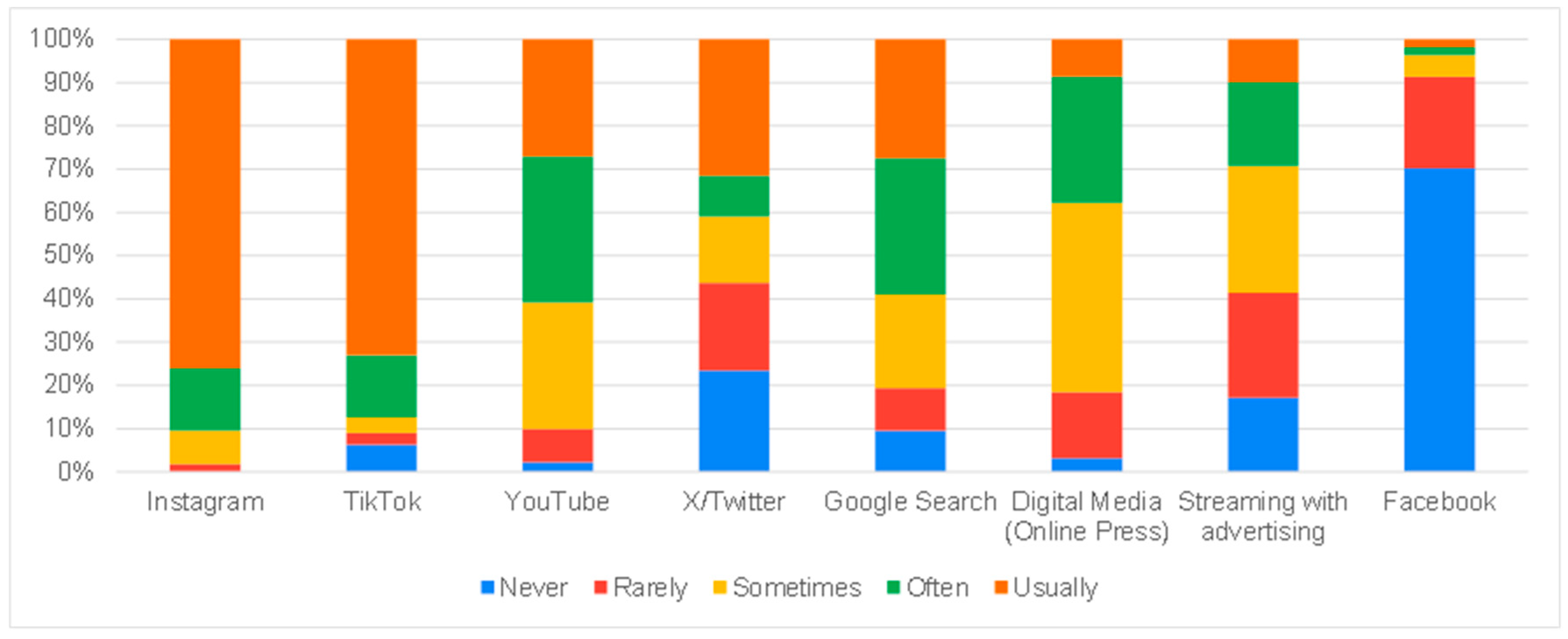
In terms of media consumption and exposure to political content, students use and interact intensively with social networks ‘several times a day’. As shown in
Figure 1, the most widely used networks are Instagram (90.54%), TikTok (87.39%), YouTube (60.81%), and X/Twitter (40.99%).
The frequency of use of these platforms places the respondents at the core of highly datafied ecosystems, characterised by the capture of behavioural signs (clicks, interactions, screen exposure time). These characteristics are typical of students who experience in a direct way the surveillance capitalism described by
Zuboff (
2019). Those platforms are opaque in the sense of personalisation, where the selection and hierarchy of contents are not determined by editorial decisions, but by predictive models trained with massive data (
Guo and Zhang 2025).
Facebook reveals a minority consumption (3.60%). They also point to the use of Google Search (59.01%), although this cannot be considered academically as a social network, but rather as a search engine, as well as online media (37.84%) and streaming services with advertisements (29.28%), which therefore occupy a secondary place in their media diet. The residual use of platforms such as Facebook points out a shift towards less clear and understandable algorithmic sources like TikTok.
3.1.2. Perceived Surveillance and Commercial Data Use
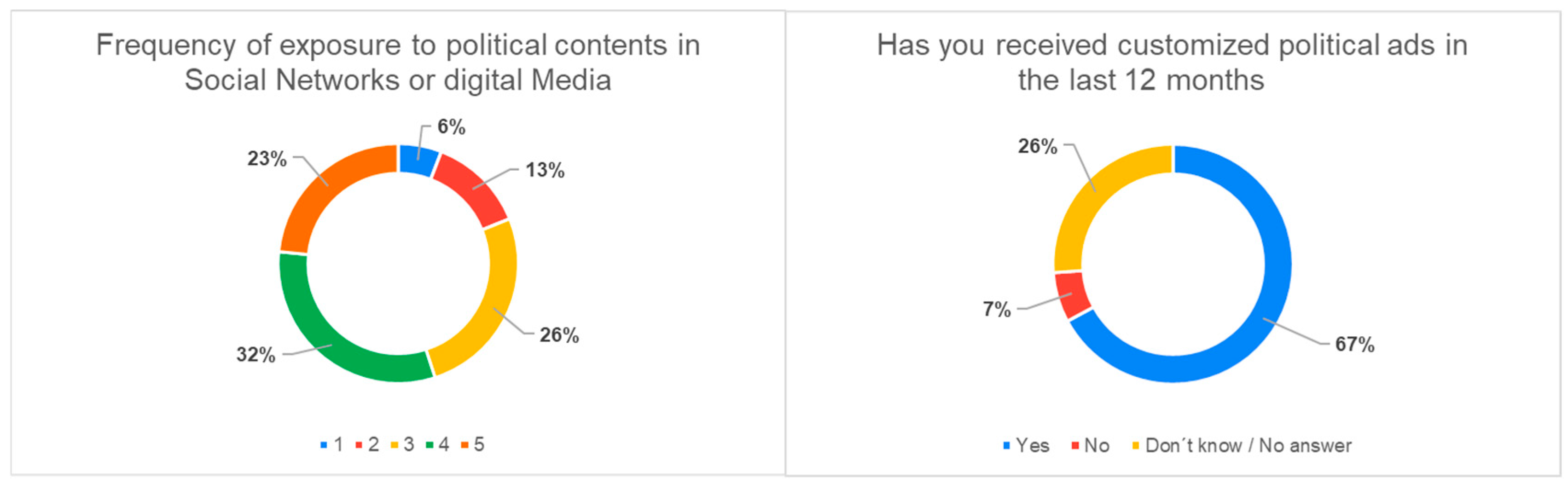
Given this intensive use of social networks, most respondents report being continuously exposed to political content (
Figure 2), with medium-high values (3–4 on a scale of 0 to 5, being 0 never, 1 rarely, 2 sometimes, 3 meaning and 5 usually), and claim to have received personalised political advertisements in the last 12 months, showing that they have been the target of political microtargeting, with messages that are likely to be persuasive. Students are aware that they are the object of strategies of political microtargeting strategies (
Boulianne and Theocharis 2020), but this knowledge does not translate into trust. On the contrary, it increases the scepticism when segment criteria remain hidden (
Huang and Liu 2025).
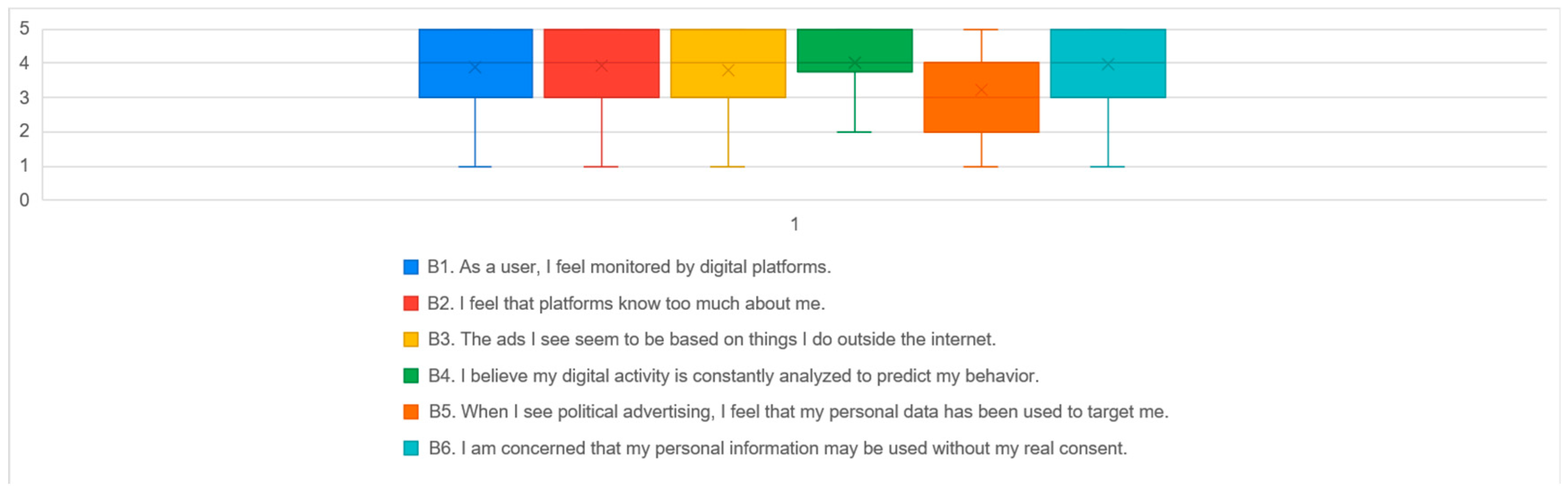
In this context of high social interaction on social networks, students’ responses reveal an intense feeling of surveillance and commercial use of their data (
Figure 3). In Section B of surveillance, high scores predominate (with values of 3–4 on a scale of 0 to 5), reflecting the loss of digital anonymity: students believe that through social media platforms and networks, ‘too much is known about them.’
They perceive that their activity is constantly being analysed to predict their behaviour (4.02). They also express their ‘concern’ about this continuous monitoring and fear that their data can be used without fully informed consent, reflecting a sense of loss of control over their personal data and a mistrust of the data usage practices of large platforms (3.99). Those values correspond with the median value represented by a cross in each box of the
Figure 3. The distance from the top of the figure and the base of the box show us where the 75% of the responses are concentrated. The open responses expressed in Block G1 clearly show this perception: there are repeated responses in which respondents state that after talking about a specific product or topic, advertisements related to those topics appear on their social media. The feeling that ‘the mobile phone is listening’ is a shared account of the feeling of extreme external control, beyond simple data-based personalisation.
As
Couldry and Mejias (
2020) point out, the opacity of automated systems generates the sense of depersonalised control that is more unsettling than traditional human surveillance. In this case, students transpose visible effects like hypercontextualised advertising to a perception of being continuously and technologically surveilled.
The result is a loss of autonomy and the recognition of private intrusions into everyday life that can activate distrust mechanisms and digital self-defence that could lead to a political and democratic risk perception (
Liu et al. 2024).
The findings thus demonstrate how experiences of algorithmic surveillance align with the previously described concept of surveillance capitalism: data extraction is becoming widespread, normalised, and internalised in everyday life. These descriptions, which are highly vivid (‘the mobile phone is listening’), reflect this depersonalised data collection, one of the defining features of surveillance capitalism. Furthermore, discourse centred on the loss of autonomy and the activation, sometimes instinctive, of self-defence mechanisms embodies this logic and, to some extent, explains the mistrust felt by students (as users) towards the acceptance they are compelled to embrace as future professionals.
3.1.3. Perceptions of Big Data in Political Communication
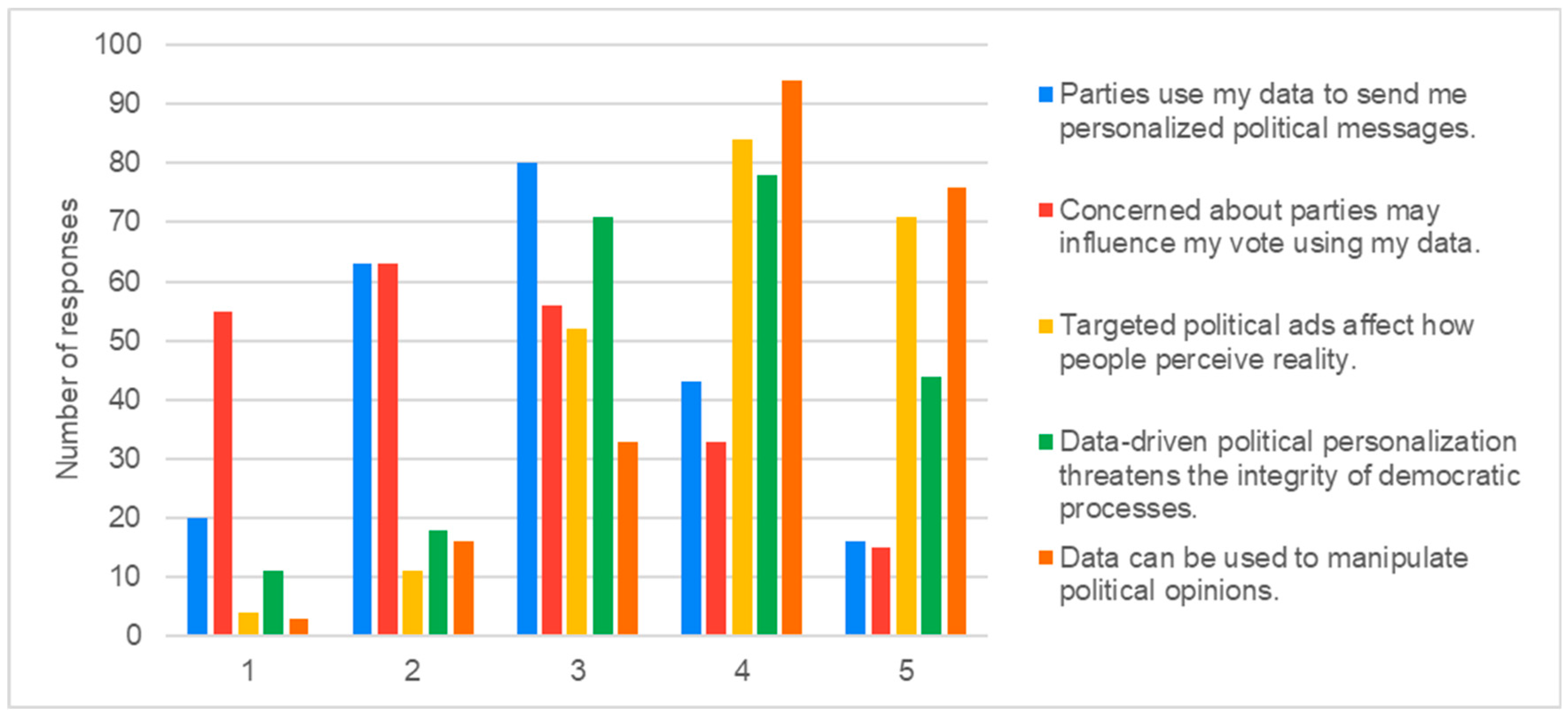
Regarding the political sphere (Block C), students believe that political parties routinely use microtargeting strategies to send them personalised messages and that this segmentation practice can influence voting decisions (average of 4.01), shape political ideas, and beyond that, reshape citizens’ perception of reality (
Figure 4). The levels of agreement with the statement that data-driven political personalisation can threaten the integrity of democratic processes are high (3.57). These descriptions of the intrusion into political thought reflect the powerful asymmetries outlined in the colonial data approach.
Overall, respondents perceive a real manipulation of public opinion through the use of data, with high values. However, for the statement ‘elections in my country are fair’,
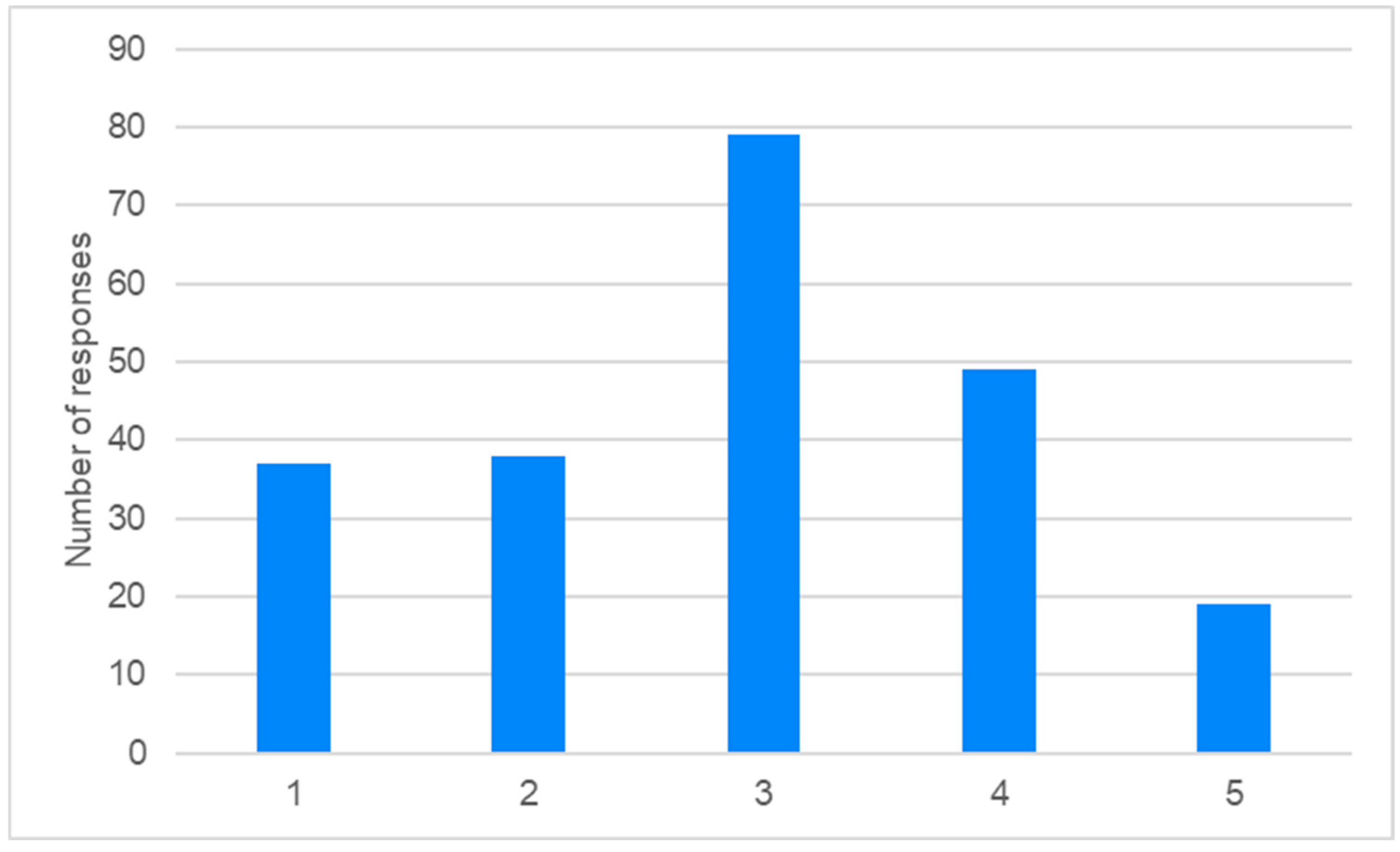
Figure 5 shows a heterogeneous distribution of values (the range encompasses from 0, totally unfair, to 5, completely fair), indicating that there is no complete distrust of democratic processes and democratic quality in Spain or, from another perspective, that distrust offers important nuances that cushion negative perceptions and, ultimately, show that the basic principles of the democratic system remain relatively solid.
The respondents attribute structural power to big data on public opinion. This idea is aligned with the approaches of
Almog Simchon et al. (
2024) about the capacity of advanced personalisation to create compelling asymmetries. However, the heterogenous distribution observed in
Figure 5 indicates a double position: on the one hand, the systemic risk of manipulation, on the other hand the national robustness of democracies.
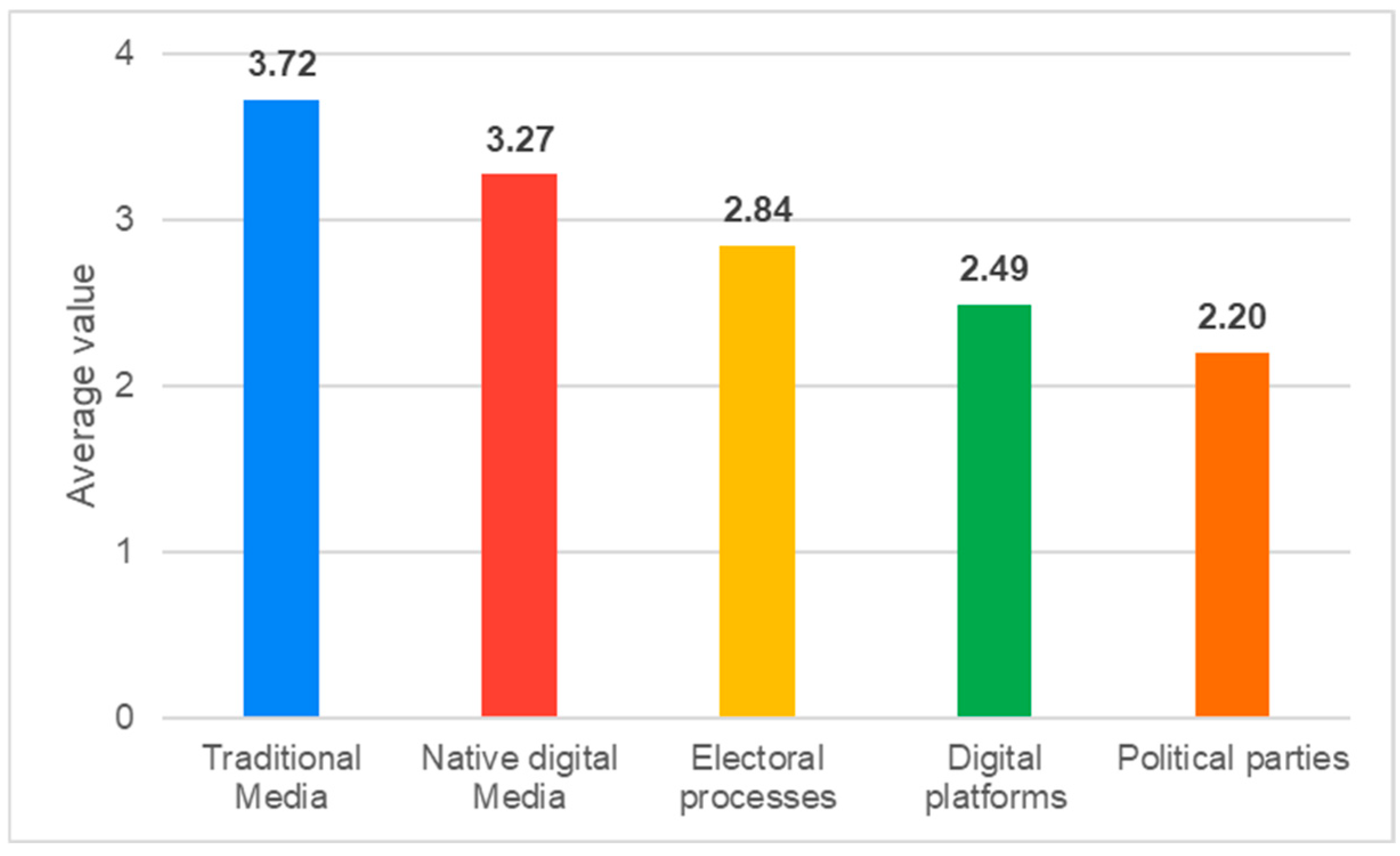
The trust ratings of the platforms and the media (
Figure 6) also show mixed results, with a greater distrust of information from political parties (2.20) than from the news media (3.72), regardless of format.
The distrust of political parties versus the media reinforces the normative role assigned to the journalism as a democratic counterweight. This finding is especially relevant given that the respondents are future journalists, and their knowledge about journalism as a watchdog of democratic processes, and the low trust in digital platforms recognises implicitly their economic interests. These elements are consistent with the literature on data colonialism and the concentration of informational power (
Couldry and Mejias 2020).
3.1.4. Professional Ethics and the Use of Data in Journalism
Moreover, regarding professional ethics and the use of data in the journalism sector, the results of the questionnaires (
Table 1) clearly show a demand for transparency (what audience data can be used and for what purpose) (4.26). They also call on the media to take a committed stance, denouncing possible abuses by political actors regarding the fraudulent use of citizen data, and are committed to establishing clear and strict ethical limits on the use of data by the journalism sector. These positions demonstrate the students’ sensitivity and critical awareness of big data. At the same time, however, the students recognise the legitimacy of the media’s use of audience data for the purpose of segmenting news content, provided that it is used ethically (responsibility).
The responses provided on this issue reveal diverse and nuanced positions, with the most frequent responses being agreement and neutrality. They also consider themselves to be part of the ecosystem in which they will carry out their work. Item E6 (‘What bothers me as a user does not always coincide with what I would accept as a professional’) shows the gap between the feeling of being monitored as a user (discomfort) and the professional logic they will probably have to accept (necessity), as a result of the impact that big data already has on journalism. There is also a sector of students who fear that journalism in the future will be ‘slaves to the algorithm’.
3.1.5. Ethical Boundaries and Role Tensions: User vs. Journalist Identity
Finally, the ethical limits, evident in the open responses from blocks G2 and G3, focus on three aspects: respect for privacy (not accessing ‘too intimate’ data); the need for compliance (explicit and informed consent from audiences); and protection of vulnerable groups (e.g., minors and the elderly), especially when data are used in political communication contexts. Many responses emphasise the need for a justified public interest in the use of data, with the aim of enabling measures that avoid sensationalism or misinformation.
3.2. Qualitative Results (Discussion Group)
- (a)
Complementing the quantitative findings, the group can confirm patterns and verify trends found in the questionnaire.
- -
The feeling of surveillance is explained with concrete examples (“mobile phones and devices listen”). “I have the feeling that AI and data analysis reduce our creativity. We are so patterned that machines study us, predict us, and, in a way, invite us to follow these patterns,” explains B. These student perceptions are conceptualised within the framework of surveillance capitalism theory as ‘behavioural surplus extraction’, that is, the constant capture of digital signals to predict and shape behaviour. Students understand how each interaction provides the raw material for predictive operations to take place.
- -
There is a clear awareness of the presence of personalised political advertising, as noted by various members of the focus group. “Every website offers advertising related to the conversations and sites I usually visit. Nothing different occurs with regard to my desires. Why not think that politics operates in the same way?” asks participant C.
- -
Students perceive real ethical risks linked to the political use of data. In this regard, participant E points out: ‘If the government uses my TikTok likes to decide what political propaganda to send me, where does that leave my freedom to freely decide who to vote for?’ and participant D adds: “There are already many apps that track your geolocation data and sell them to parties to send you biased political advertising, including fake news. Where does that leave my freedom?” G expresses his fear that tracking could affect his job search, for example: ‘Imagine that they track my social networks, my Instagram, for example, and use it to get an idea of whether or not I’m the ideal candidate for their company. That’s a complete intrusion, isn’t it?’
These confirmations reinforce the validity of the numerical arguments presented in
Section 3.1.
- (b)
In particular, the participation of the focus group also allowed us to identify tensions not explicitly stated in the questionnaire, revealing new nuances and greater depth, especially with respect to Sections E, G2 and G3 of the questionnaire. This is evident in expressions such as the following:
- -
‘As a journalist, I understand that the data is useful and even necessary, for the company for which I work, but as a user, I find it somewhat unsettling, almost like science fiction’ (participant B).
- -
‘I think the greatest risk is not manipulation, but transparency: For what purposes is big data being applied, with what consents, what will be the next step… The outlook is alarming’ (participant D).
- -
‘I’m worried about working in a sector that classifies tastes and trends as if they were supermarket products’ (participant F).
- (c)
The group discussion highlighted several recurring analytical categories: the normalisation of algorithmic control (A: ‘We know it’s the logic behind how companies operate”); the expression of fears and concerns (F: ‘While it’s part of my future career, it worries me”); and the demand for ethical training (D: ‘I think we are really not prepared for this scenario’).
Thus, the qualitative data replicate the patterns observed in the quantitative analysis, specifying some nuances such as the internalisation of algorithmic control in daily life, concerns about the future if control becomes more stringent, the demand for practical training for future professionals in the communications sector, and the perception of the unstoppable and inevitable advance of technology.
4. Discussion
In summary, the results of the research provide insight into how journalism students, who are digital natives and highly active on social networks, perceive the use of big data technology, algorithmic personalisation, and the interdependence and interconnection between political actors, social media platforms, and the media, which will largely shape the environment in which they will carry out their professional work in the near future. At the University, they have had a first glimpse of how politics and the media interact to influence the communication they receive and how algorithmic personalisation and big data enable messages to be tailored to the interests of each user. The findings thus demonstrate how student accounts of algorithmic surveillance reflect the patterns associated with the concept of surveillance capitalism and contribute to the asymmetries of trust and mistrust described by the authors.
In this regard, students are highly critical of the harmful uses to which big data and algorithmic personalisation can lead, and express concern about ethical issues such as privacy, informed consent for data use, and the protection of particularly vulnerable groups, such as minors. Thus, there is a perceived gap between their role as users (feelings of surveillance and external control, susceptibility to the development of algorithmic personalisation) and the professional logic that will likely lead them to assume that algorithmic personalisation is part of the future of journalism and that, therefore, they must accept this technology as a structural element of the environment in which they will carry out their work. Consequently, in the context of hyperconnectivity, one of the main findings leads us to the duality of mistrust and necessity.
To begin with, the tendency of students to prioritise social networks over traditional media has been widely addressed in the literature (
Tahat et al. 2024;
Hoşgör and Deniz 2025), as has the rise of social networks such as Instagram, TikTok, and YouTube among the university population, as opposed to other platforms with minority usage such as Facebook, which is more commonly used by older generations.
However, paradoxically, as future journalism professionals, they understand the usefulness and functional logic of big data and algorithmic personalisation and assume that it will inevitably form part of the media ecosystem in which they will carry out their professional tasks. At the same time, they are aware of the risks it poses to citizens, democratic systems, and the reshaping of political perceptions. Several academic studies have highlighted the democratic risks associated with the irresponsible and opaque use of these technologies. Still, when the focus shifts to contexts of proximity, the questionnaires reveal a heterogeneous distribution of responses, ranging from confidence to susceptibility and mistrust, which is more pronounced in negative terms when it comes to political parties than to news media. Thus, concern about manipulation does not directly translate into a delegitimation of democratic systems, and it can be seen how students discern between the risks arising from algorithmic personalisation and the stability of the Spanish democratic system.
Regarding trust in information providers, in line with other academic research, there is greater credibility towards traditional media and mistrust toward communication from political parties. This circumstance may implicitly lead to a belief in the possibility that the media can act as a counterweight and a Fourth Estate, guaranteeing the quality of democratic systems. Regarding social media platforms, the trust expressed is also limited, as respondents indicate that it is an extremely open space, where freedom coexists with political and commercial interests.
Another notable finding is the demand for transparency from journalism students who are calling for greater clarity on how audience data are used. They are also calling for an ethical and regulated system that prevents abusive practices that could damage democratic co-existence and health, as well as situations of excessive surveillance and control. Therefore, as users, they have experienced the feeling of surveillance and monitoring at some point, but as future journalists, they assume that these are data technologies that are inherently part of the media context. The mediation they propose to overcome this ethical conflict involves assuming responsible, ethical, and transparent use, as well as restraint, to prevent journalism from becoming a slave to the algorithms.
Although the study’s findings highlight various concerns about algorithmic surveillance, it is important to note that links drawn with issues affecting democratic legitimacy and quality should be understood as interpretations derived from student responses. Therefore, they should not be taken as a comprehensive characterisation of the overall functioning of democratic systems.
Finally, the risks identified by the respondents (violation of privacy, breach of explicit consent, and lack of protection for vulnerable groups) have also been highlighted by various codes of ethics. Insistence on compliance with ethical values and the defence of the public interest shows that students do not categorically reject big data, but rather its opacity.
Ultimately, this hope for algorithmic ethics opens new horizons for the future of the profession and reinforces the need to promote journalistic reflection, media literacy, and data ethics.
5. Conclusions
The results of the research show, first of all, that journalism students are highly critical of big data and algorithmic personalisation in the field of political communication. They also express concern about the risks this may entail, mainly those associated with privacy, informed consent, the protection of vulnerable sectors of the population, and, ultimately, the health of democratic systems.
This sensitivity and critical awareness reveal that universities are already creating a space for reflection on these risks, although some scepticism remains about the possible influence they may have on their own democratic system. They believe that microtargeting and personalisation can shape citizens’ political awareness and perceptions, but they warn of an imminent political risk and, on the contrary, see solid foundations in their democratic system.
There are also shortcomings in the actual functioning of data algorithms, generally associated with active listening devices, making it necessary to promote media literacy and adapt university curricula to new trends.
Research also highlights the existence of tensions between the role students experience as users, in which they may feel vulnerable, monitored, and controlled from outside, and their role as future journalists from which they conceive these technologies as a contextual necessity. The construction of the professional identity of journalism students is marked by this apparent contradiction, which poses an ethical and educational challenge that contributes to reconciling both dimensions. For the time being, students are calling for transparency and ethical regulation to prevent abusive practices and see hope in the development of data ethics.
Regarding the role of the media, the research reveals the trust that students still place in the media as a counterweight to abuses of political power, while there is limited trust in social media platforms, where they are aware that freedom coexists with abuse and the risks of manipulation.
Finally, the University has the opportunity to promote critical awareness and responsible use of data-driven communication, with a view to public interest, free thought, and the strengthening of democracies.
However, it should be noted that any interpretations regarding trust in democratic systems and the role of journalism must be limited to the conclusions drawn from the responses of the respondents and are not intended to describe a widespread social trend. Consequently, references to these aspects, which focus on a sample from a single university, should not be interpreted as conclusions that can be extrapolated to other geographical areas.
Also, the research results have some limitations due to the sample and the cross-sectional nature of the study, which focused on journalism students from a single university. Therefore, future comparative research could be conducted to extrapolate results to other countries and democratic systems, or even to students from other disciplines. Similarly, methodological triangulation could be added to capture greater nuances. The findings should therefore be interpreted as a starting point for understanding how journalism students perceive the professional environment of the immediate future, marked by big data and algorithmic personalisation.
Supplementary Materials
The following supporting information can be downloaded at:
https://www.mdpi.com/article/10.3390/socsci15050324/s1. Qualitative coding framework and AI-assisted exploratory support. S.1. Conceptual coding framework developed prior to AI use; S.2. examples of AI prompts used in the exploratory phase; S.3. Human–AI cross-check procedure.
Author Contributions
Conceptualization: M.Á.F.-B. and L.G.A.M.; methodology, M.Á.F.-B.; software, L.G.A.M.; validation, L.G.A.M.; formal analysis, M.Á.F.-B.; investigation, M.Á.F.-B.; resources, L.G.A.M.; data curation, M.Á.F.-B.; writing—original draft preparation, M.Á.F.-B./L.G.A.M.; writing—review and editing, M.Á.F.-B./L.G.A.M.; visualization, M.Á.F.-B./L.G.A.M.; supervision, M.Á.F.-B.; project administration, M.Á.F.-B./L.G.A.M. All authors have read and agreed to the published version of the manuscript.
Funding
This research received no external funding.
Institutional Review Board Statement
All activities carried out in this study were in accordance with current legislation and institutional guidelines on research ethics, ensuring strict adherence to ethical principles at every stage of the study. No direct identification or sensitive personal data was collected. The study was designed to minimise the risk of identification, but absolute anonymity cannot be technically guaranteed in contemporary cloud-based digital environments. In-depth interviews have guaranteed anonymity of the interviewees in order to favour the veracity of the testimony and the freedom of expression of the interviewees. Anonymous responses were processed using digital analysis tools solely for academic and research purposes, according to institutional ethical guidelines and current data protection regulations, and did not involve intentional transfer of direct personal identifications to third parties, nor the creation of individual analytical profiles by researchers. The study was conducted in accordance with the Declaration of Helsinki, point 23: no human biological material or identifiable data are used; respect for the rights, privacy, and informed consent of participants is guaranteed; vulnerable populations or risk situations are not involved; surveys and discussion groups were conducted without the collection of direct identifiers, according to ethical standards and informed consent procedures, acknowledging the inherent limits of anonymity in digital research contexts. The research has been reviewed by the Institutional Review Board (or Ethics Committee) of the Colegio Oficial de Periodistas de Andaluca.
Informed Consent Statement
Informed consent was obtained from all participants, who were informed of the digital tools used for data collection and analysis and the associated technical limitations.
Data Availability Statement
Data supporting the findings of this study are not publicly available due to privacy and ethical restrictions. The responses contain sensitive information that could compromise confidentiality and were collected under conditions that do not permit open sharing. Researchers interested in accessing anonymised or aggregated data may contact the corresponding author to discuss potential options, subject to ethical approval and institutional guidelines.
Acknowledgments
We thank the New Narratives and Emerging Technologies research group of the University of Seville for their contribution to the dissemination of the survey among students. During the preparation of this copy, Gemini Advanced was used as an initial thematic coding assistant (assisted open coding). Firstly, the researchers carried out a second complete cycle of review, adjustment, and final conceptualisation. This use was limited exclusively to technical support functions and did not replace the interpretation, analytical judgement, or theoretical decision-making. The authors acknowledge the ethical implications of using proprietary AI services and take responsibility for the methodological, analytical, and interpretative decisions made in the study. In addition, they used the following AI applications: Citewise, to help retrieve bibliographic metadata for the references; Writefull, to improve academic writing in English. Secondly, authors conducted a thorough review and made the necessary revisions to the content. Finally, authors assume full responsibility for the accuracy and integrity of the final version of the publication.
Conflicts of Interest
The authors declare that they have no known conflicts of interest or competing financial interests that could have appeared to influence the work reported in this paper.
References
- Almog Simchon, Asaf, Michael Edwards, and Stephan Lewandowsky. 2024. The persuasive effects of political microtargeting in the age of generative artificial intelligence. PNAS Nexus 3: 035. [Google Scholar] [CrossRef] [PubMed]
- Boulianne, Shelley, and Yannis Theocharis. 2020. Young people, digital media, and engagement: A meta-analysis of research. Social Science Computer Review 38: 111–27. [Google Scholar] [CrossRef]
- Couldry, Nick, and Ulises A. Mejias. 2020. The Costs of Connection: How Data Is Colonizing Human Life and Appropriating It for Capitalism. Stanford: Stanford University Press. [Google Scholar]
- Decker, Heiko. 2025. The role of content personalisation in political social media campaigning: A review of political microtargeting. Zeitschrift für Politikwissenschaft 35: 83–98. [Google Scholar] [CrossRef]
- Dobber, Trystan, Rónán Ó. Fathaigh, and Frederik J. Zuiderveen Borgesius. 2019. The regulation of online political micro-targeting in Europe. Internet Policy Review 8: 1440. [Google Scholar] [CrossRef]
- European Parliament and Council of the European Union. 2024. Regulation (EU) 2024/900 on the transparency and targeting of political advertising. Official Journal of the European Union L 2024/900: 1–44. [Google Scholar]
- Guo, Yanan, and Xiaolong Zhang. 2025. The impact mechanism of algorithmic transparency on user trust in intelligent recommendation systems of internet platforms. Journal of Computers 36: 335–48. [Google Scholar] [CrossRef]
- Gutiérrez-Caneda, Beatriz, Carl-Gustav Lindén, and Jorge Vázquez-Herrero. 2024. Ethics and journalistic challenges in the age of artificial intelligence: Talking with professionals and experts. Frontiers in Communication 9: 1465178. [Google Scholar] [CrossRef]
- Hoşgör, Hasan K., and Özge Deniz. 2025. The effect of media literacy on journalism students’ trust level in social media news. Sinop Üniversitesi Sosyal Bilimler Dergisi 9: 55–78. [Google Scholar] [CrossRef]
- Huang, Yan, and Lei Liu. 2025. The impact of algorithm awareness on the acceptance of personalized social media content recommendation based on the technology acceptance model. Acta Psychologica 259: 105383. [Google Scholar] [CrossRef]
- International Association of Privacy Professionals. 2023. Privacy and Consumer Trust Report 2023. Available online: https://iapp.org (accessed on 27 February 2026).
- Jin, Jing, Jun Liu, and Hu Ying. 2025. The positive and negative impacts of social media algorithms on consumer behavior and optimization strategies. Advances in Economics, Management and Political Sciences 237: 27–32. [Google Scholar] [CrossRef]
- Kozyreva, Anastasia, Philipp Lorenz-Spreen, Ralph Hertwig, and Stephan Lewandowsky. 2021. Public attitudes towards algorithmic personalization and use of personal data online. Humanities and Social Sciences Communications 8: 304. [Google Scholar] [CrossRef]
- Kunkel, Timo, Judith Möller, and Marc Ziegele. 2023. Transparency and trust in algorithmic news recommendation systems. Computers in Human Behavior 137: 107403. [Google Scholar] [CrossRef]
- Lewis, Seth C., and Rodrigo Zamith. 2023. Journalism ethics in the age of automation: Algorithmic accountability and professional norms. Digital Journalism 11: 743–60. [Google Scholar]
- Liu, Limei, Muhammad Salman bin Muhammad, Shiyu Gong, and Bo Liu. 2024. The moderating effect of algorithm literacy on Over-The-Top platform adoption. Entertainment Computing 49: 100623. [Google Scholar] [CrossRef]
- Mensing, D. 2022. Rethinking journalism education in datafied societies. Journalism & Mass Communication Educator 77: 123–137. [Google Scholar]
- Moravec, Václav, Nikola Hynek, Matija Skare, Beata Gavurova, and Vladislav Polishchuk. 2025. Algorithmic personalization: A study of knowledge gaps and digital media literacy. Humanities and Social Sciences Communications 12: 341. [Google Scholar] [CrossRef]
- Muralikumar, Madhusudan D., and Michelle J. Bietz. 2019. Visualizing algorithmic selection in social media. Paper presented at Companion Publication of the 2019 Conference on Computer Supported Cooperative Work and Social Computing (CSCW 2019), Austin, TX, USA, November 9–13; pp. 319–23. [Google Scholar] [CrossRef]
- Porlezza, Colin. 2023. Promoting responsible AI: A European perspective on the governance of artificial intelligence in media and journalism. Communications 48: 370–94. [Google Scholar] [CrossRef]
- Schlund, Roman, and Emily M. Zitek. 2024. Algorithmic versus human surveillance leads to lower perceptions of autonomy and increased resistance. Communications Psychology 2: 53. [Google Scholar] [CrossRef]
- Starke, Christian, Leon Metikoš, Natali Helberger, and Claes de Vreese. 2025. Contesting personalized recommender systems: A cross-country analysis of user preferences. Information, Communication & Society 28: 41–60. [Google Scholar] [CrossRef]
- Sunstein, Cass R. 2001. Designing Democracy: What Constitutions Do. Oxford: Oxford University Press. [Google Scholar] [CrossRef]
- Tahat, Khalid M., Muhammed Habes, Dana Tahat, and Mohammed Alghizzawi. 2024. Social media use in journalism and education mediated by personal integrative needs. Paper presented at 2024 11th International Conference on Social Networks Analysis, Management and Security (SNAMS), Abu Dhabi, United Arab Emirates, December 9–11; pp. 161–67. [Google Scholar]
- Ye, Jing, Luca Luceri, and Emilio Ferrara. 2024. Auditing political exposure bias: Algorithmic amplification on Twitter/X approaching the 2024 U.S. presidential election. SSRN Working Paper 2024.9. [Google Scholar] [CrossRef]
- Zhou, Rui. 2024. Understanding the impact of TikTok’s recommendation algorithm on user engagement. International Journal of Computer Science and Information Technology 3: 201–8. [Google Scholar] [CrossRef]
- Zuboff, Shoshana. 2019. The Age of Surveillance Capitalism: The Fight for a Human Future at the New Frontier of Power. New York: Public Affairs. [Google Scholar]
| Disclaimer/Publisher’s Note: The statements, opinions and data contained in all publications are solely those of the individual author(s) and contributor(s) and not of MDPI and/or the editor(s). MDPI and/or the editor(s) disclaim responsibility for any injury to people or property resulting from any ideas, methods, instructions or products referred to in the content. |