1. Introduction
In many rapidly urbanising economies, construction activity relies heavily on informal, semi-skilled, and intermittently employed labour (
Wells 1998;
Ofori 2012). While this arrangement enables cost flexibility and rapid project delivery, it often coincides with limited institutional training, fragmented subcontracting structures, and restricted opportunities for cumulative skill development (
Pathiraja and Tombesi 2009). As a result, construction sectors in such contexts frequently experience persistent deskilling, uneven quality, and constrained labour mobility despite sustained growth in building demand (
Anand 2000).
Existing responses to these challenges have largely focused on policy reform, vocational training programmes, industrialisation strategies, or technological upgrading (
ILO 2019;
Clarke 2006). In these approaches, technology is commonly treated as a neutral instrument for improving productivity, while labour is conceptualised as a resource to be optimised. Less attention has been paid to the role of architectural design itself in structuring labour–technology interaction during construction. Yet design decisions such as systemisation, sequencing, detailing, and tolerances materially configure how workers engage with technical systems on site. Architectural design may therefore influence whether construction processes reinforce repetitive execution or create conditions for situated learning.
This article adopts a constructivist understanding of technology, building on the work of Andrew Feenberg, Donald MacKenzie, and Frankfurt School theorists, who argue that technologies are socially mediated rather than purely autonomous (
Feenberg 1999;
MacKenzie and Wajcman 1985;
Adorno and Horkheimer 1944). Within this perspective, construction systems are viewed as socio-technical assemblages influenced by design decisions, organisational arrangements, and labour practices. This article further engages with theories of tacit knowledge, particularly those associated with
Polanyi (
1962), to investigate how embodied learning occurs during material production. Here, craft is not regarded as an aesthetic or nostalgic concept but as a learned practice in which judgment, adjustments, and material feedback are essential to the work.
Against this backdrop, the central research question is as follows: How can architectural design mediate labour–technology relations in construction to create conditions for embedded, non-formal skill formation?
To address this question, this study analyses two architectural projects in Sri Lanka: a suburban residential retrofit (Primrose House) and a low-income rural housing prototype (Wakwella House). These cases represent contrasting economic and technical conditions while sharing a design approach that intentionally structures construction systems through systemisation, sequencing, tolerance-based detailing, and componentised assembly. Rather than measuring long-term labour mobility outcomes, this study investigates how design decisions configure opportunities for tacit learning during production.
Methodologically, this article adopts a qualitative, practice-based, case study approach. Data are drawn from construction documentation, sequencing studies, on-site observation, and reflective records of design–construction interaction. The aim is analytical rather than towards statistical generalisation, and seeks to identify the mediating mechanisms through which design shapes labour experience.
By situating architectural design within debates on labour and technology, this article argues that construction systems should be evaluated not only in terms of efficiency and output but also in terms of how they configure participation, agency, and knowledge formation within the building process. Theoretically, it is rooted in discussions of technological determinism and constructivism, tacit knowledge and craft in construction, and culturally specific understandings of labour and technology in non-Western contexts.
2. Theoretical Framework: Technology, Craft, and Labour as Socio-Technical Mediation
2.1. Technology as a Socially Mediated Practice
Research on construction technology has often been shaped by implicit forms of technological determinism, in which mechanisation, standardisation, and efficiency are assumed to represent a universal trajectory of progress (
Ellul 1964;
Heidegger 1959;
Weber 1978). In such models, labour appears primarily as a variable to be optimised or replaced, and technical systems are treated as autonomous drivers of organisational change. This orientation has informed much construction management discourse, particularly in industrialisation and productivity studies (
Braverman 1974).
In contrast, constructivist perspectives within Science and Technology Studies argue that technologies are not neutral instruments but socio-technical arrangements shaped through negotiation among actors, institutions, and cultural values. As articulated by scholars such as Andrew Feenberg, Donald MacKenzie and Judy Wajcman, technological systems embody social choices: design decisions structure power, competence, participation, and forms of agency (
Feenberg 1999;
MacKenzie and Wajcman 1985). Technology, therefore, does not determine labour relations in a linear fashion; rather, labour–technology configurations emerge through material, organisational, and political mediation.
Feenberg, MacKenzie, and Wajcman’s ideas expand on the work of Frankfurt School theorists such as Jürgen Habermas, Herbert Marcuse, Theodor Adorno, and Max Horkheimer. These theorists argued that technology is influenced by specific social and political values rather than universal rationality (
Marcuse 1964;
Habermas 1987;
Adorno and Horkheimer 1944). They highlighted the connection between technical dominance and social organisation, showing that technology is socially dependent and can serve different roles within various social systems. Additionally, they proposed that politics and technology can interact by integrating marginalised and traditional institutions into the industrial framework, promoting democratic involvement in technical matters.
This critical perspective is neither technocratic nor romantic.
Marcuse (
1964), for example, rejected a single path of progress based solely on technological rationality, instead advocating for a rationality rooted in informal public participation in technological development.
Habermas (
1987) argued that technological progress does not threaten human existence but instead reveals human activity in a “new and purified configuration”. He explains that, unlike pre-modern societies, where technical, aesthetic, and ethical actions were interconnected, modern society disentangles these areas both practically and theoretically. Consequently, “political implications appear to interfere with human communication in life-world domains”, underscoring the need for restoring healthy social communication and mediation to effectively steer market and administrative forces (
Habermas 1987).
Within the built environment, this view recasts construction technologies as social assemblages of materials, tools, sequencing logics, tolerances, and organisational structures. Architectural design plays a critical role in configuring these assemblages. Decisions regarding systemisation, detailing, and construction sequencing are not merely aesthetic or technical refinements; they shape how workers engage with materials, how errors are accommodated, and whether learning opportunities are embedded or suppressed. Design, therefore, operates as a mediating layer between abstract technological systems and situated labour practice.
This constructivist position reframes this article’s central question: rather than asking whether technology deskills or empowers, the issue becomes how design configures the conditions under which labour encounters technology.
2.2. Craft, Tacit Knowledge, and Learning in Construction
The idea of craft is often linked to nostalgia, pre-industrial production, or stylistic expression (
Adamson 2013). In this study, however, craft is treated analytically rather than romantically. Craft is defined here as a mode of production in which tacit knowledge, embodied judgement, and material feedback are integral to the execution of tasks.
Drawing on the theory of tacit knowledge developed by Michael Polanyi, craft-based work involves forms of knowing that cannot be fully codified in manuals or drawings but are acquired through practice, observation, repetition, and adjustment (
Polanyi 1962). In construction, such knowledge emerges in activities such as jointing, casting, fitting, and negotiating dimensional tolerances. Learning occurs not only through abstraction but also through iterative engagement with materials and tools.
On the other hand, the studies of learning in construction emphasise the importance of on-the-job training, apprenticeship, and peer-based knowledge exchange as primary modes of skill acquisition (
Groak 1992;
Clarke and Winch 2007). Unlike classroom-based training, these modes allow workers to encounter the variability and uncertainty inherent in building processes, enabling learning to occur in response to real-time challenges. Craft-based practices thus function not only as methods of production but also as informal pedagogical systems that integrate labour, technology, and learning within the same process.
However, industrial fragmentation and subcontracting have progressively separated design from production, reducing opportunities for cumulative skill formation and weakening traditional apprenticeship structures (
Gann and Senker 1998;
Clarke 1992). Yet recent scholarship suggests that craft need not be opposed to contemporary production systems (
Adamson 2013;
Sennett 2008). When complexity is structured rather than eliminated, and when tolerances allow judgement rather than enforcing rigid compliance, construction systems can embed learning within production.
In this sense, craft functions pedagogically when three conditions are present: (1) tasks require judgement rather than mere repetition; (2) sequencing introduces graduated complexity; and (3) design allows for negotiation between nominal specification and material reality. Craft, therefore, is not positioned as an alternative to technology but as a particular configuration of labour–technology interaction in which tacit knowledge becomes visible and cumulative.
2.3. Contextualising Labour and Technology in Sri Lanka
Technological meaning is also shaped by historical and institutional context. Comparative studies in development and postcolonial theory have shown that labour relations in many non-Western societies evolved through land-based service systems, colonial restructuring, and informal economic practices rather than along the linear industrial trajectories often assumed in Western economic models (
Quijano 2000;
Chakrabarty 2000).
In Sri Lanka, historical labour arrangements such as ‘rajakariya’ organised work through reciprocal obligation and state authority rather than wage-based contractual systems (
Farmer 1957;
Mills 1954). Colonial reforms dismantled such structures without simultaneously establishing comprehensive systems of technical education or industrial training. Contemporary construction labour, therefore, operates within a hybrid condition marked by informality, fragmented subcontracting, and limited institutional skill development.
Linguistic and cultural histories indicate that in Sinhala, the concepts of technology and craft are closely intertwined. For instance, the Malalasekara English-Singhalese Dictionary translates ‘technology’ as ‘shilpa karmanthaya’, where ‘shilpa’ encompasses both craft and skill and ‘karmanthaya’ refers to organised work or industry (
Malalasekara 1948). These shared meanings suggest that technical practices have historically been linked to broader social notions of action and duty rather than being limited to abstract technological rationality.
This contextual perspective does not reflect cultural resistance to technology. Instead, it highlights how people’s engagement with technological systems depends on working conditions, recognition, and the distribution of benefits. When tasks are repetitive, precarious, or socially marginalised, technological change can feel like an external imposition. Conversely, when design fosters meaningful engagement and visible contribution, technology can serve as a tool for agency and skill development.
By understanding labour and technology within specific cultural contexts, this study highlights the need for context-sensitive approaches to construction reform. It also suggests that architectural design, aligned with local labour practices and knowledge, can act as a mediator, making technological change more socially meaningful and educationally effective.
2.4. From Theory to Empirical Inquiry
The discussion above establishes three interrelated premises that frame this study: first, that construction technologies are socially constructed and embedded within specific labour relations; second, that craft-based practices serve as key sites for tacit knowledge production and learning; and third, that the relationship between labour and technology is influenced by historically specific institutional conditions.
If architectural design configures construction systems, and if construction systems structure labour experience, then design decisions may determine whether technology reinforces deskilling or facilitates learning. Within this premise, the empirical case studies that follow examine how systemisation, sequencing, dimensional tolerances, and craft-based componentry operate as mediating mechanisms in two distinct Sri Lankan construction contexts.
3. Research Design and Methods
This study thus adopts a qualitative, interpretive research design grounded in a constructivist understanding of technology. If construction systems are socially mediated rather than autonomous, then labour–technology relations must be examined within the material and organisational contexts in which they are enacted. Architectural design is therefore treated not as a neutral backdrop to production but as an active configuration of socio-technical conditions.
Rather than measuring productivity outputs or long-term labour mobility, this study examines how design configures conditions for embedded, non-formal learning within building activity. A case study methodology was selected because labour–technology interaction in construction is context-dependent and processual. As noted by
Robert K. Yin (
2014), case studies are appropriate for examining contemporary phenomena within real-life settings where boundaries between context and action are intertwined. The aim is analytical generalisation: to identify mediating mechanisms that may be conceptually transferable across comparable contexts.
3.1. Case Study Selection
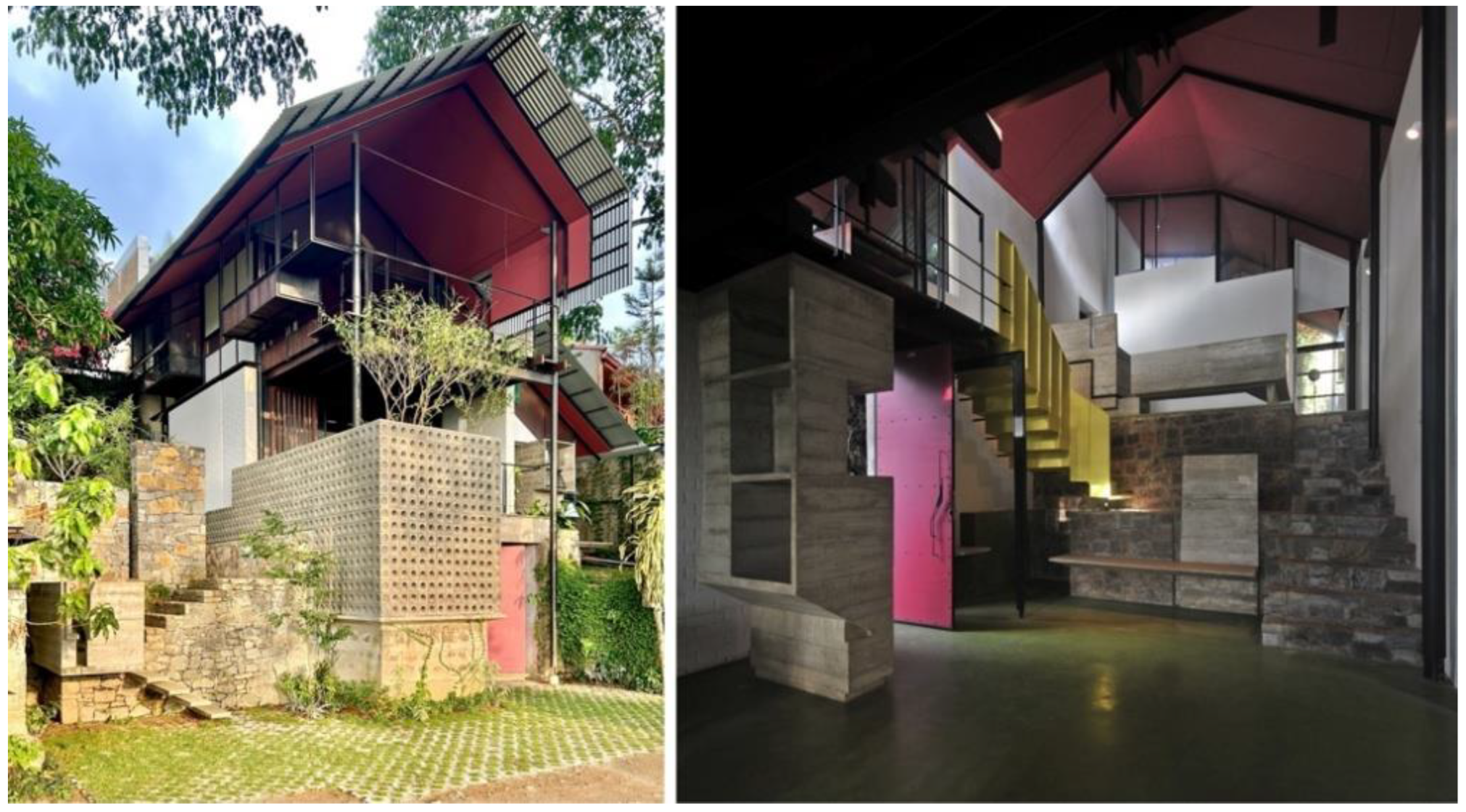
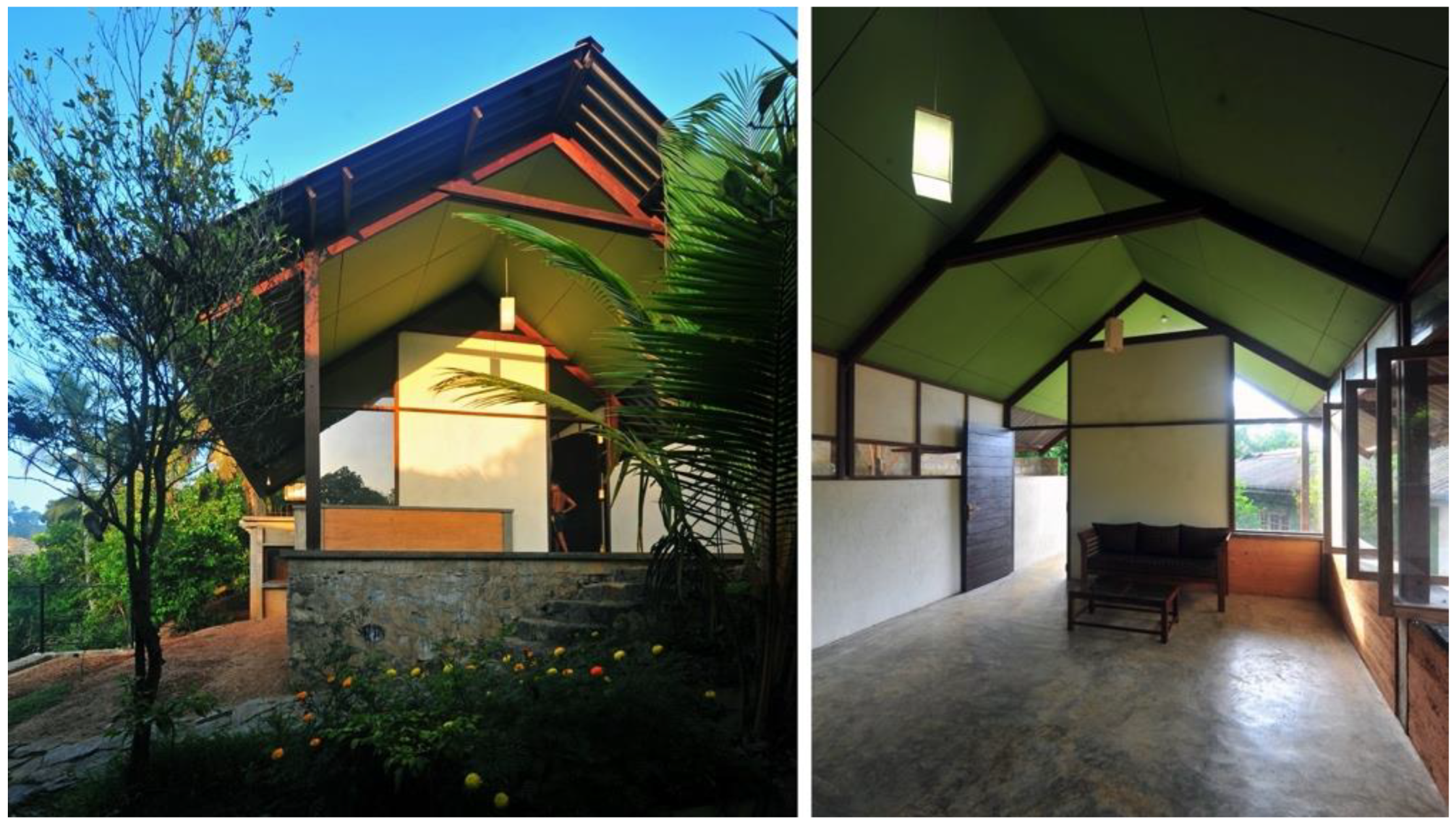
Two architectural projects in Sri Lanka were selected to represent contrasting economic, spatial, and organisational conditions while maintaining a consistent design authorship and conceptual approach. The first case, Primrose House, is a suburban residential retrofit involving structural layering, dimensional uncertainty, and coordination among specialised trades (
Figure 1). The second, Wakwella House, is a low-income rural housing prototype developed in a post-conflict setting, characterised by material hybridity and heterogeneous labour composition (
Figure 2).
The projects differ in scale, labour structure, technical complexity, and resource availability. This contrast enables comparative analysis of how design-mediated mechanisms operate under different constraints. Shared authorship allows examination of how consistent design principles are recalibrated across contexts rather than attributing outcomes to stylistic variation.
3.2. Data Collection
Data were collected through multiple qualitative sources to enable process-based triangulation. These included: (1) architectural drawings, construction documentation, system diagrams, and sequencing studies produced during the design and construction phases; (2) direct observation of construction processes and labour practices on site; and (3) reflective practice records documenting design decisions, construction challenges, and interactions with contractors and workers.
Analytical attention focused on moments where nominal specification encountered material variability, such as joint negotiation, tolerance management, sequencing transitions, and component fabrication. These moments were significant because they required judgement, adjustment, and coordination among workers.
Labour engagement was examined through observable indicators of skill formation, including: (1) gradual expansion of task complexity, (2) repetition with increasing refinement, (3) redistribution of responsibility within work sequences, and (4) collaborative problem-solving around tolerances and material interfaces.
This study does not aim to measure labour mobility, income growth, or certification outcomes over time. Instead, it identifies observable processes through which tacit knowledge can be built up within production.
3.3. Analytical Strategy
The analysis followed a thematic and process-oriented approach. Empirical material was reviewed iteratively to identify recurring patterns in how design decisions structured labour–technology interaction. Four mediating mechanisms emerged across both cases:
Systemised yet legible complexity
Tolerance-based detailing enabling judgement
Sequenced exposure to graduated technical challenges
Componentised structuring of learning opportunities
These mechanisms were interpreted through a constructivist lens, treating technology and labour as co-constructed rather than causally hierarchical. The analysis, therefore, focuses on how design configures the conditions under which learning may occur, rather than attributing learning outcomes directly to technical systems.
3.4. Researcher Positionality and Limitations
This study adopts a practitioner–researcher approach. The author’s dual role as architect and analyst enabled close access to construction processes, documentation, and site-based negotiation between design and execution. This proximity provided granular insight into socio-technical interaction but also necessitated reflexivity (
Robson 2002).
To mitigate interpretive bias, analysis was grounded in documented construction actions, task structures, and material outcomes rather than in retrospective intention. Claims are derived from observable changes in task allocation and complexity rather than from subjective assessments of worker experience.
This study is limited to two projects within a specific national context. Its contribution lies in identifying mediating mechanisms through which architectural design structures labour engagement, rather than in producing statistically generalisable claims. The findings are therefore analytically transferable rather than empirically universal.
4. Case Study 1: Retrofitting as a Socio-Technical Learning Process
The Primrose project involved the retrofit and extension of an existing residential building within a constrained suburban plot (
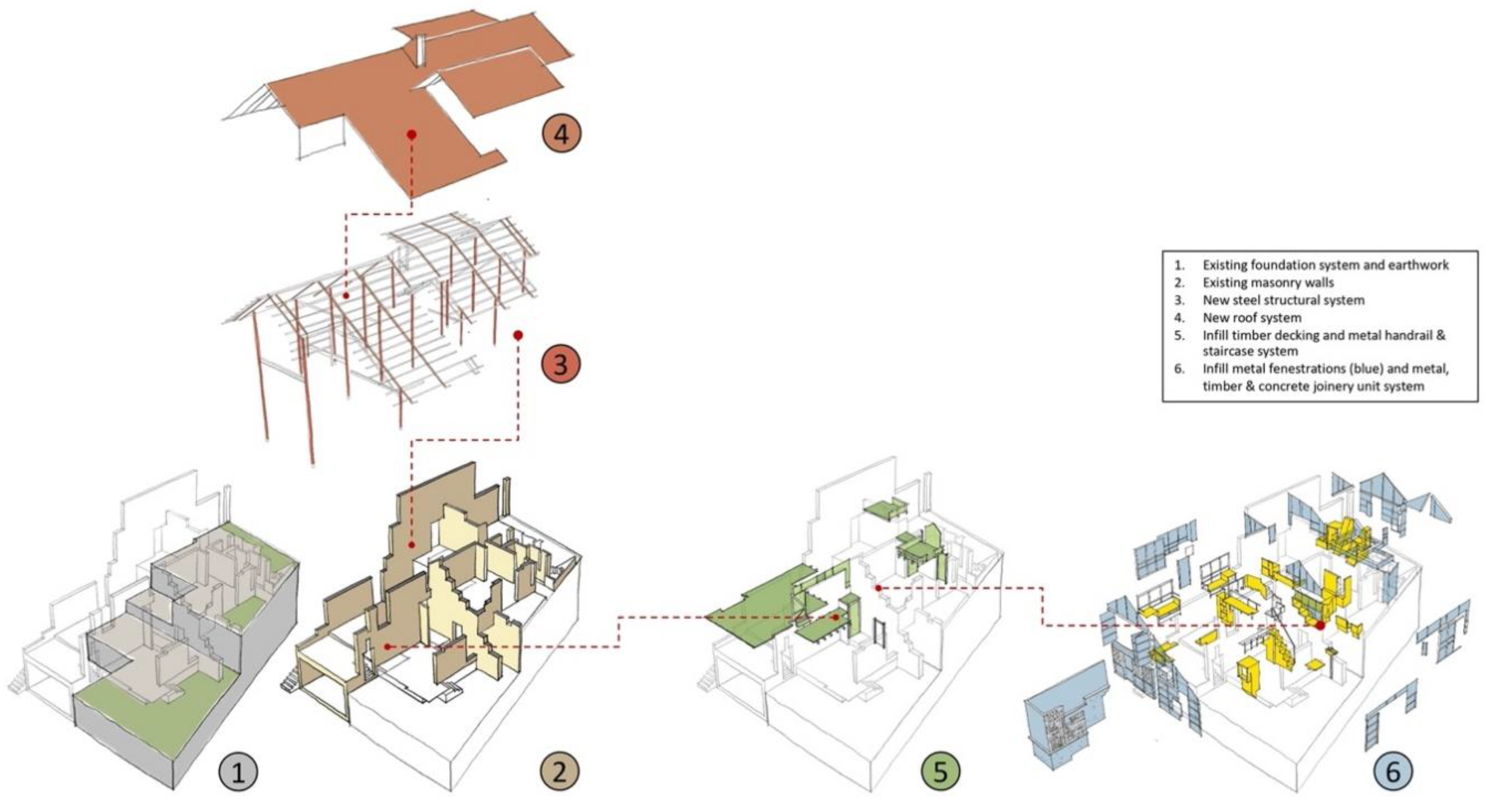
Figure 3). The project presented multiple technical challenges, including a deteriorated roof structure, irregular existing fabric, limited site access, and the need to expand internal volume without increasing the building footprint. These constraints required a construction strategy that could accommodate dimensional uncertainty while maintaining the continuity of occupation and protecting the retained structure.
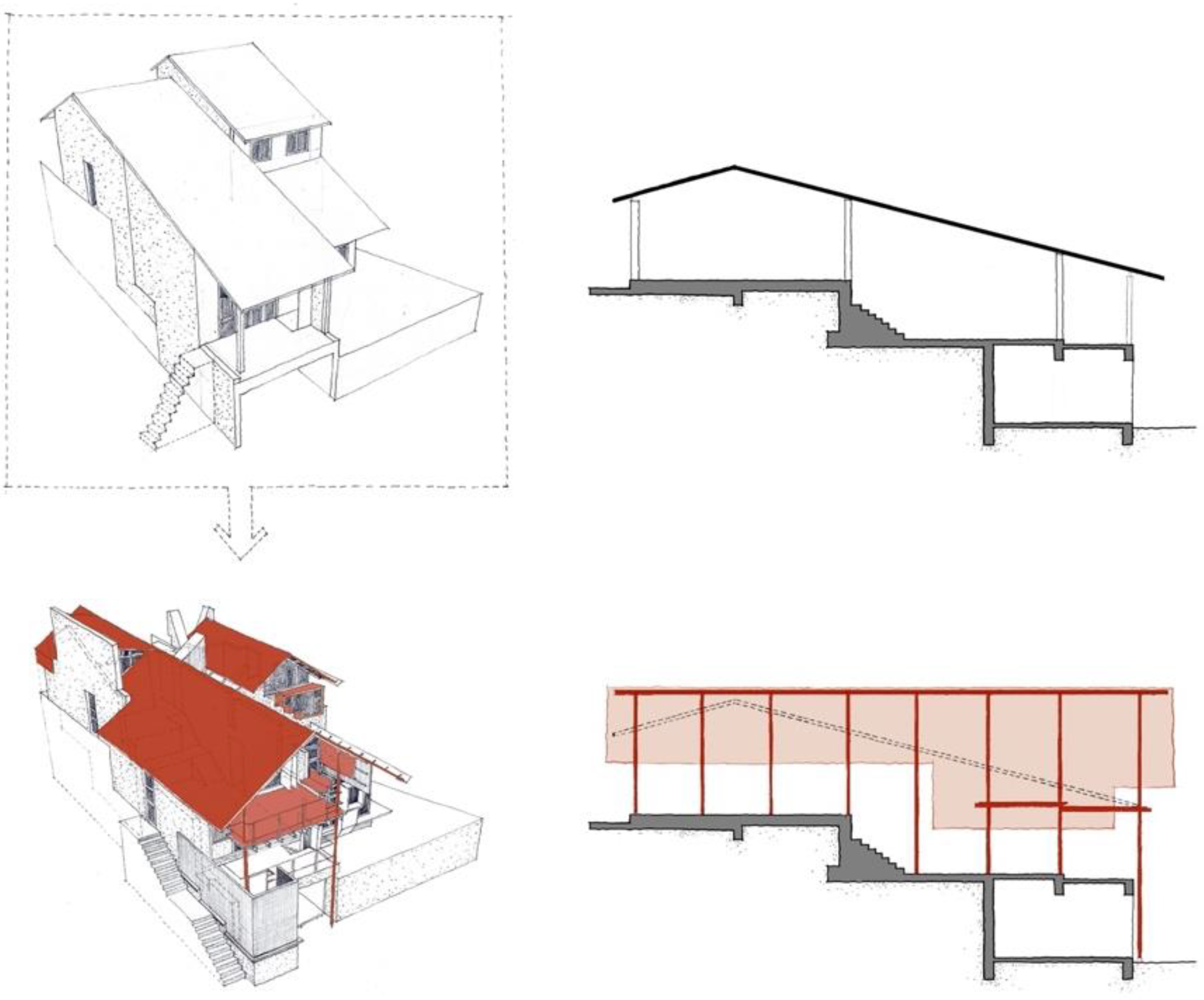
Subsequently, a key design approach involved systematically separating and layering building systems and distinguishing between the existing fabric, a new structural framework, partitions, installations, and finishes (
Figure 4). This structured organisation allowed construction to proceed in a sequence that minimised risks and enabled multiple labour groups to work independently yet cohesively. Importantly, the lightweight steel structural system and the new roof were installed prior to removing the existing roof, allowing the latter to be dismantled without exposing the interior to weather. This sequencing effectively managed environmental risks and established a staged construction process that required coordination between design intent and on-site execution.
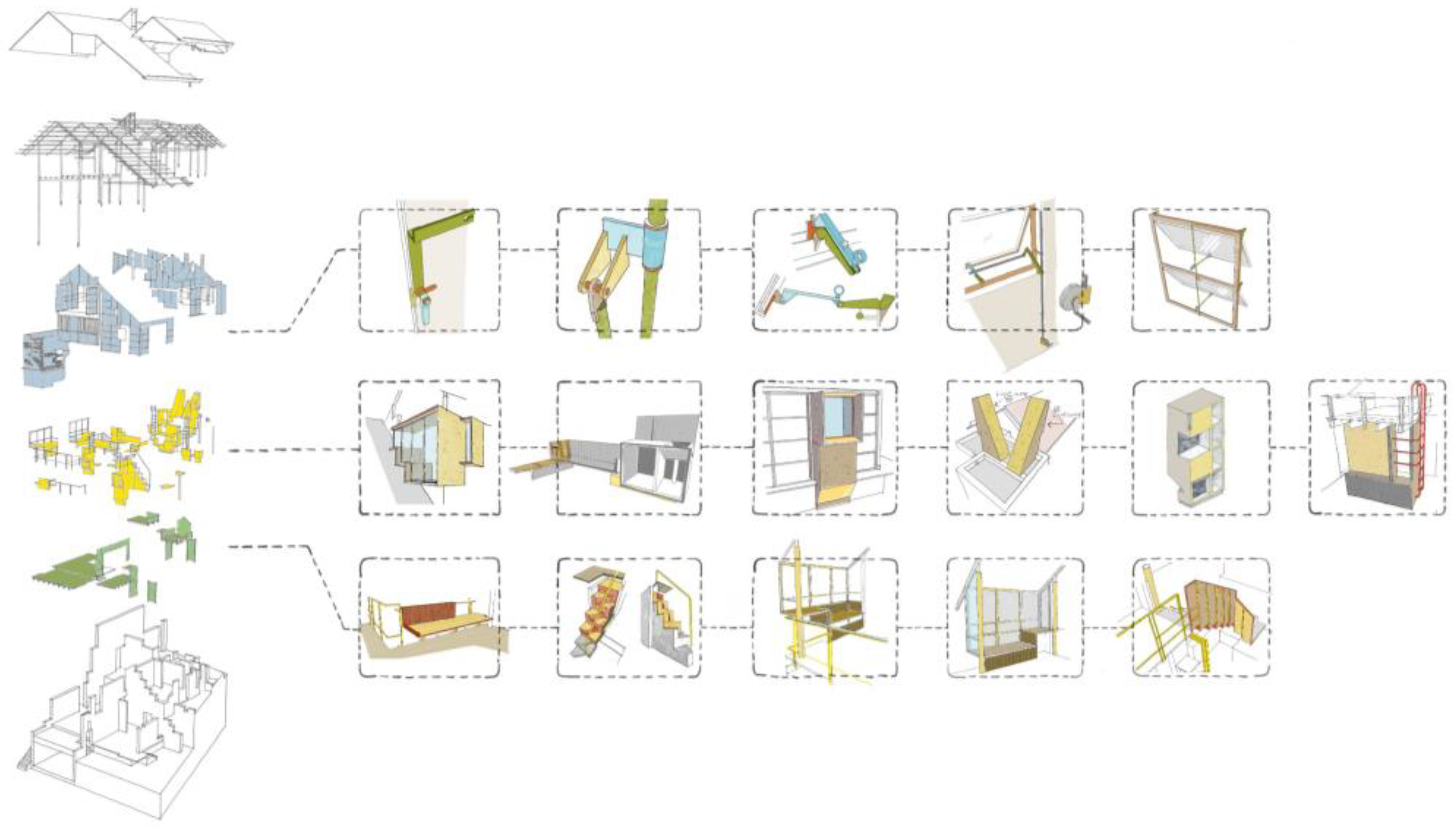
From a labour perspective, the layered system allowed different trades to engage with technology in distinct ways (
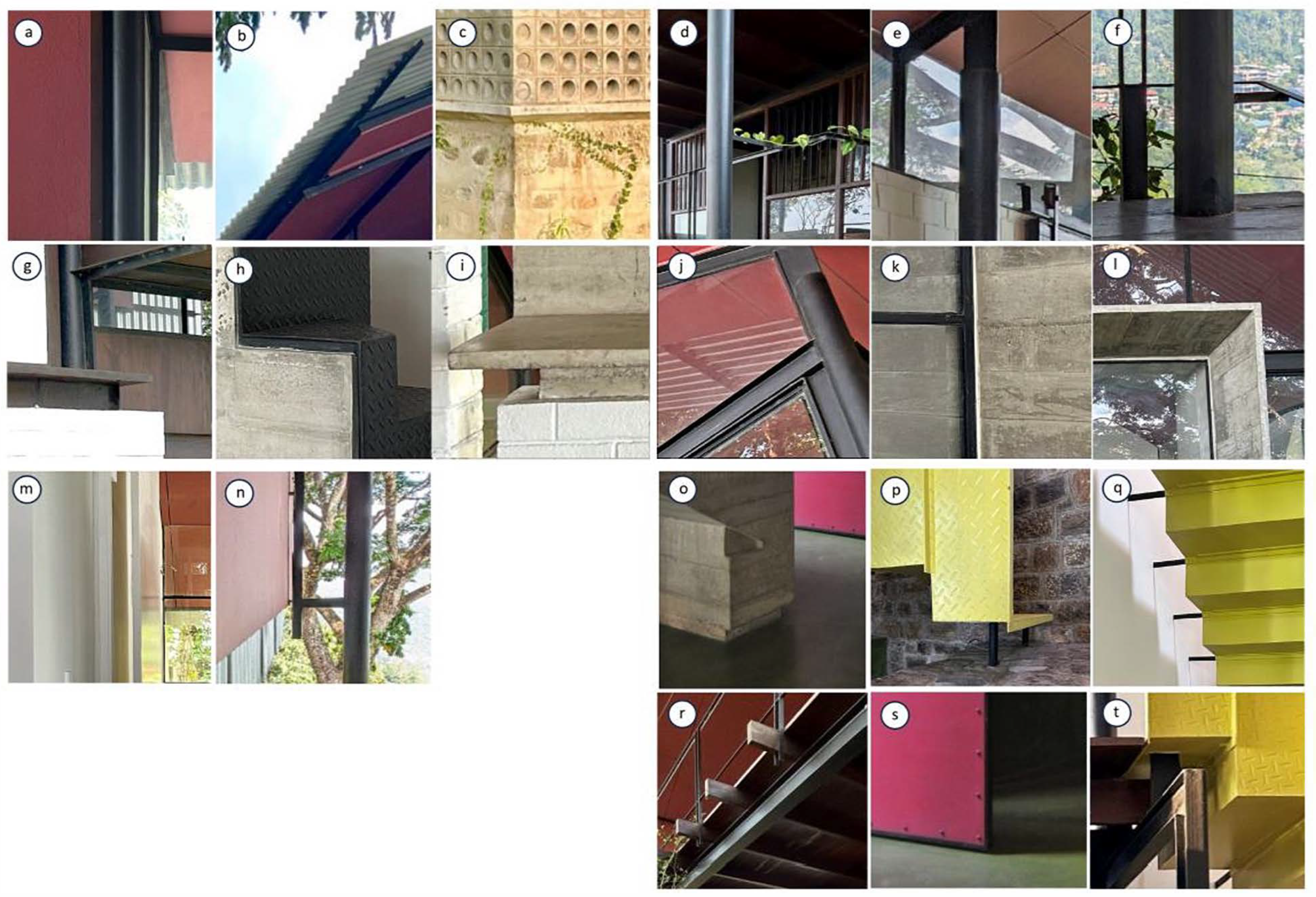
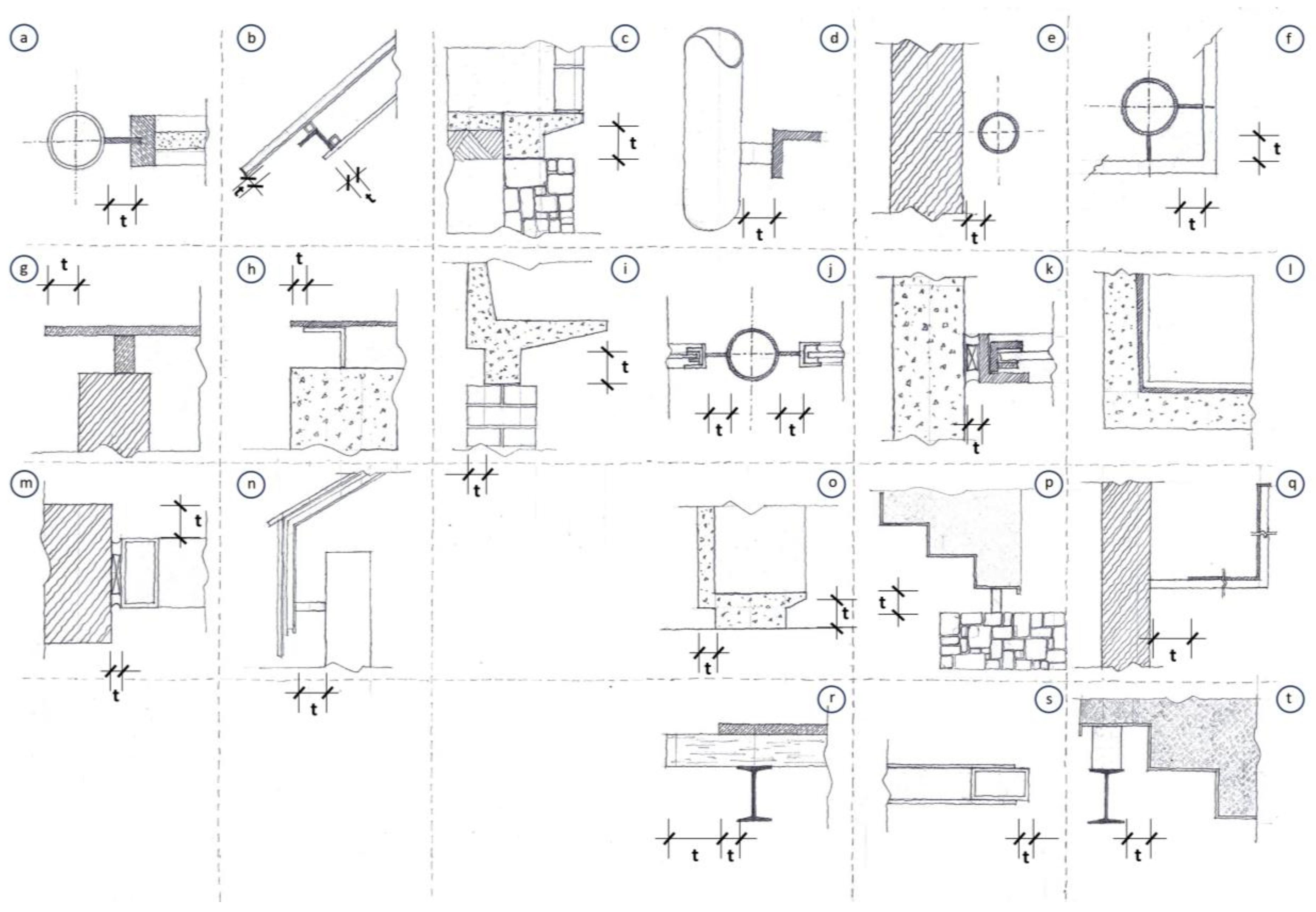
Figure 5). Masonry, timber, and steel workers operated within clearly defined yet interconnected scopes of work that supported task-specific learning while preserving the system’s overall integrity. Connection details between old and new structures were designed with dimensional tolerances, enabling workers to address inaccuracies in the existing fabric through judgement and adjustment rather than strict adherence (
Figure 6 and
Figure 7). These moments of negotiation were critical for developing tacit knowledge, as workers interacted directly with structural behaviour, load transfer, and material performance.
Dimensional tolerances are also essential in design to account for workmanship errors made by trainee craftsmen. When construction activities are used for skill development, the building system should incorporate adequate tolerances and allowances for errors. This approach inherently improves system robustness rather than striving for excessive precision, thereby enabling it to withstand suboptimal applications. This idea constitutes part of a broader theory of robust technology, aimed at integrating labour training within actual building projects (
Pathiraja 2025). It advocates for a flexible design and technological framework that can be adapted to a project’s technical and cultural variables, as well as its economic variations, without being subjected to failure chains. Within this robustness framework, various design strategies, such as allowable failures, adjustable joints, flexible coordination, and third elements, are employed to ensure that component connections can accommodate workmanship errors and non-ideal applications (
Pathiraja 2025;
Hettiarachchi and Pathiraja 2024). Building systems and components are conceptualised and detailed within this larger framework of robustness.
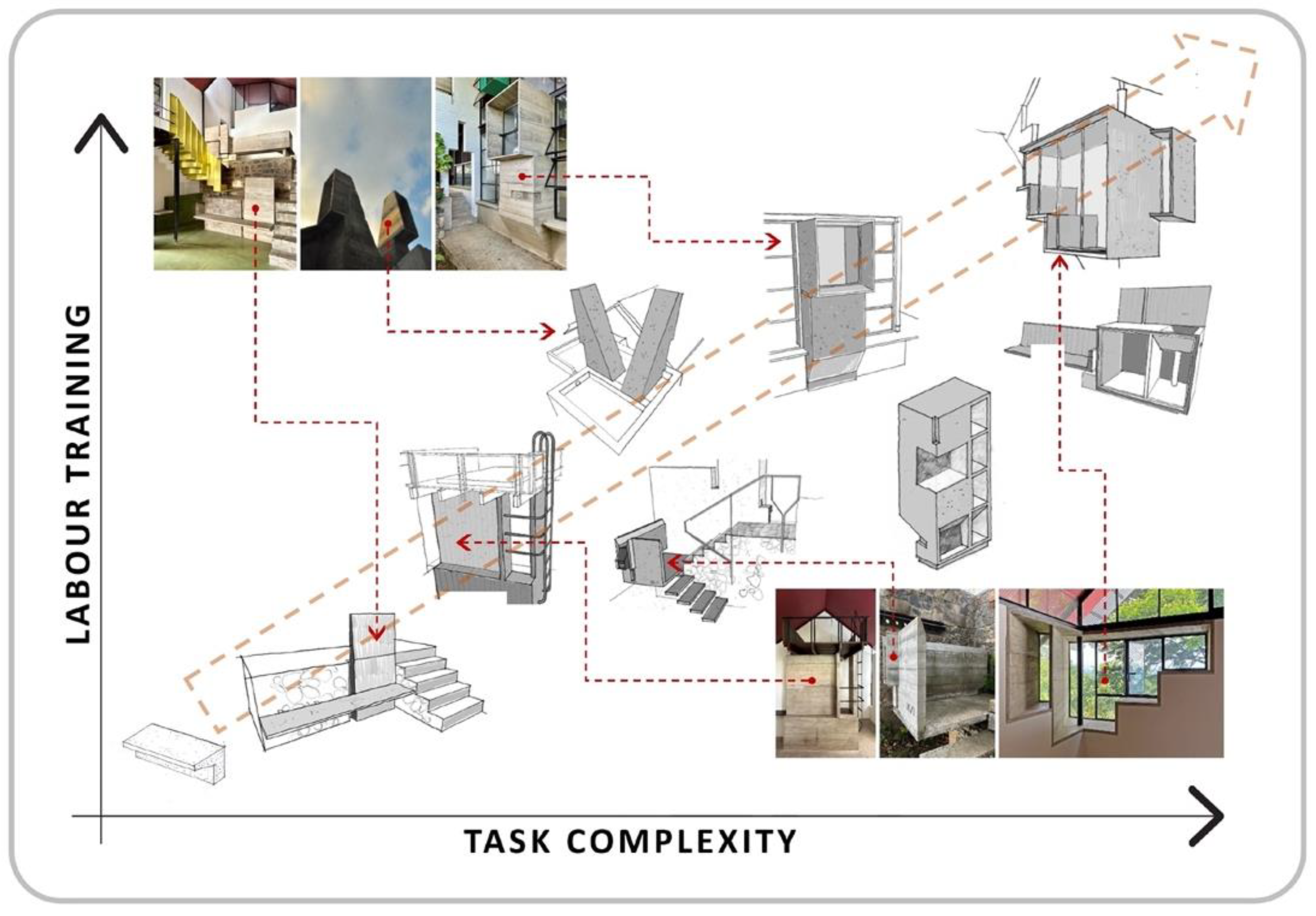
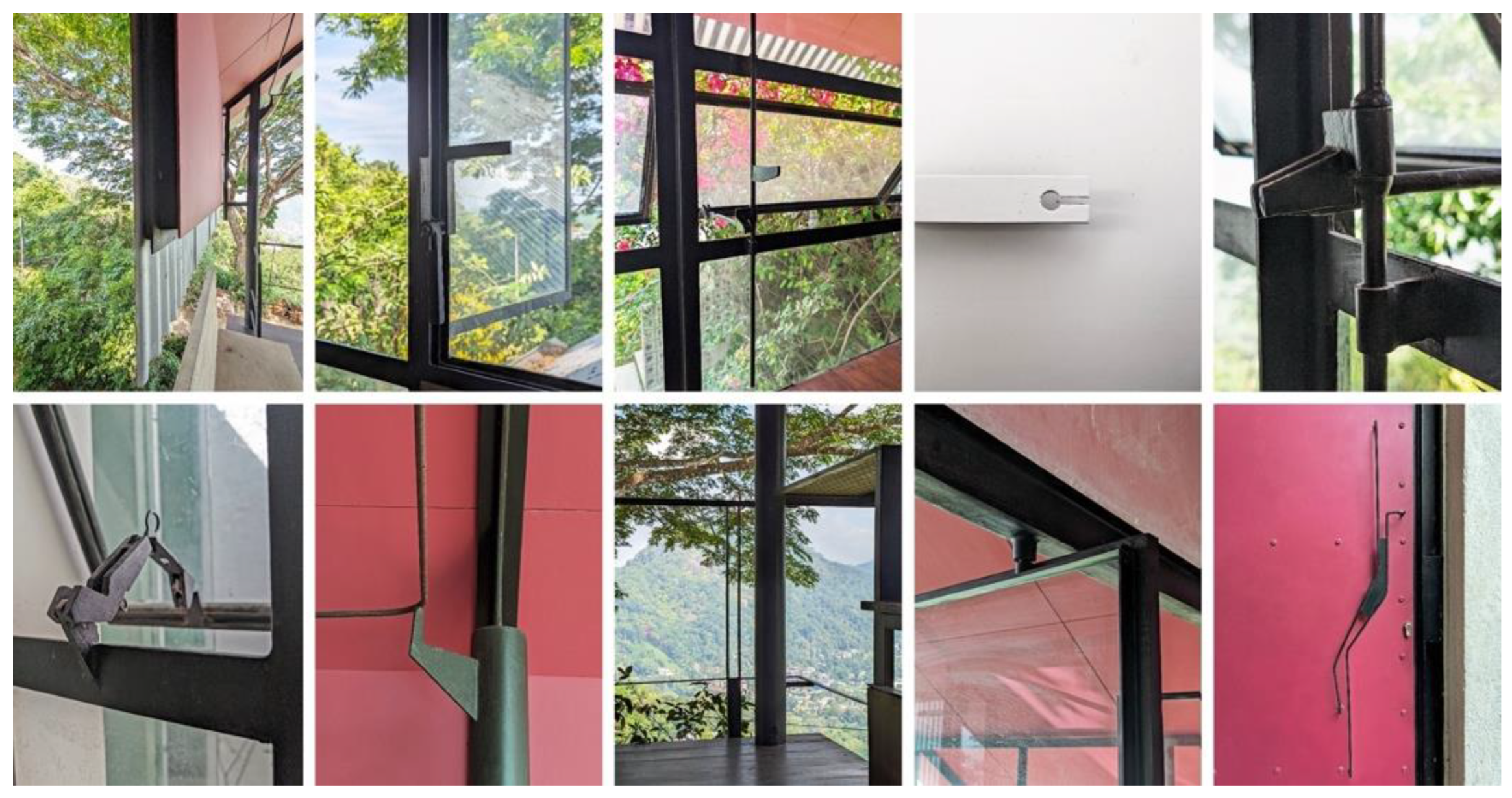
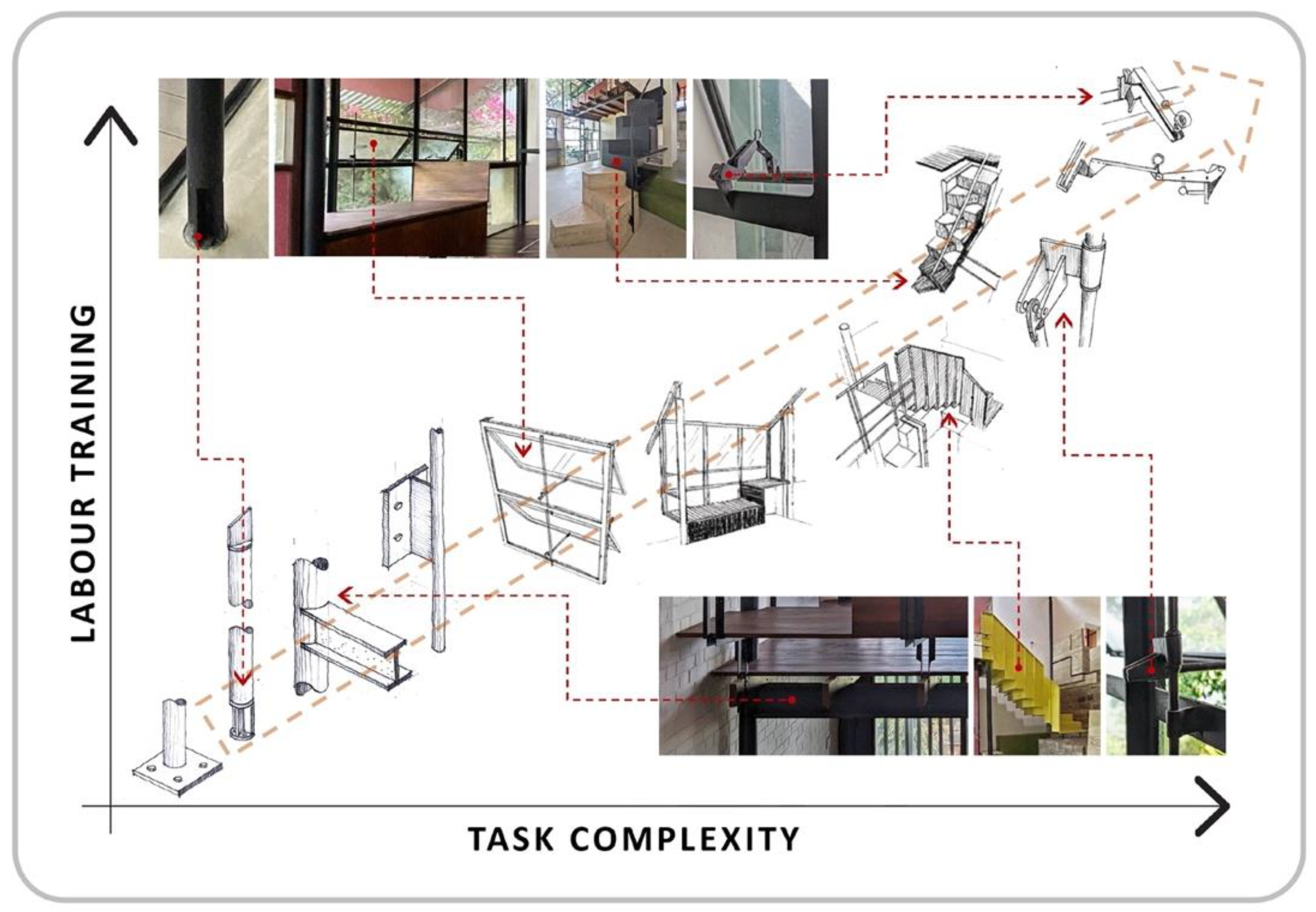
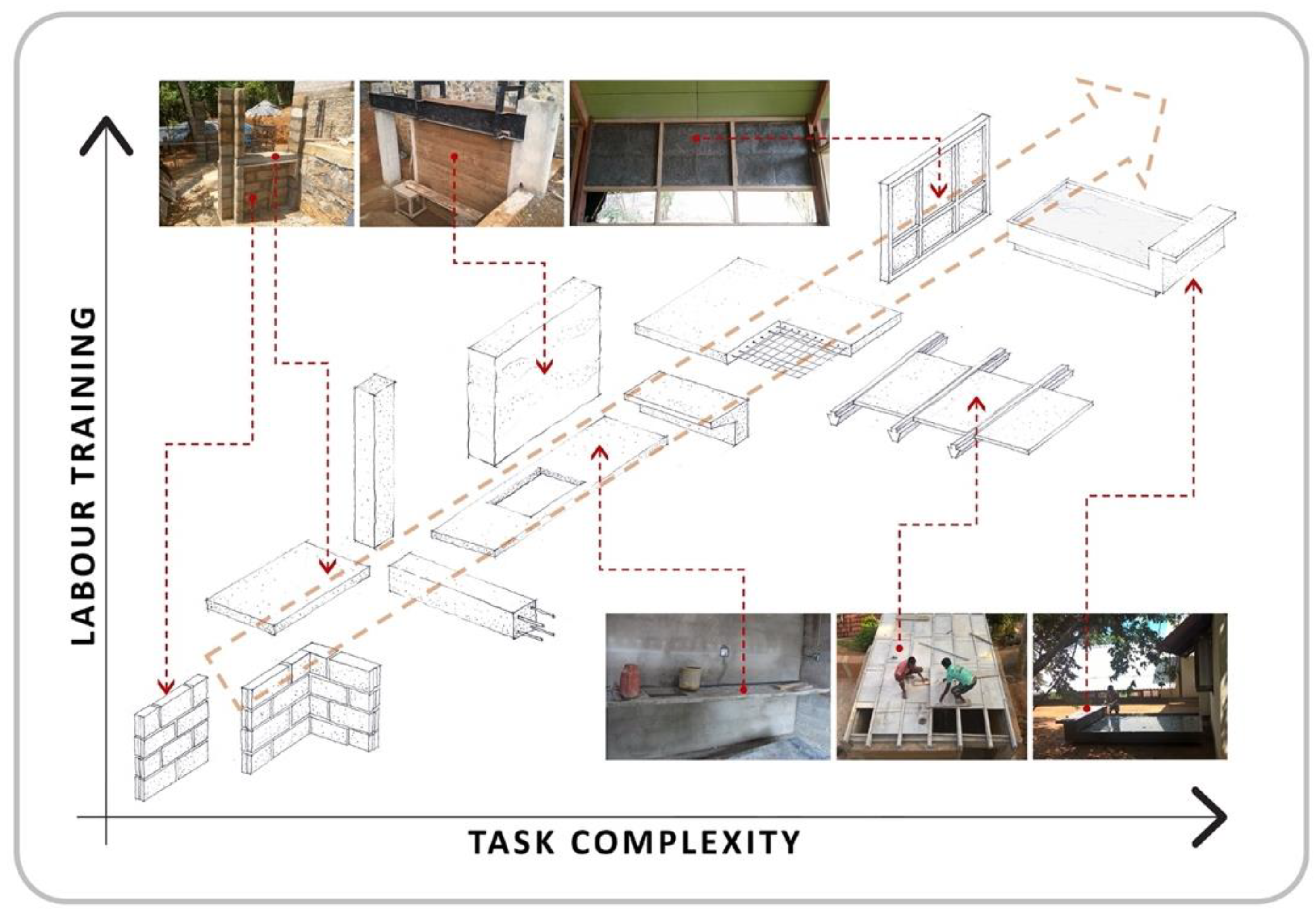
Craft-based componentry, thus developed, played a significant pedagogical role in the project. Elements such as staircases, window boxes, built-in furniture, handrails, and environmental devices were conceived as discrete components with varying levels of complexity. Fabricating and installing these elements required workers to engage in problem-solving beyond repetitive execution, particularly when components served multiple functions: structural, spatial, and environmental. For example, integrated furniture and façade elements demanded a higher level of joinery and finishing complexity while simultaneously shaping the spatial experience. These components acted as informal training devices, embedding skill development within production rather than separating learning from work. This contributed to transforming the real building activity into an organic ladder of skill-building (
Figure 8).
The project was constructed by a coalition of small-scale contractors with differing levels of prior collaboration. While some trades had previously worked with the design team, others were engaged for the first time, creating conditions for on-the-job knowledge exchange. The fabrication of door hardware from steel offcuts illustrates how material economy intersected with craft-based upskilling: workers were required to adapt tools and techniques to produce functional components outside standardised supply chains, reinforcing material understanding and manual precision (
Figure 9). As with concrete casting, this also necessitated the development of a structured learning pathway to facilitate the progression of steel welders through various skill levels, from fundamental competencies to more sophisticated techniques (
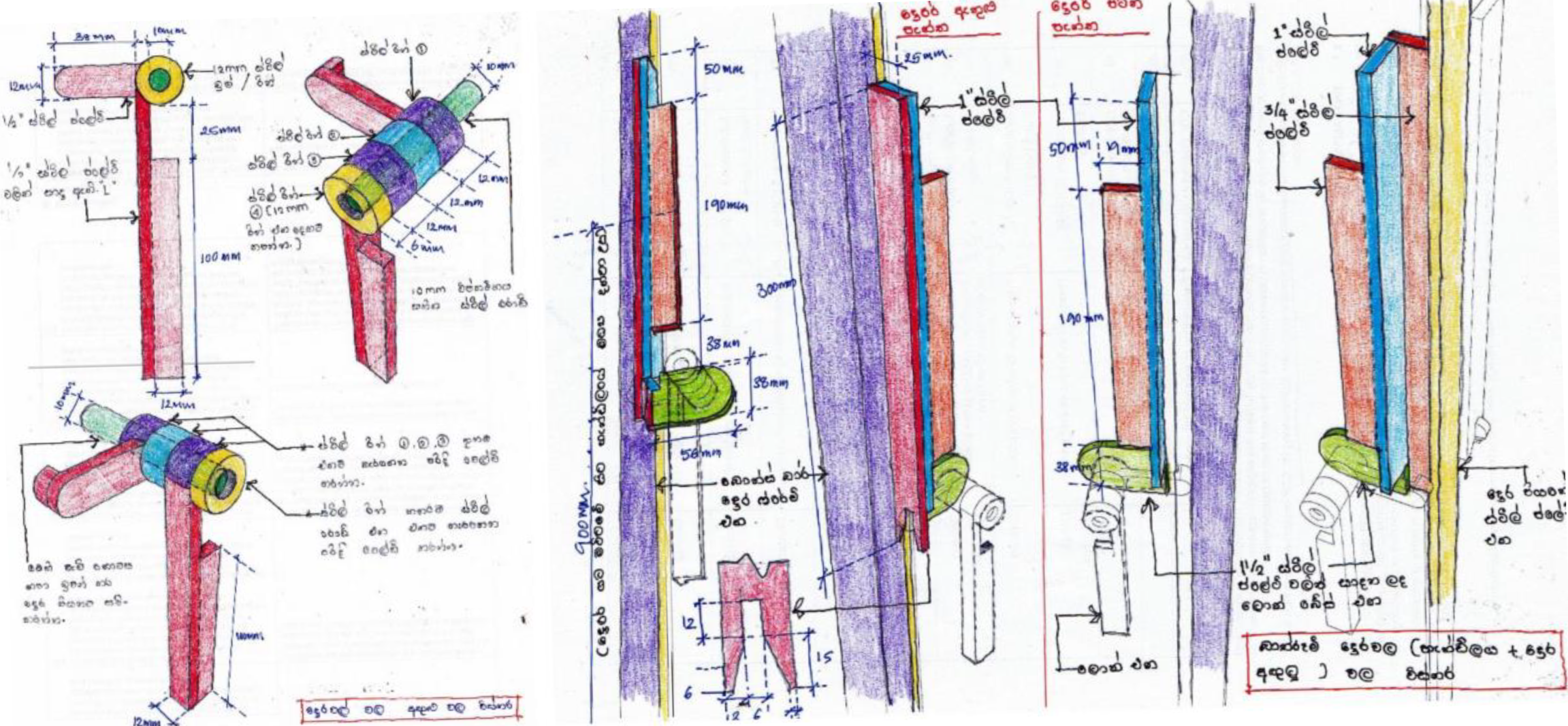
Figure 10). A crucial part of supporting this process involved clear communication between trainers and trainees, as well as conveying the design intent to on-site workers and negotiating the thinking and making involved (
Figure 11).
Overall, the Primrose project demonstrates how retrofitting, when approached through systemisation and craft-based detailing, can function as a socio-technical learning environment. Rather than treating labour as an operational input to be minimised, the construction process positioned workers as active participants in technological decision-making. Design decisions regarding sequencing, tolerances, and component complexity directly shaped opportunities for skill acquisition, illustrating how architectural practice can embed labour upskilling within the material logic of construction itself.
5. Case Study 2: Craft-Based Systemisation in Low-Income Housing
The Wakwella project was developed as a low-income housing prototype in a rural, post-conflict context, intended for a single-parent household while also serving as a transferable model for broader housing programmes. Unlike Primrose, which operated within a constrained suburban retrofit condition, Wakwella was conceived as a new-build project prioritising affordability, ease of construction, adaptability to local material availability, and the engagement of local labour with limited formal training (
Figure 12). Transferability and pedagogical value were therefore central objectives from the outset.
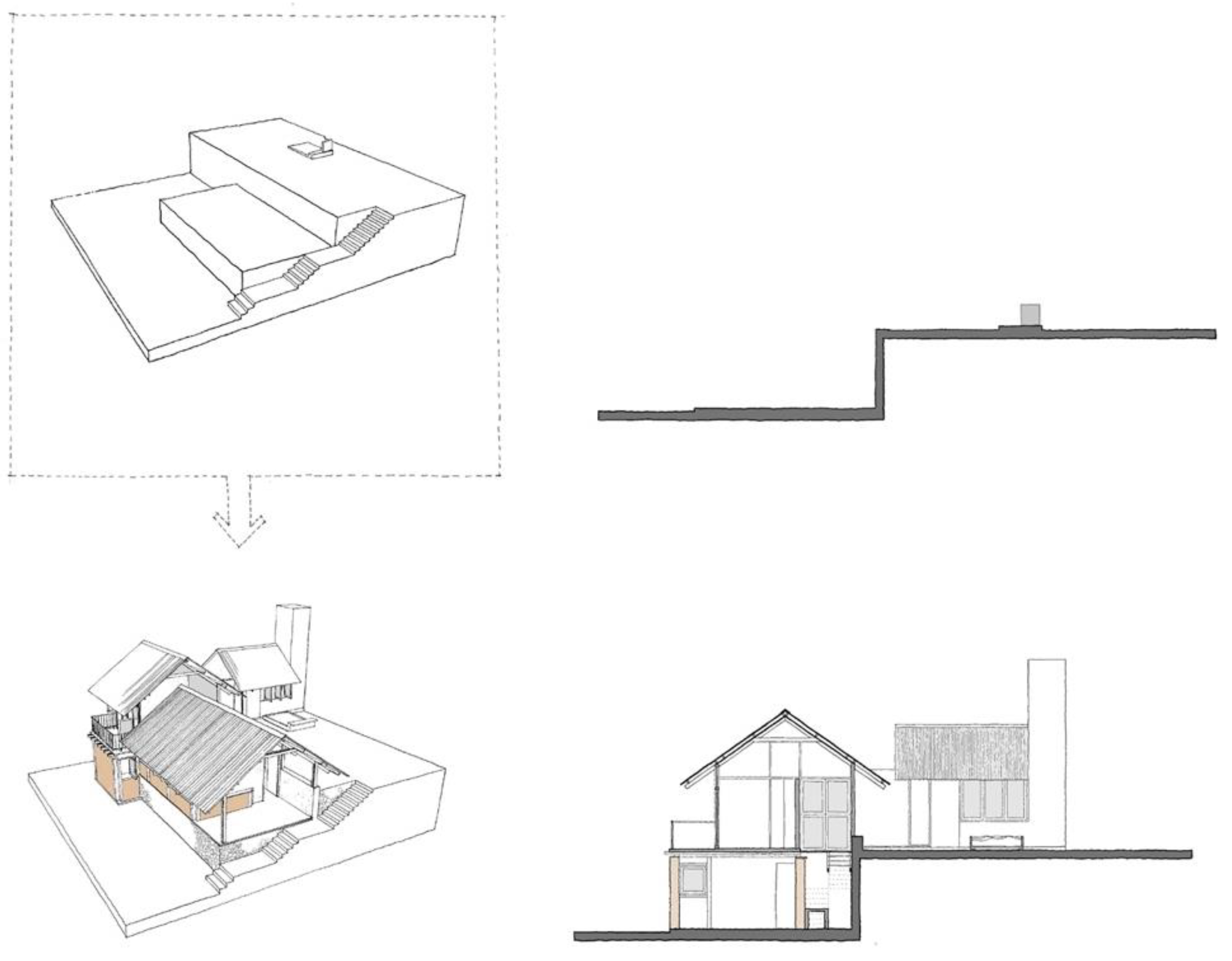
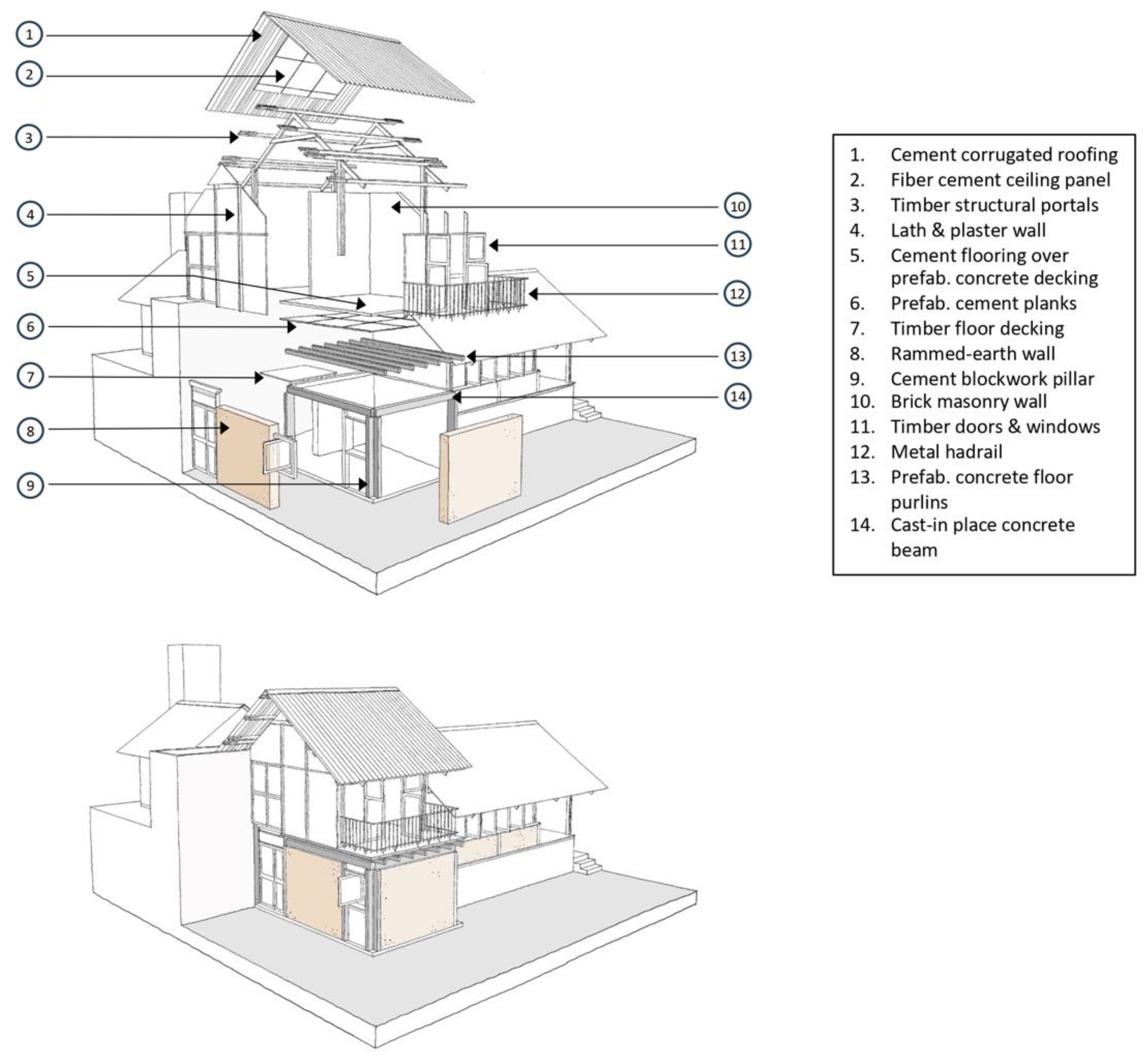
The construction strategy employed a hybrid system of materials and techniques, including timber, rubble, rammed earth, lath-and-plaster, brick masonry, prefabricated concrete components, and light steel elements. Rather than standardising the building into a single technological system, material hybridity was used deliberately to align different construction tasks with the existing skills of local labour while introducing incremental technical challenges (
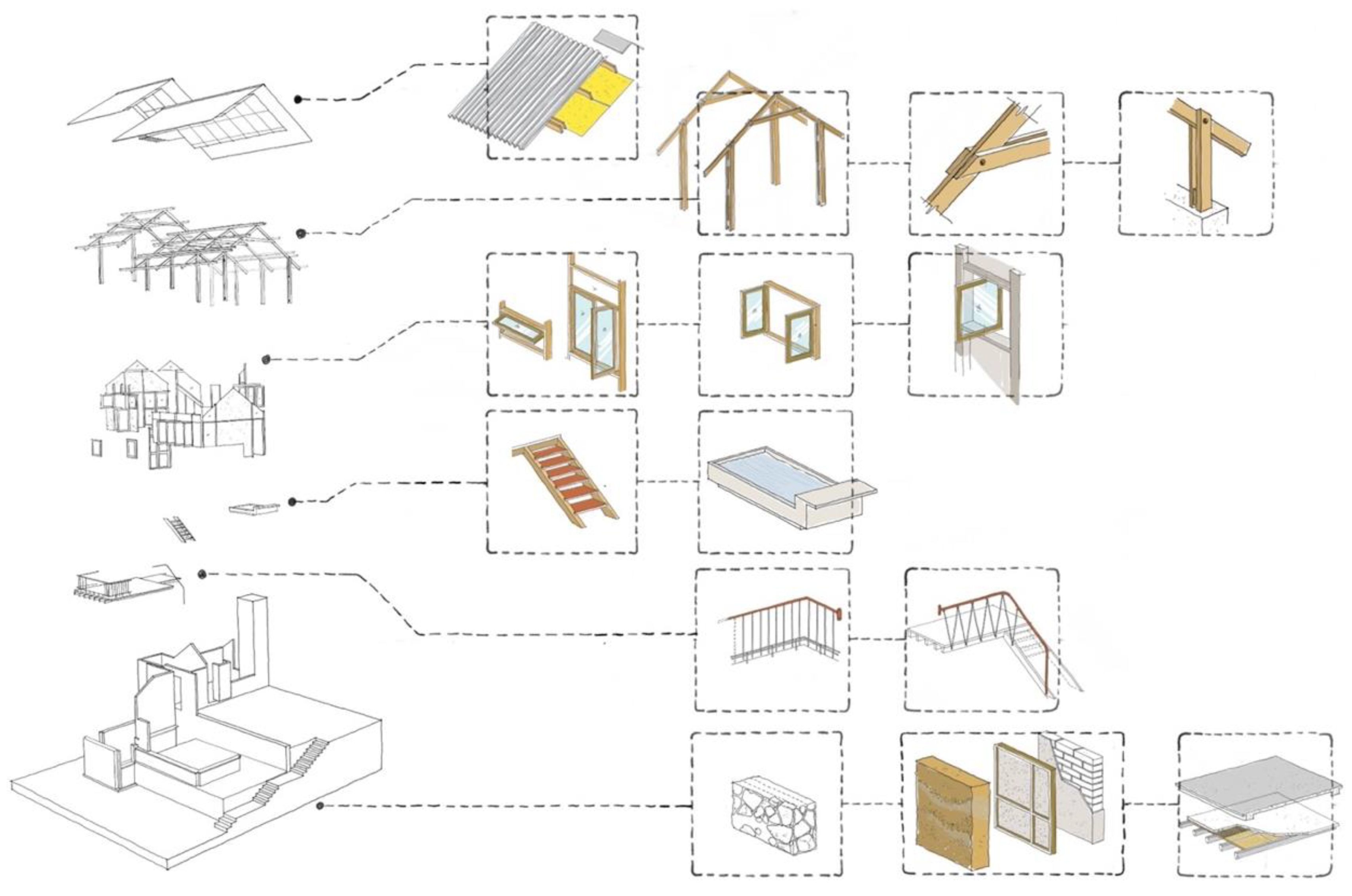
Figure 13). This approach enabled workers to build upon familiar practices while extending their competencies through exposure to new materials and construction sequences. It also resulted in the creation of a kit-of-parts building system through systematisation, enabling the replacement of generic components with alternative solutions tailored to local availability and material costs (
Figure 14).
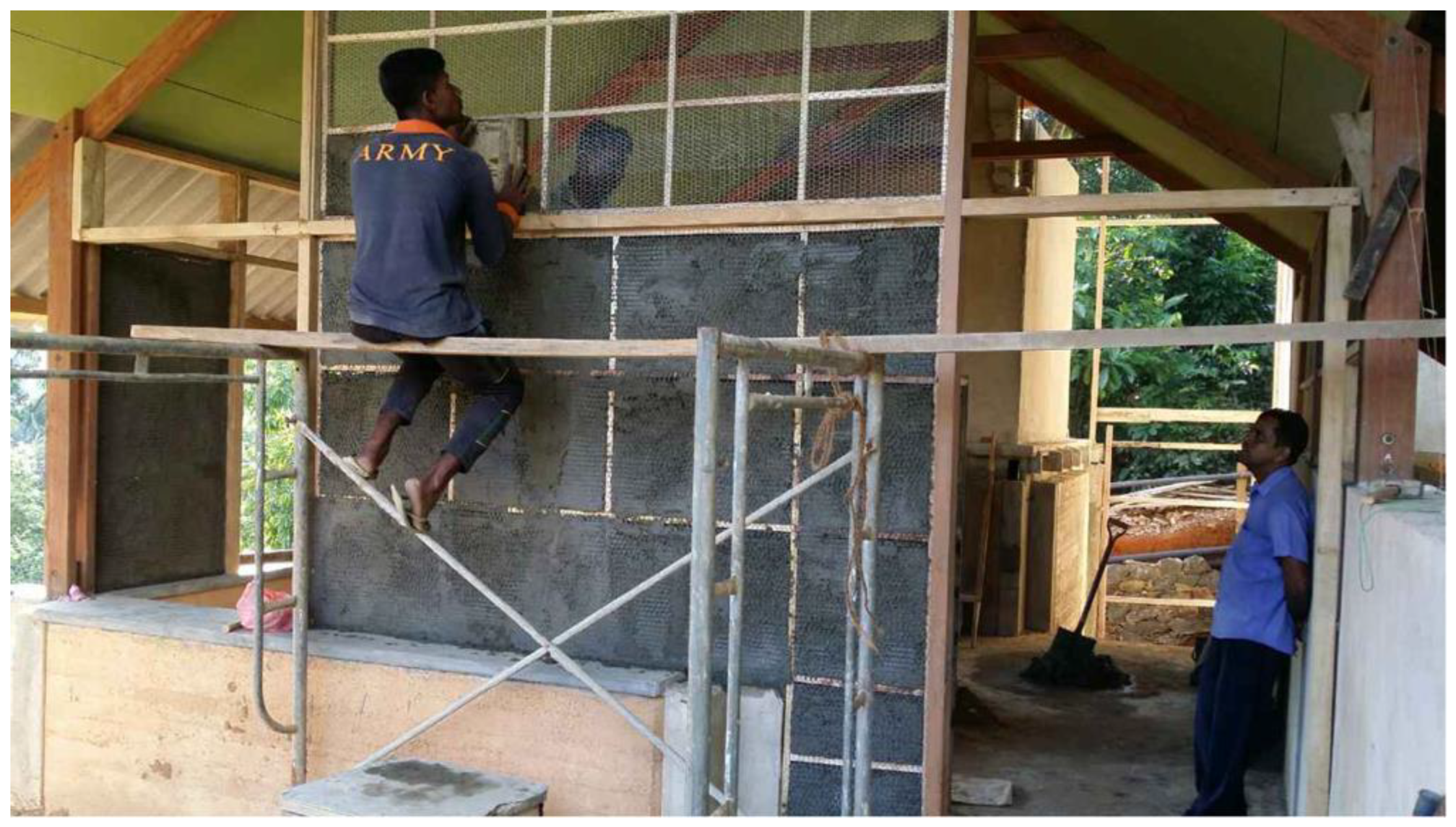
The labour organisation at Wakwella displayed notable distinctions from that of Primrose. The construction workforce consisted of local builders, artisans, community volunteers, and military personnel who had been previously trained in building trades (
Figure 15). This diverse composition of labour fostered a collective learning environment characterised by significant skill-level variation, with knowledge transfer occurring both horizontally and vertically. Tasks were organised to allow less experienced workers to participate in fundamental activities, such as earthwork and masonry, while more skilled artisans supervised operations requiring greater precision (
Figure 16). This allocation of responsibilities facilitated informal apprenticeship relationships in the absence of formal training programs.
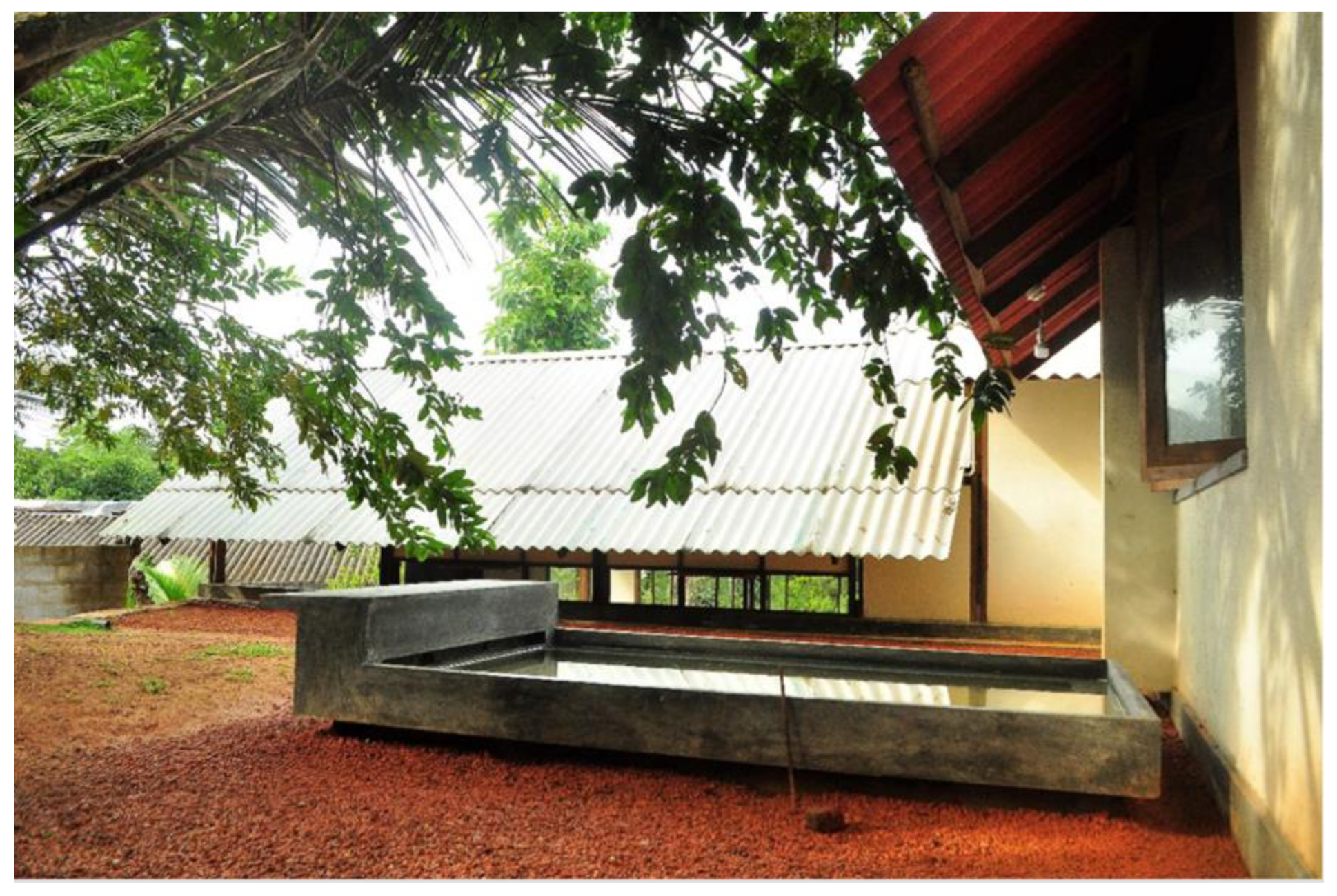
Craft-based detailing was employed selectively to support both economy and learning. Architectural elements such as courtyards, thresholds, seating, and roof transitions were designed to perform multiple spatial and environmental functions while remaining constructible with simple tools and local techniques. The integration of symbolic and cultural elements—such as the incorporation of a memorial pond replacing the tomb of the deceased house-head, a soldier who died in the civil war—demonstrates how craft-based construction can accommodate narrative and social meaning without increasing technical complexity or cost (
Figure 17). These elements required careful coordination between design intent and on-site judgement, reinforcing the role of workers as co-producers of architectural meaning.
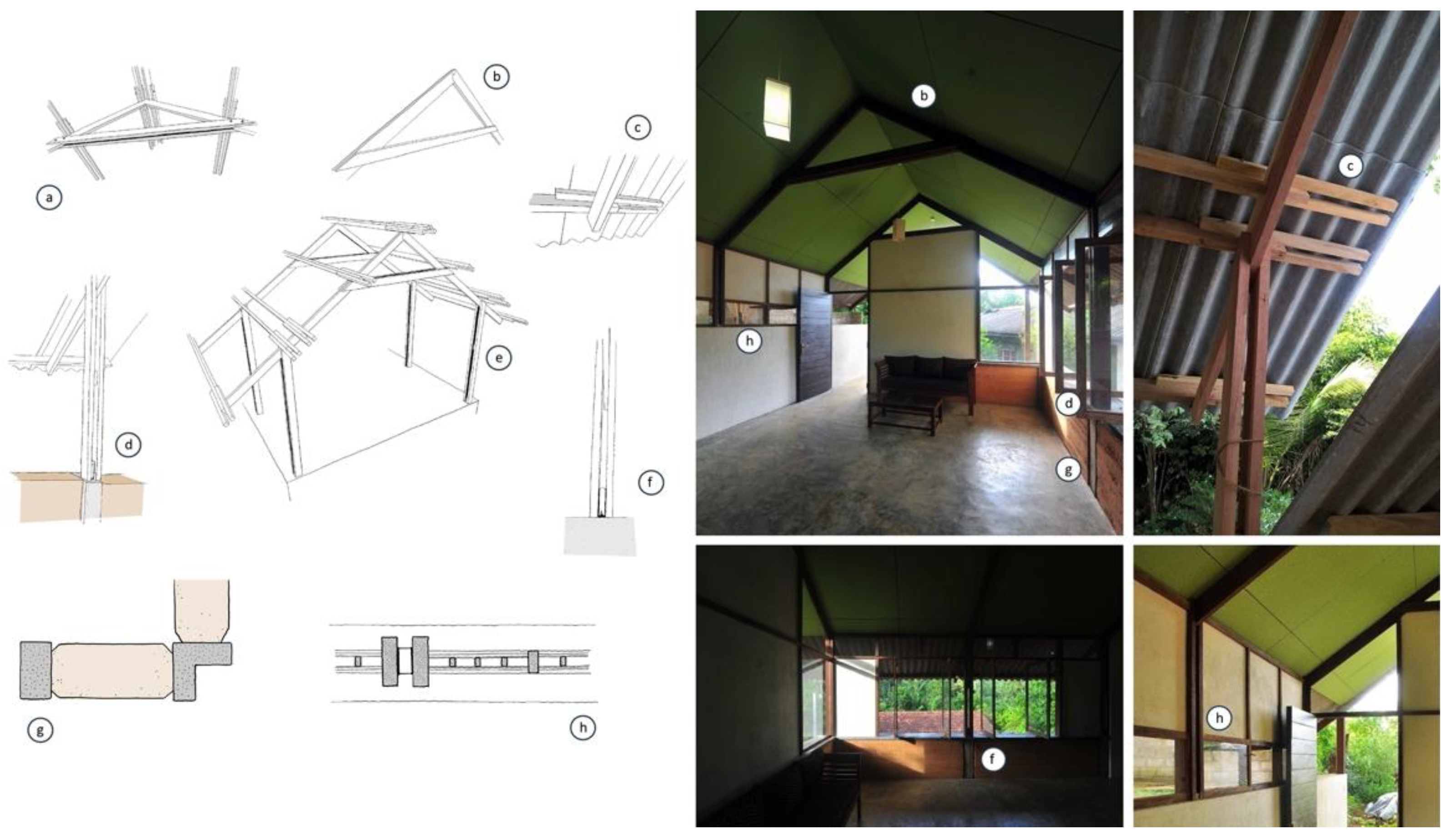
Systemisation at Wakwella was achieved through a modular approach rather than strict dimensional standardisation. As at Primrose House, design strategies such as dimensional tolerances, allowable failure, adjustable fits, and flexible coordination guided decisions during detailing when different building systems were joined. For instance, the timber structural portal was designed so that various sizes of timber components—each serving a different structural function—could be placed next to each other and interlocked without requiring precise cutting and sizing (
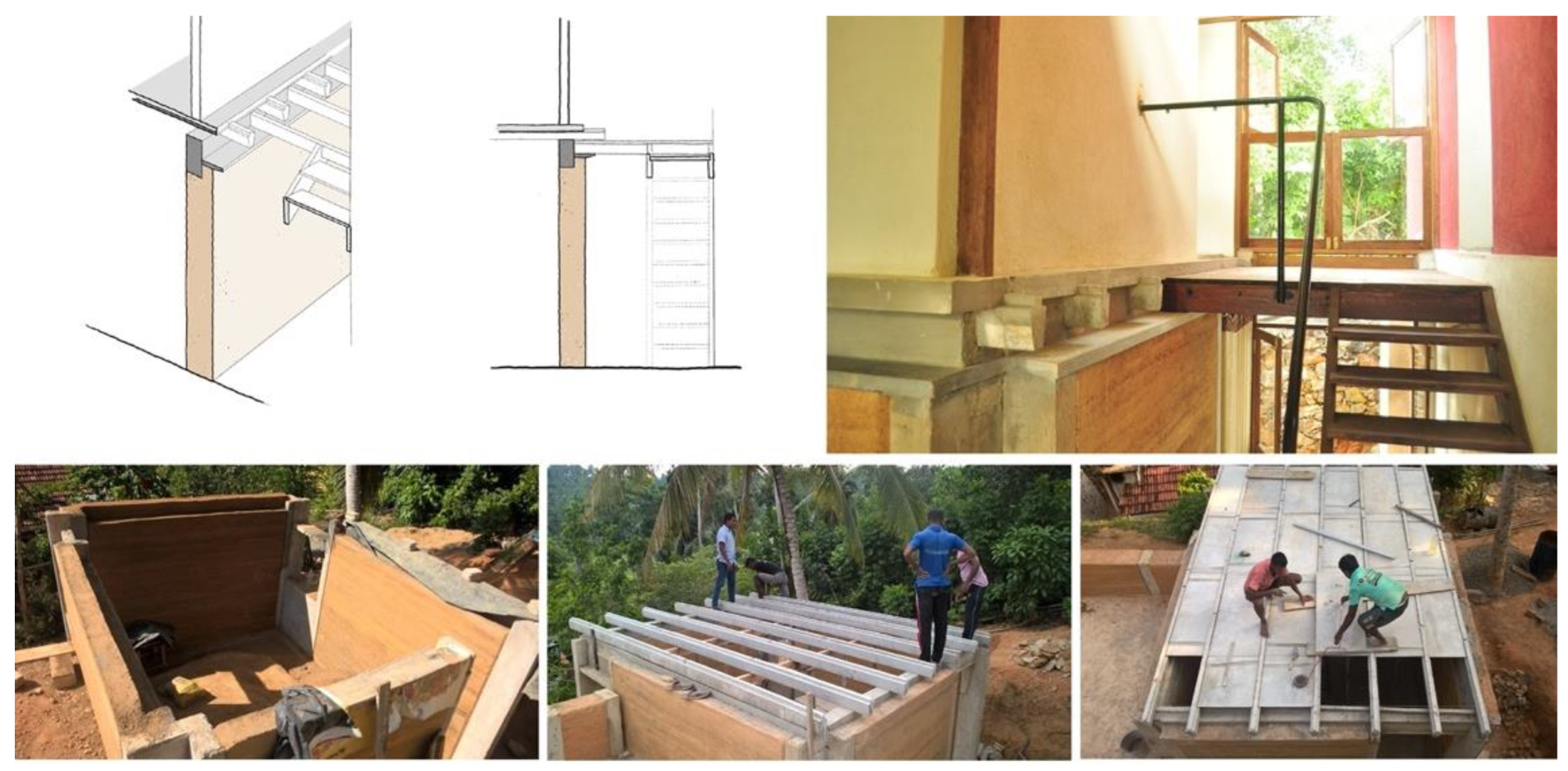
Figure 18). Connections never involve aligning components of identical size; instead, spatial gaps and dimensional differences are intentionally incorporated when fixing components together. Similarly, the assembly of the precast concrete floor decking system over rammed earth walls, along with the fixing of the timber staircase landing leading to the former, is arranged with spatial tolerances to facilitate easy installation and training (
Figure 19).
Likewise, spatial units were organised to accommodate sloping terrain and incremental construction, allowing adaptation to site conditions and future modification. This flexibility reduced reliance on exact measurements and specialised machinery, enabling labour to engage with the building process through adjustments and improvisations rather than strict adherence to predefined specifications.
The Wakwella case thus illustrates how craft-informed systemisation can support labour upskilling under conditions of economic constraint and limited technical infrastructure. In contrast to Primrose’s emphasis on precision and tolerance negotiation in a retrofit context, Wakwella demonstrates a more collective, adaptive learning model grounded in material hybridity and incremental skill acquisition. Together, the two cases reveal how design-led construction strategies can be recalibrated across contexts to embed learning within production while maintaining technical viability and social relevance.
6. Cross-Case Findings and Discussion
The comparative analysis of the Primrose and Wakwella projects demonstrates that labour–technology relations in construction are not fixed outcomes of material choice or economic constraint alone. Rather, they are structured through design decisions that configure how workers encounter, interpret, and act within technical systems. Across two markedly different contexts—a suburban retrofit and a rural low-income prototype—architectural design operated as a mediating layer between abstract technological systems and situated labour practice.
6.1. Systemisation and Labour Engagement
In both cases, systemisation emerged as a critical mechanism for mediating labour’s engagement with technology. At Primrose, the explicit layering of building systems—existing fabric, new structural skeleton, partitions, installations, and finishes—enabled technical independence between systems while preserving overall coherence. This allowed specialised labour groups to engage deeply with discrete tasks while maintaining awareness of their role within the larger assembly. In Wakwella, systemisation took a looser, modular form, accommodating site variability and material hybridity rather than dimensional negotiation. Here, systemisation functioned less as a tool for coordinating specialised trades and more as a framework for adaptability and incremental construction.
These differences suggest that systemisation is not a singular technical strategy but a context-responsive design logic. In both cases, however, it provided a structured environment in which labour could engage with complexity without being overwhelmed by it. Workers engaged with manageable subsystems whose interrelations were visible. This configuration supported situated learning by allowing labour to understand not only how to execute tasks but also where those tasks fitted within the larger assembly.
Systemisation, therefore, emerges not as a neutral coordination tool but as a socio-technical strategy that shapes cognitive access to construction processes.
6.2. Tolerances, Judgement, and Tacit Knowledge
A second shared mechanism concerns the deliberate incorporation of dimensional tolerances and adjustable connections. In both projects, joints were detailed to accommodate material irregularities and workmanship variability. Rather than enforcing rigid precision, the design allowed for negotiated alignment between the nominal specification and the built reality.
These moments of negotiation activated tacit knowledge. Workers were required to assess load paths, material behaviour, and spatial alignment in real time. Learning occurred not through formal instruction but through iterative correction, adjustment, and feedback.
The contrast between cases is instructive. At Primrose, tolerance negotiation occurred within a relatively precise structural framework, demanding refined judgement. At Wakwella, tolerance supported adaptability across heterogeneous materials and skill levels. In both instances, however, tolerances transformed potential error into pedagogical opportunity. Design thus structured conditions under which embodied knowledge could accumulate.
6.3. Sequencing and Progressive Skill Formation
Construction sequencing also served as a mediating device. Tasks were organised to introduce graduated complexity, allowing workers to build competence incrementally. At Primrose, component fabrication and metalwork progressed from basic joints to more refined elements. At Wakwella, labour moved from familiar masonry tasks towards hybrid systems such as lath-and-plaster and prefabricated floor decking.
Sequencing here mirrors apprenticeship logics without formal institutional frameworks. By embedding progressive exposure within production itself, design created pathways for skill acquisition without separating learning from work. This finding supports constructivist accounts of technology, in which organisational and design decisions—not machinery alone—shape whether labour experiences deskilling or development.
6.4. Context and the Meaning of Technology
The two cases also illustrate how technological meaning is contextually mediated. In both projects, labour engagement intensified when tasks were varied, visible, and connected to identifiable outcomes. Where workers could recognise their contribution in the finished architecture, technological systems were experienced less as external impositions and more as shared problem-solving frameworks.
Importantly, the projects did not dismiss contemporary materials or hybrid systems. Instead, they adjusted their application through design decisions that aligned complexity with local skills. Rather than simply romanticising traditional crafts, this work investigated new craft practices and alternative labour relations. This indicates that the labour agency in construction does not depend on technological regression but on the structuring of labour–technology interaction.
7. Implications for Research and Practice
Overall, the results suggest that architectural design can serve as an informal labour policy, influencing skill development through the material organisation of construction activities. By integrating learning into production, design-led approaches provide an alternative to methods that depend solely on formal training or top-down technological transfer. Although the cases are specific to particular contexts, the identified mechanisms, such as systematisation, sequencing, craft-based components, and tolerance-based detailing, have wider relevance for construction practices in settings with informal labour and limited institutional capacity.
To that end, this study offers implications for both construction research and practice. From a research standpoint, this study highlights the importance of practice-based case studies for exploring socio-technical dynamics that are hard to capture through quantitative research alone. It also emphasises the need for further investigation into the long-term effects of design-mediated learning on labour pathways, productivity, and social mobility within the construction sector. From a practical perspective, the findings below offer a normative framework outlining research-derived design principles. Architects can utilise this framework to incorporate craft as an educational resource for building production.
Construction systems can be ‘designed’ to be legible yet non-trivial. Craft functions pedagogically when labour engages with manageable complexity rather than repetitive simplification. By layering building systems and breaking work into intelligible subsystems, workers can understand how individual actions contribute to the whole, enabling learning through assembly rather than rote execution. Pedagogically, systemisation supports cognitive mapping of construction processes and encourages on-site systems thinking.
- 2.
Sequenced Exposure
Construction sequences can be structured to progressively introduce technical challenges. Learning is strengthened when labour encounters increasing levels of difficulty through staged engagement, moving from familiar to novel tasks as confidence and competence develop. This strategy mirrors apprenticeship models, allowing skill accumulation without formal instruction.
- 3.
Tacit Engagement
Tasks that require judgement, adjustment, and sensory feedback can be designed into the building product and process. Craft becomes pedagogical when workers can negotiate tolerances, material behaviour, and situational constraints, activating tacit knowledge that cannot be transferred through manuals or drawings alone. This will help trainee workers to develop an embodied understanding of materials, tools, and structural behaviour.
- 4.
Componentised Learning
Learning can be embedded within discrete architectural components. Furniture, stairs, junctions, environmental devices, and fittings can function as micro-learning units, each demanding specific skills while contributing to the architectural whole. This would transform construction components into training artefacts without separating learning from production.
- 5.
Visible Labour Logic
The logic of making can remain legible in the finished architecture. When joints, assemblies, and construction sequences are readable, workers see their labour valued and socially acknowledged, reinforcing professional identity and reflective practice. The visibility of the workers’ effort in the final output strengthens the dignity of labour and reinforces learning through recognition.
- 6.
Design-Mediated Agency
Design can be used to position labour as co-problem solvers rather than as operatives. Architectural interventions can create spaces where workers contribute knowledge, adapt solutions, and make decisions within defined technical frameworks. This would encourage responsibility, innovation, and long-term transfer of skills beyond the project.
8. Conclusions
This article examined how architectural design can function as a mediating layer within construction systems to influence labour–technology relations in contexts characterised by informal labour and limited formal training infrastructure. Drawing on constructivist theories of technology and qualitative case studies from Sri Lanka, this study argued that construction technologies are socially configured rather than autonomous, and that design decisions shape how labour engages with technical systems.
The comparative analysis of the Primrose and Wakwella projects revealed that incorporating craft-based construction practices into contemporary design and production can embed implicit learning directly into the construction process. Four main mechanisms support this integration: systemised complexity, tolerance-based detailing, sequenced task progression, and componentised learning. In both retrofit and low-income new-build contexts, these strategies structured opportunities for tacit knowledge formation by requiring judgement, adjustment, and progressive engagement with materials. Rather than treating labour as an input to be optimised, the projects positioned workers as active participants in technological negotiation.
The findings extend constructivist accounts of technology by situating architectural design as a critical site of socio-technical mediation. They also offer a methodological contribution, demonstrating how practice-based case studies can reveal learning processes within production systems that are typically hidden from quantitative productivity measures.
To that end, this study does not claim measurable long-term labour mobility outcomes, nor does it propose craft as a universal solution to construction challenges. Instead, it shows that design decisions materially structure the conditions under which learning may occur. In doing so, it suggests that architectural practice can influence labour development indirectly through the organisation of work itself.
In construction environments where formal training systems are weak or fragmented, such design-mediated strategies may provide context-sensitive pathways for integrating skill formation into everyday building activity. The broader implication is that technology in construction should be evaluated not only in terms of efficiency and output but also in terms of how it configures participation, agency, and knowledge.