
Making It Work: The Invisible Work of Mothers in Pursuit of Inclusion in School Settings

Abstract
1. Introduction
2. Methodology and Methods
2.1. Participants and Data Collection
2.2. Data Analysis
3. Results
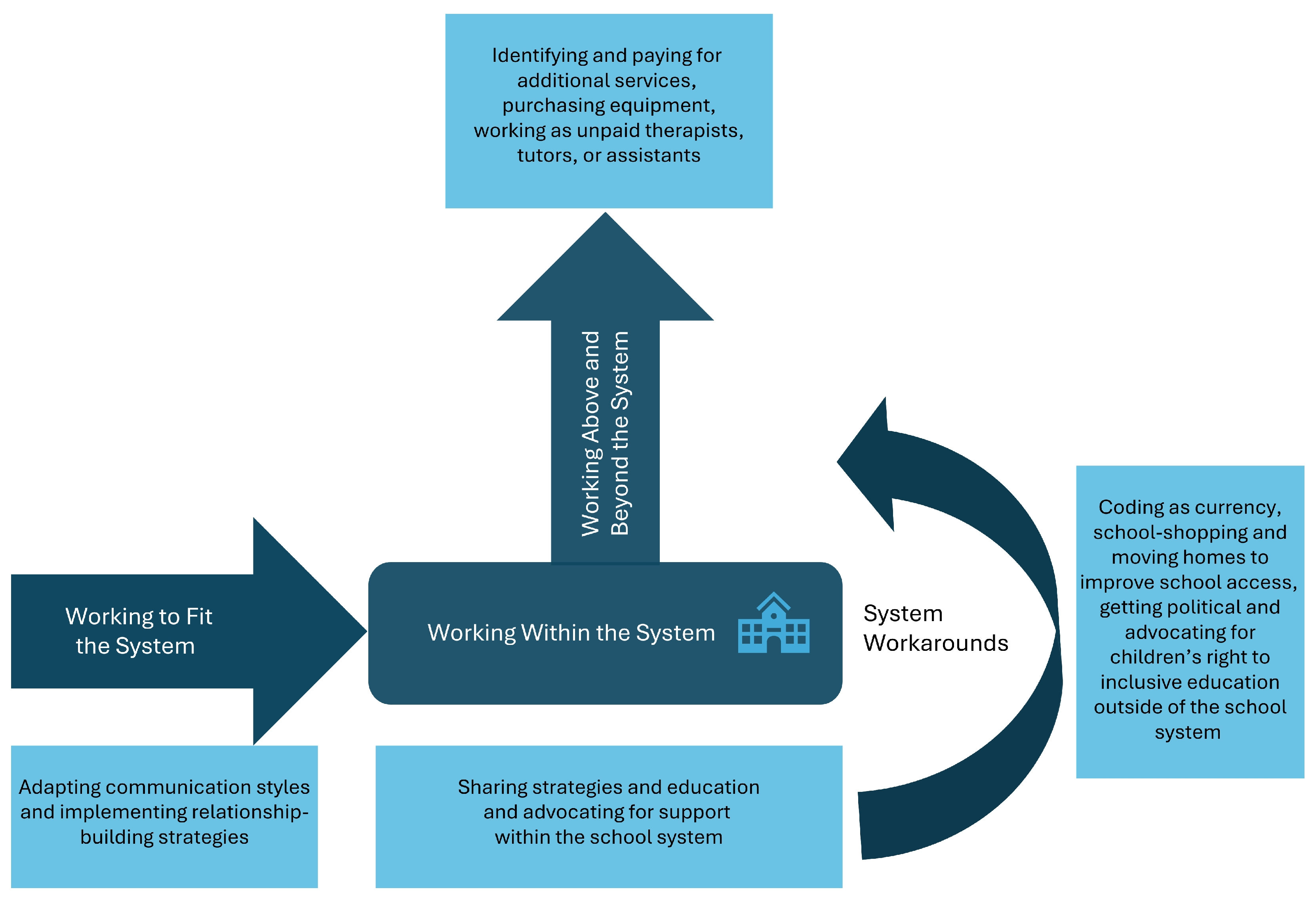
3.1. Working Within the System
Every year, I create a care plan. I go in, and I talk to…the teachers that she’s going to have...Some are receptive, some are not receptive, which is frustrating on my end…And I can tell you who buys in by just the look on their faces when I’m doing the ‘in-service’ every year. So, I can just tell.
I’d asked to come in so we could have an open discussion with the class, because kids ask questions…about Kayleigh and her surgeries, and her chair, and her, you know, like that she’s not diseased. You know, like that kind of thing…Get rid of the fear, right?…And she said no, because ‘children are generally accepting’.
Ellen had similar experiences when advocating for assistive technology to reduce her daughter’s muscle spasms associated with writing: “The school has always…shut me down on it.” And Sarah recalled a year-long effort to involve a specialist team despite her frequent requests, “I was begging for all last year…’Hey, can you have the Inclusive Learning Team come and look at him?’…Nobody ever came.” Despite their persistence, mothers described how their efforts were often unacknowledged. Working within the system required a balance of expertise, diplomacy, and endurance, work that was essential to their child’s inclusion but downplayed, ignored, or dismissed by educators or policymakers.We asked, could we put him by the window and just turn off the fluorescents over his desk? They refused to do that. We asked if they could…try to keep the volume of the other kids in the room down? They felt… that was unfair, and it was stifling the other children…We asked if he could…be removed from the room and given a quiet place to…write his tests?…That didn’t happen because they just didn’t have the staff to allow him to go to another room.
3.2. Working to Fit the System
Mothers also spoke about the transactional nature of relationship-building in school settings. Christine explained:One of the biggest things in helping the kids be included in classrooms is to empower the parents to know how to talk to administration…There are certain ways you speak to them that they understand better than others…If you…talk to them at their level…they understand you much better...Just going in and saying “it’s not working” and getting mad…it doesn’t help…Then you’re just speaking to them at an emotional level, and they don’t really know how to translate that into something factual.
These strategies required mothers to balance assertiveness with likability and professionalism with emotion to avoid being perceived as “difficult.” Christine reflected on this tension:If you can’t…put yourself on that team, you need to force your way in there…You have to buy the teachers coffee cards…You have to kiss their ass. I know it doesn’t make sense from like a very, you know, basic perception, but if you want…a working relationship… you’re going to get it through these avenues.
Similarly, Breanne, reflecting on years of advocacy, emphasized relationship management as the key to progress: “Relationships, relationships, relationships. I need them more than they need me. Right, I always tell myself that. That no matter how mad I am at any one teacher or leader in the system, I need them.”And so, I’ve always approached it that way. Like you buy the secretaries a coffee, everyone in the office is like, “Oh, where’d you get a Starbucks?” So they go, “Alexander’s mom.” And now people know you in a different light, other than just the ‘special needs mom’…You can get tagged as the ‘crazy mom’ so easily, so you have to be very careful how you approach things.
In this context, working to fit the system required mothers to perform ongoing emotional and relational labour, including managing impressions, suppressing frustration, and aligning themselves with institutional norms. Their success depended less on formal policy or procedures than on their ability to navigate the implicit sociopolitics of inclusion.They have a policy at the school that if you’re leaving for vacation…you’re expected to have everything done when you get back…He [teacher] basically clipped it out of the newsletter and pasted it into the email…But I was like, this is medical, this has nothing to do with that… It had to go to the principal. Last year, she ended up having surgery over finals…and so she did miss two finals, and one of the teachers was like, “Absolutely, it’s fine, don’t worry about it.”…And the other one was like, “No, she’s got to come and do it.”…So, she failed the final.
3.3. Crafting System Workarounds
While coding was often necessary to access services, some mothers expressed discomfort with the labelling and pathologizing processes attached to it. Breanne described her frustration after completing an extensive multidisciplinary assessment:In grade two, we finally got him in to see a child psychiatrist...He [psychiatrist] thinks he has Tourette’s, …some suspicion of ADHD, and…anxiety concerns. [We said] there’s still something missing. We took him back twice more to that psychiatrist, and he says… “He has rigidity issues. He has speech and language issues.”… Just calling them ‘issues’...We weren’t satisfied with that, cause there’s no support for him. If it’s just, oh, he has an ‘issue’ with this, there’s no coding, there’s no support, and he desperately needed it...Around about grade four,…we gave up trying to work through the system, and we just pulled him from school.
Despite completing assessments and obtaining codes, mothers found that resources and accommodations varied widely across schools and individual teachers. The work of navigating these inconsistencies often fell solely to them.We did the eight-hour multidisciplinary assessment for autism… They diagnosed him with severe ADHD and mild OCD…I brought him back to the school with that diagnosis, and the principal that year told me that that diagnosis wasn’t going to give what they needed to support him. So, one day Cole came home with…a letter in his backpack from a…privately hired psychologist that said that he has oppositional defiance disorder…I was livid, like, because he had just gone through really good testing… They said, “Don’t worry, Breanne, it’s just a funding letter.” Once he had a diagnosis of ODD…we were in a push against the school…They were just constantly trying to provide examples for why he shouldn’t be in a regular classroom.
I actually called…the week before school…The principal told me, “No, all the special needs kids go to this other school.” And I said, “No, no she’s in the inclusive programme.” And he said, “No, that’s not the way it works.”
Mothers also leveraged relationships and community networks to bypass institutional barriers. For example, Christine recalled discovering her son’s exclusion from a therapy list and intervening:So, I actually had to go to the school board and say, “Listen, this is what the situation is, I can give you her full education history, I can give you all the report cards, all of her IPPs”... We ended up getting the school that we wanted her to go to.
Similarly, Lisa worked around the system by using her insider knowledge as a school bus driver to mobilize resources for equitable access to her child’s neighbourhood school:They kept saying she [therapist] was coming in, but he was never on the list. And I kind of did my back channels. Like, through relationships. And found out that he wasn’t actually on the list…And so then, when I advocated enough, he made it on the list.
For some mothers, crafting workarounds meant extending advocacy beyond the school system altogether, including joining advocacy groups or engaging directly with policymakers. Breanne described how her growing advocacy experience led her to participate in consultations and meet with government officials:They couldn’t provide busing because they didn’t have a wheelchair bus…in this area. I’m like, “That’s garbage cause I have a spot on my bus and I’m in this area”…So, we fought with the school board…and lo and behold, all of a sudden, a bus showed up a few weeks later.
These experiences often provided mothers with insider knowledge and influence that proved useful and effective in advancing their advocacy efforts.I’d never even sat on a school board…I wasn’t into politics…I wanted to be a mom…It felt like I was going to have to become a politician to include my kids…A couple of months ago, I met with the Minister of Education with [Provincial Advocacy Organization]…to talk about…inclusive education…I started attending consultations for this pilot that was coming up, and the principal that year signed our school up for the pilot.
After so many years, I’m tired of fighting. I’m tired of constantly coming in and telling [them], “No, this isn’t going to work. You need to actually work with him instead of just throwing him in there and expecting him to do it.”… We sold our house that we’d had for 12 years.
3.4. Working Above and Beyond the System
Some mothers extended their work to others, using their accumulated knowledge to support other families navigating similar challenges. Anne explained, “I try to point them [another family] in the right direction…There’s a couple families here in [suburb]…that I’ve tried to help, or said,…this is what’s worked for us.”I connected with a family who has a daughter in a wheelchair and asked them if they’d ever heard of anything. And, lo and behold, they had the same issue entering their community school in kindergarten, and the district bought a [mobility equipment]…It helps a wheelchair climb stairs.
Mothers frequently paid for private occupational therapy, physiotherapy, speech-language therapy, behavioural therapy, tutoring, or educational supports. Christine explained: “I even paid for our private therapist…because it was cheaper for them to use therapists that already knew Alexander…They could just come in and give strategies and leave.” Others hired tutors or literacy coaches to address their child’s learning needs and gaps in educational supports. For example, Joan sought additional literacy support for her son, who was struggling to read: “I ended up hiring…a private literacy coach for him…He went from not reading at all…to reading chapter books.” Mothers also described how they went above and beyond the system by taking on the role of educator or therapist at home, spending evenings coordinating between professionals, implementing home therapy programmes, and spending evenings tutoring their children. The mothers viewed these efforts not as optional but as essential to sustaining their child’s progress in systems that offered incomplete or inconsistent support. Some mothers also enrolled in parent education programmes to better support these roles at home. Breanne described how one programme transformed her approach:Those companies, they hold their information close… I just wanted them to say, here’s what’s available to you…Nobody would do that…It’s me just trying to research some stuff. But even then, I always felt like I was coming up short…cause I didn’t know what I was looking for…Type in “What services are available for a kid with autism in [Province B]?” and…it just doesn’t work.
I took a programme through the [local inclusion programme]…where I learned how to communicate with him through play and understand him. That really deepened our relationship and my understanding of how to advocate for his needs.
However, institutional policies sometimes prevented children from using such equipment outside of school, over the summer, or between academic years. Anne described purchasing a laptop for Maddie to support her learning at school, only to discover that copyright restrictions prevented her from accessing required educational materials on her own device. Compatibility requirements or changing needs as the child transitioned to a new grade or school often necessitated replacing or upgrading technology, including laptops and software. Anne explained, “Then it was, oh, she needs another laptop. Okay, we’ll purchase her one…Then we weren’t allowed to take it with us when she left.” The financial strain of supplementing school services was a compounding factor. Ellen described the difficult trade-offs her family faced:We bought him a modified chair, we bought him a laptop, and an iPad. Like everything that they could need, we will provide in order to make it easier. I’m not going to fight with the school to buy him an adapted chair; they’re not going to do it [laughs].
So, we have paid for some stuff out of pocket, but it gets really expensive…really fast…And there’s just a certain point where you just can’t pay for it anymore. And you feel horrible, cause I mean, I would do everything that I could for my kids…But unfortunately, like, Danielle’s medications, and [my son’s] supplies, and her supplies, they come first before being able to understand everything that my six-year-old says, or whatever…You have to prioritize.
4. Discussion
4.1. From Access to Exclusion: The Conditional Nature of “Inclusion”
4.2. Navigating Hierarchies and Institutional Expectations
4.3. The Gendered Costs of Making Inclusion Work
4.4. Invisible Work as Resistance
4.5. Toward Collective and Structural Responsibility
5. Limitations and Future Directions
6. Conclusions
Author Contributions
Funding
Institutional Review Board Statement
Informed Consent Statement
Data Availability Statement
Acknowledgments
Conflicts of Interest
References
- Agran, Martin, Lewis Jackson, Jennifer A. Kurth, Diane Ryndak, Kristin Burnette, Matt Jameson, Alison Zagona, Heather Fitzpatrick, and Michael Wehmeyer. 2020. Why Aren’t Students with Severe Disabilities Being Placed in General Education Classrooms: Examining the Relations Among Classroom Placement, Learner Outcomes, and Other Factors. Research and Practice for Persons with Severe Disabilities 45: 4–13. [Google Scholar] [CrossRef] [Scilit]
- Ainscow, Mel, and Susie Miles. 2008. Making Education for All Inclusive: Where Next? Prospects 38: 15–34. [Google Scholar] [CrossRef] [Scilit]
- Alberta Education. 2013. Indicators of Inclusive Schools: Continuing the Conversation. Available online: https://www.alberta.ca/inclusive-education.aspx (accessed on 25 October 2025).
- Alberta Teachers’ Association. 2021. Inclusive Education in Alberta Classrooms and Schools. Edmonton: Alberta Teachers’ Association. [Google Scholar]
- Armstrong, Ann Cheryl, Derrick Armstrong, and Ilektra Spandagou. 2012. Inclusive Education: International Policy & Practice. London: SAGE Publications Ltd. [Google Scholar]
- Artiles, Alfredo J., Elizabeth B. Kozleski, and Sherman Dorn. 2006. Learning in Inclusive Education Research: Re-Mediating Theory and Methods with a Transformative Agenda Source. Review of Research in Education 30: 65–108. [Google Scholar] [CrossRef] [Scilit]
- Balbo, Nicoletta, and Danilo Bolano. 2024. Child Disability as a Family Issue: A Study on Mothers’ and Fathers’ Health in Italy. European Journal of Public Health 34: 79–84. [Google Scholar] [CrossRef] [Scilit] [PubMed]
- Balter, Alice Simone, Kathryn Underwood, Janelle Brady, Patricia Douglas, and Catriona Howey. 2025. Mothering Disabled Children in Early Childhood: Institutional Reproduction of the Standard North American Family. Journal of Family Issues 46: 1865–85. [Google Scholar] [CrossRef] [Scilit]
- Bhatta, Deepa, Prakash Kumar Yadav, Rajan Bhusal, Ashok Kumar Banskota, and Bibek Banskota. 2025. Parental Stress and Its Correlates among Parents of Children with Physical Disabilities: Examining the Association with Perceived Social Support. Disability and Rehabilitation, 1–12. [Google Scholar] [CrossRef] [Scilit]
- Blackmore, Roger, Elizabeth Aylward, and Rebekah Grace. 2016. ‘One of the Kids’: Parent Perceptions of the Developmental Advantages Arising from Inclusion in Mainstream Early Childhood Education Services. Australasian Journal of Early Childhood 41: 13–17. [Google Scholar] [CrossRef] [Scilit]
- Blumer, Herbert. 1954. What Is Wrong with Social Theory? American Sociological Review 19: 3–10. [Google Scholar] [CrossRef] [Scilit]
- Boyd, Victoria A., Stella L. Ng, and Catherine F. Schryer. 2015. Deconstructing Language Practices: Discursive Constructions of Children in Individual Education Plan Resource Documents. Disability and Society 30: 1537–53. [Google Scholar] [CrossRef] [Scilit]
- Braun, Virginia, and Victoria Clarke. 2022. Thematic Analysis: A Practical Guide. Thousand Oaks: SAGE Publications Ltd. [Google Scholar]
- Brekke, Idunn, and Andreea Alecu. 2023. The Health of Mothers Caring for a Child with a Disability: A Longitudinal Study. BMC Women’s Health 23: 639. [Google Scholar] [CrossRef] [Scilit]
- Brewer, Alexandra. 2018. ‘We Were on Our Own’: Mothers’ Experiences Navigating the Fragmented System of Professional Care for Autism. Social Science and Medicine 215: 61–68. [Google Scholar] [CrossRef] [Scilit]
- Bunch, Gary. 2015. An Analysis of the Move to Inclusive Education in Canada. What Works. Revista Electrónica Interuniversitaria de Formación Del Profesorado 18: 1–15. [Google Scholar] [CrossRef] [Scilit]
- Byrne, Bronagh. 2022. How Inclusive Is the Right to Inclusive Education? An Assessment of the UN Convention on the Rights of Persons with Disabilities’ Concluding Observations. International Journal of Inclusive Education 26: 301–18. [Google Scholar] [CrossRef] [Scilit]
- Chung, Heejung. 2020. Return of the 1950s Housewife? How to Stop Coronavirus Lockdown Reinforcing Sexist Gender Roles. The Conversation. Available online: https://kar.kent.ac.uk/id/eprint/87338 (accessed on 20 October 2025).
- Church, Kathryn, Jessica Vorstermans, and Kathryn Underwood. 2020. Tensions of Trans-Institutionalization in Disabled Childhoods: A Photo Essay. Canadian Journal of Disability Studies 9: 120–42. [Google Scholar] [CrossRef] [Scilit]
- Ciciolla, Lucia, and Suniya S. Luthar. 2019. Invisible Household Labor and Ramifications for Adjustment: Mothers as Captains of Households. Sex Roles 81: 467–86. [Google Scholar] [CrossRef] [Scilit]
- Daniels, Arlene Kaplan. 1987. Invisible Work. Social Problems 34: 403–15. [Google Scholar] [CrossRef] [Scilit]
- Ehsassi, Ali, and Fayçal El-Khoury. 2024. Including Every Child, Benefitting All: International Disability-Inclusive Education. Available online: https://publications.gc.ca/site/eng/9.937112/publication.html (accessed on 21 October 2025).
- Fricker, Miranda. 2017. Evolving Concepts of Epistemic Injustice. In Routledge Handbook of Epistemic Injustice. Edited by Ian James Kidd, José Medina and Gaile Pohlhaus, Jr. London: Routledge, pp. 53–60. [Google Scholar]
- Government of Canada. 2022. Canada’s Disability Inclusion Action Plan. Available online: https://www.canada.ca/en/employment-social-development/programs/disability-inclusion-action-plan/action-plan-2022.html (accessed on 21 October 2025).
- Graham, Linda J., and Roger Slee. 2008. An Illusory Interiority: Interrogating the Discourse/s of Inclusion. Educational Philosophy and Theory 40: 277–93. [Google Scholar] [CrossRef] [Scilit]
- Hardy, Ian, and Stuart Woodcock. 2024. Inclusive Education Policies–Objects of Observance, Omission, and Obfuscation: Ten Years on …. International Journal of Inclusive Education 28: 3234–52. [Google Scholar] [CrossRef] [Scilit]
- Hatton, Erin. 2017. Mechanisms of Invisibility: Rethinking the Concept of Invisible Work. Work, Employment and Society 31: 336–51. [Google Scholar] [CrossRef] [Scilit]
- Hays, Sharon. 1996. Intensive Mothering: Women’s Work on Behalf of the Sacred Child. In The Cultural Contradictions of Motherhood. New Haven: Yale University Press, pp. 97–130. [Google Scholar]
- Hochschild, Arlie, and Anne Machung. 1989. The Second Shift: Working Families and the Revolution at Home. London: Penguin Books. [Google Scholar]
- Hodge, Nick, and Katherine Runswick-Cole. 2017. ”You Say… I Hear…”: Epistemic Gaps in Practitioner-Parent/Carer Talk. In The Palgrave Handbook of Disabled Children’s Childhood Studies. London: Palgrave Macmillan, pp. 537–55. [Google Scholar] [CrossRef] [Scilit]
- Hultman, Lill, and Maya Hultman. 2023. ‘Believe Me, Only I Know How I Feel.’ An Autoethnographic Account of Experiences of Epistemic Injustice in Mental Health Care. Frontiers in Psychiatry 14: 1058422. [Google Scholar] [CrossRef] [Scilit]
- Kilinc, Sultan. 2022. Mothers of Children without Disabilities’ Conceptions of Inclusive Education: Unveiling an Exclusionary Education System Privileging Normality and Ableism. Disability & Society 37: 1678–702. [Google Scholar] [CrossRef] [Scilit]
- Kovač, Velibor Bobo, and Birgit Lene Vaala. 2019. Educational Inclusion and Belonging: A Conceptual Analysis and Implications for Practice. International Journal of Inclusive Education 25: 1205–19. [Google Scholar] [CrossRef] [Scilit]
- Lagosky, Stephanie, Doreen Bartlett, and Lynn Shaw. 2016. Invisible Work of Using and Monitoring Knowledge by Parents (End-Users) of Children with Chronic Conditions. Work 55: 727–36. [Google Scholar] [CrossRef] [Scilit] [PubMed]
- Lyons, Wanda E., S. Anthony Thompson, and Vianne Timmons. 2016. We Are Inclusive. We Are a Team. Lets Just Do It’: Commitment, Collective Efficacy, and Agency in Four Inclusive Schools. International Journal of Inclusive Education 20: 889–907. [Google Scholar] [CrossRef] [Scilit]
- Mladenov, Teodor, and Ina Dimitrova. 2022. Epistemic Injustice as a Bridge between Medical Sociology and Disability Studies. Sociology of Health & Illness 45: 1146–63. [Google Scholar] [CrossRef] [Scilit] [PubMed]
- Phelan, Shanon K., and Paige Reeves. 2022. (Re)Imagining inclusion in ways that foster belonging in the lives of disabled children and youth. The Lancet Child & Adolescent Health 6: 77–78. [Google Scholar] [CrossRef] [Scilit]
- Phelan, Shanon K., and Stella L. Ng. 2015. A Case Review: Reframing School-Based Practices Using a Critical Perspective. Physical and Occupational Therapy in Pediatrics 35: 396–411. [Google Scholar] [CrossRef] [Scilit]
- Porter, Gordon L., and David Towell. 2017. Advancing Inclusive Education: Keys to Transformational Change in Public Education Systems. Toronto: Inclusive Education Canada. [Google Scholar]
- Power, Kate. 2020. The COVID-19 Pandemic Has Increased the Care Burden of Women and Families. Sustainability: Science, Practice, and Policy 16: 67–73. [Google Scholar] [CrossRef] [Scilit]
- Reeves, Paige, Stella L. Ng, Meghan Harris, and Shanon K. Phelan. 2022. The Exclusionary Effects of Inclusion Today: (Re)Production of Disability in Inclusive Education Settings. Disability and Society 37: 612–37. [Google Scholar] [CrossRef] [Scilit]
- Rich, Adrienne Cecile. 1986. Of Woman Born: Motherhood as Experience and Institution, 10th ed. New York: W.W. Norton. [Google Scholar]
- Runswick-Cole, Katherine, and Dan Goodley. 2018. The ‘Disability Commons’: Re-Thinking Mothering Through Disability. In The Palgrave Handbook of Disabled Children’s Childhood Studies. Edited by Katherine Runswick-Cole, Tillie Curran and Kirsty Liddiard. London: Palgrave Macmillan, pp. 231–46. Available online: http://ebookcentral.proquest.com/lib/ualberta/detail.action?docID=5131248 (accessed on 24 October 2025).
- Runswick-Cole, Katherine, Patty Douglas, Penny Fogg, Sarah Alexander, Stephanie Ehret, Jen Eves, Barbara Shapley-King, Martha Ward, and Incy Wood. 2024. “When Father Christmas Is the Gaslighter”: How Special Education Systems Make (M)Others ‘Mad’. Journal of Literary & Cultural Disability Studies 18: 475–93. [Google Scholar] [CrossRef] [Scilit]
- Sakaluk, Laurel, Rhonda Breitkreuz, and Kaysi Eastlick Kushner. 2019. It All Comes out in the Wash: Family Policy, Ideology and the Pathway to Contemporary Mothering. Journal of Family Studies 28: 308–31. [Google Scholar] [CrossRef] [Scilit]
- Scott, Ellen K. 2018. Mother-Ready Jobs: Employment That Works for Mothers of Children With Disabilities. Journal of Family Issues 39: 2659–84. [Google Scholar] [CrossRef] [Scilit]
- Slee, Roger. 1996. Clauses of Conditionality: The ‘reasonable’ Accommodation of Language. In Disability and Society: Emerging Issues and Insights, 1st ed. Edited by Len Barton. London: Routledge, pp. 107–22. [Google Scholar] [CrossRef] [Scilit]
- Slee, Roger. 2013. How Do We Make Inclusive Education Happen When Exclusion Is a Political Predisposition? International Journal of Inclusive Education 17: 895–907. [Google Scholar] [CrossRef] [Scilit]
- Smith, Dorothy Edith. 1987. The Everyday World as Problematic: A Feminist Sociology. Boston: Northeastern University Press. [Google Scholar]
- Stake, Robert. 2006. Multiple Case Study Analysis. New York: The Guilford Press. [Google Scholar]
- Tabatabai, Ahoo. 2020. Mother of a Person: Neoliberalism and Narratives of Parenting Children with Disabilities. Disability and Society 35: 111–31. [Google Scholar] [CrossRef] [Scilit]
- Turnbull, Ann, and Rud Turnbull. 2020. Rights, Wrongs, and Remedies for Inclusive Education for Students with Significant Support Needs: Professional Development, Research, and Policy Reform. Research and Practice for Persons with Severe Disabilities 45: 56–62. [Google Scholar] [CrossRef] [Scilit]
- Underwood, Kathryn. 2008. How Disability Is Constructed in Our Schools. In The Construction of Disability in Our Schools. Rotterdam: Sense Publishers, pp. 155–66. [Google Scholar]
- Underwood, Kathryn, Kathryn Church, and Tricia van Rhijn. 2020. Responsible for Normal: The Contradictory Work of Families. In Critical Perspectives on Education Policy and Schools, Families, and Communities. Charlotte: Information Age Publishing, pp. 89–106. [Google Scholar]
- UNESCO. 1994. The Salamanca Statement and Framework for Action on Special Needs. Paris: United Nations Educational, Scientific and Cultural Organization, Ministry of Education and Science, Spain. [Google Scholar]
- UNESCO. 2020. Global Education Monitoring Report, 2020: Inclusion and Education: All Means All. Paris: United Nations Educational, Scientific and Cultural Organization. [Google Scholar] [CrossRef] [Scilit]
- United Nations. 2006. Convention on the Rights of Persons with Disabilities. New York: United Nations. [Google Scholar] [CrossRef] [Scilit]
- United Nations. 2019. United Nations Disability Inclusion Strategy. New York: United Nations, pp. 1–30. Available online: https://www.un.org/development/desa/disabilities/wp-content/uploads/sites/15/2019/03/UNDIS_20-March-2019_for-HLCM.P.pdf (accessed on 31 October 2025).
- Whitburn, Ben. 2017. The Subjectivities of ‘Included’ Students with Disabilities in Schools. Discourse 38: 485–97. [Google Scholar] [CrossRef] [Scilit]
- Wilkinson, Catherine, Lucy Bray, Bernie Carter, and Paula Keating. 2021. Not a Nurse but More than a Mother: The Everyday Geographies of Mothering Children with Complex Heath Care Needs. Children’s Geographies 19: 158–71. [Google Scholar] [CrossRef] [Scilit]
- Woodgate, Roberta L., Marie Edwards, Jacquie D. Ripat, Barbara Borton, and Gina Rempel. 2015. Intense Parenting: A Qualitative Study Detailing the Experiences of Parenting Children with Complex Care Needs. BMC Pediatrics 15: 197. [Google Scholar] [CrossRef] [Scilit] [PubMed]

Disclaimer/Publisher’s Note: The statements, opinions and data contained in all publications are solely those of the individual author(s) and contributor(s) and not of MDPI and/or the editor(s). MDPI and/or the editor(s) disclaim responsibility for any injury to people or property resulting from any ideas, methods, instructions or products referred to in the content. |
© 2026 by the authors. Licensee MDPI, Basel, Switzerland. This article is an open access article distributed under the terms and conditions of the Creative Commons Attribution (CC BY) license.
Share and Cite
Harasym, J.A.; Reeves, P.; Phelan, S.K. Making It Work: The Invisible Work of Mothers in Pursuit of Inclusion in School Settings. Soc. Sci. 2026, 15, 43. https://doi.org/10.3390/socsci15010043
Harasym JA, Reeves P, Phelan SK. Making It Work: The Invisible Work of Mothers in Pursuit of Inclusion in School Settings. Social Sciences. 2026; 15(1):43. https://doi.org/10.3390/socsci15010043
Chicago/Turabian StyleHarasym, Jessica A., Paige Reeves, and Shanon K. Phelan. 2026. "Making It Work: The Invisible Work of Mothers in Pursuit of Inclusion in School Settings" Social Sciences 15, no. 1: 43. https://doi.org/10.3390/socsci15010043
APA StyleHarasym, J. A., Reeves, P., & Phelan, S. K. (2026). Making It Work: The Invisible Work of Mothers in Pursuit of Inclusion in School Settings. Social Sciences, 15(1), 43. https://doi.org/10.3390/socsci15010043