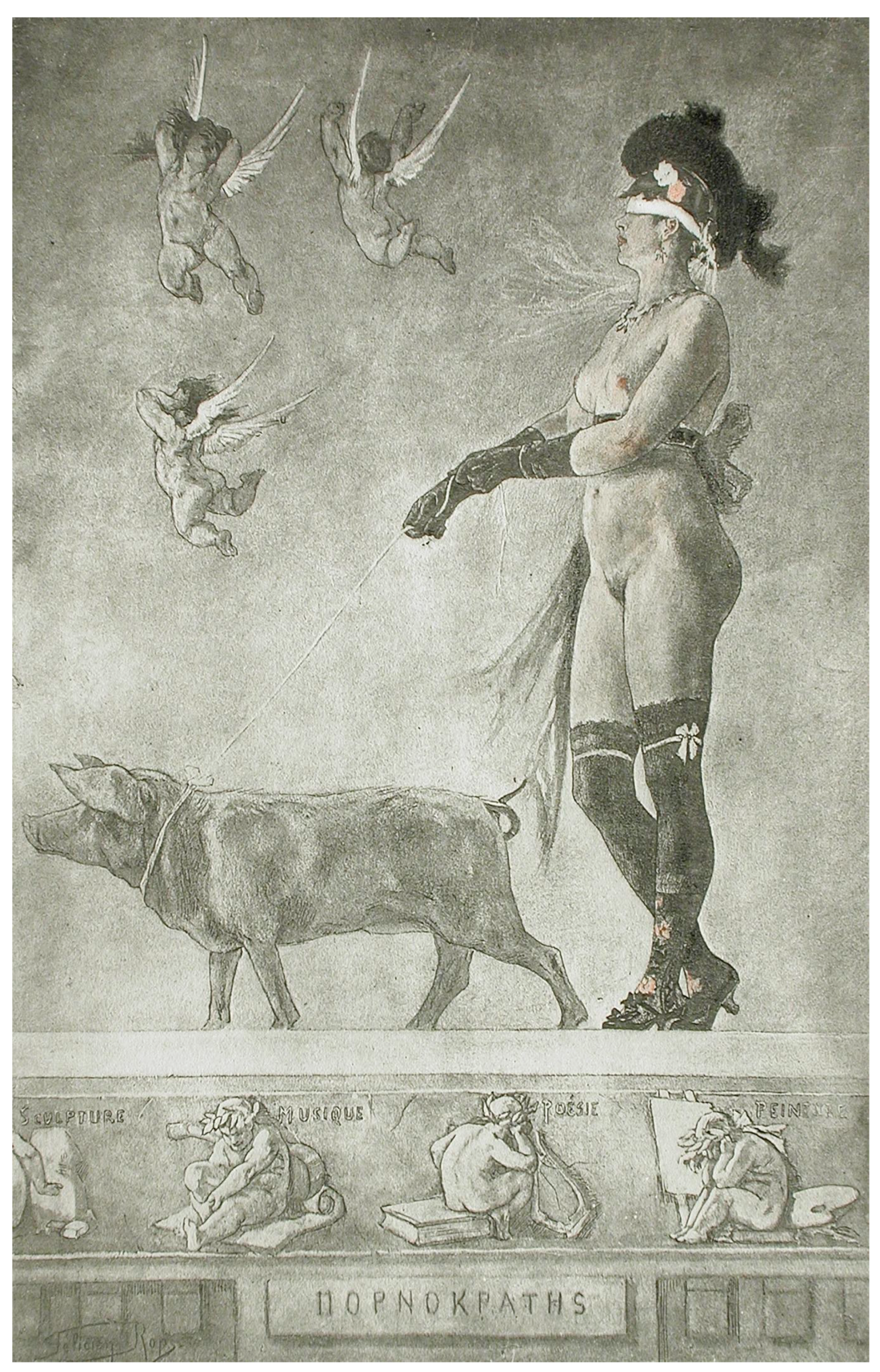

The Pig in Pornocrates

Department of History and Africana Studies, Valdosta State University, Valdosta, GA 31698, USA
Arts 2026, 15(6), 131; https://doi.org/10.3390/arts15060131
Submission received: 30 January 2026
/
Revised: 24 April 2026
/
Accepted: 18 May 2026
/
Published: 2 June 2026
(This article belongs to the Special Issue Human-Animal Interactions in Western Art)
Abstract
Pornocrates (1878) is the most influential work of Belgian artist Félicien Rops. Featuring a naked woman with a blindfold walking behind a tethered pig on a marble floor, the work caused controversy on its first appearance. It has been interpreted by critics and art historians as representing various possibilities. While the evolution of how critics and scholars have interpreted the relationship between woman and pig is important, what none of them acknowledge is the existing status of the human relationship with pigs at the turn of the century, or the phenomenon of blind pig races that mirrored the action taken in the painting. Those races were arbiters of class and gender in fin-de-siecle United States and Europe, two elements of social standing that Rops often used his work to critique. This paper describes the history and criticism of Pornocrates in relation to interpretations of human-animal difference and compares the work to the largely unknown story of blind pig races.
Pornocrates (1878) is the most influential work of Belgian artist Félicien Rops. Featuring a naked woman with a blindfold walking behind a tethered pig on a marble floor, as angels fly away, the work caused controversy on its first appearance. It has been interpreted by critics and art historians as representing various possibilities: perhaps the pig is representative of men manipulating women through disreputable means, perhaps the pig is a stand-in for luxury and sloth. It could be seen as a celebration of women’s sexuality or a representation of man’s anxiety over women’s liberation—the term féminisme was coined in 1837 but gained wider appeal throughout the 1870s. In 1969, Charles Brison, the original English-language scholar of Rops’s work, presented the artist’s pig as an allegory of the bourgeoisie’s corrupt social standards, and that interpretation has continued. In the twenty-first century, for example, Karin Andersen and Luca Bochicchio see Rops’s pig as “a human projection” (Andersen and Bochicchio 2012, p. 15).
While the evolution of how critics and scholars have interpreted the relationship between woman and pig is significant, what none of them acknowledge is the existing status of the human relationship with pigs at the turn of the century. As J. Keri Cronin has explained, “representations are always related to actual, lived, material lives” (Cronin 2018, p. 20), and the actual, lived, material lives of pigs were largely governed by human exploitation. This article reads the pig himself into the painting. It describes the history and criticism of Pornocrates in relation to interpretations of human–animal difference and compares the work to the largely unknown story of blind pig races, themselves arbiters of various forms of social standing in fin-de-siecle United States and Europe. In this reading, the exploitation of the pig in Pornocrates becomes a stand-in for the exploitation of animals writ large; the pig is representative of pigs, a commentary on a different kind of human failing. Such is not to say that Rops does not use sex and scandal to criticize the European bourgeoisie. Rather the trajectory of the painting’s cultural criticism focused additionally on human supremacy and species as a constituent hierarchical category governing the social world that Rops devoted himself to scandalizing.
Félicien Rops began his career as an illustrator (Lemonnier 1908), his work existing at the intersection of Symbolism and Decadence, where he “exploited the sexual ambiguities inherent in the Symbolist repertoire and took pride in calling himself a ‘Satanic artist’” (Mathieu 1990, p. 203). It was a desire to provoke that often included semi-pornographic human nudity and the foregrounding of animals (Calinescu 1987, pp. 154–57). Whereas nudity presented a critique of both the received morality of sexual repression and of broader social requirements (like that of wearing clothes), images of animals critiqued humanism itself, decentering the human and human supremacy at the heart of social formation and western religious belief. Rops’s had a liberationist philosophy—liberation from religion, from gender and social norms, and ultimately liberation from liberal humanism. In the early 1880s, Rops joined Les XX, a community of Belgian artists who exhibited together, but who also sought to create a space “where people are free, not only in fact but above all in thought” (Delevoy 1978, pp. 50, 106; Bade 2003, pp. 30–38; Berko and Berko 1981, pp. 355–56), a manifesto that embodied the liberationist ideology at the heart of Belgian and French thinking about art. Even before that, however, in the 1870s, the artist painted in aid of creating spaces for that freedom and liberation, and he often used animals to make his provocational critiques. Before his work with pigs, he experimented with images of other animals like salamanders, chimpanzees, and cats.
1. Rops’s Animals Before Pornocrates
Rops’s art was an intentional effort to change human values, one that developed at a time when another kind of liberationist ethic was underway. The first animal protection organization in Paris, the Société protectrice des animaux, formed in 1844, focused almost exclusively on domestic animals. The Société française contre la vivisection and the Ligue populaire contre la vivisection formed soon after to protest animal experimentation. In Belgium, the first animal welfare group, Société Belge pour la protection des animaux, was founded in 1863 and helped influence the country’s first animal protection legislation four years later (Traïni 2016, pp. 12, 14). The groups in France and Belgium were not arguing for an abolitionist animal rights position that denounced animal slaughter in its entirety, but the movement did often use animals in fantasy situations, sometimes accompanied by angels, to make the case for liberation (Cronin 2018, pp. 10, 24). The artists of the Symbolist and Decadence movements, meanwhile, were not associated in any formal way with animal protection organizations, but both were challenging societal norms at the same time; both attempted to upend human assumptions of value, one group working through the political process, the other through artistic production.
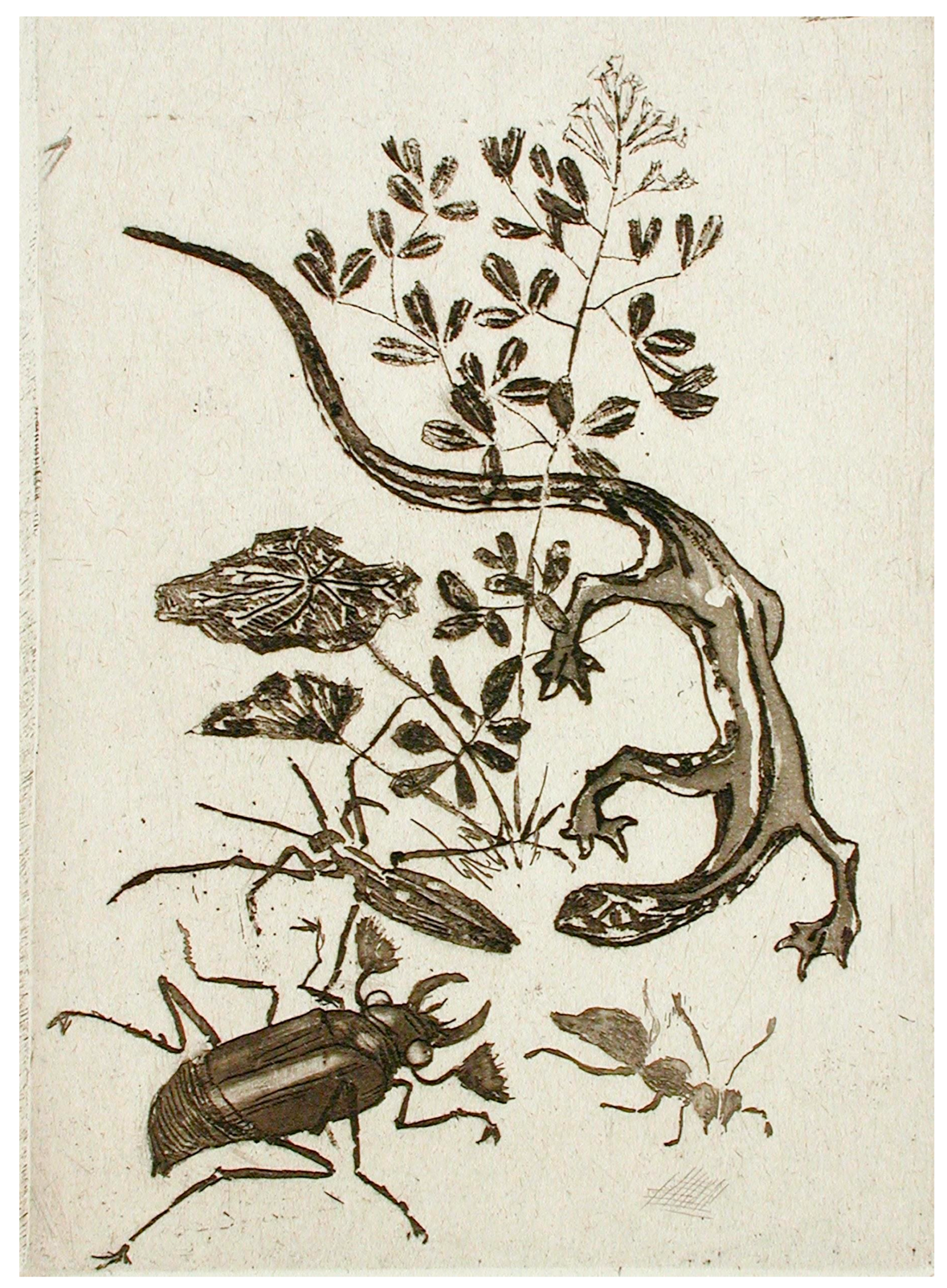
Animals, particularly in a climate where loud animal welfare voices existed, provided a mechanism for Rops to present his liberationist ideas. Presenting them in a decadent recreation of pig races, social events largely for the upper strata of society, allowed Rops to use the codes of animal protectionism already in the cultural air to combine a critique of liberal humanism with one of the classes and conventions of French high society. In doing so, however, he was also foregrounding animals themselves. They were not simply objects in the work; they were subjects. Even before Pornocrates, Rops included animals in his illustrations (those presented below are undated, but first appeared publicly in the early 1870s). Japanese Salamander and Beetle (Figure 1), for example, is a nature study painted in the style of Japanese woodblocks, one popular in late-nineteenth century Europe (Revens 1975, p. 10). An ant, spider, beetle, and salamander gather around some small plants. The spider and ant, the two animals typically interpreted as more aggressive or antagonistic, face away from each other, while the usually docile salamander and beetle face one another in an aggressive posture. The animals themselves are depicted realistically, but their stances invert common human assumptions about animal behavior. We know, Rops seems to be saying, less than we think we know about animals and their worlds.
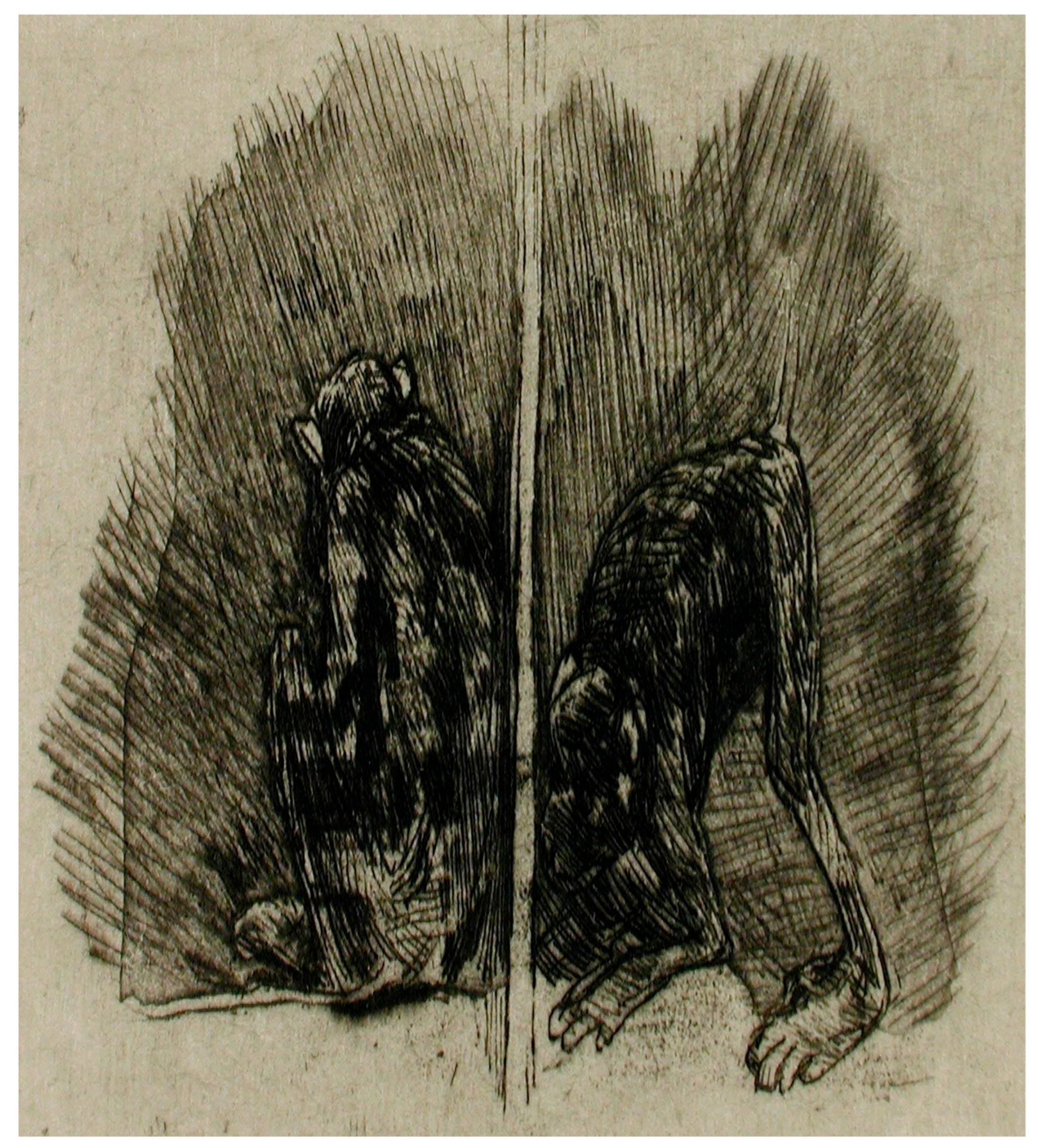
In Separated or Simian Spring (Figure 2), Rops is more abrupt, more aggressive, his serrated hatching technique a primitive prefiguring of the expressionism soon to come in the early twentieth century.
There is no overt pro-animal message in Separated, but the image of two individuals separated from one another, one seeking to get to his companion while the other looks away in presumed depression does seem to present, when combined with the vigorous hatching style and the “separated” in the title, at least a nod to a liberatory politics of animals, to the anti-vivisection movement already developed in both France and Belgium. Rops was not a known member of the Société française contre la vivisection or the Ligue populaire contre la vivisection, but protests against animal experimentation and the literature of the groups were prevalent in both Paris and Brussels. In Rops’s drawing, there is no way to view the separation of the animals neutrally. The chimpanzee’s effort to find his neighbor is given urgency by the hatching that leaves wild lines emanating from both bodies, radiating outward in an exclamation of desperation and need. Separated is not a portrait; it is a story of tragedy, of immediate and unfulfilled desire. The chimps are separated from each other, but they are also separated from the world outside, from the sun that similarly radiates outward, hatching its own rays on individual beings not caged inside, alone and separated, for experimentation. The public crusades against vivisection would have provided the context for any viewing of the work, the artist showing another of the cruel conventions upon which society was built.
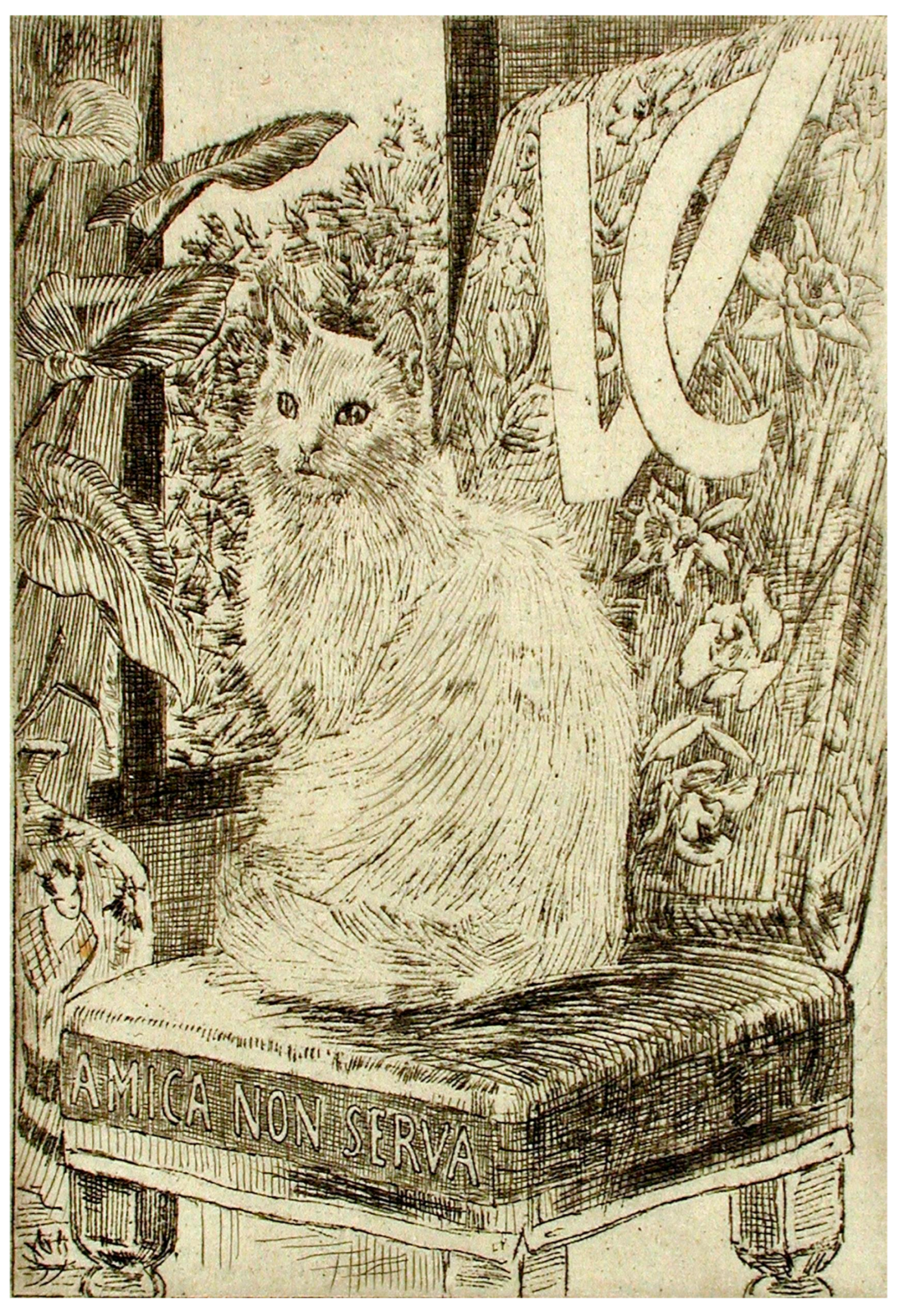
Rops is even more explicit in a third work, The Cat (Figure 3).
The Cat is far more dignified, with smooth lines and a realistic presentation. A cat sits proudly on a chair in a lush setting, but just below the cat, imprinted on the chair, is the phrase “Amica Non Serva,” a Latin phrase meaning “Friend Not Servant.” The picture itself does not push a determined animal rights agenda, and Rops’s biography does not include that kind of advocacy, but the animal welfare movements in France and Belgium would give contemporary viewers of The Cat context to interpret the drawing as a plea in some measure for domestic animals. The words in the picture linguistically liberate the cat from servitude. His insistent stare presents a sense of “the impropriety that comes of finding oneself naked, one’s sex exposed, stark naked before a cat that looks at you without moving, just to see.” Like the vulnerability felt by Derrida when finding himself the subject of his own cat’s disinterested stare, viewers of Rops’s The Cat stand “in front of the insistent gaze of the animal, a benevolent or pitiless gaze, surprised or cognizant. The gaze of a seer, visionary, or extra-lucid blind person. It is as if I were ashamed, therefore, naked in front of this cat, but also ashamed for being ashamed” (Derrida 2002, p. 372). Rops’s cat creates a version of that shame spiral, as she insists that she is not a servant, she is a friend; the viewer feels shame both for the assumption of servitude and for not recognizing the friendship. Gone is the feverish hatching of Separated, because the cat is in no immediate danger. She is not seeking an imprisoned neighbor, she is seeking a new human interpretation of her existence, just as groups like Société protectrice des animaux were seeking. The etching presents instead a depiction of the power of the animal gaze, the same gaze that Derrida depicted after being confronted by his cat.
Rops was, then, in the early 1870s responding directly in his art to changing perceptions of animals that came with the development of animal welfare movements, and even to the disappearance of farmed animals from public view in the geographical changes to slaughterhouse zoning. Those responses would, in turn, condition his work in paintings like Pornocrates later in the decade.
2. The Painting Pornocrates
Pornocrates (Figure 4) was Rops’s most influential work, first appearing in 1878. A nearly naked, blindfolded woman (Leontine Duluc, one of the artist’s regular models) holds a rope that leashes a pig, as three angels fly away from the scene (Hoffman 1984, p. 262). The woman and the pig stand on a stage that includes a frieze featuring representations of the four traditional arts: sculpture, music, literature, and painting; below them is another frieze that features the word PORNOKRATES, written in Greek.
The title provided two immediate reference points for late-nineteenth century viewers. The first was the saeculum obscurum, the “pornocracy” period of the tenth century papacy wherein the office was heavily influenced by corrupt aristocrats. Beginning with the 896 death of Pope Formosus and extending through the reign of Pope John XII, which ended in 964, the papacy was beset by conspiracy, sexual profligacy, and other scandals. Though the period was publicly lamented and named saeculum obscurum by Catholic leaders in the sixteenth century, German protestants in the early nineteenth century had provided their own description, referring to the era as a “pornocracy” (Squatriti 2004, pp. 926–27). For a “Satanic artist” like Rops, a lapsed Catholic who reveled in provocation, it was a reference that he knew would generate the religious obstinacy that he craved.
Then there was Pierre-Joseph Proudhon’s Pornocracy: Or, Women in Modern Times, an anti-feminist tract published in 1875, three years prior to Rops’s work. The worst kind of woman, Proudhon argued, “is the strong-minded woman, the one who gets involved in philosophizing, who, through the usual means of emancipation, to the horror of marriage, joins the pretensions of a doctrine, the pride of a party, the secret hope of a mass decline of the male sex” (Proudhon 1875, p. 90). Those viewing the painting through the immediate lens of Proudhon’s commentary could have interpreted the pig as the male sex in decline, controlled by an emancipated woman, pride of the party; however, Rops’s seeming celebration of the woman’s beauty gives little indication that she is an object of his disdain, as she would have been for Proudhon. Still, the author’s anti-feminist tract and the saeculum obscurum would have provided points of reference for those seeing the painting in the late nineteenth century.
“My Pornocracy is done,” Rops wrote to his friend Henri Liesse upon its completion. “This drawing delights me. I would like to show you this beautiful naked girl in shoes, gloved and wearing black, silk, skin and velvet, and, blindfolded, walking on a marble frieze, led by a pig with a ‘golden tail’ through a blue sky. Three loves—the old loves—disappear crying.” He explained that “I did this in four days in a blue satin living room, in an overheated apartment, full of smells, where opopanax and cyclamen1 gave me a little fever that was beneficial to production and even to reproduction”2 (Rops 1879a). Rops’s misogyny was part and parcel of his lust for the female form. His two governing fascinations were “death and prostitution,” his emphasis on the reproducibility of the female form seemingly giving way to his assumption of the reproducibility of female lives, a direct rejection of the féminisme gaining cultural and political capital in 1870s Paris (Hoffman 1981, p. 210).
After declaring, following the painting’s completion, “I don’t know who I’ll sell this to, but I don’t care” (Lemonnier 1908, p. 185), he ultimately sold it to Edmond Picard, a Belgian lawyer and playwright who spent much of his time outside the halls of government as a patron of the arts and who was unafraid to traffic in controversial work. Rops even created for Picard “a shuttered reliquary in which he could discreetly keep the treasured drawing, rendering its delights more piquant by being secret, only shown to the initiate” (Thompson 2000, p. 429). Edmond Picard exhibited Pornocrates at the annual Les XX show in 1886, where it solicited Rops’s and Picard’s desired scandalous outcry. Les XX, founded two years prior in 1884, was the most important artistic group in Belgium at the end of the nineteenth century, emphasizing both the avant-garde and the unity of the various art forms. “In its unification of the avant-garde in the literary, visual, and musical spheres,” explains Jane Block, “Les XX hoped not only to identify the avant-garde elements at home but to nurture and sustain them as well” (Block 1984, p. xiii). The artists of the group were “sympathetic to anarchist ideas” and “detested established art” (Block 1984, p. xv). They thus sought to present the new and the provocative.
Rops had been invited to the group’s first exhibition in 1884, then became an elected member the following year (Block 1984, p. 14). In 1887, L’Art Indépendant—a group patterned after Les XX—held an exhibition that also included Pornocrates, largely because members realized from recent history that it would elicit shock and anger. One critic of the show called Pornocrates pornographic and the exhibition more broadly “l’art cochon,” pig art (Block 1984, pp. 54–56). The Société du Palais de l’Industrie demanded that the exhibition remove the painting, but L’Art Indépendant refused. The controversy was such that the owner of the exhibition space refused to open it to the group the following year, giving it little choice but to disband (Block 1984, p. 56).
Rops’s painting, however, would live on. It was “the famous Pornocrates, or the Woman with the Pig,” explained Eugène Demolder in 1896 in the pages of the symbolist journal La Plume, “who opens the march of this procession of the damned: large, fiery hair, red-colored lower abdomen, like God or the devil made it, taunting the prudishness and bourgeois fears of institutional painters whose imbecility shears the feminine fleeces, dressed only in her stockings and her big gloves with twenty buttons, the blacks of which make the whiteness of her heroic nudity vibrate; she appears standing on the frieze where the geniuses of the arts cry, like the statue of Perversity” (Demolder 1896, p. 434). For Demolder, as for so many others, the story of Pornocrates was the woman, the brazen “perversity.” The pig was simply there as a supplement, another signifier of vice rather than a meaningful subject in his own right, hiding in plain sight in the middle of the painting.3 And Demolder would not be alone, neither in his celebration of the work itself nor in the emphasis of his interpretation.
3. The Pig in Pornocrates
Demolder, of course, was not wrong. The woman’s “perversity” was a vital part of the painting and of Rops’s vision of art itself. But so too was the pig that she held on the rope. The pig in Pornocrates stands tall, at alert, the focused leader of the naked woman whose blindfold makes her dependent on his leadership. The pig is looking up, his neck in an unnatural position that creates the assumption of dog-like vigilance from a nonhuman animal whose neck has evolved to keep his head pointed toward the ground. His legs are straight and slim, his body lean. Rops’s pig appears to have both the body and demeanor of a dog, with the head and tail of a pig painted on. The naked woman holds the rope that binds him lightly, using both hands but only two gloved fingers on each to hold a decidedly thin rope attached to the pig’s neck. Again, it is the leashing strategy one might take with a well-behaved dog, the neck strength of pigs making that kind of easy hold and flimsy binding virtually impossible. And thus Rops’s pig is an idealized representation, a pig painted by someone largely unfamiliar with pigs, fitting the woman’s idealized sexuality and the frieze’s idealization of the arts.
Rops was not alone in his unfamiliarity with pigs, as the Paris scandalized by the painting had almost no access to living farmed animals. They had become, in the words of Carol Adams, an “absent referent” (Adams 2015, p. 66). In 1859, Paris officials decided to move slaughterhouses located throughout the city to a central location outside of the city center, La Villette, part of a broader effort in many industrializing metropolitan areas to remove slaughter and animal facilities away from public view, as a response both to sanitation concerns and the cruelty practiced there (Claflin 2008, pp. 27–45). The almost one-hundred-acre district was finally completed in 1867 and remained a center of the Parisian meat industry until after World War II (Philipp 2010, pp. 115–20; Baldin 2014, pp. 52–60). Ghent, in Rops’s native Belgium, took the same step in 1857, moving its Beestenmarkt to the eastern edge of the city, a railway connected to the facility ensuring that animals from the countryside would reach the slaughterhouse without citizens having to see them. After the transition, Ghent prohibited animal slaughter within the city limits; it banned the use of open wagons to transport meat, requiring that animal products had to be hidden from public view during transport (Danneels 2019, pp. 13–16). It left the urban human population, in the words of artist Georges Bataille two generations later, “to vegetate as far as possible from the slaughterhouse, to exile themselves, out of propriety, to a flabby world in which nothing fearful remains and in which, subject to the ineradicable obsession of shame, they are reduced to eating cheese” (Bataille 1929, p. 329).
It was an important change, as interpretations of what constituted animal cruelty, as Hilda Kean has argued, “very much depended on who was doing the watching and what they were looking for” (Kean 1998, p. 94). That being the case, “the changes that would take place in the treatment of animals relied not merely on philosophical, religious or political stances but the way in which animals were literally and metaphorically seen” (Kean 1998, pp. 26–27). Pigs had been made what Keri Cronin calls “culturally invisible,” making them all the more impactful when seen (Cronin 2018, pp. 6, 17).
That seeing remained important, even when the image was an artistic recreation. Visual representation in artistic production “resituates animals by positing that they belong anywhere, which is to say, they belong nowhere” (Malamud 2012, p. 3). Diana Donald, in her analysis of animals in the art of eighteenth and early-nineteenth-century England, seeks to remedy the reality that in visual art, as in literature, animals are almost always interpreted as a lens through which human relationships can be judged, never as beings in their own right, with their own interests (Donald 2007, p. vi). Her analysis of images by Edwin Landseer, Joseph Wright, and others, then, reifies the work of nineteenth century European city planners, hiding the real lived lives of animals in plain sight. Human behavior, after all, is not only governed by “the perceived or potential status of the human but the situation in which the animal is seen,” making visual representation of the animal all the more significant, particularly when the project of human politics is to hide farmed animals from metropolitan view (Kean 1998, p. 48).
That visual representation also served to deflect the negative stereotypes associated with the animal. “The object of man’s peculiar cultural disdain for the pig,” Milo Kearney has argued, “is less the beast itself than man’s own speckled soul.” (Kearney 1991, p. 322; see also Dawson 1999) Kate Soper agrees. “The vilification of the pig can be attributed to the need to assuage the guilt of killing and eating such a commensual associate” (Soper 1995, p. 88). Pigs are, explain Peter Stallybrass and Allon White, “a site of competing, conflicting and contradictory definitions.” They became exemplars of poverty, filth, and vice, meaning that disassociation from pigs in an age of social mobility could become a signpost of proper middle-classness4 (Stallybrass and White 1986, p. 49). At the same time, they stood as symbols of gluttony, whether for food or for sexual conquest (Mizelle 2012, pp. 122–23).
In Pornocrates, sexual conquest was made explicit by the presence of the naked woman, whether she is led by the pig or leading. She is a seductive “human animal viciously depicted,” according to Bram Dijkstra, “ruler of Proudhon’s ‘Pornocracy,’ a creature blindly guided by a hog, the symbol of Circe, the bestial representative of all sexual evil” (Dijkstra 1986, p. 325). Even when such commentary emphasizes the woman, the reference to her sexuality is “bestial,” a vicious representation of a “human animal.” In Dijkstra’s interpretation, the place of the pig in the painting transfers the animalism of animal sexuality to the naked woman. She is not simply seductive; she is bestial, “blindly guided by a hog.” It is in such an account animality itself that is the signpost of degradation.
Dijkstra’s Circe reference is telling. The daughter of the sun god Helios and the Oceanid nymph Perse, Circe lives on her own island, Aeaea, when, in Homer’s telling, Odysseus arrives after the Trojan War. She lures the hero and his crew to her home, where she feeds them a feast drugged with a potion that turns them into pigs. Odysseus avoids the fate after a warning from Hermes, the messenger god, and pleads with her to return his crew to human form. She agrees after forcing him into her bed. The two have children together before Odysseus and his crew, now returned to human form, leave a year later (Homer 1891, pp. 151–64). Circe’s is, in one sense, a story of pigs used as sexual manipulation. In another, it portrays pigs as victims of that same sexual manipulation. In all interpretations, though, the story depicts pigs as lesser beings, as undesirable forms for humans. They serve as their own method of blinding, taking away humanness to those who are vulnerable to sexually predatory women.
There is also the critic’s contempt in the realization that she is “guided by a hog.” Such creates a different kind of pornocracy—a pornocracy, as it were, of meat, wherein the pig in Rops’s painting, foregrounded in the frame as he is, only assumes value as a commentary function in relation to the naked woman holding his rope. Carol Adams has explained that “the pornography of meat exploits the asymmetrical relationship of gender to normalize animal oppression, simultaneously naturalizing the gender binary and a consumer vision in which farmed animals are imputed to desire their own death and consumption. The stand-ins for women smile or wink. They are powerless, yet they want it. They are dead, yet they beckon” (Adams 2020, p. 17). If the pig in Pornocrates can be seen to be consumed—by the viewers’ eye, by the naked woman’s control, by her future appetite—then the pornocracy, as it were, can be seen as a pornocracy of meat, a corollary to the modern propaganda discussed by Adams in various works (Adams 2020, 2015). “In the jostling, crowded, perplexing world of metropolitan modernity the visual assumed,” argues Deborah Cherry, “and was ascribed, an increasing authority for telling differences and marking distinctions: seeing was elided with knowing” (Cherry 2000, p. 2). Rops was, in this sense, an arbiter of that authority, his misogyny consuming Leontine Duluc, exploiting her as he simultaneously lays the blame for animal oppression at her feet.
The viewers’ eye, however, can consume in multiple ways. The woman could also be seen, for example, as a powerful force controlling the pig, representing submissive and bestial masculinity. In this view, the pig is associated with male sexual compromise and willingness to engage in sexual behaviors under any circumstance—the so-called “male chauvinist pig,” open to being guided in aid of a perceived romantic conquest (Adams 2015, p. 161). The pig has a golden tail, possibly associating him with affluence, luxury, or acquisitiveness. The notion of pigs as referencing decadence could lead to an assumption that Rops’s pig represents fornication, reifying the potential for the “male chauvinist pig” trope. At the same time, however, the decadence reference could also lead to symbolism of sloth or devilry. Pigs have historically been associated with both. The epithet “lazy pig” has become so common that it serves as the name for restaurants and children’s books (see Randell 1993).
The devilry association comes most directly from the Bible. In the gospels of both Mark and Luke, Jesus meets a man possessed by the demon Legion. “A large herd of pigs was feeding on the nearby hillside,” as the tale was told in Mark. “The demons begged Jesus, ‘Send us among the pigs; allow us to go into them.’ He gave them permission, and the impure spirits came out and went into the pigs. The herd, about two thousand in number, rushed down the steep bank into the lake and were drowned” (Mark 5: 11–13; see also Luke 8: 32–33). The story presented pigs as receptacles for demons, animals so low in stature that Jesus, God’s representative on earth, felt comfortable condemning creatures created by that God to death. Such stories only backed earlier claims in the Old Testament’s Leviticus and Deuteronomy that pigs were unclean (Leviticus 11: 3–8; Deuteronomy 14: 3–8). The Quran contained similar descriptions (Al-Baqarah, 173). In a Europe feeding from those religious traditions—traditions that also emphasized a human supremacy countered by the burgeoning animal welfare movement—even painters like Rops who rejected most mainstream theological moralizing would be familiar with such associations.
If the woman is the force controlling the pig, however, the other criticism that Rops could be making is similar to that being made by French and Belgian animal welfare associations: human interest in social standards of beauty and morality blind them to their own cruel manipulations of other animal species. Whether those animals are their pets, as in Rops’s early cat drawing, the chimpanzees used to test the products helping them achieve those beauty standards, or the pigs consumed for their food or their entertainment, all are vulnerable to the inherent hierarchical thinking of the human society that so frustrates the artist. If the pig in Pornocrates represents pigs, animals, rather than human frailties, then the gendered and class critiques of the painting work in concert with a more direct statement on how those codings redound to the human treatment of animals. And that intersection of human social conventions, western class stratifications, and the human exploitation of other species did have a recognizable model in the recreational activities of the Parisian society so scandalized when viewing Pornocrates as Les XX.
4. Blind Pig Races
For western high society, there was, in fact, one space where humans had an unobstructed view of farmed animals. Pig races started to gain popularity in the 1820s and became a common activity in Europe and the US in the 1860s, the decade prior to Rops’s painting. Originally, the most popular form of pig races was part of lowbrow, working class culture, those in which a pig was rubbed with grease or oil, or his or her tail was rubbed with it, and contestants were encouraged to chase after the pig. The one who managed to maintain a grip on the animal was the winner, and usually was given the pig as a reward. (New York Times 1862, p. 5; 1863, p. 8; Observer 1825, p. 4; Manchester Guardian 1839, p. 2) In Paris, this form of pig racing matched the number of humans and pigs, each assigned to one another. (New York Times 1882, p. 4) In other places, such contests were played out in pools of shallow water. (New York Times 1867, p. 6) These “greased pig races,” as they came to be known, were horrifying endeavors for pigs, contests that they always, of necessity, lost, and which usually ended, sometime after the spectacle had run its course, in their deaths.
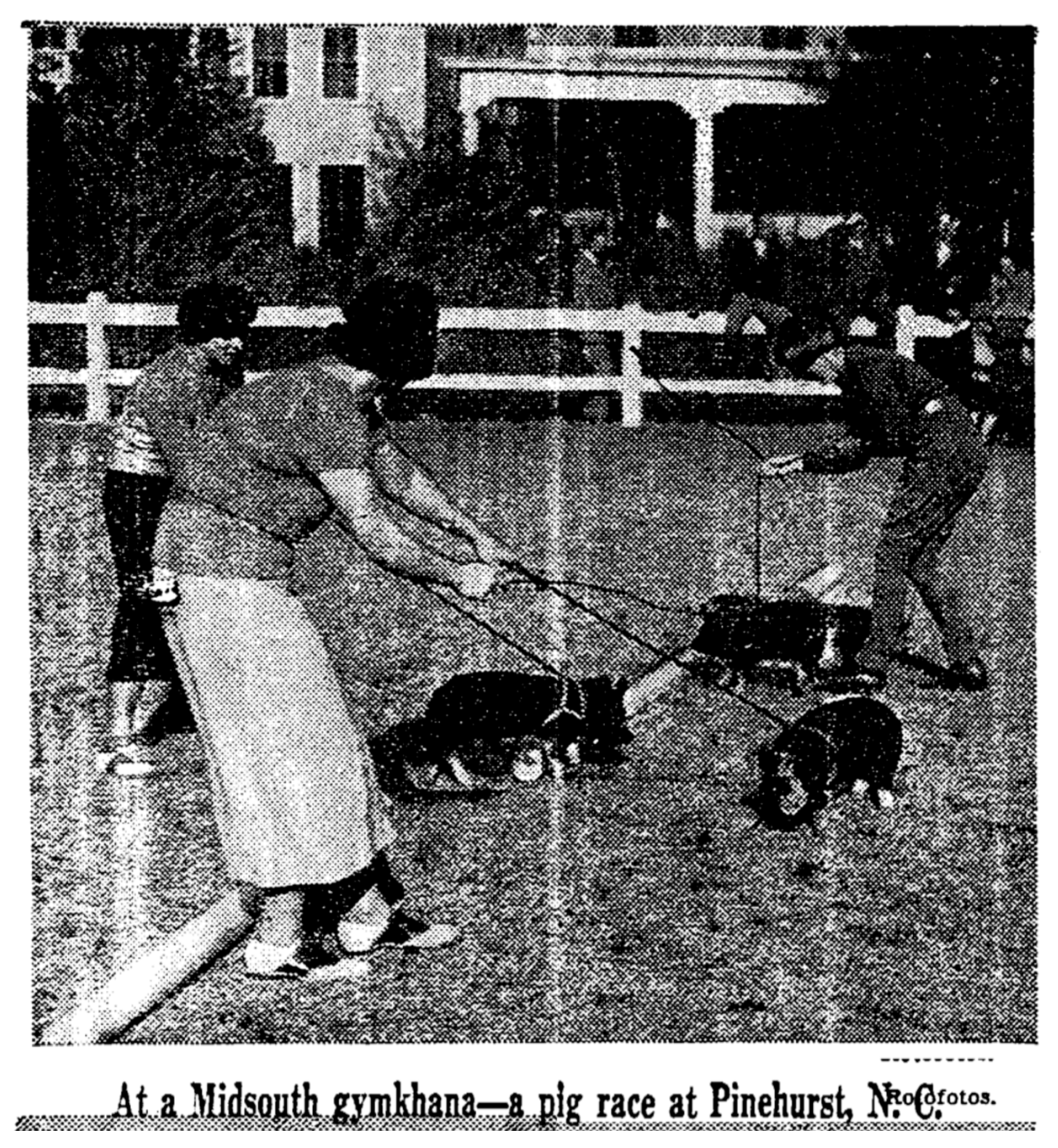
The other form of pig races, ones practiced by the upper classes, were those in which a pig was tethered to a rope, and humans walked behind them (Figure 5), attempting to control them and make their way to a predetermined finish line (New York Times 1931, p. 140; 1934, p. XX12). Upper class pig races were a regular presence in nineteenth-century high society in Paris and Belgium. As early as 1868, La Vie Parisienne reported on a party with sack races, donkey races, and pig races, in which women took part (Ther. 1868, p. 692). Tethered pig races were also a regular part of French celebrations of the Catholic remembrance of the “Massacre of the Innocents.” Such festivals continued through the 1870s and 1880s (Les Gaulois 1869, p. 1; Paris, Ancienne Gazette des Étrangers 1869, p. 1; La Petite Presse, Journal Quotidien 1869, p. 2; Le National 1875, p. 2). In 1882, Le Charivari reported that the Parisian tethered pig races being held that year were not new, and that they had also been part of society life in Brussels, as well (Le Charivari 1882, p. 69). Because these less chaotic races were part of the social circles of the capital cities and often tied to religious festivals, they served as a perfect target for Rops.
The human participants in upper-class pig races were not always women (Figure 6), but based on extant photos of such events, like the ones above, women tended to participate more than men. The photos themselves are from the twentieth-century American press, because the nineteenth-century European press did not include photographs in their accounts. But those races were certainly taking place in the Paris and Brussels of the 1860s and 1870s, and extant descriptions only mention society women as participants; the photos are presented here to show what those races looked like, with women walking behind tethered pigs in a similar fashion to the scene staged in Pornocrates. While the game was still one that used a bound pig performing against his will, the tethered version of pig races was demonstrably less traumatic for the nonhuman animals involved. But they were still traumatic; they were still an encumbrance, an exploitation of pigs by the bourgeoisie that Rops so often targeted. Most of those games took the form of “blind pig races,” wherein those holding the tethers were blindfolded, giving the crowd watching the spectacle more of a laugh as those being led around by the pigs remained unsure of where they were going. It was a human celebration that became exceedingly popular among European society culture and the upper classes, carrying through the twentieth century and—along with the more working-class greased pig races, which also continued in decidedly different circles—into the twenty-first (Globe 1920, p. 4; Blum 2008, p. 231; New York Times 1937, p. 175; Riley 1913, p. 910). None of the bourgeoisie’s version of pig races included female nudity or sexual exploitation, and neither the pigs involved nor the women holding their tethers held their heads high while participating, but Rops’s framing of the image would have given those high society art patrons staring in shock at Pornocrates a ready reference, a lens through which to view what they were seeing.
Such is not to say that Rops is necessarily depicting a version of a blind pig race (Figure 7), but there is in his depiction a reference with which contemporary viewers would have been familiar, one of the most common ways that many would have ever come into contact with living pigs. That is to say, that while the naked woman with sexually provocative accouterments is standard fare for Rops, it is reasonable to assume, against the assumption of previous interpretations, that the role of the pig in Pornocrates is more than a symbol of human failings—that the pig in Pornocrates is, instead, a representation of exploited pigs, an additional target of his class criticism directed at the treatment of animals in a society that had largely removed them from public view. Charles Brison gets perhaps closest to the possibility, noting the “utter sophistication” of the few garments “allied to the statuesque nudity of the model who perambulates, like any society lady in the Bois, not with a lap-dog but with a pig on the end of a silken leash.” Brison’s assumption of “society” veers from other critical assumptions of the painting’s human subject, thus putting her in the class of those who would possibly participate in pig races, of those who would actively exploit animals rarely seen by those considered of “utter sophistication” (Brison 1969, p. 41).
That a pig depicted in a painting could be read as something other than a human metaphor might seem a minor point, but it is significant because often the position of animals in art and fiction is reduced in commentary and criticism to human symbolism, as it is usually assumed that the humans creating the artistic product are speaking to human concerns and using animal tropes to make a broader social point. Thus the pig leading the naked woman is symbolic of decadence, affluence, or the male chauvinist pig. Reading Pornocrates through the lens of blind pig races does not negate those more human symbolic readings; it supplements them. The upper-class society habitues attending Les XX would have recognized the posture in the painting. That recognition would have coded any valid symbolic reading with a reference to actual human-pig interaction. Their exploitation of nonhuman animals was another of the bourgeoisie’s sins that Rops sought to expose. If nonhuman animals are interpreted as nonhuman animals, as simple representations of living beings, then not only are animal forms treated with more respect in art criticism, but other interpretations of the painting become possible, not to negate human symbolism, but to give that symbolism historical context and to read critiques of animal use into a painting that appeared at a time of welfare activism and the disappearance of farmed animals from urban daily life.
The three cherubs, for example, are typically interpreted as demonstrating disgust or revulsion at what they are seeing. If the pig in Pornocrates is simply a pig, or a representation of their exploitation, and if the scene is a reenactment of a blind pig race so popular at the time, then a form of entertainment associated with a kind of animal cruelty, along with human sloth, leisure, and low-brow culture being performed literally on top of the more traditional arts, as demonstrated by the friezes at the bottom of the painting, gives the cherubs more reason, in the hands of a fine artist, for revulsion. Those of the educated, artistic class had become lazy and had used their privilege to exploit the vulnerable, among them the animals they used for entertainment.
That those of privilege in the French or Belgian bourgeoisie were the ones enacting that exploitation was important to Rops and to Pornocrates. In reality, a depiction of low-brow cultural behavior toward pigs would have been more accurately depicted by a greased pig race, one where humans literally get into the mud with nonhuman animals and torture and terrorize them in the process.5 Greased pig races were, and still are, revelries in fear and violence. Blind pig races were not. But the low-brow version of pig races made little room for sultry depictions of naked women and were predominantly the form of pig races engaged in by the working class, another group exploited by the bourgeoisie. Blind pig races, by contrast, were society events. Rops himself was not an active participant in any of the predominant animal welfare groups; his speciesist critique was important, but it was always part of the class critique that framed it.
5. The Pig After Pornocrates
Whether imposing their trenchant critiques on class, religion, gender, species, or a combination of those categoricals—and when depicting animals, emphasizing salamanders, primates, cats, or pigs—Rops’s paintings were “active rhetorical agents” (Dunaway 2015, pp. 1, 111). Timothy Bewes, in his discussion of postmodern fiction, describes “the thought of the novel—as opposed to the thought of its author, narrator, readers, characters, social world, historical context, etc” (Bewes 2022, p. 5). Visual art can be seen in much the same way—Rops not intentionally defending pigs but Pornocrates thinking beyond its author, if not its characters and historical context. Representations of animals in painting, whatever authorial intent, mattered, as “representations play an important role in shaping dominant ideas about and attitudes toward nonhuman animals” (Cronin 2018, p. 6). Images, taking on a life beyond the artist, help establish and change human values (Mitchell 2005, p. 105).
Rops’s attempts to establish and change human values would continue well after his four days in that overheated blue satin living room. Just after completing Pornocrates in 1878, Rops painted La Tentation de Saint Antoine (Figure 8), a work that appeared at the very first Les XX in 1884.6
The naked woman is now on a cross and the angels flying in the painting’s northwestern quadrant are skeletons. And behind the woman, instead of leading her, is the pig, again, as in Pornocrates, maintaining a posture biologically unavailable to pigs. In a picture designed to critique Catholic sexual repression, St. Anthony’s vision is overtly pornographic. Rops, argued his French contemporary J.-K. Huysmans, “has penetrated into the very bottom of the unfathomable seething regions of Satanism” (Huysmans 1975, p. 23). The pig in the image is less mysterious, as St. Anthony was often associated with pigs and is the patron saint of pigs, tasked with protecting the animal from the caprice of humans (Rogers 1877, pp. 4–6). Still, by placing the pig behind the debauchery in the painting, and having him fixate on it, the pig in Rops’s second 1878 work seems again associated with pornography over and against sainthood. Gone is the class critique of Pornocrates; gone is any overt or specific reference to the European animal welfare movement; here, the cultural critique is decidedly religious, the pig presents as a signifier for his patron saint. At the same time, however, when the patron saint of pigs is vulnerable, pigs are vulnerable as well. Coming on the heels of Pornocrates, and after the move of abattoirs outside of city centers, it would still be possible to read the painting as a commentary on the vulnerability of farmed animals in a society that hides them from plain sight, just as Saint Anthony himself was “tempted” by his time in isolation in the Egyptian desert. The painting would be the most controversial work at that first Les XX exhibition, leading one critic to argue that it would “make a sailor blush” (Block 1984, p. 29).
By the time he painted Pornocrates and La Tentation de Saint Antoine, Rops was “the best-paid illustrator in France” (Revens 1975, p. 10). In his later career, Rops’s confidence began to fade, as “the combination of ingrained Catholicism and bourgeois standards (for Rops was still a successful member of his class) made it impossible for him to avoid the concept of sin and punishment” (Brison 1969, p. 23). That impossibility led him to despair, to “doubt and question, perhaps even to reproach himself” (Brison 1969, p. 23). Beginning in the early 1890s, Rops would begin suffering a series of illnesses that led him to retire to his country home at Biève, where he died in 1898 (Revens 1975, pp. 10–11; Brison 1969, pp. 25–26).
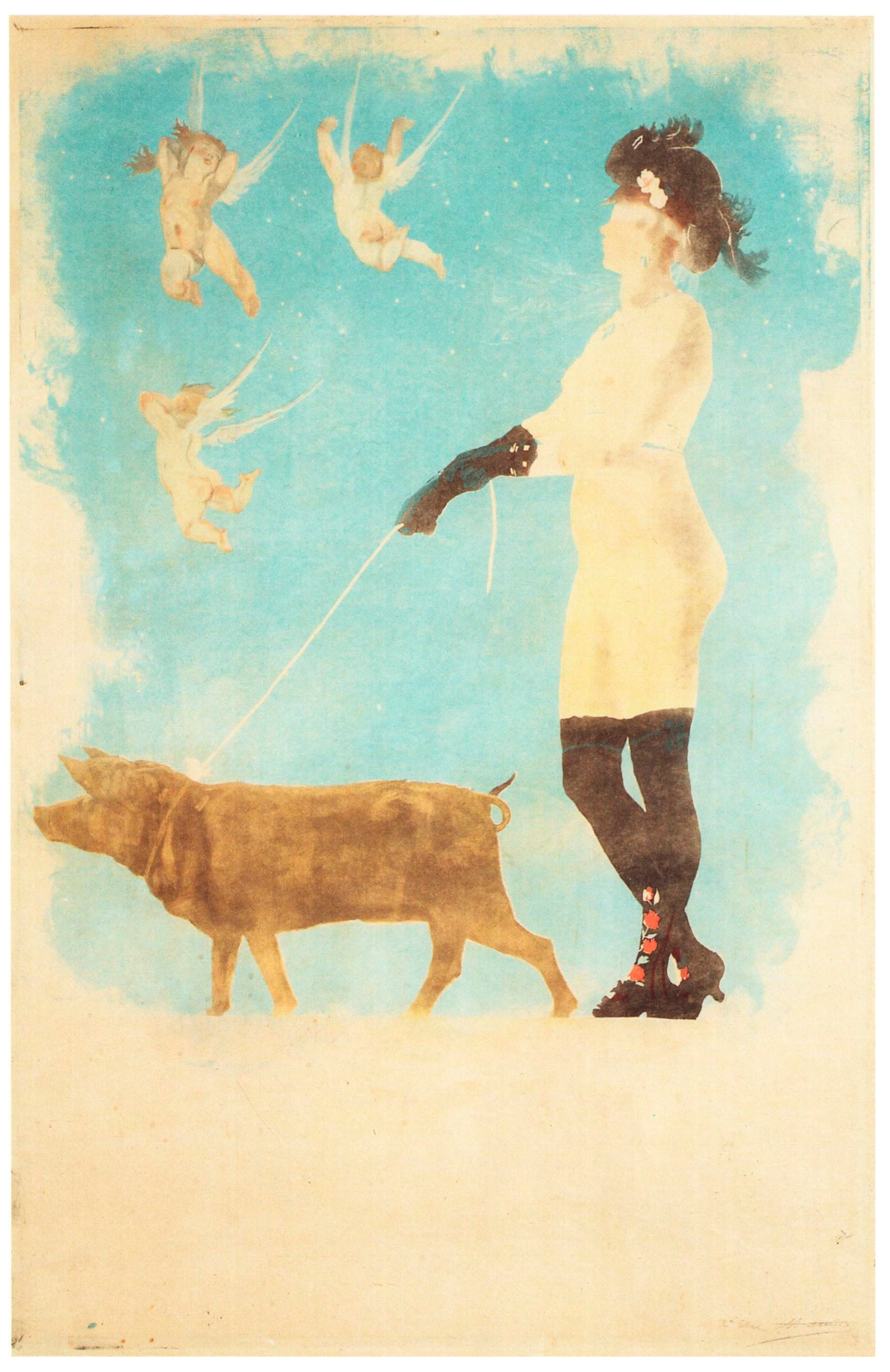
Even in his later years, however, Pornocrates never left the mind of the ailing Rops. In 1896, he returned to the image in etchings (Figure 9) and a heliogravure (Figure 10). The woman and her pig continued to haunt the decadent artist.
Charles Brison has argued that Rops’s work is defined by three overarching characteristics: the “rapid perception of lyric and demonic images which he was capable of synthesising,” an “alert humor,” and a “formidable technique” (Brison 1969, p. 45). Less defining but certainly present in each stage of Rops’s career was an engagement with nonhuman animals and, in his own way, a reasoned defense of them. What began with a tangential engagement with salamanders, monkeys, and cats would eventually bloom into far more public treatment with Pornocrates, a painting that would not only cause controversy in its play with negative stereotypes of pigs, but would also reify those stereotypes in the pig’s association with a beautiful, naked woman. At the same time, however, the painting also represented, whether the author intended it or not, the burgeoning middle- and upper-class entertainment known as blind pig racing, a different kind of pig use that also redounded negatively to the animals themselves. In so doing, Pornocrates opens, first, an understanding of Rops’s response to the burgeoning animal welfare movement and the geographical changes in farmed animal lives, and, second, the class critique embedded in a painting commonly interpreted as scandalizing Paris for its overt sexuality and gendered tropes. Neither of those lenses abrogate the validity of interpretations of the painting’s sexual provocation; they instead demonstrate that there is more to Pornocrates than is commonly assumed, a “more” that exists in the embodied presence of the pig himself. The emphasis on caprice and beauty by the French and Belgian bourgeoisie, Rops’s most influential painting argued, was damaging to other human groups, but it was also damaging to the pigs used for their leisure and entertainment.
None of the critics shocked by what they interpreted as the immorality of Pornocrates made mention of blind pig races, but that was because the pig for those critics was nothing more than a point of reference for the human, a tool used by the artist to enhance the painting’s broader statement on gender and class. Like the pigs sent to French and Belgian abattoirs every day, the pig in Pornocrates hid in plain sight to those who viewed the painting with outrage or disdain. The pig in Pornocrates, however, was also a pig, a stand-in for the animal victims that formally shared city spaces with humans. Just as the naked women in Rops’s paintings impacted the way humans thought about prostitutes, pornography, and women more broadly, the pig in his most infamous work impacted negative western stereotypes toward pigs. Those stereotypes, then, made it easier for their plight to disappear from human vision and reduced them to nothing more than signifiers of sloth, luxury, and, ultimately, evil.
Funding
This research received no external funding.
Institutional Review Board Statement
Not applicable.
Informed Consent Statement
Not applicable.
Data Availability Statement
The original data presented in the study are openly available in libraries throughout the world, the Proquest New York Times database, and the archives of the Musée Félicien Rops.
Conflicts of Interest
The author declares no conflict of interest.
| 1 | Opopanax is a gum resin used in perfumes, cyclamen a popular display flower. Rops here is referring to both the headache presented by strong smells and the aphrodisiac effect created by them, particularly when locked in an overheated blue satin living room with a naked model. |
| 2 | This commentary from Rops’s letter to Liesse is commonly used in discussions of the painting, virtually ubiquitous in the extant literature, but the letter itself is harder to find. There are two principal repositories for Rops’s letters. The first is the Musée Félicien Rops in the artist’s home of Namur Province in Belgium. The second is a smaller folio of letters in the archives of Mount Holyoke College in Massachusetts. Both feature letters to Liesse prominently in their collections, as he was a frequent correspondent of Rops, but neither seem to have that particular letter from January 1879. The Rops Museum does have one letter to Liesse on 17 January, but it is a much shorter missive about financial arrangements (Rops 1879b). |
| 3 | That entire edition of La Plume was dedicated to Rops and his work. None of it, however, dealt meaningfully with the artist’s visual representation of animals. |
| 4 | That association with the dirt and filth of the lower classes and the otherwise dispossessed remained with pigs from the medieval period through the nineteenth century, from the writing of John Gower in 1381 to that of Frederich Engels in 1844 (Mizelle 2012, pp. 118–20). |
| 5 | In one account from 1878, for example, “There was a pig-race, which created a vast amount of amusement. The unfortunate animal was chased for half an hour, and was then caught, not by the soapy tail, but by the hind leg” (New York Times 1878, p. 5). |
| 6 | Four years after that, in 1888, Rops’s fellow Belgian James Ensor would paint his own version of The Temptation of Saint Anthony, which was rejected from Les XX after consultation with the French Minister of Fine Arts, as it was assumed the painting would cause an even greater scandal than Pornocrates (Block 1984, p. 35). Perhaps fittingly, Edmund Picard, who owned Pornocrates, also purchased Ensor’s version of The Temptation of Saint Anthony (see Art Institute of Chicago 2014). |
References
- Adams, Carol J. 2015. The Sexual Politics of Meat: A Feminist-Vegetarian Critical Theory. New York: Bloomsbury. [Google Scholar]
- Adams, Carol J. 2020. The Pornography of Meat, New and Updated ed. New York: Bloomsbury. [Google Scholar]
- Andersen, Karin, and Luca Bochicchio. 2012. The Presence of Animals in Contemporary Art as a Sign of Cultural Change. Forma: Revista D’Humanitats 6: 12–23. [Google Scholar]
- Art Institute of Chicago. 2014. James Ensor: The Temptation of St. Anthony. Chicago: Art Institute of Chicago. Available online: https://publications.artic.edu/ensor/reader/temptationstanthony/section/289/289_anchor (accessed on 4 April 2022).
- Bade, Patrick. 2003. Felicien Rops. New York: Parkstone Press. [Google Scholar]
- Baldin, Damien. 2014. De l’horreur du sang à l’insoutenable souffrance animale. Élaboration sociale des régimes de sensibilité à la mise à mort des animaux (XIXe-XXe siècles). Vingtième Siècle Revue d’histoire 123: 52–68. [Google Scholar] [CrossRef]
- Bataille, Georges. 1929. Abattoir. Documents 6: 329. [Google Scholar]
- Berko, Patrick, and Viviane Berko. 1981. Rops, Felicien. In Dictionary of Belgian Painters Born Between 1750 and 1875. Brussels: Laconti, pp. 355–56. [Google Scholar]
- Bewes, Timothy. 2022. Free Indirect: The Novel in a Postfictional Age. New York: Columbia University Press. [Google Scholar]
- Block, Jane. 1984. Les XX and Belgian Avant-Gardism, 1868–1894. Ann Arbor: UMI Research Press. [Google Scholar]
- Blum, Howard. 2008. American Lightning: Terror, Mystery, Moviemaking, and the Crime of the Century. New York: Crown. [Google Scholar]
- Brison, Charles. 1969. Pornocrates: An Introduction to the Life and Work of Felicien Rops. London: Skilton. [Google Scholar]
- Calinescu, Matei. 1987. Five Faces of Modernity: Modernism, Avant-Garde, Decadence, Kitsch, Postmodernism. Durham: Duke University Press. [Google Scholar]
- Cherry, Deborah. 2000. Beyond the Frame: Feminism and Visual Culture, Britain, 1850–1900. London: Routledge. [Google Scholar]
- Claflin, Kyri. 2008. La Villette: City of Blood (1867–1914). In Meat, Modernity, and the Rise of the Slaughterhouse. Edited by Paula Young Lee. Durham: University of New Hampshire Press, pp. 27–45. [Google Scholar]
- Cronin, J. Keri. 2018. Art for Animals: Visual Culture and Animal Advocacy, 1870–1914. University Park: Pennsylvania State University Press. [Google Scholar]
- Danneels, Koenraad. 2019. Meat as an Urban Question: The Ghent Slaughterhouse in the Nineteenth Century. OASE 104: 12–21. [Google Scholar]
- Dawson, Alice. 1999. The Problem of Pigs. In Geography and Ethics: Journeys in a Moral Terrain. Edited by James D. Proctor and Davi M. Smith. New York: Routledge, pp. 193–205. [Google Scholar]
- Delevoy, Robert L. 1978. Symbolists and Symbolism. New York: Rizzoli International. [Google Scholar]
- Demolder, Eugène. 1896. Étude Patronymique de Félicien Rops. La Plume 161: 428–36. [Google Scholar]
- Derrida, Jacques. 2002. The Animal That Therefore I Am (More to Follow). Critical Inquiry 28: 369–418. [Google Scholar] [CrossRef] [PubMed]
- Dijkstra, Bram. 1986. Idols of Perversity: Fantasies of Feminine Evil In Fin-de-Siècle Culture. New York: Oxford University Press. [Google Scholar]
- Donald, Diana. 2007. Picturing Animals in Britain, 1750–1850. New Haven: Yale University Press. [Google Scholar]
- Dunaway, Finis. 2015. Seeing Green: The Use and Abuse of American Environmental Images. Chicago: University of Chicago Press. [Google Scholar]
- Globe. 1920. Shriners Have Royal Holiday at Stratford. Globe, August 26, p. 4.
- Hoffman, Edith. 1981. Notes on the Iconography of Felicien Rops. Burlington Magazine 123: 204–18. [Google Scholar]
- Hoffman, Edith. 1984. Rops: Peintre de la femme moderne. Burlington Magazine 126: 260–65. [Google Scholar]
- Homer. 1891. Odyssey. Boston: Houghton Mifflin. [Google Scholar]
- Huysmans, Joris-Karl. 1975. Instrumentum Diaboli. In The Graphic Work of Felicien Rops. New York: Léon Amiel, pp. 13–38. [Google Scholar]
- Kean, Hilda. 1998. Animal Rights: Political and Social Change in Britain Since 1800. London: Reaktion Books. [Google Scholar]
- Kearney, Milo. 1991. The Role of Swine Symbolism in Medieval Culture. Lewiston: Edwin Mellen Press. [Google Scholar]
- La Petite Presse, Journal Quotidien. 1869. Massacre of the Innocents. La Petite Presse, Journal Quotidien, September 19, p. 2.
- Le Charivari. 1882. Untitled. Le Charivari, April 4, p. 69.
- Lemonnier, Camille. 1908. Félicien Rops, l’homme et l’artiste. Paris: H. Floury. [Google Scholar]
- Le National. 1875. Untitled. Le National, September 15, p. 4.
- Les Gaulois. 1869. Massacre des Innocents. Les Gaulois, September 11, p. 1.
- Malamud, Randy. 2012. An Introduction to Animals and Visual Culture. New York: Palgrave Macmillan. [Google Scholar]
- Manchester Guardian. 1839. The Guardian. Manchester Guardian, March 13, p. 2.
- Mathieu, Pierre-Louis. 1990. The Symbolist Generation, 1870–1910. New York: Rizzoli International. [Google Scholar]
- Mitchell, W. J. T. 2005. What Do Pictures Want? The Lives and Loves of Images. Chicago: University of Chicago Press. [Google Scholar]
- Mizelle, Brett. 2012. Pig. London: Reaktion Books. [Google Scholar]
- New York Times. 1862. Important from Washington. New York Times, January 3, p. 5.
- New York Times. 1863. From the Rappahannock. New York Times, March 19, p. 8.
- New York Times. 1867. A Pig Race in the Water. New York Times, August 15, p. 6.
- New York Times. 1878. The Hackmen’s Holiday. New York Times, August 13, p. 5.
- New York Times. 1882. Queer Parisian Resorts. New York Times, June 11, p. 4.
- New York Times. 1931. Pinehurst Awaits the Annual Archery Meet. New York Times, March 15, p. 140.
- New York Times. 1934. Where Vacationists Are at Play. New York Times, January 14, p. XX12.
- New York Times. 1937. Midsouth Playgrounds. New York Times, February 7, p. 175.
- Observer. 1825. Shrewsbury Assizes. Observer, March 27, p. 4.
- Paris, Ancienne Gazette des Étrangers. 1869. Untitled. Paris, Ancienne Gazette des Étrangers, September 21, p. 1.
- Philipp, Elisabeth. 2010. L’approvisionnement de Paris en viande et la logistique ferroviaire, le cas des abattoirs de La Villette, 1867–1974. Revue d’histoire des chemin de fer 41: 113–41. [Google Scholar]
- Proudhon, Pierre-Joseph. 1875. Pornocracy: Or, Women in Modern Times. Paris: A. Lacroix. [Google Scholar]
- Randell, Beverley. 1993. The Lazy Pig. Petone: Nelson Price Milburn. [Google Scholar]
- Revens, Lee. 1975. Notes on the Life of Rops. In The Graphic Work of Felicien Rops. New York: Léon Amiel, pp. 7–11. [Google Scholar]
- Riley, Richard. 1913. Hamilton, Ont. Machinists’ Monthly Journal 25: 910. [Google Scholar]
- Rogers, Charles. 1877. Historical Notices of St. Anthony’s Monastery, Leith. London: Grampian Club. [Google Scholar]
- Rops, Félicien. 1879a. Letter to Liesse, H., January, Musée Félicien Rops or Mount Holyoke College. [Google Scholar]
- Rops, Félicien. 1879b. Letter to Liesse, H., 17 January, No. 3355, Musée Félicien Rops. Available online: https://www.ropslettres.be/fr/letters/12221 (accessed on 3 May 2022).
- Soper, Kate. 1995. What Is Nature? Culture, Politics and the Non-Human. New York: Wiley-Blackwell. [Google Scholar]
- Squatriti, Paolo. 2004. Pornocracy. In Medieval Italy: An Encyclopedia. Edited by Christopher Kleinhenz. New York: Routledge, vol. 2, pp. 926–27. [Google Scholar]
- Stallybrass, Peter, and Allon White. 1986. The Poetics and Politics of Transgression. Ithaca: Cornell University Press. [Google Scholar]
- Ther. 1868. Vie de Chateau. La Vie Parisienne, September 26, p. 692.
- Thompson, Richard. 2000. Rops. Print Quarterly 17: 427–29. [Google Scholar]
- Traïni, Christophe. 2016. The Animal Rights Struggle: An Essay in Historical Sociology. Amsterdam: Amsterdam University Press. [Google Scholar]
Figure 1.
Felicien Rops, Japanese Salamander and Beetle (no date) aquatint, 9.21 × 6.67 cm, Los Angeles County Museum of Art.
Figure 1.
Felicien Rops, Japanese Salamander and Beetle (no date) aquatint, 9.21 × 6.67 cm, Los Angeles County Museum of Art.

Figure 2.
Felicien Rops, Separated or Simian Spring (no date) etching with aquatint, 6.51 × 9.68 cm, Los Angeles County Museum of Art.
Figure 2.
Felicien Rops, Separated or Simian Spring (no date) etching with aquatint, 6.51 × 9.68 cm, Los Angeles County Museum of Art.

Figure 3.
Felicien Rops, The Cat (no date) etching, 8.26 × 5.87 cm, Los Angeles County Museum of Art.
Figure 3.
Felicien Rops, The Cat (no date) etching, 8.26 × 5.87 cm, Los Angeles County Museum of Art.

Figure 4.
Félicien Rops, Pornocrates (1878) gouache and watercolor, 75 × 48 cm, Musée provincial Félicien Rops, Namur.
Figure 4.
Félicien Rops, Pornocrates (1878) gouache and watercolor, 75 × 48 cm, Musée provincial Félicien Rops, Namur.
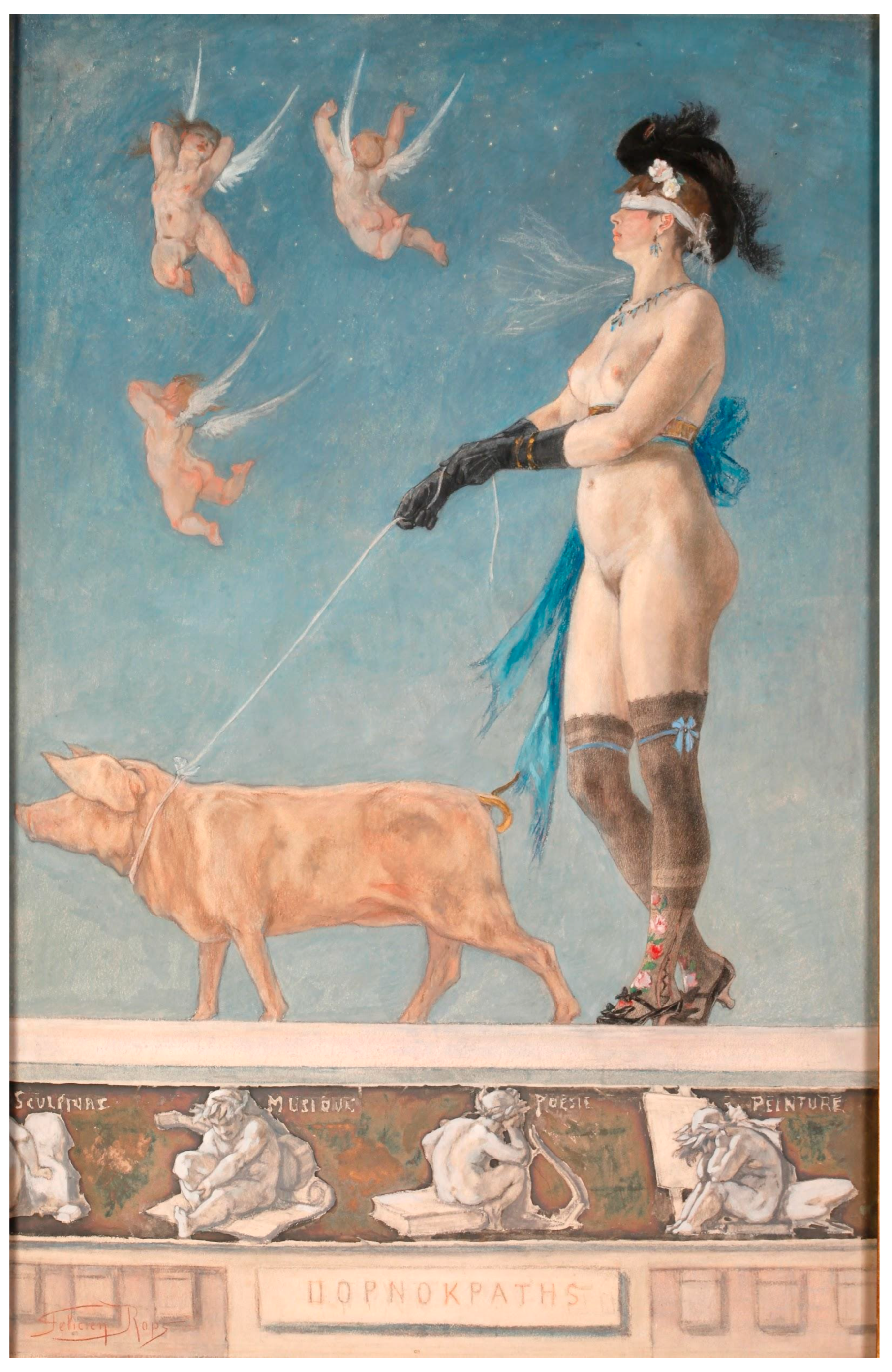
Figure 5.
New York Times, 15 March 1931, p. 140.
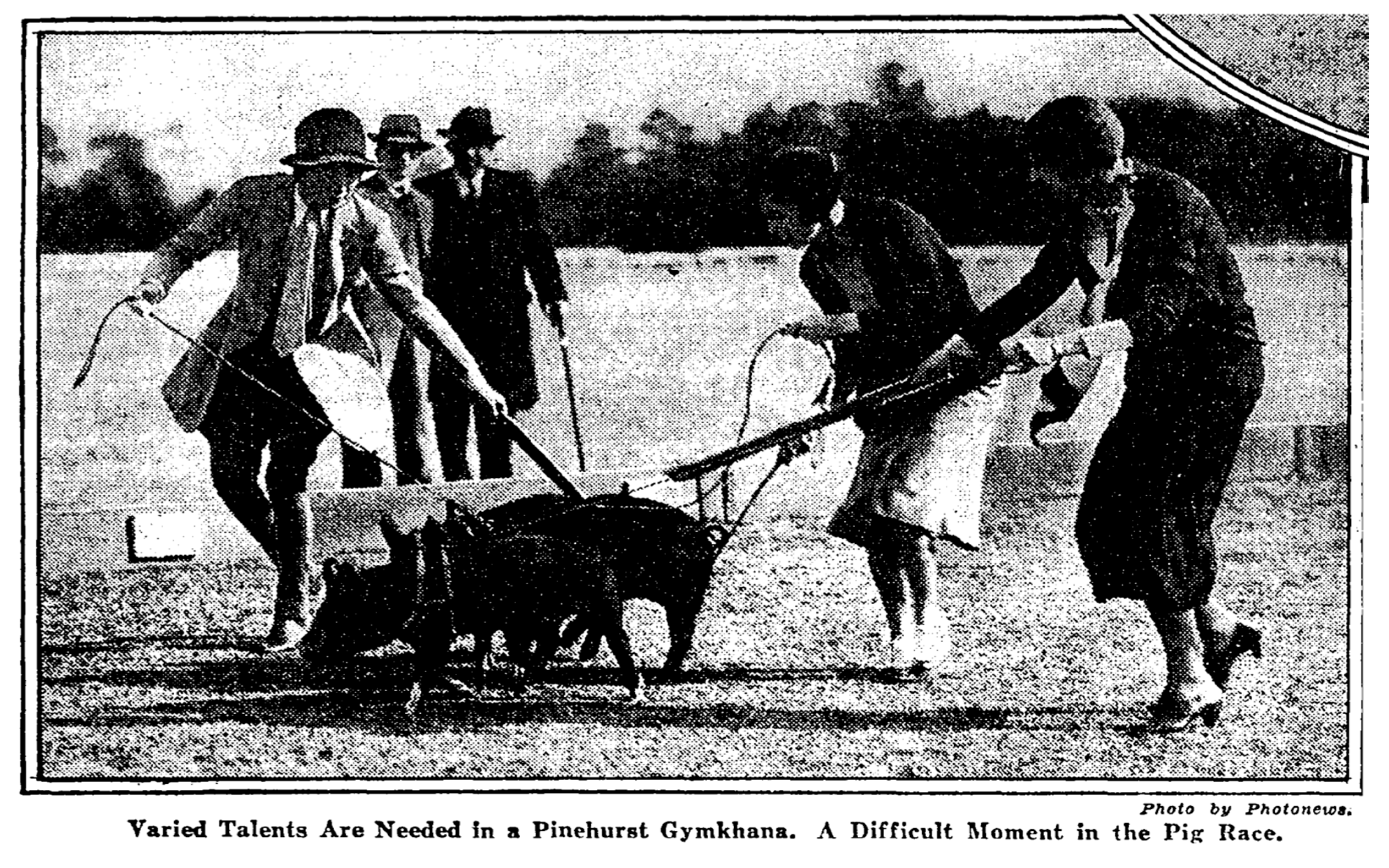
Figure 6.
New York Times, 14 January 1934, p. XX12.
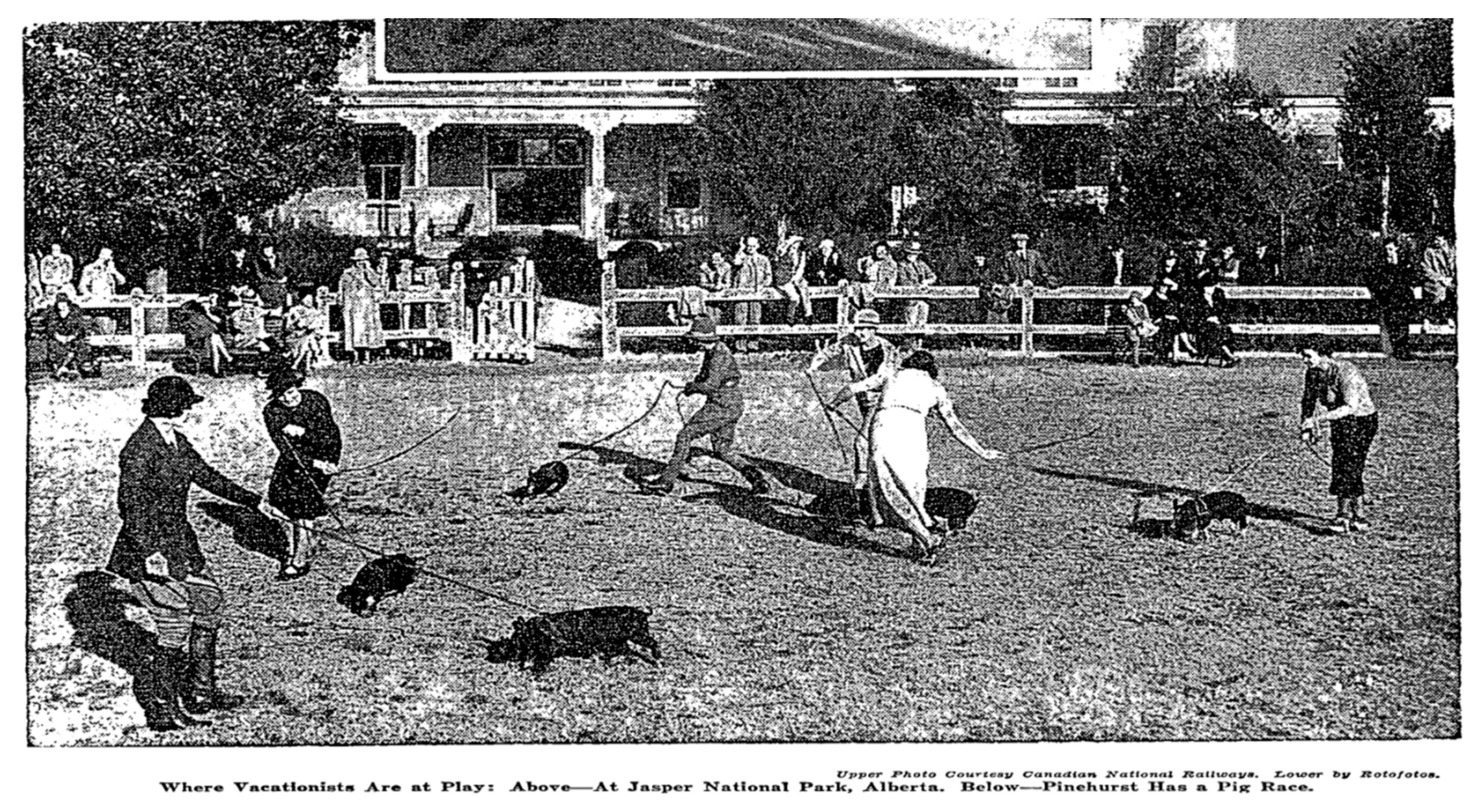
Figure 7.
New York Times, 7 February 1937, p. 175.

Figure 8.
Félicien Rops, La Tentation de Saint Antoine (1878) pastel and gouache, 73.8 × 54.3 cm, Bibliothèque royale de Belgique, Cabinet des Estampes, Brussels.
Figure 8.
Félicien Rops, La Tentation de Saint Antoine (1878) pastel and gouache, 73.8 × 54.3 cm, Bibliothèque royale de Belgique, Cabinet des Estampes, Brussels.
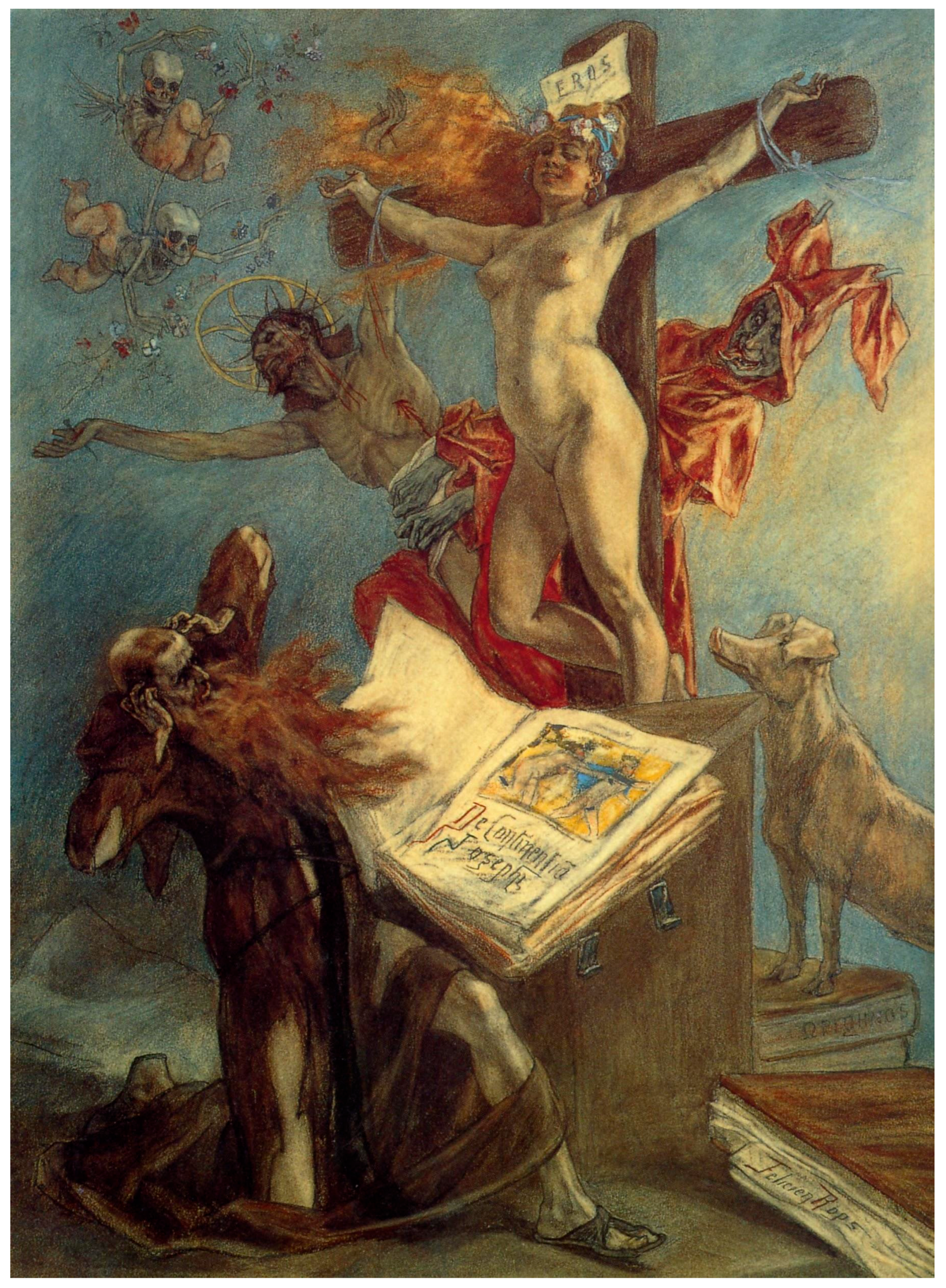
Figure 9.
Félicien Rops, Pornocrates (1896) soft-ground etching, 38.5 × 27.9 cm, Los Angeles County Museum of Art, Los Angeles.
Figure 9.
Félicien Rops, Pornocrates (1896) soft-ground etching, 38.5 × 27.9 cm, Los Angeles County Museum of Art, Los Angeles.

Figure 10.
Félicien Rops, Pornocrates (1896) héliogravure on paper, 67.5 × 44.5 cm, Musée provincial Félicien Rops, Namur.
Figure 10.
Félicien Rops, Pornocrates (1896) héliogravure on paper, 67.5 × 44.5 cm, Musée provincial Félicien Rops, Namur.
Disclaimer/Publisher’s Note: The statements, opinions and data contained in all publications are solely those of the individual author(s) and contributor(s) and not of MDPI and/or the editor(s). MDPI and/or the editor(s) disclaim responsibility for any injury to people or property resulting from any ideas, methods, instructions or products referred to in the content. |
© 2026 by the author. Licensee MDPI, Basel, Switzerland. This article is an open access article distributed under the terms and conditions of the Creative Commons Attribution (CC BY) license.
Share and Cite
MDPI and ACS Style
Aiello, T. The Pig in Pornocrates. Arts 2026, 15, 131. https://doi.org/10.3390/arts15060131
AMA Style
Aiello T. The Pig in Pornocrates. Arts. 2026; 15(6):131. https://doi.org/10.3390/arts15060131
Chicago/Turabian StyleAiello, Thomas. 2026. "The Pig in Pornocrates" Arts 15, no. 6: 131. https://doi.org/10.3390/arts15060131
APA StyleAiello, T. (2026). The Pig in Pornocrates. Arts, 15(6), 131. https://doi.org/10.3390/arts15060131
Note that from the first issue of 2016, this journal uses article numbers instead of page numbers. See further details here.