
Yarl: The Rolling Drumlins of Furness

Independent Researcher, Walney Island LA14 3DY, UK
Arts 2026, 15(6), 130; https://doi.org/10.3390/arts15060130
Submission received: 1 March 2026
/
Revised: 18 May 2026
/
Accepted: 21 May 2026
/
Published: 2 June 2026
(This article belongs to the Special Issue The Visual Arts and Environmental Regeneration in Britain)
Abstract
A micro-commission from Signal Film & Media, Barrow-in-Furness, initiated a two-year dialogue between artist/filmmaker Laurence Campbell and ecological artist David Haley. They started with the question, ‘How did such a small stream serve the development of such a large industrial town?’ Their eco-poetic, video/sonic exploration became a freshwater odyssey, discovering the blood of extinction (chalybeate-polluted water) through arterial tributaries, from deep time to 19th-century extraction to today. Their inquiry was informed by the Cumbria Archives, a local environmental conservationist, a poet and opera singer and passersby. The emergent art form revealed a complex set of ecological narratives. The project continues to raise questions about our relationships with the Nature–Climate–Culture Emergency, and the nuclear, defence, mining and water industries.
Keywords:
ecological arts; time-based arts; sonic arts; arts-led; practice-based research; ecopoetic1. Introduction
Within the quintessentially linear form of an academic journal article, it is difficult to present the process of making an artwork, or how art works. The emergent pattern and form, distinctly different from design and scientific experiment, is by its nature indeterminant. This text therefore attempts to convey how a sonic/video, eco-poetic arts-led, practice-based research project emerged (Ingold 2013).
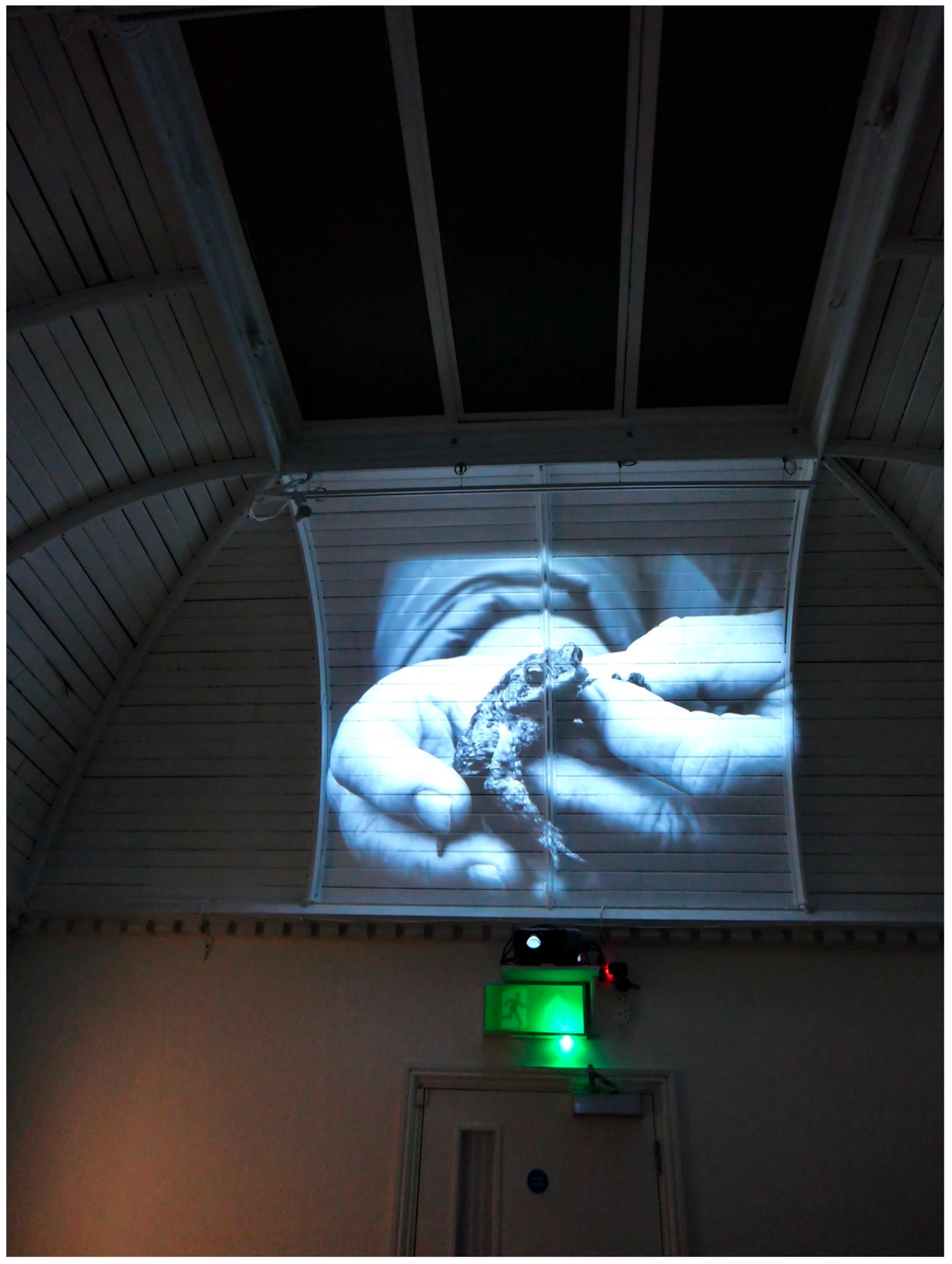
While French philosopher Edgar Morin wrote, ‘Context is everything’ (Morin 2005), the British Artist Placement Group [APG] claimed “Context is half the work” (Eleey 2007). Through this Introduction to the project’s context and narratives of place, several contextual elements are brought together that informed the making of a sonic-video, ecological arts gallery installation (Figure 1). The subject of the final installation emerged from knowing more about a particular landscape and its contexts—Barrow-in-Furness and the Furness Peninsula.
The project started with the question, ‘How did such a small stream serve the development of such a large industrial town?’ The town is Barrow-in-Furness. Its industrial development began in the mid-19th century and, through periods of boom and bust, continues. The stream is currently named Mill Beck, but has been called the Red River and Yarl. On an OS map it appears to be the main freshwater course that flows into the town. How it served and continues to serve Barrow initiated a two-year long project between ecological artist/researcher David Haley and filmmaker/artist Laurence Campbell. Their combined art forms and arts-based, practice-led research methods permitted them to explore ontological questions that most environmental science epistemologies find difficult to comprehend (Haley 2017). This text tries to articulate the story of their exploration and how it emerged as a gallery installation at the Signal Film & Media Artists Lab exhibition (December 2025–January 2026). The title of the installation, YARL: The Last Place God Made, refers to the Norse name of the once-noble river, and to a description given by ‘a trade union official visiting Barrow’ at the height of the Industrial Revolution, in the 1890s (Trescatheric 1998).
2. Project Context
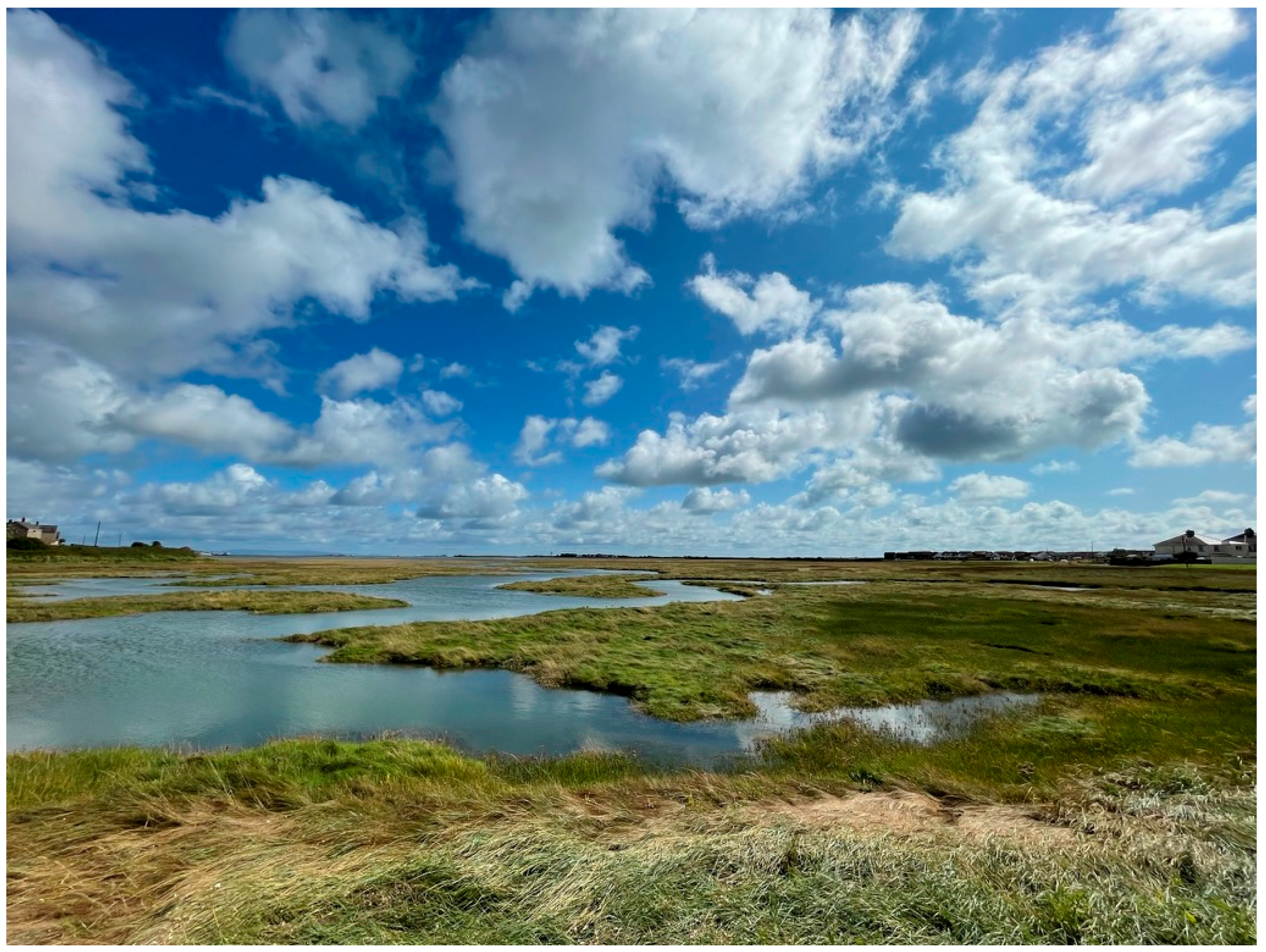
Laurence Campbell and David Haley met at a Signal Film & Media, Digital and Environmental Arts Lab in November 2022. The Lab brought 14 diverse Cumbria-based artists together for a weekend of workshops to explore the possibilities for digital arts media in environmental contexts. Following the Lab, Haley gained a micro-commission from Signal to make a video installation, EQUINOX: a day with an ocean’s edge (2023), that celebrated the ecology and tidal cycle across Tummer Hill Saltmarsh between Walney Island and Barrow-in-Furness (Figure 2). With technical support from Signal’s team, a 12 h 20 min time-lapse sequence was shot simultaneously, from either side of the saltmarsh, to capture the space between Biggar Village and Ocean Road (A590). The gallery installation then used two large screens that faced each other, creating a space between them. Haley wrote the text for the soundtrack as an 81-haiku dialogue between the saltmarsh and the Irish Sea. Haley narrated the part of the saltmarsh and contralto classical singer Jess Dandy sang the Irish Sea. In its enquiry into the future ecology of the saltmarsh, the work raised questions of the land/seascape it depicted and the means and rationale for depicting it.
Campbell and Haley met again at the second Signal Artists Lab in December 2023 and in the final session of exchanging practices, Haley was struck by Campbell’s filmic sensitivity and means of dissolving the rectangular screen through irregular masking, so he asked him to collaborate on a project. Signal later announced that they would fund Art Lab artists with micro-commissions for an exhibition in May 2025 to celebrate the reopening of their premises at Cooke’s Studios, following its major refurbishment. As time passed, the reopening was delayed and was eventually celebrated in October 2025 with a double exhibition of photographer Chris Killip’s work in nearby Askam and the Miners’ Strike of 1984–1985. The Artists Lab exhibition finally opened with the title Landscape & Protest in December 2025 and included Campbell & Haley’s installation, YARL: The Last Place God Made.
2.1. Profiles
The collaboration brought together the work of a filmmaker-artist passionate about ecology and an ecological artist/researcher passionate about filmmaking. Campbell, the filmmaker, works with many artists and arts organisations, while making his own work. Haley makes art with ecology across many media and writes on the subject. Together, they formed a creative partnership that expanded each other’s capabilities and capacity for exploration.
Their dialogue with Mill Beck became a meandering odyssey of land and water, minerals and industry, culture and politics that enabled the duo to develop a collaborative research methodology across disciplines and sectors. Central to this approach was their process of combining art forms and media as a co-learning, co-creating practice. Semi-structured interviews, archival investigation and literary searches complemented empirical field study techniques that became improvised exercises in experiential knowledge generation (Lakoff and Johnson 1980).
2.2. Narratives of Place
As David Hockney repeatedly said in his film, A Day On The Grand Canal With The Emperor of China: “The way we depict space determines what we do with it” (Hockney 1988). This perception is even more poignant when applied to placemaking. The concept of landscape originates in the Middle Dutch (16th century) painting of scenery, rendered on rectangular-shaped canvases, using rectilinear perspective to depict a large vista or the view of a natural region (Haley 2024). However, the word ‘land’ came from the earlier Norse/Proto-German, ‘landja’, which signified territorial belonging to or ownership of. The word, landscape, was first printed in English in 1603 but merged with the word, ‘landskip’, with the suffix, ‘-schaft’ or ‘-ship’, concerning the constitution, condition or shape, fashion and form [as in belonging, being and becoming, as well as to create] (Lorch 2002). The concept of landscape, then, coincides with the European colonial understanding of land to be owned and shaped to people’s needs, be that for agriculture, hunting, or aesthetic design. Landscape may therefore signify cultural identity, commodity, resource, artefact and power (Rackham 1987).
Contemporary environmental discourses are driven largely by issues of ecological degradation from species extinction to climate emergencies, and such concerns about landscape bring many strategies for its betterment, including conservation, restoration, regeneration, rewilding, wilding, nature-based solutions, natural capital, blue and green infrastructure, natural assets, and so on. In UK government and international policies, many of these initiatives focus on the economic value of land for human food security, development, the tourism industry and mineral exploitation, as expressed in the oxymoron ‘Sustainable Development’ (Haley 2008).
2.3. Questions of Heritage
By 1900, Barrow boasted many hematite mines, a large railway network, a port, a shipyard and the largest steelworks in the world, exporting across the British Empire. Most of this had been achieved within the previous 50 years by four men: James Ramsden, Henry Schneider, the 7th Duke of Devonshire and the 5th Duke of Buccleuch. Prior to 1840, the fishing village of Barrow had about 20 dwellings (Trescatheric 1992).
Heritage plays a big part in forming public perceptions of place, belonging and cultural identity, across land typologies—countryside to peri-urban to urban. Pride may be expressed in being connected to or associated with the designated UNESCO World Heritage Lake District or being Scouse (from Liverpool), Geordie (from Newcastle-upon-Tyne), or Cockney (from London). And interestingly, Signal Film & Media’s eight-year programme, the Sanky Archive, funded by the National Heritage Lottery, has done much to enhance local and national perceptions of Barrow-in-Furness. The collection of photographs, salvaged from the town’s photographers, spans the 19th and early 20th centuries, depicting everyday life and grand events, like ship launches. The extremely well-developed and utilised archive has generated a spectrum of community arts projects that have contributed to reminiscences for the older population, wonder for young people and raised questions about the future of the town.
Heritage may also be a contradiction, as the Cumbrian artist Conrad Atkinson stated, ‘much heritage freezes history’ in convenient, marketable nostalgia (Atkinson 2002), or as George Orwell put it, ‘Who controls the past controls the future. Who controls the present controls the past’ (Orwell 2000). In part, this scenario is played out in the government, local authority and BAE Systems initiative (Barrow Rising 2025). Here, the town’s mythical industrial idyl joins international defence and nuclear industrial investment to portray Barrow as a dynamic, economically booming, festival town in ‘double-speak’ (Orwell 2000).
Paradoxically, while Barrow-in-Furness is known widely for its production of nuclear submarines, poverty and deprivation, ‘it is in the top 1% nationally for landscape and nature’ (Reed 2018, RSA 2020). At the tip of the Furness Peninsula, Barrow’s stunning coastline from Morecambe Bay to the Duddon Estuary juts into the Irish Sea (Figure 2). Apart from the densely industrial urban townscape, much of the surrounding land continues to be agricultural countryside. Vestiges of 19th-century mining litter the landscape and some dramatic sites of quarrying provide post-industrial interest alongside the 12th-century Furness Abbey.
Campbell and Haley’s project attempted to disrupt heritage as nostalgia and present it as history in the context of the present, or as Sylvester (2025) reviewed for Corridor8, ‘… to unbind shared heritage and imagine it anew’ (Section S2).
2.4. Mill Beck
Looking at an OS map of the lower Furness Peninsula and Barrow-in-Furness, one small water course, Mill Beck, flows into Barrow and out to Morecambe Bay. It is formed by the confluence of Poaka Beck and Goldmire Beck, south of Dalton-in-Furness. Other tributaries seem to include the Yarl, Hagg Hill Beck, and Dane Gill Beck, but it is difficult to discern exactly how and where these other becks join. Locally, Mill Beck is also known as the Red River, as it was polluted with hematite from local mining. Coupled with the fact that, in the late 19th century, Barrow became an industrial powerhouse, this enigmatic little river prompted the question: ‘How did such a small stream serve the development of such a large industrial town?’ And so, Mill Beck became the guiding focus for an exploration of landscape becoming.
3. Practice/Method
In a previous career, Haley had produced commercial videos for conferences and industrial training programmes. The process always started with a storyboard for the client’s approval and to enable costing of the production. Although changes occurred during production, for the most part, the storyline was set and the means of production specified. Haley had also made a few video artworks that depicted specific conceptual ideas and were structurally rigorous in their shooting and editing (Haley 1996, 2007–2008, 2016, 2023). Like most of his practice across different art forms, his work focused on creating questions to find something out, rather than representing something.
Haley established walking as integral to his ecological arts practice in Manchester, with Walk on the Wild Side (2002–2017), and took this to Taipei, Guangzhou, Kowloon and Liverpool, followed by the Walkabout the City (2013–2016) programme of walks, back in Manchester (Haley 2021). Both programmes focused on revealing urban ecosystems, using a performative style of engagement with groups of walkers from different communities to encourage them to see their cities from different perspectives, questioning where and how we live with our environments.
Campbell walks a lot from his home near Ulverston, Cumbria, and wherever he happens to be. Videoing is second nature to him, often using a modified, inexpensive action camera, he constantly shoots anything and everything that catches his eye and ear. For his professional filmmaking, he uses professional equipment, but his inquisitive approach is similar.
3.1. Walking with Cameras
When they first met at the Artists Lab, Haley was taken with the ease with which Campbell just shot things while walking along a Walney Island beach, pushing the camera lens into flowers, puddles, drainpipes, close up to things. Campbell carried this way of working over into their project. Haley acquired a similar camera, but his approach was very different, videoing panoramas and letting the camera go for a walk, tracking a journey from different heights. After several shoots, they would often shoot the same things, fallen trees, fences and water, but in different ways. And when they walked with invited friends, Haley did most of the talking/shooting, while Campbell shot the event. Campbell also focused more on capturing sounds.
The videoed stories from a day’s set of encounters became a dialogue between the two and their subject matter, as Campbell edited the on-going process.
3.2. Dialogical Process
Campbell and Haley’s walks included periods of intense talking about place, politics and ‘life’, as well as long periods of silence, while they concentrated on the walk and videoing. Each day, this process became a rhythmic dialogue of in situ inquiry and storying—the making and telling of stories (Phillips and Bunda 2018), as an emergent arts-led research method.
Although the initial route for each day’s walk was agreed beforehand, the places determined their meandering and what they found on each walk. Again, this form of exploration emerged from the processes of their co-learning, co-creating and co-practice. In essence, this interdisciplinary, walking/talking was arts-led, practice-based research (Haley 2008).
3.3. Meandering Excerpts
March 2024. On the first day of shooting Haley and Campbell met at Goose Green, near The Brown Cow pub, at the confluence of Poaka Beck and Hagg Hill Beck that marks the start of Mill Beck. Haley had a new DJI Osmo4 on a pole, Campbell, a Canon SLR and Go Pro-like camera with various lenses and attachments bound with gaffer tape. At first, they were a little self-conscious, each noting with curiosity what the other found of interest to shoot—the car park, signs, benches, a memorial plaque—but they could not ignore the gushing sound of water cascading from Poaka Beck. Like dragons dancing in the frothing waterfall, the sound and image remained, in the final installation, as a defining moment. Eventually, they started to walk, making decisions about which side of Mill Beck had the best path.
Their meander took them through farm gates, hilly sheep-filled fields and past paddocks of lone ponies. Campbell, being younger and more agile, had a waterproofed camera that he dipped into the fast-flowing water. Haley panned the landscape, aware of the play between the beck and the Furness Railway line. After an hour or so Haley noted that they had neither heard nor seen a train. Campbell said, ‘Didn’t you know, there was a train derailment at Grange this morning?’ The silence of the line had its own presence.
Arriving at the confluence with Goldmire Beck, Campbell recorded a squeaky iron gate, playing with the different noises he could generate from this random instrument. Haley focused on close-ups of foliage that wrapped itself around a footbridge. At times Haley let his camera lead the walk along the ground, at head height and above, passing around and through vegetation. Looking turned to seeing and hearing to listening. Walking back to the point of departure, they commented on seeing things from the other direction. They talked a lot more over lunch and a pint at the Brown Cow.
The following week, their walk continued from where they had stopped. Mill Beck took them from scenic rural idyll, through peri-urban estates and on to the Red River Club near Yarlside. The following week, they set off from the Red River Club to Roose. Each shoot took one full day a week.
Passing through Salthouse Mills, a car-breaker’s yard and ponies in an urban field, the beck disappears around a bend of a housing estate and underground, spilling out into Cavendish Dock. Despite fatigue from the heat, they were overwhelmed from encountering so many social, industrial and natural phenomena.
They named the remains of Salthouse Mills ‘The Zone’, likening the area to that in the film Stalker (Tarkovsky 1979). Beyond the Zone, the Council-designated ‘Green Area’ conceals large water pipes that lead to and from a United Utilities water processing plant, at the site of what was a gas-fired power station by Cavendish Dock.
Another day, they met on the other side of the vast expanse of Cavendish Dock, by The Royal Port of Barrow, where joggers and dogwalkers pass by the Pacific Egret and the Pacific Heron as they offload their cargoes of nuclear waste to trains that deliver it up the coast to Sellafield.
Reflecting on their walks, they puzzled over the many small becks that spring from their source and disappear. Dane Ghill Beck, which passes Furness General Hospital and disappears near Furness Abbey, maybe into Mill Beck, underground? Hagg Hill Beck, which rises at Park Farm, encircles Dalton and joins Poaka Beck at Goose Green. Yarl Well, from someone’s back garden, runs around Dalton Cricket Club, joins Poaka Beck near Beckside Road and disappears somewhere underground, near Goose Green.
The number of confluences (Poaka Beck, Hagg Hill Beck, Yarl Beck, Goldmire Beck) at and near Dalton started to make sense given the town’s Neolithic status as the capital of Furness. Not only were the confluences a significant source of water for fish and providing fast-flowing water for the later Mediaeval mill, they brought spiritual energy too.
It was noted that many of the local villages (now suburbs of Barrow) take their names from Celtic, Old Norse or Anglo-Saxon words for rivers and streams: Yarlside, being a hill by the River Yarl; Gleaston, a farmstead by a stream; Ormsgill, or river of pigs; Roosebeck, a moorland stream; and Hindpool, the place where female deer drank, above a large aquifer. This was used by the iron works and Barrow Hematite Steel Company to drive the industrial development of the town in the 19th century and continues to be used by Kimberly Clark’s paper mill and other industries.
3.4. Walking-Talking-Shooting
An important aspect of the way this project developed was how walking the beck allowed the two to ‘play’. Childlike creativity is all too often lost in the sophistication of making art with maturity, but being released from such responsibility, having permission to play, even in the presence of an occasional dog walker, rekindled the duo’s wonder and excitement in Nature.
There is no substitute for the lived experience, but walking with, viewing with and through a camera can provide different perspectives, different approaches, different ways of seeing and thinking about place and our presence in it. While the shooting process provided purpose, meandering with Mill Beck offered random glimpses of terrain: another kind of relation to and with the world we encounter. Doing this as a duo, in tandem, provided the space for dialogue to emerge as the project’s own language (Bohm et al. 1991; Ingold 2013).
4. Meetings with Remarkable People: A Brief Collection of Anecdotes
Their inquiry was informed by the Cumbria Archives, a local environmental conservationist, a poet, a curator, an opera singer, a secret sculptor and a passersby, so the dialogue expanded in complexity to include many perspectives of the small watercourse (Bohm et al. 1991). Here are a few anecdotes that shaped the project.
4.1. Phil Northcott—Curator, Signal Film & Media
Phil Northcott guided Haley and Campbell to Bow Bridge, across hills of abandoned mineshaft ponds that followed the path of Mill Beck and railway. Clambering over barbed-wire fences, avoiding curious cattle, Phil related his childhood adventures with friends engaged in daring death-defying acts. Between the Vale of Nightshade and Mill Wood, Phil showed them the site of the underground nuclear bunker that was constructed during the Cold War for the directors and essential personnel of the shipyard.
4.2. Jess Dandy—Classical Contralto/Artist—And Amy Stretch-Parker—Artist, Ecologist, Musician and Poet
Another day, contralto Jess Dandy and artist Amy Stretch-Parker walked with Campbell and Haley from Goose Green to Mill Wood and then to the Zone. Walking and talking at a pace, they too related stories of growing up locally and how changes had occurred, like expelling travellers from their site at Roose to build a small Tesco for the new housing estate that accompanied the Yard’s Trident nuclear submarine programme in the 1980s.
At the Zone, the four played with scrap iron for sound effects and Amy recited her poem about playing in the blood-red mud. Meeting Jess some time before the walk, Haley asked if she could ‘sing a landscape’. She recounted a recent visit to a park in Tokyo, where she had done just that. He had therefore hoped that she would sing on the walk; however, the following day, Jess sent a recording of her reflection in song. Jess’s recording and Amy’s poem feature on the final soundtrack.
4.3. Pete Burton—Environmental Conservationist, Warden and Potholer
Initially, Haley and Campbell met with conservationist and retired Natural England warden Pete Burton at Barrow Library, as Haley knew he had expert ecological knowledge of the area. The hour-long meeting stretched to three hours, as Pete relayed a saga of Furness natural and industrial history, intertwined with his life. The three met again at Furness Abbey and walked to Goose Green.
Pete reminisced about his childhood, miners he had met and the way extraction shaped the land and the people who lived with it. On the crest of a hill, by the railway and Mill Beck, Pete stopped to scan the landscape, connecting the waters, the mines, the port, shipyard, past and present industries. He then sang, “For I am just a country boy, money have I none, but I have silver in the stars and gold in the morning sun”. They proceeded through bright yellow gorse bushes, as Pete continued telling his tales. He then bobbed down and back up with a toad in his hand. He talked to the toad while they videoed it, and gently popped it back on the ground. Pete’s tales continued…
Pete answered the original question, “How did such a small stream serve the large industrial development of Barrow?” As a potholer and caver, Pete had explored subterranean Furness and discovered many of the mine works that interconnected with underground streams. Much of Furness is geologically a ‘karst’ landscape, that is, limestone riddled with holes and chambers from millennia of water erosion, so small becks spring up and disappear down sinkholes. Many of them connect underground and form aquifers of pure freshwater, one of which sits under the former steelworks. They also asked Pete about connections between Yarl Well at Dalton and Yarlside near Roose, and he, like us, speculated that the valley through which Mill Beck now runs was once the River Yarl, a much larger water course—the word Yarl being Norse for great and princely.
Having briefly studied the local geology in books and maps, it was Pete’s explanation that clarified their perception and understanding of the Furness landscape and its aquatic systems. It also changed the choreography of their envisaged installation from a meandering linear path of a river channel to multi-directional pop-ups (indeterminate patterns). Campbell and Haley then explored other small becks that are potentially part of the remaining Yarl river system. This shift in perception offered a potentially rich understanding of geomorphic complexity beyond representing a landscape vista. In other words, learning of the relationships between limestone, formed in the Mesozoic Era about 252 million years ago from the extinction of marine crustacea and hematite, or ‘blood stone’ formed in the volcanic Permian-Triassic extinction event 200–250 million years ago brought the current ‘Sixth Extinction’ into geological perspective.
4.4. Susan Benson, Archivist, Barrow Archive
Barrow Archives provided a different kind of exploration, with an overwhelming treasure trove of 19th-century documents that mapped mineral extraction with water management, railways and industrial development. These included deeds, maps, surveys and permissions to mine, sold by the dukes of Devonshire and Buccleuch to mining companies ‘in return for royalties on each ton of iron ore raised from those mines situated on their land’ (Trescatheric 1998). Random photographs of 1970s workmen and plans for the Poaka Beck Reservoir accompanied dozens of maps and plans for short railways to a myriad of mines and quarries.
Susan listened quietly to the enthused duo, offering associated books and means of tackling the vast amount of material. Campbell used his DIY miniature camera to get really close to the maps and documents, as another journey across the depictions of place and time.
5. Media: Pattern–Form
5.1. Sound-Led Editing
Technically, Campbell did all the sound and video editing, sending Haley cut after cut that Haley returned with notes and suggestions, and they met in various cafes to talk for hours about life, politics and how to progress to the next sequence. From his vast filmic knowledge, Campbell was keen to let the soundtrack lead the editing process. This interconnection between senses, in this case sound and sight, deeply influenced the visual editing, and enhanced the storying of place. William Basinski’s Disintegration Loops (Basinski 2002) played an important part in setting the initial mood, as did much of the music they experienced at Barrow’s internationally acclaimed experimental and electronic music venue, Full of Noises.
While walking, they had accumulated a vast trove of sound effects and spoken narratives. Campbell played with random analogue objects to collect sounds of place, like the squeaky iron gate, scraping lumps of building debris, or running a stick along railings.
One day, re-walking the stretch from Goose Green to focus on sound, Campbell carried a small, broken harmonium. Under the bridge near the confluence with Poaka and Goldmire Becks, he laid down the instrument, set up the recording equipment and started to play the gasping tones of this dying instrument. Haley then had a go; learning which notes did and did not work, he pounded out an improvised rhythm that produced the drone they had been seeking for the soundtrack.
Pete Burton’s enthusiastic monologue of recent landscape history gave way to his rendition of “I’m Just A Country Boy”, adding a touch of sweet sadness to the crazed industrial exploits of bygone years.
After several months, the trains returned to the familiar timetable of arrivals and departures. This permitted videoing Mill Beck from the train’s perspective, and the onboard customer announcements contextualised the reason for the railway line’s existence—the list of Northwest coastal destinations maps the seams of hematite and coal mining of industry and Empire.
The final sequence closes with Jess Dandy’s soaring voice carrying the viewer away from industrial grime, as a leaf glides across the surface of a puddle, into a sublime catatonic state of nuclear reality, viewed across Cavendish Dock. Water cascades from the dock and a plaintive oystercatcher is heard across a bleak vista of Morecambe Bay.
The video/sonic sequences were edited down to seven short films, totaling 43 min. Haley and Campbell referred to these as ‘symphonic movements’ or ‘book chapters’, each depicting a section of what formed the Yarl from its sources to the sea, and each providing a choreographed sequence within the gallery space.
5.2. Poetics of Place
When French philosopher Gaston Bachelard wrote The Poetics of Space, he applied concepts of phenomenology to architecture as a discourse on experiencing constructed places in the context of Nature (Bachelard 1994). Integral to Haley’s practice since the late 1990s, he gathered note-sketches that he crafted into poetic texts. Late on in the video editing process, the idea for three A2 watercolour poems emerged from the three names of the watercourse: Red River, Mill Beck and YARL (Figure 3, Section S1). Locally excavated mineral pigments were used to render the poems. These were placed on the wall outside the installation, as a poetic visual-text prelude to the main work.
5.3. Installation Space
From walking, the dialogue shifted in editing to a different pattern of working. Although they knew that in some months’ time, their work was due to be exhibited in an exhibition at Signal Film & Media’s Cookes Studios, neither the date nor gallery space was certain. However, after about a year of video and soundscape walking, they agreed on setting some editing parameters, and after much discussion they aimed for a 30 min piece to be screened in the Smoke Room (approx. 6 m square by 4 m high), on the First Floor of the gallery.
One of the ideas they constantly reviewed was how to break away from the rectangular hegemony of the screen that dominates most film, video and media production, and continues to constrain people’s perceptions of the world through mobile phone addiction. This form of ‘screening’ tends to turn viewers into passive audiences, rather than engaged participants. Campbell’s use of lens masking and image manipulation in editing went some way to address this issue, but Haley kept referring to two highly impactful artworks that for him were emancipatory in this sense. They were Bill Viola’s Five Angels for the Millennium, at Tate Modern (Viola 2001), and Isaac Julien’s Ten Thousand Waves, at the Haywood (Julien 2010). Aside from the cinematic poetry of each work, they had in common the ability to choreograph the viewers within the gallery space. In other words, audiences were no longer physically passive. Their screening methods took gallery visitors on a journey beyond promenading to experience the unique environments of each installation. This participant activity promotes an extra level of physical and cognitive engagement with the artwork, thereby expanding the experience and relationship with the subject matter.
Between budgets, schedule uncertainty and equipment restraints, the two decided to project, onto the four walls of their hoped-for space, six 5 min sequences of their journey from the sources of Poaka Beck and Yarl Well to their confluence of Mill Beck and the journey of Mill Beck to Barrow and onto Morecambe Bay. Through the process of editing, the work became 7 sequences that last 43 min in total. However, this description of the editing process does not capture what became a year-long pattern of exchange. During brief visits to the proposed installation space, Haley gestured and notated the potential pattern of projections to be screened. For each sequence, Campbell then produced a rough-cut soundtrack and edited visual material of the journey between places to the sound. They exchanged email notes on further refinements and met in an adopted café to talk about that week’s cut.
They desperately wanted time in the Smoke Room to project, listen and edit in situ, but Signal’s reopening programming of Chris Killip’s photography and Miners’ Strike exhibition precluded this. However, they did manage a two-week get-in period before the Lab exhibition opening and this determined their final installation decisions.
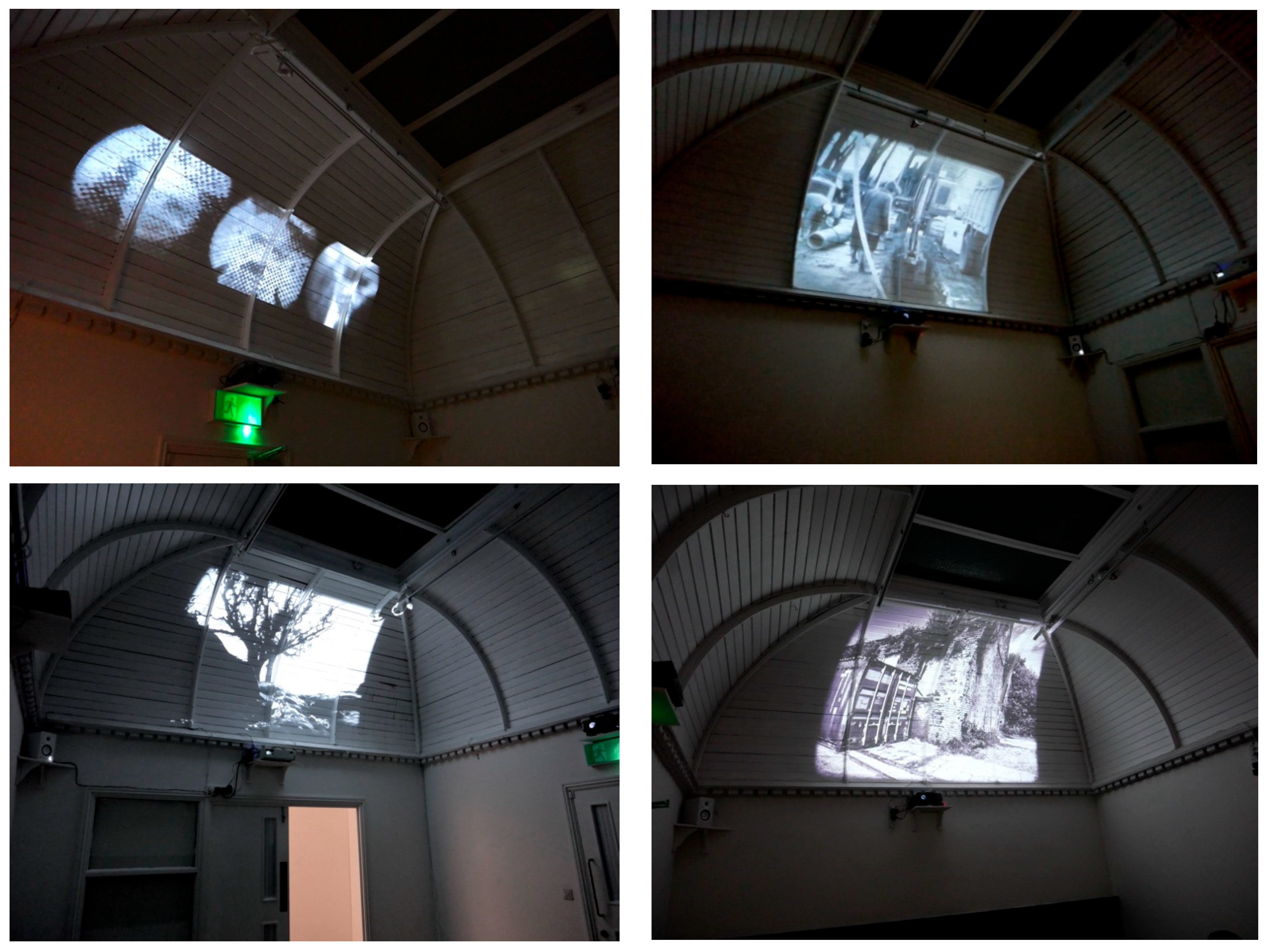
In the Smoke Room (Figure 4), the space began to talk to the work and it became obvious to project onto the four concave sides of the ceiling. This provided a shift from audience expectation and the surfaces of white wooden slats teased with the projected images. Each sequence being projected onto alternate sides of the room, this depicted the river’s meander from place to place, but not as a flowing stream, more like the random rhythm of the becks within the karst landscape. The centre of the room then became a place to animate audiences physically (back–forth–around) and perceptually, generating energy in the space itself.
6. Conclusions
6.1. Funding Applications
During the period of production, Haley initiated two funding applications to extend the work. Neither were successful, but the process of writing and collaborating on the proposals brought additional insights to the subject of the watercourse and how to experience it as an artwork.
The first application was to the COAL Prize in April 2025, entitled CHALYBEATE: BLOOD OF EXTINCTION. It featured the presence of hematite in freshwater, a mineral dating back to the Precambrian and Permian-Triassic Extinction Events that turned the waters of Mill Beck into the Red River. The same mineral makes our blood red.
The second application, YARL: over time land flows, in September 2025, was to IMMERSIVE ARTS to gain experience in Immersive Arts technologies, but they decided that they were seeking a different aesthetic from what they had seen as ‘Immersive’. They were far more interested in what Campbell termed a ‘dirty aesthetic’, one that was concerned with experience rather than immersion; a phenomenological or psychogeographical expression, choreographed with agency, rather than passively absorbing the artwork or entering a gaming environment.
6.2. Title
The title of the work had been The Lie of the Land (Shrubsole 2024), but a book of that name was published in 2024. Although the book provides an excellent critique of power and exploitation of the British countryside, they did not want to clash with it. How the Land Lies was another, albeit weaker, option. Chalybeate: Blood of Extinction was a strong contender, but required the word ‘chalybeate’ to be explained to the general public. Finally, the title, YARL: The Last Place God Made, resonated with Bryn Trescatheric’s book and the original Norse name of the river (Trescatheric 1998). This article uses ‘The Rolling Drumlins of Furness’, a term used by Pete Burton to describe the undulating hills of the Furness Peninsular and a refocusing on the geology.
The title of Signal’s exhibition became Landscape & Protest about two months before the opening and this resonated well with the artwork. Although there are no agitprop or overt political statements within the installation, the work lets Mill Beck depict the beautiful dystopia of Barrow from its 19th-century inception to the present day. Archived documents revealed callous profiting from the sale of leases to mine and quarry the land into ‘permanent destruction’; the control of waters for blind development; great feats of engineering applied and discarded to further enrich the wealthy; the reimagined and manipulated industrialised landscape. And the disregard by the nobility for people as mere human resources.
6.3. A Nexus of Crises
Seagulls now perch on the statue heads of Ramsden, Schneider and Cavendish (Devonshire). Echoes of ‘Boom Town Barrow’ (Trescatheric 1992) from the VSEL Trident submarine programme remain in the suburban dreams of 1980s housing estates that abut Mill Beck at Roose. The remains of billboards on brownfield sites await new defence investment, seen today in the realisation of Marina Village to house the next generation of yard workers on the AUKUS nuclear submarine programme (Johnson 2021). As Barrow rises once more to the tune of a nuclear arms race (Barrow Rising 2025), the waters reflect potential apocalypse. Meanwhile, the Yarl, the myriad of becks and subterranean waters flow through the mineral memory of deep time extinctions, towards Morecambe Bay and the warming of the Irish Sea and Atlantic Ocean. The nuclear and defence industries may finally be seen in the context and geologic timescale of the Nature-Climate-Culture Emergency. Art may help us to think differently.
Supplementary Materials
The following supporting information can be downloaded at: https://www.mdpi.com/article/10.3390/arts15060130/s1, Section S1: Three poetic texts by David Haley Mill Beck, Red River, Yarl,; Section S2: Excerpt from Landscape & Protest: Signal Artist Lab Review by Simon Sylvester for Corridor8.
Funding
Funding for this project was received from Signal Film and Media.
Institutional Review Board Statement
Not applicable.
Informed Consent Statement
Not applicable.
Data Availability Statement
The original contributions presented in this study are included in the article/Supplementary Materials. Further inquiries can be directed to the author.
Conflicts of Interest
The author declares no conflict of interest.
References
- Atkinson, Conrad. 2002. Lecture. Manchester: Manchester Metropolitan University. [Google Scholar]
- Bachelard, Gaston. 1994. The Poetics of Space. Boston: Beacon Press. [Google Scholar]
- Barrow Rising. 2025. Available online: https://barrowrising.uk/ (accessed on 25 February 2026).
- Basinski, William. 2002. 2002 Disintegration Loops. Available online: https://www.youtube.com/watch?v=-p_-yICwrM0 (accessed on 26 February 2026).
- Bohm, David, Donald Factor, and Peter Garrett. 1991. Dialogue, A Proposal. Available online: http://www.david-bohm.net/dialogue/dialogue_proposal.html (accessed on 23 February 2018).
- Eleey, Peter. 2007. Context Is Half the Work. London: Frieze, Issue 111, November–December. Available online: https://www.frieze.com/article/context-half-work#:~:text=Context%20is%20Half%20the%20Work&text=In%201966%2C%20the%20Artist%20Placement,Did%20the%20strategy%20bear%20fruit%3F (accessed on 20 May 2026).
- Haley, David. 1996. Gongoozaling. VHS. 1996 MA Graduate Show. Manchester: Manchester Metropolitan University. [Google Scholar]
- Haley, David. 2007–2008. A Walk on the Wild Side (WILD WALKS. 1, 2 & 3). Three Six-Minute Videos of Urban Wildlife Walks in Manchester. Mixed Show, Coast Guard, 2007 Taipei Artists Village, Taiwan. MIRIAD China Project 2007–Beijing, Xiamen, Guangzou. Santa Rosa: ECOCENTRIC Video Lounge, Sonoma County Museum. [Google Scholar]
- Haley, David. 2008. The Limits of Sustainability: The Art of Ecology. In Sustainability: A New Frontier for the Arts and Cultures. Edited by Sacha Kagan and Volker Kirchberg. Frankfurt: VAS-Verlag. [Google Scholar]
- Haley, David. 2016. NON-EQUILIBRIUM: Ecology of Time. 8 min Video Artwork Featuring Grandmaster Liming Yue; Camera & Production, Huw Whahl; Sound, Simon Connor. First Screened at Feeding the Insatiable Symposium, Dartington Hall. Curated by Richard Povall, eartdotart. [Google Scholar]
- Haley, David. 2017. ‘Undisciplinarity’ and the Paradox of Education for Sustainable Development. In Handbook of Sustainable Science and Research. Edited by Walter Leal Filho. Series, Climate Change Management. Berlin/Heidelberg: Springer. [Google Scholar]
- Haley, David. 2021. A Walk on the Wild Side: Steps towards an ecological arts pedagogy. International Journal of Education Through Art 17: 13–552. Available online: https://www.researchgate.net/publication/350618176_A_Walk_on_the_Wild_Side_Steps_towards_an_ecological_arts_pedagogy (accessed on 20 May 2026). [CrossRef]
- Haley, David. 2023. EQUINOX: A Day with an Ocean’s Edge. Micro Commission for Signal Film & Media, in TIDAL Exhibition. Available online: https://vimeo.com/886815617/6cd2ec49c1?share=copy (accessed on 20 May 2026).
- Haley, David. 2024. From “white man’s science” to a ‘Brave Space’: The art of decolonising landscape from environmental science. Landscape Research Journal. Available online: https://www.tandfonline.com/eprint/XVIGDT7IXTV8IJVJ9M3G/full?target=10.1080/01426397.2024.2413004 (accessed on 20 May 2026).
- Hockney, David. 1988. Day on the Grand Canal with the Emperor of China. Directed by Phillip Haas. Harrington Park: Milestone Films. Available online: https://milestonefilms.com/products/day-on-the-grand-canal-with-the-emperor-of-chinga (accessed on 30 January 2023).
- Ingold, Tim. 2013. Making: Anthropology, Archaeology, Art and Architecture. London: Routledge. [Google Scholar]
- Johnson, Boris. 2021. Available online: https://www.gov.uk/government/speeches/pm-statement-on-aukus-partnership-15-september-2021 (accessed on 20 May 2026).
- Julien, Isaac. 2010. Haywood Gallery, London. Available online: https://elephant.art/soul-stirring-ten-thousand-waves-makes-poetry-film/ (accessed on 20 May 2026).
- Lakoff, George, and Mark Johnson. 1980. Metaphors We Live by. Chicago: University of Chicago Press. [Google Scholar]
- Lorch, Benjamine. 2002. Theories of Media. Available online: https://csmt.uchicago.edu/glossary2004/landscape.htm (accessed on 28 September 2022).
- Morin, Edgar. 2005. Restricted Complexity, General Complexity. [Book Chapter] Philpapers. Available online: http://philpapers.org/rec/MORRCG (accessed on 20 May 2026).
- Orwell, George. 2000. Nineteen Eighty Four. London: Penguin Modern Classics. [Google Scholar]
- Phillips, Loiuse Gwenneth, and Tracey Bunda. 2018. Research Through, with and as Storying. Abingdon: Routledge. [Google Scholar]
- Rackham, Oliver. 1987. The History of the Countryside: The Classic History of Britain’s Landscape, Flora and Fauna. London: Weidenfeld & Nicolson. [Google Scholar]
- Reed, Robert. 2018. Cumbria with the RSA’s Food, Farming and Countryside Commission. Available online: https://www.ateamfoundation.org/blog-1/2018/8/14/cumbria-with-the-rsas-food-farming-and-countryside-commission (accessed on 20 May 2026).
- Shrubsole, Guy. 2024. The Lie of the Land: Who Really Cares for the Countryside? London: Willima Collins. [Google Scholar]
- Sylvester, Simon. 2025. Landscape & Protest: Signal Artist Lab. Corridor8. December 17. Available online: https://corridor8.co.uk/article/landscape-protest-signal-artist-lab/ (accessed on 20 May 2026).
- Tarkovsky, Andrei. 1979. Stalker. Available online: https://www.google.com/search?gs_ssp=eJzj4tTP1TcwLDS0rDRg9BIsSSzKzi8rzq5UKC5JzMlOLQIAjSAKJA&q=tarkovsky+stalker&rlz=1C5CHFA_enGB836GB837&oq=tarkovsky&gs_lcrp=EgZjaHJvbWUqBwgDEC4YgAQyBwgAEAAYjwIyCggBEC4YsQMYgAQyBwgCEAAYgAQyBwgDEC4YgAQyBwgEEC4YgAQyBwgFEC4YgAQyBwgGEC4YgAQyBwgHEC4YgAQyBwgIEC4YgAQyBwgJEC4YgATSAQoxNTM1NGowajE1qAIIsAIB8QW3WAvUKl2gp_EFt1gL1CpdoKc&sourceid=chrome&ie=UTF-8#fpstate=ive&vld=cid:9146e58a,vid:Q3hBLv-HLEc,st:0 (accessed on 20 May 2026).
- Trescatheric, Bryn. 1992. Building Barrow: From Fisher’s Farm to Maggi’s Farm. Barrow-in-Furness: Trescatheric. [Google Scholar]
- Trescatheric, Bryn. 1998. The Last Place God Made: A History of Victorian Barrow. Barrow-in-Furness: Trescatheric. [Google Scholar]
- Viola, Bill. 2001. Fie Angels for the Millennium. London: Tate Modern. Available online: https://www.tate.org.uk/art/artworks/viola-five-angels-for-the-millennium-t11805 (accessed on 20 May 2026).
Figure 1.
YARL: The Last Place God Made, installation. Signal Film & Media, Smoke Room, Cooke’s Studios, Barrow-in-Furness 2025. Photo: D. Haley.
Figure 1.
YARL: The Last Place God Made, installation. Signal Film & Media, Smoke Room, Cooke’s Studios, Barrow-in-Furness 2025. Photo: D. Haley.

Figure 2.
Tummerhill Saltmarsh, Walney Channel, Barrow-in-Furness. Photo D. Haley 2024.

Figure 3.
Three poetic texts, Red River, Yarl, Mill Beck; watercolour on A2 paper. Section S1. Photo: D. Haley.
Figure 3.
Three poetic texts, Red River, Yarl, Mill Beck; watercolour on A2 paper. Section S1. Photo: D. Haley.
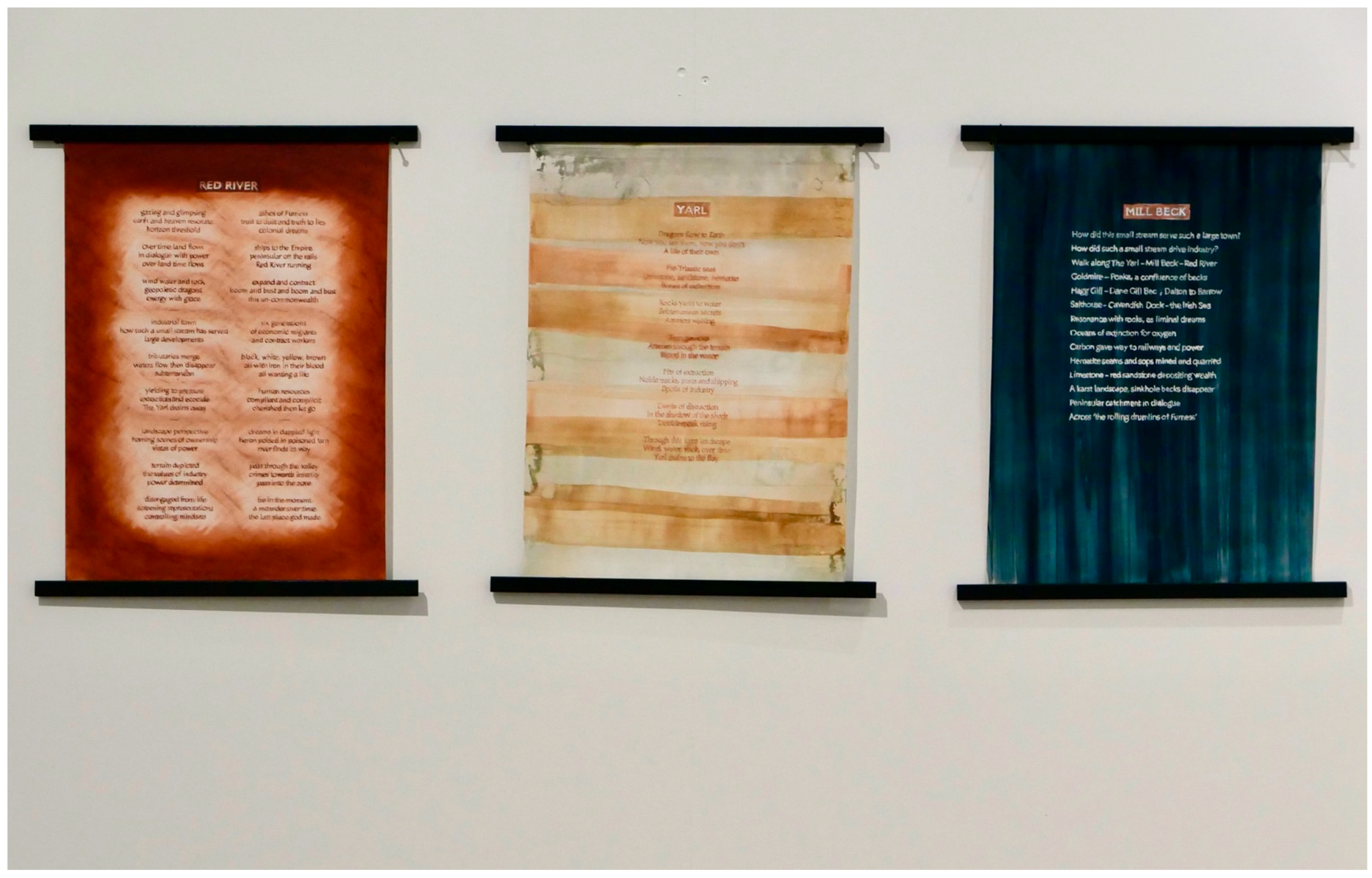
Figure 4.
YARL: The Last Place God Made, installation. Signal Film & Media, Smoke Room, Cooke’s Studios, Barrow-in-Furness 2025. Photo: D. Haley.
Figure 4.
YARL: The Last Place God Made, installation. Signal Film & Media, Smoke Room, Cooke’s Studios, Barrow-in-Furness 2025. Photo: D. Haley.

Disclaimer/Publisher’s Note: The statements, opinions and data contained in all publications are solely those of the individual author(s) and contributor(s) and not of MDPI and/or the editor(s). MDPI and/or the editor(s) disclaim responsibility for any injury to people or property resulting from any ideas, methods, instructions or products referred to in the content. |
© 2026 by the author. Licensee MDPI, Basel, Switzerland. This article is an open access article distributed under the terms and conditions of the Creative Commons Attribution (CC BY) license.
Share and Cite
MDPI and ACS Style
Haley, D. Yarl: The Rolling Drumlins of Furness. Arts 2026, 15, 130. https://doi.org/10.3390/arts15060130
AMA Style
Haley D. Yarl: The Rolling Drumlins of Furness. Arts. 2026; 15(6):130. https://doi.org/10.3390/arts15060130
Chicago/Turabian StyleHaley, David. 2026. "Yarl: The Rolling Drumlins of Furness" Arts 15, no. 6: 130. https://doi.org/10.3390/arts15060130
APA StyleHaley, D. (2026). Yarl: The Rolling Drumlins of Furness. Arts, 15(6), 130. https://doi.org/10.3390/arts15060130
Note that from the first issue of 2016, this journal uses article numbers instead of page numbers. See further details here.