The Policy Shift from Energy to Carbon Dual-Control Targets in Building Energy Efficiency: A Textual Analysis of Tianjin’s Policies over Three Decades Through the Lens of Policy Instruments
Abstract
1. Introduction
2. Literature Review
2.1. Policy Instrument Theory and Overview of International Research Methods
2.2. Policy Instrument Combinations and Synergistic Effects
2.3. Chinese National and Local Case Studies
2.4. Research Gaps
3. Methodology
3.1. Theoretical Foundation and Analytical Framework
3.2. Case Selection
3.3. Research Subjects and Text Selection
3.4. Stage Division
3.5. Coding Process and Reliability Testing
3.6. Research Methodology
3.6.1. Content Analysis Method
3.6.2. Social Network Analysis
- (1)
- Definition of co-occurrence relationship: If two policy instruments appear anywhere within the same policy document (including the main text, clauses, and appendices), they are considered to have one co-occurrence. This study adopts “the same document” as the criterion for co-occurrence, rather than “the same paragraph,” to avoid artificial discontinuities caused by differences in text structure.
- (2)
- Matrix construction and network transformation: First, for each phase, a two-mode “policy document–policy instrument” matrix is constructed, where rows represent policy documents and columns represent the 17 specific policy instruments. The matrix elements indicate whether a given instrument is used in a given policy document (1 for used, 0 for not used). Subsequently, this two-mode matrix is converted into a one-mode “policy instrument–policy instrument” co-occurrence matrix using UCINET 6 software [37]. The elements of this matrix represent the number of times any two instruments co-occur within the same policy document.
- (3)
- Node size and connection strength: In the network graph, the size of a node is measured by its degree centrality. Degree centrality refers to the number of other nodes directly connected to a given node [38], and its calculation formula is:where indicates whether node and node are connected, and is the total number of nodes in the network. A higher degree centrality indicates that the instrument occupies a more core position in the network and has a higher degree of synergy with other instruments. The connection strength is determined by the co-occurrence frequency between two instruments, i.e., the value of the element in the co-occurrence matrix. The higher the frequency, the thicker the connecting line, reflecting that the two types of instruments tend to be used in combination in policy practice.
- (4)
- Network indicator calculation: This study also calculates the density and network centralization of the network. Density reflects the closeness of connections among nodes in the network; network centralization measures the extent to which the entire network is concentrated around core nodes. A higher value indicates a more centralized network structure [39].
3.6.3. The Definition Rules of Carbon Emission Reduction Policies
- (1)
- Explicit mention of carbon reduction goals: The provision explicitly includes keywords such as “carbon reduction,” “carbon dioxide emission reduction,” “carbon emission reduction,” or “carbon reduction,” and takes reducing carbon emissions as its direct objective.
- (2)
- Direct constraint on carbon emission sources: The provision directly imposes binding requirements on fossil energy consumption, industrial process emissions, or carbon emissions from building operations, such as “control carbon emission intensity during the building operation stage” or “restrict the use of high-carbon building materials.”
- (3)
- Incentivizing carbon reduction behaviors: The provision directly incentivizes market entities to implement carbon reduction behaviors through fiscal subsidies, tax incentives, carbon trading, and other mechanisms, such as “provide financial rewards for projects with notable carbon reduction performance” or “include in the carbon emission trading system.”
4. Results
4.1. Distribution of Policy Instrument Types
4.2. Evolution of Policy Instruments Across Different Stages
4.3. The Dynamic Changes in Economic Incentive and Voluntary Instruments
4.4. Overall Characteristics of the Policy Instrument Portfolio Network
5. Discussion
5.1. Transformation of Governance at the Macro Level
5.2. Structural Evolution of Policy Instrument Networks
5.3. Interaction Mechanisms of Policy Instruments
5.4. Structural Challenges in Policy Transition
6. Conclusions
6.1. Research Implications
6.2. Limitations
Author Contributions
Funding
Data Availability Statement
Conflicts of Interest
References
- United Nations Environment Programme. Global Status Report for Buildings and Construction 2025; United Nations Environment Programme: Nairobi, Kenya, 2025. [Google Scholar]
- Gillingham, K.; Rapson, D.; Wagner, G. The rebound effect and energy efficiency policy. Rev. Environ. Econ. Policy 2016, 10, 68–88. [Google Scholar] [CrossRef] [Scilit]
- Xie, D.; Gao, Y.; Lu, X.; Wang, Y.; Li, Z. Research on the implementation path of transition from dual control of energy consumption to dual control of carbon emissions. Compr. Smart Energy 2022, 7, 73–80. [Google Scholar]
- Yan, K.; Zhou, Q.; Gao, H.; Tian, J.; Chen, L. Pathways for Industrial Parks Transitioning from Dual Control of Energy Consumption to Dual Control of Carbon Emissions. Environ. Res. Environ. Sci. 2024, 37, 1204–1214. [Google Scholar]
- Mostafaei, H.; Ashoori Barmchi, M.; Bahmani, H. Seismic resilience and sustainability: A comparative analysis of steel and reinforced structures. Buildings 2025, 15, 1613. [Google Scholar] [CrossRef] [Scilit]
- Li, S.-L.; Guo, X.-Y. The theoretical logic and practical path of shifting from dual control of energy consumption to dual control of carbon emissions. J. Dongbei Univ. Financ. Econ. 2024, 1, 37–50. [Google Scholar]
- Zhu, L.; Bian, Y. Study on Energy Consumption Changes of Office Buildings in Tianjin Considering Climate Change. Build. Energy Effic. 2025, 53, 132–138. [Google Scholar]
- Huang, H.-H. The rise of policy instrument theory and its development in China. Soc. Sci. 2010, 4, 13–19+187. [Google Scholar]
- Li, Q. Research on the selection architecture and optimization strategies of policy instruments for promoting big data development in China. Libr. Inf. Serv. 2018, 62, 5–15. [Google Scholar]
- Howlett, M.; Ramesh, M. Studying Public Policy: Policy Cycles and Policy Subsystems; Oxford University Press: Oxford, UK, 2003. [Google Scholar]
- International Energy Agency (IEA). Policies for Energy Efficiency and Climate Change Mitigation; IEA Publications: Paris, France, 2025. [Google Scholar]
- Charfeddine, L.; Rahman, A. Impact of green and energy efficiency policies on environmental sustainability: Evidence from dynamic panel threshold model. Energy Policy 2025, 202, 114589. [Google Scholar] [CrossRef] [Scilit]
- Yu, S.; Tan, Q.; Evans, M.; Kyle, P.; Vu, L.; Patel, P.L. Improving building energy efficiency in India: State-level analysis of building energy efficiency policies. Energy Policy 2017, 110, 331–341. [Google Scholar] [CrossRef] [Scilit]
- Matos, A.M.; Delgado, J.M.P.Q.; Guimarães, A.S. Relating energy poverty and thermal building regulations and energy efficiency policies in Portugal. Energy 2022, 15, 329. [Google Scholar]
- Meadowcroft, J. Policy implications of sustainable development and energy transitions. Policy Sci. 2009, 42, 323–340. [Google Scholar] [CrossRef] [Scilit]
- Rogge, K.S.; Reichardt, K. Policy mixes for sustainability transitions: An extended concept and framework for analysis. Res. Policy 2016, 45, 1620–1635. [Google Scholar] [CrossRef] [Scilit]
- Rosenow, J.; Fawcett, T.; Eyre, N. Energy efficiency and the policy mix. Build. Res. Inf. 2016, 44, 562–574. [Google Scholar] [CrossRef] [Scilit]
- Jabbour, N. A comparative meta-analysis of residential green building policies and measures in the EU, and their impact on overall energy patterns. IOP Conf. Ser. Mater. Sci. Eng. 2020, 960, 042024. [Google Scholar] [CrossRef] [Scilit]
- Fotiou, T.; Capros, P.; Fragkos, P. Policy Modelling for Ambitious Energy Efficiency Investment in the EU Residential Buildings. Energies 2022, 15, 2233. [Google Scholar] [CrossRef] [Scilit]
- Gillingham, K.; Newell, R.; Palmer, K. Energy efficiency policies: A retrospective examination. Annu. Rev. Environ. Resour. 2006, 31, 161–192. [Google Scholar] [CrossRef] [Scilit]
- Palmer, K.; Walls, M. Using information to close the energy efficiency gap: A review of benchmarking and disclosure ordinances. Energy Effic. 2017, 10, 673–691. [Google Scholar] [CrossRef] [Scilit]
- Seok, J.-E.; Kim, J.; Park, H.S. Regulatory and social dynamics of voluntary agreement adoption: The case of voluntary energy efficiency and GHG reduction agreement in South Korea. Energy Policy 2021, 148, 111903. [Google Scholar] [CrossRef] [Scilit]
- Welch, E.W.; Hibiki, A. Japanese voluntary environmental agreements: Bargaining power and reciprocity as contributors to effectiveness. Policy Sci. 2002, 35, 401–424. [Google Scholar] [CrossRef] [Scilit]
- Schade, J.; Wallström, P.; Olofsson, T.; Lagerqvist, O. A comparative study of the design and construction process of energy efficient buildings in Germany and Sweden. Energy Policy 2013, 58, 28–37. [Google Scholar] [CrossRef] [Scilit]
- Braungardt, S.; Bürger, V.; Köhler, B. Carbon pricing and complementary policies—Consistency of the policy mix for decarbonizing buildings in Germany. Energies 2021, 14, 7143. [Google Scholar] [CrossRef] [Scilit]
- Wang, J.; Sun, P. Evolutionary law analysis of China’s building energy efficiency policy research. Gansu Soc. Sci. 2011, 6, 223–225. [Google Scholar]
- Wang, L.; Yang, J.; Sun, J. Research on economic incentive policies for energy efficiency in public buildings. Soc. Sci. Res. 2015, 3, 134–136. [Google Scholar]
- Huang, W.; Wu, M.X.; Wei, D.Q. Corporate Policy Responses under the Shift from “Dual Control of Energy Consumption” to “Dual Control of Carbon Emissions”: Evidence from Zhejiang Province. Ecol. Econ. 2024, 40, 153–160. [Google Scholar]
- Dombrowsky, I.; Iacobuta, G.I.; Daioglou, V.; Keppler, D.; Soergel, B.; Weindl, I.; Kriegler, E. Policy mixes for sustainable development pathways: Representation in integrated assessment models. Environ. Res. Lett. 2025, 20, 014030. [Google Scholar] [CrossRef] [Scilit]
- Liu, Y.; Zhou, Z.; Han, Y.; Wang, C.; Li, W.; Chen, Y.; Lian, Y.; Chen, H. Potential of carbon emissions from heating in hot summer and cold winter urban residential areas in China through 2050. Energy Build. 2025, 341, 115790. [Google Scholar] [CrossRef] [Scilit]
- Dong, N. A Study on Low-Carbon Renovation Strategies for Old Residential Areas in Tianjin Based on Carbon Emission Accounting. Master’s Thesis, Tianjin University, Tianjin, China, 2021. [Google Scholar]
- Mark, P.; Roberts, H. Systematic Reviews in the Social Sciences: A Practical Guide; Blackwell Publishing: Oxford, UK, 2006. [Google Scholar]
- Erlingsson, C.; Brysiewicz, P. A hands-on guide to doing content analysis. Afr. J. Emerg. Med. 2017, 7, 93–99. [Google Scholar] [CrossRef] [Scilit]
- Fleiss, J.L. Measuring nominal scale agreement among many raters. Psychol. Bull. 1971, 76, 378–382. [Google Scholar] [CrossRef] [Scilit]
- GB 55015-2021; General Code for Energy Efficiency and Renewable Energy Application in Buildings. China Architecture & Building Press: Beijing, China, 2021.
- Krippendorff, K. Content Analysis: An Introduction to Its Methodology; SAGE Publications: Thousand Oaks, CA, USA, 2004. [Google Scholar]
- Borgatti, S.P.; Everett, M.G.; Freeman, L.C. Ucinet for Windows: Software for Social Network Analysis; Analytic Technologies: Harvard, MA, USA, 2002. [Google Scholar]
- Freeman, L.C. Centrality in social networks conceptual clarification. Soc. Netw. 1979, 1, 215–239. [Google Scholar] [CrossRef] [Scilit]
- Wasserman, S.; Faust, K. Social Network Analysis: Methods and Applications; Cambridge University Press: Cambridge, UK, 1994. [Google Scholar]





| Tool Type | Tool Name | Explanatory Note |
|---|---|---|
| Compulsory type | legal norm | Establish mandatory clauses and technical specifications for building energy conservation by legislation, providing clear legal basis and technical guidance for the industry |
| administrative penalty | Punish violations by imposing fines, suspending production for rectification, revoking qualifications, and other disciplinary measures to ensure effective implementation of energy-saving standards | |
| standard setting | Establish mandatory standard system covering the whole process of design, construction and acceptance, and promote the standardized development of energy-saving technology | |
| access restrictions | Implement market access mechanisms including project approval and material filing to prevent non-compliant products from entering the market at source | |
| regulatory measures | Implement dynamic monitoring of energy consumption, itemized measurement, and full-process supervision to strengthen process control of energy-saving measures implementation | |
| Informational | technological guidance | Publish energy-saving technology guidelines and best practice cases to lower the threshold for new technology adoption and promote industrial transformation and upgrading |
| Information Disclosure | Data Disclosure, Energy Consumption Disclosure, Labeling and Certification, Mandatory Disclosure, Promoting Energy Conservation Improvement with the Help of Social Supervision | |
| publicity and education | Conduct professional training and public science education, and enhance industry skill levels and social awareness through demonstration projects | |
| Planning Guidance | Formulate short-, medium- and long-term energy-saving target and implementation path, coordinate and promote the construction of ecological urban area and other benchmark projects | |
| database construction | Building energy consumption monitoring big data platform and green building materials database to provide scientific basis for decision-making | |
| Economic incentive type | grant-in-aid | Establish special subsidy funds and incentive mechanism to reduce the economic burden of energy-saving transformation for market entities |
| tax support | Implementing policies such as immediate VAT refunds and income tax reductions, with a focus on supporting the development of energy-saving sectors | |
| financial support | The government’s policy support for expanding corporate financing channels includes green credit, PPP financing, and energy performance contracting (EPC) | |
| market incentive | We will implement market-based incentives such as carbon emission trading and preferential procurement of energy efficiency labels | |
| Economic incentive type | grant-in-aid | Establish special subsidy funds and incentive mechanism to reduce the economic burden of energy-saving transformation for market entities |
| tax support | Implementing policies such as immediate VAT refunds and income tax reductions, with a focus on supporting the development of energy-saving sectors |
| Number | Policy Name |
|---|---|
| 1 | Tianjin Regulations on Wall Material Innovation and Building Energy Conservation Management |
| 2 | Tianjin Building Energy Conservation Management Regulations |
| 3 | The 11th Five-Year Plan for the Development of Energy Conservation and Resource Conservation in Civil Buildings in Tianjin |
| 4 | Tianjin Green Building Pilot Construction Project Management Measures |
| 5 | Implementation Plan for the Construction of Energy Conservation Supervision System for Tianjin Municipal Government Offices and Large Public Buildings |
| 6 | Tianjin’s 12th Five-Year Plan Outline |
| 7 | Tianjin Green Building Construction Management Measures |
| 8 | Tianjin Building Energy Conservation Regulations, 2012 Revision, 2018 Amendment |
| 9 | Tianjin Green Building Action Plan |
| 10 | Technical Guidelines for Evaluation of Green Building Equipment in Tianjin |
| 11 | Technical Guidelines for Evaluation of Green Building Materials in Tianjin |
| 12 | Tianjin’s 13th Five-Year Plan for Building Energy Efficiency and Green Building |
| 13 | Tianjin Building Energy Conservation and Promotion of New Technology Award Measures |
| 14 | Implementation Plan of Key Cities for Improving Energy Efficiency of Public Buildings in Tianjin |
| 15 | Catalogue of Promotion, Restriction and Prohibition of Building Energy-saving Technologies, Techniques, Materials and Equipment in Tianjin |
| 16 | Administrative Measures for the Record of Building Energy-saving Materials, Equipment and Technology in Tianjin |
| 17 | Implementation Plan for the Development of Prefabricated Building |
| 18 | Management Measures for Subsidy Funds for Improving Energy Efficiency of Public Buildings in Tianjin |
| 19 | Tianjin Green Building Management Regulations |
| 20 | Implementation Plan of Green Building Creation Action in Tianjin |
| 21 | Tianjin Green Building 14th Five-Year Plan |
| 22 | Implementation Plan of Tianjin’s 14th Five-Year Plan for Energy Conservation and Emission Reduction |
| 23 | Implementation Plan for Carbon Peak in the Field of Urban and Rural Construction in Tianjin |
| 24 | Implementation Plan for Carbon Peak in Public Institutions of Tianjin |
| 25 | Implementation Plan for Carbon Peak in the Field of Urban and Rural Construction in Tianjin |
| 26 | Tianjin Civil Building Energy Conservation Project Construction Quality Acceptance Regulations |
| Policy ID | Policy Name | Content Analysis Unit | Encoding |
|---|---|---|---|
| 1 | Tianjin Municipal Regulations on Wall Material Innovation and Building Energy Efficiency Management | Prohibition of new construction, expansion, or renovation of solid clay brick production lines; violators shall be fined | 1—1 |
| …… | …… | ||
| Defining New Wall Materials and Building Energy Efficiency | 1—14 | ||
| 2 | Tianjin Municipal Regulations on Building Energy Efficiency Management | Construction activities within the administrative region of this municipality shall comply with these regulations, and self-built rural housing shall be gradually incorporated into management | 2—1 |
| …… | …… | ||
| If the manager is negligent, the administrative or criminal responsibility shall be investigated | 2—30 | ||
| 3 | Tianjin Civil Building and Resource Conservation 11th Five-Year Development Plan | Strictly restrict the construction of new super high-rise buildings exceeding 250 m in height, and prohibit the construction of new super high-rise buildings exceeding 500 m in height; the building density of new residential buildings shall be <30%, and the height shall be ≤80 m | 3—1 |
| …… | …… | ||
| Supporting R&D for carbon peaking technologies, fostering innovative enterprises, and enhancing industry-academia-research collaboration | 3—24 | ||
| …… | …… | …… | …… |
| 25 | Implementation Plan for Carbon Peak in the Urban and Rural Construction Sector of Tianjin City | All new civil buildings must comply with the General Code for Building Energy Efficiency and Renewable Energy Utilization (GB 55015) [35]; New residential buildings shall have a floor area ratio below 30% and a height not exceeding 80 m, while 20% of new public buildings must achieve full electrification | 25—1 |
| …… | …… | ||
| Encourage farmers to participate in the energy-saving renovation of rural houses by self-raising funds and labor | 25—15 | ||
| 26 | Tianjin Civil Building Energy Conservation Project Construction Quality Acceptance Regulations | Construction sites shall establish a quality management system and inspection system | 26—1 |
| …… | …… | ||
| The energy-saving construction of exterior wall needs on-site physical inspection and recording of image data | 26—9 |
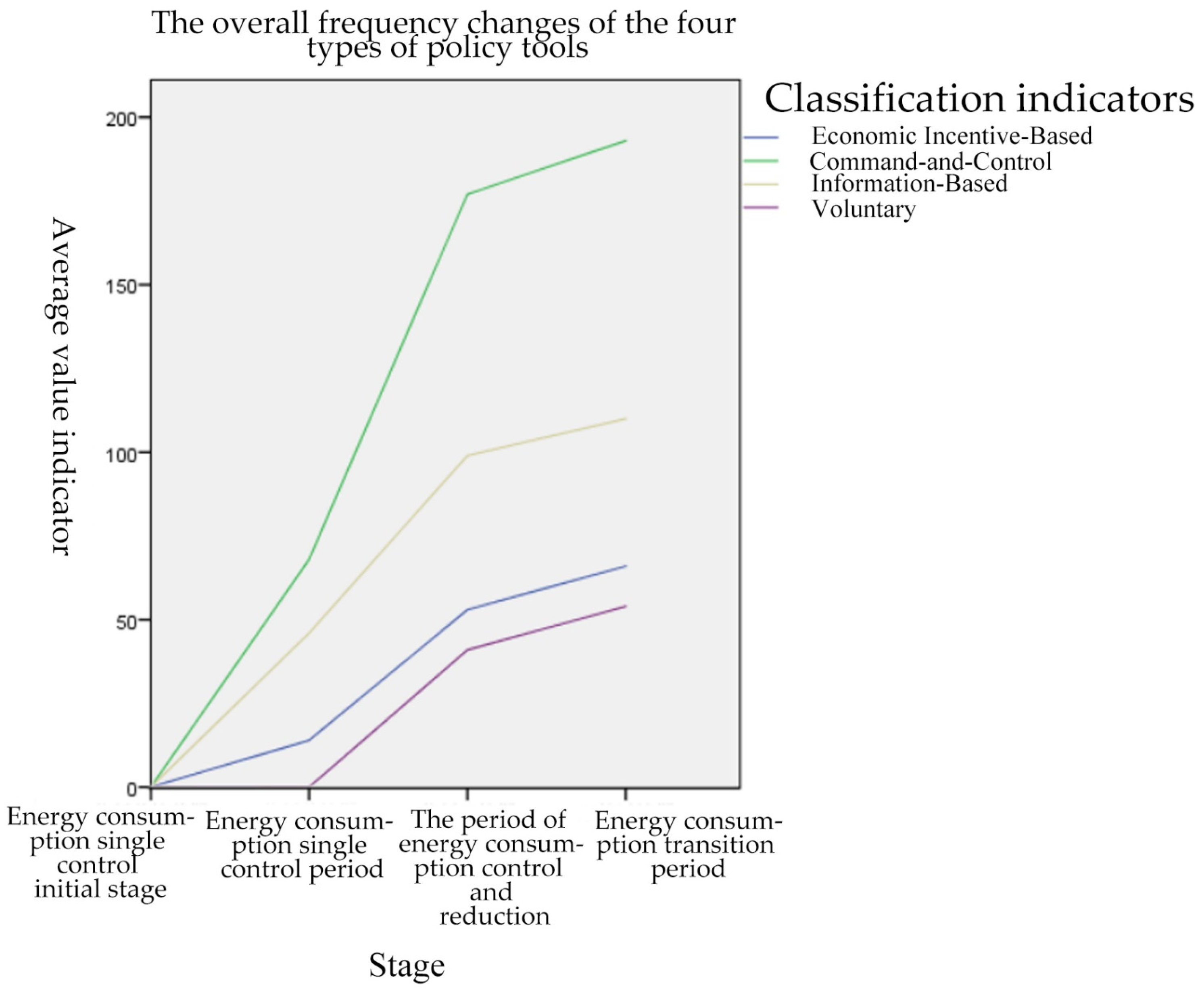
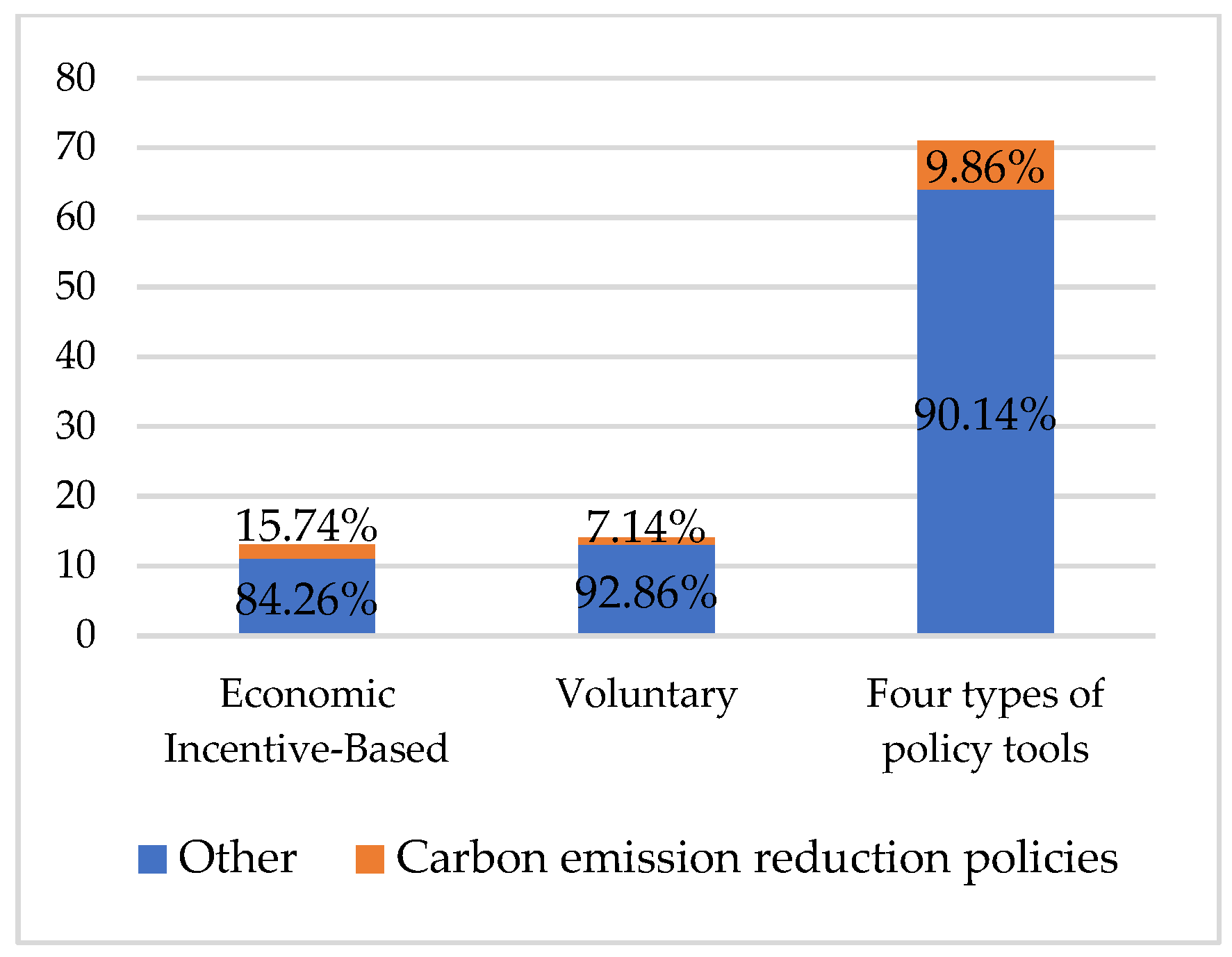
| Tool Type | Tool Name | Single-Control Period of Energy Consumption | Proportion | Period of Dual Control of Energy Consumption | Proportion | Double-Control Transition Period | Proportion | Amount to | Total Weight |
|---|---|---|---|---|---|---|---|---|---|
| Enforceable instrument | laws and regulations | 19 | 49.58% (59) | 70 | 51.50% (120) | 12 | 36.21% (21) | 200 | 48.90% |
| regulatory measures | 10 | 26 | 4 | ||||||
| administrative penalty | 15 | 6 | 1 | ||||||
| standard setting | 8 | 11 | 4 | ||||||
| access restrictions | 7 | 7 | 0 | ||||||
| Information tool | technological guidance | 18 | 32.77% (39) | 10 | 16.74% (39) | 2 | 17.24% (10) | 88 | 21.52% |
| Information Disclosure | 5 | 16 | 3 | ||||||
| publicity and education | 2 | 8 | 3 | ||||||
| Planning Guidance | 10 | 1 | 0 | ||||||
| database construction | 4 | 4 | 2 | ||||||
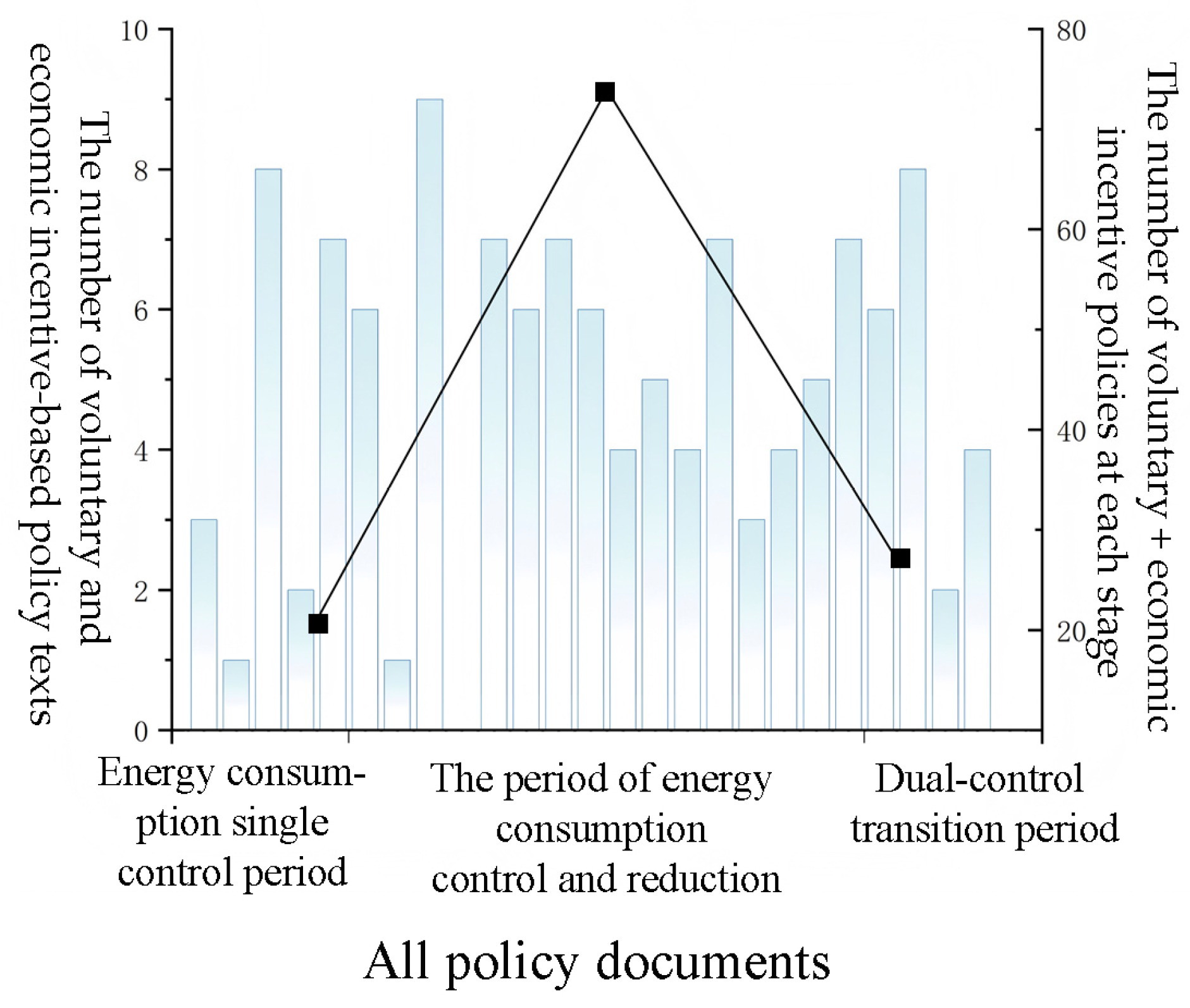
| Incentive instrument | grant-in-aid | 6 | 11.76% (14) | 20 | 15.02% (35) | 3 | 22.41% (13) | 62 | 15.16% |
| tax support | 2 | 3 | 3 | ||||||
| financial support | 5 | 9 | 4 | ||||||
| market incentive | 1 | 3 | 3 | ||||||
| Voluntary instrument | Encourage participation | 3 | 5.88% (7) | 31 | 16.74% (39) | 7 | 24.14% (14) | 59 | 14.42% |
| Demonstration and Promotion | 3 | 6 | 5 | ||||||
| voluntary compliance agreement | 1 | 2 | 2 |
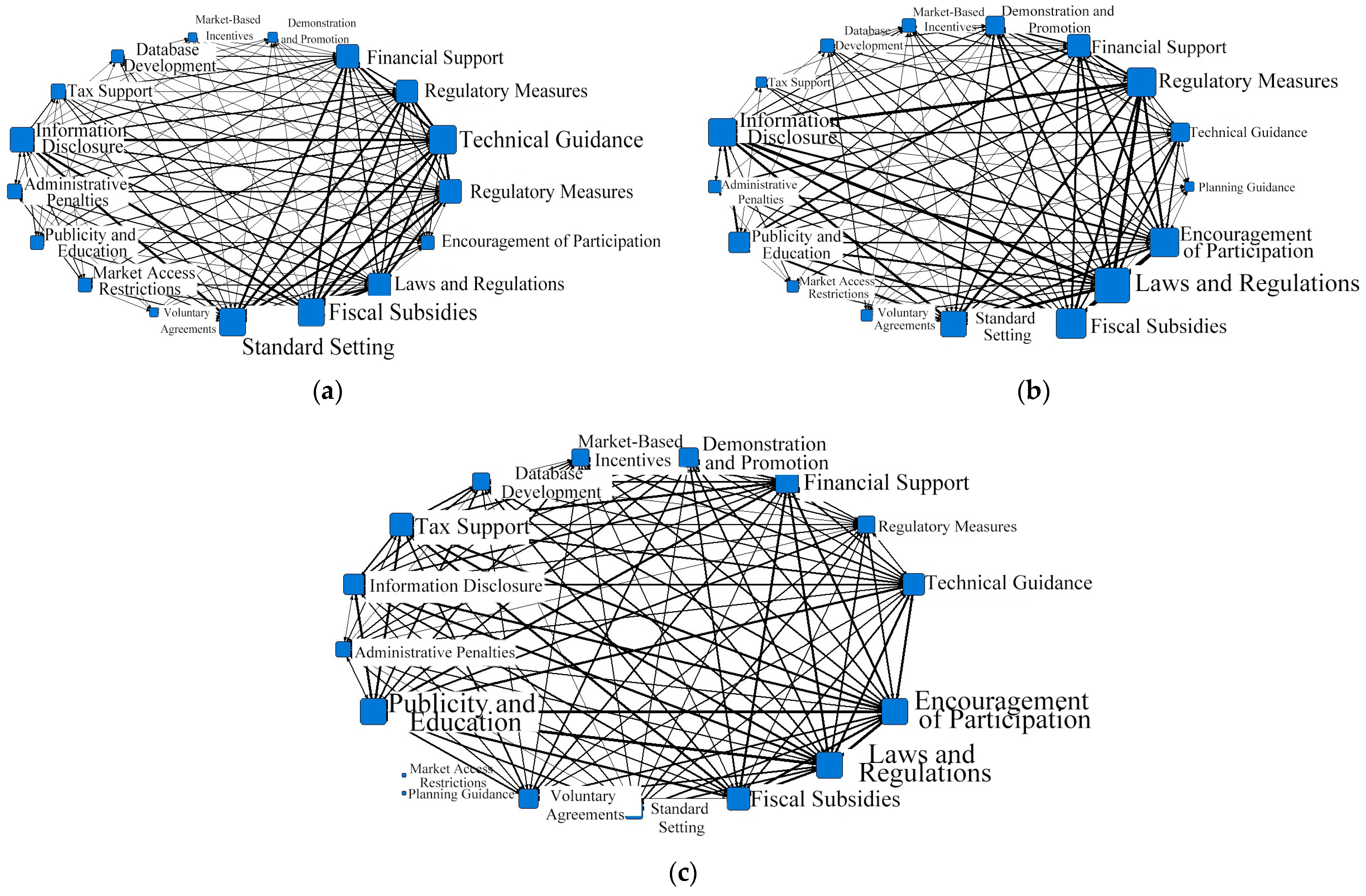
| Stage | Policy Instrument | Degree Centrality | Stage | Policy Instrument | Degree Centrality | Stage | Policy Instrument | Degree Centrality |
|---|---|---|---|---|---|---|---|---|
| Single-control period of energy consumption | technological guidance | 0.1 | Period of dual control of energy consumption | laws and regulations | 0.108 | Double-control transition period | laws and regulations | 0.087 |
| standard setting | 0.098 | grant-in-aid | 0.102 | publicity and education | 0.087 | |||
| grant-in-aid | 0.098 | regulatory measures | 0.098 | Encourage participation | 0.087 | |||
| Information Disclosure | 0.083 | Encourage participation | 0.098 | grant-in-aid | 0.075 | |||
| Planning Guidance | 0.08 | Information Disclosure | 0.093 | tax support | 0.075 | |||
| financial support | 0.078 | standard setting | 0.085 | financial support | 0.075 | |||
| laws and regulations | 0.078 | financial support | 0.07 | technological guidance | 0.068 | |||
| regulatory measures | 0.076 | publicity and education | 0.064 | Information Disclosure | 0.066 | |||
| administrative penalty | 0.046 | Demonstration and Promotion | 0.055 | Demonstration and Promotion | 0.061 | |||
| tax support | 0.043 | technological guidance | 0.051 | voluntary compliance agreement | 0.061 | |||
| access restrictions | 0.041 | database construction | 0.049 | database construction | 0.054 | |||
| publicity and education | 0.041 | market incentive | 0.046 | market incentive | 0.054 | |||
| Encourage participation | 0.041 | administrative penalty | 0.042 | regulatory measures | 0.052 | |||
| database construction | 0.035 | access restrictions | 0.040 | standard setting | 0.052 | |||
| Demonstration and Promotion | 0.022 | voluntary compliance agreement | 0.039 | administrative penalty | 0.042 | |||
| market incentive | 0.02 | tax support | 0.037 | |||||
| voluntary compliance agreement | 0.02 | Planning Guidance | 0.035 | |||||
| Network centralization | 26.83% | Network centralization | 33.04% | Network centralization | 23.17% | |||
| Density (matrix average) | 1.6140 | Density (matrix average) | 2.4743 | Density (matrix average) | 2.0956 | |||
Disclaimer/Publisher’s Note: The statements, opinions and data contained in all publications are solely those of the individual author(s) and contributor(s) and not of MDPI and/or the editor(s). MDPI and/or the editor(s) disclaim responsibility for any injury to people or property resulting from any ideas, methods, instructions or products referred to in the content. |
© 2026 by the authors. Licensee MDPI, Basel, Switzerland. This article is an open access article distributed under the terms and conditions of the Creative Commons Attribution (CC BY) license.
Share and Cite
Wang, C.; Duan, T.; Zhao, X. The Policy Shift from Energy to Carbon Dual-Control Targets in Building Energy Efficiency: A Textual Analysis of Tianjin’s Policies over Three Decades Through the Lens of Policy Instruments. Buildings 2026, 16, 1831. https://doi.org/10.3390/buildings16091831
Wang C, Duan T, Zhao X. The Policy Shift from Energy to Carbon Dual-Control Targets in Building Energy Efficiency: A Textual Analysis of Tianjin’s Policies over Three Decades Through the Lens of Policy Instruments. Buildings. 2026; 16(9):1831. https://doi.org/10.3390/buildings16091831
Chicago/Turabian StyleWang, Chaohong, Tiantian Duan, and Xiaogang Zhao. 2026. "The Policy Shift from Energy to Carbon Dual-Control Targets in Building Energy Efficiency: A Textual Analysis of Tianjin’s Policies over Three Decades Through the Lens of Policy Instruments" Buildings 16, no. 9: 1831. https://doi.org/10.3390/buildings16091831
APA StyleWang, C., Duan, T., & Zhao, X. (2026). The Policy Shift from Energy to Carbon Dual-Control Targets in Building Energy Efficiency: A Textual Analysis of Tianjin’s Policies over Three Decades Through the Lens of Policy Instruments. Buildings, 16(9), 1831. https://doi.org/10.3390/buildings16091831