


Abstract
Concrete building systems require decisions at both the member and the building level, because locally efficient cross sections do not necessarily lead to a favorable whole-building response. This study presents a two-level comparative framework comprising (i) a member-level parametric assessment of nine reinforced-concrete and composite cross-section families across six concrete grades (54 scenarios) and (ii) a building-level ETABS assessment of seven structural configurations (Models A–G) derived from a residential reinforced-concrete frame benchmark. At the member level, the alternatives were evaluated based on axial resistance, along with simplified screening-level CO2 and cost proxies. At the member level, axial resistance increased with concrete grade, although the marginal benefit diminished at higher grades for steel-dominant layouts. Balanced composite sections showed the most favorable normalized strength-to-material-proxy trends, whereas steel-heavy alternatives provided high absolute resistance but lower overall efficiency. The comparison between the member-level hybrid-section screening and the building-level composite configuration further showed that promising local section behavior does not automatically translate into superior whole-building performance. At the building level, the compared configurations were assessed through vertical base reactions, modal properties, and top-level lateral displacement response. Replacing solid beams and columns with hollow members of identical outer dimensions reduced the self-weight-related base reaction from 9591 to 8832 kN (7.9%) but slightly increased the top-level displacement response, indicating a mass–stiffness trade-off. Larger improvements were obtained when the global lateral-force-resisting mechanism was modified directly: the braced configuration produced the shortest fundamental period ( s) and the lowest displacement response, while the core-wall configuration also reduced both period and displacement substantially. By contrast, the height-extended configuration produced the most flexible response among Models A–F. An additional exploratory variant with semi-rigid beam-to-column connections (Model G) confirmed that connection-level flexibility produces a measurable but moderate increase in period and displacement relative to the reference frame, without altering the global load-resisting mechanism. Overall, the results confirm that member-level and building-level assessments should be treated as complementary decision levels in early-stage structural design.
1. Introduction and Literature Review
1.1. Motivation and Structural Rationale of This Study
Reducing concrete consumption and the associated CO2 emissions without compromising structural performance has become a central challenge in concrete construction, and recent building-level studies have confirmed that combined structural and mix-design strategies can substantially reduce the carbon footprint of mid-rise reinforced-concrete buildings [1]. This challenge is especially relevant as current fabrication and production approaches increasingly enable the targeted realization of alternative member concepts, including hollow reinforced-concrete sections, conventional solid reinforced-concrete sections, and composite concrete–steel sections with embedded steel profiles (Figure 1).
Figure 1.
Representative section typologies used in the member-level comparison: (a) hollow reinforced-concrete section, (b) solid reinforced-concrete section, and (c) composite concrete–steel section with an embedded I-profile.
This development raises a fundamental structural-design question. Efficiency cannot be judged solely at the member level, because a section that appears materially advantageous in isolation may lead to unfavorable stiffness, load-transfer, or serviceability consequences once incorporated into a complete building system. Conversely, system-level performance cannot be interpreted rigorously without considering the member typologies from which the structure is assembled. For this reason, the present work is organized as a two-level comparative study. The first level compares alternative member typologies at the cross-section level, whereas the second compares alternative structural configurations at the building level.
At the member level, this study examines nine reinforced-concrete and composite section families across multiple concrete grades to compare axial resistance with simplified material-related cost and CO2 proxies. At the building level, this study evaluates six structural configurations derived from a common reinforced-concrete residential building benchmark, namely, a reference frame, a frame with a central shear-wall core, a height-extended configuration, a hollow-member variant, a braced system, and a composite concrete–steel member system. These system-level variants clarify that changes in the global lateral-force-resisting mechanism and stiffness distribution may govern the overall response more strongly than member-level substitutions alone.
The two levels are treated as complementary rather than independent. The member-level study screens promising section concepts, whereas the building-level study evaluates how these choices affect global mass, stiffness, load path, and lateral response.
1.2. Member-Level Screening: Reinforced-Concrete and Composite Cross-Sections
The interaction between concrete grade, section dimensions, reinforcement content, embedded steel content, and the selected performance objective governs the structural and material efficiency of concrete members. Recent parametric studies have shown that these variables can substantially affect both structural feasibility and material-related performance indicators. For example, one study on reinforced-concrete beams showed that lower-carbon solutions depend not only on material quantity but also on geometric proportions [2], while another study on flat slabs showed that slab thickness, concrete grade, column spacing, column size, and reinforcement detailing can strongly influence embodied-carbon-optimal solutions [3]. Similarly, other researchers have shown that concrete grade and column spacing influence the optimal design of reinforced-concrete buildings [4] and that minimizing concrete volume does not necessarily lead to the lowest embodied carbon in reinforced-concrete frames [5,6].
More generally, several optimization studies on reinforced-concrete members have confirmed that the balance between cost, carbon, and structural performance depends strongly on the selected member configuration and design variables [7,8]. Other recent work has also explored the use of data-driven methods, such as Fuzzy Logic, Artificial Neural Networks, and ANFIS, for reinforced-concrete beam calculations, highlighting the broader relevance of parametric and machine-learning-assisted approaches for section-level assessment and pre-design [9,10]. In addition, durability-related effects may also alter the relative ranking of alternatives. For example, one study showed that corrosion-sensitive life-cycle considerations can significantly affect the sustainability ranking of reinforced-concrete beam solutions [11].
Despite these developments, the literature still tends to focus on a single-member family, a single optimization objective, or a limited subset of design variables. A consistent side-by-side comparison of multiple reinforced-concrete and composite member typologies across concrete grades under a unified evaluation procedure remains limited. Such a comparison is necessary because potentially efficient member concepts should first be identified at the local level before their broader structural implications are assessed at the building level.
Motivated by this gap, this study compares nine reinforced-concrete and composite section families across six concrete strength classes (54 scenarios) using consistent Section Designer models and simplified material-related indicators.
1.3. Building-Level Screening: Structural Configurations and Global Response
This broader system-level perspective is also consistent with earlier optimization-oriented studies on prefabricated structural systems. For example, AI-assisted and meta-heuristic approaches have been used to optimize wall–floor building layouts and beam arrangements at the whole-building scale, confirming that structural efficiency depends not only on individual member properties but also on the configuration of the overall system [12]. This need for system-level comparison is also reflected in earlier studies, which showed that even the placement of structural connections can alter the design logic of frame systems and should therefore be treated as an explicit system variable rather than as a secondary detailing choice [13].
Studies on frame and connection behavior likewise support the importance of controlled system-level comparison. For example, one study compared cast in situ and precast beam–column joint solutions and showed that the connection strategy can materially influence frame behavior and structural response [14]. More recent work also indicated that hollow and hybrid member concepts may produce system-level effects that cannot be inferred reliably from member behavior alone [15]. In the same direction, another study showed that voided structural solutions can affect whole-building environmental performance [16]. However, such assessments remain incomplete unless they are interpreted together with structural-response measures.
A clear need, therefore, exists for studies that compare similar buildings under controlled modeling assumptions while varying both member typology and structural configuration. This motivates the building-level part of the present study, in which six structural configurations of a residential reinforced-concrete building are compared in ETABS. The investigated variants include the reference frame, a central core-wall system, a height-extended configuration, a hollow-member configuration, a braced system, and a composite concrete–steel member configuration. This set of models makes it possible to distinguish between member-level substitutions that primarily affect the mass–stiffness balance and system-level interventions that modify the global lateral-load-resisting mechanism more directly.
1.4. Contribution of This Study
A key gap in the literature is the lack of a transparent framework linking member-level efficiency with whole-building response. This study addresses that gap through a two-level comparison of nine section families (Figure 1) across six concrete grades and six ETABS building configurations (Figure 2), showing that favorable local section behavior does not necessarily lead to better global structural performance.
Figure 2.
Representative examples of the system-level building configurations considered in the present study: (a) reference reinforced-concrete frame, (b) frame with a central shear-wall core, (c) braced frame system, (d) composite concrete–steel member system, and (e) height-extended frame variant.
2. Methodology
A quantitative model-based workflow was adopted to evaluate alternative concrete building solutions within a two-level comparative framework. This study combines a member-level assessment of solid, hollow, and composite cross sections with a building-level assessment based on a family of ETABS models (Models A–F).
Within the building-level assessment, the ETABS model family was defined to allow targeted structural modifications to be examined under otherwise consistent assumptions. In particular, two cross-level concepts were carried forward from the member scale to the building scale. First, the controlled solid-versus-hollow comparison (Model A versus Model D) was treated as the principal hollow-member study at the building level because it isolates the effect of replacing solid beams and columns with hollow members of identical outer dimensions. Second, Model F provides a building-level interpretation of the hybrid and composite section concept examined at the member level. In this way, both the hollow-member strategy and the hybrid/composite strategy are examined not only as local section alternatives but also as whole-building response cases, without implying a direct one-to-one transfer of member-level ranking to building-level performance. The remaining models were retained as comparative benchmark cases to clarify how strongly the response changes when the governing structural mechanism itself is modified.
2.1. Software and Tools
CSI ETABS v21 and Section Designer within SAP2000 v25 (Computers and Structures, Inc. (CSI), Walnut Creek, CA, USA) software environments were used to maintain consistent definitions of materials, sections, mass source, and analysis settings across all model variants. Architectural drawings were prepared and checked in Rhino3D 7 (Robert McNeel & Associates, Seattle, WA, USA) (Figure 3) and then used to define the structural grid, core geometry, and member layout. Post-processing, ranking, and comparative visualization were carried out in spreadsheet software.
Figure 3.
Architectural information: (a) exterior view, (b) ground-floor layout, (c) typical floor layout, and (d) upper-floor architectural layout.
- ETABS v21 (Computers and Structures, Inc. (CSI), Walnut Creek, CA, USA): three-dimensional global modeling, including diaphragms, supports, connectivity, mass source, load patterns, load combinations, gravity and lateral analyses, and extraction of global response quantities such as base reactions, modal periods, and top-level displacement metrics.
- Section Designer within SAP2000 v25 (Computers and Structures, Inc. (CSI), Walnut Creek, CA, USA): member-level modeling of the investigated solid, hollow, and composite cross sections, enabling explicit geometric definition and consistent evaluation of section properties.
- Rhino3D 7 (Robert McNeel & Associates, Seattle, WA, USA): preparation and dimensional verification of the architectural plans and structural layouts used as modeling input.
- Microsoft Excel (Microsoft Corporation, Redmond, WA, USA): organization of results, calculation of comparative indicators, and preparation of ranking tables and plots.
2.2. Research Approach and Comparison Logic
The methodological framework comprises two connected but distinct levels. At the member level, section families S1–S9 were compared to evaluate how section configuration affects axial resistance and simplified material-related proxies. At the building level, Models A–G were compared to examine how alternative member typologies and structural mechanisms influence gravity-load transfer, effective stiffness, modal characteristics, and lateral displacement response.
Models A–F were defined to isolate selected building-level design decisions while keeping the remaining modeling assumptions unchanged. Two member-level concepts were carried forward to the building scale: the hollow-member strategy, represented by the controlled comparison between Model A and Model D, and the hybrid/composite strategy, represented by Model F. In Model D, solid reinforced-concrete beams and columns were replaced by hollow members of identical outer dimensions, whereas in Model F the primary beams and columns were replaced by composite concrete–steel sections. The remaining models were retained as benchmark cases to clarify the relative importance of member-level substitutions and direct changes in the global lateral-force-resisting mechanism.
In this sense, the ETABS model family functions as a comparative sensitivity framework: some variants primarily modify the mass–stiffness balance through member substitution, whereas others alter the governing lateral-force-resisting mechanism more directly. The framework is therefore intended to compare structural tendencies under controlled assumptions rather than to imply that all variants represent equally mature design solutions.
The investigated alternatives were evaluated using indicators appropriate to each study level. At the building level, the main indicators were: (i) vertical base reactions, used as measures of gravity-load transfer and self-weight sensitivity, and (ii) global lateral-response indicators, including fundamental period, second-mode period, and top-level lateral displacement response. These quantities were used as comparative response measures within a common ETABS framework and were not intended to replace a complete performance-based or code-verification assessment. At the member level, the main indicators were: (iii) axial resistance and (iv) screening-level material-related proxies for CO2 and cost, derived from explicitly stated unit factors and used only for internally consistent comparison within the investigated dataset. Any building-level discussion of reduced material-related impact inferred from reduced gravity reaction is therefore treated only as a qualitative screening implication and not as a substitute for quantity-take-off-based embodied-carbon assessment.
2.3. Definition of Section Families and Notation
For traceability, the investigated cross sections were grouped into section families S1–S9. Each family represents a distinct geometric and material configuration defined in Section Designer and evaluated over the selected concrete-strength range. The section-family definitions, including overall dimensions, reinforcement layout, embedded steel components, and notation, are summarized in the dedicated section definition table provided in the Results section. Throughout this paper, denotes reinforcing bars, denotes embedded steel plates, and IPE denotes a European I-section steel profile. All section-level quantities were evaluated per unit member length so that the resulting structural, CO2-proxy, and cost-proxy values remain directly comparable across the investigated section families, Table 1.
Table 1.
Definition of the investigated section families S1–S9 used in the parametric study.
The member-level comparison is intentionally limited to a screening function. In particular, axial resistance was used as a consistent comparative indicator across the section families, but it does not by itself represent the full range of section performance relevant to whole-building response. Several additional mechanical parameters govern structural behavior at the member level but were not included in the present screening stage. Bending stiffness determines how effectively a member resists lateral deformation within a frame system and is not directly related to axial load-carrying capacity. Shear capacity governs the response of members under combined loading conditions and is particularly relevant for composite and non-homogeneous cross sections with embedded steel cores, where the distribution of shear stress across the section can differ substantially from that of homogeneous reinforced-concrete members. Deformation behavior and ductility determine how a section performs beyond its elastic range and are critical for seismic assessment. These parameters collectively influence the stiffness contribution of individual members to the global structural system in ways that axial resistance alone cannot capture. The present member-level screening should therefore be interpreted strictly as a first-stage comparative tool for identifying promising section concepts based on axial resistance and material-related proxies, with the explicit acknowledgment that a complete mechanical characterization of section performance would require the inclusion of these additional parameters. The building-level study should therefore be interpreted as a complementary system-level assessment rather than as a direct extrapolation of the axial screening results. This distinction is especially important for the hybrid/composite concept: favorable member-level performance identifies promising section families, whereas Model F is used to examine how the concept behaves when transferred to the building scale within a complete structural system.
2.4. Screening-Level CO2 and Cost Proxy Definition
To enable a transparent and reproducible comparison of the investigated section families, simplified screening-level proxies were defined for embodied CO2 and material cost. These proxies were used only for relative comparison within the present dataset and should not be interpreted as project-specific life-cycle or market-based values.
For each section, the quantities were evaluated per unit member length () from the concrete area, the reinforced-steel area, and any embedded structural-steel profiles or plates explicitly modeled in Section Designer. The total CO2 proxy was calculated as
where is the concrete volume per meter, is the total steel mass per meter, is the adopted concrete CO2 factor, and is the adopted steel CO2 factor.
Similarly, the cost proxy was calculated as
where and are the adopted concrete and steel cost factors, respectively.
The adopted proxy factors are reported explicitly in Table 1 and were treated as generic screening assumptions for internally consistent comparison across the investigated alternatives. They were not derived from product-specific EPDs, supplier quotations, transport scenarios, or project-specific procurement data. The resulting CO2 and cost values should therefore be interpreted only as comparative proxies for structural screening and not as substitutes for detailed environmental assessment or project-specific cost estimation.
2.5. Case Study Building and Architectural Constraints
The reference case study is a six-story residential building. The ground floor is located at level and has a story height of , with a gross floor area of 301 m2. The upper stories follow the same general functional layout and occupancy pattern, resulting in a repetitive structural grid and a comparable vertical distribution of actions. A central circulation core accommodates the staircase and elevator and defines the core geometry used in the structural models. The architectural layout, therefore, governs the member arrangement, span configuration, and placement of the principal lateral-force-resisting components considered in the building-level study.
2.6. Global Structural Modeling in ETABS
The reference structure was modeled in ETABS as a reinforced-concrete building system. The floor system consists of hollow-core slabs and remains unchanged across all model variants. Columns were modeled as square reinforced-concrete frame members, and beams as reinforced-concrete frame members supporting the slab system. Unless otherwise noted for a specific variant, rigid story diaphragms were assigned throughout the model family.
- ETABS analysis settings
All models were analyzed using a common set of modeling and analysis settings unless explicitly modified for a specific variant. The common ETABS settings and the model-specific modifications are reported in Appendix B.
2.7. Model Variants (A–G) and Isolated Building-Level Modifications
Starting from the reference configuration (Model A), additional ETABS variants were defined to isolate selected building-level modifications while keeping the remaining assumptions unchanged. The principal controlled comparison concerns Models A and D, in which hollow members of identical outer dimensions replace solid beams and columns. A second cross-level comparison is represented by Model F, where the primary beams and columns are replaced by composite concrete–steel sections in order to examine the hybrid/composite concept at the building scale. The remaining models provide comparative benchmark cases involving a central core-wall system, height extension, and bracing (Table 2).
Table 2.
Summary of the investigated structural models (A–G) and their defining modification within the building-level framework.
2.8. Loading, Combinations, and Analysis Cases
Load patterns were defined using standard action categories, including dead load, superimposed dead load, live load, snow, simplified façade wind pressure, and seismic action, and were kept identical across all model variants. Structural self-weight was included through a dedicated dead-load pattern with a self-weight multiplier of , whereas all remaining load patterns were assigned a self-weight multiplier of . The adopted characteristic-imposed actions used throughout the model family are summarized in Appendix B.
In the present comparative study, wind action was represented by a simplified uniform external façade pressure of . This assumption was maintained across all variants as a common comparative input rather than as a full code-based wind-load derivation for project-specific design. Ultimate limit-state and seismic load combinations were assembled in a consistent Eurocode-style format and applied uniformly across all models. The adopted load combination set is summarized in Appendix B (Table A2).
2.9. Seismic Action Modeling
Seismic actions were modeled in ETABS using response spectrum load cases in the two principal horizontal directions (X and Y). In addition to the gravity-load cases, directional spectrum cases and their associated eccentric variants were defined so that the seismic response of all model variants could be compared within a common analysis framework.
- Mass source
A dedicated mass source (MsSrc1) was defined from the specified load patterns. Permanent actions, including self-weight, superimposed dead load, and wall loads, were included with a multiplier of , while live load was included with a reduced factor of . The same mass source was used for all response spectrum cases.
- Response spectrum definition and analysis settings
Seismic actions were represented in ETABS using the built-in Euro-format response spectrum generator. A common spectrum definition was applied to all response spectrum load cases, and the corresponding parameters are reported in Appendix B (Table A4).
- Scaling, accidental torsion, and base-shear verification
Response spectrum scaling, base-shear verification, and accidental-torsion treatment were defined consistently across all models to preserve direct comparability of the reported seismic-response quantities. The corresponding ETABS settings are summarized in Appendix B (Table A4).
2.10. Model Generation, Data Extraction, and Performance Indicators
All models were generated and analyzed in ETABS under common modeling conventions. For the controlled solid-versus-hollow comparison, Model A was evaluated against Model D while preserving identical outer dimensions, building geometry, load patterns, load combinations, support conditions, and analysis settings. At the same time, Model F was used to examine the hybrid/composite concept at the building scale within the same comparative framework.
The following outputs were extracted for post-processing:
- Vertical base reactions under gravity-dominated load cases, to quantify differences in global dead-load demand and gravity-load transfer.
- Concrete volume inferred from section definitions and member geometry, to quantify the material reduction associated with hollowing.
- Screening-level material-related proxies derived from concrete-volume and steel-quantity changes using consistent generic unit factors, to support internal comparison of the investigated alternatives.
- Global lateral-response indicators, including modal periods and top-level lateral displacement response, to evaluate stiffness-related implications of the investigated modifications.
For all model variants, the displacement indicator was extracted consistently from the topmost structural level under the EXN response spectrum case. These quantities were used as common comparative outputs within the adopted ETABS framework and should therefore be interpreted as response indicators for cross-model assessment rather than as a complete serviceability or performance-based design evaluation.
2.11. Implementation Workflow for the Solid-Versus-Hollow Comparison
The primary controlled comparison was carried out using two models: (i) a reference configuration with solid beam and column sections (Model A), and (ii) an otherwise identical configuration in which the same members were assigned hollow sections (Model D). To preserve a one-variable comparison, all other modeling inputs were kept unchanged, including the architectural layout, story heights, member connectivity, support conditions, diaphragm assignments, material definitions, seismic mass source, response spectrum settings, analysis options, and the full set of load patterns and load combinations.
The hollow-member alternative was generated by replacing the solid beam and column sections with hollow sections of identical outer dimensions. The global layout and structural system, therefore, remained unchanged, while the internal voids reduced concrete volume and self-weight without altering the external geometric envelope. This modeling strategy enabled direct evaluation of the structural consequences of hollowing, including changes in gravity-load transfer, shifts in global mass–stiffness balance, and the associated screening-level material efficiency implications.
3. Results and Discussion
3.1. Assessment of RC Cross Sections: Axial Resistance, Screening-Level CO2 Proxy, and Screening-Level Cost Proxy
The 54 analyzed scenarios show consistent trends in axial resistance, screening-level CO2 proxy, and screening-level cost proxy across the investigated section families and concrete grades. All quantities are reported per unit member length (), and the CO2- and cost-related values are used only as internally consistent screening proxies rather than project-specific environmental or economic estimates.
Within the adopted two-level framework, these section-level results serve as a local screening stage for comparing axial resistance and simplified material-efficiency indicators. They should therefore be interpreted as comparative local evidence, while their broader structural implications are examined later through the building-level study.
3.1.1. Axial Resistance Across Concrete Grades
Across all section families, the ultimate axial resistance increases with concrete strength. The increase is most pronounced in configurations in which concrete still contributes substantially to the total resistance. In the present dataset, a cm reinforced-concrete section with reinforcement increases from approximately 374 tonf at C25 to about 564 tonf at C50. Steel-intensive composite configurations, such as S7 and S9, reach much higher absolute capacities, with peak values exceeding 1100 tonf at C50. However, in heavily reinforced and steel-dominant configurations, the marginal benefit of increasing concrete grade becomes smaller beyond approximately C40, indicating diminishing returns once the resistance is governed more by steel content and section detailing than by alone.
3.1.2. Screening-Level CO2 Proxy Across Sections
The screening-level CO2 proxy was estimated from concrete volume and steel mass using the unit factors adopted in this study (Section 2.4). As expected, the proxy increases with section size and, more strongly, with steel content. A cm section with minimal reinforcement yields values on the order of 60 to 70 kg CO2 per meter, whereas a cm section incorporating an IPE240 profile and reinforcement exceeds 180 kg CO2 per meter. Increasing concrete strength produces only a modest increase in the proxy because the grade-dependent concrete contribution remains limited relative to the steel contribution. In most composite configurations, steel mass is the dominant driver, particularly in sections containing plates, L-profiles, or embedded IPE sections.
3.1.3. Screening-Level Cost Proxy Across Sections
The screening-level cost proxy follows trends similar to those of the CO2 proxy because both are governed primarily by material quantities. Sections containing embedded steel profiles, such as IPE200 or IPE240, are markedly more expensive and frequently exceed €75 per meter, whereas simpler reinforced-concrete sections, such as a cm section with , typically remain in the range of €30 to €40 per meter. Concrete grade affects the cost proxy through the adopted grade-dependent concrete prices, but in most cases, the steel contribution dominates the total.
3.1.4. Efficiency Indicators and Ranking
To enable normalized comparison, two efficiency indicators were evaluated: (i) strength per unit screening-level CO2 proxy (tonf/kg CO2) and (ii) strength per unit screening-level cost proxy (tonf/€). Three main patterns emerge. First, S7 ( cm with ) consistently ranks among the best-performing solutions, especially at higher concrete grades, combining high axial resistance with comparatively balanced proxy values. Second, S2 ( cm with ) shows particularly strong strength-to-CO2 efficiency at relatively low material demand, reaching tonf/kg CO2 at C50. Third, steel-heavy large sections, such as S8 ( cm with ) and S9 ( cm with IPE240 ), provide high absolute capacity but comparatively weak normalized performance because of their disproportionately high steel content.
3.1.5. Best-Performing Scenarios and Interpretation
Table 3 provides a compact summary of the highest-ranked cases according to the two normalized criteria. S7 dominates the upper part of both rankings, indicating that this configuration converts material input into axial resistance particularly efficiently within the investigated parameter space. S2 also performs strongly, especially in the strength-to-CO2 ranking, demonstrating that competitive normalized performance can be achieved with smaller, materially lighter configurations. The most effective solutions are therefore not necessarily the largest or strongest sections in absolute terms, but those that achieve high resistance without disproportionate increases in steel demand.
Table 3.
Top five scenarios ranked by strength-to-CO2 efficiency (left) and strength-to-cost efficiency (right). Repeated section IDs indicate that the same section family appears multiple times among the top-ranked cases.
These rankings should be interpreted strictly as member-level screening results. Their structural relevance at the system level remains indirect and should be assessed only in conjunction with the later building-level results for self-weight, modal response, and top-level displacement demand. In particular, the strong performance of several hybrid/composite sections at the member level defines the starting point for the later interpretation of Model F, where the same design logic is examined at the whole-building scale.
- Comparison with existing studies
The present results are consistent with previous studies showing that higher concrete strength can improve structural performance without necessarily improving environmental or economic efficiency. Zhang [8] reported that the benefit of higher concrete grades must be weighed against associated material impacts; the present results support this observation, as axial resistance increases with grade while the marginal gain becomes smaller beyond approximately C40, particularly for steel-dominant composite sections. Likewise, Gan et al. [17] and Camp [18] showed that balanced design choices can simultaneously improve multiple performance objectives, a pattern also evident here in the normalized efficiency indicators. Sahebi et al. [11] further highlighted that durability-related life-cycle effects may alter the relative ranking of alternatives. Although such long-term mechanisms were not modeled in the present study, the current results still indicate that steel-intensive solutions may deliver high absolute resistance at the expense of comparatively weak normalized performance.
- Baseline benchmarking and trade-off patterns
As a reference point, a solid cm reinforced-concrete section with reinforcement and C30 concrete was adopted as the baseline configuration. Within the 54-scenario design space, the most efficient composite layouts—particularly S7 and S2 at higher concrete grades—achieve substantially higher axial resistance while also improving both normalized screening indicators, as shown in Figure 4 and Figure 5. In contrast, steel-intensive large sections such as S9 provide high absolute resistance but weaker normalized efficiency because the additional steel increases both the screening-level CO2 proxy and the screening-level cost proxy disproportionately.
Figure 4.
Small-multiple representation of for the investigated section families and concrete.
Figure 5.
Small-multiple representation of for the investigated section families and concrete.
Three recurring trade-off patterns can be identified. First, higher axial resistance is generally accompanied by higher CO2 and cost proxies, unless the configuration is geometrically and materially well-balanced, as observed particularly in S2 and S7. Second, steel-rich configurations tend to show diminishing returns in normalized efficiency despite their high absolute strength. Third, moderate steel ratios combined with targeted composite detailing provide the most favorable balance between resistance and screening-level material demand within the analyzed range. Structural efficiency, therefore, does not scale linearly with material quantity, but depends on how effectively section geometry and composite action convert material input into axial resistance.
This benchmark comparison should also be interpreted as a local screening result rather than as a direct predictor of whole-building structural response. Its role is to identify promising section concepts whose broader implications can then be judged against the system-level response trends of the ETABS model family. In that sense, the member-level ranking does not yet establish that a hybrid/composite solution will improve global performance; rather, it identifies why such a concept is worth testing later through the building-level composite configuration.
3.1.6. Visual Evidence and Traceability
Three complementary forms of presentation support the section-level interpretation. Table 3 provides a compact summary of the highest-ranked cases according to the two normalized indicators. Figure 4 and Figure 5 show how the normalized CO2- and cost-efficiency indicators vary across section families and concrete grades, thereby making both overall ranking tendencies and grade sensitivity directly visible.
Taken together, Table 3 and Figure 4 and Figure 5 show that the most efficient section concepts are not those with the highest material input but those in which geometry, reinforcement arrangement, and composite detailing provide high axial resistance with comparatively moderate CO2 and cost proxy values. These results complete the member-level part of this study and provide a traceable screening basis for the subsequent building-level comparison. More specifically, they define why hybrid and composite sections are structurally attractive at the local level while leaving open the separate question of whether this promise is preserved once such concepts are assembled into a full building system. That question is addressed later through the interpretation of the composite-member building configuration (Model F).
3.2. Building Models and Structural Analyses
The building-level part of this study was carried out using a family of ETABS models (Models A–G) derived from a common baseline and analyzed under consistent modeling assumptions, including geometry, story heights, diaphragm idealization, boundary conditions, load patterns, load combinations, and seismic input. The reported differences are therefore interpreted primarily as consequences of the intended system-level modifications. Within the overall two-level framework, this model family serves as a comparative system-level basis for examining how changes in member typology and structural mechanism influence whole-building response. In this context, Model D represents the controlled hollow-member comparison, whereas Model F provides the building-level counterpart to the hybrid and composite section concepts examined in the member-level study.
For direct cross-model comparison, the discussion focuses primarily on the indicators reported consistently across the model family, namely, the self-weight-related vertical base reaction , the modal periods and , and the maximum top-level displacement response . Additional quantities shown in the compact model summaries are retained as variant-specific ETABS outputs to document each model’s response. However, not all are used as one-to-one comparison metrics across all configurations.
3.2.1. Model A (Reference Configuration)
Model A defines the reference structural system for the building-level comparison and serves as the baseline for Models B–F. It represents a fixed-base reinforced-concrete moment-resisting frame subjected to gravity, wind, and response spectrum seismic actions. Member dimensions were selected to satisfy the architectural constraints while maintaining a practical baseline design. Ground-floor columns range from to cm and reduce toward the upper stories to cm. Two principal beam sections were adopted, namely, cm and cm. Figure 6 summarizes the model and the principal ETABS response indicators.
Figure 6.
Model A: (a) ETABS model, (b) assigned section definitions, (c) representative internal-force output, and (d) compact summary of selected ETABS response quantities.
The global response of Model A defines the reference mass–stiffness balance for the subsequent comparisons. Under self-weight, the total vertical base reaction is 9591 kN. Under lateral loading, the reported seismic base shear is 926 kN in both principal directions, whereas the corresponding base shear under the adopted simplified wind-load case is 185 kN. Within the adopted loading framework, the seismic action therefore governs the lateral base-force response more strongly than the simplified wind case.
The modal response is characterized by closely spaced first and second periods, with s and s, indicating similar effective lateral stiffness in the two principal horizontal directions. At roof level, the EXN load case produces a torsional moment of 2925 kN·m and an overturning moment of kN·m. The maximum top-level displacement under EXN reaches 12.98 mm, and the corresponding max-to-average displacement ratio is 1.22. Model A, therefore, establishes the reference whole-building response against which subsequent structural modifications are evaluated.
3.2.2. Model B (Central Core Shear-Wall System)
Model B was derived from Model A by introducing a reinforced-concrete core shear-wall system around the elevator and stair zone. This modification adds a dedicated vertical lateral-force-resisting subsystem in the building’s central section. The core-wall thickness was modeled as 25 cm in the lower stories and reduced to 20 cm in the upper stories. Figure 7 summarizes the model and the principal response quantities.
Figure 7.
Model B: (a) ETABS model with the central core-wall system, (b) core-wall arrangement, (c) representative internal-force output, and (d) compact ETABS response summary.
Model B increases the total vertical base reaction to 11,063 kN and raises the seismic base shear to 999 kN in both principal directions. The reported base shear under the adopted simplified wind load case remains 185 kN, as the comparative wind-load definition was kept unchanged. Compared with Model A, the global system becomes significantly stiffer, which is reflected by the reduction of the fundamental period from 0.817 s to 0.617 s.
The second-mode period decreases more strongly to 0.277 s, indicating a clear redistribution of stiffness and modal participation associated with the introduction of the central core. At roof level, the LC38 response gives story moments of 30,954/−22,190 kN·m at the top and 37,264/−26,563 kN·m at the bottom of the story. The maximum top-level displacement under EXN decreases to 8.11 mm, while the max-to-average displacement ratio increases to 2.11. Overall, Model B confirms the strong stiffening effect of introducing a central shear-wall core.
3.2.3. Model C (Height-Extended Configuration with Two Additional Floors)
Model C extends the reference building (Model A) by adding two upper stories. This variant was introduced to assess the baseline moment-resisting frame’s sensitivity to increased height, cumulative gravity demand, and the resulting change in global lateral response. The ETABS model was updated to include the additional stories while preserving the same structural concept, diaphragm idealization, connectivity assumptions, and load-definition framework so that the observed differences can be attributed primarily to the increase in height and total mass. Column sizes were increased, with representative dimensions reaching cm. Figure 8 summarizes the model and the principal response quantities.
Figure 8.
Model C: (a) height-extended ETABS model, (b) elevation showing the added stories, (c) representative internal-force output, and (d) compact ETABS response summary.
Model C produces the largest self-weight base reaction among the compared models, with kN. The base shear under the adopted simplified wind-load case increases to 259 kN due to the greater effective building height. At the same time, the overall lateral response becomes more flexible than that of the reference model.
The fundamental and second-mode periods rise to 1.198 s and 1.177 s, respectively, both clearly above the reference values. Correspondingly, the maximum top-level displacement increases to 18.87 mm, which is the highest value among Models A–F. The max-to-average displacement ratio remains 1.22, matching the reference model. The results show that the increase in height outweighs the beneficial effect of the enlarged columns, leading to higher overall flexibility and a larger lateral displacement demand.
3.2.4. Model D (Hollow Cross-Section Structural System)
Model D was derived from the reference configuration (Model A) while preserving the same architectural layout, story heights, boundary conditions, diaphragm assignment, material definitions, mass source, and load-pattern/load-combination framework. Its defining modification is the replacement of solid reinforced-concrete beams and columns by hollow reinforced-concrete sections of identical outer dimensions. Square hollow columns and rectangular hollow beams were adopted as the primary member types. Figure 9 summarizes the model and the principal response quantities.
Figure 9.
Model D: (a) ETABS model with hollow members, (b) representative hollow section definitions, (c) representative internal-force output, and (d) compact ETABS response summary.
Model D decreases the total vertical base reaction to 8832 kN, corresponding to a reduction of about 7.9% relative to Model A. The global response remains broadly similar to the reference frame but with a slight softening effect: the fundamental and second-mode periods increase to 0.865 s and 0.863 s, respectively.
The corresponding top-level displacement rises moderately to 13.53 mm, while the max-to-average displacement ratio remains close to the reference value at 1.2. For LC38, the axial force range at the top level is 5143–5386 kN, and the associated story moments reach 57,557/−41,638 kN·m. Model D therefore demonstrates that a moderate mass reduction can be achieved with only a limited penalty in global stiffness and top-level lateral displacement response.
3.2.5. Model E (Bracing System)
Model E was derived from the reference configuration (Model A) by introducing a dedicated bracing system in selected primary frames in order to modify the global lateral-force-resisting mechanism. In contrast to the baseline moment-resisting frame behavior, the bracing members provide a more direct axial-force-based load path for horizontal actions. Figure 10 summarizes the model and the principal response quantities.
Figure 10.
Model E: (a) ETABS model with the bracing system, (b) bracing arrangement, (c) representative internal-force output, and (d) compact ETABS response summary.
Model E leads to the stiffest global response among the compared fixed-base variants. The self-weight base reaction increases to 10,699 kN, and the seismic base shear in EX rises to 980 kN. The principal effect of the bracing system is a significant shortening of the modal periods to s and s, both the lowest in the model set.
This substantial increase in lateral stiffness is also reflected in the top-level displacement response, which drops to only 2.82 mm under EXN. The displacement distribution remains relatively regular, with a max-to-average ratio of 1.17. Overall, Model E provides the strongest reduction in lateral displacement demand among the fixed-base alternatives by directly altering the global load-resisting mechanism.
3.2.6. Model F (Composite Concrete–Steel Sections)
Model F was derived from the reference configuration (Model A) by introducing composite concrete–steel sections for the primary beams and columns. In this variant, steel profiles are embedded within the concrete members to form hybrid sections. The composite sections adopted in Model F are consistent with the geometric layout and steel arrangement of S7 ( cm with ), which achieved the highest normalized performance at the member level in both the strength-to-CO2 and strength-to-cost efficiency rankings. This selection makes the cross-level link between the member-level screening results and the building-level composite configuration explicit and ensures that the building-level composite case reflects a section concept that was identified as locally efficient in the member-level screening stage. The composite sections were implemented in ETABS by updating the frame-property assignments, while the architectural layout, story heights, boundary conditions, diaphragm assumptions, mass source, and load-pattern/load-combination framework were kept identical to the baseline in order to isolate the effect of the section modification. Figure 11 summarizes the model and the principal response quantities.
Figure 11.
Model F: (a) ETABS model with composite members, (b) representative composite section definition, (c) representative internal-force output, and (d) compact ETABS response summary.
Model F reduces the total vertical base reaction to 9147 kN, which is lower than in the reference model. However, the structural response indicates a reduction in effective global stiffness rather than a stiffening effect. The fundamental and second-mode periods increase to 0.909 s and 0.905 s, respectively, and the maximum top-level displacement rises to 15.31 mm.
At the top level under LC38, the axial force range is 5168–5382 kN and the corresponding story moments are 57,878/ kN·m. Compared with the reference frame, Model F reduces self-weight while also producing a more flexible global behavior. This result is especially important in relation to the member-level findings. Although several hybrid/composite sections performed efficiently under local screening criteria, the building-level composite configuration does not automatically convert this local advantage into improved global stiffness or reduced displacement demand. Within the present ETABS idealization, the adopted composite-member substitution should therefore be interpreted as a system-level response case rather than as direct evidence against the local usefulness of hybrid/composite sections. It is important to emphasize that these findings are model-dependent and should not be generalized beyond the specific modeling framework adopted in this study. The observed increase in fundamental period and top-level displacement in Model F is specific to the adopted modeling assumptions, which include particular cracked stiffness modifiers for beams and columns, a simplified representation of composite action through frame-property assignments in ETABS, and rigid diaphragm idealization. Under different modeling assumptions, such as higher composite action factors, refined section-specific stiffness modifiers, or more detailed representations of the steel–concrete interface behavior, the system-level response of a composite configuration could differ from the results reported here. The sensitivity of structural results to modeling assumptions and optimization strategies is well recognized in the literature on numerical modeling of structural elements [19,20], and the present results should be interpreted within this context.
3.2.7. Model G—Beam-to-Column Connection Modeling
Model G introduces link elements at beam-to-column joints to represent semi-rigid connection behavior, in contrast to the fully fixed joint assumption of the reference model. This modification reduces the effective rotational stiffness at the joint level without altering the global structural layout, member sizes, or loading definition. The total vertical base reaction remains 9591 kN, equal to Model A, confirming that the connection idealization does not affect the gravity-load transfer. The seismic base shear in EX is 926 kN and the wind shear remains 185 kN.
The modal response reflects the expected softening effect of reduced joint stiffness. The fundamental and second-mode periods increase moderately to s and s, both above the reference values of 0.817 s and 0.810 s. The maximum top-level displacement under EXN rises correspondingly to 14.4 mm, compared with 12.98 mm in Model A, while the max-to-average displacement ratio remains 1.23, close to the reference value. These results confirm that semi-rigid connection modeling produces a measurable but moderate reduction in global lateral stiffness. It should be noted, however, that the reported response quantities are sensitive to the adopted link stiffness values, which in the present model were defined as representative parametric assumptions rather than connection-specific calibrated properties. In practice, the rotational stiffness of beam-to-column connections depends strongly on the connection type, bolt pre-tensioning level, contact conditions, and detailing, all of which would require dedicated experimental or detailed numerical calibration for project-specific application. The present Model G should therefore be interpreted as an exploratory sensitivity case that illustrates the directional effect of connection flexibility on global building response, rather than as a design-ready connection model. The observed increase in period and displacement is physically consistent with the reduction in joint rotational stiffness, which reduces the frame’s ability to resist lateral deformation through beam–column interaction. In contrast with system-level interventions such as bracing or core-wall addition, the connection-level modification acts only through the stiffness of individual joints and does not alter the global load-resisting mechanism.
The corresponding response quantities for Model G are summarized in Table 4.
Table 4.
Global response summary for Model G.
3.2.8. Comparative Interpretation of the Models Within the Proposed Two-Level Framework
Within the proposed two-level framework, Models A–F represent the building-level comparison, while the section-level study provides the complementary member-level screening basis. The purpose of the present comparison is to clarify how different system-level interventions influence the building’s mass–stiffness balance, lateral-load-resisting mechanism, and the resulting trends in modal periods and top-level lateral displacement response. In this sense, the controlled solid-versus-hollow comparison (Model A versus Model D) remains the principal member-typology comparison at the building level, whereas Model F provides the building-level counterpart to the hybrid and composite section concepts identified at the member level.
For the self-weight load case, the governing base reaction is vertical; accordingly, the self-weight reaction is reported as under SW. Figure 12 visualizes the principal trends across the model family, and Figure 13 further compares the common indicators in normalized and relational form.
Figure 12.
Comparison of directly reported global indicators across Models A–F and Model G, where Model G denotes the exploratory beam-to-column connection-flexibility variant. Left: self-weight base reaction, . Middle: first and second modal periods, and . Right: maximum top-level displacement, .
Figure 13.
Cross-model comparison using quantities explicitly reported for Models A–G, where Model G denotes the exploratory beam-to-column connection-flexibility variant. Left: relation between the fundamental period and the maximum top-level displacement. Middle: selected indicators normalized by the corresponding value of Model A. Right: reported displacement concentration expressed by the maximum-to-average displacement ratio.
All cross-model comparisons reported in this section are based on a common ETABS analysis setup, including identical diaphragm assumptions, mass-source definition, material densities, cracked stiffness modifiers, modal settings, and response spectrum settings. The displacement indicator was extracted consistently from the topmost structural level of each model under the EXN response spectrum case.
The comparison shows that the largest changes in global response occur when the lateral-force-resisting mechanism is modified directly. Among the fixed-base stiffening strategies, Model E provides the strongest increase in lateral stiffness, with the shortest fundamental period ( s) and the lowest maximum top-level displacement ( mm). Model B also produces a clear stiffening effect through the introduction of a central shear-wall core, reducing the displacement to 8.11 mm and shortening the dominant period to 0.617 s.
In contrast, Model C, which extends the building height, gives the most flexible response among Models A–F, with s and mm. Model D achieves the lowest self-weight base reaction, reducing from 9591 to 8832 kN, but this benefit is accompanied by a modest increase in period and displacement relative to the reference model. Model F follows a similar pattern: although the self-weight is reduced to 9147 kN, the fundamental period increases to 0.909 s, and the displacement rises to 15.31 mm, indicating that a lower effective global stiffness offsets the mass reduction.
It should be noted that the displacement differences between Models A, D, and F are relatively small in absolute terms and should be interpreted as directional comparative indicators within the adopted common ETABS framework rather than as precise quantitative predictions. No formal sensitivity study on mesh idealization, section-property assumptions, or response spectrum analysis settings was conducted, and the reported values should therefore be read with this modeling limitation in mind. Taken together, these results show that direct modification of the global lateral-force-resisting mechanism affects building-level response much more strongly than section substitution alone. At the same time, comparing the member-level hybrid-section screening with the building-level composite configuration shows that promising local section efficiency does not automatically translate into improved whole-building stiffness or reduced displacement demand.
- Interpretation of the comparative trends
The fundamental period provides a compact measure of effective lateral stiffness relative to effective mass, conceptually following . Using Model A as the reference, three broad behavioral groups can be identified.
First, mechanism-changing fixed-base interventions produce the clearest changes in whole-building response. Models E and B shorten the fundamental period markedly and reduce the top-level lateral displacement response, indicating that bracing and the addition of a central shear-wall core are highly effective in increasing global lateral stiffness. Among the fixed-base stiffening strategies, Model E is the most effective, with s and mm, while Model B also shows a strong stiffening effect with s and mm.
Second, height increase produces the opposite trend. Model C shows the longest period and the largest displacement response among Models A–F, with s and mm. This indicates that the increase in total height governs the response more strongly than the accompanying member-size adjustments. Within the present model family, height extension therefore primarily serves as a flexibility-enhancing modification.
Third, member-typology modifications act mainly through a mass–stiffness trade-off rather than through a change in the primary structural mechanism. Hollowing in Model D reduces self-weight from 9591 to 8832 kN but slightly increases both period and top-level displacement response. This indicates that the stiffness reduction associated with hollowing slightly outweighs the beneficial effect of lower mass in the sway-governing behavior. The composite-member case, Model F, shows a similar but more pronounced tendency: despite the reduced self-weight ( kN), the realized global response is more flexible than that of the reference frame, with s and mm. In contrast to Model D, however, Model F has an additional interpretive role in this paper, because it connects the member-level hybrid/composite screening results to the system-level response study.
This outcome can be explained through three interconnected mechanisms. First, in a moment-resisting frame system, global lateral stiffness is governed by the distribution of bending stiffness across the full structural system rather than by the axial resistance of individual cross sections alone [21]. Axial resistance, which was used as the primary member-level screening indicator, does not directly control the sway stiffness of the frame, because lateral deformation under horizontal loading is resisted primarily through the flexural rigidity of beams and columns and the rotational stiffness of beam–column joints, not through the compressive capacity of the cross section. A section that is highly efficient in converting material into axial load-carrying capacity may therefore provide limited benefit in terms of global lateral stiffness if its bending stiffness contribution to the overall frame is not proportionally enhanced. Second, the uniform composite substitution adopted in Model F modifies the sectional properties of the primary members but does not alter the global lateral-force-resisting mechanism, which remains based on frame action throughout. The load-transfer path for horizontal actions is therefore unchanged, and the stiffness benefit of embedded steel profiles at the section level does not propagate into a meaningful increase in global lateral stiffness. This is in contrast to system-level interventions such as bracing or the addition of a central shear-wall core, which directly modify the load-transfer mechanism and produce substantially larger changes in global stiffness and displacement response, as observed in Models E and B, respectively. Third, the reduction in self-weight associated with composite member substitution is accompanied by a reduction in effective sectional stiffness relative to the reference solid sections, which shifts the mass-to-stiffness ratio of the system and produces a longer fundamental period, as observed in Model F. The net effect is that the stiffness reduction slightly outweighs the benefit of reduced mass in governing the lateral displacement response. These three mechanisms together explain why member-level material efficiency and building-level stiffness improvement are related but not equivalent objectives, and why a cross-level framework is necessary to evaluate both dimensions of structural performance simultaneously [10].
The comparison of the first two modal periods also helps to interpret the system behavior. Model A shows , which is consistent with a relatively balanced stiffness distribution in the two principal horizontal directions. In contrast, Model B exhibits a much wider separation between the first two modes, indicating that the added core changes the governing deformation pattern and redistributes directional stiffness more strongly than the other investigated fixed-base modifications.
- System-level trade-offs and link to the member level
The self-weight base reaction under SW clarifies why a weight penalty accompanies some improvements in stiffness and displacement response. Models B and E achieve substantial stiffness gains and reduced top-level displacement response, but they also increase relative to Model A because additional structural material is introduced. Model C produces the largest increase in because two stories are added. Model D, in contrast, provides the clearest self-weight reduction, but a modest increase in flexibility and displacement response accompanies this benefit. The comparison, therefore, shows that material reduction cannot be judged independently of stiffness- and serviceability-related consequences.
Taken together with the section-level results, the building-level comparison clarifies the structural role of the two levels in this study. The member-level investigation identifies which section families transform material input into axial resistance efficiently under consistent screening assumptions, whereas the building-level investigation shows how selected member typologies and system modifications affect global stiffness, load transfer, and lateral response. The two levels, therefore, address complementary decision layers: the first supports member selection and preliminary screening, while the second tests how those choices interact with the structural system in which they are used.
This cross-level logic is most visible in the interpretation of Model F. At the member level, several hybrid/composite sections show strong normalized performance, indicating that embedded steel can be used efficiently to increase local resistance. At the building level, however, the composite-member configuration does not outperform the reference frame in terms of period or top-level displacement response. The combined evidence therefore suggests that local section efficiency and global structural benefit are related but not identical. Efficient structural design must therefore relate member-level material efficiency to system-level structural response, rather than optimizing either level in isolation.
3.2.9. Cross-Level Interpretation of the Hollow and Hybrid/Composite Concepts
The combined results of the two-level framework show that hollow and hybrid/composite strategies should not be interpreted as equivalent design moves, because their structural value appears at different decision levels. At the member level, several hybrid/composite section families achieved the strongest normalized screening performance. In particular, S7 reached tonf/kg and tonf/€ at C50, while S2 reached tonf/kg at the same grade. These results indicate that embedded steel can increase local axial resistance efficiently under the adopted screening assumptions. At the same time, the member-level trends also suggest that the marginal structural benefit of increasing concrete grade becomes smaller beyond approximately C40, especially in steel-dominant section families. From this perspective, the hybrid/composite concept is primarily attractive as a locally efficient resistance-enhancement strategy rather than as an automatic whole-building stiffening measure.
When scaled to the building level, the hollow and composite concepts yield different system-level outcomes. Model D, which represents the controlled hollow-member substitution, reduced the self-weight base reaction from 9591 to 8832 kN, corresponding to about reduction relative to the reference model. This benefit was accompanied only by a limited increase in the fundamental period from to s and in the top-level displacement from to mm. Model F, in contrast, reduced the self-weight base reaction only to 9147 kN, or about relative to the reference model, while increasing the fundamental period to s and the top-level displacement to mm. In relative terms, the hollow-member strategy therefore achieved the larger mass reduction with the smaller penalty in global flexibility and displacement response.
This comparison clarifies that the two concepts should be judged according to different structural objectives. Hollowing primarily serves as a global weight-reduction strategy and, within the present ETABS model family, offers a more favorable system-level trade-off when local demand permits its use. Hybrid/composite sections, on the other hand, show their strongest advantage at the member level, where embedded steel improves local strength-to-material-efficiency ratios. However, the present building-level results show that uniform composite substitution of the primary beams and columns does not automatically convert this local advantage into improved whole-building stiffness or reduced displacement demand. The combined evidence therefore suggests that local section efficiency and global structural efficiency are related but not identical.
From a design standpoint, the cross-level results support a differentiated interpretation. Hollow members appear more suitable as a strategy for reducing concrete demand, self-weight, and associated screening-level CO2- and cost-related quantities, provided that the resulting stiffness reduction remains acceptable. Hybrid/composite members appear more rational as targeted strengthening measures in highly stressed or critical regions, where local resistance enhancement is needed and can be justified structurally. In contrast, when the objective is to control overall building response more directly, the present results indicate that system-level interventions such as bracing or a central core wall are more effective than section substitution alone. The two-level framework, therefore, suggests that efficient early-stage design should combine member-level material efficiency with system-level response control rather than assuming that a locally efficient section family will necessarily provide the best whole-building solution.
4. Conclusions
This study presented a two-level comparative framework for concrete building systems by combining (i) a member-level parametric evaluation of nine reinforced-concrete and hybrid/composite cross-section families (54 scenarios) with (ii) a building-level ETABS comparison of seven structural configurations (Models A–G). The aim was to assess member-level material efficiency and whole-building structural response within one consistent framework.
At the building level, the results show that modal response and top-level lateral displacement are governed primarily by the global lateral-force-resisting mechanism rather than by section substitution alone. The greatest improvements were obtained when the global load path was modified directly. The braced configuration (Model E) produced the shortest fundamental period ( s) and the lowest top-level displacement ( mm), making it the stiffest fixed-base alternative in the model set. The core-wall configuration (Model B) also significantly improved the global response, reducing the period to s and the top-level displacement to mm. In contrast, the height-extended configuration (Model C) produced the most flexible behavior, with s and mm, showing that the increase in height dominated the effect of local member enlargement.
Member-substitution strategies produced more moderate system-level effects. The hollow-member configuration (Model D) reduced the self-weight base reaction from 9591 to 8832 kN () while increasing the fundamental period only from to s and the top-level displacement from to mm. This indicates a favorable mass-reduction strategy with only a limited penalty in global stiffness and lateral response. The composite-member configuration (Model F) also reduced self-weight, but only to 9147 kN (), while increasing the fundamental period to s and the top-level displacement to mm. Within the adopted ETABS idealization, uniform composite substitution therefore did not improve the whole-building response and showed a less favorable mass–stiffness trade-off than the hollow-member alternative.
At the member level, axial resistance increased consistently with concrete strength for all investigated section families. However, the marginal benefit became smaller beyond approximately C40, especially in steel-dominant layouts. High absolute resistance did not automatically correspond to high overall efficiency. Under the adopted screening assumptions, balanced hybrid/composite sections provided the most favorable normalized performance because they combined substantial axial resistance with comparatively restrained screening-level CO2 emissions and cost. In particular, S7 ( cm with ) achieved the strongest overall performance at higher concrete grades, while S2 ( cm with ) remained highly competitive at lower material demand. From this perspective, concrete grades around C40 appear to provide a favorable overall balance between strength gain and additional cost- and CO2-related penalty.
Taken together, the results define two complementary decision levels. The member-level study identifies section families that use material efficiently under transparent screening assumptions, whereas the building-level study shows how selected section concepts and structural interventions affect global stiffness, load transfer, and displacement response. The combined evidence suggests that hollow members are more suitable as a global weight-reduction strategy where local demand allows their use, while hybrid/composite sections are more rational as targeted strengthening measures in highly stressed or critical regions rather than as uniform substitutions for all primary members. When the design objective is stronger control of whole-building response, system-level interventions, such as bracing or a central core wall, are more effective than section modifications alone.
From a practical design perspective, the proposed two-level framework can be directly implemented in early-stage structural design workflows as a sequential decision-support tool. At the first stage, the member-level screening provides a rapid and transparent basis for comparing alternative section families using standard section analysis software, without requiring a complete building model. The screening-level CO2 and cost proxies, combined with the axial resistance indicator, allow the designer to identify section concepts that provide favorable strength-to-material-efficiency ratios before investing in full structural modeling. At the second stage, the building-level assessment translates the most promising member-level concepts into complete structural configurations and evaluates their effects on global mass, stiffness distribution, modal response, and lateral displacement demand. This stage clarifies which member-level choices lead to meaningful system-level improvements and which produce only moderate or unfavorable building-level consequences, as demonstrated by the comparison between Models A–G in the present study. Together, the two stages provide a structured and traceable workflow for narrowing the design space in the early phases of concrete building design, before committing to detailed code-verification analyses and full quantity take-off. The framework is particularly suited to comparative studies in which multiple structural typologies or member concepts are being evaluated simultaneously, and where rapid screening is needed to prioritize the most promising candidates for further development. The building-level assessment is based on comparative ETABS modeling and should be interpreted as a structural-response study rather than a full design validation of all alternatives. The CO2- and cost-related quantities were used only as simplified screening-level proxies intended exclusively for relative comparison within the investigated dataset, and not as substitutes for project-specific quantity take-off, product-specific environmental product declarations, or detailed environmental and economic assessment. In particular, the proxy values reported in this study do not account for transport scenarios, construction-phase emissions, end-of-life treatment, or material-specific variability in carbon intensity, all of which are captured in more advanced approaches such as life-cycle assessment [1]. Any interpretation of the reported CO2 and cost proxy values should therefore remain strictly within the scope of comparative member-level screening, and conclusions regarding absolute environmental or economic efficiency cannot be drawn from these indicators alone. Future work should therefore include direct quantity-based evaluation of concrete and reinforcement demand, expanded serviceability assessment including interstory drift and torsional response, and more detailed calibration of selective hybrid-member placement strategies for application-specific structural systems.
Author Contributions
Conceptualization, A.B. (Abtin Baghdadi); Methodology, A.B. (Abtin Baghdadi); Software, A.B. (Aboalsaoud Besmar); Validation, A.B. (Abtin Baghdadi); Investigation, A.B. (Abtin Baghdadi); Resources, A.B. (Abtin Baghdadi); Writing—Review and Editing, A.B. (Abtin Baghdadi) and H.K.; Visualization, A.B. (Abtin Baghdadi) and A.B. (Aboalsaoud Besmar); Supervision, H.K.; Funding acquisition, H.K. All authors have read and agreed to the published version of the manuscript.
Funding
This work was funded by the Deutsche Forschungsgemeinschaft (DFG, German Research Foundation) within the Collaborative Research Center/Transregio TRR 277 “Additive Manufacturing in Construction” (project number 414265976), subproject C05.
Data Availability Statement
The raw data supporting the conclusions of this article will be made available by the authors on request.
Acknowledgments
During the preparation of this manuscript, the authors used TU-BS KI and Grammarly for language editing and readability improvement. The authors reviewed and edited the manuscript and take full responsibility for the content of the published article.
Conflicts of Interest
The authors declare no conflicts of interest.
Appendix A. Hand Calculation Sanity Checks
To support the internal consistency of the proposed two-level framework, simple hand checks were carried out at both the member and building levels. These checks are intended only as plausibility checks for the reported trends and output magnitudes; they do not replace the underlying numerical analyses and should not be interpreted as independent design verification.
Appendix A.1. Checks for the Member-Level Results
Two spot checks were performed using the intermediate values reported in Table A1, which are derived from Figure 4 and Figure 5.
Table A1.
Intermediate efficiency indicator values used in Appendix A sanity checks.
- Check A: same section, different concrete grades (S7: C25 vs. C50)
For S7, the strength-to-CO2 indicator increases from to , giving
Similarly, the strength-to-cost indicator increases from to , giving
This monotonic increase is consistent with the expected effect of increasing when concrete still contributes significantly to axial resistance.
- Check B: same concrete grade, different sections (C50: S7 vs. S2)
At C50, S7 gives , whereas S2 gives , corresponding to
For the cost-normalized indicator, the corresponding values are and , giving
Appendix A.2. Checks for the Building-Level ETABS Results
Two simple hand checks were also performed using the reported reference model values. Their purpose is only to confirm that the ETABS output is plausible at the order-of-magnitude level.
- Check 1: accidental torsion inferred from the reported torsional difference
For the reference model, the reported difference between the positive and negative accidental-torsion cases, extracted from the ETABS response output, is
Using the reference model seismic base shear
The accidental eccentricity may be approximated from
This gives
With the implemented accidental-eccentricity rule , the corresponding plan dimension is
which is of the same order as the building plan dimension in the relevant direction. This supports the consistency of the accidental-torsion implementation.
- Check 2: reference model seismic demand relative to gravity reaction
Using the reference model values
the ratio of seismic base shear to self-weight base reaction is
This is a plausible order of magnitude for a mid-rise building under moderate seismic demand. The ratio is used here solely as a sanity check, not as a formal code-verification parameter.
Taken together, these checks support the internal consistency of both levels of this study. At the member level, they confirm that the normalization-based ranking remains numerically coherent across grades and section families. At the building level, they indicate that the ETABS outputs are consistent with the adopted accidental-eccentricity implementation and with the overall scale of the reference structural model.
Appendix B. ETABS Modeling Details
Appendix B collects the ETABS modeling details required for reproducibility, including model-specific definitions, common analysis settings, and the adopted load combinations. These materials are reported to improve the traceability of Models A–G within the common ETABS framework used in the main text.
Table A2.
Load combination set used for structural analysis (: permanent actions, : imposed load, : snow load, : wind load, : earthquake).
Table A3.
Model-specific ETABS definitions used for the building-level comparison. Only modifications relative to the common modeling and analysis settings are listed.
Table A4.
Common ETABS modeling and analysis settings used for the comparative building-level study. The listed settings were kept identical across the model family unless modified explicitly for a specific variant.
References
- Hafez, H.; Bajić, P.; Aidarov, S.; Malija, X.; Drewniok, M.; Purnell, P.; Tošić, N. Parametric study on the decarbonization potential of structural system and concrete mix design choices for mid-rise concrete buildings. Mater. Struct. 2024, 57, 85. [Google Scholar] [CrossRef] [Scilit]
- Jayasinghe, A.; Orr, J.; Ibell, T.; Boshoff, W.P. Minimising embodied carbon in reinforced concrete beams. Eng. Struct. 2021, 242, 112590. [Google Scholar] [CrossRef] [Scilit]
- Jayasinghe, A.; Orr, J.; Ibell, T.; Boshoff, W.P. Minimising embodied carbon in reinforced concrete flat slabs through parametric design. J. Build. Eng. 2022, 50, 104136. [Google Scholar] [CrossRef] [Scilit]
- Rady, M.; Mahfouz, S.Y. Effects of Concrete Grades and Column Spacings on the Optimal Design of Reinforced Concrete Buildings. Materials 2022, 15, 4290. [Google Scholar] [CrossRef] [Scilit]
- Mergos, P.E. Structural design of reinforced concrete frames for minimum amount of concrete or embodied carbon. Energy Build. 2024, 318, 114505. [Google Scholar] [CrossRef] [Scilit]
- Zhang, X.; Zhang, X. Low-carbon design optimization of reinforced concrete building structures using genetic algorithm. J. Asian Archit. Build. Eng. 2024, 23, 1888–1902. [Google Scholar] [CrossRef] [Scilit]
- Kaveh, A.; Ghafari, M.H.; Bakhshpoori, T. Optimal design of planar RC frames considering CO2 emissions using ECBO, EVPS and PSO metaheuristic algorithms. J. Build. Eng. 2020, 28, 101014. [Google Scholar] [CrossRef] [Scilit]
- Zhang, X. Sustainable design of reinforced concrete structural members using embodied carbon emission and cost optimization. J. Build. Eng. 2021, 44, 106–117. [Google Scholar] [CrossRef] [Scilit]
- Baghdadi, A.; Babovic, N.; Kloft, H. Fuzzy Logic, Neural Network, and Adaptive Neuro-Fuzzy Inference System in Delegation of Standard Concrete Beam Calculations. Buildings 2024, 14, 15. [Google Scholar] [CrossRef] [Scilit]
- Alhalil, I.; Gullu, M.F. Predicting Main Characteristics of Reinforced Concrete Buildings Using Machine Learning. Buildings 2024, 14, 2967. [Google Scholar] [CrossRef] [Scilit]
- Sahebi, M.; Dehestani, M. Sustainability assessment of reinforced concrete beams under corrosion in life-span utilizing design optimization. J. Build. Eng. 2023, 65, 233–244. [Google Scholar] [CrossRef] [Scilit]
- Baghdadi, A.; Heristchian, M.; Kloft, H. Design of prefabricated wall-floor building systems using meta-heuristic optimization algorithms. Autom. Constr. 2020, 114, 103156. [Google Scholar] [CrossRef] [Scilit]
- Baghdadi, A.; Heristchian, M.; Kloft, H. Connections placement optimization approach toward new prefabricated building systems. Eng. Struct. 2021, 233, 111648. [Google Scholar] [CrossRef] [Scilit]
- Breccolotti, M.; Gentile, S.; Tommasini, M.; Materazzi, A.L.; Bonfigli, M.F.; Pasqualini, B.; Colone, V.; Gianesini, M. Beam-column joints in continuous RC frames: Comparison between cast-in-situ and precast solutions. Eng. Struct. 2016, 127, 129–144. [Google Scholar] [CrossRef] [Scilit]
- Dörrie, R.; Gantner, S.; Amiri, F.S.; Lachmayer, L.; David, M.; Rothe, T.; Freund, N.; Nouman, A.; Mawas, K.; Oztoprak, O.; et al. From Digital to Real: Optimised and Functionally Integrated Shotcrete 3D Printing Elements for Multi-Storey Structures. Buildings 2025, 15, 1461. [Google Scholar] [CrossRef] [Scilit]
- Na, S.; Paik, I. Reducing Greenhouse Gas Emissions and Costs with the Alternative Structural System for Slab: A Comparative Analysis of South Korea Cases. Sustainability 2019, 11, 5238. [Google Scholar] [CrossRef] [Scilit]
- Gan, V.J.; Wong, C.L.; Tse, K.T.; Cheng, J.C.; Lo, I.M.; Chan, C.M. Parametric modelling and evolutionary optimization for cost-optimal and low-carbon design of high-rise reinforced concrete buildings. Adv. Eng. Inform. 2019, 42, 100962. [Google Scholar] [CrossRef] [Scilit]
- Camp, C.V.; Huq, F. CO2 and cost optimization of reinforced concrete frames using a big bang-big crunch algorithm. Eng. Struct. 2013, 48, 113–122. [Google Scholar] [CrossRef] [Scilit]
- Garbowski, T.; Borecki, P.; Rutkowski, J.; Szymczak-Graczyk, A. Optimal Design of Rectangular Tank Walls With Ribs Using Numerical Models and Global Optimization. Civ. Environ. Eng. Rep. 2024, 34, 293–306. [Google Scholar] [CrossRef] [Scilit]
- Szymczak-Graczyk, A. Numerical analysis of the bottom thickness of closed rectangular tanks used as pontoons. Appl. Sci. 2020, 10, 8082. [Google Scholar] [CrossRef] [Scilit]
- Laissy, M.Y. Effect of Different Types of Bracing System and Shear Wall on the Seismic Response of RC Buildings Resting on Sloped Terrain. Civ. Eng. J. 2022, 8, 1958–1976. [Google Scholar] [CrossRef] [Scilit]
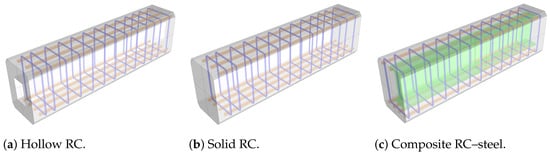
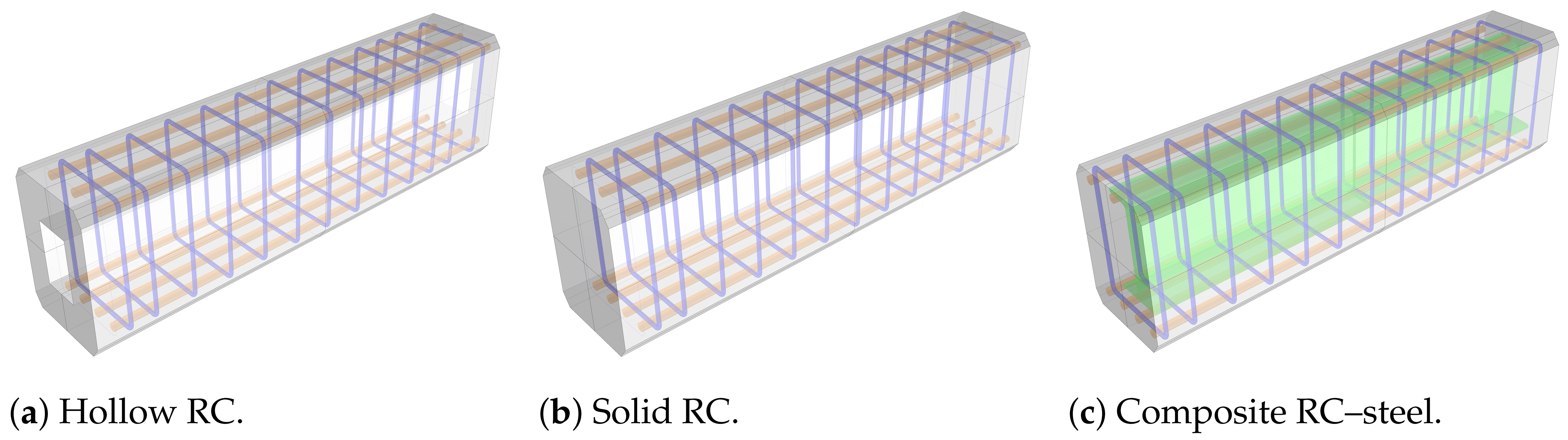
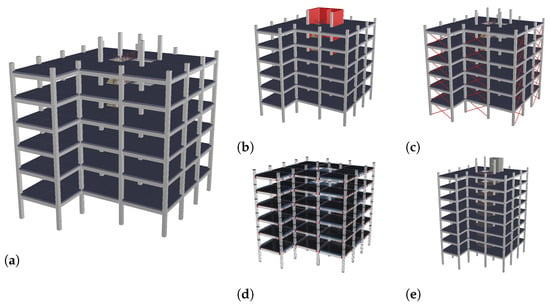
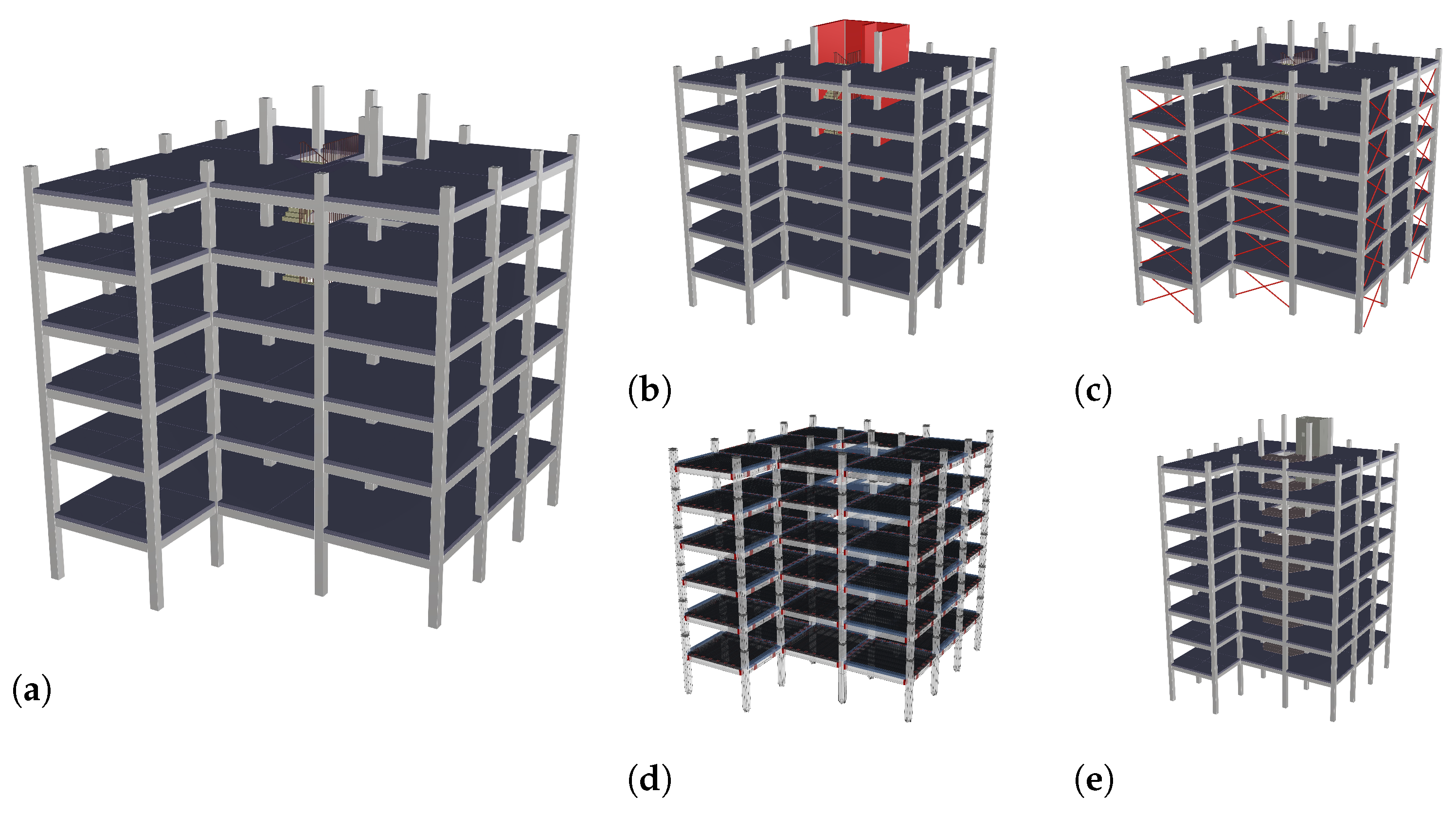
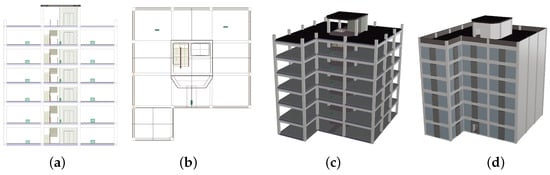
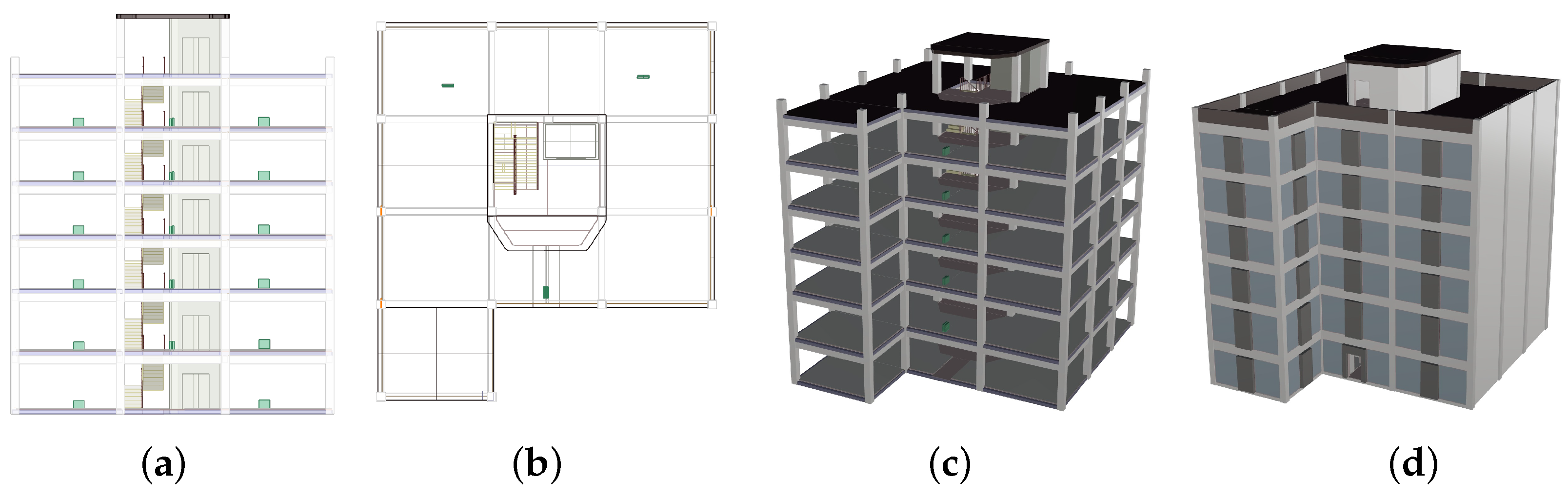
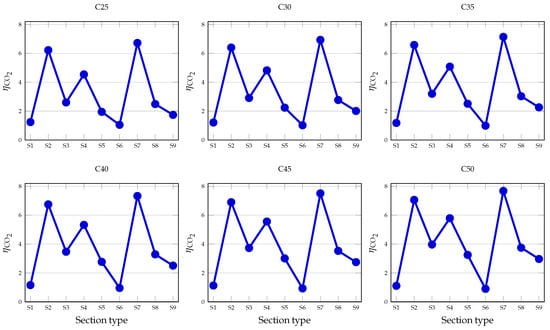
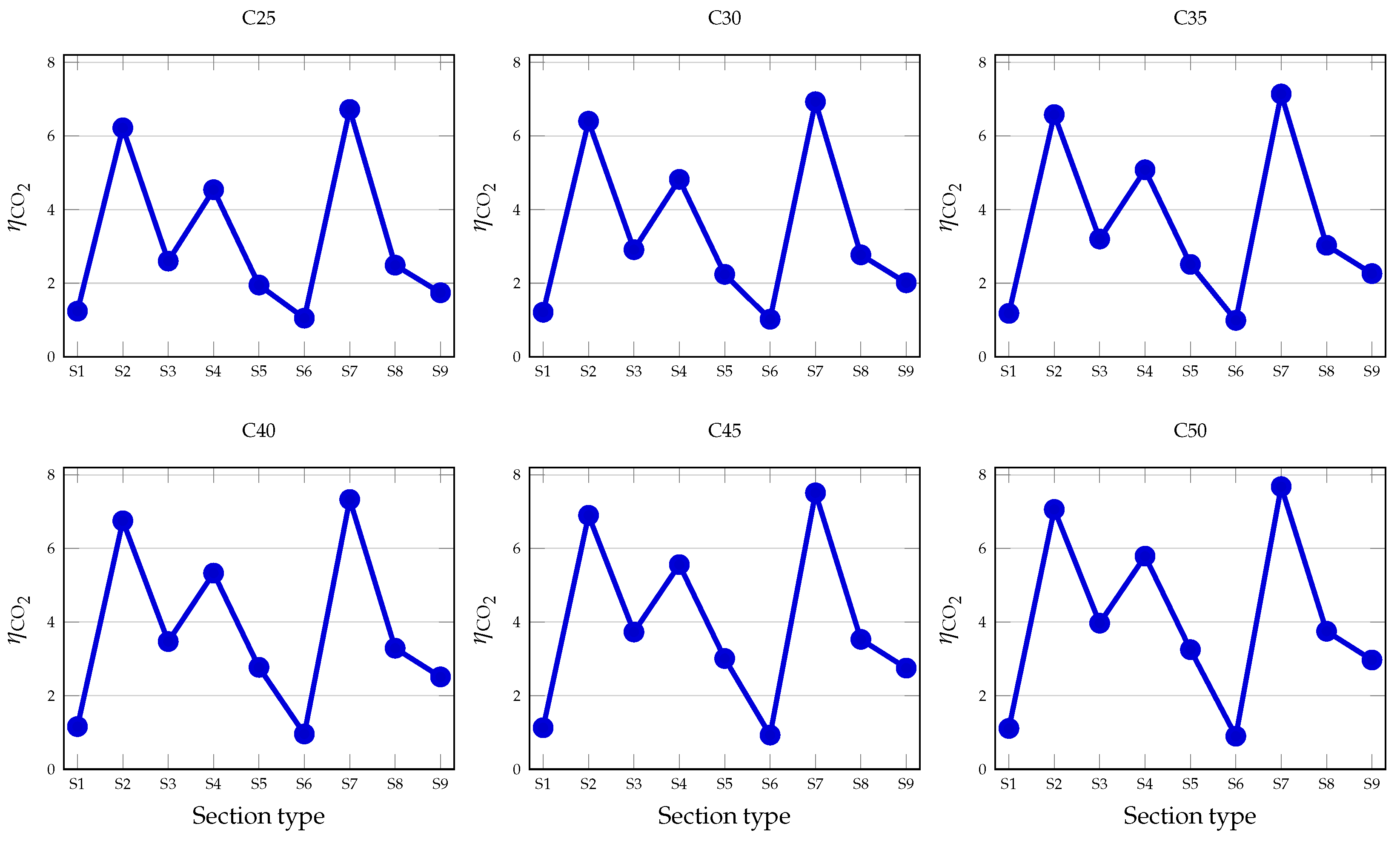
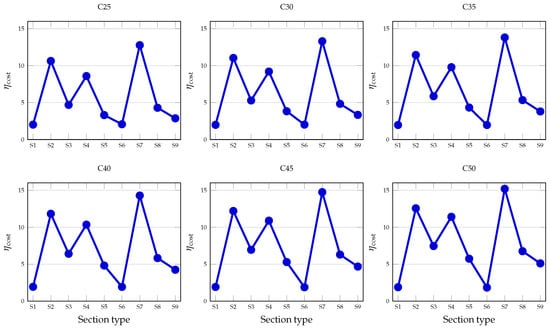
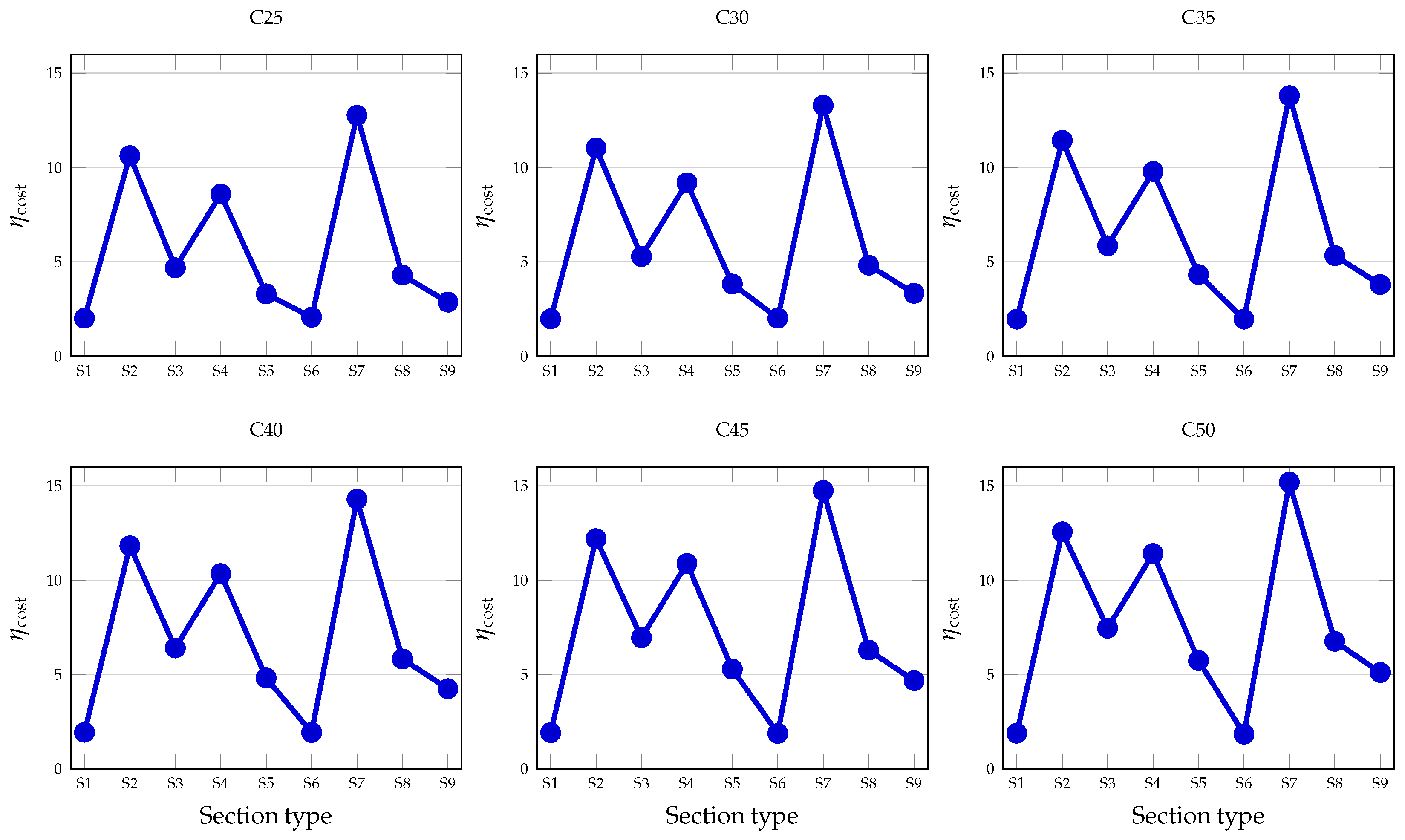
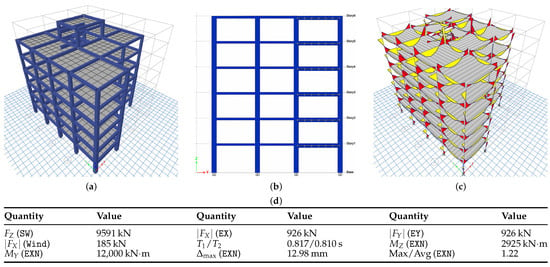
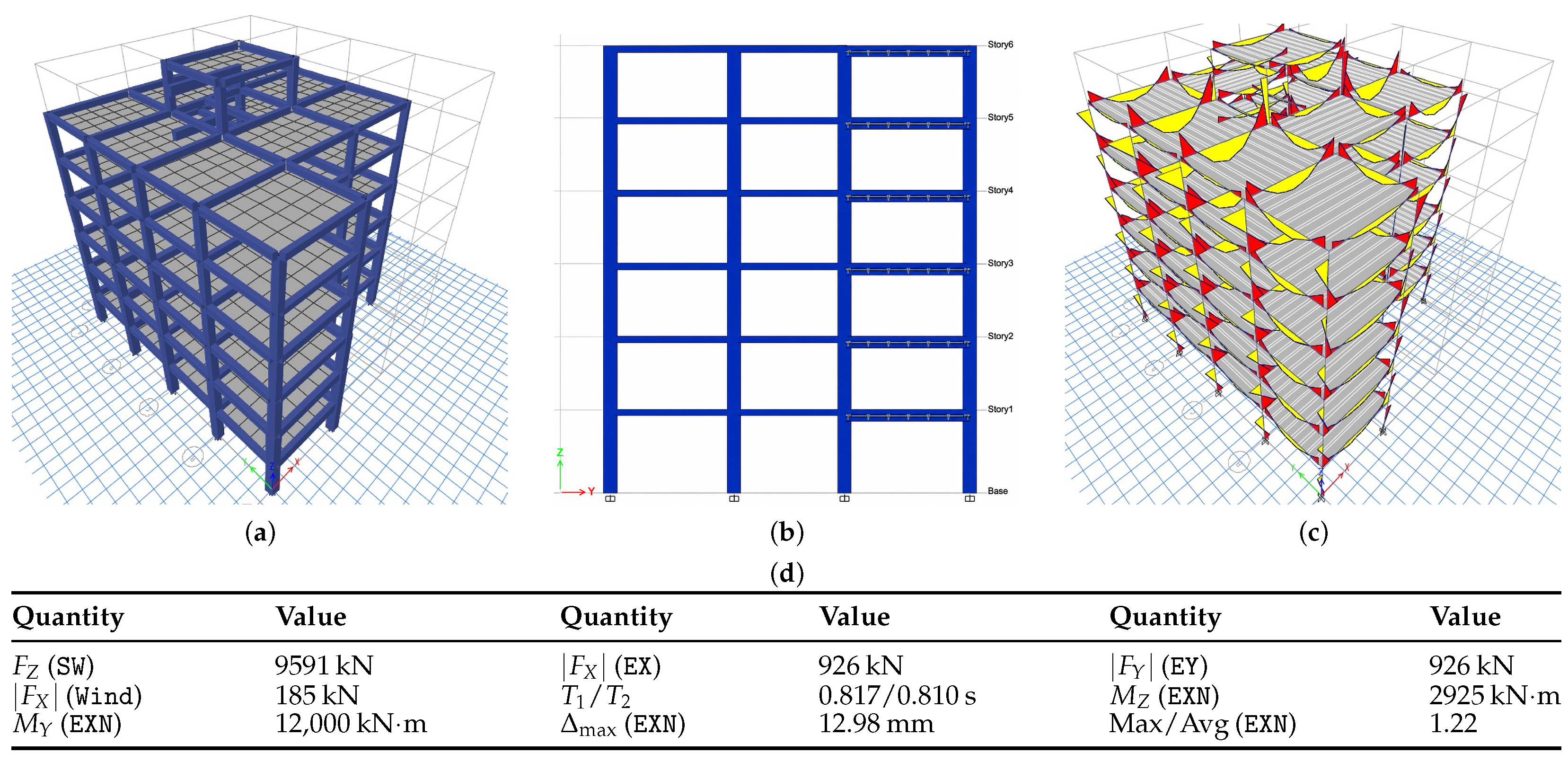
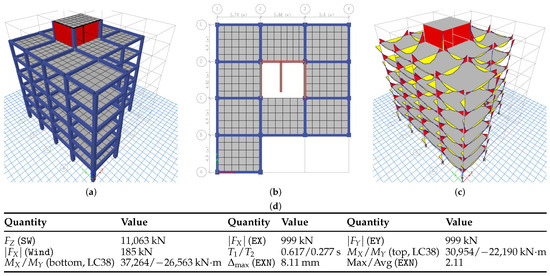
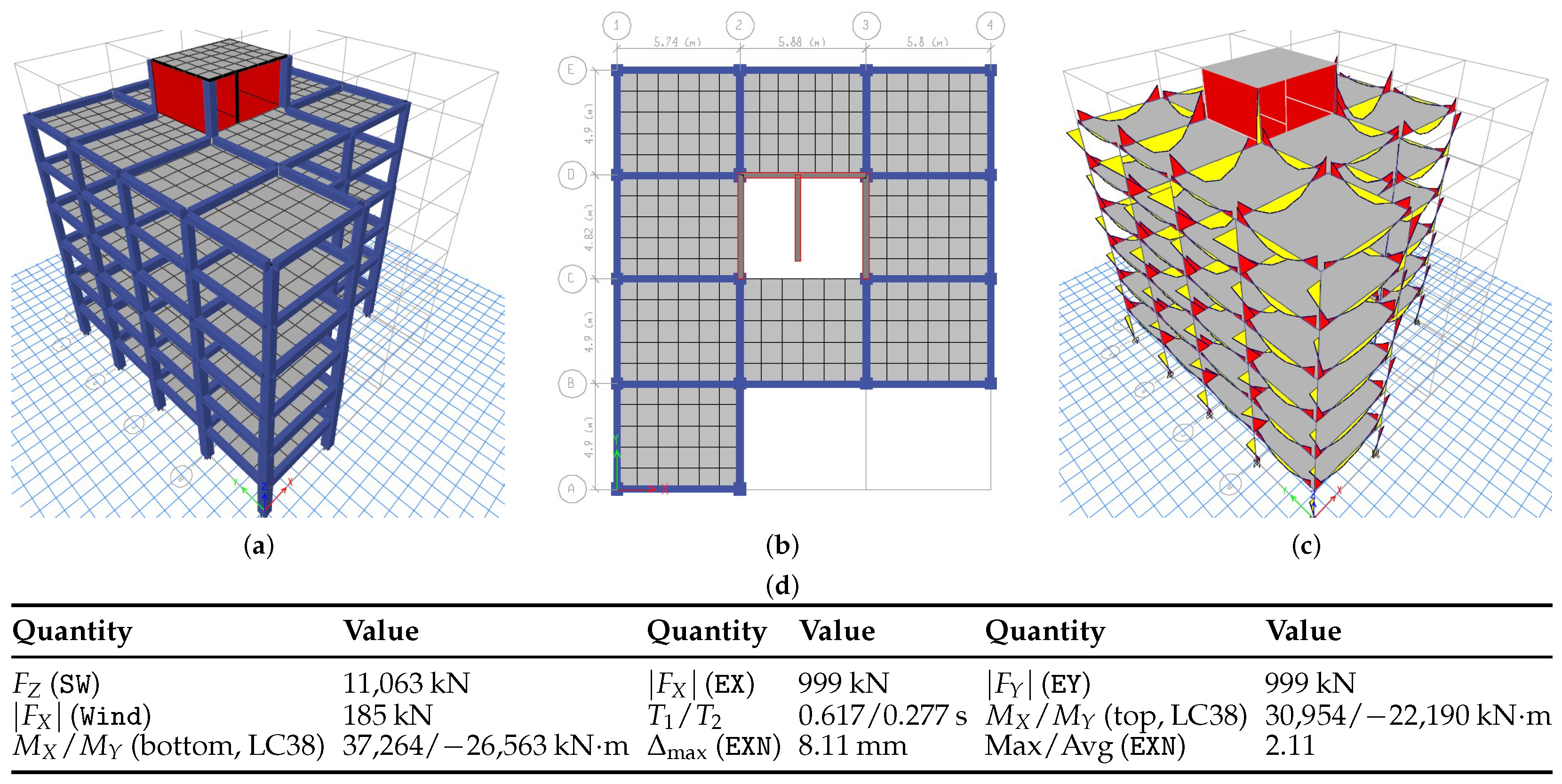
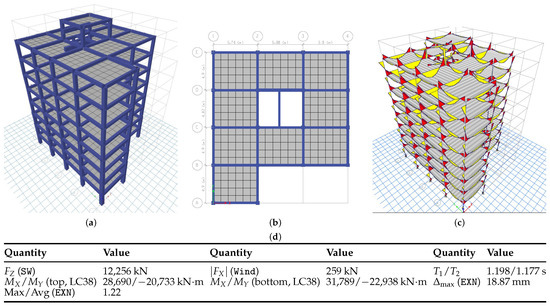
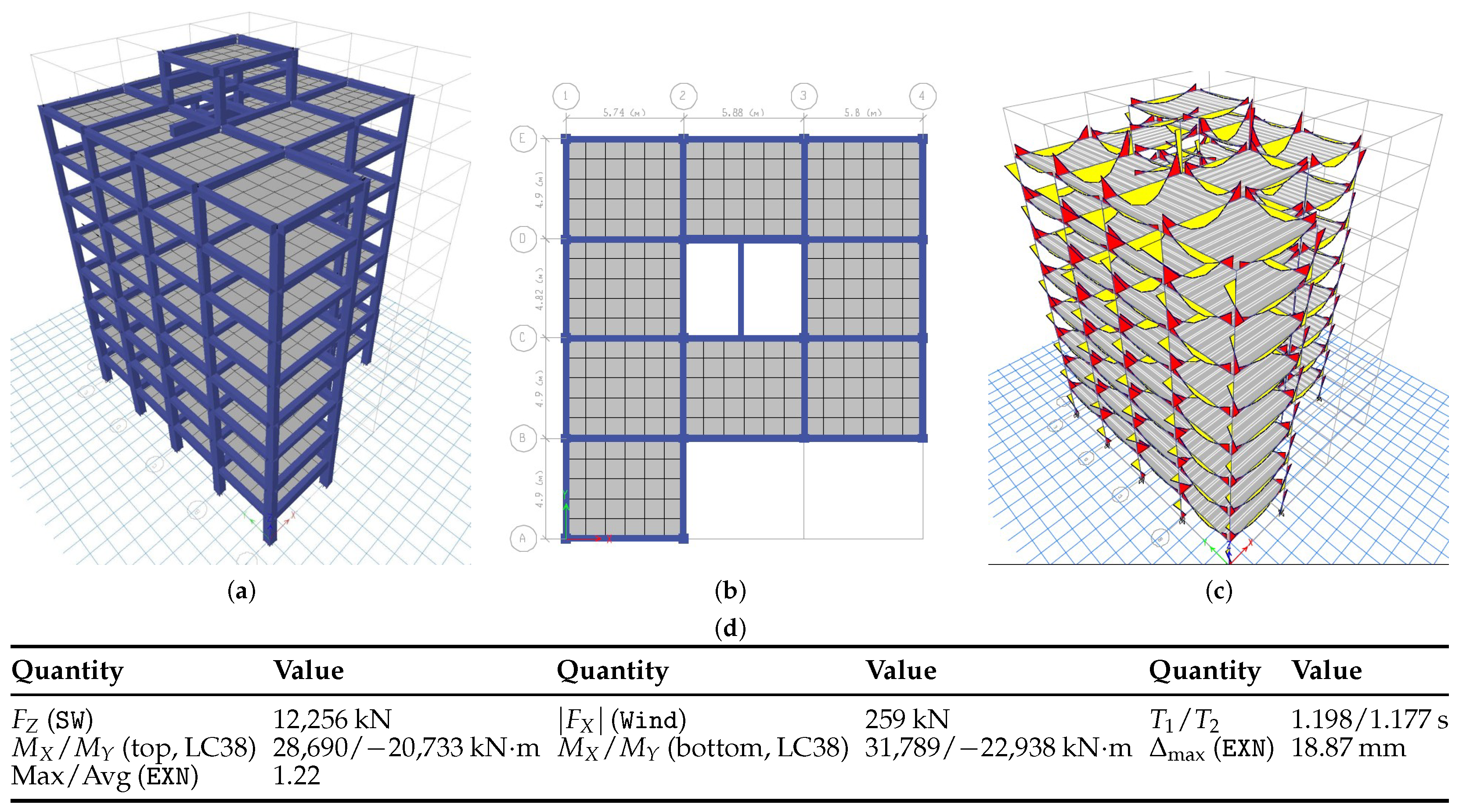
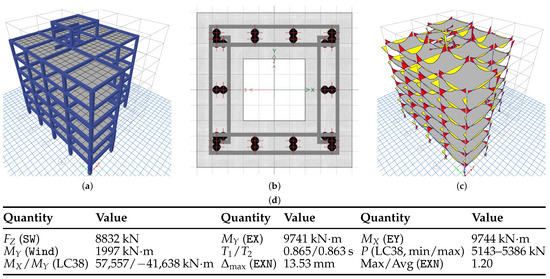
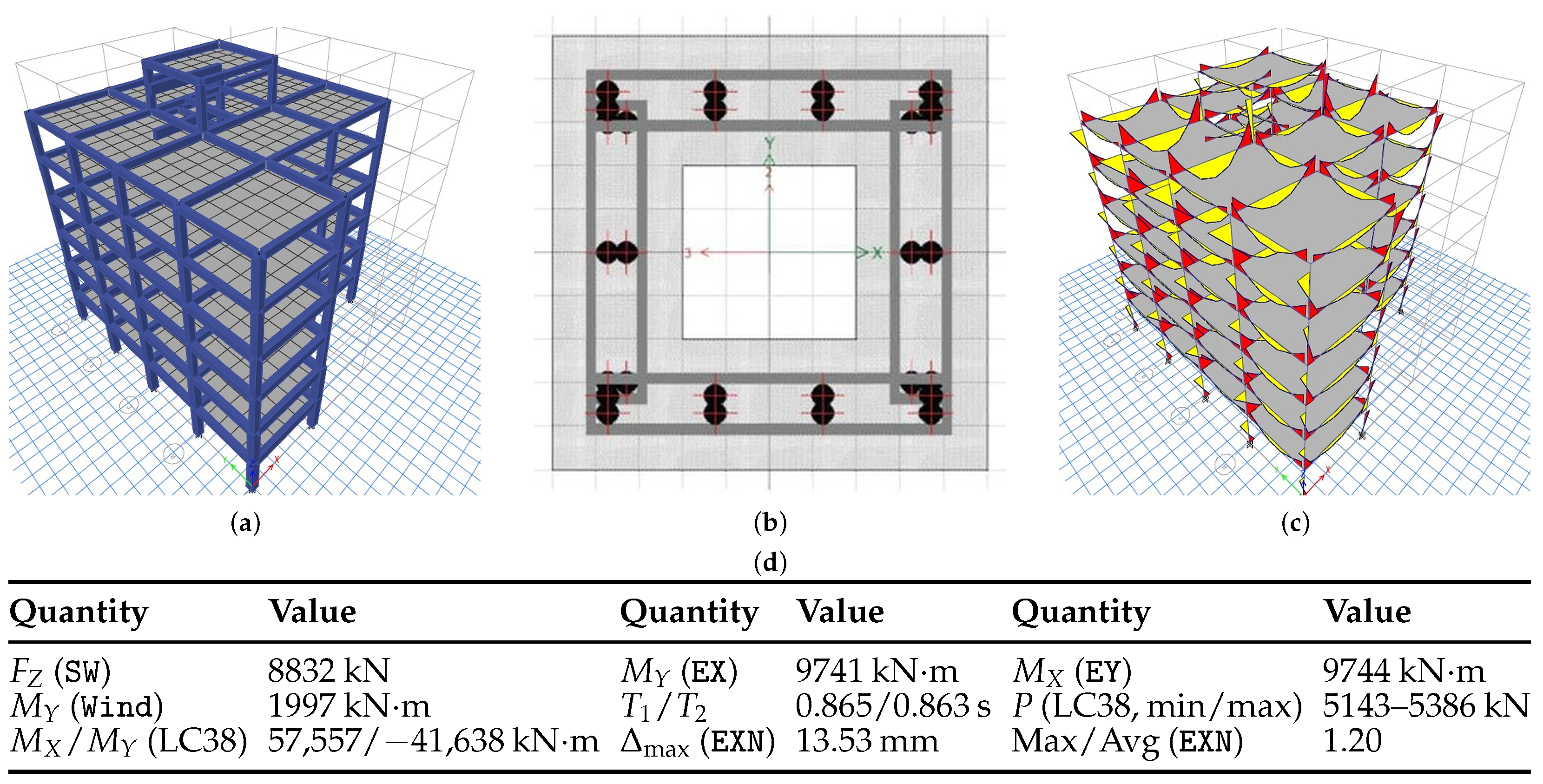
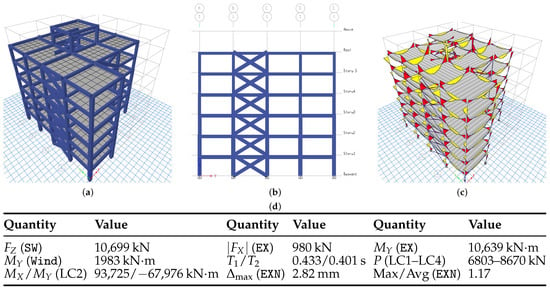
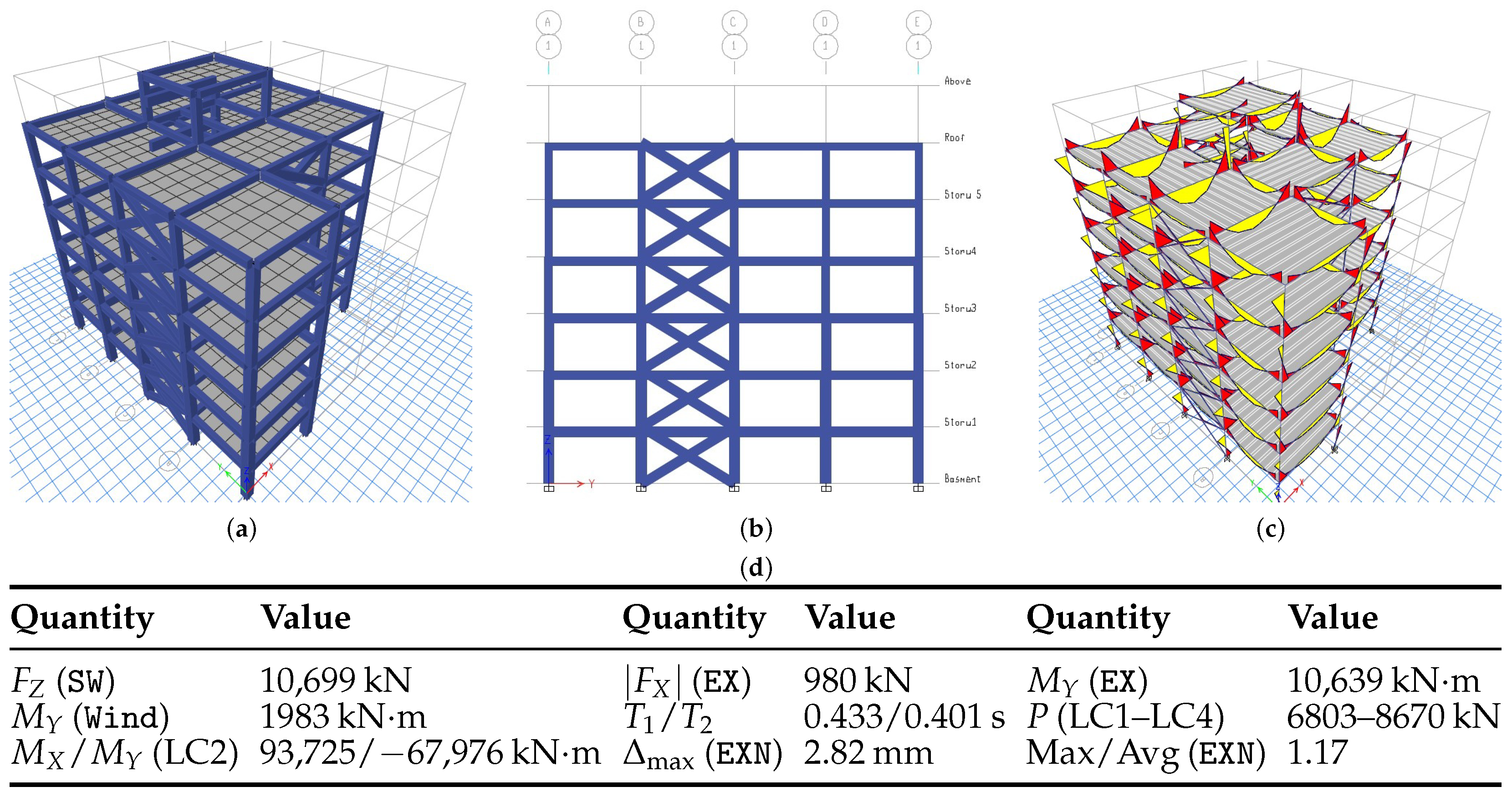
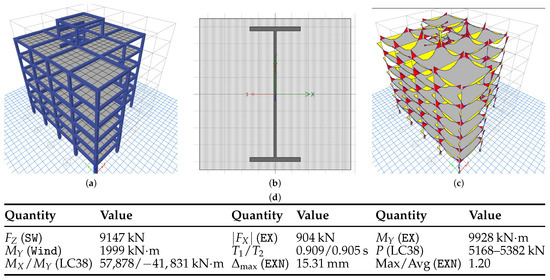
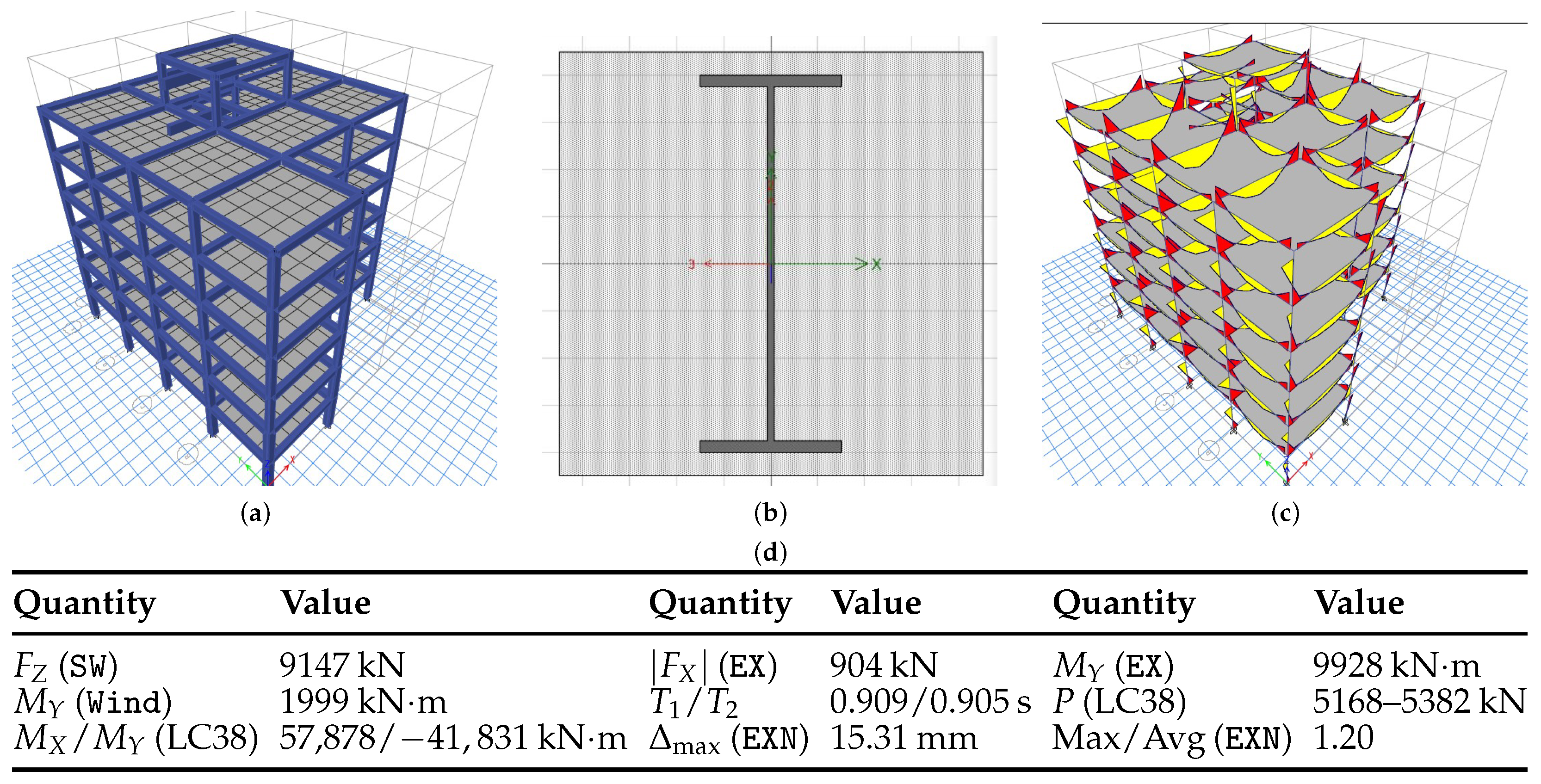
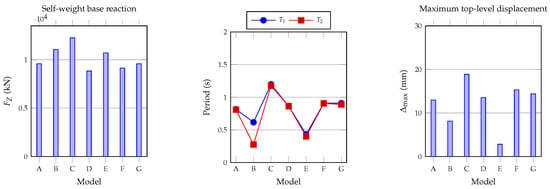
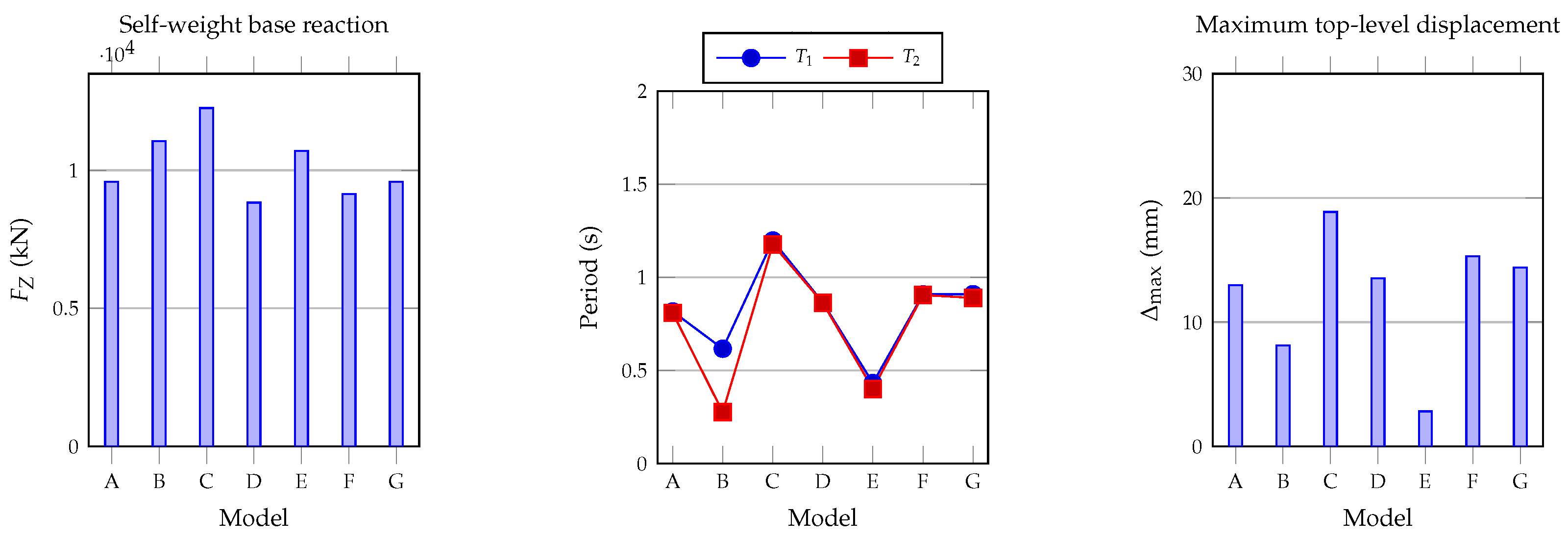
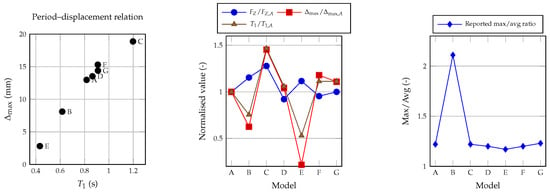
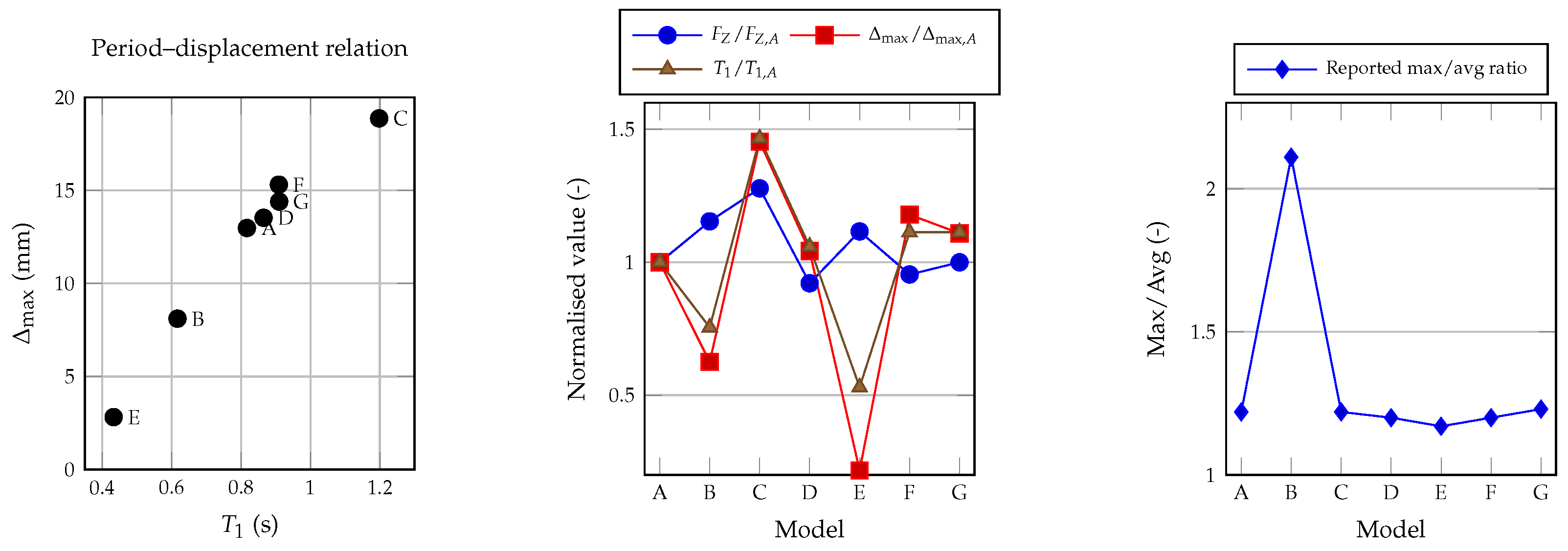

Disclaimer/Publisher’s Note: The statements, opinions and data contained in all publications are solely those of the individual author(s) and contributor(s) and not of MDPI and/or the editor(s). MDPI and/or the editor(s) disclaim responsibility for any injury to people or property resulting from any ideas, methods, instructions or products referred to in the content. |
© 2026 by the authors. Licensee MDPI, Basel, Switzerland. This article is an open access article distributed under the terms and conditions of the Creative Commons Attribution (CC BY) license.