1. Introduction
Urban streets are not merely infrastructure for movement. As socio-spatial systems, they are the primary settings in which residents experience neighborhood quality, thermal environment, and community life. For this reason, the capacity of streets to support diverse and sustained human activity, broadly termed street vitality, has been a central concern in urban planning and design for over six decades [
1,
2,
3,
4]. Vibrant streets are associated with improved physical health, stronger local economies, and greater perceived safety. Residents’ perception of street quality has been shown to predict subjective well-being more reliably than objective physical measurements alone, and recent studies confirm that the mismatch between street space quality and residents’ subjective well-being represents a critical governance gap in urban areas [
5,
6,
7].
This research tradition developed almost entirely within temperate, high-density, pedestrian-oriented cities of North America and Northern Europe. In hot–arid regions, which collectively house hundreds of millions of people across many parts of the world, street vitality operates under fundamentally different constraints. Peak daytime air temperatures routinely exceed 45 °C during summer months. Intense solar radiation renders outdoor exposure physiologically stressful for extended portions of the year. It adapts by compressing viable pedestrian activity into shaded micro-zones and shifting to evening and early morning windows. Standard vitality frameworks, however, were not designed to capture this temporal and spatial adaptation [
8,
9].
In this study, a street is defined as a hybrid socio-spatial system, a movement corridor, a public space, and a site of everyday interaction, whose performance is shaped by the interaction of urban morphology, environmental exposure, and lived use. This definition is particularly consequential in hot–arid cities, where a street may be geometrically well-connected yet thermally hostile, or spatially improved yet socially underused.
Riyadh, the capital of Saudi Arabia, provides a particularly rigorous case for testing a climate-responsive street vitality framework. Its population exceeds seven million and is projected to reach twelve million by 2040, placing intense pressure on public-realm provision. Much of the city’s residential fabric reflects car-oriented growth patterns with wide arterial roads, discontinuous pedestrian paths, and severely limited shade provision [
10,
11]. During peak summer months, daytime air temperatures in Riyadh frequently exceed 45 °C [
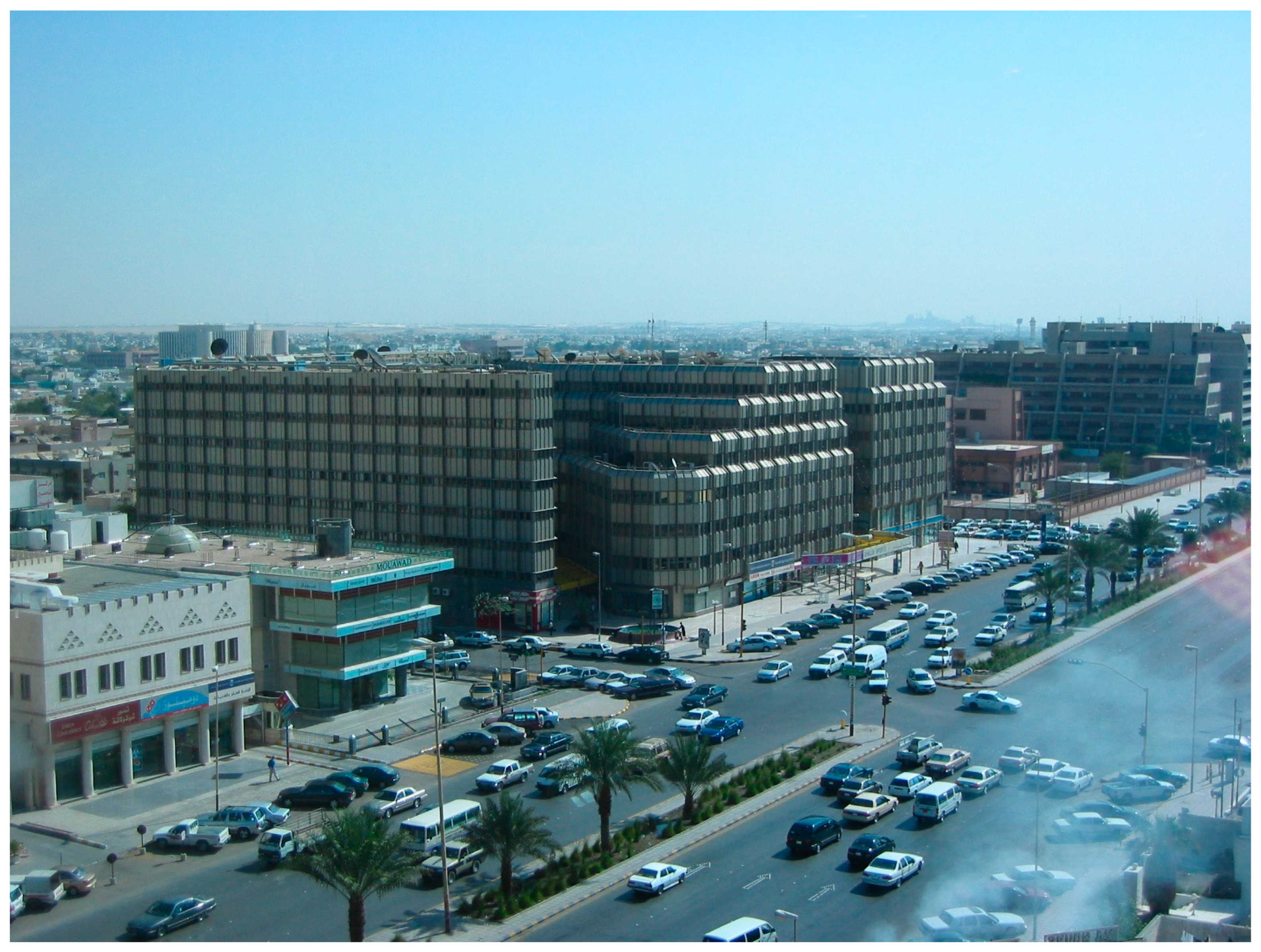
12], with outdoor spaces reaching temperatures that render sustained pedestrian activity physiologically hazardous for much of the day (
Figure 1). In this study, extreme thermal conditions refer to combinations of high air temperature and intense radiant heat exposure sufficient to substantially reduce pedestrian thermal tolerance, conditions distinguishable from formal thermal indices such as PET, which is not directly measured in this study but is referenced in the literature review as the established scientific framework for understanding outdoor thermal stress thresholds [
13,
14,
15].
Street use in Riyadh is further shaped by context-specific sociocultural patterns, such as gendered mobility practices that limit women’s independent participation in street-level public life, a strong preference for family-oriented outdoor environments, and a temporal shift in social activity toward evening and post-sunset hours [
12,
16]. These conditions are only partially legible to canonical vitality frameworks. Jacobs’s [
1] “eyes on the street” concept presupposes that people have the option and desire to linger outdoors. Gehl’s [
17] observational audit protocol does not account for thermal stress thresholds. Ewing and Clemente’s [
4] psychometric instrument was calibrated entirely in North American cities. Walk Score-type walkability indices measure physical distance but treat all outdoor conditions as equally navigable, regardless of microclimate or thermal exposure. As a result, there is a well-defined methodological gap, not simply a geographic one, but the absence of a validated framework for hot–arid cities that combines contextual sensitivity with psychometric rigor and spatial analytical structure [
18,
19].
The most methodologically rigorous vitality tools lack climatic transferability. The most contextually sensitive Gulf city studies lack empirical validation. Climate-responsive biophysical modelling has advanced significantly through tools like ENVI-met (Version 5.5.1) but these simulations are rarely tested against what residents actually report experiencing [
20]. Meanwhile, resident-centered research confirms that subjective street quality perceptions predict well-being more strongly than objective physical measurements alone
To bridge this divide, this study develops and validates the Resident-Centered Street Vitality Framework (RCSVF) through mixed-methods fieldwork across nineteen distinct Riyadh neighborhoods. The RCSVF treats resident perception not as supplementary evidence, but as a primary measure of street performance, one that must be interpreted alongside physical observation and GIS-based morphological analysis. The research pursues three specific objectives: (a) to identify and evaluate the factors that drive perceived street vitality under hot–arid conditions, (b) to examine how perceptual dimensions relate to physically observed and spatially measured street variables, and (c) to validate a scalable assessment index applicable across diverse neighborhood types in hot–arid cities.
2. Literature Review
The capacity of urban streets to support diverse human activity—broadly termed street vitality—has been a focal point of urban research for over six decades. Over time, the tools used to measure this vitality have become highly precise. Yet, as these methods gained methodological rigor, their geographic relevance shrank. Nearly every validated vitality instrument was built and calibrated in a temperate, Global North city. For hot–arid cities like Riyadh, where Saudi Vision 2030 has made street vitality an explicit policy target [
21], this creates a serious operational gap. Large-scale public investment is being currently poured into streetscapes without a validated, resident-centered way to measure success. To understand why this gap persists, this review examines four overlapping areas of research: street vitality measurement, outdoor thermal comfort, resident-centered assessment, and Gulf city urban quality.
2.1. Street Vitality Measurement: Established Frameworks and Their Limits
The observational tradition provides the foundation for modern vitality metrics. Whyte [
22] and later Gehl and Svarre [
23] created the standard protocols for mapping activity and rating physical quality across dozens of cities. Ewing and Clemente [
4] pushed this further by reliably measuring five core urban design qualities. Their rigorous, observer-based tool serves as a direct methodological baseline for the RCSVF. Mehta [
24] moved the field closer to a resident-inclusive approach by combining surveys with behavioral counts, proving that the physical and social dimensions of vitality are distinct but deeply linked.
However, these frameworks share a critical limitation: the observer holds the evaluative authority, not the resident. Furthermore, because they were developed exclusively in North America and Northern Europe, they assume that daytime street activity is the ultimate signal of a healthy street. In hot–arid settings, this premise simply does not hold. As Carmona [
25] points out, there is a stark dichotomy between a street’s physical layout as mapped by an observer and the subjective, lived experience of the people using it. Understanding spatial quality directly through the user’s lens is now essential for effective urban governance.
2.2. Digital and Data-Driven Vitality Assessment
A newer wave of research trades human observers for algorithms. Machine learning and urban big data have allowed scholars to measure vitality on a massive, highly scalable level. Some integrate point-of-interest density, GPS trajectories, and social media data. Others use convolutional neural networks to extract walkability scores directly from Google Street View imagery [
26,
27,
28,
29].
These models predict pedestrian counts incredibly well. Yet, because their algorithms are trained on temperate cities, they completely miss the reality of extreme heat. Studies in Gulf cities have shown that deep learning models systematically misclassify the exact features that make hot–arid streets functional, such as colonnades, shade canopies, and enclosed pedestrian walkways [
30,
31,
32]. Machine learning models trained on temperate-city data cannot account for resident-level thermal experience or culturally specific spatial values. Those are precisely the variables the RCSVF is designed to operationalize.
2.3. Outdoor Thermal Comfort in Hot–Arid Environments
While urban designers and data scientists missed the heat factor, outdoor thermal comfort researchers have tackled it directly. This body of literature provides the empirical grounding for the RCSVF’s climatic dimension. The thermal reality is well-documented, but its influence on neighborhood experience as perceived by residents has not been systematically integrated into vitality assessment frameworks [
33,
34,
35]. But again, this adaptive model was built in Europe. It requires recalibration for cities where the Physiologically Equivalent Temperature (PET) routinely breaks 50 °C.
Potchter et al. [
36] showed that residents of hot–arid cities actually have higher heat tolerance thresholds. However, they stop going outside much more abruptly when temperatures peak, and they value shade far more than a cooling breeze. Microclimate studies back this up. In Phoenix and Las Vegas, cities with climates similar to Riyadh, street geometry and tree canopies can drop mean radiant temperatures by up to 15–16 °C, physically dictating when people can step outside [
37,
38]. Acero and Krayenhoff proved that targeted shading interventions can drop PET by 3–5 °C, a finding strongly supported by contemporary research on the efficacy of vegetative shading in extreme heat [
39].
The science of how heat affects the human body is excellent. What is missing is a way to link that thermal reality to a multidimensional vitality instrument. We know the heat is there, but we have not systematically measured how it shapes the neighborhood experience from the resident’s own point of view.
2.4. Resident-Centered Assessment and Gulf City Evidence
The participatory turn in urban research attempts to capture exactly that point of view. While thermal comfort models define the environmental boundaries of street life, subjective well-being research shows us how people actually navigate them. Mouratidis [
5] demonstrated that perceived street quality predicts a person’s well-being much more strongly than objective physical measurements. Recent studies confirm that subjective environmental perceptions simply explain more about urban quality than hard spatial metrics do [
40,
41,
42].
Standard, climate-neutral design metrics fail because they ignore extreme heat, nighttime activity shifts, and local cultural behaviors. Manavvi and Rajasekar [
43] proved this need for contextual tools, showing that objective microclimate models often fail to capture the subjective thermal comfort thresholds of residents in Indian subcontinent cities. Looking specifically at Riyadh, the city’s shift from a dense, thermally shaded Najdi vernacular to a sprawling, car-centric grid is well-documented [
44]. Today, efforts to reverse this trend, such as the Humanization of Cities initiative, are fighting an urban heat island effect that is rising by roughly 0.07 °C every year [
45].
Yet, the regional literature on Gulf cities remains methodologically stuck. Foundational scholars successfully identified the correct local variables. However, they stopped short of validating their theoretical frameworks using rigorous statistical tools like factor analysis. Qualitative insight is crucial, but it cannot substitute for empirical validation.
2.5. Synthesis: Patterns, Contradictions, and the Research Gap
Looking across these four areas of research, a clear divide emerges. The most methodologically rigorous tools lack geographic transferability to hot–arid contexts, while the most contextually aware studies lack psychometric rigor. Street vitality metrics evolved without expanding to extreme climates. Thermal comfort models improved without integration into broader urban quality frameworks. Gulf city research identified local needs but rarely validated the instruments used to measure them.
This study addresses the gap by developing the RCSVF through reliability testing (Cronbach’s α > 0.87), criterion validity (rs = 0.790), and spatial benchmarking across 19 neighborhoods. It responds to calls for psychometric rigor as argued by Ewing & Clemente [
4], and climate-responsive benchmarks, providing an evaluative tool aligned with Saudi public-realm goals.
3. Materials and Methods
To bridge the methodological gaps identified in the literature, this study did not simply adapt an existing walkability metric. Instead, it built a new instrument. The research triangulates three distinct data streams that no prior hot–arid study has successfully combined into a single, validated framework.
3.1. Study Design
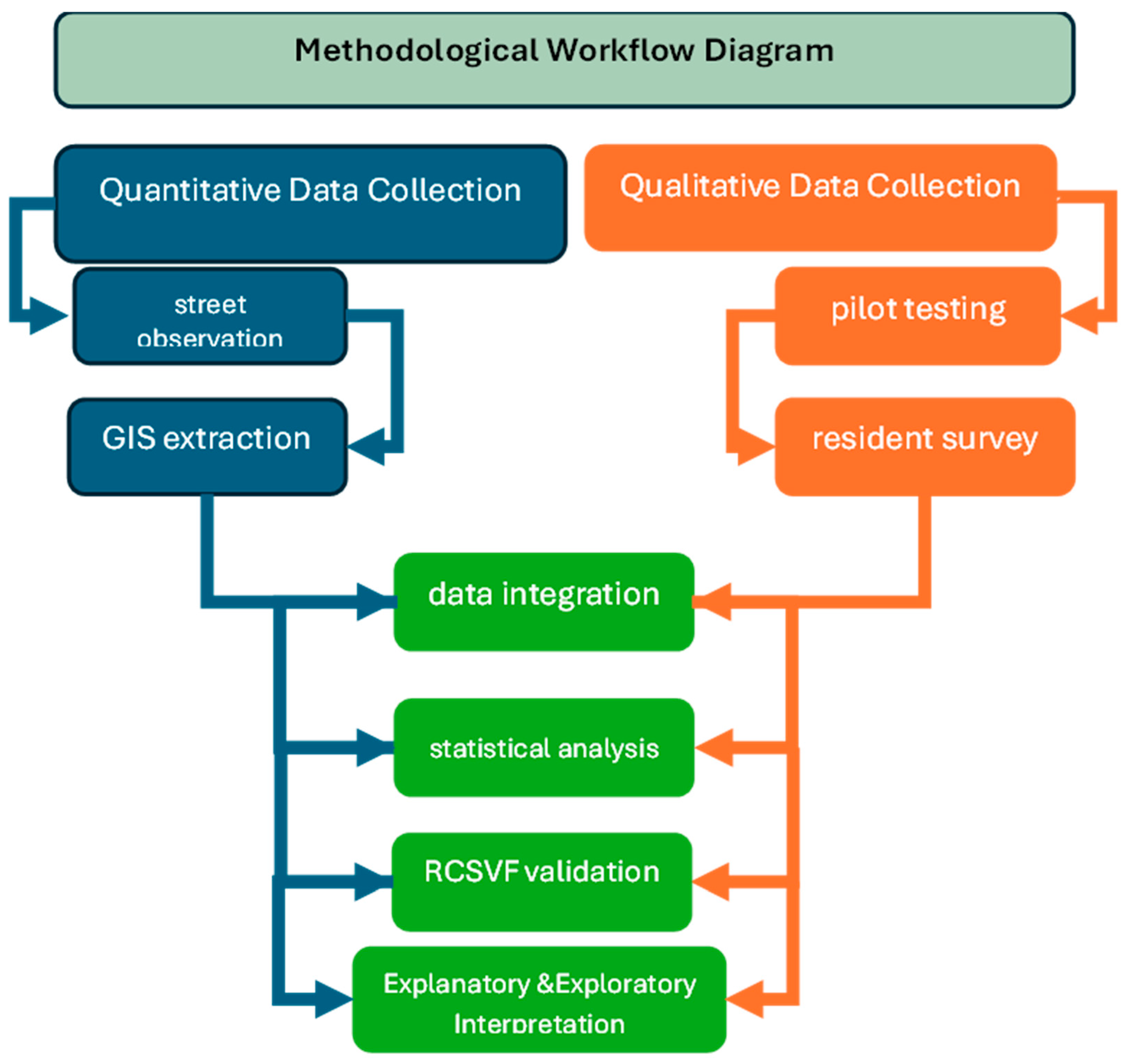
The research utilized a cross-sectional, quantitative design to integrate structured resident surveys, systematic physical street observations, and GIS-based morphological analysis. By treating these three data streams as convergent, we could directly compare how residents perceive their streets against objectively measured physical realities (
Figure 2).
Fieldwork took place between September and December 2025. The research team purposively selected nineteen residential neighborhoods across Riyadh’s five geographic sectors: the north (Al-Falah, Al-Waaha, Al-Sahafa, Al-Aqiq), east (Al-Rawdah, Al-Naseem, Al-Jazeera, Hamra), west (Al-Raed, Al-Urayjah, Al-Nakheel), center (Umm Saleem, Al-Shumaisi, Al-Malaz), and south (Al-Suwaydi, Al-Aziziyah, Al-Dar Al-Bayda). This selection captured a wide spectrum of urban density, land-use mixes, street configurations, and housing types. With ambient temperatures routinely exceeding 45 °C, intense solar radiation, and frequent dust events, Riyadh serves as the ultimate stress test—and the most informative setting—for validating a climate-responsive vitality framework.
3.2. Ethics Statement
Because the research was non-interventional and did not collect sensitive health data or involve clinical procedures, formal ethical approval was not required by the host institution. However, strict ethical standards were maintained throughout the fieldwork. Research assistants informed all participants about the study’s purpose, the voluntary nature of their involvement, and the strict anonymity of their responses. We secured written informed consent from every respondent before administering the survey.
3.3. Participants
The target population comprised adults (18 years or older) who had resided in their respective neighborhoods for at least one month. Using a stratified purposive sampling approach, the research team recruited 1102 residents distributed proportionally across Riyadh’s five geographic sectors. An additional 418 participants completed the supplementary visual preference survey. Participants’ characteristics are presented in
Table 1.
The sample reflects the context-specific social dynamics of outdoor public life in Saudi Arabia. The gender composition (69.4% male) is not an oversight but a structural characteristic of who accesses neighborhood streets as independently mobile residents, a pattern consistent with Gulf city urbanism literature. Owner-occupiers and villa residents rated their streets more positively than renters and apartment residents, a pattern explored further in
Section 4.6.
3.4. Instruments and Data Collection
Data collection proceeded in three overlapping phases, each designed to capture a different facet of street quality. First, we developed the household survey by adapting validated street quality scales into Arabic, which was then pilot-tested with 20 residents. The final instrument contained four sections: demographics; an eight-item Environmental Quality rating scale (assessing elements like pavements, parks, and cleanliness on a 5-point Likert scale); a twelve-item Service Proximity scale; and a seven-item Residential Satisfaction subscale that included binary activity tracking. Trained research assistants administered these surveys face-to-face to ensure the questions were fully understood.
The second phase measured the physical environment. We conducted systematic observations on ten representative street segments per neighborhood (133 segments total), capturing diverse street widths and land-use frontages. Two independent observers rated each segment across 35 physical quality indicators, such as shading, boundary permeability, and street furniture, using a ten-point scale (
Table 2). This process adhered to established observational protocols by Ewing and Clemente [
4] and Gehl and Svarre [
23].
Finally, the third phase grounded this perceptual and observational data in physical space. We extracted GIS-based morphological variables, including building coverage ratios, green area percentages, and intersection density, from municipal cadastral data and satellite imagery.
3.5. Outcome Measures
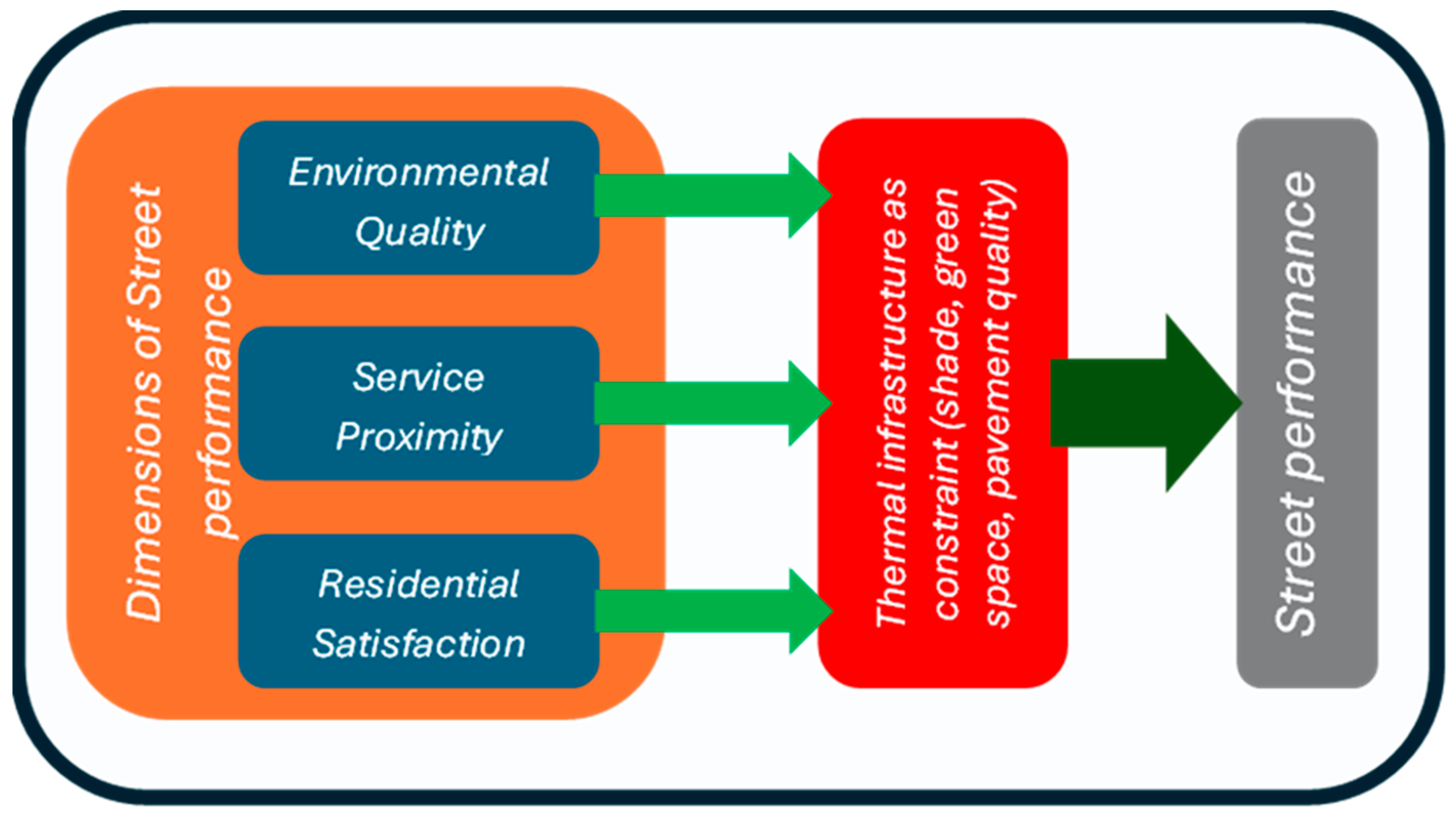
The primary outcome variable was resident-perceived street quality, calculated as the composite mean score of the Environmental Quality subscale. Secondary outcomes included overall residential satisfaction, perceived service accessibility, and pedestrian activity engagement. Crucially, the composite physical observation score for each neighborhood served as an independent criterion variable. By benchmarking the subjective survey responses against these objective physical scores, the study captures the social, behavioral, and mobility dimensions of street vitality required for a truly resident-centered framework (
Figure 3).
3.6. Statistical Analysis
All data were analyzed using IBM SPSS Statistics (Version 28.0). We calculated descriptive statistics, including means and standard deviations, at both the sector and neighborhood levels. Subscale internal consistency was verified using Cronbach’s alpha, utilizing 0.70 as the baseline for acceptability.
To test spatial differences across the city, we applied one-way ANOVAs (when Shapiro–Wilk tests confirmed normality) or Kruskal–Wallis H tests with Dunn’s post hoc comparisons and Bonferroni corrections for non-parametric data. We used Spearman rank-order correlations to assess the relationship between resident survey scores and physical observation domains. Finally, multiple linear regression models identified how strongly specific observational and morphological variables predicted resident-perceived quality. Assumptions of linearity, homoscedasticity, and multicollinearity were rigorously verified before model entry. We set the significance threshold at α = 0.05 and reported effect sizes as eta squared and Cohen’s f
2, interpreted according to Cohen [
46].
Exploratory factor analysis (principal axis factoring, varimax rotation) and confirmatory factor analysis (robust maximum likelihood) were conducted to validate the three-factor structure of the RCSVF. Model fit was evaluated using CFI, TLI, RMSEA, and SRMR, with benchmarks following Hu and Bentler [
47].
3.7. Alignment of Research Objectives, Data Sources, and Analytical Methods
To clarify the methodological design,
Table 3 maps each research objective to its corresponding data source and analytical procedure.
4. Results
Riyadh’s streets are not uniformly deficient, but unequally so. Across the data, a consistent narrative emerges. What residents most acutely miss is not beautification, but shade, walkable access, and a sense of ownership over their immediate environment.
4.1. Instrument Reliability and Descriptive Overview
Internal consistency was confirmed for all three Likert-based subscales prior to inferential analysis (
Table 4). All alpha values substantially exceeded the conventional acceptability threshold of 0.70. Across the full sample (N = 1102), perceived Environmental Quality averaged (M = 3.79, SD = 0.66). Service Proximity scored (M = 3.71, SD = 0.58), and Residential Satisfaction registered (M = 3.64, SD = 0.73). Neighborhood-level aggregates (N = 19) were used for regression benchmarking.
4.2. Item-Level Pattern and the Thermal Infrastructure Deficit
Breaking down the Environmental Quality subscale reveals a distinct hierarchy tied directly to thermal comfort. Safety and security rated highest (M = 4.12, SD = 0.90), followed by overall neighborhood quality (M = 4.02) and housing quality relative to the neighborhood (M = 3.97). Mid-range scores appeared for public services (M = 3.79), street condition (M = 3.72), and cleanliness (M = 3.67).
The two lowest-rated items dictate thermal survival: pedestrian movement and pavement condition (M = 3.60, SD = 0.91), and street trees and green space (M = 3.42, SD = 1.07). The green space metric exhibited the widest inter-respondent variability of any item in the survey. This is not just an aesthetic shortfall. Interpreted through Middel et al. [
48] and Potchter et al. [
36], this deficit signals that the green infrastructure gap is experienced physically by residents. In a city where shade is a strict precondition for walking, pedestrian pavement conditions govern whether outdoor activity is physically possible during compressed, climate-tolerable windows.
The street observation survey (N = 418) corroborated this reality. The Environmental and Green dimension scored lowest among all thematic categories (M = 3.23). Strikingly, the single lowest-rated item across all 55 survey questions evaluated weather protection and shading provision (M = 2.69). Thermal infrastructure consistently emerges as the weakest dimension in Riyadh street upgrades, exposing a systemic planning vulnerability rather than a localized spatial deficit.
4.3. Spatial Variation: Sector and Neighborhood Inequality
The burden of these deficits is highly unequal. Kruskal–Wallis tests confirmed statistically significant differences across sectors for Environmental Quality (H = 63.72,
p < 0.001), Residential Satisfaction (H = 44.03,
p < 0.001), and Service Proximity (H = 22.11,
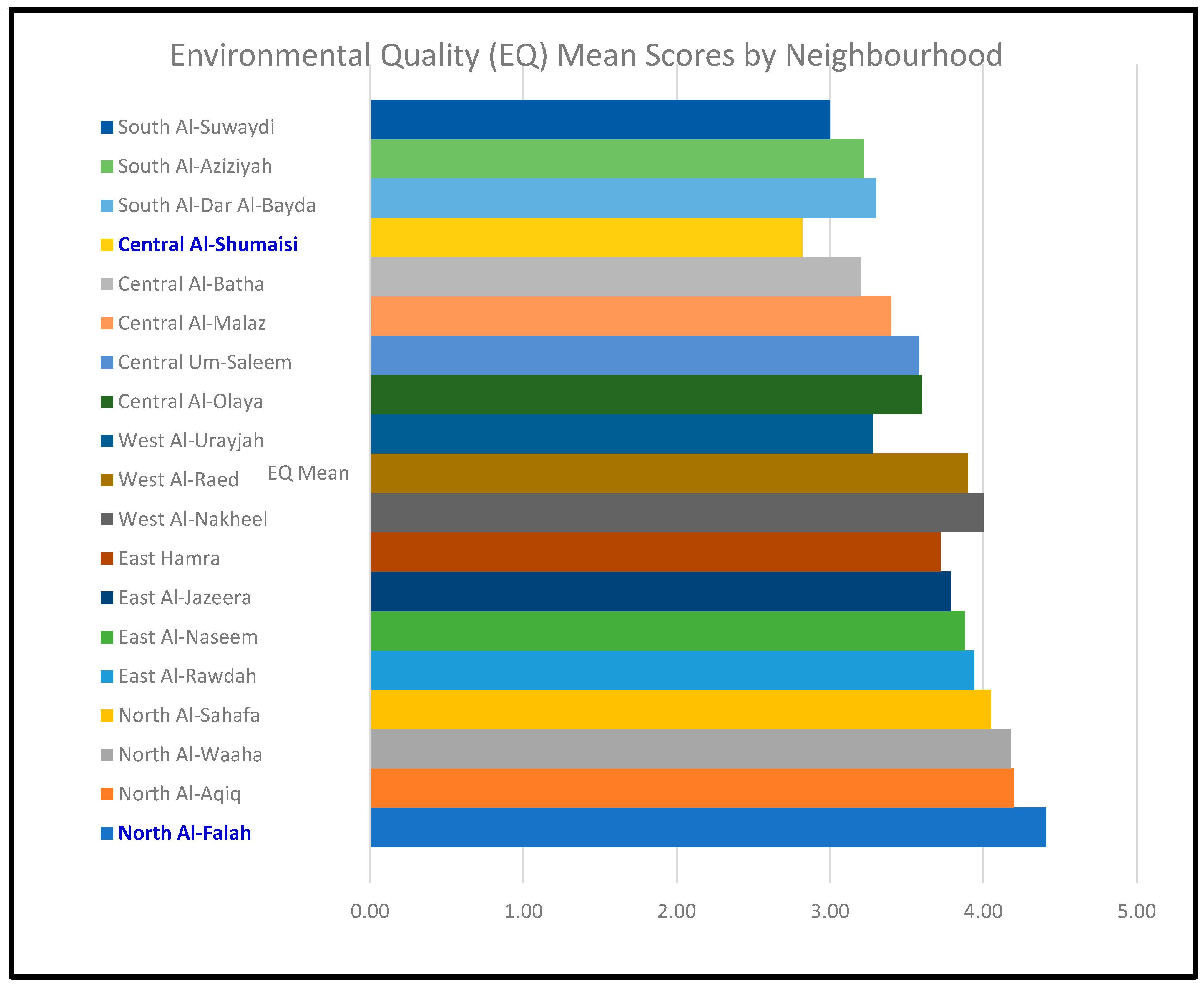
p < 0.001). The northern sector consistently led all measures (ENV: M = 4.20), while the central sector lagged considerably (ENV: M = 3.52). These sector-level patterns and neighborhood-level scores are presented in
Figure 4, which illustrates the spatial distribution of Environmental Quality across all 19 study neighborhoods.
At the neighborhood level, the Environmental Quality range spanned from Al-Falah (M = 4.41) in the north to Al-Shumaisi (M = 2.82) in the center. This gap of nearly two scale points represents more than two standard deviations. This is not a marginal statistical difference. It is the difference between a neighborhood where residents report their streets as genuinely good and one where everyday outdoor life feels chronically deficient. This disparity maps directly onto our physical observation data, where neighborhood composite scores ranged from 79.4 (Al-Raed) to 22.6 (Al-Urayjah). This alignment provides strong initial criterion validity for the RCSVF instrument (rs = 0.790,
p = 0.002) and confirms Mehta’s [
49] claim that physical quality structurally dictates street experience.
However, physical resources alone do not guarantee satisfaction. Al-Rawdah presents an instructive anomaly: it boasts relatively high Environmental Quality (M = 3.94) but the second-lowest Residential Satisfaction (M = 3.48). This divergence suggests that physical quality fails to generate satisfaction if social and recreational provisions are absent. Consistent with Carmona’s [
25] adaptive preference framework, the evaluative dimensions of public space operate as an interdependent cluster rather than isolated design variables.
4.4. Correlational Structure and Regression Analysis
What drives these disparities? Spearman intercorrelations among the three principal subscales were all strong and statistically significant. Crucially, the strongest dyadic relationship emerged between Service Proximity and Residential Satisfaction (rs = 0.747, p < 0.001). A resident’s overall contentment with their neighborhood is more tightly coupled to functional service accessibility than to physical environmental quality.
Regression analysis sharpens this picture. Simple linear regression confirmed that Environmental Quality alone explained 48.9% of the variance in Residential Satisfaction (β = 0.772, R
2 = 0.489,
p < 0.001), while Service Proximity alone explained 58.9% (β = 0.970, R
2 = 0.589,
p < 0.001). When combined in a multiple regression model (R
2 = 0.638), Service Proximity retained the dominant unique contribution (β = 0.691) relative to Environmental Quality (β = 0.344). All assumptions of linearity, homoscedasticity, and multicollinearity were satisfied prior to model entry (
Table 5).
The policy implication here is concrete. In Riyadh, resources directed at improving service proximity will yield roughly twice the satisfaction return of an equivalent investment in physical streetscape aesthetics. This directly challenges design-centric models. In extreme thermal environments, proximity and minimal walking distances are the true levers for enhancing resident well-being.
4.5. Factor Analysis (EFA/CFA) for Psychometric Validation of RCSVF
Exploratory factor analysis supported the proposed three-factor structure of the Resident-Centered Street Vitality Framework, corresponding to Environmental Quality, Service Proximity, and Residential Satisfaction. The instrument comprised 27 Likert-type items distributed across the three subscales already defined in the survey design. Sampling adequacy was strong (KMO = 0.89), and all retained items loaded above 0.60 on their intended factor, supporting the construct validity of the measurement model. Confirmatory factor analysis further supported the three-factor solution, with CFI = 0.96 and RMSEA = 0.05, indicating good overall model fit.
Exploratory factor analysis (principal axis factoring, varimax rotation) confirmed the three-factor structure (Environmental Quality, Service Proximity, Residential Satisfaction;
Table 6). All 27 items were retained (loadings > 0.60, communalities > 0.50). Sampling adequacy was meritorious (KMO = 0.892), and Bartlett’s test rejected sphericity null (χ
2(351) = 4567.3,
p < 0.001). The three factors explained 77.6% variance.
Confirmatory factor analysis (robust maximum likelihood) provided further support (
Table 7), with CFI = 0.962 (>0.95) and RMSEA = 0.048 (≤0.06), indicating good fit. These results validate the RCSVF as a psychometrically robust instrument for hot–arid street vitality assessment.
4.6. Activity Engagement: The Pedestrian-Car Paradox
How residents value their streets differs from how they actually use them. The seven binary activity items expose a structural tension in Riyadh’s neighborhoods.
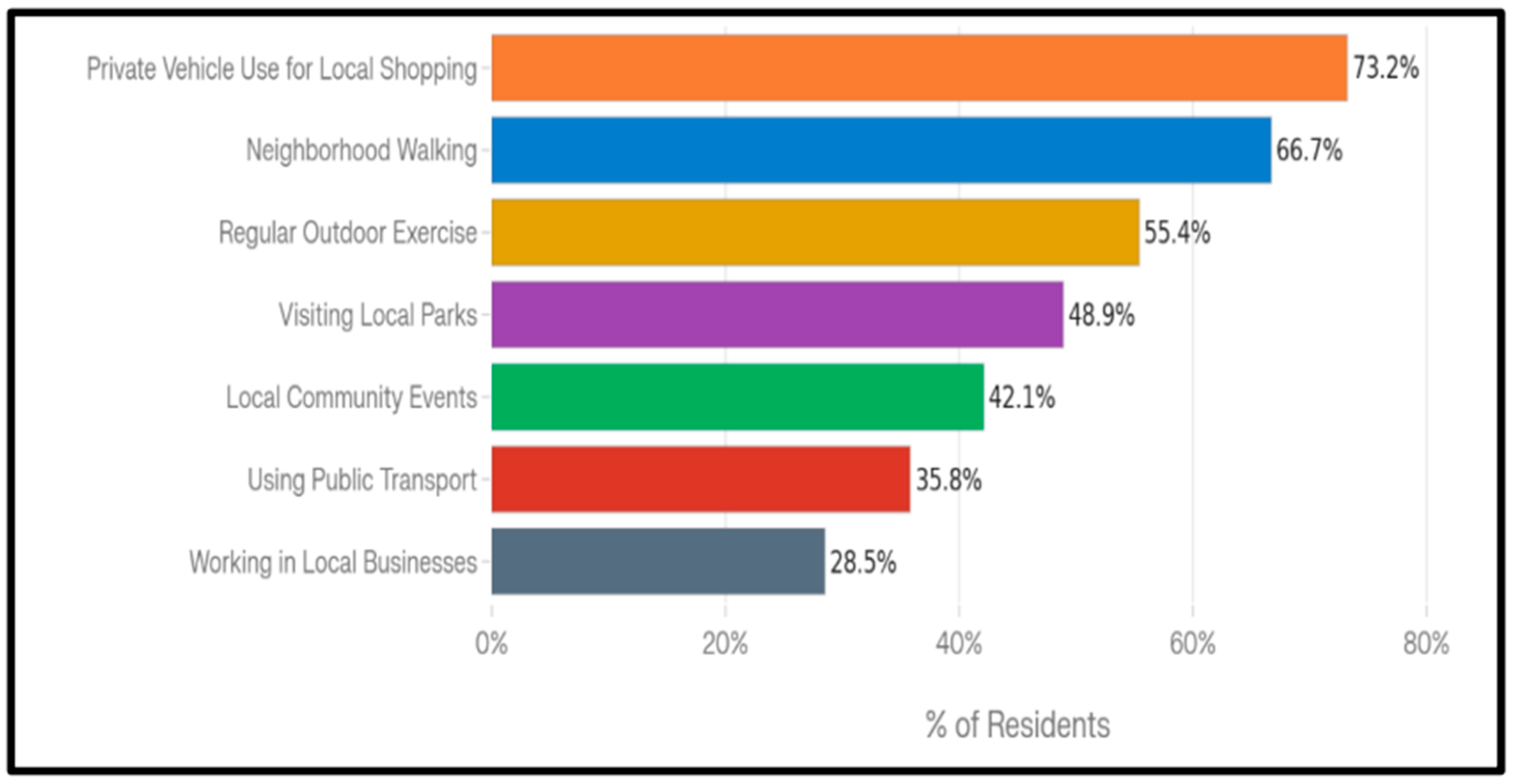
Figure 5 presents the distribution of reported activity types. Local shopping was most common (78.1%), yet 73.2% used private vehicles for these trips, while 66.7% reported walking. This reflects predominantly recreational/social pedestrian activity during climate-tolerable windows (early morning/post-sunset) rather than utilitarian mobility; streets support strolling but not yet errand-running [
24]. Targeted thermal/pavement interventions could resolve this functional gap.
While the pedestrian environment is conducive to casual walking, it remains inadequately equipped for utilitarian trips. Applying Mehta’s [
24] analytical distinction, these environments successfully generate recreational activity but fail to support reliable functional mobility. Targeted interventions in thermal comfort and pavement quality could effectively resolve this imbalance.
Furthermore, while perceived social homogeneity was notably high (75.3%), only 49.7% of respondents counted most of their friends among their neighbours. Community cohesion at the street level remains moderate. Social warmth is present, but the infrastructure needed to deepen it is still missing.
4.7. Demographic Subgroup Effects
Perceptions of street quality also shift based on the resident’s demographic profile. Tenure status produced a significant difference in Environmental Quality (Mann–Whitney U = 49,726, p < 0.001): owner-occupiers rated their streets higher than renters (M = 3.93 vs. M = 3.72). Financial investment in one’s immediate environment clearly shapes perception. Housing type followed a similar pattern (Kruskal–Wallis H = 31.75, p < 0.001), with villa residents rating their streets most positively (M = 4.01), followed by apartment residents (M = 3.71), and villa-floor residents (M = 3.62). Age revealed a U-shaped curve: the youngest (18–24: M = 4.03) and oldest (55+: M = 4.14) cohorts rated streets most favourably, while the 25–34 cohort registered the lowest mean (M = 3.68), likely reflecting lifecycle differences in unmet mobility demands.
Remarkably, length of residence showed no significant association with quality perception (Kruskal–Wallis H = 11.23, p = 0.340). Means ranged trivially from 3.77 to 3.82 across all duration categories. This null finding is methodologically crucial. It confirms the absence of adaptation bias. A resident of twenty years is no more forgiving of a broken pavement or a lack of shade than someone who arrived last year. The RCSVF captures raw, ongoing experience rather than normalized tolerance.
Looking ahead, as Riyadh’s rental apartment stock expands under planning densification efforts, these tenure and housing-type effects document a specific policy risk. Neighborhoods transitioning toward rental apartments may experience deteriorating quality perceptions even without a decline in physical infrastructure. Because the RCSVF can detect this perceptual drift before it manifests in activity data, it provides exactly the kind of early-warning capacity that resident-centered metrics are designed to deliver.
5. Conclusions
To effectively assess street quality in a hot–arid metropolis, this study developed and validated the Resident-Centered Street Vitality Framework (RCSVF). Testing the framework across nineteen distinct neighborhoods in Riyadh allowed us to build a locally calibrated tool and examine how its subscales interact. More importantly, it helped us identify exactly which physical and service-related factors drive resident satisfaction, providing a validated metric for post-occupancy evaluations of street investments. Three major findings emerged from this effort, and their implications extend far beyond Riyadh.
First, while the citywide average for perceived environmental quality was moderate (M = 3.79, SD = 0.66), this number masks massive inequalities. Neighborhood scores spanned nearly two full scale points, ranging from a high in Al-Falah (M = 4.41) to a severe low in Al-Shumaisi (M = 2.82). Because these survey results strongly mirrored our independent physical observations (rs = 0.790, p = 0.002), we can confidently confirm the RCSVF’s criterion validity.
Second, having nearby services completely dominated residential satisfaction (β = 0.691, R2 = 0.638), carrying almost double the weight of physical street quality (β = 0.344). This directly challenges a common, design-led assumption in urban planning: that aesthetic upgrades alone are the primary mechanism for improving resident well-being.
Third, residents rated safety as the highest environmental quality (M = 4.12) but ranked street trees and green space dead last (M = 3.42). The thermal infrastructure deficit we saw in our physical audits is clearly felt by the people living there. Strikingly, even flagship upgraded corridors like Tahlia Road scored poorly on the Environmental and Green dimension (M = 3.23). The lack of shade and greenery is a structural, citywide failure, not just an issue isolated to underserved areas.
These results prove that physical street quality, service accessibility, and residential satisfaction form an interdependent cluster. This validates the theoretical propositions of Carmona [
25] and Mehta [
49], extending their principles into a hot–arid context for the first time. Furthermore, thermal comfort—experienced as shade, trees, and green space—is not just a peripheral amenity. It is structurally embedded in how residents judge overall spatial quality. This strongly supports the adaptive comfort framework of Nikolopoulou and Steemers [
33], showing that thermal experience dictates the entire perception of street vitality. We also observed a clear pedestrian–car paradox: 66.7% of residents walk for leisure, but 73.2% still drive for local shopping. Riyadh’s streets currently support social strolling, but they fail entirely at utilitarian mobility. Targeted investments in shading, pavement quality, and spatial connectivity are necessary to close this functional gap.
From a policy perspective, the sheer variation between neighborhoods serves as a warning. Relying on aggregate, city-level walkability targets will hide severe local deficits, like those documented in Al-Shumaisi and Umm Saleem. By applying the RCSVF across a diverse sample, we have provided a replicable way to generate the highly localized evidence needed to allocate street investments fairly and accurately. The tool shifts the conversation. Instead of asking, “How much vitality does Riyadh have?” planners can ask, “Where are the exact deficits, who suffers from them, and what needs to change?”.
Three limitations should be acknowledged, each with a clear methodological path forward. First, the cross-sectional design establishes robust associations but cannot demonstrate causal change. Future research should adopt longitudinal or pre/post-intervention designs, ideally timed to coincide with identifiable street upgrade cycles, to test whether specific infrastructure investments produce measurable improvements in resident perception over time. Such designs would also enable the RCSVF to function as an evaluation tool rather than only as a diagnostic instrument. Second, the predominantly male sample (69.4%) reflects genuine structural constraints on women’s independent participation in street-level public life in Saudi Arabia; however, it means that women’s specific safety, comfort, and mobility needs are underrepresented. Future applications of the RCSVF should use gender-stratified sampling, time-of-day observation protocols, and potentially women-led field teams to capture this systematically excluded perspective. Third, thermal conditions were assessed through physical proxies, shade presence, tree canopy, pavement type, rather than direct thermal measurement. Future studies should integrate street-level Physiologically Equivalent Temperature (PET) measurement and mean radiant temperature (MRT) logging across multiple times of day and seasons, enabling the RCSVF to incorporate a validated thermal dimension based on measured rather than inferred exposure.
Author Contributions
Conceptualization, S.A.-D. and T.L.; methodology, S.A.-D. and T.L.; software, S.A.-D. and T.L.; validation, S.A.-D. and T.L.; formal analysis, S.A.-D. and T.L.; investigation S.A.-D. and T.L.; resources, S.A.-D. and T.L.; data curation, S.A.-D. and T.L.; writing—original draft preparation, S.A.-D. and T.L.; writing—review and editing, S.A.-D. and T.L.; project administration, S.A.-D. and T.L.; All authors have read and agreed to the published version of the manuscript.
Funding
This research was funded by Ongoing Research Funding Program (ORF-2026-1915), King Saud University, Riyadh, Saudi Arabia.
Institutional Review Board Statement
Ethical review and approval were waived for this study because it is non-interventional and non-experimental.
Informed Consent Statement
We secured written informed consent from every respondent before administering the survey.
Data Availability Statement
The study generated anonymized resident survey responses, physical street observation scoresheets, and derived statistical datasets. Because the dataset contains geographically linked responses from private residential neighborhoods, raw individual-level data are not publicly archived. Aggregated descriptive tables, subscale scores by neighborhood and sector, and the full list of 35 observation indicators are available from the corresponding author upon reasonable academic request. No sensitive health data were collected.
Conflicts of Interest
The authors declare no conflicts of interest.
References
- Jacobs, J. The Death and Life of Great American Cities; Random House: New York, NY, USA, 1961. [Google Scholar]
- Gehl, J. Cities for People; Island Press: Washington, DC, USA, 2010. [Google Scholar]
- Montgomery, J. Making a city: Urbanity, vitality and urban design. J. Urban Des. 1998, 3, 93–116. [Google Scholar] [CrossRef] [Scilit]
- Ewing, R.; Clemente, O. Measuring Urban Design: Metrics for Livable Places; Island Press: Washington, DC, USA, 2013. [Google Scholar]
- Mouratidis, K. Urban planning and quality of life: A review of pathways linking the built environment to subjective well-being. Cities 2021, 115, 103229. [Google Scholar] [CrossRef] [Scilit]
- Resch, B.; Puetz, I.; Bluemke, M.; Kyriakou, K.; Miksch, J. An interdisciplinary mixed-methods approach to analyzing urban spaces: The case of urban walkability and bikeability. Int. J. Environ. Res. Public Health 2020, 17, 6994. [Google Scholar] [CrossRef] [Scilit]
- Mouratidis, K. Neighborhood characteristics, neighborhood satisfaction, and well-being: The links with neighborhood deprivation. Land Use Policy 2020, 99, 104886. [Google Scholar] [CrossRef] [Scilit]
- Ma, S.; Wang, B.; Liu, W.; Zhou, H.; Wang, Y.; Li, S. Assessment of street space quality and subjective well-being mismatch and its impact, using multi-source big data. Cities 2024, 147, 104797. [Google Scholar] [CrossRef] [Scilit]
- Abedrabboh, O.; Alfarra, M.; Al-Ansari, T.; Fountoukis, C. Enhancing human thermal comfort in hot arid cities: A systematic review of urban heat island observations and mitigation strategies. Build. Environ. 2025, 283, 113398. [Google Scholar] [CrossRef] [Scilit]
- Galal, O.M.; Sailor, D.J.; Mahmoud, H. The impact of urban form on outdoor thermal comfort in hot arid environments during daylight hours, case study: New Aswan. Build. Environ. 2020, 184, 107222. [Google Scholar] [CrossRef] [Scilit]
- Homoud, M.; Jarrar, O.M. Walkability in Riyadh: A comprehensive assessment and implications for sustainable community, Al-Falah case study. Sustainability 2024, 16, 8073. [Google Scholar] [CrossRef] [Scilit]
- Alkhoudiri, A.; Navarro, I.; Fort, J.M.; Alumran, S. Parametric comparative analysis of outdoor thermal comfort in a desert climate: A case study of single-family houses in Riyadh. Urban Clim. 2022, 46, 101300. [Google Scholar] [CrossRef] [Scilit]
- Osman, T.A.A.; Madandola, M.; Bayram, G.; Al-Kandari, A.; Paquet, T.N.K.; Furlan, R.; Al-Matwi, R. Impact of climate on the livability of public spaces in Middle Eastern cities: A case study of The Pearl Island, Doha, Qatar. J. Urban Plan. Dev. 2024, 151, 04024057. [Google Scholar] [CrossRef] [Scilit]
- Shawesh, R.; Mohamed, M. Post-occupancy evaluation of outdoor thermal comfort in hot arid zone. Int. J. Low-Carbon Technol. 2020, 16, 50–60. [Google Scholar] [CrossRef] [Scilit]
- Elnabawi, M.M.H.; Alshehhi, S.S.; Elgendy, L.; Al Madhani, L.A.; Almehairi, M.A.; Alefari, F.G. Outdoor thermal comfort in hot arid and semi-arid cities of the Middle East and North Africa: Current knowledge, gaps, and a framework for climate-sensitive urban design. Front. Sustain. Cities 2026, 8, 1792739. [Google Scholar] [CrossRef] [Scilit]
- Almahmood, M.; Schulze, O.; Carstensen, T.A.; Jørgensen, G. The Sidewalk as a Contested Space: Women’s Negotiation of Socio-Spatial Processes of Exclusion in Public Urban Space in Saudi Arabia; The Case of Al Tahlia Street. Plan. Pract. Res. 2018, 33, 186–210. [Google Scholar] [CrossRef] [Scilit]
- Gehl, J. Life Between Buildings: Using Public Space, 6th ed.; Island Press: Washington, DC, USA, 2011. [Google Scholar]
- Brown, J.; Curtin, K.; Thomson, M.; Kung, J.; Nykiforuk, C. Contributions and limitations of Walk Score® in the context of walkability: A scoping review. Environ. Behav. 2023, 55, 468–519. [Google Scholar] [CrossRef] [Scilit]
- Hall, C.; Ram, Y. Walk Score® and its potential contribution to the study of active transport and walkability: A critical and systematic review. Transp. Res. Part D Transp. Environ. 2018, 61, 310–324. [Google Scholar] [CrossRef] [Scilit]
- Vatani, M.; Kiani, K.; Bemanian, M.; Georgescu, M. Investigating the role of residential configurations in shaping outdoor thermal comfort in hot, arid climates. Int. J. Biometeorol. 2025, 69, 2795–2813. [Google Scholar] [CrossRef] [Scilit]
- Saudi Vision 2030. Vision 2030: Kingdom of Saudi Arabia. 2016. Available online: https://www.vision2030.gov.sa (accessed on 25 March 2026).
- Whyte, W.H. The Social Life of Small Urban Spaces; Conservation Foundation: Washington, DC, USA, 1980. [Google Scholar]
- Gehl, J.; Svarre, B. How to Study Public Life; Island Press: Washington, DC, USA, 2013. [Google Scholar]
- Mehta, V. Lively streets: Determining environmental characteristics to support social behavior. J. Plan. Educ. Res. 2007, 27, 165–187. [Google Scholar] [CrossRef] [Scilit]
- Carmona, M. Public Places Urban Spaces: The Dimensions of Urban Design, 3rd ed.; Routledge: London, UK, 2021. [Google Scholar]
- Ki, D.; Chen, Z.; Lee, S.; Lieu, S. A novel walkability index using Google Street View and deep learning. Sustain. Cities Soc. 2023, 99, 104896. [Google Scholar] [CrossRef] [Scilit]
- Yue, X.; Antonietti, A.; Alirezaei, M.; Tasdizen, T.; Li, D.; Nguyen, L.; Mane, H.; Sun, A.; Hu, M.; Whitaker, R.T.; et al. Using convolutional neural networks to derive neighborhood built environments from Google Street View images and examine their associations with health outcomes. Int. J. Environ. Res. Public Health 2022, 19, 12095. [Google Scholar] [CrossRef] [Scilit]
- Choi, J.; Kang, Y. Modeling and explaining perceived walkability in urban environments using street view images and explainable AI. Spat. Inf. Res. 2025, 33, 57. [Google Scholar] [CrossRef] [Scilit]
- Ye, Y.; Xie, H.; Fang, J.; Jiang, H.; Wang, D. Eye-level street walkability assessment using pedestrian-derived virtual audits and machine-learning methods. Landsc. Urban Plan. 2023, 234, 104737. [Google Scholar]
- Masad, K.; Filali, F. Real-time green view index assessment: AI-driven analysis of urban vegetation using dashcam videos. IEEE J. Sel. Top. Appl. Earth Obs. Remote Sens. 2025, 18, 16954–16965. [Google Scholar] [CrossRef] [Scilit]
- AlKheder, S. The relation between walkability in hot arid regions and the built environment: The case of Kuwait in the Arabian Gulf. J. Urban. Int. Res. Placemaking Urban Sustain. 2026, 19, 149–173. [Google Scholar] [CrossRef] [Scilit]
- Ni, Y.; Lin, L.; Xia, H.; Wang, X. Urban street greening and resident comfort: An integrated approach based on high-precision shadow distribution and facade visual assessment. Sustainability 2025, 17, 1026. [Google Scholar] [CrossRef] [Scilit]
- Nikolopoulou, M.; Steemers, K. Thermal comfort and psychological adaptation as a guide for designing urban spaces. Energy Build. 2003, 35, 95–101. [Google Scholar] [CrossRef] [Scilit]
- Elnabawi, M.H.; Tabet Aoul, K.A.; Alhumaidi, A.; Osman, B.; Alshehhi, R.; AlMahri, S. A Behavioural Analysis of Outdoor Thermal Comfort in a Hot, Arid Climate: A Culture and Gender Equality Perspective. Archit. Sci. Rev. 2025, 68, 41–55. [Google Scholar] [CrossRef] [Scilit]
- Shafiee, E.; Yazdanfar, S.A.A.; Faizi, M.; Tahbaz, M. Human-centered insights into outdoor thermal comfort adjacent to green walls: A systematic literature review. Smart Sustain. Built Environ. 2025, 14, 1–34. [Google Scholar] [CrossRef] [Scilit]
- Potchter, O.; Cohen, P.; Lin, T.-P.; Matzarakis, A. A systematic review advocating a framework and benchmarks for assessing outdoor human thermal perception. Sci. Total Environ. 2022, 833, 155128. [Google Scholar] [CrossRef] [Scilit]
- Middel, A.; Hab, K.; Brazel, A.J.; Martin, C.A.; Guhathakurta, S. Impact of urban form and design on mid-afternoon microclimate in Phoenix Local Climate Zones. Landsc. Urban Plan. 2014, 122, 16–28. [Google Scholar] [CrossRef] [Scilit]
- Henao, J.J.; Mejia, J.F.; Krayenhoff, E.S.; Jiang, T.; Martilli, A. Effectiveness of street trees in reducing air temperature and outdoor heat exposure in Las Vegas. Environ. Res. Clim. 2025, 4, 025015. [Google Scholar] [CrossRef] [Scilit]
- Acero, J.A.; Krayenhoff, E.S. Simulation of the impact of changes in building height and street tree shading on pedestrian-level mean radiant temperature under hot-arid conditions. Urban Clim. 2021, 38, 100905. [Google Scholar]
- Hu, Y.; Zhang, M.; Chang, E.; Chen, P.; Jiao, L. Does feeling different from neighbors matter? Exploring the impact of perceived neighborhood environment on subjective well-being in a comprehensive framework. Soc. Sci. Med. 2025, 388, 118706. [Google Scholar] [CrossRef] [Scilit]
- Qiu, W.; Zhang, Z.; Liu, X.; Li, W.; Li, X.; Xu, X.; Huang, X. Subjective or objective measures of street environment, which are more effective in explaining housing prices? Landsc. Urban Plan. 2022, 221, 104358. [Google Scholar] [CrossRef] [Scilit]
- Li, M.; Guo, S.; Duarte, F.; Kumar, A.; Kobori, N.; Xue, F.; Zhuang, W.; Yeh, A.; Ratti, C. Influence of objective and perceived exposures to urban nature on people’s happiness. npj Urban Sustain. 2026, 6, 6. [Google Scholar] [CrossRef] [Scilit]
- Manavvi, S.; Rajasekar, E. Evaluating outdoor thermal comfort in urban open spaces in a humid subtropical climate: Chandigarh, India. Build. Environ. 2022, 209, 108659. [Google Scholar] [CrossRef] [Scilit]
- Aljoufie, M. Spatial analysis of urban growth and living standards in Riyadh, Saudi Arabia. Sustainability 2021, 13, 11842. [Google Scholar]
- Maghrabi, A.; Aldosari, A.; Al Mutairi, M.; Altlasi, M.; Al Shehre, A. Unveiling Riyadh’s urban heat island: A 37-year analysis of temperature trends and climate dynamics. Atmos. Clim. Sci. 2026, 16, 170–189. [Google Scholar]
- Cohen, J. Statistical Power Analysis for the Behavioral Sciences, 2nd ed.; Lawrence Erlbaum Associates: Hillsdale, NJ, USA, 1988. [Google Scholar]
- Hu, L.T.; Bentler, P.M. Fit indices in covariance structure modeling: Sensitivity to underparameterized model misspecification. Psychol. Methods 1998, 3, 424–453. [Google Scholar] [CrossRef]
- Middel, A.; Lukasczyk, J.; Zakrzewski, S.; Arnold, M.; Maciejewski, R. Urban form and composition of street canyons: A human-centric big data and deep learning approach. Landsc. Urban Plan. 2019, 183, 122–132. [Google Scholar] [CrossRef] [Scilit]
- Mehta, V. The Street: A Quintessential Social Public Space; Routledge: New York, NY, USA, 2013. [Google Scholar]
Figure 1.
Typical residential street morphology in Riyadh: wide multi-lane carriageway, discontinuous sidewalks, minimal shade structures, and low frontage activation. This configuration prioritizes vehicular movement over pedestrian habitability. (Source: Researchers, 2025).
Figure 1.
Typical residential street morphology in Riyadh: wide multi-lane carriageway, discontinuous sidewalks, minimal shade structures, and low frontage activation. This configuration prioritizes vehicular movement over pedestrian habitability. (Source: Researchers, 2025).
Figure 2.
Methodological workflow for RCSVF development and validation. Three convergent data streams, resident surveys, systematic street observation, and GIS-based spatial analysis, were integrated through statistical modelling to construct and validate the framework across 19 Riyadh neighborhoods.
Figure 2.
Methodological workflow for RCSVF development and validation. Three convergent data streams, resident surveys, systematic street observation, and GIS-based spatial analysis, were integrated through statistical modelling to construct and validate the framework across 19 Riyadh neighborhoods.
Figure 3.
Conceptual structure of the Resident-Centered Street Vitality Framework (RCSVF). The framework integrates three validated subscales, Environmental Quality, Service Proximity, and Residential Satisfaction, as interdependent dimensions of street performance. Thermal infrastructure (shade, green space, pavement quality) operates as a cross-cutting constraint affecting all three dimensions.
Figure 3.
Conceptual structure of the Resident-Centered Street Vitality Framework (RCSVF). The framework integrates three validated subscales, Environmental Quality, Service Proximity, and Residential Satisfaction, as interdependent dimensions of street performance. Thermal infrastructure (shade, green space, pavement quality) operates as a cross-cutting constraint affecting all three dimensions.
Figure 4.
A ranked neighborhood comparison by sector groupings and colour-coded Environmental Quality scores. This figure visually communicates the near-two-scale-point range between Al-Falah (M = 4.41) and Al-Shumaisi (M = 2.82). Neighborhoods ranked by Environmental Quality mean score; color-coding reflects sector groupings.
Figure 4.
A ranked neighborhood comparison by sector groupings and colour-coded Environmental Quality scores. This figure visually communicates the near-two-scale-point range between Al-Falah (M = 4.41) and Al-Shumaisi (M = 2.82). Neighborhoods ranked by Environmental Quality mean score; color-coding reflects sector groupings.
Figure 5.
The distribution of reported activity types across the seven binary items.
Figure 5.
The distribution of reported activity types across the seven binary items.
Table 1.
Participants’ characteristics in the resident survey sample (N = 1102).
Table 1.
Participants’ characteristics in the resident survey sample (N = 1102).
| Characteristic | Category | n | % | Characteristic | Category | n | % |
|---|
| Gender | Male | 764 | 69.4 | Housing type | Apartment | 644 | 58.4 |
| Female | 338 | 30.6 | | Standalone villa | 334 | 30.3 |
| Age group | 18–24 | 204 | 18.5 | | Villa floor | 124 | 11.3 |
| 25–34 | 452 | 41.1 | Urban sector | North | 289 | 26.2 |
| 35–44 | 310 | 28.1 | | East | 235 | 21.3 |
| 45–54 | 95 | 8.6 | | West | 174 | 15.8 |
| 55+ | 40 | 3.6 | | Centre | 208 | 18.9 |
| Housing tenure | Renter | 721 | 65.4 | | South | 196 | 17.8 |
| Owner-occupier | 381 | 34.6 | | | | |
Table 2.
Classification of the 35 street observation indicators across five thematic domains.
Table 2.
Classification of the 35 street observation indicators across five thematic domains.
| Domain | No. of Indicators | Example Indicators |
|---|
| Thermal and environmental quality | 8 | Shade coverage, solar protection structures, tree canopy density, pavement surface heat reflectance, green area proportion, dust barrier presence |
| Pedestrian infrastructure | 7 | Pavement continuity, pavement width, kerb quality, crossing provision, pedestrian barrier separation, surface condition, tactile guidance |
| Safety and maintenance | 7 | Lighting provision, CCTV visibility, graffiti/vandalism, litter and waste management, boundary enclosure, traffic calming, road surface condition |
| Interface and enclosure quality | 7 | Building setback, frontage activation, boundary permeability, enclosure ratio (H:W), visual interest, street furniture provision, landmark visibility |
| Amenity and accessibility | 6 | Proximity to retail frontage, seating provision, visible service access points, recreational space proximity, cycling infrastructure, bus stop condition |
Table 3.
Research objectives, data sources, and analytical methods.
Table 3.
Research objectives, data sources, and analytical methods.
| Objective | Data Source(s) | Analytical Method(s) |
|---|
| (a) Identify factors driving perceived street vitality under hot–arid conditions | Resident survey (N = 1102); visual preference survey (N = 418) | Descriptive statistics; item-level analysis; Kruskal–Wallis H test; Mann–Whitney U test |
| (b) Test how perceptual dimensions relate to measured physical and spatial variables | Street observation (N = 133 segments); GIS morphological variables | Spearman rank-order correlations; multiple linear regression |
| (c) Validate a scalable assessment index across neighborhood types | All three data streams combined | Cronbach’s alpha reliability testing; criterion validity (rs between survey and observation scores); spatial variation analysis across 19 neighborhoods |
Table 4.
Internal consistency reliability statistics for the three RCSVF subscales.
Table 4.
Internal consistency reliability statistics for the three RCSVF subscales.
| Subscale | No. of Items | Cronbach’s α | 95% CI | Interpretation |
|---|
| Environmental Quality | 8 | 0.891 | [0.878, 0.903] | Excellent |
| Service Proximity | 12 | 0.871 | [0.856, 0.885] | Good to excellent |
| Residential Satisfaction | 7 | 0.897 | [0.885, 0.908] | Excellent |
Table 5.
Correlational Structure and Regression Analysis Outputs.
Table 5.
Correlational Structure and Regression Analysis Outputs.
| Model | Predictor(s) | Std. Beta (β) | t | p | R2 | F | Model p |
|---|
| 1 (simple) | Environmental Quality | 0.772 | 14.31 | <0.001 | 0.489 | 204.8 | <0.001 |
| 2 (simple) | Service Proximity | 0.970 | 18.92 | <0.001 | 0.589 | 357.9 | <0.001 |
| 3 (multiple) | Service Proximity | 0.691 | 11.24 | <0.001 | 0.638 | 166.4 | <0.001 |
| | Environmental Quality | 0.344 | 5.59 | <0.001 | | | |
Table 6.
Exploratory factor analysis (EFA) summary for the Resident-Centered Street Vitality Framework (RCSVF).
Table 6.
Exploratory factor analysis (EFA) summary for the Resident-Centered Street Vitality Framework (RCSVF).
| Subscale | Items | Example Content (From Paper) | Primary Loading Range | Communality (h2) Range | Cronbach’s α |
|---|
| F1: Environmental Quality | 8 | Safety/security; neighborhood quality; pavements; green space; shading | 0.65–0.88 | 0.55–0.78 | 0.891 |
| F2: Service Proximity | 12 | Service accessibility items (e.g., retail, recreation proximity) | 0.62–0.85 | 0.52–0.75 | 0.871 |
| F3: Residential Satisfaction | 7 | Satisfaction + activity items | 0.70–0.90 | 0.60–0.82 | 0.897 |
Table 7.
Confirmatory factor analysis (CFA) fit indices for the three-factor RCSVF model.
Table 7.
Confirmatory factor analysis (CFA) fit indices for the three-factor RCSVF model.
| Index | Value | Benchmark | Fit Assessment |
|---|
| χ2/df | 2.87 | ≤3 (good); ≤5 (acceptable) | Good |
| CFI | 0.962 | ≥0.95 (good) | Excellent |
| TLI | 0.954 | ≥0.95 (good) | Good |
| RMSEA (90% CI) | 0.048 (0.042–0.054) | ≤0.06 (good); ≤0.08 (acceptable) | Close fit |
| SRMR | 0.045 | ≤0.08 (good) | Excellent |
| Disclaimer/Publisher’s Note: The statements, opinions and data contained in all publications are solely those of the individual author(s) and contributor(s) and not of MDPI and/or the editor(s). MDPI and/or the editor(s) disclaim responsibility for any injury to people or property resulting from any ideas, methods, instructions or products referred to in the content. |