Article

Spatiotemporal Distribution Characteristics and Influencing Factors of Historic Buildings in the Mount Tai Region: Implications for Tourism Planning

1
School of Arts, TaiShan University, Tai’an 271000, China
2
James Watt School of Engineering, University of Glasgow, Glasgow G12 8QQ, UK
3
Faculty of Humanities and Arts, Macau University of Science and Technology, Taipa, Macau 999078, China
*
Authors to whom correspondence should be addressed.
Buildings 2026, 16(9), 1795; https://doi.org/10.3390/buildings16091795
Submission received: 24 March 2026 / Revised: 22 April 2026 / Accepted: 29 April 2026 / Published: 30 April 2026
(This article belongs to the Special Issue Built Heritage Conservation in the Twenty-First Century: 3rd Edition)

Abstract

As China’s first World Heritage Mixed Property site, Mount Tai enjoys international renown, with its historic buildings serving both as the central carriers of its cultural heritage and as significant tourism resources. Existing studies have predominantly emphasized the form, scale, and construction techniques of individual buildings or architectural complexes, while less attention has been given to the overall spatial pattern shaped by the interplay of natural and social environments and to the mechanisms underlying its formation. Taking the administrative area of Tai’an City as the study extent, this research selects 451 officially protected historic buildings, classified by period and type, and employs GIS-based spatial analysis and statistical methods to examine their spatiotemporal distribution patterns and influencing factors. The results indicate the following. (1) The temporal distribution exhibits an И-shaped fluctuation pattern, with ancient architecture and ancient sites together accounting for nearly 60% of the total and constituting the core resource categories. This distribution curve is shaped jointly by preservation conditions, social stability, and heritage designation preferences. (2) The spatial distribution displays a pronounced clustering pattern, with the kernel density core shifting over forty kilometers from southwest to northeast, generating an evolutionary trajectory from Dawen River basin agglomeration to Mount Tai mountain belt agglomeration. (3) The overall pattern is associated with both natural and anthropogenic factors. During the early stages, natural conditions such as hydrology and topography provided foundational constraints, whereas in later periods, human factors, including fengshan ritual culture, religious activities, economic development, and institutional governance, exhibit increasingly apparent associations with the distribution pattern. Based on these findings, this study proposes a strategic spatial framework comprising one cultural pilgrimage ring and four thematic corridors, which translates the spatial analytical results into planning implications for the regional integration of historic building resources, and discusses differentiated conservation strategies, thereby providing an analytical foundation and a reference pathway for the dissemination of Mount Tai culture and the sustainable development of heritage tourism.

1. Introduction

Historic buildings constitute a fundamental category of immovable cultural heritage, embodying multifaceted values related to heritage preservation, tourism development, artistic appreciation, and architectural knowledge. Over the past two decades, academic inquiry into historic buildings has expanded from isolated architectural studies toward a broader interdisciplinary approach that incorporates heritage management, digital technologies, and spatial analysis. Early scholarship concentrated primarily on the documentation and conservation of individual structures or specific building complexes, with emphasis on typological classification, construction techniques, and material authenticity [1,2,3]. Concurrently, researchers developed methodologies for value assessment and formulated restoration principles to guide preservation practices [4,5]. These foundational studies have contributed significantly to the understanding of historic buildings as discrete entities, though they have generally placed less emphasis on the broader spatial patterns that characterize architectural heritage at a regional scale.
The increasing availability of Geographic Information Systems and spatial analytical tools has opened new avenues for heritage research. A growing number of studies have employed GIS-based approaches to map the distribution of cultural heritage sites, identify clustering tendencies, and explore relationships between heritage locations and environmental variables [6,7,8,9]. Methods such as kernel density estimation and nearest neighbor analysis have been applied to reveal spatial agglomeration characteristics across various heritage types, ranging from traditional villages to industrial relics [10,11,12]. Much of this work has focused on quantifying and visualizing spatial patterns. The examination of the underlying factors that produce these configurations whether natural, cultural, or policy-related has received comparatively less systematic attention. Furthermore, the explicit connection between spatial heritage analysis and tourism planning remains an area that warrants further development. While a body of literature addresses heritage tourism development [13,14,15,16], relatively few studies have utilized GIS-derived spatial evidence directly to inform the design of integrated tourism routes or regional heritage networks. Some recent work has begun to examine the spatial relationship between heritage sites and tourism infrastructure [17,18,19], yet the treatment of heritage locations as elements within evolving spatiotemporal systems shaped by historical and environmental interactions is still an emerging direction.
Within the Chinese context, recent scholarship has drawn attention to the role of heritage governance and policy frameworks in shaping the designation and distribution of protected sites. Studies such as Dang et al. [20] illustrate how institutional factors and heritage listing mechanisms influence the composition of the national registry. In parallel, research by Jia et al. [21] has applied GIS-based spatial analysis to examine the distribution patterns of cultural heritage sites in mountainous regions, though the connection between observed patterns and underlying policy drivers remains largely implicit. While these perspectives provide valuable insights into either the policy dimensions or spatial characteristics of heritage distribution, they are less frequently combined with detailed, site-level geospatial analysis that accounts for both temporal change and the interplay of natural and anthropogenic factors. As a result, an opportunity exists to bridge macro-level policy understanding with micro-level spatial investigation.
The Mount Tai region presents a particularly suitable case for exploring these connections. As the first UNESCO World Heritage Mixed Property site in China, the region contains a notable concentration of historic buildings that span multiple dynasties and are interwoven with a cultural landscape shaped by imperial rituals, religious traditions, and agricultural development. Existing research on Mount Tai’s architectural heritage has predominantly examined individual landmark structures, such as the Dai Temple or Bixia Temple, or has centered on the architectural ensemble of the mountain itself [22,23]. The broader distribution of officially protected historic buildings across the entire administrative area of Tai’an City, the ways in which this distribution has evolved over time, and the combined influence of natural geographic conditions and human activities on this evolution have not been systematically examined using quantitative spatial methods. Moreover, the potential to derive planning insights from GIS-based spatial evidence to support regional tourism coordination remains largely underexplored.
To address these gaps, this study conducts a comprehensive spatiotemporal analysis of 451 officially protected historic buildings located within the jurisdiction of Tai’an City, Shandong Province. It should be noted at the outset that the dataset includes only buildings formally designated as cultural relic protection units at the national, provincial, or municipal/county levels; general historic buildings that have not received official heritage status are excluded from the analysis. This scope limitation is acknowledged as a boundary of the present study. The specific objectives are as follows:
(1)
To characterize the spatiotemporal distribution patterns of protected historic buildings in the Mount Tai region using GIS-based metrics, including nearest neighbor index, kernel density estimation, and standard deviational ellipse analysis;
(2)
To examine the natural and anthropogenic factors that have influenced the spatial configuration and temporal evolution of these buildings, distinguishing between early-stage environmental conditions and later-stage cultural and institutional influences;
(3)
To derive evidence-based planning implications for the integration of historic building resources into a cohesive regional tourism framework, expressed through a conceptual spatial resource chain and thematic corridor structure.
By shifting the analytical focus from individual buildings to the regional scale and from static description to dynamic spatiotemporal interpretation, this study seeks to offer a methodological reference for heritage distribution research while providing data-informed insights that may support sustainable heritage tourism planning in culturally significant landscapes.

2. Data Sources and Research Methods

2.1. Study Area and Data Sources

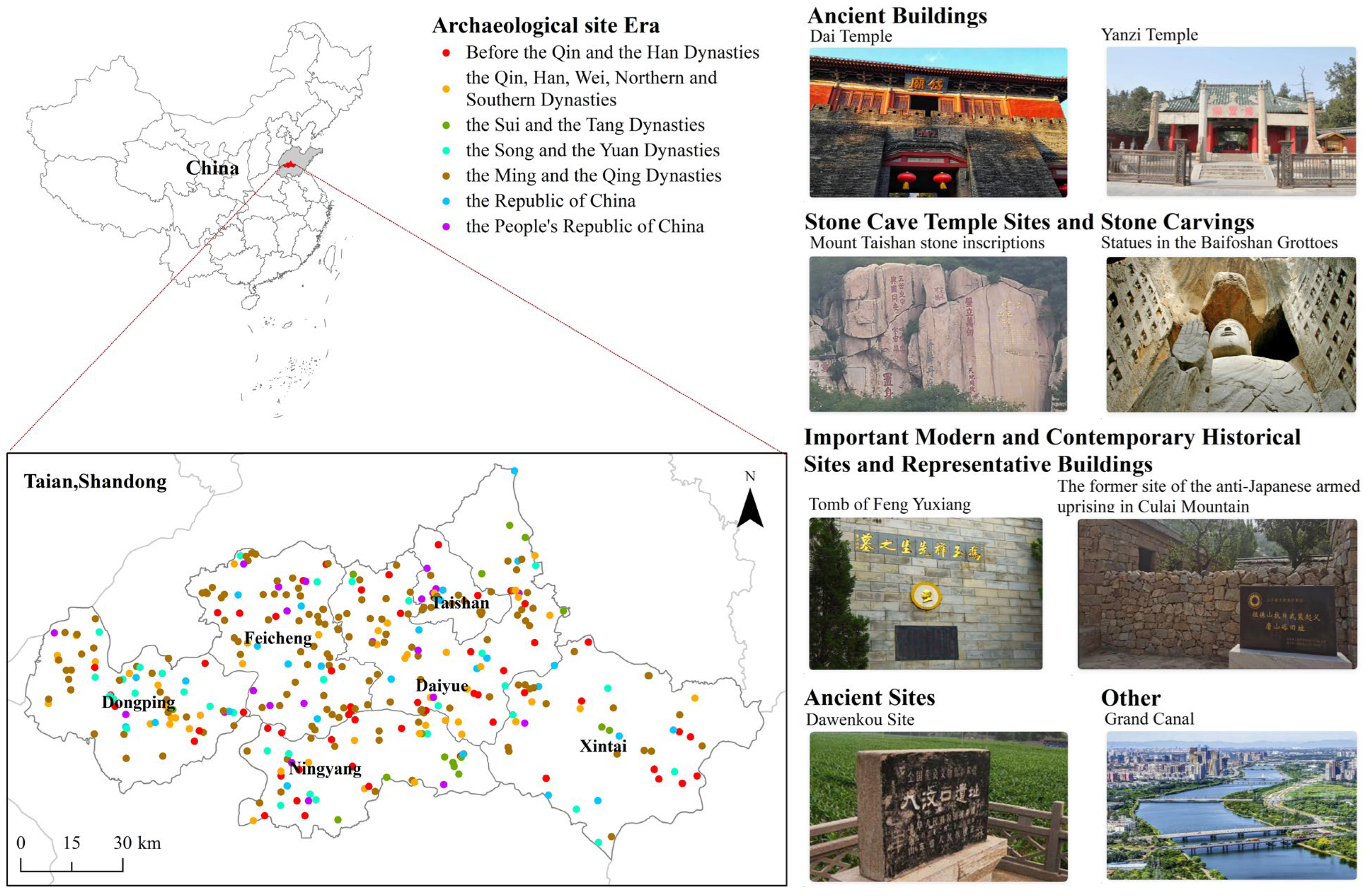
Tai’an derives its name from Mount Tai. As a geographical and cultural unit, the Mount Tai region largely coincides with the administrative jurisdiction of Tai’an City (Figure 1), encompassing two municipal districts (Taishan District and Daiyue District), two county-level cities (Feicheng City and Xintai City), and two counties (Ningyang County and Dongping County). The region is situated in the central part of Shandong Province. The Dawen River, the largest tributary of the lower reaches of the Yellow River, traverses the entire area from east to west. The topography is predominantly mountainous and hilly, with the main range of Mount Tai occupying the northern portion. The terrain descends in a stepwise manner from northeast to southwest, transitioning southward into the Dawen River Plain, thereby creating a natural landscape pattern characterized by an intermingling of mountains and waterways [24].
The Mount Tai region possesses profound cultural significance. Extending from the Paleolithic era to the present day, the area has fostered a distinctive cultural system wherein imperial fengshan rituals, diverse religious beliefs, folk customs, and landscape culture converge and intermingle, resulting in the preservation of an exceptionally rich body of historical heritage resources [25]. The core protected area of Tai’an City spans 426 km2. Within this area, a well-preserved mountain settlement system endures, comprising over 180 traditional vernacular dwellings dating from the Ming and Qing dynasties to the modern era, more than 30 historic memorial archways and gate towers, and over 10 ancient village clusters. Notably, the Mount Tai Ancient Architectural Complex is inscribed as a World Cultural Heritage site and stands as an exemplary representative of the conservation and continuity of mountain architectural ensembles in northern China.
The subjects of this study are 451 officially protected historic buildings within the jurisdiction of Tai’an City. The dataset was obtained from the National Cultural Heritage Administration, the Shandong Provincial Department of Culture and Tourism, and the Tai’an Municipal Bureau of Culture and Tourism. As of June 2025, Tai’an City contains 15 nationally protected heritage buildings, 77 provincially protected heritage buildings, and 359 heritage buildings designated at the municipal or county level. Only buildings formally designated as cultural relic protection units at the national, provincial, or municipal/county levels were included; general historic buildings that have not received official heritage status were excluded. Duplicate entries arising from multiple administrative reporting pathways were identified and removed through cross-referencing the official lists from the three administrative tiers. For heritage sites with uncertain construction dates, the temporal attribution was determined based on the predominant period of the surviving physical fabric as recorded in the official heritage designation documents; sites lacking sufficient chronological information were cross-checked with local gazetteers and archaeological reports. For architectural complexes that span multiple historical periods, classification was based on the period during which the primary extant structures were constructed, following the convention used in the national heritage inventory.
The dataset comprises basic information for each historic building, including its specific location, construction period, building typology, historical function, and protection level. The geographic coordinates for all 451 historic buildings were obtained using the Baidu Maps API coordinate extraction tool (https://api.map.baidu.com/lbsapi/cloud/index.htm, accessed on 25 December 2025). To ensure spatial accuracy and consistency, each set of coordinates was verified through secondary geolocation in Google Earth and cross-checked against the location descriptions provided in official heritage records [26]. For coordinate points exhibiting a deviation exceeding 50 m from the described location, manual adjustments were applied to minimize locational uncertainty; in instances where the site description was ambiguous, the geometric center of the described site area was adopted as the representative point. Administrative division data were sourced from the 1:1,000,000 National Fundamental Geographic Database published by the National Geomatics Center of China, while digital elevation model and hydrological data were obtained from the Geospatial Data Cloud platform of the Chinese Academy of Sciences.
All 451 records were represented as point features in the spatial analysis. For heritage sites that encompass extensive areas, such as the Dawenkou archaeological site or the Ancient Architectural Complex on Mount Tai, the geometric centroid of the officially delineated protection zone was used as the representative point. Linear heritage elements, including ancient pathways and canal segments, were similarly simplified to their midpoint coordinates for the purposes of point pattern analysis. This simplification is a recognized practice in regional-scale heritage distribution studies [27]. Following data collation, error correction, and projection transformation, all data were unified into the WGS-84 coordinate system. A spatial database of historic buildings in Tai’an was subsequently constructed using the ArcGIS 10.8 platform to provide foundational data support for the subsequent analyses.

2.2. Research Methodology

This study employs a suite of spatial analytical methods to systematically investigate the spatiotemporal distribution characteristics of historic buildings in Tai’an City. The selection of methods is guided by the specific research objectives: the Average Nearest Neighbor Index is utilized to quantify the overall spatial distribution pattern [28]; Kernel Density Estimation is applied to identify and visualize spatial agglomeration cores and density gradients [29]; and Standard Deviational Ellipse analysis is employed to capture directional trends and centroid shifts in the distribution across different periods [30].

2.2.1. Average Nearest Neighbor Index

The degree of spatial clustering or dispersion of historic building sites in Tai’an City was quantified using the Average Nearest Neighbor method, calculated as follows:
R = r ¯ r ¯ i
where r denotes the observed mean distance between each historic building site and its nearest neighboring site, ri represents the expected mean distance under a theoretical random distribution, and R is the nearest neighbor ratio. The expected mean distance is calculated based on the total area of the study region and the number of points. An R value of 1 indicates a random distribution; R < 1 indicates a clustered distribution; and R > 1 indicates a dispersed or uniform distribution [31]. The statistical significance of the results is evaluated using the Z-score and the corresponding p-value. This method is particularly suitable for regional-scale heritage analysis, as it provides a standardized, scale-invariant metric of distributional patterns [32].

2.2.2. Coefficient of Variation Analysis

To complement the distance-based nearest neighbor analysis with an area-based measure of spatial variability, the coefficient of variation (Cv) was calculated from Thiessen polygons constructed around each historic building point. The Thiessen polygon of a given point represents the region for which that point is the nearest among all sites [33]. The Cv is defined as follows:
C v = S M × 100 %
where S is the standard deviation of Thiessen polygon areas, and M is the mean area of all polygons. For an even distribution, polygon areas are relatively uniform, yielding a Cv value of approximately 30% (typically below 33%). A random distribution produces Cv values around 55% (commonly between 33 and 64%), whereas a clustered distribution results in Cv values of approximately 91% (exceeding 64%). The combined use of nearest neighbor and Cv metrics strengthens the spatial pattern classification by incorporating both distance and area perspectives [34].

2.2.3. Kernel Density Estimation

In order to properly reveal the spatial clustering characteristics and density variation patterns of historical building sites in the research area, the Kernel Density Estimation method is adopted in this study. Its calculation formula is as follows:
f ( x ) = 1 n h i   =   1 n k x x i h
where k is the kernel function, h > 0 is the bandwidth which controls the degree of smoothing, (x − xi) represents the spatial distance from the estimation point x to the historical building site xi, and n denotes the number of points contained within the bandwidth range. The bandwidth was determined using the default algorithm in ArcGIS 10.8, which calculates an optimal search radius based on the spatial extent and point density of the input dataset [35]. Sensitivity analysis was conducted using bandwidths set at 80% and 120% of the default value; the resulting density surfaces exhibited consistent core clustering locations, with only minor variation in the extent of smoothed areas [36]. The output is a continuous raster surface that visualizes high-density cores, density gradients, and spatial trends in the distribution of historic buildings.

2.2.4. Standard Deviational Ellipse Analysis

Standard deviational ellipse analysis was employed to characterize the central tendency, directional orientation, and spatial dispersion of historic buildings across different historical periods. The method calculates the geographic mean center of a point distribution and constructs an ellipse with standard deviations along the major and minor axes [37]. The ellipse is defined by the following parameters:
x ¯ = i = 1 n x i n ,   y ¯ = i = 1 n y i n
tan θ = A + B C
A = i = 1 n x ˜ i 2 i = 1 n y ˜ i 2 ,   B = i = 1 n x ˜ i 2 i = 1 n y ˜ i 2 2 + 4 i = 1 n x ˜ i · y ˜ i 2 ,   C = 2 i = 1 n x ˜ i · y ˜ i
σ x = 2 i = 1 n x ˜ i cos θ y ˜ i sin θ 2 n ,   σ y = 2 i = 1 n x ˜ i sin θ + y ˜ i cos θ 2 n
where (xi, yi) are the coordinates of point i, ( x ¯ , y ¯ ) is the mean center, ( x i ~ , y i ~ ) are the deviations from the mean center, θ is the rotation angle of the ellipse, and σx and σy are the standard deviations along the major and minor axes, respectively. The centroid coordinates reveal the geographic center of the distribution for each period, the rotation angle indicates the primary directional trend, and the lengths of the axes reflect the degree of spatial dispersion along the dominant and secondary directions [38].

2.2.5. Buffer and Overlay Analysis

Buffer zones were established around major river and lake systems at radii of 1, 2, 4, 6, and 8 km to examine the relationship between water resource proximity and site distribution. Overlay analysis was conducted between historic building points and digital elevation data to assess the distribution of sites across topographic gradients [39].

2.2.6. Methodological Rationale

The analytical framework integrates multiple spatial metrics, including distance-based metrics through nearest neighbor analysis, area-based metrics via the coefficient of variation (Cv), density-based metrics using kernel density estimation, and directional metrics from standard deviational ellipse analysis, to provide a comprehensive characterization of spatiotemporal distribution patterns. The diachronic application of these methods across seven historical periods reveals dynamic evolutionary trajectories that would remain undetected in aggregated analyses. Situated at the municipal scale of a World Heritage site, this approach permits finer grained spatial interrogation than macro-level provincial surveys while maintaining a regional perspective absent in single site architectural studies. The convergence of findings across complementary metrics enhances confidence in the identified patterns and provides an empirical foundation for deriving planning implications. Furthermore, the framework is replicable for other heritage areas seeking to integrate spatial evidence into tourism planning and cultural landscape interpretation.

3. Spatial Distribution Characteristics of Historical Buildings in the Mount Tai Region

3.1. Temporal Distribution Characteristics

3.1.1. Overall Temporal Distribution Pattern

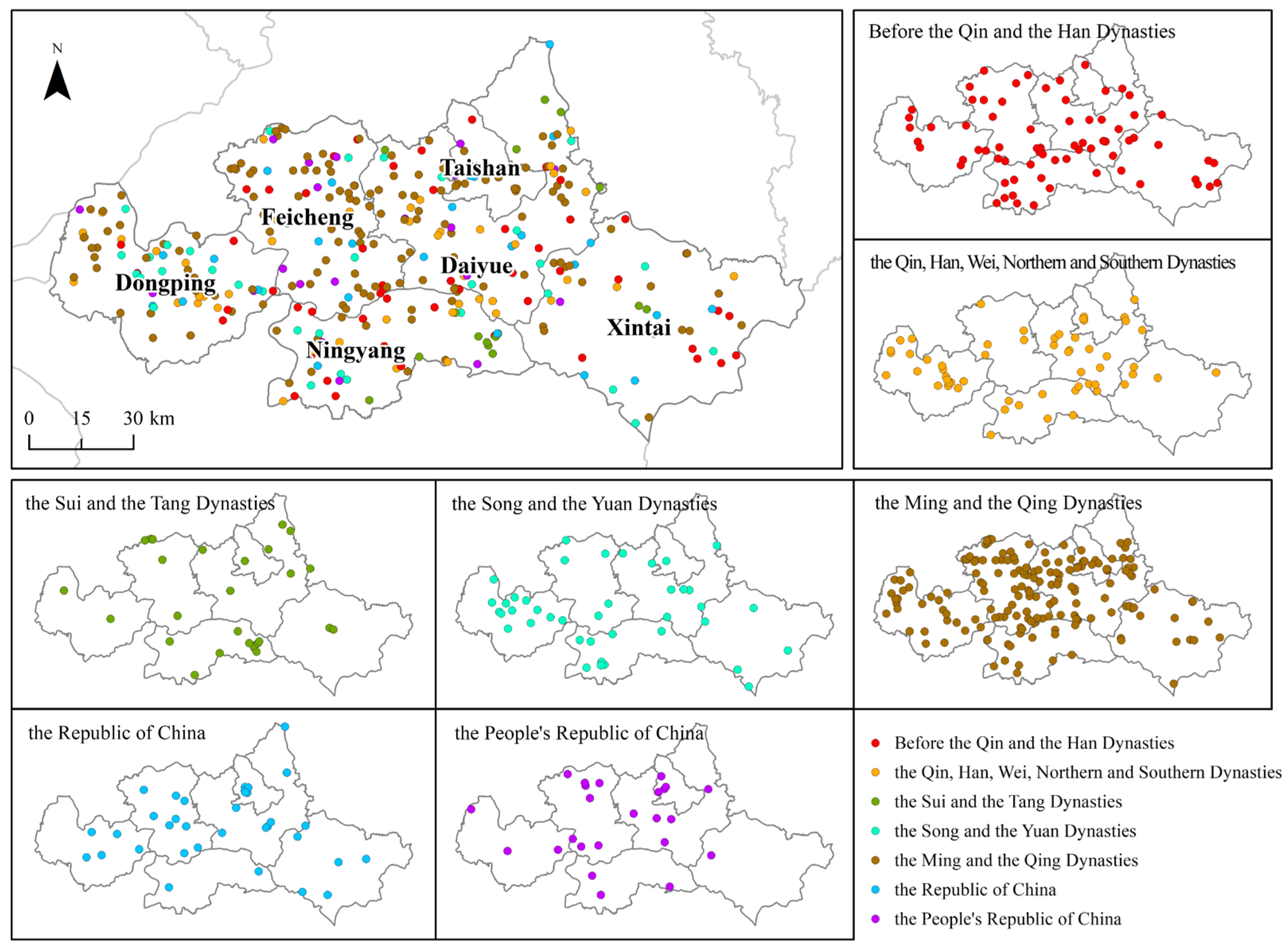
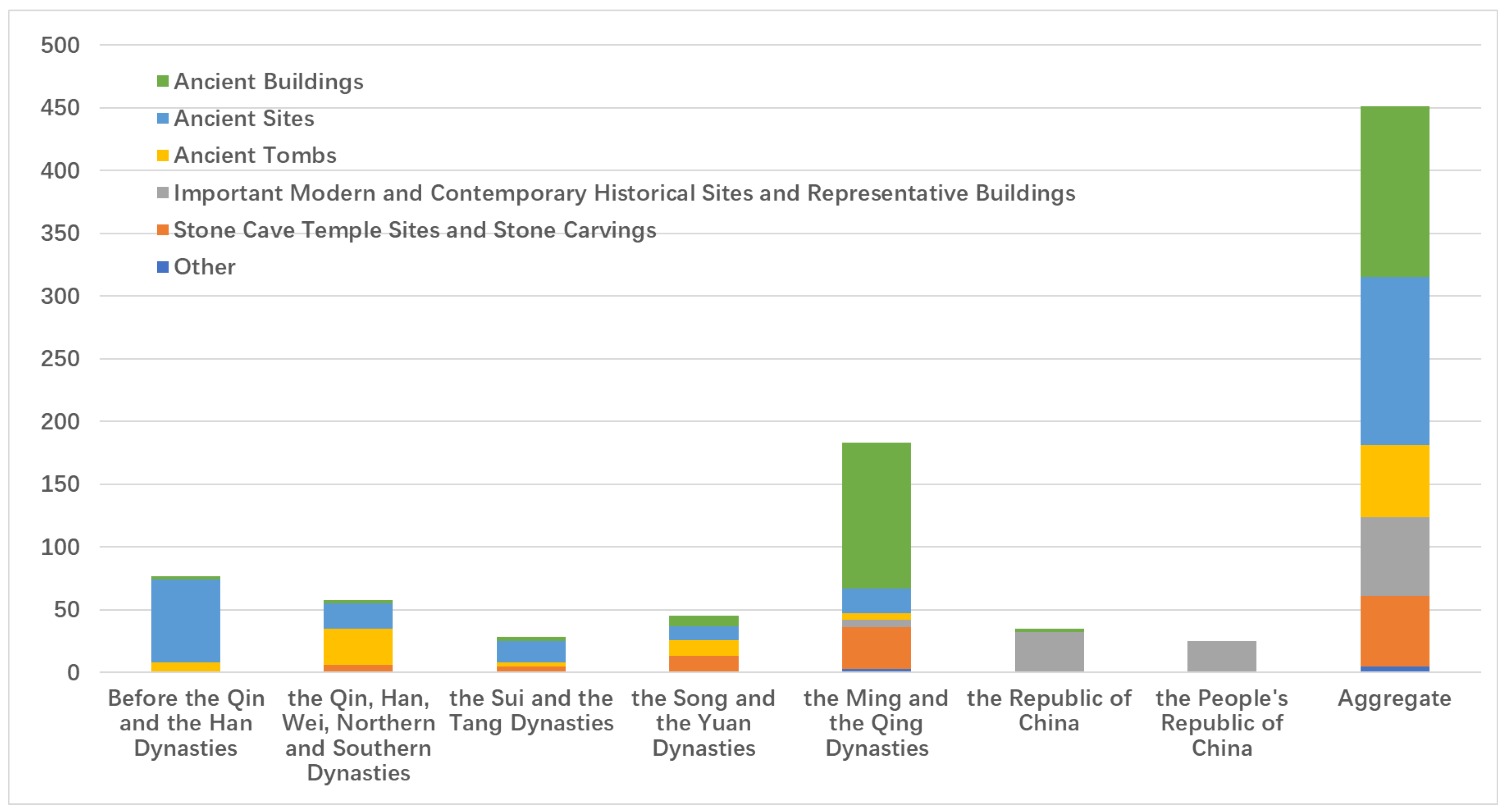
According to archaeological discoveries [40], human habitation in the Mount Tai region goes back to the Paleolithic Age. The remains of historic buildings in this area has gone through a long development period. Considering the framework of Chinese historical evolution and taking into account the scale and phased characteristics of preserved cultural relic sites, this study divides the construction periods of historical buildings in the Mount Tai region into seven main stages as follows (Figure 2): Pre-Qin and Han Dynasties (about 1.7 million BCE–221 BCE), Qin and Han to Northern and Southern Dynasties (221 BCE–581 CE), Sui and Tang Dynasties (581 CE–960 CE), Song and Yuan Dynasties (960 CE–1368 CE), Ming and Qing Dynasties (1368 CE–1912 CE), the Republican Period (1912 CE–1949 CE), and the period since the founding of the People’s Republic of China (1949 CE–present). In terms of the number of protected buildings across different periods, the distribution exhibits a distinct “И-shaped” fluctuation pattern: a relatively high number of remains predate the Qin and Han dynasties (77 sites), followed by fluctuations through subsequent eras, culminating in a peak during the Ming and Qing dynasties (183 sites), with a decline observed in the modern and contemporary periods.
However, this quantitative distribution curve cannot be directly equated with the actual intensity of construction activity in each historical period. At least three mechanisms have jointly shaped the currently observed chronological distribution pattern. First, there are period specific differences in building materials and preservation conditions. Early buildings were predominantly constructed using perishable materials such as earth and timber, making them more vulnerable to long-term natural erosion and human activities [41]. From the Sui and Tang dynasties onward, the widespread adoption of hybrid masonry, brick, and timber structures significantly enhanced building durability, thereby increasing the likelihood that later structures would survive to the present day [42]. Second, social stability and wartime destruction have exerted phased influences. Frequent warfare during the Wei, Jin, and Southern and Northern Dynasties, the Song Jin confrontation, and the Republican period led to extensive building losses, creating troughs in the number of surviving remains [43]. In contrast, the relatively stable political environment and economic prosperity of the Ming and Qing dynasties provided favorable conditions for large-scale construction and subsequent preservation [44]. Third, there is a preferential effect inherent in modern heritage designation mechanisms. In the selection of protected cultural relic sites, buildings that are of greater antiquity, larger scale, or associated with major historical events or figures are more likely to receive official recognition, whereas a substantial number of ordinary modern historic buildings have not been granted formal protection status and are therefore excluded from the sample of this study [45]. Consequently, the peaks observed in Figure 2, particularly the pronounced predominance of the Ming and Qing periods, partly reflect genuine construction prosperity during those eras and partly stem from the compounded effects of preservation advantages and designation biases.
Furthermore, calculating the number of preserved sites per unit time as preservation frequency reveals temporal differences in preservation density. The Republican period exhibits the highest preservation frequency at 94.59 sites per century, followed by the Ming-Qing period at 34.92 sites per century and the People’s Republic of China period at 32.89 sites per century. The Pre-Qin and Han period, spanning approximately 1.7 million years, has an extremely low preservation frequency of 0.0045 sites per century, while the remaining periods range between 7 and 11 sites per century. Preservation frequency is significantly negatively correlated with time elapsed since construction (Pearson r = −0.73, p < 0.05), confirming the expected relationship between temporal erosion and preservation probability and underscoring the need to account for period duration when interpreting the observed quantity of remains.

3.1.2. Temporal Distribution Patterns by Type

Based on the national list of protected cultural heritage sites, historical buildings in the Mount Tai region can be divided into six major types (Figure 3; Table 1): ancient ruins, ancient tombs, ancient buildings, cave temples and stone carvings, modern and contemporary important historical sites and representative buildings, and other types.
In terms of typological composition across different periods (Table 1), the heritage types of historic buildings in the Mount Tai region exhibit a clear phased evolution:
(1)
Before the Qin and Han dynasties, remains are predominantly ancient sites (66 sites, accounting for 85.71% of the period’s total), accompanied by 7 ancient tombs, 3 ancient architectural structures, and 1 site of other types. Grotto temples and stone carvings as well as modern and contemporary historical sites are absent. This typological profile reflects the material remains characteristic of early human societies, centered on production and habitation sites and burial practices.
(2)
From the Qin and Han to the Northern and Southern Dynasties, typological diversity increases. In addition to the preexisting categories of ancient sites (20 sites, 34.48%), ancient tombs (29 sites, 50%), and ancient architecture (3 sites), grotto temples and stone carvings (6 sites) appear for the first time. Ancient tombs constitute the most numerous type in this period, a phenomenon associated with the widespread practice of elaborate burial customs during the Han dynasties and the historical status of the Mount Tai region as a princely fiefdom.
(3)
During the Sui and Tang dynasties, the total number of remains declines slightly. The assemblage comprises ancient sites (17 sites, 60.71%), ancient tombs (3 sites), ancient architecture (3 sites), and grotto temples and stone carvings (5 sites). The renewed predominance of ancient sites may be linked to the institutionalization of imperial fengshan rituals at Mount Tai and the construction of related ceremonial facilities during this era.
(4)
During the Song and Yuan dynasties, the typological structure becomes more balanced: ancient architecture (8 sites) and grotto temples and stone carvings (12 sites) together account for 44.44% of the period’s total, while ancient sites (11 sites, 24.44%) and ancient tombs (13 sites, 28.89%) comprise the remainder. The increased number of grotto temples and stone carvings reflects the further dissemination of Buddhist culture in the Mount Tai region and the continued practice of cave excavation.
(5)
During the Ming and Qing dynasties, the number of remains reaches its peak (183 sites, accounting for 40.6% of the total sample). All six typological categories are represented. Ancient architecture (116 sites, 63.4%) dominates unequivocally, followed by grotto temples and stone carvings (33 sites, 18.03%); together, these two categories constitute over 80% of the period’s total. This typological concentration reflects both advances in building technology and economic capacity during the Ming and Qing dynasties and the intensification of Mount Tai’s function as a religious sanctuary and cultural center. Additionally, major modern and contemporary historical sites and representative buildings (6 sites) make their first appearance, signaling an extension of heritage types into the modern era.
(6)
In the Republican period and the People’s Republic of China period, typological concentration is pronounced: in the Republican period, major modern and contemporary historical sites and representative buildings are predominant (32 sites, 91.43%), while in the People’s Republic of China period, all remains belong to this category (25 sites, 100%). This typological convergence underscores a significant shift in modern and contemporary heritage designation priorities toward revolutionary sites and representative architecture and also reflects evolving criteria for heritage value recognition across different eras.
From the diachronic changes in typological composition, the following trends can be discerned. First, ancient sites and ancient tombs predominate in the early phases, reflecting a mode of spatial organization in which human activities during those periods centered on production, daily life, and funerary functions. Second, from the Song and Yuan dynasties onward, the proportion of ancient architecture and grotto temples and stone carvings steadily increases, with ancient architecture emerging as the unequivocally dominant type during the Ming and Qing dynasties. This shift is closely associated with the flourishing of religious culture, advances in building technology, and growing demand for ritual construction. Third, the modern and contemporary period is characterized by the preeminence of revolutionary sites and representative buildings, signaling an institutional reorientation of heritage designation priorities toward recent historical monuments. This evolution of typological structure not only records historical transformations in architectural function and culture but also mirrors the differing criteria of heritage value recognition and the shifting orientations of conservation policy across historical periods.

3.1.3. Temporal Evolution Characteristics

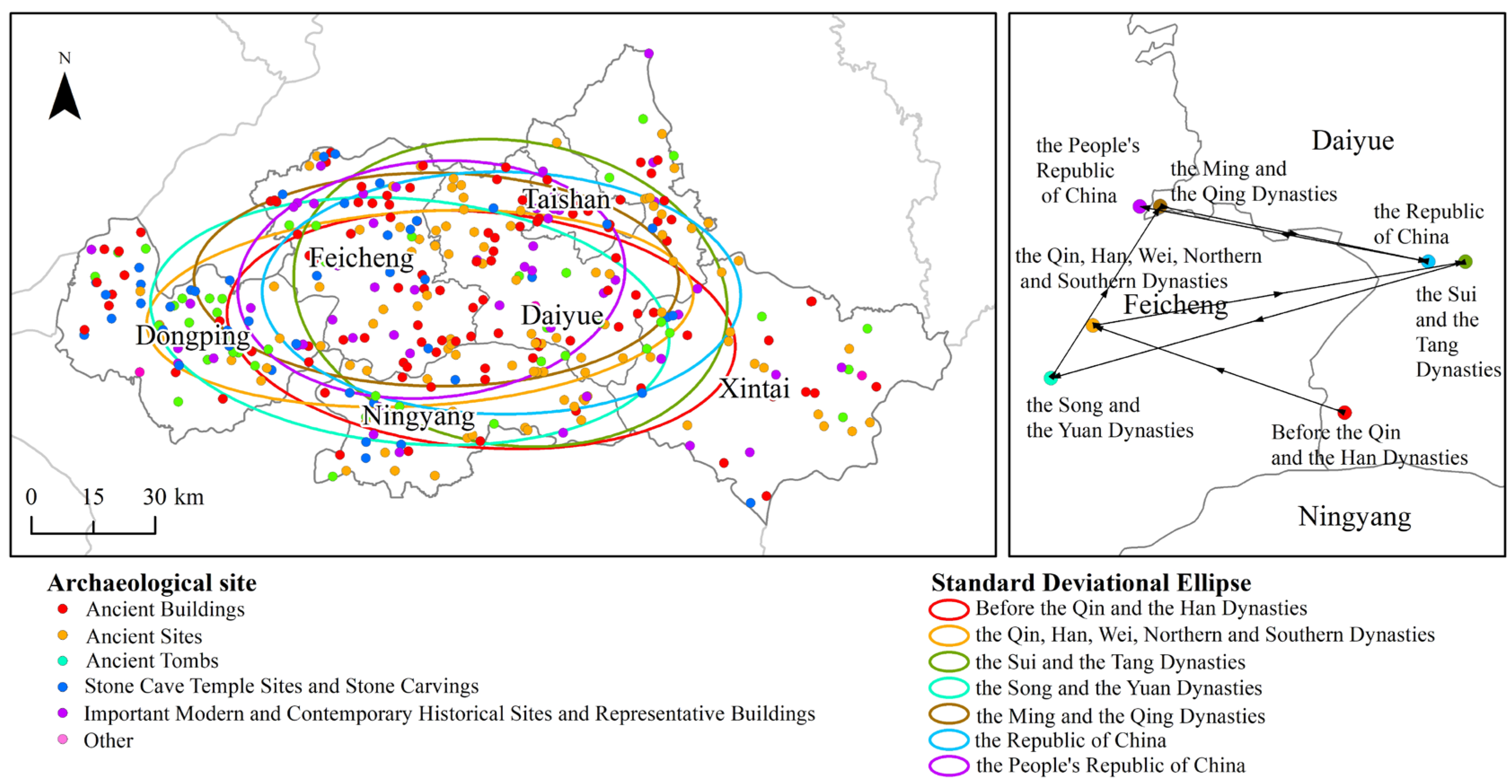
Based on the data for historic buildings in Tai’an City, the standard deviational ellipses and centroid coordinates of the spatial distribution of buildings across seven historical periods were calculated using ArcGIS 10.8 software (Figure 4), in order to reveal the directional trends and centroid shift patterns of their spatial distribution.
The migration of the centroid coordinates across different periods exhibits the following trajectory: prior to the Qin and Han dynasties, the centroid was located in the southwestern part of Daiyue District; from the Qin and Han to the Northern and Southern Dynasties, it shifted northwestward to Feicheng City; during the Sui and Tang dynasties, it turned northeastward and returned to Daiyue District; during the Song and Yuan dynasties, it moved southwestward once again to Feicheng City; during the Ming and Qing dynasties, it shifted markedly northeastward to the border area between Daiyue District and Feicheng City; in the Republican period, it moved eastward into Daiyue District; and after the founding of the People’s Republic of China, it veered westward back to the aforementioned border area. Overall, the centroid oscillated in the vicinity of the tripoint boundary zone shared by Daiyue District, Feicheng City, and Ningyang County, with the general trend exhibiting a net displacement from southwest to northeast.
Changes in the standard deviational ellipse parameters further quantify the evolution of distributional morphology across different periods (Table 2). The semi-major axis of the ellipse progressively shortens from approximately 18.2 km prior to the Qin and Han dynasties to approximately 12.5 km during the Ming and Qing dynasties, while the semi-minor axis decreases from roughly 7.6 km to roughly 5.2 km. Correspondingly, the elliptical area contracts from about 434 km2 to about 204 km2. The continuous reduction in elliptical area indicates that the spatial distribution of historic buildings exhibits a temporal trend of evolution from relative dispersion toward pronounced concentration, and this clustering process attains its most significant degree during the Ming and Qing dynasties. Changes in the rotation angle further reveal that the dominant orientation of the distribution undergoes a shift from a nearly north–south alignment (rotation angle approximately 173° prior to the Qin and Han dynasties) toward an east-by-northeast direction (approximately 160° during the Ming and Qing dynasties), a trend that converges with the overall northeast–southwest strike of the Mount Tai range.
The migration and clustering trends of the spatial centroid described above can be understood from two dimensions: the shift in regional development focus and the production of heritage space. From the perspective of regional development, the centroid consistently oscillates around the plain area at the southern foot of Mount Tai. This area constitutes the core zone of the Dawen River alluvial plain, characterized by fertile soil and abundant water resources, and has historically been a densely populated and economically vibrant region. The net northeastward displacement of the centroid broadly corresponds with the historical process whereby the political and economic center of gravity in the Tai’an area gradually shifted from the Dawenkou–Dongping Lake basin in the southwest toward the piedmont zone of Mount Tai [46]. From the perspective of heritage space production, the flourishing of Mount Tai’s fengshan ritual culture and religious activities during the Ming and Qing dynasties spurred the construction and renovation of core ceremonial architectural complexes such as the Dai Temple and Bixia Temple, thereby reinforcing the status of the southern foot of Mount Tai as a nucleus of architectural agglomeration. This constitutes a significant reason for the pronounced contraction of the elliptical area during the Ming and Qing dynasties. Since the Republican period, the amplitude of centroid migration has diminished and the elliptical morphology has tended toward stability, a phenomenon that reflects, to a certain extent, the locking effect exerted by modern heritage conservation institutions on the spatial configuration of buildings already inscribed on protection lists.

3.2. Spatial Distribution Characteristics

3.2.1. Overall Spatial Distribution Pattern

Based on nearest neighbor analysis, this study quantifies the spatial distribution pattern of historical buildings in the Mount Tai region, and compare the observed average distance with the expected average distance under a theoretical random distribution. The Nearest Neighbor Ratio (R), p-value, Z-score and other indicators are calculated. Our results show that the overall nearest neighbor ratio R = 0.5359 (<1), with an observed average distance of 1463.51 m, which is remarkably smaller than the expected average distance of 2730.78 m under random distribution, and p < 0.01, the Z-score is −18.85 (see Table 3). This indicates that the historic buildings in the Mount Tai region exhibit a pronounced clustered distribution pattern in space, rather than a random or dispersed distribution.
In terms of specific typologies, all six major categories of historic buildings exhibit clustered distribution characteristics. Among them, ancient architecture displays the lowest nearest neighbor ratio (R = 0.7108), with an observed mean distance of 3043.58 m, which is significantly smaller than the expected mean distance of 4281.98 m. The corresponding Z-score is −6.45, indicating the most pronounced degree of clustering. Ancient sites (R = 0.7507) and ancient tombs (R = 0.7856) also demonstrate conspicuous clustering features. The clustering degree of grotto temples and stone carvings is comparatively moderate (R = 0.8389), yet its p-value (0.021) nonetheless confirms that the clustered distribution is statistically significant. Major modern and contemporary historical sites and representative buildings exhibit a nearest neighbor ratio of 0.7878, likewise indicating a clustered distribution. The “other” category, which accounts for only 1.1% of the total sample (5 sites), displays a random distribution; however, given its extremely small number, its influence on the overall spatial pattern is negligible.
The formation of this overall clustered pattern can be understood from the following three perspectives. First, there is the foundational constraint imposed by the geographical environment. Natural geographical units such as the Mount Tai range, the Dawen River system, and Dongping Lake constitute the basic framework of the regional space. The siting of historic buildings has long been guided by topographical and hydrological conditions: plains and river valleys are suitable for construction, whereas steep mountainous terrain and areas distant from water sources contain few buildings. Consequently, construction naturally gravitated toward a limited number of suitable zones, thereby producing spatial clustering. Second, there is the centripetal impetus of cultural functions. As a sacred site for imperial fengshan rituals, Mount Tai possesses ceremonial architecture (such as the Dai Temple) and religious architecture (such as Lingyan Temple and Yuquan Temple) that exert strong cultural attraction, fostering the formation of architecturally dense zones in surrounding areas. The fact that ancient architecture exhibits the highest degree of clustering (R = 0.7108) constitutes a spatial manifestation of this cultural centripetal force. Third, there is the superimposed effect of heritage designation and conservation policies. The current system of protected cultural relic sites centers on graded registries and imposes strict controls on construction in the vicinity of listed buildings. This mechanism objectively reinforces the spatial stability of existing heritage clusters while also implying that the statistical visibility of densely concentrated non-designated heritage areas may be relatively low, an effect that warrants further attention in future research.
It is worth noting that the degree of clustering varies among different typologies. Ancient architecture demonstrates the strongest clustering, whereas grotto temples and stone carvings exhibit comparatively weaker clustering. This variation is related to the spatial attachment characteristics of each heritage type: ancient architecture tends to be concentrated around urban settlements and religious sanctuaries, while grotto temples and stone carvings are often distributed in linear or scattered patterns along mountain cliffs and rock faces, reflecting differing spatial constraints [47]. This divergence suggests that differentiated conservation strategies tailored to the spatial characteristics of each heritage type should be adopted in protection planning. For highly clustered ancient architectural complexes, integrated conservation may be implemented; for grotto temples and stone carvings, which are relatively dispersed, a combined approach of site specific protection and linear corridor linkage merits exploration.

3.2.2. Spatial Distribution Patterns by Type

This study analyses the spatial distribution patterns of the six major categories of historical buildings across the administrative districts of Tai’an City (see Table 4) and reveals significant differences between the districts. Daiyue District and Feicheng City hold the highest number of historical buildings, accounting for 23.06% and 26.16% of the total respectively, almost constituting half of the total of the city. The proportion of ancient buildings and ancient ruins in these areas is 68.92%, so we can conclude that these are the core clustering areas. Tai’an District accounts for only 7.10% of the total, but it exhibits relatively high proportions of ancient buildings as well as modern and contemporary important historical sites and representative buildings. Furthermore, the degrees of heritage protection here are generally higher, highlighting the vital value of the architectural heritage in this district. Dongping County, ranking third and accounting for 17.74%, leads the city in both the number of ancient tombs and the quantity of cave temples and stone carvings, showing distinct features. Ningyang County accounts for 15.30%, with ancient ruins constituting 43.48% of the total within the county—the highest percentage in the city—reflecting its long history. In Xintai City, the distribution of various cultural relics is relatively even, with no obvious bias toward any particular sort.
The differentiated characteristics of resource types across administrative divisions indicate that the historic building resources of Tai’an City are not homogeneously distributed; rather, they form a regional pattern characterized by functional complementarity. Specifically, Taishan District centers on ceremonial and religious architecture, representing the essence of Mount Tai culture. Daiyue District and Feicheng City are dominated by ancient sites and ancient architectural complexes, which embody the principal trajectory of regional civilizational development. Dongping County is distinguished by grotto temples, stone carvings, and ancient tombs, reflecting the intersection of waterway transport culture and religious art. Ningyang County excels in early ancient sites, documenting the initial stages of human activity in the region. Xintai City, in contrast, exhibits a balanced distribution of resource types and thus possesses potential for comprehensive development.
This differentiated pattern provides a spatial foundation for the thematic design of subsequent tourism routes while also imposing requirements for the formulation of differentiated conservation strategies. Core agglomeration zones (such as the border area between Daiyue District and Feicheng City) are suitable for integrated conservation measures, including the delineation of contiguous protection areas and the regulation of construction intensity. Resource characteristic zones (such as the grotto temple concentration area in Dongping County) call for typologically focused conservation, necessitating specialized protection plans that address the specific vulnerabilities of grotto temples and stone carvings. Resource dispersal zones (such as Xintai City) require the exploration of models that combine site specific protection with adaptive reuse, so as to avoid neglecting the conservation value of these resources due to their relatively low density.

3.2.3. Spatial Pattern Characteristics: Kernel Density Analysis

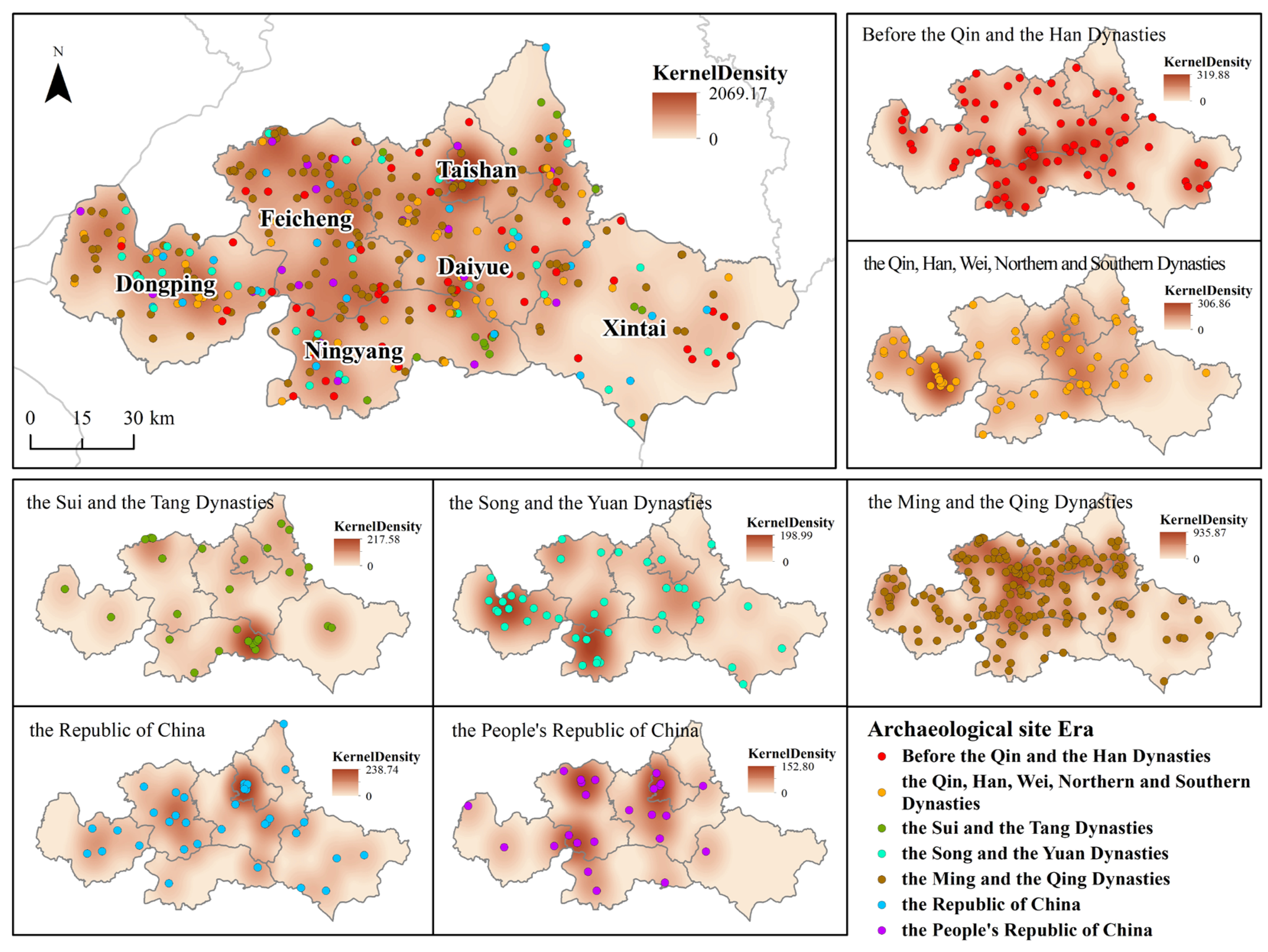
Kernel density analysis was employed to identify the spatial agglomeration cores of historic buildings across different historical periods and to trace their migration trajectories [48]. Kernel density estimation was conducted on the ArcGIS 10.8 platform, and the results are presented in Figure 5.
Prior to the Qin and Han dynasties, the high-density core area was primarily located in the tripoint boundary zone shared by Daiyue District, Feicheng City, and Ningyang County, with a maximum density value of approximately 0.42 sites per km2. The agglomeration center exhibited substantial overlap with the area of the Dawenkou site. This pattern indicates that the Dawen River basin had already emerged as a core area of human activity during the early stages of civilization. From the Qin and Han to the Northern and Southern Dynasties, the high-density zone showed a westward migration trend, with the agglomeration core shifting to the western part of Feicheng City. During the Sui and Tang dynasties, the density peak declined somewhat (to approximately 0.31 sites per km2), a change that may be attributable to the relatively small total number of remains from this period. During the Song and Yuan dynasties, a new agglomeration center formed around Dongping Lake in Dongping County, with a maximum density value of approximately 0.38 sites per km2, reflecting the historical function of Dongping Lake as a waterway transportation hub and cultural node. During the Ming and Qing dynasties, the high-density core migrated markedly northeastward, forming a zonal agglomeration pattern along the southern foot of the Mount Tai range. The density peak reached the highest level observed across the entire study period (approximately 0.61 sites per km2), with the agglomeration center situated in the border area between Daiyue District and Taishan District. During the Republican period and the People’s Republic of China period, the overall agglomeration orientation remained largely stable, although several secondary agglomeration points emerged in the vicinity of Mount Tai and along the shores of Dongping Lake.
To quantitatively characterize the migration trajectory of agglomeration cores, this study extracted the raster cells corresponding to the top 10% of kernel density values for each period and calculated the geometric center coordinates of these cells as well as the migration distance between consecutive periods (Table 5). The results reveal that from the period prior to the Qin and Han dynasties to the Song and Yuan dynasties, the kernel density center shifted northwestward and then westward, accumulating a total displacement of approximately 18.7 km. During the Ming and Qing dynasties, the center exhibited a pronounced leap northeastward of about 22.3 km. In the modern and contemporary periods, the magnitude of displacement diminished significantly (to less than 5 km).
This migration trajectory can be understood from two perspectives: the shift in regional development focus and the temporality of heritage space production. The westward agglomeration observed from the period prior to the Qin and Han dynasties to the Song and Yuan dynasties is closely linked to the development of agricultural civilization in the Dawen River basin and the function of Dongping Lake as a waterway transportation hub, since early settlement location was highly dependent on water sources and arable land resources [49]. The pronounced northeastward leap during the Ming and Qing dynasties, by contrast, is directly associated with the institutionalization of Mount Tai’s fengshan ritual culture, the flourishing of religious activities, and the consolidation of Tai’an’s status as a regional administrative center [50]. It is worth noting that the magnitude of kernel density core migration diminished markedly in the modern and contemporary periods, a phenomenon that reflects, to a certain extent, the locking effect exerted by modern heritage conservation institutions on the distribution pattern of historic buildings. As the system of protected cultural relic sites was established and refined, the spatial configuration of buildings already inscribed on protection lists tended toward stability, while the incremental addition of newly designated heritage sites became concentrated primarily in areas adjacent to existing protected zones.
In summary, the spatial agglomeration pattern of historic buildings in Tai’an City underwent an evolutionary process from agglomeration in the southwestern river basin toward zonal agglomeration along the northeastern mountain range. This evolution was fundamentally constrained by natural environmental endowments and shifting centers of economic development, and was also profoundly shaped by cultural and institutional changes as well as heritage conservation policies.

4. Analysis of Formative Factors

4.1. Natural Factors

4.1.1. Hydrological Environment

Tai’an is located in the central part of Shandong Province. The topography of Mount Tai gives rise to a drainage system that flows from higher to lower elevations. The Dawen River, the largest tributary of the lower Yellow River, flows from east to west through Taishan District, Daiyue District, Feicheng City, Ningyang County, and Dongping County within Tai’an City, ultimately discharging into Dongping Lake. After regulation by lake sluices, it joins the main channel of the Yellow River, forming an interconnected natural hydrological system comprising the Dawen River, Dongping Lake, and the Yellow River.
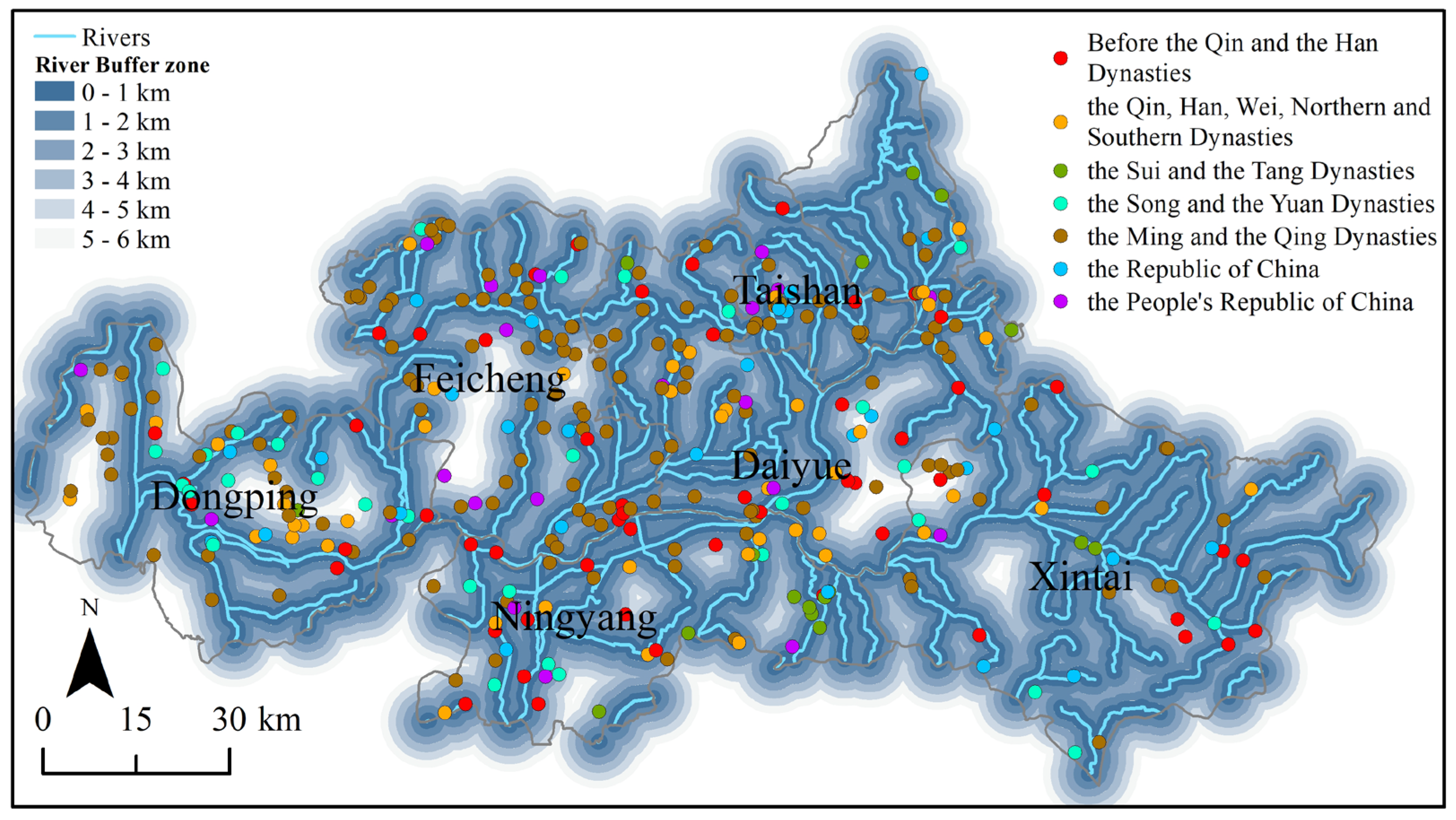
Using a 30 m resolution digital elevation model of Tai’an City, we extracted the regional water system in ArcGIS 10.8. Buffer zones were established at radii of 1, 2, 4, 6, and 8 km around major rivers and lakes, and overlay analysis was conducted with the historic building point data (Figure 6). The statistical results indicate that the majority of historic buildings are located within 1 to 2 km of water systems. Most of the remaining sites are found at distances between 2 and 6 km, while only a small proportion lie beyond 8 km. Overall, the number of historic buildings exhibits a declining trend as the distance from water systems increases.
This distance-decay pattern suggests a notable association between the siting of historic buildings and proximity to water systems. During early periods when production capacities were relatively limited, the abundant water sources, convenient access, and favorable land conditions along rivers made the central and southern Dawen River basin and the western Dongping Lake area core zones for productive activities and settlement construction [51]. With socioeconomic development and technological advancement, building distribution gradually expanded toward the northern piedmont and areas near water sources, resulting in a spatial pattern characterized by greater density in the north than in the south and in the west than in the east.

4.1.2. Topography and Geomorphology

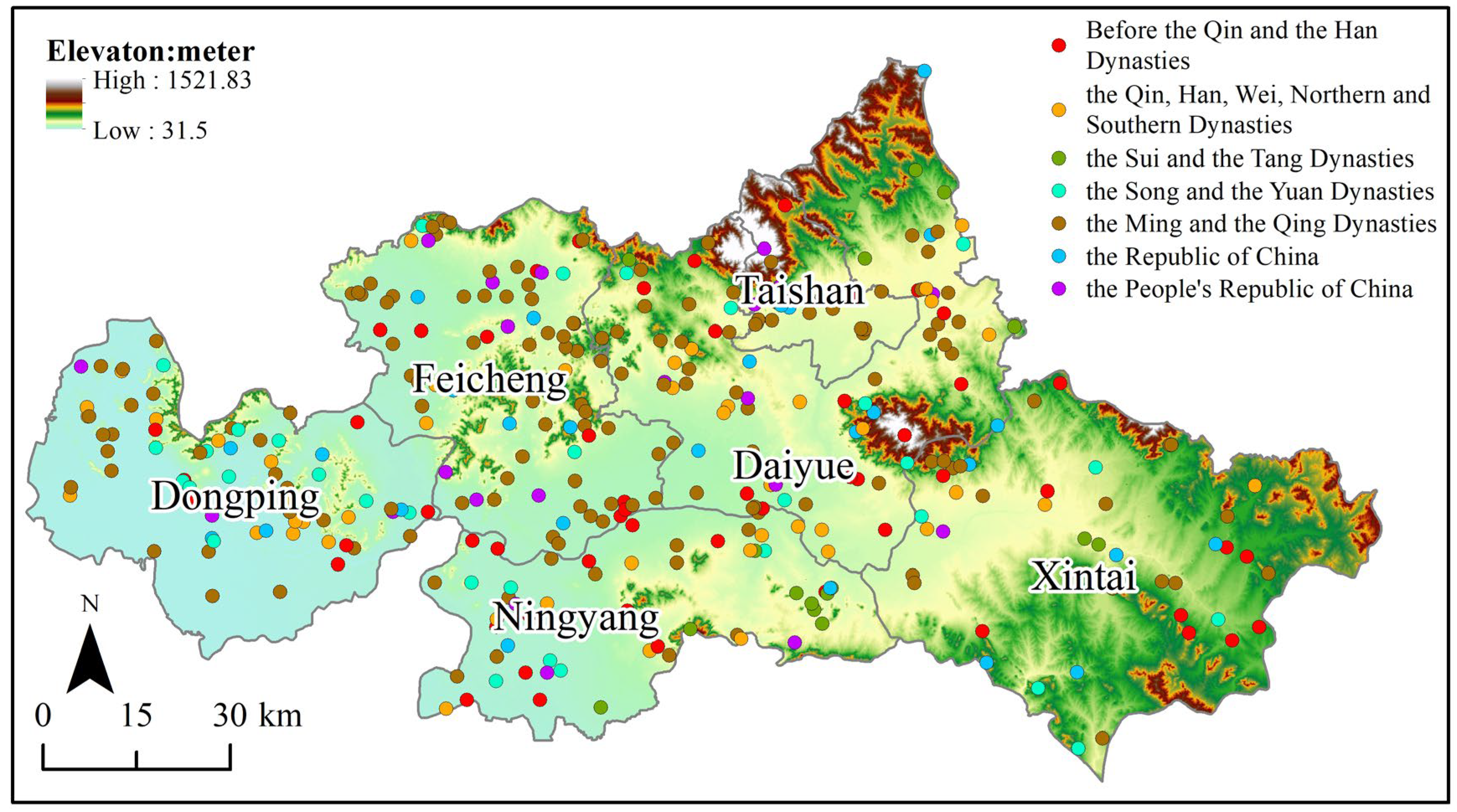
The terrain of Tai’an City consists primarily of mountains, hills, and plains, exhibiting an overall spatial pattern of stepwise descent from northeast to southwest. The northern section comprises the main range of Mount Tai, with its highest peak, Yuhuangding, reaching an elevation of 1545 m and characterized by steep slopes. The central region constitutes a transitional zone of low mountains and hills, where slopes and valley plains are widely distributed. The southwestern section is the alluvial plain of the Dawen River, featuring open and flat terrain with fertile soil. This pronounced topographic differentiation bears a discernible relationship with the siting and spatial distribution of historic buildings (Figure 7).
An overlay analysis of the historic building point data [52] and the digital elevation model [53] reveals that historic buildings are predominantly distributed in low elevation plains, hilly areas, and intermontane basins, whereas high altitude steep mountainous terrain contains relatively few such structures. The southwestern plain region features gentle topography and fertile soils, which provided the foundational conditions for the development of agrarian civilization. Over time, this area gradually evolved into a regional transportation node and a zone of cultural convergence, thereby preserving a relatively rich array of ancient sites, ancient tombs, and riverine landscape remnants. As time progressed, building distribution gradually extended northeastward into hilly areas and intermontane basins, culminating in the formation of a high-density agglomeration zone of ancient architecture along the southern foot of Mount Tai during the Ming and Qing dynasties. This distributional trend is associated, to a certain extent, with the religious and cultural functions of the northern mountain range. The main peak area of Mount Tai has long served as a locus of religious worship and cultural symbolism, and consequently, the peripheral towns and piedmont zones have gradually developed into architecturally dense areas. At the same time, the mountainous topography provided natural conditions conducive to defensive installations, and the outlying ridges of Mount Tai and the Culai Mountain area retain a number of modern military and revolutionary sites, which constitute material testimony to specific historical periods.

4.2. Human Factors

In contrast to natural factors, the influence of anthropogenic factors on the distribution of historic buildings in the Mount Tai region exhibits a progressively intensifying trend over time. During the early stages, natural conditions such as hydrology and topography provided foundational resources and spatial constraints for site selection. With the advancement of social productive forces, the evolution of political institutions, and the accumulation of cultural traditions, the associations between factors such as fengshan ritual practices, religious beliefs, economic activities, and policy frameworks on the one hand, and the distribution pattern of historic buildings on the other, have become increasingly apparent.

4.2.1. Mount Tai Culture and Religious Culture

As the foremost of the Five Sacred Mountains, Mount Tai has exerted a profound influence on the spatial distribution of historic buildings through its fengshan ritual culture and religious traditions. The fengshan ceremonies conducted by successive emperors at Mount Tai spurred the continuous construction and renovation of ceremonial buildings such as the Dai Temple and the Bixia Temple. These structures, generally of considerable scale, are concentrated predominantly at the southern foot of Mount Tai and in the adjacent piedmont plain, gradually forming an architectural agglomeration zone centered on sacrificial and ceremonial functions [54].
At the religious cultural level, the introduction and dissemination of Buddhism stimulated the construction of temple complexes such as Lingyan Temple and Yuquan Temple, while the indigenous development of Daoist culture promoted the establishment of Daoist edifices including the Jade Emperor Temple and the Queen Mother Pool. Grotto temples and stone carvings, serving as material embodiments of religious doctrine and art, are distributed primarily along the rock faces of Mount Tai itself and in the vicinity of Dongping Lake. By the Ming and Qing dynasties, religious activities had reached their zenith, the number of ancient buildings had increased markedly, and a zonal distribution pattern had emerged along the Mount Tai range, transforming the surrounding region into a core architectural cultural zone that integrates religious worship, cultural transmission, and artistic expression.
Viewed from the perspective of distributional formation logic, the influence of Mount Tai culture and religious culture on the spatial distribution of historic buildings exhibits a relatively distinct hierarchical structure. Core ceremonial buildings (such as the Dai Temple) and major religious monasteries (such as Lingyan Temple) tend to occupy nodal positions at the southern foot of Mount Tai and along major transportation arteries, constituting primary agglomeration cores. Secondary temples and Daoist shrines extend along pilgrimage routes and valley corridors, forming secondary agglomeration points. Smaller religious installations and stone carvings scattered throughout the mountains fill the transitional zones between agglomeration cores. This hierarchical spatial structure resonates with the diffusion process of religious cultural transmission while also reflecting, to a certain extent, the spatial organizational logic of the fengshan ritual system.

4.2.2. Agricultural Culture and Economic Development

The Wen River plain in the southern part of the Mount Tai region features fertile soils and abundant water resources, providing favorable conditions for the development of early agrarian civilization. The distribution of ancient sites such as the Dawenkou site attests to the importance of this area as a locus of early human settlement. The advancement of agrarian civilization stimulated the emergence of functional buildings including villages, granaries, and hydraulic facilities, giving rise to a mode of spatial organization centered on agricultural production.
A relatively clear correspondence exists between the level of economic development in each historical period and the quantity and quality of surviving architectural remains. During the Sui and Tang dynasties, advances in stone quarrying and construction techniques laid the technological foundation for architectural development. During the Ming and Qing dynasties, the prosperity of the agrarian economy and the frequency of commercial exchange propelled the Mount Tai region into a peak phase of cultural and technological development, accompanied by extensive construction activity that now constitutes the bulk of surviving historic buildings from that period. In contrast, during periods of warfare such as the Wei, Jin, and Southern and Northern Dynasties and the Republican era, economic decline and social upheaval led to considerable building losses, resulting in correspondingly reduced numbers of surviving remains and forming troughs in the quantitative distribution of historic buildings.
The influence of economic development on building distribution is manifested not only in changes in overall quantity but also in adjustments to typological structure and spatial layout [55]. The growth of the commodity economy during the Ming and Qing dynasties promoted the formation and expansion of market towns, leading to the concentrated emergence of building types such as guild halls, commercial shops, and post stations along major transportation routes and at commercial nodes. Concurrently, rising economic capacity rendered vernacular construction activities more vigorous, with building types such as traditional dwellings, ancestral halls, and academies becoming widely distributed across rural areas, thereby enriching both the typological composition and the spatial coverage of historic buildings. From this perspective, economic development has served, to a certain extent, to diffuse building activity outward from core ceremonial and religious spaces into the broader urban and rural landscape.

4.2.3. Revolutionary Culture and War Destruction

Since the onset of modern times, the Mount Tai region, by virtue of its distinctive geographical location, has served as an important arena for revolutionary activities and military conflicts, thereby shaping the distribution pattern of modern and contemporary historic buildings. During the War of Resistance against Japanese Aggression, the Culai Mountain area retained a number of revolutionary sites, including uprising commemorative sites, ordnance workshops, and field hospitals. These installations were predominantly sited within the hilly and mountainous terrain of the outlying ridges of Mount Tai and Culai Mountain, taking advantage of topographical conditions to establish defensive configurations. During the War of Liberation, Tai’an functioned as a strategic node connecting central and southern Shandong, and numerous historical traces such as battlefield sites and command posts remain preserved in the area.
At the same time, historical warfare inflicted considerable damage upon the architectural heritage of the region. The north–south confrontation during the Wei, Jin, and Southern and Northern Dynasties, the campaigns against the Jin during the Southern Song period, and the frequent conflicts of the Republican era all resulted in the destruction of a significant number of ancient buildings and ancient sites. In certain areas, these events even produced stratigraphic gaps in the surviving remains, exerting a non-negligible influence on both the overall inventory and the spatial distribution of buildings across different periods [56]. In this context, modern revolutionary sites have become a component of the historic building stock of the Mount Tai region that carries supplementary significance.
In terms of distributional characteristics, the spatial arrangement of revolutionary sites follows a logic of site selection distinct from that governing ancient ceremonial and religious architecture. Ceremonial and religious buildings tend to be located in the vicinity of the main peak of Mount Tai and along major transportation arteries, exhibiting a pronounced tendency toward agglomeration and centrality. Revolutionary sites, by contrast, are predominantly distributed in concealed zones within mountainous and hilly terrain, such as the interior of Culai Mountain and the valley areas of Mount Tai’s outlying ridges, displaying a pattern that is relatively dispersed and hidden. This divergence reflects, to a certain extent, a shift in the dominant logic governing architectural site selection across different historical periods, namely, a transition from conspicuous spatial expressions that highlight cultural and religious symbolic functions toward functional spatial choices oriented toward military defense and strategic concealment.

4.2.4. Institutional and Governance Contexts

The institutional and governance contexts relevant to the distribution pattern of historic buildings in the Mount Tai region can be examined from two perspectives: the establishment of heritage conservation institutions and their spatial effects, and the guiding role of administrative division adjustments and population agglomeration.
(1)
Establishment of Heritage Conservation Institutions and Spatial Effects
The contemporary distribution and preservation of historic buildings in the Mount Tai region are closely related to the implementation of heritage conservation policies and urban planning. As China’s first UNESCO World Heritage Mixed Property site, Mount Tai benefits from systematic protective regulations and planning support. Significant remains such as ancient buildings and sites within the core area are subject to relatively strict controls, which have, to a certain extent, mitigated the direct impact of urbanization on the heritage environment. The hierarchical designation system of cultural relic protection units at the national, provincial, and municipal/county levels delineates the scope of protection and management requirements for heritage at different tiers, thereby enabling the relatively intact conservation of iconic resources such as the Dai Temple and the Dawenkou Site.
From a spatial governance perspective, the association between the current system of protected cultural relic sites and the distribution pattern of historic buildings can be understood at two levels. First, there is the selective character of registry designation. In the process of selecting and designating protected cultural relic sites, buildings of greater antiquity, larger scale, or those associated with significant historical events or figures tend to have a higher likelihood of receiving official recognition [57]. This selective mechanism contributes, to some extent, to the differentiated visibility of various building types and periods within the protection registry. Second, there is the spatial effect of conservation controls. For buildings already inscribed on protection lists, surrounding construction activities are subject to more stringent regulation. This institutional arrangement may, in objective terms, contribute to maintaining the spatial stability of existing heritage agglomerations [58]. The locations of designated buildings are relatively fixed, and the distribution of subsequently designated heritage sites often exhibits a degree of continuity with the spatial configuration of existing protected areas. From the perspective of spatial evolution, this institutional mechanism of spatial stabilization may exert an influence on the evolution of heritage distribution patterns over extended temporal scales.
(2)
Spatial Influence of Administrative Adjustments and Population Agglomeration
Adjustments in administrative divisions and trends in population agglomeration across different historical periods bear a discernible relationship with the distribution pattern of historic buildings in the Mount Tai region. During the Ming and Qing dynasties, as Tai’an gradually consolidated its status as a regional political center, relatively stable administrative divisions facilitated population concentration in urban areas and their surroundings. This, in turn, spurred the dense construction of government offices, residences, dwellings, and temples in the border area between Taishan District and Daiyue District, establishing this zone as a core agglomeration area for ancient architectural remains. In the modern and contemporary periods, further adjustments to administrative divisions have optimized the allocation of regional resources. Areas such as Feicheng City and Daiyue District, which benefit from relatively convenient transportation and stronger economic foundations, have experienced notable population agglomeration, thereby providing favorable social conditions for the conservation and adaptive reuse of existing historic buildings.
Administrative division adjustments, population concentration, and heritage conservation institutions exhibit a certain degree of spatial superimposition. The establishment and realignment of administrative centers have channeled the spatial flows of population and economic activity, thereby influencing the primary zones in which construction activity occurred. Meanwhile, the establishment of heritage conservation institutions has contributed, to some extent, to the designation and preservation of buildings of outstanding value within these zones [59]. The combined effect of these two factors constitutes one of the institutional contexts for understanding the currently observed spatial pattern, which features the coexistence of core agglomerations and dispersed points. Moreover, the hierarchical structure of administrative divisions (municipality, district/county, township/town) and the tiered system of cultural relic protection units (national, provincial, municipal/county levels) have formed an institutionally corresponding relationship. This structural characteristic may exert a certain influence on both the spatial allocation of heritage resources and the distribution of management authority.

5. Planning Implications and Strategic Framework

5.1. Rationale for the Spatial Framework

The construction of the One Ring, Four Corridors planning framework derives from core findings concerning the spatiotemporal distribution patterns and formative factors of historic buildings. The logical connections can be examined across four dimensions: agglomeration core and ring positioning, kernel density center migration and corridor orientation, administrative district resource typologies and corridor themes, and the linear spatial guidance of hydrological and topographic factors.
First, agglomeration core and the positioning of the loop route. The results of kernel density analysis (Figure 5) indicate that during the Ming and Qing dynasties, historic buildings formed the highest density agglomeration core of the entire study period along the southern foot of Mount Tai, with a peak density of approximately 0.61 sites per km2. Standard deviational ellipse analysis (Table 2) further reveals that the elliptical area contracted to approximately 204 km2 during the Ming and Qing dynasties, the smallest value across all periods, reflecting a pronounced spatial concentration of distribution in the border area between Daiyue District and Taishan District. Nearest neighbor analysis (Table 3) shows that ancient architecture exhibits the highest degree of clustering among all typologies (R = 0.7108). Together, these findings point to the southern foot of Mount Tai as the spatial locus of the core agglomeration zone of regional cultural heritage, thereby forming the primary basis for the spatial positioning of the Mount Tai Cultural Pilgrimage Loop. This loop route is laid out along the periphery of the Mount Tai range in order to connect the ceremonial architectural complexes and religious remains of the highest density within this area.
Second, kernel density center migration and corridor orientation. The analysis of kernel density core migration (Table 5) reveals a trajectory of agglomeration center movement from southwest to northeast. Prior to the Qin and Han dynasties, the kernel density core was situated in the tripoint boundary zone shared by Daiyue District, Feicheng City, and Ningyang County, exhibiting substantial overlap with the area of the Dawenkou site. From the Qin and Han dynasties to the Song and Yuan dynasties, the agglomeration core shifted continuously westward and northwestward, forming a new agglomeration center around Dongping Lake within Dongping County, with a peak density of approximately 0.38 sites per km2. During the Ming and Qing dynasties, the core underwent a pronounced northeastward leap of approximately 22.3 km, arriving at the border area between Daiyue District and Taishan District. This migration trajectory provides a reference for the spatial alignment of three corridors. The Dawen River Civilizational Corridor extends southwestward to connect zones of dense early archaeological sites, corresponding to the westward agglomeration observed from the pre-Qin and Han period to the Song and Yuan dynasties. The Dongping Lake Eco-cultural Corridor encompasses the western waterway cultural nodes, corresponding to the lake area agglomeration of the Song and Yuan dynasties. The Mount Tai Ancient Architecture Educational Corridor extends northeastward to cover the Ming and Qing architectural agglomeration belt, corresponding to the northeastward migration of the Ming and Qing dynasties.
Third, resource types by administrative division and corridor themes. The typological distribution statistics by administrative division (Table 4) reveal the differentiated characteristics of resource composition across different areas, thereby providing a typological basis for the thematic positioning of each corridor. Daiyue District and Feicheng City together account for nearly half of the total number of historic buildings in the municipality, and ancient sites and ancient architecture constitute 68.92% of their combined total. This resource composition supports a thematic focus on the exploration of civilizational origins and ancient architectural complexes for the Dawen River Corridor. Dongping County ranks first in the municipality in terms of both ancient tombs and cave temples and stone carvings (22 and 20 sites, respectively). This resource advantage underpins the positioning of the Dongping Lake Corridor with a thematic emphasis on stone carving art and waterway transport culture. Although Taishan District accounts for only 7.10% of the total number of historic buildings, the heritage sites within this district generally hold higher protection designations, and the proportion of ancient architecture and modern and contemporary important historical sites is prominent. This supports the thematic focus of the loop route on fengshan ritual and religious culture. Ningyang County exhibits the highest proportion of ancient sites in the municipality, accounting for 43.48% of the district’s total, reflecting deep historical sedimentation and providing resource support for the upstream extension of the Dawen River Corridor. The distribution of revolutionary sites in the Culai Mountain area and the outlying ridges of Mount Tai supports the thematic positioning of the Red Memory Corridor.
Fourth, linear spatial guidance provided by hydrological and topographic factors. The analysis of natural factors offers an environmental rationale for the spatial organization of corridors along water systems and mountain ranges. Hydrological environment analysis (Figure 6) demonstrates a notable association between the siting of historic buildings and proximity to water systems. The majority of buildings are distributed within 1 to 2 km of water systems, and their number exhibits a declining trend as distance increases. Water systems served not only as the foundation for subsistence and production in early settlements but also as linear conduits for cultural transmission, commercial exchange, and population movement. Organizing corridor space along the axes of water systems thus aligns with the natural geographical logic underlying the distribution of historic buildings [60]. Topographic and landform analysis (Figure 7) indicates that the distribution of historic buildings is closely related to topographical features. In the early periods, buildings were concentrated in the southwestern plains and river valleys, and the later distribution gradually extended northeastward into hilly areas and intermontane basins, culminating in the formation of a high-density agglomeration zone of ancient architecture along the southern foot of Mount Tai during the Ming and Qing dynasties. The Mount Tai Ancient Architecture Educational Corridor is laid out along the strike of the Mount Tai range, reflecting the guiding role of topography in the siting of religious and ceremonial architecture. Revolutionary sites are predominantly distributed in concealed zones within the interior of Culai Mountain and the valley areas of Mount Tai’s outlying ridges. Their site selection logic differs markedly from that of ceremonial and religious architecture, thereby providing a topographical basis for the spatial organization of the Culai Mountain Red Memory Corridor as a route independent of the other corridors.

5.2. One Ring, Four Corridors: A Strategic Spatial Framework

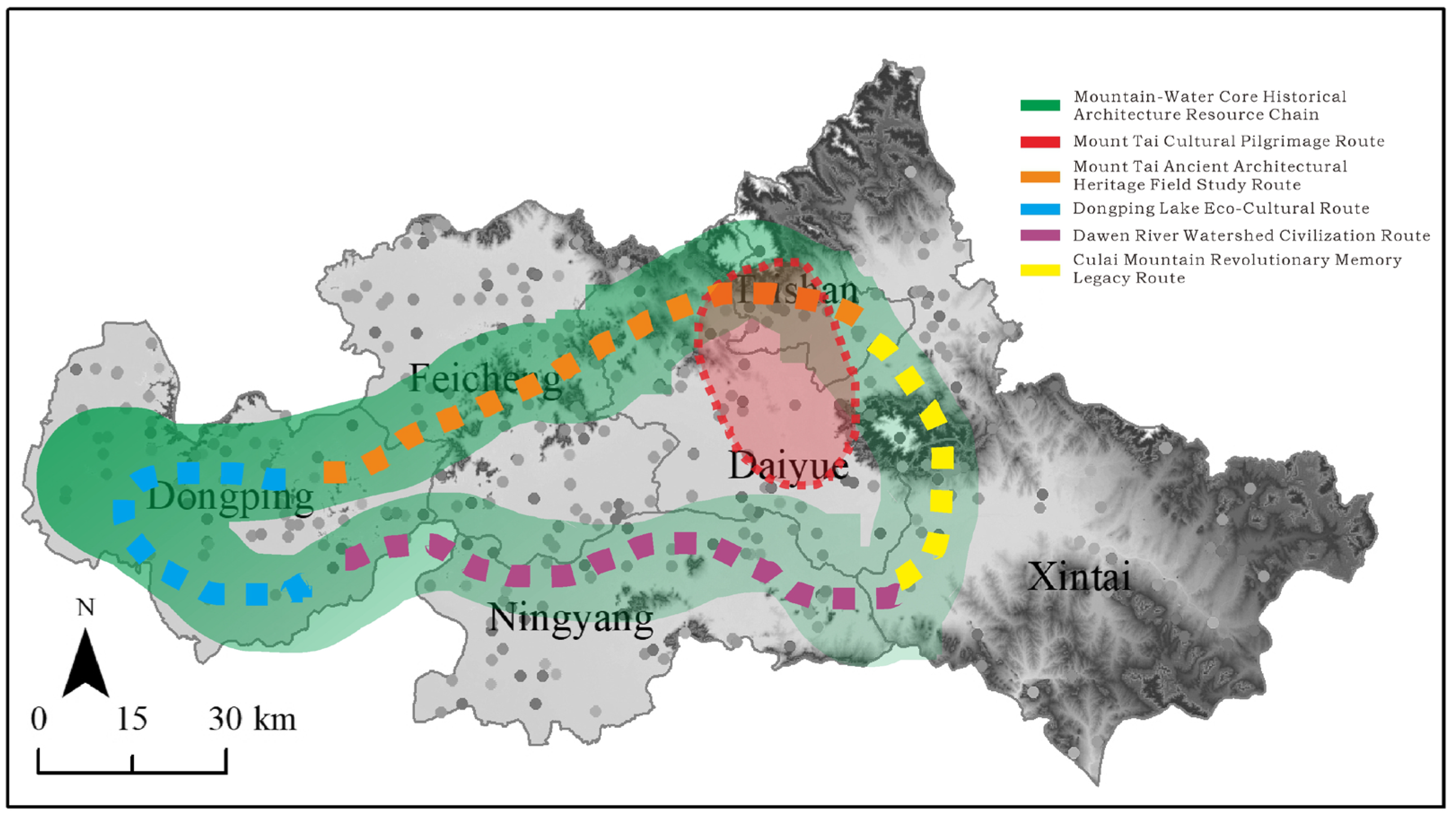
Based on the spatial patterns and resource characteristics identified in the preceding analysis, this study proposes a conceptual regional integration framework termed One Ring, Four Corridors (Figure 8). The framework employs Mount Tai, Culai Mountain, the Dawen River, and Dongping Lake as geographical and landscape linkages to construct a region-wide historic building resource network.

5.2.1. Mount Tai Cultural Pilgrimage Ring

Kernel density analysis identifies the southern foothills of Mount Tai as the highest density agglomeration core of the study period, with a peak density of approximately 0.61 sites per km2 during the Ming and Qing dynasties. Standard deviational ellipse analysis confirms pronounced spatial concentration in this area, with the elliptical area contracting to its minimum value of approximately 204 km2 during the same period. Nearest neighbor analysis further indicates that ancient architecture exhibits the highest clustering intensity among all typologies (R = 0.7108). These findings collectively establish the southern Mount Tai area as the primary heritage agglomeration zone.
The Mount Tai Cultural Pilgrimage Ring connects core historic building resources across Taishan District, Daiyue District, and Feicheng City, including ceremonial architecture such as the Dai Temple and Bixia Temple, religious sites including Lingyan Temple and Yuquan Temple, and the Dawenkou archaeological site. The Ring is organized around the themes of fengshan ritual culture and religious culture, integrating pilgrimage, cultural exploration, and heritage education functions.

5.2.2. Dawen River Basin Civilization Corridor

Kernel density core migration analysis reveals that from the pre-Qin period through the Song and Yuan dynasties, high-density cores were consistently distributed along the Dawen River basin and around Dongping Lake, with a cumulative migration of approximately 18.7 km (Table 5). Hydrological analysis demonstrates a distance decay pattern in building distribution relative to water systems, with the majority of sites located within 2 km of water bodies (Figure 6). Typological statistics indicate that Ningyang County has the highest proportion of ancient sites in the municipality (43.48%), while Daiyue District and Feicheng City constitute core agglomeration areas for both ancient sites and ancient architecture (Table 4).
The Dawen River Basin Civilization Corridor follows the Dawen River–Dongping Lake–Yellow River system, connecting ancient sites, traditional villages, vernacular dwellings, and hydraulic landscapes. The corridor supports ecological hiking, agricultural heritage experiences, and folk culture interpretation, highlighting the historical role of the water system in regional civilizational development.

5.2.3. Mount Tai Ancient Architecture Study Corridor

Kernel density analysis shows a pronounced northeastward shift of the agglomeration core by approximately 22.3 km during the Ming and Qing dynasties, forming a zonal concentration along the southern foothills of Mount Tai (Figure 5, Table 5). Typological data indicate that Ming and Qing ancient architecture totals 116 sites, representing 63.4% of the period total and the highest absolute number across all periods (Table 1). Taishan, Daiyue, and Feicheng collectively account for over 70% of the citywide ancient architecture inventory (Table 4). The distribution exhibits a hierarchical structure, with core ceremonial buildings forming primary agglomeration nodes and secondary temples extending along valleys.
The Mount Tai Ancient Architecture Study Corridor extends along the main peak and outlying ridges of Mount Tai, connecting predominantly Ming and Qing architectural complexes. The corridor integrates content on architectural forms, construction techniques, decorative arts, and cultural significance, and may support expert guided interpretation, traditional craft workshops, and field documentation activities.

5.2.4. Dongping Lake Ecological Culture Corridor

Kernel density analysis identifies a distinct agglomeration center around Dongping Lake during the Song and Yuan dynasties, with a peak density of approximately 0.38 sites per km2 (Figure 5, Table 5). Dongping County ranks first in the municipality in terms of both ancient tombs (22 sites) and grotto temples and stone carvings (20 sites) (Table 4). Grotto temples and stone carvings in this area are distributed primarily along rock faces and lakeshore zones.
The Dongping Lake Ecological Culture Corridor integrates ancient tombs, grotto temples, and stone carvings around Dongping Lake. Potential offerings include archaeological interpretation, stone carving art study programs, and lakeside ecological recreation, addressing the tourism potential of specialized heritage categories.

5.2.5. Culai Mountain Red Memory Heritage Corridor

Typological statistics show that heritage from the Republican period and the People’s Republic of China period is heavily concentrated in major modern and contemporary historical sites and representative buildings, accounting for 91.43% and 100% of respective period totals (Table 1). Revolutionary sites in this area are predominantly located in concealed mountainous terrain, including the interior of Culai Mountain and the valley areas of Mount Tai’s outlying ridges, exhibiting a siting logic distinct from that of ceremonial and religious architecture.
The Culai Mountain Red Memory Heritage Corridor connects modern and contemporary historical sites such as the former base of the Anti-Japanese Armed Uprising and Feng Yuxiang’s Tomb. The corridor emphasizes revolutionary history education, scenario-based interpretation, and battlefield themed outdoor activities, combining educational functions with experiential engagement.

5.3. Differentiated Conservation and Use Strategies

Spatial analysis reveals notable differences across heritage typologies in agglomeration intensity, resource distribution, and site selection conditions. This section outlines differentiated strategies from four perspectives: tiered protection, context specific zoning, intensity control, and environmentally responsive development.
First, tiered protection based on agglomeration intensity. Nearest neighbor analysis shows that ancient architecture exhibits the highest clustering (R = 0.7108), concentrated primarily along the southern foothills of Mount Tai and around urban settlements. Grotto temples and stone carvings display lower clustering (R = 0.8389), distributed in linear or scattered patterns along mountain cliffs. For highly clustered architectural complexes, integrated conservation with contiguous protection zones and construction controls is recommended. For relatively dispersed grotto temples and stone carvings, a combined approach of site specific protection and linear corridor linkage may enhance spatial connectivity while ensuring structural integrity.
Second, context specific zoning based on resource characteristics. The typological differentiation across administrative districts (Table 4) calls for context sensitive approaches. The border area between Daiyue District and Feicheng City represents the core agglomeration zone for ancient architecture and ancient sites, where integrated conservation and resource consolidation should be prioritized. Dongping County leads the municipality in terms of both ancient tombs and grotto temples and stone carvings, warranting specialized plans that address the specific vulnerabilities of grotto temples. Ningyang County has the highest proportion of ancient sites in the municipality, requiring strengthened site protection and environmental remediation. Xintai City exhibits a balanced distribution of resources, suggesting a combined approach of site specific protection and adaptive reuse.
Third, intensity control based on protection level. Nationally protected sites require core protection zones, construction buffer areas, visitor volume limitations, and digital monitoring. Provincial- and municipal-level sites may accommodate moderate tourism use contingent upon structural safety, with adaptive reuse pathways explored where appropriate. Ancient sites and ancient tombs should follow minimal intervention principles, employing vegetation restoration, fencing, and environmental remediation. Modern and contemporary historical sites require strengthened historical research and interpretive system enhancement.
Fourth, environmentally responsive development informed by hydrological and topographic conditions. Hydrological analysis demonstrates that the majority of sites are located within 1 to 2 km of water bodies. Tourism development along the Dawen River and Dongping Lake should integrate flood control and environmental infrastructure. Topographic analysis indicates that development intensity in mountain corridors should be moderated, favoring low impact activities such as hiking and ecological tourism. Plains and valley areas may combine agricultural landscapes and rural settlement resources. Green travel modes, including public transport and cycling, should be promoted.

6. Conclusions and Discussion

6.1. Summary of Findings and Contributions

This study employed mathematical statistics and GIS-based spatial analysis methods to systematically investigate the spatiotemporal distribution characteristics, formative factors, and planning implications of 451 protected historic buildings in the Mount Tai region. The principal findings are summarized as follows.
(1)
The temporal distribution exhibits an “И-shaped” fluctuation pattern, shaped jointly by three mechanisms: preservation conditions, social stability, and designation preferences. Ancient architecture and ancient sites together account for nearly 60% of the total and constitute the core resource typologies. The number of buildings reaches its peak during the Ming and Qing dynasties, while the modern and contemporary period is dominated by major historical sites and representative buildings. The quantitative curve does not equate directly to the intensity of actual construction activity in each period. Early buildings, constructed with perishable materials, are less likely to have survived; periods of warfare correspond to troughs in the number of remains; and modern designation mechanisms tend to favor buildings of greater antiquity or larger scale, whereas a substantial number of ordinary modern and contemporary buildings have not been inscribed on protection lists. These three mechanisms have jointly shaped the currently observed chronological distribution characteristics.
(2)
The spatial distribution exhibits a pronounced clustered pattern, with the agglomeration core shifting from southwest to northeast, forming an evolutionary trajectory from river basin agglomeration to zonal agglomeration along the mountain range. Nearest neighbor analysis indicates an overall clustered distribution, with ancient architecture displaying the highest degree of clustering. Standard deviational ellipse analysis reveals that the elliptical area contracted from approximately 434 km2 prior to the Qin and Han dynasties to approximately 204 km2 during the Ming and Qing dynasties, indicating a trend toward spatial concentration. Kernel density analysis further elucidates the migration process of the agglomeration core: prior to the Qin and Han dynasties, the core was situated in the Dawen River basin; from the Qin and Han dynasties to the Song and Yuan dynasties, it shifted westward toward Dongping Lake; during the Ming and Qing dynasties, it migrated northeastward to the southern foothills of Mount Tai; and in the modern and contemporary periods, the amplitude of migration tended to diminish. Resource types exhibit differentiated characteristics across administrative districts. Daiyue District and Feicheng City constitute the core agglomeration zone for ancient sites and ancient architecture, Dongping County is distinguished by grotto temples and stone carvings as well as ancient tombs, Ningyang County features a prominent proportion of ancient sites, and Taishan District is characterized by a concentration of ceremonial and religious architecture.
(3)
The distribution of historic buildings exhibits diachronic associations with both natural and anthropogenic factors. During the early stages, natural conditions such as hydrology and topography provided foundational constraints for site selection, with buildings predominantly distributed within 1 to 2 km of water bodies and concentrated in low elevation plains and river valleys. In later stages, the associations between anthropogenic factors and the distribution pattern became increasingly apparent. The fengshan ritual culture and religious culture of Mount Tai guided the agglomeration of ceremonial architecture toward the southern foothills, forming a hierarchical spatial structure. The development of agrarian civilization and the commodity economy facilitated the diffusion of building activity from core ceremonial spaces outward into urban and rural areas. Revolutionary activities engendered the distribution of historical sites in concealed mountainous terrain. The establishment of heritage conservation institutions exerted a stabilizing effect on the existing agglomeration pattern in the modern and contemporary periods.
(4)
Based on the spatial analytical results, this study proposes a strategic planning implications framework. The analytical findings provide the foundation for the construction of the “One Ring and Four Corridors” framework. The location of the agglomeration core supports the positioning of the loop route, the migration trajectory of the kernel density center guides the alignment of the corridors, the resource typologies by administrative district determine the thematic focus of each corridor, and the hydrological and topographic factors offer an environmental reference for the linear spatial organization of the corridors.
This study extends existing knowledge in the following respects. First, it elevates the analytical perspective from iconic individual buildings to the regional scale, systematically presenting the spatiotemporal distribution pattern of historic buildings within the municipal territory of a UNESCO World Heritage Mixed Property site. Second, it introduces a governance perspective into the analysis of formative factors, exploring the potential influence of factors such as heritage designation preferences, institutional locking effects, and administrative division adjustments on the distribution pattern, thereby seeking to establish an intermediate-scale linkage between macro-level governance research and micro-level spatial analysis. Third, it constructs a conceptual mapping framework from spatial metrics to planning decisions, offering an analytically grounded approach that may serve as a reference for translating heritage spatial analysis findings into planning practice.

6.2. Limitations and Future Research

(1)
The sample scope is confined to officially protected buildings. This study includes only those buildings designated as cultural relic protection units at various levels; general historic buildings that have not received official recognition were excluded from the analysis. This boundary condition may result in buildings from the Ming and Qing dynasties and earlier periods being relatively accentuated, while the absence of ordinary modern and contemporary historic buildings leads to an underestimation of distribution density in those periods. Core heritage zones appear more prominent due to the dense concentration of protected units, whereas the statistical visibility of ordinary buildings in remote areas remains relatively limited. Future research could incorporate non designated buildings into the analysis through field surveys and local documentary sources, and compare the distributional differences between formally protected units and informal heritage sites, thereby examining the influence of designation mechanisms on spatial patterns.
(2)
Uncertainty exists in certain heritage attribute information. For some buildings, records of functional evolution and restoration history remain incomplete. The practice of representing areal heritage sites by their central points and linear heritage features by their midpoints may also simplify localized spatial characteristics. Future research could refine attribute records through archival research and field surveys, represent areal heritage sites using boundary polygons, and employ higher precision positioning technologies to reduce locational deviation.
(3)
The discussion of formative factors is positioned as interpretive analysis. Chapter 4 aims to explore the associations between various factors and the distribution pattern, rather than to conduct causal inference or to test the magnitude of contributions. Issues such as the interactive effects of natural and anthropogenic factors, the diachronic influence of policy changes, and the differentiated effects of conservation management across administrative tiers await more systematic quantitative investigation. Future research could introduce spatial regression analysis or multilevel models to evaluate the relative weights and interaction mechanisms among various factors.
(4)
The empirical support for the planning framework requires further strengthening. The “One Ring and Four Corridors” framework proposed in this study is positioned at the strategic level and does not yet incorporate implementation oriented elements such as accessibility assessment, visitor capacity estimation, transportation network modeling, and stakeholder consultation. Future research could build upon this framework by conducting assessments of transportation accessibility and infrastructure along the corridors, optimizing thematic positioning and service allocation with reference to visitor flow data, formulating capacity control plans for core protected zones, and exploring planning mechanisms that coordinate heritage conservation, tourism development, and community interests.
(5)
Conservation vulnerability and dynamic adaptability warrant dedicated investigation. This study emphasizes the static analysis of distribution patterns and formative factors, with relatively limited attention to dynamic stressors such as natural erosion, tourism pressure, and urbanization impacts. Future research could integrate climate change scenarios and urban expansion simulations to evaluate the conservation vulnerability of different corridors and agglomeration zones, establish dynamic monitoring systems covering heritage structures, surrounding environments, and visitor activities, and explore pathways of adaptive reuse, thereby providing more forward looking decision support for the sustainable transmission of historic buildings in the Mount Tai region.

Author Contributions

Conceptualization, Q.Q.; methodology, J.C.; software, Q.Q.; validation, Q.Q. and Z.T.; formal analysis, Q.Q. and X.G.; investigation, Z.T.; data curation, Q.Q. and X.G.; writing—original draft preparation, Q.Q.; writing—review and editing, J.C.; supervision, X.G.; project administration, J.C.; funding acquisition, J.C. All authors have read and agreed to the published version of the manuscript.

Funding

This research received no external funding.

Data Availability Statement

Data is contained within the article.

Conflicts of Interest

The authors declare no conflicts of interest.

References

  1. Lpekoglu, B. An architectural evaluation method for conservation of traditional dwellings. Build. Environ. 2006, 41, 386–394. [Google Scholar] [CrossRef]
  2. Croce, V.; Caroti, G.; Piemonte, A.; De Luca, L.; Veron, P. H-BIM and Artificial Intelligence: Classification of Architectural Heritage for Semi-Automatic Scan-to-BIM Reconstruction. Sensors 2023, 23, 2497. [Google Scholar] [CrossRef]
  3. Naiyuan, C.; Syamsunur, D.; Surol, S.; Wahyuni, P.I.; Nelfia, L.O.; Ng, J.L.; Momade, M.H. Material Analysis, Restoration and Protection of Modern and Contemporary Architectural Relics. Heranca 2025, 8, 1–14. [Google Scholar] [CrossRef]
  4. Li, X.Y. Urban Heritage Policy in China: A Case Study of Preservation Systems in Wuhan. Heranca-Rev. Hist. Patrim. Cult. 2024, 7, 64–79. [Google Scholar] [CrossRef]
  5. Cao, K.R.; Liu, Y.; Cao, Y.H.; Wang, J.W.; Tian, Y.G. Construction and characteristic analysis of landscape gene maps of traditional villages along ancient Qin-Shu roads, Western China. Herit. Sci. 2024, 12, 37. [Google Scholar] [CrossRef]
  6. Lin, Y.D.; Luo, P.J. A Study on the Implicit Structure of Historical Environment in Urban Space of Xuzhou. Sustainability 2022, 14, 6837. [Google Scholar] [CrossRef]
  7. Squassina, A. Construction Wisdom: Preserving Venice with Both Tradition and Innovation. Stud. Conserv. 2022, 67, 253–259. [Google Scholar] [CrossRef]
  8. Jia, B.S.; Jiang, Y.Y. Flexibility of Traditional Buildings and Craftsmanship in China. Open House Int. 2011, 36, 20–31. [Google Scholar]
  9. Bos, M.; Claeys, D.; Stiernon, D.; Vandenbroucke, D. Objectivising Heritage Assessment with Values: Criteria-Based Grid and Constructivist Approach. Heritage 2025, 8, 116. [Google Scholar] [CrossRef]
  10. Xu, Y.B.; Rollo, J.; Esteban, Y.; Tong, H.; Yin, X. Developing a Comprehensive Assessment Model of Social Value with Respect to Heritage Value for Sustainable Heritage Management. Sustainability 2021, 13, 13373. [Google Scholar] [CrossRef]
  11. Fan, J.Y.; Zheng, B.H.; Yuan, H.Y.; Zhang, B.Y.; Zhang, P. Spatial Connectivity and Development Potential of Traditional Villages in Clustered Areas: A Case Study of Qiandongnan Prefecture. Land 2025, 14, 1929. [Google Scholar] [CrossRef]
  12. Yue, K.J.; Yin, C.J.; Shan, J. Agglomeration phenomena and evolutionary patterns of contemporary architectural interventions in traditional villages: An empirical analysis from 211 cases in Songyang County, China. Habitat Int. 2025, 166, 103571. [Google Scholar] [CrossRef]
  13. Martinelli, L.; Calcerano, F.; Adinolfi, F.; Chianetta, D.; Gigliarelli, E. Open HBIM-IoT Monitoring Platform for the Management of Historical Sites and Museums. An Application to the Bourbon Royal Site of Carditello. Int. J. Archit. Herit. 2023, 19, 153–170. [Google Scholar] [CrossRef]
  14. Savini, F.; Fabbrocino, G.; Marra, A. Digitization of historical architectural elements, a workflow for knowledge of minor centers in inner areas. Disegnarecon 2021, 14, 26. [Google Scholar] [CrossRef]
  15. Yu, S.J.; Zhang, Y.; Liu, Y.Y.; Sun, Y. The legacy of educational space in China: The transformation of the Jiangyin Confucian temple in the early twentieth century. Paedagog. Hist. 2022, 60, 209–225. [Google Scholar] [CrossRef]
  16. Tubielewicz-Michalczuk, M. Selected Educational Buildings and Their Role in Contemporary Education, On the Example of Czestochowa. Space Form 2023, 53, 91–108. [Google Scholar] [CrossRef]
  17. Resnianskiy, S.I.; Stytsiuk, R.Y.; Rozanova, T.P.; Popov, B.N. The origin and formation of interaction between tourism, cultural heritage and development of territories: The historical experience of China. OOO Zhurnal Vopr. Istor. 2022, 2022, 218–228. [Google Scholar] [CrossRef]
  18. Jin, Y.; Hou, B.; Kong, X. The Practice Characteristics of Authorized Heritage Discourse in Tourism: Thematic and Spatial. Land 2024, 13, 816. [Google Scholar] [CrossRef]
  19. Kurnaz, A. A Stakeholder-Based Conservation Assessment and Sustainable Development Strategies in Rural Tourism: A Case Study of Adatepe Village. Conserv. Manag. Archaeol. Sites 2026, 27, 163–185. [Google Scholar] [CrossRef]
  20. Dang, X.Y.; Hong, Q.Y.; Liu, W.Q.; Wang, Y.B. China’s heritage governance blueprint: Revisiting evolutionary trajectories, reframing institutional priorities and mapping the national registry. Habitat Int. 2025, 165, 103541. [Google Scholar] [CrossRef]
  21. Jia, A.Q.; Liang, X.X.; Wen, X.; Yun, X.; Ren, L.J.; Yun, Y.X. GIS-Based Analysis of the Spatial Distribution and Influencing Factors of Traditional Villages in Hebei Province, China. Sustainability 2023, 15, 9089. [Google Scholar] [CrossRef]
  22. Zhu, R.; Fong, L.H.N.; Gan, M.R. Rethinking the consequences of postmodern authenticity: The case of a World Cultural Heritage in Augmented Reality. Curr. Issues Tour. 2022, 26, 617–631. [Google Scholar] [CrossRef]
  23. Yu, Y.; Liu, B.; Ma, L.; Han, X.; Jung, T. ‘Thousand Years of Charm’: Exploring the Aesthetic Characteristics of the Mount Tai Landscape from the Cross-Textual Perspective. Land 2023, 12, 2129. [Google Scholar] [CrossRef]
  24. Yuan, G.; Yun, W.; Yong, K.; Jing, Z. Hillside topographic pattern of tree species diversity and soil nutrients in Mount Tai, China. Plant Soil 2024, 504, 209–217. [Google Scholar] [CrossRef]
  25. Wenzel, C. Towards a Buddhist History of Mount Tai. J. Chin. Relig. 2022, 50, 1–44. [Google Scholar] [CrossRef]
  26. Wu, H.Y.; Shen, Z.X.; Hou, S.Y.; Jiao, H.Y.; Liu, Z.Q.; Xie, L.T.; Liang, J.Y.; Qing, Y.X.; Zhang, X.P.; Gui, Z.P.; et al. AutoGEEval plus plus: A multi-level and multi-geospatial-modality automated evaluation framework for large language models in geospatial code generation on Google Earth Engine. Big Earth Data 2025, 9, 747–796. [Google Scholar] [CrossRef]
  27. Wang, X.F.; Zhang, J.Z.; Cenci, J.; Becue, V. Spatial Distribution Characteristics and Influencing Factors of the World Architectural Heritage. Heritage 2022, 4, 2942–2959. [Google Scholar] [CrossRef]
  28. Zheng, W.F.; Tropsha, A. Novel variable selection quantitative structure-property relationship approach based on the k-nearest-neighbor principle. J. Chem. Inf. Comput. Sci. 2000, 40, 185–194. [Google Scholar] [CrossRef]
  29. Comaniciu, D.; Meer, P. Mean shift: A robust approach toward feature space analysis. IEEE Trans. Pattern Anal. Mach. Intell. 2002, 24, 603–619. [Google Scholar] [CrossRef]
  30. Wang, B.; Shi, W.Z.; Miao, Z.L. Confidence Analysis of Standard Deviational Ellipse and Its Extension into Higher Dimensional Euclidean Space. PLoS ONE 2015, 10, e0118537. [Google Scholar] [CrossRef]
  31. Huang, C.; Xiao, C.L.; Rong, L.S. Integrating Point-of-Interest Density and Spatial Heterogeneity to Identify Urban Functional Areas. Remote Sens. 2022, 14, 4201. [Google Scholar] [CrossRef]
  32. Amiri, A.M.; Nadimi, N.; Khalifeh, V.; Shams, M. GIS-based crash hotspot identification: A comparison among mapping clusters and spatial analysis techniques. Int. J. Inj. Control Saf. Promot. 2021, 28, 325–338. [Google Scholar] [CrossRef]
  33. Yang, Z.Y.; Yang, D.; Geng, J.J.; Tian, F.X. Evaluation of Suitability and Spatial Distribution of Rural Settlements in the Karst Mountainous Area of China. Land 2022, 11, 2101. [Google Scholar] [CrossRef]
  34. Wang, C.P.; Yang, Y.X.; Li, G.T.; Yan, S.Y. Evaluation and Division Methods of Coupled Spatial Units between Parks and Living Circles: A Case Study of Four National-Level New Areas. Buildings 2024, 14, 2493. [Google Scholar] [CrossRef]
  35. Gizzi, F.T.; Sileo, M.; Biscione, M.; Danese, M.; de Buergo, M.A. The conservation state of the Sassi of Matera site (Southern Italy) and its correlation with the environmental conditions analysed through spatial analysis techniques. J. Cult. Herit. 2016, 17, 61–74. [Google Scholar] [CrossRef]
  36. Ushakov, N.G.; Ushakov, V.G. On bandwidth selection in kernel density estimation. J. Nonparametric Stat. 2012, 24, 419–428. [Google Scholar] [CrossRef]
  37. Du, Q.; Zhou, J.; Pan, T.; Sun, Q.; Wu, M. Relationship of carbon emissions and economic growth in China’s construction industry. J. Clean. Prod. 2019, 220, 99–109. [Google Scholar] [CrossRef]
  38. Lou, J.; Yang, G.L.; Song, L.J.; Liu, K.D. From resources to capital: Investigating the efficiency of forest ecosystem products value realization in China. Socio-Econ. Plan. Sci. 2024, 96, 102052. [Google Scholar] [CrossRef]
  39. Huang, Y.H.; Huang, Y.Y.; Chen, Y.L.; Yang, S. Spatial evolution of traditional waterside settlements south of the Yangtze River and the distribution of settlement heritage: Evidence from the Nanxi River Basin. npj Herit. Sci. 2025, 13, 62. [Google Scholar] [CrossRef]
  40. von Falkenhausen, L. Shandong Province, vol. 4: Mount Tai-Sutra Stone Valley. J. Am. Orient. Soc. 2024, 144, 680–693. [Google Scholar] [CrossRef]
  41. Jiang, X.Y.; Yeo, S.Y.; Galli, B. The potential of applying soft capping approach on earthen and masonry built heritage. J. Cult. Herit. 2025, 73, 158–171. [Google Scholar] [CrossRef]
  42. Li, C.J.; Ren, K.X.; Xu, X.; Kuang, K.C.; Yang, H.X.; Lam, J.F.I. Spatio-Temporal Distribution Patterns and Evolutionary Mechanisms of Ancient Architecture in the Yangtze River Basin. Buildings 2025, 15, 4466. [Google Scholar] [CrossRef]
  43. Sun, Y.; Wu, Y.Q.; Yu, H.F.; Li, Y.H. County-level urban forms and their correlation with local governance in Jiande, China: Evidence from historical records. J. Asian Archit. Build. Eng. 2024, 24, 1985–1998. [Google Scholar] [CrossRef]
  44. Ding, D.; Yu, X.J.; Wang, Z.L. The Evolution of the Living Environment in Suzhou in the Ming and Qing Dynasties Based on Historical Paintings. ACM J. Comput. Cult. Herit. 2021, 14, 20. [Google Scholar] [CrossRef]
  45. Hao, Y.H.; Yao, Z.H.; Wu, R.G.; Bao, Y.Y. Damage and restoration technology of historic buildings of brick and wood structures: A review. npj Herit. Sci. 2024, 12, 301. [Google Scholar] [CrossRef]
  46. Shao, G.D.; Ai, J.J.; Sun, Q.W.; Hou, L.Y.; Dong, Y.F. Soil quality assessment under different forest types in the Mount Tai, central Eastern China. Ecol. Indic. 2020, 115, 106439. [Google Scholar] [CrossRef]
  47. Yan, Y.; Bai, Z.; Hu, X.; Wang, Y.S. How Do Natural Environmental Factors Influence the Spatial Patterns and Site Selection of Famous Mountain Temple Complexes in China? Quantitative Research on Wudang Mountain in the Ming Dynasty. Land 2025, 14, 1441. [Google Scholar] [CrossRef]
  48. Liao, Y.D.; Cenci, J.; Zhang, J.Z. Chinese Modern Architectural Heritage Resources: Perspectives of Spatial Distribution and Influencing Factors. ISPRS Int. J. Geo-Inf. 2023, 12, 358. [Google Scholar] [CrossRef]
  49. Liu, Q.; Li, Y.F. Impact of Land Resource Endowment and Socio-Economic Conditions on Agricultural Migrants’ Settlement Intentions: Evidence from China. Sage Open 2026, 16, 21582440251410309. [Google Scholar] [CrossRef]
  50. Yang, R. The Distribution of Zhicao by Buddhist Ways After the Fengshan Ritual in Mount Tai, 1008–1016. Religions 2025, 16, 634. [Google Scholar] [CrossRef]
  51. Wahurwagh, A.; Dongre, A. Burhanpur Cultural Landscape Conservation: Inspiring Quality for Sustainable Regeneration. Sustainability 2015, 7, 932–946. [Google Scholar] [CrossRef]
  52. Dammag, B.Q.D.; Jian, D.; Dammag, A.Q.; Almutery, S.; Habibullah, A.; Baik, A. A Geospatially Enabled HBIM-GIS Framework for Sustainable Documentation and Conservation of Heritage Buildings. Buildings 2026, 16, 585. [Google Scholar] [CrossRef]
  53. Borkowski, A.S.; To Duc, A. Integration of BIM and GIS data of a heritage building using FME. Civ. Environ. Eng. Rep. 2024, 34, 204–215. [Google Scholar] [CrossRef]
  54. Lin, J.N.; Zhang, L.P.; Li, N.J.; Zhang, Z.G.; Lu, B.R.; Huang, L.H.; Li, A.; Gao, M.; Wang, J.H.; Gao, Z.; et al. Novel method of ecological damage assessment for intentional destruction of cultural relics and historic sites. Cogent Soc. Sci. 2024, 10, 2398689. [Google Scholar] [CrossRef]
  55. Feng, S.Y.; Lu, Q.; Wu, Z.H.; Guo, Z.H. The Distribution Model and Spatial Structure of Market Towns in the Pearl River Delta during the Ming, Qing, and Min-Guo Periods: A Case Study of Taishan County. Land 2022, 11, 1354. [Google Scholar] [CrossRef]
  56. Kalman, H. Destruction, mitigation, and reconciliation of cultural heritage. Int. J. Herit. Stud. 2017, 23, 538–555. [Google Scholar] [CrossRef]
  57. Wu, Y.; Wu, Y.L.; Miao, M.R.; Wang, M.X.; Li, X.B.; Candeias, A. Research on Construction of Suzhou’s Historical Architectural Heritage Corridors and Cultural Relics-Themed Trails Based on Current Effective Conductance (CEC) Model. Buildings 2025, 15, 2605. [Google Scholar] [CrossRef]
  58. Qian, X.Y.; Yu, Y.; Liu, R.J. The Spatial Relationship Characteristics and Differentiation Causes Between Traditional Villages and Intangible Cultural Heritage in China. Buildings 2025, 15, 2094. [Google Scholar] [CrossRef]
  59. Zhang, L.; Lu, P.; Lau, R.; Yan, L.J.; Li, X.; Yang, R.X.; Leung, H.H.; Chen, P.P.; Wang, X. Unique traditional villages on the Loess Plateau of China: Historic evolution and challenges to sustainable development of silo-caves. Herit. Sci. 2021, 9, 118. [Google Scholar] [CrossRef]
  60. Zhang, Y.X.; Yang, Y.F.; Wu, W.H. Spatial Distribution Characteristics and Influencing Factors of Intangible Cultural Heritage in the Tarim River Basin of China. Sustainability 2026, 18, 2100. [Google Scholar] [CrossRef]
Figure 1. Study Area.
Buildings 16 01795 g001
Figure 2. Temporal Distribution Pattern of Historical Buildings Based on Different Historical Periods.
Buildings 16 01795 g002
Figure 3. Distribution of Historical Building Quantities and Types Across Different Historical Periods.
Buildings 16 01795 g003
Figure 4. Analysis Diagram of Historical Building Distribution Direction and Centroid Location.
Buildings 16 01795 g004
Figure 5. Kernel Density Analysis of Historical Building Spatial Distribution.
Buildings 16 01795 g005
Figure 6. Overlay Analysis Diagram of Historical Buildings and Lake-River System Buffer Zones.
Buildings 16 01795 g006
Figure 7. Overlay Analysis Diagram of Digital Elevation and Historical Building Distribution.
Buildings 16 01795 g007
Figure 8. Conceptual Framework of the One Ring, Four Corridors Spatial Network.
Buildings 16 01795 g008
Table 1. Statistical Table of the Quantity and Proportion of Various Types of Historical Buildings Across Different Historical Periods.
PeriodAncient RuinsAncient TombsAncient BuildingsCave Temples and Stone CarvingsModern and Contemporary Important Historical Sites and Representative BuildingsOthersTotal (Percentage)
Before the Qin and Han dynasties667300177 (17.1%)
Qin, Han, Wei, Jin, and Northern and Southern Dynasties2029360058 (12.9%)
Sui and Tang Dynasties173350028 (6.2%)
Song and Yuan Dynasties11138120145 (10.0%)
Ming and Qing Dynasties2051163363183 (40.6%)
Republican Period003032035 (7.8%)
People’s Republic of China Period000025025 (5.5%)
Total
(Percentage)
134 (29.7%)57 (12.6%)136 (30.2%)56 (12.4%)63 (14%)5 (1.1%)451 (100%)
Table 2. Standard Deviational Ellipse Parameters of Historic Building Distribution by Historical Period.
PeriodCenter X (°E)Center Y (°N)Major Axis (km)Minor Axis (km)Rotation Angle (°)Area (km2)
Before the Qin and Han dynasties116.9528.1218.27.6173.5434.2
Qin, Han, Wei, Jin, and Northern and Southern Dynasties116.8228.2316.86.9168.2363.9
Sui and Tang Dynasties116.9828.1915.46.3162.7304.5
Song and Yuan Dynasties116.8428.1417.17.2171.8386.4
Ming and Qing Dynasties117.0328.2212.55.2159.6204.1
Republican Period117.1028.2013.15.5158.3226.0
People’s Republic of China Period117.0128.2112.85.4160.1216.9
Note: Center coordinates are expressed in decimal degrees (WGS-84). Major and minor axes represent one standard deviation. Rotation angle is measured clockwise from due north.
Table 3. Statistical Table of Nearest Neighbor Ratio for Historical Buildings.
TypeObserved Mean Distance (m)Expected Mean Distance (m)Nearest Neighbor Ratiop-ValueZ-ScoreSpatial Distribution Type
Ancient Ruins3089.76674116.05480.7506620.000000−5.521682Clustered
Ancient Tombs5026.79326398.89190.7855720.001955−3.097055Clustered
Ancient Buildings3043.57674281.97610.7107880.000000−6.452334Clustered
Cave Temples and Stone Carvings4926.89005873.19630.8388770.021074−2.306652Clustered
Modern and Contemporary Important Historical Sites and Representative Buildings5247.00476660.60380.7877670.001270−3.222655Clustered
Others28,799.057810,346.57522.7834390.0000007.629113Random
Overall1463.50742730.78340.5359300.000000−18.853982Clustered
Table 4. Spatial Distribution of Historical Buildings by Type and Administrative District.
TypeAdministrative DivisionTotal
Tai’an DistrictDaiyue DistrictFeicheng CityXintai CityDongping CountyNingyang County
Ancient Ruins34329161330134
Ancient Tombs0978221157
Ancient Buildings143348121514136
Cave Temples and Stone Carvings3417520756
Modern and Contemporary Important Historical Sites and Representative Buildings12141768663
Others0101215
Total (Percentage)32 (7.10%)104 (23.06%)118 (26.16%)48 (10.64%)80 (17.74%)69 (15.30%)451 (100%)
Table 5. Kernel Density Core Parameters and Migration Distances by Historical Period.
PeriodCore Longitude (°E)Core Latitude (°N)Peak Density (Sites/km2)Migration Distance (km)
Before the Qin and Han dynasties116.8828.050.42-
Qin, Han, Wei, Jin, and Northern and Southern Dynasties116.7528.100.3612.4
Sui and Tang Dynasties116.9228.120.3116.8
Song and Yuan Dynasties116.6828.080.3823.5
Ming and Qing Dynasties117.0528.200.6122.3
Republican Period117.0928.180.354.8
People’s Republic of China Period117.0228.190.283.6
Note: Core coordinates represent the geometric center of the top 10% raster cells ranked by kernel density value for each period. Migration distance is calculated as the Euclidean distance between core centers of consecutive periods.
Disclaimer/Publisher’s Note: The statements, opinions and data contained in all publications are solely those of the individual author(s) and contributor(s) and not of MDPI and/or the editor(s). MDPI and/or the editor(s) disclaim responsibility for any injury to people or property resulting from any ideas, methods, instructions or products referred to in the content.