


Abstract
This study reexamines the concept of techne within computer-aided architectural practices and proposes a Lakatosian research program framework to understand its historical continuity and contemporary transformation. Since its ancient origins, techne has been not only a knowledge of making but a mode of thinking and knowing that unifies mental and material production within a single practice. To analyze its transformation, Imre Lakatos’s methodology of research programs is adopted as a framework, and techne is examined as a research program. Within this framework, the hard core of techne is defined as the craftsman–tool–material–knowledge relationship grounded in the unity of making and knowing, while code, software, parametric systems, and algorithmic feedback mechanisms are interpreted as components of the protective belt in the digital age. The study specifically focuses on the relationship between the designer and the tool. Bernard Cache’s Objectile practice is presented as a case study that illustrates the architect’s transformation in the digital age from a user of tools to a developer of tools. The findings reveal the following principal patterns: tool development emerges as a conceptual necessity and an epistemic act; knowledge in digital practice acquires a hybrid structure between explicit and tacit knowledge; and feedback loops reshape not only design but also the tool itself. Consequently, techne is repositioned as a progressive research program that remains productive in architecture at both theoretical and operational levels.
1. Introduction
1.1. Literature Review on Techne and Digital Craft
Bernard Cache begins his essay titled Digital Semper with the following sentence: “Digital Semper.” To put these two words together seems like a contradiction in terms [1]. Cache immediately sets out to resolve this contradiction: the affinity between computer-aided production and Semper’s theory of craft points to a structural continuity behind the apparent paradox. With the introduction of computer-aided design and production tools into architectural practice, the relationship between making and knowing was re-problematized. This problematization brings techne to the forefront not as a historical nostalgia, but as a contemporary conceptual reference for understanding how knowledge is produced under changing tools.
The concept of techne in architectural discourse is not only a term referring to specific production techniques or the sum of skills related to practical applications. Historically, it has been understood as a fundamental epistemological framework that explains the structure of the relationships between knowledge and practice, thinking and making, and abstraction and material production [2]. Therefore, techne does not only refer to practical knowledge or knowledge of making. It constitutes a foundational concept that enables an understanding of how architectural knowledge is produced, transmitted, transformed, and related to the subject.
In Ancient Greek thought, techne emerged within the context of traditional production practices, where the distinction between episteme (theoretical knowledge) and praxis (action) had not yet been firmly established in the modern sense [2]. Plato defines techne as a mode of production grounded in knowledge and directed toward a specific purpose [3]. According to Aristotle, within the framework he develops in the Nicomachean Ethics, techne is a mode of knowing that presupposes a pre-conceived end and requires mastery over the sequence of processes necessary to realize that end [4]. In this sense, techne is related not only to the final outcome but also to the knowledge of the dynamics of the process, and it involves an understanding of the conditions that make the outcome possible.
This ancient framework is highly significant for architectural practice, as architectural knowledge emerges not only from abstract theoretical propositions but also from decisions made during the production process, the materials used, the tools employed, and the relationships established with materials. Therefore, techne should be understood not as a linear model in which knowledge is transferred from the theoretical realm to practice, but as a mode of thinking in which knowledge emerges within the process of production. It assumes that architectural knowledge is constructed not only through representation but also through the act of making.
In modern philosophy, the treatment of the concept of techne becomes particularly prominent through the work of Heidegger. Heidegger critiques approaches that identify techne with technique and instrumentality in the modern sense, and defines the concept as a mode of revealing by relating it to poiesis [5]. Techne concerns the state of knowing and ways of knowing—knowing how to do something and what to reveal. According to Heidegger, techne is a form of knowing that makes the existing visible, and in this respect, it serves not only a technical but also an ontological function [5]. This approach emphasizes that the act of making is not simply a functional or instrumental activity, but a meaningful mode of relating to the world.
In Heidegger’s approach, techne becomes a concept through which the relationships between human, world, and object can be rethought [5]. Phenomenological and anthropological approaches emphasize that knowledge is produced not only through mental representations but also through bodily practices and material interactions. For instance, Tim Ingold’s concept of making can be interpreted as a contemporary reading of techne. Ingold defines making not as the application of a predetermined form, but as an open-ended process of interaction with materials [6]. This mode of thinking expands the epistemological structure of techne by foregrounding the intuitive, experiential, and processual dimensions of architectural production.
One of the fields in which the concept of techne has been extensively discussed within architectural theory is tectonic discourse. Semantically, tectonics is not only concerned with the structural expression of a building. It offers a conceptual framework that allows the relationships between meaning, material, construction techniques, knowledge of making, and detail to be considered together. In this context, Karl Bötticher distinguishes between core form (Kernform) and art form (Kunstform) to explain the relationship between the ontological reality of the structure and its representational level [7].
Core form expresses the structural and functional necessities of a building, while art form represents its aesthetic expression. Therefore, knowledge of making is not only technical but also a form of intellectual expression. Gottfried Semper, on the other hand, focuses on the cultural and anthropological dimensions of making. He locates the origins of architecture not in structural necessities, but in human production practices and craft culture, and through his Bekleidung theory, he demonstrates how the relationship between material, symbolic meaning, and technique in architecture has evolved historically [8]. In this context, techne—as making, revealing, and knowing how to make—can be positioned as a field through which cultural meaning is also produced.
In the twentieth century, Kenneth Frampton’s concept of tectonic culture addresses the tension between representation and construction in modern architecture. In discussing tectonic culture, he refers to the concept of techne, derived from the Greek verb tikto, meaning to produce, although it is etymologically distinct. He argues that the Greeks did not distinguish between art and craft, and that techne refers to a form of knowledge that reveals what is concealed within a work [9]. This explanatory concept reminds us that knowing and making are inseparable and describes how something reveals its ontological condition by demonstrating its epistemic value.
In his discussions on detail, Marco Frascari reveals the role of techne in architectural knowledge at the scale of the detail. Detail is a domain in which decisions made during design and construction processes, material knowledge, the relationship with materials, and craft knowledge become embodied. Frascari argues that detail is not simply a technical element, but the smallest unit of architectural meaning production. Through the conceptual framework he constructs based on techne, detail brings together the concrete and abstract aspects of architecture. According to him, techne is thought in action, embodied in detail, representing a creative unity of knowledge and action that operates through details, transforming material and construction into architectural narratives that carry meaning. For this reason, the architectural detail is discussed as the place where techne is most concentrated [10]. These approaches emphasize that architectural knowledge is produced in close relation to the act of making.
In contemporary architectural practice, the radical transformation of design, production, and construction tools is also transforming the subject who produces, designs, and makes, as well as the relationships established with tools and materials and construction practices. Computational design, parametric modeling, software-based and algorithmic processes, and computer-aided fabrication not only enable the development of new formal possibilities; they also transform the operation of the design process, decision-making mechanisms, and modes of knowledge production [11]. This transformation has been extensively discussed in the architectural literature, particularly through debates on the impact of new technologies on architecture, new modes of representation, and new production methods. At the Fabrication Conference held in Canada in 2004, a significant shift in focus within this field was highlighted [12]. This shift in focus from the representational plane to the structural plane leads the author to reconsider knowledge of making and the concept of techne. The tension between the concern that digital tools exclude embodied knowledge and the argument that these tools generate a new form of craft knowledge constitutes the central axis of the discussion of techne in the digital age.
The relationship between architecture and computational thinking has its roots in early developments. Negroponte’s 1970 work reconceptualizes the relationship between the architect and the computer beyond traditional tool use, framing it as a mutually evolving partnership. He argues that, in design processes, machines should not only execute commands but evolve into artificial intelligence systems capable of understanding human behavior and context. Thus, the computer is positioned not simply as a drawing tool, but as an active participant in the design process [13].
The emergence of the concept of digital craft coincides with the period in which computer-aided design was repositioned in architectural practice not only as a tool of representation, but as a knowledge environment directly involved in the production process. In the 1990s, the integration of CNC milling, robotic fabrication, and parametric modeling into architecture began to question the traditional separation between design and construction. At this turning point, McCullough developed the concept of abstract craft, arguing that the designer working at the computer behaves like a craftsman who establishes a direct relationship with material [14]. Subsequently, the concept of digital craft emerged, as digital tools were no longer used only for drawing; instead, they began to encode material behavior, guide production decisions, and directly transfer the designer’s knowledge into the production chain. While Kolarevic demonstrated that digital fabrication fundamentally transformed the relationship between the architect and the tool [15], Gramazio and Kohler, through their research at ETH Zürich, showed how robotic fabrication processes function as a craft practice that carries material knowledge [16]. The use of the term craft in this new context is not coincidental; it can be interpreted as an attempt to understand the issue not in terms of technical efficiency, but in terms of how knowledge participates in the production process.
Antoine Picon approaches this discussion from a more cautious perspective. Arguing that the craftsman ideal, as articulated by Sennett and Ingold—based on direct, embodied engagement with material—cannot be fully translated into the context of digital production, Picon also questions to what extent the material computation approach advocated by pioneers of digital fabrication, such as Gramazio and Kohler, can achieve this ideal. According to him, the affinity of digital culture for the figure of the craftsman carries the risk of overlooking the fundamental separation between the digital file and physical material, and thus risks remaining a nostalgic stance. The desire to reunite knowledge and matter must therefore be critically examined in light of the structural realities of digital production [17].
Kolarevic argues that computational design practices have transformed the modern understanding of representation and have made the design process more fluid and open to feedback [18]. Antoine Picon, on the other hand, suggests that the emerging digital culture represents not only a technical change, but also a fundamental transformation in ways of thinking about design and production [19]. Neil Leach approaches the impact of digital technologies on architecture from a broad cultural and philosophical perspective, arguing that this transformation is not only a technical shift but also involves a restructuring of architectural modes of thinking [20]. Mario Carpo draws attention to mass customization practices in this field and argues that craft-like approaches similar to traditional craft are re-emerging [21]. Although architectural work in the digital age may appear easier and faster to implement, it in fact requires a more complex set of knowledge and skills. Another dimension of the increasing complexity of the act of making is that the architect is no longer only a master of physical materials, but also a manager of digital processes. Designers are expected to possess deep knowledge of parametric modeling, algorithmic coding, data analysis, and digital fabrication techniques. As Malcolm McCullough points out, computer-aided design can be understood as a new form of craft [14]. It is not a process governed by rule-based automation, but rather a new kind of craftsmanship—a new form of digital handwork.
Carpo interprets this transformation through two distinct phases: the first digital turn transformed the ways of making in architecture, while the second digital turn is transforming ways of thinking [22]. This distinction is crucial for the discussion of techne: in the first transformation, tools redefined production, whereas in the second transformation, knowledge production itself is being restructured. This background helps explain why techne has once again become a conceptual reference point in the digital age.
Much of the contemporary literature approaches computational tools as new techniques in architecture; however, it does not offer a comprehensive epistemological framework for understanding how architectural knowledge is produced through these tools. Computational design and digital technologies are often evaluated in terms of performance optimization, formal complexity, or software proficiency, while the ontological dimension of knowledge of making remains largely overlooked. Yet the practice of making has transformed into a multi-layered system that engages with material through various forms of interaction and operates through code, software, and computational systems. This transformation is mostly discussed at a technical and operational level, whereas epistemological questions concerning the production of knowledge, its structure, and its relationship with the subject remain insufficiently addressed. Addressing this gap in the literature, this study proposes a Lakatosian research program framework in order to analyze the transformation of the concept of techne in digital architecture.
This study draws on the conceptual frameworks of three different disciplines and establishes a distinct position within each. The Lakatosian methodology, borrowed from the philosophy of science, is adapted here to a new domain of architectural epistemology—the transformation of techne in the digital age. The concept of techne, rooted in architectural and philosophical traditions, is rearticulated not as a fixed historical category but as an epistemological structure that is continuously reconfigured under changing conditions of production. The discussions of embodied knowledge and tacit knowledge developed within the anthropology of craft are also employed to test the limits and potentials of digital craft practice. At the intersection of these three disciplines, the study aims to contribute simultaneously to contemporary architectural theory, digital craft research, and Lakatosian philosophy of science.
At this point, the return to the concept of techne does not stem from historical nostalgia, but from an epistemological inquiry. In ancient thought, techne described the inseparable unity of theory and practice, thinking and making. This unity was transformed in modern architectural practice, where the distance between design and construction gradually increased [23]. While the digital age reproduces this distance on a different plane, it also has the potential to reposition design and production processes within an integrated framework based on continuous feedback. The cyclical relationship between making and knowing thus becomes visible once again. Therefore, the return to techne is not an attempt to revive a past model of production; it is an attempt to establish a conceptual reference point for analyzing the continuity and transformation of the relationship between making and knowing under changing technological conditions. Knowledge of making is therefore acquiring a hybrid structure that includes computational intuition alongside physical intuition.
The concept of techne can be observed to appear both implicitly and explicitly in the literature across different contexts. A review of the literature shows that within architectural epistemology, techne has been discussed particularly in relation to craft, tectonics, and making practices, and is often positioned as a foundational and continuous concept that explains the relationship between making and knowing. On the other hand, the literature on computer-aided architecture and digital craft analyzes the transformation of production tools and design processes but does not address this transformation through the comprehensive epistemological scope of the concept of techne, particularly in terms of knowledge production, its structure, and its relationship with the subject. In other words, while digital practices are mostly evaluated at a technical and operational level, the concept of techne remains largely confined to its historical and theoretical context. At this point, the contribution of this study is to reconsider techne through its formal, conceptual, and epistemological dimensions and to develop a reading framework that makes it possible to analyze the transformation of knowledge of making in the digital age.
1.2. Research Objectives and Inquiries
The main objective of this study is to develop a theoretical framework that addresses both the historical continuity and the contemporary transformation of the concept of techne by reconsidering it within the context of computer-aided architectural practices. In this respect, the Lakatosian research program methodology is adopted as an analytical framework, and Bernard Cache’s Objectile practice is examined as a case study that demonstrates the transformation of techne in the digital age through the relationship established with tools. Within this framework, the main research questions of the study are formulated as follows:
- Why is the concept of techne significant for architectural theory, and how does it re-emerge in digital practices?
In architectural thought, techne constitutes a fundamental epistemological structure that establishes the inseparable unity of making and knowing. This unity was fragmented through the process of modernization, as design, production, and knowledge became increasingly separated [23]. In the digital age, the reintegration of design and production processes problematizes this separation on a different plane and reactivates techne as a contemporary conceptual reference framework.
- Why does the concept of techne require redefinition in the digital age?
Digital tools, parametric systems, and software-based production processes are fundamentally transforming the ways in which architectural knowledge is produced, transmitted, and legitimized. However, the existing literature largely addresses this transformation at a technical and operational level, leaving the ontological dimension of knowledge of making in the background. The redefinition of techne, therefore, emerges as an epistemological necessity for addressing this gap.
- How do technological transformations reshape the relationship between making and knowing in architecture?
In traditional craft practice, knowledge of making is produced through the direct bodily relationship established by the subject with material and tools [24]. In the digital age, this relationship shifts from physical contact to a computational environment; knowledge is no longer produced solely as something inherent to the subject, but is distributed across algorithms, feedback loops, and systemic outputs. This transformation does not eliminate the relationship between making and knowing; it fundamentally transforms the ground and the mode in which this relationship is constituted.
- How does Bernard Cache’s practice of tool developing demonstrate the reconfiguration of techne in the context of computer-aided architectural practices?
Cache’s practice of tool making transforms the role of the architect from a designer who uses ready-made tools into a toolmaker who constructs the operational framework of design. This transformation shifts the status of the tool from a passive instrument to a productive structure that defines the conditions of design. As code becomes the constitutive material of design, the relationship between tool, material, and knowledge is reorganized, making visible how the new conditions of techne operate in the digital age at the level of concrete workflows. In addition, this study aims not only to present a theoretical discussion but also to propose an analytical method that enables the simultaneous analysis of conceptual continuity and transformation within architectural epistemology. Therefore, the paper follows a research structure that integrates a theoretical framework, an analytical matrix, and a case study.
1.3. Scope of Research
This study reconsiders the concept of techne within the context of computer-aided architectural practices and aims to address both its historical continuity and its transformation within contemporary production practices. The research approaches techne as a theoretical framework that brings together making and knowing in architecture and examines how this framework is being reconfigured through digital tools, software-based design processes, and algorithmic feedback mechanisms.
The paper is structured into five main sections (Figure 1). The first section, the introduction, discusses why the relationship between making and knowing in architecture has been reopened for discussion in relation to technological transformations. It defines the significance of the concept of techne for contemporary architectural theory, positions the study theoretically, and provides a review of the literature on techne and digital craft.
Figure 1.
Diagram outlining the structure of the article.
The second section examines the concept of techne within the framework of Imre Lakatos’s methodology of research programs and establishes the analytical framework of the study. Lakatos’s methodology is adapted to the field of architecture, and an inquiry matrix consisting of five research areas is developed in order to analyze the relationship between the hard core and the protective belt of techne. In this section, the five key components of techne, namely tool relationship, material interaction, the role of the architect, modes of knowledge production, and discursive value, are mapped onto the Lakatosian hard core and protective belt structure to construct an inquiry matrix, which is then used to guide the case analysis.
The third section focuses on the transformation of the relationship between the architect and tools in the digital age. In this section, Bernard Cache’s practice of tool making is analyzed as a case in which techne is concretized in the context of digital architecture. Cache’s way of reconstructing the conditions of design through software, code, and parametric systems makes visible the relationship between the architect and the tool and how knowledge of making is reproduced in the digital environment.
The fourth section presents the findings obtained from the theoretical framework and the case analysis of the study. The main themes and patterns that emerge in the context of the relationships between tools, processes, and knowledge production are discussed in this section. This section presents the theoretical syntheses derived from the case analysis. The findings are structured not as empirical data points, but as theoretical inferences obtained through the interpretation of Cache’s practice within a Lakatosian framework.
In the fifth and final section, the findings are discussed in the context of architectural theory and digital production practices. The epistemological and operational dimensions of techne are evaluated, and the theoretical implications of the transformation of the architect into a tool-developing actor are examined. Thus, the paper repositions techne as a productive conceptual framework that has historical continuity in architecture but gains new hybrid forms in the digital age.
2. Materials and Methods
The materials of this research are structured on two interconnected levels. The first is the conceptual level that establishes the historical and philosophical background of the concept of techne and its position within architectural discourse. The second is the analytical level developed to examine the contemporary transformations produced by digital craft practices within the relationships between tools, materials, and design processes. In order to address these two levels together, both the components of techne that demonstrate continuity and those that are redefined in the digital age are examined through a Lakatosian research program methodology.
The temporal scope of the study extends from the understanding of techne in ancient Greek thought to modern and contemporary architectural theory and digital production practices. The selected theoretical references were determined from foundational texts that establish the unity of making and knowing, as well as contemporary approaches that transform the relationships between tools, techniques, and production. Three criteria guided the selection of references: their contribution to the ontological depth of the concept, their influence on architectural epistemology, and their capacity to directly address the relationship between tools, materials, and knowledge. Approaches that did not meet these criteria—those that remained only at a formal or technical level—were excluded from the scope of the study.
The analytical process of this study proceeds in three sequential steps. In the first step, the techne and craft literature is read inductively to identify the constitutive components of techne, which form the conceptual basis of the inquiry matrix. In the second step, these components are mapped onto the Lakatosian hard core–protective belt structure to construct the five-domain inquiry matrix. In the third step, Cache’s Objectile practice is examined as a case study through the tool relationship domain of the matrix—specifically focusing on the transformation of the architect from a tool user to a tool developer—as this is where Cache’s practice most directly engages the central research question and makes the progressive character of the techne research program visible at the level of concrete workflow.
2.1. Methodological Approach: Techne as a Research Program
The theoretical framework of the study is based on Imre Lakatos’s methodology of research programs. Lakatos argued that scientific theories should be evaluated not as isolated hypotheses, but as research programs that develop over time and consist of both stable and changing components. Each research program consists of three main components. Lakatos conceptualizes scientific research as a sequence of successive theories and practices. At the center of this sequence lies the hard core, which is not questioned by researchers and defines the identity of the program. Surrounding the hard core is the protective belt, which consists of modifiable auxiliary hypotheses. The development of the program is guided by negative heuristics and positive heuristics: negative heuristics ensure the protection of the hard core, while positive heuristics open new directions for research [25].
Through this structure, Lakatos’s methodology offers a dynamic model that explains both the continuity of science and its potential for creative development. The method provides a flexible and structural research framework that can be applied not only to the natural sciences but also to complex and discursive fields such as the social sciences and architecture. A research program is defined as progressive if it predicts new phenomena and some of these predictions are confirmed; it is defined as degenerative if it only makes adjustments to existing problems and fails to generate new predictions [25].
The adaptation of this methodology to architectural discourse is not new. Since the 1970s, Stanford Anderson has introduced Imre Lakatos’s perspective into the field of architecture. Anderson interpreted Le Corbusier’s Maison Domino diagram as the hard core of a research program and demonstrated how this core was enriched over time through new auxiliary hypotheses [26]. Royston Landau, on the other hand, adapted Lakatos’s methodology to architectural production and proposed that architectural programs could be evaluated within a framework of formal, tectonic, ethical, and political rules [27].
This study follows the path opened by Anderson and Landau and discusses the concept of techne as a research program. The rationale for this approach is based on several considerations. First, the Lakatosian approach makes it possible to understand the transformation of the concept of techne by distinguishing between its stable core and its changing manifestations through the hard-core–protective belt structure (Figure 2). Second, this method provides an evaluative framework for examining whether techne continues to produce new possibilities, questions, and practices in the digital age, and for assessing its progressiveness. In this context, positive heuristics offer an analytical approach for identifying which new tools, methods, and forms of knowledge techne bring into visibility in architecture.
Figure 2.
Diagram shows techne as a research program.
The relationship between the hard core and the protective belt of techne is analyzed through an inquiry matrix consisting of five research areas (Table 1). This matrix is constructed in order to operationalize the Lakatosian components. For each research area, the matrix defines the historical-philosophical assumption accepted in the hard core, the new component that emerges in the protective belt in the digital age, and the trigger questions that reveal the tension between these two. Within the matrix, the components of the protective belt represent the positive heuristics of the program. They define the directions in which techne evolves in the digital age and open up new pathways for research. The guiding questions, in turn, operationalize these heuristics by rendering the transformation of each domain investigable and by making the framework applicable to different digital production practices. Thus, instead of fixing what techne is as a predetermined concept, the method makes it possible to investigate how it is constructed within specific relationships and at which points it transforms. The research areas of the matrix were developed based on concepts identified through the literature review as constitutive components of the concept of techne.
Table 1.
Techne research program inquiry matrix.
The five research areas defined in the matrix are as follows: the relationship with tools, interaction with materials, the role of the architect, modes of knowledge production, and discursive value. In each of these areas, the hard-core assumptions represent the fundamental structure of techne derived from its ancient origins and preserved over time, while the protective belt represents the mechanisms through which this structure is reorganized or transformed in the digital age.
The identification of these five research areas is not an arbitrary classification, but the result of an inductive reading of the literature on techne and craft. Each area was identified as a conceptual constant recurring across independent sources. In the area of the relationship with tools, Heidegger [5] and Sennett [24] independently address the integration of tool and body as a constitutive dimension of techne. In the area of interaction with materials, Adamson [28] and Ingold [6] position physical engagement as a prerequisite for knowledge production. In the area of the role of the architect, McCullough [14] and Frampton [9] discuss the integrated nature of design and production. In the area of knowledge production, Polanyi [29] and Sennett [24] address the resistance of tacit knowledge to discursive representation in complementary ways. In the area of discursive value, the works of Meagher [30] and Uz Baki [31] define the philosophical and discursive continuity of techne.
In this study, code, software, and algorithmic feedback systems are conceptualized as the production tools of the digital age and as the protective belt components of tool development practice; the manner in which these elements render the hard-core operative under changing conditions is demonstrated through the case analysis.
The definition of the hard core as consisting of tool, material, craftsman, and knowledge is not only the result of an inductive reading of the literature but also arises from the logical necessity by which these elements require one another. Without the maker, the tool becomes only an object; without the tool, the maker cannot intervene in the material; without material, the tool remains inoperative; and without knowledge, these three elements cannot be integrated, and the defining unity of techne cannot be established. This cyclical necessity requires that the four elements be considered together. The removal of any one of them would deprive techne of its conceptual coherence.
2.1.1. Relationship with Tools
The craftsman establishes a direct, sensory, and experiential relationship with tools. Over time, the tool becomes an extension of the maker’s body and knowledge. In the phenomenological tradition extending from Heidegger to Merleau-Ponty, the relationship between the subject and the tool is explained through the concept of readiness-to-hand (Zuhandenheit) [32,33]. These ready-to-hand tools constitute a precondition for human beings to establish a relationship with being. In this sense, techne can be understood as an intrinsic mode of knowing that involves giving new form to matter and revealing the potential of being through tools that are ready-to-hand. As mastery in tool use develops, the tool becomes an extension of the user’s body; as Richard Sennett argues, in the relationship between the craftsman and the tool, the tool also shapes the craftsman [24].
In digital practice, this fundamental relationship does not disappear; it transforms. Code, algorithms, and software constitute new forms of the tool, representing contemporary manifestations of the same category that has taken different concrete forms across historical periods. While the category of the tool within the hard core remains stable, the specific forms that instantiate it change historically. The stone axe, hand tool, CNC machine, and parametric software are expressions of the same structural position within the program at different moments. Each belongs to the protective belt, while the concept of the tool itself remains part of the hard core.
In digital practices, the tool becomes an environment that shapes the designer’s intentions through parameters, constraints, and possibilities within feedback-driven computational systems. At the same time, construction tools are also undergoing transformation. Architectural knowledge is now expressed not only through the shaping of physical materials but also through the writing and modification of code. The tool still remains an extension of the designing and making subject; however, the media through which this relationship is established are changing, and the structure, representation, and transmission of knowledge are being transformed. The architect’s relationship with software differs fundamentally from the relationship established with hand tools.
Lynn explains this new relationship produced by digital tools through the concept of topology: while tectonics is norm-dependent and static, topology allows continuous transformations and more flexible geometries [34]. This transition demonstrates that the relationship with tools has transformed not only at the level of production but also at the level of form.
However, the intuitive dimension of the architect’s relationship with software remains open to critical questioning.
2.1.2. Material Interaction
In traditional construction practices, knowledge of materials is acquired through direct physical interaction. The craftsman observes the behavior of the material in real time and learns from it. Adamson’s explanation of craft knowledge emphasizes that this process is not about collecting information, but about developing a form of attention. Observing the material’s responses and guidance and using it toward intended purposes becomes a body of knowledge accumulated over time [28].
In contemporary parametric and generative systems, material behavior has become computationally representable, giving rise to the concept of new materiality [35]. In digital environments, materials are informed through data, and feedback loops are established through parametric and generative systems. This transformation has led to discussions of new materiality, which positions material not only as a physical raw substance but as an active entity participating in computational processes. The designer works with data representing material properties through constraints and feedback loops. In this context, the making subject learns from simulations in a manner similar to how the craftsman learns from the material. For example, while a metal craftsman listens to the sound produced by each hammer strike to guide the process, it becomes necessary to ask whether a designer can listen to material through digital tools. Here, listening represents the sensory relationship established with the material.
2.1.3. Role of the Architect
The craftsman as a subject is both designer and producer; however, with industrialization and modern production techniques, the designing and making subjects became separated. Malcolm McCullough’s analysis of the craftsman emphasizes this condition: the craftsman is not simply someone who executes a design, but someone who develops or modifies the design within the process of making by adapting to material conditions and discovering through experience [14].
In digital practices, it can be observed that the designer’s focus shifts from the representational level to the structural level. The reintegration of design and production occurs not through manual tools but through technological tools. The architect who develops parametric systems controls the design process, feeds it through feedback loops, and instead of drawing forms individually, writes the rules that generate forms [36]. Instead of specifying dimensions, the architect codes relationships. This transformation makes it necessary to reconsider the productive authority attributed to the craftsman by techne. From an epistemological perspective, the question arises whether the architect is becoming more empowered as a productive subject or whether the practice is becoming increasingly abstract. This tension constitutes one of the central questions of digital craft discussions.
Mark Burry’s analysis of scripting culture directly illustrates this transformation: when software programming becomes part of the design process, the tool user becomes a tool maker, and this transformation emerges not only as a technical competence but as the designer’s capacity to define their own mode of working [37].
2.1.4. Modes of Knowledge Production
Craft knowledge is produced subjectively and emerges through the participation of the subject within the making environment. Since craft knowledge is acquired through experience and is inherent to the subject, it can be understood as tacit knowledge [29]. This knowledge cannot be discursively represented; it is transmitted through apprenticeship and shared practice and accumulates in the memory of the subject [38]. Sennett states that craft knowledge is produced through a dialogue between the mind and the hand, and argues that this dialogue is not only specific to craft practice but is also a structure inherent to thought and knowledge [24]. Ingold, on the other hand, argues that knowledge is dynamically shaped by the relationship between the body, materials, and the environment [6].
In computational design, knowledge shifts from a structure inherent to the maker to a distributed structure produced through the interaction between the designer, the tool, and the process [39]. The designer not only produces knowledge but also receives knowledge from the tools they use. The transfer of tacit craft knowledge into software—the encoding of material constraints into parametric models and the translation of design and production decisions into algorithmic rules—does not mean that this knowledge is entirely transformed into explicit knowledge [40]. The part that cannot be translated continues to exist in the intuitive decisions the designer makes while establishing the conditions of the system. At this point, the following question can be raised: What kind of structural transformation does transferring knowledge of making into computational models actually indicate?
2.1.5. Discursive Value
From Aristotle to Heidegger, techne has become a concept that provides a framework for thinking about the nature of making. Uz Baki defines techne as a discursive formation in architecture. This concept has maintained a discursive continuity by circulating simultaneously and in a mutually reinforcing manner across the fields of practice, theory, and education [31]. The source of this continuity lies in the fact that techne rearticulates the fundamental tension of architecture—the dualities between making and knowing, art and science, practice and theory—in every historical period. In the transitions from handicraft to machine production and from there to digital fabrication, the concept does not become obsolete, because this tension does not disappear; it only emerges in different forms.
Computer-aided architectural practices have triggered new debates. As Picon observed, computer technologies were initially used as tools for drawing and representation, and architectural production continued to rely on the designer’s intuition [19]. On the other hand, there is also a widespread view that defines new technologies as an emerging form of digital craft. According to this interpretation, pioneered by McCullough, digital practice, like traditional craft, is a way of knowing: the designer learns by directly experiencing the resistance, constraints, and possibilities of the software; knowledge is formed not by looking at the screen, but by making and repeating [14].
2.2. Analytical Approach: Case Study
The second approach of the study is based on testing the theoretical framework through a concrete architectural practice. To ensure that the transformation of techne in the digital age does not remain a conceptual claim. There is a need for a production practice in which this transformation can be observed. Accordingly, the study adopts the case study method.
Bernard Cache’s Objectile practice has been selected as a case study. This choice is based on three key reasons. First, Cache’s practice is centered on tool development; the architect is positioned not only as a user of existing tools, but as a subject who develops his own design tools. This position exemplifies the transformation of techne within the realm of the tool relationship in the most direct way. Second, Cache’s practice presents both theoretical and operational dimensions simultaneously: the philosophical foundation established through the concept of Objectile, combined with the technical practice materialized through the development processes of TopSolid and TopWood software, makes the conceptual and productive dimensions of techne visible at the same time. Third, the Semper Pavilion and the Philibert-De-L’Orme-Pavilion can be read as two distinct stages where the cognitive continuity between the tool and the design intent is first disrupted and then reconstructed; this chronology demonstrates, at the level of concrete workflow, how techne operates as a progressive program in the Lakatosian sense.
The analysis of the case study is conducted through the tool relationship inquiry category of the research program matrix. This focus does not exclude the connections that Cache’s practice establishes with the other four domains—material interaction, the role of the architect, knowledge production, and discursive value but it concentrates the analytical emphasis on the epistemological status of tool development practice. Examining all five domains with equal depth within a single case study would risk both exceeding the analytical scope of the study and reducing each domain to a surface-level reading. The five-domain matrix is therefore designed to define the full conceptual terrain of techne and to provide a framework for future comparative research, while the case analysis concentrates on the domain that most directly makes the program’s progressive character visible.
This focus operationalizes the positive heuristic of the techne research program within the domain of the relationship with tools (Table 2). In this domain, the positive heuristic directs the inquiry toward the following question: What does the shift from using tools to forming partnerships with them and developing them reveal about the nature of architectural knowledge? This question not only defines the focus of the study but also prevents the framework from being limited to Cache’s practice alone. It renders the framework applicable to any digital production practice in which the architect’s relationship with tools is epistemologically decisive, thereby concretizing the program’s extensible character.
Table 2.
Lakatosian framework applied to Cache’s Objectile practice.
3. Bernard Cache as a Tool Maker
In Digital Real: Blobmeister, Bernard Cache describes the development process of his own practice in three stages [41]. The first stage involves developing familiarity with software and CNC tools by working on small-scale objects and furniture. The second stage is the design and construction of the Semper Pavilion, in which two-dimensional panels were used as building components. The third stage involves developing his own software tools in order to overcome the limitations revealed by this experience. Cache defines this third stage as follows: “Our job now is to write the code that will enable us to reduce our two months of work to two weeks, without overtime. And in order to do that, we have to get back to basics” [41]. This returning to the basics transforms tool development from a choice into a necessity. It becomes the inevitable outcome of the digital craftsman’s process of embedding their own techne into software.
This approach reconstructs the hard core of the techne research program in the inquiry category of tool relations—that the tool is an extension of the maker’s knowledge—within a digital context. The traditional craftsman gradually transforms the tool into an extension of their body. Cache, however, establishes this relationship at the software level. In both cases, the tool is not a passive instrument imposed from the outside. It is a structure that internalizes the craftsman’s knowledge, intent, and logic of production, taking shape alongside them.
3.1. Foundations: Earth Moves and Objectile
The starting point of Cache’s practice is Earth Moves: The Furnishing of Territories, completed in 1983 and published by MIT Press in 1995 [42]. This text contains the first formulation, in an architectural context, of the concept that Gilles Deleuze would later call the objectile in Le Pli [43]. The chronology is significant here: Cache’s architectural practice developed the philosophical concept before it was named by the philosopher; Deleuze’s concept translated into philosophical language a design logic that was already operating in practice.
The objectile defines a new ontological status for the architectural object: not a fixed and repeatable form, but a mathematical function capable of producing a family of related forms through parametric variations [42]. Within this conceptual framework, the architect is no longer the author of a specific object, but the author of the conditions—codes, parameters, and constraints—through which all objects, including that object, are produced [21]. Cache makes this point clear in his article titled “Objectile: The Pursuit of Philosophy by Other Means?”. According to Cache, a computer essentially does two things: it computes, and it stores in memory. The tools necessary for an architect to fully utilize these two capabilities do not yet exist [44]. The software infrastructure that would materialize the concept of the objectile would have to be built by Cache himself over the following decade. Conceptual necessity precedes practical necessity, and tool development emerges at this point not as a choice, but as the logical outcome of thought.
This philosophical ground also intersects with the discussions on topology that developed simultaneously in architecture in the 1990s. With Greg Lynn’s introduction of Deleuze’s concept of the fold into architecture, and with the development of Cache’s concept of the objectile, two lines emerged [34]. Both were nourished by the same philosophical source but followed different practical trajectories. Cache’s originality lies in translating this philosophical ground directly into production practice and tool development.
3.2. Small-Scale Experiments: Constructing Techne in the Digital Context
The first stage of Cache’s practical trajectory consists of experimental studies carried out on small-scale objects and furniture. Since this scale limited the complexity of the design, it made it easier to understand the operation of the tools and to establish a direct relationship with the material. These small processes of discovery reflect Cache’s way of constructing knowledge by developing familiarity with tools, media, and materials [45]. This process can be interpreted as the starting point of constructing his own techne.
Sennett emphasizes that in the relationship between the artisan and the tool, the tool also shapes the craftsman, and that learning is not simply a one-way transfer [24]. Cache’s small-scale experiments are the digital versions of this process: learning by experimenting with CNC parameters—cutter diameter, cutting depth, step interval—means understanding the material’s behavior in the digital environment through computational intuition rather than physical sensation. In Cache’s own words, objects are “no longer designed but calculated” [42]. During these experiments, wooden panels, tabletops, and screen walls with curved surfaces are conceived not as a single form but as a family of forms derived from the same mathematical function. Each object is a specific materialization of the algorithmic model; changing the parameters—often in a random manner—makes it possible to generate different geometries within the same series [15]. By limiting the complexity of design, this small-scale production process enabled an understanding of the material’s behavior in the digital environment through experimentation with CNC parameters. In this sense, it functioned as the computational counterpart of the traditional craftsman’s direct bodily relationship with material. In the digital craft literature, the process that Kolarevic defines as the information continuum—the direct flow of design data into the production process—is experimentally established in Cache’s practice for the first time at this stage [18].
During this process, Cache joined the TopSolid platform through a collaboration with Missler Software that began in 1987 [41]. At that time, Missler was developing a platform that integrated parametric CAD with CNC manufacturing into a single workflow. Cache participates in this process not as an ordinary user, but as a development partner integrating architecture-specific requirements into the platform: parametric constraints, material behavior models, and integration requirements with the production process are embedded into the software’s core structure [46]. The tool is not adopted from the outside but is built from within. This is the first concrete expression in the digital context of the hard core of the techne’s tool relationship—an extension of the toolmaker’s knowledge.
Mario Carpo defines this early phase of digital production as the characteristic form of the first digital turn [47]. CAD/CAM software was primarily used as a tool of representation and production, and the relationship between the designer and the tool had not yet fully transformed. Cache’s collaboration with TopSolid represents the ground he established in order to overcome the limits of this phase.
3.3. Semper Pavilion: The Turning Point
The name of the Semper Pavilion is not accidental. Gottfried Semper searched for the origins of architecture not in structural necessities but in human production practices such as textile weaving, wall construction, and carpentry. Through his Bekleidung theory, he argued that the primary constitutive element of architecture is not the structural core but the surface that defines space [48]. Cache directly adopts this legacy in his article Digital Semper. Semper’s search for the relationship between technique and aesthetics within production practice itself constitutes a theoretical source that can be renewed in the digital age [1]. The computational modeling of material and the CNC production of non-standard components can be interpreted as forms of craft knowledge defined by Semper that have changed medium but preserved their structural continuity.
Cache describes the design and construction process of the Semper Pavilion as the second phase of its practice. All components of the structure—panels, details, connectors, and the structural system—were designed digitally and manufactured using CNC milling [45]. In this process, the wood material data encoded in the TopWood module served as active constraints that shaped the panel geometries [41]. In traditional woodworking, this knowledge is acquired through the direct physical relationship the craftsman builds with the material over the years. What Cache and his team have done is to encode a portion of this embodied knowledge into software. The hard core of the material interaction domain—where material knowledge guides design—is preserved in the digital realm through this encoding; the only thing that has changed is the medium in which this knowledge resides: it has shifted from physical contact to a computational model.
The result was both a success and a clarification of boundaries. Cache describes this experience as follows: “such a small piece of architecture required two months’ work for the ofice. Furthermore, were we to change the pavilion design, most of the operations would have to be repeated without significant time-saving” [49]. The chain of design decisions—from conceptual hypothesis to production code—is not yet associative; any change restarts the process, and the cognitive continuity between the designer and the tool is broken. It is evident that Cache experienced this rupture firsthand; the Semper Pavilion is the structure where this rupture was experienced. From the perspective of the Techne research program, this represents the transitional moment in the field of tool relations: the distinction between tool use and tool development becomes concretely visible here.
3.4. Philibert de L’Orme Pavilion: Tool Making as an Epistemic Practice
After the rupture revealed by the Semper Pavilion, Cache decided to develop his own software tools [49]. This decision marks a turning point in which techne was reconstituted in the digital context. De L’Orme Pavilion can be read as the architectural embodiment of this decision. In his article titled Philibert De L’Orme Pavilion: Towards an Associative Architecture, Cache establishes the historical continuity of stereotomy by referencing Philibert de L’Orme, the direct source of inspiration for the pavilion [49]. De L’Orme’s famous trompe system—curved wooden structures conceptualized as a general system of intersecting conical forms [50]—serves as the Renaissance precursor to the concept of the objectile for Cache. The tools have changed—the saw of De L’Orme has been replaced by parametric software and CNC machines—but the structural question remains the same: how can non-standard forms be produced from standard components? Cache underlines this historical continuity through projective geometry, arguing that existing CAD software still does not fully support projective geometry and that new generation CAD software is situated somewhere between 1550 and 1872—that is, between De L’Orme’s studies on stereotomy and Klein’s Erlangen Program. Cache describes the Church of Saint-Étienne-du-Mont in Paris as the most Semperian architectural work and interprets De L’Orme’s knot and weaving patterns as a Renaissance manifestation of Semper’s Bekleidung principle. The mathematical structure of these weaving patterns—topology and knot theory—constitutes the starting point for the software tools developed within the Objectile project [49].
Philibert de L’Orme Pavilion consists of a free-form wooden shell structure based on NURBS surfaces from a geometric perspective. Cache first develops a geometric skeleton composed of curves, arcs, axes, and points; this skeleton serves as the primary structure that parametrically defines the pavilion’s form. Every component of the structure is linked to this skeleton via a parent–child relationship: when the position of any point on the skeleton changes, all associated components update automatically. Cache explains this system as follows: “In an associative architecture, design procedures rely on a limited number of geometrical and numerical parents that can be easily modified and then regenerate the whole design of the building as well as its manufacturing programmes In an associative architecture, design procedures rely on a limited number of geometrical and numerical parents that can be easily modified and then regenerate the whole design of the building as well as its manufacturing programmes” [49].
Associativity is important in this design because, due to the pavilion’s non-orthogonal form and double-curvature cladding, each component has a different shape. One component affects the others. In total, there are 45 curved panels and 180 connecting pieces [49]. Furthermore, the process includes naming the parts for assembly. All these dynamics explain why the focus is on software development.
The production workflow proceeds in five stages. In the first stage, the shell surface is modeled parametrically; primary curvature parameters, boundary conditions, and structural constraints are defined within the system. In the second stage, the surface is subdivided into fabrication units through panel subdivision algorithms; encoded timber material data is incorporated into the process as active constraints shaping the panel geometries [41]. Material functions not as a passive raw input but as an active agent guiding the design process. In the third stage, the system automatically generates 800 separate G-code files for 237 unique components, eliminating intermediate layers between the architect and the fabrication machine. Based on his previous experiences, Cache realized that transitioning from a precise digital environment to the imprecise physical world was somewhat difficult. To account for the imperfections of real physical materials, very small gaps and inaccuracies were programmed into the model [45]. Cache concludes that it would be easier to calculate these tolerances in a digital environment rather than after processing. Cache defines this approach as follows: “Not only do we minimise the matter needed, but we simplify all the manual operations required to prepare the rough shape. This is the way we conceive of digital architecture: we concentrate all the complexity in the software and the machining operations in order to make the manual operations fewer and more intuitive.” [49]. In the fourth stage, the panels are cut and machined on a CNC machine; in this way, hundreds of unique components with distinct geometric shapes are produced without the individual attention and lengthy labor time required by traditional craftsmanship. In the fifth stage, the produced panels are mounted onto the on-site structural framework in accordance with the assembly logic defined in the design environment [49]. This stage marks the moment of verification between the computational system’s predictions and the physical behavior of the material.
Digital craftsmanship can take many forms throughout the design and construction process, including the creation of one’s own tools. Bernard Cache is a digital toolmaker whose practice is informed by the process of making. His architectural craftsmanship is highly focused on the digital software environment, as everything derived from the feedback loop is fed back into the software tool as parameters. In this process, Cache has embedded his own techne into the software: he has created a tool that minimizes repetitive tasks while taking full advantage of the computer’s computational and memory capabilities, enabling the designer to define their own relationships, parameters, and systems of relationships. Structurally parallel to the traditional craftsman’s ability to shape his tool to fit his hand, this process no longer relies on an externally provided tool; instead, the tool has been built from within to link the architect’s conceptual framework to the production chain.
Objectile is an open-ended notation system that allows infinite parametric variations; these variations can be directly manufactured using file-to-factory technologies, thereby enabling the serial production of non-identical components. In this way, limited ranges of variation can be produced in series without additional cost. Stephen Perrella emphasized the importance that Cache attributed to production as a tectonic alternative to the image-based environment. By placing Cache’s Objectile practice at the center of the digital architecture debates of the time, Stephen Perrella highlighted the importance the architect placed on production as a tectonic alternative to the image-based representational environment [51].
Philibert De L’Orme Pavilion, in this process, is not only a building but the architectural evidence of a tool-making practice. The cognitive continuity that was broken in the Semper Pavilion—the chain between conceptual intention and production code—is reestablished here as an associative system. This reconstruction positions Cache’s practice as a concrete example of the shift from the architect as a tool user to the architect as a tool maker and brings the transformation of techne in the digital context to the level of an observable workflow.
4. Results
This study approached the concept of techne as a Lakatosian research program and, within this framework, examined Bernard Cache’s Objectile practice through the tool relationship domain of the five-field inquiry matrix developed in this study. The case study revealed the structural continuities and ruptures between traditional craft practice and computational design processes through three main patterns. These patterns are discussed in detail in the following subsections.
4.1. Techne and Architectural Epistemology
The concept of techne is reconsidered in this study not only as an ancient form of craft knowledge but as a dynamic epistemological structure that reconstructs the inseparable unity of making and knowing in every historical period. Historically, techne has incorporated the transformations occurring at each moment of rupture in which the relationship between the craftsman, the tool, the material, and knowledge has changed. Rather than becoming obsolete, the concept has gained new capacities in response to new modes of production. This productivity reflects architecture’s capacity to continuously renegotiate the tension between making and knowing in every era; thus, techne moves beyond being a historical reference and becomes a contemporary conceptual framework for understanding architectural epistemology in the digital age.
4.2. Lakatosian Framework
When the concept of techne is considered as a research program, its transformation in the digital age can be interpreted not as a rupture but as a progressive evolution. While the hard core—comprising the unity of the craftsman, tool, material, and knowledge—remains intact, the inquiries within the protective belt reveal the new components that digital production practices have introduced to the concept: code, software, and algorithmic feedback systems surround the hard core and demonstrate that techne continues to generate new capacities in architecture. Within the domain of the relationship with tools, this transformation becomes most visible. The nature of the architect’s relationship with tools—whether the architect is a tool user or a tool maker—directly determines how architectural knowledge is produced and explains the productivity of techne in the digital age.
Within Lakatos’s framework, a research program is defined as progressive not only when it accommodates existing problems, but when it generates new theoretical or empirical content [25]. In this study, this criterion is adapted to the architectural context: the progressive character of the techne program is evaluated through its capacity to produce new tools, new forms of knowledge, new design capabilities, and theoretical questions that could not previously be articulated. Cache’s development of the TopSolid and TopWood software provides a concrete example of this progressiveness: the practice of tool-making enabled the emergence of design capacities—such as the relational parametric logic of the Objectile—that could not be formulated prior to the construction of the tool itself. The program is therefore progressive because each new problem encountered generates new capacities rather than only adapting to an existing condition.
From this perspective, it is also possible to define a degenerative scenario within this framework. If computer-aided practices had remained only as tools for representing predetermined design decisions, rather than serving as means for exploring new structural and conceptual possibilities, and if the architect had continued to operate within the capacities offered by existing software without developing new tools, the program would not generate new knowledge or capabilities but would only adapt to existing possibilities. In such a case, the tool–knowledge relationship would remain passive, the unity of maker, tool, material, and knowledge at the hardcore would not be renewed by the protective belt, and the program would assume a degenerative character in Lakatos’s terms. The tension between design intent and tool capacity would not be resolved but rather suppressed within the constraints imposed by the tools.
Within the Lakatosian framework, the protective belt consists of auxiliary hypotheses that absorb potential criticisms directed at the hard core, thereby preventing its refutation. When adapted to the design context, this mechanism operates as follows: the core assumption of the hard core—that the tool is an extension of the maker—becomes open to question in the digital age, since digital tools rely not on bodily contact but on computational processes, creating a tension that threatens the validity of the hard core. Code, software, and associated feedback systems, as contemporary tools within the protective belt, resolve this tension by enabling the hard core to remain operative under new conditions of production. When the architect embeds their knowledge and design logic into software, the tool once again functions as an extension of the maker; this time, the integration is not physical but computational, yet the essence of the tool–maker relationship is preserved. Tool development practice becomes decisive at this point. By developing software, the architect reconstructs the unity of tool and maker at the level of the hard core within the digital environment. In this way, the protective belt does not passively shield the hard core but actively and productively sustains it; by being revised and expanded in response to new conditions of production, it generates new tools, new forms of knowledge, and new design capacities, thereby maintaining the progressive character of the program.
4.3. Tool Development as Epistemic Practice
Cache’s practical trajectory provides a concrete ground for rethinking the relationship between traditional craft and digital production through the tool relationship dimension of techne. For instance, a blacksmith evaluates the material’s response with each hammer strike and adjusts the next movement accordingly; fifty thousand hammer strikes mean fifty thousand evaluations and adjustments [52]. This cyclical production of knowledge—learning by making, receiving feedback from the material, and correcting the action—is the essence of techne in traditional craft practice and tool development (Figure 3). In Cache’s practice, the structure of this cycle is preserved, but the medium in which it occurs changes fundamentally: the outputs of the parametric system, the reflections of material constraints within the model, and errors emerging during the production process inform the next design decision; feedback is no longer bodily but computational. From a Lakatosian perspective, physical materials—wood, stone, and metal—remain part of the hard core; the craftsman’s direct engagement with matter continues to serve as the enduring point of reference. What belongs to the protective belt, by contrast, is digital material. Data, parametric constraints, and computational models that represent material behavior. These function as new mediating components that encode and transmit material knowledge in the digital age. The hard core, therefore, is not redefined but reactivated through different tools. Within Frayling’s framework of research through making, the act of making is defined as a form of research [53]. When Cache’s practice is read within this framework, tool development emerges not only as a technical preference but as a conceptual necessity arising at the point where existing software could not accommodate the relational logic required by the objectile concept.
Figure 3.
Diagram showing the transformation of the relationship with the tool.
The intuitive decisions made by the designer while constructing the parametric system, the judgments developed through learning from the production process, and the fact that material resistance cannot be fully modeled within the computational environment are concrete indicators of the limits of this practice. This finding reveals that knowledge in digital craft practice is neither entirely explicit nor entirely tacit but instead takes on a hybrid structure that continuously transforms between the two. The traditional craftsman shapes the tool to fit his hand because a standard tool cannot fully embody the knowledge of the body. Cache develops software because existing software cannot fully embody the mathematical logic of the objectile. In both cases, the tool is not adopted from the outside but constructed from within, and this act of construction reestablishes the hard core of techne in the domain of the tool relationship within the digital environment. Tool development here becomes an epistemic act.
4.4. The Continuity of Techne and New Discourses
Cache’s decision to develop tools was not the result of a strategy but of an experience. In the Semper Pavilion, the fact that every update reset the process was not a failure, but concrete evidence that existing tools were incapable of accommodating the objectile concept. This knowledge directly led to the decision to develop new tools. In this context, the feedback loop in digital craft practice assumed an unusual function: it not only improved the design but reshaped the tool itself. Pavillon de l’Orme represents the stage at which this loop matured: each geometric problem required a new software capability, and this capability made the next problem solvable; the loop did not close but expanded. There is a parallel between this developmental process and research programs. The progressive character of Lakatosian programs operates according to the same logic: external information does not close the system but keeps it open by feeding it.
Semper in textiles, De L’Orme in stereotomy, and Cache in parametric software all ask the same question: how can non-standard forms be produced from standard components? This question demonstrates that the relationship between making and knowing remains relevant even as tools and conditions change. This continuity is not only a historical observation, but it also provides a functional analytical ground for understanding how architectural knowledge is produced, transmitted, and transformed in the digital age. Within this framework, techne operates not as an obsolete concept, but as a progressive research program that gains new capacities in response to changing production conditions.
From a practical perspective, this finding has concrete implications for digital design and production practices as well as for architectural education. The difference between learning software and developing software indicates not only a difference in skill level but an epistemological distinction. The capacity to develop tools defines the architect’s ability to directly connect design knowledge to the production chain. Placing this capacity at the center of architectural education and digital craft research would enable techne to sustain its productivity in the digital age at both theoretical and operational levels. The findings of this analysis confirm that techne still provides a functional conceptual framework for understanding how architecture adapts to changing tools and modes of production and how new forms of knowledge are generated. At future structural ruptures- points at which new modes of making, material relationships, and digital production practices reshape architectural knowledge- techne will continue to serve as a reliable reference for interpreting and analyzing these transformations.
5. Discussion
The findings of this study make a significant contribution to the literature by opening a discussion on the transformation of the concept of techne through Bernard Cache’s computer-aided production and tool development practices. In the literature, digital production practices are mostly discussed through technical tools and production processes, while the epistemological and ontological dimensions of making knowledge often remain in the background. This study approaches techne not as a fixed historical category but as a model of thinking and making that is continuously restructured within changing production environments. Lakatos’s research program framework makes this interpretation possible, allowing the concept’s continuity and transformation to be evaluated within the same analytical framework. This approach moves beyond the nostalgic reading frequently encountered in discussions of techne and demonstrates that the concept still provides a productive framework for digital architectural research.
This study concludes that the argument that tool development is not a technical preference but a conceptual necessity. As the case analysis demonstrates, this necessity emerges spontaneously at the point where existing tools are unable to carry the conceptual framework; it operates as a practice structurally parallel to the traditional craftsman shaping a tool to fit his own hand. In both cases, the tool is not adopted from the outside but constructed from within. This observation reveals that tool development is not only a technical skill but an epistemic act: the architect does not only use knowledge but actively constructs the conditions under which knowledge is produced. Sennett’s analysis of how knowledge is produced through the craftsman’s relationship with tools, together with McCullough’s positioning of digital practice as an abstract form of craft [14,24], supports this argument at both historical and conceptual levels. Within this framework, the distinction between tool user and tool maker emerges not simply as a professional position but as an epistemological distinction that directly determines how architectural knowledge is produced.
The feedback loop operates as a distinctive mechanism within this epistemic process. In traditional craft practice, feedback is immediate and embodied. The material resists, responds, and redirects the maker’s action in real time. In digital practice, however, feedback operates through a different temporality and medium outputs of the parametric system, the representation of material constraints within the model, and errors encountered during the production process collectively shape subsequent design decisions. What makes Cache’s practice epistemically distinctive is that this feedback not only refines the design but also reshapes the tool itself. Each new problem encountered in the workflow generates a new software capability, which in turn makes the next problem solvable. The tool, therefore, is not a fixed instrument that precedes the design process, but a structure continuously reconfigured by it. This condition distinguishes digital craft from mere digital production. The feedback loop produces not only form, but also the conditions under which form becomes possible.
Cache’s practice concretizes this argument. The process extending from the small-scale experiments to De L’Orme Pavilion makes visible, at the level of workflow, the transition from the first digital turn to the second digital turn, in which modes of thinking were restructured [22,47]. This transition can be interpreted as a progressive evolution within a Lakatosian framework. The first digital turn expanded the protective belt, while the second digital turn reactivated the hard core of the program—the inseparability of making and knowing—through new tools. Thus, the techne program did not close in either transformation but expanded. The rupture represented by the Semper Pavilion marks the point at which tools redefined production but had not yet transformed thought. De L’Orme Pavilion represents the moment at which this transformation was completed. Thus, the continuity of techne lies not in the change in tools themselves but in the nature of the relationship the architect establishes with the tool.
Beyond the Cache case, these findings have broader implications for contemporary architectural discourse. The distinction between using software and developing tools is not only technical but represents a fundamental difference in the epistemological status of the architect. In an era in which digital production culture is expanding, and coding, machine learning, and generative design tools are becoming central to practice, whether architects engage with these tools as users or as developers directly determines how architectural knowledge is produced. This distinction is particularly critical in the context of digital fabrication: with the widespread adoption of robotic production, CNC machining, and parametric systems, the capacity to develop tools becomes a condition for directly translating design intent into the production chain. From the perspective of architectural education, this situation points to a gap that remains to be addressed in the curriculum. An education focused solely on software proficiency overlooks the epistemic dimension of tool use. By positioning tool development as an epistemic act, the framework proposed in this study offers a ground for rethinking what it means to make in the digital age.
The relationship conceptualized by Negroponte as a human–machine partnership [13] gains a new dimension in Leach’s contemporary discussion on how architectural knowledge is produced in the age of artificial intelligence. Leach argues that artificial intelligence functions not only as a tool of production in architecture, but as a cognitive partner that shapes design thinking; this transformation fundamentally reconfigures the position of the architect as a subject and the processes of knowledge production [54]. Within this framework, it can be anticipated that the protective belt of the techne program will continue to acquire new components through artificial intelligence and machine learning. Examining this transformation within the same Lakatosian research program framework offers a productive ground for future research.
The historical dimension of this transformation is further clarified through Patrik Schumacher’s framework of autopoiesis. Schumacher defines architecture as an autonomous communication system that produces and continuously reconfigures itself. Within this system, concepts, values, and tools of production interact with one another to generate architectural knowledge from within. Every major instrumental transformation in the history of architecture—from perspective drawing to parametric systems—can be understood as an evolutionary outcome of this autopoietic system. Rather than closing the system, each transformation has expanded its scope by restructuring the ways in which knowledge is produced and transmitted. As algorithmic systems generate complex urban and architectural patterns, they also transform how design decisions are formed and communicated, positioning parametricism as a contemporary manifestation of this evolutionary process [55]. In Schumacher’s later work, tectonism advances parametricism further by defining an architectural practice in which formal production and structural logic are integrated within the same algorithmic system [56]. While parametricism generates formal and spatial possibilities algorithmically, tectonism treats form and structure not as independent computations but as interdependent components produced within a network of mutual relations. Cache’s practice shares an affinity with tectonism in that it embeds material knowledge and construction logic into the algorithmic system rather than focusing solely on form generation. Both place at their core the inseparability of making and knowing—the integration of form, material, and construction knowledge within a single practice. However, Cache arrives at this position through a Deleuzian ontology of the object, while Schumacher frames it as a disciplinary imperative.
Methodologically, this study applies the Lakatosian framework to the constitutive components of techne, building on the groundwork through which Anderson and Landau introduced this framework into the field of architecture [26,27]. Through the five-domain inquiry matrix, the study operationalizes the concept across the dimensions of the relationship with tools, material interaction, the role of the architect, knowledge production, and discursive value. This matrix offers a testable and expandable model for analyzing similar digital production practices. Defining tool development as an epistemic act also has concrete implications for architectural education and digital craft research. The difference between learning software and developing software indicates not only a difference in skill level but an epistemological distinction. Placing this distinction at the center of architectural education and digital craft research would enable techne to sustain its productivity in the digital age at both theoretical and operational levels.
This study has several limitations. First, the case analysis is limited to a single practice. The extent to which Cache’s unique position represents the generalizability of the techne framework should be tested through comparative studies. Second, the inquiry matrix was primarily applied through the domain of the relationship with tools, while the other four domains were not examined in equal depth. Third, further research is required to assess the applicability of the Lakatosian framework across different digital production contexts and historical periods. Future studies may address these limitations by adopting a comparative approach that examines all five research domains of techne through separate case studies and by investigating the impact of AI-assisted design tools on practices of production and knowledge formation.
The limitations of this study also highlight that its findings are produced within the context of a specific practice and analytical framework, and they encourage the validation of its claim of progressiveness across a broader range of cases. In this regard, a possible direction for future research would be to examine an architectural practice that operates solely with off-the-shelf software through the domain of the relationship with tools. Such a comparative study could provide complementary insights into how the absence of tool development practices affects the character of the program. Furthermore, it should not be overlooked that tool development practices depend not only on epistemic conditions but also on economic and institutional factors. Investigating which architects are able to develop tools and the structural conditions that make this practice possible could be more comprehensively addressed by bringing Deamer’s labor perspective into dialogue with the Lakatosian framework [23].
The original contribution of this study lies in positioning techne as a Lakatosian research program, thereby addressing a gap within architectural discourse, and in defining tool development as an epistemic act. The systematically developed five-domain inquiry matrix provides a framework that enables the constitutive components of techne to be analyzed comparatively with digital practices and can be adapted to different contexts. As demonstrated by Cache’s practice, techne has not become obsolete in the face of changing tools. The epistemological status of the relationship with tools remains decisive, and the concept continues to maintain its productivity in the digital age at both theoretical and operational levels.
Author Contributions
Conceptualization, İ.T.; Methodology, İ.T.; Validation, S.K.; Formal analysis, S.K.; Investigation, İ.T.; Resources, İ.T.; Data curation, İ.T.; Writing—original draft, İ.T.; Writing—review and editing, İ.T.; Visualization, İ.T.; Supervision, S.K. All authors have read and agreed to the published version of the manuscript.
Funding
This research received no external funding.
Data Availability Statement
The original contributions presented in this study are included in the article. Further inquiries can be directed to the corresponding author.
Acknowledgments
This article was derived from the first author’s doctoral research at Yıldız Technical University.
Conflicts of Interest
The authors declare no conflicts of interest.
References
- Cache, B. Digital Semper. In Proceedings of the Anymore; MIT Press: Cambridge, MA, USA, 2000; pp. 192–197. [Google Scholar]
- Parry, R. Episteme and Techne. In Stanford Encyclopedia of Philosophy (Fall 2020 Edition); Stanford University: Stanford, CA, USA, 2000. [Google Scholar]
- Cooper, J.M.; Hutchinson, D.S. Plato: The Complete Works; Hackett Publishing Co.: Indianapolis, IN, USA, 1997. [Google Scholar]
- Aristoteles. Nikomakos’a Etik; Say Yayınları: İstanbul, Turkey, 2015. [Google Scholar]
- Heidegger, M. Question Concerning Technology; Garland Publishing: New York, NY, USA, 1977. [Google Scholar]
- Ingold, T. Anhtropology, Archaelogy, Art and Architecture; Routledge: London, UK, 2013. [Google Scholar]
- Bötticher, K. The Principles of the Hellenic and Germanic Ways of Building. In What Style Should We Build; Bloomfield, J., Forster, K.W., Reese, T.F., Eds.; Getty Publications: Los Angeles, CA, USA, 1992; pp. 147–168. [Google Scholar]
- Semper, G. Style in the Technical and Tectonic Arts, or, Practical Aesthetics; Getty Publications: Los Angeles, CA, USA, 2004. [Google Scholar]
- Frampton, K. Studies in Tectonic Culture: The Poetics of Construction in Nineteenth and Twentieth Century Architecture; MIT Press: Cambridge, MA, USA, 1995. [Google Scholar]
- Frascari, M. The Tell-the-Tale Detail (1984). In Theorizing a New Agenda for Architecture: An Anthology of Architectural Theory 1965–1995; Nesbitt, K., Ed.; Princeton Architectural Press: New York, NY, USA, 1996. [Google Scholar]
- Gürsel, İ. Dino Creative Design Exploration By Parametric Generative Systems in Architecture. METU J. Fac. Archit. 2012, 29, 207–224. [Google Scholar] [CrossRef] [Scilit]
- Beesley, P. Fabrication: Examining the Digital Practice of Architecture. In Proceedings of the 2004 AIA/ACADIA Conference; University of Waterloo School of Architecture Press: Toronto, ON, Canada, 2004. [Google Scholar]
- Negroponte, N. The Architecture Machine; The MIT Press: Cambridge, MA, USA, 1970. [Google Scholar]
- McCullough, M. Abstracting Craft: The Practiced Digital Hand; MIT Press: Cambridge, MA, USA, 1996. [Google Scholar]
- Kolarevic, B. (Ed.) Digital Production. In Architecture in the Digital Age: Design and Manufacturing; Spon Press: New York, NY, USA, 2003. [Google Scholar]
- Matthias Kohler, F.G. Digital Materiality in Architecture; Lars Müller Publishers: Baden, Germany, 2008. [Google Scholar]
- Picon, A. The Materiality of Architecture; University of Minnesota Press: Minneapolis, MN, USA, 2020. [Google Scholar]
- Kolarevic, B. Information Master Builders. In Architecture in the Digital Age: Design and Manufacturing; Spon Press: New York, NY, USA, 2003. [Google Scholar]
- Picon, A. Digital Culture in Architecture; Birkhauser: Basel, Switzerland, 2010. [Google Scholar]
- Leach, N. (Ed.) Designing for a Digital World; Academy Press: London, UK, 2002. [Google Scholar]
- Carpo, M. The Alphabet and the Algorithm; MIT Press: Cambridge, MA, USA, 2011. [Google Scholar]
- Carpo, M. The Second Digital Turn; The MIT Press: Cambridge, MA, USA, 2017. [Google Scholar]
- Deamer, P. The Architect as Worker: Immaterial Labor, the Creative Class, and the Politics of Design; Bloomsbury Academic: London, UK, 2015. [Google Scholar]
- Sennett, R. The Craftsman; Yale University Press: New Haven, CT, USA, 2008. [Google Scholar]
- Lakatos, I. Falsification and the Methodology of Scientific Research Programmes. In The Methodology of Scientific Research Programmes: Philosophical Papers Vol. 1; Worrall, J., Currie, G., Eds.; Cambridge University Press: Cambridge, MA, USA, 1978. [Google Scholar]
- Anderson, S. Stanford Anderson Architectural Research Programmes in The Work of Le Corbusier. Des. Stud. 1984, 5, 151–158. [Google Scholar] [CrossRef] [Scilit]
- Landau, R. Notes on the Concept of An Architectural Position. AA Files 1982, 1, 111–114. [Google Scholar]
- Adamson, G. Thinking Through Craft; Berg: London, UK, 2007. [Google Scholar]
- Polanyi, M. The Tacit Dimension; Doubleday: New York, NY, USA, 1996. [Google Scholar]
- Meagher, R. Techne. Perspecta 1988, 24, 159–164. [Google Scholar] [CrossRef] [Scilit] [PubMed]
- Baki, M.P.U. A Technopoietic Investigation: Techné as a Discursive Formation in Architecture. Ph.D. Thesis, Middle East Technical University, Ankara, Turkey, 2022. [Google Scholar]
- Heidegger, M. Being and Time; Harper & Row: New York, NY, USA, 1962. [Google Scholar]
- Merleau-Ponty, M. Phenomenology of Perception; Routledge: London, UK, 2002. [Google Scholar]
- Lynn, G. Blobs, or Why Tectonics Is Square and Topology Is Groovy. ANY Archit. N. Y. 1996, 14, 58–61. [Google Scholar]
- Menges, A. Material Computation: Higher Integration in Morphogenetic Design. Archit. Des. 2012, 82, 14–21. [Google Scholar] [CrossRef] [Scilit]
- Woodbury, R. Elements of Parametric Design; Routledge: London, UK, 2010. [Google Scholar]
- Burry, M. Scripting Cultures: Architectural Design and Programming; Wiley: Chichester, UK, 2011. [Google Scholar]
- Collins, H. Tacit and Explicit Knowledge; University of Chicago Press: Chicago, IL, USA, 2010. [Google Scholar]
- Sheil, B. Transgression from Drawing to Making. Archit. Res. Q. 2005, 9, 20–32. [Google Scholar] [CrossRef] [Scilit]
- Oxman, R. Digital Architecture as a Challenge for Design Pedagogy: Theory, Knowledge, Models and Medium. Des. Stud. 2008, 29, 99–120. [Google Scholar] [CrossRef] [Scilit]
- Schmal, P.C. Digital Real: Blobmeister; Birkhäuser: Basel, Switzerland, 2001. [Google Scholar]
- Cache, B. Earth Moves: The Furnishing of Territories; MIT Press: Cambridge, MA, USA, 1995; Volume 33. [Google Scholar]
- Cache, B.; Girard, C. Objectile: The Pursuit of Philosophy by Other Means? In Deleuze and Architecture; Stephen Loo, H.F., Ed.; Edinburgh University Press: Edinburgh, UK, 2013. [Google Scholar]
- Vermillion, J. The Digital Craftsperson: An Investigation into Digital Tools|Processes|Craft. Master’s Thesis, Ball State University, Muncie, IN, USA, 2005. [Google Scholar]
- Kolarevic, B. Digital Morphogenesis and Computational Architectures. In Proceedings of the 4th Iberoamerican Congress of Digital Graphics (SIGraDi); Universidade Federal do Rio de Janeiro: Rio de Janeiro, Brazil, 2000. [Google Scholar]
- Canadian Centre for Architecture CCA. Archive. In Bernard Cache Fonds: Objectile Records; Canadian Centre for Architecture CCA: Montréal, QC, Canada, 2015. [Google Scholar]
- Carpo, M. The Digital Turn in Architecture 1992–2012; Wiley: Chichester, UK, 2013. [Google Scholar]
- Cache, B. Gottfried Semper: Stereotomy, Biology, and Geometry. Perspecta 2002, 33, 80–87. [Google Scholar] [CrossRef] [Scilit]
- Cache, B. Philibert De L’Orme Pavilion: Towards an Associative Architecture. Archit. Des. 2003, 73, 17–25. [Google Scholar]
- Potié, P. Philibert de L’Orme: Figures Du Projet; Parenthèses: Marseilles, France, 1996. [Google Scholar]
- Bernard Cache, S.P. Topological Architecture. In The Digital Turn in Architecture 1992–2012; Wiley: Chichester, UK, 2013; pp. 146–148. [Google Scholar]
- Thomas, R. Metalsmithing for the Artist-Craftsman; Chilton Book Company: Philadelphia, PA, USA, 1960. [Google Scholar]
- Frayling, C. Research in Art and Design. R. Coll. Art Res. Pap. 1993, 1, 1–5. [Google Scholar]
- Leach, N. Architecture in the Age of Artificial Intelligence: An Introduction to AI for Architects; Bloomsburt Publishing: London, UK, 2022. [Google Scholar]
- Schumacher, P. The Autopoiesis of Arcitecture: A New Framework for Architecture; Wiley: Chichester, UK, 2011. [Google Scholar]
- Schumacher, P. Tectonism: Architecture for the 21st Century; The Images Publishing Group: Melbourne, Australia, 2023. [Google Scholar]
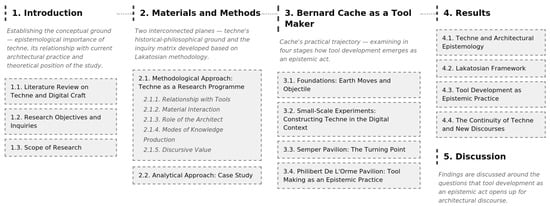
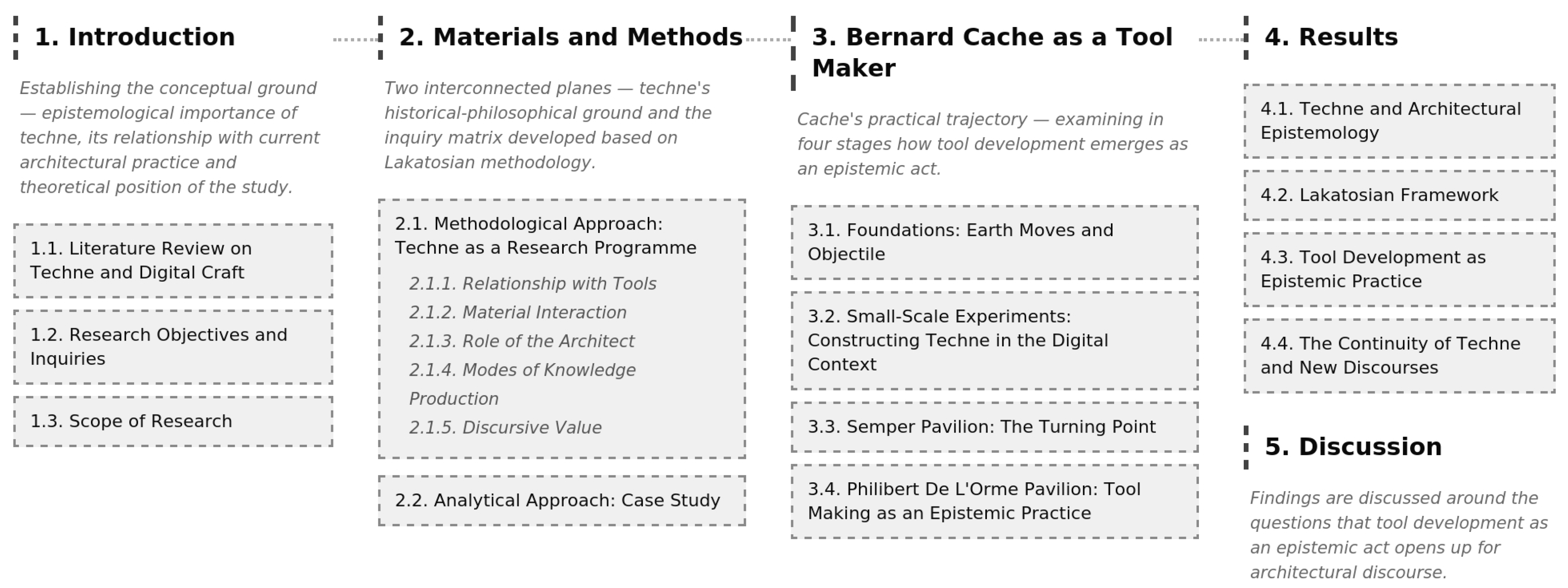
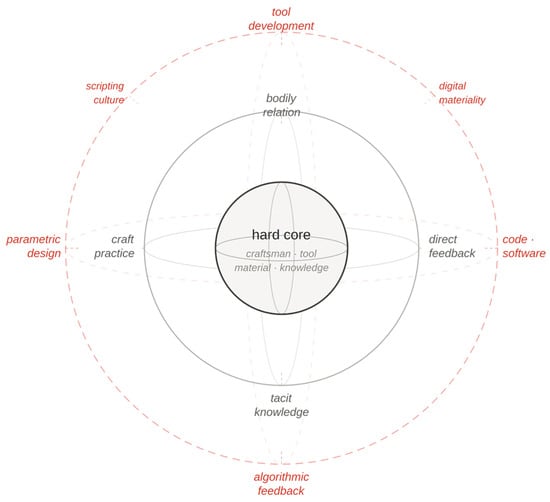
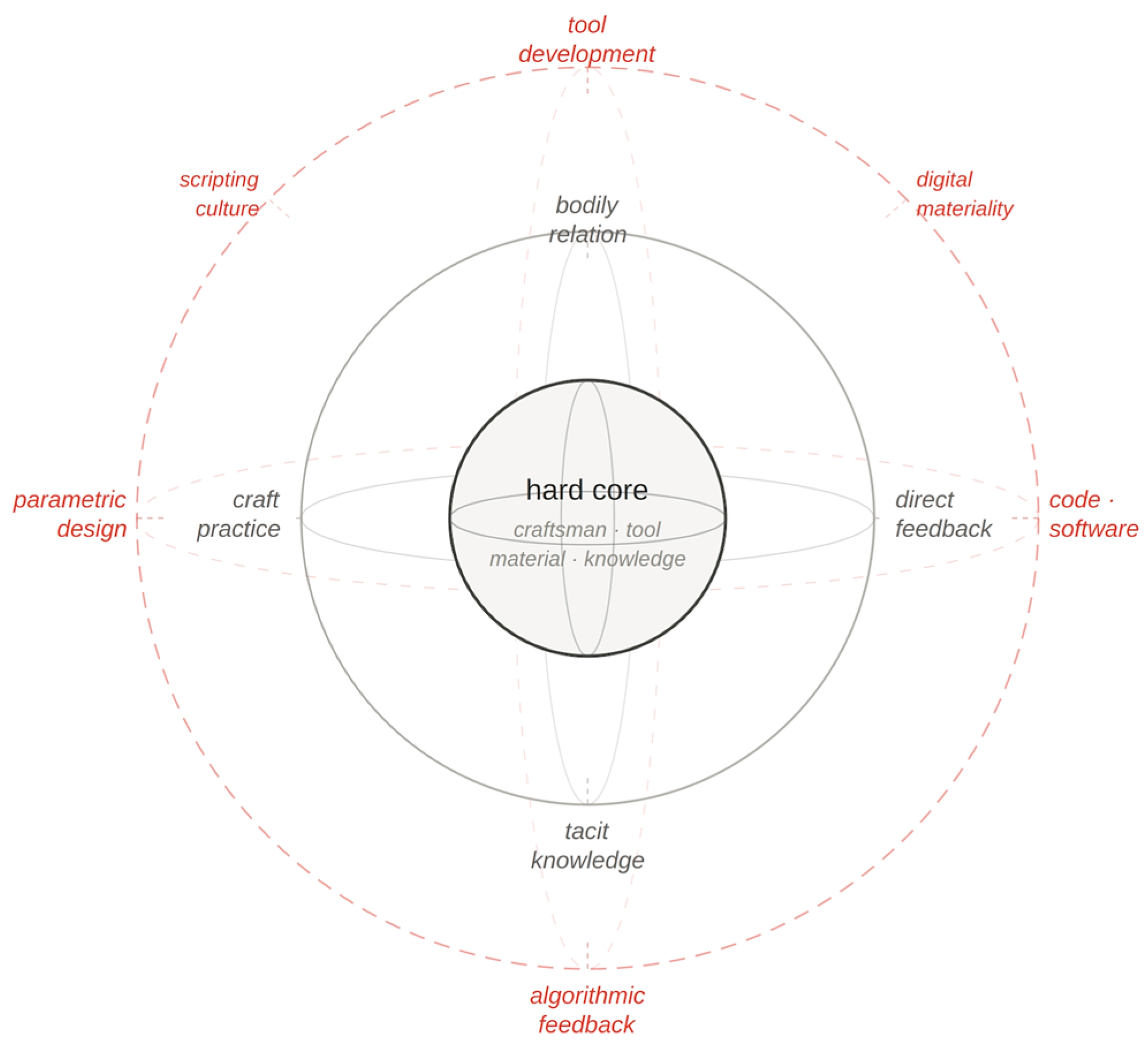
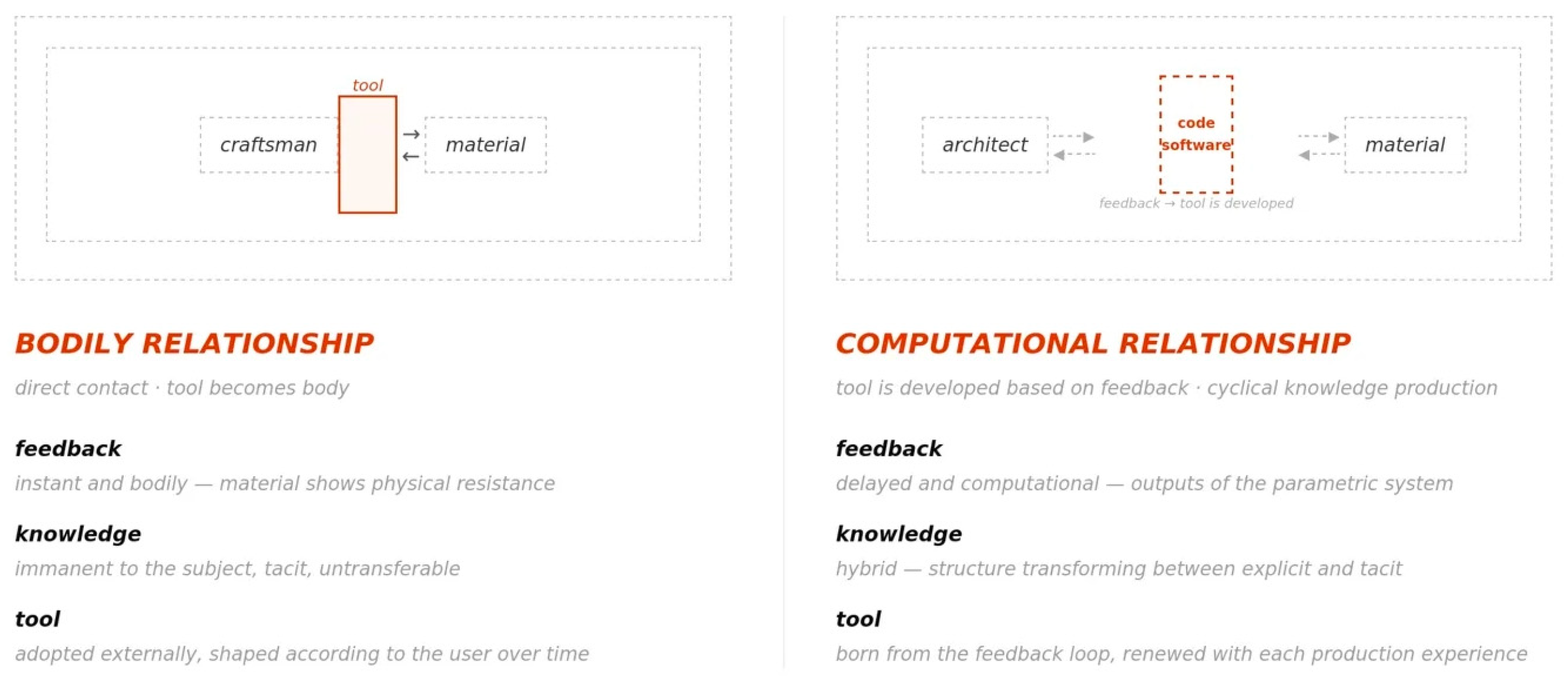

Disclaimer/Publisher’s Note: The statements, opinions and data contained in all publications are solely those of the individual author(s) and contributor(s) and not of MDPI and/or the editor(s). MDPI and/or the editor(s) disclaim responsibility for any injury to people or property resulting from any ideas, methods, instructions or products referred to in the content. |
© 2026 by the authors. Licensee MDPI, Basel, Switzerland. This article is an open access article distributed under the terms and conditions of the Creative Commons Attribution (CC BY) license.