HCFF-Net: A Hybrid Contextual Feature Fusion Network for Robust Heavy Equipment Classification in Complex Construction Environments


Abstract
1. Introduction
1.1. Machine Learning Approaches
1.2. Deep Learning Approaches
1.3. Research Gap

| Category | Method | Dataset | Strength | Limitation |
|---|---|---|---|---|
| Machine learning | Light GBM, XGBoost [19] | Heavy equipment datasets | Predict residual value of heavy equipment | -Depends on data quality and quantity -Performance improves with better data collection |
| Random Forest [20] | National accident database | Identifies high-risk workers | Limited by historical data and missing variables due to privacy constraints | |
| BO-NGBoost [21] | Wuhan Metro data | Forecasts tunnel deformation | Limited sample size and geographical scope | |
| Hyperparameter-tuned ML models [23] | Daily work reports | Estimate crew productivity effectively | Low data quality and high computational cost | |
| ML Regression models [24] | Self-collected equipment data | Predict equipment cost trends | -Sensitive to market -Relies on inconsistent data | |
| Logistic Regression [26] | 39 contractors work on multistory building projects | Predicts construction labor productivity through HRM practices | -Findings limited to Australian projects -Excludes union data | |
| ML + SHAP [28] | Crane accident dataset | Informed safety decision-making | Limited to structured data | |
| Regression model [29] | Equipment cost data | Quantitative risk prediction | -Ignores equipment subcategories -Unvalidated normal cost assumptions | |
| Deep learning | WATLAS [30] | Construction site images | Performs well on imbalanced data with limited labels | -Single-region dataset limits generalization -Needs expert labeling and tuning |
| 3D ResNet [31] | Excavator videos | Activity recognition via transfer learning and SHAP-based camera analysis | -Limited to excavators -May not generalize to other equipment | |
| HCDN [32] | Housekeeping-CCD dataset (construction site images) | Detects housekeeping changes accurately in real site images | -Device and site-specific -Slower training and limited scalability | |
| CNN & Swin Transformer [33] | RGB images of end-of-life plastic waste | High accuracy with low-cost RGB images | -Limited to four types of plastic waste -RGB images are not enough for detailed classification | |
| CNN & Transfer learning [34] | Field images of trucks | Compares multiple architectures Transfer learning improves accuracy | -Only works for uncovered trucks in open sites -Limited generalizability | |
| CNN-based framework [35] | Project surveillance videos | Automates equipment tracking and reduces manual monitoring | -Limited to specific sites and excavator types -Performance affected by detection and lighting | |
| LMM + Graph RAG [36] | Accident video footage | Automates safety analysis using multimodal reasoning | -Designed for specific accident types -Limited contextual transferability | |
| STR-Transformer [37] | Unsafe action video dataset | Monitors worker safety and action effectively | -Requires large dataset -Limited to predefined action classes | |
| Multi-camera vision DL [38] | Earthmoving project video | Enables productivity monitoring via multiple cameras | -Relies on fixed multi-camera setup -Poor adaptability to other layouts | |
| SSD-MobileNet [39] | Dynamic jobsite footages | High real-time accuracy | -Small dataset -Tested on limited vehicle types and conditions | |
| Semi-supervised DL [40] | ACID | Enhances site monitoring using data augmentation | -Requires careful tuning -Performance drops with noisy images | |
| VGG-16 [41] | Construction site images | Handles single and multi-label classification | -Small dataset -Transfer learning misses domain features | |
| CNN model [42] | Heavy equipment images | Automated heavy equipment classification | -No advanced feature fusion for complex environments | |
| CNN model [43] | Custom heavy equipment dataset | Multi-class detection | Limited generalization to unseen classes | |
| YOLOv10 + Transformer [44] | Construction site images | Heavy equipment detection | -Needs more diverse training data -Requires better domain adaptation | |
| Faster R-CNN [45] | Excavator-specific dataset | Bucket filling estimation | Task-specific and low generalization | |
| CNN–BiLSTM [46] | Excavator activity video dataset | Classify excavator activities | Limited to excavator-specific activities with moderate generalization capability | |
| CRNN [47] | Equipment sound dataset | Equipment sound-based classification | Limited realism and noise representation in synthetic data | |
| SRGAN Network [48] | Custom heavy equipment dataset | Enhancing safety in heavy equipment operations | Limited equipment types and dataset | |
| Proposed HCFF-Net | ACID | -Good generalization across equipment types -DRRF + GCCR improves feature quality | -Requires GPU for training -Needs diverse data for rare equipment |
2. Experimental Setup and Methods
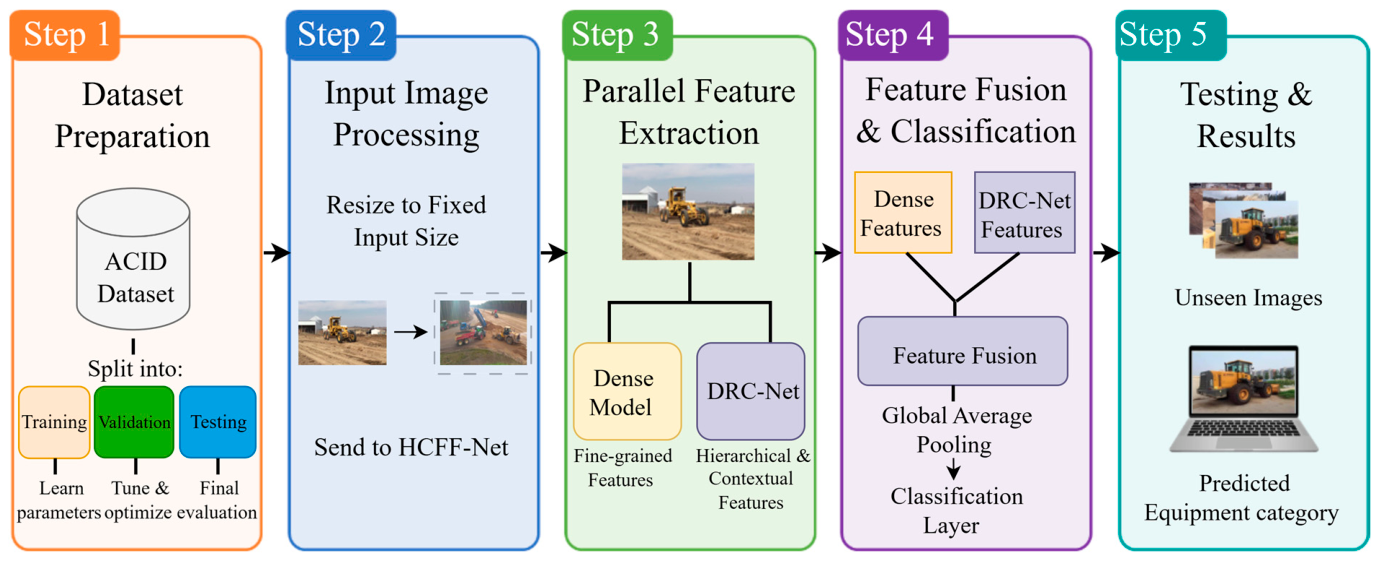
2.1. Proposed Method and Development Workflow
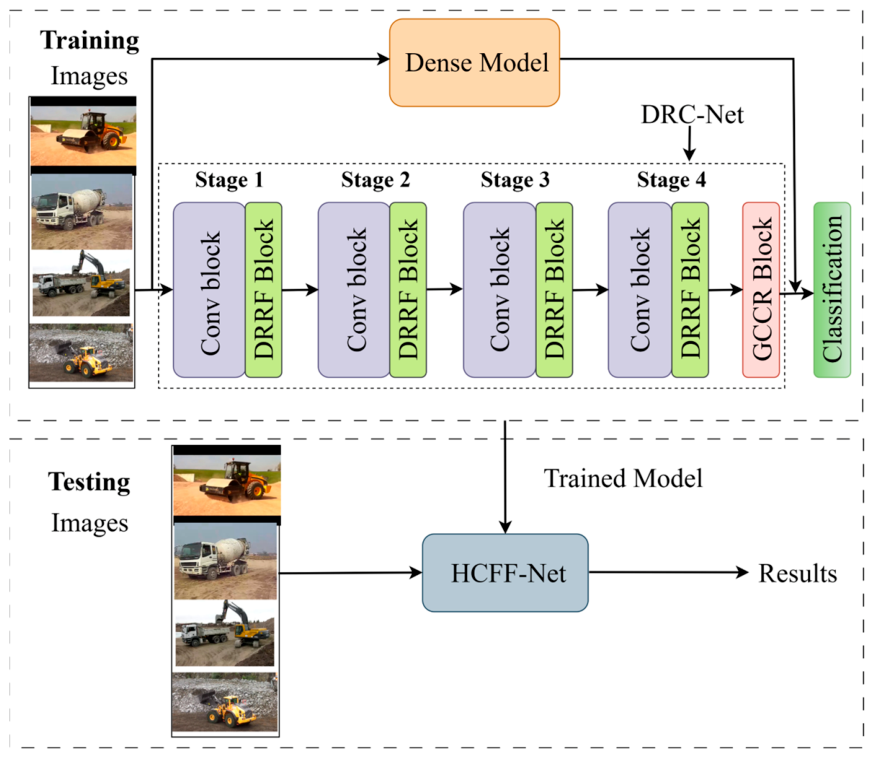
2.2. HCFF-Net Structure
2.3. DRRF
2.4. GCCR
2.5. Statistical Analysis Using McNemar’s Test
3. Experimental Results
3.1. Evaluation Merics
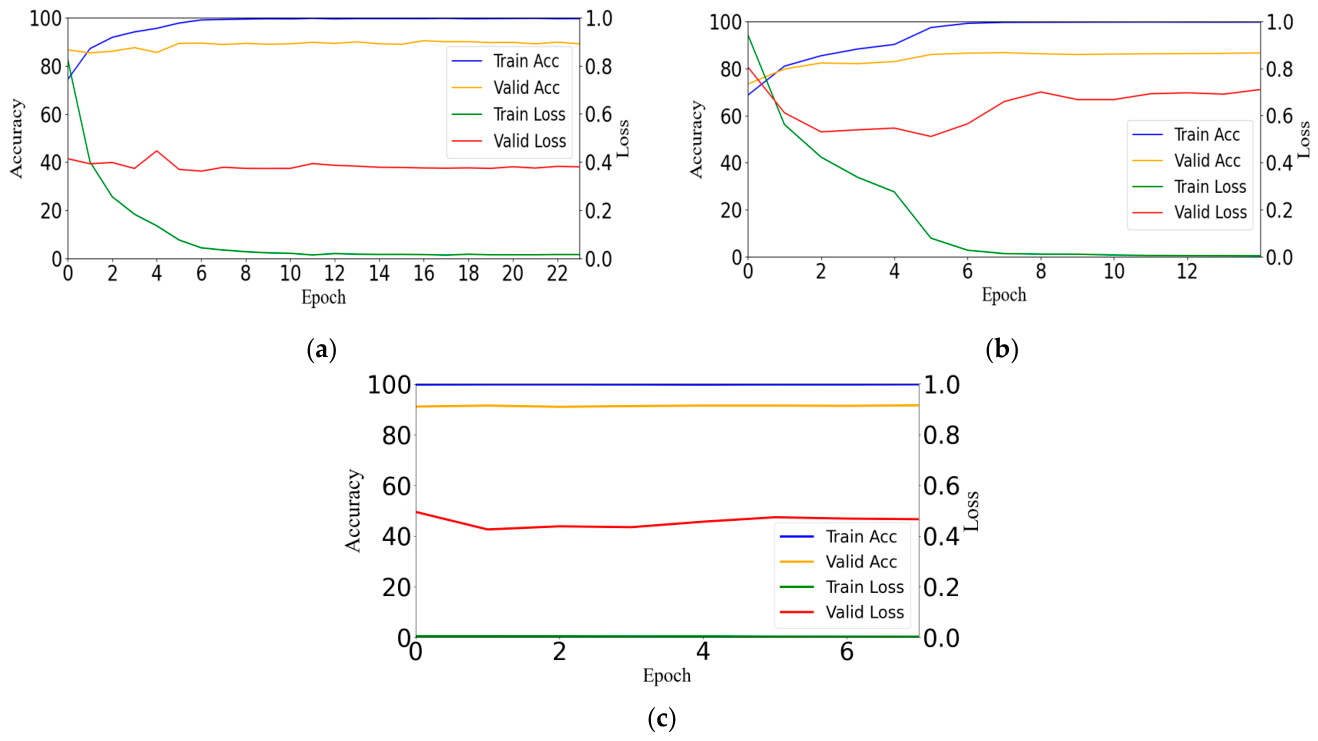
3.2. Ablation Study
3.3. Comparison of HCFF-Net with State-of-the-Art (SOTA) Methods
3.4. Comparisons of Model Complexity
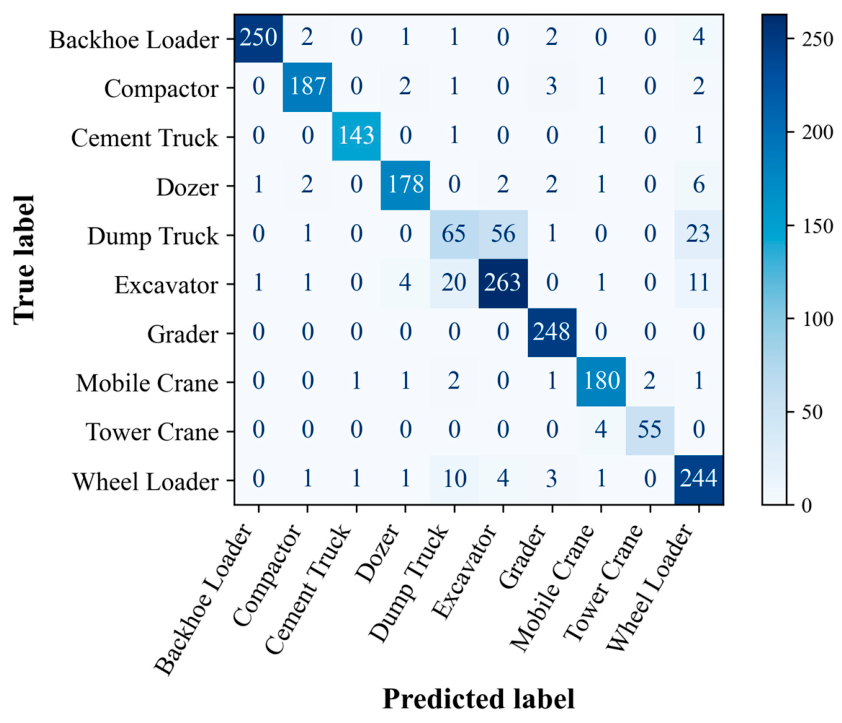
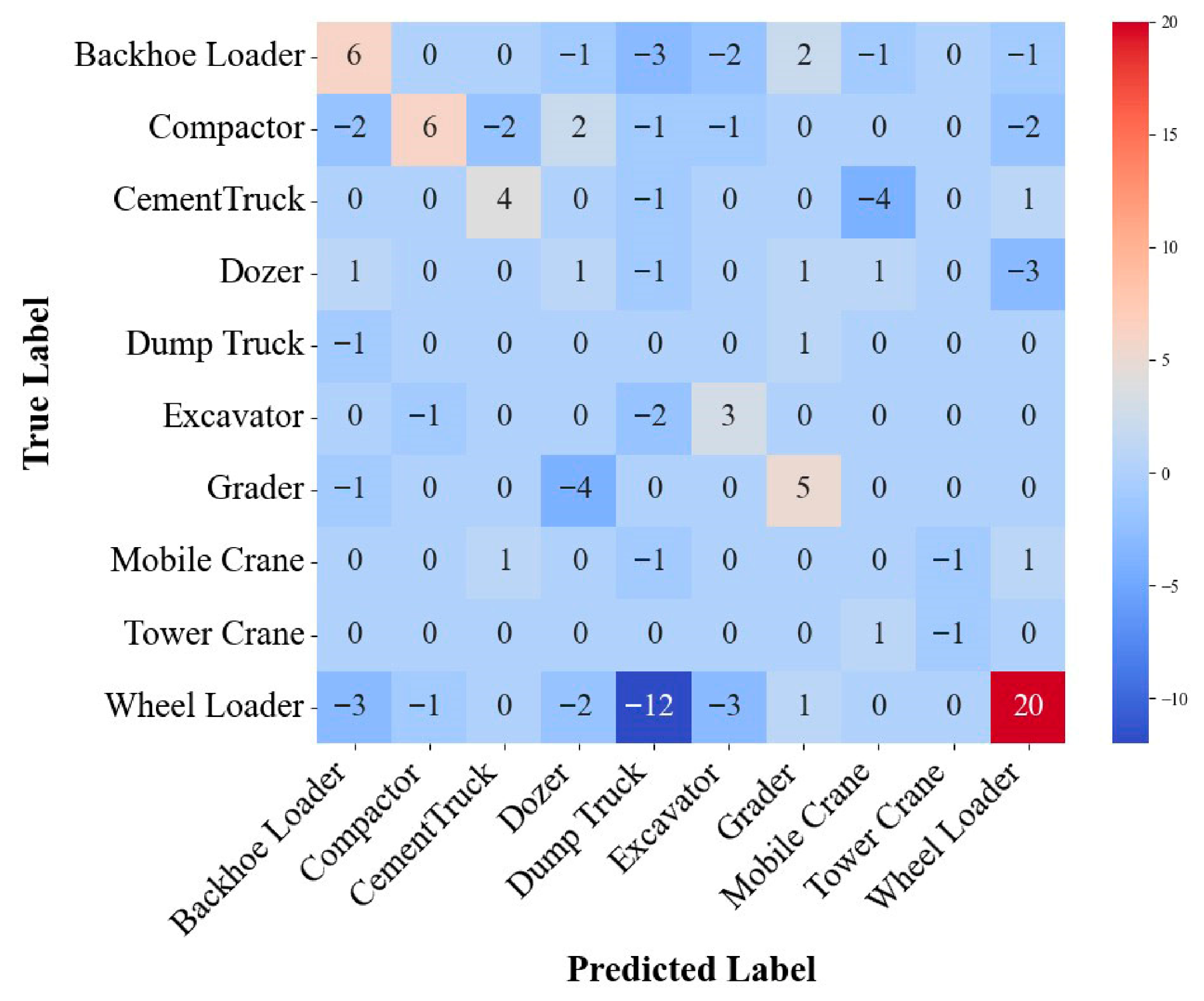
3.5. Confusion Matrix Results
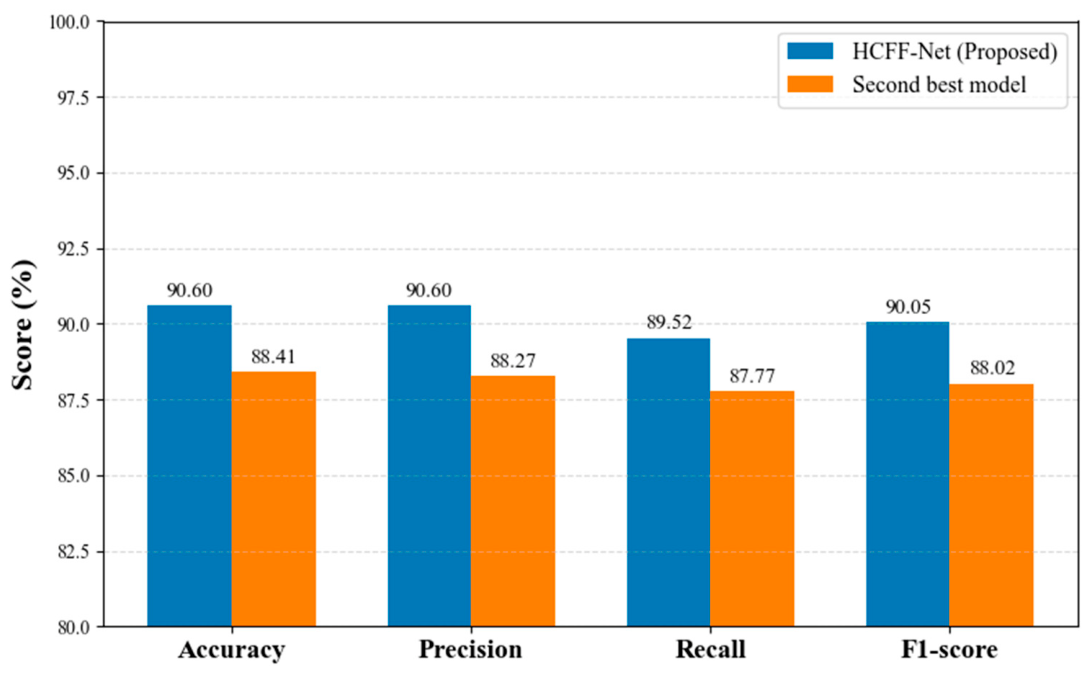
3.6. Comparison with the Second-Best Model
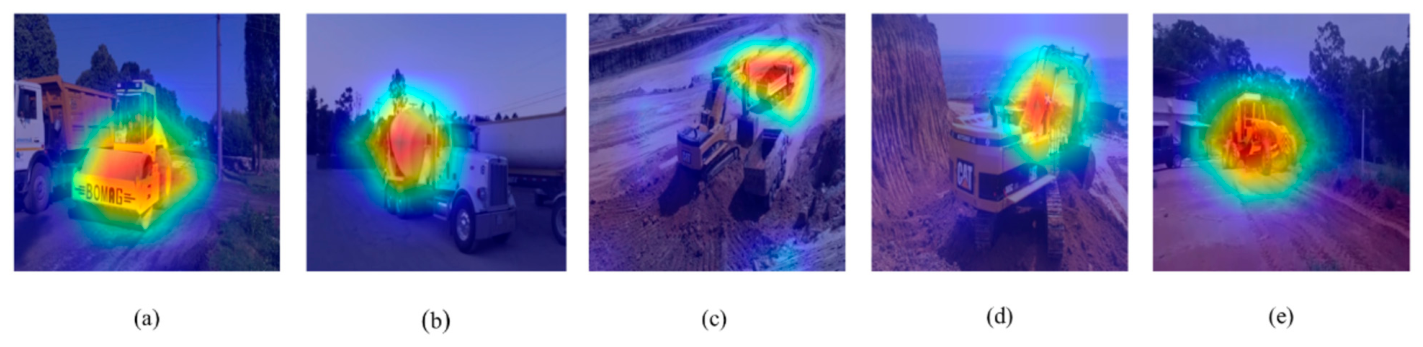
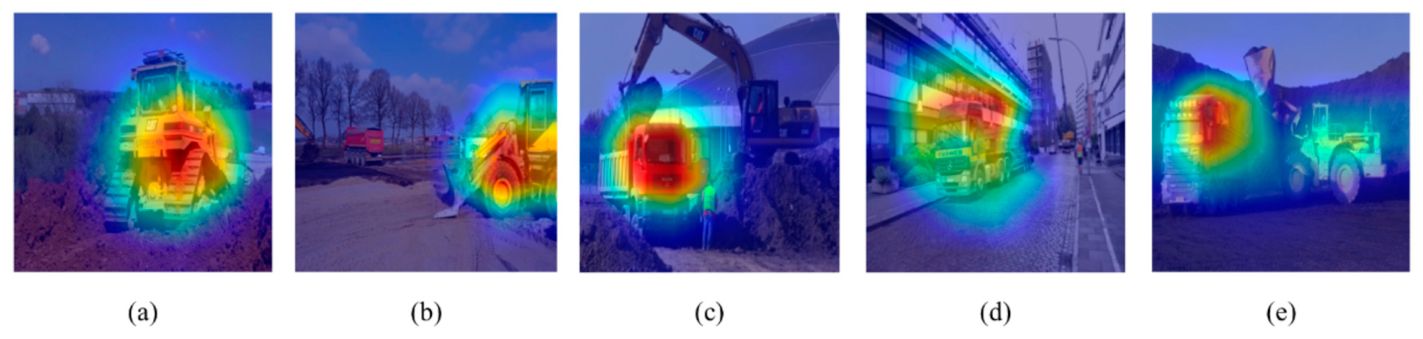
3.7. Visualization Result Using Grad-CAM
4. Discussion
5. Conclusions
- A novel deep learning framework (HCFF-Net) was developed specifically for heavy equipment classification in visually complex construction environments.
- Two feature enhancement modules (DRRF and GCCR) were introduced to improve contextual feature representation and classification robustness.
- A hybrid contextual feature fusion strategy was proposed to improve discrimination between visually similar equipment categories.
- A comprehensive evaluation methodology was established, including ablation analysis, statistical validation, and visualization-based model interpretation to ensure reliable performance assessment.
- HCFF-Net achieved superior classification performance compared to conventional deep learning architectures, reaching 90.60% accuracy and 90.05% F1-score, demonstrating the effectiveness of contextual feature fusion.
- Ablation experiments confirmed that the DRRF and GCCR modules significantly improve feature discrimination and contribute to overall performance improvement.
- Comparative evaluation showed that HCFF-Net outperforms several state-of-the-art CNN architectures while maintaining competitive computational efficiency.
- Statistical validation using McNemar’s test demonstrated that the performance improvement over the second-best performing model is statistically significant.
- Confusion matrix analysis and Grad-CAM visualization confirmed that HCFF-Net successfully learns discriminative structural features and focuses on relevant equipment regions during classification.
Author Contributions
Funding
Data Availability Statement
Acknowledgments
Conflicts of Interest
References
- McKinsey & Company. Mgi-Reinventing-Construction-a-Route-to-Higher-Productivity; McKinsey & Company: New York, NY, USA, 2017. [Google Scholar]
- You, K.; Zhou, C.; Ding, L. Deep Learning Technology for Construction Machinery and Robotics. Autom. Constr. 2023, 150, 104852. [Google Scholar] [CrossRef]
- Liu, J.; Luo, H.; Liu, H. Deep Learning-Based Data Analytics for Safety in Construction. Autom. Constr. 2022, 140, 104302. [Google Scholar] [CrossRef]
- Datta, S.D.; Islam, M.; Rahman Sobuz, M.H.; Ahmed, S.; Kar, M. Artificial Intelligence and Machine Learning Applications in the Project Lifecycle of the Construction Industry: A Comprehensive Review. Heliyon 2024, 10, e26888. [Google Scholar] [CrossRef]
- Lee, Y.-S.; Kim, D.-K.; Kim, J.-H.; Lee, Y.-S.; Kim, D.-K.; Kim, J.-H. Deep-Learning-Based Anti-Collision System for Construction Equipment Operators. Sustainability 2023, 15, 16163. [Google Scholar] [CrossRef]
- Langroodi, A.K.; Vahdatikhaki, F.; Doree, A. Activity Recognition of Construction Equipment Using Fractional Random Forest. Autom. Constr. 2021, 122, 103465. [Google Scholar] [CrossRef]
- Chandra, S.S.; Sepasgozar, S.M.E.; Kumar, V.R.P.; Singh, A.K.; Krishnaraj, L.; Awuzie, B.O. Assessing Factors Affecting Construction Equipment Productivity Using Structural Equation Modeling. Buildings 2023, 13, 502. [Google Scholar] [CrossRef]
- Huang, K.; Abisado, M.B. Lightweight Construction Safety Behavior Detection Model Based on Improved YOLOv8. Discov. Appl. Sci. 2025, 7, 4. [Google Scholar] [CrossRef]
- Hwang, J.; Jeong, I.; Kim, J.; Chi, S. Web-Based Multi-Vision Platform for Earthwork Productivity on Construction Sites Using Real-Time Model Updating. Front. Struct. Civ. Eng. 2025, 19, 1021–1040. [Google Scholar] [CrossRef]
- Badhan, S.J.; Samsami, R.; Badhan, S.J.; Samsami, R. Artificial Intelligence (AI) in Construction Safety: A Systematic Literature Review. Buildings 2025, 15, 4084. [Google Scholar] [CrossRef]
- Nakanishi, Y.; Kaneta, T.; Nishino, S. A Review of Monitoring Construction Equipment in Support of Construction Project Management. Front. Built Environ. 2022, 7, 632593. [Google Scholar] [CrossRef]
- Arabi, S.; Haghighat, A.; Sharma, A. A Deep Learning Based Solution for Construction Equipment Detection: From Development to Deployment. arXiv 2019, arXiv:1904.09021. [Google Scholar] [CrossRef]
- Pal, A.; Lin, J.J.; Hsieh, S.-H.; Golparvar-Fard, M. Automated Vision-Based Construction Progress Monitoring in Built Environment through Digital Twin. Dev. Built Environ. 2023, 16, 100247. [Google Scholar] [CrossRef]
- Wang, Z.; Wu, Y.; Yang, L.; Thirunavukarasu, A.; Evison, C.; Zhao, Y. Fast Personal Protective Equipment Detection for Real Construction Sites Using Deep Learning Approaches. Sensors 2021, 21, 3478. [Google Scholar] [CrossRef]
- Fang, W.; Ding, L.; Zhong, B.; Love, P.E.D.; Luo, H. Automated Detection of Workers and Heavy Equipment on Construction Sites: A Convolutional Neural Network Approach. Adv. Eng. Inform. 2018, 37, 139–149. [Google Scholar] [CrossRef]
- Molaei, A.; Kolu, A.; Lahtinen, K.; Geimer, M. Automatic Estimation of Excavator Actual and Relative Cycle Times in Loading Operations. Autom. Constr. 2023, 156, 105080. [Google Scholar] [CrossRef]
- Sami Ur Rehman, M.; Shafiq, M.T.; Ullah, F. Automated Computer Vision-Based Construction Progress Monitoring: A Systematic Review. Buildings 2022, 12, 1037. [Google Scholar] [CrossRef]
- Xiao, B.; Wang, Y.; Chi, H.-L.; Hou, L.; Kang, S.-C.; Hou, X.; Wang, Y.; Chai, P.; Dodampegama, S.K.; Xiao, Y.; et al. Alberta Construction Image Dataset (ACID). Available online: https://www.acidb.net/dataset (accessed on 23 January 2026).
- Shehadeh, A.; Alshboul, O.; Al Mamlook, R.E.; Hamedat, O. Machine Learning Models for Predicting the Residual Value of Heavy Construction Equipment: An Evaluation of Modified Decision Tree, LightGBM, and XGBoost Regression. Autom. Constr. 2021, 129, 103827. [Google Scholar] [CrossRef]
- Choi, J.; Gu, B.; Chin, S.; Lee, J.-S. Machine Learning Predictive Model Based on National Data for Fatal Accidents of Construction Workers. Autom. Constr. 2020, 110, 102974. [Google Scholar] [CrossRef]
- Chen, H.; Liu, J.; Shen, G.Q.; Feng, Z. Control of Existing Tunnel Deformation Caused by Shield Adjacent Undercrossing Construction Using Interpretable Machine Learning and Multiobjective Optimization. Autom. Constr. 2025, 170, 105943. [Google Scholar] [CrossRef]
- Eriksson, D.; Ghabcheloo, R. Comparison of Machine Learning Methods for Automatic Bucket Filling: An Imitation Learning Approach. Autom. Constr. 2023, 150, 104843. [Google Scholar] [CrossRef]
- Sadatnya, A.; Sadeghi, N.; Sabzekar, S.; Khanjani, M.; Tak, A.N.; Taghaddos, H. Machine Learning for Construction Crew Productivity Prediction Using Daily Work Reports. Autom. Constr. 2023, 152, 104891. [Google Scholar] [CrossRef]
- Boyko, N.; Lukash, O. Methodology for Estimating the Cost of Construction Equipment Based on the Analysis of Important Characteristics Using Machine Learning Methods. J. Eng. 2023, 2023, 8833753. [Google Scholar] [CrossRef]
- Momade, M.H.; Shahid, S.; Hainin, M.R.B.; Nashwan, M.S.; Tahir Umar, A. Modelling Labour Productivity Using SVM and RF: A Comparative Study on Classifiers Performance. Int. J. Constr. Manag. 2022, 22, 1924–1934. [Google Scholar] [CrossRef]
- Gurmu, A.; Ongkowijoyo, C. Predicting Construction Labor Productivity Based on Implementation Levels of Human Resource Management Practices. J. Constr. Eng. Manag. 2019, 146, 04019115. [Google Scholar] [CrossRef]
- You, Z.; Wu, C. A Framework for Data-Driven Informatization of the Construction Company. Adv. Eng. Inform. 2019, 39, 269–277. [Google Scholar] [CrossRef]
- Kim, D.; Kosseim, L.; Ma, J.W. Interpretable Machine Learning in Construction Crane Accident Damage Estimation Using SHapley Additive exPlanations. In Computing in Civil Engineering 2025: Computational and Intelligent Technologies; ASCE: Reston, VA, USA, 2025; pp. 458–467. [Google Scholar] [CrossRef]
- Song, Y.; Kim, M.; Lee, J. Evaluating Construction Equipment Accident Risk by Analyzing Utilization and Costs Using Regression Models. Risk Anal. 2026, 46, e70167. [Google Scholar] [CrossRef] [PubMed]
- Mannem, K.R.; Prieto, S.A.; de Soto, B.G.; Bacao, F. Weighted Adaptive Active Transfer Learning for Imbalanced Multi-Object Classification in Construction Site Imagery. Autom. Constr. 2025, 176, 106297. [Google Scholar] [CrossRef]
- Shin, Y.; Seo, S.; Koo, C. Deep Learning-Based Automated Method for Enhancing Excavator Activity Recognition in Far-Field Construction Site Surveillance Videos. Autom. Constr. 2025, 173, 106099. [Google Scholar] [CrossRef]
- Sun, K.; Shao, Z.; Goh, Y.M.; Tian, J.; Gan, V.J.L. Change Detection Network for Construction Housekeeping Using Feature Fusion and Large Vision Models. Autom. Constr. 2025, 172, 106038. [Google Scholar] [CrossRef]
- Ranjbar, I.; Ventikos, Y.; Arashpour, M. Deep Learning-Based Construction and Demolition Plastic Waste Classification by Resin Type Using RGB Images. Resour. Conserv. Recycl. 2025, 212, 107937. [Google Scholar] [CrossRef]
- Liu, Q.; Feng, C.; Song, Z.; Louis, J.; Zhou, J. Deep Learning Model Comparison for Vision-Based Classification of Full/Empty-Load Trucks in Earthmoving Operations. Appl. Sci. 2019, 9, 4871. [Google Scholar] [CrossRef]
- Chen, C.; Zhu, Z.; Hammad, A. Automated Excavators Activity Recognition and Productivity Analysis from Construction Site Surveillance Videos. Autom. Constr. 2020, 110, 103045. [Google Scholar] [CrossRef]
- Uhm, M.; Kim, J.; Lee, G. Automated Analysis of Construction Safety Accident Videos Using a Large Multimodal Model and Graph Retrieval-Augmented Generation. Autom. Constr. 2025, 177, 106363. [Google Scholar] [CrossRef]
- Yang, M.; Wu, C.; Guo, Y.; Jiang, R.; Zhou, F.; Zhang, J.; Yang, Z. Transformer-Based Deep Learning Model and Video Dataset for Unsafe Action Identification in Construction Projects. Autom. Constr. 2023, 146, 104703. [Google Scholar] [CrossRef]
- Kim, J.; Chi, S. Multi-Camera Vision-Based Productivity Monitoring of Earthmoving Operations. Autom. Constr. 2020, 112, 103121. [Google Scholar] [CrossRef]
- Arabi, S.; Haghighat, A.; Sharma, A. A Deep-Learning-Based Computer Vision Solution for Construction Vehicle Detection. Comput.-Aided Civ. Infrastruct. Eng. 2020, 35, 753–767. [Google Scholar] [CrossRef]
- Shi, M.; Chen, C.; Xiao, B.; Seo, J. Vision-Based Detection Method for Construction Site Monitoring by Integrating Data Augmentation and Semisupervised Learning. J. Constr. Eng. Manag. 2024, 150, 5. [Google Scholar] [CrossRef]
- Nath, N.D.; Chaspari, T.; Behzadan, A.H. Single- and Multi-Label Classification of Construction Objects Using Deep Transfer Learning Methods. J. Inf. Technol. Constr. 2019, 24, 511–526. [Google Scholar] [CrossRef]
- Yamany, M.S.; Elbaz, M.M.; Abdelaty, A.; Elnabwy, M.T. Leveraging Convolutional Neural Networks for Efficient Classification of Heavy Construction Equipment. Asian J. Civ. Eng. 2024, 25, 6007–6019. [Google Scholar] [CrossRef]
- Shin, Y.; Choi, Y.; Won, J.; Hong, T.; Koo, C. A New Benchmark Model for the Automated Detection and Classification of a Wide Range of Heavy Construction Equipment. J. Manag. Eng. 2024, 40, 04023069. [Google Scholar] [CrossRef]
- Eum, I.; Kim, J.; Wang, S.; Kim, J. Heavy Equipment Detection on Construction Sites Using You Only Look Once (YOLO-Version 10) with Transformer Architectures. Appl. Sci. 2025, 15, 2320. [Google Scholar] [CrossRef]
- Helian, B.; Huang, X.; Yang, M.; Bian, Y.; Geimer, M. Computer Vision-Based Excavator Bucket Fill Estimation Using Depth Map and Faster R-CNN. Autom. Constr. 2024, 166, 105592. [Google Scholar] [CrossRef]
- Kim, I.S.; Latif, K.; Kim, J.; Sharafat, A.; Lee, D.E.; Seo, J. Vision-Based Activity Classification of Excavators by Bidirectional LSTM. Appl. Sci. 2023, 13, 272. [Google Scholar] [CrossRef]
- Elelu, K.; Le, T.; Le, C. Equipment Sounds’ Event Localization and Detection Using Synthetic Multi-Channel Audio Signal to Support Collision Hazard Prevention. Buildings 2024, 14, 3347. [Google Scholar] [CrossRef]
- Kim, B.; An, E.-J.; Kim, S.; Sri Preethaa, K.R.; Lee, D.-E.; Lukacs, R.R. SRGAN-Enhanced Unsafe Operation Detection and Classification of Heavy Construction Machinery Using Cascade Learning. Artif. Intell. Rev. 2024, 57, 206. [Google Scholar] [CrossRef]
- Deng, J.; Dong, W.; Socher, R.; Li, L.-J.; Li, K.; Fei-Fei, L. ImageNet: A Large-Scale Hierarchical Image Database. In Proceedings of the 2009 IEEE Conference on Computer Vision and Pattern Recognition (CVPR), Miami, FL, USA, 20–25 June 2009; pp. 248–255. [Google Scholar] [CrossRef]
- Paszke, A.; Gross, S.; Massa, F.; Lerer, A.; Bradbury, J.; Chanan, G.; Killeen, T.; Lin, Z.; Gimelshein, N.; Antiga, L.; et al. PyTorch: An Imperative Style, High-Performance Deep Learning Library. In Proceedings of the Advances in Neural Information Processing Systems; Curran Associates, Inc.: New York, NY, USA, 2019; Volume 32. [Google Scholar] [CrossRef]
- Abadi, M.; Barham, P.; Chen, J.; Chen, Z.; Davis, A.; Dean, J.; Devin, M.; Ghemawat, S.; Irving, G.; Isard, M.; et al. TensorFlow: A System for Large-Scale Machine Learning. In Proceedings of the 12th USENIX Symposium on Operating Systems Design and Implementation (OSDI ’16), Savannah, GA, USA, 2–4 November 2016; pp. 265–283. [Google Scholar] [CrossRef]
- Ramos, L.; Casas, E.; Romero, C.; Rivas-Echeverría, F.; Morocho-Cayamcela, M.E. A Study of ConvNeXt Architectures for Enhanced Image Captioning. IEEE Access 2024, 12, 13711–13728. [Google Scholar] [CrossRef]
- Huang, G.; Liu, Z.; van der Maaten, L.; Weinberger, K.Q. Densely Connected Convolutional Networks. arXiv 2018, arXiv:1608.06993. [Google Scholar] [CrossRef]
- Chen, L.-C.; Papandreou, G.; Schroff, F.; Adam, H. Rethinking Atrous Convolution for Semantic Image Segmentation. arXiv 2017, arXiv:1706.05587. [Google Scholar] [CrossRef]
- Hu, J.; Shen, L.; Sun, G. Squeeze-and-Excitation Networks. In Proceedings of the IEEE Conference on Computer Vision and Pattern Recognition (CVPR 2018), Salt Lake City, UT, USA, 18–22 June 2018; pp. 7132–7141. [Google Scholar] [CrossRef]
- Woo, S.; Park, J.; Lee, J.-Y.; Kweon, I.S. CBAM: Convolutional Block Attention Module. In Proceedings of the European Conference on Computer Vision (ECCV 2018), Munich, Germany, 8–14 September 2018; pp. 3–19. [Google Scholar] [CrossRef]
- Pembury Smith, M.Q.R.; Ruxton, G.D. Effective Use of the Mcnemar Test. Behav. Ecol. Sociobiol. 2020, 74, 133. [Google Scholar] [CrossRef]
- Kingma, D.P.; Ba, J. Adam: A Method for Stochastic Optimization. arXiv 2017, arXiv:1412.6980. [Google Scholar] [CrossRef]
- Ho, Y.; Wookey, S. The Real-World-Weight Cross-Entropy Loss Function: Modeling the Costs of Mislabeling. IEEE Access 2020, 8, 4806–4813. [Google Scholar] [CrossRef]
- Zhang, X.; Zhou, X.; Lin, M.; Sun, J. ShuffleNet: An Extremely Efficient Convolutional Neural Network for Mobile Devices. In Proceedings of the 2018 IEEE/CVF Conference on Computer Vision and Pattern Recognition; IEEE: Salt Lake City, UT, 2018; pp. 6848–6856. [Google Scholar] [CrossRef]
- Krizhevsky, A.; Sutskever, I.; Hinton, G.E. ImageNet Classification with Deep Convolutional Neural Networks. Commun. ACM 2017, 60, 84–90. [Google Scholar] [CrossRef]
- Szegedy, C.; Vanhoucke, V.; Ioffe, S.; Shlens, J.; Wojna, Z. Rethinking the Inception Architecture for Computer Vision. In Proceedings of the 2016 IEEE Conference on Computer Vision and Pattern Recognition (CVPR); IEEE: Las Vegas, NV, USA, 2016; pp. 2818–2826. [Google Scholar] [CrossRef]
- Chollet, F. Xception: Deep Learning with Depthwise Separable Convolutions. In Proceedings of the 2017 IEEE Conference on Computer Vision and Pattern Recognition (CVPR); IEEE: Honolulu, HI, USA, 2017; pp. 1800–1807. [Google Scholar] [CrossRef]
- Tan, M.; Le, Q.V. EfficientNet: Rethinking Model Scaling for Convolutional Neural Networks. In Proceedings of the International Conference on Machine Learning, Virtual Event, 13–18 July 2020; pp. 6105–6114. [Google Scholar] [CrossRef]
- Qin, Y.; Tang, Q.; Xin, J.; Yang, C.; Zhang, Z.; Yang, X. A Rapid Identification Technique of Moving Loads Based on Mobilenetv2 and Transfer Learning. Buildings 2023, 13, 572. [Google Scholar] [CrossRef]
- He, K.; Zhang, X.; Ren, S.; Sun, J. Deep Residual Learning for Image Recognition. In Proceedings of the 2016 IEEE Conference on Computer Vision and Pattern Recognition (CVPR); IEEE: Las Vegas, NV, USA, 2016; pp. 770–778. [Google Scholar] [CrossRef]
- Confusion Matrix. 2026. Available online: https://en.wikipedia.org/wiki/Confusion_matrix (accessed on 2 March 2026).
- Selvaraju, R.R.; Cogswell, M.; Das, A.; Vedantam, R.; Parikh, D.; Batra, D. Grad-CAM: Visual Explanations from Deep Networks via Gradient-Based Localization. Int. J. Comput. Vis. 2020, 128, 336–359. [Google Scholar] [CrossRef]



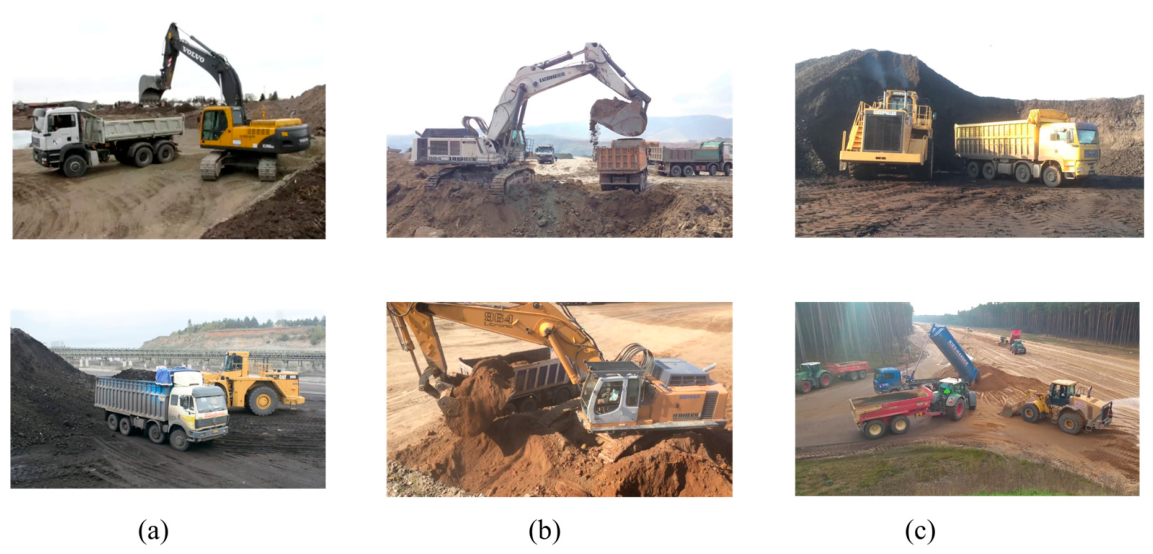

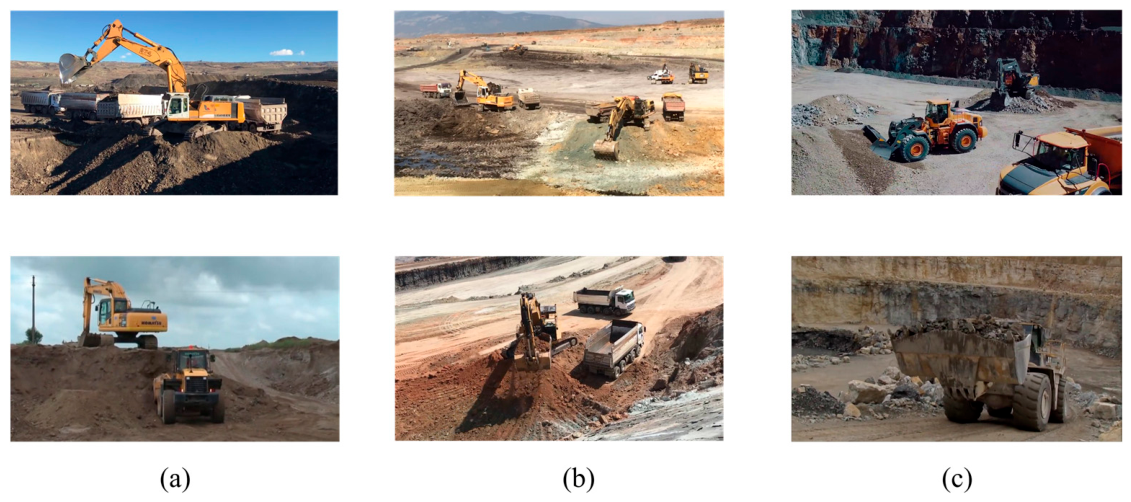
| No. of Classes | Heavy Equipment Type | Samples |
|---|---|---|
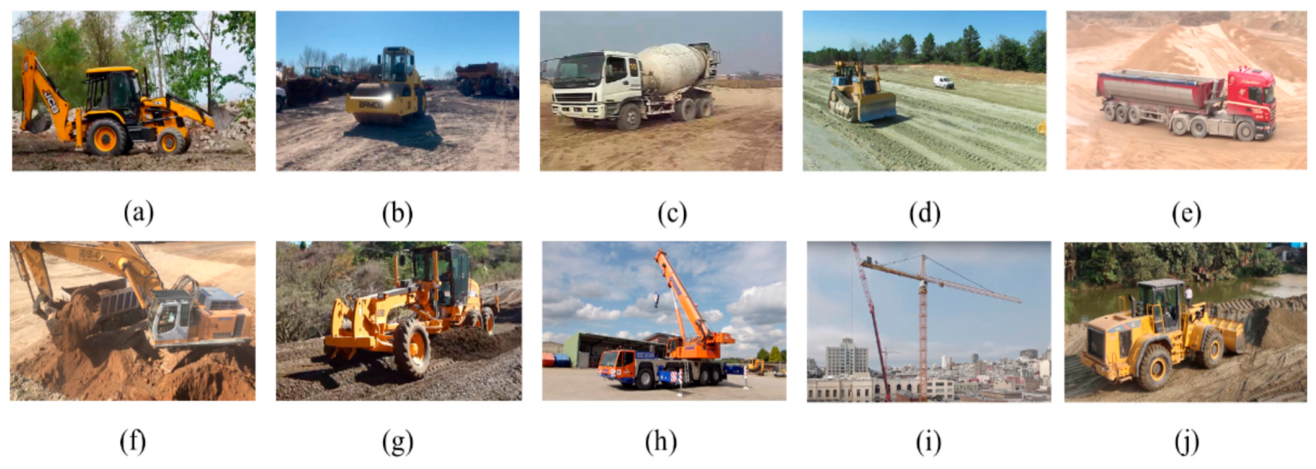
| 1 | Backhoe Loader | 1300 |
| 2 | Compactor | 979 |
| 3 | Cement Truck | 730 |
| 4 | Dozer | 959 |
| 5 | Dump Truck | 729 |
| 6 | Excavator | 1506 |
| 7 | Grader | 1240 |
| 8 | Mobile Crane | 938 |
| 9 | Tower Crane | 295 |
| 10 | Wheel Loader | 1324 |
| - | Total | 10,000 |
| Case | Accuracy | Precision | Recall | F1-Score |
|---|---|---|---|---|
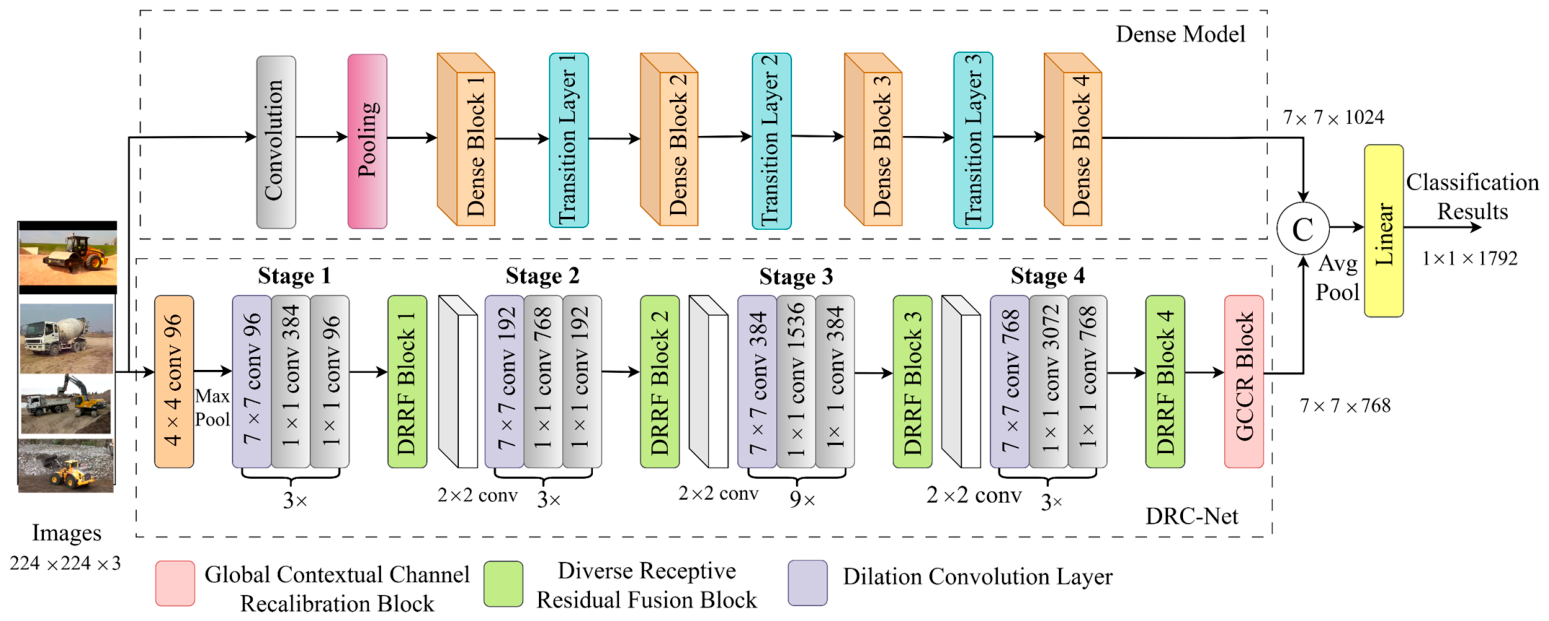
| Dense Model | 88.41 | 88.18 | 87.16 | 87.67 |
| DRC-Net | 90.10 | 89.78 | 89.29 | 89.53 |
| HCFF-Net | 90.60 | 90.60 | 89.52 | 90.05 |
| Case | DRRF | DRRF | DRRF | GCCR | Accuracy | Precision | Recall | F1-Score |
|---|---|---|---|---|---|---|---|---|
| 1 | - | - | - | - | 88.41 | 88.27 | 87.77 | 88.02 |
| 2 | ✓ | - | - | - | 88.81 | 88.75 | 87.74 | 88.24 |
| 3 | ✓ | ✓ | - | - | 88.41 | 88.05 | 87.32 | 87.68 |
| 4 | ✓ | ✓ | ✓ | - | 89.06 | 88.68 | 87.77 | 88.22 |
| 5 | ✓ | ✓ | ✓ | ✓ | 90.10 | 89.78 | 89.29 | 89.53 |
| Models | Accuracy | Precision | Recall | F1-Score |
|---|---|---|---|---|
| Shuffle-Net [60] | 77.21 | 77.52 | 74.38 | 75.92 |
| AlexNet [61] | 80.71 | 80.47 | 79.78 | 80.13 |
| InceptionNet-v3 [62] | 84.61 | 82.97 | 83.60 | 83.29 |
| VGG16 [41] | 84.76 | 84.20 | 83.01 | 83.60 |
| XceptionNet [63] | 86.66 | 86.00 | 86.00 | 86.00 |
| EfficientNet-b0 [64] | 87.01 | 86.45 | 86.18 | 86.31 |
| MobileNet-v2 [65] | 87.81 | 87.26 | 87.41 | 87.33 |
| ResNet50 [66] | 88.11 | 87.69 | 87.42 | 87.55 |
| DenseNet121 [53] | 88.41 | 88.18 | 87.16 | 87.67 |
| ConvNext-S [52] | 88.41 | 88.27 | 87.77 | 88.02 |
| Proposed (HCFF-Net) | 90.60 | 90.60 | 89.52 | 90.05 |
| Models | Memory Usage (MB) | #Param (M) | FLOPs (G) |
|---|---|---|---|
| Shuffle-Net [60] | 1.37 | 0.35 | 0.044 |
| AlexNet [61] | 217.61 | 57.04 | 0.71 |
| InceptionNet-v3 [62] | 103.75 | 23.83 | 2.86 |
| VGG16 [41] | 512.32 | 134.30 | 15.47 |
| XceptionNet [63] | 79.66 | 20.83 | 4.59 |
| EfficientNet-b0 [64] | 15.50 | 4.02 | 0.41 |
| MobileNet-v2 [65] | 8.66 | 2.24 | 0.33 |
| ResNet50 [66] | 89.96 | 23.52 | 4.13 |
| DenseNet121 [53] | 26.89 | 7 | 2.89 |
| ConvNext-S [52] | 188.69 | 49.45 | 8.69 |
| Proposed (HCFF-Net) | 247.83 | 64.82 | 12.77 |
| Models | Desktop | GPU Mode | ||
|---|---|---|---|---|
| - | Inference Time | Frame/s | Inference Time | Frame/s |
| Shuffle-Net [60] | 16.73 | 59.78 | 10.58 | 94.49 |
| AlexNet [61] | 27.61 | 36.21 | 3.38 | 295.90 |
| InceptionNet-v3 [62] | 113.98 | 8.77 | 18.05 | 55.40 |
| VGG16 [41] | 244.34 | 4.09 | 20.19 | 49.52 |
| XceptionNet [63] | 126.61 | 7.93 | 13.19 | 75.82 |
| EfficientNet-b0 [64] | 42.41 | 23.58 | 13.11 | 76.26 |
| MobileNet-v2 [65] | 28.82 | 34.70 | 8.26 | 121.03 |
| ResNet50 [66] | 110.31 | 9.07 | 11.04 | 90.58 |
| DenseNet121 [53] | 112.24 | 8.91 | 25.06 | 39.90 |
| ConvNext-S [52] | 163.27 | 6.12 | 23.62 | 42.34 |
| Proposed (HCFF-Net) | 304.85 | 3.28 | 43.54 | 22.97 |
| No. | Second-Best Model Correct | Second-Best Model Incorrect |
|---|---|---|
| HCFF-Net correct | 1729 | 84 |
| HCFF-Net incorrect | 40 | 148 |
Disclaimer/Publisher’s Note: The statements, opinions and data contained in all publications are solely those of the individual author(s) and contributor(s) and not of MDPI and/or the editor(s). MDPI and/or the editor(s) disclaim responsibility for any injury to people or property resulting from any ideas, methods, instructions or products referred to in the content. |
© 2026 by the authors. Licensee MDPI, Basel, Switzerland. This article is an open access article distributed under the terms and conditions of the Creative Commons Attribution (CC BY) license.
Share and Cite
Sultan, H.; Choi, J. HCFF-Net: A Hybrid Contextual Feature Fusion Network for Robust Heavy Equipment Classification in Complex Construction Environments. Buildings 2026, 16, 1764. https://doi.org/10.3390/buildings16091764
Sultan H, Choi J. HCFF-Net: A Hybrid Contextual Feature Fusion Network for Robust Heavy Equipment Classification in Complex Construction Environments. Buildings. 2026; 16(9):1764. https://doi.org/10.3390/buildings16091764
Chicago/Turabian StyleSultan, Hamza, and Jongsoo Choi. 2026. "HCFF-Net: A Hybrid Contextual Feature Fusion Network for Robust Heavy Equipment Classification in Complex Construction Environments" Buildings 16, no. 9: 1764. https://doi.org/10.3390/buildings16091764
APA StyleSultan, H., & Choi, J. (2026). HCFF-Net: A Hybrid Contextual Feature Fusion Network for Robust Heavy Equipment Classification in Complex Construction Environments. Buildings, 16(9), 1764. https://doi.org/10.3390/buildings16091764